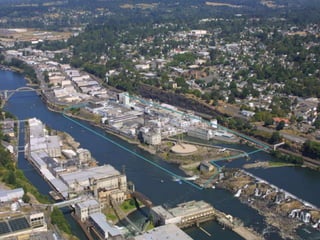
The Most Spectacular Place
We Don’t Visit
Willamette Falls Legacy Project
Upstream View
Topography
Past
Present
The Legacy
The Four Core Values
Only Existing Access
Riverfront Access
Get Close to the Water
Cultural and Historic Interpretation
Preserving Site Character
By Incorporating Historic and Cultural Features
Economic Development
The New Blue Heron
Early Site Specific Opportunities
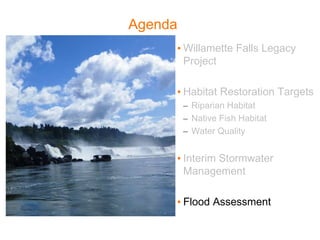
Agenda
• Willamette Falls Legacy
Project
• Habitat Restoration
– Riparian Habitat
– Native Fish Habitat
– Water Quality
• Interim Stormwater
Management
• Flood Assessment
RiparianHabitat
• Key
Elements
• Desired
Outcomes
• Links to
Other
Goals
NativeFishHabitat
• Key
Elements
• Desired
Outcomes
• Links to
Other
Goals
WaterQuality
• Key
Elements
• Desired
Outcomes
• Links to
Other
Goals
Riparian Habitat – Key Elements
• A mix of native trees and shrubs, typically adapted to seasonal flooding
such as: Oregon ash, cottonwood, red alder, red-osier dogwood, red
elderberry as well as sedges, rushes and ferns.
• Rocky outcrops including basalt outcrops and bluffs which provide
unique habitat for insects, amphibians, and rare plants.
Riparian Habitat Desired Outcomes
• Restore native trees and shrubs
along the Willamette
• Protect and restore rocky outcrops
by removing buildings and structures.
• Provide important habitat for
migratory birds and other wildlife.
• Improve water quality through
filtration, stormwater attenuation,
woody debris, and leaf litter inputs into
the river.
Restoring Native Vegetation
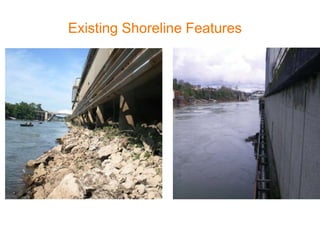
Existing Shoreline Features
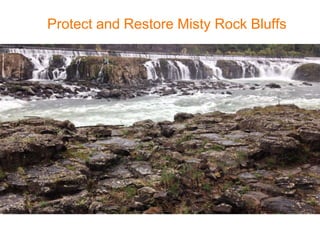
Protect and Restore Misty Rock Bluffs
Riparian Habitat link to other Key Goals
• Public Access:
Protection of rocky outcrops and riparian areas provide scenic views for the
public. Restoring native vegetation will provide a natural feeling to portions
of the highly developed site and increase wildlife watching opportunities.
Riparian Habitat link to other Key Goals
• Public Access:
Protection of rocky outcrops and riparian areas provide scenic views for the
public. Restoring native vegetation will provide a natural feeling to portions
of the highly developed site and increase wildlife watching opportunities.
• Cultural and Historic Interpretation:
Protection of rocky outcrops are likely to be areas of significant cultural
importance to the tribes.
Riparian Habitat link to other Key Goals
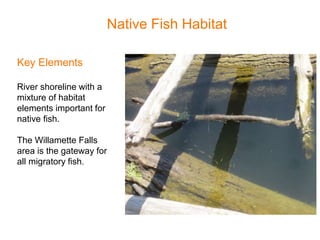
Native Fish Habitat
Key Elements
River shoreline with a
mixture of habitat
elements important for
native fish.
The Willamette Falls
area is the gateway for
all migratory fish.
Native Fish Habitat –Desired Outcomes
• Restore shoreline habitat
complexity, including
alcoves and inlets for cool
water refugia and off-
channel habitat during
periods of high river flow.
• Provide important resting
and movement habitat for
anadromous fish species.
Historic Shoreline
Tail Races
Alcoves
• Cultural and Historic Interpretation:
Salmon fishing and lamprey harvest
are culturally important to the tribes.
• Access: Interpreting salmon and
lamprey life cycles are likely to be key
parts of any interpretation program.
• Economic Development: Restoration
jobs could provide additional jobs and
revenue for the community.
Links to other Key Goals
Water Quality Key Elements
• Springs and seeps that provide
cold water input to the River.
• The 54 cfs water right could be
returned to in stream flows for water
quality and fish habitat.
• Surface water (primarily treated
stormwater) could provide additional
flows through historic side
channels and alcoves.
• Healthy water quality (clean and
cool water) is important to native
fish and other wildlife that use the
site.
Water Quality –Desired Outcomes
• Improve water temperature and chemistry above
existing conditions at the site.
Flow through the Upper Pool
Water Quality in the Upper Pool
Spills and Overflows
Cultural and historic interpretation:
Interpretative signage can describe the water quality improvements at the site.
Water Quality Links to Other Goals
Agenda
• Willamette Falls Legacy
Project
• Habitat Restoration Targets
– Riparian Habitat
– Native Fish Habitat
– Water Quality
• Interim Stormwater
Management
• Flood Assessment
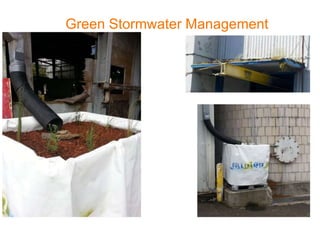
Green Stormwater Management
Treatment at the Tailraces
Agenda
• Willamette Falls Legacy
Project
• Habitat Restoration Targets
– Riparian Habitat
– Native Fish Habitat
– Water Quality
• Interim Stormwater
Management
• Flood Assessment
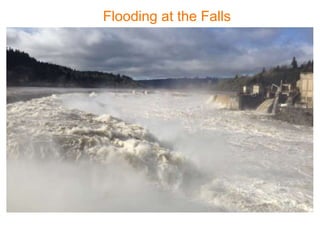
Historic Flooding
Flooding at the Falls
A Quiet Day
Vision Report and Master Plan adopted last
night by Oregon City Council
Next Steps – Willamette River Walk
• Public access out to view
the Falls should happen
before anything else on
the former Blue Heron
mill site.
• Thus, the community and
project partners have
identified the opportunity
for a public walkway
along the Willamette
River
Demonstration Plans A and C
Questions?
Marjorie Wolfe, PE, CFM
mwolfe@wolfwaterresources.com
Brian Vaughn
brian.vaughn@oregonmetro.gov
for more information visit

WFLP

  • 1.
    The Most SpectacularPlace We Don’t Visit Willamette Falls Legacy Project
  • 3.
  • 4.
  • 5.
  • 6.
  • 7.
  • 8.
  • 9.
  • 10.
  • 11.
    Get Close tothe Water
  • 12.
    Cultural and HistoricInterpretation
  • 13.
  • 14.
    By Incorporating Historicand Cultural Features
  • 15.
  • 16.
  • 17.
    Early Site SpecificOpportunities
  • 18.
    Agenda • Willamette FallsLegacy Project • Habitat Restoration – Riparian Habitat – Native Fish Habitat – Water Quality • Interim Stormwater Management • Flood Assessment
  • 19.
    RiparianHabitat • Key Elements • Desired Outcomes •Links to Other Goals NativeFishHabitat • Key Elements • Desired Outcomes • Links to Other Goals WaterQuality • Key Elements • Desired Outcomes • Links to Other Goals
  • 20.
    Riparian Habitat –Key Elements • A mix of native trees and shrubs, typically adapted to seasonal flooding such as: Oregon ash, cottonwood, red alder, red-osier dogwood, red elderberry as well as sedges, rushes and ferns. • Rocky outcrops including basalt outcrops and bluffs which provide unique habitat for insects, amphibians, and rare plants.
  • 21.
    Riparian Habitat DesiredOutcomes • Restore native trees and shrubs along the Willamette • Protect and restore rocky outcrops by removing buildings and structures. • Provide important habitat for migratory birds and other wildlife. • Improve water quality through filtration, stormwater attenuation, woody debris, and leaf litter inputs into the river.
  • 22.
  • 23.
  • 24.
    Protect and RestoreMisty Rock Bluffs
  • 25.
    Riparian Habitat linkto other Key Goals • Public Access: Protection of rocky outcrops and riparian areas provide scenic views for the public. Restoring native vegetation will provide a natural feeling to portions of the highly developed site and increase wildlife watching opportunities.
  • 26.
    Riparian Habitat linkto other Key Goals • Public Access: Protection of rocky outcrops and riparian areas provide scenic views for the public. Restoring native vegetation will provide a natural feeling to portions of the highly developed site and increase wildlife watching opportunities.
  • 27.
    • Cultural andHistoric Interpretation: Protection of rocky outcrops are likely to be areas of significant cultural importance to the tribes. Riparian Habitat link to other Key Goals
  • 28.
    Native Fish Habitat KeyElements River shoreline with a mixture of habitat elements important for native fish. The Willamette Falls area is the gateway for all migratory fish.
  • 29.
    Native Fish Habitat–Desired Outcomes • Restore shoreline habitat complexity, including alcoves and inlets for cool water refugia and off- channel habitat during periods of high river flow. • Provide important resting and movement habitat for anadromous fish species.
  • 30.
  • 31.
  • 32.
  • 33.
    • Cultural andHistoric Interpretation: Salmon fishing and lamprey harvest are culturally important to the tribes. • Access: Interpreting salmon and lamprey life cycles are likely to be key parts of any interpretation program. • Economic Development: Restoration jobs could provide additional jobs and revenue for the community. Links to other Key Goals
  • 34.
    Water Quality KeyElements • Springs and seeps that provide cold water input to the River. • The 54 cfs water right could be returned to in stream flows for water quality and fish habitat. • Surface water (primarily treated stormwater) could provide additional flows through historic side channels and alcoves. • Healthy water quality (clean and cool water) is important to native fish and other wildlife that use the site.
  • 35.
    Water Quality –DesiredOutcomes • Improve water temperature and chemistry above existing conditions at the site.
  • 36.
    Flow through theUpper Pool
  • 37.
    Water Quality inthe Upper Pool
  • 38.
  • 39.
    Cultural and historicinterpretation: Interpretative signage can describe the water quality improvements at the site. Water Quality Links to Other Goals
  • 40.
    Agenda • Willamette FallsLegacy Project • Habitat Restoration Targets – Riparian Habitat – Native Fish Habitat – Water Quality • Interim Stormwater Management • Flood Assessment
  • 41.
  • 42.
  • 43.
    Agenda • Willamette FallsLegacy Project • Habitat Restoration Targets – Riparian Habitat – Native Fish Habitat – Water Quality • Interim Stormwater Management • Flood Assessment
  • 44.
  • 45.
  • 46.
  • 47.
    Vision Report andMaster Plan adopted last night by Oregon City Council
  • 48.
    Next Steps –Willamette River Walk • Public access out to view the Falls should happen before anything else on the former Blue Heron mill site. • Thus, the community and project partners have identified the opportunity for a public walkway along the Willamette River
  • 49.
  • 50.
    Questions? Marjorie Wolfe, PE,CFM mwolfe@wolfwaterresources.com Brian Vaughn brian.vaughn@oregonmetro.gov
  • 51.