PRESENTATION for (insert audience specifics) introducing new technologies for increasing revenue from existing production January (insert specific date) 2010 (insert presenter(s) name – and position(s)) WET/EIG
Oil Ionizer  recovers fresh & weathered crude increased market value $k’s/day Proven New Technologies Water Ionizer enhances water floods cleans produced water increased production value $k’s/day PetroSonic upgrades heavy crude increased market value $3-$14per/BBL Enhanced Oil Recovery (EOR) Microbe enhanced oil recovery treats tar sands targets sustained 77% increased well production Strata  concrete containment creates sellable product from hydrocarbon waste Exit Terra-Kleen and InfraSonic soil remediation PCB disposal increasing revenue from existing production Environmental solutions WET/EIG
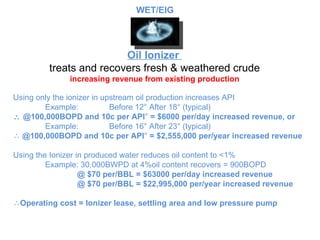
Oil Ionizer  treats and recovers fresh & weathered crude increasing revenue from existing production Using only the ionizer in upstream oil production increases API Example:  Before 12 ° After 18° (typical)    @100,000BOPD and 10c per API °  = $6000 per/day increased revenue, or Example: Before 16 ° After 23° (typical) @100,000BOPD and 10c per API °  = $2,555,000 per/year increased revenue Using the Ionizer in produced water reduces oil content to <1% Example: 30,000BWPD at 4%oil content recovers = 900BOPD @ $70 per/BBL = $63000 per/day increased revenue @ $70 per/BBL = $22,995,000 per/year increased revenue Operating cost = Ionizer lease, settling area and low pressure pump WET/EIG
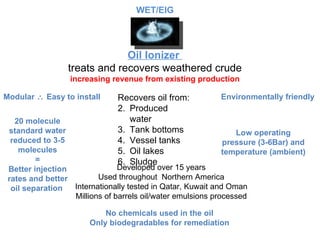
Oil Ionizer  treats and recovers weathered crude increasing revenue from existing production Developed over 15 years Used throughout  Northern America Internationally tested in Qatar, Kuwait and Oman Millions of barrels oil/water emulsions processed Modular    Easy to install Low operating pressure (3-6Bar) and temperature (ambient) 20 molecule standard water reduced to 3-5 molecules = Better injection rates and better oil separation  No chemicals used in the oil Only biodegradables for remediation Environmentally friendly Recovers oil from: Produced water Tank bottoms Vessel tanks Oil lakes Sludge WET/EIG
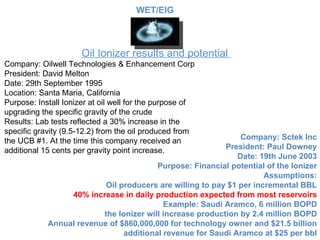
Oil Ionizer results and potential  Company: Oilwell Technologies & Enhancement Corp President: David Melton Date: 29th September 1995 Location: Santa Maria, California Purpose: Install Ionizer at oil well for the purpose of upgrading the specific gravity of the crude Results: Lab tests reflected a 30% increase in the specific gravity (9.5-12.2) from the oil produced from the UCB #1. At the time this company received an additional 15 cents per gravity point increase. Company: Sctek Inc President: Paul Downey Date: 19th June 2003 Purpose: Financial potential of the Ionizer Assumptions: Oil producers are willing to pay $1 per incremental BBL 40% increase in daily production expected from most reservoirs Example: Saudi Aramco, 6 million BOPD the Ionizer will increase production by 2.4 million BOPD Annual revenue of $860,000,000 for technology owner and $21.5 billion additional revenue for Saudi Aramco at $25 per bbl WET/EIG
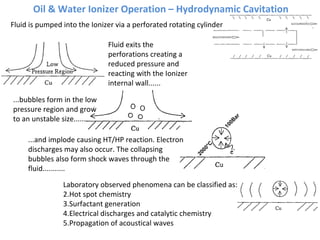
Oil & Water Ionizer Operation – Hydrodynamic Cavitation Fluid is pumped into the Ionizer via a perforated rotating cylinder Fluid exits the perforations creating a reduced pressure and reacting with the Ionizer internal wall...... ...bubbles form in the low pressure region and grow to an unstable size...... ...and implode causing HT/HP reaction. Electron discharges may also occur. The collapsing bubbles also form shock waves through the fluid........... Laboratory observed phenomena can be classified as: Hot spot chemistry Surfactant generation Electrical discharges and catalytic chemistry Propagation of acoustical waves 2000 ° C 100Bar
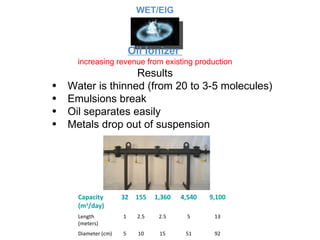
Oil Ionizer   increasing revenue from existing production Results Water is thinned (from 20 to 3-5 molecules) Emulsions break  Oil separates easily Metals drop out of suspension WET/EIG Capacity (m 3 /day) 32 155 1,360 4,540 9,100 Length  (meters) 1 2.5 2.5 5 13 Diameter (cm) 5 10 15 51 92
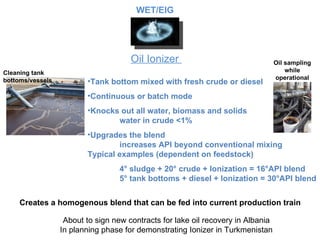
Tank bottom mixed with fresh crude or diesel Continuous or batch mode Knocks out all water, biomass and solids water in crude <1% Upgrades the blend increases API beyond conventional mixing Typical examples (dependent on feedstock) 4° sludge + 20° crude + Ionization = 16°API blend 5° tank bottoms + diesel + Ionization = 30°API blend Oil Ionizer  Cleaning tank bottoms/vessels Oil sampling while operational Creates a homogenous blend that can be fed into current production train About to sign new contracts for lake oil recovery in Albania In planning phase for demonstrating Ionizer in Turkmenistan WET/EIG
Oil Ionizer – the way forward WET/EIG would welcome the opportunity to work with (insert specifics) in the following manner: WET/EIG visit  (insert specifics)   (Insert specifics) provide information to  WET/EIG of the area for potential growth by use of the Oil Ionizer.  WET/EIG build operating data and take 4 x 20litre representative samples Following analysis of the operating data and samples WET/EIG  will provide a business proposal to include: a) Equipment and personnel required b) Details of an in-line demonstration c) A profit-sharing or lease agreement upon success of the demonstration WET/EIG
Oil Ionizer SUMMARY Increasing revenue from every API ° raised  for every BBL oil produced Increasing revenue via oil recovery from every BBL of produced water Increasing revenue from salvaging settled crude in tanks/vessels/lakes Ionizing is here now and ready to enhance existing oil production volumes Back to menu increasing revenue from existing production WET/EIG
Water Ionizer increasing revenue from existing production Ionized water used for well injection Increases oil production Example:  Switching to ionized water has increased well production by 25% - sustained due to effects of water thinning, metals removal, formation cleaning i.e. breaks up skin damage, swollen clays, and damage from acid and gel fracs.  Removes fine particles from the reservoir  WET/EIG
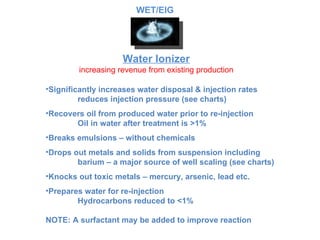
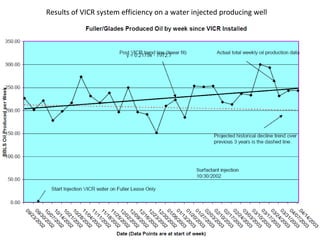
Water Ionizer increasing revenue from existing production Significantly increases water disposal & injection rates reduces injection pressure (see charts) Recovers oil from produced water prior to re-injection Oil in water after treatment is >1% Breaks emulsions – without chemicals Drops out metals and solids from suspension including  barium – a major source of well scaling (see charts) Knocks out toxic metals – mercury, arsenic, lead etc. Prepares water for re-injection Hydrocarbons reduced to <1% NOTE: A surfactant may be added to improve reaction WET/EIG
Results of VICR system efficiency on a water injected producing well
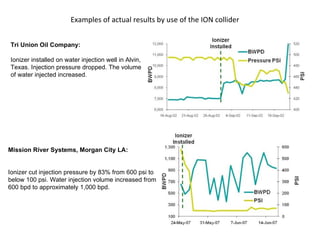
Examples of actual results by use of the ION collider Tri Union Oil Company:  Ionizer installed on water injection well in Alvin, Texas. Injection pressure dropped. The volume of water injected increased. Mission River Systems, Morgan City LA:  Ionizer cut injection pressure by 83% from 600 psi to below 100 psi. Water injection volume increased from 600 bpd to approximately 1,000 bpd.
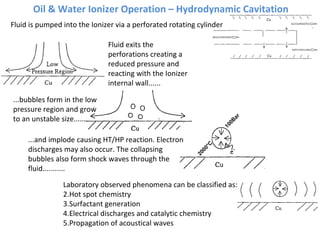
Oil & Water Ionizer Operation – Hydrodynamic Cavitation Fluid is pumped into the Ionizer via a perforated rotating cylinder Fluid exits the perforations creating a reduced pressure and reacting with the Ionizer internal wall...... ...bubbles form in the low pressure region and grow to an unstable size...... ...and implode causing HT/HP reaction. Electron discharges may also occur. The collapsing bubbles also form shock waves through the fluid........... Laboratory observed phenomena can be classified as: Hot spot chemistry Surfactant generation Electrical discharges and catalytic chemistry Propagation of acoustical waves 2000 ° C 100Bar
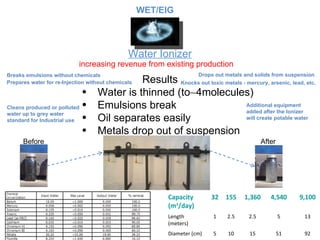
Water Ionizer Results Water is thinned (to  4molecules) Emulsions break Oil separates easily Metals drop out of suspension After Before increasing revenue from existing production Breaks emulsions without chemicals Drops out metals and solids from suspension Knocks out toxic metals - mercury, arsenic, lead, etc. Prepares water for re-Injection without chemicals Cleans produced or polluted water up to grey water standard for Industrial use Additional equipment added after the Ionizer will create potable water WET/EIG Capacity (m 3 /day) 32 155 1,360 4,540 9,100 Length  (meters) 1 2.5 2.5 5 13 Diameter (cm) 5 10 15 51 92
Water Ionizer results Company: New Tech Engineering President: Regan D. Wood Date: 21st December 2001 Location: Bixby, Oklahoma Purpose: Ionize produced salt water in Highbaugh field Results: 120 bbls of salt water and 280 bbls of untreated salt water were simultaneously pumped through the Ion izer.  The resulting mixture was left overnight and in the morning revealed 2 inches of oil in the tank which were not apparent before treatment. The technology is able to break oil in water emulsions to reveal two immiscible liquids (oil and water). Occupation: Consulting Geophysicist Name: Edwin K. Hiserodt Date: 17th March 2004 Purpose: Characterize details of chemical/physical changes in water caused by treatment with the Ionizer Results: Experiment conducted using Tulsa city water pumped from a 5-gallon plastic container. Low pressure (20 psi) non-stop, 60 second run; reduced resistivity by 10% high pressure (98 psi) non-stop, 60 second run; reduced resistivity by 17% Using the VICR #micro 6, at high pressure reduced resistivity by 57.5% Experiment conducted with salt water 7,000ppm using the Ionizer #micro 6 at low pressure Precipitous drop in resistivity of 96%, and a 33% drop in pH for the first few minutes, before rising to original level. Conclusions: Using Ionizer leads to greater destruction of bacteria/alga and also reduces the number of molecules in water clusters, which will greatly reduce pressure required to drive contaminated water. WET/EIG
Water Ionizer – the way forward WET/EIG would welcome the opportunity to work with (insert specifics) in the following manner: WET/EIG visit  (Insert specifics)   (Insert specifics) provide information to  Ionizer Middle East and CIS of the area for potential growth by use of the Oil Ionizer.  WET/EIG build operating data and take 4 x 20litre representative samples Following analysis of the operating data and samples  WET/EIG will provide a business proposal to include: a) Equipment and personnel required b) Details of an in-line demonstration c) A profit-sharing or lease agreement upon success of the demonstration WET/EIG
Water Ionizer SUMMARY Up to 25% increased production – sustained Up to 85% decrease in injection pressure Reduces oil in produced water  <1% remaining Elimination or huge reduction in damaging metals  Back to menu increasing revenue from existing production WET/EIG
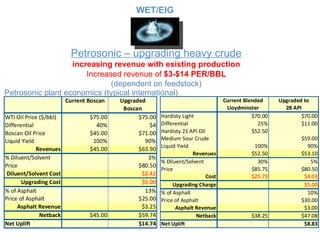
Petrosonic – upgrading heavy crude increasing revenue with existing production Petrosonic plant economics (typical international) Increased revenue of  $3-$14 PER/BBL  (dependent on feedstock) WET/EIG
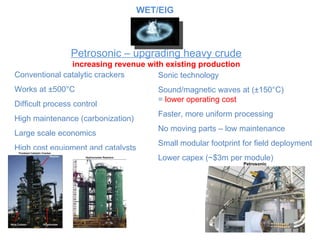
Petrosonic – upgrading heavy crude increasing revenue with existing production Conventional catalytic crackers Works at ±500 °C Difficult process control High maintenance (carbonization) Large scale economics High cost equipment and catalysts Sonic technology Sound/magnetic waves at (±150 °C) =  lower operating cost Faster, more uniform processing No moving parts – low maintenance Small modular footprint for field deployment Lower capex ( ~$3m per module) Petrosonic WET/EIG
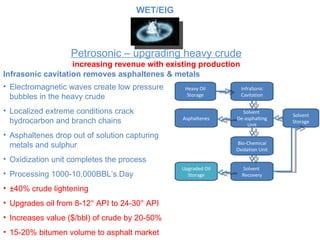
Petrosonic – upgrading heavy crude increasing revenue with existing production Electromagnetic waves create low pressure bubbles in the heavy crude Localized extreme conditions crack hydrocarbon and branch chains Asphaltenes drop out of solution capturing metals and sulphur Oxidization unit completes the process Processing 1000-10,000BBL’s.Day ±40% crude lightening Upgrades oil from 8-12 ° API to 24-30° API Increases value ($/bbl) of crude by 20-50% 15-20% bitumen volume to asphalt market Infrasonic cavitation removes asphaltenes & metals WET/EIG Solvent Storage InfraSonic Cavitation Solvent  De-asphalting Unit Solvent  Recovery Asphaltenes Upgraded Oil Storage Bio-Chemical Oxidation Unit Heavy Oil Storage
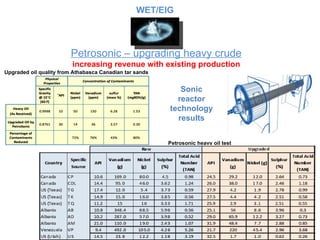
Petrosonic – upgrading heavy crude increasing revenue with existing production Upgraded oil quality from Athabasca Canadian tar sands Petrosonic heavy oil test results Sonic reactor technology results WET/EIG
Petrosonic – upgrading heavy crude increasing revenue with existing production Fast integration & transportation. The process is designed to be easily applicable to the upstream and midstream constituents. As a result, business models can take on various forms: Oil Producers:  Decrease viscosity and need for diluents; improve quality; increase marketability. Typical volume is 1-10kbopd Pipeline Operators:  Decrease viscosity and need for diluent hence ability to increase throughput. Typical size from 20-50kbopd. Storage & Blending Operators:  Increase yield and quality. Typical size ranges from 20-50kbopd. Retailers:  Increase yield & quality. Typical sizes ranges from 2.5-20kbopd.  Refiners:  Increase yield and quality. De-bottleneck refinery. Typical sizes range from 30-100kbopd.Sonic will sub-license. Back to menu WET/EIG
Petrosonic – upgrading heavy crude increasing revenue with existing production Back to menu SUMMARY Increased revenue of  $3-$14 PER/BBL  by Raising the oil API ° - up to 40% Operates at only 150 °C   No moving parts = low maintenance costs Removed bitumen sold to the asphalt market WET/EIG
Microbe enhanced oil recovery increasing revenue with existing production DOWNHOLE USE Microbes can boost production from thousands of stripper wells worldwide where CO2 injection and other tertiary oil recovery techniques fail or are too expensive Targets 77% sustained increase in production 20% increase in porosity and permeability Creates surfactants to lower surface tension Tackles bitumen, tar sands, oil shale Vastly reduces energy and water requirements Entraps heavy metals, eliminates toxins Chemically mobilizes natural system of microbes Cracks heavier fractions while in the ground Increases well head pressure Efficient & reliable solution More Solvent than Catalyst, so re-useable Fast: increased production in 2-4 months, peak levels reached in 5-9 months Specific microbes chosen for best efficiency on a particular type of hydrocarbon Cost dependent on Microbe selection and quantity required Back to menu WET/EIG
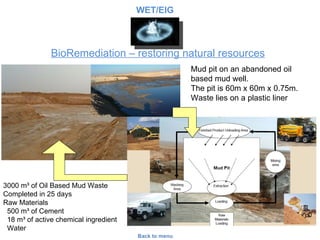
Strata – Concrete containment Treat any form of oil based waste irrespective of it’s age, condition and the presence of foreign objects Treat the waste on location after an event, or intervene on spillages in remote areas No down time for ongoing operations No transport of hazardous waste Transformation of the waste into a benign solid Totally sanitize the waste area Landscape the terrain Key is in simple mobile units Based on well known and proven consolidation process and is rapidly deployed Mixes waste material with Sodium Silicate at 45% and normal building standard cement Sodium Silicate bonds the oil much like a detergent Cement absorbs the mixture and solidifies it into a hard composite 0% volatile oil with 0% leaching oil, 0% toxicity for heavy metals and hydrocarbons The chemical process is already established as a recognized method of treatment. How WET/EIG
BioRemediation – restoring natural resources Mud pit on an abandoned oil based mud well. The pit is 60m x 60m x 0.75m. Waste lies on a plastic liner 3000 m³ of Oil Based Mud Waste Completed in 25 days Raw Materials 500 m³ of Cement 18 m³ of active chemical ingredient Water Back to menu WET/EIG
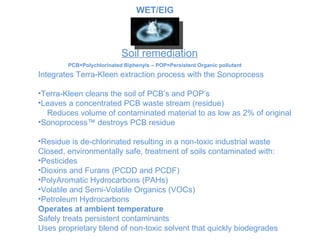
Soil remediation PCB=Polychlorinated Biphenyls – POP=Persistent Organic pollutant Integrates Terra-Kleen extraction process with the  Sonoprocess Terra-Kleen cleans the soil of PCB’s and POP’s Leaves a concentrated PCB waste stream (residue) Reduces volume of contaminated material to as low as 2% of o riginal Sonoprocess™ destroys PCB residue Residue is de-chlorinated resulting in a non-toxic industrial waste Closed, environmentally safe, treatment of soils contaminated with: Pesticides Dioxins and Furans (PCDD and PCDF) PolyAromatic Hydrocarbons (PAHs) Volatile and Semi-Volatile Organics (VOCs) Petroleum Hydrocarbons Operates at ambient temperature Safely treats persistent contaminants Uses proprietary blend of non-toxic solvent that quickly biodegrades WET/EIG
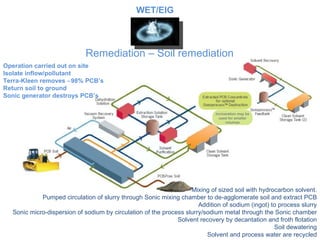
Remediation – Soil remediation Operation carried out on site Isolate inflow/pollutant Terra-Kleen removes   98% PCB’s Return soil to ground Sonic generator destroys PCB’s Mixing of sized soil with hydrocarbon solvent. Pumped circulation of slurry through Sonic mixing chamber to de-agglomerate soil and extract PCB Addition of sodium (ingot) to process slurry Sonic micro-dispersion of sodium by circulation of the process slurry/sodium metal through the Sonic chamber Solvent recovery by decantation and froth flotation Soil dewatering Solvent and process water are recycled Incineration may be used for smaller volumes WET/EIG
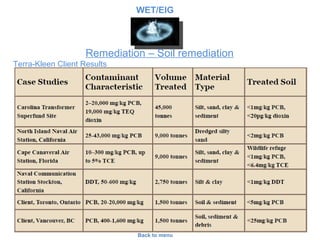
Remediation – Soil remediation Terra-Kleen Client Results Back to menu WET/EIG
What we need to know to initiate a project study: Where is the interest: 1) Non-Producing wells (water injection must be possible) 2) Poorly producing wells (water injection must be possible) 3) Upstream of wellhead e.g. Water separation from oil system 4) Upstream of wellheads e.g. Oil separation  from water system 5) Recovering oil from settling tanks 6)  Water cleaning 7 ) Potable water making What volumes are to be treated NOTE: Systems can be built for 350-1 00 ,000 BPD Location Comprehensive fluid data at proposed location Current and historic statistics (for predicting treatment benefits) 1) Composition of the fluids today and previously (trend lines) 2) Pressures within all systems today and previously (trend lines) 3) Temperatures within all systems today and previously (trend lines) A team of specialists can be made available to present the expected increased production rates and revenue (following approved trials and analysis)

Wet eig new technologies presentation january2010

  • 1.
    PRESENTATION for (insertaudience specifics) introducing new technologies for increasing revenue from existing production January (insert specific date) 2010 (insert presenter(s) name – and position(s)) WET/EIG
  • 2.
    Oil Ionizer recovers fresh & weathered crude increased market value $k’s/day Proven New Technologies Water Ionizer enhances water floods cleans produced water increased production value $k’s/day PetroSonic upgrades heavy crude increased market value $3-$14per/BBL Enhanced Oil Recovery (EOR) Microbe enhanced oil recovery treats tar sands targets sustained 77% increased well production Strata concrete containment creates sellable product from hydrocarbon waste Exit Terra-Kleen and InfraSonic soil remediation PCB disposal increasing revenue from existing production Environmental solutions WET/EIG
  • 3.
    Oil Ionizer treats and recovers fresh & weathered crude increasing revenue from existing production Using only the ionizer in upstream oil production increases API Example: Before 12 ° After 18° (typical)  @100,000BOPD and 10c per API ° = $6000 per/day increased revenue, or Example: Before 16 ° After 23° (typical) @100,000BOPD and 10c per API ° = $2,555,000 per/year increased revenue Using the Ionizer in produced water reduces oil content to <1% Example: 30,000BWPD at 4%oil content recovers = 900BOPD @ $70 per/BBL = $63000 per/day increased revenue @ $70 per/BBL = $22,995,000 per/year increased revenue Operating cost = Ionizer lease, settling area and low pressure pump WET/EIG
  • 4.
    Oil Ionizer treats and recovers weathered crude increasing revenue from existing production Developed over 15 years Used throughout Northern America Internationally tested in Qatar, Kuwait and Oman Millions of barrels oil/water emulsions processed Modular  Easy to install Low operating pressure (3-6Bar) and temperature (ambient) 20 molecule standard water reduced to 3-5 molecules = Better injection rates and better oil separation No chemicals used in the oil Only biodegradables for remediation Environmentally friendly Recovers oil from: Produced water Tank bottoms Vessel tanks Oil lakes Sludge WET/EIG
  • 5.
    Oil Ionizer resultsand potential Company: Oilwell Technologies & Enhancement Corp President: David Melton Date: 29th September 1995 Location: Santa Maria, California Purpose: Install Ionizer at oil well for the purpose of upgrading the specific gravity of the crude Results: Lab tests reflected a 30% increase in the specific gravity (9.5-12.2) from the oil produced from the UCB #1. At the time this company received an additional 15 cents per gravity point increase. Company: Sctek Inc President: Paul Downey Date: 19th June 2003 Purpose: Financial potential of the Ionizer Assumptions: Oil producers are willing to pay $1 per incremental BBL 40% increase in daily production expected from most reservoirs Example: Saudi Aramco, 6 million BOPD the Ionizer will increase production by 2.4 million BOPD Annual revenue of $860,000,000 for technology owner and $21.5 billion additional revenue for Saudi Aramco at $25 per bbl WET/EIG
  • 6.
    Oil & WaterIonizer Operation – Hydrodynamic Cavitation Fluid is pumped into the Ionizer via a perforated rotating cylinder Fluid exits the perforations creating a reduced pressure and reacting with the Ionizer internal wall...... ...bubbles form in the low pressure region and grow to an unstable size...... ...and implode causing HT/HP reaction. Electron discharges may also occur. The collapsing bubbles also form shock waves through the fluid........... Laboratory observed phenomena can be classified as: Hot spot chemistry Surfactant generation Electrical discharges and catalytic chemistry Propagation of acoustical waves 2000 ° C 100Bar
  • 7.
    Oil Ionizer increasing revenue from existing production Results Water is thinned (from 20 to 3-5 molecules) Emulsions break Oil separates easily Metals drop out of suspension WET/EIG Capacity (m 3 /day) 32 155 1,360 4,540 9,100 Length (meters) 1 2.5 2.5 5 13 Diameter (cm) 5 10 15 51 92
  • 8.
    Tank bottom mixedwith fresh crude or diesel Continuous or batch mode Knocks out all water, biomass and solids water in crude <1% Upgrades the blend increases API beyond conventional mixing Typical examples (dependent on feedstock) 4° sludge + 20° crude + Ionization = 16°API blend 5° tank bottoms + diesel + Ionization = 30°API blend Oil Ionizer Cleaning tank bottoms/vessels Oil sampling while operational Creates a homogenous blend that can be fed into current production train About to sign new contracts for lake oil recovery in Albania In planning phase for demonstrating Ionizer in Turkmenistan WET/EIG
  • 9.
    Oil Ionizer –the way forward WET/EIG would welcome the opportunity to work with (insert specifics) in the following manner: WET/EIG visit (insert specifics) (Insert specifics) provide information to WET/EIG of the area for potential growth by use of the Oil Ionizer. WET/EIG build operating data and take 4 x 20litre representative samples Following analysis of the operating data and samples WET/EIG will provide a business proposal to include: a) Equipment and personnel required b) Details of an in-line demonstration c) A profit-sharing or lease agreement upon success of the demonstration WET/EIG
  • 10.
    Oil Ionizer SUMMARYIncreasing revenue from every API ° raised for every BBL oil produced Increasing revenue via oil recovery from every BBL of produced water Increasing revenue from salvaging settled crude in tanks/vessels/lakes Ionizing is here now and ready to enhance existing oil production volumes Back to menu increasing revenue from existing production WET/EIG
  • 11.
    Water Ionizer increasingrevenue from existing production Ionized water used for well injection Increases oil production Example: Switching to ionized water has increased well production by 25% - sustained due to effects of water thinning, metals removal, formation cleaning i.e. breaks up skin damage, swollen clays, and damage from acid and gel fracs.  Removes fine particles from the reservoir WET/EIG
  • 12.
    Water Ionizer increasingrevenue from existing production Significantly increases water disposal & injection rates reduces injection pressure (see charts) Recovers oil from produced water prior to re-injection Oil in water after treatment is >1% Breaks emulsions – without chemicals Drops out metals and solids from suspension including barium – a major source of well scaling (see charts) Knocks out toxic metals – mercury, arsenic, lead etc. Prepares water for re-injection Hydrocarbons reduced to <1% NOTE: A surfactant may be added to improve reaction WET/EIG
  • 13.
    Results of VICRsystem efficiency on a water injected producing well
  • 14.
    Examples of actualresults by use of the ION collider Tri Union Oil Company: Ionizer installed on water injection well in Alvin, Texas. Injection pressure dropped. The volume of water injected increased. Mission River Systems, Morgan City LA: Ionizer cut injection pressure by 83% from 600 psi to below 100 psi. Water injection volume increased from 600 bpd to approximately 1,000 bpd.
  • 15.
    Oil & WaterIonizer Operation – Hydrodynamic Cavitation Fluid is pumped into the Ionizer via a perforated rotating cylinder Fluid exits the perforations creating a reduced pressure and reacting with the Ionizer internal wall...... ...bubbles form in the low pressure region and grow to an unstable size...... ...and implode causing HT/HP reaction. Electron discharges may also occur. The collapsing bubbles also form shock waves through the fluid........... Laboratory observed phenomena can be classified as: Hot spot chemistry Surfactant generation Electrical discharges and catalytic chemistry Propagation of acoustical waves 2000 ° C 100Bar
  • 16.
    Water Ionizer ResultsWater is thinned (to  4molecules) Emulsions break Oil separates easily Metals drop out of suspension After Before increasing revenue from existing production Breaks emulsions without chemicals Drops out metals and solids from suspension Knocks out toxic metals - mercury, arsenic, lead, etc. Prepares water for re-Injection without chemicals Cleans produced or polluted water up to grey water standard for Industrial use Additional equipment added after the Ionizer will create potable water WET/EIG Capacity (m 3 /day) 32 155 1,360 4,540 9,100 Length (meters) 1 2.5 2.5 5 13 Diameter (cm) 5 10 15 51 92
  • 17.
    Water Ionizer resultsCompany: New Tech Engineering President: Regan D. Wood Date: 21st December 2001 Location: Bixby, Oklahoma Purpose: Ionize produced salt water in Highbaugh field Results: 120 bbls of salt water and 280 bbls of untreated salt water were simultaneously pumped through the Ion izer. The resulting mixture was left overnight and in the morning revealed 2 inches of oil in the tank which were not apparent before treatment. The technology is able to break oil in water emulsions to reveal two immiscible liquids (oil and water). Occupation: Consulting Geophysicist Name: Edwin K. Hiserodt Date: 17th March 2004 Purpose: Characterize details of chemical/physical changes in water caused by treatment with the Ionizer Results: Experiment conducted using Tulsa city water pumped from a 5-gallon plastic container. Low pressure (20 psi) non-stop, 60 second run; reduced resistivity by 10% high pressure (98 psi) non-stop, 60 second run; reduced resistivity by 17% Using the VICR #micro 6, at high pressure reduced resistivity by 57.5% Experiment conducted with salt water 7,000ppm using the Ionizer #micro 6 at low pressure Precipitous drop in resistivity of 96%, and a 33% drop in pH for the first few minutes, before rising to original level. Conclusions: Using Ionizer leads to greater destruction of bacteria/alga and also reduces the number of molecules in water clusters, which will greatly reduce pressure required to drive contaminated water. WET/EIG
  • 18.
    Water Ionizer –the way forward WET/EIG would welcome the opportunity to work with (insert specifics) in the following manner: WET/EIG visit (Insert specifics) (Insert specifics) provide information to Ionizer Middle East and CIS of the area for potential growth by use of the Oil Ionizer. WET/EIG build operating data and take 4 x 20litre representative samples Following analysis of the operating data and samples WET/EIG will provide a business proposal to include: a) Equipment and personnel required b) Details of an in-line demonstration c) A profit-sharing or lease agreement upon success of the demonstration WET/EIG
  • 19.
    Water Ionizer SUMMARYUp to 25% increased production – sustained Up to 85% decrease in injection pressure Reduces oil in produced water <1% remaining Elimination or huge reduction in damaging metals Back to menu increasing revenue from existing production WET/EIG
  • 20.
    Petrosonic – upgradingheavy crude increasing revenue with existing production Petrosonic plant economics (typical international) Increased revenue of $3-$14 PER/BBL (dependent on feedstock) WET/EIG
  • 21.
    Petrosonic – upgradingheavy crude increasing revenue with existing production Conventional catalytic crackers Works at ±500 °C Difficult process control High maintenance (carbonization) Large scale economics High cost equipment and catalysts Sonic technology Sound/magnetic waves at (±150 °C) = lower operating cost Faster, more uniform processing No moving parts – low maintenance Small modular footprint for field deployment Lower capex ( ~$3m per module) Petrosonic WET/EIG
  • 22.
    Petrosonic – upgradingheavy crude increasing revenue with existing production Electromagnetic waves create low pressure bubbles in the heavy crude Localized extreme conditions crack hydrocarbon and branch chains Asphaltenes drop out of solution capturing metals and sulphur Oxidization unit completes the process Processing 1000-10,000BBL’s.Day ±40% crude lightening Upgrades oil from 8-12 ° API to 24-30° API Increases value ($/bbl) of crude by 20-50% 15-20% bitumen volume to asphalt market Infrasonic cavitation removes asphaltenes & metals WET/EIG Solvent Storage InfraSonic Cavitation Solvent De-asphalting Unit Solvent Recovery Asphaltenes Upgraded Oil Storage Bio-Chemical Oxidation Unit Heavy Oil Storage
  • 23.
    Petrosonic – upgradingheavy crude increasing revenue with existing production Upgraded oil quality from Athabasca Canadian tar sands Petrosonic heavy oil test results Sonic reactor technology results WET/EIG
  • 24.
    Petrosonic – upgradingheavy crude increasing revenue with existing production Fast integration & transportation. The process is designed to be easily applicable to the upstream and midstream constituents. As a result, business models can take on various forms: Oil Producers: Decrease viscosity and need for diluents; improve quality; increase marketability. Typical volume is 1-10kbopd Pipeline Operators: Decrease viscosity and need for diluent hence ability to increase throughput. Typical size from 20-50kbopd. Storage & Blending Operators: Increase yield and quality. Typical size ranges from 20-50kbopd. Retailers: Increase yield & quality. Typical sizes ranges from 2.5-20kbopd. Refiners: Increase yield and quality. De-bottleneck refinery. Typical sizes range from 30-100kbopd.Sonic will sub-license. Back to menu WET/EIG
  • 25.
    Petrosonic – upgradingheavy crude increasing revenue with existing production Back to menu SUMMARY Increased revenue of $3-$14 PER/BBL by Raising the oil API ° - up to 40% Operates at only 150 °C  No moving parts = low maintenance costs Removed bitumen sold to the asphalt market WET/EIG
  • 26.
    Microbe enhanced oilrecovery increasing revenue with existing production DOWNHOLE USE Microbes can boost production from thousands of stripper wells worldwide where CO2 injection and other tertiary oil recovery techniques fail or are too expensive Targets 77% sustained increase in production 20% increase in porosity and permeability Creates surfactants to lower surface tension Tackles bitumen, tar sands, oil shale Vastly reduces energy and water requirements Entraps heavy metals, eliminates toxins Chemically mobilizes natural system of microbes Cracks heavier fractions while in the ground Increases well head pressure Efficient & reliable solution More Solvent than Catalyst, so re-useable Fast: increased production in 2-4 months, peak levels reached in 5-9 months Specific microbes chosen for best efficiency on a particular type of hydrocarbon Cost dependent on Microbe selection and quantity required Back to menu WET/EIG
  • 27.
    Strata – Concretecontainment Treat any form of oil based waste irrespective of it’s age, condition and the presence of foreign objects Treat the waste on location after an event, or intervene on spillages in remote areas No down time for ongoing operations No transport of hazardous waste Transformation of the waste into a benign solid Totally sanitize the waste area Landscape the terrain Key is in simple mobile units Based on well known and proven consolidation process and is rapidly deployed Mixes waste material with Sodium Silicate at 45% and normal building standard cement Sodium Silicate bonds the oil much like a detergent Cement absorbs the mixture and solidifies it into a hard composite 0% volatile oil with 0% leaching oil, 0% toxicity for heavy metals and hydrocarbons The chemical process is already established as a recognized method of treatment. How WET/EIG
  • 28.
    BioRemediation – restoringnatural resources Mud pit on an abandoned oil based mud well. The pit is 60m x 60m x 0.75m. Waste lies on a plastic liner 3000 m³ of Oil Based Mud Waste Completed in 25 days Raw Materials 500 m³ of Cement 18 m³ of active chemical ingredient Water Back to menu WET/EIG
  • 29.
    Soil remediation PCB=PolychlorinatedBiphenyls – POP=Persistent Organic pollutant Integrates Terra-Kleen extraction process with the Sonoprocess Terra-Kleen cleans the soil of PCB’s and POP’s Leaves a concentrated PCB waste stream (residue) Reduces volume of contaminated material to as low as 2% of o riginal Sonoprocess™ destroys PCB residue Residue is de-chlorinated resulting in a non-toxic industrial waste Closed, environmentally safe, treatment of soils contaminated with: Pesticides Dioxins and Furans (PCDD and PCDF) PolyAromatic Hydrocarbons (PAHs) Volatile and Semi-Volatile Organics (VOCs) Petroleum Hydrocarbons Operates at ambient temperature Safely treats persistent contaminants Uses proprietary blend of non-toxic solvent that quickly biodegrades WET/EIG
  • 30.
    Remediation – Soilremediation Operation carried out on site Isolate inflow/pollutant Terra-Kleen removes  98% PCB’s Return soil to ground Sonic generator destroys PCB’s Mixing of sized soil with hydrocarbon solvent. Pumped circulation of slurry through Sonic mixing chamber to de-agglomerate soil and extract PCB Addition of sodium (ingot) to process slurry Sonic micro-dispersion of sodium by circulation of the process slurry/sodium metal through the Sonic chamber Solvent recovery by decantation and froth flotation Soil dewatering Solvent and process water are recycled Incineration may be used for smaller volumes WET/EIG
  • 31.
    Remediation – Soilremediation Terra-Kleen Client Results Back to menu WET/EIG
  • 32.
    What we needto know to initiate a project study: Where is the interest: 1) Non-Producing wells (water injection must be possible) 2) Poorly producing wells (water injection must be possible) 3) Upstream of wellhead e.g. Water separation from oil system 4) Upstream of wellheads e.g. Oil separation from water system 5) Recovering oil from settling tanks 6) Water cleaning 7 ) Potable water making What volumes are to be treated NOTE: Systems can be built for 350-1 00 ,000 BPD Location Comprehensive fluid data at proposed location Current and historic statistics (for predicting treatment benefits) 1) Composition of the fluids today and previously (trend lines) 2) Pressures within all systems today and previously (trend lines) 3) Temperatures within all systems today and previously (trend lines) A team of specialists can be made available to present the expected increased production rates and revenue (following approved trials and analysis)