Western Gorilla
DANIEL RAMIREZ, MORGAN GILLEY
VERTEBRATE ZOOLOGY SUMMER 2017
LAB REPORT C
UNIVERSITY OF CENTRAL ARKANSAS
Objectives
• Background (Habitat, features, evolutionary history)
• Communication (verbal and nonverbal)
• Behavior
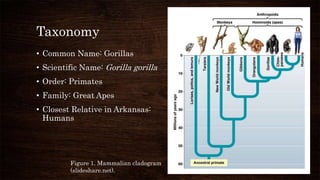
Taxonomy
• Common Name: Gorillas
• Scientific Name: Gorilla gorilla
• Order: Primates
• Family: Great Apes
• Closest Relative in Arkansas:
Humans
Figure 1. Mammalian cladogram
(slideshare.net).
Habitat and Geographical Location
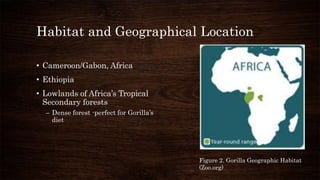
• Cameroon/Gabon, Africa
• Ethiopia
• Lowlands of Africa’s Tropical
Secondary forests
– Dense forest -perfect for Gorilla’s
diet
Figure 2. Gorilla Geographic Habitat
(Zoo.org)
Appearance & Food
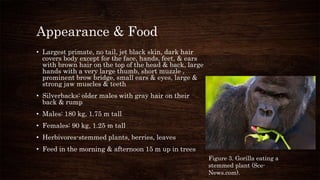
• Largest primate, no tail, jet black skin, dark hair
covers body except for the face, hands, feet, & ears
with brown hair on the top of the head & back, large
hands with a very large thumb, short muzzle ,
prominent brow bridge, small ears & eyes, large &
strong jaw muscles & teeth
• Silverbacks: older males with gray hair on their
back & rump
• Males: 180 kg, 1.75 m tall
• Females: 90 kg, 1.25 m tall
• Herbivores-stemmed plants, berries, leaves
• Feed in the morning & afternoon 15 m up in trees
Figure 3. Gorilla eating a
stemmed plant (Sce-
News.com).
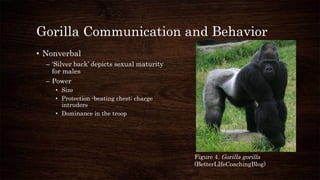
Gorilla Communication and Behavior
• Nonverbal
– ‘Silver back’ depicts sexual maturity
for males
– Power
• Size
• Protection -beating chest; charge
intruders
• Dominance in the troop
Figure 4. Gorilla gorilla
(BetterLIfeCoachingBlog)
Gorilla Communication and Behavior
Cont’d
• Verbal
– Growling
• Warning for intruders/competitors
– Hooting by dominant male
• Causes members of troop to acknowledge
dominant male
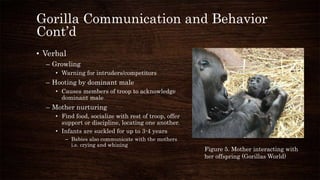
– Mother nurturing
• Find food, socialize with rest of troop, offer
support or discipline, locating one another.
• Infants are suckled for up to 3-4 years
– Babies also communicate with the mothers
i.e. crying and whining
Figure 5. Mother interacting with
her offspring (Gorillas World)
Gorilla Behavior
• Mom & baby playing
• https://www.youtube.com/watch?v=
Ac6p7T2Bc00
• Chest Pounding -Communication
• https://www.youtube.com/watch?v=
lk2udXac7nU
Figure 6. Gorilla pounding chest
(Sendirimu)
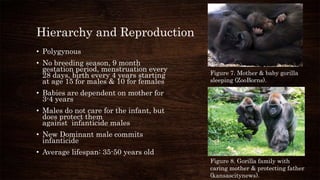
Hierarchy and Reproduction
• Polygynous
• No breeding season, 9 month
gestation period, menstruation every
28 days, birth every 4 years starting
at age 15 for males & 10 for females
• Babies are dependent on mother for
3-4 years
• Males do not care for the infant, but
does protect them
against infanticide males
• New Dominant male commits
infanticide
• Average lifespan: 35-50 years old
Figure 7. Mother & baby gorilla
sleeping (ZooBorns).
Figure 8. Gorilla family with
caring mother & protecting father
(kansascitynews).
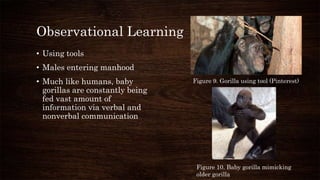
Observational Learning
• Using tools
• Males entering manhood
• Much like humans, baby
gorillas are constantly being
fed vast amount of
information via verbal and
nonverbal communication
Figure 9. Gorilla using tool (Pinterest)
Figure 10. Baby gorilla mimicking
older gorilla
Questions?
Sources
• http://www.gorillas-world.com/gorilla-communication/
• http://animaldiversity.org/accounts/Gorilla_gorilla/
• Title slide picture (DailyMail)

Western gorilla

  • 1.
    Western Gorilla DANIEL RAMIREZ,MORGAN GILLEY VERTEBRATE ZOOLOGY SUMMER 2017 LAB REPORT C UNIVERSITY OF CENTRAL ARKANSAS
  • 2.
    Objectives • Background (Habitat,features, evolutionary history) • Communication (verbal and nonverbal) • Behavior
  • 3.
    Taxonomy • Common Name:Gorillas • Scientific Name: Gorilla gorilla • Order: Primates • Family: Great Apes • Closest Relative in Arkansas: Humans Figure 1. Mammalian cladogram (slideshare.net).
  • 4.
    Habitat and GeographicalLocation • Cameroon/Gabon, Africa • Ethiopia • Lowlands of Africa’s Tropical Secondary forests – Dense forest -perfect for Gorilla’s diet Figure 2. Gorilla Geographic Habitat (Zoo.org)
  • 5.
    Appearance & Food •Largest primate, no tail, jet black skin, dark hair covers body except for the face, hands, feet, & ears with brown hair on the top of the head & back, large hands with a very large thumb, short muzzle , prominent brow bridge, small ears & eyes, large & strong jaw muscles & teeth • Silverbacks: older males with gray hair on their back & rump • Males: 180 kg, 1.75 m tall • Females: 90 kg, 1.25 m tall • Herbivores-stemmed plants, berries, leaves • Feed in the morning & afternoon 15 m up in trees Figure 3. Gorilla eating a stemmed plant (Sce- News.com).
  • 6.
    Gorilla Communication andBehavior • Nonverbal – ‘Silver back’ depicts sexual maturity for males – Power • Size • Protection -beating chest; charge intruders • Dominance in the troop Figure 4. Gorilla gorilla (BetterLIfeCoachingBlog)
  • 7.
    Gorilla Communication andBehavior Cont’d • Verbal – Growling • Warning for intruders/competitors – Hooting by dominant male • Causes members of troop to acknowledge dominant male – Mother nurturing • Find food, socialize with rest of troop, offer support or discipline, locating one another. • Infants are suckled for up to 3-4 years – Babies also communicate with the mothers i.e. crying and whining Figure 5. Mother interacting with her offspring (Gorillas World)
  • 8.
    Gorilla Behavior • Mom& baby playing • https://www.youtube.com/watch?v= Ac6p7T2Bc00 • Chest Pounding -Communication • https://www.youtube.com/watch?v= lk2udXac7nU Figure 6. Gorilla pounding chest (Sendirimu)
  • 9.
    Hierarchy and Reproduction •Polygynous • No breeding season, 9 month gestation period, menstruation every 28 days, birth every 4 years starting at age 15 for males & 10 for females • Babies are dependent on mother for 3-4 years • Males do not care for the infant, but does protect them against infanticide males • New Dominant male commits infanticide • Average lifespan: 35-50 years old Figure 7. Mother & baby gorilla sleeping (ZooBorns). Figure 8. Gorilla family with caring mother & protecting father (kansascitynews).
  • 10.
    Observational Learning • Usingtools • Males entering manhood • Much like humans, baby gorillas are constantly being fed vast amount of information via verbal and nonverbal communication Figure 9. Gorilla using tool (Pinterest) Figure 10. Baby gorilla mimicking older gorilla
  • 11.
  • 12.