West Virginia

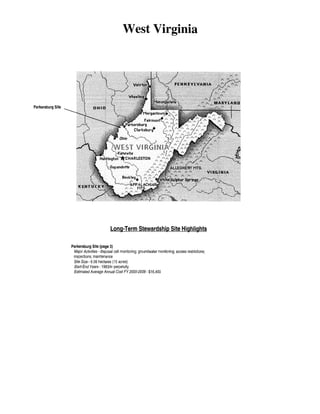
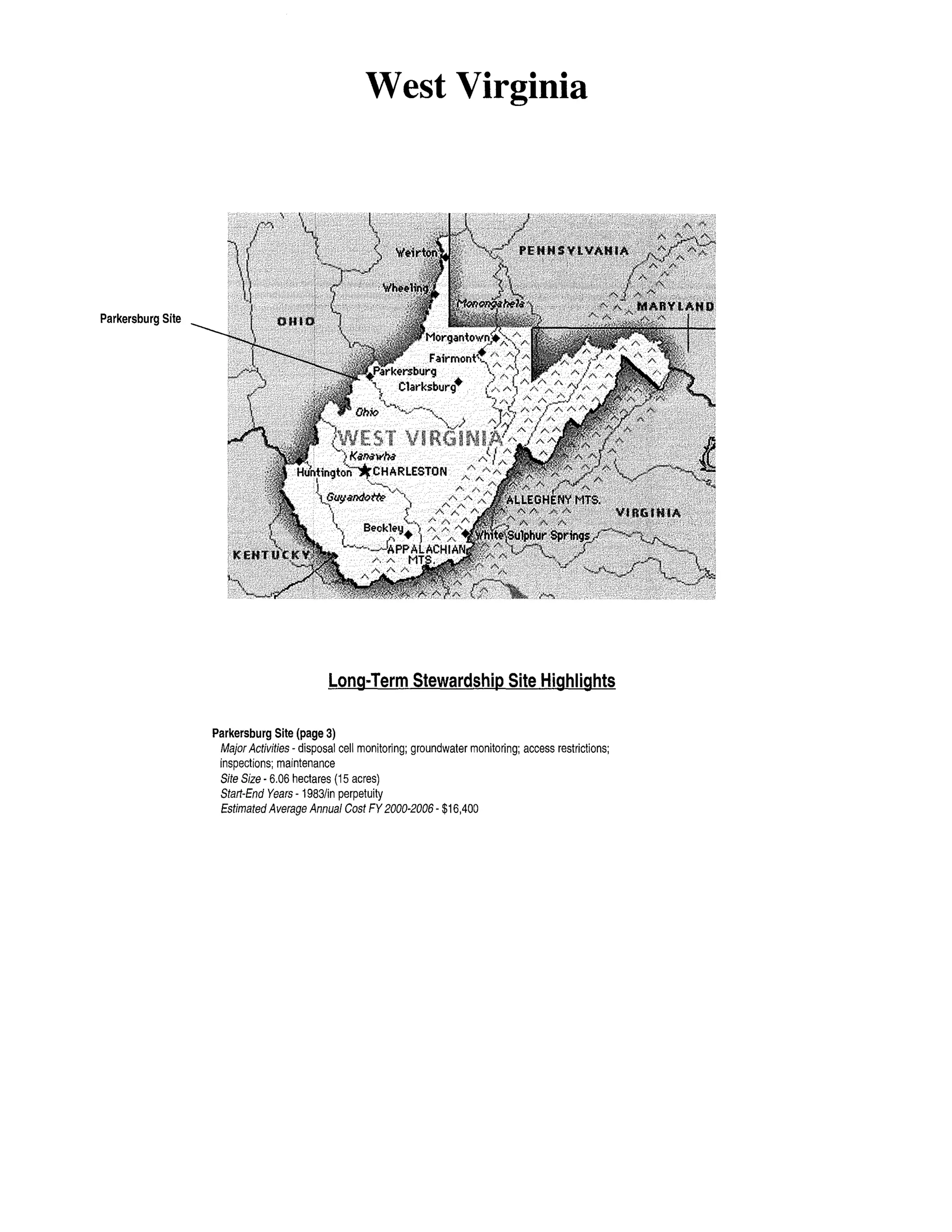
Parkersburg Site

Long-Term Stewardship Site Highlights
Parkersburg Site (page 3)
Major Activities- disposal cell monitoring; groundwater monitoring; access restrictions;
inspections; maintenance
Site Size- 6.06 hectares (15 acres)
Stat1-End Years- 1983/in perpetuity
Estimated Average Annual Cost FY 2000-2006- $16,400
Table of Contents

Table of Contents

Parkersburg Site

West Virginia

0

0

0

0

0

0

0

0

0

0

0

0

0

0

0

0

0

0

0

0

0

0

0

0

0

0

0

0

0

0

0

0

0

0

0

0

0

0

0

0

0

0

0

0

0

0

0

0

0

0

0

0

0

0

0

0

0

0

0

0

0

0

0

0

0

0

0

0

0

0

0

0

3

1
National Defense Authorization Act (NDAA) Long-Term Stewardship Report

West Virginia

2
Parkersburg Site

PARKERSBURG SITE

1.0

SITE SUMMARY

1.1

Site Description and Mission

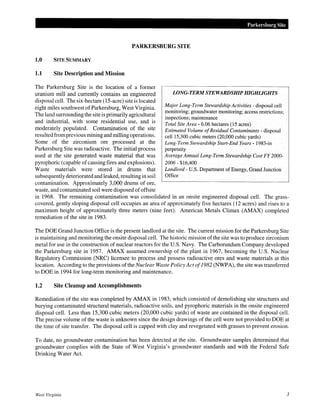
The Parkersburg Site is the location of a former
LONG-TERM STEWARDSHIP HIGHLIGHTS
uranium mill and currently contains an engineered
disposal cell. The six-hectare (15-acre) site is located
Major Long-Term Stewardship Activities - disposal cell
eight miles southwest of Parkersburg, West Virginia.
monitoring; groundwater monitoring; access restrictions;
The land surrounding the site is primarily agricultural
inspections; maintenance
and industrial, with some residential use, and is
Total Site Area- 6.06 hectares (15 acres)
moderately populated. Contamination of the site
Estimated Volume of Residual Contaminants- disposal
resulted from previous mining and milling operations.
cell 15,300 cubic meters (20,000 cubic yards)
Some of the zirconium ore processed at the
Long-Term Stewardship Start-End Years- 1983-in
Parkersburg Site was radioactive. The initial process
perpetuity
Average Annual Long-Term Stewardship Cost FY 2000used at the site generated waste material that was
pyrophoric (capable of causing fires and explosions).
2006- $16,400
Landlord- U.S. Department of Energy, Grand Junction
Waste materials were stored in drums that
Office
subsequently deteriorated and leaked, resulting in soil
contamination. Approximately 3,000 drums of ore,
waste, and contaminated soil were disposed of offsite
in 1968. The remaining contamination was consolidated in an onsite engineered disposal cell. The grasscovered, gently sloping disposal cell occupies an area of approximately five hectares (12 acres) and rises to a
maximum height of approximately three meters (nine feet). American Metals Climax (AMAX) completed
remediation of the site in 1983.
The DOE Grand Junction Office is the present landlord at the site. The current mission for the Parkersburg Site
is maintaining and monitoring the onsite disposal cell. The historic mission of the site was to produce zirconium
metal for use in the construction of nuclear reactors for the U.S. Navy. The Carborundum Company developed
the Parkersburg site in 1957. AMAX assumed ownership of the plant in 1967, becoming the U.S. Nuclear
Regulatory Commission (NRC) licensee to process and possess radioactive ores and waste materials at this
location. According to the provisions of the Nuclear Waste Policy Act of 1982 (NWPA), the site was transferred
to DOE in 1994 for long-term monitoring and maintenance.

1.2

Site Cleanup and Accomplishments

Remediation ofthe site was completed by AMAX in 1983, which consisted of demolishing site structures and
burying contaminated structural materials, radioactive soils, and pyrophoric materials in the onsite engineered
disposal cell. Less than 15,300 cubic meters (20,000 cubic yards) of waste are contained in the disposal cell.
The precise volume of the waste is unknown since the design drawings of the cell were not provided to DOE at
the time of site transfer. The disposal cell is capped with clay and revegetated with grasses to prevent erosion.
To date, no groundwater contamination has been detected at the site. Groundwater samples determined that
groundwater complies with the State of West Virginia's groundwater standards and with the Federal Safe
Drinking Water Act.

West Virginia

3
National Defense Authorization Act (NDAA) Long-Term Steardship Report

To Parkersburg (-7 miles)

@ GroundWater Monitoring Well

0

0.1

:,.

0.2

Miles

Parkersburg Site

2.0

SITE· WIDE LONG· TERM STEWARDSHIP

2.1

Long-Term Stewardship Activities

Long-term stewardship activities at the Parkersburg Site began in 1983, prior to the site's transfer to DOE. The
site was transferred to DOE 1994, and DOE is now responsible for conducting all long-term stewardship
activities at the site. A two-meter (six-foot) tall locked fence surrounds the site, controlling access to the disposal
cell. To prevent human exposure to the buried waste, no drilling or other intrusive activities are allowed on the
property, except for installation of additional groundwater monitoring wells.
Boundary monuments define the six corners of the legal boundary of the site property. Warning signs are placed
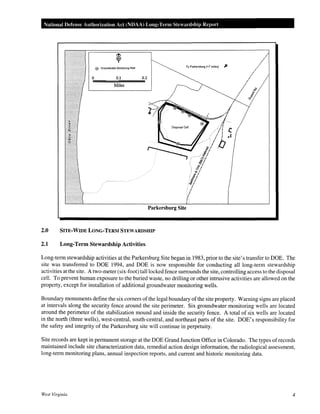
at intervals along the security fence around the site perimeter. Six groundwater monitoring wells are located
around the perimeter of the stabilization mound and inside the security fence. A total of six wells are located
in the north (three wells), west-central, south-central, and northeast parts of the site. DOE's responsibility for
the safety and integrity of the Parkersburg site will continue in perpetuity.
Site records are kept in permanent storage at the DOE Grand Junction Office in Colorado. The types of records
maintained include site characterization data, remedial action design information, the radiological assessment,
long-term monitoring plans, annual inspection reports, and current and historic monitoring data.

West Virginia

4
Parkersburg Site

2.2

Specific Long-Term Stewardship Activities

Engineered Units
The contaminated materials were placed on concrete
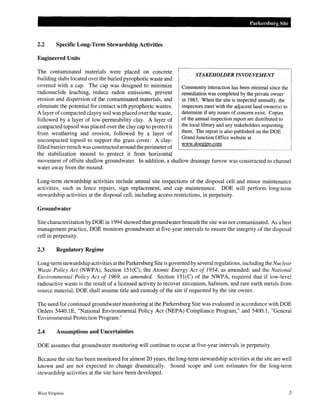
STAKEHOWER INVOLVEMENT
building slabs located over the buried pyrophoric waste and
covered with a cap. The cap was designed to minimize
Community interaction has been minimal since the
radionuclide leaching, reduce radon emissions, prevent
remediation was completed by the private owner
erosion and dispersion of the contaminated materials, and
in 1983. When the site is inspected annually, the
eliminate the potential for contact with pyrophoric wastes.
inspectors meet with the adjacent land owner(s) to
determine if any issues of concern exist. Copies
A layer of compacted clayey soil was placed over the waste,
of the annual inspection report are distributed to
followed by a layer of low-permeability clay. A layer of
the local library and any stakeholders requesting
compacted topsoil was placed over the clay cap to protect it
them. The report is also published on the DOE
from weathering and erosion, followed by a layer of
Grand Junction Office website at
uncompacted topsoil to support the grass cover. A claywww.doegjpo.com.
filled barrier trench was constructed around the perimeter of
the stabilization mound to protect it from horizontal
movement of offsite shallow groundwater. In addition, a shallow drainage furrow was constructed to channel
water away from the mound.
Long-term stewardship activities include annual site inspections of the disposal cell and minor maintenance
activities, such as fence repairs, sign replacement, and cap maintenance. DOE will perform long-term
stewardship activities at the disposal cell, including access restrictions, in perpetuity.

Groundwater
Site characterization by DOE in 1994 showed that groundwater beneath the site was not contaminated. As a best
management practice, DOE monitors groundwater at five-year intervals to ensure the integrity of the disposal
cell in perpetuity.

2.3

Regulatory Regime

Long-term stewardship activities at the Parkersburg Site is governed by several regulations, including the Nuclear
Waste Policy Act (NWPA), Section 151(C); the Atomic Energy Act of 1954, as amended; and the National
Environmental Policy Act of 1969, as amended. Section 151(C) of the NWPA, required that if low-level
radioactive waste is the result of a licensed activity to recover zirconium, hafnium, and rare earth metals from
source material, DOE shall assume title and custody of the site if requested by the site owner.
The need for continued groundwater monitoring at the Parkersburg Site was evaluated in accordance with DOE
Orders 5440.1E, "National Environmental Policy Act (NEPA) Compliance Program," and 5400.1, "General
Environmental Protection Program."

2.4

Assumptions and Uncertainties

DOE assumes that groundwater monitoring will continue to occur at five-year intervals in perpetuity.
Because the site has been monitored for almost 20 years, the long-term stewardship activities at the site are well
known and are not expected to change dramatically. Sound scope and cost estimates for the long-term
stewardship activities at the site have been developed.

West Virginia

5
National Defense Authorization Act (NDAA) Long-Term Stewardship Report

3.0

ESTIMATED LONG-TERM STEWARDSHIP COSTS

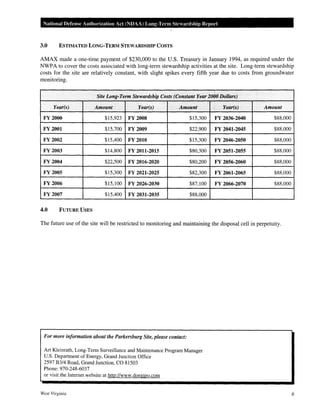
AMAX made a one-time payment of $230,000 to the U.S. Treasury in January 1994, as required under the
NWPA to cover the costs associated with long-term stewardship activities at the site. Long-term stewardship
costs for the site are relatively constant, with slight spikes every fifth year due to costs from groundwater
monitoring.
Site Long-Term Stewardship Costs (Constant Year 2000 Dollars)
Year(s)

Amount

Year(s)

Amount

'~

Year(s)

Amount

FY 2000

$15,923

FY2008

$15,300

FY 2036-2040

$88,000

FY2001

$15,700

FY 2009

$22,900

FY 2041-2045

$88,000

FY 2002

$15,400

FY 2010

$15,300

FY 2046-2050

$88,000

FY 2003

$14,800

FY 2011-2015

$80,300

FY 2051-2055

$88,000

FY 2004

$22,500

FY 2016-2020

$80,200

FY 2056-2060

$88,000

FY 2005

$15,300

FY 2021-2025

$82,300

FY 2061-2065

$88,000

FY 2006

$15,100

FY 2026-2030

$87,100

FY 2066-2070

$88,000

FY 2007

$15,400

FY 2031-2035

$88,000

4.0

FUTURE USES

The future use of the site will be restricted to monitoring and maintaining the disposal cell in perpetuity.

For more information about the Parkersburg Site, please contact:

Art Kleinrath, Long-Term Surveillance and Maintenance Program Manager
U.S. Department of Energy, Grand Junction Office
2597 B3/4 Road, Grand Junction, CO 81503
Phone: 970-248-6037
or visit the Internet website at http://www.doegjpo.com

West Virginia

6

West virginia

  • 1.
    West Virginia Parkersburg Site Long-TermStewardship Site Highlights Parkersburg Site (page 3) Major Activities- disposal cell monitoring; groundwater monitoring; access restrictions; inspections; maintenance Site Size- 6.06 hectares (15 acres) Stat1-End Years- 1983/in perpetuity Estimated Average Annual Cost FY 2000-2006- $16,400
  • 3.
    Table of Contents Tableof Contents Parkersburg Site West Virginia 0 0 0 0 0 0 0 0 0 0 0 0 0 0 0 0 0 0 0 0 0 0 0 0 0 0 0 0 0 0 0 0 0 0 0 0 0 0 0 0 0 0 0 0 0 0 0 0 0 0 0 0 0 0 0 0 0 0 0 0 0 0 0 0 0 0 0 0 0 0 0 0 3 1
  • 4.
    National Defense AuthorizationAct (NDAA) Long-Term Stewardship Report West Virginia 2
  • 5.
    Parkersburg Site PARKERSBURG SITE 1.0 SITESUMMARY 1.1 Site Description and Mission The Parkersburg Site is the location of a former LONG-TERM STEWARDSHIP HIGHLIGHTS uranium mill and currently contains an engineered disposal cell. The six-hectare (15-acre) site is located Major Long-Term Stewardship Activities - disposal cell eight miles southwest of Parkersburg, West Virginia. monitoring; groundwater monitoring; access restrictions; The land surrounding the site is primarily agricultural inspections; maintenance and industrial, with some residential use, and is Total Site Area- 6.06 hectares (15 acres) moderately populated. Contamination of the site Estimated Volume of Residual Contaminants- disposal resulted from previous mining and milling operations. cell 15,300 cubic meters (20,000 cubic yards) Some of the zirconium ore processed at the Long-Term Stewardship Start-End Years- 1983-in Parkersburg Site was radioactive. The initial process perpetuity Average Annual Long-Term Stewardship Cost FY 2000used at the site generated waste material that was pyrophoric (capable of causing fires and explosions). 2006- $16,400 Landlord- U.S. Department of Energy, Grand Junction Waste materials were stored in drums that Office subsequently deteriorated and leaked, resulting in soil contamination. Approximately 3,000 drums of ore, waste, and contaminated soil were disposed of offsite in 1968. The remaining contamination was consolidated in an onsite engineered disposal cell. The grasscovered, gently sloping disposal cell occupies an area of approximately five hectares (12 acres) and rises to a maximum height of approximately three meters (nine feet). American Metals Climax (AMAX) completed remediation of the site in 1983. The DOE Grand Junction Office is the present landlord at the site. The current mission for the Parkersburg Site is maintaining and monitoring the onsite disposal cell. The historic mission of the site was to produce zirconium metal for use in the construction of nuclear reactors for the U.S. Navy. The Carborundum Company developed the Parkersburg site in 1957. AMAX assumed ownership of the plant in 1967, becoming the U.S. Nuclear Regulatory Commission (NRC) licensee to process and possess radioactive ores and waste materials at this location. According to the provisions of the Nuclear Waste Policy Act of 1982 (NWPA), the site was transferred to DOE in 1994 for long-term monitoring and maintenance. 1.2 Site Cleanup and Accomplishments Remediation ofthe site was completed by AMAX in 1983, which consisted of demolishing site structures and burying contaminated structural materials, radioactive soils, and pyrophoric materials in the onsite engineered disposal cell. Less than 15,300 cubic meters (20,000 cubic yards) of waste are contained in the disposal cell. The precise volume of the waste is unknown since the design drawings of the cell were not provided to DOE at the time of site transfer. The disposal cell is capped with clay and revegetated with grasses to prevent erosion. To date, no groundwater contamination has been detected at the site. Groundwater samples determined that groundwater complies with the State of West Virginia's groundwater standards and with the Federal Safe Drinking Water Act. West Virginia 3
  • 6.
    National Defense AuthorizationAct (NDAA) Long-Term Steardship Report To Parkersburg (-7 miles) @ GroundWater Monitoring Well 0 0.1 :,. 0.2 Miles Parkersburg Site 2.0 SITE· WIDE LONG· TERM STEWARDSHIP 2.1 Long-Term Stewardship Activities Long-term stewardship activities at the Parkersburg Site began in 1983, prior to the site's transfer to DOE. The site was transferred to DOE 1994, and DOE is now responsible for conducting all long-term stewardship activities at the site. A two-meter (six-foot) tall locked fence surrounds the site, controlling access to the disposal cell. To prevent human exposure to the buried waste, no drilling or other intrusive activities are allowed on the property, except for installation of additional groundwater monitoring wells. Boundary monuments define the six corners of the legal boundary of the site property. Warning signs are placed at intervals along the security fence around the site perimeter. Six groundwater monitoring wells are located around the perimeter of the stabilization mound and inside the security fence. A total of six wells are located in the north (three wells), west-central, south-central, and northeast parts of the site. DOE's responsibility for the safety and integrity of the Parkersburg site will continue in perpetuity. Site records are kept in permanent storage at the DOE Grand Junction Office in Colorado. The types of records maintained include site characterization data, remedial action design information, the radiological assessment, long-term monitoring plans, annual inspection reports, and current and historic monitoring data. West Virginia 4
  • 7.
    Parkersburg Site 2.2 Specific Long-TermStewardship Activities Engineered Units The contaminated materials were placed on concrete STAKEHOWER INVOLVEMENT building slabs located over the buried pyrophoric waste and covered with a cap. The cap was designed to minimize Community interaction has been minimal since the radionuclide leaching, reduce radon emissions, prevent remediation was completed by the private owner erosion and dispersion of the contaminated materials, and in 1983. When the site is inspected annually, the eliminate the potential for contact with pyrophoric wastes. inspectors meet with the adjacent land owner(s) to determine if any issues of concern exist. Copies A layer of compacted clayey soil was placed over the waste, of the annual inspection report are distributed to followed by a layer of low-permeability clay. A layer of the local library and any stakeholders requesting compacted topsoil was placed over the clay cap to protect it them. The report is also published on the DOE from weathering and erosion, followed by a layer of Grand Junction Office website at uncompacted topsoil to support the grass cover. A claywww.doegjpo.com. filled barrier trench was constructed around the perimeter of the stabilization mound to protect it from horizontal movement of offsite shallow groundwater. In addition, a shallow drainage furrow was constructed to channel water away from the mound. Long-term stewardship activities include annual site inspections of the disposal cell and minor maintenance activities, such as fence repairs, sign replacement, and cap maintenance. DOE will perform long-term stewardship activities at the disposal cell, including access restrictions, in perpetuity. Groundwater Site characterization by DOE in 1994 showed that groundwater beneath the site was not contaminated. As a best management practice, DOE monitors groundwater at five-year intervals to ensure the integrity of the disposal cell in perpetuity. 2.3 Regulatory Regime Long-term stewardship activities at the Parkersburg Site is governed by several regulations, including the Nuclear Waste Policy Act (NWPA), Section 151(C); the Atomic Energy Act of 1954, as amended; and the National Environmental Policy Act of 1969, as amended. Section 151(C) of the NWPA, required that if low-level radioactive waste is the result of a licensed activity to recover zirconium, hafnium, and rare earth metals from source material, DOE shall assume title and custody of the site if requested by the site owner. The need for continued groundwater monitoring at the Parkersburg Site was evaluated in accordance with DOE Orders 5440.1E, "National Environmental Policy Act (NEPA) Compliance Program," and 5400.1, "General Environmental Protection Program." 2.4 Assumptions and Uncertainties DOE assumes that groundwater monitoring will continue to occur at five-year intervals in perpetuity. Because the site has been monitored for almost 20 years, the long-term stewardship activities at the site are well known and are not expected to change dramatically. Sound scope and cost estimates for the long-term stewardship activities at the site have been developed. West Virginia 5
  • 8.
    National Defense AuthorizationAct (NDAA) Long-Term Stewardship Report 3.0 ESTIMATED LONG-TERM STEWARDSHIP COSTS AMAX made a one-time payment of $230,000 to the U.S. Treasury in January 1994, as required under the NWPA to cover the costs associated with long-term stewardship activities at the site. Long-term stewardship costs for the site are relatively constant, with slight spikes every fifth year due to costs from groundwater monitoring. Site Long-Term Stewardship Costs (Constant Year 2000 Dollars) Year(s) Amount Year(s) Amount '~ Year(s) Amount FY 2000 $15,923 FY2008 $15,300 FY 2036-2040 $88,000 FY2001 $15,700 FY 2009 $22,900 FY 2041-2045 $88,000 FY 2002 $15,400 FY 2010 $15,300 FY 2046-2050 $88,000 FY 2003 $14,800 FY 2011-2015 $80,300 FY 2051-2055 $88,000 FY 2004 $22,500 FY 2016-2020 $80,200 FY 2056-2060 $88,000 FY 2005 $15,300 FY 2021-2025 $82,300 FY 2061-2065 $88,000 FY 2006 $15,100 FY 2026-2030 $87,100 FY 2066-2070 $88,000 FY 2007 $15,400 FY 2031-2035 $88,000 4.0 FUTURE USES The future use of the site will be restricted to monitoring and maintaining the disposal cell in perpetuity. For more information about the Parkersburg Site, please contact: Art Kleinrath, Long-Term Surveillance and Maintenance Program Manager U.S. Department of Energy, Grand Junction Office 2597 B3/4 Road, Grand Junction, CO 81503 Phone: 970-248-6037 or visit the Internet website at http://www.doegjpo.com West Virginia 6