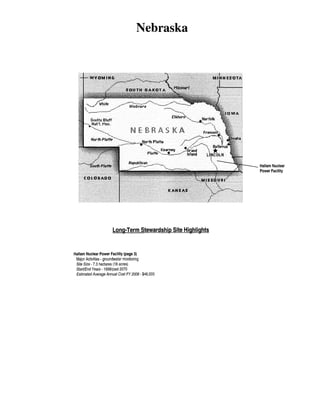
Nebraska

Hallam Nuclear
Power Facility

Long-Term Stewardship Site Highlights

Hallam Nuclear Power Facility (page 3)
Major Activities- groundwater monitoring
Site Size -7.3 hectares (18 acres)
Start/End Years- 1998/past 2070
Estimated Average Annual Cost FY 2006- $46,000
Table of Contents

Table of Contents

Hallam Nuclear Power Facility ............................................................. 3

Nebraska

1
National Defense Authorization Act (NDAA) Long-Term Stewardship Report

Nebraska

2
Hallam Nuclem· Powe1· Facility

HALLAM NUCLEAR POWER FACILITY
1.0

SITE SUMMARY

1.1

Site Description and Mission

The Hallam Nuclear Power Facility is a former sodiumcooled, graphite-moderated nuclear reactor. It was built
and operated by the U.S. Atomic Energy Commission
(AEC), the predecessor agency of the U.S. Department
of Energy (DOE), between 1962 and 1964. The reactor
was decommissioned and dismantled in 1969. The
facility is located on a small portion of the 260-hectare
(640-acre) site of the Sheldon Power Station in
Lancaster County, Nebraska, approximately 30
kilometers ( 19 miles) south of Lincoln, on land owned
by the Nebraska Public Power District.

LONG-TERM STEWARDSHIP HIGHLIGHTS
Major Long-Term Stewardship Activities -

groundwater monitoring
Total Site Area- 7.3 hectares (18 acres)
Estimated Volume of Residual Contaminants-

facilities unknown
Long-Term Stewardship Start-End Years- 1998-past
2070
Average Annual Long-Term Stewardship Cost FY
2000-2006-$46,000
Landlord- U.S. Department of Energy, Grand

Junction Office
The current mission of the Hallam Nuclear Power
Facility is to perform long-term stewardship activities,
including monitoring of the groundwater. The AEC operated the 240-megawatt thermal reactor as a
demonstration facility from 1962 until 1964. In 1965, the ABC terminated its agreement with the Nebraska
Public Power District (then known as Consumers Public Power District) to operate the reactor facility. The
Nebraska Public Power District dismantled and decommissioned the reactor from 1967 through 1969. In 1971,
the AEC retired the facility.

1.2

Site Cleanup and Accomplishments

The Nebraska Public Power District dismantled and decommissioned the reactor core and removed most of the
radioactive materials from the site; however, some radioactive materials were entombed in place. All potential
contaminants at the site are contained within the entombment structure in Area 1 (reactor vessel and vessel
containment structures), Area 2 (Fuel Storage Pit 3 thimbles), or Area 3 (moderator element storage cells). These
contaminants include nickel-63, cobalt-60, iron-55, manganese-54, samarium-151, cesium-137, strontium-90,
and tritium. The contaminants within the structure consist of activation products in the stainless steel reactor
vessel and its internals. Lesser amounts of activation products are dispersed in the carbon steel thermal shield
and guard vessel surrounding the reactor vessel and in the compartment liner itself.
The core and most of the radioactive materials, including all of the bulk sodium, were removed from the site. The
residual sodium reacted with steam to form sodium hydroxide, removing the potential for hydrogen formation
at a later date should water leak into the facility. The reactor vessel and surrounding guard vessel, which use
double-walled piping, as well as most of the reactor vessel internals, remain within the compartment. Fuel
Storage Pit 3 contains a number of stainless steel thimbles formerly used to store spent fuel elements. The storage
pool was drained, and the thimbles now contain process tubes, control rod tubes, dummy elements, and a spent
neutron source. To prevent leaks, closures and dust covers for each thimble have been welded in place and the
interspace has been filled with expanding concrete.
Storage Area 3 consists of 12 storage cells containing three canistered moderator elements that experienced
cladding failures during reactor operation. A number of parts such as pumps, valves, and segments of piping are
stored in these cells. The moderator cells were sealed by welding the plug casings to the cell liners and filling
Nebraska

3
National Defense Authorization Act (NDAA) Long-Term Stewardship Report

@ Groundwater Monitoring Well
0.05

0.1

To Lincoln, NE
(-19 miles)

I

;

Miles

11
'Iii

'

I ~
' ;;
I re
' i
I <!
j !
' ~
I n:

f
,I o

I

r
I

l

Sewage
Treatment
Plant

r

i

i

I
Hallam Nuclear Power Facility

the space above the plugs with expanding concrete.
The basement level of the facility contained radioactive waste disposal equipment, all of which has either been
removed or decontaminated, as appropriate. All reactor compartments have been sealed, and the surface of the
below-grade concrete structure was covered with sand, a waterproof polyvinyl membrane, and a covering of
earth. The cover was sloped for proper drainage, and drain tile was installed at the periphery. Above-grade
structures have been weatherproofed by a layer of polyvinyl and a protective cover of concrete. All that remains
above ground is the sealed concrete intermediate heat exchanger building. Total radioactivity was 300,000 curies
at the time of closure. By 2000, the activity level will have decayed to approximately 15,000 curies.
There is no known soil or groundwater contamination at the Hallam Nuclear Power Facility and no evidence of
contamination being released from the site.

2.0

SITE-WIDE LONG-TERM STEWARDSHIP

2.1

Long-Term Stewardship Activities

Although the Nebraska Public Power District owns the property, DOE currently has the responsibility to perform
long-term stewardship activities for the entombed reactor structure at the Hallam Nuclear Power Facility. Longterm stewardship responsibility was transferred to the DOE Grand Junction Office in 1998. The former reactor
site is now a 0.6 hectare (1.4 acre) grass-covered mound with a heat exchanger building. The installation of a
shallow groundwater monitoring system was completed in 1995 and is used as part of the surveillance program
for the entombed reactor. Groundwater monitoring is conducted annually and will continue indefinitely. Site
records are kept in permanent storage at the DOE Grand Junction Office in Colorado. The types of records kept
include characterization data, decommissioning design information, decommissioning report, annual inspection
Nebraska

4
Hallam Nuclear Power Facility

reports, and groundwater monitoring results. In addition, the Nebraska Public Power District will control access
to the site due to contaminated buried materials.

2.2

Specific Long-Term Stewardship Activities

Groundwater

STAKEHOLDER INTERACTION

Community interaction at the site has been
minimal to date. DOE sends a copy of the site's
annual inspection report to the State of Nebraska
and the Nebraska Public Power District.

Although there is no known groundwater contamination at
the site, groundwater monitoring is conducted annually to
ensure the stability of the entombed reactor. Water level
measurements are obtained from all19 DOE wells. Samples for analysis are obtained from 17 of the DOE wells.
The samples are analyzed for gross alpha, gross beta, tritium, gamma spectrometry, and nickel-63. The annual
monitoring and surveillance report discusses the results of the groundwater monitoring and summarizes the
physical condition of the site. This report also discusses the need for follow-up inspections, monitoring, or
maintenance actions, should any be necessary.

Facilities
The reactor is entombed onsite. Access to the property is restricted, as entry can only be made through the
secured property of an operating power plant where the site is located. Potential contaminants remain within the
entombed reactor; however, DOE does not conduct any active monitoring of this area.

2.3

Regulatory Regime

Long-term stewardship activities at the Hallam Nuclear Power Facility is governed by several requirements in
the following regulations: the Atomic Energy Act of 1954, as amended; EPA Groundwater Protection Standards;
and the National Environmental Policy Act of 1969, as amended.

2.4

ASSUMPTIONS AND UNCERTAINTIES

DOE's Grand Junction Office plans to evaluate the monitoring program and may decrease the sampling
frequency and the number of sampling locations. However, for the purpose of this report, groundwater
monitoring is assumed to continue indefinitely. Because the site is already performing long-term stewardship
activities, these activities are well known and are not expected to change dramatically. Site surveillance and
maintenance will be required past 2070.
3.0

ESTIMATED LONG-TERM STEWARDSHIP COSTS

The following table shows the estimated costs of long-term stewardship activities for the Hallam Nuclear Power
Facility. Because the site is already conducting long-term stewardship activities, costs are based on actual costs.
The costs below include repairs to the roof and walls of the concrete structure in fiscal year (FY) 2001. These
cost estimates reflect the current site agreements and monitoring frequencies. Thus, if the frequency and the
number of sampling locations decrease, the costs will decrease.

Nebraska

5
National Defense Authorization Act (NOAA) Long-Term Stewardship Report

Site Long-Term Stewardship Costs (Constant Year 2000 Dollars)
Year(s)

Amo.unt

Year(s)

Amount

Year(s)

Amount

FY 2000

$44,000

FY 2008

$30,500

FY 2036-2040

$208,100

FY2001

$125,700

FY2009

$30,500

FY 2041-2045

$160,000

FY2002

$30,700

FY 2010

$30,500

FY 2046-2050

$160,100

FY 2003

$29,600

FY 2011-2015

$146,100

FY 2051-2055

$160,000

FY 2004

$30,000

FY 2016-2020

$187,700

FY 2056-2060

$208,100

FY 2005

$30,300

FY 2021-2025

$149,700

FY 2061-2065

$160,000

FY2006

$30,700

FY 2026-2030

$158,400

FY 2066-2070

$160,100

FY 2007

$30,500

FY 2031-2035

$160,000

4.0

FUTURE USES

The site is within an electrical generating power station owned by Nebraska Public Power District, which
maintains security for the site. The facility will remain under controlled access due to contaminated materials.
No drilling or other intrusive activities are allowed on the property. For any future inquiries, county land title
records have been annotated regarding the presence of the decommissioned facility.

For more information about the Hallam Nuclear Power Facility, contact:
Art Kleinrath, Long-Term Surveillance and Maintenance Program Manager
U.S. Department of Energy, Grand Junction Office
2597 B3/4 Road, Grand Junction, CO 81503
Phone: 970-248-6037
or visit the Internet website at http://www.doegjpo.com

Nebraska

6

Nebraska

  • 1.
    Nebraska Hallam Nuclear Power Facility Long-TermStewardship Site Highlights Hallam Nuclear Power Facility (page 3) Major Activities- groundwater monitoring Site Size -7.3 hectares (18 acres) Start/End Years- 1998/past 2070 Estimated Average Annual Cost FY 2006- $46,000
  • 3.
    Table of Contents Tableof Contents Hallam Nuclear Power Facility ............................................................. 3 Nebraska 1
  • 4.
    National Defense AuthorizationAct (NDAA) Long-Term Stewardship Report Nebraska 2
  • 5.
    Hallam Nuclem· Powe1·Facility HALLAM NUCLEAR POWER FACILITY 1.0 SITE SUMMARY 1.1 Site Description and Mission The Hallam Nuclear Power Facility is a former sodiumcooled, graphite-moderated nuclear reactor. It was built and operated by the U.S. Atomic Energy Commission (AEC), the predecessor agency of the U.S. Department of Energy (DOE), between 1962 and 1964. The reactor was decommissioned and dismantled in 1969. The facility is located on a small portion of the 260-hectare (640-acre) site of the Sheldon Power Station in Lancaster County, Nebraska, approximately 30 kilometers ( 19 miles) south of Lincoln, on land owned by the Nebraska Public Power District. LONG-TERM STEWARDSHIP HIGHLIGHTS Major Long-Term Stewardship Activities - groundwater monitoring Total Site Area- 7.3 hectares (18 acres) Estimated Volume of Residual Contaminants- facilities unknown Long-Term Stewardship Start-End Years- 1998-past 2070 Average Annual Long-Term Stewardship Cost FY 2000-2006-$46,000 Landlord- U.S. Department of Energy, Grand Junction Office The current mission of the Hallam Nuclear Power Facility is to perform long-term stewardship activities, including monitoring of the groundwater. The AEC operated the 240-megawatt thermal reactor as a demonstration facility from 1962 until 1964. In 1965, the ABC terminated its agreement with the Nebraska Public Power District (then known as Consumers Public Power District) to operate the reactor facility. The Nebraska Public Power District dismantled and decommissioned the reactor from 1967 through 1969. In 1971, the AEC retired the facility. 1.2 Site Cleanup and Accomplishments The Nebraska Public Power District dismantled and decommissioned the reactor core and removed most of the radioactive materials from the site; however, some radioactive materials were entombed in place. All potential contaminants at the site are contained within the entombment structure in Area 1 (reactor vessel and vessel containment structures), Area 2 (Fuel Storage Pit 3 thimbles), or Area 3 (moderator element storage cells). These contaminants include nickel-63, cobalt-60, iron-55, manganese-54, samarium-151, cesium-137, strontium-90, and tritium. The contaminants within the structure consist of activation products in the stainless steel reactor vessel and its internals. Lesser amounts of activation products are dispersed in the carbon steel thermal shield and guard vessel surrounding the reactor vessel and in the compartment liner itself. The core and most of the radioactive materials, including all of the bulk sodium, were removed from the site. The residual sodium reacted with steam to form sodium hydroxide, removing the potential for hydrogen formation at a later date should water leak into the facility. The reactor vessel and surrounding guard vessel, which use double-walled piping, as well as most of the reactor vessel internals, remain within the compartment. Fuel Storage Pit 3 contains a number of stainless steel thimbles formerly used to store spent fuel elements. The storage pool was drained, and the thimbles now contain process tubes, control rod tubes, dummy elements, and a spent neutron source. To prevent leaks, closures and dust covers for each thimble have been welded in place and the interspace has been filled with expanding concrete. Storage Area 3 consists of 12 storage cells containing three canistered moderator elements that experienced cladding failures during reactor operation. A number of parts such as pumps, valves, and segments of piping are stored in these cells. The moderator cells were sealed by welding the plug casings to the cell liners and filling Nebraska 3
  • 6.
    National Defense AuthorizationAct (NDAA) Long-Term Stewardship Report @ Groundwater Monitoring Well 0.05 0.1 To Lincoln, NE (-19 miles) I ; Miles 11 'Iii ' I ~ ' ;; I re ' i I <! j ! ' ~ I n: f ,I o I r I l Sewage Treatment Plant r i i I Hallam Nuclear Power Facility the space above the plugs with expanding concrete. The basement level of the facility contained radioactive waste disposal equipment, all of which has either been removed or decontaminated, as appropriate. All reactor compartments have been sealed, and the surface of the below-grade concrete structure was covered with sand, a waterproof polyvinyl membrane, and a covering of earth. The cover was sloped for proper drainage, and drain tile was installed at the periphery. Above-grade structures have been weatherproofed by a layer of polyvinyl and a protective cover of concrete. All that remains above ground is the sealed concrete intermediate heat exchanger building. Total radioactivity was 300,000 curies at the time of closure. By 2000, the activity level will have decayed to approximately 15,000 curies. There is no known soil or groundwater contamination at the Hallam Nuclear Power Facility and no evidence of contamination being released from the site. 2.0 SITE-WIDE LONG-TERM STEWARDSHIP 2.1 Long-Term Stewardship Activities Although the Nebraska Public Power District owns the property, DOE currently has the responsibility to perform long-term stewardship activities for the entombed reactor structure at the Hallam Nuclear Power Facility. Longterm stewardship responsibility was transferred to the DOE Grand Junction Office in 1998. The former reactor site is now a 0.6 hectare (1.4 acre) grass-covered mound with a heat exchanger building. The installation of a shallow groundwater monitoring system was completed in 1995 and is used as part of the surveillance program for the entombed reactor. Groundwater monitoring is conducted annually and will continue indefinitely. Site records are kept in permanent storage at the DOE Grand Junction Office in Colorado. The types of records kept include characterization data, decommissioning design information, decommissioning report, annual inspection Nebraska 4
  • 7.
    Hallam Nuclear PowerFacility reports, and groundwater monitoring results. In addition, the Nebraska Public Power District will control access to the site due to contaminated buried materials. 2.2 Specific Long-Term Stewardship Activities Groundwater STAKEHOLDER INTERACTION Community interaction at the site has been minimal to date. DOE sends a copy of the site's annual inspection report to the State of Nebraska and the Nebraska Public Power District. Although there is no known groundwater contamination at the site, groundwater monitoring is conducted annually to ensure the stability of the entombed reactor. Water level measurements are obtained from all19 DOE wells. Samples for analysis are obtained from 17 of the DOE wells. The samples are analyzed for gross alpha, gross beta, tritium, gamma spectrometry, and nickel-63. The annual monitoring and surveillance report discusses the results of the groundwater monitoring and summarizes the physical condition of the site. This report also discusses the need for follow-up inspections, monitoring, or maintenance actions, should any be necessary. Facilities The reactor is entombed onsite. Access to the property is restricted, as entry can only be made through the secured property of an operating power plant where the site is located. Potential contaminants remain within the entombed reactor; however, DOE does not conduct any active monitoring of this area. 2.3 Regulatory Regime Long-term stewardship activities at the Hallam Nuclear Power Facility is governed by several requirements in the following regulations: the Atomic Energy Act of 1954, as amended; EPA Groundwater Protection Standards; and the National Environmental Policy Act of 1969, as amended. 2.4 ASSUMPTIONS AND UNCERTAINTIES DOE's Grand Junction Office plans to evaluate the monitoring program and may decrease the sampling frequency and the number of sampling locations. However, for the purpose of this report, groundwater monitoring is assumed to continue indefinitely. Because the site is already performing long-term stewardship activities, these activities are well known and are not expected to change dramatically. Site surveillance and maintenance will be required past 2070. 3.0 ESTIMATED LONG-TERM STEWARDSHIP COSTS The following table shows the estimated costs of long-term stewardship activities for the Hallam Nuclear Power Facility. Because the site is already conducting long-term stewardship activities, costs are based on actual costs. The costs below include repairs to the roof and walls of the concrete structure in fiscal year (FY) 2001. These cost estimates reflect the current site agreements and monitoring frequencies. Thus, if the frequency and the number of sampling locations decrease, the costs will decrease. Nebraska 5
  • 8.
    National Defense AuthorizationAct (NOAA) Long-Term Stewardship Report Site Long-Term Stewardship Costs (Constant Year 2000 Dollars) Year(s) Amo.unt Year(s) Amount Year(s) Amount FY 2000 $44,000 FY 2008 $30,500 FY 2036-2040 $208,100 FY2001 $125,700 FY2009 $30,500 FY 2041-2045 $160,000 FY2002 $30,700 FY 2010 $30,500 FY 2046-2050 $160,100 FY 2003 $29,600 FY 2011-2015 $146,100 FY 2051-2055 $160,000 FY 2004 $30,000 FY 2016-2020 $187,700 FY 2056-2060 $208,100 FY 2005 $30,300 FY 2021-2025 $149,700 FY 2061-2065 $160,000 FY2006 $30,700 FY 2026-2030 $158,400 FY 2066-2070 $160,100 FY 2007 $30,500 FY 2031-2035 $160,000 4.0 FUTURE USES The site is within an electrical generating power station owned by Nebraska Public Power District, which maintains security for the site. The facility will remain under controlled access due to contaminated materials. No drilling or other intrusive activities are allowed on the property. For any future inquiries, county land title records have been annotated regarding the presence of the decommissioned facility. For more information about the Hallam Nuclear Power Facility, contact: Art Kleinrath, Long-Term Surveillance and Maintenance Program Manager U.S. Department of Energy, Grand Junction Office 2597 B3/4 Road, Grand Junction, CO 81503 Phone: 970-248-6037 or visit the Internet website at http://www.doegjpo.com Nebraska 6