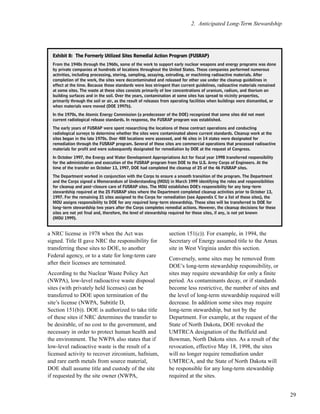
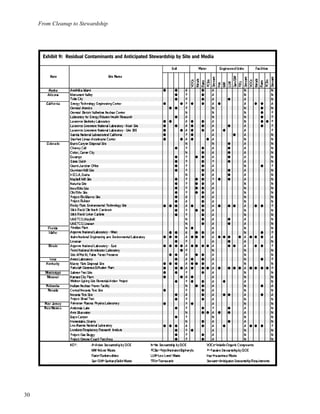
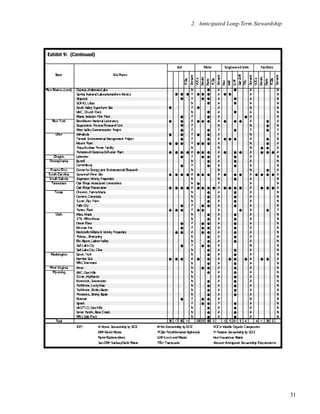
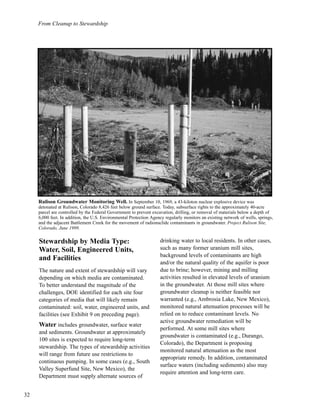
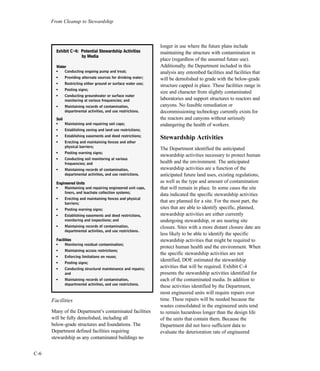
From Cleanup to Stewardship
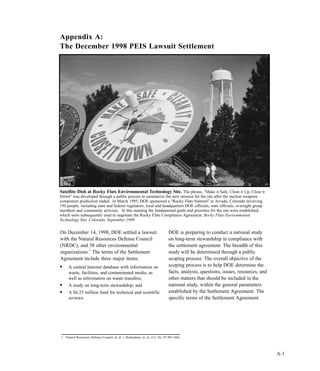
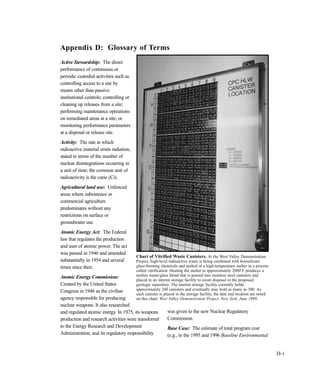
a Companion Report to Accelerating Cleanup: Paths to Closure
and
Background Information
to Support the Scoping Process
Required for the 1998 PEIS Settlement Study
U.S. Department of Energy
Office of Environmental Management
October 1999
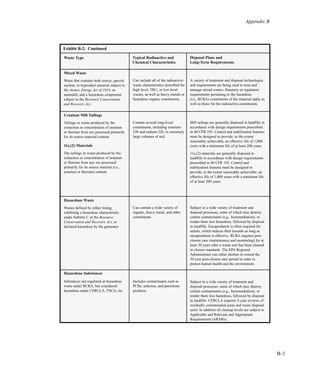
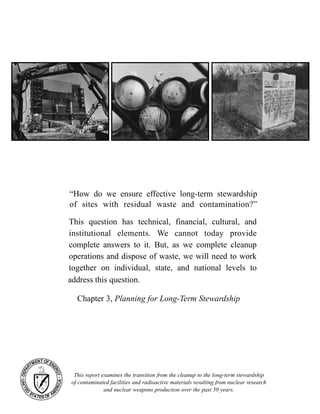
Long-term stewardship is expected to be needed at more
than 100 DOE sites after DOE’s Environmental
Management program completes disposal, stabilization,
and restoration operations to address waste and
contamination resulting from nuclear research and
nuclear weapons production conducted over the past 50
years. From Cleanup to Stewardship provides
background information on the Department of Energy
(DOE) long-term stewardship obligations and activities.
This document begins to examine the transition from
cleanup to long-term stewardship, and it fulfills the
Secretary’s commitment to the President in the 1999
Performance Agreement to provide a companion report
to the Department’s Accelerating Cleanup: Paths to
Closure report. It also provides background information
to support the scoping process required for a study on
long-term stewardship required by a 1998 Settlement
Agreement.
From Cleanup to Stewardship was produced by the
Department’s Office of Strategic Planning and Analysis
within the Office of Environmental Management, with
assistance from hundreds of people throughout the
Department, as well as from contractors, independent
experts, and others.
To obtain copies of this report or for more information on
the environmental management activities of the U.S.
Department of Energy, contact:
The Environmental Management
Information Center
1-800-736-3282 or
www.em.doe.gov/lts
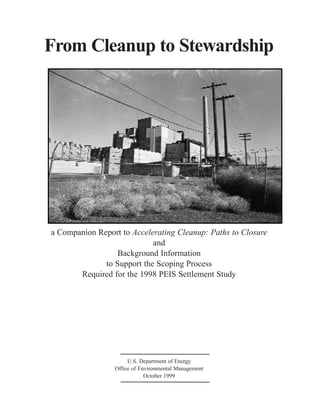
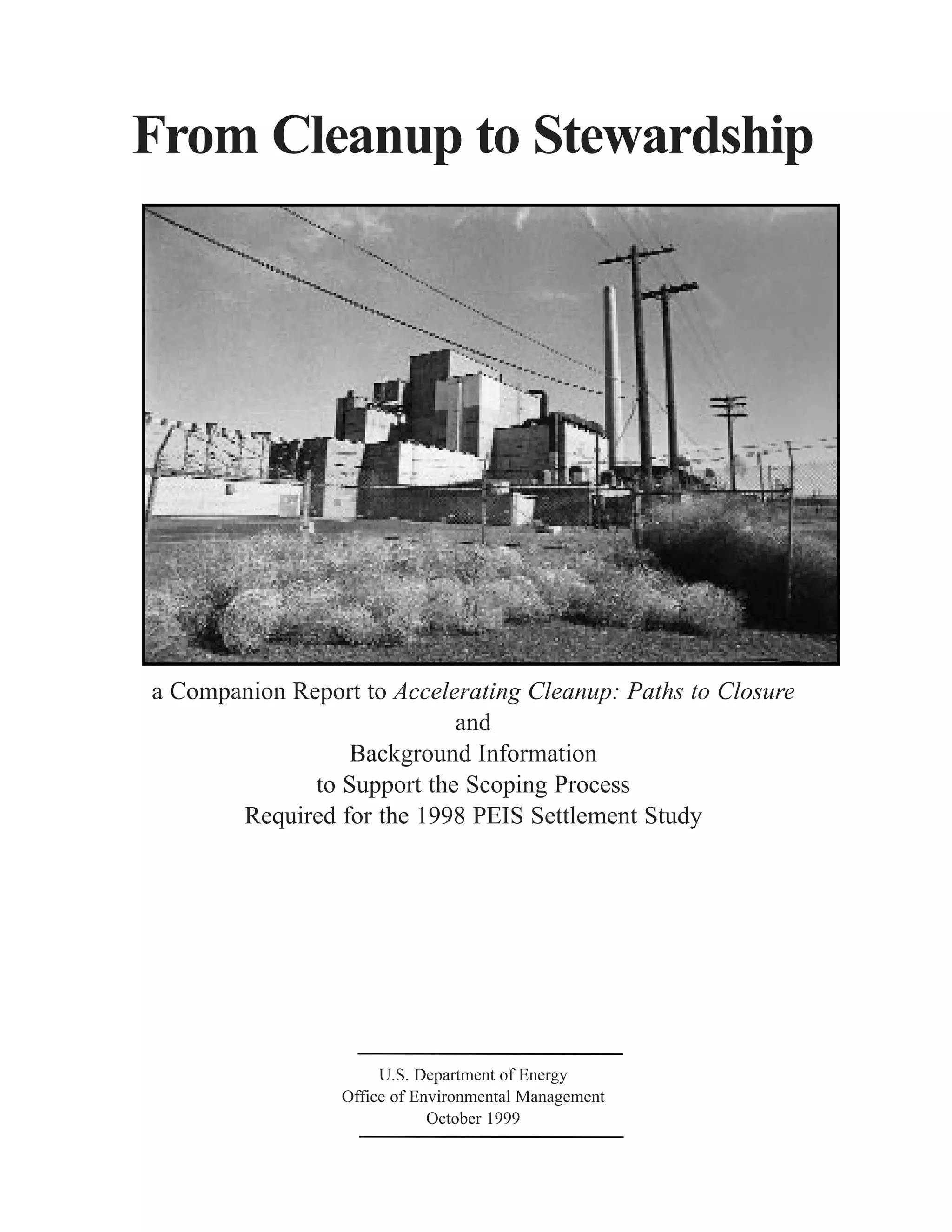
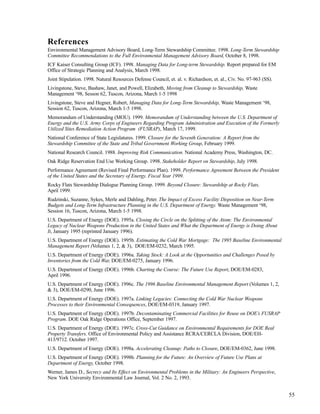
Front cover:
Hanford “B” Reactor with Tumbleweeds
This reactor was the world’s first large-scale plutonium
production reactor. Built in less than one year, it produced
plutonium from 1944 to 1968. It will be maintained as a National
Historic Mechanical Engineering Landmark.
Hanford Site, Washington, July 1994.
From Cleanup
To Stewardship
ii
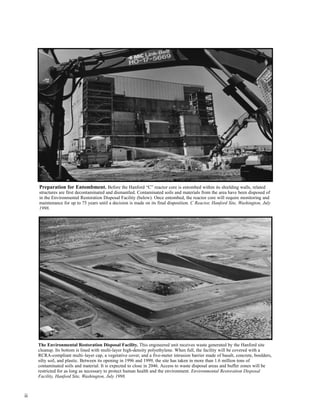
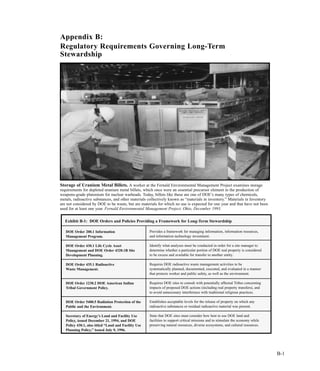
Preparation for Entombment. Before the Hanford “C” reactor core is entombed within its shielding walls, related
structures are first decontaminated and dismantled. Contaminated soils and materials from the area have been disposed of
in the Environmental Restoration Disposal Facility (below). Once entombed, the reactor core will require monitoring and
maintenance for up to 75 years until a decision is made on its final disposition. C Reactor, Hanford Site, Washington, July
1998.
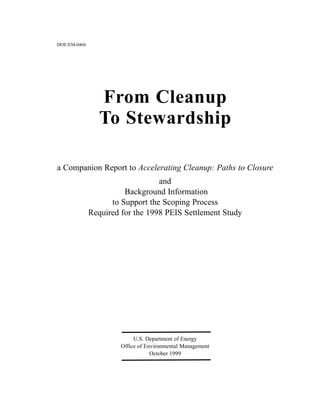
The Environmental Restoration Disposal Facility. This engineered unit receives waste generated by the Hanford site
cleanup. Its bottom is lined with multi-layer high-density polyethylene. When full, the facility will be covered with a
RCRA-compliant multi–layer cap, a vegetative cover, and a five-meter intrusion barrier made of basalt, concrete, boulders,
silty soil, and plastic. Between its opening in 1996 and 1999, the site has taken in more than 1.6 million tons of
contaminated soils and material. It is expected to close in 2046. Access to waste disposal areas and buffer zones will be
restricted for as long as necessary to protect human health and the environment. Environmental Restoration Disposal
Facility, Hanford Site, Washington, July 1998.
From Cleanup
To Stewardship
a Companion Report to Accelerating Cleanup: Paths to Closure
and
Background Information
to Support the Scoping Process
Required for the 1998 PEIS Settlement Study
U.S. Department of Energy
Office of Environmental Management
October 1999
DOE/EM-0466
v
Table of Contents
Preface . . . . . . . . . . . . . . . . . . . . . . . . . . . . . . . . . . . . . . . . . . . . . . . . . . . . . . . . . . . . . . . . . . . . . . . . . . .vii
Introduction . . . . . . . . . . . . . . . . . . . . . . . . . . . . . . . . . . . . . . . . . . . . . . . . . . . . . . . . . . . . . . . . . . . . . . . 1
Purpose of Report . . . . . . . . . . . . . . . . . . . . . . . . . . . . . . . . . . . . . . . . . . . . . . . . . . . . . . . . . . . . . . . 5
Organization of Report . . . . . . . . . . . . . . . . . . . . . . . . . . . . . . . . . . . . . . . . . . . . . . . . . . . . . . . . . . . . 6
Chapter 1: The Nature of Long-Term Stewardship at DOE Sites . . . . . . . . . . . . . . . . . . . . . . . . . . . . 9
Residual Hazards . . . . . . . . . . . . . . . . . . . . . . . . . . . . . . . . . . . . . . . . . . . . . . . . . . . . . . . . . . . . . . . 10
Why Hazards Will Remain . . . . . . . . . . . . . . . . . . . . . . . . . . . . . . . . . . . . . . . . . . . . . . . . . . . . . . . . 12
Long-Term Stewardship Activities . . . . . . . . . . . . . . . . . . . . . . . . . . . . . . . . . . . . . . . . . . . . . . . . . . 14
Regulatory Context . . . . . . . . . . . . . . . . . . . . . . . . . . . . . . . . . . . . . . . . . . . . . . . . . . . . . . . . . . . . . 18
Stewardship and Land Use . . . . . . . . . . . . . . . . . . . . . . . . . . . . . . . . . . . . . . . . . . . . . . . . . . . . . . . . 19
Long-Term Stewardship Not Unique to DOE . . . . . . . . . . . . . . . . . . . . . . . . . . . . . . . . . . . . . . . . . . 19
Chapter 2: Anticipated Long-Term Stewardship at DOE Sites . . . . . . . . . . . . . . . . . . . . . . . . . . . . . 25
Stewardship Expected at 109 Sites after Cleanup . . . . . . . . . . . . . . . . . . . . . . . . . . . . . . . . . . . . . . . 25
Nature and Extent of Stewardship Activities . . . . . . . . . . . . . . . . . . . . . . . . . . . . . . . . . . . . . . . . . . . 28
Stewardship by Media Type: Water, Soil, Engineered Units, and Facilities . . . . . . . . . . . . . . . . . . . . 32
Timing of Long-Term Stewardship Activities . . . . . . . . . . . . . . . . . . . . . . . . . . . . . . . . . . . . . . . . . . 40
Land Use . . . . . . . . . . . . . . . . . . . . . . . . . . . . . . . . . . . . . . . . . . . . . . . . . . . . . . . . . . . . . . . . . . . . . 41
Current Organizational Responsibilities . . . . . . . . . . . . . . . . . . . . . . . . . . . . . . . . . . . . . . . . . . . . . . 43
Costs of Post-Cleanup Stewardship Activities Unknown . . . . . . . . . . . . . . . . . . . . . . . . . . . . . . . . . 44
Chapter 3: Planning for Long-Term Stewardship . . . . . . . . . . . . . . . . . . . . . . . . . . . . . . . . . . . . . . . 47
References . . . . . . . . . . . . . . . . . . . . . . . . . . . . . . . . . . . . . . . . . . . . . . . . . . . . . . . . . . . . . . . . . . . . . . . 55
Index of Site -Specific Photographs and Exhibits . . . . . . . . . . . . . . . . . . . . . . . . . . . . . . . . . . . . . . . . . . .57
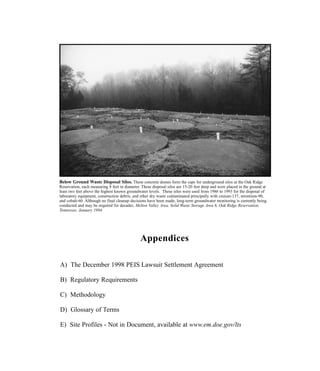
Appendices
Appendix A: The December 1998 PEIS Lawsuit Settlement Agreement . . . . . . . . . . . . . . . . . . . . . . . . A-1
Appendix B: Regulatory Requirements Governing Long-Term Stewardship . . . . . . . . . . . . . . . . . . . . . B-1
Appendix C: Methodology . . . . . . . . . . . . . . . . . . . . . . . . . . . . . . . . . . . . . . . . . . . . . . . . . . . . . . . . . . C-1
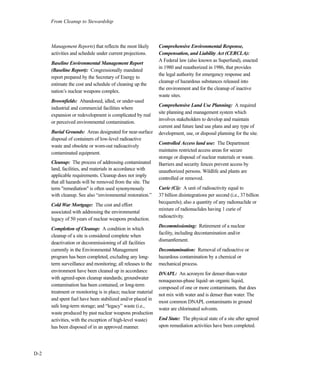
Appendix D: Glossary of Terms . . . . . . . . . . . . . . . . . . . . . . . . . . . . . . . . . . . . . . . . . . . . . . . . . . . . . . D-1
Appendix E: Site Profiles — Not in Document, available at www.em.doe.gov/lts
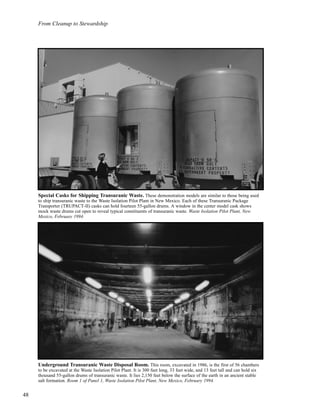
Transuranic Waste Storage Pads. Drums containing transuranic waste sit on a concrete pad in temporary storage.
This waste is contaminated with uranium-233 and plutonium. In 1999, the Department began disposing of transuranic
waste in the Waste Isolation Pilot Plant near Carlsbad, New Mexico. Transuranic Waste Storage Pads, E Area Burial
Grounds, Savannah River Site, South Carolina, January 1994.
vi
Low-Level Waste Burial. The Idaho National Engineering and Environmental Laboratory disposes of low-level waste in
this pit at the Radioactive Waste Management Complex Subsurface Disposal Area. The laboratory has 4,700 cubic meters
of low-level waste in inventory and is projected to generate an additional 115,000 cubic meters in the next 35 years. New
waste will come from facility decommissioning and dismantlement, treating and characterizing other waste streams, and
ongoing processes. Radioactive Waste Management Complex, Idaho National Engineering and Environmental
Laboratory, Idaho, March 1994.
Sedan Crater. This crater is the site of a 110-kiloton thermonuclear explosion at the Nevada Test Site in 1962. The
crater is 600 feet deep and 1,200 feet wide. Because of the widely dispersed plutonium and other radionuclides that
resulted from this explosion, this test area and others will require long-term institutional controls to prevent inadvertent
exposure to residual contamination. Area 10, Nevada Test Site, Nevada, October 1984.
vii
Preface
Beginning with the Manhattan Project during World War II, the
Federal Government has carried out extensive nuclear weapons
research and development, production, and testing activities.
Since the Cold War began, significant institutional, scientific, and
legal changes occurred: massive industrial facilities were
constructed, operated, and in many cases, shut down; scientific
research revealed much about how ionizing radiation may affect
human health; major environmental laws have been enacted; and
the missions of the Department of Energy (DOE) and its
predecessors changed significantly as a consequence of national
and world events.
Perhaps the biggest changes in the nation’s nuclear weapons
enterprise are now upon us. The Cold War ended nearly a decade
ago, and the Department has undertaken a massive program to
address the environmental consequences of nuclear weapons
production, while using a smaller complex of facilities to maintain
the nuclear weapons stockpile.
Despite these dramatic changes, one thing has remained
constant — the Federal Government’s obligation to protect human
health and the environment. The Atomic Energy Act of 1954
provides for protecting health and minimizing danger to life and
property. Since then, a number of environmental laws have
imposed additional requirements on DOE’s facilities, operations,
and activities. The need to address environmental, safety, and
health issues will remain as we enter a new millennium.
viii
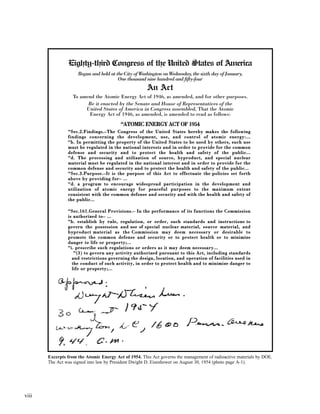
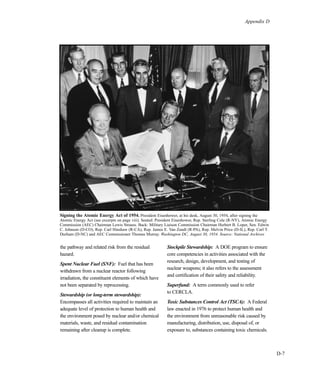
Excerpts from the Atomic Energy Act of 1954. This Act governs the management of radioactive materials by DOE.
The Act was signed into law by President Dwight D. Eisenhower on August 30, 1954 (photo page A-1).
Eighty-third Congress of the United States of America
Begun and held at the City of Washington on Wednesday, the sixth day of January,
One thousand nine hundred and fifty-four
An Act
To amend the Atomic Energy Act of 1946, as amended, and for other purposes.
Be it enacted by the Senate and House of Representatives of the
United States of America in Congress assembled, That the Atomic
Energy Act of 1946, as amended, is amended to read as follows:
““AATTOOMMIICC EENNEERRGGYY AACCTT OOFF 11995544
““SSeecc..22..FFiinnddiinnggss..––TThhee CCoonnggrreessss ooff tthhee UUnniitteedd SSttaatteess hheerreebbyy mmaakkeess tthhee ffoolllloowwiinngg
ffiinnddiinnggss ccoonncceerrnniinngg tthhee ddeevveellooppmmeenntt,, uussee,, aanndd ccoonnttrrooll ooff aattoommiicc eenneerrggyy::......
““bb.. IInn ppeerrmmiittttiinngg tthhee pprrooppeerrttyy ooff tthhee UUnniitteedd SSttaatteess ttoo bbee uusseedd bbyy ootthheerrss,, ssuucchh uussee
mmuusstt bbee rreegguullaatteedd iinn tthhee nnaattiioonnaall iinntteerreessttss aanndd iinn oorrddeerr ttoo pprroovviiddee ffoorr tthhee ccoommmmoonn
ddeeffeennssee aanndd sseeccuurriittyy aanndd ttoo pprrootteecctt tthhee hheeaalltthh aanndd ssaaffeettyy ooff tthhee ppuubblliicc......
““dd.. TThhee pprroocceessssiinngg aanndd uuttiilliizzaattiioonn ooff ssoouurrccee,, bbyypprroodduucctt,, aanndd ssppeecciiaall nnuucclleeaarr
mmaatteerriiaall mmuusstt bbee rreegguullaatteedd iinn tthhee nnaattiioonnaall iinntteerreesstt aanndd iinn oorrddeerr ttoo pprroovviiddee ffoorr tthhee
ccoommmmoonn ddeeffeennssee aanndd sseeccuurriittyy aanndd ttoo pprrootteecctt tthhee hheeaalltthh aanndd ssaaffeettyy ooff tthhee ppuubblliicc......
““SSeecc..33..PPuurrppoossee..––IItt iiss tthhee ppuurrppoossee ooff tthhiiss AAcctt ttoo eeffffeeccttuuaattee tthhee ppoolliicciieess sseett ffoorrtthh
aabboovvee bbyy pprroovviiddiinngg ffoorr–– ......
““dd.. aa pprrooggrraamm ttoo eennccoouurraaggee wwiiddeesspprreeaadd ppaarrttiicciippaattiioonn iinn tthhee ddeevveellooppmmeenntt aanndd
uuttiilliizzaattiioonn ooff aattoommiicc eenneerrggyy ffoorr ppeeaacceeffuull ppuurrppoosseess ttoo tthhee mmaaxxiimmuumm eexxtteenntt
ccoonnssiisstteenntt wwiitthh tthhee ccoommmmoonn ddeeffeennssee aanndd sseeccuurriittyy aanndd wwiitthh tthhee hheeaalltthh aanndd ssaaffeettyy ooff
tthhee ppuubblliicc......
““SSeecc..116611..GGeenneerraall PPrroovviissiioonnss..–– IInn tthhee ppeerrffoorrmmaannccee ooff iittss ffuunnccttiioonnss tthhee CCoommmmiissssiioonn
iiss aauutthhoorriizzeedd ttoo–– ......
““bb.. eessttaabblliisshh bbyy rruullee,, rreegguullaattiioonn,, oorr oorrddeerr,, ssuucchh ssttaannddaarrddss aanndd iinnssttrruuccttiioonnss ttoo
ggoovveerrnn tthhee ppoosssseessssiioonn aanndd uussee ooff ssppeecciiaall nnuucclleeaarr mmaatteerriiaall,, ssoouurrccee mmaatteerriiaall,, aanndd
bbyypprroodduucctt mmaatteerriiaall aass tthhee CCoommmmiissssiioonn mmaayy ddeeeemm nneecceessssaarryy oorr ddeessiirraabbllee ttoo
pprroommoottee tthhee ccoommmmoonn ddeeffeennssee aanndd sseeccuurriittyy oorr ttoo pprrootteecctt hheeaalltthh oorr ttoo mmiinniimmiizzee
ddaannggeerr ttoo lliiffee oorr pprrooppeerrttyy;;......
““ii.. pprreessccrriibbee ssuucchh rreegguullaattiioonnss oorr oorrddeerrss aass iitt mmaayy ddeeeemm nneecceessssaarryy......
““((33)) ttoo ggoovveerrnn aannyy aaccttiivviittyy aauutthhoorriizzeedd ppuurrssuuaanntt ttoo tthhiiss AAcctt,, iinncclluuddiinngg ssttaannddaarrddss
aanndd rreessttrriiccttiioonnss ggoovveerrnniinngg tthhee ddeessiiggnn,, llooccaattiioonn,, aanndd ooppeerraattiioonn ooff ffaacciilliittiieess uusseedd iinn
tthhee ccoonndduucctt ooff ssuucchh aaccttiivviittyy,, iinn oorrddeerr ttoo pprrootteecctt hheeaalltthh aanndd ttoo mmiinniimmiizzee ddaannggeerr ttoo
lliiffee oorr pprrooppeerrttyy;;......
1
Introduction
During the last decade, the Department of
Energy (DOE) has made significant progress in
its environmental cleanup program (see
Exhibit 1), resulting in substantially lower risks
and lower annual costs for maintaining safe
conditions. This experience in planning and
completing cleanup has made one fact clear:
complete restoration to levels acceptable for
unrestricted use cannot be accomplished at many
sites. Consequently, long-term stewardship will
be needed at these sites to ensure that the
selected remedies will remain protective for
future generations. According to this background
document, long-term stewardship includes all
activities required to protect human health and
the environment from hazards remaining at DOE
sites after cleanup is complete.
DOE is required to conduct stewardship activities
under existing requirements (see Appendix B),
and many DOE organizations have been
conducting stewardship activities over the years
as part of their ongoing missions. Scientists and
engineers have long understood that much of the
waste and other materials managed by DOE
(i.e., radionuclides and metals) cannot be broken
down into non-hazardous materials. These
materials must be managed by treatment,
isolation, and monitoring.
For example, the preferred remedy for many
radionuclide contaminated soils will be to
excavate the soil and place it in an engineered
disposal cell (e.g., a landfill or an above-ground
vault). While this results in a safer overall site
end state, the radionuclides will remain at the site
and pose a known hazard for years into the future
while the natural decaying process takes place.
The disposal cell, therefore, will need long-term
monitoring, maintenance, and controls to ensure
the remedy remains protective of human health
and the environment in the future.
The realization that long-term stewardship
ultimately will be a primary mission at most
DOE sites grew out of analytical efforts to
develop a clearer “path forward,” and to improve
the financial and managerial control of the
Department’s Environmental Management (EM)
program. These analyses, published in the
Baseline Environmental Management Reports
(DOE 1995b, 1996c) and Accelerating Cleanup:
Paths to Closure Report (DOE 1998a), have
helped the Department estimate the long-term
costs and schedule of the cleanup program well
into the 21st Century.
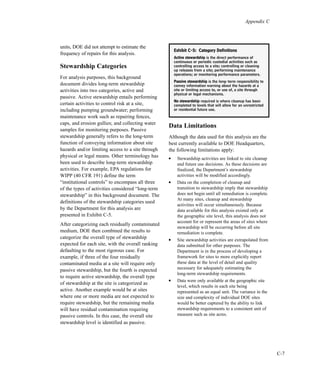
EExxhhiibbiitt 11:: CClleeaannuupp PPrrooggrreessss SSiinnccee 11998899
l
The Department has completed remedial work
(i.e., "cleanup") at almost half of its sites.
l
Significant progress has been made in
constructing and operating waste treatment and
disposal facilities.
l
Hundreds of kilograms of dangerous nuclear
materials have been stabilized.
l
Approximately 450 facilities have been
decommissioned through 1998.
l
Dozens of new technologies, developed and
implemented at DOE sites, have enabled the
Department to reduce risks and ]mortgage^ costs
and remedy previously intractable contamination.
EExxiissttiinngg RReeqquuiirreemmeennttss ffoorr
LLoonngg--TTeerrmm SStteewwaarrddsshhiipp
Existing laws, regulations, and DOE policies and
directives provide broad requirements for DOE to
conduct monitoring, reporting, record keeping,
and long-term surveillance and maintenance for
waste management facilities, soil and buried
waste, engineered waste disposal units, facilities,
surface water, and groundwater (see Appendix B).
Long-term stewardship activities are being
conducted by a variety of DOE organizations. For
many DOE sites and organizations, stewardship
activities represent only a minor part of their
principal mission, although long-term stewardship
is the only mission at several sites.
Although statutory and regulatory requirements
provide a general foundation for long-term
stewardship, it is not certain whether existing
requirements encompass all of the activities that
may be involved in long-term stewardship, nor do
they ensure the development of effective
implementation strategies.
2
From Cleanup to Stewardship
The results of these analyses have helped put a
price on the environmental consequences of the
Cold War, and they have revealed how to
reduce that price through smarter ways of doing
business, especially by accelerating cleanup.
Four major findings of these analyses were:
l
The initial projected cost was too high and the
timetable too long for Congress to be expected
to provide continuing support of the program.
1
Significant changes were therefore required to
improve efficiency and expedite the cleanup.
l
Substantial costs were projected for maintaining
infrastructure and safe conditions during
cleanup operations, rather than directly paying
for cleanup. Therefore, accelerating cleanup
will reduce costs.
l
Many of the Department’s cleanup plans
assume that waste and residual contamination
will be stabilized, but cannot be removed
entirely. These plans have been and will
continue to be approved by regulators and made
in consultation with stakeholders.
l
Many of the DOE sites that have not
completed cleanup are just beginning to
define the full scope and cost of long-term
stewardship activities.
Upon publication of the second Baseline report
in 1996, the Department established a goal of
completing cleanup at as many sites as possible
by the year 2006. To accomplish this goal, the
Department increased its efforts to improve
efficiency through greater integration among
site cleanup programs, and related initiatives.
The Department reorganized the budget
structure for the EM program into more than
350 “projects” to focus attention on discrete
sets of tasks with clear end points. The
Department also established a new account
structure with three general budget categories:
l
“Site Closure” – sites for which EM has
established a goal of completing cleanup by the
end of FY 2006. After cleanup is completed at
these sites, no further Departmental mission is
envisioned, except for limited long-term
surveillance and maintenance, and the sites will
be available for some alternative use.
l
“Site/Project Completion” – projects that will
be completed by 2006 at EM sites where overall
site cleanup will not be fully accomplished by
2006; and entire sites where cleanup will be
completed by 2006 (except for long-term
stewardship activities), and where there will be
a continuing federal workforce at the site to
carry out enduring missions.
l
“Post 2006 Completion” – projects that are
expected to require work beyond FY 2006.
This improved cleanup and closure effort was
described initially in a draft report in February
1998, Accelerating Cleanup: Paths to Closure,
and in a revised report issued in June 1998
(DOE 1998a). Among other things, this report
described the projected end state for each site
once cleanup has been completed.
WWhhyy AAddddrreessss SStteewwaarrddsshhiipp NNooww??
l
To provide for smooth transition from cleanup to long-term stewardship through technical, financial, and
managerial planning
l
Emphasize that the "cleanup" goal in many cases is to reduce and control, not eliminate, risk and cost
l
Ensure that Congress, regulators, and other stakeholders have a clear understanding of what the cleanup
mission will "produce" and clarify that there is an attainable end point
l
Set realistic expectations and show interim successes and results
l
Identify technology research and development needs
l
Assure regulators and the public that DOE will not walk away from its enduring obligations.
1. The Baseline Environmental Management Reports estimated that cleanup costs would be approximately $230 billion, whereas the most recent
estimate (Paths to Closure) has been $147 billion. The differences reflect efficiency improvements as well as smaller scope (i.e., newly generated
waste is not included in the $147 billion estimate) [see DOE 1998a].
Introduction
3
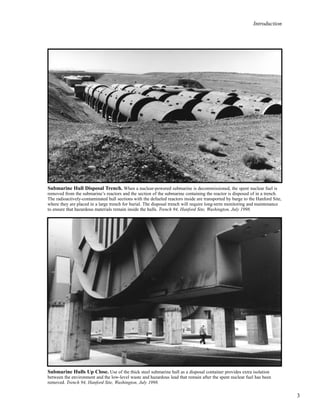
Submarine Hull Disposal Trench. When a nuclear-powered submarine is decommissioned, the spent nuclear fuel is
removed from the submarine’s reactors and the section of the submarine containing the reactor is disposed of in a trench.
The radioactively-contaminated hull sections with the defueled reactors inside are transported by barge to the Hanford Site,
where they are placed in a large trench for burial. The disposal trench will require long-term monitoring and maintenance
to ensure that hazardous materials remain inside the hulls. Trench 94, Hanford Site, Washington, July 1998.
Submarine Hulls Up Close. Use of the thick steel submarine hull as a disposal container provides extra isolation
between the environment and the low-level waste and hazardous lead that remain after the spent nuclear fuel has been
removed. Trench 94, Hanford Site, Washington, July 1998.
From Cleanup to Stewardship
4
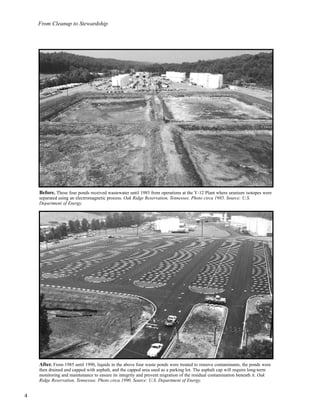
Before. These four ponds received wastewater until 1985 from operations at the Y-12 Plant where uranium isotopes were
separated using an electromagnetic process. Oak Ridge Reservation, Tennessee. Photo circa 1985. Source: U.S.
Department of Energy.
After. From 1985 until 1990, liquids in the above four waste ponds were treated to remove contaminants, the ponds were
then drained and capped with asphalt, and the capped area used as a parking lot. The asphalt cap will require long-term
monitoring and maintenance to ensure its integrity and prevent migration of the residual contamination beneath it. Oak
Ridge Reservation, Tennessee. Photo circa 1990. Source: U.S. Department of Energy.
5
Introduction
Purpose of Report
This report has been prepared to fulfill two
commitments made by the Department. First,
Paths to Closure indicated that further discussion
of end states and long-term stewardship would
be presented in a companion report (see p. 6-3 in
DOE 1998a). Secretary of Energy Bill
Richardson formalized this commitment in his
1999 Performance Agreement with the President.
Second, the Department settled a lawsuit in
December 1998 that requires DOE, among
other things, to prepare a study on long-term
stewardship (Joint Stipulation 1998). Although
the study will not be conducted under the
National Environmental Policy Act (NEPA), the
study is required to follow certain of the
procedures of the Council on Environmental
Quality for conducting a scoping process under
NEPA, as well as the Department’s NEPA
procedures regarding public comment.
Specifically, the Settlement Agreement provides
DOE [will] prepare a study on its long-term
stewardship activities. By ‘long-term
stewardship,’ DOE refers to the physical
controls, institutions, information and other
mechanisms needed to ensure protection of
people and the environment at sites where DOE
has completed or plans to complete ‘cleanup’
(e.g., landfill closures, remedial actions,
removal actions, and facility stabilization). This
concept of long-term stewardship includes, inter
alia, land use controls, monitoring,
maintenance, and information management.
See Appendix A for the complete language of
the relevant section of the agreement.
For the purposes of this analysis, the definition
of long-term stewardship also includes sites for
which DOE will have long-term responsibility,
even though DOE was not responsible for
actual cleanup at these sites (e.g., certain
uranium mill tailing sites). DOE will determine
the breadth of the long-term stewardship study
considering public scoping comments pursuant
to the terms of the Settlement Agreement.2
This
report provides background information for that
scoping process. It is intended to provide a
basis for more informed discussions among
various DOE offices, regulators, and affected
communities on stewardship needs and the
potential links between existing and future
cleanup decisions, risks, costs, technologies,
HHooww DDooeess TThhiiss RReeppoorrtt RReellaattee ttoo tthhee PPaatthhss ttoo
CClloossuurree PPrroocceessss aanndd tthhee SSttuuddyy RReeqquuiirreedd bbyy tthhee
SSeettttlleemmeenntt AAggrreeeemmeenntt??
The site-specific data used to develop From Cleanup
to Stewardship are based on information submitted
by the sites in support of the June 1998 Paths to
Closure report. Significant public involvement is
being conducted at both the site and national levels
for this ongoing process. Therefore, issues regarding
site-specific data are addressed through the Paths to
Closure process. Information on that process can be
obtained at www.em.doe.gov/closure or from the
Environmental Management Information Center
(1-800-736-3282). No additional data were collected
for this report.
This background report provides a national summary
of the nature and extent of DOE’s current and
anticipated long-term stewardship needs. It also
examines some of the issues, challenges, and
barriers associated with the transition from cleanup
to long-term stewardship.
A follow-on long-term stewardship study, pursuant
to the terms of the Settlement Agreement, will
examine these issues, challenges, and barriers in
greater detail and will begin to identify potential
paths forward for the Department. However, the
study process will not interfere with site-specific
activities for developing cleanup and long-term
stewardship strategies. Because long-term
stewardship is a relatively new concept, there are
few precedents upon which to rely. Therefore, the
Department is actively seeking broad public input to
the draft study process. Information on how to
become involved in the draft study process can be
obtained from www.em.doe.gov/lts or the
Environmental Management Information Center at
1-800-736-3282.
2. According to the Settlement Agreement, DOE will follow the procedures set forth in the regulations of the President’s Council on Environmental
Quality (CEQ) for public scoping, 40 CFR 1507.7(a)(1)-(2), and the procedures set forth in DOE’s NEPA regulations for public review of
environmental impact statements, 10 CFR 1021.313, except that (a) DOE will not transmit the study, in draft form, to EPA, and DOE (not EPA) will
publish a Notice of Availability in the Federal Register as set forth in 10 CFR 1021.313 (a), and (b) DOE will not include any Statement of Findings
as set forth in 10 CFR 1021.313 (c).
6
From Cleanup to Stewardship
future land use, and the level of effort required
to conduct stewardship activities.
Organization of the Report
In three chapters this report will address the
following:
l
The Nature of Long-Term Stewardship at
DOE Sites (Chapter 1), which describes the
scope and breadth of long-term stewardship
activities and why they will be required.
l
Anticipated Long-Term Stewardship at DOE
Sites (Chapter 2), which summarizes what is
known so far about end states, the number and
location of sites that will likely require
stewardship, the type of stewardship required,
and which sites are currently carrying out
stewardship activities.
l
Planning for Long-Term Stewardship
(Chapter 3), which outlines several issues the
Department has initially identified that need to
be addressed to ensure a successful transition
from cleanup to long-term stewardship, and that
may be appropriate to consider in the long-term
stewardship study required by the Settlement
Agreement.
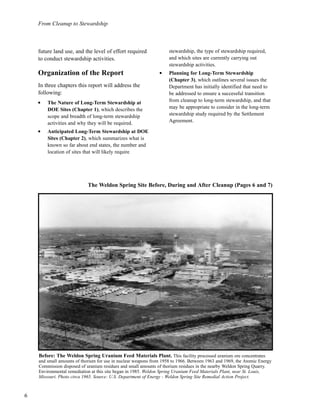
Before: The Weldon Spring Uranium Feed Materials Plant. This facility processed uranium ore concentrates
and small amounts of thorium for use in nuclear weapons from 1958 to 1966. Between 1963 and 1969, the Atomic Energy
Commission disposed of uranium residues and small amounts of thorium residues in the nearby Weldon Spring Quarry.
Environmental remediation at this site began in 1985. Weldon Spring Uranium Feed Materials Plant, near St. Louis,
Missouri. Photo circa 1965. Source: U.S. Department of Energy - Weldon Spring Site Remedial Action Project.
The Weldon Spring Site Before, During and After Cleanup (Pages 6 and 7)
Introduction
7
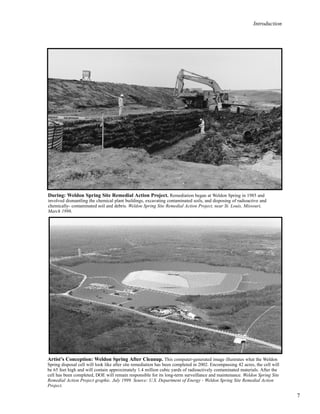
During: Weldon Spring Site Remedial Action Project. Remediation began at Weldon Spring in 1985 and
involved dismantling the chemical plant buildings, excavating contaminated soils, and disposing of radioactive and
chemically- contaminated soil and debris. Weldon Spring Site Remedial Action Project, near St. Louis, Missouri,
March 1996.
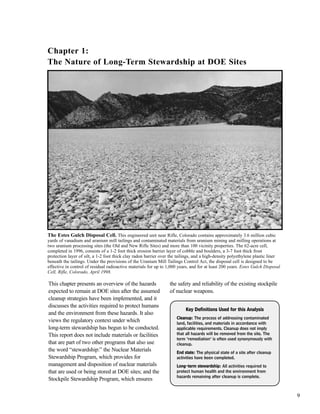
Artist’s Conception: Weldon Spring After Cleanup. This computer-generated image illustrates what the Weldon
Spring disposal cell will look like after site remediation has been completed in 2002. Encompassing 42 acres, the cell will
be 65 feet high and will contain approximately 1.4 million cubic yards of radioactively contaminated materials. After the
cell has been completed, DOE will remain responsible for its long-term surveillance and maintenance. Weldon Spring Site
Remedial Action Project graphic. July 1999. Source: U.S. Department of Energy - Weldon Spring Site Remedial Action
Project.
9
This chapter presents an overview of the hazards
expected to remain at DOE sites after the assumed
cleanup strategies have been implemented, and it
discusses the activities required to protect humans
and the environment from these hazards. It also
views the regulatory context under which
long-term stewardship has begun to be conducted.
This report does not include materials or facilities
that are part of two other programs that also use
the word “stewardship:” the Nuclear Materials
Stewardship Program, which provides for
management and disposition of nuclear materials
that are used or being stored at DOE sites; and the
Stockpile Stewardship Program, which ensures
the safety and reliability of the existing stockpile
of nuclear weapons.
KKeeyy DDeeffiinniittiioonnss UUsseedd ffoorr tthhiiss AAnnaallyyssiiss
CClleeaannuupp: The process of addressing contaminated
land, facilities, and materials in accordance with
applicable requirements. Cleanup does not imply
that all hazards will be removed from the site. The
term "remediation" is often used synonymously with
cleanup.
EEnndd ssttaattee: The physical state of a site after cleanup
activities have been completed.
LLoonngg--tteerrmm sstteewwaarrddsshhiipp: All activities required to
protect human health and the environment from
hazards remaining after cleanup is complete.
Chapter 1:
The Nature of Long-Term Stewardship at DOE Sites
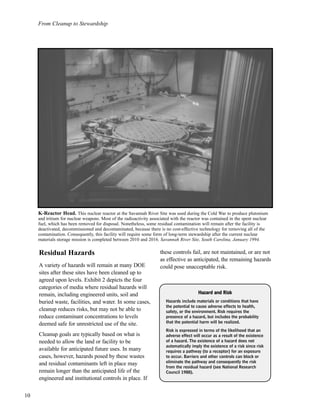
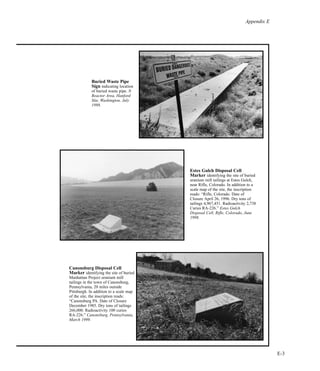
The Estes Gulch Disposal Cell. This engineered unit near Rifle, Colorado contains approximately 3.6 million cubic
yards of vanadium and uranium mill tailings and contaminated materials from uranium mining and milling operations at
two uranium processing sites (the Old and New Rifle Sites) and more than 100 vicinity properties. The 62-acre cell,
completed in 1996, consists of a 1-2 foot thick erosion barrier layer of cobble and boulders, a 3-7 foot thick frost
protection layer of silt, a 1-2 foot thick clay radon barrier over the tailings, and a high-density polyethylene plastic liner
beneath the tailings. Under the provisions of the Uranium Mill Tailings Control Act, the disposal cell is designed to be
effective in control of residual radioactive materials for up to 1,000 years, and for at least 200 years. Estes Gulch Disposal
Cell, Rifle, Colorado, April 1998.
From Cleanup to Stewardship
10
Residual Hazards
A variety of hazards will remain at many DOE
sites after these sites have been cleaned up to
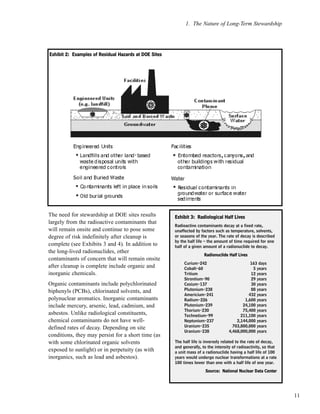
agreed upon levels. Exhibit 2 depicts the four
categories of media where residual hazards will
remain, including engineered units, soil and
buried waste, facilities, and water. In some cases,
cleanup reduces risks, but may not be able to
reduce contaminant concentrations to levels
deemed safe for unrestricted use of the site.
Cleanup goals are typically based on what is
needed to allow the land or facility to be
available for anticipated future uses. In many
cases, however, hazards posed by these wastes
and residual contaminants left in place may
remain longer than the anticipated life of the
engineered and institutional controls in place. If
these controls fail, are not maintained, or are not
as effective as anticipated, the remaining hazards
could pose unacceptable risk.
HHaazzaarrdd aanndd RRiisskk
Hazards include materials or conditions that have
the potential to cause adverse effects to health,
safety, or the environment. Risk requires the
presence of a hazard, but includes the probability
that the potential harm will be realized.
Risk is expressed in terms of the likelihood that an
adverse effect will occur as a result of the existence
of a hazard. The existence of a hazard does not
automatically imply the existence of a risk since risk
requires a pathway (to a receptor) for an exposure
to occur. Barriers and other controls can block or
eliminate the pathway and consequently the risk
from the residual hazard (see National Research
Council 1988).
K-Reactor Head. This nuclear reactor at the Savannah River Site was used during the Cold War to produce plutonium
and tritium for nuclear weapons. Most of the radioactivity associated with the reactor was contained in the spent nuclear
fuel, which has been removed for disposal. Nonetheless, some residual contamination will remain after the facility is
deactivated, decommissioned and decontaminated, because there is no cost-effective technology for removing all of the
contamination. Consequently, this facility will require some form of long-term stewardship after the current nuclear
materials storage mission is completed between 2010 and 2016. Savannah River Site, South Carolina, January 1994.
11
The need for stewardship at DOE sites results
largely from the radioactive contaminants that
will remain onsite and continue to pose some
degree of risk indefinitely after cleanup is
complete (see Exhibits 3 and 4). In addition to
the long-lived radionuclides, other
contaminants of concern that will remain onsite
after cleanup is complete include organic and
inorganic chemicals.
Organic contaminants include polychlorinated
biphenyls (PCBs), chlorinated solvents, and
polynuclear aromatics. Inorganic contaminants
include mercury, arsenic, lead, cadmium, and
asbestos. Unlike radiological constituents,
chemical contaminants do not have well-
defined rates of decay. Depending on site
conditions, they may persist for a short time (as
with some chlorinated organic solvents
exposed to sunlight) or in perpetuity (as with
inorganics, such as lead and asbestos).
1. The Nature of Long-Term Stewardship
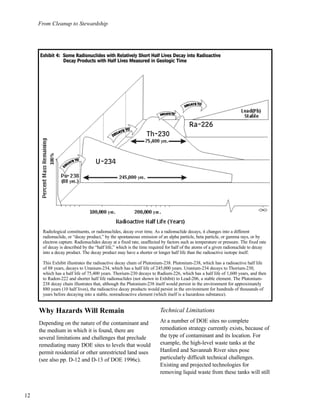
EExxhhiibbiitt 33:: RRaaddiioollooggiiccaall HHaallff LLiivveess
Radioactive contaminants decay at a fixed rate,
unaffected by factors such as temperature, solvents,
or seasons of the year. The rate of decay is described
by the half life – the amount of time required for one
half of a given amount of a radionuclide to decay.
RRaaddiioonnuucclliiddee HHaallff LLiivveess
Curium-242 163 days
Cobalt-60 5 years
Tritium 12 years
Strontium-90 29 years
Cesium-137 30 years
Plutonium-238 88 years
Americium-241 432 years
Radium-226 1,600 years
Plutonium-239 24,100 years
Thorium-230 75,400 years
Technetium-99 211,100 years
Neptunium-237 2,144,000 years
Uranium-235 703,800,000 years
Uranium-238 4,468,000,000 years
The half life is inversely related to the rate of decay,
and generally, to the intensity of radioactivity, so that
a unit mass of a radionuclide having a half life of 100
years would undergo nuclear transformations at a rate
100 times lower than one with a half life of one year.
SSoouurrccee:: NNaattiioonnaall NNuucclleeaarr DDaattaa CCeenntteerr
EExxhhiibbiitt 22:: EExxaammpplleess ooff RReessiidduuaall HHaazzaarrddss aatt DDOOEE SSiitteess
From Cleanup to Stewardship
12
Why Hazards Will Remain
Depending on the nature of the contaminant and
the medium in which it is found, there are
several limitations and challenges that preclude
remediating many DOE sites to levels that would
permit residential or other unrestricted land uses
(see also pp. D-12 and D-13 of DOE 1996c).
Technical Limitations
At a number of DOE sites no complete
remediation strategy currently exists, because of
the type of contaminant and its location. For
example, the high-level waste tanks at the
Hanford and Savannah River sites pose
particularly difficult technical challenges.
Existing and projected technologies for
removing liquid waste from these tanks will still
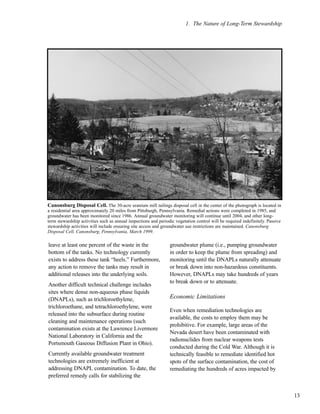
Radiological constituents, or radionuclides, decay over time. As a radionuclide decays, it changes into a different
radionuclide, or “decay product,” by the spontaneous emission of an alpha particle, beta particle, or gamma rays, or by
electron capture. Radionuclides decay at a fixed rate, unaffected by factors such as temperature or pressure. The fixed rate
of decay is described by the “half life,” which is the time required for half of the atoms of a given radionuclide to decay
into a decay product. The decay product may have a shorter or longer half life than the radioactive isotope itself.
This Exhibit illustrates the radioactive decay chain of Plutonium-238. Plutonium-238, which has a radioactive half life
of 88 years, decays to Uranium-234, which has a half life of 245,000 years. Uranium-234 decays to Thorium-230,
which has a half life of 75,400 years. Thorium-230 decays to Radium-226, which has a half life of 1,600 years, and then
to Radon-222 and shorter half life radionuclides (not shown in Exhibit) to Lead-206, a stable element. The Plutonium-
238 decay chain illustrates that, although the Plutonium-238 itself would persist in the environment for approximately
880 years (10 half lives), the radioactive decay products would persist in the environment for hundreds of thousands of
years before decaying into a stable, nonradioactive element (which itself is a hazardous substance).
EExxhhiibbiitt 44:: SSoommee RRaaddiioonnuucclliiddeess wwiitthh RReellaattiivveellyy SShhoorrtt HHaallff LLiivveess DDeeccaayy iinnttoo RRaaddiiooaaccttiivvee
DDeeccaayy PPrroodduuccttss wwiitthh HHaallff LLiivveess MMeeaassuurreedd iinn GGeeoollooggiicc TTiimmee
1. The Nature of Long-Term Stewardship
13
leave at least one percent of the waste in the
bottom of the tanks. No technology currently
exists to address these tank “heels.” Furthermore,
any action to remove the tanks may result in
additional releases into the underlying soils.
Another difficult technical challenge includes
sites where dense non-aqueous phase liquids
(DNAPLs), such as trichloroethylene,
trichloroethane, and tetrachloroethylene, were
released into the subsurface during routine
cleaning and maintenance operations (such
contamination exists at the Lawrence Livermore
National Laboratory in California and the
Portsmouth Gaseous Diffusion Plant in Ohio).
Currently available groundwater treatment
technologies are extremely inefficient at
addressing DNAPL contamination. To date, the
preferred remedy calls for stabilizing the
groundwater plume (i.e., pumping groundwater
in order to keep the plume from spreading) and

monitoring until the DNAPLs naturally attenuate
or break down into non-hazardous constituents.
However, DNAPLs may take hundreds of years
to break down or to attenuate.
Economic Limitations
Even when remediation technologies are
available, the costs to employ them may be
prohibitive. For example, large areas of the
Nevada desert have been contaminated with
radionuclides from nuclear weapons tests
conducted during the Cold War. Although it is
technically feasible to remediate identified hot
spots of the surface contamination, the cost of
remediating the hundreds of acres impacted by
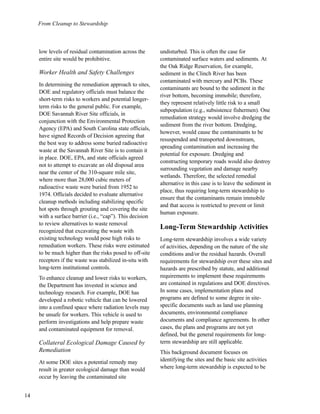
Canonsburg Disposal Cell. The 30-acre uranium mill tailings disposal cell in the center of the photograph is located in
a residential area approximately 20 miles from Pittsburgh, Pennsylvania. Remedial actions were completed in 1985, and
groundwater has been monitored since 1986. Annual groundwater monitoring will continue until 2004, and other long-
term stewardship activities such as annual inspections and periodic vegetation control will be required indefinitely. Passive
stewardship activities will include ensuring site access and groundwater use restrictions are maintained. Canonsburg
Disposal Cell, Canonsburg, Pennsylvania, March 1999.
From Cleanup to Stewardship
14
low levels of residual contamination across the
entire site would be prohibitive.
Worker Health and Safety Challenges
In determining the remediation approach to sites,
DOE and regulatory officials must balance the
short-term risks to workers and potential longer-
term risks to the general public. For example,
DOE Savannah River Site officials, in
conjunction with the Environmental Protection
Agency (EPA) and South Carolina state officials,
have signed Records of Decision agreeing that
the best way to address some buried radioactive
waste at the Savannah River Site is to contain it
in place. DOE, EPA, and state officials agreed
not to attempt to excavate an old disposal area
near the center of the 310-square mile site,
where more than 28,000 cubic meters of
radioactive waste were buried from 1952 to
1974. Officials decided to evaluate alternative
cleanup methods including stabilizing specific
hot spots through grouting and covering the site
with a surface barrier (i.e., “cap”). This decision
to review alternatives to waste removal
recognized that excavating the waste with
existing technology would pose high risks to
remediation workers. These risks were estimated
to be much higher than the risks posed to off-site
receptors if the waste was stabilized in-situ with
long-term institutional controls.
To enhance cleanup and lower risks to workers,
the Department has invested in science and
technology research. For example, DOE has
developed a robotic vehicle that can be lowered
into a confined space where radiation levels may
be unsafe for workers. This vehicle is used to
perform investigations and help prepare waste
and contaminated equipment for removal.
Collateral Ecological Damage Caused by
Remediation
At some DOE sites a potential remedy may
result in greater ecological damage than would
occur by leaving the contaminated site
undisturbed. This is often the case for
contaminated surface waters and sediments. At
the Oak Ridge Reservation, for example,
sediment in the Clinch River has been
contaminated with mercury and PCBs. These
contaminants are bound to the sediment in the
river bottom, becoming immobile; therefore,
they represent relatively little risk to a small
subpopulation (e.g., subsistence fishermen). One
remediation strategy would involve dredging the
sediment from the river bottom. Dredging,
however, would cause the contaminants to be
resuspended and transported downstream,
spreading contamination and increasing the
potential for exposure. Dredging and
constructing temporary roads would also destroy
surrounding vegetation and damage nearby
wetlands. Therefore, the selected remedial
alternative in this case is to leave the sediment in
place, thus requiring long-term stewardship to
ensure that the contaminants remain immobile
and that access is restricted to prevent or limit
human exposure.
Long-Term Stewardship Activities
Long-term stewardship involves a wide variety
of activities, depending on the nature of the site
conditions and/or the residual hazards. Overall
requirements for stewardship over these sites and
hazards are prescribed by statute, and additional
requirements to implement these requirements
are contained in regulations and DOE directives.
In some cases, implementation plans and
programs are defined to some degree in site-
specific documents such as land use planning
documents, environmental compliance
documents and compliance agreements. In other
cases, the plans and programs are not yet
defined, but the general requirements for long-
term stewardship are still applicable.
This background document focuses on
identifying the sites and the basic site activities
where long-term stewardship is expected to be
1. The Nature of Long-Term Stewardship
15
required. These site-level stewardship activities
include two general categories:
1. Active controls entail performing certain
activities to control risk at a site on a relatively
frequent or continuous basis, such as operating,
maintaining and monitoring the engineered
controls implemented at sites, including caps,
other physical barriers, and groundwater pump-
and-treat systems. This could include practical
tasks such as repairing fences and erosion
gullies, and collecting water samples (or using
less expensive monitoring technologies yet to
be developed).
2. Passive controls generally entail less intensive
tasks required to convey information about
site hazards and/or limiting access through
physical or legal means. Passive controls could
include ensuring the continued effectiveness
of applicable controls, including physical
systems (e.g., fences and other barriers),
governmental controls (e.g., ordinances and
building permits), and proprietary controls (e.g.,
deeds and easements).
Decisions about these activities are expected to
be part of the local decision-making process
during cleanup (and have typically been
included explicitly in long-term surveillance
and monitoring permits for uranium mill
tailings sites with the Nuclear Regulatory
Commission (NRC)). They are introduced here
to provide background for involving regulators,
Tribal, state and local governments, and other
stakeholders as those local decisions are made.
In addition, there are a variety of other tasks,
which may not occur at a local site level, that
will likely be needed for an effective long-term
stewardship program. These include:
l
Supporting and evaluating new technologies as
they develop that may be useful in reducing the
long-term stewardship costs, improving
performance, or performing a permanent
remedy that obviates the need for long-term
stewardship as well as improving our
understanding of the health and environmental
impacts of residual contaminants;
l
Emergency response;
l
Compliance oversight;
l
Natural and cultural resource management;
l
Information management;
l
Budget preparation, and other administrative
support; and
l
Site redevelopment, and community liaison
and planning.
These issues are not addressed in as much
depth in this background document, and are
expected to be among the broader
programmatic issues addressed in the study
being performed pursuant to the December
1998 Settlement Agreement.
Other terminology has been used to describe
long-term stewardship activities. For example,
EPA regulations (40 CFR 191) define the term
“institutional controls” to encompass all three
of the types of activities considered as
“long-term stewardship” in this background
document. According to these regulations,
active institutional control means:
l
Controlling or cleaning up releases from a site;
l
Performing maintenance operations or remedial
actions at a site;
l
Monitoring parameters related to disposal
system performance; or
l
Controlling access to a disposal site by any
means other than passive institutional controls.
Passive institutional control means:
l
Permanent markers placed at a disposal site;
l
Government ownership and regulations
regarding land or resource use;
l
Public records and archives; and
l
Other methods of preserving knowledge
about the location, design, and contents of a
disposal system.
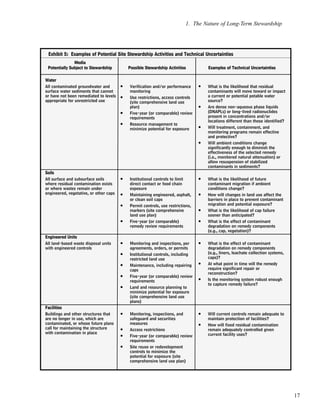
Exhibit 5 illustrates some stewardship activities
that may be conducted at the sites and highlights
some of the technical uncertainties that the
Department currently is facing (additional
information on stewardship activities can be
found in ICF 1998).
From Cleanup to Stewardship
16
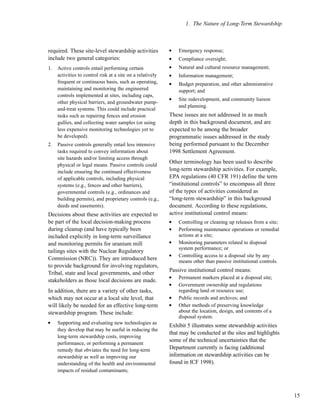
Mound Plant. Located in Miamisburg, Ohio, the plant was used to produce actuators, ignitors, and detonators for
nuclear weapons. DOE has begun transferring parts of the site to the Miamisburg Mound Community Improvement
Corporation for reuse as a commercial/industrial complex and is expected to complete most of this transfer by 2005. The
site is being cleaned up to meet industrial land use standards, and institutional controls in the form of deed restrictions will
be placed on the transferred property to maintain land use restrictions. Mound Plant, Miamisburg, Ohio, May 1984.
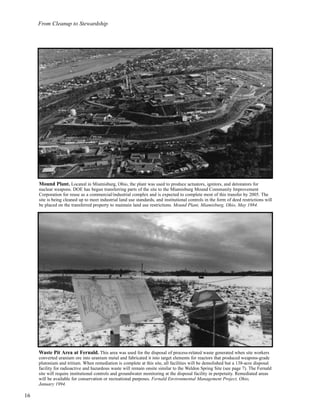
Waste Pit Area at Fernald. This area was used for the disposal of process-related waste generated when site workers
converted uranium ore into uranium metal and fabricated it into target elements for reactors that produced weapons-grade
plutonium and tritium. When remediation is complete at this site, all facilities will be demolished but a 138-acre disposal
facility for radioactive and hazardous waste will remain onsite similar to the Weldon Spring Site (see page 7). The Fernald
site will require institutional controls and groundwater monitoring at the disposal facility in perpetuity. Remediated areas
will be available for conservation or recreational purposes. Fernald Environmental Management Project, Ohio,
January 1994.
17
1. The Nature of Long-Term Stewardship
WWaatteerr
All contaminated groundwater and
surface water sediments that cannot
or have not been remediated to levels
appropriate for unrestricted use
SSooiillss
All surface and subsurface soils
where residual contamination exists
or where wastes remain under
engineered, vegetative, or other caps
EEnnggiinneeeerreedd UUnniittss
All land-based waste disposal units
with engineered controls
FFaacciilliittiieess
Buildings and other structures that
are no longer in use, which are
contaminated, or whose future plans
call for maintaining the structure
with contamination in place
EExxhhiibbiitt 55:: EExxaammpplleess ooff PPootteennttiiaall SSiittee SStteewwaarrddsshhiipp AAccttiivviittiieess aanndd TTeecchhnniiccaall UUnncceerrttaaiinnttiieess
MMeeddiiaa
PPootteennttiiaallllyy SSuubbjjeecctt ttoo SStteewwaarrddsshhiipp
l
Verification and/or performance
monitoring
l
Use restrictions, access controls
(site comprehensive land use
plan)
l
Five-year (or comparable) review
requirements
l
Resource management to
minimize potential for exposure
l
Institutional controls to limit
direct contact or food chain
exposure
l
Maintaining engineered, asphalt,
or clean soil caps
l
Permit controls, use restrictions,
markers (site comprehensive
land use plan)
l
Five-year (or comparable)
remedy review requirements
l
Monitoring and inspections, per
agreements, orders, or permits
l
Institutional controls, including
restricted land use
l
Maintenance, including repairing
caps
l
Five-year (or comparable) review
requirements
l
Land and resource planning to
minimize potential for exposure
(site comprehensive land use
plans)
l
Monitoring, inspections, and
safeguard and securities
measures
l
Access restrictions
l
Five-year (or comparable) review
requirements
l
Site reuse or redevelopment
controls to minimize the
potential for exposure (site
comprehensive land use plan)
PPoossssiibbllee SStteewwaarrddsshhiipp AAccttiivviittiieess
l
What is the likelihood that residual
contaminants will move toward or impact
a current or potential potable water
source?
l
Are dense non-aqueous phase liquids
(DNAPLs) or long-lived radionuclides
present in concentrations and/or
locations different than those identified?
l
Will treatment, containment, and
monitoring programs remain effective
and protective?
l
Will ambient conditions change
significantly enough to diminish the
effectiveness of the selected remedy
(i.e., monitored natural attenuation) or
allow resuspension of stabilized
contaminants in sediments?
l
What is the likelihood of future
contaminant migration if ambient
conditions change?
l
How will changes in land use affect the
barriers in place to prevent contaminant
migration and potential exposure?
l
What is the likelihood of cap failure
sooner than anticipated?
l
What is the effect of contaminant
degradation on remedy components
(e.g., cap, vegetation)?
l
What is the effect of contaminant
degradation on remedy components
(e.g., liners, leachate collection systems,
caps)?
l
At what point in time will the remedy
require significant repair or
reconstruction?
l
Is the monitoring system robust enough
to capture remedy failure?
l
Will current controls remain adequate to
maintain protection of facilities?
l
How will fixed residual contamination
remain adequately controlled given
current facility uses?
EExxaammpplleess ooff TTeecchhnniiccaall UUnncceerrttaaiinnttiieess
From Cleanup to Stewardship
18
Regulatory Context
The Department conducts its stewardship
activities in compliance with applicable laws,
regulations, interagency agreements, and site-
specific compliance agreements. Appendix B
highlights some of the more significant statutes
affecting DOE.
The Atomic Energy Act provides authority for the
Department to protect the health and safety of the
public from hazards associated with sources of
radiation under its control. This responsibility
encompasses properties with radioactive material,
including radioactive waste disposal facilities.
DOE’s waste disposal practices are subject to a
variety of post-disposal care requirements.
Applicable laws, regulations, and DOE Orders
vary by waste type (e.g., transuranic waste,
low-level waste; see Appendix B); however, DOE
is generally required to implement controls at
waste disposal sites in perpetuity. For example,
mill tailing standards promulgated by EPA
(40 CFR 192) prescribe institutional control
requirements such as land ownership and DOE
oversight and maintenance of mill tailings
disposal facilities. These activities are conducted
by DOE under a permanent license issued by the
NRC under 10 CFR 40. As another example,
NRC licensing criteria being developed for the
proposed geologic repository would require that
passive control measures be designed to serve
their intended purpose for as long as practicable
(64 FR 8640).
Regulations applicable to waste disposal facilities
may include design standards that have specific
time frames associated with them. For example,
40 CFR 192.02(a) requires that controls for mill
tailing sites be effective for up to 1,000 years, to
the extent reasonably achievable, and, in any case,
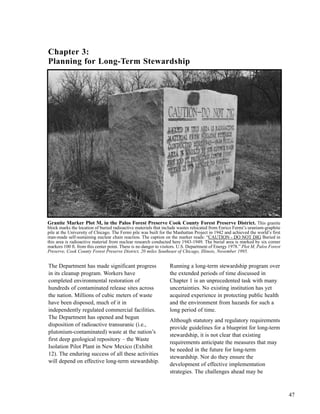
for at least 200 years. Design standards having
specified time frames are developed to balance
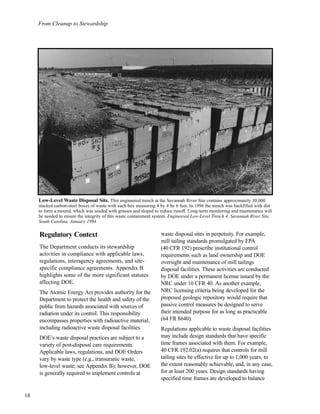
Low-Level Waste Disposal Site. This engineered trench at the Savannah River Site contains approximately 30,000
stacked carbon-steel boxes of waste with each box measuring 4 by 4 by 6 feet. In 1996 the trench was backfilled with dirt
to form a mound, which was seeded with grasses and sloped to reduce runoff. Long-term monitoring and maintenance will
be needed to ensure the integrity of this waste containment system. Engineered Low-Level Trench 4, Savannah River Site,
South Carolina, January 1994.
1. The Nature of Long-Term Stewardship
19
capital costs with expected maintenance costs.
Controls with a design criteria of 10,000 years
would be very expensive to construct, but
inexpensive to maintain. Controls with a design
criteria of 100 years would be inexpensive to
construct, but would require more maintenance. In
any case, uranium mill tailings sites contain wastes
containing uranium-238 and thorium-230 with
half-lives of 4.47 billion years and 75,400 years,
respectively. It therefore is expected that controls
established for mill tailing sites will require
monitoring and maintenance activities to be
conducted far beyond the time frame of the
design standards.
Regulatory requirements for disposal systems for
transuranic waste require that these systems be
designed to provide a reasonable expectation that
the cumulative releases of radionuclides to the
environment for 10,000 years will not exceed
exposure standards (40 CFR 191.13 and 191.15).
The 10,000 year period upon which the
performance assessment for the disposal system is
based is less than the half lives of common
transuranic elements (see Exhibit 4). Also, the
regulations for transuranic disposal systems do not
allow applicants to assume that active institutional
controls will be effective more than 100 years
(40 CFR 191.14a), even though the regulations also
require that the applicant maintain active
institutional controls for as long a period as
practicable after disposal (40 CFR 191.14(a)).
Stewardship and Land Use
Future land use, cleanup strategies, and long-term
stewardship needs are interdependent. Future use
goals are an important factor in determining
cleanup strategies and associated stewardship
needs. However, the technological and other
limitations discussed earlier will limit the range of
attainable future use options. Furthermore, ongoing
DOE missions (e.g., safeguarding nuclear
materials, maintaining waste disposal cells,
research and development activities, and
performing trustee responsibility for cultural and
ecological resources) may predetermine future use
for affected areas of sites.
In the absence of a future non-EM site mission,
some DOE property, if releasable, can be declared
excess and transferred to other Federal or
non-Federal entities. Such transfers require legal
agreements and institutional controls to maintain
ongoing long-term stewardship responsibilities.
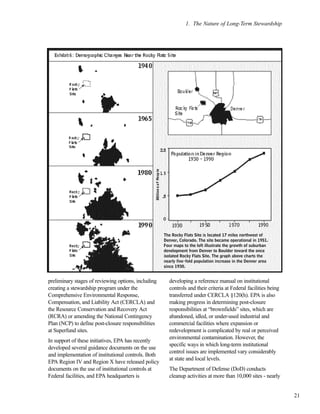
Exhibit 6 illustrates the importance of future use
planning as urban areas expand and approach the
boundaries of some of the Department’s facilities.
A key element of many long-term stewardship
programs will likely be the use of institutional
controls—including governmental and proprietary
controls—to ensure that land use restrictions are
maintained. Local government controls include
deed restrictions, zoning restrictions, permit
programs, well-drilling restrictions, and other
restrictions that are traditionally established by
local governments. Proprietary controls include
deed restrictions, easements, and restrictive
covenants that are based on state property law.
Successful implementation of these institutional
controls will require coordination between
Federal agencies as well as Tribal, state, and
local governments.
Long-Term Stewardship
Not Unique to DOE
Although DOE sites are the subject of this report,
stewardship responsibilities are not unique to the
Department. At least three other Federal agencies
are involved in cleanup programs at other sites that
will result in residual hazards and require some
type of stewardship after completion. The extent of
long-lived radionuclide contamination distinguishes
DOE from other Federal agencies, but the issues
and challenges faced by other agencies are similar
to those the Department must address.
Representatives of EPA’s Federal Facilities
Restoration and Reuse Office have participated in
long-term stewardship workshops sponsored by
DOE and have recognized that long-term
stewardship is critical to reducing the risk posed by
remaining hazards. EPA is currently determining its
stewardship responsibilities and is in the
20
From Cleanup to Stewardship
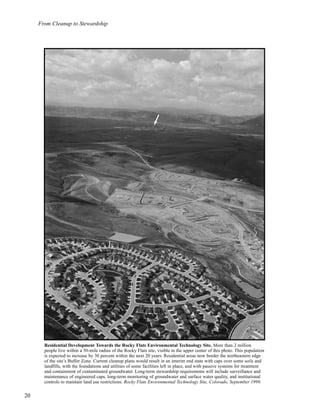
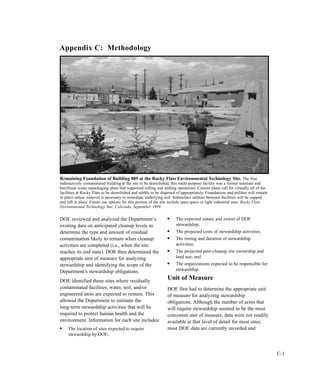
Residential Development Towards the Rocky Flats Environmental Technology Site. More than 2 million
people live within a 50-mile radius of the Rocky Flats site, visible in the upper center of this photo. This population
is expected to increase by 30 percent within the next 20 years. Residential areas now border the northeastern edge
of the site’s Buffer Zone. Current cleanup plans would result in an interim end state with caps over some soils and
landfills, with the foundations and utilities of some facilities left in place, and with passive systems for treatment
and containment of contaminated groundwater. Long-term stewardship requirements will include surveillance and
maintenance of engineered caps, long-term monitoring of groundwater and surface water quality, and institutional
controls to maintain land use restrictions. Rocky Flats Environmental Technology Site, Colorado, September 1999.
preliminary stages of reviewing options, including
creating a stewardship program under the
Comprehensive Environmental Response,
Compensation, and Liability Act (CERCLA) and
the Resource Conservation and Recovery Act
(RCRA) or amending the National Contingency
Plan (NCP) to define post-closure responsibilities
at Superfund sites.
In support of these initiatives, EPA has recently
developed several guidance documents on the use
and implementation of institutional controls. Both
EPA Region IV and Region X have released policy
documents on the use of institutional controls at
Federal facilities, and EPA headquarters is
developing a reference manual on institutional
controls and their criteria at Federal facilities being
transferred under CERCLA §120(h). EPA is also
making progress in determining post-closure
responsibilities at “brownfields” sites, which are
abandoned, idled, or under-used industrial and
commercial facilities where expansion or
redevelopment is complicated by real or perceived
environmental contamination. However, the
specific ways in which long-term institutional
control issues are implemented vary considerably
at state and local levels.
The Department of Defense (DoD) conducts
cleanup activities at more than 10,000 sites - nearly
1. The Nature of Long-Term Stewardship
21
The Rocky Flats Site is located 17 miles northwest of
Denver, Colorado. The site became operational in 1951.
Four maps to the left illustrate the growth of suburban
development from Denver to Boulder toward the once
isolated Rocky Flats Site. The graph above charts the
nearly five-fold population increase in the Denver area
since 1930.
22
From Cleanup to Stewardship
2,000 contaminated military installations and more
than 9,000 formerly used defense properties –
through its Defense Environmental Restoration
Program. To some degree, remediation challenges
posed by DoD sites are similar to those at DOE
sites – they are often large tracts of land, frequently
used for multiple purposes, and commonly
contaminated with many constituents.
Contamination at DoD facilities typically involves
organic chemicals, such as solvents
(e.g., trichloroethylene) or jet fuel; inorganic
chemicals such as metals; and sometimes
radioactive materials, though much less frequently
and in much smaller quantities than at DOE sites.
DoD sites also present similar stewardship
challenges to those DOE is facing, including
maintaining access controls; monitoring, pumping
and treating groundwater; implementing monitored
natural attenuation; and maintaining long-term
caps. DoD faces unique, often difficult, challenges
in determining the best way to remediate weapons
ranges, many of which contain unexploded
ordnance. Currently, DoD is working in several
areas to address these and other long-term care
issues. A multi-agency task force, led by the Air
Force Base Conversion Agency, is preparing
guidance for Defense installations on navigating
the CERCLA and RCRA processes from the time
the remedy is in place to the time of site closeout.
The guidance, The Road to Site Closure, is
expected to be final by spring of 2000. The draft
document is available online at
http://www.afbca.hq.af.mil/closeout.
The Department of the Interior (DOI) is responsible
for overseeing approximately 13,000 former
mining sites, some of which have been abandoned
by the original owners. Hazards remaining at
former mining sites include byproducts such as
tailings and leachates, blasting caps, wires, and
open holes. Because many mining sites are so
large, remediation is often infeasible and
institutional controls will be heavily relied upon.
NRC regulates and licenses commercial, industrial,
academic and medical uses of nuclear energy. NRC
also regulates private sector and DOE uranium mill
tailing sites cleanup projects and resulting disposal
cells. NRC has developed regulations that address
long-term stewardship at sites where unrestricted
use is not attainable (10 CFR 20.1403(c)). These
regulations require the facility to reduce residual
radioactivity as low as reasonably achievable,
provide for legally enforceable institutional
controls, provide financial assurance for long-term
control and maintenance of the site, submit a
decommissioning plan, and demonstrate that
annual doses will not exceed specified levels if the
institutional controls are ineffective. Once the
above requirements are met, NRC no longer
regulates the site. Typically, oversight of the
institutional controls and long-term stewardship is
accepted by another Federal agency (including
DOE) or a state or local government entity. For
example, after NRC decommissioned mill
buildings, consolidated mill tailings, and fenced off
the disposal cell at the private Arco Bluewater
facility in New Mexico, the site was transferred to
DOE for long-term surveillance and monitoring.
The nation’s commitment to long-term stewardship
is not limited to radioactive materials, DOE sites,
or Federal sites; it is intrinsic to the management of
other types of waste and sources of contamination
across the nation. For example, sanitary and
hazardous landfills include long-lived hazardous
constituents such as metals and organic
compounds. Leachate from some of these landfills
has contaminated groundwater resources.
Furthermore, many industrial facilities and former
waste management facilities (e.g., impoundments
and storage facilities) contain long-lived hazardous
constituents. At least part of the burden for
long-term stewardship of these areas and facilities
is likely to fall on state and local governments
and/or the private sector.
Given the diversity of issues and types of sites, the
Department is seeking to coordinate its long-term
stewardship activities with Federal, state and local
officials, Tribes, and stakeholders.
1. The Nature of Long-Term Stewardship
23
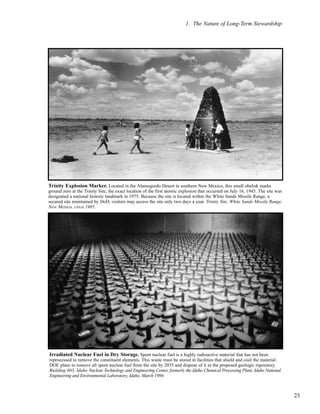
Trinity Explosion Marker. Located in the Alamogordo Desert in southern New Mexico, this small obelisk marks
ground zero at the Trinity Site, the exact location of the first atomic explosion that occurred on July 16, 1945. The site was
designated a national historic landmark in 1975. Because the site is located within the White Sands Missile Range, a
secured site maintained by DoD, visitors may access the site only two days a year. Trinity Site, White Sands Missile Range,
New Mexico, circa 1985.
Irradiated Nuclear Fuel in Dry Storage. Spent nuclear fuel is a highly radioactive material that has not been
reprocessed to remove the constituent elements. This waste must be stored in facilities that shield and cool the material.
DOE plans to remove all spent nuclear fuel from the site by 2035 and dispose of it in the proposed geologic repository.
Building 603, Idaho Nuclear Technology and Engineering Center, formerly the Idaho Chemical Processing Plant, Idaho National
Engineering and Environmental Laboratory, Idaho, March 1994.
25
This chapter summarizes the anticipated
long-term stewardship needs at DOE sites,
based on an analysis of existing information
from field offices. It discusses the residual
hazards at sites after cleanup projects are
complete and examines the nature and extent of
the stewardship activities likely to be needed.
Stewardship Expected
at 109 Sites after Cleanup
The Department first analyzed sites that might
need stewardship by identifying sites where
DOE has remediation, waste management, or
nuclear materials and facility stabilization
responsibilities. DOE then included in its
analysis sites that have been (or will be)
transferred to the Department for long-term
care. This resulted in the Department’s
analyzing 144 sites in 31 states and one U.S.
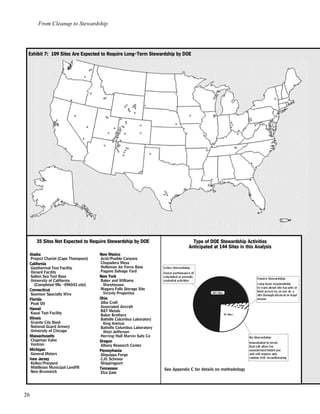
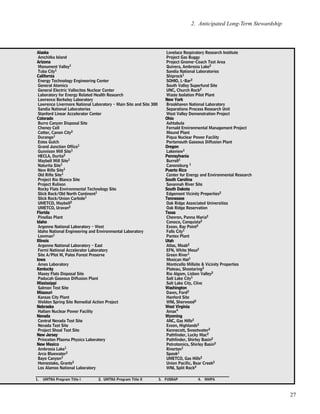
territory (see Appendix C). Of the 144 sites,
109 sites are expected to require some degree of
long-term stewardship based on completed or
planned cleanup strategies (see Exhibit 7). Most
cleanup plans have already received some level
of regulatory approval. The sites expected to
require DOE stewardship range from small sites
(approximately the size of a football field) with
limited contamination, such as the General
Atomics Site in California, to large and
complex ones such as the Nevada Test Site
(larger than the State of Rhode Island).
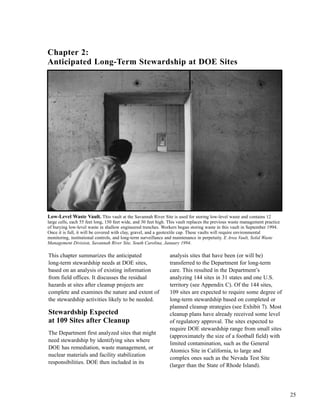
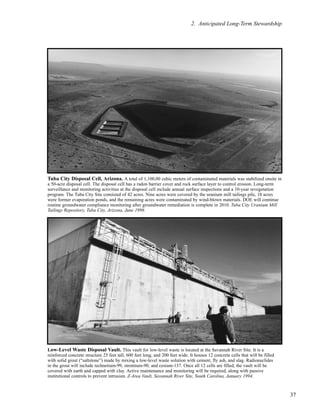
Low-Level Waste Vault. This vault at the Savannah River Site is used for storing low-level waste and contains 12
large cells, each 55 feet long, 150 feet wide, and 30 feet high. This vault replaces the previous waste management practice
of burying low-level waste in shallow engineered trenches. Workers began storing waste in this vault in September 1994.
Once it is full, it will be covered with clay, gravel, and a geotextile cap. These vaults will require environmental
monitoring, institutional controls, and long-term surveillance and maintenance in perpetuity. E Area Vault, Solid Waste
Management Division, Savannah River Site, South Carolina, January 1994.
Chapter 2:
Anticipated Long-Term Stewardship at DOE Sites
From Cleanup to Stewardship
26
EExxhhiibbiitt 77:: 110099 SSiitteess AArree EExxppeecctteedd ttoo RReeqquuiirree LLoonngg--TTeerrmm SStteewwaarrddsshhiipp bbyy DDOOEE
AAllaasskkaa
Project Chariot (Cape Thompson)
CCaalliiffoorrnniiaa
Geothermal Test Facility
Oxnard Facility
Salton Sea Test Base
University of California
(Completed 98c -096543 site)
CCoonnnneeccttiiccuutt
Seymour Specialty Wire
FFlloorriiddaa
Peak Oil
HHaawwaaiiii
Kauai Test Facility
IIlllliinnooiiss
Granite City Steel
National Guard Armory
University of Chicago
MMaassssaacchhuusseettttss
Chapman Valve
Ventron
MMiicchhiiggaann
General Motors
Neeww JJeerrsseeyy
Kellex/Pierpont
Middlesex Municipal Landfill
New Brunswick
NNeeww MMeexxiiccoo
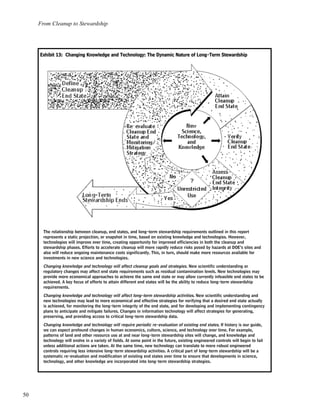
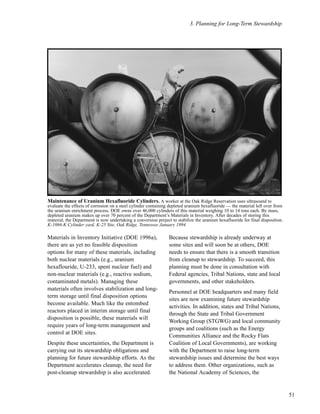
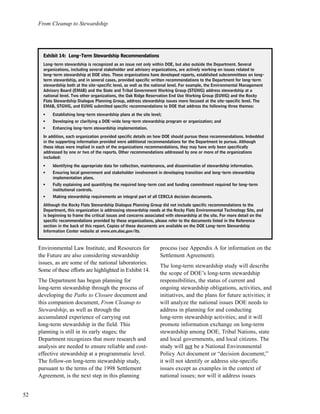
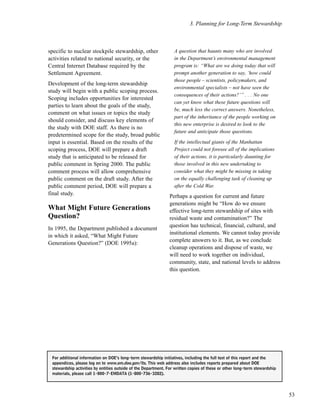
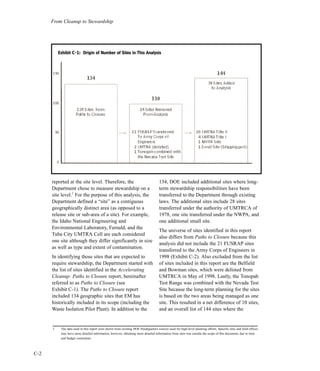
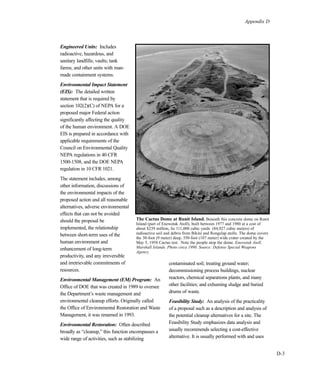
Acid/Pueblo Canyons
Chupadera Mesa
Holloman Air Force Base
Pagano Salvage Yard
NNeeww YYoorrkk
Baker and Williams
Warehouses
Niagara Falls Storage Site
Vicinity Properties
OOhhiioo
Alba Craft
Associated Aircraft
B&T Metals
Baker Brothers
Battelle Columbus Laboratory
King Avenue
Battelle Columbus Laboratory
West Jefferson
Herring-Hall Marvin Safe Co
OOrreeggoonn
Albany Research Center
PPeennnnssyyllvvaanniiaa
Aliquippa Forge
C.H. Schnoor
Shippingport
TTeennnneesssseeee
Elza Gate
3355 SSiitteess NNoott EExxppeecctteedd ttoo RReeqquuiirree SStteewwaarrddsshhiipp bbyy DDOOEE TTyyppee ooff DDOOEE SStteewwaarrddsshhiipp AAccttiivviittiieess
AAnnttiicciippaatteedd aatt 114444 SSiitteess iinn tthhiiss AAnnaallyyssiiss
See Appendix C for details on methodology
27
2. Anticipated Long-Term Stewardship
AAllaasskkaa
Amchitka Island
AArriizzoonnaa
Monument Valley1
Tuba City1
CCaalliiffoorrnniiaa
Energy Technology Engineering Center
General Atomics
General Electric Vallecitos Nuclear Center
Laboratory for Energy Related Health Research
Lawrence Berkeley Laboratory
Lawrence Livermore National Laboratory - Main Site and Site 300
Sandia National Laboratories
Stanford Linear Accelerator Center
CCoolloorraaddoo
Burro Canyon Disposal Site
Cheney Cell
Cotter, Canon City2
Durango1
Estes Gulch
Grand Junction Office1
Gunnison Mill Site1
HECLA, Durita2
Maybell Mill Site1
Naturita Site1
New Rifle Site1
Old Rifle Site1
Project Rio Blanco Site
Project Rulison
Rocky Flats Environmental Technology Site
Slick Rock/Old North Continent1
Slick Rock/Union Carbide1
UMETCO, Maybell2
UMETCO, Uravan2
FFlloorriiddaa
Pinellas Plant
IIddaahhoo
Argonne National Laboratory - West
Idaho National Engineering and Environmental Laboratory
Lowman1
IIlllliinnooiiss
Argonne National Laboratory - East
Fermi National Accelerator Laboratory
Site A/Plot M, Palos Forest Preserve
IIoowwaa
Ames Laboratory
KKeennttuucckkyy
Maxey Flats Disposal Site
Paducah Gaseous Diffusion Plant
MMiissssiissssiippppii
Salmon Test Site
MMiissssoouurrii
Kansas City Plant
Weldon Spring Site Remedial Action Project
NNeebbrraasskkaa
Hallam Nuclear Power Facility
NNeevvaaddaa
Central Nevada Test Site
Nevada Test Site
Project Shoal Test Site
NNeeww JJeerrsseeyy
Princeton Plasma Physics Laboratory
NNeeww MMeexxiiccoo
Ambrosia Lake1
Arco Bluewater2
Bayo Canyon3
Homestake, Grants2
Los Alamos National Laboratory
Lovelace Respiratory Research Institute
Project Gas Buggy
Project Gnome-Coach Test Area
Quivera, Ambrosia Lake2
Sandia National Laboratories
Shiprock1
SOHIO, L-Bar2
South Valley Superfund Site
UNC, Church Rock2
Waste Isolation Pilot Plant
NNeeww YYoorrkk
Brookhaven National Laboratory
Separations Process Research Unit
West Valley Demonstration Project
OOhhiioo
Ashtabula
Fernald Environmental Management Project
Mound Plant
Piqua Nuclear Power Facility
Portsmouth Gaseous Diffusion Plant
OOrreeggoonn
Lakeview1
PPeennnnssyyllvvaanniiaa
Burrell1
Canonsburg 1
PPuueerrttoo RRiiccoo
Center for Energy and Environmental Research
SSoouutthh CCaarroolliinnaa
Savannah River Site
SSoouutthh DDaakkoottaa
Edgemont Vicinity Properties2
TTeennnneesssseeee
Oak Ridge Associated Universities
Oak Ridge Reservation
TTeexxaass
Chevron, Panna Maria2
Conoco, Conquista2
Exxon, Ray Point2
Falls City1
Pantex Plant
UUttaahh
Atlas, Moab2
EFN, White Mesa2
Green River1
Mexican Hat1
Monticello Millsite & Vicinity Properties
Plateau, Shootaring2
Rio Algom, Lisbon Valley2
Salt Lake City1
Salt Lake City, Clive
WWaasshhiinnggttoonn
Dawn, Ford2
Hanford Site
WNI, Sherwood2
WWeesstt VViirrggiinniiaa
Amax4
WWyyoommiinngg
ANC, Gas Hills2
Exxon, Highlands2
Kennecott, Sweetwater2
Pathfinder, Lucky Mac2
Pathfinder, Shirley Basin2
Petrotomics, Shirley Basin2
Riverton1
Spook1
UMETCO, Gas Hills2
Union Pacific, Bear Creek2
WNI, Split Rock2
1. UMTRA Program Title I 2. UMTRA Program Title II 3. FUSRAP 4. NWPA
From Cleanup to Stewardship
28
Nature and Extent of
Stewardship Activities
The nature and extent of anticipated long-term
stewardship activities at the 109 sites will vary
based on the amount and type of residual
contamination, the anticipated future site uses,
and other factors (e.g., proximity to a river and
floodplain). To understand how stewardship
activities can vary across sites, DOE analyzed
the level of stewardship (e.g., active or
passive) as well as the types of activities likely
to be needed.
Appendix C presents more detailed information
on the methodology used for this report.
Level of Stewardship – Active and Passive
Of the 109 sites currently expected to require
stewardship, 103 are expected to require active
stewardship (see Exhibit 7). Active stewardship
ranges from detection monitoring on a
continuous or periodically recurring basis, to
enforcing access and use restrictions. Sites
expected to require active stewardship vary in
size and complexity.
DOE is expected to rely solely on passive
stewardship at only 6 of the 109 long-term
stewardship sites. Passive stewardship requires
less oversight and care. Enduring obligations
may include permanent markers or public
records to convey information on previous uses
or residual contamination. Sites where DOE
expects to rely on passive controls include
General Atomics and General Electric in
California, where excavation and removal of
contamination occurred to levels allowing for
industrial use, and where NRC has released the
site without radiological restrictions, but where
DOE will need to maintain records of previous
activities or residual contamination.
Long-term stewardship by DOE is not currently
anticipated at 35 sites, most of which were
remediated under the Formerly Utilized Sites
Remedial Action Program (FUSRAP; see
Exhibit 8). However, a record of the extent of
cleanup will need to be maintained at a central
DOE or Federal archiving facility.
The number of sites where DOE has
stewardship responsibility may increase over
time. Additional sites may be identified and
added to DOE’s responsibility under existing or
new laws. The Uranium Mill Tailings Radiation
Control Act (UMTRCA) of 1978 directs DOE
to stabilize, dispose of, and control uranium
mill tailings at inactive mill sites. Sites included
under Title I of UMTRCA are those that
operated prior to 1978, and where all uranium
was produced for sale to the Federal
Government. Title II of UMTRCA includes
privately owned sites that were operating under
SStteewwaarrddsshhiipp IInnffoorrmmaattiioonn
This report represents the Department's first attempt
to quantify the likely scope of its stewardship
activities. As such, data were not available to
adequately address all issues relative to stewardship,
such as natural, cultural, ecological, or human
health risk.
DOE has used available information from field office
personnel to catalogue known end states where
cleanup has already been completed and projected
end states where cleanup is ongoing. The primary
source was data submitted in support of the 1998
Accelerating Cleanup: Paths to Closure report. DOE
used the known and projected end state information
to identify those sites where residual contamination
in facilities and/or media (i.e., water, soil, and
engineered units) would likely remain and to
estimate the scope and duration of stewardship
activities needed.
It is important to note that because of the lack of
detailed data available for most sites, all information
is summarized at the site level, instead of for each
waste or contamination area within a site (e.g.,
Hanford, Fernald, and the Salmon Site are each
considered one site, despite the differences in size
and complexity) [see Appendix C].
Assumed end states and associated stewardship
activities for each site are summarized in Appendix
E. Appendix E is not included in the print version of
this document due to its length. It is, however,
available on the long-term stewardship web site
(www.em.doe.gov/lts) and, by request, from the EM
Information Center (1-800-736-3282).
29
2. Anticipated Long-Term Stewardship
a NRC license in 1978 when the Act was
signed. Title II gave NRC the responsibility for
transferring these sites to DOE, to another
Federal agency, or to a state for long-term care
after their licenses are terminated.
According to the Nuclear Waste Policy Act
(NWPA), low-level radioactive waste disposal
sites (with privately held licenses) can be
transferred to DOE upon termination of the
site’s license (NWPA, Subtitle D,
Section 151(b)). DOE is authorized to take title
of these sites if NRC determines the transfer to
be desirable, of no cost to the government, and
necessary in order to protect human health and
the environment. The NWPA also states that if
low-level radioactive waste is the result of a
licensed activity to recover zirconium, hafnium,
and rare earth metals from source material,
DOE shall assume title and custody of the site
if requested by the site owner (NWPA,
section 151(c)). For example, in 1994, the
Secretary of Energy assumed title to the Amax
site in West Virginia under this section.
Conversely, some sites may be removed from
DOE’s long-term stewardship responsibility, or
sites may require stewardship for only a finite
period. As contaminants decay, or if standards
become less restrictive, the number of sites and
the level of long-term stewardship required will
decrease. In addition some sites may require
long-term stewardship, but not by the
Department. For example, at the request of the
State of North Dakota, DOE revoked the
UMTRCA designation of the Belfield and
Bowman, North Dakota sites. As a result of the
revocation, effective May 18, 1998, the sites
will no longer require remediation under
UMTRCA, and the State of North Dakota will
be responsible for any long-term stewardship
required at the sites.
EExxhhiibbiitt 88:: TThhee FFoorrmmeerrllyy UUttiilliizzeedd SSiitteess RReemmeeddiiaall AAccttiioonn PPrrooggrraamm ((FFUUSSRRAAPP))
From the 1940s through the 1960s, some of the work to support early nuclear weapons and energy programs was done
by private companies at hundreds of locations throughout the United States. These companies performed numerous
activities, including processing, storing, sampling, assaying, extruding, or machining radioactive materials. After
completion of the work, the sites were decontaminated and released for other use under the cleanup guidelines in
effect at the time. Because those standards were less stringent than current guidelines, radioactive materials remained
at some sites. The waste at these sites consists primarily of low concentrations of uranium, radium, and thorium on
building surfaces and in the soil. Over the years, contamination at some sites has spread to vicinity properties,
primarily through the soil or air, as the result of releases from operating facilities when buildings were dismantled, or
when materials were moved (DOE 1997b).
In the 1970s, the Atomic Energy Commission (a predecessor of the DOE) recognized that some sites did not meet
current radiological release standards. In response, the FUSRAP program was established.
The early years of FUSRAP were spent researching the locations of these contract operations and conducting
radiological surveys to determine whether the sites were contaminated above current standards. Cleanup work at the
sites began in the late 1970s. Over 400 locations were assessed, and 46 sites in 14 states were designated for
remediation through the FUSRAP program. Several of these sites are commercial operations that processed radioactive
materials for profit and were subsequently designated for remediation by DOE at the request of Congress.
In October 1997, the Energy and Water Development Appropriations Act for fiscal year 1998 transferred responsibility
for the administration and execution of the FUSRAP program from DOE to the U.S. Army Corps of Engineers. At the
time of the transfer on October 13, 1997, DOE had completed the cleanup of 25 of the 46 FUSRAP sites.
The Department worked in conjunction with the Corps to ensure a smooth transition of the program. The Department
and the Corps signed a Memorandum of Understanding (MOU) in March 1999 identifying the roles and responsibilities
for cleanup and post-closure care of FUSRAP sites. The MOU establishes DOE's responsibility for any long-term
stewardship required at the 25 FUSRAP sites where the Department completed cleanup activities prior to October 13,
1997. For the remaining 21 sites assigned to the Corps for remediation (see Appendix C for a list of these sites), the
MOU assigns responsibility to DOE for any required long-term stewardship. These sites will be transferred to DOE for
long-term stewardship two years after the Corps completes remedial actions. However, the cleanup decisions for these
sites are not yet final and, therefore, the level of stewardship required for these sites, if any, is not yet known
(MOU 1999).
From Cleanup to Stewardship
30
EExxhhiibbiitt 99:: RReessiidduuaall CCoonnttaammiinnaannttss aanndd AAnnttiicciippaatteedd SStteewwaarrddsshhiipp bbyy SSiittee aanndd MMeeddiiaa
31
2. Anticipated Long-Term Stewardship
EExxhhiibbiitt 99:: ((CCoonnttiinnuueedd))
From Cleanup to Stewardship
32
Stewardship by Media Type:
Water, Soil, Engineered Units,
and Facilities
The nature and extent of stewardship will vary
depending on which media are contaminated.
To better understand the magnitude of the
challenges, DOE identified for each site four
categories of media that will likely remain
contaminated: soil, water, engineered units, and
facilities (see Exhibit 9 on preceding page).
Water includes groundwater, surface water
and sediments. Groundwater at approximately
100 sites is expected to require long-term
stewardship. The types of stewardship activities
will range from future use restrictions to
continuous pumping. In some cases (e.g., South
Valley Superfund Site, New Mexico), the
Department must supply alternate sources of
drinking water to local residents. In other cases,
such as many former uranium mill sites,
background levels of contaminants are high
and/or the natural quality of the aquifer is poor
due to brine; however, mining and milling
activities resulted in elevated levels of uranium
in the groundwater. At those mill sites where
groundwater cleanup is neither feasible nor
warranted (e.g., Ambrosia Lake, New Mexico),
monitored natural attenuation processes will be
relied on to reduce contaminant levels. No
active groundwater remediation will be
performed. At some mill sites where
groundwater is contaminated (e.g., Durango,
Colorado), the Department is proposing
monitored natural attenuation as the most
appropriate remedy. In addition, contaminated
surface waters (including sediments) also may
require attention and long-term care.
Rulison Groundwater Monitoring Well. In September 10, 1969, a 43-kiloton nuclear explosive device was
detonated at Rulison, Colorado 8,426 feet below ground surface. Today, subsurface rights to the approximately 40-acre
parcel are controlled by the Federal Government to prevent excavation, drilling, or removal of materials below a depth of
6,000 feet. In addition, the U.S. Environmental Protection Agency regularly monitors an existing network of wells, springs,
and the adjacent Battlement Creek for the movement of radionuclide contaminants in groundwater. Project Rulison Site,
Colorado, June 1999.
33
2. Anticipated Long-Term Stewardship
N Reactor along the Columbia River. Originally, the river provided cooling water for the reactor. Spent nuclear fuel
has been stored in the “wet storage” (water filled) basins in this complex of buildings supporting the reactor, which ceased
operations in 1987. Because of corrosion of the cladding of the spent fuel rods, approximately 15 million gallons of water
contaminated with strontium-90 has been released into the groundwater. DOE has installed a groundwater pump-and-treat
system to control the movement of the contaminated groundwater. Institutional controls will remain in place at the site
indefinitely to restrict groundwater use, and the semi-annual monitoring will continue for at least 30 years after closure of
the last facilities. N Reactor, Hanford Site, Washington, July 1994.
Oak Ridge Waste Pond. This waste pond, in the south-central part of Oak Ridge National Laboratory’s main plant
area, contains radiologically-contaminated sediments resulting from settling of low-level radioactive liquid wastes
generated from experiments and material processing at the laboratory. The radionuclides contained in the sediment include
americium, cesium, cobalt, plutonium, and strontium. Oak Ridge National Laboratory, Tennessee, January 1994.
From Cleanup to Stewardship
34
Soil includes release sites, burn pits, burial
grounds, and areas contaminated from
underground utilities, tanks, or surrounding
buildings. Stewardship of contaminated soil is
anticipated at 71 sites. At some sites, soil
stewardship is driven by subsurface rather than
surface contamination. At the “Nevada
Offsites” (former nuclear test sites in Alaska,
Colorado, Nevada, New Mexico, and
Mississippi), extensive subsurface
contamination exists from conducting
underground nuclear tests. Because no cost-
effective technology yet exists to remediate
these types of subsurface contamination, they
will continue to pose hazards over the long-
term. Stewardship activities will be required to
prevent people from intruding into these areas
in the future.
Source of Soil Contamination. This exhaust stack was the source of emissions from the Fernald site’s enriched
uranium materials processing facility. The malfunctioning of systems like this resulted in releases of several hundred tons
of uranium dust into the environment. Although remediation of contaminated soil can restore the Fernald site to an “end
state” that serves a number of alternative land uses, residential and agricultural uses will not be considered. Institutional
controls will be implemented to ensure that these restrictions are upheld. Plant 9, Fernald Environmental Management
Project, Ohio, December 1993.
35
2. Anticipated Long-Term Stewardship
Pit 9 Radioactive Waste Burial Ground. Engineers gather on the edge of Pit 9 to discuss remediation strategies for
this burial ground where, from 1967 to 1969, approximately 150,000 cubic feet of transuranic and low-level waste were
buried; but poor record-keeping of past disposal practices has made it difficult to calculate what lies beneath the surface
here today. The lack of technologies to fully remediate this area will result in long-term stewardship responsibilities.
Radioactive Waste Management Complex, Idaho National Engineering and Environmental Laboratory, Idaho,
March 1994.
The Nevada Test Site. Atmospheric nuclear explosions here resulted in widely dispersed surface soil contamination.
The warning sign is an example of passive stewardship; it reads “Potential Radiation Hazard Before any major
excavation or earth-moving operation contact RAD-SAFE at C.P.2 tel 2571.” Nevada Test Site, near Mercury, Nevada,
October 1984.
From Cleanup to Stewardship
36
Engineered units include radioactive,
hazardous, and sanitary landfills; vaults; and
tank farms with man-made containment
systems. Engineered units at 70 sites are
expected to require some level of stewardship
activity. These include units such as the
Environmental Restoration Disposal Facility
(ERDF) and the high-level waste tanks at the
Hanford Site. Engineered units generally
contain large volumes of waste and
contamination and include areas where the most
highly contaminated wastes have been
consolidated for permanent disposal or
long-term retrievable storage. Engineered units
will require active stewardship activities such
as leachate collection, cap maintenance, erosion
control, and access restriction. Data on the size
and number of all the engineered units that will
remain on DOE sites were not readily available
for this analysis. Some sites, however, provided
the precise number and size of engineered units
that will remain onsite, with most sites
containing only one or two units at closure.
Landfill with RCRA Cap. Ten acres of black, high-density polyethylene cover a mixed waste landfill at the Oak Ridge
Reservation. The cap is designed to prevent gases from escaping, reduce erosion, and keep rainwater from leaching
contaminants into groundwater. Installed in 1989, the cap is designed to last from 15 to 20 years. Maintenance and monitoring
will be required at least until 2019. Solid Waste Storage Area 6, Oak Ridge Reservation, Tennessee, January 1994.
37
2. Anticipated Long-Term Stewardship
Tuba City Disposal Cell, Arizona. A total of 1,100,00 cubic meters of contaminated materials was stabilized onsite in
a 50-acre disposal cell. The disposal cell has a radon barrier cover and rock surface layer to control erosion. Long-term
surveillance and monitoring activities at the disposal cell include annual surface inspections and a 10-year revegetation
program. The Tuba City Site consisted of 42 acres. Nine acres were covered by the uranium mill tailings pile, 18 acres
were former evaporation ponds, and the remaining acres were contaminated by wind-blown materials. DOE will continue
routine groundwater compliance monitoring after groundwater remediation is complete in 2010. Tuba City Uranium Mill
Tailings Repository, Tuba City, Arizona, June 1998.
Low-Level Waste Disposal Vault. This vault for low-level waste is located at the Savannah River Site. It is a
reinforced concrete structure 25 feet tall, 600 feet long, and 200 feet wide. It houses 12 concrete cells that will be filled
with solid grout (“saltstone”) made by mixing a low-level waste solution with cement, fly ash, and slag. Radionuclides
in the grout will include technetium-99, strontium-90, and cesium-137. Once all 12 cells are filled, the vault will be
covered with earth and capped with clay. Active maintenance and monitoring will be required, along with passive
institutional controls to prevent intrusion. Z-Area Vault, Savannah River Site, South Carolina, January 1994.
From Cleanup to Stewardship
Facilities include entombed reactors, canyons
and other buildings with residual contamination, as
well as remaining infrastructure. Contaminated
facilities will remain at as many as 32 sites. Many
of the currently contaminated buildings across the
complex will be fully demolished and will only
require stewardship for an interim phase prior to
decontamination and demolition.
Most contaminated facilities can be addressed by
decontamination or demolition and disposal.
Consequently, contaminated facilities typically
pose less of a technical challenge for cleanup and
stewardship than underground storage and disposal
situations, such as high-level waste tanks.
Nonetheless, certain contaminated facilities pose
significant stewardship challenges, such as the
nuclear production reactors and chemical
separations facilities (reprocessing “canyons”).
These facilities are very large, with extensive
radionuclide contamination that is both intense and
long-lived, and that could pose risks to workers
conducting remediation activities. There are no
specific plans as yet for the final disposition of the
canyons. One option being considered is to
demolish the buildings, bury them in place, and
place an engineered cap on the area. Whatever the
final disposition, these facilities will be in a
long-term surveillance and maintenance mode
until final decisions are made, and probably for
very long periods of time thereafter. For example,
the reactors at the Hanford Site will be placed in
an interim safe storage mode for 75 years to allow
the radioactive contamination to decay to safer
levels, and the Department will then consider
options for their final disposition. The photos in
Exhibit 10 illustrate the changes in a reactor when
it undergoes transition from production to interim
safe storage. During the interim safe storage phase,
DOE will be conducting technology demonstration
projects to test at least 20 new technologies and
approaches that may provide safer, less expensive,
and more efficient ways to decommission aging
nuclear facilities.
38
F-Area at the Savannah River Site. A number of facilities in this ½ square mile area will remain contaminated
indefinitely because of a lack of cost-effective technologies available to remove the intense levels of radioactivity. The
reprocessing "canyon" near the center of the photo is still operating, but, even after deactivation and decommissioning, it
is unlikely to ever be decontaminated sufficiently to allow for unrestricted use. The underground storage tanks in the
lower part of the photo will contain residual waste after most of the high-level waste has been removed for vitrification.
Grout (similar to concrete) has been poured in the “emptied” tanks to immobilize the residual waste and prevent the
buried tank shells from collapsing. F Area, Savannah River Site, South Carolina, August 1983.
39
2. Anticipated Long-Term Stewardship
C Reactor During Surveillance
& Maintenance Phase. The
reactor facility was abandoned in-
place from 1969 until 1996, with
only minimal surveys and structural
maintenance work performed.
Access was controlled, but the
buildings gradually deteriorated and
posed serious industrial safety and
environmental risks. Assessments
determined that aggressive cleanup
action would be far less costly than
structural repairs. June 1996.
Source: U.S. Department of Energy-
Richland Operations.
Hanford B/C Reactor
Complex During Operation.
Construction of the 100-B/C
plutonium production reactor
complex at Hanford began in
August 1943 as part of the
Manhattan Project. B Reactor
(shown here), was the first of
Hanford’s nine production
reactors to begin operating in
September 1944, under the
direction of Enrico Fermi. Work
on C Reactor began in June 1951;
it operated from November 1952
to April 1969. Photo circa 1953.
Source: U.S. Department of
Energy-Richland Operations.
C Reactor in Interim Safe Storage.
Decontamination and demolition of C
Reactor secondary structures from 1996 to
1998 reduced the facility’s “footprint” by
81%. All hazardous materials and
nonessential equipment were removed. The
reactor’s core remains within its existing
shielding walls, with the walls serving as a
base for a new corrosion-resistant steel roof.
This Safe Storage Enclosure, completed in
September 1998, is designed to safely
contain the reactor for up to 75 years while
the radioactive contamination decays.
September 1998. Source: U.S. Department
of Energy-Richland Operations
EExxhhiibbiitt 1100:: IInntteerriimm SSaaffee SSttoorraaggee ooff CC RReeaaccttoorr aatt HHaannffoorrdd SSiittee
From Cleanup to Stewardship
40
Timing of Long-Term Stewardship
Activities
DOE has already completed cleanup and is
conducting long-term stewardship at 41 of the
109 sites expected to require stewardship.
Long-term stewardship is also underway at
portions of many other sites where cleanup
activities and other missions (e.g., nuclear
weapons maintenance) continue. Exhibit 11
illustrates that stewardship activities will increase
as cleanup is completed.
l
In 1989, 126 sites were undergoing active
cleanup. Of the 18 completed sites, active
stewardship was ongoing at nine sites, passive
stewardship was occurring at one site, and no
stewardship was required at eight sites.
l In 1998, fewer than half of the 144 sites were still
undergoing active cleanup. Of the 74 completed
sites, active stewardship was required at 39 sites,
passive stewardship at two sites, and no
stewardship at 33 sites.
l
By 2006, only 21 of the sites (15 percent) are
expected to be undergoing active cleanup. Of the
123 sites where cleanup is expected to be
complete, active stewardship is anticipated at
84 sites, passive stewardship at four sites, and no
stewardship at 35 sites.
l
Active cleanup is expected to be completed at
all sites by 2050. By then, active stewardship
currently is anticipated at 103 sites, passive
stewardship at six sites, and no stewardship
at 35 sites.
The 21 sites expected to require active cleanup
beyond 2006 generally are larger sites or sites
with contamination requiring more complex
remediation measures. All 21 sites will likely
require extensive stewardship. Some
stewardship activities already are taking place
at portions of these sites where specific
remediation goals have been met. For example,
while cleanup at the Hanford Site as a whole is
not expected to be complete until 2046, cleanup
of portions of the site is already complete, and
stewardship is underway. As other portions of
these sites meet cleanup goals, stewardship will
begin there as well.
EExxhhiibbiitt 1111:: SStteewwaarrddsshhiipp AAccttiivviittiieess IInnccrreeaassee aass CClleeaannuupp iiss CCoommpplleetteedd
41
2. Anticipated Long-Term Stewardship
The duration of stewardship depends on the
persistence of site hazards as well as the
technologies available for remediation. The data
submitted on the duration of stewardship
activities were insufficient to determine a
definitive end date for stewardship; however,
several sites expected stewardship to be needed
for 100 years or in perpetuity.
Land Use
As noted in Chapter 1 of this report (page 19),
future land use, cleanup strategies, and
long-term stewardship are interdependent.
Therefore, information regarding future land
use for DOE facilities is critical for developing
effective cleanup strategies and long-term
stewardship plans.
The Paths to Closure data that were used as the
basis for this report provide very little
information regarding future land use
assumptions at DOE sites. Therefore, previous
land use planning analyses (DOE 1996b, 1998b)
were used to develop the future use assumptions
provided in Appendix E.
Because these previous land use planning reports
addressed a limited number of sites, DOE is
seeking to improve its understanding of current
and anticipated future land use to aid in site
cleanup and stewardship planning. Moreover,
DOE is working with its field office personnel to
develop common definitions for land use
categories (e.g. industrial vs. recreational), which
will allow for inter-site planning and
comparisons. Finally, site personnel are
continuing to work with local governments and
Field of Wells at Savannah River Site A-M Area. The Integrated Demonstration site contains 150 monitoring wells,
some quite shallow and some as deep as 200 feet. The wells keep track of the contamination left after the major cleanup
project at the M Area, which included removing large amounts of waste, capping the old disposal area, and pumping and
treating contaminated groundwater. The site also includes the world’s first horizontal injection well used for environmental
remediation. M Area Settling Basin, Savannah River Site, South Carolina, January 1994.
From Cleanup to Stewardship
42
After: Waste Calcining Facility. After the calcining plant’s superstructure and contaminated equipment had been
demolished, the remaining rubble pile was filled with grout to stabilize any residual contamination. Idaho National
Engineering and Environmental Laboratory, Idaho, May 1999. Source: U.S. Department of Energy - Idaho Operations.
Before: Waste Calcining Facility. This facility solidified high-level radioactive waste generated by the reprocessing
of spent nuclear fuel. The photo, taken in 1990, shows the early stages of facility deactivation. Idaho National Engineering
and Environmental Laboratory, Idaho, 1990. Source: U.S. Department of Energy - Idaho Operations.
43
2. Anticipated Long-Term Stewardship
other stakeholders to develop plans for
anticipated future land use that are consistent
with required planning assumptions.
There are a number of reasons why decisions
have not been made regarding post-cleanup
alternative future use of many sites. First, many
sites have, or are seeking, a non-EM mission
(e.g., nuclear weapons materials management or
scientific research), so active DOE control of
the site is expected to continue indefinitely.
Second, many fundamental cleanup decisions
have not been made (e.g., cleanup strategy,
amount of residual contamination, and
disposition of excess property); until decisions
have been made on these issues, definitive
future use cannot be determined.
In some cases, before determining the future
use of a site, DOE may prepare an
environmental impact statement or
environmental assessment pursuant to NEPA to
analyze the potential environmental impacts of
alternative uses. A number of DOE sites
(e.g., Hanford, Nevada Test Site, and Los
Alamos National Laboratory) have already been
the subject of an environmental impact
statement covering land use. Land use or
resource management plans have also been
developed for other sites (DOE 1998b).
Current Organizational
Responsibilities
Current responsibility for long-term
stewardship resides with a variety of DOE
offices. For most sites, when cleanup is
ongoing, but where cleanup of certain portions
has been completed (e.g., Hanford and
Savannah River Sites), long-term stewardship is
part of the overall infrastructure maintenance
responsibilities of the DOE operations office
managing the site. For a number of sites where
cleanup has been completed, personnel assigned
to the Grand Junction Office (GJO) in Colorado
perform a variety of long-term stewardship
functions. The mission of DOE’s GJO is to
assume long-term custody of certain sites where
cleanup is complete and to provide a common
basis for their operation, security, surveillance,
monitoring, maintenance, annual reporting, and
emergency response. There are currently five
types of sites assigned to the GJO program for
long-term surveillance and maintenance:
(1) UMTRCA Title I sites, which are inactive
uranium milling sites where NRC licenses
terminated prior to November 1978;
(2) UMTRCA Title II sites, which are uranium
milling sites licensed as of 1978;
(3) NWPA Section 151 sites that were privately
owned and that contain radioactive wastes but
not low-level mill tailings;
(4) Decontamination and decommissioning sites,
including three entombed nuclear reactors
(Hallam reactor, Nebraska; Piqua reactor, Ohio;
and the Site A/Plot M burial site of Enrico
Fermi’s original “Chicago Pile” reactor, Illinois)
and associated waste materials; and
(5) Other sites, including the former Pinellas Plant
in Florida, transferred to GJO in 1997.
Long-term stewardship responsibilities for
additional sites will likely be transferred to this
program. For example, long-term stewardship
responsibility for the Weldon Spring Site is
expected to be transferred to GJO in 2002.
The Department’s Nevada Operations Office is
responsible for long-term stewardship at former
nuclear explosion test sites in Alaska, Colorado,
Nevada, New Mexico, and Mississippi (referred
to as “Nevada Offsites”).
Other offices perform stewardship functions
following waste management activities. For
example, Savannah River Site personnel are
managing two underground storage tanks that
had been filled with high-level waste and
subsequently “closed” by removing and
vitrifying most of the waste and filling the tank
with grout. Also, DOE’s West Valley
(New York) personnel are developing long-term
stewardship plans for the site following
completion of waste management and other
cleanup tasks.
44
From Cleanup to Stewardship
Costs of Post-Cleanup Stewardship
Activities Unknown
There are a number of long-term stewardship
activities for which funding will likely be
required. First, there are tasks required as part
of direct site maintenance, including site
monitoring, maintenance of the remedy, and
regular (e.g., annual or five-year) review of the
long-term stewardship plan to determine if
changes are appropriate. Second, site security
and overhead costs may include maintaining
fences, gates, signs, roads, and utilities
(e.g., electric, water and sewer) for security
facilities in some cases. Third, a relatively small
cost is required for record keeping, including
archiving records, indexing, reproduction, title
and deed recording, and distribution of records.
Compared to other activities (e.g., waste
management, environmental restoration, fissile
materials stabilization, and security) the
Department currently spends relatively little
money on long-term stewardship. As part of its
cleanup program, the Department is seeking to
lower the post-cleanup risks as much as
possible and, as a result, the required costs for
long-term stewardship site maintenance. There
is little specific information available, however,
on the Department’s long-term stewardship
funding requirements.
The primary reason for this lack of
comprehensive and specific information is that
the Department is conducting much of its
current long-term stewardship responsibilities
as part of the larger site infrastructure support
and maintenance activities associated with
operations.4
Because these costs are combined
with other site maintenance costs, such as site
security, emergency response, and road repair,
there is relatively little explicit information on
long-term stewardship. Moreover, long-term
stewardship costs are dwarfed by other site
support costs incurred during active
environmental management (i.e., environmental
restoration, waste management, and nuclear
materials and facilities stabilization) or other
missions (e.g., Defense Programs or Nuclear
Energy). The costs for long-term stewardship
are more apparent when these other costs are
eliminated through completions of the
environmental management missions or
cessation of the other missions, thereby
eliminating the need for large site infrastructure
support funding. Also, site personnel cannot
project long-term stewardship costs until
specific end states are determined for the active
environmental management tasks.
Nonetheless, the Department has recently
developed a significant amount of general
long-term stewardship cost information,
including cost elements (i.e., What is being
funded?) and responsibility for costs (i.e., Who
is funding it?), as well as some useful anecdotal
cost information from specific projects.
The most explicit funding for long-term
stewardship is provided through GJO. The
FY 1999 budget for the Grand Junction long-
term surveillance and monitoring program is
$1.6 million, with life cycle costs for individual
sites ranging from $4,000 to $2.5 million.
These costs generally include collecting
groundwater samples, repairing fences,
conducting minor erosion control, restricting
access, and conducting periodic surface
inspections. These costs do not include
potentially required major site repair if a
breach in site containment were to occur.
The costs also do not include active pumping
and treatment of contaminated groundwater
as part of a long-term remediation or
containment system. In the near future,
however, GJO will likely be responsible for
such “pump and treat” systems at three former
uranium mill tailings sites.
4. In a broader sense, long-term stewardship is an extension of the current funding for site infrastructure to maintain safe conditions (e.g., roof repair,
repaving parking lots, radiation control). Clearly, one of the goals of cleanup, in addition to reducing risks, is to reduce the cost of maintaining safe site
conditions, thereby reducing long-term stewardship costs.
45
2. Anticipated Long-Term Stewardship
The Department’s Nevada Operations Office
has managed long-term stewardship (mostly
collecting groundwater and surface water
samples near the underground test locations) at
the “Nevada Offsites” for about 25-35 years.
These activities are assumed to continue
indefinitely. Annual costs currently range from
$30,000 to $50,000 per site. The monitoring at
these sites is performed by EPA but paid for by
DOE. Experience with these sites suggests that
such monitoring can be conducted at a modest
cost, although its direct applicability to other
DOE sites has not yet been determined.
47
The Department has made significant progress
in its cleanup program. Workers have
completed environmental restoration of
hundreds of contaminated release sites across
the nation. Millions of cubic meters of waste
have been disposed, much of it in
independently regulated commercial facilities.
The Department has opened and begun
disposition of radioactive transuranic (i.e.,
plutonium-contaminated) waste at the nation’s
first deep geological repository – the Waste
Isolation Pilot Plant in New Mexico (Exhibit
12). The enduring success of all these activities
will depend on effective long-term stewardship.
Running a long-term stewardship program over
the extended periods of time discussed in
Chapter 1 is an unprecedented task with many
uncertainties. No existing institution has yet
acquired experience in protecting public health
and the environment from hazards for such a
long period of time.
Although statutory and regulatory requirements
provide guidelines for a blueprint for long-term
stewardship, it is not clear that existing
requirements anticipate the measures that may
be needed in the future for long-term
stewardship. Nor do they ensure the
development of effective implementation
strategies. The challenges ahead may be
Chapter 3:
Planning for Long-Term Stewardship
Granite Marker Plot M, in the Palos Forest Preserve Cook County Forest Preserve District. This granite
block marks the location of buried radioactive materials that include wastes relocated from Enrico Fermi’s uranium-graphite
pile at the University of Chicago. The Fermi pile was built for the Manhattan Project in 1942 and achieved the world’s first
man-made self-sustaining nuclear chain reaction. The caption on the marker reads: “CAUTION - DO NOT DIG Buried in
this area is radioactive material from nuclear research conducted here 1943-1949. The burial area is marked by six corner
markers 100 ft. from this center point. There is no danger to visitors. U.S. Department of Energy 1978.” Plot M, Palos Forest
Preserve, Cook County Forest Preserve District, 20 miles Southeast of Chicago, Illinois, November 1995.
From Cleanup to Stewardship
48
Special Casks for Shipping Transuranic Waste. These demonstration models are similar to those being used
to ship transuranic waste to the Waste Isolation Pilot Plant in New Mexico. Each of these Transuranic Package
Transporter (TRUPACT-II) casks can hold fourteen 55-gallon drums. A window in the center model cask shows
mock waste drums cut open to reveal typical constituents of transuranic waste. Waste Isolation Pilot Plant, New
Mexico, February 1994.
Underground Transuranic Waste Disposal Room. This room, excavated in 1986, is the first of 56 chambers
to be excavated at the Waste Isolation Pilot Plant. It is 300 feet long, 33 feet wide, and 13 feet tall and can hold six
thousand 55-gallon drums of transuranic waste. It lies 2,150 feet below the surface of the earth in an ancient stable
salt formation. Room 1 of Panel 1, Waste Isolation Pilot Plant, New Mexico, February 1994.
3. Planning for Long-Term Stewardship
49
technical, economic, institutional, cultural,
environmental, or of a type not yet anticipated.
The uncertainties associated with long-term
stewardship of DOE sites include the nature of
the hazards, the effectiveness of monitoring and
maintenance of barriers and institutional
controls, and the cost of these activities. Other
unknowns include the availability of adequate
technologies, the future development of better
remedial and surveillance technologies,
long-term funding and other resources, and
long-term management of data. These
uncertainties and unknowns make it difficult to
shape definitive plans for the many years that
stewardship will be needed. Exhibit 13
illustrates how science and technology will
affect cleanup end state and long-term
stewardship strategies over time.
The long-term stewardship challenges facing
DOE also include the disposition of “materials
in inventory.” The Department is responsible
for managing a variety of materials resulting
from the operation of large production facilities
and numerous laboratories that acquired and
produced enormous amounts of chemicals,
metals, radioactive substances, and other
materials. As described in the report of the
EExxhhiibbiitt 1122:: TThhee WWaassttee IIssoollaattiioonn PPiilloott PPllaanntt ((WWIIPPPP))
After years of research, construction and regulatory reviews, DOE began disposing of waste at WIPP in March 1999.
WIPP is the world's first engineered geologic repository for radioactive waste disposal. It will dispose of much of the
transuranic waste from the research and production of nuclear weapons that has been stored at numerous locations
throughout the United States.
WIPP is located in southeastern New Mexico in an ancient stable salt formation 2,150 feet underground. Its disposal
location was selected in part because the salt formation is stable and has "plastic" properties; in time, the salt will
surround and contain the waste. The site was evaluated by EPA and the National Academy of Sciences and was
determined to be suitable for permanent disposal of waste based on its ability to isolate the waste safely for at least
10,000 years.
WIPP was certified by EPA based on extensive technical documentation about the site provided as part of the
regulatory process. Current estimates are that it will take at least 35 years for WIPP to be filled to its capacity. It will
be shut down over a 10-12 year period, then will be carefully monitored for another two or three generations. In about
2099, the site will be closed permanently and marked to warn future generations to keep out. In response to regulatory
requirements for passive institutional controls, DOE submitted designs for markers that identify the WIPP site and
convey information about the disposal system's design and contents. The conceptual design includes the following
elements:
A massive berm 10 meters (33 feet) tall and 30 meters (98 feet) wide at its base will surround the surface of the
repository. To decrease collection of precipitation in the enclosed area of the berm, drainage paths will be built at
approximately 100 meter (328 foot) intervals. Large permanent magnets buried at intervals in the berm will give the
structure a distinctive magnetic signature. These magnets will measure approximately 1 meter (3.2 feet) long and 0.5
meters (1.6 feet) square in cross-section and will produce a signal detectable with current airborne detection
equipment.
A series of 16 granite monuments, each standing 6.7 meters (22 feet) above ground and buried 6.7 meters (22 feet)
into the soil, will be placed along the inside perimeter of the berm. A warning of the dangers of the materials
entombed below will be inscribed in seven languages: English, French, Spanish, Chinese, Russian, and Arabic (the six
official United Nations languages), and Navajo.
Several thousand small markers, constructed of three different materials (granite, aluminum oxide, and fired clay) will
be buried at random intervals within the repository footprint and in the berm. Each of the markers will have a warning
message in one of the seven languages used on the monuments.
Three granite-walled information centers with four exterior walls, seven parallel interior information walls, and no roof
will be inscribed with more detailed warnings in tables, figures, diagrams, and maps. One will be built above ground
without a roof to permit observation of the messages in natural light. The others will be buried. One information room
will be buried within the center of the southern section of the berm. The final information room will be buried 160
meters (525 feet) north of the berm on a line between the above ground information center and the disposal area. The
location of the buried information rooms will be documented in records located off-site in archives and record centers
and in the above-ground information center.
From Cleanup to Stewardship
50
The relationship between cleanup, end states, and long-term stewardship requirements outlined in this report
represents a static projection, or snapshot in time, based on existing knowledge and technologies. However,
technologies will improve over time, creating opportunity for improved efficiencies in both the cleanup and
stewardship phases. Efforts to accelerate cleanup will more rapidly reduce risks posed by hazards at DOE’s sites and
also will reduce ongoing maintenance costs significantly. This, in turn, should make more resources available for
investments in new science and technologies.
Changing knowledge and technology will affect cleanup goals and strategies. New scientific understanding or
regulatory changes may affect end state requirements such as residual contamination levels. New technologies may
provide more economical approaches to achieve the same end state or may allow currently infeasible end states to be
achieved. A key focus of efforts to attain different end states will be the ability to reduce long-term stewardship
requirements.
Changing knowledge and technology will affect long-term stewardship activities. New scientific understanding and
new technologies may lead to more economical and effective strategies for verifying that a desired end state actually
is achieved, for monitoring the long-term integrity of the end state, and for developing and implementing contingency
plans to anticipate and mitigate failures. Changes in information technology will affect strategies for generating,
preserving, and providing access to critical long-term stewardship data.
Changing knowledge and technology will require periodic re-evaluation of existing end states. If history is our guide,
we can expect profound changes in human economics, culture, science, and technology over time. For example,
patterns of land and other resource use at and near long-term stewardship sites will change, and knowledge and
technology will evolve in a variety of fields. At some point in the future, existing engineered controls will begin to fail
unless additional actions are taken. At the same time, new technology can translate to more robust engineered
controls requiring less intensive long-term stewardship activities. A critical part of long-term stewardship will be a
systematic re-evaluation and modification of existing end states over time to ensure that developments in science,
technology, and other knowledge are incorporated into long-term stewardship strategies.
EExxhhiibbiitt 1133:: CChhaannggiinngg KKnnoowwlleeddggee aanndd TTeecchhnnoollooggyy:: TThhee DDyynnaammiicc NNaattuurree ooff LLoonngg--TTeerrmm SStteewwaarrddsshhiipp
3. Planning for Long-Term Stewardship
51
Materials in Inventory Initiative (DOE 1996a),
there are as yet no feasible disposition
options for many of these materials, including
both nuclear materials (e.g., uranium
hexaflouride, U-233, spent nuclear fuel) and
non-nuclear materials (e.g., reactive sodium,
contaminated metals). Managing these
materials often involves stabilization and long-
term storage until final disposition options
become available. Much like the entombed
reactors placed in interim storage until final
disposition is possible, these materials will
require years of long-term management and
control at DOE sites.
Despite these uncertainties, the Department is
carrying out its stewardship obligations and
planning for future stewardship efforts. As the
Department accelerates cleanup, the need for
post-cleanup stewardship is also accelerated.
Because stewardship is already underway at
some sites and will soon be at others, DOE
needs to ensure that there is a smooth transition
from cleanup to stewardship. To succeed, this
planning must be done in consultation with
Federal agencies, Tribal Nations, state and local
governments, and other stakeholders.
Personnel at DOE headquarters and many field
sites are now examining future stewardship
activities. In addition, states and Tribal Nations,
through the State and Tribal Government
Working Group (STGWG) and local community
groups and coalitions (such as the Energy
Communities Alliance and the Rocky Flats
Coalition of Local Governments), are working
with the Department to raise long-term
stewardship issues and determine the best ways
to address them. Other organizations, such as
the National Academy of Sciences, the
Maintenance of Uranium Hexafluoride Cylinders. A worker at the Oak Ridge Reservation uses ultrasound to
evaluate the effects of corrosion on a steel cylinder containing depleted uranium hexafluoride — the material left over from
the uranium enrichment process. DOE owns over 46,000 cylinders of this material weighing 10 to 14 tons each. By mass,
depleted uranium makes up over 70 percent of the Department’s Materials in Inventory. After decades of storing this
material, the Department is now undertaking a conversion project to stabilize the uranium hexafluoride for final disposition.
K-1066-K Cylinder yard, K-25 Site, Oak Ridge, Tennessee January 1994.
From Cleanup to Stewardship
52
Environmental Law Institute, and Resources for
the Future are also considering stewardship
issues, as are some of the national laboratories.
Some of these efforts are highlighted in Exhibit 14.
The Department has begun planning for
long-term stewardship through the process of
developing the Paths to Closure document and
this companion document, From Cleanup to
Stewardship, as well as through the
accumulated experience of carrying out
long-term stewardship in the field. This
planning is still in its early stages; the
Department recognizes that more research and
analysis are needed to ensure reliable and cost-
effective stewardship at a programmatic level.
The follow-on long-term stewardship study,
pursuant to the terms of the 1998 Settlement
Agreement, is the next step in this planning
process (see Appendix A for information on the
Settlement Agreement).
The long-term stewardship study will describe
the scope of DOE’s long-term stewardship
responsibilities, the status of current and
ongoing stewardship obligations, activities, and
initiatives, and the plans for future activities; it
will analyze the national issues DOE needs to
address in planning for and conducting
long-term stewardship activities; and it will
promote information exchange on long-term
stewardship among DOE, Tribal Nations, state
and local governments, and local citizens. The
study will not be a National Environmental
Policy Act document or “decision document;”
it will not identify or address site-specific
issues except as examples in the context of
national issues; nor will it address issues
EExxhhiibbiitt 1144:: LLoonngg--TTeerrmm SStteewwaarrddsshhiipp RReeccoommmmeennddaattiioonnss
Long-term stewardship is recognized as an issue not only within DOE, but also outside the Department. Several
organizations, including several stakeholder and advisory organizations, are actively working on issues related to
long-term stewardship at DOE sites. These organizations have developed reports, established subcommittees on long-
term stewardship, and in several cases, provided specific written recommendations to the Department for long-term
stewardship both at the site-specific level, as well as the national level. For example, the Environmental Management
Advisory Board (EMAB) and the State and Tribal Government Working Group (STGWG) address stewardship at a
national level. Two other organizations, the Oak Ridge Reservation End Use Working Group (EUWG) and the Rocky
Flats Stewardship Dialogue Planning Group, address stewardship issues more focused at the site-specific level. The
EMAB, STGWG, and EUWG submitted specific recommendations to DOE that address the following three themes:
l
Establishing long-term stewardship plans at the site level;
l
Developing or clarifying a DOE-wide long-term stewardship program or organization; and
l
Enhancing long-term stewardship implementation.
In addition, each organization provided specific details on how DOE should pursue these recommendations. Imbedded
in the supporting information provided were additional recommendations for the Department to pursue. Although
these ideas were implied in each of the organizations recommendations, they may have only been specifically
addressed by one or two of the reports. Other recommendations addressed by one or more of the organizations
included:
l
Identifying the appropriate data for collection, maintenance, and dissemination of stewardship information.
l
Ensuring local government and stakeholder involvement in developing transition and long-term stewardship
implementation plans.
l
Fully explaining and quantifying the required long-term cost and funding commitment required for long-term
institutional controls.
l
Making stewardship requirements an integral part of all CERCLA decision documents.
Although the Rocky Flats Stewardship Dialogue Planning Group did not include specific recommendations to the
Department, this organization is addressing stewardship needs at the Rocky Flats Environmental Technology Site, and
is beginning to frame the critical issues and concerns associated with stewardship at the site. For more detail on the
specific recommendations provided by these organizations, please refer to the documents listed in the Reference
section in the back of this report. Copies of these documents are available on the DOE Long-term Stewardship
Information Center website at www.em.doe.gov/lts.
3. Planning for Long-Term Stewardship
53
specific to nuclear stockpile stewardship, other
activities related to national security, or the
Central Internet Database required by the
Settlement Agreement.
Development of the long-term stewardship
study will begin with a public scoping process.
Scoping includes opportunities for interested
parties to learn about the goals of the study,
comment on what issues or topics the study
should consider, and discuss key elements of
the study with DOE staff. As there is no
predetermined scope for the study, broad public
input is essential. Based on the results of the
scoping process, DOE will prepare a draft
study that is anticipated to be released for
public comment in Spring 2000. The public
comment process will allow comprehensive
public comment on the draft study. After the
public comment period, DOE will prepare a
final study.
What Might Future Generations
Question?
In 1995, the Department published a document
in which it asked, “What Might Future
Generations Question?” (DOE 1995a):
A question that haunts many who are involved
in the Department’s environmental management
program is: “What are we doing today that will
prompt another generation to say, ‘how could
those people – scientists, policymakers, and
environmental specialists – not have seen the
consequences of their actions?’” . . . No one
can yet know what these future questions will
be, much less the correct answers. Nonetheless,
part of the inheritance of the people working on
this new enterprise is desired to look to the
future and anticipate those questions.
If the intellectual giants of the Manhattan
Project could not foresee all of the implications
of their actions, it is particularly daunting for
those involved in this new undertaking to
consider what they might be missing in taking
on the equally challenging task of cleaning up
after the Cold War.
Perhaps a question for current and future
generations might be “How do we ensure
effective long-term stewardship of sites with
residual waste and contamination?” The
question has technical, financial, cultural, and
institutional elements. We cannot today provide
complete answers to it. But, as we conclude
cleanup operations and dispose of waste, we
will need to work together on individual,
community, state, and national levels to address
this question.
For additional information on DOE’s long-term stewardship initiatives, including the full text of this report and the
appendices, please log on to www.em.doe.gov/lts. This web address also includes reports prepared about DOE
stewardship activities by entities outside of the Department. For written copies of these or other long-term stewardship
materials, please call 1-800-7-EMDATA (1-800-736-3282).
55
References
Environmental Management Advisory Board, Long-Term Stewardship Committee. 1998. Long-Term Stewardship
Committee Recommendations to the Full Environmental Management Advisory Board, October 8, 1998.
ICF Kaiser Consulting Group (ICF). 1998. Managing Data for Long-term Stewardship. Report prepared for EM
Office of Strategic Planning and Analysis, March 1998.
Joint Stipulation. 1998. Natural Resources Defense Council, et. al. v. Richardson, et. al., Civ. No. 97-963 (SS).
Livingstone, Steve, Bashaw, Janet, and Powell, Elizabeth, Moving from Cleanup to Stewardship, Waste
Management ‘98, Sesson 62, Tuscon, Arizona, March 1-5 1998
Livingstone, Steve and Hegner, Robert, Managing Data for Long-Term Stewardship, Waste Management ‘98,
Session 62, Tuscon, Arizona, March 1-5 1998.
Memorandum of Understanding (MOU). 1999. Memorandum of Understanding between the U.S. Department of
Energy and the U.S. Army Corps of Engineers Regarding Program Administration and Execution of the Formerly
Utilized Sites Remediation Action Program (FUSRAP), March 17, 1999.
National Conference of State Legislatures. 1999. Closure for the Seventh Generation: A Report from the
Stewardship Committee of the State and Tribal Government Working Group, February 1999.
National Research Council. 1988. Improving Risk Communication. National Academy Press, Washington, DC.
Oak Ridge Reservation End Use Working Group. 1998. Stakeholder Report on Stewardship, July 1998.
Performance Agreement (Revised Final Performance Plan). 1999. Performance Agreement Between the President
of the United States and the Secretary of Energy. Fiscal Year 1999.
Rocky Flats Stewardship Dialogue Planning Group. 1999. Beyond Closure: Stewardship at Rocky Flats,
April 1999.
Rudzinski, Suzanne, Sykes, Merle and Dahling, Peter. The Impact of Excess Facility Disposition on Near-Term
Budgets and Long-Term Infrastructure Planning in the U.S. Department of Energy. Waste Management ‘98,
Session 16, Tuscon, Arizona, March 1-5 1998.
U.S. Department of Energy (DOE). 1995a. Closing the Circle on the Splitting of the Atom: The Environmental
Legacy of Nuclear Weapons Production in the United States and What the Department of Energy is Doing About
It, January 1995 (reprinted January 1996).
U.S. Department of Energy (DOE). 1995b. Estimating the Cold War Mortgage: The 1995 Baseline Environmental
Management Report (Volumes 1, 2, & 3), DOE/EM-0232, March 1995.
U.S. Department of Energy (DOE). 1996a. Taking Stock: A Look at the Opportunities and Challenges Posed by
Inventories from the Cold War, DOE/EM-0275, January 1996.
U.S. Department of Energy (DOE). 1996b. Charting the Course: The Future Use Report, DOE/EM-0283,
April 1996.
U.S. Department of Energy (DOE). 1996c. The 1996 Baseline Environmental Management Report (Volumes 1, 2,
& 3), DOE/EM-0290, June 1996.
U.S. Department of Energy (DOE). 1997a. Linking Legacies: Connecting the Cold War Nuclear Weapons
Processes to their Environmental Consequences, DOE/EM-0319, January 1997.
U.S. Department of Energy (DOE). 1997b. Decontaminating Commercial Facilities for Reuse on DOE’s FUSRAP
Program. DOE Oak Ridge Operations Office, September 1997.
U.S. Department of Energy (DOE). 1997c. Cross-Cut Guidance on Environmental Requirements for DOE Real
Property Transfers. Office of Environmental Policy and Assistance RCRA/CERCLA Division, DOE/EH-
413/9712. October 1997.
U.S. Department of Energy (DOE). 1998a. Accelerating Cleanup: Paths to Closure, DOE/EM-0362, June 1998.
U.S. Department of Energy (DOE). 1998b. Planning for the Future: An Overview of Future Use Plans at
Department of Energy, October 1998.
Werner, James D., Secrecy and Its Effect on Environmental Problems in the Military: An Engineers Perspective,
New York University Environmental Law Journal, Vol. 2 No. 2, 1993.
57
Arizona
Tuba City (UMTRA)
Tuba City Disposal Cell, Arizona 37
Colorado
Project Rulison
Rulison Groundwater Monitoring Well, 32
Rulison Marker, E-2
Rocky Flats Environmental Technology Site
Demographic Changes Near the Rocky Flats Site, 21
Remaining Foundation of Building 889 at the Rocky
Flats Environmental Technology Site, C-1
Residential Development Towards the Rocky Flats
Environmental Technology Site, 20
Satellite Dish at Rocky Flats Environmental
Technology Site, A-1
Estes Gulch (UMTRA)
Estes Gulch Disposal Cell Marker, E-3
The Estes Gulch Disposal Cell, 9
District of Columbia
President Dwight Eisenhower signing the Atomic
Energy Act of 1954
Idaho
Idaho National Engineering and Environmental
Laboratory
Before and After: Waste Calcining Facility, 42
Irradiated Nuclear Fuel in Dry Storage, 23
Low-Level Waste Burial, ii
Pit 9 Radioactive Waste Burial Ground, 35
Illinios
Site A/Plot M, Palos Forest Preserve
Fermi Marker, E-2
Granite Marker Plot M, in the Palos Forest Preserve
Cook County Forest Preserve District, 47
Missouri
Weldon Spring Site Remedial Action Project
Artist's Conception: Weldon Spring After Cleanup, 7
Before: The Weldon Spring Uranium Feed Materials
Plant, 7
During: Weldon Spring Site Remedial Action
Project, 6
Nevada
Nevada Test Site
Sedan Crater, ii
The Nevada Test Site, 35
New Mexico
Bayo Canyon Site
Bayo Canyon Site Marker, E-2
Waste Isolation Pilot Plant
Special Casks for Shipping Transuranic Waste, 48
The Waste Isolation Pilot Plant, 49
Underground Transuranic Waste Disposal Room, 48
White Sands Missle Range
Trinity Explosion Marker, 23
New York
West Valley Demonstration Project
Chart of Vitrified Waste Canisters, D-1
Stainless Steel Canister for Vitrified Waste at West
Valley Demonstration Project, E-1
Ohio
Fernald Environmental Management Project
Source of Soil Contamination, 34
Storage of Uranium Metal Billets, B-1
Waste Pit Area at Fernald, 16
Mound Plant
Mound Plant, 16
Pennsylvania
Canonsburg (UMTRA)
Canonsburg Disposal Cell, 13
Canonsburg Disposal Cell Marker, E-3
South Carolina
Savannah River Site
F-Area at the Savannah River Site, 38
Field of Wells at Savannah River Site A-M Area, 41
K-Reactor Head, 10
Low-Level Waste Disposal Site, 18
Low-Level Waste Disposal Vault, 37
Low-Level Waste Vault, 25
Transuranic Waste Storage Pads, v
Tennessee
Oak Ridge Reservation
Before and After Waste Ponds, 4
Below Ground Waste Disposal Silos, Appendix
Cover Page
Landfill with RCRA Cap, 36
Maintenance of Uranium Hexafluoride Cylinders, 51
Oak Ridge Waste Pond, 33
Washington
Hanford Site
Buried Waste Pipe Sign, E-3
Hanford "B" Reactor with Tumbleweeds, front cover
Interim Safe Storage of C Reactor at
Hanford Site, 39
N-Reactor along the Columbia River, 33
Preparation for Entombment, vi
Submarine Hull Disposal Trench, 3
Submarine Hulls Up Close, 3
The Environmental Restoration Disposal Facility, vi
Marshall Islands
Runit Island
The Cactus Dome at Runit Island, D-3
Index of Site-Specific Photographs and Exhibits
Appendices
A) The December 1998 PEIS Lawsuit Settlement Agreement
B) Regulatory Requirements
C) Methodology
D) Glossary of Terms
E) Site Profiles - Not in Document, available at www.em.doe.gov/lts
Below Ground Waste Disposal Silos. These concrete domes form the caps for underground silos at the Oak Ridge
Reservation, each measuring 8 feet in diameter. These disposal silos are 15-20 feet deep and were placed in the ground at
least two feet above the highest known groundwater levels. These silos were used from 1986 to 1993 for the disposal of
laboratory equipment, construction debris, and other dry waste contaminated principally with cesium-137, strontium-90,
and cobalt-60. Although no final cleanup decisions have been made, long-term groundwater monitoring is currently being
conducted and may be required for decades. Melton Valley Area, Solid Waste Storage Area 6, Oak Ridge Reservation,
Tennessee, January 1994.
A-1
On December 14, 1998, DOE settled a lawsuit
with the Natural Resources Defense Council
(NRDC), and 38 other environmental
organizations.1
The terms of the Settlement
Agreement include three major items:
l
A central Internet database with information on
waste, facilities, and contaminated media, as
well as information on waste transfers;
l
A study on long-term stewardship; and
l
A $6.25 million fund for technical and scientific
reviews.
DOE is preparing to conduct a national study
on long-term stewardship in compliance with
the settlement agreement. The breadth of this
study will be determined through a public
scoping process. The overall objective of the
scoping process is to help DOE determine the
facts, analysis, questions, issues, resources, and
other matters that should be included in the
national study, within the general parameters
established by the Settlement Agreement. The
specific terms of the Settlement Agreement
Appendix A:
The December 1998 PEIS Lawsuit Settlement
1. Natural Resources Defense Council, et. al. v. Richardson, et. al., Civ. No. 97-963 (SS).
Satellite Dish at Rocky Flats Environmental Technology Site. The phrase, "Make it Safe, Clean it Up, Close it
Down" was developed through a public process to summarize the new mission for the site after the nuclear weapons
component production ended. In March 1995, DOE sponsored a "Rocky Flats Summit" in Arvada, Colorado involving
150 people, including state and federal regulators, local and headquarters DOE officials, state officials, oversight group
members and community activists. At this meeting the fundamental goals and priorities for the site were established,
which were subsequently used to negotiate the Rocky Flats Compliance Agreement. Rocky Flats Environmental
Technology Site, Colorado, September 1999.
From Cleanup to Stewardship
regarding the long-term stewardship national
study are as follows:
DOE will prepare a study on its long-term
stewardship activities. By “long-term stewardship,”
DOE refers to the physical controls, institutions,
information and other mechanisms needed to ensure
protection of people and the environment at sites
where DOE has completed or plans to complete
“cleanup” (e.g., landfill closures, remedial actions,
removal actions, and facility stabilization). This
concept of long-term stewardship includes, inter alia,
land use controls, monitoring, maintenance, and
information management. While DOE’s study on
long-term stewardship will not be a NEPA document
or its functional equivalent, DOE will, nevertheless,
follow the procedures set forth in the regulations of
the President’s Council on Environmental Quality
(CEQ) for public scoping, 40 C.F.R § 1501.7(a)(1)-
(2), and the procedures set forth in DOE’s NEPA
regulations for public review, of environmental
impact statements (EIS’s), 10 C.F.R. § 1021.313,
except that (a) DOE will not transmit the study, in
draft form, to EPA, and DOE (not EPA) will publish
a Notice of Availability in the Federal Register, as set
forth in 10 C.F.R. § 1021.313(a); and (b) DOE will
not include any Statement of Findings as set forth in
10 C.F.R. § 1021.313(c). In the study, DOE will
discuss, as appropriate, alternative approaches to
long-term stewardship and the environmental
consequences associated with those alternative
approaches.
A-2
Exhibit B-1: DOE Orders and Policies Providing a Framework for Long-Term Stewardship
Provides a framework for managing information, information resources,
and information technology investment.
Identify what analyses must be conducted in order for a site manager to
determine whether a particular portion of DOE real property is considered
to be excess and available for transfer to another entity.
Requires DOE radioactive waste management activities to be
systematically planned, documented, executed, and evaluated in a manner
that protects worker and public safety, as well as the environment.
Requires DOE sites to consult with potentially affected Tribes concerning
impacts of proposed DOE actions (including real property transfers), and
to avoid unnecessary interference with traditional religious practices.
Establishes acceptable levels for the release of property on which any
radioactive substances or residual radioactive material was present.
State that DOE sites must consider how best to use DOE land and
facilities to support critical missions and to stimulate the economy while
preserving natural resources, diverse ecosystems, and cultural resources.
DOE Order 200.1 Information
Management Program.
DOE Order 430.1 Life Cycle Asset
Management and DOE Order 4320.1B Site
Development Planning.
DOE Order 435.1 Radioactive
Waste Management.
DOE Order 1230.2 DOE American Indian
Tribal Government Policy.
DOE Order 5400.5 Radiation Protection of the
Public and the Environment.
Secretary of Energy’s Land and Facility Use
Policy, issued December 21, 1994, and DOE
Policy 430.1, also titled “Land and Facility Use
Planning Policy,” issued July 9, 1996.
B-1
Appendix B:
Regulatory Requirements Governing Long-Term
Stewardship
Storage of Uranium Metal Billets. A worker at the Fernald Environmental Management Project examines storage
requirements for depleted uranium metal billets, which once were an essential precursor element in the production of
weapons-grade plutonium for nuclear warheads. Today, billets like these are one of DOE’s many types of chemicals,
metals, radioactive substances, and other materials collectively known as “materials in inventory.” Materials in Inventory
are not considered by DOE to be waste, but are materials for which no use is expected for one year and that have not been
used for at least one year. Fernald Environmental Management Project, Ohio, December 1993.
From Cleanup to Stewardship
B-2
Waste Type
High-Level Waste (HLW)
The highly radioactive waste material
resulting from the reprocessing of spent
nuclear fuel, including liquid waste that
contains fission products in sufficient
concentrations; and other highly
radioactive material that is determined,
consistent with existing law, to require
permanent isolation.
Spent Nuclear Fuel (SNF)
Fuel that has been withdrawn from a
nuclear reactor following irradiation, the
constituent elements of which have not
been separated by reprocessing.
Transuranic Waste (TRU)
Radioactive waste containing more than
100 nanocuries (3700 becquerels) of
alpha-emitting transuranic isotopes per
gram of waste, with half-lives greater than
20 years, except for: (1) high-level
radioactive waste; (2) waste that the
Secretary of Energy has determined, with
the concurrence of the Administrator of
the Environmental Protection Agency,
does not need the degree of isolation
required by the 40 CFR 191 disposal
regulations; or (3) waste that the Nuclear
Regulatory Commission has approved for
disposal on a case-by-case basis in
accordance with 10 CFR 61.
Low-Level Waste (LLW)
Radioactive waste that is not high-level
radioactive waste, spent nuclear fuel,
transuranic waste, byproduct material (as
defined in section 11e.(2) of the Atomic
Energy Act of 1954, as amended), or
naturally occurring radioactive material.
Typical Radioactive and
Chemical Characteristics
Contains short- and long-lived
fission products, usually in high
concentrations, as well as
hazardous chemicals and heavy
metals.
Usually contains high
concentrations of short- and
long-lived isotopes, including
fission products, activation
products, and transuranic
isotopes.
Contains neptunium, plutonium,
curium, americium, and other
elements with an atomic number
greater than 92.
Contains a wide variety of
radionuclides. Some wastes in
this category may have more
short-lived radioactivity per unit
volume than average high-level
waste, although most wastes
contains small amounts of
radioactivity among large
volumes of other material (e.g.,
trash, soil, debris, water).
Disposal Plans and
Long-Term Requirements
DOE currently plans to vitrify HLW and dispose
of it in a geologic repository. DOE also plans to
dispose of SNF in a repository. Disposal of HLW
and SNF in a potential repository at Yucca
Mountain in Nevada would be licensed by
NRC in accordance with licensing criteria that
have been proposed (64 FR 8640) and radiation
protection standards to be issued by EPA
(40 CFR 197), under the authority of the Nuclear
Waste Policy Act and the Energy Policy Act
of 1992.
DOE plans to dispose of defense TRU wastes in
the Waste Isolation Pilot Plant (WIPP). EPA
issued its final permit for certification of WIPP in
May 1998. The New Mexico Environmental
Department, delegated the authority by EPA, is
currently reviewing the draft RCRA “Part B”
permit it issued in August 1998. WIPP began
receiving waste in March 1999. For WIPP, EPA
must certify that there is a reasonable expectation
that the waste will remain isolated for 10,000
years. Although permanent DOE control is
required by law and regulation, for purposes of
analysis, EPA prohibits reliance on active
institutional controls for longer than 100 years.
For purposes of analysis, passive institutional
controls cannot be relied upon to delay possible
human intrusion into the site longer than several
hundred years following disposal (40 CFR 191
and 194).
Low-level waste is disposed of in landfills, shafts,
concrete vaults, or other near-surface containment
units.
DOE guidance interpreting DOE Order 435.1
states that for purposes of performance
assessment, lapses in active institutional controls
should be considered following a 100-year
period. Performance assessments look forward
for a minimum of 1,000 years.
Exhibit B-2: Regulatory Requirements by Waste Type
B-3
Appendix B
Waste Type Typical Radioactive and
Chemical Characteristics
Disposal Plans and
Long-Term Requirements
Mixed Waste
Waste that contains both source, special
nuclear, or byproduct material subject to
the Atomic Energy Act of 1954, as
amended, and a hazardous component
subject to the Resource Conservation
and Recovery Act.
Uranium Mill Tailings
Tailings or waste produced by the
extraction or concentration of uranium
or thorium from ore processed primarily
for its source material content.
11e.(2) Materials
The tailings or waste produced by the
extraction or concentration of uranium
or thorium from any ore processed
primarily for its source material (i.e.,
uranium or thorium) content.
Hazardous Waste
Wastes defined by either listing,
exhibiting a hazardous characteristic
under Subtitle C of the Resource
Conservation and Recovery Act, or
declared hazardous by the generator.
Hazardous Substances
Substances not regulated as hazardous
waste under RCRA, but considered
hazardous under CERCLA, TSCA, etc.
Can include all of the radioactive
waste characteristics described for
high level, TRU, or low-level
wastes, as well as heavy metals or
hazardous organic constituents.
Contain several long-lived
constituents, including uranium-
238 and radium-226, in extremely
large volumes of soil.
Can contain a wide variety of
organic, heavy metal, and other
constituents.
Includes contaminants such as
PCBs, asbestos, and petroleum
products.
A variety of treatment and disposal technologies
and requirements are being used to treat and
manage mixed wastes. Statutory or regulatory
requirements pertaining to the hazardous
(i.e., RCRA) constituents of the material apply as
well as those for the radioactive constituents.
Mill tailings are generally disposed in landfills in
accordance with design requirements prescribed
in 40 CFR 192. Control and stabilization features
must be designed to provide, to the extent
reasonably achievable, an effective life of 1,000
years with a minimum life of at least 200 years.
11e.(2) materials are generally disposed in
landfills in accordance with design requirements
prescribed in 40 CFR 192. Control and
stabilization features must be designed to
provide, to the extent reasonably achievable, an
effective life of 1,000 years with a minimum life
of at least 200 years.
Subject to a wide variety of treatment and
disposal processes, some of which may destroy
certain contaminants (e.g., bioremediation), or
render them less hazardous, followed by disposal
in landfills. Encapsulation is often required for
metals, which reduces their hazards as long as
encapsulation is effective. RCRA requires post-
closure care (maintenance and monitoring) for at
least 30 years after a waste unit has been cleaned
to closure standards. The EPA Regional
Administrator can either shorten or extend the
30 year post-closure care period in order to
protect human health and the environment.
Subject to a wide variety of treatment and
disposal processes, some of which may destroy
certain contaminants (e.g., bioremediation), or
render them less hazardous, followed by disposal
in landfills. CERCLA requires 5-year reviews of
residually contaminated areas and waste disposal
units. In addition all cleanup levels are subject to
Applicable and Relevant and Appropriate
Requirements (ARARs).
Exhibit B-2: Continued
C-1
DOE reviewed and analyzed the Department’s
existing data on anticipated cleanup levels to
determine the type and amount of residual
contamination likely to remain when cleanup
activities are completed (i.e., when the site
reaches its end state). DOE then determined the
appropriate unit of measure for analyzing
stewardship and identifying the scope of the
Department’s stewardship obligations.
DOE identified those sites where residually
contaminated facilities, water, soil, and/or
engineered units are expected to remain. This
allowed the Department to estimate the
long-term stewardship activities that will be
required to protect human health and the
environment. Information for each site includes:
l
The location of sites expected to require
stewardship by DOE;
l
The expected nature and extent of DOE
stewardship;
l
The projected costs of stewardship activities;
l
The timing and duration of stewardship
activities;
l
The projected post-cleanup site ownership and
land use; and
l
The organizations expected to be responsible for
stewardship.
Unit of Measure
DOE first had to determine the appropriate unit
of measure for analyzing stewardship
obligations. Although the number of acres that
will require stewardship seemed to be the most
consistent unit of measure, data were not readily
available at that level of detail for most sites;
most DOE data are currently recorded and
Appendix C: Methodology
Remaining Foundation of Building 889 at the Rocky Flats Environmental Technology Site. The first
radioactively contaminated building at the site to be demolished, this multi-purpose facility was a former uranium and
beryllium waste repackaging plant that supported rolling and milling operations. Current plans call for virtually all of the
facilities at Rocky Flats to be demolished and rubble to be disposed of appropriately. Foundations and utilities will remain
in place unless removal is necessary to remediate underlying soil. Subsurface utilities between facilities will be capped
and left in place. Future use options for this portion of the site include open space or light industrial uses. Rocky Flats
Environmental Technology Site, Colorado, September 1999.
C-2
reported at the site level. Therefore, the
Department chose to measure stewardship on a
site level.1
For the purpose of this analysis, the
Department defined a “site” as a contiguous
geographically distinct area (as opposed to a
release site or sub-area of a site). For example,
the Idaho National Engineering and
Environmental Laboratory, Fernald, and the
Tuba City UMTRA Cell are each considered
one site although they differ significantly in size
as well as type and extent of contamination.
In identifying those sites that are expected to
require stewardship, the Department started with
the list of sites identified in the Accelerating
Cleanup: Paths to Closure report, hereinafter
referred to as Paths to Closure (see
Exhibit C-1). The Paths to Closure report
included 134 geographic sites that EM has
historically included in its scope (including the
Waste Isolation Pilot Plant). In addition to the
134, DOE included additional sites where long-
term stewardship responsibilities have been
transferred to the Department through existing
laws. The additional sites include 28 sites
transferred under the authority of UMTRCA of
1978, one site transferred under the NWPA, and
one additional small site.
The universe of sites identified in this report
also differs from Paths to Closure because this
analysis did not include the 21 FUSRAP sites
transferred to the Army Corps of Engineers in
1998 (Exhibit C-2). Also excluded from the list
of sites included in this report are the Belfield
and Bowman sites, which were delisted from
UMTRCA in May of 1998. Lastly, the Tonopah
Test Range was combined with the Nevada Test
Site because the long-term planning for the sites
is based on the two areas being managed as one
site. This resulted in a net difference of 10 sites,
and an overall list of 144 sites where the
From Cleanup to Stewardship
EExxhhiibbiitt CC--11:: OOrriiggiinn ooff NNuummbbeerr ooff SSiitteess iinn TThhiiss AAnnaallyyssiiss
1. The data used in this report were drawn from existing DOE Headquarters sources used for high-level planning efforts. Specific sites and field offices
may have more detailed information, however, obtaining more detailed information from sites was outside the scope of this document, due to time
and budget constraints.
Appendix C
C-3
Department potentially has long-term
stewardship obligations. A complete list of the
sites included in this analysis is provided in
Chapter 2.
Sites included under Title I of UMTRCA are
those that operated prior to 1978 and where all
or most of the uranium was used for a Federal
Agency. Title II of UMTRCA includes sites that
were operating under an NRC license in 1978
when the Act was promulgated. Section 202 of
UMTRCA gave NRC the authorization to
transfer title and custody of these sites (other
than land owned by Federal, state, or Tribal
governments) to either the Federal government
(DOE) or a state government. This transfer of
custody would occur prior to termination of the
license, and NRC would then issue a separate
license for long-term care and maintenance of
the site. Because the responsibility for providing
long-term stewardship at 28 sites is likely to be
transferred to DOE, these sites are included in
the scope of DOE’s long-term obligations.
According to the NWPA, Subtitle D,
Section 151(b), low-level radioactive waste
disposal sites with privately held licenses can be
transferred to DOE upon the termination of the
site’s license, provided that NRC requirements
for site closure, decontamination, and
decommissioning have been met, title and
custody of the site will be transferred to DOE at
no cost to the Federal government, and DOE
ownership and management of the site is
necessary or desirable in order to protect public
health and safety and the environment. Section
151(c) states that if low-level radioactive waste
is the result of a licensed activity to recover
zirconium, hafnium and rare earth metals from
source material, DOE can accept title and
custody of the site if requested by the site
owner. Currently, responsibility for one NWPA
Section 151(c) site has been transferred to the
Department and is included in this analysis.
Data Sources
DOE analyzed the data submitted by the sites in
support of Paths to Closure to determine a site’s
expected cleanup levels and resulting end state.
Determining the overall site end state from the
data submitted for Paths to Closure involved
interpreting and compiling data from numerous
project-level data elements known as project
baseline summaries (PBSs). To ensure that the
data were aggregated correctly, site and
operations office contacts were asked to review
the information compiled, verify the accuracy of
EExxhhiibbiitt CC--22:: 2211 FFUUSSRRAAPP SSiitteess TTrraannssffeerrrreedd ttoo
AArrmmyy CCoorrppss ooff EEnnggiinneeeerrss iinn 11999988
CCoonnnneeccttiiccuutt
Combustion Engineering
IIlllliinnooiiss
Madison
MMaarryyllaanndd
W.R. Grace & Company
MMaassssaacchhuusseettttss
Shpack Landfill
MMiissssoouurrii
Latty Avenue Properties
St. Louis Airport Site
St. Louis Airport Site Vicinity Properties
St. Louis Downtown Site
NNeeww JJeerrsseeyy
DuPont & Company
Maywood Chemical Works
Middlesex Sampling Plant
Wayne Interim Storage Site
NNeeww YYoorrkk
Ashland Oil #1
Ashland Oil #2
Bliss and Laughlin Steel
Colonie Site
Linde Air Products
Niagara Falls Storage Site
Seaway Industrial Park
OOhhiioo
Luckey
Painesville
The number of sites where DOE has stewardship
responsibility may increase over time. Additional
sites may be identified and added to DOE’s
responsibility under existing or new laws.
C-4
From Cleanup to Stewardship
the data, fill in data gaps, and update the data
based on any changes in site cleanup plans that
may have occurred since the original data were
submitted. For sites that did not submit data for
Paths to Closure, site cleanup and end state
descriptions were obtained from the
Accelerating Cleanup: Focus on 2006
Discussion Draft or the 1996 Baseline
Environmental Management Report. To the
extent possible, site and operations contacts
were also contacted to verify data for sites
where the majority of the data were obtained
from older source documents. For all sites
included in this analysis, the assumptions used
as the foundation for this analysis are likely to
change as site-specific factors change or are
better understood (see Exhibit C-3 for a
discussion of how stewardship activities are
likely to change over time).
Date Cleanup Complete
The Department identified the anticipated date
for completing cleanup activities or putting
ongoing remediation systems in place. These
dates were determined based on the projected
date for completing cleanup identified in Paths
to Closure, or on the actual date that
remediation was completed if the site is already
closed. The date for completing cleanup
represented the start date when long-term
stewardship is the sole remaining mission for
the site. Any activities aimed at containing,
managing, or providing long-term maintenance
for contamination or remedies that are in place
after this date are included as part of the site’s
long-term stewardship responsibility.
Site End State
Although general information on the extent of
residual contamination was available in Paths to
Closure, that report did not focus on the
anticipated long-term stewardship requirements
after cleanup was completed. DOE had to look
more in-depth at the types of residual
contamination likely to remain on the site once
all cleanup was completed in order to determine
the long-term stewardship requirements for each
site. To develop a more informed understanding
of the residual contamination and resulting
stewardship activities, DOE divided the overall
site end state information by the type of media
that was contaminated:
l
Water (groundwater and surface waters);
l
Soil (including buried waste);
l
Engineered units (e.g., landfills); and
l
Facilities.
The method used to differentiate among media
types (e.g., soil vs. engineered units) is solely
for purposes of this analysis and does not reflect
regulatory or policy determinations.
The first step in identifying media that will have
residual contamination was to determine if any
contamination of those media had ever occurred.
If no evidence existed of any prior
contamination, that medium was assumed to
require no stewardship. If contamination had
occurred and the planned cleanup strategy will
not return the medium to a degree of residual
contamination suitable for unrestricted use, then
that medium was assumed to require some degree
of long-term stewardship. Remediation to levels
EExxhhiibbiitt CC--33:: LLeevveellss ooff SStteewwaarrddsshhiipp AAccttiivviittiieess AArree
LLiikkeellyy ttoo CChhaannggee OOvveerr TTiimmee
Stewardship activities identified in this analysis
indicate the activities expected when cleanup is
completed; however, the stewardship process is
dynamic and the specific activities at a site will change
over time in response to both site-specific and
external factors. These factors include regulatory
changes, technology developments, demographic
shifts, and changes in the contamination due to
attenuation or ongoing remediation. For example,
changes in scientific understanding of the effects of
residual contamination may result in changes to our
regulatory standards resulting in more or less
stringent stewardship activities. Similarly, technology
developments may enable additional contamination to
be removed, which could decrease the need for long-
term stewardship.
C-5
Appendix C
acceptable for unrestricted use is not considered
to require stewardship because this level of use is
based on calculations that project that
unacceptable human health risks will not occur
even under the most extensive exposure scenarios
(e.g. residential use).
Water
Ongoing groundwater remediation will continue
at many sites after the official site “closure”
date. This situation exists because of the long
time frames required to capture and remediate
contaminated groundwater. Therefore, unlike
other media, the end date for groundwater
remediation was often set at the time that the
remedy was put in place, and the ongoing
natural attenuation or pump and treat activities
are included as part of the water stewardship
activities. The Department assumed that
stewardship would be required for any
groundwater or surface water areas where
remediation will not return the water to below
drinking water standards or, in some cases, to
background levels. Drinking water standards are
not the norm for all sites since in many areas the
natural background levels of contaminants are
above drinking water standards. This is
particularly true for some uranium mill tailings
sites where the natural background levels of
uranium in the groundwater are above drinking
water standards and/or the groundwater is not
naturally potable due to other concerns
(e.g. elevated salinity or turbidity levels).
Soil
The Department assumed stewardship will be
required for all discrete areas of soil that will
have residual contamination above levels that
will allow for unrestricted use. Soil areas are
defined to include soils, sediments, burial
grounds, burn pits, and other historical disposal
areas that do not have engineered containment
structures. For many residually contaminated
soil areas, the remedial approach includes
placing a cap over the residual contamination to
prevent precipitation from infiltrating the
contamination and transporting the
contamination to groundwater. Capped soil areas
are primarily areas where contaminated soils are
partially excavated but some residually
contaminated soils will remain in place;
however, they also include some burial grounds
where waste was disposed. These areas are not
classified as “engineered units” for this analysis,
because they do not have liners, engineered side
walls, or leachate collection systems. The caps
over residually contaminated soil areas (typically
composed of clay, asphalt, cement, or
multi-layer synthetic material) will need to be
actively maintained to ensure that cracks or
breaks in the cap, implied into the contaminant,
do not occur or are repaired when necessary.
Engineered Units
For this analysis, the Department defined
engineered units as permanent, land-based
disposal units such as landfills, vaults, and tank
farms that have engineered containment
structures such as liners and leachate collection
systems. Engineered units also include units
designed for long-term retrievable storage of
nuclear materials or high-level waste. In
evaluating the stewardship needed for engineered
units, DOE identified those units currently
accepting waste, as well as historical units that
no longer receive waste but that will remain
onsite following the completion of remediation
activities. All engineered units that are likely to
remain onsite are assumed to require some type
of long-term stewardship, partially as a result of
the post-closure care activities required in the
various regulations that apply to DOE’s waste
disposal activities, but also due to the general
nature of the units. Engineered units are areas
where wastes and residual contamination are
consolidated for permanent disposal or long-term
retrievable storage. Therefore, these units will
require stewardship activities.
From Cleanup to Stewardship
C-6
Facilities
Many of the Department’s contaminated facilities
will be fully demolished, including all
below-grade structures and foundations. The
Department defined facilities requiring
stewardship as any contaminated buildings no
longer in use where the future plans include
maintaining the structure with contamination in
place (regardless of the assumed future use).
Additionally, the Department included in this
analysis any entombed facilities and facilities that
will be demolished to grade with the below-grade
structure capped in place. These facilities range in
size and character from slightly contaminated
laboratories and support structures to reactors and
canyons. No feasible remediation or
decommissioning technology currently exists for
the reactors and canyons without seriously
endangering the health of workers.
Stewardship Activities
The Department identified the anticipated
stewardship activities necessary to protect human
health and the environment. The anticipated
stewardship activities are a function of the
anticipated future land uses, existing regulations,
as well as the type and amount of contamination
that will remain in place. In some cases the site
data indicated the specific stewardship activities
that are planned for a site. For the most part, the
sites that are able to identify specific, planned,
stewardship activities are either currently
undergoing stewardship, or are nearing site
closure. Sites with a more distant closure date are
less likely to be able to identify the specific
stewardship activities that might be required to
protect human health and the environment. When
the specific stewardship activities are not
identified, DOE estimated the stewardship
activities that will be required. Exhibit C-4
presents the stewardship activities identified for
each of the contaminated media. In addition to
these activities identified by the Department,
most engineered units will require repairs over
time. These repairs will be needed because the
wastes consolidated in the engineered units tend
to remain hazardous longer than the design life
of the units that contain them. Because the
Department did not have sufficient data to
evaluate the deterioration rate of engineered
EExxhhiibbiitt CC--44:: PPootteennttiiaall SStteewwaarrddsshhiipp AAccttiivviittiieess
bbyy MMeeddiiaa
WWaatteerr
l
Conducting ongoing pump and treat;
l
Providing alternate sources for drinking water;
l
Restricting either ground or surface water use;
l
Posting signs;
l
Conducting groundwater or surface water
monitoring at various frequencies; and
l
Maintaining records of contamination,
departmental activities, and use restrictions.
SSooiill
l
Maintaining and repairing soil caps;
l
Establishing zoning and land use restrictions;
l
Establishing easements and deed restrictions;
l
Erecting and maintaining fences and other
physical barriers;
l
Posting warning signs;
l
Conducting soil monitoring at various
frequencies; and
l
Maintaining records of contamination,
departmental activities, and use restrictions.
EEnnggiinneeeerreedd UUnniittss
l
Maintaining and repairing engineered unit caps,
liners, and leachate collection systems;
l
Erecting and maintaining fences and physical
barriers;
l
Posting warning signs;
l
Establishing easements and deed restrictions,
monitoring and inspections; and
l
Maintaining records of contamination,
departmental activities, and use restrictions.
FFaacciilliittiieess
l
Monitoring residual contamination;
l
Maintaining access restrictions;
l
Enforcing limitations on reuse;
l
Posting signs;
l
Conducting structural maintenance and repairs;
and
l
Maintaining records of contamination,
departmental activities, and use restrictions.
Appendix C
C-7
units, DOE did not attempt to estimate the
frequency of repairs for this analysis.
Stewardship Categories
For analysis purposes, this background
document divides long-term stewardship
activities into two categories, active and
passive. Active stewardship entails performing
certain activities to control risk at a site,
including pumping groundwater; performing
maintenance work such as repairing fences,
caps, and erosion gullies; and collecting water
samples for monitoring purposes. Passive
stewardship generally refers to the long-term
function of conveying information about site
hazards and/or limiting access to a site through
physical or legal means. Other terminology has
been used to describe long-term stewardship
activities. For example, EPA regulations for
WIPP (40 CFR 191) define the term
“institutional controls” to encompass all three
of the types of activities considered “long-term
stewardship” in this background document. The
definitions of the stewardship categories used
by the Department for this analysis are
presented in Exhibit C-5.
After categorizing each residually contaminated
medium, DOE then combined the results to
categorize the overall type of stewardship
expected for each site, with the overall ranking
defaulting to the most rigorous case. For
example, if three of the four residually
contaminated media at a site will require only
passive stewardship, but the fourth is expected
to require active stewardship, the overall type
of stewardship at the site is categorized as
active. Another example would be at sites
where one or more media are not expected to
require stewardship, but the remaining media
will have residual contamination requiring
passive controls. In this case, the overall site
stewardship level is identified as passive.
Data Limitations
Although the data used for this analysis are the
best currently available to DOE Headquarters,
the following limitations apply:
l
Stewardship activities are linked to site cleanup
and future use decisions. As these decisions are
finalized, the Department’s stewardship
activities will be modified accordingly.
l
Data on the completion of cleanup and
transition to stewardship imply that stewardship
does not begin until all remediation is complete.
At many sites, cleanup and stewardship
activities will occur simultaneously. Because
data available for this analysis existed only at
the geographic site level, this analysis does not
account for or represent the areas of sites where
stewardship will be occurring before all site
remediation is complete.
l
Site stewardship activities are extrapolated from
data submitted for other purposes. The
Department is in the process of developing a
framework for sites to more explicitly report
these data at the level of detail and quality
necessary for adequately estimating the
long-term stewardship requirements.
l
Data were only available at the geographic site
level, which results in each site being
represented as an equal unit. The variance in the
size and complexity of individual DOE sites
would be better captured by the ability to link
stewardship requirements to a consistent unit of
measure such as site acres.
EExxhhiibbiitt CC--55:: CCaatteeggoorryy DDeeffiinniittiioonnss
AAccttiivvee sstteewwaarrddsshhiipp is the direct performance of
continuous or periodic custodial activities such as
controlling access to a site; controlling or cleaning
up releases from a site; performing maintenance
operations; or monitoring performance parameters.
PPaassssiivvee sstteewwaarrddsshhiipp is the long-term responsibility to
convey information warning about the hazards at a
site or limiting access to, or use of, a site through
physical or legal mechanisms.
NNoo sstteewwaarrddsshhiipp required is where cleanup has been
completed to levels that will allow for an unrestricted
or residential future use.
D-1
Active Stewardship: The direct
performance of continuous or
periodic custodial activities such as
controlling access to a site by
means other than passive
institutional controls; controlling or
cleaning up releases from a site;
performing maintenance operations
on remediated areas at a site; or
monitoring performance parameters
at a disposal or release site.
Activity: The rate at which
radioactive material emits radiation,
stated in terms of the number of
nuclear disintegrations occurring in
a unit of time; the common unit of
radioactivity is the curie (Ci).
Agricultural land use: Unfenced
areas where subsistence or
commercial agriculture
predominates without any
restrictions on surface or
groundwater use.
Atomic Energy Act: The Federal
law that regulates the production
and uses of atomic power. The act
was passed in 1946 and amended
substantially in 1954 and several
times since then.
Atomic Energy Commission:
Created by the United States
Congress in 1946 as the civilian
agency responsible for producing
nuclear weapons. It also researched
and regulated atomic energy. In 1975, its weapons
production and research activities were transferred
to the Energy Research and Development
Administration, and its regulatory responsibility
was given to the new Nuclear Regulatory
Commission.
Base Case: The estimate of total program cost
(e.g., in the 1995 and 1996 Baseline Environmental
Appendix D: Glossary of Terms
Chart of Vitrified Waste Canisters. At the West Valley Demonstration
Project, high-level radioactive waste is being combined with borosilicate
glass-forming chemicals and melted in a high-temperature melter in a process
called vitrification. Heating the melter to approximately 2000
o
F produces a
molten waste/glass blend that is poured into stainless steel canisters and
placed in an interim storage facility to await disposal in the proposed
geologic repository. The interim storage facility currently holds
approximately 240 canisters and eventually may hold as many as 300. As
each canister is placed in the storage facility, the date and location are noted
on this chart. West Valley Demonstration Project, New York, June 1999.
From Cleanup to Stewardship
D-2
Management Reports) that reflects the most likely
activities and schedule under current projections.
Baseline Environmental Management Report
(Baseline Report): Congressionally mandated
report prepared by the Secretary of Energy to
estimate the cost and schedule of cleaning up the
nation’s nuclear weapons complex.
Brownfields: Abandoned, idled, or under-used
industrial and commercial facilities where
expansion or redevelopment is complicated by real
or perceived environmental contamination.
Burial Grounds: Areas designated for near-surface
disposal of containers of low-level radioactive
waste and obsolete or worn-out radioactively
contaminated equipment.
Cleanup: The process of addressing contaminated
land, facilities, and materials in accordance with
applicable requirements. Cleanup does not imply
that all hazards will be removed from the site. The
term "remediation" is often used synonymously
with cleanup. See also “environmental restoration.”
Cold War Mortgage: The cost and effort
associated with addressing the environmental
legacy of 50 years of nuclear weapons production.
Completion of Cleanup: A condition in which
cleanup of a site is considered complete when
deactivation or decommissioning of all facilities
currently in the Environmental Management
program has been completed, excluding any long-
term surveillance and monitoring; all releases to the
environment have been cleaned up in accordance
with agreed-upon cleanup standards; groundwater
contamination has been contained, or long-term
treatment or monitoring is in place; nuclear material
and spent fuel have been stabilized and/or placed in
safe long-term storage; and “legacy” waste (i.e.,
waste produced by past nuclear weapons production
activities, with the exception of high-level waste)
has been disposed of in an approved manner.
Comprehensive Environmental Response,
Compensation, and Liability Act (CERCLA):
A Federal law (also known as Superfund), enacted
in 1980 and reauthorized in 1986, that provides
the legal authority for emergency response and
cleanup of hazardous substances released into
the environment and for the cleanup of inactive
waste sites.
Comprehensive Land Use Planning: A required
site planning and management system which
involves stakeholders to develop and maintain
current and future land use plans and any type of
development, use, or disposal planning for the site.
Controlled Access land use: The Department
maintains restricted access areas for secure
storage or disposal of nuclear materials or waste.
Barriers and security fences prevent access by
unauthorized persons. Wildlife and plants are
controlled or removed.
Curie (Ci): A unit of radioactivity equal to
37 billion disintegrations per second (i.e., 37 billion
becquerels); also a quantity of any radionuclide or
mixture of radionuclides having 1 curie of
radioactivity.
Decommissioning: Retirement of a nuclear
facility, including decontamination and/or
dismantlement.
Decontamination: Removal of radioactive or
hazardous contamination by a chemical or
mechanical process.
DNAPL: An acronym for denser-than-water
nonaqueous-phase liquid–an organic liquid,
composed of one or more contaminants, that does
not mix with water and is denser than water. The
most common DNAPL contaminants in ground
water are chlorinated solvents.
End State: The physical state of a site after agreed
upon remediation activities have been completed.
Appendix D
D-3
Engineered Units: Includes
radioactive, hazardous, and
sanitary landfills; vaults; tank
farms; and other units with man-
made containment systems.
Environmental Impact Statement
(EIS): The detailed written
statement that is required by
section 102(2)(C) of NEPA for a
proposed major Federal action
significantly affecting the quality
of the human environment. A DOE
EIS is prepared in accordance with
applicable requirements of the
Council on Environmental Quality
NEPA regulations in 40 CFR
1500-1508, and the DOE NEPA
regulation in 10 CFR 1021.
The statement includes, among
other information, discussions of
the environmental impacts of the
proposed action and all reasonable
alternatives, adverse environmental
effects that can not be avoided
should the proposal be
implemented, the relationship
between short-term uses of the
human environment and
enhancement of long-term
productivity, and any irreversible
and irretrievable commitments of
resources.
Environmental Management (EM) Program: An
Office of DOE that was created in 1989 to oversee
the Department’s waste management and
environmental cleanup efforts. Originally called
the Office of Environmental Restoration and Waste
Management, it was renamed in 1993.
Environmental Restoration: Often described
broadly as “cleanup,” this function encompasses a
wide range of activities, such as stabilizing
contaminated soil; treating ground water;
decommissioning process buildings, nuclear
reactors, chemical separations plants, and many
other facilities; and exhuming sludge and buried
drums of waste.
Feasibility Study: An analysis of the practicality
of a proposal such as a description and analysis of
the potential cleanup alternatives for a site. The
Feasibility Study emphasizes data analysis and
usually recommends selecting a cost-effective
alternative. It is usually performed with and uses
The Cactus Dome at Runit Island. Beneath this concrete dome on Runit
Island (part of Enewetak Atoll), built between 1977 and 1980 at a cost of
about $239 million, lie 111,000 cubic yards (84,927 cubic meters) of
radioactive soil and debris from Bikini and Rongelap atolls. The dome covers
the 30-foot (9 meter) deep, 350-foot (107 meter) wide crater created by the
May 5, 1958 Cactus test. Note the people atop the dome. Enewetak Atoll,
Marshall Islands. Photo circa 1990. Source: Defense Special Weapons
Agency.
From Cleanup to Stewardship
D-4
data from a Remedial Investigation; together, they
are commonly referred to as a “RI/FS” or
Remedial Investigation/Feasibility Study.
Fissile Material: Although sometimes used as a
synonym for fissionable material, this term has
acquired a more restricted meaning; namely, any
material fissionable by low-energy (i.e., thermal or
slow) neutrons. Fissile materials include
Uranium-235, Uranium-233, Plutonium-239, and
Plutonium-241.
Formerly Utilized Sites Remedial Action
Program (FUSRAP): A Federal program initiated
in 1974 to identify and remediate sites around the
country that were contaminated during the 1940s
and 1950s as a result of researching, developing,
processing, and producing uranium and thorium,
and storing processing residues.
Future Land Use: The ultimate uses to be
permitted for currently contaminated lands, waters,
and structures at each DOE installation. land use
decisions will strongly influence the cost of
environmental management.
Geologic Repository: A mined facility for
disposal of radioactive waste that uses waste
packages and the natural geology as barriers to
provide waste isolation.
Half Life: The time in which one half of the
atoms of a particular radionuclide disintegrate into
another nuclear form. Half lives for specific
radionuclides vary from millionths of a second to
billions of years.
Hazard: A source of danger (i.e., material, energy
source, or operation) with the potential to cause
illness, injury, or death to personnel or damage to
an operation or to the environment (without regard
for the likelihood or credibility of accident
scenarios or consequence mitigation).
Hazardous Substances: Substances not regulated
as hazardous waste under RCRA, but considered
hazardous under CERCLA, TSCA, etc.
Hazardous Waste: A category of waste regulated
under RCRA. To be considered hazardous, a waste
must be a solid waste under RCRA and must
exhibit at least one of four characteristics described
in 40 CFR 261.20 through 40 CFR 261.24
(i.e., ignitability, corrosivity, reactivity, or toxicity)
or be specifically listed by the Environmental
Protection Agency in 40 CFR 261.31 through
40 CFR 261.33. Source, special nuclear, or
by-product materials as defined by the Atomic
Energy Act are not hazardous waste because they
are not solid waste under RCRA.
Hazards: Materials or conditions that have the
potential to cause adverse effects to health, safety,
or the environment.
High-Level Waste (HLW): High-level waste is
the highly radioactive waste material resulting
from the reprocessing of spent nuclear fuel,
including liquid waste produced directly in
reprocessing and any solid material derived from
such liquid waste that contains fission products in
sufficient concentrations; and other highly
radioactive material that is determined, consistent
with existing law, to require permanent isolation.
In Situ: In place.
Industrial Land Use: Active industrial facility
where groundwater may be restricted.
Institutional Controls: Non-engineering
measures—usually, but not always, legal
controls—intended to affect human activities in
such a way as to prevent or reduce exposure to
hazardous substances. Institutional controls
include, but are not necessarily limited to: land and
resource (e.g., water) use and deed restrictions;
well-drilling prohibitions, building permits and
well use advisories and deed notices; other legally
enforceable measures. However, they are distinct
D-5
Appendix D
from physical engineering measures such as
treatment and containment systems.
Isotopes: Any of two or more variations of an
element in which the nuclei have the same number
of protons (i.e., the same atomic number) but
different numbers of neutrons so that their atomic
masses differ. Isotopes of a single element possess
almost identical chemical properties, but often
different physical properties (e.g., carbon-12 and
13 are stable, carbon-14 is radioactive).
Landlord: Activities that involve the physical
operation and maintenance of DOE installations.
Specific tasks vary but generally include providing
utilities, maintenance, and general infrastructure
for the entire installation.
Legacy Waste: Any waste within a complex that
was generated by past weapons production or
research activities and is in storage awaiting
treatment or disposal.
Life-Cycle Cost Estimate: All the anticipated
costs, associated with a project or program
alternative throughout its life. This includes costs
from pre-operations through operations or to the
end of the alternative.
Long-Term Stewardship: All activities required to
protect human health and the environment from
hazards remaining after cleanup is complete.
Low-Level Waste (LLW): Low-level radioactive
waste is radioactive waste that is not high-level
radioactive waste, spent nuclear fuel, transuranic
waste, byproduct material (as defined in section
11e.(2) of the Atomic Energy Act of 1954, as
amended), or naturally occurring radioactive
material.
Manhattan Project: The U.S. Government project
that produced the first nuclear weapons during
World War II. Started in 1942, the Manhattan
Project formally ended in 1946. The Hanford Site,
Oak Ridge Reservation, and Los Alamos National
Laboratory were created for this effort. The project
was named for the Manhattan Engineer District of
the U.S. Army Corps of Engineers.
Mixed Waste: Waste that contains both source,
special nuclear, or byproduct material subject to
the Atomic Energy Act of 1954, as amended, and a
hazardous component subject to the Resource
Conservation and Recovery Act.
National Environmental Policy Act of 1969
(NEPA): NEPA is the basic national charter for
protection of the environment. It establishes policy,
sets goals (in Section 101), and provides means (in
Section 102) for carrying out the policy. Section
102(2) contains “action-forcing” provisions to
ensure that Federal agencies follow the letter and
spirit of the Act. For major Federal actions
significantly affecting the quality of the human
environment, Section 102(2)(C) of NEPA requires
Federal agencies to prepare a detailed statement
that includes the environmental impacts of the
proposed action and other specified information.
National Priorities List (NPL): The
Environmental Protection Agency’s list of the most
serious uncontrolled or abandoned hazardous
waste sites identified for possible long-term
remedial action under CERCLA. The list is based
primarily on the score a site receives from the EPA
Hazard Ranking System described in 40 CFR 300,
Appendix A. EPA must update the NPL at least
once a year.
Nevada Offsites: Underground nuclear tests
conducted at eight locations in five different states
(Alaska, Colorado, Mississippi, Nevada, and New
Mexico) from 1957 to 1973 as part of the
Plowshare program to develop peaceful (industrial
and scientific) applications for nuclear explosives
and the Vela Uniform program to improve the
capability of detecting, monitoring, and identifying
underground nuclear detonations.
From Cleanup to Stewardship
D-6
Nuclear Waste Policy Act (NWPA): The Federal
law that provides for the development of geologic
repositories for disposal of high-level waste and
spent nuclear fuel and other issues (see page 29).
Nuclear Weapons Complex: The chain of
foundries, uranium enrichment plants,
reactors, chemical separation plants, factories,
laboratories, assembly plants, and test sites
that produced nuclear weapons. Sixteen major U.S.
facilities in 12 states formed the nuclear weapons
complex.
Open Space Land Use: Posted areas are reserved
generally as buffer or wildlife management zones.
Native Americans or other authorized parties may
be allowed permits for occasional surface area use.
Access to or use of certain areas may be prevented
by passive barriers (e.g., where soil is capped).
Limited hunting or livestock grazing may be
allowed.
Passive Stewardship: Includes ongoing custodial
controls such as land or resource use restrictions;
permanent markers, signs, or restrictions at a site;
or public records, deed restrictions, and archived
information.
Plutonium (Pu): A heavy, radioactive, metallic
element with the atomic number 94. It is produced
artificially by neutron bombardment of uranium.
Plutonium has 15 isotopes with atomic masses
ranging from 232 to 246 and half lives from 20
minutes to 76 million years. Its most important
isotope is fissile plutonium-239.
Radioactive: Of, caused by, or exhibiting
radioactivity.
Radioactivity: The spontaneous transformation of
unstable atomic nuclei, usually accompanied by
the emission of ionizing radiation.
Radioisotope or Radionuclide: An unstable
isotope that undergoes spontaneous transformation,
emitting radiation.
Record of Decision (ROD): A public document
that explains the cleanup alternatives to be used at
National Priorities List sites where, under
CERCLA, trust funds pay for the cleanup. In
addition, a ROD under NEPA is a concise public
document that records a Federal agency’s
decision(s) concerning a proposed action for which
the agency has prepared an environmental impact
statement (EIS). The ROD is prepared in
accordance with the requirements of the Council
on Environmental Quality NEPA regulations
(40 CFR 1505.2). A ROD identifies the
alternatives environmentally preferable
alternative(s), factors balanced by the agency in
making the decision, whether all practicable means
to avoid or minimize environmental harm have
been adopted, and if not, why they were not.
Recreational Land Use: Unfenced areas where
daytime use for recreational activities (e.g., hiking,
biking, sports), hunting, and some overnight
camping is allowed. Fishing may be limited to
catch-and-release.
Residential Land Use: Unfenced areas where
permanent residential use predominates. There is
no restriction on surface water use, but
groundwater use may be restricted.
Resource Conservation and Recovery Act
(RCRA): A Federal law enacted in 1976 to
address the treatment, storage, and disposal of
hazardous waste.
Risk: Risk requires the presence of a hazard, but
adds to the hazard the probability that the potential
harm or undesirable consequences will be realized.
Risk is expressed (qualitatively or quantitatively)
in terms of the likelihood that an adverse effect
will occur as a result of the existence of a hazard.
The existence of a hazard does not automatically
imply the existence of a risk since risk requires a
pathway (to a receptor) for an exposure to occur.
Barriers and other controls can block or eliminate
Appendix D
D-7
the pathway and related risk from the residual
hazard.
Spent Nuclear Fuel (SNF): Fuel that has been
withdrawn from a nuclear reactor following
irradiation, the constituent elements of which have
not been separated by reprocessing.
Stewardship (or long-term stewardship):
Encompasses all activities required to maintain an
adequate level of protection to human health and
the environment posed by nuclear and/or chemical
materials, waste, and residual contamination
remaining after cleanup is complete.
Stockpile Stewardship: A DOE program to ensure
core competencies in activities associated with the
research, design, development, and testing of
nuclear weapons; it also refers to the assessment
and certification of their safety and reliability.
Superfund: A term commonly used to refer
to CERCLA.
Toxic Substances Control Act (TSCA): A Federal
law enacted in 1976 to protect human health and
the environment from unreasonable risk caused by
manufacturing, distribution, use, disposal of, or
exposure to, substances containing toxic chemicals.
Signing the Atomic Energy Act of 1954. President Eisenhower, at his desk, August 30, 1954, after signing the
Atomic Energy Act (see excerpts on page viii). Seated: President Eisenhower, Rep. Sterling Cole (R-NY), Atomic Energy
Commission (AEC) Chairman Lewis Strauss. Back: Military Liaison Commission Chairman Herbert B. Loper, Sen. Edwin
C. Johnson (D-CO), Rep. Carl Hinshaw (R-CA), Rep. James E. Van Zandt (R-PA), Rep. Melvin Price (D-IL), Rep. Carl T.
Durham (D-NC) and AEC Commissioner Thomas Murray. Washington DC, August 30, 1954. Source: National Archives
From Cleanup to Stewardship
D-8
Transuranic Elements: All elements beyond
uranium on the periodic table; that is, all elements
with an atomic number greater than 92. All
transuranic elements are man made. They include
neptunium, plutonium, americium, and curium.
Transuranic Waste (TRU): Transuranic waste is
radioactive waste containing more than 100
nanocuries (3700 becquerels) of alpha- emitting
transuranic isotopes per gram of waste, with half-
lives greater than 20 years, except for:
(1) high-level radioactive waste; (2) waste that the
Secretary of Energy has determined, with the
concurrence of the Administrator of the
Environmental Protection Agency, does not need
the degree of isolation required by the 40 CFR 191
disposal regulations; or (3) waste that the Nuclear
Regulatory Commission has approved for disposal
on a case-by-case basis in accordance with
10 CFR 61.
Unrestricted Land Use: Unfenced areas where
there is no restriction on the types of activities that
may occur, including permanent residential use.
Uranium (U): A radioactive, metallic element
with the atomic number 92; the heaviest naturally
occurring element. Uranium has 14 known
isotopes, of which uranium-238 is the most
abundant in nature. Uranium-235 is commonly
used as a fuel for nuclear fission.
Uranium Mill Tailings: Tailings or waste
produced by the extraction or concentration of
uranium or thorium from ore processed primarily
for its source material content.
Uranium Mill Tailings Radiation Control Act
(UMTRCA) of 1978: The act that directed DOE
to provide for stabilization and control of the
uranium mill tailings from inactive uranium
milling sites in a safe and environmentally sound
manner to minimize radiation health hazards to the
public. It authorized the Department to undertake
remedial actions at 24 designated inactive uranium
processing sites and at an estimated 5,048 vicinity
properties (see pages 28 and 29).
Uranium Mill Tailings Remedial Action
(UMTRA): A DOE program to plan, implement,
and complete environmental restoration
(e.g. cleanup of contaminated surface water and
groundwater) at inactive uranium-processing sites
and their vicinity sites, as directed and authorized
by the Uranium Mill Tailings Radiation Control
Act of 1978.
Vitrification: A process by which waste is
transformed from a liquid or sludge into an
immobile solid that traps radionuclides and
prevents waste from contaminating soil, ground
water, and surface water. DOE has selected
vitrification processes to solidify and stabilize
certain forms of radioactive and hazardous waste.
This process does not reduce radioactivity. The
will use borosilicate glass to immobilize its high-
level radioactive waste.
Waste Isolation Pilot Plant (WIPP): A DOE
facility designed and authorized to permanently
dispose of transuranic radioactive waste in a mined
underground facility in deep geologic salt beds. It
is located in southeastern New Mexico, 26 miles
(42 km) east of the city of Carlsbad.
Waste Management: Activities that include
treating, storing, and disposing of high-level
radioactive waste, transuranic waste, low-level
radioactive waste, low-level mixed waste,
hazardous chemical waste, and sanitary waste.
The site profiles in
Appendix E provide a
description of the
anticipated stewardship
activities at each
geographic site included in
the analysis for this report.
These profiles are based on
the data submitted for the
1998 Paths to Closure
report and include a site
overview that describes the
site location, landlord,
anticipated future use, and
any identified site-wide
stewardship issues. Site
cleanup plans, anticipated
residual contamination, and
resulting stewardship
activities are then described
in more detail for each of
the media (i.e., water, soil,
engineered units, and
facilities) described in this
report.
E-1
Appendix E is not
included in the printed
version of this document;
however, an electronic
version of Appendix E is
available at
www.em.doe.gov/lts. If
you do not have access to
the internet, copies of
the site profiles included
in Appendix E can be
obtained by contacting
the Center for
Environmental
Management Information
at 1-800-7-EMDATA.
Stainless Steel Canister for Vitrified Waste at West Valley
Demonstration Project. This 10-foot by 2-foot stainless steel canister is
identical to those being used to store vitrified high level radioactive waste prior to
disposal in the proposed geologic repository. The waste, primarily cesium-137 and
strontium-90, was generated from reprocessing commercial spent nuclear fuel to
recover uranium and plutonium and was stored in a 740,000-gallon tank.
Vitrification of the liquid high-level waste (containing most of the cesium-137) was
completed in June 1998. DOE is now removing and vitrifying the “tank heel,” the
remaining sludge layer at the bottom of the tank, which contains most of the
strontium-90 and transuranic elements. West Valley Demonstration Project, New
York, June 1999.
Appendix E: Site Profiles
From Cleanup to Stewardship
E-2
Bayo Canyon Site Marker
identifying a site near Los Alamos,
New Mexico, where cleanup was
completed in 1982 and strontium-
90 was left in subsurface soil. The
inscription reads: “Buried
Radioactive Materials. No
Excavation Prior to 2142 A.D. See
County Records. N 21 48 21 W.”
Bayo Canyon Site, New Mexico,
1986. Source: DOE EM Visuals
Resource Center.
Rulison Marker identifying the site of the
1969 Rulison underground nuclear explosion.
The inscription reads “Project Rulison Nuclear
Explosive Emplacement Well (R-E). Site of the
second nuclear gas stimulation experiment in
the United States. One 43 kiloton nuclear
explosive was detonated in this well, 8,426 feet
below the surface on September 10, 1969. No
excavation, drilling, and/or removal of
subsurface materials below a depth of 6,000
feet is permitted within Lot II, NE 1/4 SW 1/4,
of Section 25, Township 7, South, Range 95
West, 6th Principal Meridian, Garfield County,
Colorado without U.S. Government permission.
U.S. Energy Research and Development
Administration, September 1976.” Rulison,
Garfield County, Colorado, June 1998.
MMaarrkkeerrss aatt SSiitteess wwiitthh RReessiidduuaall CCoonnttaammiinnaattiioonn
Fermi Marker located
20 miles outside of
Chicago, Illinois,
identifying the site of
buried radioactive wastes
that inclulde materials
from Enrico Fermi’s
uranium-graphite pile at
the University of Chicago.
The text of the inscription
is on page 47. Plot M,
Palos Forest Preserve,
Illinois, November 1995.
Appendix E
E-3
Canonsburg Disposal Cell
Marker identifying the site of buried
Manhattan Project uranium mill
tailings in the town of Canonsburg,
Pennsylvania, 20 miles outside
Pittsburgh. In addition to a scale map
of the site, the inscription reads:
“Canonsburg PA. Date of Closure
December 1985. Dry tons of tailings
266,000. Radioactivity 100 curies
RA-226.” Canonsburg, Pennsylvania,
March 1999.
Buried Waste Pipe
Sign indicating location
of buried waste pipe. N
Reactor Area, Hanford
Site, Washington, July
1998.
Estes Gulch Disposal Cell
Marker identifying the site of buried
uranium mill tailings at Estes Gulch,
near Rifle, Colorado. In addition to a
scale map of the site, the inscription
reads: “Rifle, Colorado. Date of
Closure April 26, 1996. Dry tons of
tailings 4,967,451. Radioactivity 2,738
Curies RA-226.” Estes Gulch
Disposal Cell, Rifle, Colorado, June
1998.
All of the photographs in this report were taken by Robert Del Tredici, except
for those on pages 3, 6, 7 (bottom), 39, 42, D-3, D-7 and E-2 (bottom).
Photographs on pages vi (top) and 16 (top) are from At Work in the Fields of the
Bomb by Robert Del Tredici and are copyrighted by Robert Del Tredici. These
photographs are used here by special arrangement with the photographer, as are
the Del Tredici photos on page 23 (top), 35 (bottom), 38, 47 and E-2 (top).
Back Cover Photos:
Preparation for Entombment, see caption on page vi.
Maintenance of Uranium Hexafluoride Cylinders, see caption on page 51.
Granite Marker, Plot M, see caption on page 47.
“How do we ensure effective long-term stewardship
of sites with residual waste and contamination?”
This report examines the transition from the cleanup to the long-term stewardship
of contaminated facilities and radioactive materials resulting from nuclear research
and nuclear weapons production over the past 50 years.
This question has technical, financial, cultural, and
institutional elements. We cannot today provide
complete answers to it. But, as we complete cleanup
operations and dispose of waste, we will need to work
together on individual, state, and national levels to
address this question.
Chapter 3, Planning for Long-Term Stewardship

From Cleanup to Stewardship Oct 1999

  • 1.
    From Cleanup toStewardship a Companion Report to Accelerating Cleanup: Paths to Closure and Background Information to Support the Scoping Process Required for the 1998 PEIS Settlement Study U.S. Department of Energy Office of Environmental Management October 1999
  • 2.
    Long-term stewardship isexpected to be needed at more than 100 DOE sites after DOE’s Environmental Management program completes disposal, stabilization, and restoration operations to address waste and contamination resulting from nuclear research and nuclear weapons production conducted over the past 50 years. From Cleanup to Stewardship provides background information on the Department of Energy (DOE) long-term stewardship obligations and activities. This document begins to examine the transition from cleanup to long-term stewardship, and it fulfills the Secretary’s commitment to the President in the 1999 Performance Agreement to provide a companion report to the Department’s Accelerating Cleanup: Paths to Closure report. It also provides background information to support the scoping process required for a study on long-term stewardship required by a 1998 Settlement Agreement. From Cleanup to Stewardship was produced by the Department’s Office of Strategic Planning and Analysis within the Office of Environmental Management, with assistance from hundreds of people throughout the Department, as well as from contractors, independent experts, and others. To obtain copies of this report or for more information on the environmental management activities of the U.S. Department of Energy, contact: The Environmental Management Information Center 1-800-736-3282 or www.em.doe.gov/lts Front cover: Hanford “B” Reactor with Tumbleweeds This reactor was the world’s first large-scale plutonium production reactor. Built in less than one year, it produced plutonium from 1944 to 1968. It will be maintained as a National Historic Mechanical Engineering Landmark. Hanford Site, Washington, July 1994.
  • 3.
  • 4.
    ii Preparation for Entombment.Before the Hanford “C” reactor core is entombed within its shielding walls, related structures are first decontaminated and dismantled. Contaminated soils and materials from the area have been disposed of in the Environmental Restoration Disposal Facility (below). Once entombed, the reactor core will require monitoring and maintenance for up to 75 years until a decision is made on its final disposition. C Reactor, Hanford Site, Washington, July 1998. The Environmental Restoration Disposal Facility. This engineered unit receives waste generated by the Hanford site cleanup. Its bottom is lined with multi-layer high-density polyethylene. When full, the facility will be covered with a RCRA-compliant multi–layer cap, a vegetative cover, and a five-meter intrusion barrier made of basalt, concrete, boulders, silty soil, and plastic. Between its opening in 1996 and 1999, the site has taken in more than 1.6 million tons of contaminated soils and material. It is expected to close in 2046. Access to waste disposal areas and buffer zones will be restricted for as long as necessary to protect human health and the environment. Environmental Restoration Disposal Facility, Hanford Site, Washington, July 1998.
  • 5.
    From Cleanup To Stewardship aCompanion Report to Accelerating Cleanup: Paths to Closure and Background Information to Support the Scoping Process Required for the 1998 PEIS Settlement Study U.S. Department of Energy Office of Environmental Management October 1999 DOE/EM-0466
  • 7.
    v Table of Contents Preface. . . . . . . . . . . . . . . . . . . . . . . . . . . . . . . . . . . . . . . . . . . . . . . . . . . . . . . . . . . . . . . . . . . . . . . . . . .vii Introduction . . . . . . . . . . . . . . . . . . . . . . . . . . . . . . . . . . . . . . . . . . . . . . . . . . . . . . . . . . . . . . . . . . . . . . . 1 Purpose of Report . . . . . . . . . . . . . . . . . . . . . . . . . . . . . . . . . . . . . . . . . . . . . . . . . . . . . . . . . . . . . . . 5 Organization of Report . . . . . . . . . . . . . . . . . . . . . . . . . . . . . . . . . . . . . . . . . . . . . . . . . . . . . . . . . . . . 6 Chapter 1: The Nature of Long-Term Stewardship at DOE Sites . . . . . . . . . . . . . . . . . . . . . . . . . . . . 9 Residual Hazards . . . . . . . . . . . . . . . . . . . . . . . . . . . . . . . . . . . . . . . . . . . . . . . . . . . . . . . . . . . . . . . 10 Why Hazards Will Remain . . . . . . . . . . . . . . . . . . . . . . . . . . . . . . . . . . . . . . . . . . . . . . . . . . . . . . . . 12 Long-Term Stewardship Activities . . . . . . . . . . . . . . . . . . . . . . . . . . . . . . . . . . . . . . . . . . . . . . . . . . 14 Regulatory Context . . . . . . . . . . . . . . . . . . . . . . . . . . . . . . . . . . . . . . . . . . . . . . . . . . . . . . . . . . . . . 18 Stewardship and Land Use . . . . . . . . . . . . . . . . . . . . . . . . . . . . . . . . . . . . . . . . . . . . . . . . . . . . . . . . 19 Long-Term Stewardship Not Unique to DOE . . . . . . . . . . . . . . . . . . . . . . . . . . . . . . . . . . . . . . . . . . 19 Chapter 2: Anticipated Long-Term Stewardship at DOE Sites . . . . . . . . . . . . . . . . . . . . . . . . . . . . . 25 Stewardship Expected at 109 Sites after Cleanup . . . . . . . . . . . . . . . . . . . . . . . . . . . . . . . . . . . . . . . 25 Nature and Extent of Stewardship Activities . . . . . . . . . . . . . . . . . . . . . . . . . . . . . . . . . . . . . . . . . . . 28 Stewardship by Media Type: Water, Soil, Engineered Units, and Facilities . . . . . . . . . . . . . . . . . . . . 32 Timing of Long-Term Stewardship Activities . . . . . . . . . . . . . . . . . . . . . . . . . . . . . . . . . . . . . . . . . . 40 Land Use . . . . . . . . . . . . . . . . . . . . . . . . . . . . . . . . . . . . . . . . . . . . . . . . . . . . . . . . . . . . . . . . . . . . . 41 Current Organizational Responsibilities . . . . . . . . . . . . . . . . . . . . . . . . . . . . . . . . . . . . . . . . . . . . . . 43 Costs of Post-Cleanup Stewardship Activities Unknown . . . . . . . . . . . . . . . . . . . . . . . . . . . . . . . . . 44 Chapter 3: Planning for Long-Term Stewardship . . . . . . . . . . . . . . . . . . . . . . . . . . . . . . . . . . . . . . . 47 References . . . . . . . . . . . . . . . . . . . . . . . . . . . . . . . . . . . . . . . . . . . . . . . . . . . . . . . . . . . . . . . . . . . . . . . 55 Index of Site -Specific Photographs and Exhibits . . . . . . . . . . . . . . . . . . . . . . . . . . . . . . . . . . . . . . . . . . .57 Appendices Appendix A: The December 1998 PEIS Lawsuit Settlement Agreement . . . . . . . . . . . . . . . . . . . . . . . . A-1 Appendix B: Regulatory Requirements Governing Long-Term Stewardship . . . . . . . . . . . . . . . . . . . . . B-1 Appendix C: Methodology . . . . . . . . . . . . . . . . . . . . . . . . . . . . . . . . . . . . . . . . . . . . . . . . . . . . . . . . . . C-1 Appendix D: Glossary of Terms . . . . . . . . . . . . . . . . . . . . . . . . . . . . . . . . . . . . . . . . . . . . . . . . . . . . . . D-1 Appendix E: Site Profiles — Not in Document, available at www.em.doe.gov/lts Transuranic Waste Storage Pads. Drums containing transuranic waste sit on a concrete pad in temporary storage. This waste is contaminated with uranium-233 and plutonium. In 1999, the Department began disposing of transuranic waste in the Waste Isolation Pilot Plant near Carlsbad, New Mexico. Transuranic Waste Storage Pads, E Area Burial Grounds, Savannah River Site, South Carolina, January 1994.
  • 8.
    vi Low-Level Waste Burial.The Idaho National Engineering and Environmental Laboratory disposes of low-level waste in this pit at the Radioactive Waste Management Complex Subsurface Disposal Area. The laboratory has 4,700 cubic meters of low-level waste in inventory and is projected to generate an additional 115,000 cubic meters in the next 35 years. New waste will come from facility decommissioning and dismantlement, treating and characterizing other waste streams, and ongoing processes. Radioactive Waste Management Complex, Idaho National Engineering and Environmental Laboratory, Idaho, March 1994. Sedan Crater. This crater is the site of a 110-kiloton thermonuclear explosion at the Nevada Test Site in 1962. The crater is 600 feet deep and 1,200 feet wide. Because of the widely dispersed plutonium and other radionuclides that resulted from this explosion, this test area and others will require long-term institutional controls to prevent inadvertent exposure to residual contamination. Area 10, Nevada Test Site, Nevada, October 1984.
  • 9.
    vii Preface Beginning with theManhattan Project during World War II, the Federal Government has carried out extensive nuclear weapons research and development, production, and testing activities. Since the Cold War began, significant institutional, scientific, and legal changes occurred: massive industrial facilities were constructed, operated, and in many cases, shut down; scientific research revealed much about how ionizing radiation may affect human health; major environmental laws have been enacted; and the missions of the Department of Energy (DOE) and its predecessors changed significantly as a consequence of national and world events. Perhaps the biggest changes in the nation’s nuclear weapons enterprise are now upon us. The Cold War ended nearly a decade ago, and the Department has undertaken a massive program to address the environmental consequences of nuclear weapons production, while using a smaller complex of facilities to maintain the nuclear weapons stockpile. Despite these dramatic changes, one thing has remained constant — the Federal Government’s obligation to protect human health and the environment. The Atomic Energy Act of 1954 provides for protecting health and minimizing danger to life and property. Since then, a number of environmental laws have imposed additional requirements on DOE’s facilities, operations, and activities. The need to address environmental, safety, and health issues will remain as we enter a new millennium.
  • 10.
    viii Excerpts from theAtomic Energy Act of 1954. This Act governs the management of radioactive materials by DOE. The Act was signed into law by President Dwight D. Eisenhower on August 30, 1954 (photo page A-1). Eighty-third Congress of the United States of America Begun and held at the City of Washington on Wednesday, the sixth day of January, One thousand nine hundred and fifty-four An Act To amend the Atomic Energy Act of 1946, as amended, and for other purposes. Be it enacted by the Senate and House of Representatives of the United States of America in Congress assembled, That the Atomic Energy Act of 1946, as amended, is amended to read as follows: ““AATTOOMMIICC EENNEERRGGYY AACCTT OOFF 11995544 ““SSeecc..22..FFiinnddiinnggss..––TThhee CCoonnggrreessss ooff tthhee UUnniitteedd SSttaatteess hheerreebbyy mmaakkeess tthhee ffoolllloowwiinngg ffiinnddiinnggss ccoonncceerrnniinngg tthhee ddeevveellooppmmeenntt,, uussee,, aanndd ccoonnttrrooll ooff aattoommiicc eenneerrggyy::...... ““bb.. IInn ppeerrmmiittttiinngg tthhee pprrooppeerrttyy ooff tthhee UUnniitteedd SSttaatteess ttoo bbee uusseedd bbyy ootthheerrss,, ssuucchh uussee mmuusstt bbee rreegguullaatteedd iinn tthhee nnaattiioonnaall iinntteerreessttss aanndd iinn oorrddeerr ttoo pprroovviiddee ffoorr tthhee ccoommmmoonn ddeeffeennssee aanndd sseeccuurriittyy aanndd ttoo pprrootteecctt tthhee hheeaalltthh aanndd ssaaffeettyy ooff tthhee ppuubblliicc...... ““dd.. TThhee pprroocceessssiinngg aanndd uuttiilliizzaattiioonn ooff ssoouurrccee,, bbyypprroodduucctt,, aanndd ssppeecciiaall nnuucclleeaarr mmaatteerriiaall mmuusstt bbee rreegguullaatteedd iinn tthhee nnaattiioonnaall iinntteerreesstt aanndd iinn oorrddeerr ttoo pprroovviiddee ffoorr tthhee ccoommmmoonn ddeeffeennssee aanndd sseeccuurriittyy aanndd ttoo pprrootteecctt tthhee hheeaalltthh aanndd ssaaffeettyy ooff tthhee ppuubblliicc...... ““SSeecc..33..PPuurrppoossee..––IItt iiss tthhee ppuurrppoossee ooff tthhiiss AAcctt ttoo eeffffeeccttuuaattee tthhee ppoolliicciieess sseett ffoorrtthh aabboovvee bbyy pprroovviiddiinngg ffoorr–– ...... ““dd.. aa pprrooggrraamm ttoo eennccoouurraaggee wwiiddeesspprreeaadd ppaarrttiicciippaattiioonn iinn tthhee ddeevveellooppmmeenntt aanndd uuttiilliizzaattiioonn ooff aattoommiicc eenneerrggyy ffoorr ppeeaacceeffuull ppuurrppoosseess ttoo tthhee mmaaxxiimmuumm eexxtteenntt ccoonnssiisstteenntt wwiitthh tthhee ccoommmmoonn ddeeffeennssee aanndd sseeccuurriittyy aanndd wwiitthh tthhee hheeaalltthh aanndd ssaaffeettyy ooff tthhee ppuubblliicc...... ““SSeecc..116611..GGeenneerraall PPrroovviissiioonnss..–– IInn tthhee ppeerrffoorrmmaannccee ooff iittss ffuunnccttiioonnss tthhee CCoommmmiissssiioonn iiss aauutthhoorriizzeedd ttoo–– ...... ““bb.. eessttaabblliisshh bbyy rruullee,, rreegguullaattiioonn,, oorr oorrddeerr,, ssuucchh ssttaannddaarrddss aanndd iinnssttrruuccttiioonnss ttoo ggoovveerrnn tthhee ppoosssseessssiioonn aanndd uussee ooff ssppeecciiaall nnuucclleeaarr mmaatteerriiaall,, ssoouurrccee mmaatteerriiaall,, aanndd bbyypprroodduucctt mmaatteerriiaall aass tthhee CCoommmmiissssiioonn mmaayy ddeeeemm nneecceessssaarryy oorr ddeessiirraabbllee ttoo pprroommoottee tthhee ccoommmmoonn ddeeffeennssee aanndd sseeccuurriittyy oorr ttoo pprrootteecctt hheeaalltthh oorr ttoo mmiinniimmiizzee ddaannggeerr ttoo lliiffee oorr pprrooppeerrttyy;;...... ““ii.. pprreessccrriibbee ssuucchh rreegguullaattiioonnss oorr oorrddeerrss aass iitt mmaayy ddeeeemm nneecceessssaarryy...... ““((33)) ttoo ggoovveerrnn aannyy aaccttiivviittyy aauutthhoorriizzeedd ppuurrssuuaanntt ttoo tthhiiss AAcctt,, iinncclluuddiinngg ssttaannddaarrddss aanndd rreessttrriiccttiioonnss ggoovveerrnniinngg tthhee ddeessiiggnn,, llooccaattiioonn,, aanndd ooppeerraattiioonn ooff ffaacciilliittiieess uusseedd iinn tthhee ccoonndduucctt ooff ssuucchh aaccttiivviittyy,, iinn oorrddeerr ttoo pprrootteecctt hheeaalltthh aanndd ttoo mmiinniimmiizzee ddaannggeerr ttoo lliiffee oorr pprrooppeerrttyy;;......
  • 11.
    1 Introduction During the lastdecade, the Department of Energy (DOE) has made significant progress in its environmental cleanup program (see Exhibit 1), resulting in substantially lower risks and lower annual costs for maintaining safe conditions. This experience in planning and completing cleanup has made one fact clear: complete restoration to levels acceptable for unrestricted use cannot be accomplished at many sites. Consequently, long-term stewardship will be needed at these sites to ensure that the selected remedies will remain protective for future generations. According to this background document, long-term stewardship includes all activities required to protect human health and the environment from hazards remaining at DOE sites after cleanup is complete. DOE is required to conduct stewardship activities under existing requirements (see Appendix B), and many DOE organizations have been conducting stewardship activities over the years as part of their ongoing missions. Scientists and engineers have long understood that much of the waste and other materials managed by DOE (i.e., radionuclides and metals) cannot be broken down into non-hazardous materials. These materials must be managed by treatment, isolation, and monitoring. For example, the preferred remedy for many radionuclide contaminated soils will be to excavate the soil and place it in an engineered disposal cell (e.g., a landfill or an above-ground vault). While this results in a safer overall site end state, the radionuclides will remain at the site and pose a known hazard for years into the future while the natural decaying process takes place. The disposal cell, therefore, will need long-term monitoring, maintenance, and controls to ensure the remedy remains protective of human health and the environment in the future. The realization that long-term stewardship ultimately will be a primary mission at most DOE sites grew out of analytical efforts to develop a clearer “path forward,” and to improve the financial and managerial control of the Department’s Environmental Management (EM) program. These analyses, published in the Baseline Environmental Management Reports (DOE 1995b, 1996c) and Accelerating Cleanup: Paths to Closure Report (DOE 1998a), have helped the Department estimate the long-term costs and schedule of the cleanup program well into the 21st Century. EExxhhiibbiitt 11:: CClleeaannuupp PPrrooggrreessss SSiinnccee 11998899 l The Department has completed remedial work (i.e., "cleanup") at almost half of its sites. l Significant progress has been made in constructing and operating waste treatment and disposal facilities. l Hundreds of kilograms of dangerous nuclear materials have been stabilized. l Approximately 450 facilities have been decommissioned through 1998. l Dozens of new technologies, developed and implemented at DOE sites, have enabled the Department to reduce risks and ]mortgage^ costs and remedy previously intractable contamination. EExxiissttiinngg RReeqquuiirreemmeennttss ffoorr LLoonngg--TTeerrmm SStteewwaarrddsshhiipp Existing laws, regulations, and DOE policies and directives provide broad requirements for DOE to conduct monitoring, reporting, record keeping, and long-term surveillance and maintenance for waste management facilities, soil and buried waste, engineered waste disposal units, facilities, surface water, and groundwater (see Appendix B). Long-term stewardship activities are being conducted by a variety of DOE organizations. For many DOE sites and organizations, stewardship activities represent only a minor part of their principal mission, although long-term stewardship is the only mission at several sites. Although statutory and regulatory requirements provide a general foundation for long-term stewardship, it is not certain whether existing requirements encompass all of the activities that may be involved in long-term stewardship, nor do they ensure the development of effective implementation strategies.
  • 12.
    2 From Cleanup toStewardship The results of these analyses have helped put a price on the environmental consequences of the Cold War, and they have revealed how to reduce that price through smarter ways of doing business, especially by accelerating cleanup. Four major findings of these analyses were: l The initial projected cost was too high and the timetable too long for Congress to be expected to provide continuing support of the program. 1 Significant changes were therefore required to improve efficiency and expedite the cleanup. l Substantial costs were projected for maintaining infrastructure and safe conditions during cleanup operations, rather than directly paying for cleanup. Therefore, accelerating cleanup will reduce costs. l Many of the Department’s cleanup plans assume that waste and residual contamination will be stabilized, but cannot be removed entirely. These plans have been and will continue to be approved by regulators and made in consultation with stakeholders. l Many of the DOE sites that have not completed cleanup are just beginning to define the full scope and cost of long-term stewardship activities. Upon publication of the second Baseline report in 1996, the Department established a goal of completing cleanup at as many sites as possible by the year 2006. To accomplish this goal, the Department increased its efforts to improve efficiency through greater integration among site cleanup programs, and related initiatives. The Department reorganized the budget structure for the EM program into more than 350 “projects” to focus attention on discrete sets of tasks with clear end points. The Department also established a new account structure with three general budget categories: l “Site Closure” – sites for which EM has established a goal of completing cleanup by the end of FY 2006. After cleanup is completed at these sites, no further Departmental mission is envisioned, except for limited long-term surveillance and maintenance, and the sites will be available for some alternative use. l “Site/Project Completion” – projects that will be completed by 2006 at EM sites where overall site cleanup will not be fully accomplished by 2006; and entire sites where cleanup will be completed by 2006 (except for long-term stewardship activities), and where there will be a continuing federal workforce at the site to carry out enduring missions. l “Post 2006 Completion” – projects that are expected to require work beyond FY 2006. This improved cleanup and closure effort was described initially in a draft report in February 1998, Accelerating Cleanup: Paths to Closure, and in a revised report issued in June 1998 (DOE 1998a). Among other things, this report described the projected end state for each site once cleanup has been completed. WWhhyy AAddddrreessss SStteewwaarrddsshhiipp NNooww?? l To provide for smooth transition from cleanup to long-term stewardship through technical, financial, and managerial planning l Emphasize that the "cleanup" goal in many cases is to reduce and control, not eliminate, risk and cost l Ensure that Congress, regulators, and other stakeholders have a clear understanding of what the cleanup mission will "produce" and clarify that there is an attainable end point l Set realistic expectations and show interim successes and results l Identify technology research and development needs l Assure regulators and the public that DOE will not walk away from its enduring obligations. 1. The Baseline Environmental Management Reports estimated that cleanup costs would be approximately $230 billion, whereas the most recent estimate (Paths to Closure) has been $147 billion. The differences reflect efficiency improvements as well as smaller scope (i.e., newly generated waste is not included in the $147 billion estimate) [see DOE 1998a].
  • 13.
    Introduction 3 Submarine Hull DisposalTrench. When a nuclear-powered submarine is decommissioned, the spent nuclear fuel is removed from the submarine’s reactors and the section of the submarine containing the reactor is disposed of in a trench. The radioactively-contaminated hull sections with the defueled reactors inside are transported by barge to the Hanford Site, where they are placed in a large trench for burial. The disposal trench will require long-term monitoring and maintenance to ensure that hazardous materials remain inside the hulls. Trench 94, Hanford Site, Washington, July 1998. Submarine Hulls Up Close. Use of the thick steel submarine hull as a disposal container provides extra isolation between the environment and the low-level waste and hazardous lead that remain after the spent nuclear fuel has been removed. Trench 94, Hanford Site, Washington, July 1998.
  • 14.
    From Cleanup toStewardship 4 Before. These four ponds received wastewater until 1985 from operations at the Y-12 Plant where uranium isotopes were separated using an electromagnetic process. Oak Ridge Reservation, Tennessee. Photo circa 1985. Source: U.S. Department of Energy. After. From 1985 until 1990, liquids in the above four waste ponds were treated to remove contaminants, the ponds were then drained and capped with asphalt, and the capped area used as a parking lot. The asphalt cap will require long-term monitoring and maintenance to ensure its integrity and prevent migration of the residual contamination beneath it. Oak Ridge Reservation, Tennessee. Photo circa 1990. Source: U.S. Department of Energy.
  • 15.
    5 Introduction Purpose of Report Thisreport has been prepared to fulfill two commitments made by the Department. First, Paths to Closure indicated that further discussion of end states and long-term stewardship would be presented in a companion report (see p. 6-3 in DOE 1998a). Secretary of Energy Bill Richardson formalized this commitment in his 1999 Performance Agreement with the President. Second, the Department settled a lawsuit in December 1998 that requires DOE, among other things, to prepare a study on long-term stewardship (Joint Stipulation 1998). Although the study will not be conducted under the National Environmental Policy Act (NEPA), the study is required to follow certain of the procedures of the Council on Environmental Quality for conducting a scoping process under NEPA, as well as the Department’s NEPA procedures regarding public comment. Specifically, the Settlement Agreement provides DOE [will] prepare a study on its long-term stewardship activities. By ‘long-term stewardship,’ DOE refers to the physical controls, institutions, information and other mechanisms needed to ensure protection of people and the environment at sites where DOE has completed or plans to complete ‘cleanup’ (e.g., landfill closures, remedial actions, removal actions, and facility stabilization). This concept of long-term stewardship includes, inter alia, land use controls, monitoring, maintenance, and information management. See Appendix A for the complete language of the relevant section of the agreement. For the purposes of this analysis, the definition of long-term stewardship also includes sites for which DOE will have long-term responsibility, even though DOE was not responsible for actual cleanup at these sites (e.g., certain uranium mill tailing sites). DOE will determine the breadth of the long-term stewardship study considering public scoping comments pursuant to the terms of the Settlement Agreement.2 This report provides background information for that scoping process. It is intended to provide a basis for more informed discussions among various DOE offices, regulators, and affected communities on stewardship needs and the potential links between existing and future cleanup decisions, risks, costs, technologies, HHooww DDooeess TThhiiss RReeppoorrtt RReellaattee ttoo tthhee PPaatthhss ttoo CClloossuurree PPrroocceessss aanndd tthhee SSttuuddyy RReeqquuiirreedd bbyy tthhee SSeettttlleemmeenntt AAggrreeeemmeenntt?? The site-specific data used to develop From Cleanup to Stewardship are based on information submitted by the sites in support of the June 1998 Paths to Closure report. Significant public involvement is being conducted at both the site and national levels for this ongoing process. Therefore, issues regarding site-specific data are addressed through the Paths to Closure process. Information on that process can be obtained at www.em.doe.gov/closure or from the Environmental Management Information Center (1-800-736-3282). No additional data were collected for this report. This background report provides a national summary of the nature and extent of DOE’s current and anticipated long-term stewardship needs. It also examines some of the issues, challenges, and barriers associated with the transition from cleanup to long-term stewardship. A follow-on long-term stewardship study, pursuant to the terms of the Settlement Agreement, will examine these issues, challenges, and barriers in greater detail and will begin to identify potential paths forward for the Department. However, the study process will not interfere with site-specific activities for developing cleanup and long-term stewardship strategies. Because long-term stewardship is a relatively new concept, there are few precedents upon which to rely. Therefore, the Department is actively seeking broad public input to the draft study process. Information on how to become involved in the draft study process can be obtained from www.em.doe.gov/lts or the Environmental Management Information Center at 1-800-736-3282. 2. According to the Settlement Agreement, DOE will follow the procedures set forth in the regulations of the President’s Council on Environmental Quality (CEQ) for public scoping, 40 CFR 1507.7(a)(1)-(2), and the procedures set forth in DOE’s NEPA regulations for public review of environmental impact statements, 10 CFR 1021.313, except that (a) DOE will not transmit the study, in draft form, to EPA, and DOE (not EPA) will publish a Notice of Availability in the Federal Register as set forth in 10 CFR 1021.313 (a), and (b) DOE will not include any Statement of Findings as set forth in 10 CFR 1021.313 (c).
  • 16.
    6 From Cleanup toStewardship future land use, and the level of effort required to conduct stewardship activities. Organization of the Report In three chapters this report will address the following: l The Nature of Long-Term Stewardship at DOE Sites (Chapter 1), which describes the scope and breadth of long-term stewardship activities and why they will be required. l Anticipated Long-Term Stewardship at DOE Sites (Chapter 2), which summarizes what is known so far about end states, the number and location of sites that will likely require stewardship, the type of stewardship required, and which sites are currently carrying out stewardship activities. l Planning for Long-Term Stewardship (Chapter 3), which outlines several issues the Department has initially identified that need to be addressed to ensure a successful transition from cleanup to long-term stewardship, and that may be appropriate to consider in the long-term stewardship study required by the Settlement Agreement. Before: The Weldon Spring Uranium Feed Materials Plant. This facility processed uranium ore concentrates and small amounts of thorium for use in nuclear weapons from 1958 to 1966. Between 1963 and 1969, the Atomic Energy Commission disposed of uranium residues and small amounts of thorium residues in the nearby Weldon Spring Quarry. Environmental remediation at this site began in 1985. Weldon Spring Uranium Feed Materials Plant, near St. Louis, Missouri. Photo circa 1965. Source: U.S. Department of Energy - Weldon Spring Site Remedial Action Project. The Weldon Spring Site Before, During and After Cleanup (Pages 6 and 7)
  • 17.
    Introduction 7 During: Weldon SpringSite Remedial Action Project. Remediation began at Weldon Spring in 1985 and involved dismantling the chemical plant buildings, excavating contaminated soils, and disposing of radioactive and chemically- contaminated soil and debris. Weldon Spring Site Remedial Action Project, near St. Louis, Missouri, March 1996. Artist’s Conception: Weldon Spring After Cleanup. This computer-generated image illustrates what the Weldon Spring disposal cell will look like after site remediation has been completed in 2002. Encompassing 42 acres, the cell will be 65 feet high and will contain approximately 1.4 million cubic yards of radioactively contaminated materials. After the cell has been completed, DOE will remain responsible for its long-term surveillance and maintenance. Weldon Spring Site Remedial Action Project graphic. July 1999. Source: U.S. Department of Energy - Weldon Spring Site Remedial Action Project.
  • 19.
    9 This chapter presentsan overview of the hazards expected to remain at DOE sites after the assumed cleanup strategies have been implemented, and it discusses the activities required to protect humans and the environment from these hazards. It also views the regulatory context under which long-term stewardship has begun to be conducted. This report does not include materials or facilities that are part of two other programs that also use the word “stewardship:” the Nuclear Materials Stewardship Program, which provides for management and disposition of nuclear materials that are used or being stored at DOE sites; and the Stockpile Stewardship Program, which ensures the safety and reliability of the existing stockpile of nuclear weapons. KKeeyy DDeeffiinniittiioonnss UUsseedd ffoorr tthhiiss AAnnaallyyssiiss CClleeaannuupp: The process of addressing contaminated land, facilities, and materials in accordance with applicable requirements. Cleanup does not imply that all hazards will be removed from the site. The term "remediation" is often used synonymously with cleanup. EEnndd ssttaattee: The physical state of a site after cleanup activities have been completed. LLoonngg--tteerrmm sstteewwaarrddsshhiipp: All activities required to protect human health and the environment from hazards remaining after cleanup is complete. Chapter 1: The Nature of Long-Term Stewardship at DOE Sites The Estes Gulch Disposal Cell. This engineered unit near Rifle, Colorado contains approximately 3.6 million cubic yards of vanadium and uranium mill tailings and contaminated materials from uranium mining and milling operations at two uranium processing sites (the Old and New Rifle Sites) and more than 100 vicinity properties. The 62-acre cell, completed in 1996, consists of a 1-2 foot thick erosion barrier layer of cobble and boulders, a 3-7 foot thick frost protection layer of silt, a 1-2 foot thick clay radon barrier over the tailings, and a high-density polyethylene plastic liner beneath the tailings. Under the provisions of the Uranium Mill Tailings Control Act, the disposal cell is designed to be effective in control of residual radioactive materials for up to 1,000 years, and for at least 200 years. Estes Gulch Disposal Cell, Rifle, Colorado, April 1998.
  • 20.
    From Cleanup toStewardship 10 Residual Hazards A variety of hazards will remain at many DOE sites after these sites have been cleaned up to agreed upon levels. Exhibit 2 depicts the four categories of media where residual hazards will remain, including engineered units, soil and buried waste, facilities, and water. In some cases, cleanup reduces risks, but may not be able to reduce contaminant concentrations to levels deemed safe for unrestricted use of the site. Cleanup goals are typically based on what is needed to allow the land or facility to be available for anticipated future uses. In many cases, however, hazards posed by these wastes and residual contaminants left in place may remain longer than the anticipated life of the engineered and institutional controls in place. If these controls fail, are not maintained, or are not as effective as anticipated, the remaining hazards could pose unacceptable risk. HHaazzaarrdd aanndd RRiisskk Hazards include materials or conditions that have the potential to cause adverse effects to health, safety, or the environment. Risk requires the presence of a hazard, but includes the probability that the potential harm will be realized. Risk is expressed in terms of the likelihood that an adverse effect will occur as a result of the existence of a hazard. The existence of a hazard does not automatically imply the existence of a risk since risk requires a pathway (to a receptor) for an exposure to occur. Barriers and other controls can block or eliminate the pathway and consequently the risk from the residual hazard (see National Research Council 1988). K-Reactor Head. This nuclear reactor at the Savannah River Site was used during the Cold War to produce plutonium and tritium for nuclear weapons. Most of the radioactivity associated with the reactor was contained in the spent nuclear fuel, which has been removed for disposal. Nonetheless, some residual contamination will remain after the facility is deactivated, decommissioned and decontaminated, because there is no cost-effective technology for removing all of the contamination. Consequently, this facility will require some form of long-term stewardship after the current nuclear materials storage mission is completed between 2010 and 2016. Savannah River Site, South Carolina, January 1994.
  • 21.
    11 The need forstewardship at DOE sites results largely from the radioactive contaminants that will remain onsite and continue to pose some degree of risk indefinitely after cleanup is complete (see Exhibits 3 and 4). In addition to the long-lived radionuclides, other contaminants of concern that will remain onsite after cleanup is complete include organic and inorganic chemicals. Organic contaminants include polychlorinated biphenyls (PCBs), chlorinated solvents, and polynuclear aromatics. Inorganic contaminants include mercury, arsenic, lead, cadmium, and asbestos. Unlike radiological constituents, chemical contaminants do not have well- defined rates of decay. Depending on site conditions, they may persist for a short time (as with some chlorinated organic solvents exposed to sunlight) or in perpetuity (as with inorganics, such as lead and asbestos). 1. The Nature of Long-Term Stewardship EExxhhiibbiitt 33:: RRaaddiioollooggiiccaall HHaallff LLiivveess Radioactive contaminants decay at a fixed rate, unaffected by factors such as temperature, solvents, or seasons of the year. The rate of decay is described by the half life – the amount of time required for one half of a given amount of a radionuclide to decay. RRaaddiioonnuucclliiddee HHaallff LLiivveess Curium-242 163 days Cobalt-60 5 years Tritium 12 years Strontium-90 29 years Cesium-137 30 years Plutonium-238 88 years Americium-241 432 years Radium-226 1,600 years Plutonium-239 24,100 years Thorium-230 75,400 years Technetium-99 211,100 years Neptunium-237 2,144,000 years Uranium-235 703,800,000 years Uranium-238 4,468,000,000 years The half life is inversely related to the rate of decay, and generally, to the intensity of radioactivity, so that a unit mass of a radionuclide having a half life of 100 years would undergo nuclear transformations at a rate 100 times lower than one with a half life of one year. SSoouurrccee:: NNaattiioonnaall NNuucclleeaarr DDaattaa CCeenntteerr EExxhhiibbiitt 22:: EExxaammpplleess ooff RReessiidduuaall HHaazzaarrddss aatt DDOOEE SSiitteess
  • 22.
    From Cleanup toStewardship 12 Why Hazards Will Remain Depending on the nature of the contaminant and the medium in which it is found, there are several limitations and challenges that preclude remediating many DOE sites to levels that would permit residential or other unrestricted land uses (see also pp. D-12 and D-13 of DOE 1996c). Technical Limitations At a number of DOE sites no complete remediation strategy currently exists, because of the type of contaminant and its location. For example, the high-level waste tanks at the Hanford and Savannah River sites pose particularly difficult technical challenges. Existing and projected technologies for removing liquid waste from these tanks will still Radiological constituents, or radionuclides, decay over time. As a radionuclide decays, it changes into a different radionuclide, or “decay product,” by the spontaneous emission of an alpha particle, beta particle, or gamma rays, or by electron capture. Radionuclides decay at a fixed rate, unaffected by factors such as temperature or pressure. The fixed rate of decay is described by the “half life,” which is the time required for half of the atoms of a given radionuclide to decay into a decay product. The decay product may have a shorter or longer half life than the radioactive isotope itself. This Exhibit illustrates the radioactive decay chain of Plutonium-238. Plutonium-238, which has a radioactive half life of 88 years, decays to Uranium-234, which has a half life of 245,000 years. Uranium-234 decays to Thorium-230, which has a half life of 75,400 years. Thorium-230 decays to Radium-226, which has a half life of 1,600 years, and then to Radon-222 and shorter half life radionuclides (not shown in Exhibit) to Lead-206, a stable element. The Plutonium- 238 decay chain illustrates that, although the Plutonium-238 itself would persist in the environment for approximately 880 years (10 half lives), the radioactive decay products would persist in the environment for hundreds of thousands of years before decaying into a stable, nonradioactive element (which itself is a hazardous substance). EExxhhiibbiitt 44:: SSoommee RRaaddiioonnuucclliiddeess wwiitthh RReellaattiivveellyy SShhoorrtt HHaallff LLiivveess DDeeccaayy iinnttoo RRaaddiiooaaccttiivvee DDeeccaayy PPrroodduuccttss wwiitthh HHaallff LLiivveess MMeeaassuurreedd iinn GGeeoollooggiicc TTiimmee
  • 23.
    1. The Natureof Long-Term Stewardship 13 leave at least one percent of the waste in the bottom of the tanks. No technology currently exists to address these tank “heels.” Furthermore, any action to remove the tanks may result in additional releases into the underlying soils. Another difficult technical challenge includes sites where dense non-aqueous phase liquids (DNAPLs), such as trichloroethylene, trichloroethane, and tetrachloroethylene, were released into the subsurface during routine cleaning and maintenance operations (such contamination exists at the Lawrence Livermore National Laboratory in California and the Portsmouth Gaseous Diffusion Plant in Ohio). Currently available groundwater treatment technologies are extremely inefficient at addressing DNAPL contamination. To date, the preferred remedy calls for stabilizing the groundwater plume (i.e., pumping groundwater in order to keep the plume from spreading) and monitoring until the DNAPLs naturally attenuate or break down into non-hazardous constituents. However, DNAPLs may take hundreds of years to break down or to attenuate. Economic Limitations Even when remediation technologies are available, the costs to employ them may be prohibitive. For example, large areas of the Nevada desert have been contaminated with radionuclides from nuclear weapons tests conducted during the Cold War. Although it is technically feasible to remediate identified hot spots of the surface contamination, the cost of remediating the hundreds of acres impacted by Canonsburg Disposal Cell. The 30-acre uranium mill tailings disposal cell in the center of the photograph is located in a residential area approximately 20 miles from Pittsburgh, Pennsylvania. Remedial actions were completed in 1985, and groundwater has been monitored since 1986. Annual groundwater monitoring will continue until 2004, and other long- term stewardship activities such as annual inspections and periodic vegetation control will be required indefinitely. Passive stewardship activities will include ensuring site access and groundwater use restrictions are maintained. Canonsburg Disposal Cell, Canonsburg, Pennsylvania, March 1999.
  • 24.
    From Cleanup toStewardship 14 low levels of residual contamination across the entire site would be prohibitive. Worker Health and Safety Challenges In determining the remediation approach to sites, DOE and regulatory officials must balance the short-term risks to workers and potential longer- term risks to the general public. For example, DOE Savannah River Site officials, in conjunction with the Environmental Protection Agency (EPA) and South Carolina state officials, have signed Records of Decision agreeing that the best way to address some buried radioactive waste at the Savannah River Site is to contain it in place. DOE, EPA, and state officials agreed not to attempt to excavate an old disposal area near the center of the 310-square mile site, where more than 28,000 cubic meters of radioactive waste were buried from 1952 to 1974. Officials decided to evaluate alternative cleanup methods including stabilizing specific hot spots through grouting and covering the site with a surface barrier (i.e., “cap”). This decision to review alternatives to waste removal recognized that excavating the waste with existing technology would pose high risks to remediation workers. These risks were estimated to be much higher than the risks posed to off-site receptors if the waste was stabilized in-situ with long-term institutional controls. To enhance cleanup and lower risks to workers, the Department has invested in science and technology research. For example, DOE has developed a robotic vehicle that can be lowered into a confined space where radiation levels may be unsafe for workers. This vehicle is used to perform investigations and help prepare waste and contaminated equipment for removal. Collateral Ecological Damage Caused by Remediation At some DOE sites a potential remedy may result in greater ecological damage than would occur by leaving the contaminated site undisturbed. This is often the case for contaminated surface waters and sediments. At the Oak Ridge Reservation, for example, sediment in the Clinch River has been contaminated with mercury and PCBs. These contaminants are bound to the sediment in the river bottom, becoming immobile; therefore, they represent relatively little risk to a small subpopulation (e.g., subsistence fishermen). One remediation strategy would involve dredging the sediment from the river bottom. Dredging, however, would cause the contaminants to be resuspended and transported downstream, spreading contamination and increasing the potential for exposure. Dredging and constructing temporary roads would also destroy surrounding vegetation and damage nearby wetlands. Therefore, the selected remedial alternative in this case is to leave the sediment in place, thus requiring long-term stewardship to ensure that the contaminants remain immobile and that access is restricted to prevent or limit human exposure. Long-Term Stewardship Activities Long-term stewardship involves a wide variety of activities, depending on the nature of the site conditions and/or the residual hazards. Overall requirements for stewardship over these sites and hazards are prescribed by statute, and additional requirements to implement these requirements are contained in regulations and DOE directives. In some cases, implementation plans and programs are defined to some degree in site- specific documents such as land use planning documents, environmental compliance documents and compliance agreements. In other cases, the plans and programs are not yet defined, but the general requirements for long- term stewardship are still applicable. This background document focuses on identifying the sites and the basic site activities where long-term stewardship is expected to be
  • 25.
    1. The Natureof Long-Term Stewardship 15 required. These site-level stewardship activities include two general categories: 1. Active controls entail performing certain activities to control risk at a site on a relatively frequent or continuous basis, such as operating, maintaining and monitoring the engineered controls implemented at sites, including caps, other physical barriers, and groundwater pump- and-treat systems. This could include practical tasks such as repairing fences and erosion gullies, and collecting water samples (or using less expensive monitoring technologies yet to be developed). 2. Passive controls generally entail less intensive tasks required to convey information about site hazards and/or limiting access through physical or legal means. Passive controls could include ensuring the continued effectiveness of applicable controls, including physical systems (e.g., fences and other barriers), governmental controls (e.g., ordinances and building permits), and proprietary controls (e.g., deeds and easements). Decisions about these activities are expected to be part of the local decision-making process during cleanup (and have typically been included explicitly in long-term surveillance and monitoring permits for uranium mill tailings sites with the Nuclear Regulatory Commission (NRC)). They are introduced here to provide background for involving regulators, Tribal, state and local governments, and other stakeholders as those local decisions are made. In addition, there are a variety of other tasks, which may not occur at a local site level, that will likely be needed for an effective long-term stewardship program. These include: l Supporting and evaluating new technologies as they develop that may be useful in reducing the long-term stewardship costs, improving performance, or performing a permanent remedy that obviates the need for long-term stewardship as well as improving our understanding of the health and environmental impacts of residual contaminants; l Emergency response; l Compliance oversight; l Natural and cultural resource management; l Information management; l Budget preparation, and other administrative support; and l Site redevelopment, and community liaison and planning. These issues are not addressed in as much depth in this background document, and are expected to be among the broader programmatic issues addressed in the study being performed pursuant to the December 1998 Settlement Agreement. Other terminology has been used to describe long-term stewardship activities. For example, EPA regulations (40 CFR 191) define the term “institutional controls” to encompass all three of the types of activities considered as “long-term stewardship” in this background document. According to these regulations, active institutional control means: l Controlling or cleaning up releases from a site; l Performing maintenance operations or remedial actions at a site; l Monitoring parameters related to disposal system performance; or l Controlling access to a disposal site by any means other than passive institutional controls. Passive institutional control means: l Permanent markers placed at a disposal site; l Government ownership and regulations regarding land or resource use; l Public records and archives; and l Other methods of preserving knowledge about the location, design, and contents of a disposal system. Exhibit 5 illustrates some stewardship activities that may be conducted at the sites and highlights some of the technical uncertainties that the Department currently is facing (additional information on stewardship activities can be found in ICF 1998).
  • 26.
    From Cleanup toStewardship 16 Mound Plant. Located in Miamisburg, Ohio, the plant was used to produce actuators, ignitors, and detonators for nuclear weapons. DOE has begun transferring parts of the site to the Miamisburg Mound Community Improvement Corporation for reuse as a commercial/industrial complex and is expected to complete most of this transfer by 2005. The site is being cleaned up to meet industrial land use standards, and institutional controls in the form of deed restrictions will be placed on the transferred property to maintain land use restrictions. Mound Plant, Miamisburg, Ohio, May 1984. Waste Pit Area at Fernald. This area was used for the disposal of process-related waste generated when site workers converted uranium ore into uranium metal and fabricated it into target elements for reactors that produced weapons-grade plutonium and tritium. When remediation is complete at this site, all facilities will be demolished but a 138-acre disposal facility for radioactive and hazardous waste will remain onsite similar to the Weldon Spring Site (see page 7). The Fernald site will require institutional controls and groundwater monitoring at the disposal facility in perpetuity. Remediated areas will be available for conservation or recreational purposes. Fernald Environmental Management Project, Ohio, January 1994.
  • 27.
    17 1. The Natureof Long-Term Stewardship WWaatteerr All contaminated groundwater and surface water sediments that cannot or have not been remediated to levels appropriate for unrestricted use SSooiillss All surface and subsurface soils where residual contamination exists or where wastes remain under engineered, vegetative, or other caps EEnnggiinneeeerreedd UUnniittss All land-based waste disposal units with engineered controls FFaacciilliittiieess Buildings and other structures that are no longer in use, which are contaminated, or whose future plans call for maintaining the structure with contamination in place EExxhhiibbiitt 55:: EExxaammpplleess ooff PPootteennttiiaall SSiittee SStteewwaarrddsshhiipp AAccttiivviittiieess aanndd TTeecchhnniiccaall UUnncceerrttaaiinnttiieess MMeeddiiaa PPootteennttiiaallllyy SSuubbjjeecctt ttoo SStteewwaarrddsshhiipp l Verification and/or performance monitoring l Use restrictions, access controls (site comprehensive land use plan) l Five-year (or comparable) review requirements l Resource management to minimize potential for exposure l Institutional controls to limit direct contact or food chain exposure l Maintaining engineered, asphalt, or clean soil caps l Permit controls, use restrictions, markers (site comprehensive land use plan) l Five-year (or comparable) remedy review requirements l Monitoring and inspections, per agreements, orders, or permits l Institutional controls, including restricted land use l Maintenance, including repairing caps l Five-year (or comparable) review requirements l Land and resource planning to minimize potential for exposure (site comprehensive land use plans) l Monitoring, inspections, and safeguard and securities measures l Access restrictions l Five-year (or comparable) review requirements l Site reuse or redevelopment controls to minimize the potential for exposure (site comprehensive land use plan) PPoossssiibbllee SStteewwaarrddsshhiipp AAccttiivviittiieess l What is the likelihood that residual contaminants will move toward or impact a current or potential potable water source? l Are dense non-aqueous phase liquids (DNAPLs) or long-lived radionuclides present in concentrations and/or locations different than those identified? l Will treatment, containment, and monitoring programs remain effective and protective? l Will ambient conditions change significantly enough to diminish the effectiveness of the selected remedy (i.e., monitored natural attenuation) or allow resuspension of stabilized contaminants in sediments? l What is the likelihood of future contaminant migration if ambient conditions change? l How will changes in land use affect the barriers in place to prevent contaminant migration and potential exposure? l What is the likelihood of cap failure sooner than anticipated? l What is the effect of contaminant degradation on remedy components (e.g., cap, vegetation)? l What is the effect of contaminant degradation on remedy components (e.g., liners, leachate collection systems, caps)? l At what point in time will the remedy require significant repair or reconstruction? l Is the monitoring system robust enough to capture remedy failure? l Will current controls remain adequate to maintain protection of facilities? l How will fixed residual contamination remain adequately controlled given current facility uses? EExxaammpplleess ooff TTeecchhnniiccaall UUnncceerrttaaiinnttiieess
  • 28.
    From Cleanup toStewardship 18 Regulatory Context The Department conducts its stewardship activities in compliance with applicable laws, regulations, interagency agreements, and site- specific compliance agreements. Appendix B highlights some of the more significant statutes affecting DOE. The Atomic Energy Act provides authority for the Department to protect the health and safety of the public from hazards associated with sources of radiation under its control. This responsibility encompasses properties with radioactive material, including radioactive waste disposal facilities. DOE’s waste disposal practices are subject to a variety of post-disposal care requirements. Applicable laws, regulations, and DOE Orders vary by waste type (e.g., transuranic waste, low-level waste; see Appendix B); however, DOE is generally required to implement controls at waste disposal sites in perpetuity. For example, mill tailing standards promulgated by EPA (40 CFR 192) prescribe institutional control requirements such as land ownership and DOE oversight and maintenance of mill tailings disposal facilities. These activities are conducted by DOE under a permanent license issued by the NRC under 10 CFR 40. As another example, NRC licensing criteria being developed for the proposed geologic repository would require that passive control measures be designed to serve their intended purpose for as long as practicable (64 FR 8640). Regulations applicable to waste disposal facilities may include design standards that have specific time frames associated with them. For example, 40 CFR 192.02(a) requires that controls for mill tailing sites be effective for up to 1,000 years, to the extent reasonably achievable, and, in any case, for at least 200 years. Design standards having specified time frames are developed to balance Low-Level Waste Disposal Site. This engineered trench at the Savannah River Site contains approximately 30,000 stacked carbon-steel boxes of waste with each box measuring 4 by 4 by 6 feet. In 1996 the trench was backfilled with dirt to form a mound, which was seeded with grasses and sloped to reduce runoff. Long-term monitoring and maintenance will be needed to ensure the integrity of this waste containment system. Engineered Low-Level Trench 4, Savannah River Site, South Carolina, January 1994.
  • 29.
    1. The Natureof Long-Term Stewardship 19 capital costs with expected maintenance costs. Controls with a design criteria of 10,000 years would be very expensive to construct, but inexpensive to maintain. Controls with a design criteria of 100 years would be inexpensive to construct, but would require more maintenance. In any case, uranium mill tailings sites contain wastes containing uranium-238 and thorium-230 with half-lives of 4.47 billion years and 75,400 years, respectively. It therefore is expected that controls established for mill tailing sites will require monitoring and maintenance activities to be conducted far beyond the time frame of the design standards. Regulatory requirements for disposal systems for transuranic waste require that these systems be designed to provide a reasonable expectation that the cumulative releases of radionuclides to the environment for 10,000 years will not exceed exposure standards (40 CFR 191.13 and 191.15). The 10,000 year period upon which the performance assessment for the disposal system is based is less than the half lives of common transuranic elements (see Exhibit 4). Also, the regulations for transuranic disposal systems do not allow applicants to assume that active institutional controls will be effective more than 100 years (40 CFR 191.14a), even though the regulations also require that the applicant maintain active institutional controls for as long a period as practicable after disposal (40 CFR 191.14(a)). Stewardship and Land Use Future land use, cleanup strategies, and long-term stewardship needs are interdependent. Future use goals are an important factor in determining cleanup strategies and associated stewardship needs. However, the technological and other limitations discussed earlier will limit the range of attainable future use options. Furthermore, ongoing DOE missions (e.g., safeguarding nuclear materials, maintaining waste disposal cells, research and development activities, and performing trustee responsibility for cultural and ecological resources) may predetermine future use for affected areas of sites. In the absence of a future non-EM site mission, some DOE property, if releasable, can be declared excess and transferred to other Federal or non-Federal entities. Such transfers require legal agreements and institutional controls to maintain ongoing long-term stewardship responsibilities. Exhibit 6 illustrates the importance of future use planning as urban areas expand and approach the boundaries of some of the Department’s facilities. A key element of many long-term stewardship programs will likely be the use of institutional controls—including governmental and proprietary controls—to ensure that land use restrictions are maintained. Local government controls include deed restrictions, zoning restrictions, permit programs, well-drilling restrictions, and other restrictions that are traditionally established by local governments. Proprietary controls include deed restrictions, easements, and restrictive covenants that are based on state property law. Successful implementation of these institutional controls will require coordination between Federal agencies as well as Tribal, state, and local governments. Long-Term Stewardship Not Unique to DOE Although DOE sites are the subject of this report, stewardship responsibilities are not unique to the Department. At least three other Federal agencies are involved in cleanup programs at other sites that will result in residual hazards and require some type of stewardship after completion. The extent of long-lived radionuclide contamination distinguishes DOE from other Federal agencies, but the issues and challenges faced by other agencies are similar to those the Department must address. Representatives of EPA’s Federal Facilities Restoration and Reuse Office have participated in long-term stewardship workshops sponsored by DOE and have recognized that long-term stewardship is critical to reducing the risk posed by remaining hazards. EPA is currently determining its stewardship responsibilities and is in the
  • 30.
    20 From Cleanup toStewardship Residential Development Towards the Rocky Flats Environmental Technology Site. More than 2 million people live within a 50-mile radius of the Rocky Flats site, visible in the upper center of this photo. This population is expected to increase by 30 percent within the next 20 years. Residential areas now border the northeastern edge of the site’s Buffer Zone. Current cleanup plans would result in an interim end state with caps over some soils and landfills, with the foundations and utilities of some facilities left in place, and with passive systems for treatment and containment of contaminated groundwater. Long-term stewardship requirements will include surveillance and maintenance of engineered caps, long-term monitoring of groundwater and surface water quality, and institutional controls to maintain land use restrictions. Rocky Flats Environmental Technology Site, Colorado, September 1999.
  • 31.
    preliminary stages ofreviewing options, including creating a stewardship program under the Comprehensive Environmental Response, Compensation, and Liability Act (CERCLA) and the Resource Conservation and Recovery Act (RCRA) or amending the National Contingency Plan (NCP) to define post-closure responsibilities at Superfund sites. In support of these initiatives, EPA has recently developed several guidance documents on the use and implementation of institutional controls. Both EPA Region IV and Region X have released policy documents on the use of institutional controls at Federal facilities, and EPA headquarters is developing a reference manual on institutional controls and their criteria at Federal facilities being transferred under CERCLA §120(h). EPA is also making progress in determining post-closure responsibilities at “brownfields” sites, which are abandoned, idled, or under-used industrial and commercial facilities where expansion or redevelopment is complicated by real or perceived environmental contamination. However, the specific ways in which long-term institutional control issues are implemented vary considerably at state and local levels. The Department of Defense (DoD) conducts cleanup activities at more than 10,000 sites - nearly 1. The Nature of Long-Term Stewardship 21 The Rocky Flats Site is located 17 miles northwest of Denver, Colorado. The site became operational in 1951. Four maps to the left illustrate the growth of suburban development from Denver to Boulder toward the once isolated Rocky Flats Site. The graph above charts the nearly five-fold population increase in the Denver area since 1930.
  • 32.
    22 From Cleanup toStewardship 2,000 contaminated military installations and more than 9,000 formerly used defense properties – through its Defense Environmental Restoration Program. To some degree, remediation challenges posed by DoD sites are similar to those at DOE sites – they are often large tracts of land, frequently used for multiple purposes, and commonly contaminated with many constituents. Contamination at DoD facilities typically involves organic chemicals, such as solvents (e.g., trichloroethylene) or jet fuel; inorganic chemicals such as metals; and sometimes radioactive materials, though much less frequently and in much smaller quantities than at DOE sites. DoD sites also present similar stewardship challenges to those DOE is facing, including maintaining access controls; monitoring, pumping and treating groundwater; implementing monitored natural attenuation; and maintaining long-term caps. DoD faces unique, often difficult, challenges in determining the best way to remediate weapons ranges, many of which contain unexploded ordnance. Currently, DoD is working in several areas to address these and other long-term care issues. A multi-agency task force, led by the Air Force Base Conversion Agency, is preparing guidance for Defense installations on navigating the CERCLA and RCRA processes from the time the remedy is in place to the time of site closeout. The guidance, The Road to Site Closure, is expected to be final by spring of 2000. The draft document is available online at http://www.afbca.hq.af.mil/closeout. The Department of the Interior (DOI) is responsible for overseeing approximately 13,000 former mining sites, some of which have been abandoned by the original owners. Hazards remaining at former mining sites include byproducts such as tailings and leachates, blasting caps, wires, and open holes. Because many mining sites are so large, remediation is often infeasible and institutional controls will be heavily relied upon. NRC regulates and licenses commercial, industrial, academic and medical uses of nuclear energy. NRC also regulates private sector and DOE uranium mill tailing sites cleanup projects and resulting disposal cells. NRC has developed regulations that address long-term stewardship at sites where unrestricted use is not attainable (10 CFR 20.1403(c)). These regulations require the facility to reduce residual radioactivity as low as reasonably achievable, provide for legally enforceable institutional controls, provide financial assurance for long-term control and maintenance of the site, submit a decommissioning plan, and demonstrate that annual doses will not exceed specified levels if the institutional controls are ineffective. Once the above requirements are met, NRC no longer regulates the site. Typically, oversight of the institutional controls and long-term stewardship is accepted by another Federal agency (including DOE) or a state or local government entity. For example, after NRC decommissioned mill buildings, consolidated mill tailings, and fenced off the disposal cell at the private Arco Bluewater facility in New Mexico, the site was transferred to DOE for long-term surveillance and monitoring. The nation’s commitment to long-term stewardship is not limited to radioactive materials, DOE sites, or Federal sites; it is intrinsic to the management of other types of waste and sources of contamination across the nation. For example, sanitary and hazardous landfills include long-lived hazardous constituents such as metals and organic compounds. Leachate from some of these landfills has contaminated groundwater resources. Furthermore, many industrial facilities and former waste management facilities (e.g., impoundments and storage facilities) contain long-lived hazardous constituents. At least part of the burden for long-term stewardship of these areas and facilities is likely to fall on state and local governments and/or the private sector. Given the diversity of issues and types of sites, the Department is seeking to coordinate its long-term stewardship activities with Federal, state and local officials, Tribes, and stakeholders.
  • 33.
    1. The Natureof Long-Term Stewardship 23 Trinity Explosion Marker. Located in the Alamogordo Desert in southern New Mexico, this small obelisk marks ground zero at the Trinity Site, the exact location of the first atomic explosion that occurred on July 16, 1945. The site was designated a national historic landmark in 1975. Because the site is located within the White Sands Missile Range, a secured site maintained by DoD, visitors may access the site only two days a year. Trinity Site, White Sands Missile Range, New Mexico, circa 1985. Irradiated Nuclear Fuel in Dry Storage. Spent nuclear fuel is a highly radioactive material that has not been reprocessed to remove the constituent elements. This waste must be stored in facilities that shield and cool the material. DOE plans to remove all spent nuclear fuel from the site by 2035 and dispose of it in the proposed geologic repository. Building 603, Idaho Nuclear Technology and Engineering Center, formerly the Idaho Chemical Processing Plant, Idaho National Engineering and Environmental Laboratory, Idaho, March 1994.
  • 35.
    25 This chapter summarizesthe anticipated long-term stewardship needs at DOE sites, based on an analysis of existing information from field offices. It discusses the residual hazards at sites after cleanup projects are complete and examines the nature and extent of the stewardship activities likely to be needed. Stewardship Expected at 109 Sites after Cleanup The Department first analyzed sites that might need stewardship by identifying sites where DOE has remediation, waste management, or nuclear materials and facility stabilization responsibilities. DOE then included in its analysis sites that have been (or will be) transferred to the Department for long-term care. This resulted in the Department’s analyzing 144 sites in 31 states and one U.S. territory (see Appendix C). Of the 144 sites, 109 sites are expected to require some degree of long-term stewardship based on completed or planned cleanup strategies (see Exhibit 7). Most cleanup plans have already received some level of regulatory approval. The sites expected to require DOE stewardship range from small sites (approximately the size of a football field) with limited contamination, such as the General Atomics Site in California, to large and complex ones such as the Nevada Test Site (larger than the State of Rhode Island). Low-Level Waste Vault. This vault at the Savannah River Site is used for storing low-level waste and contains 12 large cells, each 55 feet long, 150 feet wide, and 30 feet high. This vault replaces the previous waste management practice of burying low-level waste in shallow engineered trenches. Workers began storing waste in this vault in September 1994. Once it is full, it will be covered with clay, gravel, and a geotextile cap. These vaults will require environmental monitoring, institutional controls, and long-term surveillance and maintenance in perpetuity. E Area Vault, Solid Waste Management Division, Savannah River Site, South Carolina, January 1994. Chapter 2: Anticipated Long-Term Stewardship at DOE Sites
  • 36.
    From Cleanup toStewardship 26 EExxhhiibbiitt 77:: 110099 SSiitteess AArree EExxppeecctteedd ttoo RReeqquuiirree LLoonngg--TTeerrmm SStteewwaarrddsshhiipp bbyy DDOOEE AAllaasskkaa Project Chariot (Cape Thompson) CCaalliiffoorrnniiaa Geothermal Test Facility Oxnard Facility Salton Sea Test Base University of California (Completed 98c -096543 site) CCoonnnneeccttiiccuutt Seymour Specialty Wire FFlloorriiddaa Peak Oil HHaawwaaiiii Kauai Test Facility IIlllliinnooiiss Granite City Steel National Guard Armory University of Chicago MMaassssaacchhuusseettttss Chapman Valve Ventron MMiicchhiiggaann General Motors Neeww JJeerrsseeyy Kellex/Pierpont Middlesex Municipal Landfill New Brunswick NNeeww MMeexxiiccoo Acid/Pueblo Canyons Chupadera Mesa Holloman Air Force Base Pagano Salvage Yard NNeeww YYoorrkk Baker and Williams Warehouses Niagara Falls Storage Site Vicinity Properties OOhhiioo Alba Craft Associated Aircraft B&T Metals Baker Brothers Battelle Columbus Laboratory King Avenue Battelle Columbus Laboratory West Jefferson Herring-Hall Marvin Safe Co OOrreeggoonn Albany Research Center PPeennnnssyyllvvaanniiaa Aliquippa Forge C.H. Schnoor Shippingport TTeennnneesssseeee Elza Gate 3355 SSiitteess NNoott EExxppeecctteedd ttoo RReeqquuiirree SStteewwaarrddsshhiipp bbyy DDOOEE TTyyppee ooff DDOOEE SStteewwaarrddsshhiipp AAccttiivviittiieess AAnnttiicciippaatteedd aatt 114444 SSiitteess iinn tthhiiss AAnnaallyyssiiss See Appendix C for details on methodology
  • 37.
    27 2. Anticipated Long-TermStewardship AAllaasskkaa Amchitka Island AArriizzoonnaa Monument Valley1 Tuba City1 CCaalliiffoorrnniiaa Energy Technology Engineering Center General Atomics General Electric Vallecitos Nuclear Center Laboratory for Energy Related Health Research Lawrence Berkeley Laboratory Lawrence Livermore National Laboratory - Main Site and Site 300 Sandia National Laboratories Stanford Linear Accelerator Center CCoolloorraaddoo Burro Canyon Disposal Site Cheney Cell Cotter, Canon City2 Durango1 Estes Gulch Grand Junction Office1 Gunnison Mill Site1 HECLA, Durita2 Maybell Mill Site1 Naturita Site1 New Rifle Site1 Old Rifle Site1 Project Rio Blanco Site Project Rulison Rocky Flats Environmental Technology Site Slick Rock/Old North Continent1 Slick Rock/Union Carbide1 UMETCO, Maybell2 UMETCO, Uravan2 FFlloorriiddaa Pinellas Plant IIddaahhoo Argonne National Laboratory - West Idaho National Engineering and Environmental Laboratory Lowman1 IIlllliinnooiiss Argonne National Laboratory - East Fermi National Accelerator Laboratory Site A/Plot M, Palos Forest Preserve IIoowwaa Ames Laboratory KKeennttuucckkyy Maxey Flats Disposal Site Paducah Gaseous Diffusion Plant MMiissssiissssiippppii Salmon Test Site MMiissssoouurrii Kansas City Plant Weldon Spring Site Remedial Action Project NNeebbrraasskkaa Hallam Nuclear Power Facility NNeevvaaddaa Central Nevada Test Site Nevada Test Site Project Shoal Test Site NNeeww JJeerrsseeyy Princeton Plasma Physics Laboratory NNeeww MMeexxiiccoo Ambrosia Lake1 Arco Bluewater2 Bayo Canyon3 Homestake, Grants2 Los Alamos National Laboratory Lovelace Respiratory Research Institute Project Gas Buggy Project Gnome-Coach Test Area Quivera, Ambrosia Lake2 Sandia National Laboratories Shiprock1 SOHIO, L-Bar2 South Valley Superfund Site UNC, Church Rock2 Waste Isolation Pilot Plant NNeeww YYoorrkk Brookhaven National Laboratory Separations Process Research Unit West Valley Demonstration Project OOhhiioo Ashtabula Fernald Environmental Management Project Mound Plant Piqua Nuclear Power Facility Portsmouth Gaseous Diffusion Plant OOrreeggoonn Lakeview1 PPeennnnssyyllvvaanniiaa Burrell1 Canonsburg 1 PPuueerrttoo RRiiccoo Center for Energy and Environmental Research SSoouutthh CCaarroolliinnaa Savannah River Site SSoouutthh DDaakkoottaa Edgemont Vicinity Properties2 TTeennnneesssseeee Oak Ridge Associated Universities Oak Ridge Reservation TTeexxaass Chevron, Panna Maria2 Conoco, Conquista2 Exxon, Ray Point2 Falls City1 Pantex Plant UUttaahh Atlas, Moab2 EFN, White Mesa2 Green River1 Mexican Hat1 Monticello Millsite & Vicinity Properties Plateau, Shootaring2 Rio Algom, Lisbon Valley2 Salt Lake City1 Salt Lake City, Clive WWaasshhiinnggttoonn Dawn, Ford2 Hanford Site WNI, Sherwood2 WWeesstt VViirrggiinniiaa Amax4 WWyyoommiinngg ANC, Gas Hills2 Exxon, Highlands2 Kennecott, Sweetwater2 Pathfinder, Lucky Mac2 Pathfinder, Shirley Basin2 Petrotomics, Shirley Basin2 Riverton1 Spook1 UMETCO, Gas Hills2 Union Pacific, Bear Creek2 WNI, Split Rock2 1. UMTRA Program Title I 2. UMTRA Program Title II 3. FUSRAP 4. NWPA
  • 38.
    From Cleanup toStewardship 28 Nature and Extent of Stewardship Activities The nature and extent of anticipated long-term stewardship activities at the 109 sites will vary based on the amount and type of residual contamination, the anticipated future site uses, and other factors (e.g., proximity to a river and floodplain). To understand how stewardship activities can vary across sites, DOE analyzed the level of stewardship (e.g., active or passive) as well as the types of activities likely to be needed. Appendix C presents more detailed information on the methodology used for this report. Level of Stewardship – Active and Passive Of the 109 sites currently expected to require stewardship, 103 are expected to require active stewardship (see Exhibit 7). Active stewardship ranges from detection monitoring on a continuous or periodically recurring basis, to enforcing access and use restrictions. Sites expected to require active stewardship vary in size and complexity. DOE is expected to rely solely on passive stewardship at only 6 of the 109 long-term stewardship sites. Passive stewardship requires less oversight and care. Enduring obligations may include permanent markers or public records to convey information on previous uses or residual contamination. Sites where DOE expects to rely on passive controls include General Atomics and General Electric in California, where excavation and removal of contamination occurred to levels allowing for industrial use, and where NRC has released the site without radiological restrictions, but where DOE will need to maintain records of previous activities or residual contamination. Long-term stewardship by DOE is not currently anticipated at 35 sites, most of which were remediated under the Formerly Utilized Sites Remedial Action Program (FUSRAP; see Exhibit 8). However, a record of the extent of cleanup will need to be maintained at a central DOE or Federal archiving facility. The number of sites where DOE has stewardship responsibility may increase over time. Additional sites may be identified and added to DOE’s responsibility under existing or new laws. The Uranium Mill Tailings Radiation Control Act (UMTRCA) of 1978 directs DOE to stabilize, dispose of, and control uranium mill tailings at inactive mill sites. Sites included under Title I of UMTRCA are those that operated prior to 1978, and where all uranium was produced for sale to the Federal Government. Title II of UMTRCA includes privately owned sites that were operating under SStteewwaarrddsshhiipp IInnffoorrmmaattiioonn This report represents the Department's first attempt to quantify the likely scope of its stewardship activities. As such, data were not available to adequately address all issues relative to stewardship, such as natural, cultural, ecological, or human health risk. DOE has used available information from field office personnel to catalogue known end states where cleanup has already been completed and projected end states where cleanup is ongoing. The primary source was data submitted in support of the 1998 Accelerating Cleanup: Paths to Closure report. DOE used the known and projected end state information to identify those sites where residual contamination in facilities and/or media (i.e., water, soil, and engineered units) would likely remain and to estimate the scope and duration of stewardship activities needed. It is important to note that because of the lack of detailed data available for most sites, all information is summarized at the site level, instead of for each waste or contamination area within a site (e.g., Hanford, Fernald, and the Salmon Site are each considered one site, despite the differences in size and complexity) [see Appendix C]. Assumed end states and associated stewardship activities for each site are summarized in Appendix E. Appendix E is not included in the print version of this document due to its length. It is, however, available on the long-term stewardship web site (www.em.doe.gov/lts) and, by request, from the EM Information Center (1-800-736-3282).
  • 39.
    29 2. Anticipated Long-TermStewardship a NRC license in 1978 when the Act was signed. Title II gave NRC the responsibility for transferring these sites to DOE, to another Federal agency, or to a state for long-term care after their licenses are terminated. According to the Nuclear Waste Policy Act (NWPA), low-level radioactive waste disposal sites (with privately held licenses) can be transferred to DOE upon termination of the site’s license (NWPA, Subtitle D, Section 151(b)). DOE is authorized to take title of these sites if NRC determines the transfer to be desirable, of no cost to the government, and necessary in order to protect human health and the environment. The NWPA also states that if low-level radioactive waste is the result of a licensed activity to recover zirconium, hafnium, and rare earth metals from source material, DOE shall assume title and custody of the site if requested by the site owner (NWPA, section 151(c)). For example, in 1994, the Secretary of Energy assumed title to the Amax site in West Virginia under this section. Conversely, some sites may be removed from DOE’s long-term stewardship responsibility, or sites may require stewardship for only a finite period. As contaminants decay, or if standards become less restrictive, the number of sites and the level of long-term stewardship required will decrease. In addition some sites may require long-term stewardship, but not by the Department. For example, at the request of the State of North Dakota, DOE revoked the UMTRCA designation of the Belfield and Bowman, North Dakota sites. As a result of the revocation, effective May 18, 1998, the sites will no longer require remediation under UMTRCA, and the State of North Dakota will be responsible for any long-term stewardship required at the sites. EExxhhiibbiitt 88:: TThhee FFoorrmmeerrllyy UUttiilliizzeedd SSiitteess RReemmeeddiiaall AAccttiioonn PPrrooggrraamm ((FFUUSSRRAAPP)) From the 1940s through the 1960s, some of the work to support early nuclear weapons and energy programs was done by private companies at hundreds of locations throughout the United States. These companies performed numerous activities, including processing, storing, sampling, assaying, extruding, or machining radioactive materials. After completion of the work, the sites were decontaminated and released for other use under the cleanup guidelines in effect at the time. Because those standards were less stringent than current guidelines, radioactive materials remained at some sites. The waste at these sites consists primarily of low concentrations of uranium, radium, and thorium on building surfaces and in the soil. Over the years, contamination at some sites has spread to vicinity properties, primarily through the soil or air, as the result of releases from operating facilities when buildings were dismantled, or when materials were moved (DOE 1997b). In the 1970s, the Atomic Energy Commission (a predecessor of the DOE) recognized that some sites did not meet current radiological release standards. In response, the FUSRAP program was established. The early years of FUSRAP were spent researching the locations of these contract operations and conducting radiological surveys to determine whether the sites were contaminated above current standards. Cleanup work at the sites began in the late 1970s. Over 400 locations were assessed, and 46 sites in 14 states were designated for remediation through the FUSRAP program. Several of these sites are commercial operations that processed radioactive materials for profit and were subsequently designated for remediation by DOE at the request of Congress. In October 1997, the Energy and Water Development Appropriations Act for fiscal year 1998 transferred responsibility for the administration and execution of the FUSRAP program from DOE to the U.S. Army Corps of Engineers. At the time of the transfer on October 13, 1997, DOE had completed the cleanup of 25 of the 46 FUSRAP sites. The Department worked in conjunction with the Corps to ensure a smooth transition of the program. The Department and the Corps signed a Memorandum of Understanding (MOU) in March 1999 identifying the roles and responsibilities for cleanup and post-closure care of FUSRAP sites. The MOU establishes DOE's responsibility for any long-term stewardship required at the 25 FUSRAP sites where the Department completed cleanup activities prior to October 13, 1997. For the remaining 21 sites assigned to the Corps for remediation (see Appendix C for a list of these sites), the MOU assigns responsibility to DOE for any required long-term stewardship. These sites will be transferred to DOE for long-term stewardship two years after the Corps completes remedial actions. However, the cleanup decisions for these sites are not yet final and, therefore, the level of stewardship required for these sites, if any, is not yet known (MOU 1999).
  • 40.
    From Cleanup toStewardship 30 EExxhhiibbiitt 99:: RReessiidduuaall CCoonnttaammiinnaannttss aanndd AAnnttiicciippaatteedd SStteewwaarrddsshhiipp bbyy SSiittee aanndd MMeeddiiaa
  • 41.
    31 2. Anticipated Long-TermStewardship EExxhhiibbiitt 99:: ((CCoonnttiinnuueedd))
  • 42.
    From Cleanup toStewardship 32 Stewardship by Media Type: Water, Soil, Engineered Units, and Facilities The nature and extent of stewardship will vary depending on which media are contaminated. To better understand the magnitude of the challenges, DOE identified for each site four categories of media that will likely remain contaminated: soil, water, engineered units, and facilities (see Exhibit 9 on preceding page). Water includes groundwater, surface water and sediments. Groundwater at approximately 100 sites is expected to require long-term stewardship. The types of stewardship activities will range from future use restrictions to continuous pumping. In some cases (e.g., South Valley Superfund Site, New Mexico), the Department must supply alternate sources of drinking water to local residents. In other cases, such as many former uranium mill sites, background levels of contaminants are high and/or the natural quality of the aquifer is poor due to brine; however, mining and milling activities resulted in elevated levels of uranium in the groundwater. At those mill sites where groundwater cleanup is neither feasible nor warranted (e.g., Ambrosia Lake, New Mexico), monitored natural attenuation processes will be relied on to reduce contaminant levels. No active groundwater remediation will be performed. At some mill sites where groundwater is contaminated (e.g., Durango, Colorado), the Department is proposing monitored natural attenuation as the most appropriate remedy. In addition, contaminated surface waters (including sediments) also may require attention and long-term care. Rulison Groundwater Monitoring Well. In September 10, 1969, a 43-kiloton nuclear explosive device was detonated at Rulison, Colorado 8,426 feet below ground surface. Today, subsurface rights to the approximately 40-acre parcel are controlled by the Federal Government to prevent excavation, drilling, or removal of materials below a depth of 6,000 feet. In addition, the U.S. Environmental Protection Agency regularly monitors an existing network of wells, springs, and the adjacent Battlement Creek for the movement of radionuclide contaminants in groundwater. Project Rulison Site, Colorado, June 1999.
  • 43.
    33 2. Anticipated Long-TermStewardship N Reactor along the Columbia River. Originally, the river provided cooling water for the reactor. Spent nuclear fuel has been stored in the “wet storage” (water filled) basins in this complex of buildings supporting the reactor, which ceased operations in 1987. Because of corrosion of the cladding of the spent fuel rods, approximately 15 million gallons of water contaminated with strontium-90 has been released into the groundwater. DOE has installed a groundwater pump-and-treat system to control the movement of the contaminated groundwater. Institutional controls will remain in place at the site indefinitely to restrict groundwater use, and the semi-annual monitoring will continue for at least 30 years after closure of the last facilities. N Reactor, Hanford Site, Washington, July 1994. Oak Ridge Waste Pond. This waste pond, in the south-central part of Oak Ridge National Laboratory’s main plant area, contains radiologically-contaminated sediments resulting from settling of low-level radioactive liquid wastes generated from experiments and material processing at the laboratory. The radionuclides contained in the sediment include americium, cesium, cobalt, plutonium, and strontium. Oak Ridge National Laboratory, Tennessee, January 1994.
  • 44.
    From Cleanup toStewardship 34 Soil includes release sites, burn pits, burial grounds, and areas contaminated from underground utilities, tanks, or surrounding buildings. Stewardship of contaminated soil is anticipated at 71 sites. At some sites, soil stewardship is driven by subsurface rather than surface contamination. At the “Nevada Offsites” (former nuclear test sites in Alaska, Colorado, Nevada, New Mexico, and Mississippi), extensive subsurface contamination exists from conducting underground nuclear tests. Because no cost- effective technology yet exists to remediate these types of subsurface contamination, they will continue to pose hazards over the long- term. Stewardship activities will be required to prevent people from intruding into these areas in the future. Source of Soil Contamination. This exhaust stack was the source of emissions from the Fernald site’s enriched uranium materials processing facility. The malfunctioning of systems like this resulted in releases of several hundred tons of uranium dust into the environment. Although remediation of contaminated soil can restore the Fernald site to an “end state” that serves a number of alternative land uses, residential and agricultural uses will not be considered. Institutional controls will be implemented to ensure that these restrictions are upheld. Plant 9, Fernald Environmental Management Project, Ohio, December 1993.
  • 45.
    35 2. Anticipated Long-TermStewardship Pit 9 Radioactive Waste Burial Ground. Engineers gather on the edge of Pit 9 to discuss remediation strategies for this burial ground where, from 1967 to 1969, approximately 150,000 cubic feet of transuranic and low-level waste were buried; but poor record-keeping of past disposal practices has made it difficult to calculate what lies beneath the surface here today. The lack of technologies to fully remediate this area will result in long-term stewardship responsibilities. Radioactive Waste Management Complex, Idaho National Engineering and Environmental Laboratory, Idaho, March 1994. The Nevada Test Site. Atmospheric nuclear explosions here resulted in widely dispersed surface soil contamination. The warning sign is an example of passive stewardship; it reads “Potential Radiation Hazard Before any major excavation or earth-moving operation contact RAD-SAFE at C.P.2 tel 2571.” Nevada Test Site, near Mercury, Nevada, October 1984.
  • 46.
    From Cleanup toStewardship 36 Engineered units include radioactive, hazardous, and sanitary landfills; vaults; and tank farms with man-made containment systems. Engineered units at 70 sites are expected to require some level of stewardship activity. These include units such as the Environmental Restoration Disposal Facility (ERDF) and the high-level waste tanks at the Hanford Site. Engineered units generally contain large volumes of waste and contamination and include areas where the most highly contaminated wastes have been consolidated for permanent disposal or long-term retrievable storage. Engineered units will require active stewardship activities such as leachate collection, cap maintenance, erosion control, and access restriction. Data on the size and number of all the engineered units that will remain on DOE sites were not readily available for this analysis. Some sites, however, provided the precise number and size of engineered units that will remain onsite, with most sites containing only one or two units at closure. Landfill with RCRA Cap. Ten acres of black, high-density polyethylene cover a mixed waste landfill at the Oak Ridge Reservation. The cap is designed to prevent gases from escaping, reduce erosion, and keep rainwater from leaching contaminants into groundwater. Installed in 1989, the cap is designed to last from 15 to 20 years. Maintenance and monitoring will be required at least until 2019. Solid Waste Storage Area 6, Oak Ridge Reservation, Tennessee, January 1994.
  • 47.
    37 2. Anticipated Long-TermStewardship Tuba City Disposal Cell, Arizona. A total of 1,100,00 cubic meters of contaminated materials was stabilized onsite in a 50-acre disposal cell. The disposal cell has a radon barrier cover and rock surface layer to control erosion. Long-term surveillance and monitoring activities at the disposal cell include annual surface inspections and a 10-year revegetation program. The Tuba City Site consisted of 42 acres. Nine acres were covered by the uranium mill tailings pile, 18 acres were former evaporation ponds, and the remaining acres were contaminated by wind-blown materials. DOE will continue routine groundwater compliance monitoring after groundwater remediation is complete in 2010. Tuba City Uranium Mill Tailings Repository, Tuba City, Arizona, June 1998. Low-Level Waste Disposal Vault. This vault for low-level waste is located at the Savannah River Site. It is a reinforced concrete structure 25 feet tall, 600 feet long, and 200 feet wide. It houses 12 concrete cells that will be filled with solid grout (“saltstone”) made by mixing a low-level waste solution with cement, fly ash, and slag. Radionuclides in the grout will include technetium-99, strontium-90, and cesium-137. Once all 12 cells are filled, the vault will be covered with earth and capped with clay. Active maintenance and monitoring will be required, along with passive institutional controls to prevent intrusion. Z-Area Vault, Savannah River Site, South Carolina, January 1994.
  • 48.
    From Cleanup toStewardship Facilities include entombed reactors, canyons and other buildings with residual contamination, as well as remaining infrastructure. Contaminated facilities will remain at as many as 32 sites. Many of the currently contaminated buildings across the complex will be fully demolished and will only require stewardship for an interim phase prior to decontamination and demolition. Most contaminated facilities can be addressed by decontamination or demolition and disposal. Consequently, contaminated facilities typically pose less of a technical challenge for cleanup and stewardship than underground storage and disposal situations, such as high-level waste tanks. Nonetheless, certain contaminated facilities pose significant stewardship challenges, such as the nuclear production reactors and chemical separations facilities (reprocessing “canyons”). These facilities are very large, with extensive radionuclide contamination that is both intense and long-lived, and that could pose risks to workers conducting remediation activities. There are no specific plans as yet for the final disposition of the canyons. One option being considered is to demolish the buildings, bury them in place, and place an engineered cap on the area. Whatever the final disposition, these facilities will be in a long-term surveillance and maintenance mode until final decisions are made, and probably for very long periods of time thereafter. For example, the reactors at the Hanford Site will be placed in an interim safe storage mode for 75 years to allow the radioactive contamination to decay to safer levels, and the Department will then consider options for their final disposition. The photos in Exhibit 10 illustrate the changes in a reactor when it undergoes transition from production to interim safe storage. During the interim safe storage phase, DOE will be conducting technology demonstration projects to test at least 20 new technologies and approaches that may provide safer, less expensive, and more efficient ways to decommission aging nuclear facilities. 38 F-Area at the Savannah River Site. A number of facilities in this ½ square mile area will remain contaminated indefinitely because of a lack of cost-effective technologies available to remove the intense levels of radioactivity. The reprocessing "canyon" near the center of the photo is still operating, but, even after deactivation and decommissioning, it is unlikely to ever be decontaminated sufficiently to allow for unrestricted use. The underground storage tanks in the lower part of the photo will contain residual waste after most of the high-level waste has been removed for vitrification. Grout (similar to concrete) has been poured in the “emptied” tanks to immobilize the residual waste and prevent the buried tank shells from collapsing. F Area, Savannah River Site, South Carolina, August 1983.
  • 49.
    39 2. Anticipated Long-TermStewardship C Reactor During Surveillance & Maintenance Phase. The reactor facility was abandoned in- place from 1969 until 1996, with only minimal surveys and structural maintenance work performed. Access was controlled, but the buildings gradually deteriorated and posed serious industrial safety and environmental risks. Assessments determined that aggressive cleanup action would be far less costly than structural repairs. June 1996. Source: U.S. Department of Energy- Richland Operations. Hanford B/C Reactor Complex During Operation. Construction of the 100-B/C plutonium production reactor complex at Hanford began in August 1943 as part of the Manhattan Project. B Reactor (shown here), was the first of Hanford’s nine production reactors to begin operating in September 1944, under the direction of Enrico Fermi. Work on C Reactor began in June 1951; it operated from November 1952 to April 1969. Photo circa 1953. Source: U.S. Department of Energy-Richland Operations. C Reactor in Interim Safe Storage. Decontamination and demolition of C Reactor secondary structures from 1996 to 1998 reduced the facility’s “footprint” by 81%. All hazardous materials and nonessential equipment were removed. The reactor’s core remains within its existing shielding walls, with the walls serving as a base for a new corrosion-resistant steel roof. This Safe Storage Enclosure, completed in September 1998, is designed to safely contain the reactor for up to 75 years while the radioactive contamination decays. September 1998. Source: U.S. Department of Energy-Richland Operations EExxhhiibbiitt 1100:: IInntteerriimm SSaaffee SSttoorraaggee ooff CC RReeaaccttoorr aatt HHaannffoorrdd SSiittee
  • 50.
    From Cleanup toStewardship 40 Timing of Long-Term Stewardship Activities DOE has already completed cleanup and is conducting long-term stewardship at 41 of the 109 sites expected to require stewardship. Long-term stewardship is also underway at portions of many other sites where cleanup activities and other missions (e.g., nuclear weapons maintenance) continue. Exhibit 11 illustrates that stewardship activities will increase as cleanup is completed. l In 1989, 126 sites were undergoing active cleanup. Of the 18 completed sites, active stewardship was ongoing at nine sites, passive stewardship was occurring at one site, and no stewardship was required at eight sites. l In 1998, fewer than half of the 144 sites were still undergoing active cleanup. Of the 74 completed sites, active stewardship was required at 39 sites, passive stewardship at two sites, and no stewardship at 33 sites. l By 2006, only 21 of the sites (15 percent) are expected to be undergoing active cleanup. Of the 123 sites where cleanup is expected to be complete, active stewardship is anticipated at 84 sites, passive stewardship at four sites, and no stewardship at 35 sites. l Active cleanup is expected to be completed at all sites by 2050. By then, active stewardship currently is anticipated at 103 sites, passive stewardship at six sites, and no stewardship at 35 sites. The 21 sites expected to require active cleanup beyond 2006 generally are larger sites or sites with contamination requiring more complex remediation measures. All 21 sites will likely require extensive stewardship. Some stewardship activities already are taking place at portions of these sites where specific remediation goals have been met. For example, while cleanup at the Hanford Site as a whole is not expected to be complete until 2046, cleanup of portions of the site is already complete, and stewardship is underway. As other portions of these sites meet cleanup goals, stewardship will begin there as well. EExxhhiibbiitt 1111:: SStteewwaarrddsshhiipp AAccttiivviittiieess IInnccrreeaassee aass CClleeaannuupp iiss CCoommpplleetteedd
  • 51.
    41 2. Anticipated Long-TermStewardship The duration of stewardship depends on the persistence of site hazards as well as the technologies available for remediation. The data submitted on the duration of stewardship activities were insufficient to determine a definitive end date for stewardship; however, several sites expected stewardship to be needed for 100 years or in perpetuity. Land Use As noted in Chapter 1 of this report (page 19), future land use, cleanup strategies, and long-term stewardship are interdependent. Therefore, information regarding future land use for DOE facilities is critical for developing effective cleanup strategies and long-term stewardship plans. The Paths to Closure data that were used as the basis for this report provide very little information regarding future land use assumptions at DOE sites. Therefore, previous land use planning analyses (DOE 1996b, 1998b) were used to develop the future use assumptions provided in Appendix E. Because these previous land use planning reports addressed a limited number of sites, DOE is seeking to improve its understanding of current and anticipated future land use to aid in site cleanup and stewardship planning. Moreover, DOE is working with its field office personnel to develop common definitions for land use categories (e.g. industrial vs. recreational), which will allow for inter-site planning and comparisons. Finally, site personnel are continuing to work with local governments and Field of Wells at Savannah River Site A-M Area. The Integrated Demonstration site contains 150 monitoring wells, some quite shallow and some as deep as 200 feet. The wells keep track of the contamination left after the major cleanup project at the M Area, which included removing large amounts of waste, capping the old disposal area, and pumping and treating contaminated groundwater. The site also includes the world’s first horizontal injection well used for environmental remediation. M Area Settling Basin, Savannah River Site, South Carolina, January 1994.
  • 52.
    From Cleanup toStewardship 42 After: Waste Calcining Facility. After the calcining plant’s superstructure and contaminated equipment had been demolished, the remaining rubble pile was filled with grout to stabilize any residual contamination. Idaho National Engineering and Environmental Laboratory, Idaho, May 1999. Source: U.S. Department of Energy - Idaho Operations. Before: Waste Calcining Facility. This facility solidified high-level radioactive waste generated by the reprocessing of spent nuclear fuel. The photo, taken in 1990, shows the early stages of facility deactivation. Idaho National Engineering and Environmental Laboratory, Idaho, 1990. Source: U.S. Department of Energy - Idaho Operations.
  • 53.
    43 2. Anticipated Long-TermStewardship other stakeholders to develop plans for anticipated future land use that are consistent with required planning assumptions. There are a number of reasons why decisions have not been made regarding post-cleanup alternative future use of many sites. First, many sites have, or are seeking, a non-EM mission (e.g., nuclear weapons materials management or scientific research), so active DOE control of the site is expected to continue indefinitely. Second, many fundamental cleanup decisions have not been made (e.g., cleanup strategy, amount of residual contamination, and disposition of excess property); until decisions have been made on these issues, definitive future use cannot be determined. In some cases, before determining the future use of a site, DOE may prepare an environmental impact statement or environmental assessment pursuant to NEPA to analyze the potential environmental impacts of alternative uses. A number of DOE sites (e.g., Hanford, Nevada Test Site, and Los Alamos National Laboratory) have already been the subject of an environmental impact statement covering land use. Land use or resource management plans have also been developed for other sites (DOE 1998b). Current Organizational Responsibilities Current responsibility for long-term stewardship resides with a variety of DOE offices. For most sites, when cleanup is ongoing, but where cleanup of certain portions has been completed (e.g., Hanford and Savannah River Sites), long-term stewardship is part of the overall infrastructure maintenance responsibilities of the DOE operations office managing the site. For a number of sites where cleanup has been completed, personnel assigned to the Grand Junction Office (GJO) in Colorado perform a variety of long-term stewardship functions. The mission of DOE’s GJO is to assume long-term custody of certain sites where cleanup is complete and to provide a common basis for their operation, security, surveillance, monitoring, maintenance, annual reporting, and emergency response. There are currently five types of sites assigned to the GJO program for long-term surveillance and maintenance: (1) UMTRCA Title I sites, which are inactive uranium milling sites where NRC licenses terminated prior to November 1978; (2) UMTRCA Title II sites, which are uranium milling sites licensed as of 1978; (3) NWPA Section 151 sites that were privately owned and that contain radioactive wastes but not low-level mill tailings; (4) Decontamination and decommissioning sites, including three entombed nuclear reactors (Hallam reactor, Nebraska; Piqua reactor, Ohio; and the Site A/Plot M burial site of Enrico Fermi’s original “Chicago Pile” reactor, Illinois) and associated waste materials; and (5) Other sites, including the former Pinellas Plant in Florida, transferred to GJO in 1997. Long-term stewardship responsibilities for additional sites will likely be transferred to this program. For example, long-term stewardship responsibility for the Weldon Spring Site is expected to be transferred to GJO in 2002. The Department’s Nevada Operations Office is responsible for long-term stewardship at former nuclear explosion test sites in Alaska, Colorado, Nevada, New Mexico, and Mississippi (referred to as “Nevada Offsites”). Other offices perform stewardship functions following waste management activities. For example, Savannah River Site personnel are managing two underground storage tanks that had been filled with high-level waste and subsequently “closed” by removing and vitrifying most of the waste and filling the tank with grout. Also, DOE’s West Valley (New York) personnel are developing long-term stewardship plans for the site following completion of waste management and other cleanup tasks.
  • 54.
    44 From Cleanup toStewardship Costs of Post-Cleanup Stewardship Activities Unknown There are a number of long-term stewardship activities for which funding will likely be required. First, there are tasks required as part of direct site maintenance, including site monitoring, maintenance of the remedy, and regular (e.g., annual or five-year) review of the long-term stewardship plan to determine if changes are appropriate. Second, site security and overhead costs may include maintaining fences, gates, signs, roads, and utilities (e.g., electric, water and sewer) for security facilities in some cases. Third, a relatively small cost is required for record keeping, including archiving records, indexing, reproduction, title and deed recording, and distribution of records. Compared to other activities (e.g., waste management, environmental restoration, fissile materials stabilization, and security) the Department currently spends relatively little money on long-term stewardship. As part of its cleanup program, the Department is seeking to lower the post-cleanup risks as much as possible and, as a result, the required costs for long-term stewardship site maintenance. There is little specific information available, however, on the Department’s long-term stewardship funding requirements. The primary reason for this lack of comprehensive and specific information is that the Department is conducting much of its current long-term stewardship responsibilities as part of the larger site infrastructure support and maintenance activities associated with operations.4 Because these costs are combined with other site maintenance costs, such as site security, emergency response, and road repair, there is relatively little explicit information on long-term stewardship. Moreover, long-term stewardship costs are dwarfed by other site support costs incurred during active environmental management (i.e., environmental restoration, waste management, and nuclear materials and facilities stabilization) or other missions (e.g., Defense Programs or Nuclear Energy). The costs for long-term stewardship are more apparent when these other costs are eliminated through completions of the environmental management missions or cessation of the other missions, thereby eliminating the need for large site infrastructure support funding. Also, site personnel cannot project long-term stewardship costs until specific end states are determined for the active environmental management tasks. Nonetheless, the Department has recently developed a significant amount of general long-term stewardship cost information, including cost elements (i.e., What is being funded?) and responsibility for costs (i.e., Who is funding it?), as well as some useful anecdotal cost information from specific projects. The most explicit funding for long-term stewardship is provided through GJO. The FY 1999 budget for the Grand Junction long- term surveillance and monitoring program is $1.6 million, with life cycle costs for individual sites ranging from $4,000 to $2.5 million. These costs generally include collecting groundwater samples, repairing fences, conducting minor erosion control, restricting access, and conducting periodic surface inspections. These costs do not include potentially required major site repair if a breach in site containment were to occur. The costs also do not include active pumping and treatment of contaminated groundwater as part of a long-term remediation or containment system. In the near future, however, GJO will likely be responsible for such “pump and treat” systems at three former uranium mill tailings sites. 4. In a broader sense, long-term stewardship is an extension of the current funding for site infrastructure to maintain safe conditions (e.g., roof repair, repaving parking lots, radiation control). Clearly, one of the goals of cleanup, in addition to reducing risks, is to reduce the cost of maintaining safe site conditions, thereby reducing long-term stewardship costs.
  • 55.
    45 2. Anticipated Long-TermStewardship The Department’s Nevada Operations Office has managed long-term stewardship (mostly collecting groundwater and surface water samples near the underground test locations) at the “Nevada Offsites” for about 25-35 years. These activities are assumed to continue indefinitely. Annual costs currently range from $30,000 to $50,000 per site. The monitoring at these sites is performed by EPA but paid for by DOE. Experience with these sites suggests that such monitoring can be conducted at a modest cost, although its direct applicability to other DOE sites has not yet been determined.
  • 57.
    47 The Department hasmade significant progress in its cleanup program. Workers have completed environmental restoration of hundreds of contaminated release sites across the nation. Millions of cubic meters of waste have been disposed, much of it in independently regulated commercial facilities. The Department has opened and begun disposition of radioactive transuranic (i.e., plutonium-contaminated) waste at the nation’s first deep geological repository – the Waste Isolation Pilot Plant in New Mexico (Exhibit 12). The enduring success of all these activities will depend on effective long-term stewardship. Running a long-term stewardship program over the extended periods of time discussed in Chapter 1 is an unprecedented task with many uncertainties. No existing institution has yet acquired experience in protecting public health and the environment from hazards for such a long period of time. Although statutory and regulatory requirements provide guidelines for a blueprint for long-term stewardship, it is not clear that existing requirements anticipate the measures that may be needed in the future for long-term stewardship. Nor do they ensure the development of effective implementation strategies. The challenges ahead may be Chapter 3: Planning for Long-Term Stewardship Granite Marker Plot M, in the Palos Forest Preserve Cook County Forest Preserve District. This granite block marks the location of buried radioactive materials that include wastes relocated from Enrico Fermi’s uranium-graphite pile at the University of Chicago. The Fermi pile was built for the Manhattan Project in 1942 and achieved the world’s first man-made self-sustaining nuclear chain reaction. The caption on the marker reads: “CAUTION - DO NOT DIG Buried in this area is radioactive material from nuclear research conducted here 1943-1949. The burial area is marked by six corner markers 100 ft. from this center point. There is no danger to visitors. U.S. Department of Energy 1978.” Plot M, Palos Forest Preserve, Cook County Forest Preserve District, 20 miles Southeast of Chicago, Illinois, November 1995.
  • 58.
    From Cleanup toStewardship 48 Special Casks for Shipping Transuranic Waste. These demonstration models are similar to those being used to ship transuranic waste to the Waste Isolation Pilot Plant in New Mexico. Each of these Transuranic Package Transporter (TRUPACT-II) casks can hold fourteen 55-gallon drums. A window in the center model cask shows mock waste drums cut open to reveal typical constituents of transuranic waste. Waste Isolation Pilot Plant, New Mexico, February 1994. Underground Transuranic Waste Disposal Room. This room, excavated in 1986, is the first of 56 chambers to be excavated at the Waste Isolation Pilot Plant. It is 300 feet long, 33 feet wide, and 13 feet tall and can hold six thousand 55-gallon drums of transuranic waste. It lies 2,150 feet below the surface of the earth in an ancient stable salt formation. Room 1 of Panel 1, Waste Isolation Pilot Plant, New Mexico, February 1994.
  • 59.
    3. Planning forLong-Term Stewardship 49 technical, economic, institutional, cultural, environmental, or of a type not yet anticipated. The uncertainties associated with long-term stewardship of DOE sites include the nature of the hazards, the effectiveness of monitoring and maintenance of barriers and institutional controls, and the cost of these activities. Other unknowns include the availability of adequate technologies, the future development of better remedial and surveillance technologies, long-term funding and other resources, and long-term management of data. These uncertainties and unknowns make it difficult to shape definitive plans for the many years that stewardship will be needed. Exhibit 13 illustrates how science and technology will affect cleanup end state and long-term stewardship strategies over time. The long-term stewardship challenges facing DOE also include the disposition of “materials in inventory.” The Department is responsible for managing a variety of materials resulting from the operation of large production facilities and numerous laboratories that acquired and produced enormous amounts of chemicals, metals, radioactive substances, and other materials. As described in the report of the EExxhhiibbiitt 1122:: TThhee WWaassttee IIssoollaattiioonn PPiilloott PPllaanntt ((WWIIPPPP)) After years of research, construction and regulatory reviews, DOE began disposing of waste at WIPP in March 1999. WIPP is the world's first engineered geologic repository for radioactive waste disposal. It will dispose of much of the transuranic waste from the research and production of nuclear weapons that has been stored at numerous locations throughout the United States. WIPP is located in southeastern New Mexico in an ancient stable salt formation 2,150 feet underground. Its disposal location was selected in part because the salt formation is stable and has "plastic" properties; in time, the salt will surround and contain the waste. The site was evaluated by EPA and the National Academy of Sciences and was determined to be suitable for permanent disposal of waste based on its ability to isolate the waste safely for at least 10,000 years. WIPP was certified by EPA based on extensive technical documentation about the site provided as part of the regulatory process. Current estimates are that it will take at least 35 years for WIPP to be filled to its capacity. It will be shut down over a 10-12 year period, then will be carefully monitored for another two or three generations. In about 2099, the site will be closed permanently and marked to warn future generations to keep out. In response to regulatory requirements for passive institutional controls, DOE submitted designs for markers that identify the WIPP site and convey information about the disposal system's design and contents. The conceptual design includes the following elements: A massive berm 10 meters (33 feet) tall and 30 meters (98 feet) wide at its base will surround the surface of the repository. To decrease collection of precipitation in the enclosed area of the berm, drainage paths will be built at approximately 100 meter (328 foot) intervals. Large permanent magnets buried at intervals in the berm will give the structure a distinctive magnetic signature. These magnets will measure approximately 1 meter (3.2 feet) long and 0.5 meters (1.6 feet) square in cross-section and will produce a signal detectable with current airborne detection equipment. A series of 16 granite monuments, each standing 6.7 meters (22 feet) above ground and buried 6.7 meters (22 feet) into the soil, will be placed along the inside perimeter of the berm. A warning of the dangers of the materials entombed below will be inscribed in seven languages: English, French, Spanish, Chinese, Russian, and Arabic (the six official United Nations languages), and Navajo. Several thousand small markers, constructed of three different materials (granite, aluminum oxide, and fired clay) will be buried at random intervals within the repository footprint and in the berm. Each of the markers will have a warning message in one of the seven languages used on the monuments. Three granite-walled information centers with four exterior walls, seven parallel interior information walls, and no roof will be inscribed with more detailed warnings in tables, figures, diagrams, and maps. One will be built above ground without a roof to permit observation of the messages in natural light. The others will be buried. One information room will be buried within the center of the southern section of the berm. The final information room will be buried 160 meters (525 feet) north of the berm on a line between the above ground information center and the disposal area. The location of the buried information rooms will be documented in records located off-site in archives and record centers and in the above-ground information center.
  • 60.
    From Cleanup toStewardship 50 The relationship between cleanup, end states, and long-term stewardship requirements outlined in this report represents a static projection, or snapshot in time, based on existing knowledge and technologies. However, technologies will improve over time, creating opportunity for improved efficiencies in both the cleanup and stewardship phases. Efforts to accelerate cleanup will more rapidly reduce risks posed by hazards at DOE’s sites and also will reduce ongoing maintenance costs significantly. This, in turn, should make more resources available for investments in new science and technologies. Changing knowledge and technology will affect cleanup goals and strategies. New scientific understanding or regulatory changes may affect end state requirements such as residual contamination levels. New technologies may provide more economical approaches to achieve the same end state or may allow currently infeasible end states to be achieved. A key focus of efforts to attain different end states will be the ability to reduce long-term stewardship requirements. Changing knowledge and technology will affect long-term stewardship activities. New scientific understanding and new technologies may lead to more economical and effective strategies for verifying that a desired end state actually is achieved, for monitoring the long-term integrity of the end state, and for developing and implementing contingency plans to anticipate and mitigate failures. Changes in information technology will affect strategies for generating, preserving, and providing access to critical long-term stewardship data. Changing knowledge and technology will require periodic re-evaluation of existing end states. If history is our guide, we can expect profound changes in human economics, culture, science, and technology over time. For example, patterns of land and other resource use at and near long-term stewardship sites will change, and knowledge and technology will evolve in a variety of fields. At some point in the future, existing engineered controls will begin to fail unless additional actions are taken. At the same time, new technology can translate to more robust engineered controls requiring less intensive long-term stewardship activities. A critical part of long-term stewardship will be a systematic re-evaluation and modification of existing end states over time to ensure that developments in science, technology, and other knowledge are incorporated into long-term stewardship strategies. EExxhhiibbiitt 1133:: CChhaannggiinngg KKnnoowwlleeddggee aanndd TTeecchhnnoollooggyy:: TThhee DDyynnaammiicc NNaattuurree ooff LLoonngg--TTeerrmm SStteewwaarrddsshhiipp
  • 61.
    3. Planning forLong-Term Stewardship 51 Materials in Inventory Initiative (DOE 1996a), there are as yet no feasible disposition options for many of these materials, including both nuclear materials (e.g., uranium hexaflouride, U-233, spent nuclear fuel) and non-nuclear materials (e.g., reactive sodium, contaminated metals). Managing these materials often involves stabilization and long- term storage until final disposition options become available. Much like the entombed reactors placed in interim storage until final disposition is possible, these materials will require years of long-term management and control at DOE sites. Despite these uncertainties, the Department is carrying out its stewardship obligations and planning for future stewardship efforts. As the Department accelerates cleanup, the need for post-cleanup stewardship is also accelerated. Because stewardship is already underway at some sites and will soon be at others, DOE needs to ensure that there is a smooth transition from cleanup to stewardship. To succeed, this planning must be done in consultation with Federal agencies, Tribal Nations, state and local governments, and other stakeholders. Personnel at DOE headquarters and many field sites are now examining future stewardship activities. In addition, states and Tribal Nations, through the State and Tribal Government Working Group (STGWG) and local community groups and coalitions (such as the Energy Communities Alliance and the Rocky Flats Coalition of Local Governments), are working with the Department to raise long-term stewardship issues and determine the best ways to address them. Other organizations, such as the National Academy of Sciences, the Maintenance of Uranium Hexafluoride Cylinders. A worker at the Oak Ridge Reservation uses ultrasound to evaluate the effects of corrosion on a steel cylinder containing depleted uranium hexafluoride — the material left over from the uranium enrichment process. DOE owns over 46,000 cylinders of this material weighing 10 to 14 tons each. By mass, depleted uranium makes up over 70 percent of the Department’s Materials in Inventory. After decades of storing this material, the Department is now undertaking a conversion project to stabilize the uranium hexafluoride for final disposition. K-1066-K Cylinder yard, K-25 Site, Oak Ridge, Tennessee January 1994.
  • 62.
    From Cleanup toStewardship 52 Environmental Law Institute, and Resources for the Future are also considering stewardship issues, as are some of the national laboratories. Some of these efforts are highlighted in Exhibit 14. The Department has begun planning for long-term stewardship through the process of developing the Paths to Closure document and this companion document, From Cleanup to Stewardship, as well as through the accumulated experience of carrying out long-term stewardship in the field. This planning is still in its early stages; the Department recognizes that more research and analysis are needed to ensure reliable and cost- effective stewardship at a programmatic level. The follow-on long-term stewardship study, pursuant to the terms of the 1998 Settlement Agreement, is the next step in this planning process (see Appendix A for information on the Settlement Agreement). The long-term stewardship study will describe the scope of DOE’s long-term stewardship responsibilities, the status of current and ongoing stewardship obligations, activities, and initiatives, and the plans for future activities; it will analyze the national issues DOE needs to address in planning for and conducting long-term stewardship activities; and it will promote information exchange on long-term stewardship among DOE, Tribal Nations, state and local governments, and local citizens. The study will not be a National Environmental Policy Act document or “decision document;” it will not identify or address site-specific issues except as examples in the context of national issues; nor will it address issues EExxhhiibbiitt 1144:: LLoonngg--TTeerrmm SStteewwaarrddsshhiipp RReeccoommmmeennddaattiioonnss Long-term stewardship is recognized as an issue not only within DOE, but also outside the Department. Several organizations, including several stakeholder and advisory organizations, are actively working on issues related to long-term stewardship at DOE sites. These organizations have developed reports, established subcommittees on long- term stewardship, and in several cases, provided specific written recommendations to the Department for long-term stewardship both at the site-specific level, as well as the national level. For example, the Environmental Management Advisory Board (EMAB) and the State and Tribal Government Working Group (STGWG) address stewardship at a national level. Two other organizations, the Oak Ridge Reservation End Use Working Group (EUWG) and the Rocky Flats Stewardship Dialogue Planning Group, address stewardship issues more focused at the site-specific level. The EMAB, STGWG, and EUWG submitted specific recommendations to DOE that address the following three themes: l Establishing long-term stewardship plans at the site level; l Developing or clarifying a DOE-wide long-term stewardship program or organization; and l Enhancing long-term stewardship implementation. In addition, each organization provided specific details on how DOE should pursue these recommendations. Imbedded in the supporting information provided were additional recommendations for the Department to pursue. Although these ideas were implied in each of the organizations recommendations, they may have only been specifically addressed by one or two of the reports. Other recommendations addressed by one or more of the organizations included: l Identifying the appropriate data for collection, maintenance, and dissemination of stewardship information. l Ensuring local government and stakeholder involvement in developing transition and long-term stewardship implementation plans. l Fully explaining and quantifying the required long-term cost and funding commitment required for long-term institutional controls. l Making stewardship requirements an integral part of all CERCLA decision documents. Although the Rocky Flats Stewardship Dialogue Planning Group did not include specific recommendations to the Department, this organization is addressing stewardship needs at the Rocky Flats Environmental Technology Site, and is beginning to frame the critical issues and concerns associated with stewardship at the site. For more detail on the specific recommendations provided by these organizations, please refer to the documents listed in the Reference section in the back of this report. Copies of these documents are available on the DOE Long-term Stewardship Information Center website at www.em.doe.gov/lts.
  • 63.
    3. Planning forLong-Term Stewardship 53 specific to nuclear stockpile stewardship, other activities related to national security, or the Central Internet Database required by the Settlement Agreement. Development of the long-term stewardship study will begin with a public scoping process. Scoping includes opportunities for interested parties to learn about the goals of the study, comment on what issues or topics the study should consider, and discuss key elements of the study with DOE staff. As there is no predetermined scope for the study, broad public input is essential. Based on the results of the scoping process, DOE will prepare a draft study that is anticipated to be released for public comment in Spring 2000. The public comment process will allow comprehensive public comment on the draft study. After the public comment period, DOE will prepare a final study. What Might Future Generations Question? In 1995, the Department published a document in which it asked, “What Might Future Generations Question?” (DOE 1995a): A question that haunts many who are involved in the Department’s environmental management program is: “What are we doing today that will prompt another generation to say, ‘how could those people – scientists, policymakers, and environmental specialists – not have seen the consequences of their actions?’” . . . No one can yet know what these future questions will be, much less the correct answers. Nonetheless, part of the inheritance of the people working on this new enterprise is desired to look to the future and anticipate those questions. If the intellectual giants of the Manhattan Project could not foresee all of the implications of their actions, it is particularly daunting for those involved in this new undertaking to consider what they might be missing in taking on the equally challenging task of cleaning up after the Cold War. Perhaps a question for current and future generations might be “How do we ensure effective long-term stewardship of sites with residual waste and contamination?” The question has technical, financial, cultural, and institutional elements. We cannot today provide complete answers to it. But, as we conclude cleanup operations and dispose of waste, we will need to work together on individual, community, state, and national levels to address this question. For additional information on DOE’s long-term stewardship initiatives, including the full text of this report and the appendices, please log on to www.em.doe.gov/lts. This web address also includes reports prepared about DOE stewardship activities by entities outside of the Department. For written copies of these or other long-term stewardship materials, please call 1-800-7-EMDATA (1-800-736-3282).
  • 65.
    55 References Environmental Management AdvisoryBoard, Long-Term Stewardship Committee. 1998. Long-Term Stewardship Committee Recommendations to the Full Environmental Management Advisory Board, October 8, 1998. ICF Kaiser Consulting Group (ICF). 1998. Managing Data for Long-term Stewardship. Report prepared for EM Office of Strategic Planning and Analysis, March 1998. Joint Stipulation. 1998. Natural Resources Defense Council, et. al. v. Richardson, et. al., Civ. No. 97-963 (SS). Livingstone, Steve, Bashaw, Janet, and Powell, Elizabeth, Moving from Cleanup to Stewardship, Waste Management ‘98, Sesson 62, Tuscon, Arizona, March 1-5 1998 Livingstone, Steve and Hegner, Robert, Managing Data for Long-Term Stewardship, Waste Management ‘98, Session 62, Tuscon, Arizona, March 1-5 1998. Memorandum of Understanding (MOU). 1999. Memorandum of Understanding between the U.S. Department of Energy and the U.S. Army Corps of Engineers Regarding Program Administration and Execution of the Formerly Utilized Sites Remediation Action Program (FUSRAP), March 17, 1999. National Conference of State Legislatures. 1999. Closure for the Seventh Generation: A Report from the Stewardship Committee of the State and Tribal Government Working Group, February 1999. National Research Council. 1988. Improving Risk Communication. National Academy Press, Washington, DC. Oak Ridge Reservation End Use Working Group. 1998. Stakeholder Report on Stewardship, July 1998. Performance Agreement (Revised Final Performance Plan). 1999. Performance Agreement Between the President of the United States and the Secretary of Energy. Fiscal Year 1999. Rocky Flats Stewardship Dialogue Planning Group. 1999. Beyond Closure: Stewardship at Rocky Flats, April 1999. Rudzinski, Suzanne, Sykes, Merle and Dahling, Peter. The Impact of Excess Facility Disposition on Near-Term Budgets and Long-Term Infrastructure Planning in the U.S. Department of Energy. Waste Management ‘98, Session 16, Tuscon, Arizona, March 1-5 1998. U.S. Department of Energy (DOE). 1995a. Closing the Circle on the Splitting of the Atom: The Environmental Legacy of Nuclear Weapons Production in the United States and What the Department of Energy is Doing About It, January 1995 (reprinted January 1996). U.S. Department of Energy (DOE). 1995b. Estimating the Cold War Mortgage: The 1995 Baseline Environmental Management Report (Volumes 1, 2, & 3), DOE/EM-0232, March 1995. U.S. Department of Energy (DOE). 1996a. Taking Stock: A Look at the Opportunities and Challenges Posed by Inventories from the Cold War, DOE/EM-0275, January 1996. U.S. Department of Energy (DOE). 1996b. Charting the Course: The Future Use Report, DOE/EM-0283, April 1996. U.S. Department of Energy (DOE). 1996c. The 1996 Baseline Environmental Management Report (Volumes 1, 2, & 3), DOE/EM-0290, June 1996. U.S. Department of Energy (DOE). 1997a. Linking Legacies: Connecting the Cold War Nuclear Weapons Processes to their Environmental Consequences, DOE/EM-0319, January 1997. U.S. Department of Energy (DOE). 1997b. Decontaminating Commercial Facilities for Reuse on DOE’s FUSRAP Program. DOE Oak Ridge Operations Office, September 1997. U.S. Department of Energy (DOE). 1997c. Cross-Cut Guidance on Environmental Requirements for DOE Real Property Transfers. Office of Environmental Policy and Assistance RCRA/CERCLA Division, DOE/EH- 413/9712. October 1997. U.S. Department of Energy (DOE). 1998a. Accelerating Cleanup: Paths to Closure, DOE/EM-0362, June 1998. U.S. Department of Energy (DOE). 1998b. Planning for the Future: An Overview of Future Use Plans at Department of Energy, October 1998. Werner, James D., Secrecy and Its Effect on Environmental Problems in the Military: An Engineers Perspective, New York University Environmental Law Journal, Vol. 2 No. 2, 1993.
  • 67.
    57 Arizona Tuba City (UMTRA) TubaCity Disposal Cell, Arizona 37 Colorado Project Rulison Rulison Groundwater Monitoring Well, 32 Rulison Marker, E-2 Rocky Flats Environmental Technology Site Demographic Changes Near the Rocky Flats Site, 21 Remaining Foundation of Building 889 at the Rocky Flats Environmental Technology Site, C-1 Residential Development Towards the Rocky Flats Environmental Technology Site, 20 Satellite Dish at Rocky Flats Environmental Technology Site, A-1 Estes Gulch (UMTRA) Estes Gulch Disposal Cell Marker, E-3 The Estes Gulch Disposal Cell, 9 District of Columbia President Dwight Eisenhower signing the Atomic Energy Act of 1954 Idaho Idaho National Engineering and Environmental Laboratory Before and After: Waste Calcining Facility, 42 Irradiated Nuclear Fuel in Dry Storage, 23 Low-Level Waste Burial, ii Pit 9 Radioactive Waste Burial Ground, 35 Illinios Site A/Plot M, Palos Forest Preserve Fermi Marker, E-2 Granite Marker Plot M, in the Palos Forest Preserve Cook County Forest Preserve District, 47 Missouri Weldon Spring Site Remedial Action Project Artist's Conception: Weldon Spring After Cleanup, 7 Before: The Weldon Spring Uranium Feed Materials Plant, 7 During: Weldon Spring Site Remedial Action Project, 6 Nevada Nevada Test Site Sedan Crater, ii The Nevada Test Site, 35 New Mexico Bayo Canyon Site Bayo Canyon Site Marker, E-2 Waste Isolation Pilot Plant Special Casks for Shipping Transuranic Waste, 48 The Waste Isolation Pilot Plant, 49 Underground Transuranic Waste Disposal Room, 48 White Sands Missle Range Trinity Explosion Marker, 23 New York West Valley Demonstration Project Chart of Vitrified Waste Canisters, D-1 Stainless Steel Canister for Vitrified Waste at West Valley Demonstration Project, E-1 Ohio Fernald Environmental Management Project Source of Soil Contamination, 34 Storage of Uranium Metal Billets, B-1 Waste Pit Area at Fernald, 16 Mound Plant Mound Plant, 16 Pennsylvania Canonsburg (UMTRA) Canonsburg Disposal Cell, 13 Canonsburg Disposal Cell Marker, E-3 South Carolina Savannah River Site F-Area at the Savannah River Site, 38 Field of Wells at Savannah River Site A-M Area, 41 K-Reactor Head, 10 Low-Level Waste Disposal Site, 18 Low-Level Waste Disposal Vault, 37 Low-Level Waste Vault, 25 Transuranic Waste Storage Pads, v Tennessee Oak Ridge Reservation Before and After Waste Ponds, 4 Below Ground Waste Disposal Silos, Appendix Cover Page Landfill with RCRA Cap, 36 Maintenance of Uranium Hexafluoride Cylinders, 51 Oak Ridge Waste Pond, 33 Washington Hanford Site Buried Waste Pipe Sign, E-3 Hanford "B" Reactor with Tumbleweeds, front cover Interim Safe Storage of C Reactor at Hanford Site, 39 N-Reactor along the Columbia River, 33 Preparation for Entombment, vi Submarine Hull Disposal Trench, 3 Submarine Hulls Up Close, 3 The Environmental Restoration Disposal Facility, vi Marshall Islands Runit Island The Cactus Dome at Runit Island, D-3 Index of Site-Specific Photographs and Exhibits
  • 69.
    Appendices A) The December1998 PEIS Lawsuit Settlement Agreement B) Regulatory Requirements C) Methodology D) Glossary of Terms E) Site Profiles - Not in Document, available at www.em.doe.gov/lts Below Ground Waste Disposal Silos. These concrete domes form the caps for underground silos at the Oak Ridge Reservation, each measuring 8 feet in diameter. These disposal silos are 15-20 feet deep and were placed in the ground at least two feet above the highest known groundwater levels. These silos were used from 1986 to 1993 for the disposal of laboratory equipment, construction debris, and other dry waste contaminated principally with cesium-137, strontium-90, and cobalt-60. Although no final cleanup decisions have been made, long-term groundwater monitoring is currently being conducted and may be required for decades. Melton Valley Area, Solid Waste Storage Area 6, Oak Ridge Reservation, Tennessee, January 1994.
  • 71.
    A-1 On December 14,1998, DOE settled a lawsuit with the Natural Resources Defense Council (NRDC), and 38 other environmental organizations.1 The terms of the Settlement Agreement include three major items: l A central Internet database with information on waste, facilities, and contaminated media, as well as information on waste transfers; l A study on long-term stewardship; and l A $6.25 million fund for technical and scientific reviews. DOE is preparing to conduct a national study on long-term stewardship in compliance with the settlement agreement. The breadth of this study will be determined through a public scoping process. The overall objective of the scoping process is to help DOE determine the facts, analysis, questions, issues, resources, and other matters that should be included in the national study, within the general parameters established by the Settlement Agreement. The specific terms of the Settlement Agreement Appendix A: The December 1998 PEIS Lawsuit Settlement 1. Natural Resources Defense Council, et. al. v. Richardson, et. al., Civ. No. 97-963 (SS). Satellite Dish at Rocky Flats Environmental Technology Site. The phrase, "Make it Safe, Clean it Up, Close it Down" was developed through a public process to summarize the new mission for the site after the nuclear weapons component production ended. In March 1995, DOE sponsored a "Rocky Flats Summit" in Arvada, Colorado involving 150 people, including state and federal regulators, local and headquarters DOE officials, state officials, oversight group members and community activists. At this meeting the fundamental goals and priorities for the site were established, which were subsequently used to negotiate the Rocky Flats Compliance Agreement. Rocky Flats Environmental Technology Site, Colorado, September 1999.
  • 72.
    From Cleanup toStewardship regarding the long-term stewardship national study are as follows: DOE will prepare a study on its long-term stewardship activities. By “long-term stewardship,” DOE refers to the physical controls, institutions, information and other mechanisms needed to ensure protection of people and the environment at sites where DOE has completed or plans to complete “cleanup” (e.g., landfill closures, remedial actions, removal actions, and facility stabilization). This concept of long-term stewardship includes, inter alia, land use controls, monitoring, maintenance, and information management. While DOE’s study on long-term stewardship will not be a NEPA document or its functional equivalent, DOE will, nevertheless, follow the procedures set forth in the regulations of the President’s Council on Environmental Quality (CEQ) for public scoping, 40 C.F.R § 1501.7(a)(1)- (2), and the procedures set forth in DOE’s NEPA regulations for public review, of environmental impact statements (EIS’s), 10 C.F.R. § 1021.313, except that (a) DOE will not transmit the study, in draft form, to EPA, and DOE (not EPA) will publish a Notice of Availability in the Federal Register, as set forth in 10 C.F.R. § 1021.313(a); and (b) DOE will not include any Statement of Findings as set forth in 10 C.F.R. § 1021.313(c). In the study, DOE will discuss, as appropriate, alternative approaches to long-term stewardship and the environmental consequences associated with those alternative approaches. A-2
  • 73.
    Exhibit B-1: DOEOrders and Policies Providing a Framework for Long-Term Stewardship Provides a framework for managing information, information resources, and information technology investment. Identify what analyses must be conducted in order for a site manager to determine whether a particular portion of DOE real property is considered to be excess and available for transfer to another entity. Requires DOE radioactive waste management activities to be systematically planned, documented, executed, and evaluated in a manner that protects worker and public safety, as well as the environment. Requires DOE sites to consult with potentially affected Tribes concerning impacts of proposed DOE actions (including real property transfers), and to avoid unnecessary interference with traditional religious practices. Establishes acceptable levels for the release of property on which any radioactive substances or residual radioactive material was present. State that DOE sites must consider how best to use DOE land and facilities to support critical missions and to stimulate the economy while preserving natural resources, diverse ecosystems, and cultural resources. DOE Order 200.1 Information Management Program. DOE Order 430.1 Life Cycle Asset Management and DOE Order 4320.1B Site Development Planning. DOE Order 435.1 Radioactive Waste Management. DOE Order 1230.2 DOE American Indian Tribal Government Policy. DOE Order 5400.5 Radiation Protection of the Public and the Environment. Secretary of Energy’s Land and Facility Use Policy, issued December 21, 1994, and DOE Policy 430.1, also titled “Land and Facility Use Planning Policy,” issued July 9, 1996. B-1 Appendix B: Regulatory Requirements Governing Long-Term Stewardship Storage of Uranium Metal Billets. A worker at the Fernald Environmental Management Project examines storage requirements for depleted uranium metal billets, which once were an essential precursor element in the production of weapons-grade plutonium for nuclear warheads. Today, billets like these are one of DOE’s many types of chemicals, metals, radioactive substances, and other materials collectively known as “materials in inventory.” Materials in Inventory are not considered by DOE to be waste, but are materials for which no use is expected for one year and that have not been used for at least one year. Fernald Environmental Management Project, Ohio, December 1993.
  • 74.
    From Cleanup toStewardship B-2 Waste Type High-Level Waste (HLW) The highly radioactive waste material resulting from the reprocessing of spent nuclear fuel, including liquid waste that contains fission products in sufficient concentrations; and other highly radioactive material that is determined, consistent with existing law, to require permanent isolation. Spent Nuclear Fuel (SNF) Fuel that has been withdrawn from a nuclear reactor following irradiation, the constituent elements of which have not been separated by reprocessing. Transuranic Waste (TRU) Radioactive waste containing more than 100 nanocuries (3700 becquerels) of alpha-emitting transuranic isotopes per gram of waste, with half-lives greater than 20 years, except for: (1) high-level radioactive waste; (2) waste that the Secretary of Energy has determined, with the concurrence of the Administrator of the Environmental Protection Agency, does not need the degree of isolation required by the 40 CFR 191 disposal regulations; or (3) waste that the Nuclear Regulatory Commission has approved for disposal on a case-by-case basis in accordance with 10 CFR 61. Low-Level Waste (LLW) Radioactive waste that is not high-level radioactive waste, spent nuclear fuel, transuranic waste, byproduct material (as defined in section 11e.(2) of the Atomic Energy Act of 1954, as amended), or naturally occurring radioactive material. Typical Radioactive and Chemical Characteristics Contains short- and long-lived fission products, usually in high concentrations, as well as hazardous chemicals and heavy metals. Usually contains high concentrations of short- and long-lived isotopes, including fission products, activation products, and transuranic isotopes. Contains neptunium, plutonium, curium, americium, and other elements with an atomic number greater than 92. Contains a wide variety of radionuclides. Some wastes in this category may have more short-lived radioactivity per unit volume than average high-level waste, although most wastes contains small amounts of radioactivity among large volumes of other material (e.g., trash, soil, debris, water). Disposal Plans and Long-Term Requirements DOE currently plans to vitrify HLW and dispose of it in a geologic repository. DOE also plans to dispose of SNF in a repository. Disposal of HLW and SNF in a potential repository at Yucca Mountain in Nevada would be licensed by NRC in accordance with licensing criteria that have been proposed (64 FR 8640) and radiation protection standards to be issued by EPA (40 CFR 197), under the authority of the Nuclear Waste Policy Act and the Energy Policy Act of 1992. DOE plans to dispose of defense TRU wastes in the Waste Isolation Pilot Plant (WIPP). EPA issued its final permit for certification of WIPP in May 1998. The New Mexico Environmental Department, delegated the authority by EPA, is currently reviewing the draft RCRA “Part B” permit it issued in August 1998. WIPP began receiving waste in March 1999. For WIPP, EPA must certify that there is a reasonable expectation that the waste will remain isolated for 10,000 years. Although permanent DOE control is required by law and regulation, for purposes of analysis, EPA prohibits reliance on active institutional controls for longer than 100 years. For purposes of analysis, passive institutional controls cannot be relied upon to delay possible human intrusion into the site longer than several hundred years following disposal (40 CFR 191 and 194). Low-level waste is disposed of in landfills, shafts, concrete vaults, or other near-surface containment units. DOE guidance interpreting DOE Order 435.1 states that for purposes of performance assessment, lapses in active institutional controls should be considered following a 100-year period. Performance assessments look forward for a minimum of 1,000 years. Exhibit B-2: Regulatory Requirements by Waste Type
  • 75.
    B-3 Appendix B Waste TypeTypical Radioactive and Chemical Characteristics Disposal Plans and Long-Term Requirements Mixed Waste Waste that contains both source, special nuclear, or byproduct material subject to the Atomic Energy Act of 1954, as amended, and a hazardous component subject to the Resource Conservation and Recovery Act. Uranium Mill Tailings Tailings or waste produced by the extraction or concentration of uranium or thorium from ore processed primarily for its source material content. 11e.(2) Materials The tailings or waste produced by the extraction or concentration of uranium or thorium from any ore processed primarily for its source material (i.e., uranium or thorium) content. Hazardous Waste Wastes defined by either listing, exhibiting a hazardous characteristic under Subtitle C of the Resource Conservation and Recovery Act, or declared hazardous by the generator. Hazardous Substances Substances not regulated as hazardous waste under RCRA, but considered hazardous under CERCLA, TSCA, etc. Can include all of the radioactive waste characteristics described for high level, TRU, or low-level wastes, as well as heavy metals or hazardous organic constituents. Contain several long-lived constituents, including uranium- 238 and radium-226, in extremely large volumes of soil. Can contain a wide variety of organic, heavy metal, and other constituents. Includes contaminants such as PCBs, asbestos, and petroleum products. A variety of treatment and disposal technologies and requirements are being used to treat and manage mixed wastes. Statutory or regulatory requirements pertaining to the hazardous (i.e., RCRA) constituents of the material apply as well as those for the radioactive constituents. Mill tailings are generally disposed in landfills in accordance with design requirements prescribed in 40 CFR 192. Control and stabilization features must be designed to provide, to the extent reasonably achievable, an effective life of 1,000 years with a minimum life of at least 200 years. 11e.(2) materials are generally disposed in landfills in accordance with design requirements prescribed in 40 CFR 192. Control and stabilization features must be designed to provide, to the extent reasonably achievable, an effective life of 1,000 years with a minimum life of at least 200 years. Subject to a wide variety of treatment and disposal processes, some of which may destroy certain contaminants (e.g., bioremediation), or render them less hazardous, followed by disposal in landfills. Encapsulation is often required for metals, which reduces their hazards as long as encapsulation is effective. RCRA requires post- closure care (maintenance and monitoring) for at least 30 years after a waste unit has been cleaned to closure standards. The EPA Regional Administrator can either shorten or extend the 30 year post-closure care period in order to protect human health and the environment. Subject to a wide variety of treatment and disposal processes, some of which may destroy certain contaminants (e.g., bioremediation), or render them less hazardous, followed by disposal in landfills. CERCLA requires 5-year reviews of residually contaminated areas and waste disposal units. In addition all cleanup levels are subject to Applicable and Relevant and Appropriate Requirements (ARARs). Exhibit B-2: Continued
  • 77.
    C-1 DOE reviewed andanalyzed the Department’s existing data on anticipated cleanup levels to determine the type and amount of residual contamination likely to remain when cleanup activities are completed (i.e., when the site reaches its end state). DOE then determined the appropriate unit of measure for analyzing stewardship and identifying the scope of the Department’s stewardship obligations. DOE identified those sites where residually contaminated facilities, water, soil, and/or engineered units are expected to remain. This allowed the Department to estimate the long-term stewardship activities that will be required to protect human health and the environment. Information for each site includes: l The location of sites expected to require stewardship by DOE; l The expected nature and extent of DOE stewardship; l The projected costs of stewardship activities; l The timing and duration of stewardship activities; l The projected post-cleanup site ownership and land use; and l The organizations expected to be responsible for stewardship. Unit of Measure DOE first had to determine the appropriate unit of measure for analyzing stewardship obligations. Although the number of acres that will require stewardship seemed to be the most consistent unit of measure, data were not readily available at that level of detail for most sites; most DOE data are currently recorded and Appendix C: Methodology Remaining Foundation of Building 889 at the Rocky Flats Environmental Technology Site. The first radioactively contaminated building at the site to be demolished, this multi-purpose facility was a former uranium and beryllium waste repackaging plant that supported rolling and milling operations. Current plans call for virtually all of the facilities at Rocky Flats to be demolished and rubble to be disposed of appropriately. Foundations and utilities will remain in place unless removal is necessary to remediate underlying soil. Subsurface utilities between facilities will be capped and left in place. Future use options for this portion of the site include open space or light industrial uses. Rocky Flats Environmental Technology Site, Colorado, September 1999.
  • 78.
    C-2 reported at thesite level. Therefore, the Department chose to measure stewardship on a site level.1 For the purpose of this analysis, the Department defined a “site” as a contiguous geographically distinct area (as opposed to a release site or sub-area of a site). For example, the Idaho National Engineering and Environmental Laboratory, Fernald, and the Tuba City UMTRA Cell are each considered one site although they differ significantly in size as well as type and extent of contamination. In identifying those sites that are expected to require stewardship, the Department started with the list of sites identified in the Accelerating Cleanup: Paths to Closure report, hereinafter referred to as Paths to Closure (see Exhibit C-1). The Paths to Closure report included 134 geographic sites that EM has historically included in its scope (including the Waste Isolation Pilot Plant). In addition to the 134, DOE included additional sites where long- term stewardship responsibilities have been transferred to the Department through existing laws. The additional sites include 28 sites transferred under the authority of UMTRCA of 1978, one site transferred under the NWPA, and one additional small site. The universe of sites identified in this report also differs from Paths to Closure because this analysis did not include the 21 FUSRAP sites transferred to the Army Corps of Engineers in 1998 (Exhibit C-2). Also excluded from the list of sites included in this report are the Belfield and Bowman sites, which were delisted from UMTRCA in May of 1998. Lastly, the Tonopah Test Range was combined with the Nevada Test Site because the long-term planning for the sites is based on the two areas being managed as one site. This resulted in a net difference of 10 sites, and an overall list of 144 sites where the From Cleanup to Stewardship EExxhhiibbiitt CC--11:: OOrriiggiinn ooff NNuummbbeerr ooff SSiitteess iinn TThhiiss AAnnaallyyssiiss 1. The data used in this report were drawn from existing DOE Headquarters sources used for high-level planning efforts. Specific sites and field offices may have more detailed information, however, obtaining more detailed information from sites was outside the scope of this document, due to time and budget constraints.
  • 79.
    Appendix C C-3 Department potentiallyhas long-term stewardship obligations. A complete list of the sites included in this analysis is provided in Chapter 2. Sites included under Title I of UMTRCA are those that operated prior to 1978 and where all or most of the uranium was used for a Federal Agency. Title II of UMTRCA includes sites that were operating under an NRC license in 1978 when the Act was promulgated. Section 202 of UMTRCA gave NRC the authorization to transfer title and custody of these sites (other than land owned by Federal, state, or Tribal governments) to either the Federal government (DOE) or a state government. This transfer of custody would occur prior to termination of the license, and NRC would then issue a separate license for long-term care and maintenance of the site. Because the responsibility for providing long-term stewardship at 28 sites is likely to be transferred to DOE, these sites are included in the scope of DOE’s long-term obligations. According to the NWPA, Subtitle D, Section 151(b), low-level radioactive waste disposal sites with privately held licenses can be transferred to DOE upon the termination of the site’s license, provided that NRC requirements for site closure, decontamination, and decommissioning have been met, title and custody of the site will be transferred to DOE at no cost to the Federal government, and DOE ownership and management of the site is necessary or desirable in order to protect public health and safety and the environment. Section 151(c) states that if low-level radioactive waste is the result of a licensed activity to recover zirconium, hafnium and rare earth metals from source material, DOE can accept title and custody of the site if requested by the site owner. Currently, responsibility for one NWPA Section 151(c) site has been transferred to the Department and is included in this analysis. Data Sources DOE analyzed the data submitted by the sites in support of Paths to Closure to determine a site’s expected cleanup levels and resulting end state. Determining the overall site end state from the data submitted for Paths to Closure involved interpreting and compiling data from numerous project-level data elements known as project baseline summaries (PBSs). To ensure that the data were aggregated correctly, site and operations office contacts were asked to review the information compiled, verify the accuracy of EExxhhiibbiitt CC--22:: 2211 FFUUSSRRAAPP SSiitteess TTrraannssffeerrrreedd ttoo AArrmmyy CCoorrppss ooff EEnnggiinneeeerrss iinn 11999988 CCoonnnneeccttiiccuutt Combustion Engineering IIlllliinnooiiss Madison MMaarryyllaanndd W.R. Grace & Company MMaassssaacchhuusseettttss Shpack Landfill MMiissssoouurrii Latty Avenue Properties St. Louis Airport Site St. Louis Airport Site Vicinity Properties St. Louis Downtown Site NNeeww JJeerrsseeyy DuPont & Company Maywood Chemical Works Middlesex Sampling Plant Wayne Interim Storage Site NNeeww YYoorrkk Ashland Oil #1 Ashland Oil #2 Bliss and Laughlin Steel Colonie Site Linde Air Products Niagara Falls Storage Site Seaway Industrial Park OOhhiioo Luckey Painesville The number of sites where DOE has stewardship responsibility may increase over time. Additional sites may be identified and added to DOE’s responsibility under existing or new laws.
  • 80.
    C-4 From Cleanup toStewardship the data, fill in data gaps, and update the data based on any changes in site cleanup plans that may have occurred since the original data were submitted. For sites that did not submit data for Paths to Closure, site cleanup and end state descriptions were obtained from the Accelerating Cleanup: Focus on 2006 Discussion Draft or the 1996 Baseline Environmental Management Report. To the extent possible, site and operations contacts were also contacted to verify data for sites where the majority of the data were obtained from older source documents. For all sites included in this analysis, the assumptions used as the foundation for this analysis are likely to change as site-specific factors change or are better understood (see Exhibit C-3 for a discussion of how stewardship activities are likely to change over time). Date Cleanup Complete The Department identified the anticipated date for completing cleanup activities or putting ongoing remediation systems in place. These dates were determined based on the projected date for completing cleanup identified in Paths to Closure, or on the actual date that remediation was completed if the site is already closed. The date for completing cleanup represented the start date when long-term stewardship is the sole remaining mission for the site. Any activities aimed at containing, managing, or providing long-term maintenance for contamination or remedies that are in place after this date are included as part of the site’s long-term stewardship responsibility. Site End State Although general information on the extent of residual contamination was available in Paths to Closure, that report did not focus on the anticipated long-term stewardship requirements after cleanup was completed. DOE had to look more in-depth at the types of residual contamination likely to remain on the site once all cleanup was completed in order to determine the long-term stewardship requirements for each site. To develop a more informed understanding of the residual contamination and resulting stewardship activities, DOE divided the overall site end state information by the type of media that was contaminated: l Water (groundwater and surface waters); l Soil (including buried waste); l Engineered units (e.g., landfills); and l Facilities. The method used to differentiate among media types (e.g., soil vs. engineered units) is solely for purposes of this analysis and does not reflect regulatory or policy determinations. The first step in identifying media that will have residual contamination was to determine if any contamination of those media had ever occurred. If no evidence existed of any prior contamination, that medium was assumed to require no stewardship. If contamination had occurred and the planned cleanup strategy will not return the medium to a degree of residual contamination suitable for unrestricted use, then that medium was assumed to require some degree of long-term stewardship. Remediation to levels EExxhhiibbiitt CC--33:: LLeevveellss ooff SStteewwaarrddsshhiipp AAccttiivviittiieess AArree LLiikkeellyy ttoo CChhaannggee OOvveerr TTiimmee Stewardship activities identified in this analysis indicate the activities expected when cleanup is completed; however, the stewardship process is dynamic and the specific activities at a site will change over time in response to both site-specific and external factors. These factors include regulatory changes, technology developments, demographic shifts, and changes in the contamination due to attenuation or ongoing remediation. For example, changes in scientific understanding of the effects of residual contamination may result in changes to our regulatory standards resulting in more or less stringent stewardship activities. Similarly, technology developments may enable additional contamination to be removed, which could decrease the need for long- term stewardship.
  • 81.
    C-5 Appendix C acceptable forunrestricted use is not considered to require stewardship because this level of use is based on calculations that project that unacceptable human health risks will not occur even under the most extensive exposure scenarios (e.g. residential use). Water Ongoing groundwater remediation will continue at many sites after the official site “closure” date. This situation exists because of the long time frames required to capture and remediate contaminated groundwater. Therefore, unlike other media, the end date for groundwater remediation was often set at the time that the remedy was put in place, and the ongoing natural attenuation or pump and treat activities are included as part of the water stewardship activities. The Department assumed that stewardship would be required for any groundwater or surface water areas where remediation will not return the water to below drinking water standards or, in some cases, to background levels. Drinking water standards are not the norm for all sites since in many areas the natural background levels of contaminants are above drinking water standards. This is particularly true for some uranium mill tailings sites where the natural background levels of uranium in the groundwater are above drinking water standards and/or the groundwater is not naturally potable due to other concerns (e.g. elevated salinity or turbidity levels). Soil The Department assumed stewardship will be required for all discrete areas of soil that will have residual contamination above levels that will allow for unrestricted use. Soil areas are defined to include soils, sediments, burial grounds, burn pits, and other historical disposal areas that do not have engineered containment structures. For many residually contaminated soil areas, the remedial approach includes placing a cap over the residual contamination to prevent precipitation from infiltrating the contamination and transporting the contamination to groundwater. Capped soil areas are primarily areas where contaminated soils are partially excavated but some residually contaminated soils will remain in place; however, they also include some burial grounds where waste was disposed. These areas are not classified as “engineered units” for this analysis, because they do not have liners, engineered side walls, or leachate collection systems. The caps over residually contaminated soil areas (typically composed of clay, asphalt, cement, or multi-layer synthetic material) will need to be actively maintained to ensure that cracks or breaks in the cap, implied into the contaminant, do not occur or are repaired when necessary. Engineered Units For this analysis, the Department defined engineered units as permanent, land-based disposal units such as landfills, vaults, and tank farms that have engineered containment structures such as liners and leachate collection systems. Engineered units also include units designed for long-term retrievable storage of nuclear materials or high-level waste. In evaluating the stewardship needed for engineered units, DOE identified those units currently accepting waste, as well as historical units that no longer receive waste but that will remain onsite following the completion of remediation activities. All engineered units that are likely to remain onsite are assumed to require some type of long-term stewardship, partially as a result of the post-closure care activities required in the various regulations that apply to DOE’s waste disposal activities, but also due to the general nature of the units. Engineered units are areas where wastes and residual contamination are consolidated for permanent disposal or long-term retrievable storage. Therefore, these units will require stewardship activities.
  • 82.
    From Cleanup toStewardship C-6 Facilities Many of the Department’s contaminated facilities will be fully demolished, including all below-grade structures and foundations. The Department defined facilities requiring stewardship as any contaminated buildings no longer in use where the future plans include maintaining the structure with contamination in place (regardless of the assumed future use). Additionally, the Department included in this analysis any entombed facilities and facilities that will be demolished to grade with the below-grade structure capped in place. These facilities range in size and character from slightly contaminated laboratories and support structures to reactors and canyons. No feasible remediation or decommissioning technology currently exists for the reactors and canyons without seriously endangering the health of workers. Stewardship Activities The Department identified the anticipated stewardship activities necessary to protect human health and the environment. The anticipated stewardship activities are a function of the anticipated future land uses, existing regulations, as well as the type and amount of contamination that will remain in place. In some cases the site data indicated the specific stewardship activities that are planned for a site. For the most part, the sites that are able to identify specific, planned, stewardship activities are either currently undergoing stewardship, or are nearing site closure. Sites with a more distant closure date are less likely to be able to identify the specific stewardship activities that might be required to protect human health and the environment. When the specific stewardship activities are not identified, DOE estimated the stewardship activities that will be required. Exhibit C-4 presents the stewardship activities identified for each of the contaminated media. In addition to these activities identified by the Department, most engineered units will require repairs over time. These repairs will be needed because the wastes consolidated in the engineered units tend to remain hazardous longer than the design life of the units that contain them. Because the Department did not have sufficient data to evaluate the deterioration rate of engineered EExxhhiibbiitt CC--44:: PPootteennttiiaall SStteewwaarrddsshhiipp AAccttiivviittiieess bbyy MMeeddiiaa WWaatteerr l Conducting ongoing pump and treat; l Providing alternate sources for drinking water; l Restricting either ground or surface water use; l Posting signs; l Conducting groundwater or surface water monitoring at various frequencies; and l Maintaining records of contamination, departmental activities, and use restrictions. SSooiill l Maintaining and repairing soil caps; l Establishing zoning and land use restrictions; l Establishing easements and deed restrictions; l Erecting and maintaining fences and other physical barriers; l Posting warning signs; l Conducting soil monitoring at various frequencies; and l Maintaining records of contamination, departmental activities, and use restrictions. EEnnggiinneeeerreedd UUnniittss l Maintaining and repairing engineered unit caps, liners, and leachate collection systems; l Erecting and maintaining fences and physical barriers; l Posting warning signs; l Establishing easements and deed restrictions, monitoring and inspections; and l Maintaining records of contamination, departmental activities, and use restrictions. FFaacciilliittiieess l Monitoring residual contamination; l Maintaining access restrictions; l Enforcing limitations on reuse; l Posting signs; l Conducting structural maintenance and repairs; and l Maintaining records of contamination, departmental activities, and use restrictions.
  • 83.
    Appendix C C-7 units, DOEdid not attempt to estimate the frequency of repairs for this analysis. Stewardship Categories For analysis purposes, this background document divides long-term stewardship activities into two categories, active and passive. Active stewardship entails performing certain activities to control risk at a site, including pumping groundwater; performing maintenance work such as repairing fences, caps, and erosion gullies; and collecting water samples for monitoring purposes. Passive stewardship generally refers to the long-term function of conveying information about site hazards and/or limiting access to a site through physical or legal means. Other terminology has been used to describe long-term stewardship activities. For example, EPA regulations for WIPP (40 CFR 191) define the term “institutional controls” to encompass all three of the types of activities considered “long-term stewardship” in this background document. The definitions of the stewardship categories used by the Department for this analysis are presented in Exhibit C-5. After categorizing each residually contaminated medium, DOE then combined the results to categorize the overall type of stewardship expected for each site, with the overall ranking defaulting to the most rigorous case. For example, if three of the four residually contaminated media at a site will require only passive stewardship, but the fourth is expected to require active stewardship, the overall type of stewardship at the site is categorized as active. Another example would be at sites where one or more media are not expected to require stewardship, but the remaining media will have residual contamination requiring passive controls. In this case, the overall site stewardship level is identified as passive. Data Limitations Although the data used for this analysis are the best currently available to DOE Headquarters, the following limitations apply: l Stewardship activities are linked to site cleanup and future use decisions. As these decisions are finalized, the Department’s stewardship activities will be modified accordingly. l Data on the completion of cleanup and transition to stewardship imply that stewardship does not begin until all remediation is complete. At many sites, cleanup and stewardship activities will occur simultaneously. Because data available for this analysis existed only at the geographic site level, this analysis does not account for or represent the areas of sites where stewardship will be occurring before all site remediation is complete. l Site stewardship activities are extrapolated from data submitted for other purposes. The Department is in the process of developing a framework for sites to more explicitly report these data at the level of detail and quality necessary for adequately estimating the long-term stewardship requirements. l Data were only available at the geographic site level, which results in each site being represented as an equal unit. The variance in the size and complexity of individual DOE sites would be better captured by the ability to link stewardship requirements to a consistent unit of measure such as site acres. EExxhhiibbiitt CC--55:: CCaatteeggoorryy DDeeffiinniittiioonnss AAccttiivvee sstteewwaarrddsshhiipp is the direct performance of continuous or periodic custodial activities such as controlling access to a site; controlling or cleaning up releases from a site; performing maintenance operations; or monitoring performance parameters. PPaassssiivvee sstteewwaarrddsshhiipp is the long-term responsibility to convey information warning about the hazards at a site or limiting access to, or use of, a site through physical or legal mechanisms. NNoo sstteewwaarrddsshhiipp required is where cleanup has been completed to levels that will allow for an unrestricted or residential future use.
  • 85.
    D-1 Active Stewardship: Thedirect performance of continuous or periodic custodial activities such as controlling access to a site by means other than passive institutional controls; controlling or cleaning up releases from a site; performing maintenance operations on remediated areas at a site; or monitoring performance parameters at a disposal or release site. Activity: The rate at which radioactive material emits radiation, stated in terms of the number of nuclear disintegrations occurring in a unit of time; the common unit of radioactivity is the curie (Ci). Agricultural land use: Unfenced areas where subsistence or commercial agriculture predominates without any restrictions on surface or groundwater use. Atomic Energy Act: The Federal law that regulates the production and uses of atomic power. The act was passed in 1946 and amended substantially in 1954 and several times since then. Atomic Energy Commission: Created by the United States Congress in 1946 as the civilian agency responsible for producing nuclear weapons. It also researched and regulated atomic energy. In 1975, its weapons production and research activities were transferred to the Energy Research and Development Administration, and its regulatory responsibility was given to the new Nuclear Regulatory Commission. Base Case: The estimate of total program cost (e.g., in the 1995 and 1996 Baseline Environmental Appendix D: Glossary of Terms Chart of Vitrified Waste Canisters. At the West Valley Demonstration Project, high-level radioactive waste is being combined with borosilicate glass-forming chemicals and melted in a high-temperature melter in a process called vitrification. Heating the melter to approximately 2000 o F produces a molten waste/glass blend that is poured into stainless steel canisters and placed in an interim storage facility to await disposal in the proposed geologic repository. The interim storage facility currently holds approximately 240 canisters and eventually may hold as many as 300. As each canister is placed in the storage facility, the date and location are noted on this chart. West Valley Demonstration Project, New York, June 1999.
  • 86.
    From Cleanup toStewardship D-2 Management Reports) that reflects the most likely activities and schedule under current projections. Baseline Environmental Management Report (Baseline Report): Congressionally mandated report prepared by the Secretary of Energy to estimate the cost and schedule of cleaning up the nation’s nuclear weapons complex. Brownfields: Abandoned, idled, or under-used industrial and commercial facilities where expansion or redevelopment is complicated by real or perceived environmental contamination. Burial Grounds: Areas designated for near-surface disposal of containers of low-level radioactive waste and obsolete or worn-out radioactively contaminated equipment. Cleanup: The process of addressing contaminated land, facilities, and materials in accordance with applicable requirements. Cleanup does not imply that all hazards will be removed from the site. The term "remediation" is often used synonymously with cleanup. See also “environmental restoration.” Cold War Mortgage: The cost and effort associated with addressing the environmental legacy of 50 years of nuclear weapons production. Completion of Cleanup: A condition in which cleanup of a site is considered complete when deactivation or decommissioning of all facilities currently in the Environmental Management program has been completed, excluding any long- term surveillance and monitoring; all releases to the environment have been cleaned up in accordance with agreed-upon cleanup standards; groundwater contamination has been contained, or long-term treatment or monitoring is in place; nuclear material and spent fuel have been stabilized and/or placed in safe long-term storage; and “legacy” waste (i.e., waste produced by past nuclear weapons production activities, with the exception of high-level waste) has been disposed of in an approved manner. Comprehensive Environmental Response, Compensation, and Liability Act (CERCLA): A Federal law (also known as Superfund), enacted in 1980 and reauthorized in 1986, that provides the legal authority for emergency response and cleanup of hazardous substances released into the environment and for the cleanup of inactive waste sites. Comprehensive Land Use Planning: A required site planning and management system which involves stakeholders to develop and maintain current and future land use plans and any type of development, use, or disposal planning for the site. Controlled Access land use: The Department maintains restricted access areas for secure storage or disposal of nuclear materials or waste. Barriers and security fences prevent access by unauthorized persons. Wildlife and plants are controlled or removed. Curie (Ci): A unit of radioactivity equal to 37 billion disintegrations per second (i.e., 37 billion becquerels); also a quantity of any radionuclide or mixture of radionuclides having 1 curie of radioactivity. Decommissioning: Retirement of a nuclear facility, including decontamination and/or dismantlement. Decontamination: Removal of radioactive or hazardous contamination by a chemical or mechanical process. DNAPL: An acronym for denser-than-water nonaqueous-phase liquid–an organic liquid, composed of one or more contaminants, that does not mix with water and is denser than water. The most common DNAPL contaminants in ground water are chlorinated solvents. End State: The physical state of a site after agreed upon remediation activities have been completed.
  • 87.
    Appendix D D-3 Engineered Units:Includes radioactive, hazardous, and sanitary landfills; vaults; tank farms; and other units with man- made containment systems. Environmental Impact Statement (EIS): The detailed written statement that is required by section 102(2)(C) of NEPA for a proposed major Federal action significantly affecting the quality of the human environment. A DOE EIS is prepared in accordance with applicable requirements of the Council on Environmental Quality NEPA regulations in 40 CFR 1500-1508, and the DOE NEPA regulation in 10 CFR 1021. The statement includes, among other information, discussions of the environmental impacts of the proposed action and all reasonable alternatives, adverse environmental effects that can not be avoided should the proposal be implemented, the relationship between short-term uses of the human environment and enhancement of long-term productivity, and any irreversible and irretrievable commitments of resources. Environmental Management (EM) Program: An Office of DOE that was created in 1989 to oversee the Department’s waste management and environmental cleanup efforts. Originally called the Office of Environmental Restoration and Waste Management, it was renamed in 1993. Environmental Restoration: Often described broadly as “cleanup,” this function encompasses a wide range of activities, such as stabilizing contaminated soil; treating ground water; decommissioning process buildings, nuclear reactors, chemical separations plants, and many other facilities; and exhuming sludge and buried drums of waste. Feasibility Study: An analysis of the practicality of a proposal such as a description and analysis of the potential cleanup alternatives for a site. The Feasibility Study emphasizes data analysis and usually recommends selecting a cost-effective alternative. It is usually performed with and uses The Cactus Dome at Runit Island. Beneath this concrete dome on Runit Island (part of Enewetak Atoll), built between 1977 and 1980 at a cost of about $239 million, lie 111,000 cubic yards (84,927 cubic meters) of radioactive soil and debris from Bikini and Rongelap atolls. The dome covers the 30-foot (9 meter) deep, 350-foot (107 meter) wide crater created by the May 5, 1958 Cactus test. Note the people atop the dome. Enewetak Atoll, Marshall Islands. Photo circa 1990. Source: Defense Special Weapons Agency.
  • 88.
    From Cleanup toStewardship D-4 data from a Remedial Investigation; together, they are commonly referred to as a “RI/FS” or Remedial Investigation/Feasibility Study. Fissile Material: Although sometimes used as a synonym for fissionable material, this term has acquired a more restricted meaning; namely, any material fissionable by low-energy (i.e., thermal or slow) neutrons. Fissile materials include Uranium-235, Uranium-233, Plutonium-239, and Plutonium-241. Formerly Utilized Sites Remedial Action Program (FUSRAP): A Federal program initiated in 1974 to identify and remediate sites around the country that were contaminated during the 1940s and 1950s as a result of researching, developing, processing, and producing uranium and thorium, and storing processing residues. Future Land Use: The ultimate uses to be permitted for currently contaminated lands, waters, and structures at each DOE installation. land use decisions will strongly influence the cost of environmental management. Geologic Repository: A mined facility for disposal of radioactive waste that uses waste packages and the natural geology as barriers to provide waste isolation. Half Life: The time in which one half of the atoms of a particular radionuclide disintegrate into another nuclear form. Half lives for specific radionuclides vary from millionths of a second to billions of years. Hazard: A source of danger (i.e., material, energy source, or operation) with the potential to cause illness, injury, or death to personnel or damage to an operation or to the environment (without regard for the likelihood or credibility of accident scenarios or consequence mitigation). Hazardous Substances: Substances not regulated as hazardous waste under RCRA, but considered hazardous under CERCLA, TSCA, etc. Hazardous Waste: A category of waste regulated under RCRA. To be considered hazardous, a waste must be a solid waste under RCRA and must exhibit at least one of four characteristics described in 40 CFR 261.20 through 40 CFR 261.24 (i.e., ignitability, corrosivity, reactivity, or toxicity) or be specifically listed by the Environmental Protection Agency in 40 CFR 261.31 through 40 CFR 261.33. Source, special nuclear, or by-product materials as defined by the Atomic Energy Act are not hazardous waste because they are not solid waste under RCRA. Hazards: Materials or conditions that have the potential to cause adverse effects to health, safety, or the environment. High-Level Waste (HLW): High-level waste is the highly radioactive waste material resulting from the reprocessing of spent nuclear fuel, including liquid waste produced directly in reprocessing and any solid material derived from such liquid waste that contains fission products in sufficient concentrations; and other highly radioactive material that is determined, consistent with existing law, to require permanent isolation. In Situ: In place. Industrial Land Use: Active industrial facility where groundwater may be restricted. Institutional Controls: Non-engineering measures—usually, but not always, legal controls—intended to affect human activities in such a way as to prevent or reduce exposure to hazardous substances. Institutional controls include, but are not necessarily limited to: land and resource (e.g., water) use and deed restrictions; well-drilling prohibitions, building permits and well use advisories and deed notices; other legally enforceable measures. However, they are distinct
  • 89.
    D-5 Appendix D from physicalengineering measures such as treatment and containment systems. Isotopes: Any of two or more variations of an element in which the nuclei have the same number of protons (i.e., the same atomic number) but different numbers of neutrons so that their atomic masses differ. Isotopes of a single element possess almost identical chemical properties, but often different physical properties (e.g., carbon-12 and 13 are stable, carbon-14 is radioactive). Landlord: Activities that involve the physical operation and maintenance of DOE installations. Specific tasks vary but generally include providing utilities, maintenance, and general infrastructure for the entire installation. Legacy Waste: Any waste within a complex that was generated by past weapons production or research activities and is in storage awaiting treatment or disposal. Life-Cycle Cost Estimate: All the anticipated costs, associated with a project or program alternative throughout its life. This includes costs from pre-operations through operations or to the end of the alternative. Long-Term Stewardship: All activities required to protect human health and the environment from hazards remaining after cleanup is complete. Low-Level Waste (LLW): Low-level radioactive waste is radioactive waste that is not high-level radioactive waste, spent nuclear fuel, transuranic waste, byproduct material (as defined in section 11e.(2) of the Atomic Energy Act of 1954, as amended), or naturally occurring radioactive material. Manhattan Project: The U.S. Government project that produced the first nuclear weapons during World War II. Started in 1942, the Manhattan Project formally ended in 1946. The Hanford Site, Oak Ridge Reservation, and Los Alamos National Laboratory were created for this effort. The project was named for the Manhattan Engineer District of the U.S. Army Corps of Engineers. Mixed Waste: Waste that contains both source, special nuclear, or byproduct material subject to the Atomic Energy Act of 1954, as amended, and a hazardous component subject to the Resource Conservation and Recovery Act. National Environmental Policy Act of 1969 (NEPA): NEPA is the basic national charter for protection of the environment. It establishes policy, sets goals (in Section 101), and provides means (in Section 102) for carrying out the policy. Section 102(2) contains “action-forcing” provisions to ensure that Federal agencies follow the letter and spirit of the Act. For major Federal actions significantly affecting the quality of the human environment, Section 102(2)(C) of NEPA requires Federal agencies to prepare a detailed statement that includes the environmental impacts of the proposed action and other specified information. National Priorities List (NPL): The Environmental Protection Agency’s list of the most serious uncontrolled or abandoned hazardous waste sites identified for possible long-term remedial action under CERCLA. The list is based primarily on the score a site receives from the EPA Hazard Ranking System described in 40 CFR 300, Appendix A. EPA must update the NPL at least once a year. Nevada Offsites: Underground nuclear tests conducted at eight locations in five different states (Alaska, Colorado, Mississippi, Nevada, and New Mexico) from 1957 to 1973 as part of the Plowshare program to develop peaceful (industrial and scientific) applications for nuclear explosives and the Vela Uniform program to improve the capability of detecting, monitoring, and identifying underground nuclear detonations.
  • 90.
    From Cleanup toStewardship D-6 Nuclear Waste Policy Act (NWPA): The Federal law that provides for the development of geologic repositories for disposal of high-level waste and spent nuclear fuel and other issues (see page 29). Nuclear Weapons Complex: The chain of foundries, uranium enrichment plants, reactors, chemical separation plants, factories, laboratories, assembly plants, and test sites that produced nuclear weapons. Sixteen major U.S. facilities in 12 states formed the nuclear weapons complex. Open Space Land Use: Posted areas are reserved generally as buffer or wildlife management zones. Native Americans or other authorized parties may be allowed permits for occasional surface area use. Access to or use of certain areas may be prevented by passive barriers (e.g., where soil is capped). Limited hunting or livestock grazing may be allowed. Passive Stewardship: Includes ongoing custodial controls such as land or resource use restrictions; permanent markers, signs, or restrictions at a site; or public records, deed restrictions, and archived information. Plutonium (Pu): A heavy, radioactive, metallic element with the atomic number 94. It is produced artificially by neutron bombardment of uranium. Plutonium has 15 isotopes with atomic masses ranging from 232 to 246 and half lives from 20 minutes to 76 million years. Its most important isotope is fissile plutonium-239. Radioactive: Of, caused by, or exhibiting radioactivity. Radioactivity: The spontaneous transformation of unstable atomic nuclei, usually accompanied by the emission of ionizing radiation. Radioisotope or Radionuclide: An unstable isotope that undergoes spontaneous transformation, emitting radiation. Record of Decision (ROD): A public document that explains the cleanup alternatives to be used at National Priorities List sites where, under CERCLA, trust funds pay for the cleanup. In addition, a ROD under NEPA is a concise public document that records a Federal agency’s decision(s) concerning a proposed action for which the agency has prepared an environmental impact statement (EIS). The ROD is prepared in accordance with the requirements of the Council on Environmental Quality NEPA regulations (40 CFR 1505.2). A ROD identifies the alternatives environmentally preferable alternative(s), factors balanced by the agency in making the decision, whether all practicable means to avoid or minimize environmental harm have been adopted, and if not, why they were not. Recreational Land Use: Unfenced areas where daytime use for recreational activities (e.g., hiking, biking, sports), hunting, and some overnight camping is allowed. Fishing may be limited to catch-and-release. Residential Land Use: Unfenced areas where permanent residential use predominates. There is no restriction on surface water use, but groundwater use may be restricted. Resource Conservation and Recovery Act (RCRA): A Federal law enacted in 1976 to address the treatment, storage, and disposal of hazardous waste. Risk: Risk requires the presence of a hazard, but adds to the hazard the probability that the potential harm or undesirable consequences will be realized. Risk is expressed (qualitatively or quantitatively) in terms of the likelihood that an adverse effect will occur as a result of the existence of a hazard. The existence of a hazard does not automatically imply the existence of a risk since risk requires a pathway (to a receptor) for an exposure to occur. Barriers and other controls can block or eliminate
  • 91.
    Appendix D D-7 the pathwayand related risk from the residual hazard. Spent Nuclear Fuel (SNF): Fuel that has been withdrawn from a nuclear reactor following irradiation, the constituent elements of which have not been separated by reprocessing. Stewardship (or long-term stewardship): Encompasses all activities required to maintain an adequate level of protection to human health and the environment posed by nuclear and/or chemical materials, waste, and residual contamination remaining after cleanup is complete. Stockpile Stewardship: A DOE program to ensure core competencies in activities associated with the research, design, development, and testing of nuclear weapons; it also refers to the assessment and certification of their safety and reliability. Superfund: A term commonly used to refer to CERCLA. Toxic Substances Control Act (TSCA): A Federal law enacted in 1976 to protect human health and the environment from unreasonable risk caused by manufacturing, distribution, use, disposal of, or exposure to, substances containing toxic chemicals. Signing the Atomic Energy Act of 1954. President Eisenhower, at his desk, August 30, 1954, after signing the Atomic Energy Act (see excerpts on page viii). Seated: President Eisenhower, Rep. Sterling Cole (R-NY), Atomic Energy Commission (AEC) Chairman Lewis Strauss. Back: Military Liaison Commission Chairman Herbert B. Loper, Sen. Edwin C. Johnson (D-CO), Rep. Carl Hinshaw (R-CA), Rep. James E. Van Zandt (R-PA), Rep. Melvin Price (D-IL), Rep. Carl T. Durham (D-NC) and AEC Commissioner Thomas Murray. Washington DC, August 30, 1954. Source: National Archives
  • 92.
    From Cleanup toStewardship D-8 Transuranic Elements: All elements beyond uranium on the periodic table; that is, all elements with an atomic number greater than 92. All transuranic elements are man made. They include neptunium, plutonium, americium, and curium. Transuranic Waste (TRU): Transuranic waste is radioactive waste containing more than 100 nanocuries (3700 becquerels) of alpha- emitting transuranic isotopes per gram of waste, with half- lives greater than 20 years, except for: (1) high-level radioactive waste; (2) waste that the Secretary of Energy has determined, with the concurrence of the Administrator of the Environmental Protection Agency, does not need the degree of isolation required by the 40 CFR 191 disposal regulations; or (3) waste that the Nuclear Regulatory Commission has approved for disposal on a case-by-case basis in accordance with 10 CFR 61. Unrestricted Land Use: Unfenced areas where there is no restriction on the types of activities that may occur, including permanent residential use. Uranium (U): A radioactive, metallic element with the atomic number 92; the heaviest naturally occurring element. Uranium has 14 known isotopes, of which uranium-238 is the most abundant in nature. Uranium-235 is commonly used as a fuel for nuclear fission. Uranium Mill Tailings: Tailings or waste produced by the extraction or concentration of uranium or thorium from ore processed primarily for its source material content. Uranium Mill Tailings Radiation Control Act (UMTRCA) of 1978: The act that directed DOE to provide for stabilization and control of the uranium mill tailings from inactive uranium milling sites in a safe and environmentally sound manner to minimize radiation health hazards to the public. It authorized the Department to undertake remedial actions at 24 designated inactive uranium processing sites and at an estimated 5,048 vicinity properties (see pages 28 and 29). Uranium Mill Tailings Remedial Action (UMTRA): A DOE program to plan, implement, and complete environmental restoration (e.g. cleanup of contaminated surface water and groundwater) at inactive uranium-processing sites and their vicinity sites, as directed and authorized by the Uranium Mill Tailings Radiation Control Act of 1978. Vitrification: A process by which waste is transformed from a liquid or sludge into an immobile solid that traps radionuclides and prevents waste from contaminating soil, ground water, and surface water. DOE has selected vitrification processes to solidify and stabilize certain forms of radioactive and hazardous waste. This process does not reduce radioactivity. The will use borosilicate glass to immobilize its high- level radioactive waste. Waste Isolation Pilot Plant (WIPP): A DOE facility designed and authorized to permanently dispose of transuranic radioactive waste in a mined underground facility in deep geologic salt beds. It is located in southeastern New Mexico, 26 miles (42 km) east of the city of Carlsbad. Waste Management: Activities that include treating, storing, and disposing of high-level radioactive waste, transuranic waste, low-level radioactive waste, low-level mixed waste, hazardous chemical waste, and sanitary waste.
  • 93.
    The site profilesin Appendix E provide a description of the anticipated stewardship activities at each geographic site included in the analysis for this report. These profiles are based on the data submitted for the 1998 Paths to Closure report and include a site overview that describes the site location, landlord, anticipated future use, and any identified site-wide stewardship issues. Site cleanup plans, anticipated residual contamination, and resulting stewardship activities are then described in more detail for each of the media (i.e., water, soil, engineered units, and facilities) described in this report. E-1 Appendix E is not included in the printed version of this document; however, an electronic version of Appendix E is available at www.em.doe.gov/lts. If you do not have access to the internet, copies of the site profiles included in Appendix E can be obtained by contacting the Center for Environmental Management Information at 1-800-7-EMDATA. Stainless Steel Canister for Vitrified Waste at West Valley Demonstration Project. This 10-foot by 2-foot stainless steel canister is identical to those being used to store vitrified high level radioactive waste prior to disposal in the proposed geologic repository. The waste, primarily cesium-137 and strontium-90, was generated from reprocessing commercial spent nuclear fuel to recover uranium and plutonium and was stored in a 740,000-gallon tank. Vitrification of the liquid high-level waste (containing most of the cesium-137) was completed in June 1998. DOE is now removing and vitrifying the “tank heel,” the remaining sludge layer at the bottom of the tank, which contains most of the strontium-90 and transuranic elements. West Valley Demonstration Project, New York, June 1999. Appendix E: Site Profiles
  • 94.
    From Cleanup toStewardship E-2 Bayo Canyon Site Marker identifying a site near Los Alamos, New Mexico, where cleanup was completed in 1982 and strontium- 90 was left in subsurface soil. The inscription reads: “Buried Radioactive Materials. No Excavation Prior to 2142 A.D. See County Records. N 21 48 21 W.” Bayo Canyon Site, New Mexico, 1986. Source: DOE EM Visuals Resource Center. Rulison Marker identifying the site of the 1969 Rulison underground nuclear explosion. The inscription reads “Project Rulison Nuclear Explosive Emplacement Well (R-E). Site of the second nuclear gas stimulation experiment in the United States. One 43 kiloton nuclear explosive was detonated in this well, 8,426 feet below the surface on September 10, 1969. No excavation, drilling, and/or removal of subsurface materials below a depth of 6,000 feet is permitted within Lot II, NE 1/4 SW 1/4, of Section 25, Township 7, South, Range 95 West, 6th Principal Meridian, Garfield County, Colorado without U.S. Government permission. U.S. Energy Research and Development Administration, September 1976.” Rulison, Garfield County, Colorado, June 1998. MMaarrkkeerrss aatt SSiitteess wwiitthh RReessiidduuaall CCoonnttaammiinnaattiioonn Fermi Marker located 20 miles outside of Chicago, Illinois, identifying the site of buried radioactive wastes that inclulde materials from Enrico Fermi’s uranium-graphite pile at the University of Chicago. The text of the inscription is on page 47. Plot M, Palos Forest Preserve, Illinois, November 1995.
  • 95.
    Appendix E E-3 Canonsburg DisposalCell Marker identifying the site of buried Manhattan Project uranium mill tailings in the town of Canonsburg, Pennsylvania, 20 miles outside Pittsburgh. In addition to a scale map of the site, the inscription reads: “Canonsburg PA. Date of Closure December 1985. Dry tons of tailings 266,000. Radioactivity 100 curies RA-226.” Canonsburg, Pennsylvania, March 1999. Buried Waste Pipe Sign indicating location of buried waste pipe. N Reactor Area, Hanford Site, Washington, July 1998. Estes Gulch Disposal Cell Marker identifying the site of buried uranium mill tailings at Estes Gulch, near Rifle, Colorado. In addition to a scale map of the site, the inscription reads: “Rifle, Colorado. Date of Closure April 26, 1996. Dry tons of tailings 4,967,451. Radioactivity 2,738 Curies RA-226.” Estes Gulch Disposal Cell, Rifle, Colorado, June 1998.
  • 97.
    All of thephotographs in this report were taken by Robert Del Tredici, except for those on pages 3, 6, 7 (bottom), 39, 42, D-3, D-7 and E-2 (bottom). Photographs on pages vi (top) and 16 (top) are from At Work in the Fields of the Bomb by Robert Del Tredici and are copyrighted by Robert Del Tredici. These photographs are used here by special arrangement with the photographer, as are the Del Tredici photos on page 23 (top), 35 (bottom), 38, 47 and E-2 (top). Back Cover Photos: Preparation for Entombment, see caption on page vi. Maintenance of Uranium Hexafluoride Cylinders, see caption on page 51. Granite Marker, Plot M, see caption on page 47.
  • 98.
    “How do weensure effective long-term stewardship of sites with residual waste and contamination?” This report examines the transition from the cleanup to the long-term stewardship of contaminated facilities and radioactive materials resulting from nuclear research and nuclear weapons production over the past 50 years. This question has technical, financial, cultural, and institutional elements. We cannot today provide complete answers to it. But, as we complete cleanup operations and dispose of waste, we will need to work together on individual, state, and national levels to address this question. Chapter 3, Planning for Long-Term Stewardship