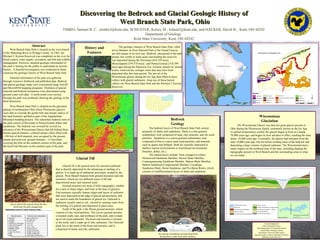
This document summarizes the geologic history of West Branch State Park in Ohio. The bedrock underneath the park consists of Devonian to Pennsylvanian shale and sandstone formations that were deposited in marine environments. During the last ice age, the Wisconsinan glacier advanced over the area, eroding the bedrock and depositing glacial sediments. These sediments included tills that formed ground and end moraines across the park. The glacier also filled an ancient buried stream valley with 350 feet of drift, which is now occupied by the Mahoning River and reservoir. Today, the park sits atop these glacial sediments, providing insight into the area's bedrock and glacial geological past.