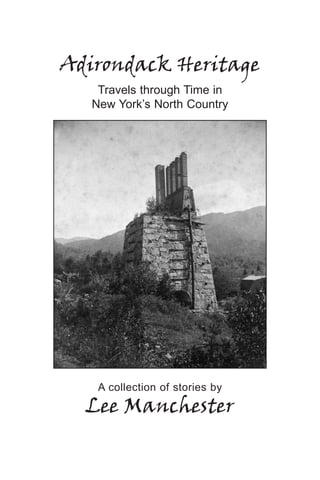
Adirondack Heritage
    Travels through Time in
   New York’s North Country


    A collection of stories by
  Lee Manchester
Adirondack Heritage
Adirondack Heritage
      Stories about historic
    Essex County, New York,
   the Adirondack High Peaks
       region, and vicinity

  By Lee Manchester
OTHER BOOKS BY LEE MANCHESTER

                 Edited by Lee Manchester
                     Island in the Valley:
          Stories About the History of Lemoore (Ca.)
              The Lake Placid Club: 1890 to 2002
                  Main Street, Lake Placid:
             An Architectural and Historic Survey
             The Secret Poems of Mary C. Landon
The Plains of Abraham, A History of North Elba and Lake Placid:
             Collected Writings of Mary MacKenzie
    Tales from the Deserted Village: First-Hand Accounts of
     Early Explorations into the Heart of the Adirondacks

               Written by Lee Manchester
              Adventures in the New Wilderness
Table of contents
                      THE HISTORIC OLYMPIC REGION
North Elba & Lake Placid
1. Lake Placid’s first hotels................................................................ 1
2. Placid’s Main Street ....................................................................... 5
3. Touring historic Newman ............................................................ 12
4. Historic schoolhouses of North Elba............................................ 19
5. Lake Placid-North Elba History Museum .................................... 24
6. The North Elba Cemetery ............................................................ 28
7. Palace Theater marks 75th anniversary........................................ 34
8. Plans afoot to restore historic 1932 bob run................................. 38
9. Fine art adorns Placid post office................................................. 43
10. Olympic art at 25........................................................................ 47
11. LPN-100: Editors & publishers.................................................. 52
12. A century of the News................................................................ 57
Wilmington
13. Wilmington, plain and simple .................................................... 64
14. Whiteface Veterans Memorial Highway.................................... 68
15. Whiteface Mountain & the 10th Mountain Division................... 74
16. Wilmington’s original town hall ................................................ 79
17. Mountain trails pass remains of Wilmington iron mines ........... 81
18. Santa’s historians ....................................................................... 84
19. Wilmington Camp Meeting marks century of worship .............. 91

                  HISTORIC ESSEX COUNTY & BEYOND
Tooling around the county
20.   Taking a trip up old Route 9 ..................................................... 99
21.   Schroon Lake .......................................................................... 102
22.   Port Henry............................................................................... 108
23.   Westport.................................................................................. 114
24.   Essex ....................................................................................... 120
25.   New Russia ............................................................................. 125
26.   Minerva................................................................................... 130
27.   Newcomb ................................................................................ 135
Historic spotlight: Town of Jay
28.   The ghost towns among us...................................................... 139
29.   The Jay bridge story................................................................ 142
30.   The resurrection of Wellscroft ................................................ 150
31.   The theater that had nine lives ................................................ 158
32. Hollywood Theater set to re-open ...........................................161
33. The Graves Mansion................................................................163
34. Adirondack mill town looks at historic preservation...............166
Schoolhouses
35. Historic Adirondack schoolhouses ..........................................173
36. The one-room schoolhouses of Lewis .....................................180
Historic & cultural sites
37.   Fort Ticonderoga readies for season (2003) ............................185
38.   Fort Ticonderoga opens for 2005 season.................................191
39.   The Crown Point ruins.............................................................195
40.   Awesome Au Sable Chasm .....................................................200
41.   Adirondack History Center Museum.......................................205
42.   The Penfield Homestead Museum...........................................211
43.   Adirondack music camps ........................................................215
44.   The Iron Center Museum.........................................................220
45.   The Alice T. Miner Museum ...................................................225
46.   Six Nations Indian Museum ....................................................230
47.   The Akwesasne Museum.........................................................235
48.   The Chapman Museum............................................................239
49.   Two stops in Malone ...............................................................243

                                       ADIRONDAC
50.   Adirondac ghost town awaits its future ...................................249
51.   The road to Adirondac.............................................................255
52.   Seeing the furnace for the trees ...............................................260
53.   Bidding adieu to “the deserted village,” Part 1........................268
54.   Bidding adieu to “the deserted village,” Part 2........................276
55.   Life at the Upper Works ..........................................................283

                           HISTORIC PRESERVATION,
                              ADIRONDACK-STYLE
56.   Adirondack Architectural Heritage .........................................291
57.   Santanoni .................................................................................298
58.   Preserving Santanoni ...............................................................303
59.   The AARCH Top Five, Part 1 .................................................309
60.   The AARCH Top Five, Part 2 .................................................314
61.   The bridges of the Au Sable Valley.........................................319
62.   Save our bridges ......................................................................324
63.   The Rockwell Kent tour ..........................................................328
64.   Trudeauville.............................................................................333
65.   Willsboro Point........................................................................339
66.   Historic Keeseville.................................................................. 348
67.   Historic Adirondack inns ........................................................ 354
68.   Valcour Island......................................................................... 362
69.   Two camps on Osgood Pond, Part 1 ....................................... 367
70.   Two camps on Osgood Pond, Part 2 ....................................... 373

                         JOHN BROWN’S FARM &
                      THE UNDERGROUND RAILROAD
71.   Tour retraces trail taken by John Brown’s body ..................... 381
72.   Adirondack Underground Railroad ties .................................. 389
73.   John Brown: Revisited & revised ........................................... 397
74.   Remembering John Brown ..................................................... 403
75.   John Brown’s body: A new guidebook................................... 409
The Historic
Olympic Region
Lake Placid’s first hotels
                   F IRST PUBLISHED A PRIL 23, 2004


      Today Lake Placid is known the world over as a double-
Olympic village, a comfortable base for treks into the Adirondack
High Peaks, and a prime four-season resort.
      But in 1871, Lake Placid consisted of just two farmhouses: One
belonged to Joseph Nash; the other, to Benjamin Brewster.
      Brewster’s land ran up Signal Hill, between Placid and Mirror
lakes, and all the way around the “Morningside” of Mirror Lake.
      Nash owned most of Mirror Lake’s west side.
      Nash had bought his tract in 1850, when he was 23.
      Brewster, Nash’s brother-in-law, followed a year later. He was
22.
      Joe Nash boarded a small but steady stream of travelers in his
home, expanding his “Red House” in 1855 to accommodate the
growing traffic.
      It was Ben Brewster, however, who built the first real hotel in
Lake Placid — that is, the first building specifically meant as a
hostelry. In 1871 he erected a big frame structure between the lakes,
with a big front porch. He called it the Lake Placid House, though
most folks knew it simply as Brewster’s.
      In his book, “History of the Adirondacks,” Alfred Donaldson
described Brewster’s as “ugly, jerry-built and primitive in the
extreme - unpainted, two-storied, with only 10 rooms, nails for coat
hooks, barrels for tables, doors leading nowhere, and a leaky roof,”
recounted Mary MacKenzie, the Lake Placid historian.
      “Unpainted it may have been for a time, but otherwise a
different story is told by Seneca Ray Stoddard’s 1873 photo of the
Lake Placid House,” MacKenzie wrote. “It was, in fact, a
commodious, three-story, sturdy and honest structure, and quite
attractive in a backcountry fashion.”
      The Lake Placid House’s could accommodate 60 guests.
      Though the railroad wouldn’t arrive until 1894, an ever-
growing flood of tourists came by horse, foot and carriage to Lake
Placid. In 1876, just 5 years after his brother-in-law opened the Lake
Placid House, Joe Nash built the settlement’s second hotel, called
Excelsior House, high on Signal Hill above, directly across from
today’s St. Agnes Catholic Church.


                                  1
“It was a pretty little structure,” MacKenzie said, “3½ stories
high, with a broad veranda and an observation outlook. Capacity was
90.”
      Nash built the place as an investment, not as a new career. He
leased it for a couple of years to Moses Ferguson, then sold the inn to
John Stevens, a 30-yearold from Plattsburgh. The new owner
promptly renamed it Stevens House.

      BUSINESS GREW, but competition was growing, too, and
quickly. Moses Ferguson left the Excelsior to build his own hotel in
1878, this one on an even higher hill close to the middle of Mirror
Lake’s western shore.
      “Only 20 years before,” MacKenzie wrote, “Joe Nash had
trapped a panther on the very spot where Ferguson erected a little
hotel, aptly named the Grand View. A small, plain but tidy building,
it boasted three stories capped with an observation look-out, and an
encircling veranda amply stocked with rocking chairs.”
      The Grand View occupied the site where the Lussi family now
operates the Lake Placid Resort Holiday Inn. Within 4 years, two
more hotels were built at the base of the hill below the Grand View.
The first, Allen House, was opened in 1880. The proprietor, Henry
Allen, had managed Brewster’s since 1876. He also ran the
stagecoach line connecting Lake Placid with the railroad depot in Au
Sable Forks.
      “Architecturally, Allen House was totally unlike the typical
boxy Adirondack hotel of the period,” Mary MacKenzie wrote, “and
it was big, easily outclassing its three competitors. It could
accommodate 100 guests.” In his Adirondack guidebook, Seneca
Ray Stoddard gave the Allen House top marks.
      “A great, roomy, rambling structure,” he wrote.
      So successful was Allen House that, after just 1 year’s
operation, Allen was in a position to buy the Grand View above,
operating the two hotels together for several years.
      In the meantime, Allen House got a new neighbor: the Mirror
Lake House, opened in 1882 by Joe Nash’s daughter Hattie and her
husband Charlie Green. The graceful little four-story structure, with a
three-story rear wing, could accommodate 75 guests.
      The Mirror Lake House (not to be confused with today’s Mirror
Lake Inn, at the northern end of the lake) must have been an instant
success, for after just one summer’s operation it drew a hefty offer
from Silas and Spencer Prime, of Upper Jay, to buy the hotel.
      When the Allen House burned in 1886, the Mirror Lake’s only
nearby competition was the Grand View. Ira Isham, of Plattsburgh,


2   Olympic Region
bought the Mirror Lake in 1888 and immediately set about with a
major improvement program. In 1889 he installed an electric plant,
making the hotel one of the first electrified buildings in the area.
      Isham also expanded the building so that, by 1890, “the Mirror
Lake ... was a magnificent, imposing palace of a place, the likes of
which had never before been seen in the North Country,” MacKenzie
wrote.
      But in 1894 the Mirror Lake House burned to the ground,
suffering the fate of most of the grand, old, wood-frame hotels of the
early Adirondacks, leaving only the Grand View on the hill that bore
its name.
      Under Henry Allen’s leadership, the Grand View grew and
grew, reaching its final proportions by 1900.

       TO THE NORTH, the Stevens House was experiencing one
successful season after another.
       Then came Christmas Eve 1885. At 8 a.m. that day, an
overheated stovepipe caught the upper rooms afire. Before long, the
entire building was ablaze. John Stevens and his partner, brother
George Stevens, pulled themselves together and, the next spring, set
about rebuilding a bigger, better hotel. Even a microburst that tore
down the nearly finished framework on May 14, 1886, couldn’t stop
them; the new hotel opened that July 4.
       It was an amazing place, “a splendid structure, built on lines of
classic simplicity,” wrote MacKenzie. “It was four stories high, with
a wide, encircling piazza [porch] on the ground floor and a central
observation tower. The appointments were lavish.”
       The new Stevens House could accommodate 200 guests; a
major expansion 14 years later doubled that. Meanwhile, down the
hill at Brewster’s, things were much more quiet. The Stevens
brothers had bought Ben out 1887, putting the Lake Placid House in
the hands of caretakers. Lake Placid’s original hotel changed hands
two more times before being sold in 1897 to George Cushman, who
immediately began a breathtaking expansion of the property.
       “The result was a spacious and imposing four-story structure.
An unnamed architect finished off the facade in a style that might be
called Adirondack Gothic,” wrote MacKenzie.
       To modern architectural critics, MacKenzie observed, “the
building comes across as grandiose, even a bit absurd, but it was
greatly admired in its day. Dominating the rise of land between the
two lakes, the new Lake Placid House was quite a sight. Given its
size and location, it shows up in the majority of the early Lake Placid
picture postcards and photos.”


                                              Adirondack Heritage      3
Extraordinary as were the results, the cost of financing the
expansion was too much for the Lake Placid House. It went into
foreclosure just a couple of years later.

      BY THE TURN of the 20th century, the Stevens House, Lake
Placid House and Grand View were no longer alone on the Lake
Placid hospitality scene. Ever since he built the Excelsior, Joe Nash
had been engaging in a brisk real estate trade, selling off the lots that
quickly became the homes, shops and small hotels of early Lake
Placid’s Main Street.
      When the railroad finally made it to Lake Placid in 1894, access
to the area was made relatively easy, and tourism grew
exponentially.
      In 1900, the village of Lake Placid incorporated. By the end of
the 20th century’s first decade, the village had paved streets.
      It all started with two young pioneers, Joe Nash and Ben
Brewster, and their pioneering Lake Placid hotels: Nash’s “Red
House,” Brewster’s Lake Placid House, and the Excelsior.

                       The fate of the big three
      The Grand View, in 1922, became Lake Placid’s first Jewish-
owned hotel, breaking the Adirondacks’ notorious ethnic barrier. A
refuge for refugees of Hitler’s Third Reich during World War II, the
Grand View closed in 1956. It was razed in 1961, making way for
the Holiday Inn.
      Stevens House was financially crippled by the stock market
crash of 1929. Auctioned off in 1933, the hotel was taken over for
taxes by Essex County a decade later. It was bought in 1947 for the
express purpose of demolishing what had become a notorious
eyesore.
      Lake Placid House operated successfully until 1920, when a
pair of fires finished off the inn that contained at its core the village’s
original hotel.


4   Olympic Region
Placid’s Main Street:
              A Walking Tour
                    F IRST PUBLISHED A PRIL 9, 2004


      When you think of historic buildings in Lake Placid, several
structures probably leap to mind: Melvil Dewey’s Lake Placid Club
complex, now just a landscaped hillside; the John Brown farm in the
North Elba settlement, south of town; the 1932 Olympic Arena, on
Main Street.
      Placid’s Main Street, however, is richer in local architectural
history than you probably imagine. In some cases the buildings tell
their own tales, just as they stand. In other cases, however, you have
to know what’s hidden inside Main Street’s buildings to appreciate
their stories.
      This article tells the stories of some of the most important
buildings still standing on Lake Placid’s Main Street. We’ve
designed it as a walking-tour guide, so that you can see the historic
village structures for yourself and develop your own sense of how
Lake Placid was built, brick by brick.

      THE FIRST settlement in North Elba township was on the
Plains of Abraham, south of Lake Placid village toward the Cascade
Lakes. While the North Elba settlement was begun around 1800, it
was not until the 1870s that Main Street was first developed along
Mirror Lake. In the 130-or-so years since the first structure was built
on Main Street, there have been three architectural periods: the
Victorian, from the 1880s into the 1920s; the Neo-Classical, from
about 1912 until the mid-1930s; and everything thereafter.
      Architect and historic preservationist Janet Null, of Troy,
compiled a historic survey of Lake Placid’s Main Street architecture
nearly two decades ago. Null’s study, published in 1990, and the
historic files compiled by the late Mary MacKenzie, former Lake
Placid and North Elba historian, were the primary sources for this
article.
      “The first impression of Main Street,” Null wrote in 1990, “is
of an aggressive commercial strip, lacking a clear identity, beset by
an almost overwhelming visual clutter, and consisting of a diverse
range of architectural quality.
      “The crisis in identity is between being a quaint historical
village street or being a modern commercial strip development.


                                   5
“The irony is that Main Street has a genuine identity under the
distractions, in its historic buildings which have not been generally
appreciated for their inherent values and character,” Null wrote.
      “It is paramount to recognize ... that the vast majority of the
original and historic structures on the street remain standing today,
even if disguised.”

                    1. North Elba Town Hall (1916)
       The first stop on our walking tour of historic Main Street
buildings is the North Elba Town Hall. Like many of the important
buildings of the day, it was designed by architect Floyd Brewster,
scion of a Lake Placid pioneer family, in the restrained Neo-Classical
style.
       The first Town Hall, built on the same site in 1903, was called
“The Tin Playhouse” for its tin sheathing. That building burned in
1915.
       The interior of today’s Town Hall was completely gutted and
rebuilt in 1977-78 in the runup to the 1980 Olympics. The clock
tower was rebuilt in 1986.

      2. Lake Placid High School (1922; 1934-35; 2001-02)
      Across Main Street from the Town Hall stands the impressive
“new” Lake Placid High School, looking down on the site where the
village’s first high school was built in 1901. Another Neo- Classical
structure, the central and southern portions of the building seen from
the road were added in 1934 to a much smaller structure erected in
1922. It’s hard to tell where the original structure ends and the newer
portion begins because the designs are so completely in sync. A
major addition, not visible from Main Street, was built in the first
years of the new century, behind the older building.

               3. Olympic Center (1932; 1977; 1984)
      Immediately north of the high school is the Lake Placid
Olympic Center, built in three stages. The historic core of the
building is the Neo-Classical brickfaced, steel-arched Olympic
Arena, built in 1932 by distinguished Adirondack architect William
Distin, protege of Great Camp designer William Coulter, of Saranac
Lake.
      Three attachments have been added to the dignified 1932
Arena, none very gracefully. To the north a low-lying, utilitarian box
of a building contains the Lussi Rink and the Lake Placid-North Elba
Visitors Bureau. To the south and west rises the 1980 Olympic
Arena, a very modern structure, attractive in its own way but


6   Olympic Region
architecturally incompatible with the 1932 Arena. Connecting the
1932 and 1980 buildings is a small “link building,” constructed in the
mid-1980s.

                   4. Lake Placid fire house (1912)
       Look at the red brick building that stands across Main Street
from the Olympic Center. In your mind’s eye, take away the signs
for Cunningham’s Ski Barn, erected after the village sold the
building in the 1980s; take away the 1-story, concrete block addition
to the south, built after 1945; replace the storefront with two, big
doors, and there you will have Lake Placid’s early firehouse. The
tall, brick tower rising at the rear was for hanging hoses to dry after a
fire.

         5. Adirondack Community Church (1923; 1958)
      This is the second Methodist church built on this lakeside site.
The first building was bought whole in 1923, when construction of
the new building began, and moved a couple of blocks down Main
Street next to the Speedskating Oval. It’s been used ever since as a
restaurant or nightclub. In the former church’s latest incarnation, it’s
known as “Wiseguys.”
      The stone of the Neo-Gothic main building of the Adirondack
Community Church was drawn from a granite quarry in Au Sable
Forks. An addition, Erdman Hall, was built in 1958 on the north side
of the building.

                   6. WWI Memorial (mid-1920s)
     A small stone memorial to the eight Lake Placid boys who died
in World War I stands in a quiet, dignified garden overlooking
Mirror Lake, just below the Adirondack Community Church. The
date of the memorial is uncertain.

       7. Northwoods Inn/Hotel Marcy (1897; 1927; 1967)
      The building that now bears the name “Northwoods Inn,” at the
south end of the central stretch of Main Street, is actually the Hotel
Marcy, Lake Placid’s first fireproof hotel, opened in 1927. The real
Northwoods Inn, opened in 1897, a hostel adjacent to and south of
the Marcy, ironically burned to the ground in December 1966. The
concrete-block structure now standing on that site was hurriedly
erected the year following the fire.
      The Marcy and the Northwoods Inn were simple, elegant
structures, in sharp contrast to the buildings now standing in their
place.


                                               Adirondack Heritage      7
8. Lamoy House/Alford Inn/Peacock Building
                    (1880; later additions)
       Nestled within the structure of the bizarre, warehouse-like,
rustic Tudor-industrial gift store on the lot north of the Marcy is the
oldest extant edifice on Main Street. In the fall of 1880 Marshall
Lamoy, a Wilmington immigrant, built a large, handsome house on
the hillside here. After running it as a boarding house for some years,
the Lamoys sold it in 1900 to the Rev. William Moir, rector of St.
Eustace-by-the-Lakes, the new Episcopal church in town. After
Moir’s death, it passed to North Elba farmer Harvey Alford in 1919.
Six years later he made a large addition to the south end of the house,
calling it the Alford Inn. In 1937 the name was changed again, to the
Lake Placid Inn, after the famous lakeside hotel that had burned in
1920. The “LPI” operated until the 1970s, when it was sold to
Eastern Mountain Sports and became a retail store. What is now the
first floor was excavated out of the hillside beneath the Alford
Inn/LPI in the 1990s by new owner Greg Peacock.

             9. Happy Hour Theatre/Wanda Building
                    (1911; additions, 1920s)
      At 117 Main stands another “building within a building.” As
you face it, imagine a building about half the size, three stories high,
simple, elegant, with a hipped roof. That building, the 1911 Happy
Hour Theatre, Lake Placid’s first cinema house, stands as the core of
the Wanda Building. The Happy Hour was bought by the company
that built the larger, more modern Palace Theatre, a few blocks up
Main Street, in 1926. Converted into an apartment building with
storefronts, it was substantially expanded in the 1920s.

             10. Former St. Eustace Parish Hall (1901)
      The building that currently houses the Imagination Station
store, at 107 Main Street, was originally built as a “parish hall” or
community center for the St. Eustace Episcopal congregation. It
housed a gymnasium, a lecture and dance hall, bowling alleys, game
rooms and a boat house. In 1915 the building was sold to George
Stevens, of Stevens House fame, who converted it for commercial
use.

                    11. Masonic Temple (1916)
     Next door to the former parish hall, local architect Floyd
Brewster designed the Neo-Classical Masonic Temple, built in 1916
and substantially unaltered today.


8   Olympic Region
12. St. Agnes No. 1/Ben & Jerry’s
             (1896; addition between 1908 and 1917)
      Take a look at the building at 83 Main St. while you still can.
The owners of the building where Ben & Jerry currently has its store
have big redevelopment plans that will leave the structure’s historic
origins utterly unrecognizable.
      What you’re looking at, believe it or not, is the original St.
Agnes Catholic Church, built in 1896. The congregation grew so
quickly that, by 1906, a new church had been erected on Saranac
Avenue, the predecessor of the current church building.
      The old Main Street building was sold to Frank Walton, who
removed the steeple before moving in the stock and fixtures from his
Mill Hill hardware store. A major addition to the building was
erected sometime between 1908 and 1917.
      When the Lake Placid Hardware Store went out of business in
1990, the old church windows from St. Agnes No. 1 were still stored
in the basement.

     13. Bank of Lake Placid (1915-16; rear addition 1930)
       The building that houses the Main Street branch of NBT Bank
was originally the Bank of Lake Placid, as the name engraved at the
top of the building attests. Designed by Floyd Brewster. the village’s
first bank building “is an example of the Renaissance palazzo revival
of the early 20th century, most often found in in a more urban
context,” according to Janet Null.
       “The bank has been a mainstay commercial institution in the
community,” wrote Null in 1990, “and the architecture of the
building is highly valued by the community as a whole. In short, it is
a local landmark.”

      14. Lake Placid Public Library (1886; later additions)
     One of the oldest buildings on Main Street, as well as one of the
most attractive, the Lake Placid Public Library was built for just
$1,200. Even adjusted for inflation, that’s still less than $25,000 in
modern money — quite a bargain. The shinglestyle cottage has been
refurbished and added to several times, but it has retained its original
character very well. For a special treat, visit the quiet lakeside garden
on the rear of the library lot, overlooking Mirror Lake.

    15. St. Eustace Episcopal Church (1900; moved 1926)
     St. Eustace-by-the-Lakes, one of Lake Placid’s two turn-ofthe-
20th-century Episcopal churches, was originally built on the corner
of Lake Street and Victor Herbert Road, between Mirror and Placid


                                              Adirondack Heritage      9
lakes. The building was designed by renowned Great Camp architect
William Coulter.
      After maintaining two churches for more than 20 years,
however, the congregation sold its St. Hubert’s Church (since
destroyed by fire) in the Newman neighborhood south of Lake
Placid, and decided to move St. Eustace to a church-owned lot on
Main Street. Coulter protege William Distin supervised the
dismantling of the church, the numbering of its component parts, and
the reconstruction of the church. The original wood tower was
replaced with a taller stone tower on the opposite front corner of the
building, possibly to visually anchor the building on its new corner
lot.
      Inside, an authentic Tiffany stained-glass window depicts
Whiteface Mountain and Lake Placid, figuratively depicting “an
experience of spiritual redemption in the wilderness,” according to
Null.
      “With its dark-stained siding, random stone tower and simple
detailing, the church is a fine example of almost-rustic Gothic
Revival,” wrote Null. “Its siting overlooking the village park and
lake, and conversely its high visibility, make it a focal point of the
center of the village. Its excellent state of preservation enhances its
value. ... St. Eustace must be ranked as one of the most important
buildings on Main Street.”

                      16. Palace Theatre (1926)
      Lake Placid’s second — and only surviving — movie house is
the Palace Theatre. Outside, the building retains its Neo- Classical
cast-stone detailing, including the large central window, lotus-capital
pilasters and pediment. Inside, through several subdivisions of the
theater space to increase the number of viewing rooms, the interior
design has preserved the late Art Nouveau stenciling and other
details on the walls, even going so far as to reproduce them on the
new interior walls. The main theater, on the ground floor, is graced
by the Palace’s original Robert Morton pipe organ, restored in 1998
and played for the Palace’s annual silent-film festival each October.

                       17. Pioneers monument
      In the park at the head of Main Street, overlooking Mirror Lake,
is a small stone with a memorial legend carved in its face. The
memorial honors the two men who, with their families, pioneered the
settlement along the lake shore: Joe Nash and Benjamin Brewster.
Main Street itself was created by carving up Nash’s farm in the late
19th century and selling it piecemeal to the homebuilders, hoteliers


10   Olympic Region
and entrepreneurs who were creating the first version of modern-day
Lake Placid village.
      If it’s not too chilly or too wet, sit down in this little green park,
look out over the stillness of Mirror Lake, and contemplate the
century-and-a-quarter of Lake Placid history through which you have
just walked. You have been given a glimpse into a side of the
Olympic Village rarely afforded to anyone, neither visitors nor
residents. Maybe, now that you know a little about the avenue’s
origins and development, your next shopping trip down Main Street
will be a little more meaningful for you.


                                               Adirondack Heritage       11
Touring historic Newman
                 F IRST PUBLISHED O CTOBER 22, 2004


      Newman?
      Where the heck is Newman?
      Surprise, surprise: Newman is right here.
      For many years, Newman was the name used for the lower
section of Lake Placid — the section where the Lake Placid News
currently makes its home.
      Centered around Mill Pond, Newman and its early industries
were crucial to the development of the village that came to be known
as Lake Placid, and before that to the settlement of North Elba.
      Mary MacKenzie, the late local historian, did the
groundbreaking research that unearthed the complete story of
Newman, from the first decade of North Elba’s settlement at the
beginning of the 19th century, through the demise of the Newman
Post Office in December 1936.
      Using MacKenzie’s research, we’ve put together a historic
walking-and-driving tour of Newman that may lend a new
perspective to your understanding of Lake Placid.

                         The ‘Newman’ name
      The very first homestead of the First Colony established at
North Elba was located in Newman. The town’s original settler,
Elijah Bennet, built his home near Mill Pond in 1800.
      The area did not come to be called Newman, however, until
1891.
      A post office for the growing village of Lake Placid was
established at a site on Mirror Lake in 1883, but it was quite a walk
for the daily mail from there to the lower village. Residents of the
lower village put together a petition to the U.S. Postmaster General,
asking that a second post office be established.
      Fortunately for them, gentlewoman farmer Anna Newman had
grown up with the Postmaster General. Newman, who came to
Heaven Hill Farm in 1872 from Philadelphia, penned a note of
support for the new post office that was included with the petition.
      “The response was immediate,” MacKenzie wrote. “By 1891,
the lower end of the village had its own post office, bearing the name
‘Newman’ in honor of Anna.
      “It was only a matter of time before the entire area came to be
called Newman, as though it were a separate village.”


                                 12
1) Power Pond dam
      The first stop on our tour of Newman is at the Power Pond dam,
just above the village’s electric plant.
      To get there, drive 1.5 miles down Sentinel Road from the
traffic light at Main Street. Turn left on Power House Lane. Cross the
bridge at the bottom, and park at the pulloff on the right.
      Standing at the bridge, looking upstream on the Chubb River,
you will see the Power Pond dam from which the village Electric
Department gets its power. That dam was built at the same site as the
very first dam built in North Elba, in 1809.
      That first dam provided mechanical power for the small
industrial complex associated with the Elba Iron Works, located
below the dam and just across the bridge from where you’ve parked.
Two forges, a sawmill and a grist mill were among the operations
here between 1809 and 1817.
      The Elba Iron Works faced two challenges. First, the ore from
its Cascade Lakes mine was contaminated with pyrite, making it
necessary to haul high-quality ore in from Clintonville, nearly 30
miles away. In 1814 a new road was cleared over the Sentinel
mountain range, connecting North Elba to Wilmington, a dozen
miles downstream on the River Sable.
      Just two years later, however, a climatological disaster struck
the young settlement. Ash from a tremendous volcanic explosion in
the South Pacific spread through the atmosphere, drastically reducing
the amount of sunlight reaching the Earth in northern New York and
New England. The year 1816 became known as “the year without a
summer,” when snow fell in every month of the year. Almost all of
the farmers in North Elba abandoned the settlement to avoid
starvation.
      The following year, the Elba Iron Works shut down, too.
      If you stand in the pine grove planted in 1940 on the foundry’s
former site, and kick your toe into the duff, you may discover
something the Iron Works left behind two centuries ago: a chunk of
“scoria,” or iron-ore tailings, looking like a reddish piece of
hardened, bubbly lava.

                            2) Railroad depot
      To get to our next stop, go back out to Sentinel Road, turn right,
and drive about a mile to the intersection of Station Street, just before
the Chubb River bridge. Turn left. Park at the railroad station, just
past the first intersection.
      The railroad finally made its way to Lake Placid in 1893, but it
was 10 years before the as-yet-unincorporated village got its own


                                             Adirondack Heritage      13
depot. The train station has not been altered in any significant way
since it opened in 1903, although commercial rail service ended more
than 30 years ago. In 1967, the building was acquired for the Lake
Placid-North Elba Historical Society, which now houses its museum
there. The new Adirondack Scenic Railway also uses the depot for
one end of its tourist-train service between Lake Placid and Saranac
Lake, 11 miles away.

                           3) Hurley Brothers
      Next to the railroad depot is Hurley Brothers. Today the
business delivers fuel oil to heat North Country homes, but when the
building was erected in 1909, the three original Hurley Brothers were
dealers in grain, hay, wood and coal. The building that stands there
today is essentially unchanged; the enormous coal and grain silos
built next to it in 1916, however, were razed in 1975.

                       4) American House site
      Across the street from the railroad station and Hurley Brothers
is a utilitarian, warehouse-type building covered in corrugated metal.
The Lake Placid store of the Hulbert Supply Co. stands on the site of
the old American House hotel.
      The American House was built by the three Hurley brothers
across from the end of the railroad line around 1893, within a few
months after train service had been introduced to Lake Placid. It was
“a substantial three-story hotel of 30 rooms,” MacKenzie wrote.
“Catering to summer visitors, [the Hurleys] often fed 180 guests at a
time and lodged 40.” The building “was gutted by fire in the early
1940s and was torn down.”
      Standing behind Hulbert Supply is the last vestige of the
American House: its former stable, once the headquarters of the Lake
Placid Trotting Association, which sponsored popular wintertime
horse races on Mirror Lake in the early 20th century.

                               5) Mill Pond
      Just down the block from the American House site is Mill
Pond. Just as the early Chubb River dam at Power Pond was the
industrial heart of the first North Elba settlement, so the second dam
above it, built in 1855, helped drive the development of what would
become the village of Lake Placid. A sawmill stood on the north side
of the original wooden dam; later, across the stream, another mill for
shingles and lath was built.
      The first dam held until 1974, when it washed out. Rebuilt with
funds raised by a community group led by MacKenzie, among


14   Olympic Region
others, the second dam was washed out in 1998 by high spring floods
carrying much debris from that winter’s disastrous ice storm. The
dam was rebuilt yet again in 1999, this time by the village of Lake
Placid. The “millhouse” on the north end of the dam is a storehouse
for maintenance supplies for the nearby park.

                           6) Opera House
      On the corner of Station Street and Sentinel Road, just
downstream from Mill Pond, stands Lisa G’s restaurant, originally
built in 1895 as the White Opera House building. The top story,
reached by an outside staircase, had a large hall with a stage and
space for an audience of 500. On the lower floors (there were three,
originally) were a hardware store and a butcher shop.

                         7) General Store
     Across Station Street from Lisa G’s is the newly remodeled and
renamed Station Street bar and grill, formerly styled The Handlebar.
The building was originally a general store, built in July 1886 by
George White. When the Newman Post Office was first opened in
1891, it was located in Mr. White’s store.

                        8) Newman Post Office
      Just one block up Sentinel Road from Station Street, across
River Street from the IGA grocery, now stands the Downhill Grill. In
earlier days, this building served as the Newman Post Office, from
1915 until the office was closed in December 1936. Before 1915, the
building held Hattie Slater’s millinery store. It once played a
prominent role as the bank in one of the many “wild west” silent
films shot in Lake Placid during the early 1920s.

                      9) Lake Placid Synagogue
       Going farther up Sentinel Road, up Mill Hill, we find on our
left a gray two-story house set a few yards back from the sidewalk.
Believe it or not, when this house was built in 1903, it was Lake
Placid’s first synagogue, which served the area’s Jewish community
for nearly six decades. Eddie Cantor and Sophie Tucker gave a
benefit in 1930 in Lake Placid to raise funds for the house of
worship. It was closed in 1959 when the new synagogue was
completed on Saranac Avenue.

                        10) Lake Placid News
     Next door to the old synagogue stands the red, two-story frame
building where the Lake Placid News has made its home since 1975.
The rear half of the building was erected in the 1890s, and for many


                                           Adirondack Heritage     15
years served as Pete McCollum’s harness shop. An addition was later
tacked on the front.

       11) Lyon’s Inn (North Elba House; Stagecoach Inn)
      Go back down to the train station, get in your car, and drive on
Station Street to the corner of Old Military Road. Turn left. On your
right-hand side, past the modern school building on your left, you
will see the broad porch and arrayed dormers of the 1½-story
Stagecoach Inn. Two or three years ago an attic fire swept through
the inn, putting it out of commission.
      The core of this building was once thought to be Iddo Osgood’s
Inn, first built no later than 1833. Mary MacKenzie’s research,
however, convinced her by 1995 that this was definitely not
Osgood’s, but a completely different hostelry: Lyon’s Inn, also
known as North Elba House.
      The confusion arose from the fact that both inns stood on land
originally owned by Elba pioneer Iddo Osgood. Osgood sold that
land to Earl Avery in 1851, and Martin Lyon bought it from Avery in
1864.
      Lyon expanded one of the houses on the former Osgood land,
turning it into the North Elba House — but not the house that had
served as Osgood’s Inn, according to Martin’s grandson Henry Lyon.
Henry remembered the Osgood buildings standing to the east of his
grandfather’s inn — and he remembered that they were demolished
early in the 20th century. The house that became the original part of
Lyon’s Inn is shown on an 1858 map on Avery’s land, but it is
possible that the house had already been built when Osgood sold the
land to Avery in 1851. It is not possible to date the initial
construction of Lyon’s Inn any more precisely than that at present.
      Lyon’s Inn housed the North Elba post office and was the
premiere gathering place for the settlement for many years.

            12) Heaven Hill Farm/Anna Newman house
      Continue driving east on Old Military Road until you reach
Bear Cub Road. Turn right. Go a couple of miles down this country
road, until you see the sign for Heaven Hill Farm on your right.
      The core of the greatly expanded and altered home currently
standing at the end of the long, long driveway was built in the 1840s
by Horatio Hinckley, a farmer who came to North Elba from Lewis,
another township in Essex County. It is thought to be the oldest
building still standing in the town of North Elba.
      The house and farm were purchased in 1875 by Anna Newman,
“a wealthy, benevolent and extremely eccentric Philadelphian,”


16   Olympic Region
MacKenzie wrote, “who fell in love with the Adirondacks, made
North Elba her home until her death in 1915, and became one of the
town’s chief benefactors.”

                        13) Old White Church
      Heading back down Bear Cub Road, make a right on Old
Military Road. After driving 0.4 miles, look carefully on your left for
the private lane that runs between the Jewish cemetery and the North
Elba Cemetery, for that is the drive down which the town’s oldest
church, known affectionately as the “Old White Church,” was
relocated in the 1990s.
      The North Elba Union Church was completed in 1875. Just 10
years later, however, the Baptists and Methodists that had formed the
“Union” separated, each congregation building their own churches in
Lake Placid. Anna Newman paid to keep the White Church open and
maintained until her death in 1915. It stood empty until 1930, when
the local Grange bought it, removing the steeple.
      The future of the White Church was in doubt fairly recently, but
community efforts succeeded in getting the structure moved from its
former site, on Old Military Road at the corner of Church Street, to
its present location.

                     14) Little Red Schoolhouse
      Coming back out to Old Military Road, make a right-hand turn
back toward Lake Placid. Go 0.7 miles to Johnson Avenue, on your
right, and turn there. Go through two intersections, Winter and
Summer streets, then look for No. 27 on your left, a 1½-story frame
house, white on the bottom, green on top. This private residence was
once North Elba’s “Little Red Schoolhouse,” the oldest of the town’s
surviving one-room schoolhouses.
      Built in 1848, “Little Red” was part of North Elba’s second
wave of settlement. There being neither church nor municipal
building at the time, the schoolhouse served both those functions,
too. When North Elba township seceded from the town of Keene in
1850, it was Little Red where the new town’s organizational meeting
was held.
      Classes were held in the schoolhouse until 1915, when
automobiles had become common enough to transport students in to
the village from the outlying areas served by one-room schools. Ten
years later, the building was sold to a private party, who moved it
one block over from its original site at the east end of Summer Street.
      Today, almost 80 years after its move, Little Red is the home of
the James Wilson family. Without a photo in hand of the old


                                            Adirondack Heritage     17
schoolhouse, it may be difficult to see Little Red in the Wilson home.
The house today, however, has the same roof lines as the old school,
and the enclosed porch corresponds pretty clearly to the old open
porch of the one-room schoolhouse.


18   Olympic Region
Historic schoolhouses
               of North Elba
                    F IRST PUBLISHED A PRIL 30, 2004


      When today’s Lake Placid visitors consider what the Olympic
Village’s old schools must have looked like, they may think of the
earliest portion of the handsome, neo-classical Lake Placid High
School building, overlooking the Speedskating Oval, the Olympic
Center and North Elba’s town hall.
      The truth is, the modern Lake Placid High School building is
the end product of an evolution in educational architecture that dates
back to the first decade of the 19th century.
      Some visitors might be interested in the fact that, in one form or
another, all of the early Lake Placid schoolhouses — or, at least, their
immediate successors — are still standing. For those with a few
hours to spare, we’ve put together a car trip back in time through the
roads around North Elba township to those old one-room
schoolhouses.
      As with our other historical surveys, this article depends on
extensive research and original materials painstakingly compiled by
the late local historian Mary MacKenzie. Her files are housed in the
archives of the Lake Placid Public Library.

                             The first school
      This area was first settled around 1800. No one homesteaded
anywhere near Mirror or Placid lakes until 1850. The first colony
here was established in a settlement that came to be called North
Elba, some miles to the south of present-day Lake Placid. By 1810,
the 40 families settled there had already erected a log schoolhouse
for their children’s use.
      The “year without a summer,” in 1816, drove three-quarters of
the first colony out of the Adirondacks. The dust cloud created by the
1815 volcanic explosion of Mount Tambora, on the Javanese island
of Sumbawa — said to have been 10 times more powerful than the
Krakatoa explosion of 1883 — covered the sun for months, causing
snow and frost in northern New York and New England well into
August 1816.
      The last living memory of the first North Elba schoolhouse was
related to Mary MacKenzie by a local centenarian, who recalled that,
as a little girl, she had seen its ruins still huddled behind the Torrance


                                   19
Farm on Heart Lake (Adirondack Lodge) Road, across Route 73
from where a later North Elba School building still stands.

                      ‘Little Red Schoolhouse’
      The next attempt to settle North Elba after the “year without a
summer” was more successful than the first. A second wave of
immigration came here in the 1840s. By 1850, North Elba once again
had about 40 families.
      The first school built for the new settlers’ families became
known locally as the Little Red Schoolhouse. It was erected in 1848
on the corner of Sentinel Road and Summer Street on land donated
by Iddo Osgood, a holdover from the first colony.
      A couple of years later, when North Elba township voted to
secede from Keene, the only public building available for the
organizational meeting was Little Red.
      Even when the village of Lake Placid began growing up around
Main Street in the 1870s, Little Red was the school Placid’s children
attended. A private school opened by the local librarian on Main
Street in 1885 took some of the growth pressure off the Little Red
Schoolhouse, succeeded in 1887 by a one-room public school built
below the present high school site across from Town Hall.
      The school in the village grew and grew by addition until, by
1902, it had become a two-story, barn-like structure with an
enrollment of 335 students.
      Growth continued. By the middle of the decade from 1910 to
1920, Lake Placid had begun debating construction of an altogether
new school building. In the midst of that discussion, in 1915, the
Little Red Schoolhouse finally closed its doors as an educational
institution.
      Ten years later the Nov. 20, 1925, issue of the Lake Placid
News reported that Little Red had been purchased by a private party.
The house was moved one block over on Summer Street, from
Sentinel to Johnson Road, “one of the streets in the new Hurley and
Johnson tract, where it is to be hoped it may for many more years
witness the continued development of the village.”
      Today, almost 80 years after its move, Little Red is the home of
the James Wilson family. Without a photo in hand of the old
schoolhouse, it may be difficult to see Little Red in the Wilson home.
The house today, however, has the same roof lines as the old school,
and the enclosed porch corresponds pretty clearly to the old open
porch of the one-room schoolhouse.


20   Olympic Region
North Elba School
       A couple of years after the Little Red School was opened,
families in the old North Elba settlement built a new schoolhouse for
themselves across the Keene road from the Torrance Farm, where the
original log schoolhouse had stood. Gerrit Smith, founder of North
Elba’s famous Black colony, sold the land for the new schoolhouse
to the school district for $1 in 1850.
       That second log schoolhouse stayed in use for some years. It
was torn down in 1886, and a frame building was erected in its place.
In 1920, a small vestibule was added to the west end facing the road,
containing a cloakroom and restrooms — thus, the double roof line
still evident in the structure.
       “Back in the old days, when school buses were not available to
bring pupils of outlying sections in to the village to attend classes in
a luxurious central school, at times there were 85 pupils in the one-
room (North Elba School) building on the Cascade road, one teacher
teaching all grades,” said a Lake Placid News article on Jan. 24,
1941.
       Gertrude Torrance, born in 1919, lived as a child on her father
Rollie’s farm across the road from the North Elba School, which she
attended.
       “I started school when I was 5 years old,” she recalled, “and
went there through the 6th grade, a few years before they centralized.
They drove us in to Lake Placid in a Pierce Arrow car.
       “My sister stayed on, though, for a little (at the North Elba
School) — she was 4 years younger than me. By the time the school
closed, there were only four students going.”
       The last class at the North Elba School was held in 1936. The
building was sold in August 1941 to school-board trustee Rollie
Torrance. Twelve years later he deeded the school building to his
daughter, Gertrude Torrance Hare. Mrs. Hare still lives in the
converted schoolhouse with her husband Walter.
       The former North Elba School house stands today on Route 73,
opposite the entrance to the Adirondack Lodge Road. The old
building is only barely recognizable within the expanded structure
the Hares have built around it. Little but the old double roof line can
still be seen of the North Elba School in the Hare home today.

                             Cascade School
      In 1879, Sabrina Goff deeded half an acre to a new school
district situated at the far end of North Elba township, on the Cascade
Road to Keene Center. Jacob Wood, grandfather of famed local golf
pro Craig Wood, built the schoolhouse for $240.


                                             Adirondack Heritage     21
A 1911 yearbook indicates that the Cascade School was, in
large part, a Goff family operation, though three other families’
children also attended. Three of the 10 pupils were Goffs, as were the
district trustee and clerk.
      The Cascade School was one of the last of the one-room
schools still holding class in North Elba township — possibly the
very last one — and the farthest away from the Lake Placid Central
School. When the question of closing the school was debated in
August 1940, Chairman C. Walter Goff broke the 4-4 tie vote to send
the Cascade children in to Lake Placid.
      “The call for the closing of the school was issued by the Lake
Placid Central School to eliminate the expense of a teacher,” read the
Aug. 30, 1940, issue of the Lake Placid News, “inasmuch as the
board of education did not think the number of pupils attending
warranted it.”
      Albert Goff purchased the building after the school was closed,
turning it into a summer home. Albert deeded it to his nephew
Harold Goff; Harold’s widow, Marie Goff Senecal, still lives in it.
The homes of Harold and Marie’s children surround the old
schoolhouse.
      Standing on the left side of Route 73 just past the entrance to
Mount Van Hoevenberg on the way from Lake Placid to Keene, the
Cascade School building has been extended in the rear, but the form
of the old schoolhouse has been lovingly preserved in the structure,
as seen in the bell tower.

                          Averyville School
      Out on the Averyville Road stands another of North Elba
township’s early one-room schoolhouses. The yellow, frame building
is the second of the Averyville settlement’s schools.
      The first Averyville School was built sometime in the first half
of the 19th century, after Simeon Avery settled here in 1819. That
building was sold in 1888 and moved to a farm run by Frank Alford,
who later moved to Main Street and operated the Alford Inn, next to
the Marcy. Mary MacKenzie could find no evidence of the first
school building’s survival anywhere in the township.
      The second Averyville School, built in 1888 when the first
school was moved off the site, was closed at the end of the 1932
school term. The building was sold at auction in 1936 to Lester E.
Otis.
      “He (Otis) has partitioned it off into rooms and made an
attractive cottage which is used by the family on occasion,” read a


22   Olympic Region
Lake Placid News article of April 21, 1939. “The schoolhouse
property is cultivated as a vegetable garden.”
       “For a long time it has been a part of the Malone family
summer residence property,” MacKenzie wrote in November 2001.
“Sadly, it has long been neglected and now presents a very shabby
and forlorn appearance.
       “An effort should be made at some level to restore this historic
little building,” MacKenzie added. “There have been no additions
made to it, and the bell tower readily identifies it as an old rural
schoolhouse.”
       The house is on the right-hand side of the Averyville Road, past
several sharp curves, about 3 miles from the Old Military Road.
Ray Brook School
       The last school on our little tour is in Ray Brook, between Lake
Placid and Saranac Lake.
       The original one-room Ray Brook schoolhouse was built before
1876 on the road off Route 86 that now leads to a federal prison.
That school either burned or was demolished, according to
MacKenzie; no trace of it has been identified.
       Another school was built on the Old Ray Brook Road between
1903 and 1905 for the children of the employees at the new state
tuberculosis hospital.
       An odd bit of history concerning the Ray Brook School was
recorded in 1915 in the Lake Placid News:
       “Shortly after entering upon his duties (as school district
trustee) last August, (Merle L.) Harder cut the schoolhouse in two
and started to remove part to another site,” the LPN reported. “His
action was declared illegal, and the removal of the part of the
building stopped after it had been gotten on trucks. He was directed
to replace the school house upon its foundations and restore it to its
former condition.”
       Exactly when the Ray Brook School was closed, we do not
know. According to Charles Damp, current resident of the old
schoolhouse, the building was used as a community center through
the 1950s.
       “He (Damp) has made many improvements,” MacKenzie
wrote, “but has retained the bell tower so that the building still has
the look of an old schoolhouse.”
       The 100-year-old Ray Brook School can still be recognized as
the core of the modern Damp house.


                                            Adirondack Heritage     23
Lake Placid–North
           Elba History Museum
                   F IRST PUBLISHED J UNE 6, 2003


      When you think of Lake Placid, what comes to mind?
      The Olympics?
      Mirror and Placid lakes?
      The High Peaks country?
      The Lake Placid Club?
      The “Adirondack style” of architecture and houseware design?
      There’s one place in the village where you can be introduced to
all of it, and where you can see it in its historic context.
      That place is the Lake Placid-North Elba Historical Society
Museum.
      The museum’s home is a piece of Lake Placid history itself: the
village’s old railroad station, which is celebrating its 100th
anniversary this year.
      The Delaware & Hudson Railroad built the Saranac Lake-Lake
Placid spur off the main New York Central line between Utica and
Malone in 1893, but it was not until 1903 that a passenger and
baggage depot was built in Lake Placid.
      Highway construction after World War II undercut the
economic foundations of America’s railroads. The last D&H
passenger train visited Lake Placid in 1965. The village’s railroad
station seemed doomed until sisters Frances and Louise Brewster
bought the building in 1967, giving it to the historical society that
summer for use as a museum.

      THE MUSEUM has had several directors over the last 36 years.
The latest is Gary Francois, who took over in March.
      “They didn’t hire me for my vast knowledge of Lake Placid
history,” admitted the Lake Placid photographer. “What I had to
offer is my energy, my commitment and my artist’s eye.”
      With just a couple of months to get the museum ready for its
five-month season, Francois went to work right away, cleaning out
the restored railroad depot’s overfull Waiting Room.
      In years past the walls have been covered — some would say
cluttered — with unframed historic photos, while the floor has been
packed with display cases stuffed with precious historic artifacts.


                                 24
Francois has been paring down the numbers of items on
display, framing the rarest historic photos and creating enough room
around them so that they are accessible. He’s done the same with
both the contents of the cabinets and their arrangement, creating
simpler, more meaningful displays on different aspects of local
history in a series of cases that are easy to move around.
      While not himself a historian, Francois seems to understand
what makes history significant to museum visitors. He showed our
reporter a series of photographs of the Joseph Nash 19th century
homestead on the northern edge of Mirror Lake, on the site where the
Ramada Inn now stands.
      The first photo was shot in 1873 by Seneca Ray Stoddard. It
shows the Nash farm complex standing alone on a rolling green
hillside, below it the waters of Mirror Lake — then called Bennet
Pond after the village’s original settler.
      “I appreciate the innocence of this photo,” Francois said. “I
don’t want to lose that sense of things.”
      The other two Nash farmstead photos, though shot just a few
years later, show more and more buildings erected nearby.
      Today, that same area is Lake Placid’s prime shopping district.

       THE WAITING Room at the railway depot museum uses all the
space at its disposal for displaying historic artifacts. On the floor are
cabinets that tell the stories of the Lake Placid Club, radical
abolitionist John Brown, Lake Placid’s 98-year-old Volunteer Fire
Department, and a farm that is nearly as old as North Elba township
itself, the late Henry Uihlein’s Heaven Hill Farm.
       One entire wall in the Waiting Room is devoted to the growth
of winter sports in Lake Placid and the village’s Olympic history.
       Another wall displays farm implements recovered from nearby
barns, fields and meadows, evidence of the work done by North
Elba’s earliest agricultural settlers.
       In a loft overlooking the Waiting Room are various 19th
century conveyances, including a bicycle with a huge front wheel
centered by a pair of tiny foot pedals.

     THE MUSIC Room, situated just off the Waiting Room, is the
smallest display area in the history museum. One wall is dedicated to
the memory of legendary singer Kate Smith, most famous for her
signature rendition of “God Bless America.” Smith summered in
Lake Placid, where she was much-beloved. A group called the Kate
Smith Society visits the museum every year to maintain “Kate’s
Wall.”


                                              Adirondack Heritage      25
Visitors to the Music Room will also find a working 1890s
Edison phonograph, a 1940s Philco radio set and a Victorian organ
standing next to a relic of another Placid summer person, conductor
Victor Herbert’s music stand.

      THE MUSEUM’S central display room is usually called “The
General Store.” The room serves as a catch-all for the kinds of items
one would typically find in a turn-of-the-20th-century sundries store,
complete with a pharmacy, a cigar-store Indian and the post-office
boxes from the old Newman neighborhood postal station, which used
to stand just down the street from the railroad depot.
      The General Store has lots of interesting artifacts — perhaps
too many. It awaits Francois’ paring skills.
      Beyond the store is the museum’s final display area, the
Adirondack Room, containing a fine display of typical Adirondack
camp furniture, including a dining table set with service from the
legendary Camp Underhill, on the north shore of Placid Lake.
      On the Adirondack Room’s walls are stuffed samples of a wide
variety of Adirondack wildlife, including the supposedly extinct
Adirondack mountain lion — “supposedly,” we say, because the cats
continue to be spotted once or twice every few years, from the High
Peaks to the Champlain Valley.

      THURSDAY EVENING programs are a regular part of the
history museum’s annual calendar, with anywhere from half a dozen
to two dozen people attending a given night’s activities. This year’s
lecture series, which starts at 8 p.m. each evening, includes:
     • July 31, “Why Historic Preservation?” with Steven
           Engelhart, executive director of Adirondack Architectural
           Heritage;
     • Aug. 7, Gary Francois shares some of his Adirondack
           landscape and recreational photography in an audiovisual
           show;
     • Aug. 14, Jay artist Terrance Young talks about his
           Adirondack etchings and poetry;
     • Aug. 21, Doug Wolf, president of the Whiteface Historic
           Preservation Society, talks about the cultural and natural
           history of Whiteface Mountain, and
     • Aug. 28, a color slide program on the recently completed
           restoration of the stained-glass windows at Lake Placid’s
           Adirondack Community Church.
      An extra feature on the museum’s calendar is a fund-raising
craft fair scheduled for Saturday, Aug. 2.


26   Olympic Region
THE LAKE Placid-North Elba Historical Society Museum will
be open from 10 a.m. to 4 p.m. over the next three weekends — June
7 and 8, June 14 and 15, and June 21 and 22.
      From Tuesday, June 24, through mid-October the museum will
be open Tuesday through Sunday (closed Mondays) from 10 a.m. to
4 p.m.
      The railroad depot museum is located on Averyville Road in
Lake Placid, a block off South Main Street at the base of Mill Hill.
Lisa G’s restaurant, an opera house 100 years ago, stands on the
corner of South Main Street and Averyville Road.
      This year there is no fixed admission fee to the museum, though
a $2 donation is recommended. Museum supporters are encouraged
to join the Lake Placid-North Elba Historical Society. Membership
dues are $15 a year.
      The museum also welcomes contributions. Gifts are now being
sought to help pay for repairs to the museum’s original slate roof.
Work on the roof is scheduled to begin later this month. Nearly
$40,000 has been raised for the project, but another $10,000 is still
needed.
      For more information about the Lake Placid-North Elba
Historical Society, call (518) 523-1608.


                                           Adirondack Heritage    27
The North Elba Cemetery
                  A walk through Placid History
                   F IRST PUBLISHED A PRIL 15, 2005


      It's Mud Season. The trails are too sloppy for hiking, but the
weather is too pretty to stay inside.
      What to do?
      Here's an idea for an enlightening walk: a historical tombstone
tour through the North Elba Cemetery. Many of the people who
made the village of Lake Placid and the town of North Elba what
they are today can be found there, resting from their labors.
      The North Elba Cemetery is on the north side of Old Military
Road, about a quarter mile west of the Cascade Road, across from a
roofless, cylindrical brick tower rising from an open field (an
environmental sculpture left over from the 1980 Olympics).
      The North Elba Cemetery is divided into sections by the
network of one-lane roads passing through it. Most of the graveyard's
historic tombstones can be found in the section to the right of the
westernmost entrance to the cemetery, adjacent to Old Military Road.

       EUNICE NEEDHAM. North Elba was first settled in 1800. Most
of the members of its First Colony did not stay on past 1816, known
as “the year without a summer,” and the closing of the local iron
works in 1817.
       Among those who made up North Elba’s First Colony were
brothers Charles and Jeremiah Needham Jr. Born in Wales,
Massachusetts, the Needhams arrived in North Elba on June 26,
1806. It’s not clear whether Eunice Needham, daughter of Jeremiah
and his wife Ruth, was born before or after they arrived here. What’s
certain is that little Eunice was the first person to be buried in the
North Elba Cemetery, on Jan. 2, 1810, “in the fourth year of her
life.”
       Eunice’s tombstone is a simple, gray marker, broken near the
base and laid flat across her grave.

      THE OSGOODS. Another member of the First Colony was
Iddo Osgood, who came to North Elba on March 4, 1808, at the age
of 28. Osgood was a fairly substantial farmer, buying up much of the
cultivated land abandoned when the First Colony collapsed. Osgood
later became North Elba’s first innkeeper as well as a man of some
political substance on the local scene.


                                  28
For many years, most Placidians thought that the Old
Stagecoach Inn on Old Military Road was an expansion upon
Osgood’s original inn. The year 1833, shown on the sign at the
Stagecoach Inn, refers to the earliest known date when Osgood’s
hosted paying guests.
      In the mid-1980s, however, researchers concluded that
Osgood’s and the Old Stagecoach Inn had been separate structures,
and that Osgood’s had been torn down sometime in the early 20th
century. Osgood’s Inn was probably located where the Uihlein
Mercy Center stands today.
      Iddo, a Congregationalist deacon, held religious services at
Osgood’s Inn, and his son Dillon grew up to become an ordained
Congregationalist minister as well as North Elba’s first postmaster.
      Four Osgood graves stand together in the North Elba Cemetery:
old Iddo, who died in 1861 at the age of 82; the first of Iddo’s three
wives, Clarista (d. 1816); his second wife, Prudence (d. 1831); and
Dillon, who died the year before his father at the age of 39.

     ROBERT SCOTT. Another early Elba settler was Robert Scott.
      Born in 1803, Scott came to Alstead Hill in Keene as a young
child with his mother and father shortly after 1810. In 1840, when
only nine other families were living in North Elba, Scott and his wife
Laura bought a 240-acre tract on what is now called the Cascade
Road, about a half-mile east of today’s municipal golf course.
      By 1850 the Scotts had built a frame house at the base of a little
mountain that came to be known as Scott’s Cobble. They began
taking in guests, one of whom was early travel writer J.T. Headley,
who said of North Elba, “I had never heard of it before, and am
surprised that its location has not attracted more attention.”
      From 1849 to 1851, Scott’s nearest neighbor was John Brown,
who later gained notoriety in the Harper’s Ferry raid of 1859. Brown
was returning home one winter day from a business trip to
Springfield, Mass., when he got stuck at Keene without a ride over
the mountains to North Elba. Brown nearly died on that journey
through the deep snows of the Old Mountain Road, but he managed
somehow to make it to Robert Scott’s, who let him rest up and get
warm before hitching his oxen to a sleigh and taking Brown home.
      In 1854, Scott was part of the three-man team responsible for
building today’s Lake Placid-Wilmington Road through the
Wilmington Notch, replacing the old winter road running through the
Sentinel Range above the Notch behind Connery and Winch ponds.
      Scott’s boarding house was expanded in the 1870s by niece
Martha Scott and her husband Moses Sampson Ames, who


                                             Adirondack Heritage     29
rechristened it the Mountain View House. Guests came from all over,
and the Mountain View was widely hailed for many years. It burned
in 1903.

      BROWN FAMILY. The graves of abolitionist John Brown and
many other members of the Harper’s Ferry party can be found near
Brown’s farmhouse in North Elba. Three members of John Brown’s
family, however, are buried in the North Elba Cemetery: daughter
Ellen, daughter-in-law Martha, and grandson Frederick.
      Freddie was born in August 1859 to Watson Brown and his
wife Belle Thompson, daughter of North Elba pioneer Roswell
Thompson (also buried in the North Elba Cemetery). The Brown and
Thompson families were very close; Belle’s brother Henry had
married Ruth Brown in 1850. Two months after Freddie was born,
his father was killed in the Harper’s Ferry raid.
      The following year, Freddie’s mother took him on a visit to the
home of Louisa May Alcott in Concord, Mass., along with his
grandmother Mary, John Brown’s widow.
      “The two pale women sat silent and serene through the clatter,”
wrote Alcott, “and the bright-eyed, handsome baby received the
homage of the multitude like a little king, bearing the kisses and
praises with the utmost dignity.
      “When he was safe back in the study, playing alone at his
mother’s feet, C. and I went and worshipped in our own way at the
shrine of John Brown’s grandson, kissing him as if he were a little
saint, and feeling highly honored when he sucked our fingers, or
walked on us with his honest little red shoes, much the worse for
wear.”
      Little Freddie died just three years later of diphtheria. He was 4
years old. His broken tombstone, lying flat on the ground above his
grave, says simply, “Gone Home.”

      EPPS FAMILY. John Brown came to North Elba in 1849 to help
a small, fledgling African-American colony that had been established
here by wealthy abolitionist Gerrit Smith. The members of that
colony were not escaped slaves, or even freed slaves; all had been
born as free men and women, most of them in New York state. Born
as city folks, however, they were having a hard time making it as
farmers.
      Thirteen Black families are recorded on the North Elba census
from 1850 to 1870. By 1871, only of those 13 families remained: the
family of Lyman Epps.


30    Olympic Region
The Epps family came to North Elba from Troy in June 1849,
taking a wagon trail up the Vermont side of Lake Champlain and
crossing by ferry to Westport where, according to one story, they met
John Brown’s family. The two families joined forces, making the 40-
mile journey together through the wilderness to “the Plains of
Abraham,” as North Elba was called in its earliest days.
      Lyman Sr. and his son Lyman Jr. became famous for singing a
favorite hymn of Brown, “Blow Ye the Trumpets Blow,” at the
abolitionist’s funeral in December 1859. Both were highly regarded
in the community. In 1875 the elder Epps became a founding
member of North Elba’s first formal hall of worship, the White
Church (named for the color of its paint, not its members). He also
helped establish the Lake Placid Public Library in 1883.
      Individual headstones, arrayed in a line on either side of the
Epps family obelisk, mark the graves of Epps family members.
Buried with them is William Appo, another member of the North
Elba Black colony, who married one of the Epps daughters.

      STUART BAIRD. The tombstone spells his name “Beard,” but a
short article in the Essex County Republican spells its Baird, and this
is the spelling preferred by local historians.
      Also known locally as “Old Baird,” the itinerant tinker’s name
was linked with that of the White Church in one of Alfred
Donaldson’s famously inaccurate stories about Adirondack history.
      According to A.D., Baird was an eccentric who wore the same
clothes for years at a time, patching them over when holes wore
through the fabric. When he died on Oct. 19, 1873, Donaldson wrote,
“his coat of many rags was peeled off, some of the half-rotten
patches split open and were found to contain bills of various
denominations. ... The total yield was $350. ...
      “The suggestion was made that it be used to build a church,”
Donaldson wrote. “It [the White Church] still stands — and is a
monument to a vagabonding tinker who unconsciously spent his life
in hoarding and secreting funds for its erection.”
      Nice story — but not completely true. When Baird died at the
home of one of his customers, the poormaster —none other than
Robert Scott — found just under $200 in cash on the tinker’s person,
which was applied to the cost of his tombstone and burial plot.
      Fund-raising to build the Union Church — the proper name for
the White Church — had been under way for a considerable while by
the time of Baird’s death, and pledges from the community had
already covered the anticipated cost: between $1,200 and $1,500.


                                            Adirondack Heritage     31
Work was started on the building in the fall of 1873; two years later,
it was finished.
      The late North Elba historian, Mary MacKenzie, wrote that the
White Church “was a monument not to Stuart Baird, but to the many
North Elba residents who made it possible by their willing
sacrifices.”

       JOSEPH V. NASH. Young Joe Nash’s first exposure to North
Elba came in 1839 when, as a 13-year-old boy, he and his brother
Timothy, age 15, came walking up the Old Mountain Road on their
way from Willsboro, driving before them a herd of young cows.
Their father had bought a farm from Roswell Thompson, and the
family was starting a new life on the Plains of Abraham.
       In 1850, 24-year-old Joe Nash paid $240 for a 160-acre plot in
the wilderness of Bennet Pond’s western shore. (Today, we know
that pond as Mirror Lake). Nash built a cabin, cleared a farm, and the
following year married schoolteacher Harriet Brewster, whose family
had come to North Elba from Jay in 1841.
       Joe built a frame house around 1852, and in 1859 bought
another 160 acres, again for $240, extending south from his earlier
tract. Nash’s farm covered all of what would later become Main
Street, from the Hilton to the high school, including much of Signal
Hill.
       In the late 1870s, just a few years before his death in 1884,
Nash began subdividing and selling off his property for development.
Much of the core of the village of Lake Placid was built on the lots
created out of Joe Nash’s farm, and many think of him today as the
founder of the village.

       BENJAMIN T. BREWSTER. Nash’s brother-in-law, 22-year-old
Ben Brewster, bought the tract just north of Joe’s in 1851. For two
decades, Brewster farmed. But in 1871, several years after Joe Nash
had started taking in boarders at his home, Brewster decided to build
the first real hotel within the boundaries of what would later become
the village of Lake Placid. He called it the Lake Placid House, but
most folks knew it simply as Brewster’s.
       Brewster did well — not as well as Nash, but well enough to
build himself a stately Victorian residence in 1883 that, 40 years
later, became the Mirror Lake Inn. There, Brewster lived out the
remainder of his long life in comfort and ease.
       Near the end of his days, at the age of 84, white-bearded
Benjamin Brewster was cast for a bit role as Father Time in one of
the many silent films then being shot in Lake Placid. When told that


32   Olympic Region
his face would soon be seen all over the country, he was not
impressed.
      “Well, I’m known all over the country anyhow,” he said — and
he was probably right.
      Note: While a marker for the graves of Benjamin Brewster’s
father, Thomas P. Brewster, and other members of his family stands
in the same section of the North Elba Cemetery as most of the other
historic burial plots, the headstones for Ben Brewster and his wife,
Julia Ann Washburn, are found to the north of the eastern end of the
road running along the back of the cemetery.

      THE DEWEYS. Heading back out toward Old Military Road
from Benjamin Brewster’s grave, there are two more sites on the left
that are especially worthy of note.
      The first, standing far back from the driveway, is the family
plot of the Deweys. Father Melvil and son Godfrey may have played
the most significant roles of any two individuals in the whole history
of Lake Placid. Melvil Dewey founded and developed the Lake
Placid Club, and Godfrey Dewey single-handedly won the bid for the
1932 Winter Olympic Games in Lake Placid.
      Our final stop after visiting the Deweys’ headstone is a few
steps back toward the driveway.

      THE MacKENZIES. Mary MacKenzie, who died on April 15,
2003 — two years ago today — was, for all practical purposes, the
creator of Lake Placid and North Elba history, being the first to delve
into the source material of that history in a really rigorous, systematic
way. She was first named official North Elba town historian in 1960,
the same year her husband Seymour died. In 1980, the year the
Olympics returned, the village of Lake Placid also named her its
official historian.
      MacKenzie’s small, illustrated book, “Lake Placid and North
Elba: A History, 1800-2000,” was published the year before her
death, and two more of her books are being published posthumously.
“Collected Poetry 1931 to 1937” is being released next month by
Blueline, the literary magazine of the Adirondacks. And next year a
massive volume, “The Plains of Abraham: Collected Writings on the
History of North Elba and Lake Placid, N.Y.,” will be published by
Nicholas K. Burns Publishing.
      If there is anything in this brief historic walk through the North
Elba Cemetery that you have found enlightening, stop for a moment
at Mary’s grave and thank her.


                                             Adirondack Heritage      33
Palace Theater marks
            75th anniversary
                   F IRST PUBLISHED J UNE 18, 2001


       The main venue for film exhibition at this weekend’s Lake
Placid Film Forum is the Palace Theater on Main Street, which is
celebrating its 75th anniversary this year.
       The Adirondack Theater Corporation, a locally owned and
managed concern, erected the Palace Theater in 1926. As the
building neared completion, the corporation also took out a long-
term lease on the only other movie house in Lake Placid, the 15-year-
old Happy Hour Theater.
       The Happy Hour had been built in 1911 by its owner-operators,
referred to in the Lake Placid News of the day only as “Messrs.
Walton & Adams.”
       “During the intervening period (since the Happy Hour’s
construction), extensive alterations have been made in the property,”
the 1926 News said, “which have materially increased the seating
capacity of the auditorium.”
       ATC took possession of the Happy Hour on May 16, 1926, less
than two weeks before the doors were opened to the Palace.
       It’s not certain when the Happy Hour closed, but current Palace
owner Reg Clark recalls that it was not long after the new theatre’s
opening.
       The final touch to the new Palace cinema was the installation of
“a first-class, strictly orchestral concert organ,” said the LPN. “The
organ differs from the so-called pipe organs and church organs in
that it is strictly orchestral in practically all its qualities.
       “There are two departments or organs, one on each side of the
stage. It requires many miles of wire for the electrical works, and a
15 h.p. motor to operate it.”
       The organ was played to accompany the silent films being
shown when the Palace was built.

                         The Palace opens
      Today, the Palace Theater remains the same in many details as
the grand, 925-seat movie palace that opened on May 29, 1926,
“before an audience that filled every seat of the big auditorium and
overflowed into such standing space as was available,” according to
the News.


                                  34
“The buzz of conversation ceased as the special orchestra struck
up an overture. The audience seemed to realize that here was
something more than a mere theater opening. In truth it was a dream
made real,” the News reported.
      When Chamber of Commerce President W.R. Wikoff addressed
the audience — gathered from as far afield as Plattsburgh, Keene and
Au Sable Forks — he spoke of the Palace as an emblem of Lake
Placid’s shining future.
      “He (Wikoff) dwelt on the fact,” the LPN said in its decidedly
biased report of the opening, “that the Palace was a monument to the
optimists of the village, the men who said, ‘It could be done.’ He
also pointed out that Lake Placid is going ahead in no uncertain way,
as proved by the new theater.”
      Sources differ on who designed the Palace Theater. The June 4,
1926, Lake Placid News gives the credit to John N. Linn, of
Brooklyn. A later historical assessment, however, lists architect
Louis Wetmore, of Glens Falls, as the designer.
      Both sources agree that the building was constructed by George
Bola, a Lake Placid contractor.
      The Palace that today’s movie-goers experience exhibits many
of the distinctive architectural features of the original 1926 building,
including:
     • the Neo-Classical “cast stone” detailing on the Palace’s
          Main Street facade, with its central Palladian window, lotus-
          capital pilasters and pediment;
     • the orchestra pit in the main, downstairs movie hall,
          complete with the Robert Morton 1926 pipe organ, built in
          Van Nuys, Calif., and bought for $25,000 — or, in the
          inflated currency of 2001, about a quarter of a million
          dollars;
     • late Art Nouveau stenciled walls; and
     • original cast plaster chandeliers and wall sconces.
      The theater’s painted ceiling panels originally depicted angels,
suspended in the heavens above and watching over the movie patrons
below. The angels were covered over in the 1930s with a
composition material designed to improve the auditorium’s acoustics
after the introduction of “talkies.”
      “Talkies” — motion pictures synchronized with a soundtrack
— were first brought to the Palace in 1929.
      “Lake Placid as a village would probably not have talking
pictures for some time to come, due to the heavy initial expense of
installation,” observed the April 5, 1929, edition of the Lake Placid
News, “but (Placid’s) position as a resort town, and the wish of the


                                            Adirondack Heritage      35
local owners and manager to keep up with the parade, bring (the
talkies) to Lake Placid ... a year or two ahead of what would be the
case if the summer-visitor angle did not enter into the calculations.”

                      Clark restores the Palace
      Reg Clark inherited a Lake Placid funeral parlor, and running it
constitutes his “day job.” But at night, the man who worked in the
Palace as a lad runs his very own movie house.
      In 1960, the year Clark bought the Palace, 12 cinema screens
were operating in the area. By 1983, all but the Palace and Saranac
Lake’s Berkeley Theater, also run by Clark, had closed. (The
Berkeley closed last year.)
      For more than 20 years, the Palace continued to rotate several
movies a week across its single screen, just as it had since its 1926
opening.
      Then, in 1983, following the advent of the first multiplex
theaters in the larger cities, Clark closed off the balcony to make way
for a second screen. A “grand re-opening” was held on June 10,
1983, to mark the occasion, with Kate Smith singing “God Bless
America.”
      Two years later Clark cut that upstairs room in half, making for
three screens in all.
      Today there are 298 seats downstairs at the Palace, and 136
more in each of the two upstairs viewing rooms, for a total seating
capacity of 570.
      Though the viewing space was broken up to accommodate the
greater variety demanded by modern audiences, Clark hired Eileen
Black, of Saranac Lake, to restore the Art Nouveau wall paintings in
the two upper halls and duplicate the style of their trim on the wall
dividing the rooms.
      “Dividing the theater improved its economic viability without
significantly impairing its integrity, as the main auditorium remains
intact,” wrote Troy architect Janet Null in a 1990 evaluation of the
Palace for the Lake Placid-North Elba Historic Commission.
      “Apart from the changes above and minor alterations on the
facade, the theater retains its original form and fabric,” said Null.
      She characterized the Palace as “eclectic rather than innovative
in design, but nevertheless harmonious. It is a very prominent part of
Main Street, and well-appreciated in the community.”
      Null’s study of the theater was conducted as part of an effort by
Clark and Lake Placid Building Inspector James Morganson to
secure money from the N.Y. Office of Historic Preservation to
renovate the building’s crumbling Main Street facade.


36   Olympic Region
The money did not come soon enough for some, however, as a
report from the Village Board’s July 1991 meeting indicates. A
resident came to that meeting to complain that pieces of crumbling
brick had fallen onto the sidewalk in front of the theater, inches from
his parked car.
      Protective nets had to be thrown up over the sidewalk before
the facade was finally stabilized.

                     The return of the pipe organ
      The building was not all that Reg Clark restored at the Palace
Theater.
      In 1998 Clark commissioned the rebuilding of the original
Robert Morton organ, which is one of only two such organs still in
operation in the theaters in which they were originally installed.
      Not only had the Morton organ suffered the normal indignities
associated with age and disuse, but the wires connecting its central
console to the two pipe units on either side of the stage had been
accidentally cut in the process of modernizing the downstairs
viewing hall in the mid-1980s.
      Melvin Robinson, who rebuilt the Palace organ, said that
theater organs had been designed in the silent-film era to give a “big
sound” to a one-musician instrument.
      “What’s especially unique about the Palace’s organ,” he told
the News, “is that it comes with all the ‘toys’ — the tam-tams,
drums, whistles and other percussion instruments.” Those rare
percussive add-ons accompanied the organ as it played the
soundtrack to the Twenties’ silent film classics.
      The Morton organ had its revival debut in October 1998 for the
Lake Placid Institute’s Silent Film Festival, and it’s gotten a workout
for that festival every year since.
      In addition, the organ was played last year during the inaugural
Lake Placid Film Forum as accompaniment for a silent film.
      At this year’s Forum the organ will again be played by Jeff
Barker, who assisted Robinson in restoring the Palace instrument
three years ago, for a showing of Buster Keaton’s “The Cameraman”
(1928, 90 minutes) this Sunday, June 10, at 4 p.m.


                                            Adirondack Heritage      37
Plans afoot to restore
           historic 1932 bob run
                   F IRST PUBLISHED J ULY 11, 2003


      In 1929, Godfrey Dewey had a dream: to bring the Winter
Olympics to Lake Placid.
      To win the bid, though, Lake Placid would have to build from
scratch a bobsled run — the first in the Western Hemisphere, where
virtually nobody knew a thing about the sport.
      Today, more than 70 years later, the abandoned channels and
curves of the first half mile of Dewey’s history-making bob run still
snake down the slopes of Mount Van Hoevenberg, still discernible
through the brush that’s grown up in the course’s track.
      What would it be like if that bobsled run were cleared of brush
so that visitors to Mount Van Hoevenberg could hike its channels
and curves, experiencing it for themselves, with interpretive plaques
along the way to help them understand what they were seeing?
      That’s the idea brought to the table earlier this year by Liz de
Fazio, executive director of the 1932 and 1980 Lake Placid Winter
Olympic Museum, and Jonathan Becker, a member of the museum’s
board of directors. Along the way they gathered support from others
interested in preserving the ‘32 bob run, including the U.S. Bobsled
Federation, based in Lake Placid, and the Olympic Regional
Development Authority, which operates the Verizon Sports Complex
at Mount Van Hoevenberg.

                          ‘If you build it ... ’
      Godfrey Dewey himself deserves most of the credit for the
success of Lake Placid’s 1932 Winter Olympic bid, since Dewey
traveled solo to Switzerland in March 1929 to press the village’s
case. The Lake Placid Club, founded by Dewey’s father Melvil in
1895, had already helped establish the village’s reputation as a winter
sports Mecca. Dewey knew that, besides the routine construction of
an indoor arena and a speedskating track, all Lake Placid needed to
host a Winter Olympiad was a bobsled course.
      Before leaving on a steamer for Europe, Dewey was able to win
a guarantee from then-Governor Franklin Roosevelt that the state
would pay for a bob run’s construction if Placid won the Olympic
bid.
      That left only two problems:


                                  38
1) Nobody in North America had ever built a bobsled run
before — indeed, only a handful of Americans had even ridden in a
bobsled by 1929; those who had were expatriate Americans who
trained and raced in Europe.
       2) The best sites for such a project were on state land in the
Adirondack Park, where construction was forbidden by the famous
“forever wild” clause in the state constitution.
       Before leaving Europe Dewey solved his first problem by
securing the services of famed German bob-run engineer Stanislaus
Zentzytsky.
       By the time Dewey returned to Lake Placid that summer,
however, the second problem was far from being settled. Zentzytsky
was asked to develop separate designs for bob runs at each of three
potential sites: the Wilmington Notch and Scarface Mountain, both
on state land, and Mount Jo, overlooking the newly rebuilt
Adirondack Loj, both owned by Melvil Dewey’s Lake Placid Club.
       As an interim measure, Dewey and Zentzytsky designed a
temporary practice run for the LPC’s Intervales ski-jump site.
       “This would at least enable workmen to become familiar with
both construction and maintenance of the walls of snow and ice, and
would give Americans a chance to practice the sport,” wrote Chris
Ortloff in his definitive history, “Lake Placid: The Olympic Years,
1932-1980.”
       The practice run at Intervales was a half mile long, compared
with the Olympic’s one-and-a-half miles, with just seven curves
versus the 26 that would later be constructed. The Intervales course
was finished in time for the winter of 1929-30, when the very first
North American bobsled practice runs and competitions were held.
       It wasn’t until March 1930 that the courts finally ruled that the
bob run could definitely not be built on state land. Rather than
proceed with construction on Mount Jo, however, Dewey wrote
Zentzytsky that he’d found another site owned by the Lake Placid
Club that was far more suitable: South Meadows Mountain, which
would later be renamed Mount Van Hoevenberg for the late, revered
LPC engineer.
       “On Aug. 4, (1930,) the workmen walked into the wilderness of
Mount Van Hoevenberg,” Ortloff wrote. “A remarkable 148 days
later, there stood a completed bobsled run.”
       The full length of that original course, which ran for a mile and
a half down Mount Van Ho, was in steady use from the winter of
1930-31 until 1939, according to reliable sources. That summer the
upper half-mile of the course was shut down for safety reasons, never
to be opened for bobsleds again.


                                             Adirondack Heritage     39
The reason: While even a few of the older, lighter sleds
(average speed: 46 mph) had shot off the mile-and-a-half course,
none of the newer, heavier sleds could handle the long track safely.
      While the latest bobsled run on Mount Van Hoevenberg,
completed just 3 years ago, follows the course of the old track, with
the start house located where the treacherous Whiteface Curve used
to be, only a DEC hiking path (No. 79 in the latest ADK guide to
High Peaks trails) now follows the old top half-mile. The trail runs
parallel to and about 20 feet uphill from the overgrown contours of
the abandoned Olympic relic.

                           Reviving the ’32 run
       “I’ve been thinking about restoring that run for years, ever since
I first read about the (bobsled) track and its condition in the Ortloff
book,” said Jonathan Becker, a member of the Lake Placid Winter
Olympic Museum board of directors from Guilford, Conn.
       “Last year I asked Steve Vassar to take me up there,” Becker
said. Vassar, a former amateur bobsledder, is an administrative
assistant at the Olympic Museum. “He knows that thing like the back
of his hand.
       “It’s basically intact. All we need to do to bring it out again is
to clear the brush out, dig out the moss and soil from the stoneworks
(on the curves), and anyone can see it.
       Becker and Liz DeFazio, Olympic Museum executive director,
agreed that “it’s a natural for the Winter Olympic Museum to be
involved in this,” Becker said.
       The first half-mile of the original bob run “was so historical that
we needed to start preservation on it as soon as possible,” DeFazio
said.
       The two organized a first meeting of museum, ORDA and
Bobsled Federation officials with community leaders early this year
to generate ideas.
       “Right now, we envision it (the restored bobsled run) as a
hiking and walking experience,” DeFazio explained.
       From the start house at the top of the new bobsled run, an
existing trail to the starting point of the 1932 track would be cleared
and improved. Then the channel itself would be cleared of
vegetation, opening up that even, half-barrel-shaped course as a
walking path. Interpretive markers along the way would explain the
history and engineering of the run, helping visitors better appreciate
what they were seeing.
       There has been talk of possibly relocating two of the warm-up
buildings constructed for the 1932 Olympics back to their original


40    Olympic Region
sites, if the logistics can be arranged. One of the small buildings is
now the post office at the Cascade Acres trailer park, in Lake Placid;
the other is being used for storage in the ORDA maintenance yard at
the foot of Mount Van Hoevenberg.
       Ultimately, the half-mile curated historic walk down the old,
abandoned portion of the run would be extended, said DeFazio, to a
path running the length of the modern bobsled run.
       “But for right now, we’re focusing on the most immediate need:
the original half-mile,” she said.
       At a May 29 meeting of the group discussing the old bob run’s
possible restoration, Tony Carlino described in greater detail the
work that will have to be done to open the abandoned course to
heritage hikers — as the manager at ORDA’s Mount Van
Hoevenberg facility, Carlino should know.
       “It (the course) is not considered an archaeological resource, so
there are no restrictions on that count,” Carlino said. “The track was
allowed to be reforested (after its abandonment), and 100 or more
trees have grown up in its path. With the vegetation there now, I
figure it will take six people 10 days to clear. It will be quite a
volunteer project.”
       Carlino reminded the group that the project would require
several layers of approval before even the simplest work could be
started.
       “After it goes to Ted (Blazer, ORDA CEO), it’ll have to go to
the DEC (the state Department of Environmental Conservation) and
maybe the APA (the Adirondack Park Agency, which serves as a
regional zoning agency),” Carlino said.
       “If we can’t get the DEC permit, can just clearing the brush
(from the existing start house to the beginning of the old run) do
something?” Becker asked at the May meeting.
       “Well, it’s been 80 years,” Carlino replied.
       Sandy Caligiore, ORDA spokesman, elaborated Monday on
Carlino’s cautions.
       “There are a variety of necessary measures that have to be taken
before anything can be done, starting with approval to clear the
access path and the run itself,” Caligiore said, “and there’s a good bit
of money that will have to be raised to pay for the work, too.
       “No timetable has been set for the project, though we’re
thinking in terms of the next couple of years.”
       Given the necessary funds and official clearances, however,
Caligiore expressed enthusiasm for the project.


                                            Adirondack Heritage      41
“Our long-range intention is to make the entire 1932 track
accessible. We want people to know what happened there, and we
want them to be able to appreciate its significance.”
      According to DeFazio, the group exploring the ’32 bob run’s
restoration plans to hold a combination educational meeting and
fund-raiser early this fall.


42   Olympic Region
Fine art adorns
                Placid post office
                  F IRST PUBLISHED A UGUST 11, 2006


      The next time you mail a letter at the Lake Placid post office,
look up.
      Affixed to the wall above the P.O. boxes and service windows
are five fine murals depicting winter sports, painted in the realistic
American Scene style predominating among the New Deal public art
projects during the Depression.
      Like us, you’ve probably looked at these paintings many times
and have wondered about the story behind them: Who painted them,
and when, and why?
      This summer, we searched out the answers to those questions.
This week, we’ll share them with you.

       THE STORY starts on May 16, 1936, when the cornerstone was
laid for Lake Placid’s new post office.
       As a federal building, the post office would have been slated for
the installation of an original mural created specifically for its walls.
That was the job of the U.S. Treasury Department’s Section of
Painting and Sculpture, later called the Section of Fine Arts.
       Created during FDR’s first year in office as part of his
sweeping “New Deal” assault on the Great Depression, “The
Section” held 190 competitions over the course of its 11-year history
to choose artists and designs for the “democratic art galleries” it
wanted the nation’s post offices to become.
       “The general theme was to reinforce people’s sense of pride
and place and identity,” wrote Carol Van West, author of
“Tennessee’s New Deal Landscape.”
       “The New Deal philosophy was that we should restore hope
and pride to America after the Depression. The artwork that resulted
reflected that Americans do, in fact, have a past and a place that we
can be proud of.”
       Once an artist won a competition for a specific post office, they
were strongly encouraged to visit the town that would be receiving
their mural, examine the space available for their work, and learn a
little about the community.
       Each post office was given a mural budget equal to about 1
percent of the building’s total cost, and the Section tried to pay its


                                   43
artists $20 per square foot for the work they created. At that rate, the
Lake Placid Post Office mural would have cost the government a
little over $1,000.

       THE PAINTER chosen in 1936 to decorate our new post office
was Henry Billings, 35, a muralist of some little renown.
       Billings was born to a well-to-do family in Bronxville, Long
Island in 1901. He was the grandson of John Shaw Billings, a famous
medical bibliographer, first director of the New York Public Library,
and designer of the Johns Hopkins Hospital.
       “After only a few years of formal education that terminated
when he was 17 in what he describes as ‘general confusion,’ the
artist served a short apprenticeship in various architectural offices,”
wrote Art Digest editor Peyton Boswell Jr. in his landmark 1939
book, “Modern American Painting.”
       “But he soon left to study at the Art Students’ League, a
decision which he says was ‘an appalling choice from the family’s
point of view, inasmuch as I obviously had no talent.’
       “At the League he studied with Boardman Robinson and
Kenneth Hayes Miller on and off for about three years,” Boswell
wrote. “Then, in 1921, he went to Woodstock.”
       Half a century before the famous hippie music festival of the
late 1960s, Woodstock was home to several artists’ colonies,
including the summer retreat of the Art Students’ League.
       “Billings gave his first one-man show in 1928,” Boswell
continued, “and three years later held another exhibition of
decorative panels, the designs of which were based on machinery.”
       The 1931 exhibition captured loads of critical attention.
       “Mr. Henry Billings, 29, is a slightly gloomy young man who
lives in the fantastic toy village art colony at Woodstock,” said an art
magazine in a story about that 1931 show.
       “He is not sure himself when first he became interested in
murals, although for the past two years the subject has engaged him.
... Recently, he exhibited his designs in New York. Unable to find a
gallery, he took a floor in the Squibbs Building and showed them
there.”
       “The press was enthusiastic,” said Time magazine in a Feb. 16,
1931 story about the Squibbs show. “Henry Billings’ pictures
average about ten by six feet apiece, all are based on modern
machinery. ... It is the Billings theory that colorful, firmly painted
abstractions, based on worm-gear drives or air-cooled radial engines
... are more suitable for modern buildings than nymphs, satyrs or Red
Men standing on the site of Number Six smelter.


44    Olympic Region
“Even the most cautious critics admitted last week that the
Billings murals were different, decorative. Artist Billings’ good
friend Murdock Pemberton of the New Yorker went further, called
them ‘as thrilling as anything in town at present’.”

      MACHINERY, however, is not the subject of Billings’ surviving
works of public art, including:
• a mural of a crouching panther, painted on the wall of the ladies’
     lounge on the third mezzanine level of Radio City Music Hall in
     Manhattan;
• “Maury County Landscape,” a mural painted in Columbia,
     Tennessee, where phosphate mining was a major industry at the
     time Billings’ work was executed, showing a billowing
     smokestack in the midst of a rural setting;
• “The Golden Triangle of Trade,” a three-panel mural in the
     Medford, Massachusetts post office depicting Medford’s
     shipping trade and rum industry, both historically fed by African
     slavery, and
• two triangular murals in the old post office in Wappingers Falls,
     near Woodstock, portraying the town’s first mill on Wappingers
     Creek, ca. 1780, and its textile mills, ca. 1880.
      Billings was a visiting art instructor at Bard College, also near
Woodstock, when he won the competition in 1936 to paint a mural in
the new Lake Placid post office. The Nov. 13 Lake Placid News
briefly describes Billings’ initial visit to the Olympic Village, two
days earlier:
      “Henry Billings ... who has been designated ... to execute a
series of murals in the new Lake Placid post office, was in town on
Wednesday making a preliminary survey of the project. During his
stay he interviewed local residents concerning the subject matter of
the various Lake Placid scenes to be reproduced.
      “Either winter or summer sports subjects, or both, will be
utilized, it is expected.”
      Winter sports won out — and not just because of the Olympic
Winter Games that had been held in Lake Placid nearly five years
earlier.
      To be sure, one of the panels depicted a four-man bobsled team
riding the Olympic track on Mount Van Hoevenberg, a track built
expressly for the 1932 Olympics.
      Another panel, however, portrayed an alpine skier — an event
popular at Lake Placid Club competitions, but not included in the
Olympic program until 1936.


                                            Adirondack Heritage     45
The other three panels showed: a figure skater, a sport for
which Placid had become famous; a hockey court like the one
formerly set up on the LPC rinks; and speed skaters on an open lake,
like those who had raced in the extraordinarily popular competitions
on Mirror Lake in the 1920s.
      As was the pattern for all the Section of Fine Arts murals,
Billings’ work was completed in his studio, and the finished
canvasses were brought to Lake Placid for installation. That event
was reported by the Lake Placid News in a Page One brief on July
23, 1937.

      FORTY-TWO years later, as the Winter Olympics approached,
the U.S. Postal Service asked several artists and art conservators —
including Billings himself — to submit bids for the restoration of the
Lake Placid murals.
      The winning bid came from Linda Tucker of Cambridge,
Massachusetts.
      In her Nov. 12, 1979 evaluation of the murals’ condition,
Tucker wrote, “The murals are painted flatly using white, blue, earth
browns and reds to create the winter scenes. The paint is thinly but
opaquely applied in most places. There is little brush stroke texture
and no impasto [thickly applied paint]. Some of the faces are painted
only with washes. In some areas the yellowed ground shows through,
contrasting with the white surface paint.”
      Tucker thoroughly cleaned all five of Billings’ panels,
removing specks of household paint that had strayed onto the
canvasses over the years. To protect the murals, she sealed them with
a single thin coat of picture varnish.
      For her work, Tucker was paid $1,400 — substantially more
than Billings had been paid for the original compositions.
      Henry Billings died in Sag Harbor in 1987, fifty years after
painting the Lake Placid murals. His work is still on display in the
village post office, that “democratic art gallery” created in 1937 by a
New Deal public art program.


46   Olympic Region
Olympic art at 25
                F IRST PUBLISHED N OVEMBER 12, 2004


      With the first snowfall last week, Lake Placid has officially
entered the 1980 Olympic Winter Games’ silver jubilee season.
      Most of the 25th Anniversary activities will take place in
February, commemorating the Games themselves.
      But another anniversary is passing even as you read this story:
the anniversary of the installation of several pieces of public art
around the Olympic Village in conjunction with the impending
Winter Games.
      Art programs had long been a part of the modern Olympic
Games, taking their cue from Olympic founder Baron de Coubertin.
      “The Olympic movement,” wrote de Coubertin, “is intended to
bring together into a radiant union all the qualities of mankind that
guide him to perfection.”
      “Conceiving art and sport, creative and physical striving as
complementary activities, he saw their union as a necessary
precondition for achieving his ideal of the ‘total man’,” read the
introduction to the 1980 art program’s guidebook, “Art at the
Olympics.”
      Much of the art commissioned for the 1980 Winter Games was
nonrepresentational. Its concept may have had a clear connection to
the Olympic ideal and to winter sport, but it was difficult for many
Placidians to connect with the abstract, physical form of much of that
art .
      “Lake Placid’s Reaction to Modern Art: Frigid,” read the
headline on the New York Times story of Nov. 30, 1979, about the
reception locals were giving to the Olympic art program.
      According to the Times article, art program director Carolyn
Hopkins had concluded that most members of the Lake Placid
Olympic Organizing Committee couldn’t have cared less about
cutting-edge, modern art.
      “When we were discussing the performing arts portion of the
program,” Hopkins was quoted as saying, “one committee member
said, ‘If you put on a tutu and run across the stage, that should take
care of it.’ “
      According to Hopkins, the Placid taste in art would have been
satisfied with “a nice representational statue of Jack Shea.”


                                 47
What the village got, however, was several pieces of some of
the most modern sculpture then available, created especially to
complement the 1980 Olympic Winter Games.
      Some of those sculptures were deliberately temporary — Lloyd
Hamrol’s sculpture in snow at the Holiday Inn, for instance, or the
various arrangements of fences framing pieces of landscape all
around Lake Placid.
      Five pieces of sculpture, however, were left standing after the
Games as permanent artistic memories of the 1980 Olympics.
      We’ve done a little digging into the history files and, with the
help of Birgit Schulte’s excellent photography, we’ve created this
tour of those sculptures so that, in this Olympic Silver Anniversary
season, you can re-experience those works of art for yourself.

                            1) ‘Vans for Ruth’
      To start the tour, park your car near the Olympic Center on
Main Street and walk up to the box office. In the park area across the
driveway, adjacent to Main Street, stands James Buchman’s steel and
granite sculpture, cryptically titled “Vans for Ruth.”
      “Buchman’s enigmatic totem seems to record a tension between
the power of its upward thrust and the erosion of its forms,”
interprets the 1980 art guidebook. “The granite section in particular,
scored in a manner that recalls brickwork, evokes the qualities of a
ruin. This effect is underscored by the spikey, splayed piece of iron
that attaches itself to the granite.
      “Buchman appears to address a certain history of building, or
more generally a reference to history, the tension between man’s will
and the inevitable destruction of time.”
      According to a description of similar works by Buchman
“planted” in the sculpture garden of the Arvada, Colo., Center for the
Arts and Humanities, “James Buchman first discovered granite in
1972 when he was living and working in Vermont, where it was
plentiful. The power of his ‘homemade’ sculpture is evident.”
      A Tennessee native educated at Dartmouth College, Buchman
now maintains a studio in suburban Ulster County, in the hamlet of
Cottekill.

                   2) Sonja Henie Ice Fountain
     The Sonja Henie Ice Fountain, designed by Norwegian artist
Carl Nesjar, was an Olympic gift from the people of Norway to the
people of North Elba township for the 1980 Winter Games. It stands
on the front lawn of the Olympic Center.


48   Olympic Region
The aluminum sculpture consists of five globes — three are 5
feet across, two are 4 feet in diameter — representing the linked
circles of the Olympic symbol. Each globe originally had a water
nozzle attached at the top, “so that a continuous spray of fine drops
of water creates different effects according to the weather,” the 1980
guide says.
      “In temperatures above freezing, the droplets roll slowly
downward, creating the impression that the spheres are rotating about
their own axes. In temperatures below freezing, ice accumulates.”
      Because we were not able to determine before press time the
condition of the nozzles on the Sonia Henie Ice Fountain, we are not
certain if the sculpture still functions as a fountain.

                               3) ‘High Peaks’
        The next stop on our 1980 Olympic art tour is in Peacock Park,
on the western (village) shore of Mirror Lake. To get there from the
Olympic Center, cross Main Street; go up to the Post Office; turn
right down Parkside Drive. Peacock Park is on your left.
        Joel Perlman’s black metal sculpture, “High Peaks,” is easy to
find. It stands between the toboggan chute and the village beach
house. A tree that had grown up next to it in the years after the 1980
Olympics, compromising the sculpture’s space, has recently been
removed.
        According to the Olympic art guidebook, “Perlman’s ‘High
Peaks’ deals with the idea of ‘the monument’ by activating its
surroundings through indirect reference and contrast. Of welded steel
... its verticality reflects the trees around it; small welded-on sections
curve outward as if in imitation of the character of branches.
        “The vertical elements of Perlman’s sculpture converge and are
tied together at base and midsection by more straightforwardly
geometric elements. Here the work assumes a stronger architectonic
quality. It refers obliquely to ‘dwelling,’ as well as to the horizontal
planes of the ground and the lake.
        “This work thus explores the resonances and tensions,” the
guidebook says, “between the natural and the manmade, between
man’s empathy with the natural environment and his estrangement
from it.”
        Perlman, 61, a Cornell alum (1965), today is an instructor in
fine arts at the School of Visual Arts in Manhattan. He continues to
make welded-steel sculptures, something he started doing in the early
1970s. His geometric works are part of the permanent collections of
the Hirshhorn Gallery in Washington, D.C., and the Whitney
Museum in Manhattan.


                                              Adirondack Heritage      49
4) ‘Maya’
      The next stop on our tour will require a little driving. Head up
Main Street from the Olympic Center, following the curve left onto
Saranac Avenue. Across from the Howard Johnson’s, turn left
toward the Lake Placid Center for the Arts. You will see Linda
Howard’s “Maya,” a sculpture framed with parallel metal bars, in the
middle of the remote parking lot on your right.
      “Linda Howard’s ‘Maya’,” the guidebook explains, “attempts
to use physical structure as a means of probing levels of
consciousness and meditative states. The state defined by this work
might be called orderly distortion, for it hovers between simplicity
and complexity.
      “An incremental serial function determines the rate of its
rotation and expansion. The basic frame is fairly simple, yet the
resultant shape, with its reverse warp and topological tensions of
convexity and concavity, resists any simple perceptual grasp.”
      Linda Howard, 70, now lives in Florida.
      Before you leave the Lake Placid Center for the Arts for the
next stop on our 1980 Olympic art tour, drop in on the LPCA’s two
galleries. The Fine Arts Gallery, located in the main floor of the
LPCA itself, is open throughout the winter from 1 to 5 p.m. on
Tuesdays, Wednesdays, Thursdays and Saturdays, and on from 1 to 9
p.m. on Fridays.
      The North Gallery, located in the adjacent Adirondack Crafts
Center building, is open 7 days a week from 10 a.m. to 5 p.m.

                              5) ‘30 Below’
       Our final stop is on the corner of New John Brown Road and
Old Military Road. To get there from the LPCA, go back out to
Saranac Avenue and turn left. Go past the Price Chopper plaza on
your left to Carolyn Avenue, and turn left. When Carolyn “T”s into
Old Military Road, turn left again. Go about 2.6 miles. New John
Brown Road is the first road on the right after Bear Cub Road.
       Nancy Holt’s “30 Below” is a 30-foot-high, circular brick tower
standing in the vacant lot directly across Old Military Road from the
cemetery. The lot is owned by Cornell University. Earthen ramps
have been built on either side of the open tower so that visitors can
look into it from the outside. Arches lead into the tower itself from
ground level.
       According to the 1980 Olympic art guide, the idea of Holt’s
tower “is to focus the entire universe on this particular spot in Lake
Placid — or, conversely, to identify this particular location in terms
of its cosmological coordinates. Sited according to the points of the


50   Olympic Region
compass, its arches aligned with the North Star, it appears as a purely
conceptual, axiomatic marker of place.
       “The viewer is ... encouraged to enter the tower. As we pass
from an open, limitless condition to one of containment, enclosure,
the scale shifts radically, from cosmic and expansive to subjective
and intimate. Inside, we observe nature is if through the wrong end
of a telescope: the sky above appears detached; clouds pass as if on
film.
       “When occupied,” the guidebook says, “the tower is converted
into an observatory from which natural phenomena are contemplated
as images, their own representations.”
       Nancy Holt, 66, born in Worcester, Mass., now works and lives
in tiny Galisteo, New Mexico, in the mountains outside Santa Fe.
Widow of site-specific environmental sculptor Robert Smithson,
Holt has become probably the best-known of the 1980 Olympic
artists. She has created work as diverse as her “Sun Tunnels” in the
Utah desert (mid-1970s) and “Sky Mound,” a combination park and
artwork built to reclaim a 57-acre landfill in New Jersey, which is
still under construction.


                                            Adirondack Heritage     51
LPN-100:
            Editors & publishers
                   F IRST PUBLISHED M AY 27, 2005


     The next two stories were written in commemoration of the
centennial of the Lake Placid News, the village’s weekly newspaper.

      There are, no doubt, many ways of looking at the centennial
history of any community institution like the Lake Placid News. I’m
going to look at it from two angles: as a succession of publishers and
editors, and as an evolution of product.

                           LPN pre-history
      Lake Placid’s first newspaper was the Mountain Mirror. Today,
only one copy of one issue of the Mirror survives.
      We have information about the Mirror, however, from three
different sources. One of those sources says that the Mirror was
published by Allie Vosburg; the other says the publisher’s name was
either A.H. Townsend or Ralph Townsend.
      No conflict exists, however, about when the first issue of the
Mountain Mirror was published: Dec. 8, 1893.
      A direct predecessor to the Lake Placid News was The
Adirondack, which started publication in 1895. It was published out
of the printing plant in Saranac Lake that also produced the
Adirondack Enterprise — which was where the man who would
create the Lake Placid News comes into our story.

                       Dan Winters, 1905-1925
      A man named Daniel Winters published the first issue of the
Lake Placid News in May 1905 — on either the 1st or the 5th,
depending upon which source you consult.
      Dan Winters was born near Cornwall, Ontario, on Aug. 26,
1876, the son of Joseph and Elizabeth (McGuire) Winters. He moved
across the border into the U.S. at about age 18, in 1894. Winters
settled in Saranac Lake, where he became an apprentice pressman at
the Adirondack Enterprise. In Saranac Lake he met Margaret
Morgan, who had moved there from New York City. The couple
married in 1904.
      It was shortly after the Winters set up housekeeping that Dan
Winters began considering the idea of publishing his own newspaper


                                  52
in Lake Placid. He had already been working on The Adirondack for
some time, but taking the risk to run his own paper was a big step.
      When Winters sold the paper in 1925, he recollected what he
had been told when he first announced his plan to start the Lake
Placid News.
      “They said that a newspaper could not be made a success
financially — and, for a while, [I] almost believed [I] was told the
cold, hard truth,” he recalled, “but pluck and perseverance finally
won out, and today the News holds a high standing with the best
weekly papers throughout the state.”
      For a few years, starting in March 1916, Winters took on a
partner, UVM graduate Leon W. Dean. Winters assured his readers
on March 17 that, though a new editor was coming aboard, “The
paper will continue to be primarily a local sheet, with news of, and
news for, the people of Lake Placid and those interested in her
welfare. It is believed that such news is more acceptable than news
that is but a repetition of a city daily. Lake Placid news first,
Adirondack news second, world news third.”

                     The Lattimer era, 1925-1960
      By July 22, 1921, the paper’s masthead was once again
showing only Daniel Winters at the helm. Perhaps the job was
simply too big a job for Winters alone; on June 26, 1925, the Lake
Placid News announced its sale to George M. Lattimer, of Newark,
N.J., effective July 1.
      Lattimer was no stranger to either Lake Placid or the LPN. The
summer following his graduation in 1912 from Colgate University in
Hamilton, Lattimer had worked for Winters as an LPN reporter. At
the end of that summer, he had married a local girl, Grace Chatfield,
the daughter of Mrs. F.A. Isham.
      Lattimer taught college English for several years and worked in
advertising before returning to Lake Placid in 1925 to buy the News.
      The Lattimer family owned and operated the LPN for 35 years.
When George Sr. died in 1940, Grace Lattimer took over as both
publisher and editor. Later, Grace was assisted by editor George
Swayze, who went on to become state editor for the Syracuse Post
Standard. Then, toward the end of the Lattimer era, son George Jr.
became editor.

                       Loeb & Tubby, 1960
      The Sept. 16, 1960 issue of the Lake Placid News announced its
sale to the Adirondack Publishing Company, whose owners James
Loeb and Roger Tubby had bought the Adirondack Daily Enterprise


                                           Adirondack Heritage     53
less than a decade before. Both Loeb and Tubby had careers in public
service as diplomats — Loeb serving as U.S. ambassador to Guinea
and Peru, Tubby as the American representative to United Nations
operations in Lausanne, Switzerland — making them probably the
most distinguished newspaper publishers in the region, but also
making it difficult for them to really oversee the two papers.
      One of the first things the Adirondack Publishing Company did
upon purchasing the Lake Placid News was to hire a wrecking
company to come to the old LPN office at the bottom of Mill Hill to
demolish the paper’s ancient letter press, which had been in steady
use since 1912.
      Shortly thereafter, Loeb & Tubby’s new editor Marge Lamy
moved the News into the old Masonic Building on central Main
Street.
      “Though our address will change to 103 Main St.,” a notice in
the paper read, “our telephone is still 118.”
      By all accounts, the LPN had some very good years under
Lamy, a Lake Placid native and Enterprise veteran.
      “Marge Wilson Lamy ... not only wrote the copy, but sold the
ads and laid out the paper with an efficiency rarely equaled since,”
wrote LPN staff writer Laura Viscome in 1978 while recounting the
paper’s history.
      From 1966 to 1970, the Lake Placid News was run by a series
of editors in relatively rapid succession:
      Bill McLaughlin, from the Enterprise, followed Lamy. When he
returned to Saranac Lake, Howard Riley stepped in for the first time
as interim LPN editor.
      McLaughlin was followed around 1967 by Faye Fishel Howard,
who “leaned to the literary” according to Viscome. Howard moved
the Lake Placid News from the Masonic Building basement to
offices on the second floor of North Elba Town Hall.
      In rapid succession after Faye Howard came John Griebsch,
then Bob Goetz, previous sports editor at the Enterprise and later
sports editor at the Press Republican in Plattsburgh. Howard Riley
stepped in again as interim editor after Goetz’s departure in 1970,
assisted by Laura Viscome as LPN city editor.
      The last LPN editor under Loeb & Tubby was also the first
editor under its new ownership. Ellen George, editor from 1970 to
1971, was “a true reporter and fine editor” according to Viscome.
“Ellen was probably the most controversial editor of that era.”
George left the News for the Maine Times before entering law
school, but she was still LPN editor in 1970 when Loeb & Tubby
sold the paper.


54   Olympic Region
The Doolittles, 1970-1974
      After owning the paper for some 10 years, semi-absentee
owners James Loeb and Roger Tubby sold the Adirondack Daily
Enterprise and the Lake Placid News in the latter part of 1970 to
William and Susan Doolittle. Bill Doolittle had a strong background
in the newspaper business; at the time of the LPN purchase, he was
the education editor of the Newark Evening News.
      Editor Ellen George stayed on for a few months after the News
was sold, but a new editor was brought on in 1971: Lisa Forrest, of
Gloversville, who had “apprenticed” under George. Under Forrest,
the Lake Placid News made the technological jump from “hot lead”
type to “cold type,” or offset printing. Forrest left the News in 1973
for the Press Republican.
      At that time, Suzie Doolittle took over as LPN editor, making
two momentous — some would say disastrous — decisions.
      First, according to Viscome, Suzie Doolittle “found it easier to
operate the News from the Enterprise office in Saranac Lake, and for
the first time in its history the Lake Placid News lost its Lake Placid
home and its telephone.”
      Second, during her year as editor, Doolittle had the LPN printed
in the tabloid format, like the New York Daily News.
      Placid folks didn’t take either innovation well; by mid-1974,
some people were saying that the Lake Placid News was done for.

                         The Hales, 1974-1978
      In the nick of time, the Lake Placid News was bought by Ed
and Bobby Hale, who probably saved Lake Placid’s newspaper. The
transaction was affected on Oct. 4, 1974, and the LPN was
immediately brought “home” from Saranac Lake to a small office in
the building owned by Dr. George Hart near the Lake Placid Post
Office on Main Street. Less than a year later, in Sept. 1975, the Hales
moved the paper again, this time into a house they had refurbished on
Mill Hill that still serves nearly three decades later as the
newspaper’s editorial home.
      The Hales, who were natives of Ridgewood, N.J., did much to
reinvigorate the Lake Placid News during their short term of
ownership, but they sold the paper after holding it for just a little
more than three years.

             Ogden Newspapers Inc., 1978 to present
      “As of Sunday, Jan. 29,” wrote Laura Viscome in a brief 1978
history of the LPN, “Lake Placid News Inc. ceased to exist.” The
paper, Viscome reported had been bought by Ogden Newspapers


                                            Adirondack Heritage     55
Inc., a century-old, family-owned newspaper company with
headquarters in Wheeling, W.Va. The company brought in Neil
Chaffie, a newspaperman and freelance reporter, to edit the Lake
Placid News for its first year under the new ownership.
      In January 1979, the News got its first long-term editor since
the end of the Lattimer era in 1960: Ron Landfried, of Harrisburg,
Pa. Landfried came from The Inter-Mountain, an Ogden-owned
paper in Elkins, W.Va.
      Interestingly, Bill Doolittle again became publisher of the Lake
Placid News later that year. Ogden bought the Adirondack Daily
Enterprise in 1979, keeping Doolittle on as publisher of both the
ADE and the LPN for 10 more years. Landfried and Doolittle appear
to have gotten along well; Landfried didn’t leave until Doolittle did.
      The current publisher of the Lake Placid News under Ogden
ownership is Catherine Moore, who took the job on 1989. Under her,
a succession of journalists have edited the LPN: Tom Keegan,
Kristin Young, Erin Doolittle, Julie Stowell, Shir Filler, Tom
Henecker, Andy Flynn, Jennifer Coffey, “Red” Thompson, Ryan
Brenizer, Pat Hendricks.
      The current editor of the Lake Placid News is Ed Forbes, a
2002 graduate of St. Lawrence University and previously the city
editor of the Adirondack Daily Enterprise. Forbes came to the LPN
in September 2003.


56   Olympic Region
A century of the News:
   How it’s changed and grown
                   F IRST PUBLISHED M AY 27, 2005


      When we first started talking early this year about the Lake
Placid News centennial, I saw one big problem: Nobody really had
any idea of what had happened to the News — where it had started,
what it had looked like over the years, how it had changed, and why.
      Given a world without deadlines or dinner bells, I could have
spent a whole year reading through the LPN microfilms — which
date back to January 1914 — taking notes, organizing data and
forming impressions of the patterns I found in the paper’s
development.
      I did not, however, have an infinite amount of time for digging
into LPN back issues. Every week there were new town board
meetings, new conflicts in E’town, new trails to be hiked, new
people to meet — and new stories to write about it all. Hundredth
anniversary or not, we still had a paper to put out.
      I came up with a compromise: I would print out the anniversary
issue — the issue published May 1 or immediately thereafter — for
every fifth year. Using those samples, I would check out what the
paper looked like in the beginning, and I would document the ways
in which it had changed every 5 years.

                              May 7, 1915
      I had to start with 1915, the LPN’s 10th anniversary year,
because no copies of the paper dated any earlier than January 2,
1914, had survived — fires, evidently, had wiped out the early
records of the News.
      Still, there probably weren’t that many differences between the
paper in 1905 and in 1915. The page had seven columns, each one
built up line-by-line with moveable type, a form of printing that did
not change one bit at the LPN until 1960. No illustrations. Gray as a
battleship (or the Wall Street Journal).
      Anchoring three of the four corners of Page 1 were — you’ll
never guess — advertisements, something anathema to modern
newspaper design rules for front pages.
      Page 2 was national and “world” news — and by “world,” I
mean news from Western Europe and Mexico. Page 3 was state
news. How these stories were gathered, I don’t know. There must


                                 57
have been some equivalent of the Associated Press wire service from
which the editor drew material.
      Some of the abiding elements of the inside pages: “personals,”
or notes about the doings of individuals throughout the community,
and “locals,” or short updates on what’s going on in outlying
communities.
      I saw some humorous elements in the 1915 Lake Placid News,
things that I know were typical of newspapers then that you’d never
see today. One such element was the boosterism the LPN’s editor felt
himself bound to infuse the paper with. Here’s an example, from the
lead to a story about the groundbreaking for the Bank of Lake Placid
building on Main Street (now an NBT branch):
      “Just as numerous and well cared for church edifices and
schools evidence the moral and educational progress and welfare of a
community, so modern and well appointed bank buildings proclaim
to visitors and the passing throng the material condition of a village.
It should, therefore, be a source of pride and satisfaction to Lake
Placid people that our village will soon possess one of the most
modernly equipped, handsome and adequate of bank buildings,
ground having been broken this week on the Green lot, so known,
just south of the Lake Placid Pharmacy, fronting on Main street, for
the new home of the Bank of Lake Placid.”
      Another element common in the 1915 newspaper that would
seem either funny or criminal in today’s paper: advertisements
masquerading as news articles — and they were everywhere, all
through the Lake Placid News. Here’s one with a headline reading,
“Farmer’s Wife Too Ill to Work”:
      “Kasota, Minn. — ‘I am glad to say that Lydia Pinkham’s
Vegetable Compound has done more for me than anything else, and I
had the best physician here. I was so weak and nervous that I could
not do my work and suffered with pains…’”
      Well, you get the idea.
      A third fairly common element in the 1915 newspaper — one
that I really found disturbing (and you probably would, too) — was
the presence of blatantly racist “humor” that was clearly considered
acceptable 90 years ago. I won’t repeat any examples of these
because they are, frankly, just wrong. I’m glad that this particular
element did not continue long in the Lake Placid News.

                          July 22, 1921
     The papers for 1920 and the first half of 1921 could not be
located when microfilms were being made of the old LPNs, so the


58   Olympic Region
closest I could get to the next 5-year anniversary issue was July 22,
1921.
     The only new element in this issue was the “Club Colum” with
news from the Lake Placid Club. The name was spelled using LPC
founder Melvil Dewey’s (in)famous “simplified spelling.”
     Advertisements were gone from the front page.

                            May 1, 1925
      Several new items made their appearance in this issue. One was
apropos of the Prohibition era, which ran from 1920 to 1933: the
“WCTU Column,” essentially a weekly opinion piece from the local
chapter of the Women’s Christian Temperance Union.
      Two entertainment items also made their first appearance in this
issue: a crossword puzzle and a lone comic strip, “What’s The Use.”
      Advertisements had snuck back onto Page 1, but now without
box frames or special graphic headlines; they just looked like “filler”
dropped at the bottom of a column after a story ended.

                             May 2, 1930
     Five years after George M. Lattimer bought the Lake Placid
News from founder Dan Winters, he was going great guns. The front
page had no more ads, and the inside pages had no more wire stories
about state, national or “world” news — it was all local, local, local.
The Lake Placid News, for its time, had really come of age.

                              May 3, 1935
      Lattimer was starting to experiment with some of the design
devices that help readers tell the difference between big stories and
minor stories. On Page 1, he was running headlines for a couple of
major items across the top of two or three columns, and grouping the
copy for those stories underneath those heads. Other stories, also
grouped together, started beneath them. This was the beginning of
“modular” page design, something most of us take for granted when
we pick up a modern newspaper.
      One editorial irony in this issue, published in the depths of the
Great Depression: The NRA eagle, symbolic of FDR’s New Deal
programs, and the motto “We Do Our Part” appeared prominently on
the editorial page masthead — but on the page before that, a news
story featured a prominent headline, “Banker Says Relief Destroys
Character” (the corollary to which might be, “Grinding Poverty
Builds Character”).
      A few new items appear in this issue that remained staples of
the Lake Placid News for some years: the heading “News of This


                                            Adirondack Heritage      59
County and the Next” topped one- or two-line briefs about Franklin
and Clinton county news; the “Lake Placid Personals” heading went
over local “social” items; “It Happened 20 Years Ago” drew items
from the 1915 newspaper; only one or two letters to the editor were
published, appearing under the heading of “The Idea as I See It”; and
a “Weather” column listed high and low temperatures recorded
during the previous week, comparing them with the same data for the
same week a year before.
      This was the first anniversary issue that actually made mention
of the LPN’s anniversary, with an editorial titled “Thirty Candles.”

                            May 3, 1940
     No changes.

                               May 4, 1945
       Aside from all the war news in this issue, published just 4 days
before the Allies declared victory in Europe, one oddity jumps out:
the volume number for the 1940 anniversary issue was 36, meaning
it was the beginning of the LPN’s 36th year of publication. For some
reason, the volume number of the 1945 anniversary issue, 5 years
later, is 35, although it should be 41. What happened to those 6 years,
huh?! The volume-number change occurred after the death of George
Lattimer Sr. in 1940, when the late editor’s wife Grace took over the
paper, and wasn’t corrected until the mid-1970s.

                                May 5, 1950
       This issue of the News, published 10 years after George
Lattimer’s death, shows too many signs of it being a moribund
newspaper. Ads have returned to the front page. Instead of local
news on Page 2, there are only “legals,” the kinds of advertisements
that towns and businesses are required by law to take out when they
have some kind of announcement that must be publicized. On other
inside pages, the ads are “stacked high,” with very little room for the
few news stories still published — and most of those stories are
taken from press releases, not new, original reporting. This is a paper
that has run out of steam, and a publisher who is milking the LPN for
all it’s worth with little care shown for the reader or for the
community at large.

                             May 6, 1955
      The News has pulled back somewhat from death’s doors in this
issue — there’s a higher ratio of news space to advertising inches,
and more real news items.


60   Olympic Region
But the look of the paper on its 50th anniversary is virtually
identical to the way it must have appeared when it was first
published in 1905. No investment has been made in bringing the
Lake Placid News into the modern, post-war world.

                            May 6, 1960
      On the eve of Jack Kennedy’s New Frontier, there is still no
change in the LPN. It’s time for this paper to find new ownership,
new ideas and new investment capital — which is exactly what
happened less than 5 months after this issue was published, when
James Loeb and Roger Tubby bought the Lake Placid News and
installed a new editor, Margaret Wilson Lamy.

                              May 6, 1965
      Nearly 5 years later, the News had clearly been brought several
big steps into the modern world. The 8-column page was made up
with the newest typesetting equipment and the latest presses at
Saranac Lake — well, maybe not the VERY newest and latest, but
certainly more up-to-date than the equipment the Lattimers had been
using, which had been purchased by Dan Winters around 1912 (no
kidding!).

                              May 7, 1970
      The News had improved even more by this time, with really
enhanced local content. There were lots more locally written
columns, especially on the editorial page. The editors were
experimenting — perhaps a little too much — with the use of photo
pages; for this issue, they had bought two full-page photo essays
from AP Newsfeatures, one of a group of performing motorcycle
cops from Mexico, the other of industrial innovations in the
economic exploitation of the Canadian Arctic. “Too much” or not —
at least they were trying new things.

                               May 1, 1975
       This is, objectively, one of the two best issues out of the 19
representative samples we studied for this centennial overview of the
Lake Placid News. It shows the extraordinary progress brought to the
News by Ed and Bobby Hale, published just 7 months after they
purchased the paper.
       The nameplate design on the top of Page 1 is the one we still
use at the LPN, with just a few minor changes. The Hales were the
first page designers to really take advantage of the concept of “the
grid,” which helps you keep stories together in a coherent, attractive
way. The writing was modern, too; news stories took every


                                             Adirondack Heritage       61
advantage of their “feature-y” elements, and the accompanying
graphics helped readers “enter” the stories. A first-person (albeit
unsigned) editorial essay mused on the possible return of the
Adirondack Railroad — and the chances of building a bike path on
the railroad right-of-way if the train was not able to return.
      And, for the first time in 30 years or more, the volume number
was correct!
      The Hales did a great job during the short time they ran the
Lake Placid News.

                               May 1, 1980
      This was another one of the LPN’s two best issues reviewed for
this story. Edited by Ron Landfried after he had been on the job here
for a little over a year, and just 3 months after the thrilling — but
exhausting — job of covering a Winter Olympics, this paper marked
the 75th anniversary of the News with a front-page story and an
archival photo to put readers in the anniversary mood.
      There was lots of good, original writing in this issue, too — and
good use of photography. In addition to the anniversary story on
Page 1, there were three bylined news stories, all of which “jumped”
to the inside. There was also a real “photo story” on the bottom of the
page, with three panels showing a canoe “spill” that occurred during
the previous weekend’s annual Whitewater Derby on the East Branch
of the Au Sable River.
      Page 2 was almost another Page 1. In what ways? For one, it
was an “open” page — that is, it had no advertisements — something
almost unheard of for an inside page in earlier years of the News. It
had five real news stories, two “stand-alone” photograph stories, and
only one “brief.”
      Of the remaining 10 pages in this special issue, three were
special ad pages where local residents and businesses congratulated
the LPN on its anniversary, and one was a mock-up of what Page 1
of the May 1, 1905 issue might have looked like. Of the six
remaining regular pages, one was for legal ads and “jumps” (the back
ends of stories that started on Page 1). That left four more “editorial”
pages for stories, essays and photos. Of those four, two were “open”
like Page 2 had been. Readers were getting very, very good value
from the LPN at this time.
             TH
     THE 75     ANNIVERSARY issue was probably the best example
of the kind of work done at the LPN since being bought by Ogden
Newspapers Inc. in 1978. Since then, there have been ups, and there


62   Olympic Region
have been downs — but the LPN has looked, more or less, pretty
much the same.


                                         Adirondack Heritage     63
Wilmington, plain and simple
                 F IRST PUBLISHED S EPTEMBER 3, 2004


       It’s not Orlando.
       It’s not Anaheim.
       It’s not Lake George.
       And it’s definitely not Lake Placid!
       It’s Wilmington, plain and simple.
       If you’re the kind who needs to have your fun made for you,
Wilmington’s not for you.
       But if you’re the kind who makes your own fun where you find
it, then Wilmington has all the opportunity you or your family could
hope for.
       Wilmington started life as a pioneer settlement. Farming rye
(and making whiskey), raising cattle and sheep, forging local iron,
processing starch, milling lumber — these were the ways
Wilmington earned (and made) its bread for nearly half a century
after its split from Jay township in 1821.
       After the Civil War, however, the Adirondack iron industry
collapsed; with it the rest of the local economy subsided as well.
       Fortuitously, that was when the tourists started arriving — by
foot, by horse, by carriage.
       “One of the beauties of this region is, that the prices are yet
low,” wrote travel writer J. Bonsall in 1879 of Wilmington. “Perhaps
time will come when they will be as high as the mountains, but that
time is yet distant. [And today, it is still a ways off.]
       “A more unassuming village I never saw. It consists, all told, of
the traditional store, church, blacksmith ship and hotel. The smithy is
quiet, the store apparently sold out, the church closed, and only the
hotel possesses any signs of life,” Bonsall wrote, “but the Whiteface
Mountain House, by its genuine hospitality and courtesy of its
proprietor, atones for all the faults and failure of the village.”
       From the beginning of Wilmington’s reincarnation as a tourist
destination, Whiteface Mountain was one of its primary draws.
Guides led groups up the trail, and a rustic lodge built halfway up
sheltered those seeking a wilder experience than they could find in
the hamlet below.
       High Falls Gorge was one of the early tourist attractions, too.
Starting in 1890, visitors paid to cross rustic toll bridges suspended
between the sheer rock faces and experience the power of the West
Branch of the Au Sable River rushing beneath them. Sometime in the


                                  64
1920s the old bridges were abandoned, but in 1961 the attraction was
re-opened with a new bridge and visitors center.
      The first great engineering feat on Whiteface, completed in
1935, was the Veterans Memorial Highway, a two-lane, 8.5-mile
tollway climbing the only Adirondack High Peak that can be
ascended by road. The journey starts at a Swiss-style chalet, which
houses both the toll booth and a visitors center presenting the history
of the road, which is listed on the National Register of Historic
Places.
      The road climbs past some amazing views to a parking area just
a few hundred feet below the Whiteface summit. From the parking
lot, visitors can climb up a staircase cut into the mountainside past
“The Castle,” or they can ride to the Summit House in an elevator
through a 400-plus-foot tunnel carved through the granite. From
there, you’ll have a 360-degree view of everything around you, from
Lake Champlain and the Green Mountains to Montreal to the central
High Peaks.
      The next development on Whiteface was a small ski center on
what is now called Marble Mountain, but the winds whipping down
the mountainside at that spot forced relocation to the present site of
the Whiteface Mountain Ski Center in 1957. Today, Whiteface
boasts 73 trails and 18 miles of skiing and snowboarding.
      In 1949, Wilmington’s other signature attraction opened its
gates. Santa’s Workshop, the brainchild of businessman Julian Reiss
and set artist Arto Monaco, was a place of innocence where children
of all ages went to replenish their sense of wonder.
      Small motels sprang up along the main road through
Wilmington in the 1950s during the heyday of Santa’s Workshop.
The Mystery Spot, one of the hundreds of “tilt houses” that sprouted
across the country in those days, drew guests from the “highway,”
the two-lane road connecting Lake Placid to Jay and Au Sable Forks.
      In 1967 the North Country’s own superhighway, called the
Northway, opened up between Albany and Montreal, taking the place
of the old Route 9. With all the traffic that formerly made its way
through the hamlets of the eastern Adirondacks now swept away on a
raised freeway, the old attractions started dying off, and the old
tourist towns started fading away.
      Wilmington was no exception.
      But then came the 1980 Winter Olympics, and Wilmington
experienced a resurgence as thousands of mountain and snow lovers
came here for the alpine skiing competition on Whiteface Mountain.


                                            Adirondack Heritage     65
Challenges
      The Northway is not the only challenge Wilmington has faced
in recent years — not by far.
      In 1999, Julian Reiss’s son Bob decided he was going to get out
of the theme-park business. Santa’s Workshop had been breaking
even — but only barely — for several years, and it was time to pass
the concept along to the next generation, Reiss said, to redevelop and
renew. His half-hour advertisement on the QVC cable shopping
channel attracted the attention of a small-time con man who nearly
closed the North Pole down. Indeed, during the summer of 2001, the
gates were shut while Reiss and his former colleague fought for
control of the park.
      That winter, however, Reiss and a group of local business
operators began slowly reviving Santa’s Workshop with the
traditional “Christmas Preview” program. In the summer of 2002 the
park re-opened with a bang — and a new investor — ready to take
on the new decade, if not the new millennium.
      Another more recent challenge that faced Wilmington was a
plague of high bacteria readings in the Au Sable River, forcing the
closure of the town’s public beach, first for a couple of weeks at the
end of the summer of 2002, then again in 2003 for most of the
summer.Local residents and business people, rallied by town leaders,
demanded that Lake Placid, about 17 miles upstream, install
equipment to disinfect the outflow from its sewage plant. Last winter
they were successful — and this summer, the Health Department has
been happy with the results of the bacteria tests taken at the beach.

                                Identity
      Wilmington has had to face an even greater challenge to its
future, however, than either con men or bacteria counts.
      In 1998, local tourism operators brought the first of two
referendums before the public, asking them to change the name of
their town from Wilmington to Whiteface. Business people said they
couldn’t attract visitors to Wilmington because nobody knew where
Wilmington was — but Whiteface, everybody knew.
      The 1998 referendum was defeated by a very narrow margin —
too narrow, the business folk thought, to be considered decisive. Two
years later they revived the effort, saying that most people thought
Whiteface was in Lake Placid, not Wilmington, and that the only
way to link the mountain to the community was to rename the town.
Long-time locals fought back more vigorously in 2000 — some
would say more venomously — and killed the proposal they believed
would strip their ancestral home of its historic identity.


66   Olympic Region
Innovation
      Innovation is creating a new identity in Wilmington, and the
summer beach concerts started in 1996 are typical of that new
creative identity. So are the three cultural festivals held in August
and September at the Whiteface Mountain Ski Center: the Native
American Festival (started in 1996), the Highland Festival (2000),
and the granddaddy of the trio, Wilmington’s Oktoberfest (since
1992).
      The same entrepreneurial drive has shown itself in the last
couple of years in a kind of Wilmington business renaissance. It
started in the beginning of the summer of 2002 when The Candyman
began refurbishing the old Gateway restaurant, moving its fudge
factory and retail shop from Jay in July. A couple of months later, the
owners of Steinhoff’s Sportsman’s Inn and Restaurant opened
Stein’s Wine & Spirits next door.
      In October the Corner Stone building next to the Candyman
was renovated. Its first occupant, a realty office, was soon joined by
a gift shop featuring the work of a local artists cooperative.
      The same day the Corner Stone gift shop opened, Mona Dubay
opened a new restaurant down the road in the building that once
housed Wilmington’s Pancake Haven. Dubay’s husband Frank has
continued to improve the building and motel behind it, while Mona
and the rest of the family keep reinventing the restaurant itself.
      In the summer of 2003 the Dubays helped Terry and Sue Young
of Wilmington clean up a retail space at the other end of the “Time”
building, which the Youngs used as an annex for their established
Jay studio art and craft store. The attempt did not work as well as the
Youngs had hoped, but this summer the same space has been
occupied by Wilmington artist Stevie Capozio, who has opened an
annex of her own RiverBend Gallery.
      In the meantime, Wilmington’s longstanding summer “entertain
yourself” activities — fly and live-bait fishing, swimming, hiking —
have been joined by mountain biking, thanks to a growing network
of trails cleared and maintained by the Wilmington Mountain
Peddlers.


                                            Adirondack Heritage     67
Whiteface Veterans
             Memorial Highway
              A five mile drive to the top of the world
                   F IRST PUBLISHED J UNE 10, 2005


      It’s been 70 years since President Franklin D. Roosevelt drove
up to Wilmington in an open car to inaugurate the new Veterans
Memorial Highway in 1935.
      You, too, can drive to the top of Whiteface, New York’s fifth
highest mountain.
      The toll road has been open since the middle of last month, and
will continue to welcome visitors through the Columbus
Day/Canadian Thanksgiving weekend.
      From Lake Placid, the trip up Whiteface Mountain starts with
the 10-mile drive north on Route 86 to the little hamlet of
Wilmington. At the Wilmington stop sign (yes, there’s only one),
take a left — you’ll see the marker pointing you up the mountain to
the Memorial Highway.
      Climb past Santa’s Workshop, America’s oldest theme park, on
your right, and past the road to the Atmospheric Sciences Research
Station on your left. When you get to a fork in the road, bear left
(there’s another sign, so you’re not likely to lose your way).
The tollhouse, and the history
      Just ahead, you’ll see what looks like a Swiss alpine chalet.
That’s the 1934 tollhouse that marks the beginning of the 5-mile-
long Veterans Memorial Highway. It’s more than just a toll gate
where you’ll pay your part for the upkeep of this amazing feat of
civil engineering — it’s also a visitors interpretive center, with
exhibits highlighting the historic and natural significance of the area.
      The center has been run since 1999 by the Whiteface
Preservation and Resource Association. On display are exhibits
highlighting area geology, flora and fauna, along with maps, aerial
and satellite images, and historic photographs depicting the planning
and construction of the Memorial Highway and its associated
buildings.
      Unfortunately, the WPRA has had trouble finding enough
volunteers to keep the visitors center open every day.
      A road up the mountain was first suggested over 100 years ago
by a Lake Placid entrepreneur, but it was not until the 1920s that a


                                  68
highway up Whiteface was promoted with real vigor — after a road
was paved up Pike’s Peak in Colorado.
      The prospect of constructing a new road through the
Wilmington Wild Forest split the membership of the Adirondack
Mountain Club and was opposed by other leading conservationists,
but it won support from one highly influential group of Empire State
voters: the network of American Legion members all across New
York.
      The owner of the four acres at the peak of Whiteface
contributed them to the project with the proviso that the road be
dedicated to the memory of America’s Great War veterans. It was
later rededicated to the memory of all American veterans.
      Built in the 1930s, the highway itself and its associated
buildings have been nominated for listing on the National Register of
Historic Places by the state Office of Parks, Recreation and Historic
Preservation.
      “It was really an amazing feat of engineering to put this road up
the mountain,” observed Steve Engelhart, executive director of
Adirondack Architectural Heritage, “and there’s a certain aesthetic to
the road, to the retaining walls, that sort of thing, that’s of the era.
Even the very idea that there should be an aesthetic element to a
road-building project was a reflection of the time.”
      The construction project was dedicated in 1929 by New York
Governor Franklin Delano Roosevelt. Six years later, Roosevelt
returned as the American president to cut the ribbon opening the
highway. It was the suggestion of a wheelchair-bound FDR that led
to the blasting of an elevator tunnel to carry visitors from the parking
lot to the summit of Whiteface Mountain, rising 4,867 feet above sea
level.

                          The memorial drive
       The drive up the Veterans Memorial Highway takes visitors
from 2,351 feet above sea level at the tollhouse to 4,602 feet at the
Castle driveway, 5 miles away, an increase in elevation of 450 feet
per mile. Besides the steady climb, the narrowness of the road, and
the hairpin turns, there’s one more good reason for the 25-mph speed
limit: frost heaves, the washboard-like deformations left by water
freezing beneath the macadam surface through the long, cold
Adirondack winter.
       The weather at the top of Whiteface is mercurial. Standing by
itself, with no other high peaks nearby, it catches every bit of
weather that passes through northwestern Essex County. One day
you’ll come, and the chalkboard displayed on the tollhouse wall will


                                             Adirondack Heritage     69
show clear skies at the summit, allowing for up to 80 miles of
visibility. Another day, it will be hazy, with just 1 mile’s visibility.
Yet another day, the summit will be completely socked in.
      Visitors will get a sense for themselves of likely summit
conditions when they’ve gone about a mile past the tollhouse, where
the first big view springs up through the trees at the Union Falls
overlook, elevation 2,700 feet. Given the right conditions, you’ll see
Taylor Pond below you, lying like a dark blue blanket across a valley
nestled against the next range of mountains north.
      Higher still, past the 3,300-foot elevation marker, Taylor Pond
can be seen even more clearly below — and looking up over your
shoulder, you should get your first glimpse of “the Castle” above, a
cut-stone-and-concrete structure erected at the end of the Veterans
Highway.
      Visitors have reported seeing fossil snow banks lying in the
shaded curves of the Whiteface roadway as late as the Memorial Day
weekend, becoming more common the higher they drove. Early
season visitors have even reported seeing layers of ice draped like
transparent curtains across northern rock faces cut into the mountain
above 3,900 feet, the snow melting in the direct sunlight above it
dripping down into the shade and freezing again.
      At 3.7 miles along the mountain highway, just past a hairpin
turn, drivers should slow down, preparing for a big surprise: the first
fabulous view from Whiteface to the south and west, where Placid
Lake with its southern peninsula and three signature islands rests, the
Olympic Village nestled just beyond it, the High Peaks rising behind
the village.

                                The Castle
       From there, it’s just 1.3 more miles to the parking lot at the top
of the Veterans Highway, just below the Castle, built in 1936. From
the parking lot, the Castle doesn’t look like much, but the Moorish
stone arches along its driveway and inside, and the view from the
upstairs gift shop and snack bar, are stunners. The Castle has two
other signal attractions: It’s heated, and it has the only bathrooms
available for use by Whiteface summit guests.
       Outside the Castle is the start of an iron-railed staircase that
climbs a fifth of a mile up a bare granite ridge past dwarf pine
forests, lichens and other vegetation that can be found only at alpine
heights. These are among the oldest plant communities in New York
state, and they are similar to what is found at sea level hundreds of
miles closer to the Arctic Circle. Five interpretive markers along the
trail describe some of the features you’ll find there.


70    Olympic Region
Before you embark on the walk (make that, hike!) up the 26-
story summit staircase, here are a few things to consider:
       1) Though the bottom of the “staircase” starts with cut-stone
steps, and though there are stone, metal or wooden steps built into
many segments of the trail, there are also long stretches that climb
across smooth, bare rock. Granted, the iron guardrails that line both
sides of the trail are a great help — but still, the climb to the summit
is much more than just a long walk up a staircase.
       2) If you are going to climb the staircase, make sure you’ve
worn a sturdy pair of shoes.
       3) Remember that upward climbs are also downward climbs —
it just depends upon where you start from. You can avoid a strenuous
hike while still partaking of the stairway ridge trail by leaving the
Castle and heading down through the parking lot to the elevator
tunnel entrance. Take the elevator to the summit, and walk back
down the Castle staircase.

                        The ride to the summit
      Beneath a cut-stone archway is the entrance to a 426-foot
tunnel cut into the living granite. The ceiling of the gradually rising
tunnel is perhaps 7 feet above the floor, and there are maybe 6½ feet
between the walls. Lamps are affixed every 10 feet at about knee
height beneath the metal handrails on either side of the path. The low
lights and narrow tunnel lend a distinctly subterranean tone to this
short walk through the heart of the mountain nearly a mile above sea
level.
      The smallish elevator car — it holds 15 kids or 12 adults, jam-
packed — rises into the middle of the Summit House at the top of
Whiteface Mountain. When you step out of the circular stone house
onto the wide porch surrounding it, though, the spectacular 360-
degree view will give you the impression of being on top of the
world.
      While the other High Peaks are all grouped together, Whiteface
rises alone. Nothing close by is anywhere near its height, giving
visitors a viewing experience they can’t get on any other
mountaintop in the Adirondacks. Add to that the facts that you can
motor up Whiteface and ride in an elevator to the summit, and you
begin to appreciate how extraordinarily accessible is the experience
there.
      The Summit House and the elevator tunnel rising into it were
the last pieces of the Memorial Highway construction project,
completed in 1938.


                                             Adirondack Heritage     71
Atop the Summit House shines a lantern. A plaque affixed to
the wall explains, “This Memorial Light ... is a mark of tribute to the
war veterans of the nation. It burns constantly from May 15 until the
Memorial Highway is closed to the public at the end of October.”
       There are two exits from the Summit House: one due north, and
one due south. The north-facing doorway opens onto the portion of
the surrounding patio that looks out toward Canada; the southern exit
leads to the rocky summit and the view of Placid Lake and the High
Peaks. Standing with his family one Saturday on the southern patio, a
little boy was heard to exclaim, “You could never hit Lake Placid
with a rock from here. It’s impossible!”
       Adjacent to the Summit House is a shingled tower rising
several stories above the granite, the Whiteface Mountain Summit
Weather Observatory, affiliated with the SUNY weather research
facility headquartered down the mountain near Santa’s Workshop.
       Past the weather observatory, the mountain summit vista opens
out at last. As many visitors hike up from Wilmington or the Marble
Mountain trailhead to the summit as ride the elevator or climb the
staircase. It’s not uncommon to find the rough granite mountaintop
crawling with guests, all entranced by the glorious view presented for
them there, many munching on lunches packed up in knapsacks or
picnic baskets.

                            Hours, fees, info
      The Veterans Memorial Highway on Whiteface Mountain will
be open daily from 9 a.m. to 4 p.m. until June 27. Starting June 28,
the hours are 8:30 a.m. to 5 p.m. daily. From Sept. 1 through Oct. 11,
the hours of operation go back to 9 a.m. to 4 p.m. daily. If the
weather allows, the highway may stay open past Oct. 11.
      The toll for trips up the Veterans Memorial Highway is $9 for
car and driver, $6 for motorcycle and driver, and $4 for each
additional passenger. There is no additional charge for parking at the
top.
      For more information, visit the Web site for the Olympic
Regional Development Authority at orda.org, or telephone (518)
946-2223, ext. 319.

                         Tips for visitors
     Dress for the weather — On one of the days when our reporter
drove up the Memorial Highway, the temperature was in the upper
70s in Wilmington, but close to 40 degrees Fahrenheit at the top of
Whiteface Mountain. Just because it’s summer down here doesn’t


72   Olympic Region
mean it’s summer up there! To check weather conditions before you
set out, call 946-7175.
      Observe highway signs — You’ll see several signs on the
Veterans Memorial Highway: the 25-mph speed limit, for one, and
the suggestion that you use your low gear to help save your brakes on
the downhill trip. Both signs are well worth observing. A couple of
years ago, a tour bus burned out its brakes on the way down the
mountain and tore out much of the tollhouse gateway before riding
up a guard rail and coming to a stop.
      Bring a picnic lunch — There are plenty of tables on the drive
up, or you can lay out a mountaintop luncheon at the summit. The
menu at the Castle grill isn’t especially pricey, but the selection is
quite limited.
      Visit the Castle first — Whether you plan to climb the 26-story
staircase, which starts from the Castle driveway, or take the elevator
to the top of Whiteface, stop at the Castle first. In addition to the grill
and gift shop upstairs, it has the only restrooms you’ll find on the
mountaintop.
      Elevator up, staircase down — Once you get to the parking lot
at the top of the Veterans Memorial Highway, you have a choice as
to how you’ll get to the summit of Whiteface. Our suggestion: Take
the elevator up, and take the staircase down. Neither is to be missed,
but the steep, rocky staircase is best experienced as a downhill
journey.
      Essential equipment: map, compass, binoculars and camera —
The view from the top of Whiteface Mountain is truly unique,
because Whiteface stands apart from all the other Adirondack High
Peaks. To get the most from the view you can only get atop this
mountain, bring a good topographic map and a compass to help you
identify the geographic features laid out below, and binoculars to
pick out details. To bring home a record of the stupendous views
you’ll see up there, make sure you take along a camera, too — even a
disposable camera with a fixed lens is better than no camera at all.


                                              Adirondack Heritage       73
Whiteface Mountain and
     the 10th Mountain Division
                F IRST PUBLISHED M EMORIAL D AY 2004


      Lake Placid and neighboring Wilmington will see lots of
visitors this Memorial Day weekend — but most will probably be
unaware of the connection between the Adirondack Mountains and
one of the Army’s most storied units, the 10th Mountain Division.
      Men from the 10th punctured the German lines in northern
Italy’s Appenine Mountains in the last months of World War II.
      Soldiers from the modern 10th served in Somalian
peacekeeping operations in 1993, rescuing a group of Army Rangers
in the incident later made famous by the movie, “Blackhawk Down.”
      Tenth Mountain troops were among the first deployed to
Afghanistan after the terrorist attacks of September 2001.
      They are currently part of an ongoing anti-terrorist task force
based in tiny Djibouti, on the Red Sea in eastern Africa.
      And they continue to serve in Iraq.
      Today the 10th Mountain Division is headquartered out of Fort
Drum, just outside Watertown, a natural base for a unit specializing
in, among other things, mountain and winter warfare.
      It was the winter-sports expertise of men from the Olympic
Region that created the initial connection between Lake Placid,
Wilmington and the 10th Mountain Division in the runup to
America’s involvement in World War II.
      It was the continuing connection that led to the dedication of
the Whiteface Mountain Ski Center to the 10th Mountain Division
when the facility was opened in 1958.

                          Creation of the 10th
      In November 1939 the mighty Soviet Union invaded tiny
Finland. The Red army was turned back by a small but extremely
effective force of Finnish ski troops.
      The lesson of that encounter was not lost on the United States.
      A year later, prodded by National Ski Patrol chairman Charles
Minot Dole, the U.S. Army began forming its own ski troops. The
very first ski-patrol unit, under the command of U.S. Olympic team
captain Rolf Monson, started training in November 1940 in Lake
Placid out of barracks at the Plattsburgh Army Air Base.


                                  74
Gradually, the commitment to build a force capable of fighting
on the snowy heights of the Europe’s mountains led to the
commitment of a full Army division based at Camp Hale, high in the
Rockies near Pando, Colorado.
       The 10th Mountain Division shipped out to Italy late in 1944.
Their first mission: capture Mount Belvedere, where German
artillery had prevented the Americans from marching forward into
the Po Valley.
       It was dangerous work, but there was no one else to do it.
       When Brig. Gen. George Hayes, commander of the 10th, was
given the assignment in January 1945, he reportedly asked, “Who is
going to share the bullets with us when we attack?”
       “No one,” came the reply from Fifth Army Gen. L.K. Truscott.
       After deploying several scouting parties, the real assault on
Belvedere began just after midnight the night of Feb. 19-20, 1945,
with five battalions climbing the ridge rising 2,000 feet above the
rushing Dardagna River.
       One of the mountain troops injured in that attack was young
Pfc. John F. Dixon, the son of Mrs. Curtis Stevens of Lake Placid.
       Jack Dixon, president of Lake Placid High School’s Class of
1943 and salutatorian at that year’s commencement exercises, had
enlisted the February after his graduation. Taking a serious head
wound in the assault on Belvedere, he was sent back to the States for
medical treatment, finishing out the war in an Army hospital on
Staten Island.
       A break in the action gave Jack’s comrades a chance to write a
group letter home to him in the hospital. The letter was penned on
April 12, 1945.
       “The fellows are all sitting around planning how we will have a
yearly reunion after the war is over,” wrote Chuck Warren, “and,
who knows, maybe we’ll have it up at Lake Placid.”
       The day that letter was postmarked, April 14, the 10th
Mountain Division began its final push northward. It was the unit’s
bloodiest engagement of the war; over the next 4 days, 290 men died
and 1,059 were wounded.
       Finally, in May 1945, the German army surrendered.
       “You wouldn’t recognize the company any more,” wrote Ralph
Hebel in a May 31 letter to Dixon, three weeks after the surrender.
“The old ones who have lasted through both drives, in most cases,
were wounded once, some twice. ... Our casualties in obtaining the
heights were close to 75 percent — even more if the shock cases
were included.”


                                            Adirondack Heritage    75
Hebel spent two pages reciting the names of dead and wounded
ski troopers Dixon would have known.

                               ‘Uncle Art’
       One of the medics ministering to the wounded of the 10th
Mountain Division in the Appenines was Arthur Draper, Caroline
Lussi’s father.
       “My dad was much older than the rest,” Lussi said in an
interview on Monday in her Lake Placid Resort office. “They called
him Uncle Art.
       “It was gruesome fighting in Italy. My dad was a medic. He
didn’t have any training in surgery, but he performed surgery
anyway, out of necessity, to save lives.”
       Draper had enlisted in the mountain troops when he was
already in his 30s.
       Son of the foreign editor of the Herald-Tribune, as a young
New York Times reporter Draper had been assigned to cover a
dedication ceremony of some sort atop Mount Marcy.
       “Standing there, looking out on the mountains, he asked
himself, ‘Why am I living in the city?’ ” his daughter recalled him
saying.
       It wasn’t long before Draper was promoting the “snow trains”
bringing ski tourists into North Creek. Later, as a Conservation
Department ranger, he worked with Lake Placid’s Henry Wade
Hicks to develop skiing in the Olympic Village.
       And then came the war.
       “They were a very close-knit bunch, the men of the 10th,” Lussi
said. “I heard them tell plenty of stories about the places they’d been
in Italy — but never about the combat. It was just too horrible.”
       Draper stayed in touch with his former comrades in arms after
returning to the Adirondacks, opening the Marble Mountain ski
center, editing The Conservationist, then running the Belleayre ski
operation in the Catskills.
       There, Draper became friends with then-Gov. Averil Harriman.
According to Lussi, the two worked on the state constitutional
amendment allowing the development of a ski center within the
“forever wild” Forest Preserve on Whiteface Mountain. After the
amendment passed, Harriman named Draper to become the facility’s
first general manager.
       Naturally enough, “Uncle Art” saw to it that New York’s great
ski mountain, later to host the region’s second winter Olympics, was
dedicated to the alpine troops of his beloved 10th Mountain Division.
Leading a contingent of ski-troop veterans attending the opening of


76   Olympic Region
Whiteface on Jan. 25, 1958, and the ceremony dedicating the
mountain to the 10th was Gen. Hayes himself.

      SINCE THEN, the 10th Mountain Division has not only been
reactivated, but it has been based in nearby Fort Drum, cementing the
unit’s North Country connection.
      Scions of the Olympic Village have continued to join the 10th,
too, men like Johnny Bickford, 23, grandson of WW2 ski soldier
Jack Dixon. Now a sergeant, Bickford joined the Army in mid-2001,
a year after graduating from Lake Placid High School.
      Bickford’s first deployment was to the Sinai desert after the
terrorist attacks of Sept. 11, 2001. That was followed by a longer —
and much more dangerous — assignment to Afghanistan.
      “The last few days have been really tough for me,” Bickford
wrote in a February letter home to his mom, Amy Bickford. “I lost
one of my closest friends. His name was Robert Cook. He came
home with me once, and you met him at the Thirsty Moose.
      “This is what happened. A weapons cache was found, and
while moving it, it blew up. We don’t know if it was booby trapped,
or just unstable powders.
      “We had the memorial service yesterday. It was very hard. I
have to be strong for my young guys. I have to hide sometimes
because I can’t help but cry,” the young sergeant wrote his mom.
      Three other soldiers died that day with Cook. According to
Major Daniel Bohr, media relations officer for Fort Drum, it was the
single deadliest day for the 10th Mountain Division in Afghanistan.
A total of 10 men from the 10th lost their lives in that deployment.
      Besides the danger of the Afghan mission, living conditions for
10th Mountain Division soldiers were extremely challenging.
      “We live in a compound with mud walls and sleep 30 guys in a
tent,” Bickford wrote in February. “We have no running water. I
haven’t had a shower in over 30 days. Morale is at an all-time low.”
      Bickford’s unit returned to Fort Drum last week.
      “He touched down at 8:30 last Sunday (May 16),” Amy
Bickford told the News. “We’re very lucky to have him home, and
safe. We heard so little news from Afghanistan — except when
someone was killed.”
      Despite the challenges, Sgt. Bickford recently re-enlisted for
another 4 years in the Army. He does not expect to be deployed
again for at least another year. In the meantime he has already started
schoolwork to enter the Army’s Criminal Investigation Division.


                                            Adirondack Heritage     77
Those who wish to welcome Bickford home may attend a
gathering at the American Legion at 316 Main St. in Lake Placid this
Friday, May 28, at 5 p.m.


78   Olympic Region
Wilmington’s original
                town hall
                F IRST PUBLISHED F EBRUARY 15, 2002


       Don Morrison has put a lot of work into coordinating the
renovation of Wilmington’s original town hall, adjacent to and now
owned by the Whiteface Community Methodist Church on Route 86
in Wilmington — but the credit, he said, goes to the community
itself.
       “I’m just the gopher here,” Morrison said last Saturday
morning. “I went out and got the other people to do the work.”
       Reuben Sanford, a leader of the early Wilmington settlement,
built the modest, 1½-story white frame structure in 1835. Sanford
also built the Wilmington Methodist church, in 1834, and the Jay
Methodist church, situated on the hamlet green.
       Sometime in the early part of the last century, the township
moved its offices from the original town hall into the steepled
building that stands today behind the Little Supermarket on Route
86. That building, which now houses the Northern Lights School,
had earlier been the headquarters of Wilmington’s notorious Ku Klux
Klan chapter.
       With the original town hall vacated, the Wilmington American
Legion took over the building, renaming it the Major Reuben
Sanford Post. It has been quite a while, however, since the Legion
held a meeting in the small, uninsulated structure. Today, the group
gathers in Wilmington’s new Community Center on Springfield
Road, which also houses Wilmington’s town government offices.
       Last February, the Legion post transferred its deed for the old
town hall to the Methodist Church in exchange for a $1 bill and the
church’s promise that Sanford’s name would always be associated
with the building.
       According to Rev. Linda McIntyre, pastor at the Whiteface
Methodist Church, the Sanford Building was essentially sound when
the church accepted the deed, but quite a bit of work still had to be
done to make the building safe, warm and fully usable: New doors
and windows were installed, drywall was hung, a new floor was
nailed down, new fluorescent light fixtures were placed in the
resurfaced ceiling, all-new wiring was put in, and the whole main
floor was insulated to make the best use of the building’s new gas-
powered space heater.


                                 79
Some structural work had to be done underneath the building,
too, McIntyre said: Several rotten supporting beams had to be
replaced, and the entire building had to be jacked up so that the
crumbling stonework foundation could be repaired.
      It could be said, Morrison observed, that the Wilmington
community has erected a new building inside the old town hall while
preserving the appearance of the historic structure’s exterior shell.
      Outside, McIntyre herself has begun the job of scraping off the
ancient, peeling white paint in preparation for a painting party
planned for the spring — but for now, the building’s interior is ready
for occupation.
      The Sanford Building houses three function areas: the church
pastor’s study, the main room with a combination library and
meeting space, and the community food pantry. The pantry’s old
shelves in the church basement were emptied last Friday night and
Saturday morning by volunteers and moved over to the new area,
where they’re all ready for use.
      The renovation of the Sanford Building is part of a coordinated
effort by the Methodist Church, the Wilmington library, the local
visitors bureau and the town government to develop the adjacent
acreage into a hamlet heritage center on the banks of the Au Sable
River. A number of developments over the last couple of years have
lent credibility to the heritage-center idea:
      • The old hardware-store building formerly situated next to the
church and fronting on Route 86 was demolished last year, opening
up a central park area and creating a more open river vista.
      • The Whiteface Mountain Regional Visitors Bureau recently
leased a nearby building that had housed the Whiteface Liquor Store,
renovating it for use as the community’s visitors center.
      • The bureau has been given grants to develop plans for a mini-
park on the Au Sable riverbank and for the creation of original
statuary to be placed in the heritage center.
      • The church has been seeking funds from the state’s Barns
Restoration and Preservation Project to renovate the rearmost
building on the heritage-center site, known as the Methodist Barn.
Hopes are that the large, central area in that structure can eventually
be used for community gatherings.


80   Olympic Region
Mountain trails pass remains
    of Wilmington iron mines
                   F IRST PUBLISHED M AY 12, 2006


      If you keep your eyes open the next time you’re walking
through the mountains around Wilmington, you may see something
surprising: the remains of Wilmington’s small, short-lived iron-
mining industry.
      Last weekend, Guy Stephenson of the Wilmington Historical
Society led a tour to one such site up a little-used hunting trail near
Stephenson Brook, named for his forebears.
      Stephenson showed our group of eight “history tourists” half a
dozen small, relatively shallow pits. One of them was filled with
water; the others were lined with multiple layers of autumn leaves
and moss.
      The trail leading to the pits passed through several large,
blackened circles, the remnants of charcoal kilns where fuel had been
made for Wilmington’s iron forges, located alongside the Au Sable
River in the hamlet below.
      Surrounding the pits themselves, one could still find big chunks
of heavy, high-grade iron ore, looking much like any other rocks but
weighing much, much more than one would expect for their size.
      Stephenson’s site, he said, was definitely not the only place
where one could expect to see such pits.
      “If you’re climbing up the trail from the Wilmington reservoir
to Whiteface,” said our guide, “you’ll walk through an opening that’s
been made in the stone fence that used to run around the Marble
family farm.
      “Near there are more of these pits.”
      The iron-mining pits in the Wilmington hills are more or less
circular, but not precisely so, differentiating them from the glacial
cirques you’ll see all over the Adirondacks. The ones Stephenson
showed his group last Saturday ranged in diameter between 8 and 30
feet, and in depth between 5 and 15 feet or so.

      WILMINGTON’S iron industry appears to have been started by
the town’s first leading citizen, Reuben Sanford. Born in 1780 in
Connecticut, the son of immigrants from England, Sanford moved in
1800 to the area that later became Wilmington township, opening a
small hotel and setting up a potashery.


                                  81
Sanford did not get into the iron-making business until about
1820 — but he never mined his own ore.
      Several years earlier, Archibald McIntyre had started shipping
high-grade ore from Palmer Hill through Wilmington for transport
over a new winter road to his iron works in North Elba. Three years
after the Elba Iron Works closed in 1817, Sanford started hauling in
ore from Palmer Hill, as McIntyre had done.
      Sanford operated his forge on the Au Sable, at the present
Wilmington dam site, until 1849, using Palmer Hill ore the whole
time.
      It wasn’t until 1868 that Wilmington iron was first made from
Wilmington ore.
      John Nye was the son of Keene iron maker Frederick Nye.
When the Saint Huberts dam broke in 1856, John lost his family
forge in Keene. It took him a few years to get back on his feet, but in
1863 he bought “the Comstock Forge property in Wilmington,”
according to one biographic profile, possibly the same forge first
developed by Sanford.
      By 1868, Nye had taken on a partner, George Weston.
      In his 1869 “Military and Civil History of the County of Essex,
New York,” Winslow C. Watson described the shift that had begun
the year before in Nye and Weston’s operation.
      “In 1868, about two hundred tons of iron were made at this
[Nye and Weston’s] forge,” Watson wrote. “It consumes charcoal
and produces bloom iron.
      “At present it uses the Palmer Hill ore, drawn about thirteen
miles, but a bed is now in process of opening, it is represented, with
favorable indications in the extent and quantity of the ore.”
      A second account, written in October 1868, indicates that the
Wilmington iron bed had, by then, started producing workable ore.
      “The ore bed at Wilmington, belonging to Mr. George Weston
and Frederick [sic] Nye, is opening finely,” read an Oct. 9, 1868
brief in the Plattsburgh Sentinel. “It is now ascertained beyond a
doubt that it is an immense bed of very rich ore. The iron
manufactured from it commands a greater price than any made in this
country. Steel and horse shoe nails of the first quality have been
made from this iron.”
      Nye sold the Wilmington forge to W.F. and S.H. Weston in
1873, “remaining with them as superintendent until they
discontinued the business,” said his profile.
      According to H.P. Smith’s 1885 “History of Essex County,” the
Westons doubled the capacity of Nye’s forge the year after they


82   Olympic Region
bought it. At the time Smith wrote, he referred to it as a still-active
operation.
     By 1890, however, most of the small iron works in Essex
County had been wiped out by the discovery of the vast Messabi iron
range in Minnesota and northern Wisconsin.

      OUR REGION is one of great natural beauty, beyond question
— but it has also been the home of many generations of people who
have worked, farmed, raised their families and died here.
      The next time you climb Whiteface Mountain or walk one of
the trails through the Stephenson Range in Wilmington township,
keep your eyes open for a blackened patch of earth littered with
pieces of ancient charcoal, or a small, irregular pit dug into the side
of your path, for you are walking through not only a state park but a
site of significant 19th century industrial activity.
      If you find one of the old charcoal kiln sites or abandoned iron-
mining pits, pause for a moment and remember pioneer Adirondack
industrialists Reuben Sanford, John Nye and George Weston. Their
heritage — and their progeny — live on in the town of Wilmington.

            For more about Wilmington’s history, visit
         www.WilmingtonHistoricalSociety.org on the Web.


                                            Adirondack Heritage      83
Santa’s historians
         Son of Santa's Workshop founder works with
      Wilmington Historical Society to preserve, catalogue
         archival items from theme park's earliest days
                   F IRST PUBLISHED J ULY 14, 2006


      The history of one of Wilmington’s most significant businesses,
Santa’s Workshop, was the subject of an hour-long talk and slide
show delivered by Bob Reiss last Friday evening at Mother
Hubbard’s, the theme park’s restaurant.
      Santa’s Workshop was founded by Lake Placid businessman
Julian Reiss and two colleagues in 1949. After Julian Reiss died of
cancer in 1959, son Bob Reiss started becoming active in the
business. In 1964, Bob became Santa’s general manager, guiding the
theme park’s operations and development until 2001, when Doug
Waterbury took over Bob’s responsibilities as he prepared to
purchase Santa’s Workshop.
      The evening’s program was organized by Karen Peters,
president of the Wilmington Historical Society.
      “Karen came to me in January,” Reiss recalled, “and said that
we [the Wilmington Historical Society] would like to get a little
about Santa’s Workshop into the town records.
      “I told her that would suit us just fine, since we were just
starting to look at our own history and digging stuff out of attics and
files and trying to figure out what to do with all this.
      “Karen said, ‘We have some people who can help you do
that’,” Reiss told his SRO audience last Friday.
      Santa’s history helpers, Reiss said, were Peter Yuro, Nancy
Gonyea, Merri Carol Peck, Jane Newman, and Bob and Karen Peters
of the Wilmington Historical Society.
      “We dug into boxes and musty files and put together the
material that we’re going to show you tonight,” Reiss said.
      Because of the sheer volume of the archival material to be
processed, Reiss’s program last week covered only the first few years
of the theme park’s operations, up to about 1953.

                       It started with a story
      “We’re going to start this where all stories should begin,” Reiss
said, “at the beginning.”
      Bob Reiss talked about his father Julian’s involvement in New
York’s State Commission Against Discrimination in the mid-1940s,


                                  84
which took him all over the state from the family’s second home in
Bay Shore, L.I.
      Just before Christmas 1945, Julian Reiss took the family on a
car trip from Bay Shore up to Lake Placid. To help pass the time, he
told a story to daughter Patty.
      The story was about one of Patty’s favorite characters, Baby
Bear, who had gotten lost in the woods.
      “In the course of time, he happened to stray across a little
village where there were a whole lot of people busy working,” Reiss
said, “happy, singing, and they were making toys and things.”
      Baby Bear was taken in and cared for by the villagers, who
turned out to be Santa’s elves. The youngster had stumbled upon
Saint Nick’s mountain workshop.
      “My sister said, ‘I want to go see that, too’,” Reiss said.
      “My father had to tell her that there were no roads up there, no
planes — there was no way to get her there.
      “After a while, my sister fell asleep, but my father kept on
thinking about the story. ‘Wouldn’t it be a wonderful thing if there
were a place where parents could take their children and relive the
fantasies of Santa Claus for themselves as well as their children?’
      “And that’s where the idea for Santa’s Workshop came from,”
said Reiss.

                          Enter Arto Monaco
      “Now, my father had a great imagination, but he was no artist,”
Reiss acknowledged. “He had to find some way to take this dream
that he had in his mind and put it down on paper. What would it look
like, so that it would be believable but also a fantasy?”
      By chance, someone introduced Julian Reiss to a young artist in
Upper Jay who had worked for Disney before the war and had
returned home to start a toy factory: Arto Monaco.
      Reiss said that, though his father owned the Northland Auto
dealership at the time, he drove around in a beat-up jalopy and wore
a baggy suit with frayed cuffs and scuffed-up shoes.
      Julian Reiss described the concept of Santa’s village to
Monaco.
      “Arto, being a little bit cautious,” Reiss recalled, “looked at my
father and said, ‘I like your dream, but I’m a little concerned. This is
going to cost quite a bit of money. Where will you get it from?’”
      Julian Reiss told Monaco that if he would sketch out some
drawings of the kind of buildings he had envisioned for Santa’s
Workshop, Julian would show them to his father, who would provide
the cash.


                                             Adirondack Heritage     85
What Julian Reiss didn’t tell Monaco was that his father was a
banker and a shipping magnate.
     Thanks to the work of the Wilmington Historical Society,
Reiss’s slide show included many of Arto Monaco’s original 1948
sketches of the buildings to be constructed at Santa’s Workshop.
     “Right from the beginning, we were talking logs and steep
roofs,” Reiss said.
     The building drawn on one sketch was obscured by maybe 30
experimental brush strokes, each with a different color.
     “He was trying to figure out what color went with which and
where it belonged,” Reiss said. “That was the third part of what Arto
could do. It took the shapes, it took the styles, but it also took the
colors, all blended in together, to make this place what it is today.”

                    Finding site for North Pole
      Bob Reiss talked about the process of finding a site where
Julian Reiss and Arto Monaco could build their new attraction.
      “The first idea was that they would build where the Charcoal
Pit restaurant is now, on Saranac Avenue, where Old MacDonald’s
Farm was later built,” Reiss said.
      “They had already decided that they were going to use logs in
the building, so they needed someone who was familiar with logs.
That led them to Harold Fortune who, at that time, was building the
cabins at Whiteface Inn on the shore of Lake Placid with his nephew
Fred.”
      Reiss said that Arto and Julian went over to see the cabins and
talk with Harold Fortune.
      “Harold got very enthusiastic about the idea,” Reiss recalled,
“but he said, ‘The place you want to do this is down on Whiteface
Mountain, because you already have the [Whiteface Veterans
Memorial] Highway there [to the summit], which attracts so many
tourists. Also, they’re going to build the ski center there [on Marble
Mountain, the predecessor of the Whiteface ski center], and that’s
going to be a big thing. There’s going to be a year-round resort with
hotels all over the place at the base of the ski center; this would be
the place to be.
      “Also, being up in the mountains, in the woods,” Reiss added,
“would be a more believable place to find Santa than on Saranac
Avenue, on the edge of the village of Lake Placid.”
      The three partners selected the particular location where Santa’s
Workshop stands today because of its brook, which they envisioned
flowing through the heart of Santa’s village.


86   Olympic Region
Walking it off
      Reiss said that, other than the sketches and watercolors Arto
Monaco had created, there were no blueprints, no designs of any sort
for the buildings at Santa’s Workshop. The partners simply went up
to the site, looked around, and started walking off the dimensions.
      “They said, ‘This is where the pond will be ... We’ll put the
North Pole here ... Now, where’s Santa’s house going to be? Let’s
put that over there’,” Reiss said.
      “They went over and put a stake in the ground, and that was
Santa’s house.
      “But how big is it going to be?”
      Reiss stepped off several paces, demonstrating the “design
procedure” for his audience.
      “There; that looks about right,” he said.
      “The story is, there was never a blueprint for one of these
buildings. They were all built, ‘Well, this would make a good size.
Here’s Arto’s drawing of what it ought to look like. Go ahead and
build it!’
      “Arto was on the site the whole time. The workmen would
come to him and say, ‘What am I supposed to do here?’ Arto would
dash off a sketch and say, ‘Make it like that.’
      “That’s how the village was built,” Reiss said.
      “It was a wonderful way to do it, but we wouldn’t do it like that
today. You didn’t need an environmental impact study or any zoning
plans; you just did what you wanted to do!”

                           Opening the park
      Workers started building at Santa’s Workshop early in the
spring of 1948 and worked until late in the year, when they couldn’t
work any more, Reiss said. Early the next spring, as soon as the ice
was out of the way, they started again. By opening day — July 1,
1949 — they had completed most of the lower village.
      In words reminiscent of those used to open the Olympic Games,
the poster announcing the theme park’s opening read, “This man-
made fairyland now open for the children of the world.”
      In sharp contrast to today’s visitors, the first bunch of guests on
opening day at Santa’s Workshop were mostly adults.
      It wouldn’t be until a little advertising, a slew of newspaper
stories, and a lot of word-of-mouth started circulating the story of
Saint Nick’s village in the Adirondacks that families would start
planning their summer vacation trips to include the Wilmington
attraction.


                                             Adirondack Heritage      87
No cash registers
      Initially, Santa’s Workshop was set up so that guests didn’t buy
an entry ticket — they paid the 76-cent fee, as well as any charges
for whatever they bought or ate inside the park, on their way out.
      “Our original idea was that we didn’t want any cash registers in
the park,” Reiss said. “You would come in and just be able to enjoy
yourself.
      “You were given a shopping card when you came in. Whatever
you buy is written down, and when you leave it’s all tallied up,
including the entrance fee.
      “The only thing is, the goats [wandering the grounds at Santa’s
Workshop] discovered the shopping cards, and they liked the way
they tasted. Many of our guests got to the check-out register without
their shopping cards.”

                    Marketing Santa’s village
      Like the “construction plans” for Santa’s Workshop, the
business model for Julian Reiss’s brand-new theme park was
rudimentary.
      “We had no major marketing strategy, no business plan,” said
Bob Reiss. “Our promotions were centered around three areas.
      “First, we plastered bumper signs on anything we could.
      “Second, we had posters that read, ‘Come see Santa at the
North Pole.’ I was home that first summer on my first leave from the
Navy, just before the park opened, and my father gave me this big
stack of posters and told me to put them up wherever I could.
      “The third thing we had that really worked well for us,” Reiss
said, “was the public relations and the press business.”
      Almost from Day One, an unexpected torrent of syndicated
stories and photos began flowing out of Santa’s Workshop, material
that was published in newspapers and magazines all across North
America. The idea of a children’s park where fantasies came to life
seemed to fascinate America’s journalists.
      The first photo-story about Santa’s Workshop, by Pat Patricof,
hit the newspaper wires on July 5, 1949 — just four days after the
park first opened. Patricof’s photo showed Santa standing at the
refrigerated column dubbed “the North Pole,” in the middle of the
theme park, presenting toys to a pair of girls from Au Sable Forks,
Sarah Richards and Carol Lagoy.
      Patricof’s picture ran in more than 700 newspapers across the
continent.
      Within two months of the opening of Santa’s Workshop, stories
and photos had been run in newspapers with a combined circulation


88   Olympic Region
of more than 10 million copies, with a potential readership of 100
million people — at a time when the total population of the United
States was about 150 million.
      “We found that everybody really wants to be friendly with
Santa Claus,” Reiss said. “There’s hardly anybody that doesn’t.”
      After all, what journalist wants to be put on the Naughty List?

                    Extraordinary early success
      The flood of free publicity drew thousands of visitors to Santa’s
Workshop — many, many more than the park’s founders had
expected.
      “When we did our first figuring,” said Reiss, pointing to a slide
image of an early ledger sheet, “we thought that maybe we could get
300 visitors in a day.
      “On opening day, we got 212 visitors, and we thought that was
okay.
      “But later that season,” Reiss said, pointing to another page
from Santa’s ledger book, “I see a day when we had 972.
      “Here we are in the first year of operation, on the Sunday of
Labor Day weekend — 4,348 visitors. ...
      “A year later, on Sept. 2, 1950, we had 8,719 people — and
remember, children under 10 and over 90 aren’t paying, so the
number actually coming into the park that day was probably more
like 14,000 people.
      “Automobiles were backed up all the way down the hill [into
Wilmington hamlet], all the way to Jay [5 miles away] and to Lake
Placid [12 miles],” said Reiss.

                           Operation Toylift
      “The success of the park went beyond all expectation,” Reiss
recalled. “As a result, we decided that we wanted to reach out to
some of the children who couldn’t come to the park — children in
homes, handicapped, orphans. In December 1949, we instituted
Santa’s Operation Toylift.”
      The program bought and distributed Christmas presents to
institutionalized children.
      Julian Reiss himself flew his own Stinson 150 that first year to
inaugurate Operation Toylift, visiting Watertown, Glens Falls,
Malone and Plattsburgh, bringing Christmas toys and gifts to
children who might not otherwise have had any.
      In later years, sponsorship of Operation Toylift was picked up
by Esso Oil, which contributed the use of one of its corporate planes


                                            Adirondack Heritage     89
for the project. The Esso plane, Reiss said, made it possible to
expand the program’s coverage to cities throughout the Northeast.

      REISS CLOSED his presentation last Friday evening having
covered the beginnings and early success of Santa’s Workshop, up
until 1953. Additional archiving would be done over the coming
year, Reiss said, with the help of the Wilmington Historical Society,
and he would deliver a second installment on the history of Santa’s
Workshop in 2007.


90   Olympic Region
Wilmington Camp Meeting
     marks century of worship
                   F IRST PUBLISHED J ULY 30, 2004


      A small, enthusiastic group gathered last weekend in a shaded
grove outside Wilmington to mark a historic event: their 100th
annual holiness camp meeting.
      “I suppose in the scale of things, this is small peanuts,” said
Jane Hardy Peck — “Aunt” Jane — as she guided a reporter through
the camp earlier this month in preparation for a special anniversary
service held last Saturday, July 24, “but people have come here every
year for generations. Lives have been changed here, and those people
have gone back to their communities to make a difference.”
      To many, the words “camp meeting” might seem anachronistic,
bringing to mind the “holiness” revivals of an earlier era — but,
according to Aunt Jane, there are at least 1,000 camp meetings being
held in 2004. In the North Country alone, camp meetings are still
held in Brushton, Vermontville and Mooers, the latter being the
camp meeting responsible for inspiring Wilmington’s nearly a
century ago.
      Though closely linked with Wilmington’s Church of the
Nazarene — many of the families most involved with starting and
continuing the camp meeting were also responsible for creating the
Nazarene congregation that moved into the old Congregational
sanctuary — Wilmington Nazarene Pastor Marty Bausman says that
the camp meeting, run in the holiness tradition, is
nondenominational. It is owned and operated by the Wilmington
Camp Meeting Association’s 15-member board.

                          Meetings started
     The Wilmington Camp Meeting was started in 1905 during a
resurgence of the post-Civil War camp-meeting movement. B.S.
Taylor, a nationally known holiness evangelist whose family came
from Mooers, started the camp meeting there in 1902 — about the
same time as the Nazarene denomination was being formed.
     “A group of people from Wilmington somehow found their way
to Mooers,” wrote an anonymous author in the Wilmington camp’s
75th anniversary book. “These people all embraced the teachings of
B.S. Taylor. ... After some tent meetings ... they met with Rev.
Taylor to consider starting a camp meeting.”


                                 91
“My father [Deane Hardy] gave the land for the camp,” said
Jane Peck. He cut it out of his farm, up on the corner.”
      “ ‘Holiness’ was the word that set the group apart from many
churches,” wrote Wilmington’s anniversary author. “It was widely
misunderstood, and the group sometimes was called ‘Holy Rollers.’
      “From personal observation, I never did see any rolling,”
quipped the anniversary author, “but I did see plenty of holy people.”
      For years the camp meeting was harassed by locals, some years
more vigorously than others.
      “Outside the camp meeting some of the ‘Rough Gang’ would
collect and harass, interrupt and interfere as much as they could,”
recalled Donald G. Marshall of Wilmington in his oral memoir,
recorded in 1991 when he was 72 years old.
      “I remember they’d throw firecrackers to disrupt the
congregation, and things like that. There would be lots of laughing,
drinking and so forth.”
      Earlier opposition to the Wilmington Camp Meeting was more
virulent, according to a report published in the Essex County
Republican in 1905 or 1906.
      “All went well until Thursday evening, when a number of
persons, most of them women, began to make disturbance by
laughing and jeering in meeting,” wrote O.F. Maynard.
      The following night, Maynard wrote, “a mob of women and
men gathered in the highway in front of the tent.” They grabbed a
man who had scolded those disturbing the meeting the night before,
taking him “to a spot near the bank of the river, and there tar and
feathers were applied.”
      After taking care of their critic, the women came back,
“march[ing] into the tent ... with concealed knives ... demanding that
the tent be vacated. ... Some of the ropes of the tent were cut, and the
mob continued to howl outside till midnight.
      “But the Holiness people kept on praising God ... and a number
of souls were saved and sanctified — even some of the mobbers.”

                            The tabernacle
      For more than a decade, the Wilmington Camp Meeting met
under a large canvas tent. It wasn’t until 1916 that the “old”
tabernacle was built, its packed-earth floor covered with sawdust.
      “The sides of the old tabernacle were hinged,” Aunt Jane
recalled. “They could open up like wings, and they could be propped
up. When the tabernacle was full, people could gather close outside.”
      The old tabernacle, however, was lost to fire in 1940 or 1941 —
different stories mention both years.


92    Olympic Region
“My father [Deane Hardy] feared it [the tabernacle fire] was
from a spark produced by his little mill, which cut the wood he used
on his farm,” Peck said.
       Once the fire started, it was only minutes until the entire
building was consumed.
       “He [Deane Hardy] never ran his mill after that,” Peck recalled.
       The fire occurred just two weeks before camp meeting was
scheduled to open that year.
       A swarm of volunteers descended on the camp, cleaning up the
debris and building the “new” tabernacle — which stands there today
— in record time.
       In 2004, the building looks much as it does in archival photos.
The interior is plain in the extreme. A concrete floor slopes from the
back door down to the altar and stage at the front, the slope creating a
sanctuary that is much larger inside than one would expect from
seeing the building’s exterior.
       No ceiling or inside walls cover the 2x4” studs and 4x4”
supporting beams. The effect is like the inside of a very solid, very
clean farm building that has been converted into a rustic auditorium.
       At the front of the tabernacle is an extremely simple altar,
looking rather like a set of solid, sanded sawhorses, placed end to
end. As one participant in last weekend’s anniversary service
testified, “My most important memory of camp took place right
here,” he said, bending over and patting a spot on the altar rail where,
one summer, his life had been changed.
       “It’s seen some good use over the years,” observed Pastor
Marty during a pre-service tour of the tabernacle.
       “It’s where God touches down,” added Aunt Jane.

                           Other buildings
      Besides the tabernacle, the single most prominent building on
the Wilmington Camp Meeting grounds is the white, frame, two-
story dining hall. Like the tabernacle, the current dining hall is a
replacement, built over the ruins of the original structure, which was
built around 1916. A girls’ dormitory now occupies the building’s
second floor, which formerly served as a roughly partitioned family
dorm.
      The Children’s Tabernacle, built decades back, stands in a
corner of the camp grounds. It was used for several years as a boys’
dorm, but it was recently restored for the children’s services held
each evening while the adults attend the revival meetings.
      The oldest surviving structure on the grounds is the tiny Birch
Bark Cabin, one of the camp’s first two cabins, built around 1907.


                                            Adirondack Heritage      93
Close to 20 more cabins stand on the camp grounds today.
      “Some families build — or adopt — cabins,” explained Pastor
Marty, “but they belong to the [Wilmington Camp Meeting]
Association.”
      Each cabin has its history.
      One called the Construction Cabin made its way onto the camp
meeting grounds some 30 years ago, remembers Jane Peck.
      “It was the office for the construction crew building the ‘new’
Haselton bridge at that time,” said Aunt Jane. “When the job was
done, they were going to just tear it down, but some people asked if
they could move it over here instead.”
      Several of today’s camp-meeting shelters lived former lives as
tourist cabins at a motel on the Au Sable River between Jay and Au
Sable Forks.
      The last cabin built on the grounds is called, simply, Dana’s
Log Cabin. The simple, sturdy structure was made by Jane Peck’s
husband, “Uncle” Dana Peck, in 1992, after his retirement.
      “He did the whole thing, everything, himself,” Jane recalled.
“He even cut the logs.”
      The latest addition to the Wilmington Camp Meeting campus is
the new, cinder-block bathhouse. Its construction just a year or two
ago left the old, frame bathhouse free to be used for other purposes.
      Half of the old bathhouse building — which was originally the
Hardy Farm’s granary — is now used as a workshop. The other half
is the camp’s medical unit, mandated by the state Health Department,
complete with an isolation room and shower for anyone who comes
down with a serious, infectious disease while attending camp.

                        Celebrating camp life
      The Wilmington Camp Meeting experience is a hybrid creature:
part family vacation, part kids’ summer camp, part revival meeting
— all of it infused by the spirituality that forms camp’s core.
      “Even if we come onto this place in the middle of the fall, just
for a minute to take care of a building, we can feel it,” Bausman said
during Saturday’s 100th anniversary service. “This is a holy place.”
      For the week or so when camp is in session, the campers’ day
starts at 7:30 a.m. with a prayer meeting. Folks are free each day to
enjoy the region’s attractions — Whiteface Mountain, Santa’s
Workshop, hiking the High Peaks or fishing the famous Au Sable —
but every evening they return for revival services.
      Voluntarism is as much a part of the Wilmington Camp
Meeting culture as preaching, singing, prayer and commitment.


94   Olympic Region
“One of the reasons this camp has been such a success is the
volunteers,” said Jane Peck. “About the only one who gets paid is the
cook.”
      Several speakers at last Saturday’s anniversary service
mentioned the sense of privilege they felt as youngsters when they
finally became old enough to take up certain chores around camp and
pitch in.
      Today’s Wilmington Camp Meeting draws fewer camper-
worshipers than it once did. About 50 people attended last weekend’s
special anniversary service, but longtime camper Gene Loughran
recalled, “I can remember this tabernacle being filled with people, to
the point where you couldn’t find a seat.”
      The anniversary service was a time when campers shared old
songs and sharp memories with one another of camp life and what it
had meant to them and their families.
      For some, the memories were of the youth camp, held the week
before the regular camp meeting.
      Jonathan Bausman, Pastor Marty’s son, has been coming to the
camp meetings for 10 years, ever since his father had become pastor
of the Wilmington Nazarene Church. Jonathan, recently graduated
from college and newly married, recalled his experience at youth
camp, “running through the field , playing capture the flag — and
just about to be thrown into ‘jail.’ ”
      Marcia Peck started coming to the Wilmington Camp Meeting
in 1979 at the invitation of a schoolmate at Eastern Nazarene
College, Dana D. Peck, son of Uncle Dana and Aunt Jane Peck —
and, later, Marcia’s husband.
      “You have to understand, I’m a city girl,” Marcia Peck shared
with her fellow campers. “It was refreshing for me to come up here
and see this jewel in the woods.”


                                           Adirondack Heritage     95
Historic Essex
County & Beyond
Taking a trip up old Route 9
                  F IRST PUBLISHED O CTOBER 14, 2005


      Today, a drive through the Adirondacks from New York or
Boston or Montreal usually involves Interstate 87, the Adirondack
Northway.
      The Northway has not always been there, however. It only
opened in 1967.
      Before the Northway, most of a traveler’s journey through the
Adirondacks would have been along US-9.
      Known to historians simply as “the Old State Road,” US-9
mostly follows the path first opened up between the state capital and
the northern frontier in the late 18th century.
      Settlement after settlement grew up along the Old State Road in
the early 19th century: Pottersville, Schroon Lake, North Hudson,
Pleasant Valley, Lewis, Deerhead, Keeseville.
      Later, the road provided relatively ready access to Lake
Champlain resorts and North Country camps for the growing hordes
of vacationers coming up from “The City,” inspired by “Adirondack”
Murray’s book, “Adventures in the Wilderness,” published in 1869.

       AFTER THE WAR, families began taking to the roads in their
new automobiles for two-week adventures along US-9, taking in the
Adirondacks through their windshields. The wallets of Route 9’s
auto explorers fueled the rise of all kinds of new, small, tourist-
oriented businesses, and they kept existing attractions like Au Sable
Chasm alive for another generation or two.
       Ironically, the Northway was expected to dramatically increase
visitation to these attractions by making it just that much easier to
drive up here from Metropolis.
       Instead, almost as soon as I-87 opened in 1967, the old
Adirondack tourism culture began to die. No longer carried at a near-
walking pace along US-9’s scenic conveyor belt of a roadway past
the little colonies of tourist cabins and tourist traps, the visitors just
stopped coming altogether, almost overnight.
       With the coming of Columbus Day last weekend, the traditional
end of the Adirondack “summer,” it seemed like an appropriate time
to take a trip up US-9 and muse upon the end of Adirondack
summers past.


                                   99
I STARTED my little retro-adventure in Pottersville, at the
northern end of Warren County.
      Pottersville was a doubly appropriate place to begin my day trip
through time. The hamlet, just a few miles south of the Essex County
line on US-9, was bisected by the construction of I-87. There may be
no other settlement in the Adirondacks so utterly changed by the
opening of the Northway.
      Today, Pottersville is home to a few motels, a couple of
campgrounds, and one of the last of the old-style, family-oriented
Adirondack attractions: the Natural Stone Bridge and Caverns.
      The trip north from Pottersville toward Schroon Lake passes a
couple of big, church-oriented camps before reaching the old
entrance to the grand Scaroon Manor resort, now a DEC camp site.
Most of the road to Schroon Lake, however, is dominated by small,
tidy family camps.
      Schroon Lake itself is a village whose history and economy has
been dominated by tourism. The days of the grand old hotels, like the
Leland House and the Brown Swan Club, are over. The Leland
House burned before World War II, and the Brown Swan Club
became the headquarters of Word of Life, an evangelical Christian
organization.
      Schroon Lake went through a few years of decline, when the
vacant storefronts on Main Street outnumbered those with live
businesses. But in recent years it’s been building back, to the point
where a vacant storefront is now an oddity. Schroon Lake is still a
mostly summer resort town — but it’s a stable summer place, rather
than one on its way out.

      PARADOX, AN even smaller summer resort colony, is reached
by taking a little side trip eastward on Route 74 off US-9 at the stop
sign just north of Schroon Lake.
      The margin of tiny Paradox Lake is dotted with old, small,
civilized family camps, the spaces between them punctuated by the
disintegrated remains of abandoned retreats, old tennis courts
overtaken with brush, empty foundation holes yawning along
embankments above the beach.
      Somehow, with the autumn leaves turning and falling from the
trees under the low, gray sky, it all looks like it’s just as it should be
in Paradox.

    BACK UP ON US-9, the road winds northward out of Schroon
township into North Hudson, an old logging community that became


100    Essex County
famous for its little Wild West theme park, Frontier Town, which
opened its gates in 1951.
      Covering the mile or so between US-9 and the Northway’s
North Hudson exit, Frontier Town outlasted almost all the other old-
style Adirondack attractions, keeping a score of small tourist motels
along the Old State Road alive. When Frontier Town went bankrupt
in 1998, however, the motels started closing, too.
      Today, the biggest surviving business in the hamlet of North
Hudson is Gokey’s Trading Post, where Frontier Town’s final
liquidation auction was held last October.
      Most of the township’s old tourist-cottage colonies stand vacant
along the highway, some shrouded in scrub brush, others laid bare by
empty parking-lot pavement.

      IT’S NOT UNTIL you press northward, passing under the
Northway and following Route 9 as it curves through the infamous
“Krazy Korners,” a freeway-like interchange in the middle of
nowhere, that you begin to encounter live settlements again as you
close in on Elizabethtown, the county seat.
      But then, almost as soon you reach it, Elizabethtown is gone,
traversed in just a minute or two.
      Then there’s Lewis, an old, no-nonsense Adirondack iron-
mining and logging hamlet, a place that’s rough and pretty all at the
same time.
      And then it’s onward again through the low, rolling hills of
northern Essex County.
      Chestertown, the last township in the county along Route 9,
greets visitors with the rising, rocky cliffs of Poke-O-Moonshine, a
favorite of rock climbers in the summer and ice climbers in winter.
      Visible atop the mountain on most days is a restored fire tower,
its metal roof reflecting the sun like a landlocked lighthouse. On the
day I drive Route 9, however, the cloud cover is very, very low,
pouring across the mountain’s summit like a liquid grey quilt laid
across the sky.
      Just north of Poke-O, in Keeseville, is where I call quits to my
travels up US-9. Had I traveled on, I would have crossed Au Sable
Chasm before skirting the shore of Lake Champlain, past Valcour
Island.
      After passing through Plattsburgh, US-9 shoots straight
northward, traveling inland through Chazy and Champlain before
reaching, at last, the American frontier.
      And there, at the end of America, the end of another summer
and the end of the road, is where I end this story.


                                          Adirondack Heritage      101
Schroon Lake
                F IRST PUBLISHED S EPTEMBER 5, 2003


       For some visitors, “the Adirondacks” means Lake Placid, with
its array of modern hotels and winter-sports venues.
       For others, the Adirondack experience means a rough road
leading to a remote, rustic camp, or a hike through the wilderness, or
a panoramic view from a mountain peak.
       But there is another Adirondack experience, one that provides a
different kind of getaway from urban congestion and workaday busy-
ness.
       It’s called Schroon Lake.

                             A little history
      Schroon township is situated on the southern edge of Essex
County, about as far as one can get from Lake Placid, which is
situated up in the county’s northwestern end. Schroon’s original
settlers came to the area at about the same time as North Elba farms
were first being cleared, just before 1800.
      There are two general theories behind the origin of Schroon
Lake’s name. One is that it is derived from a Native American word
or personal name.
      The other theory — and the one given more weight by
historians — is that the lake was given its name by the French during
their occupation of Fort St. Frederic at modern-day Crown Point. The
lake was named, this theory says, for Madame Scarron, a wife of
Louis XIV.
      Like other settlements in the Lake Champlain area of the
eastern Adirondacks, Schroon Lake began as a working town, not a
resort. Tanning, lumber, iron — these were what drew the first
settlers. But with the rapid depletion of the region’s lumber,
entrepreneurs were forced to seek another way of supporting
themselves and their communities.
      The answer was tourism.
      “Adirondack” Murray’s famous 1869 book had triggered a near
stampede into New York’s northern wilderness. The completion of
the Adirondack Railroad in 1872 made tourist travel to the Lake
Champlain area practical.
      In Schroon Lake the leading hotel was the Leland House, built
in 1872. Unlike many Adirondack resorts, with their notorious anti-
Semitic policies, Leland House began actively seeking Jewish guests


                                 102
in the early 1900s. Other nearby hostelries followed suit, including
Taylor’s Hotel on the south end of the lake, which later became the
famous Scaroon Manor resort.
      Joe Frieber, Scaroon’s nimble operator, fell ill in the late 1950s.
The property was sold in 1960 to the state, and in 1969 the state’s
Department of Environmental Conservation torched the remaining
buildings.
      Leland House burned to the ground before World War II, and
postwar changes in vacation habits steered newly mobile American
families away from places like Schroon Lake to more remote sites.
      The opening of the Northway in 1967 removed the primary
flow of traffic between New York City and Montreal from Schroon
Lake’s Main Street, Route 9. With that shift, tourism subsided even
further.

                             Revitalization
      In recent years, however, Schroon Lake has undergone a kind
of renaissance.
      “Main Street used to be full of empty storefronts,” said Cathy
Moses, Schroon Lake supervisor, when she took a reporter through
the hamlet last fall. “Now they’re mostly full.”
      Unlike many Adirondack hamlets, Schroon Lake has a small
full-service grocery, a new pharmacy, a bank, a one-screen movie
theater and a bowling alley in addition to its motels, restaurants and
gift shops.
      State money has paid for resurfacing Route 9, building new
sidewalks down Main Street and along the town’s waterfront,
installing new streetlights, restoring a 1930s park fountain and
plumbing new handicapped-accessible bathrooms in the Boathouse
Theater adjacent to the central village park.
      Local businesses, Moses added, have bought benches that have
been placed throughout the park and along Main Street.
      A perennial garden planted around a new, modern sculpture
highlights the park’s two-story stone bandstand, which last month
hosted the Adirondack Folk Music Festival.
      “We’re just about done!” enthused Moses in a recent interview.
      The street and park improvements enhanced the activities
already offered visitors to Schroon Lake. A paved area in the park
near the bandstand hosts square dancing every Wednesday night in
July and August, as it has for as long as anyone can remember,
drawing people from throughout the area. The band, Ed Lowman &
Friends, and the dance caller, Paul Rosenberg, marked their 25th year
at the park this summer.


                                            Adirondack Heritage      103
The Boathouse Theater on the hamlet’s waterfront has a full
schedule of musical performances in the summer, coordinated by the
historic Seagle Music Colony and the Schroon Lake Arts Council.
This summer’s performances ranged from “The Marriage of Figaro”
and the Bolshoi String Quartet to Woods Tea Company and
Adirondack harpist Martha Gallagher.
      The DEC maintains an ample dock below the theater for small
craft, where a cruise boat takes visitors on a one-hour tour of the lake
twice weekly.
      Nearby is Schroon Lake’s town beach, the home of the hamlet’s
July 4th concert and fireworks extravaganza. Above the beach is a
playground. Across the street are tennis and basketball courts.
      After Labor Day, Schroon Lake grows very quiet. But from
mid-June to the end of August, the hamlet is something unique in the
Adirondacks: an old-style summer resort, unblighted by over-
commercialization but still offering a full, simple array of what
visitors need and want from a vacation destination.

                           The past is present
      Several of Schroon Lake’s best modern attractions are actually
restored remnants of its past.
      Schroon Lake’s nine-hole municipal golf course was built in
1917 for the Leland House hotel. After the Leland House fire of
1938, the links were bought by another local retreat. In 1944, the
town was pressured to buy the course to keep it open and publicly
accessible.
      Adirondack Life golf correspondent Alex Shoumatoff included
the Schroon Lake links in a 1996 rundown of eight North Country
courses.
      “It draws you in, lulls you into complacency, with a short,
straight, par-four first (hole), followed by two par threes,”
Shoumatoff wrote, “but the last four holes are blind. This is a course
that has to be played a lot before you get the hang of it.”
      According to Shoumatoff, his wife evaluated the course in
simpler terms: “This course looks easy, but it’s tough.”
      Another Schroon Lake relic revived for modern-day use is the
single-screen Strand Theater, on Main Street. The building was
originally the Terra Alta boarding house, built in 1922. In 1937 it
was converted into a movie palace, one of a string of Strand theaters
being opened throughout the North Country.
      After sitting empty for years, the place was bought by
cinethusiasts Larry and Liz McNamara, who restored the theater’s


104    Essex County
300 seats, complete with original leather, updating only the
projection room and the sound system.
       Though the Strand’s opening night on Aug. 1, 1998, was
marred when a skunk became trapped in the ventilation system, the
movie hall has been a big hit ever since, according to locals.
       The Schroon Lake Historical Museum is another one of the
town’s tourism assets that has been rescued from the past. The
museum is housed in a beautifully restored, two-story white frame
house on Main Street, the Root Homestead. Bought from the county
in 1975, the Schroon-Hudson Historical Society spent two years
restoring the structure before opening the museum in 1977.
       The museum is open Wednesday through Sunday during the
summer from 12:30 to 4:30 p.m., and Saturdays and Sundays (same
hours) from Labor Day through Columbus Day weekend — or by
appointment.
       The exhibits inside the museum, endearing as they are to long-
time local families, aren’t nearly as evocative of the area’s history as
those in the new annex building in the rear, where several displays
tell the story of the different kinds of labor that originally built the
region’s economy.

                          Two major players
      Two other major components in the life of Schroon Lake
deserve mention: the Word of Life community, and the Seagle Music
Colony.
      Word of Life is an evangelistic enterprise based in Schroon
Lake that now includes facilities in several states. Preacher Jack
Wyrtzen bought what’s now called Word of Life Island — or, to its
teen-aged campers, just “The Rock” — in the middle of Lake
Schroon in 1946. Wyrtzen later purchased the main house of the
Brown Swan Club on the mainland, which became the Word of Life
Inn, the core of a convention and retreat center. Another youth ranch
operates in nearby Warren County.
      In the 1970s Word of Life was at odds with Schroon Lake
natives over its tax-exempt status and its aggressive proselytizing
tactics, but today the operation seems to be living peaceably with its
neighbors.
      The second major player in Schroon Lake life is the Seagle
Music Colony. The motto on its letterhead boasts of “seven glorious
weeks of musical theater every summer.” Founded by popular singer
Oscar Seagle in 1920, it was the first of the summer music colonies,
predating even Tanglewood.


                                            Adirondack Heritage      105
The Seagle Colony brings more than 100 budding musical
actors to Schroon Lake each summer for training and a full
performance schedule in its rustic theater. The colony also stages
several programs each summer in Schroon Lake’s Boathouse Theater
and the Lake Placid Center for the Arts.

                        The present, and the future
       Two major activities are part of Schroon Lake’s renaissance.
The first is the Adirondack Marathon Distance Festival, now in its
seventh year, being run over the weekend of Sept. 27 and 28. Billed
as “probably the most beautiful 26 miles, 385 yards you’ll ever run,”
the marathon course takes participants all the way around Lake
Schroon.
       The marathon is the creation of Schroon Lake retiree Dan
Perry, a former marketing executive. After watching his son-in-law
run in another marathon in 1996, Perry had a hunch. He drove
around Lake Schroon, clocking almost exactly 26 miles on his
odometer. All the course needed was a loop added around Schroon
Lake Central School to complete the standard marathon’s 26.2 miles.
       In its short life the Adirondack Marathon has won a surprising
degree of respect in the running world. After just one year’s
operation it was chosen as one of the two finalists for the 1998 U.S.
Olympic trials for the marathon.
       The start of the second of Schroon Lake’s major activities is
still a few months away, but planning is already in an advanced stage
for the town’s big bicentennial in 2004. The year-long celebration
will kick off with First Night festivities this Dec. 31, including a
dance, carriage or sleigh rides (depending on the snow pack), an
ecumenical worship service and midnight fireworks.
       Lots more bicentennial activities are planned throughout 2004
for Schroon Lake. A calendar is available from the town’s chamber
of commerce.

                            For more info
     There’s lots more to do in the area around Schroon Lake that
we simply don’t have space to describe here: a wide-ranging network
of snowmobile trails, miles and miles of bicycle routes, hiking paths
galore, a number of heritage attractions, even a buffalo farm.
     There are several excellent sources of further information about
the Schroon Lake region. The first is the Schroon Lake Area
Chamber of Commerce. The chamber has a visitors center right on
Main Street. Its phone number is (888) SCHROON (724-7666), and
the mailing address is P.O. Box 726, Schroon Lake NY 12870.


106    Essex County
Several Internet sites also offer plenty of regional information:
     • www.schroonlakechamber.com
     • www.schroonlake.org
     • www.schroonlakeregion.com
      For some really excellent background on the history of Schroon
Lake, you’ll want to pick up the two books by Ann Breen Metcalfe
available at the Schroon Lake Historical Museum:
     • “The Leland House: An Adirondack Innovator,” a 68-page
illustrated paperback, published in 1994 by the Essex County
Historical Society in Elizabethtown, and
     • “The Schroon River: A History of an Adirondack Valley
and its People,” a 64-page illustrated paperback the size of a coffee-
table book, published in 2000 by the Warren County Historical
Society in Lake George.


                                           Adirondack Heritage     107
Port Henry
                    A walking tour of the mining
                     capital of the Adirondacks
                F IRST PUBLISHED S EPTEMBER 26, 2003


      There is no one thing, no single place, that defines the
Adirondacks.
      The rocky, alpine summit of Mount Marcy; Lake Placid’s busy
Main Street; the festive fortifications of Ticonderoga and the ghostly
ruins of Crown Point; a hundred blackfly-infested swamps behind a
hundred beaver dams; the picturesque, old-style resort towns like
Schroon Lake; the overgrown stone pyramid of Adirondac’s
abandoned 1854 blast furnace, rising like a ruined Maya temple from
the forest floor, and the ski slopes of Whiteface Mountain — all of
these are the Adirondacks.
      And so is Port Henry, the capital of the small iron-mining
kingdom that is Moriah township, nestled in the eastern Adirondack
foothills of Essex County above Lake Champlain. The vast
Adirondack iron deposits were crucial to the early development of
the area, drawing 19th century settlers to North Elba, Jay, Au Sable
Forks, Clintonville, Au Sable Chasm, Adirondac — and to Port
Henry, in the town of Moriah.

                           A little history
      The first record of Moriah iron fabrication comes from the
region’s Revolutionary War annals. Starting in 1851, the Moriah
mines were run by the Witherbee, Sherman Company.
      When the Great Depression struck in the 1930s, Witherbee,
Sherman had a hard time running the mines at a profit, shutting them
down for long stretches at a time.
      In 1939, as American industry began gearing up for
involvement in World War II, Republic Steel leased the Witherbee,
Sherman mines and facilities, modernizing them into profitability.
      By the 1960s, though, the mines had gone so deep underground
that it took workers an hour and a half just to get from the surface to
their work sites. The profits became slimmer each year until finally,
in 1971, Republic closed the Moriah mines.
      Today’s Port Henry is a village in transition. Architecturally,
the village that remains is mostly what’s left of the iron-kingdom
capital built between 1870 and 1930. Like other mill towns that have


                                 108
lost their mills, such as Au Sable Forks, Port Henry is seeking a new
identity — down, but far from out.
       “To me, when I go to Port Henry, I get very excited,” says
Steve Engelhart, executive director of Adirondack Architectural
Heritage — or AARCH, as it is called for short — a nonprofit
preservation group headquartered in Keeseville. “I see a community
that has, for its size, some of the best architecture in the whole
region.”
       In 1989 Engelhart was part of a three-member team that
produced a detailed survey of Moriah township’s historical
resources.
       “What this (the town’s commissioning of the survey) tells me is
that this is a town that wants to recognize and celebrate its historical
resources, and it wants to build on that,” Engelhart said.
       “Port Henry had a lot going for it: a beautiful setting,
commerce, and enough distance from Plattsburgh and Glens Falls
that it was still quiet, out of the mainstream,” Engelhart continued.
       “When an industry goes south, there’s a tremendous sadness —
but, in Port Henry, they also have great pride in their past.”
       Now may be the best time in its history to visit Port Henry, an
industrial village on the edge of the Adirondacks — and the edge of
its future.

                          The walking tour
      One measure of the justified pride Port Henry takes in its past is
the walking tour put together by the Moriah Historical Society. A
brochure leading visitors to the 13 sites described below is available
at the Iron Center museum, located in the Park Place heritage district
just south of downtown Port Henry off Route 9N.

     1) First stop is the Lee House on the northeast corner of South
Main Street and Church Lane (soon to be renamed St. Patrick’s
Place). Once the largest hotel in Port Henry, the Lee House was
opened in 1877 just off the old village green at the intersection of
Main and Broad streets. As a hotel it boasted 50 guest rooms served
by one of the first Otis elevators. It was saved from demolition and
refurbished about 10 years ago. The hotel is used today as a seniors
apartment building. The Lee House is one of several commercial
buildings around the old green built in the Italianate style. So is ...

     2) The Warner Block, on the northwest corner of North Main
and Broad streets. Built around 1870, this commercial building


                                            Adirondack Heritage     109
features an unusual cutaway corner, allowing the building to flow
around the contour of the road.

      3) Going up Broad Street, the next stop is the old Port Henry
Fire Hall. Built in 1883, it is one of the many civic buildings
contributed by mining magnate George Riley Sherman, who
inherited his father’s interests in the Moriah iron industry. It was
recently renovated as a private residence.
      The fire hall was built in the style of the Romanesque Revival,
a hearkening back to pre-Gothic architectural forms that was popular
in the late 19th century. Some of the signature marks of that style in
the old fire hall are its heavy, round window arches, separated by
brick pilasters.
      “The difference between an ordinary building and a really fine
one is in the details,” Steve Engelhart said.
      “How much do those details add to the cost of such a building?
Maybe 5 percent? ... We don’t go to that effort today, we are so
driven by cost. But Sherman saw this building as an (aesthetic)
contribution to the community, not just something to sit there.”

      4) The next stop on our walking tour is the Walter C. Witherbee
House, located a good walk up the Broad Street hill on the corner of
Stone Street. This was one of the two really grand homes built in
Port Henry. Constructed in the 1890s for one of the Moriah mine
owners, it was built in the “Shingle Style” used by architects of the
era especially for large, oceanside summer homes. Typifying the
style are, of course, the wooden shingles used to accent the peaks of
the gables and to create a visual distinction between floors. Two
corner towers and a “port-cochere” — a 19th century garage port —
have elegant conical roofs.
      Though the Witherbee House is currently “between
renovations,” it is still considered one of the best examples of a large
Shingle Style home in the entire region. While the exterior has
remained intact, its interior has gone through several generations of
alterations, once when it was headquarters for Port Henry’s post of
the Veterans of Foreign Wars, and most recently when it served as
home to the Knights of Columbus.
      A more modest but better-preserved rendition of the Shingle
Style stands across Stone Street from the Witherbee House. Also
built in the 1890s, it was originally part of the Witherbee estate.

     5) We come back down Broad Street, turning right on College
Street, to visit our next stop, the former Port Henry School. If you


110    Essex County
are interested in this building, we suggest that you visit it soon,
before it’s completely gone. The old two-story brick school building,
the third on its site, dates from 1917. When the new Moriah Central
School was built just outside Port Henry in 1967, this building was
left vacant. It was bought a decade ago by New Jersey developer
Thomas Eliopoulos, who also owns the Walter Witherbee house.
Eliopoulos once had thoughts of possibly converting it into an
apartment building, but nothing came of the idea. The building was
condemned a couple of years ago by the village, and Eliopoulos was
ordered to tear it down last spring. Before that could happen,
however, a group of six kids exploring the old building accidentally
set it ablaze with the rolled-up newspapers they were using as torches
to light their way through the darkened hallways.

     6) Our next stop is down Church Street on corner of Foote
Street at the former Methodist Episcopal Church. Built in either 1872
or 1874 (sources differ), this large, fairly sophisticated, High
Victorian Gothic church structure — along with Christ Church, just
down the block — was part of an expansion of the religious horizons
of Port Henry, previously monopolized by the First Presbyterian
Church and St. Patrick’s Catholic Church. Today this building
houses a restaurant and take-out pizzeria.

      7) Down Foote Street where it curves into Henry Street is
Christ Episcopal Church. This smaller High Victorian Gothic
structure was erected in 1872 at a cost of $10,000. It was desanctified
in 1993 and given to the town for refurbishment as the home of the
Moriah Historical Society. The structure’s many restoration
challenges, however, delayed work on the building. Then, in the late
1990s, the coach house of the old Witherbee, Sherman Company
office building on Park Place was given to the society for its new
museum.
      The Episcopal church building was sold to a private developer,
Kristen Bronander. Through her Heron Properties company,
Bronander had restored Woodruff House in Elizabethtown, first as an
antiques showroom, then as a B&B. She initially planned to turn the
Port Henry Episcopal church building into an antiques shop,
according to locals, but the building needed so much work that she
put her plans on hold indefinitely.
      Today this beautiful little building is, unfortunately,
disintegrating where it stands. The front steps are rotten through; the
cut limestone foundation is shifting; the clapboard siding is falling
apart, and several panes of stained glass have been broken.


                                           Adirondack Heritage     111
“If this building can just hang on a little longer,” said Steve
Engelhart, “as the economy gets better there will be more people
willing and able to restore a structure like this.”

       8) Going back out Foote Street we make a right onto Church
Street, going down about a quarter of a block to Henry’s Garage.
“This is a really utilitarian building,” observed Steve Engelhart, “but
there was still a little attention given to detail, even here, like the use
of rusticated block in the construction, the corners and pilasters
coming out to provide definition and create a visual pattern, and the
little conical caps on the corners.
       “And I like the pride of placing the sign on the top with the
building’s name and the year it was constructed.”
       Henry’s Garage was, as the sign built into the structure says,
constructed in 1911. According to local histories, it was one of
several garages built around Port Henry to accommodate the
Adirondack advent of the automobile. Sources do not say, however,
why an auto garage had to be so huge — four stories high, and built
to extend back from Church Street all the way to Henry.
       Like many of the structures erected in the interior of Moriah
township around the turn of the last century, Henry’s Garage appears
to be built from concrete blocks made with tailings from the iron
mines, which bound the concrete into an especially durable
construction material.
       Today, Henry’s Garage is home to the village fire department.

      9) Just down the block from Henry’s Garage is the Sherman
Free Library. The front half of the library was built in 1887-88. In
1907 the library was extended backward, nearly doubling its space.
The Sherman Library seems to defy the laws of physics: it is much
larger inside than appears possible from the outside. It is one of
several structures in Port Henry built in the Richardsonian
Romanesque style, a variation on the Romanesque Revival
developed by Henry Hobson Richardson.
      The library is a heavy brick and stone structure with
symmetrically placed, arched windows and a large, central, arched
entry beneath a steeply gabled dormer. Inside, from hardwood floor
to high, open ceiling, it is paneled in dark, gleaming oak. A second-
storylevel walkway, lined with the shelves where the institution’s
older books are kept, circumscribes the room to the library’s rear.
      Another example of the benevolence of George R. Sherman, the
entire collection of 2,500 books initially housed in the library bearing


112    Essex County
his name was donated by Sherman. He also created an endowment
that covered the library’s operating expenses for many years.

     10) Directly across Church Street from the library is the Mount
Moriah Presbyterian Church. Built in 1888 at a cost of $9,236, this
church building is yet another part of George R. Sherman’s legacy in
Port Henry. The Mount Moriah Presbyterian Church is a heavy,
impressive Richardsonian Romanesque stone structure.

       11) Back across Church Street on the corner of Main Street
stands the Glens Falls National Bank building. Originally the First
National Bank of Port Henry, this Neoclassical-style building, with
its distinctive gilded dome, was completed in 1908.

      12) Crossing Main Street and turning onto Church Lane, we
pass behind the grocery store to take a look at what’s left of
Ledgeside. This once-grand French Second Empire manor was the
home of Frank S. Witherbee, another one of the village mining
magnates. Built in 1872 and once the architectural centerpiece of
Port Henry, Ledgeside has twice suffered insults rendered by
“progress”: once when the Grand Union grocery (now Tops Friendly
Market) was built on its front lawn in 1965, and again when the
Essex County ARC, Ledgeside’s current occupant, built multiple
additions to the structure, taking no care whatsoever to respect the
structure’s original design in any way.

      13) Directly across the ARC parking lot from what’s left of
Ledgeside is St. Patrick’s Catholic Church. Set on one of the most
picturesque sites in Port Henry overlooking Lake Champlain, St.
Patrick’s was a work in progress for many years. The initial stone
structure was built in 1854. Enlargements and renovations that took
place between 1863 and 1875, including a new High Victorian
Gothic bell tower, brought the building to its current size. Following
a major fire in 1897, large-scale restoration gave the church its
current configuration of door and window placement.


                                           Adirondack Heritage     113
Westport
                  F IRST PUBLISHED A UGUST 13, 2004


      If you’ve been puttering around the Adirondacks for a few
years, as I have, you’ve probably seen your share of fraying 19th
century resort towns, bypassed by one new highway or another.
      You’ve seen the Adirondack mining-and-mill towns that lost
their reason for being when Minnesota’s iron-rich Messabi Range
was discovered in 1887.
      And you’ve seen the post-industrial remnants of Lake
Champlain villages and the canal cities hit with the double historical
whammies of the railroad and the automobile.
      You know what these partial or mostly ghost towns look like.
      So why, one might ask, does Westport look so good?!
      That was the question I asked myself over and over on Sunday
while visiting this quiet Lake Champlain burg, situated squarely in
the middle of Essex County’s Adirondack Riviera.
      I don’t have the answer to that question — but I do have some
ideas about how to enjoy Westport for yourself.
      After all, that’s my job.

                              Walking tour
      Probably the best way to introduce yourself to Westport is by
picking up a copy of “A Walking Tour Guide to Westport, New
York.” This little 33-page illustrated booklet, which comes complete
with a map, has been published since 1982 by the local Chamber of
Commerce and the Westport Historical Society. Recently updated
it’s available throughout the village for $3.
      The tour starts right in the middle of town at the Westport
Library, a beautiful brown frame building (1888) with a small
turreted clock tower that looks down on the village’s central green.
      The green was not always there, however. It was created by a
catastrophic fire that swept through central Westport in 1876,
destroying Person’s Lake House, an inn that sat on the land that is
now the library lawn. Buildings in the downtown commercial area
date from the same period, with businesses rebuilding after the fire.
      The 1876 fire did not, apparently, threaten Westport’s many
beautiful, old homes, many of them built in the first half of the 19th
century — and many of them described on the walking tour.
      One thing you’ll notice as you stroll by these old homes is how
many of them have become small, boutique bed-and-breakfast


                                 114
hostelries. While the once-grand Westport Inn was struck down by
the same post-1940s decline that hit every other grand Adirondack
hotel, from Schroon Lake to Lake Placid and beyond — the Westport
Inn site has been transformed into a lakeside outdoor theater called
Ballard Park — the customized B&Bs and small inns seem to have
really found a niche in Westport.
      The Westport Country Club, formerly the private links of the
Westport Inn, appears to be going strong. Started in the late 19th
century with just six holes, it expanded to nine after the turn of the
century, then to a full 18 in 1928. The clubhouse stands at the end of
a long, private drive whose entrance is right in the middle of the
village.
      Even more central to Westport, geographically and historically,
is the Westport Marina. From the village’s founding, the dock area
was crucial to the Westport economy. Early on, pig iron went down
Lake Champlain from Westport to the canals and refineries, while
finished goods for the community were unloaded on the docks.
Ferries crossed the lake to Vermont, and steamboats carried tourists
up and down the lake.
      Today, the Westport Marina books floating tours of Lake
Champlain — though the famous Philomena D only goes out twice a
season now, rather than 4 days a week — as well as renting boats and
providing dock services for visiting craft. The Galley at the Westport
Marina is also considered one of the village’s better restaurants.

                           Westport culture
      Just above the marina is Ballard Park, which offers an amazing
array of free, live performances during the summer. Last weekend,
for instance, a local Shakespeare group staged three performances of
“Measure for Measure,” and “A Midsummer Night’s Dream” will be
performed at 3 p.m. on Labor Day, Monday, Sept. 6.
      Thursday evening musical performances scheduled for this
month in Ballard Park include:
      • Aug. 12, “Common Ground” bluegrass;
      • Aug. 19, “Alien Folklife” eclectic folk, and
      • Aug. 26, “Just Local Music” from 3 to 9 p.m., with a $6
      donation going to benefit the Arts Council for the Northern
      Adirondacks, which has its headquarters in Westport.
      Ballard Park will also be Ground Zero for this Saturday’s
annual Westport Heritage Festival. Activities start at 9 a.m. with a 5-
km walk/run. A History Tent will be open all day, and a house tour
will guide visitors through the village from noon to 4 p.m. The kids
can hitch rides on a horse-drawn carriage from 11 a.m. “till the horse


                                           Adirondack Heritage     115
gets tired.” A high tea will be served at the beautiful, stone church on
Main Street, with sittings at 2:30 and 4 p.m. Live music will be
offered in the afternoon by blues guitarist Joan Crane, followed by
the Joe Wyant jazz sextet. The day will be capped with a picnic and
sock hop starting at 6 p.m.
      Another Westport cultural venue is the famous Depot Theater,
which makes its home in the refurbished 1876 Delaware & Hudson
Railroad depot on the edge of the village. Through early September,
the Depot players will perform “Kiss Me Kate,” Cole Porter’s
musical adaptation of Shakespeare’s “Taming of the Shrew.” The
season will close with Donald Marguiles comic drama, “Collected
Story,” playing Sept. 9 through 12.

                                  The fair
      Across the road from the train station are the Essex County
Fairgrounds, where the 156th annual county fair will kick off next
Tuesday, Aug. 17, running all the way through the following
weekend.
      The fair dates back to 1848, when it was held outside
Keeseville. Two years later it moved to Elizabethtown. To take
advantage of accessibility from the “superhighway” of the day, Lake
Champlain, Essex County moved the fair one more time, in 1865, to
Westport, and here it has stayed ever since. The historic fairgrounds
buildings were inventoried in 1985 for the New York state
Department of Parks, Recreation and Historic Preservation. The gem
of the lot is the Floral Hall, a simple but beautiful structure built in
1885.
      Harness racing has been a prime attraction of the fair from its
inception, and this year is no exception. Because fewer and fewer
horses are being trained to the harness, however, harness races are
staged on fewer and fewer days of the fair each year. This year, the
ponies will run only on Tuesday and Wednesday, Aug. 17 and 18,
with a noon post time each day.
      The big attractions of the modern Essex County Fair are the
motor events: the riding lawnmower pull at 5 p.m. Tuesday, Aug. 17;
the truck pull at 6 p.m. Thursday, Aug. 19; an early set of tractor
pulls starting at 6 p.m. Friday, Aug. 20, and the big tractor pull at 6
p.m. Saturday, Aug. 21. The county fair concludes on Sunday, Aug.
22, with the famous demolition derbies, one starting at noon, the
other at 5 p.m.
      As always, there will be plenty of live music at the Essex
County Fair. But where previous fairs have offered sound-alike
“tribute” performers with names like Shania Twin (not Twain!) and


116    Essex County
the Dixie Chicklets, this year the acts are all local and all real. The
headliner is Wood’s Tea Company, a folk and bluegrass act out of
Vermont that will perform in the main arena at 7 p.m. Wednesday.
     The $8 daily admission ticket will not only get you through the
gate but onto all the carnival rides.

                   Side Trip #1: Camp Dudley Road
       The Westport walking tour recommends a couple of side trips,
both well worth the taking if you have the time and inclination.
       The first side trip is down Camp Dudley Road, which turns off
Route 9N a couple of miles south of the village. The entire road is
one long historic district, listed on the National Register of Historic
Places.
       You’ll see one of the reasons for considering this area
historically significant about halfway down the road, on your right-
hand side. There, sitting by its lonesome beneath a huge, old tree is a
tiny, square, stone building, a chimney rising from its central peak.
Around it is an empty field; in the distance behind it rise the
Adirondack foothills.
       For a full century, this handsome little building, made of native
limestone, was a one-room schoolhouse. Built in 1816 and used all
the way through 1916, it is the oldest standing schoolhouse in Essex
County, though not the first one built.
       Farther down the road is Barber Lane, turning off to the left, at
the end of which is the Barber’s Point lighthouse, a twin to the
Valcour Island lighthouse. Built in 1873, the lighted tower above the
stone lightkeeper’s house was decommissioned in 1936, when it was
sold for a private residence.
       If you drive down Barber Lane, remember that the light is still a
private residence; take a look from your vehicle, maybe even a
snapshot or two, but please don’t go wandering across the owner’s
lawn.
       Farther still down Camp Dudley Road is the YMCA camp
itself, one of the oldest — if not the oldest — children’s summer
camps in the United States. Opened in 1884, the well-maintained
grounds have grown and the number of its beautiful buildings has
steadily increased over the years. Check in at the camp office before
strolling the grounds.

                      Side Trip #2: Wadhams
     Going back into the village of Westport, the other side trip
described in the walking tour booklet takes you to the hamlet of
Wadhams, less than 4 miles north on Route 22.


                                           Adirondack Heritage      117
The central feature of the hamlet today, as it was two centuries
ago, is the Wadhams falls, through which the Boquet River roars.
The power from those falls drove a sawmill 100 years ago. An
artificial channel cut deep into the living rock of the riverbed
maximized the mechanical force available for a gristmill, opened in
1802. In 1904, a hydroelectric plant was built in Wadhams, with
water from above the falls transported down a huge, above-ground
pipe into a powerhouse perched above the river just downstream.
       Wadhams was a lively little industrial hamlet in the 19th
century. In the years following the Civil War, it had a population of
1,300.
       Today, Wadhams is a sparsely inhabited, almost-ghost town
with a population of about 100. The gristmill, the sawmill, the old
iron forge — all of the riverside industry is gone, all but the
powerhouse. Matthew W. Foley, a glassblower from Vermont,
bought it in the fall of 1976.
       The furnaces used for blowing glass take a tremendous amount
of energy, which is why Foley started looking for a reliable source of
hydroelectric power during the energy crisis of the 1970s.
       “Before we came here, we were using 1,000 gallons of propane
every three weeks,” Foley said.
       Once rehabilitated — the plant had been out of commission for
about 8 years when Foley bought it — the hydroelectric turbines in
the Wadhams powerhouse were capable of generating up to 525
kilowatts. Foley only needed about 25 kw to run his furnace, so he
started selling the excess power on the open market. Today, that’s
how he makes his living, both from the Wadhams powerhouse and
from another one he built in 1993 at the St. Regis Falls dam.
       Aside from Foley’s powerhouse, the only other live concerns in
Wadhams are the library, nestled into a corner by the falls formerly
occupied by the old sawmill; the Congregationalist church, which
merged with the Methodist congregation from the end of Church
Street in 1940; and a new coffee and bake shop housed in the
hamlet’s former feed store.
       Merricks Bread and Coffee opened a couple of years ago in the
old Agway building. Using organic flour milled in Westport, the
Merrick family makes bread and other baked goods in their wood-
fired oven, selling espresso on the side and serving pizza several
nights a week. It’s kind of an odd business to be found in a
community where more people can be counted in the graveyard than
walking on the streets — but it’s a pleasant oddity, and a refreshing
stop after poking around the falls, the old powerhouse and the former


118    Essex County
Methodist church, recently purchased for conversion into a summer
home by a Brooklyn couple.

                        More info on the Web
      • westportny.com — The Westport Chamber of Commerce site,
with links to most of the village’s boutique inns and B&Bs,
restaurants and shopping.
      • depottheatre.org — What’s playing, and when, at the Depot
Theater.
      • essexcountyfair.org — Complete information on the Essex
County Fair.
      • campdudley.org — The YMCA camp’s own Web site.


                                        Adirondack Heritage    119
Essex
                 F IRST PUBLISHED A UGUST 27, 2004


       In the Adirondacks, we’re familiar with the concept of
“refreshment” — of damping stress with a dipper of water drawn
from a deep well.
       Our Adirondacks, after all, are the wooded wilderness where
folk escape for refreshment when the world is too much with them.
       And when the present is too strong a presence, we have another
remedy: historic Essex, a township on the Adirondack coast of Lake
Champlain, where the past is present.
       Like so many other Essex County towns, iron making was once
a major industry in Essex. Mills along the Boquet River ground the
grain grown in Essex fields, and Essex shipyards built the bateaux
that carried American troops into battle with the British in 1814.
       Essex grew and prospered until the mid-19th century, but its
maritime economy disintegrated when the railroad chugged into the
Champlain Valley in 1849. The town’s population plummeted from
2,351 in 1850 to 1,633 in 1860.
       Because of this sudden, steep decline in population, there was
little demand for new housing in Essex — and with the end of the
town’s economic growth, no one could afford to build, anyway.
       “For the most part, what was standing in 1860 had to make do.
It was used and preserved,” wrote the authors of an excellent guide to
the historic architecture of Essex, published in 1986 by Essex
Community Heritage Organization — ECHO, for short.
       “As a result, Essex today retains one of the most remarkably
intact ensembles of pre-Civil War architecture in New York state.”
       In 1975, the entire hamlet of Essex was listed as a historic
district on the National Register of Historic Places.
       Essex today is a quiet retreat on the Adirondack Riviera — and
it has grown progressively quieter with each passing decade. The
2000 census counted only 713 permanent residents, a 19 percent
decline from the figure recorded just 20 years before.

                           Essex via Boquet
     The trip of a little over 42 miles from Lake Placid to Essex
takes about 1 hour 15 minutes, leading the traveler through Keene
and Elizabethtown before entering the tiny hamlet of Boquet.
     Boquet was a thriving mill town in its own right in the late 18th
and early 19th centuries. By 1842 it had 50 houses and 400 residents.


                                 120
The first sight you’ll see as you enter Boquet is the stunningly
simple Boquet Chapel, a white board Gothic Revival church built in
1855 by the Essex Episcopalians. The local builders followed a
catalog design by architect Richard Upjohn, who later became one of
the leading church architects in the country.
      “This wooden chapel … is a superb example of a rural Gothic
Revival church,” says the ECHO architectural guide, “without
exaggeration, one of the finest of its type in the entire country.”
      Continuing on toward Essex, just after turning a sharp right
corner in the road, you’ll see the other architectural wonder of
Boquet: its famous octagonal stone schoolhouse, built in 1826 and
used until 1952. ECHO and the town of Essex undertook its
preservation in the early 1990s.

                            Entering Essex
       Just a couple of miles beyond Boquet, across the railroad tracks
and up a rise, you’ll catch your first glimpse of Lake Champlain, laid
out before you like a silver blanket between the Adirondacks and the
Green Mountains. Driving down Station Road into Essex hamlet,
you’ll see squarely ahead of you the Essex Firehouse, now an art and
antiques store, built around 1804. Figured in its pediment are the rays
of the rising sun, a kind of Essex architectural trademark that you’ll
see reflected, over and over, throughout the hamlet.
       Find a parking place — there are plenty, and they’re all free —
and walk back up Station Road to the two-story, brick house on your
left. This Greek Revival-style home, built around 1847 for merchant
Cyrus Stafford, now houses ECHO’s offices in its second floor. This
is where you’ll get your copy of ECHO’s architectural guide, an
essential piece of equipment on your visit.

                            Essex schools
      We’re not going to try to cover everything the ECHO guide
describes in this story. We’ll draw your attention, instead, to a couple
of aspects of Essex architecture that particularly struck us on our visit
earlier this week.
      The first is Essex’s schools: all five of them!
      Though the hamlet’s first school, built in 1787, burned to the
ground, its second school was built on the same site in 1818. The Old
Brick Schoolhouse, as it’s called, is located on Elm Street, which
runs parallel to and one block west of Main Street. Old Brick started
life as a one-room school, its belfry centered on its roof. When a
second room was added to the north end in 1836, the belfry was
moved, again centering it.


                                            Adirondack Heritage      121
In 1867, though the hamlet’s population was declining, a new,
larger school was built up the street, on the corner of Elm and
Station. The two-story frame Union School had classrooms on the
first floor and an upstairs gymnasium. The exterior was designed in
the Greek Revival style, long out of date by the mid-1860s, “one of
the many examples … of the conservatism of Essex builders,”
according to the ECHO guide. The building is topped with a replica
of an earlier weathervane.
       The Union School closed when Essex’s fourth-generation
public school opened in 1905 on — you guessed it — School Street.
The two-story brick “high school” actually housed all 12 grades. It
stood vacant for several years after consolidation drew Essex
students to a new central school in 1950.
       Today, the “new” high school and the Old Brick Schoolhouse
have been renovated as private residences.
       The Union School, renovated in the 1970s for the Adirondack
Art Association after decades of neglect, today stands empty once
more.

                             The other two
      But, wait … We mentioned Essex’s five schoolhouses. Where
are the other two?
      One of them stands on Church Street at the corner of Elm —
but you’d never know it to look at the building. St. John’s Episcopal
Church was originally the private family schoolhouse of the H.H.
Ross family. Built in 1835, the little school began hosting Essex’s
Episcopal congregation for Sunday services starting in 1853. In
1880, the building was given over wholly to the church. It was
moved a short distance to its present site, where large projecting
buttresses, window points and a most delicate, most unusual belfry
were added. The church bell comes from the wreck of the lake
steamer Champlain, which grounded on the rocks north of Westport
in 1878.
      The fifth of Essex’s schoolhouses is another family school —
and another octagonal structure. Standing like an ornate enclosed
gazebo on the lawn of the Harmon Noble house, on Main Street
north of the ferry dock, this school was built in the 1850s. After the
Noble children had grown up, it continued serving as a study for their
father.


122    Essex County
Architectural ‘quirks’
       Another aspect Essex architecture that struck us was its quirks.
Maybe “quirks” isn’t quite the right word for what we mean, but
you’ll get the idea.
       Most of Essex is a 19th century historic preservation district,
it’s true — but there’s more to Essex architecture than the 19th
century. To prove it, take a walk down Begg’s Point Road, which
runs off Main Street along the lakeshore of — you got it again —
Begg’s Point.
       There on the right-hand side, looking out over the Essex docks,
is an oddly poignant bit of recent Americana: a restored 1954 four-
unit tourist motel, the Lakeside. Interpretive signs placed on the
structure tell us that the building was restored in 2001 as an homage
to its late proprietor.
       Just a hundred yards or so down the road, on Begg’s Point
itself, screened by a thick stand of trees, rises another Essex
architectural landmark that is definitely not of the 19th century —
not even the 20th. A slender, ultramodern, two-story house, sheathed
in metal, is being built in this historic district, the design of famed
avant garde architect Steven Holl.
       “It’s called the Nail Collector’s House, because it’s being built
on the site of a 19th century nail factory,” explained ECHO
Executive Director Bob Hammerslag.
       The land upon which it is being built is the former site of the
1963 summer home of Donald Beggs, whose family contributed the
lot next door to the town for a lakeside public park. Beggs, an ECHO
member, gave his house to the preservation group with the idea that
it would be sold to raise money.
       “When we sold it [the Beggs house] to Alan Wardle, of New
York City, it was subject to several development restrictions,”
Hammerslag said, “shorefront, commercial, size — but not style.
       “It’s generated a lot of controversy,” Hammerslag admitted,
“but I see it as the newest architectural specimen in the Essex
collection.”
       Besides the Lakeside Motel and the Nail Collector’s House, we
spotted one more bit of architectural quirkiness to appreciate in
Essex. Heading back up to Main Street and moving southward, one
spots the old Texaco emblem on a sign rising over two gasoline
pumps — but, upon closer examination, one realizes that it’s not the
Texaco symbol at all, but the Essex Garage’s stab at making a
historic allusion.


                                           Adirondack Heritage      123
Essex may be one of the best collections of restored and
preserved 19th century architecture in the country — but it’s not
without a sense of humor.

                     Sidewalk to the Adirondacks
      Before you finish your Essex tour in the central Main Street
shops and restaurants, we’d like to suggest one more walk: about half
a mile northward on a sidewalk to the edge of town, past some of the
grandest homes in the hamlet.
      The sonic backdrop to everything in Essex — the sound of
water lapping rhythmically at the lake shore — comes into the aural
foreground on this walk, with nothing but the road between you and
Lake Champlain.
      As you walk farther, the road turns ever so slightly away from
Champlain and toward the fields surrounding Essex. The water
sounds are gradually replaced, step by step, by the random
stereophonic symphony of crickets chirping in the grass along both
sides of the road.
      And then, suddenly, you’re out of the hamlet … and there, on
your left, a meadow opens out, and no longer are you in the 19th
century — you’re back in the Adirondacks, the foothills rising on the
far side of the fields before you.

                           Essex resources
      • For more information about the historic architecture of Essex
township, contact the Essex Community Heritage Organization at
(518) 963-7088, or visit their Web site at essexny.org.
      • “Essex: An Architectural Guide,” a 48-page illustrated
booklet, contains maps and narrative of a complete walking-driving
tour of significant architectural sites in Essex township. It’s
published by ECHO.
      • “Essex, New York: An Early History,” a 94-page illustrated
paperback book, is the latest update of the town’s official history,
published last year by the Belden Noble Memorial Library in Essex.


124    Essex County
New Russia
                F IRST PUBLISHED S EPTEMBER 30, 2005


      New Russia is a pretty little spot along Route 9 at the southern
end of the town of Elizabethtown — but there’s more to the hamlet
than meets the eye.
      That’s why we took a drive through New Russia last week with
local historian Maggie Bartley: to get the stories behind the beautiful
old houses, the quaint village post office, the famously dangerous
swimming hole and the turn-of-the-century camps perched high on
the hills above the Boquet River.
      The area was first settled in 1792 by Revolutionary War
veterans from Vermont who bought tracts along the road cut through
the Adirondack wilderness by Platt Rogers. The road, which came
down from Plattsburgh, hit a stone wall at Split Rock Falls and went
no further, at least for the time being.
      It was the mechanical power provided by the water flowing
down the triple falls of Split Rock that made one of New Russia’s
early industries possible. The iron forge built by Basil Bishop in
1825 used a huge trip hammer, powered by water from the falls, to
beat the impurities out of the raw local iron. Contemporary accounts
say that the sound of that hammer could be heard for miles through
the woods.
      Next to New Russia’s white frame post office, Split Rock Falls
may be the hamlet’s best known landmark. A place of great natural
beauty, the Route 9 pull-off at the top of the falls has been the car
park of choice over the years for the thousands of youngsters who
have come to swim in the pools formed by the falls.
      Two years ago, four counselors from a nearby youth camp were
drowned at Split Rock Falls, caught underwater by the incredible
hydraulic pressure produced by the tumbling waters. A small
monument to the four boys, built by John E. Glomann Jr. of
Keeseville, still stands on the side of Route 9, though it is slowly
disintegrating.

                             Graveyards
      “Everything is hidden here,” said Maggie Bartley as we turned
east off Route 9 onto the dirt driveway leading up to New Russia’s
oldest cemetery, just a hundred yards or so south of Windy Cliff
(we’ll go there in a few minutes). Lying buried in the Boquet


                                 125
Cemetery are pioneer settler Elijah Bishop, his brother-in-law and
business partner William Kellogg, and quite a few of their neighbors.
      This sign for the cemetery says that it was established in the
1790s, but the oldest tombstone inscriptions date only to the early
1800s. Bartley speculates that one old inscriptionless stone may mark
the first burial there, “before they were set up to carve a proper
headstone.”
      Another early graveyard can be found on the west side of the
Lincoln Pond Road, north of the turnoff to the Kingdom Dam. The
Simonds graveyard serves as the final resting place for locals who
died in the early to mid-19th century — the same period when New
Russia was finally given a name.
      Essex County Clerk Edmund Williams gave the settlement its
name in 1845, at the peak of its iron-mining activity. The name New
Russia was probably meant to connect the community, by reputation,
with the high-grade iron for which Russia was then famous.
      “Basically, it was a marketing ploy,” Bartley said.

                             Schoolhouses
      The children of New Russia, like those in many other
Adirondack communities, were first educated in small, one-room
schoolhouses, scattered around the settlement within walking
distance of as many children as possible. According to Bartley, two
of New Russia’s three old schoolhouses still survive.
      One of them is a tidy, brown, frame structure standing on Route
9, south of the post office, on the east side of the road. With an
addition built onto the north end, and without its signature belfry,
only the lines of the building and the front alcove still suggest the
building’s original function.
      The second surviving schoolhouse has also been converted for
residential use, though it is currently vacant. It stands on the west
side of the Lincoln Pond Road just south of the Kingdom Dam Road
intersection, where the Simonds Hill Road used to meet the Lincoln
Pond Road before the Northway cut it off. Standing alone in a field,
an addition built onto the north end, sans belfry, there is little about
the building’s architecture but its lines to indicate its previous
purpose.
Lincoln Pond
      The Kingdom Dam Road is a winding dirt lane, lined with
camp driveways. At its end stands the Kingdom Dam, a 1920s hydro
dam that holds back the Black River waters to form the Upper
Lincoln Pond.


126    Essex County
The original Kingdom Dam was built to harness water power
for the old Kingdom Furnace, another of New Russia’s many small
iron manufactories.
      According to Bartley, the road that runs to the Kingdom Dam
used to wind farther along the Black River before cutting off to the
east and ending in Westport.
      “You can’t drive it anymore,” she said, “but you might be able
to hike it.”
      No trace of the Upper Pond’s industrial past remains at the end
of the Kingdom Dam Road, except for the small dam itself. Today, it
is a quiet spot of exceptional beauty.
      “This is where we go on the weekends,” Bartley said, tongue
only partly in cheek, “to get away from the hustle and bustle of New
Russia.”

                            Hunter’s Home
      Like most Essex County communities, New Russia has gone
through four stages of development. First, it was settled by farmers
from New England.
      When iron was discovered, a wave of poor Irish immigrants
came to burn the charcoal, work the forges and make their fortune.
      After the bottom fell out of the Adirondack iron industry in the
1880s, with the discovery of far richer iron fields in Minnesota’s
Mesabi range, New Russia’s entrepreneurial energies turned toward
tourism. Several hotels and guest houses operated along the State
Road (Route 9), including the famous Hunter’s Home, an expanded
version of an early hotel built in 1830.
      The main house of Hunter’s Home burned to the ground in
October 1925; all that is left are the decorative stone-and-cement
posts on the west side of the road, just before the rise to Split Rock
Falls, that once marked the carriageway entry to the hotel.
      Two of the remote buildings from the Hunter’s Home complex
escaped the 1925 fire. To the north is Brookside, a large, two-story,
white frame house with the characteristic sunburst decoration typical
of so many buildings of the era in eastern Essex County. Built to
handle the overflow from Hunter’s Home, Brookside is now a private
residence.
      To the south of the Hunter’s Home driveway is a red, barn-like,
two-story house, with a dry-docked boat standing in the yard. This
was the dance hall for Hunter’s Home, converted for use by the
YMCA in the 1950s but now a private residence.


                                          Adirondack Heritage     127
Otis Mountain camps
       Going back up Route 9 toward Elizabethtown, on your left you
will see a brown barn flanked by a stone wall ending in a decorative
gate post, in front of which stands a sign reading “Windy Cliff.”
       From the road, this is the only indication you’ll get of one of
New Russia’s main “hidden” features: seven isolated camps erected
between 1895 and 1905 on the New Russian hillsides overlooking
the Boquet River, all built by William Otis and his son Albert.
       Two of the camps were built on Iron Mountain, to the river’s
west; the other five were raised on Otis Mountain to the east — but
all of them are referred to collectively as “the Otis Mountain camps.”
       Windy Cliff, the first of the seven camps, was built high up on
Iron Mountain in 1895. The barn and house at the base of the
mountain, on Route 9, were built for the camp’s live-in caretaker.
       During the Depression, Windy Cliff was sold by the county for
back taxes. The buyer was famed Russian cellist Gregor Piatigorsky,
who bought title to the camp for just $5,000. In 1941, Piatigorsky
remodeled the caretaker’s cottage for year-round living, as the camp
itself was not winterized. He sold the property in 1950 to a Montreal
family.
       Bartley is something of an expert on the subjects of Piatigorsky
and the Otis Mountain camps, having written about them for
Adirondack Life. Today, she conducts an annual tour of the camps
for Adirondack Architectural Heritage, the regional preservation
organization. Her book about Piatigorsky, “Grisha,” was self-
published last year.
       Another New Russia character about whom Bartley has written
is Ozzie Sweet, the famous photojournalist. Bartley’s story about
Sweet is slated for an upcoming issue of Adirondack Life. Bartley
stopped briefly on Route 9 to show us one of Sweet’s early artistic
creations: the outline of a Native American profile, titled “Indian
Joe,” inspired by the carving of the Mount Rushmore figures in the
late 1920s.

                              Stage Four
     Earlier, we mentioned four stages in the lives of most Essex
County communities, but we only listed three: settlement, iron
working, and tourism.
     A variety of factors led to the latest stage in the development of
many Adirondack communities. After World War II, fewer and
fewer families were able to take off several months during the
summer to vacation at a camp or resort hotel in the Adirondacks.
Easier access to trains, planes and automobiles opened up more


128    Essex County
destinations to vacation travelers than those that could be visited by
regional rail.
      The final blow to the resort communities along Route 9,
however, was the completion of the Adirondack Northway in 1967.
Suddenly, the only people going through places like Pottersville,
Schroon Lake, North Hudson and North Russia were people who
were going, specifically, to those places; everyone else just passed
the old towns by, at 70 miles an hour, on their way to Plattsburgh and
Montreal.
      “All the traffic went away,” Bartley said, “and all the business
dried up.”
      The opening of the Northway signalled the beginning of the
fourth and latest stage in the development of communities like New
Russia.
      Today, New Russia has no churches, no shops, no grocery, no
restaurants, no hotels or guest houses. The center of community life
is the post office, from which postmaster Margaret McCoy serves
about 70 families. New Russia is a quiet, pretty little spot along
Route 9 — and not much more than that.
      But that may be changing.
      Pointing to several houses that have been built in the last year
or two, or that are being built now, Bartley said, “We’re having
something of a renaissance.”
      Several properties are for sale, too, for those who want to buy
their own piece of New Russian peace and quite — including the
home of one of the original settlers, the Simond house on Lincoln
Pond Road. Built in 1820 by New England immigrants, it was bought
in 1864 by an Irish immigrant, John Otis, with the $300 one of his
sons earned as a bounty for enlisting in the Union army during the
Civil War.

                            Getting there
      New Russia is just a few miles south of Elizabethtown on U.S.
Route 9. It’s about 30 miles from Lake Placid, or about a 45-minute
drive. Take state Route 73 out of Lake Placid and through Keene.
Turn left onto state Route 9N between Keene and Keene Valley. In
Elizabethtown, turn right on U.S. Route 9. The New Russia post
office is about 4 miles from the intersection of routes 9N and 9.


                                          Adirondack Heritage     129
Minerva
         Adirondack community celebrates its heritage
                    F IRST PUBLISHED J ULY 8, 2005


       Want an honest-to-Adirondack, down-home, community Fourth
of July?
       Then take a trip this Saturday to the far southern end of Essex
County for Minerva Day, this community’s annual celebration of
itself.

                         First stop: Aiden Lair
      There are several ways to get to Minerva from Lake Placid. Our
preferred route is down Route 73 through Keene to the Northway,
then south one exit to the Blue Ridge Road (Route 2) at North
Hudson. Drive west through the wooded hills, past a buffalo farm (!)
on your left, toward Newcomb. After about 20 miles, you’ll see the
cutoff on your left to Route 28N, which will take you into Minerva
township.
      As you head southward, keep your eyes open for a three-and-a-
half story, shingle style lodge on your left, partially overgrown, its
front windows boarded over. This is Aiden Lair, the second stop on
Teddy Roosevelt’s famous night ride to the presidency back in
September 1901.
      The original lodge burned to the ground in 1914. The ruin
standing there now was built shortly thereafter.
      “The building’s not in very good shape,” admitted local
historian Nancy Shaw. “It will eventually have to be torn down,
probably.”

                          Historical museum
      The heart of Minerva’s community heritage beats at the
Minerva Historical Society Museum in Olmstedville.
      This year the society marks its 50th anniversary. The group will
be honored by the reading of an official resolution of the town board
at the museum opening, and a car will carry some of the society’s
leaders in Saturday’s Minerva Day parade.
      The Minerva Historical Society acquired its present home,
Olmstedville’s former Methodist church building, in 1977.
      “There were only a few Methodists left in town,” explained
historical society trustee Molly Maguire, “and they couldn’t keep it
going, so they sold the building to us.”


                                 130
It took four years for the society to open the church back up as
a museum.
      The building was sold to the historical society with the
provision that nothing inside it be removed or destroyed. That’s
mostly the reason for the museum’s peculiar but functional display
tables, says museum director Martha Galusha. Boards are laid across
the top of church pews that have been pushed together. Blue cloths
cover the boards, making for an attractive display background.
      One of the museum’s two permanent display hangs in six large
panels on the walls of the old church: a mural depicting Minerva’s
communal family tree, painted in 1980 by local artist and historian
Noelle Donahue. Along with Donahue’s “Tree of Life” mural, the
museum maintains detailed genealogical records of long-time
Minerva families.
      Another permanent display is a group of prints from Winslow
Homer’s Adirondack paintings. The artist spent many a summer at
the North Woods Club, a private retreat in Minerva township.
      The only permanent resident of the Minerva Historical Society
Museum, however, is a female manikin dressed in period costume
named — you guessed it — Minerva Olmsted.
      “One year we had a contest at the central school to name her,”
Galusha said. “Before that, everybody just referred to her as ‘the
manikin’.”
      Every year the Minerva Historical Society Museum stages a
new, themed display. This year’s theme is music.
      “That’s why the radio, and the banjo, and the accordion,”
Galusha explained last Friday, gesturing toward parts of the new
exhibit still in the making.
      “On opening day — Minerva Day — we’ll have a program with
music as the feature,” she said. “Dan Berggren will be the headliner.”
      The museum’s opening program will run from 1 to 2 p.m. this
Saturday.
      Galusha says that she’s a “newcomer” to Olmstedville, having
lived there for a mere half-century. She arrived in 1954 when, as an
18-year-old, she came to marry local boy Gerald Galusha in the
Methodist church that now houses the community’s historical
museum. Martha started work as the museum’s director in 2003.
      Besides operating the museum, the historical society puts out a
quarterly newsletter and publishes “Minerva: A History of a Town in
Essex County, N.Y.” The first edition covered 1817 to 1967. Later, a
second edition brought the book up to 1985.


                                          Adirondack Heritage     131
“It seems like time to start on another update,” said Nancy
Shaw, chairwoman of the historical society. “It’s been 20 years since
the last one.”
      “I had a gentleman tell me, not too long ago, that Minerva has
the best historical society that they have found,” said Molly Maguire.
      Minerva Olmsted would, no doubt, entirely agree.
      The Minerva Historical Society Museum in Olmstedville is
open from the July 4 weekend through Labor Day weekend, every
day except Monday, from 2 to 4 p.m.

                                Irishtown
      Another historic building restored by the Minerva Historic
Society is the old one-room schoolhouse in Irishtown, the last such
school left standing in the township. Built in 1860, the Irishtown
school was closed in 1930 when the town’s central school district
was created.
      Sold to a private party, the building was used for years to store
Little League equipment until the historical society acquired it 7 or 8
years ago.
      “It had a blackboard, and some open shelving, and a lot of
junk,” said Shaw.
      What did it take to restore the little schoolhouse a couple of
years ago?
      “A lot!” said Galusha. “The sills were all gone. We had to jack
it up and replace the foundation, redo the floor, new ceiling, new
roof, paint. People donated desks they had.”
      The white frame schoolhouse stands next to a churchyard, in
the midst of which rises little St. Mary’s church. Built in 1847, the
Catholic house of worship fell into disuse after a much larger church
was built in nearby Olmstedville in 1871.
      St. Mary’s was restored in the 1940s, according to the official
Minerva history, largely through the fund-raising efforts of Ella
Frances Lynch. Mass is now said at St. Mary’s every Memorial Day
for the souls of those buried in her churchyard.
      Quiet little Irishtown will be abuzz with activity on Minerva
Day this Saturday. From 1:30 to 3:30 p.m., the Minerva and
Johnsburg rescue squads will battle it out in a softball match on the
newly refurbished Brannon Field, located just across the road from
St. Mary’s.
      From 3 to 4:30 p.m., both the church and the schoolhouse will
be open for visitors. A bagpiper will serenade the Irishtown guests at
3:45 p.m.


132    Essex County
Minerva community pride
      Minerva township is tiny — at last count, just 796 people made
their permanent residence here.
      “We’re small,” admitted Molly Maguire, “but we’re active.”
      “If something needs doing, we do it,” added Nancy Shaw, “and
we don’t let religion or politics come in our way. Never.”
      As an example, Shaw described the Minerva Service
Organization, which grew out of the town’s old Fire Auxiliary
several years ago.
      “If someone’s in need, we help them,” Shaw said. “We raised
money for the Little League ball field in Irishtown, the school
playground, a scholarship. We’re always doing something.”
      Minervans are justly proud of their parks. One of them,
Courtney Park, was built on the Four Corners in Olmstedville on the
former site of the Alpine House hotel. Another overlooks a new dam,
just below the Four Corners, on Olmstedville’s old mill pond.
      The gem of Minerva, though, is Donnelly Beach on Minerva
Lake. The beach features a campground, tennis courts and a skating
rink complete with its own warming shack.

                              Minerva Day
      Minerva Day is another example of the kind of community
pride that built Minerva’s parks and restored its historic structures.
The celebration has been held every year since 1987 over the
Independence Day weekend in conjunction with the opening of the
Minerva Historical Society Museum.
      “At that time [in 1987], there were a few of us who had
businesses,” explained Minerva Day organizer Betty LeMay. She
was among those who started the commemoration. “We were just so
happy with the town that we wanted people to come discover
Minerva, both the business and community sides.”
      LeMay, a town councilwoman, owns the Lemon Potpourri, a
gift and tea shop located in a historic general store on the Four
Corners intersection at the heart of Olmstedville.
      She ran down the schedule for Minerva Day:
      “It all begins at the town hall at 8 o’clock with a brunch,
followed by an ecumenical service at 8:30,” she said, “just to thank
God for what we have here.”
      Several Minerva Day activities will be running all day long.
One of them is the townwide garage sale, with goods for sale at 19
different sites. (You can get a map at the Town Hall on Route 28N in
Minerva hamlet.)


                                          Adirondack Heritage     133
Another all-day activity is a “living history” exhibition at the
Morse Blacksmith Shop on Route 30, also known as the A.P. Morse
Memorial Highway.
      “One of the remaining Morse children has all of the old
equipment,” LeMay explained, “and he opens up the shop for anyone
who wants to see it, starting at 9 o’clock.”
      The big event of Minerva Day is the parade, which starts at 5
p.m. on Route 28N at “Sporty’s,” a faux log-cabin tavern built on the
former site of the historic Mountain View hotel, which burned
several years ago.
      “It’s just a hometown parade,” LeMay said. “It’s not terribly
big, but this will be one of our biggest years with 30-some entries.
No big marching bands, but there will be a few kazoo bands and a
bagpiper.”
      The parade will run to Donnelly Beach on Minerva Lake, where
a potluck dinner starts at 6 p.m. After supper is finished, the Minerva
Fire Department will host games, activities and a hayride for the
children.
      Then, at 7 p.m., the Minerva Citizen of the Year award will be
given. This year’s recipient is Lynn Green.
      “Lynn is a nice young lady who has helped out so much with
the kids in the area,” said LeMay. “She’s led the Girl Scouts for
many years. She’s also the lifeguard down at the beach, and now
she’s a member of the Rescue Squad. She jumps right in and can’t
wait to do enough to help people out. She’s good, all the way
around.”
      Capping off the day, at dusk, will be a fireworks show on the
beach.

                      Minerva on the Web
     To find more information on the Internet about Minerva, visit
these Web sites:
• www.townofminerva.us, the official town Web site.
• www.irishtown.capitalceltic. com, a volunteer creation of
    Albany Web site designer E.E. Healy.


134    Essex County
Newcomb
            Community celebrates Teddy Roosevelt,
               local history, September 10 & 11
                F IRST PUBLISHED S EPTEMBER 9, 2005


      This weekend, Newcomb will celebrate its rich history during
the township’s fifth annual Teddy Roosevelt Weekend, scheduled for
Saturday, Sept. 10, and Sunday, Sept. 11.

                          Teddy’s night ride
      Why a Teddy Roosevelt Weekend in remote little Newcomb,
New York?
      Because this was where Vice President Theodore Roosevelt,
former governor of New York, became the 26th president of the
United States.
      In mid-September 1901, TR and his family were vacationing at
the Tahawus Club, a private preserve in Newcomb township. On
Friday, Sept. 13, word came from Buffalo that President William
McKinley was near death from an assassin’s bullet. Local guide
Harrison Hall climbed Mount Marcy to give the news to the
mountaineering vice president.
      Teddy left the Tahawus Club’s Upper Works colony at 10:30
that night, traveling 35 miles by wagon relay to the train station at
North Creek, where a coach awaited him. Local folks figure that, by
2:15 a.m., Roosevelt and his driver were just a few miles into the
second stage of their journey. That was the moment when McKinley
passed into eternity, and TR became president.
      A memorial plaque was placed on Route 28N in Newcomb
township several years later at the approximate spot where Teddy
Roosevelt’s wagon probably was at 2:15 a.m., Saturday, Sept. 14,
2001.

                             Adirondac
     The most historically significant element of Newcomb’s Teddy
Roosevelt Weekend will take place, appropriately, at Adirondac,
where TR was vacationing when he was called to the presidency.
     Adirondac has had a long, colorful history. From 1826 to 1858,
it was an iron mining village owned by Archibald MacIntyre, whose
Elba Iron Works outside Lake Placid had operated between 1811 and
1817. The settlement was a ghost town between 1858 and 1876,
when a sportsman’s club leased the property from MacIntyre’s heirs.


                                 135
The club, eventually named the Tahawus Club, moved out of
Adirondac in 1941 when it leased the village and adjacent lands to
the National Lead Company. NL mined titanium from the MacIntyre
ore beds for use as battleship paint pigment during World War II. In
1963, when NL decided it was getting out of the landlord business,
mine workers were moved into new housing on the edge of
Newcomb hamlet — and Adirondac became, once again, a ghost
town. Sixteen years later, NL pulled out of Newcomb altogether,
shutting down the mines.
      Teddy Roosevelt Weekend festivities at Adirondac will take
place on Sunday afternoon near the MacNaughton Cottage, the only
building left from the MacIntyre iron-mining days — and probably
the house where the Roosevelt family vacationed in September 1901.
Kicking things off at 2:30 will be local singer/songwriter Bill Hall,
the great-grandson of guide Harrison Hall, singing songs about the
history of Newcomb.
      Starting at 3 p.m., local historian Ray Masters will introduce
several people who lived in Adirondac at different periods of its life.
Ann Knox, a member of the Tahawus Club for nearly 80 years, will
reminisce about the summers she spent as a girl in Adirondac. Dexter
Hatch, a retired NL metallurgist, will describe the operation of the
MacIntyre 1854 blast furnace, still standing outside the ghost village.
After a tour through Adirondac, the afternoon will conclude with a
reception in the Tahawus Club’s southern colony, 10 miles down the
road at the “Lower Works.”
      But there’s much more to Newcomb — and Newcomb history
— than Adirondac.
      And there’s much more to Newcomb’s Teddy Roosevelt
Weekend than the Sunday afternoon activities at Adirondac.
      A few of the highlights of the weekend are:

     NEW HISTORY HOUSE — The Newcomb Historical Society is
moving into new quarters: a brown, two-story house next to the
hamlet’s fire station and Town Hall. The society will host an open
house on Saturday and Sunday, from 10 a.m. to 2 p.m. The house,
while still mostly empty, has an exhibit on the 1963 move by NL
workers into the new Winebrook housing development on the east
end of Newcomb.

    ‘ROUGH RIDERS’ reception — At 11 a.m. Saturday, the
Newcomb Historical Society will host a reception at the new History
House for the weekend’s guests of honor: a group of historic re-


136    Essex County
enactors from Tampa, Fla., called “The Rough Riders.” Visit the
group’s Web site at www.tampa-roughriders.org.

      SLIDE SHOW — In the basement of the Town Hall, two
buildings down from the History House, a slide show on “TR in the
Adirondacks” will be presented at 1 p.m. Saturday. The show has
been put together by Mike Nardacci, great-grandson of Mike Cronin,
the driver on the third leg of Roosevelt’s 1901 midnight ride.

      HISTORIC BUS TOURS — The Newcomb Historical Society
will be offering three bus tours of the township on Saturday. The
tours will depart from the High Peaks overlook on Route 28N, at the
east end of the hamlet, at 10 a.m., 1 p.m., 3 p.m. The tour will run
from the TR monument on the east end of town all the way to the site
of the old District One schoolhouse on the west end, showing
pictures of buildings that used to stand along the way and describing
various points of interest. Two of the three tours will be led by
Virginia Hall, town historian and president of the Newcomb
Historical Society, who worked for 39 years at National Lead.

     GOODNOW FIRE TOWER — At the end of a 2-mile trail
leading off Route 28N on the west end of Newcomb, in the
Huntington Wild Forest, stands the fire tower atop Goodnow
Mountain. On Saturday, between 10 a.m. and 2 p.m., the tower will
be manned by Mike Gooden, the last of the state fire observers who
worked on Goodnow. Gooden, who now works for the state College
of Environmental Science and Forestry, will be telling visitors all
about the tower and the forest it helped protect.

       SANTANONI TOURS — Closer to the center of Newcomb
hamlet is the entrance and gatehouse to Camp Santanoni, built in
1892 as the private retreat of banker Robert C. Pruyn but now a state-
owned historic district. Visitors are welcome to visit the beautiful
gatehouse during its open house on Saturday and Sunday between 10
a.m. and 2 p.m. Those with a little adventure in their blood — and a
little time to invest — can take a free ride on a horse-drawn wagon
into the Santanoni Preserve with former resident historian Dorothea
Musgrave Malsbury. The 9.8-mile round trip will go past the
Santanoni experimental farm complex to the Pruyns’ architecturally
unique lodge on Newcomb Lake, designed like a Japanese temple but
built using construction and decorating methods typical of
Adirondack great camps. Wagon rides will leave from the gatehouse
on Saturday and Sunday at 10 a.m., 11 a.m., noon, 1 p.m. and 2 p.m.


                                          Adirondack Heritage     137
Getting there
      There are two ways to get to Newcomb from Lake Placid,
neither direct, but both beautiful. (The Adirondack High Peaks stand
directly between the two communities, so you have to go all the way
around Mount Marcy and its neighboring summits.)
      The western route to Newcomb from Lake Placid is the shorter
of the two — about 65 miles, with an estimated travel time of 1 hour
45 minutes. Take Route 86 out of Lake Placid to Saranac Lake;
Route 3, then Route 30, to Tupper Lake, then Long Lake; and Route
28N into Newcomb.
      The eastern route to Newcomb is about 80 miles long, taking
roughly 2 hours 15 minutes from Lake Placid. You start by going to
Jay hamlet on Route 86; south on Route 9N to Keene; south and east
on Route 73 through Keene Valley and St. Huberts to the
Adirondack Northway (I-87); south one exit to North Hudson (Exit
29); and west on the Blue Ridge Road (aka the Boreas Road) a little
more than 20 miles to Newcomb.


138   Essex County
The ghost towns among us
                Jay historians bring the past to life
                    in the midst of the present
                   F IRST PUBLISHED A PRIL 18, 2003


       When you drive through Jay, what do you see?
       A handful of houses scattered among some vacant lots?
       Or the living remnants of a vibrant 19th century Adirondack
industrial hamlet?
       For local historians like Mary Wallace, her daughter Bev
Hickey, and town Councilwoman Amy Shalton, Jay’s past is alive all
around them. The work they do to preserve the township’s past keeps
it alive for residents and visitors alike, making Jay a richer place to
experience.
       “When I started as town historian in 1982, all I had was a little
box full of things,” said Mary Wallace in an interview last week.
       In the intervening 21 years, that “little box full of things” grew
into a large collection that filled one of the bedrooms in her Glen
Road house.
       Thanks in part to the efforts of Councilwoman Shalton, who is
also Wallace’s deputy historian, the Jay historical collection is now
stored in the cabinets of a room in the Jay Community Center, in Au
Sable Forks.
       Shalton said that she was in the process of getting a $5,000
grant from the New York State Archives to equip that room as the
town’s new archival center. Not only will the small facility arrange
the material already gathered by Wallace, but it will help with the
preservation and restoration of some of the historical documents
currently stored in the Community Center’s basement.
       “Every time the (Au Sable) River floods, so does the
basement,” Shalton said.
       While Wallace has focused on gathering and inventorying the
material of Jay’s historic past, daughter and retired school librarian
Bev Wallace Hickey has tried to interpret that material for the
children and adults of the Au Sable Valley.
       “When I was in school, I collected documents,” Hickey
recalled. “People were very good about letting me make copies of
their own documents, as long as I returned them right away. And
Mother has been very generous in letting me copy some of the
material she’s gathered.”


                                  139
With the papers Hickey collected, she started putting together
slide shows, historic walking tours and children’s history programs
— among them, her Au Sable Days presentations at Holy Name
Catholic School, in Au Sable Forks, now given on the second
Thursday of June each year.
       “I’ve been doing Au Sable Days for about 5 years now,”
Hickey said.
       “In addition to the talks for the students, we make up displays
of the antique clothing and kitchen implements that Mother collects.
       “One of the years, the kids couldn’t figure out what anything
was,” she recalled. “They didn’t know what a creamer was, for
instance, because they’d only seen the kind of cream that comes from
a carton.
       “So I decided to have a silver tea for all those kids,” Hickey
concluded. She gathered enough period china, real silver tableware,
cloth napkins and silver or china teapots to serve afternoon tea to
about 60 area schoolchildren.
       The early history of Jay township, the three women said, had
been fairly well documented.
       Hickey had written a 177-page history herself, publishing it in
1999, but only 30 copies were made. If you want to take a look at her
manuscript, called “Recollections of the Town of Jay,” you’ll have to
visit the Au Sable Forks Free Library.
       There you will find much more in the way of resources on local
history than just Hickey’s excellent manuscript. Dozens of books on
the folk and events that made the Adirondacks, the Au Sable Valley,
Clinton and Essex counties, and Jay township’s three hamlets — Jay,
Upper Jay and Au Sable Forks — are kept in its special collection.
       Included in the Au Sable Forks library local history collection
is at least one book dedicated to the story of Noah John Rondeau, the
famous Adirondack hermit. Rondeau’s story illustrates one of the
most common pitfalls of the amateur historian: credulity.
       “Noah John was a bit of an outlaw,” Hickey said. “If you talk to
some people, you’ll hear that he was a romantic hermit. Others will
tell you that he just didn’t want to pay his taxes, and they’ll remind
you that his ‘hermitage’ was on state land.
       “If you’re doing original research, you have to talk to some of
the old-timers about their own experiences and the stories they
remember about earlier times. Just don’t take everything they tell you
as gospel,” Hickey cautioned.
       Wallace, Hickey and Shalton mentioned a few other resources
for those interested in local history, including the Keeseville Public
Library, the archives at the Wells Memorial Library in Upper Jay,


140    Essex County
and the Feinberg Collection at the Plattsburgh State University
library.
       “Also, if you’re looking for something specific, the County
Clerk’s Office in Elizabethtown can be very helpful, too,” said
Hickey.
       All three agreed that the biggest shortage in local historical
research is in the post-World War II era.
       “From the early 1900s through the 1940s there’s been a lot
written,” Hickey said. “There’s nothing after that, though, and now’s
the time when that material should be gathered, while the stories are
still alive.”
       Hickey mentions, as an example, the story of the “Ladies of the
Valley” as a recent historical study deserving attention.
       “All the men picked up and went to war in the early 1940s,”
Hickey said. “If it hadn’t been for those staunch old ladies left
behind, this area would never have survived.”
       Jay township has seen its share of challenges:
• the breaking of the St. Huberts dam in September 1856, whose
      resulting flash flood not only washed out nearly every bridge on
      the Au Sable River but destroyed the main iron works and other
      industrial facilities in Jay;
• the slow decline of demand for iron after the Civil War,
      followed by the economic bust of 1893, forced Jay’s iron works
      to fold up altogether; and
• the 1971 closing of the pulp mill in Au Sable Forks, the area’s
      major employer. The closure was brought on, in large part, by
      increasingly stringent environmental regulation.
       To make sense of what one sees in Jay, or Upper Jay, or Au
Sable Forks today, one must understand the history of those
communities and the challenges they have faced.
       Mary Wallace, Bev Hickey and Amy Shalton are three people
working to preserve the record of that history, making sure it is
available to future generations.


                                          Adirondack Heritage     141
The Jay bridge story
                  F IRST PUBLISHED A UGUST 20, 2004


       The history of the Jay bridge is an inextricable part of the
history of this hamlet; you can’t tell the story of Jay without telling
the story of the bridge. That may be why the prospect of building a
new Jay bridge over the Au Sable River has generated so much
controversy since the plans were first developed 21 years ago.
       The project’s last major hurdle was winning the Adirondack
Park Agency’s approval, a task that was completed last Friday, Aug.
13. With that final barrier surmounted, we thought it might be helpful
to walk through the history of the Jay bridge one more time, from
start to finish, as the community puts the controversy over the
bridge’s future behind it.

                           19th century Jay
      The settlement of Jay started at the end of the 18th century
when Nathaniel Mallory bought a 200-acre lot around the rocky falls
on the east branch of the River Sable. Within a couple of years,
Mallory and his brother William were operating a saw mill, a grist
mill, a blacksmith shop, a tannery and a small forge on the south
bank of the river, all drawing mechanical power from a dam built just
above the falls.
      Mallory sold his riverside industrial complex in 1802 to John
Purmort for the bargain price of $5,000 in gold (just over $65,000 in
modern currency). Purmort and his family expanded these works,
and with them the hamlet of Jay grew.
      “Purmort continued the manufacture of iron as well as
undertaking an extensive manufacturing and mercantile business,”
said the writers of a 1991 historical survey of Jay. “By 1853 the
small hamlet of Jay had grown to include a store, clothing works,
tannery, wheelwright shop, blacksmith shop, forge and 17
dwellings.”
      Around 1855, fire struck the building that housed the Purmort
iron forge. No sooner was it rebuilt — at significant expense — than
an even greater disaster struck: the flood of Sept. 30, 1856. Heavy
rains caused a dam at St. Huberts, above Keene Valley, to burst; the
wall of water let loose took out every bridge on the Au Sable River
between St. Huberts and Lake Champlain, except two in Keeseville.
      Most of the covered bridge connecting the Purmort works to
Jay hamlet was destroyed, as were most of the industrial buildings on


                                 142
the south bank. With finances already stretched thin after rebuilding
the forge just a year or two earlier, the Purmorts could re-open only
their store on the north bank and the grist mill on the south.
      Work on a new covered bridge was started the spring after the
flood. George M. Burt of Au Sable Forks was hired to build a 160-
foot span, reconnecting the remaining 80-foot portion of the old
bridge with the river’s south bank. Most of the work was completed
in 1857, though the exterior covering was not finished until the
following year.
      Eight years after the flood, in 1864, the J. & J. Rogers Iron
Company of Au Sable Forks bought out the Purmorts. Rogers
installed a new, larger forge as well as a brick factory that supplied
construction materials for other company buildings in the area,
including a new, two-story company store. The handsome brick
building, with its distinctive cupola, stood on the north bank until the
1950s.
      Like most other Adirondack iron makers, Rogers pulled out of
the business in the late 19th century. On July 24, 1890, the company
closed down the Jay forge, which never re-opened.
      By 1953 the Purmort dam was gone, and two nearby buildings
west of the bridge — a grist mill and a carpenter’s shop later
converted into a butter factory — had been razed. The forge east of
the bridge was demolished in the early 1950s after the Rogers
property was finally sold off. The last of the forge-complex
buildings, a bright-red barn-like structure, served for several decades
as the Jay Highway Department garage until it was demolished in
1990.
      Today, all that’s left of Jay’s riverside industrial complex are
four of the Rogers workers’ houses — two on the north bank, two on
the south — along with an early 19th century blacksmith shop, the
monumental stone remains of containment walls and dam footings on
both sides of the river ... and the Jay covered bridge.

                     Accidents shape the bridge
      Little was recorded about the Jay covered bridge until 1941,
when the first of a series of crucial accidents occurred. Those
accidents may have been factors in driving the state to start planning
in 1983 for a new bridge in Jay over the Au Sable River.
      On Oct. 16, 1941, a Jay township gravel truck was driving
across the covered bridge when it broke the center span and dropped
through to the river below. A new floor was installed in the bridge
then, using 23-foot-long 12-by-12-inch timbers. The repair job cost
$20,000 — more than $250,000 in today’s inflated currency.


                                           Adirondack Heritage      143
On Jan. 26, 1953, a truck loaded with 8 tons of lumber broke
through the planking on the old, pre-1857 north end of the bridge.
The 80 feet of bridge left over from before the 1856 flood was
removed, replaced by an earth-filled concrete approach and
abutment. Three steel-and-concrete piers were installed under the
remaining span. The repair cost was, again, $20,000 — or about
$135,000 today.
      Further changes were made to the bridge in 1969, but not in
response to an accident. A line of I-beams was run beneath the center
of the bridge, and a fourth pier was built near the southern end to
support the I-beam.
      On Nov. 7, 1985, a loaded Pepsi truck lost its brakes coming
down the Wilmington Road toward the Jay Green, careening down
Mill Hill and ripping through the covered bridge. The truck tore out
all the wooden cross beams and steel reinforcements on the upper
portion of the bridge, leaving it crooked and close to collapse. The
bridge was closed for a month while $45,000 in repairs were made.

                          New bridge planned
      Plans for a new bridge were already in the works by the time
the Pepsi truck lost its brakes. The state Department of
Transportation made its first project request for a new bridge in
November 1983. The following May, federal funding was approved
and the DOT started designing the project. A draft design, completed
in 1986, proposed a site for the new bridge 600 feet upstream from
the covered bridge — just above the Jay swimming hole. A public
information meeting on the plan was held in February 1986 in the
Community Center in Au Sable Forks, but the project got sidelined
when federal funding was killed.
      Later in 1986, the Essex County Board of Supervisors came up
with an alternative to a new bridge for Jay: Just maintain the covered
bridge. A plan was put together to preserve the covered bridge as part
of a public park and new historic district. The design for this project,
funded by two grants from the New York State Council on the Arts,
was completed in 1987, and work on the year-long project was
supposed to begin in July 1987.
      It didn’t.
      When federal funding for the DOT’s new-bridge project was
restored in 1992, public opposition formed around a new group,
Bridge and Beyond, led by Jay B&B owner Fred Balzac. Bridge and
Beyond objected to placing a bridge so close to Jay’s swimming
hole, a major tourist draw for the hamlet.


144    Essex County
Bridge and Beyond employed several tactics to communicate
their message. Letters to the editors of local newspapers were
written. Balzac penned articles on the Jay bridge for sympathetic
newsletters and magazines.
       “Before the first concrete pier is submerged in the Au Sable,”
Balzac wrote for the New York State Covered Bridge Society
Courier in March 1993, “isn’t it worth exploring whether a bridge
that has served the transportation needs of the area for six
generations can first be remade to handle them for six generations
more?”
       In 1993, Jay artist Joan Turbek came out with a children’s
coloring book, “The Little River and the Big, Big Bridge,”
distributed by North Country Books. Turbek’s story focussed on a
little girl in an Adirondack riverside town whose swimming hole,
near a charming wooden covered bridge, was being threatened by the
prospect of a big new bridge.
       The DOT started investigating the alternative of rehabilitating
the covered bridge to accommodate truck loads, holding another
public meeting at the Community Center on Dec. 13, 1994, to
discuss all of Jay’s bridge options. That meeting did not, however,
turn the tide in favor of a restored covered bridge.
       On July 6, 1995, the Board of Supervisors took back its 1986
resolution in support of rehabilitating the wooden covered bridge.
The following month, on Aug. 10, the Jay Town Board unanimously
adopted a resolution supporting a new bridge to be built 600 feet
upstream of the covered bridge.
       Bridge and Beyond struck back with a petition campaign,
mailed out in October 1995 just prior to local elections. According to
the group, 400 people responded to the “survey,” with 72 percent
(288 people) opposing the new, upstream bridge proposal.
       The main issue in the November 1995 local election was the
Jay bridge. Voters overwhelmingly backed the re-election of town
Supervisor Vernon McDonald (555), a supporter of the new bridge,
against Barry L. Clark (244) and Bridge and Beyond’s Fred Balzac
(207).
       By the time another set of public meetings on the project were
called for Feb. 5 and 6, 1997, two more site options had been floated
by the DOT: one 1,400 feet upstream of the covered bridge, the other
2,400 feet upstream. In the meantime, height restrictions on the
covered bridge had been reduced to 8 feet, forcing lumber trucks, fire
trucks and school buses wanting to cross from Jay to the Glen Road
to go 5 miles north to the Stickney Bridge or 6 miles south to Upper
Jay.


                                          Adirondack Heritage     145
A Jan. 24, 1997, article in the Lake Placid News focused on the
role of Jay Ward, Ward Lumber’s president, in the matter. Ward had
consistently supported building a new bridge rather than
rehabilitating the old one. Critics said his only concern was making it
quicker and cheaper for logging trucks to get to the Ward Lumber
mill on Glen Road.
      At the Feb. 5, 1997, public meeting, DOT officials ruled out the
rehabilitation of the covered bridge for motor vehicles, pointing out
that after rehabilitation it would still have been a “substandard, one-
lane bridge, but would have lost much of its historic value ... after the
extensive renovation necessary to accommodate large trucks.”
      At the same meeting, officials ruled out building a new bridge
400 feet downstream of the covered-bridge site — the same location
where final plans have placed Jay’s new bridge — because of
problems with building on a flood plain and the chance that a new
bridge could be damaged if a flood ever washed the covered bridge
away.

                     The covered bridge removed
      In May 1997 came the Jay bridge’s D-day. Early in the month,
a DOT engineer issued a report stating that the covered bridge could
no longer sustain traffic. The bridge was closed on May 14. Even if
the covered bridge were to be repaired, county officials said, it would
only be able to carry vehicles weighing 3 tons or less — still not
sufficient for lumber trucks, fire trucks or school buses.
      The county Board of Supervisors decided in June to have the
covered bridge lifted off its footings and stored on the riverbank for
later restoration. Part of the board’s decision was based on a
memorandum of understanding signed that month between Essex
County and the state Office of Parks, Recreation and Historic
Preservation concerning the preservation of the covered bridge.
      In the meantime, with the covered bridge removed and no
permanent replacement yet constructed, a temporary, one-lane bridge
would be installed in the wooden bridge’s place.
      Bridge and Beyond accused county leaders and Jay Ward of
orchestrating the covered bridge’s closure to bring the matter to a
head and force the decisions needed to get a new bridge built.
      While the covered bridge waited for removal, anonymous
persons painted “grafitti” on the structure. According to one source,
the “grafitti” read “Save the Bridge.”
      The covered bridge was sawed into four sections to facilitate its
removal. On June 12, 1997, the last two sections of the bridge were
lifted off the river. The temporary replacement bridge was installed


146    Essex County
and opened to traffic on July 3. A couple of weeks later, on July 15,
another public information meeting was held on the project.
      A DOT report released in September 1997 focused on two sites
for a new Jay bridge: one 1,400 feet upstream of the former covered-
bridge site, the other 400 feet downstream.
      The upstream option, costing $3.6 million, would involved
2,000 feet of new access road and $210,000 in costs for buying rights
of way from property owners.
      The downstream option, pegged at $4.6 million, would require
3,379 feet of new access road, plus the rerouting of 1,450 feet of the
North Jay Road to avoid potential flood damage, and about $234,000
in rights-of-way costs.
      In January 1998, Fred Balzac gave a personal endorsement to
the downstream location, saying it would have less of a detrimental
impact on the community than would the upstream option. He noted
that approaches to the upstream location would necessitate a bridge
standing 50 to 60 feet above the river and more than 400 feet long,
making it more expensive for the county because it would require
special maintenance equipment the county doesn’t have.
      On Aug. 27, 1998, the Jay covered bridge was placed on the
state register of historic places.
      On Dec. 11, 1998, following an extensive study, the State
Historic Preservation Office said that neither the upstream site nor
the downstream site for a new bridge would negatively affect any of
Jay’s historical assets.
      A March 23, 1999, public meeting gave residents a chance to
share their views about the upstream and downstream options. Jay
Ward said he was not satisfied with either of them, asking what had
happened with the site 600 feet upstream. Ward was told that the
600-foot-upstream approach would run through a designated
recreation area along the Au Sable River, making it ineligible for
federal funding.
Town Board struggles
      As the time drew closer when a siting position would have to be
made, a public hearing was held on Nov. 9, 1999, at the Community
Center in Au Sable Forks. “Both of these sites, nobody wants them,”
said Tom Douglas, who had won re-election one week earlier to a
second term as town supervisor. “I’m deathly opposed to it, and I’m
willing to fight.” Town historian Mary Wallace, on the other hand,
endorsed the downstream site.
      One week later, on Nov. 16, 1999, Douglas suffered a heart
attack, sidelining him while discussions of siting Jay’s new bridge
proceeded.


                                          Adirondack Heritage     147
A Dec. 9, 1999, straw poll of Jay Town Board members
inclined toward supporting the downstream alternative. Only
Councilman Tom P. O’Neill supported the upstream site.
      In December 1999, county public-works chief Fred Buck
clarified that the added cost for maintaining an upstream bridge
would not be significant, despite earlier concerns he had expressed.
      Several days before a special Dec. 27 meeting of the Jay Town
Board, scheduled to endorse one of the sites for a new Jay bridge,
lame-duck Councilman John Sheldrake said that he had changed his
mind, based on Buck’s remark and would support the upstream site.
      When Dec. 27 came, the Town Board was deadlocked, with
O’Neill and Sheldrake voting in favor of the upstream site,
councilmen Lee Torrance and Archie Depo against it. An attempt by
Depo to defer action on site endorsement until Supervisor Douglas
could get back to work was defeated, despite heartfelt pleas from son
Randy Douglas and daughter Debbie Straight.
      When the Jay Town Board took up the matter of site
endorsement on Feb. 3, 2000, the councilors were still deadlocked,
despite the rotation of two former councilmen off the board. O’Neill
and new Councilman Gerry Hall voted for the location 1,400 feet
upstream, while Depo and new Councilwoman Vickie Trombley
endorsed the site 400 feet downstream of the old covered bridge. A
letter from Supervisor Douglas, still sidelined by his heart attack,
indicated that he opposed both sites but would recommend the
downstream location, citing lower maintenance costs and less visual
impact.
      On Feb. 7, 2000, the Essex County Board of Supervisors passed
a resolution supporting the 400-feet-downstream site for Jay’s new
bridge.
      On March 13, 2000, Supervisor Douglas died en route to the
hospital after suffering a final, severe heart attack.
      Federal funding for the Jay bridge project lapsed again in 2000,
but in 2001 the DOT began preparing a Final Environmental Impact
Statement on both the upstream and downstream sites. When the
FEIS and Final Design Report were released in February 2002, the
site 400 feet downstream of the former covered-bridge site was
chosen.
      On Jan. 6, 2003, Essex County gave final approval for the
design of the new bridge project.
      In the face of opposition to the project from a local homeowner,
the Jay Town Board passed a unanimous resolution on May 13,
2004, in support of the downstream site.


148    Essex County
On Aug. 13, 2004, the APA voted unanimously to approve the
DOT’s project plans for Jay’s new bridge.


                             *****
                 Jay: The town of covered bridges
      The primary tourist attraction in present-day Jay township is the
mid-19th century covered bridge in Jay hamlet. Today it sits in an
empty lot, in the latter stages of historic reconstruction.
      Today’s covered bridge replaced an earlier one that was washed
away in September 1856, when the St. Huberts dam broke on the Au
Sable River above Keene Valley. Construction was started on the
“new” bridge in 1857, and work was finished in 1858.
      The Jay covered bridge is the only one remaining in the
Adirondack-Lake Champlain region, and before its removal was the
largest covered bridge still in use in New York state.
      But Jay township once had five covered bridges spanning all
the key Au Sable River crossings.
      Before 1879, both of the vehicular bridges then standing in Au
Sable Forks — the Rolling Mill Hill bridge, and the Main Street
bridge — were covered bridges.
      The 1856 flash flood that wiped out the original bridge in Jay
hamlet also destroyed the bridge between Rolling Mill Hill and the
village of Au Sable Forks. A wooden covered bridge built to replace
the earlier Rolling Mill Hill bridge was in turn replaced in 1879 by
the 114-foot, single-span, iron bridge that crosses the river there
today.
      Au Sable Fork’s Main Street crossing of the West Branch of the
Au Sable River has been the site of many bridges. The south side of
an early wooden covered bridge there burned in an 1864 fire, but
another covered bridge took its place. In 1890 a steel arch bridge
replaced the last covered bridge. That 1890 bridge was replaced in
turn by the bridge to be found there today, built in 1931-32.
      The Stickney Bridge, which crosses the Au Sable between the
Forks and Jay hamlet, used to be a covered bridge. The present
structure was built in 1928.
      A wooden covered bridge crossing the Au Sable at Upper Jay
was built in 1855, just in time to be washed out by the 1856 flood.
Another covered bridge was built to replace it, constructed by the
same man who built the covered bridge in Jay. That bridge spanned
the river in Upper Jay from 1857 until 1915, when a vote was taken
to replace it with a steel bridge. The 1915 bridge was replaced again
in 1960 with the structure that stands there today.


                                           Adirondack Heritage     149
The resurrection
                 of Wellscroft
         Remote century-old Adirondack manor house
           is slowly being restored by latest owners
         T HE COMPLETE VERSION OF A STORY PUBLISHED IN
 A DIRONDACK L IFE MAGAZINE , C OLLECTORS I SSUE (S EPT ./O CT .) 2002


      Wellscroft is a huge, two-story Tudor Revival house set on the
slopes of Ebenezer Mountain overlooking little Upper Jay, an Essex
County hamlet that straddles the Au Sable River. The Wellscroft
estate has gone through several changes of ownership since being
built nearly a century ago. Twice abandoned, twice logged, twice
looted, the estate has now found owners who understand its potential
and have dedicated themselves to its restoration.

                       The Wells family legacy
       The Wellscroft story cannot be told without the tale of the
couple who built it in 1903: Wallis Craig Smith and Jean Wadham
Wells.
       Jean Wells was born in 1876 in Saginaw, Michigan. Her father
Charles, a native of Upper Jay, and her mother Mary, a Keeseville
girl, had come to Saginaw after the Civil War, where Charles had
made his fortune in the lumber and hardware trade. He and his
partner founded the Marshall-Wells Hardware Co., for several
decades one of the largest chains of hardware stores in the United
States. Despite the Wells family’s mercantile wealth, tragedy struck
it repeatedly, taking two of Jean’s three sisters and leaving her an
orphan six months before her 18th birthday. She inherited a Marshall-
Wells trust income and her family’s home.
       Wallis Smith was born in 1875. He was the son of Jay Smith, a
local pharmacist who had come to Michigan from western New York
in 1851 to help settle Saginaw City, building a prosperous business
there for himself. Wallis earned his law degree in 1899, and the
following year he went into practice as an attorney in Saginaw.
       The connection between Wallis and Jean came through her late
father’s business. Charles’ former partner, Allen M. Marshall, was
the widowed husband of Wallis’s sister, and Wallis himself was later
to become a director of Marshall-Wells.
       On June 29, 1901, Wallis Smith married Jean Wells at her
family estate, which became their Saginaw home. After the wedding


                                 150
the two wealthy young people — she 25, he 26 — went on a
honeymoon through Europe and Egypt. Upon returning, the Smiths
started building a summer retreat on land that had been given to Jean
by her Keeseville relatives in December 1899. The 750-acre plot lay
on the slopes of Ebenezer Mountain, overlooking the Au Sable River
and the hamlet of Upper Jay, where Jean’s father had been raised. To
honor her family, the estate was named Wellscroft. It was finished in
1903.

                       A self-sufficient retreat
      The construction of Wellscroft was part of a growing trend in
the Adirondacks, according to an architectural history survey of the
estate conducted by Steven Engelhart, executive director of the
nonprofit Adirondack Architectural Heritage, based in Keeseville.
Beginning in the late 1860s, adventurous travelers began to discover
the natural beauty of the Adirondack Mountains, its many
opportunities for outdoor recreation, and its beneficial health effects.
Some wealthy seasonal visitors constructed private backwoods
kingdoms like Camp Santanoni, in Newcomb township, started in
1890. Others put up their vacation estates using more conventional
models of architecture. Wellscroft was an example of the latter.
      Built in 1903 at a cost of $500,000 — or about $10 million in
today’s dollars — Wellscroft was designed as a large, self-contained
summer retreat, including a 15,000 square foot main house and a
caretaker’s cottage, firehouse, powerhouse, carriage house, and
icehouse. Wellscroft had a small artificial lake for boating and two
more reservoirs providing water for electric generation, fire fighting
and household use. After the birth of the Smiths’ two daughters in
1906 and 1908, the family added a children’s playhouse to their
Ebenezer Mountain-side complex.
      The predominant architectural mode of all the buildings on the
property, from the manor house to the humblest storage shed, is the
Tudor Revival style. Characteristics of this style, which was
especially popular from 1890 through 1940, included the moderately
to steeply pitched roof dominated by several prominent cross gables,
stone and decorative half-timbering on its facades, narrow diamond-
paned windows, and massive chimneys. During the 1920s and ’30s,
the style was so popular for middle- and upper-middle-class homes
that they were dubbed “Stockbroker Tudor.” According to Engelhart,
Wellscroft represents a kind of high water mark for the Tudor
Revival style in America.
      The interior of the main house was designed in the manner of
the Arts and Crafts movement, founded in England by John Ruskin


                                           Adirondack Heritage      151
and William Morris and given currency in America by designer
Gustav Stickley through his influential magazine, The Craftsman.
Wellscroft’s interior displays all the hallmarks of the Arts and Crafts
style, including the liberal use of wood in floors and decorative trim,
beamed ceilings, wainscoting, fireside nooks, window seats and
built-in cabinets and other furnishings.

                  Estate goes through many hands
       Wallis and Jean Smith and their two daughters continued to
visit their summer home for nearly 40 years, despite the decline of
the Marshall-Wells Hardware chain during the Great Depression and
the resulting loss of income from Jean’s trust and Wallis’s work as a
corporate director. It was not until the beginning of World War II
that the Smiths were finally forced to relinquish the deed to their
vacation retreat.
       In 1943 the 750-acre estate was sold to Lamb Lumber Co., of
Lake Placid. Lamb logged Wellscroft for 13 years, taking between 4
million and 5 million board feet of lumber off the property before
selling it to a pair of businessmen from the Paramus, New Jersey
area: Alexander Kueller and Raymond Van Olst.
       Between 1956 and 1963, Kueller and Van Olst ran Wellscroft
as a mountain resort, complete with an on-premise restaurant, fishing
lake, horse-and-hiking trail complex — and, some say, as a brothel.
According to the tales told in the hamlet below, a code phrase was
passed among the local clientele whenever a new batch of girls
arrived at the main house: “The band is playing at Wellscroft
tonight.” Though often denied, such stories are too widely circulated
in Upper Jay to be easily dismissed. Those tales say that it was the
ever-more-public knowledge of the private goings-on at Wellscroft
that forced Kueller and Van Olst to sell the place in 1963.
       The new owner was Charles Fletcher, of Franklin, N.J. The
retired Navy aviator and inventor of the Hovercraft was (and
continues to be) president of a corporation that manufactures
aeronautical equipment. Fletcher did little with Wellscroft during his
three decades of ownership. In 1979 he split the property, dividing
the timberland on the rear acreage from the manor house and its
surrounding 15 acres.
In 1989 the timberland was sold to local lumberman Bill Ward Sr.,
who logged the same land that had been cut from 1943 to 1956 by
Lamb Lumber. Ward logged more than just the back acreage at
Wellscroft, according to several reports. The front 15 acres were also
logged during that period, the property’s current owners claim. Both
the children’s playhouse and the powerhouse were severely damaged


152    Essex County
when trees were dropped through their roofs, and several huge pines
planted almost 100 years before around the main house site were cut
and removed. In 1992 Bill Ward Sr. sold his acreage to a Florida
investment company that ended up surrendering the land a year later
to Wilmington township in lieu of back taxes. Wilmington has been
trying to find another buyer for the land ever since.
      In July 1993, the main house and its surrounding 15 acres were
bought by Nikdonto Ltd., a company with a Champlain address that
had only been registered with the N.Y. Department of State since
October 1992. The company’s president, Diane Saracino, said in an
interview with the Lake Placid News that Nikdonto was a small
marketing firm for the larger Tetra Penta Group, supposedly a
biotechnology company. Saracino herself had registered Tetra Penta
Ltd. with the state in April 1993, six months after filing Nikdonto’s
paperwork.
      Saracino and her boyfriend, Robert Roy, of Montreal, moved
into the main house at Wellscroft. Roy said he owned Alpha Cell
Technologies Inc., a research group that was also involved in
constructing infrastructure projects in Third World countries.
Saracino said that she and Roy were going to convert Wellscroft into
an international research center for biotechnology. “It will never be a
home,” she told the Plattsburgh Press-Republican in 1995, “but a
corporate headquarters for our huge corporation that we will make
public this year.”
      On March 2, 1995, disaster struck. The Wellscroft caretaker’s
cottage, which Saracino had recently renovated, was destroyed in a
kerosene-heater fire. The main house, however, was untouched,
thanks in large part to the Upper Jay Volunteer Fire Department.
      The following February, Saracino personally took over
ownership of Wellscroft, paying off the back taxes owed since
Nikdonto had purchased it. Then, late in 1997, Saracino disappeared,
evidently in a great, big hurry. Not only were business papers and
children’s effects left behind, but food was left in the refrigerator and
on the supper table.
      According to one investigator, Saracino was located on Dec.
24, 1997, somewhere in Missouri, where she was served with papers
for defaulting on her mortgage. A Lake Placid attorney familiar with
the case said, “She’s a real flake who got involved with a bad
relationship. The guy bolted, she got stuck, the bank made a bad loan
because of a wrong (high) appraisal, etc. The principal mortgage was
for $360,000.” Another $300,000 in loans was also picked up by the
bank when Saracino skipped town.


                                            Adirondack Heritage      153
New owners rescue Wellscroft from verge of disintegration
      Between late 1997 and April 1999, when the current owners
bought the Wellscroft estate, the lodge was vandalized and
systematically looted. Youngsters from the area used the house for a
while as a secluded hangout, trashing the place. “There were 228
window panes broken,” one of the new owners said, “and we took
six of those commercial Dumpsters of garbage out of the basement.”
When this writer first visited the house in July 2000, 15 months after
its purchase, the owners had still not been able to touch one room in
the basement, which was a foot deep in trash. “That’s what the whole
basement was like,” the owner said at the time, “and three feet deep
in water, too.”
      Randy and Linda Stanley, the new owners of Wellscroft, had
been looking for a big, old house to renovate for several years. When
Randy, the owner of a Saranac Lake auto dealership, saw the ad for
Wellscroft, he said that “something seemed right about it.”
      “Our families, our friends, they all tried to persuade us not to do
it,” Linda Stanley said recently. “That was three years ago (April
1999), and we still have a year or two to go for the landscaping and
the outbuildings. But it’s well worth it — it’s an amazing old home.
But to really appreciate it, you had to see what was here, and not
what wasn’t here.”
      The restoration of Wellscroft has been a truly Herculean task,
according to Linda Stanley. “We bought 120 gallons of
polyurethane,” she said, “and roofing shingles by the tractor trailer
load.” The charred remains of the old caretaker’s house had to be
leveled; the powerhouse had to be reroofed; a wood furnace had to
be installed (the main house is now heated with hot water, the pipes
installed between the first and second floors), and mountains of
debris had to be removed, inside and out, before the place could be
considered habitable. It was well over a year after they bought the
property before the Stanleys could move in. Even then, years of
restoration work were still to be done. Yet today, just three years
after the estate’s rescue from the verge of disintegration, visitors to
Wellscroft can see much of the house and land as it was when Wallis
and Jean Smith built it as a grand summer retreat for their young
family.

                          Inside Wellscroft
     The main house at Wellscroft is laid out in a long, irregular
rectangle with two stories, a basement, and an attic. An open porch
extends from the southern end of the first floor, which is faced with
native cobblestone carried up from the Au Sable riverbed. A sleeping


154    Essex County
porch extends out from the master bedroom on the northern end of
the second floor, which is finished with either wood shingles or
decorative half timbering of wood and stucco. Three dormers and
five massive brick chimneys punctuate the moderately pitched roof.
       Five doors of various sizes and types lead into the main house.
The grand entrance opens off the rounded carriage port into a tower-
like two-story semicircle containing the central staircase between the
first and second floors. A single set of stairs leads up to a landing
halfway between the stories lined with window seats. From that
intermediate landing, two separate staircases wrap around the outside
of the tower to the second-story landing. The dark wood of the stairs,
the banisters, and the window casings seems to glow in the light that
pours through the high, leaded windows.
       On the far end of the tower entrance’s ground floor are a pair of
double doors with two Tiffany stained-glass windows. Those doors
lead into a huge, open living room, the eastern wall of which is full
of windows that let light pour in from the Jay mountain range across
the river. Here and throughout, the house has been furnished with
period pieces in the mission style designed by Stickley. The Tiffany
shades on the wall sconces and hanging light fixtures are mostly
reproductions, but they were chosen to reflect the originals shown in
old pictures of the house that were shot before its looting in the late
1990s. The walls downstairs are covered in carefully chosen,
authentic Arts and Crafts-style canvas or linen wall coverings.
       Moving through the rest of the main floor, with its billiard
room, bar, ladies’ tea room and dining room, many of the same
design and decorating elements echo throughout: beamed ceilings,
paneled wainscoting, floors of oak and southern yellow pine, brick
fireplaces, hand-painted murals, and built-in benches, cupboards and
window seats. Moving from room to room, these elements bring a
string of words to mind: Simple. Elegant. Attractive. Comfortable.
Durable.
       The second floor is dominated by a 90-foot hallway flanked by
bedrooms, all with large windows facing either the Jay Range or
Ebenezer, all with built-in window seats, all with coal-burning
fireplaces, and almost all with large closets and their own attached
bathrooms — both features quite unusual for the architecture of the
time. Each bath on the second floor is fitted with a corner sink, a
built-in medicine cabinet and solid nickel plumbing fixtures.
       But these parts of the house are only half the story. Distinct
from the family quarters are the servants’ quarters and work areas.
From the large kitchen and pantry areas downstairs, with their three
large walk-in coolers, a narrow enclosed staircase leads to the


                                           Adirondack Heritage      155
second-story servants’ area, with two bedrooms, a simple bath and a
huge linen closet for making up the guest rooms. The doorway that
separates the servants’ area from the guest rooms on the second story
speaks volumes about the social arrangements of the time, fitted on
one side with a plain brass handle, on the other with a small, solid
crystal knob the size of a billiard ball. Another narrow staircase leads
from the second story to the attic, which was all servants’ territory.
From a rough, wainscoted central living area, doorways lead to four
closed, private bedrooms and one large dormitory. Running
vertically through the main house, from attic to basement, are a
laundry chute and an open, hand-operated elevator, windows set into
one side of the shaft, ordinary doors into the other.

          Outbuildings and grounds: Works in progress
      Much more work remains to be done outside the main house
than inside at Wellscroft. The century-old trees that once graced the
lawn cannot be restored, but the Stanleys are removing the brush that
has grown among the debris on the dry bed of the small lake below
the main house. From the renovated gazebo, visitors will one day be
able to look down upon small boats floating gently on the renewed
lake waters.
      For one of the three ruined Wellscroft outbuildings there is only
a past, no future. The Stanleys say they do not plan to rebuild the
curious six-room children’s playhouse, built by Wellscroft workmen
from a kit. “I think that was pre-assembled somewhere else,” said
Linda Stanley, describing the playhouse from the wreckage that she
and her husband had salvaged for use in restoring the main house.
“All the pieces were numbered and labeled.”
      For two other outbuildings now in ruins, however, the Stanleys
have plans for future restoration, using photographs to rebuild the
caretaker’s cottage and the two-story carriage house — the latter
complete with second-floor apartments and bell tower — to resemble
their originals.
      Cut into the hillside between the site of the children’s
playhouse and the ruins of the caretaker’s cottage is a small root
cellar. The stairway leading down into the ground is lined in cut
stone, just like the walls and the low, barrel-vaulted ceiling of the
cellar itself.
      The powerhouse roof has been rebuilt, and the structure now
holds the Stanleys’ mammoth wood furnace and a huge store of
firewood. Next to the powerhouse is the old firehouse, where
Wellscroft’s copper-pumped fire engine was stored along with an all-
purpose repair shop.


156    Essex County
Immediately above the powerhouse on the Ebenezer Mountain
slope is the lower of Wellscroft’s two storage reservoirs, both built of
stone and concrete, this one now drained and awaiting a swimming-
pool liner. The upper reservoir, set a mile back in the hills on its own
brook and surrounded by small pines and birches, is still filled with
water. The reservoir is mostly intact, but it is starting to leak, ever so
slowly, from several cracks opened by a recent earthquake in nearby
Au Sable Forks.
      Between the twin reservoirs is one more pair of outbuildings
from the Wellscroft estate, a small storage shed and a large icehouse,
which stand on the part of the estate now belonging to the town of
Wilmington.
      Visitors are welcome at Wellscroft, which the Stanleys operate
as a bed and breakfast. For information or reservations, call (518)
946-2547 or visit Wellscroft on the Web at wellscroftlodge.com
      Last year the Stanleys were recognized with an award from
Adirondack Architectural Heritage for their exemplary preservation
and stewardship work at Wellscroft. “They are to be commended for
taking on such a large, difficult project,” said AARCH, “for
maintaining high standards for its restoration, and for bringing an
important and endangered property back to life.”


                                            Adirondack Heritage       157
The theater that
                  had nine lives
        The Hollywood Theater, an old Au Sable Forks
       movie palace, may be reborn as a visitor’s center
                 F IRST PUBLISHED D ECEMBER 8, 2000


      AU SABLE FORKS — The Hollywood Theater, a building that
has gone through more renovations than most folk can count, may be
reborn yet again, this time as a regional visitor’s center.
      “Picture this,” owner John Pattno invites you:
      “You’re driving down from Canada. You get off the Northway
at Keeseville and motor west toward Lake Placid. The first and only
stop light you hit as you head into the Adirondack Park is in Au
Sable Forks,” Pattno pointed out.
      “So what will visitors see there? That’s your gateway to all
those attractions and all that money that’s been spent on Lake Placid-
area facilities,” Pattno said.
      At present, that corner is home to some severely dilapidated
buildings, one on the verge of complete collapse.
      Pattno, however, envisions a time in the not-too-distant future
when visitors to that corner will see green lawns, a covered bridge
overlooking the confluence of the Au Sable River’s east and west
branches, a series of solid, restored 1930s-era commercial facades —
and a local museum housed in the historic theater facility.
      “I don’t know what to do to make this place work,” Pattno
admitted, “but cleaning it up is where it starts.”
      Pattno and his brother Mike have owned the Hollywood
Theater building since July 9, 1993, in the name of their family
furniture business, H. Pattno & Son. Third generation Au Sablians,
the Pattno brothers have used the building as a carpet warehouse.
      The theater has seen better days — and hopes to again.
      “Personally, I love it,” said Steven Engelhart of the Hollywood
Theater building. Engelhart is executive director of Adirondack
Architectural Heritage, a nonprofit historic preservation organization
headquartered in Keeseville.
      “I love buildings that are odd and quirky,” Engelhart
elaborated, “and the Hollywood Theater certainly fills that bill. If
you look around, you won’t find 10 buildings in the area that were
designed in the Art Deco or Streamline Moderne style.
      “It’s very beautiful, and very rare.”


                                 158
According to John Pattno, the Hollywood Theater was built in
1938, a year after the property was acquired by the Bridge Theater
Inc. from Charles Marshall, who purchased it along with Frank
Marshall in 1915 from the J. & J. Rogers Company. The lot was one
that had been laid out in the 1892 survey of Au Sable Forks.
       “Fred Pelkey and Lawrence Bean built it on a lot that had been
leveled in the fire of 1925 that destroyed most of Au Sable Forks,”
Pattno said, “and they ran it from 1938 way up until 1970 or so.
Somewhere around then it closed down.
       “Then in 1978, Dick Ward came into the building. He was there
to buy the old popcorn machine sitting in the lobby, something for
his kids, but he just walked right past the machine and into the
theater — and he was so enchanted with the place that he bought it!”
       Pattno said Ward extensively refurbished the theater, operating
it for several years himself and leasing it out to others for a while
before closing it again, shipping off the rows of chairs to one of the
movie theaters in Lake Placid, building a platform to level the
downward-sloping theatrical floor and leasing the building out to a
Lake Placid sled manufacturer who used it as a factory for “just a
couple of years.”
       The building was sitting vacant and unused when the Pattnos
bought it in mid-1993.
       Friends of the North Country has become the focal point for
activity surrounding the future rehabilitation of the Hollywood
Theater.
       “The first step in what we’re doing there,” said Scott Campbell,
a staffer at Friends of the North Country, “is paying to put together a
conditions report. We got a grant from Rural New York to study the
building’s current condition and talk with community leaders about
possible future uses, and that will lay the groundwork for whatever
happens next.”
       Architect Carl Sterns was hired to evaluate the building’s
condition.
       “For the second step, we’ve gotten a $25,000 grant from the
Adirondack Community Enhancement Program, initiated by state
Sen. Ron Stafford, to restore the Art Deco exterior tiles on the
building’s facade,” Campbell said.
       “We’ll take them all down, lay them out inside, number and
inventory them, have the damaged ones repaired, and then put them
all back up. We have a company, Boston Terra Cotta, that says they
can make duplicate tiles for us.


                                           Adirondack Heritage     159
“We hope the grant will cover the tile restoration,” Campbell
said. “All the figures we put down in the grant — they were just
estimates.”
      “We’ve already made some progress on the Hollywood Theater
project,” said Ann Holland, executive director of Friends of the
North Country, “but we have to go out and raise money for
everything we do there, every step of the way.
      “We hope to have the research done soon to get the building
onto the National Historic Register,” Holland said. “Meanwhile,
we’re working to repair and stabilize the building,” keeping it from
any further damage in what historic architects call “a state of arrested
decay.”
      Ultimately, Friends of the North Country, community leaders
and the building’s owners hope the Hollywood Theater will be
refurbished for use as a combination regional history museum and
visitor’s interpretive center — but that, Holland and Campbell both
emphasized, is still a ways off.
      “It’s one thing to get grants to fix the building,” Holland said.
“It’s another thing to operate it.”


160    Essex County
Hollywood Theater
                set to re-open
                    F IRST PUBLISHED M AY 12, 2006


      AU SABLE FORKS — The Hollywood Theater has been
purchased by a Lake Placid couple who plan to re-open it next
summer.
      Sierra Serino confirmed last week that she and her husband
Cory Hanf have bought the 69-year-old, 300-seat movie house from
James Leigh Properties. Serino said that, as soon as they can sell
their Lake Placid home, they will move to Au Sable Forks to be close
to the theater and the extensive renovation project ahead of them.
      Serino and Hanf plan to divide the single auditorium into twin
cinemas, each with 125 seats and its own mezzanine for seating
families with young children.
      With any luck, Serino said, the Hollywood Theater will open its
doors again early in the summer of 2007.

      THE FIRST movie flickered to life on the screen of the
Hollywood Theater on Sunday, Sept. 5, 1937.
      That first film, “Lost Horizon,” marked a turning point in the
life of this Adirondack milltown.
      That January, Au Sable Forks had lost its first movie house, the
Bridge Theater, to a fire.
      Twelve years earlier, in 1925, most of the Forks’ downtown
area had burned to the ground in a fast-moving fire.
      When the Hollywood opened in September 1937, it was hailed
as “one of the most fire-proof theaters in the state of New York” by
owners Fred Pelkey and Lawrence Bean. The theater, designed by
architect Quentin F. Haig of Westport, was constructed by West
Brothers, a Rouses Point contracting firm.
      “The owners of the theater, anxious that the public may be
convinced of the absolute safety of the place, invites its inspection by
anyone who desires to satisfy themselves of the type of construction
and the fact that it is absolutely fireproof,” read a front-page news
article in the Adirondack Record published the week of the theater’s
opening.
      Later in that same issue, a two-page spread featured ads from
virtually every business in Au Sable Forks congratulating the
Hollywood Theater’s owners on the opening of their new film house.


                                  161
THE HOLLYWOOD continued showing movies until 1971,
when the unincorporated village’s only major employer, the J. & J.
Rogers Co. pulp mill, closed down for good.
       “Then in 1978, Dick Ward came into the building,” said John
Pattno in 2000. “He was there to buy the old popcorn machine sitting
in the lobby, something for his kids, but he just walked right past the
machine and into the theater — and he was so enchanted with the
place that he bought it!”
       Pattno said Ward extensively refurbished the theater, operating
it for several years himself and leasing it out to others for a while
before closing it again, shipping off the rows of chairs to one of the
movie theaters in Lake Placid, building a platform to level the
downward-sloping theatrical floor and leasing the building out to a
Lake Placid sled manufacturer who used it as a factory for “just a
couple of years.”
       The building was sitting vacant and unused when John Pattno
and his brother Mike bought it on July 9, 1993. The Pattnos used it as
storage space for their carpet business.
       “I don’t know what to do to make this place work,” Pattno
admitted six years ago, “but cleaning it up is where it starts.”
       And “cleaning up” is just what Jamie and Shirley Atkins did
after buying the historic movie house from the Pattnos in February
2002. Purchased on speculation for the couple’s development
company, James Leigh Properties, the Atkins knew that they would
have to stabilize the old brick structure and replace the decaying
facade before they could market it to a tenant or buyer.
       Unfortunately, their August 2003 facade reconstruction job
ended up destroying one of the most distinctive architectural features
of the Hollywood Theater: its multitude of decorative Art Deco tiles.
       Friends of the North Country, a regional nonprofit
redevelopment organization, had secured in 2000 a $25,000 grant to
help restore the Art Deco tiles on the Hollywood Theater’s facade.
When James Leigh Properties bought the building from the Pattno
brothers, however, they returned the grant money. The Atkins had
estimated the actual cost of renovating the facade with the restored
tiles at nearly $100,000.


162    Essex County
The Graves Mansion
                    First published February 23, 2001


      AU SABLE FORKS — The most prominent architectural
landmark in this former mill town, vacant for years, has been bought
by a “hometown boy done good.”
      Tommy and Nancy Cross bought the Graves Mansion last fall,
with plans to renovate it a floor at a time. They hope to move into the
mansion by the end of this summer, says local historian and family
friend Sharron Hewston, who led a reporter on an extremely rare tour
of the home on Tuesday, Feb. 20.
      The three-story, 15,000-square-foot structure sits on a 9.8-acre
wooded lot across from the Au Sable Forks Primary School at the
corner of Church and College streets.
      Ground was first broken for the mansion in the 1870s. Built at a
cost of $75,000 — or about $1.25 million today, adjusted for
inflation, a tremendous bargain — the 32-room Second Empire-style
edifice has 20 bedrooms, nine baths and nine fireplaces, each one
unique.
      The mansion was built by Henry Graves, a clerk from
Plattsburgh who married into the family of James Rogers Sr., brother
of John Rogers. The siblings owned the famous J. and J. Rogers Co.,
whose early iron foundry, then its paper and pulp mills, served as the
center of economic life in this 19th century Adirondack industrial
village.
      According to notes in an architectural survey of the area
compiled by Friends of the North Country, Graves built his mansion
“reportedly in an attempt to out-do his in-laws, with whom he was
feuding.” Father-in-law James Rogers had bought a smaller Second
Empire home on Au Sable’s Main Street several years before.
      “Lest this gesture be too subtle,” say the architectural survey
notes, “Graves emphasized his point by building a barn, no longer
extant, as a replica of Rogers’ house. According to local lore, Graves
was also at odds with the governing body of St. James Episcopal
Church, and he proceeded to construct an ice house reminiscent of
the church.”
      Born Aug. 17, 1825, in Plattsburgh, a grandson of one of
George Washington’s Revolutionary War orderlies, Graves was an
ambitious man. Coming to work for the Rogers Co. at age 20, he
romanced James Rogers youngest daughter Mary. When he asked for
permission to marry her in the mid-1850s, however, Graves was told


                                  163
the young woman could not be wed before her older sister Kate was
married. Jumping tracks, the young clerk wooed the elder Rogers
daughter, marrying her in 1861.
       Ten years later Graves was named to the board of directors of J.
and J. Rogers Co., assuming the vice presidency in 1877 when his
father-in-law retired. Upon the death of his wife’s uncle, John
Rogers, in 1879, Henry became company president.
       Graves began building his mansion in the mid-1870s, financing
the project with funds embezzled from the Rogers Co.
       The former clerk’s drive to prove his superiority to everyone
may have proved his undoing, according to historian Hewston.
       “When President Cleveland came through town in 1886, he
stopped at the mansion on his way to Paul Smiths,” Hewston said.
“In the president’s entourage were officials who may have caught
wind of something fishy in Graves’ finances.”
       An 1890 audit uncovered Graves’ embezzlement. Relieving
him of his duties at the Rogers Co., his in-laws nonetheless took pity
on him, assuming the debt for his grandiose house and allowing him
and his wife to live out their lives in the simple but spacious
servants’ quarters in the rear of the building.
       Graves died in the mansion on July 1, 1917, at the age of 91.
       His youngest son Harry lived in the house with his wife Anna, a
schoolteacher from Vermont, for a few years before the mansion was
bought by a local man named Featherstone, who listed the property
for sale with George Stevens, a Lake Placid realtor — but no buyers
were found.
       At one point, a local person bid $3,000 to demolish the mansion
for its bricks, but the offer was declined.
       For nearly 20 years the empty mansion was known to local
youngsters as a haunted house, visited from time to time by boys and
girls looking for ghosts.
       Then in 1937 it was sold to Louis Robare, who originally
thought he would tear it down. The more he saw of the Graves
Mansion, though, the more difficult it became to demolish it.
       He and his wife moved into the place, restoring it to its original
grandeur. The Robares began subdividing the house in 1945, renting
off portions as apartments and moving Louis’ insurance brokerage,
the Robare Agency, into the ground floor of the old servants’
quarters in the mid-1960s.
       One of the Robares’ apartments was rented in the mid-1970s to
James and Karen Votraw. Karen, an English teacher at Peru High
School, wrote what is still considered to be the definitive article on


164    Essex County
the Graves Mansion while living there. Her piece was published in
the July-August 1977 issue of Adirondack Life magazine.
      Another couple took over the place from the widowed Nancy
Robare in the early 1980s. Planning to turn the mansion into a bed
and breakfast, they painted over the walnut and the oak doors on the
third floor, installing a bizarre faux skylight in the ceiling of the
central hallway.
      Then Rodney Fye, a man in his mid-60s, purchased the
building, doing some restoration work in the 1990s and opening the
mansion for public tours led by curator Tom Campbell.
      Fye, who had restored some 200 Victorian-era homes in San
Francisco, had originally planned to retire to the Graves Mansion.
However, in April 1995, at the age of 67, he began looking for a
buyer to take the property off his hands, saying that he planned to
relocate overseas. As a purchase incentive, Fye offered to make the
purchaser the beneficiary of a life insurance policy that would wholly
compensate the buyer for the mansion’s $1 million price.
      The taker of this offer was a California-based group that
intended to use the Graves Mansion and its expansive grounds as a
drug rehab. The group ran into fire-safety problems when they tried
to get permits for the facility, however, according to Hewston.
      “The fire escapes and all would have been costly,” she said,
“and they would have significantly detracted from the beauty of the
place, which is one of the reasons they wanted to locate there.”
      And so the property went on the market again. This time, the
buyers are native folk who plan to make their home in the mansion.
As a result, those closest to the house are breathing a sigh of relief.
      “Tommy Cross always dreamed of buying this place,” Hewston
said. “He’s a hometown boy, respected by everyone, and
everybody’s happy to see him and Nancy be able to pick it up.”


                                           Adirondack Heritage     165
Adirondack mill town looks
      at historic preservation
                  F IRST PUBLISHED M ARCH 29, 2002


      AU SABLE FORKS — This 19th century iron-forging hamlet on
the Au Sable River was once a prime example of the kind of
compact, self-sufficient working-class town that characterized the
Adirondacks.
      The 1971 shutdown of the paper mill that succeeded Au Sable’s
iron forges damped the fire in the settlement’s economic furnace.
      Historic preservation could be one factor in the renewal of Au
Sable Forks, making it a living museum of the North Country’s
working past.
      The idea of establishing a historic district in Au Sable Forks,
while not a new one, was given new currency a couple of weeks ago
at the last meeting of Jay’s Town Board. Sharron Hewston, vice
chairwoman of the township’s Planning Board, suggested that Jay
and Black Brook combine forces to back a joint task force seeking
National Historic Registry listing for the community. (The Au Sable
River, which runs through the hamlet’s core, is the dividing line
between the townships of Jay and Black Brook as well as the
counties of Essex and Clinton.)
      Councilwoman Amy Shalton, who also serves as deputy
historian for the town of Jay, immediately raised concerns that listing
on the National Historic Register might keep people from making
changes to the buildings they own within such a district.
      Councilwoman Vickie Trombley seconded Shalton’s concerns.
      “I can’t support this tonight,” said Trombley. “I would have to
know more about this.”
      After a few more minutes of discussion, the idea was tabled for
reconsideration when the Town Board gets more information on how
historic districts work, including the advantages they offer to
property owners and communities and the disadvantages that might
come with their creation.

                      Historic Au Sable Forks
     In 1990 and 1991, three architectural historians working for the
organization that later became Friends of the North Country
undertook something called a “reconnaissance-level survey” of the


                                 166
four townships in the Lower Au Sable Valley, including the hamlet
of Au Sable Forks.
      “Before 1825 there were only three families in this district,” the
report said. A sawmill was built in 1825. In 1828 the first iron forge
began to process ore mined at Palmer Hill, several miles north of the
settlement.
      “But it was not until 1837, when the J&J Rogers Company
purchased the Sable Iron Company,” the report continued, “that the
village of Au Sable Forks began to grow, to become one of the
largest settlements in the region.”
      One might think that the ruins of the Rogers paper and pulp
mills, deteriorating along the riverbanks where the West Branch of
the Au Sable enters town, would be the most visible reminders of the
company that made this company town — but one would be wrong.
The strongest reminder of the mill in this former milltown are the
former homes of its managers and millworkers, the houses and
tenements that line every street in every direction from the
confluence of the Au Sable’s branched sources.
      The grandest homes were those built by the owners and
directors of the Rogers Company in the last quarter of the 19th
century, when the iron industry was peaking. Cofounder James
Rogers had a Second Empire mansard-roofed home built on Main
Street in 1874. His son-in-law, Henry Graves, feeling he had to outdo
his wife’s family, built a veritable palace at the corner of Church and
College street — with money, it was later learned, that he had
embezzled from the Rogers Company.
      “The last of the grand houses to be built in Au Sable Forks,” the
report said, “was a very large 1920 Colonial Revival house built by
I.H. Chahoon, grandson of James Rogers and a president of the
Rogers Company.”

                        The workers’ homes
      The humbler homes of the Rogers millworkers, however, far
outnumbered those of their masters when the plant was in operation,
and still do so today.
      “Rogers company houses are noteworthy in that they are at
least a cut above most company-built housing seen in most company
towns,” said the historical survey of Au Sable Forks.
      “Many of the houses were built between 1860 and 1890, when
the popular Victorian style was manifested with a variety of shapes,
textures and detailing,” continued the survey. “The company houses
dating from 1890 to 1920 reflect the Colonial Revival Style, with a


                                           Adirondack Heritage      167
more symmetrical, often pedimented gable front usually with the
addition of a front porch.
      “The southernmost Jersey section of town is made up of nearly
identical gable-front workers’ houses built in the last quarter of the
19th and early 20th centuries.”
      Two features typified the Rogers houses and tenements: the
diagonal clapboard or fish-scale patterns found in the gables, and the
diamond-shaped windows usually found in the topmost stories.

                            After the flames
      “In 1925 a huge fire devastated the Au Sable Forks commercial
district, which was located in the southern, Jay side of town,” the
report said. “In the northern, Black Brook side, directly across the
river on Main Street, there is a unique circa 1860 three-story frame
commercial building. Despite being underutilized and deteriorated,
the building retains a feeling of what the commercial district might
have been like pre-fire.
      “Because the downtown was completely destroyed and rebuilt,
the present Main Street is a cohesive example of a 1920s commercial
block architecture. It is interesting to note the emphasis on fireproof
construction, with all buildings being brick, stone or cement block.”
      To replace some of the burned houses adjacent to the business
district, Rogers built 14 new bungalow-style houses.
      The only residential development in Au Sable itself since then
has been the building of a uniquely shaped one-story structure on
Pleasant Street with an A-framed portico in front. The Sixties-era
structure, now a home, was originally the Coffee Kup diner.

                             Survey says …
      Jessica Smith, Ann Cousins and Steven Engelhart, the authors
of the survey of Au Sable’s historic resources offered several
recommendations for future preservation research in the community,
which they called “a significant and reasonably intact concentration
of historic sites … (that) merits more intensive survey work. This
would be done with the intention of eventually establishing (a) …
National Register historic district and/or listing several individual
properties on the National Register.”
      The trio also listed several specific sites “which are likely to be
eligible for the National Register on their own merits. These sites
include, but are not limited to, the Graves Mansion, Henry Rogers
House, James Rogers House and the Chahoon House.”
      The kind of work done by Smith, Cousins and Engelhart is
called “the first step” in any kind of historic preservation project by


168    Essex County
Essex County Planner Bill Johnston, who also serves as chairman of
the board for Adirondack Architectural Heritage, the North
Country’s preeminent preservation organization.
      “The reconnaissance-level survey tries to understand the forces
that drove a community’s development,” Johnston said in an
interview conducted earlier this week, “and look at examples of the
buildings produced by those forces during various architectural
periods.”
      According to Johnston, a reconnaissance-level survey also
identifies further research and preservation efforts necessary to
understand and save a community’s architectural heritage.
      In the case of Au Sable Forks, those efforts might be furthered
by filing an application to have the entire community, or significant
portions thereof, listed as a National Historic Register District.

                    What historic districts don’t do
      Lots of people have lots of ideas about what the establishment
of a historic district does. Some of those ideas are accurate; some are
not.
      “One of the most prevalent myths is that, once your building is
listed on the National Register, you can’t do certain things to your
property,” observed Steve Engelhart, now the executive director of
Adirondack Architectural Heritage, in an interview last week.
      A pamphlet from the Historic Preservation Field Services
Bureau of the N.Y. State Office of Parks spells this out even more
explicitly: “Listing on the National Register in no way interferes with
a property owner’s right to remodel, alter, manage, sell or even
demolish a property when using private funds for projects that do not
require state or federal permits or (environmental quality) reviews.”
      One of those who has been most vocal over the last couple of
weeks in opposing the creation of a National Historic Register
District is Howard Aubin, operator of a small lumber mill outside Au
Sable Forks and a long-time member of the Adirondack Solidarity
Alliance.
      Aubin said he was opposed to “registering (our historic places)
with the state or national governments” for fear of “some kind of
control” being imposed upon the local community from those outside
forces.
      “I’d love to see us set something up under local control,” Aubin
said. “Nobody is better able to express local history from a local
viewpoint than local people.”
      Ironically, most of the restrictions many people associate with
historic districts are not imposed by the National Register; they are


                                           Adirondack Heritage     169
the products of strictly local historic districts, creations of
communities that seek stricter controls over historic properties than
those offered by the federal or state governments.

                      What historic districts do
      What are the benefits that accrue from creating a National
Historic Register District or having a historic building listed on the
National Registry?
      First: money.
      “New York state has a matching fund for the renovation of
public or quasi-public historic buildings,” explained Bill Johnston.
That kind of funding is available for restoring properties listed on the
National Historic Register and owned by municipalities and
nonprofit organizations. The Moriah Town Hall, Johnston said, was
renovated using such matching funds.
      “Also, the Sacred Sites Fund has various kinds of grants for
renovating historic religious structures,” Johnston said, “but the
buildings must first be listed on the National Historic Register.
      “There’s also an investment tax credit offered by the federal
government for the renovation of historic commercial buildings. For
every $100 invested, you get $20 taken off your tax bill,” Johnston
continued. He cited the example of Hubbard Hall, in Elizabethtown.
      “The building was in terrible shape,” he said. “People thought it
should be knocked down. The county was able to find a developer
capable of renovating it, and the tax credit made the difference
between the project being unfeasible and its profitability.
      “As far as private homes are concerned, there is proposed
legislation to make the tax credit available at both the federal and
state levels,” the county planner added, “but with everything that’s
happened over the last year, I wouldn’t be too sure about those right
now.
      “But once those are enacted, and once individual homeowners
learn about such benefits, people will be clamoring to create historic
districts.”
      It should be noted that, in historic preservation, “he who pays
the piper calls the tune.” Those renovating a historic commercial
property will have to meet federal preservation standards before they
can claim the federal tax credit.
      National Historic Register listing is also a prerequisite for many
of the historic preservation grants and loans available through
nonprofit organizations or private foundations like the Preservation
League of New York State.


170    Essex County
Historic tourism, historic pride
      One of the latest trends in the tourism industry is something
called “historic tourism.” Some people like to spend their vacation
time visiting places that mean something more than just a suntan,
good surf or an array of great restaurants. They want to spend time
that matters in places that matter — the kinds of places listed on the
National Historic Register.
      The research that goes into filing for historic-district listing is
also crucial in marketing that district once it gains recognition.
      “Once you do the research,” said Bill Johnston, “you can
produce a book and design walking tours that give visitors an idea of
what to do, of what’s interesting about an area.”
      The final benefit of preserving historic structures and historic
districts may be the least tangible: a renewed sense of pride in
community.
      New York state’s brochure on the National Register notes that
not only do “listings honor a property by recognizing its
importance,” but “listing raises the community’s awareness of and
pride in its past.”
      Steve Engelhart of Adirondack Architectural Heritage put it this
way:
      “If you studied the most successful communities in the
northeast, you would see that one of their most common
characteristics is that they have decided to preserve their historic
heritage.”
      In other words:
      • if we understand the extraordinary historic significance of the
“ordinary” buildings all around us;
      • if we appreciate what they tell us about the series of decisions
that have made our communities what they are; and
      • if we respect the vision, the courage, the sacrifice — the
spiritual mortar — that went into the construction and conservation
of every historic building —
      If we learn to appreciate and preserve our history, we will come
to appreciate ourselves all the more.
      But historic preservation doesn’t just happen.
      “If we don’t preserve and protect what we have, it taint going to
be there,” cautioned Ann Ruzow Holland, executive director of
Friends of the North Country, the organization that manages
community development projects for the towns of Jay and Black
Brook.
      “National Register listing gives us a tool that we can use in
raising funds. It helps us protect historic buildings,” Ruzow said,


                                            Adirondack Heritage      171
“and historic preservation controls created by the community prevent
sprawl, allow for infill, and protects that quaint, small, Adirondack
community feel that’s so valuable to us here.
      “But it takes years,” she cautioned, lest anyone think that
historic preservation is a quick, easy fix. “You have to set your feet
on the path, and everyone has to work together.”


172    Essex County
Historic Adirondack
                schoolhouses
                 F IRST PUBLISHED J ANUARY 30, 2004


      You’d never know it from driving by Dave Bushey’s house
today, but this neat, simple, one-story frame home was once one of
Jay hamlet’s two 19th century schoolhouses.
      Built in the 1840s, the Peck Hill School — also known in the
hamlet simply as “the Brown School” — was actually one of the
larger schools in the Adirondacks. The front room was a gymnasium;
in the rear, classes were held for more than a dozen students.
      At least 15 small schools operated at various locations and at
various times throughout Jay township in the 19th and early 20th
centuries. Each was a local version of the “little red schoolhouse”
popularized in the paintings of New York artist Winslow Homer in
the 1870s.
      Today, just four of those 15 schoolhouses still stand.
      Two are year-round homes occupied by scions of old Jay
families. Besides the Brown School, there is the North Jay School at
the corner of the North Jay and the Hazen and Carey roads,
renovated in the 1940s by George Stanley and occupied today by the
Marv Stanley family.
      The other two of Jay’s four surviving schoolhouse buildings,
however, are endangered: the Green Street school, east of Au Sable
Forks, and the Hodges School, in the Glen on the way toward Lewis.

                    Peck Hill School, Jay hamlet
      The town of Jay — which includes Upper Jay, the Glen, Jay
hamlet (also called Lower Jay or Jay Center), North Jay and most of
Au Sable Forks — was first settled around 1795. By 1803, a post
office had been established in Jay hamlet.
      The Adirondack iron industry fed the town’s early rapid
growth. In 1822, the town had six school districts with 362 students.
Seven years later, 405 students were enrolled in nine school districts.
      The earliest mention of any school in Jay hamlet is from 1812,
but the location of that school is unknown.
      The earliest definite record of a school in Jay hamlet shows that
on Sept. 1, 1843, Jesse Tobey gave or sold to the town the land upon
which the Peck Hill School was built.


                                 173
Peck Hill, for which the school was named, was so called for
the Peck family, who lived just over the hill on the outskirts of
Wilmington township.
      “It (the school building) was well-built,” said David K. Bushey
Sr., who began renovating the building in 1956 for reuse as his
family’s home.
      “It had stone walls underneath for support every 10 feet, each
with a big beam on the top,” Bushey said. “The floor joists, about 10
inches in diameter, were laid across those beams, all slotted to fit
together. Then three layers of floor boarding were laid on top of the
joists.”
      Two entrances led into the Brown School building on either
side of a steepled belfry, on the building’s east side: one into the
front gymnasium, the other into the rear classroom. Both rooms were
open to the rafters.
      Behind the school was a shed, still standing, where horses were
tied up during school.
      The Peck Hill School closed in 1936 when the school district
built a pair of two-room brick schoolhouses, one in Upper Jay, the
other in Jay hamlet.
      Dave Bushey acquired the Peck Hill School building in 1956.
      “Bill Hathaway had it,” Bushey said. “He had been renting it
and using it to store antique furniture. Eventually, the school board
wanted to get the property off its books, and they put it up for
auction. I bid against Hathaway, and I got it for $1,500.”
      In the nearly half century since Bushey bought the school
building, he has made numerous changes to the structure: First, the
interior was partitioned. A front entrance was added, with an
enclosed porch. The belfry was torn down — the brass school bell
long gone — and another enclosed porch was added to the side of the
building. The ceiling was lowered and a second floor was created.
      With vinyl insert windows, new doors, vinyl siding, a new
sheet-metal roof, new wiring and modern plumbing, the 16-room
duplex standing today on Route 86 bears only slight resemblance to
the Brown School building that was so central to Jay hamlet life for
nearly a century — but, like the North Jay School, it has been
preserved in some form by the family that has come to live in it.

                        Green Street School
     The Green Street School has not been so lucky. Built in 1900
on the eastern outskirts of Au Sable Forks, today it looks like one
more heavy snow might bring its roof down.


174    Essex County
For now, the old schoolhouse stands directly across from where
the Grove Road “Ts” into Green Street.
      The 2.6 acres upon which the 104-year-old school building
stands is owned, today as it was a century ago, by the family of
Melvin Decker. Today Decker lives in Highland Mills, in suburban
Orange County.
      “The town asked my great-uncle, Matt Ryan, to loan them the
land for a school,” Decker said. “When the school closed during
World War II, the title reverted to my family.”
      According to Decker, the property descended to him from Ryan
through Ryan’s sister, Margaret, who went to live in Lake Placid
with her aunt, Decker’s grandmother.
      “I was up there a few times with my mother to see the place
(the schoolhouse), but it’s been a while,” Decker admitted.
      An enclosed porch added to the south side of the small
building, bringing the total floor space up to 792 square feet, has
completely collapsed. A pine tree has fallen on the roof of the
original structure, though the roof remains intact for now.
      Inside, all that is left from the building’s school days are a pre-
WW2 kerosene heater, the three blackboards running the length of an
entire wall, the built-in school-supply cabinets, and the cloakrooms at
either end of the building.
      Written on one of the blackboards in a neat, cursive hand is an
anonymous plea: “Please keep all doors closed. The mice will come
in.”

                            Hodges School
      Like the Green Street School, the future of the Hodges School
is in question — not because of the building’s condition, but because
the owner of the property upon which it stands wants it removed.
      The family of owner Tony Sinopoli has summered on the
property since he was a child. Today Sinopoli, like Decker, lives in
suburban Orange County.
      Though Sinopoli offered a couple of years ago to give the
building to the town of Jay as a historical artifact, Sinopoli told town
officials then that they would have to move the Hodges School
building somewhere else if they wanted it.
      “I love that property more than any other piece of land in the
world,” Sinopoli explained. “I want to keep it as a quiet retreat, and
we wouldn’t have that if we had visitors traipsing up there all the
time to look at the schoolhouse.”
      The property upon which the one-room school stands was
dedicated to the town for use as a school site by the Hodges family as


                                            Adirondack Heritage      175
early as 1851, though Sinopoli is not sure whether any school was
actually built there as early as that. The Hodges farmed the acreage
below the school site, where their former house still stands on the
corner of Styles Brook and Luke Glen roads.
      The current school building was erected in the very early years
of the 20th century. Celia Bola Hickey, one of the first teachers at the
Hodges School — if not the very first one — started her teaching
career there in the early 1900s, descendant Beverly Wallace Hickey
wrote in her 1999 history of Jay township.
      “The local residents held a ‘box social’ to raise money for the
blackboards,” Hickey wrote. “Each woman made a lunch and put it
in a decorated box. The box was then auctioned off to the highest
bidder, who got to eat supper with the preparer. Of course you were
not supposed to know whose box it was, so it would be a surprise,
but that was not always the case.”
      According to Sinopoli, the blackboards bought a century ago
with the money raised from schoolmarm Celia Bola’s “box social”
are still there, along with the original flooring and window shutters,
though the building’s siding was replaced in the 1920s.
      Records showing when the Hodges School was closed are
currently unavailable, but classes would almost certainly not have
continued after the new two-room brick schoolhouse was opened in
nearby Upper Jay in 1936.
      Sinopoli says that the Glen community found other uses for the
Hodges School house, however, after the last school bell had
sounded. In the 1950s and 1960s, Sinopoli says, square dances were
held in the building.
      Now, a couple of years after Sinopoli’s initial offer, the town of
Jay is facing a deadline: The town must find a new site for the
Hodges School building before the summer starts — and the funds to
pay for moving the building — or Sinopoli will remove the structure
himself.
      At the most recent meeting of the Jay Town Board, officials
discussed the possibility of moving a storage shed away from a
public area just below the Jay rapids. Councilors Archie Depo and
Amy Shalton, who have taken measurements, say that the shed site’s
dimensions would accommodate the Hodges School building.
      Officials emphasized, however, that no decision has yet been
made on what to do — if anything — with the Hodges School.1


1
  Neither the Town of Jay nor historic preservation enthusiasts were able to muster the
resources necessary to move the Hodges School to a public site. The owner
demolished the building in 2006 to make way for a new camp.


176     Essex County
THE FATE of the old, one-room schoolhouses that served the
growing communities of the Adirondacks in the 19th and early 20th
centuries has aroused much interest throughout the region.
      In Wilmington township, adjacent to Jay, three of the eight
schoolhouses documented in 1850 still stand.
      One of them, the Kilborn School, is a private residence.
Located just off the Springfield Road on the Hardy-Kilborn Road, it
looks every bit like the little red one-room schoolhouse it once was,
original belfry and all. The woodshed out back is original, too,
though the front porch is not, according to current resident Jennifer
Owens.
      According to Bob Peters, the Kilborn School building was first
refurbished as a residence in 1977. Peters completed additional
renovations a few years ago, selling it to the Kenneth Owens family
just last year.
      Another one of Wilmington’s surviving schoolhouses stands
just 2.45 miles north on the Hardy Road from the Kilborn School.
The owners of the Hardy School building, which is now used as a
seasonal camp, have maintained its architectural integrity. An
outhouse still stands shyly in the shaded woods behind the
schoolhouse. Only an enclosed entry porch has been added to the
front of the structure.
      Records currently available do not show when either the
Kilborn or Hardy schools were first built, nor when their school bells
last rang to dismiss class.
      Such is not the case with the Haselton School. A brass plaque
proudly affixed above the front porch of the recently restored
schoolhouse tells passersby that classes were held there, on the banks
of the Au Sable River in a remote stretch of northern Wilmington
township, between 1836 and 1943.
      Halsey Haselton, who owns the building, replaced its roof in
the late 1990s, according to cousin Dan Gould. It was left to Gould,
however, to repaint the school’s exterior siding and replace the rotten
boards on the front porch.
      “My daughter Aimee and I slapped two coats of oil-based
primer onto those old boards a couple of summers ago before
applying the paint,” Gould said. “They just drank it up. But once we
got that done, the boards kind of straightened themselves out, and we
could pound the nails back in to secure them. Structurally, it’s in
really good shape.”
      A patch of trimming inside the schoolhouse, with wainscoting
of different sizes on either side, shows where the building was
extended a couple of yards back toward the river at one point in time.


                                           Adirondack Heritage     177
A stone foundation holds the older portion of the schoolhouse, while
a poured concrete foundation supports the rear.
      Inside the Haselton School building, nothing has been touched
for years. The blackboard is gone but the old stove is still there,
surrounded by a filigreed iron shield that kept the schoolchildren
from burning themselves. Rolled up and tucked away in the vestibule
are the ancient maps that once hung from the walls, along with a flip
chart displaying history questions from 1905.

      ELSEWHERE in Essex County, historians have done much to
document the schoolhouses that once fostered the region’s growth.
      In 1988 Marilyn Cross published a 38-page book describing the
history and fate of Lewis township’s 21 schoolhouses, the first seven
of which were opened in 1814. Today, eight of those 21
schoolhouses are still standing, in one form or another — most as
private residences, a few as ruins, one as a chicken house.
      Adirondack Architectural Heritage recently started leading
tours of architecturally significant schoolhouses still standing in
Essex township. Last year's tour covered eight schools, including the
beautiful Bouquet Octagonal School, built of stone in 1826.
Currently owned by the town of Essex, it was restored in 1972 by the
Essex Community Heritage Organization.
      Other old schoolhouses in the area now refurbished as private
residences include structures in Onchiota, Chateaugay, Keene, Ray
Brook and the little hamlet of Sodom, Johnsburg township, Warren
County.
      At least six Adirondack schoolhouses have been restored for
museums. The best-known of these is the Rising Schoolhouse, built
in Ohio, N.Y., in 1907, closed in 1945, and moved on sleds in the
winter of 1988 to the Adirondack Museum in Blue Mountain Lake.
      Other Adirondack schoolhouses restored for — or as —
museums include:
      The Burt School, originally constructed in 1826 on the Middle
Road in Essex. The school was closed in 1945. It was moved in the
early 1970s to the 1812 Homestead Farm and Museum, in Willsboro.
      The two-story 1867 Union School, a block off the lake on
Route 22 in Essex, was closed in 1908. It was restored in the 1970s
as an art gallery for the Adirondack Art Association.
      The Giffords Valley School is currently home to the Northville/
Northampton Historical Society Museum. The school was built
before 1856, possibly as early as 1813. It was partially dismantled for
moving to its present site in 1990.


178    Essex County
The Riverside Schoolhouse is now part of the Old Fort House
Museum, in Fort Edward. The school, built around 1900, was
originally located on West River Road, Northumberland township,
Saratoga County. It closed in the mid-1950s.
      In Fonda, on the southern outskirts of the Adirondacks, the
local school district has restored its very own “Little Red
Schoolhouse,” the Plank Road School, for use as an instructional
device. The schoolhouse was moved in June 1973 from its original
site on the southwest corner of Route 30A and Old Trail Road in
Montgomery County.

      REGIONAL interest in old schoolhouses is intense, to say the
least. To prove it, here are a couple more examples to wrap up our
story.
      Some schoolhouse enthusiasts seemingly can’t live without
having one of their very own. Stephen and Beverly Zingerline, of
Rome, were two such enthusiasts. In 1986 they looked and looked
for an old schoolhouse to purchase and renovate, but to no avail.
Their solution? Stephen built Beverly an authentic reproduction in
their back yard.
      Adirondack schoolhouse fans who don’t want to go quite as far
as the Zingerlines can rent one for just the weekend. A remodeled
schoolhouse is part of the Lake Champlain Inn B&B, 428 County
Route 3, in Putnam Station, northern Washington County.


                                         Adirondack Heritage    179
The one-room
          schoolhouses of Lewis
                  F IRST PUBLISHED O CTOBER 1, 2004


      With the fall leaves coming into their full color, you may feel
like taking a drive this weekend down the back roads of Essex
County. If you do, we have a suggestion: Combine your “leaf
peeper” expedition with a driving tour of Lewis township’s seven
surviving one-room schoolhouses.
      Local historian Marilyn Cross documented all of Lewis’s old
“common school districts” more than a decade ago in her booklet,
“Lewis Schools, 1814-1988.” To Cross’s research we’ve added a few
details drawn from our own trip through Lewis last week and a
couple of tours through the deed books in the Essex County Clerk’s
office in Elizabethtown.

                           Travel directions
       Before we get into the tour itself, let’s lay out the directions so
you’ll know where you’re going. (A map of Essex County would
come in handy just about now.)

       1) From Elizabethtown, take state Route 9 north to county
Route 8 (Elizabethtown-Wadhams Road); turn RIGHT — go to the
first intersection at Brainard’s Forge Road — the Brainard’s Forge
Schoolhouse, now a private home, stands on the southeast corner.
       2) At that same intersection, make a LEFT (north) onto Lee
Bridge Road — at Steele Woods Road, turn RIGHT — at Lewis-
Wadhams Road, turn RIGHT — the French Schoolhouse is the
building standing by itself directly across from where Alden Road
T’s into Lewis-Wadhams Road.
       3) Turn around and come back on Lewis-Wadhams Road, past
Steele Woods Road, to the intersection of Hyde Road (going RIGHT,
or east) and Redmond Road (going STRAIGHT, or north) (Lewis-
Wadhams Road continues, but veers to the LEFT). The Livingstone
Schoolhouse stands on the northeast corner of this intersection.
       4) Go north on Redmond Road, which turns into Dixon Road
before it T’s into Stowersville Road, where you turn RIGHT — go
under the freeway and take the first LEFT (north) onto Moss Road —
the Stowersville School stands on the left side of the road just a short
ways up, immediately after the Floyds’ mailbox and tiny cow yard.


                                   180
5) Continue on Moss Road, and follow it as it curves to the
right and left again, becoming Crowningshield Road, until it T’s into
Deerhead-Reber Road, where you will turn LEFT (west) — pass
under the freeway, and continue to the intersection with Route 9 —
the former Deerhead Schoolhouse stands on the northwest corner.
      6) Go north on Route 9 to the next intersection at Trout Pond
Road (it may not be marked; look for a sign to a Jewish youth camp),
turn LEFT — the former Wrisley Schoolhouse is on your right, about
half a mile up the road, immediately before the small bridge crossing
the North Branch of the Boquet River.
      7) Turn around, come back down Trout Pond Road, turn RIGHT
(south) onto Route 9, and head to our last stop, past the Lewis-
Wadhams Road and the Essex County landfill to the former Steele
School, on your right, directly across from where the Ray Woods
Road T’s into Route 9. To return to Lake Placid, continue south on
Route 9 into Elizabethtown.

                      1. Brainard’s Forge School
      The first stop on our tour is the Brainard’s Forge Schoolhouse,
today the home of John and Meredith King. Though refurbished as a
family dwelling, the main building is still easily recognizable as a
former one-room schoolhouse. A schoolbell still hangs in the belfry.
      Though the Brainard’s Forge Schoolhouse was located just over
the township line, in Elizabethtown, it served many Lewis families
for well over a century. Classes were probably held in this school
district as early as 1822, but the property for the Brainard’s Forge
Schoolhouse was given to the district on Sept. 8, 1827, by John and
Jemima Daniels.
      According to Marilyn Cross, classes ended at Brainard’s Forge
in 1948, but it was not until Nov. 22, 1949, that district voters made
the decision final to close down the school. The building apparently
sat vacant for more than 15 years until the central school district sold
it in May 1965 to Hubert and Phyllis Karcher.

                        2. French Schoolhouse
      Our next stop is another old schoolhouse that served Lewis
youngsters but was located just a few steps across the Lewis
township line, this time in Essex township.
      The French Schoolhouse, converted in later years for use as a
barn, displays the same lines and the same belfry as the nearby
Brainard’s Forge School. It has lapsed into disuse and stands alone,
forlorn-looking, tall trees demarking the former schoolyard from the
surrounding fields of the Vernon Alden Pierce farm.


                                           Adirondack Heritage      181
Pierce and wife Nancy Boyle Pierce acquired the French
Schoolhouse building in November 1971 from Gertrude French, to
whose family the property had reverted when the school was closed
in 1947. The lot is described in the Pierce deed as “...about 1/3d acre
heretofore conveyed by Daniel S. & Mary French, of Lewis, to
Clayton Sayre, ... trustee of School District No. 7, town of Essex.”
      According to Marilyn Cross, the French School District was
one of the first to serve Lewis township, starting instruction in 1814.
The former schoolhouse at the intersection of Alden Road was the
last in a series that served the district, finally closing in February
1947.

                     3. Livingstone Schoolhouse
      Our third stop is at Lewis’s Little Red Schoolhouse, the
Livingstone School, now the summer retreat of a couple with Lewis
roots who live in Virginia. Probably the best preserved of Lewis’s
schoolhouse, Marilyn Cross wrote that “it is a pleasure to drive past
this school house and see a part of history in our town so well
preserved.”
      According to Cross, classes were held in the Livingstone
School district as early as 1814, though we were unable to determine
the date when the present schoolhouse was built. The 1948 deed to
the lot and building says only that “the same … has been used for
district school purposes for many years past.”
      District voters officially closed the school on May 27, 1948.
Two months later the central school board sold the property to Ivan
and Judith Galamian, who 4 years earlier had founded the world-
famous Meadowmount School of Music at the nearby Milholland
estate.
      The Galamians held on to the Little Red Schoolhouse for 36
years, selling it to Alberta Coonrod West in May 1984. The current
owners, Curtis and Alice West, inherited it from Alberta in 1997.

                    4. Stowersville Schoolhouse
      You’ll know when you’re almost to our next stop when you
reach neighbor Carl Floyd’s place. Floyd keeps a couple of dairy
cows in the shade of the trees covering the former Stowersville
Schoolhouse yard, next door. A hand-painted sign nailed to a tree
behind Floyd’s mailbox advertises “Nice Clean Smelt.”
      The common-school district served by the Stowersville School
started operating in 1830, but in 1910 the old building on
Stowersville Road was condemned, according to Marilyn Cross, and
a new school was erected at the top of the hill on nearby Moss Road.


182    Essex County
The land for the new school had been given to the district by Merton
and Inez Thrall in February 1907. According to Cross, the white
school building originally had green trim, not the brown seen today.
      Classes ceased at the Stowersville School in 1946. The building
was owned by a series of local families until early 1996, when it was
bought by a California man. Today the property is in decline, the
yard overgrown, the building in need of some maintenance, but
probably looking more as it did in the old schoolhouse days than any
of the other six Lewis schoolhouses still standing.

                      5. Deerhead Schoolhouse
      Our fifth stop, back out on Route 9, has sprouted extensions to
the side and rear, and a double dormer has pushed the attic roof
upward, but the old Deerhead Schoolhouse is still recognizable
within the private home into which it has metamorphosed.
      According to Marilyn Cross, the Deerhead School district
started in 1814. The land where the present building stands was
given to the district on Dec. 15, 1841, by Essex industrialists Harmon
and Belden Noble, but the deed indicates that a schoolhouse was
already there.
      Though Cross says classes at the Deerhead School ended in
1948, the official vote to close the school was not taken until March
11, 1965. The following month the school board sold the property to
Cecil and Alda Buse. It passed from them through the hands of
Humberto and Amelia Tirado before being purchased in 1976 by
Arthur and Blanche Cross. Blanche still holds the title to the house at
Deerhead Corner.

                        6. Wrisley Schoolhouse
       Our next to the last stop is one of the most remote of the
surviving Lewis schoolhouses: the Wrisley School — or, rather, the
house that has been built over the last decade around the former
Wrisley School.
       Established in 1847, according to Cross, the Wrisley School
had 54 students enrolled in 1882, but only 7 in 1910. Eight years
later, in 1918, the school was closed and the remaining students were
bussed to the Deerhead School.
       A deed search of the property where the former schoolhouse
still stands found no mention of the Wrisley School, but a 1993 photo
in Cross’s book shows the small building that now forms the front of
the current house, clearly identified, standing by itself.
       The current owner, a Ballston Lake woman who purchased the
property in 1989, has built a substantial summer home on the Boquet


                                           Adirondack Heritage     183
River’s North Branch from the tiny seed of the old Wrisley School,
which can still be identified within the larger structure.

                        7. Steele Schoolhouse
      Our final stop, back on Route 9 on the way back toward
Elizabethtown, is the former Steele Schoolhouse, today a private
home with an addition to one side.
      Established in 1840, according to Cross, by 1934 it had just two
students, and the decision was made to bus them to E’town. The
official vote closing the school did not come, however, until Aug. 31,
1939.
      The building remained vacant until late in the summer of 1944,
when it was bought by Edmund and Frances Burlow, whose home on
the Cutting Road had recently burned. The Burlows later sold the
Steele School building to Raymond and Helen MacDougal, from
whom the current owner acquired it in 1994.


184    Essex County
Fort Ticonderoga
              readies for season
                  F IRST PUBLISHED M ARCH 21, 2003


      As American forces prepared this week for a new war against
Iraq, historians and educators in Ticonderoga prepared for yet
another visitors’ season at the site of America’s first Revolutionary
War victory: Fort Ticonderoga.
      A little over an hour’s drive from Lake Placid, Ticonderoga is
situated — town, village and fort — in the far southeastern corner of
Essex County, just a short stone’s throw across Lake Champlain
from the Green Mountains of Vermont.
      Fort Ticonderoga is an absolute North Country “must see” —
but to appreciate this historical gem, one must know its history.

                     Two centuries of battle
       It was the two-mile “carry” up the La Chute River from Lake
Champlain through Ticonderoga village to Lake George that gave the
site its name, a Mohican word that means “land between the waters.”
       Overlooking the water highway connecting the two lakes as
well as the St. Lawrence and Hudson rivers, Ticonderoga’s strategic
importance made it the frontier for centuries between competing
cultures: first between the northern Abenaki and southern Mohawk
natives, then between French and English colonizers, and finally
between royalists and patriots in the American Revolution.
       It was at Ticonderoga that, in 1609, French explorer Samuel de
Champlain and his party of Huron and Abenaki guides encountered a
band of Mohawk Iroquois warriors, setting off the first battle
associated with the European exploration and settlement of the North
Country.
       Champlain’s journey down the lake which came to bear his
name brought the eastern foothills of the Adirondack Mountains into
the territory worked by the voyageurs, the backwoods fur traders
whose pelts enriched New France. Ticonderoga was the
southernmost outpost of the French territory.
       In 1755 the French began building the star-shaped stone
battlements of Fort Carillon atop the prominence overseeing Lake
Champlain and the La Chute River to guard their frontier.
       Within three years, however, Britain poured troops up from
Lake George, named for their king, to challenge the French position.


                                 185
On July 8, 1758, Scotland’s Black Watch Regiment led a British
attack on Carillon. Though the British outnumbered the French by 3-
to-1, the fort withstood the attack. The bloody battle left 3,000
soldiers of the Black Watch dead on the field.
       The following year, however, the British returned to Carillon,
this time defeating the French. Before they withdrew, the French
forces blew up as much of the fort as they could. British Fort
Ticonderoga was built over the French foundations.

                     Revolutionary Ticonderoga
      Sixteen years passed under British control — and then came the
Revolution.
      On April 19, 1775, the “shot heard round the world” was fired
in the Battle of Lexington and Concord, starting America’s War of
Independence. The Continental Army, starting from scratch, armed
only with pitchforks and hunting rifles, desperately needed artillery.
Two men independently came up with a scheme to take the remote,
lightly held outpost at Fort Ticonderoga, giving the patriots nearly
five dozen state-of-the-art British cannon.
      “Ethan Allen had the men,” explained Lisa Simpson, publicist
for the Fort Ticonderoga Association, “and Benedict Arnold had the
authority from the Continental Congress. These two joined forces in
Vermont and hatched a plan for the attack.”
      Arnold, Allen and the Green Mountain Boys crossed Lake
Champlain in the early morning darkness on May 10, 1775. Quietly,
quietly, they opened the fort’s heavy, wooden door, walked in, and
demanded its surrender from the sleepy, surprised British. Fort
Ticonderoga, manned by just 50 troops — mostly invalids and old
men, according to Simpson — fell to the Americans without a shot
being fired.
      It was not until the next winter, however, with ice covering
Lake Champlain and snow on the Green Mountains, that American
forces were able to haul away the fort’s 59 one-ton guns, pulling
them cross-country on sleds to the hills overlooking Boston harbor.
On March 17, 1776, the Ticonderoga guns forced the British navy to
retreat.
      During the American occupation of Fort Ticonderoga, the
patriots were very, very busy. They fortified the opposite prominence
across Lake Champlain in Vermont, creating Fort Independence,
linking the two outposts with a floating bridge.
      They also outfitted America’s first naval fleet, commanded by
Benedict Arnold. Though defeated later in 1776 at the Battle of


186    Essex County
Valcour Island, that fleet stalled a British advance southward from
Canada.
      The next year, British General John Burgoyne began another
march south, taking the fort at Crown Point, north of Ticonderoga on
Lake Champlain, in late June 1777.
      Unable to immediately breach the battlements at Fort
Ticonderoga, Burgoyne did what appeared to be the impossible: He
and his troops cut a road through the brush, hauling their artillery up
the steep slope of Mount Defiance, across the La Chute. From there,
the British bombarded the American positions.
      “The Americans packed up their stuff,” Simpson said, “and in
the dead of night, on July 6, they snuck out as quietly as they could,
crossing the floating bridge to Fort Independence and eventually
retreating to Saratoga.”
      There they joined a gathering of American forces that grew to
nearly 10,000 troops. When Burgoyne caught up with them on Sept.
13, he was in for the surprise of his life. There at Saratoga, the tides
of the war turned in the patriots’ favor.
      When the British abandoned Fort Ticonderoga after the
Revolution, it quickly fell to waste. By the time General George
Washington visited the site, in 1783, he found it in ruins — and ruins
it remained for more than a century.

                      The long wait for rebuilding
      Ironically, it was the son of an exiled Loyalist family who was
responsible for initially securing Fort Ticonderoga from complete
decay.
      William Ferris Pell was born in 1779 in Westchester. His
family fled during the Revolution to the Maritimes, returning to the
new United States in 1786. By 1806 the family had established a
thriving auction house and import/export firm in New York City.
      In 1820, taken with the natural beauty and the picturesque
martial ruins, Pell bought 540-acre peninsula upon which the remains
of Fort Ticonderoga stood. In 1826 he built an inn on the lake, called
the Pavilion, which housed travelers taking the fashionable
“Northern Tour” up Lake George and the new Champlain Canal
from Whitehall.
      Pell, however, did nothing to rebuild Fort Ticonderoga, whose
stones and timbers had been looted for a variety of building projects
in the area prior to his purchase of the site. Tourists visited the fort to
see the ruins of a famous spot in the new country’s history; it would
not be until the first decade of the 20th century that visitors would be


                                             Adirondack Heritage      187
able to see the star-shaped fortress restored to even a shadow of its
former strength.
      With the American centennial, however, interest in preserving
American historic sites came into vogue. A federal proposal to buy
the fort and erect a monument was defeated in 1889, but interest in
Ticonderoga was renewed in 1908 with the impending tercentennial
of Champlain’s “discovery” of the lake now bearing his name.
      That September the Ticonderoga Historical Society organized a
clambake to generate support for rebuilding the ruins of the old fort.
One of the speakers at the clambake was 27-year-old architect Alfred
Bossom, who had developed elaborate plans for the restoration
project. Stephan Pell, 34, cousin of the Pavilion’s manager, was
utterly taken with Bossom’s proposals.
      Pell’s enthusiasm won over his wife Sarah, and the couple
approached her father, Col. Robert Thompson, seeking financial
support. With the colonel’s money, Stephan and Sarah Pell bought
out the outstanding family shares in the property and hired Bossom
to restore Fort Ticonderoga and completely renovate the Pavilion.
      By 1909, the fort was sufficiently restored to be re-opened as a
public museum, and by 1930 was in substantially the state it is in
today, barring the rebuilding work begun most recently by the Fort
Ticonderoga Association, a nonprofit organization established by the
Pell family to manage the institution.

                            The fort today
      From the gatehouse at the entrance to the fort grounds, one
begins the long drive in from Route 74, east of the village of
Ticonderoga.
      “You wouldn’t have seen any of these trees when the fort was
actively in use,” Simpson explained as we drove in for a recent visit,
gesturing toward the woods covering the hillside. “It wasn’t
considered wise to leave a lot of trees for enemy fighters to hide
behind.”
      Along with the green, 18th century embankments visible from
the drive, one poignant memorial stands out: a circular stone pavilion
erected to honor the 3,000 soldiers of the Black Watch Regiment
killed in the 1758 assault on Fort Carillon.
      “Each stone in that memorial,” Simpson said, “was contributed
by one of the Scottish clans from their home turf in their memory.”
      The first impression upon entering Fort Ticonderoga is the
panoramic view of Lake Champlain and the Green Mountains. You
walk along the stone-paved deck to a low, stone passageway leading
to a heavy, wooden door.


188    Essex County
“This is the door through which Ethan Allen crept the night
they captured the fort,” Simpson said. The passageway was low, she
explained, “because you don’t design forts where horsemen can just
gallop in.”
      The “museum” at Fort Ticonderoga opens all around you once
you pass through that door, but two buildings have been specifically
refurbished with museum displays on both floors. They are dedicated
to 18th century military equipment, to the area, and to the Pell
family.
      When we visited, snow and ice still covered much of parade
grounds and buildings at Fort Ticonderoga. The fort does not open
for visitors until May 10, the day it was taken by Ethan Allen. It is
open from 9 a.m. to 5 p.m. every day through Oct. 19 this year. On
average, about 600 visitors walk through the gates every day —
many more than that in July and August, many fewer the other
months.
      During the season, guests would be guided through the facility
by museum employees in period costumes. A fife and drum band
would march several times a day on the parade grounds; muskets
would fire in artillery demonstrations; picnic lunches would be open
on the green lawns outside. At the end of their visit, they could
browse through the museum store and bookshop, and if they get
hungry they could grab a bite from the snack bar, which tries to keep
its prices down for family visitors, according to Simpson.
      Most visitors spend about half a day at Fort Ticonderoga,
Simpson said, “but you could easily spend the whole day if you
wanted.” With other historic attractions in the immediate area, a visit
to Ticonderoga could easily turn into a two- or three-day affair.
      Several times each summer, large groups of period re-enactors
gather at Fort Ticonderoga:
      • On the third weekend each June, the fort hosts the Grand
Encampment of the French and Indian War, with over 900 re-
enactors.
      • A Revolutionary War Encampment takes place the second
weekend of September, with over 400 re-enactors.
      • On Columbus Day weekend, a smaller group of re-enactors
gathers for the Native American Harvest Moon Festival, an 18th
century Eastern Woodlands Indian encampment.
      Soon, Simpson said, Fort Ticonderoga will be open year round,
at least on a limited basis, when the new Mars Educational Center is
completed. It will be housed in the reconstructed French East
Barracks, completely demolished nearly 250 years ago. The all-
weather facility will hold two classrooms, a meeting hall, and


                                           Adirondack Heritage     189
climate-controlled display areas that can be used in both summer and
winter.
     “The skyline at Fort Ticonderoga will look the way it did in
1759, and hasn’t been since,” said Executive Director Nick
Westbrook at a recent community meeting in Ticonderoga village.
     The project will cost $16 million, and it’s just one aspect of the
ongoing renovations to the historic site that are now underway.
     Fort Ticonderoga officials say that they hope to have the Mars
Center open by 2009, in time for the 400th anniversary of
Champlain’s historic journey.


                             *****
     Admission to Fort Ticonderoga costs $12 for adults, $10.80 for
seniors and students, $6 for children aged 7 to 12, and free for
children under 7.
     The fort is open this year [2003] from May 10 through Oct. 19.
     For more information call (518) 585-2821, or visit Fort Ti-
conderoga on the Web at fort-ticonderoga.org.


190    Essex County
Fort Ticonderoga
         opens for 2005 season
                    F IRST PUBLISHED J UNE 3, 2005


      Nearby Fort Ticonderoga offers some of the same nostalgic
appeal as castles of Europe, with one key difference: nothing you see
here is original; it is all a reconstruction.
      Unlike European castles, military forts in America were not
built to last. They were constructed as fortifications to guard strategic
locations, and they were built to last only for the duration of a
particular war. Afterward, they would be expected to disintegrate.
      That’s what happened here. The first fort on this site, called
Fort Carillon, was built by the French in 1755 to safeguard what was
then the border between French and British North America. Fort
Carillon looked down upon the La Chute River, which connected
lakes Champlain and George, major “highways” of the period.
Carillon’s powder magazine was torched when the French evacuated
the fort in 1759; the resulting explosion destroyed much of the
facilities there.
      The British built their fort on top of the French foundations.
During the American revolution, the renamed Fort Ticonderoga
passed back and forth between British and patriot forces. Finally,
following the redcoat defeat at Saratoga, British troops destroyed
Fort Ticonderoga as they retreated to Canada in November 1777.
      By the time Ticonderoga was visited by Gen. George
Washington in July 1783, shortly after the end of the Revolutionary
War, the site was already in ruin. In succeeding years, stone and
timber from the fort was hauled off for use in local building projects.
      In 1820, the fortress ruins and the peninsula below them were
purchased by the Pell family. The Pells preserved the fort ruins from
further looting, but they did no restoration work.
      It wasn’t until 1909, the tercentenary of Champlain’s encoun-
ter with the Mohawks, that the restoration of Fort Ticonderoga
began. The project was essentially completed in the early 1930s.
      Today, the site is administered by a nonprofit educational
organization called the Fort Ticonderoga Association, created by the
Pell family.


                                  191
Carillon Battlefield
      The first thing that Fort Ti visitors see after they drive through
the entry gate is the Carillon Battlefield, made memorable by the
British assault of July 8, 1758, upon Fort Carillon. Though the
British, led by Scotland’s famous Black Watch regiment, came with
a force five times that of the French defenders, the British were
slaughtered.
      You’ll see monument after monument along the drive in to the
fort, each commemorating a different hero or military unit of either
the French and Indian War or the American revolution. Especially
poignant is the small, circular “cairn” erected to memorialize the
Black Watch. Each stone of the cairn, built in 1997, was donated by
a different Scots clan specifically for this memorial.
      Several green, grassy ridges can be seen rising along both sides
of the driveway. These mark the old French lines of defense for Fort
Carillon. Fort officials hope that the French lines will be
reconstructed with help from Quebec in time for the 250th
anniversary of the Carillon defense in 2008.

                           Fort Ticonderoga
      The reconstructed British fort contains a large museum within
its two restored barracks, with displays showing everything from
18th century rifles and munitions to an exhibit on the USS
Ticonderoga World War II aircraft carrier.
      The fort is in a constant state of reconstruction. Most recently
rebuilt was the southern exterior wall around the arched sallyport,
through which American patriots entered the fort in 1775.
      “When this was reconstructed in the 1930s, they used Moriah
mine tailings for fill behind this wall,” explained Fort Ticonderoga
publicist Lisa Simpson Lutts. “The only problem with that was that it
was corrosive, so it was eating away at the masonry from the inside.”
      The exterior wall was completely dismantled and the corrosive
fill was removed before a new wall was built. The cost to the Fort
Ticonderoga Association: $1 million.

                       Summer’s big event
      Every August, Fort Ticonderoga hosts a major gathering of fife-
and-drum corps from throughout the eastern U.S. This summer’s
muster, however, is expected to be an especially big event.
      “Every year, we bet from 10 to 13 corps,” Simpson said. “This
year, we have 30 corps already signed up, with about 600
musicians.”


192    Essex County
The big draw for the muster Aug. 5-7 is the U.S. Army’s Old
Guard Fife & Drum Corps, the granddaddy of them all.
      “They will be competing in the muster,” Simpson said, “and
also performing in a special concert for the other fife-and-drum corps
musicians.”

                            King’s Garden
      The newest major element of the Fort Ticonderoga site is the
King’s Garden, located on the peninsula below the fortification. The
gardens are open for visitors from June 1 through Oct. 10 from 10
a.m. to 4 p.m.
      Today’s garden site has been used as such for centuries. When
Samuel de Champlain had his famous 1609 encounter here with
Mohawk warriors, he and his party appropriated for themselves the
corn they found growing here.
      French troops from Fort Caril-lon were the first Europeans to
raise a crop here in 1755, calling it “le Jardin du Roi.” Later, British
troops followed suit. The gardens seen today have little in common,
however, with the military subsistence farms of the 18th century.
      The King’s Garden was originally the private garden of the Pell
family. It was designed in the 1920s by landscape architect Marian
Cruger Coffin, whose best-know work was at the duPonts’ estate of
Winterthur.
      Restoration of the King’s Garden began in 1993, using the
detailed plans left by Coffin along with aerial photographs, articles
written about the garden, and a few surviving plants from the original
project.
      The most recently restored feature of the King’s Garden is the
rare Lord & Burnham greenhouse, located just outside the brick
walls of the garden proper.
      King’s Garden visitors this Saturday, June 4, will be treated to
the Fort Ticonderoga Spring Festival, which will include a plant sale
featuring plants from the garden, tours of the garden, a 1:30 p.m.
dedication ceremony for the greenhouse, and a variety of family
activities.

                        Reading about Fort Ti
      Several really good books have been published in just the last
few years about Fort Ticonderoga, all of which can be bought at the
Log House restaurant and gift shop at the entrance to the fort.
      In 2001, the Fort Ticonderoga Association came out with a
beautifully illustrated book describing the history of the newly
restored King’s Gardens on the peninsula below the fortification. “A


                                           Adirondack Heritage      193
Favorite Place of Resort for Strangers,” by Lucinda A. Brockway,
sells for $29.95.
      Last year, Arcadia Publishing came out with a book about the
fort in its Postcard History Series. “Fort Ticonderoga,” by Carl R.
Crego, uses many rare and never-before-published postcards and
images. It is the first illustrated military history of the fort as well as
the first book to present a pictorial account of its restoration. It sells
for $19.99.
      This May, Fort Ticonderoga unveiled its first-ever full-color
guidebook to help a new generation of tourists and devotees of Fort
Ticonderoga capture their memories. The 24-page guidebook, which
sells for $8.95, is filled with stunning pictures of Fort Ticonderoga,
the adjacent battlefield, and the King’s Garden.


194    Essex County
The Crown Point ruins
                F IRST PUBLISHED S EPTEMBER 12, 2003


      This week we’re going on another trip back in time to the
origins of the European settlement in the North Country. Our
destination: a 19th century lighthouse, gussied up around 1910 to
memorialize Champlain’s travels 300 years before, and the ruins of
two 18th century forts — one French, one British.
      All three, plus a small interpretive museum, are part of the
Crown Point State Historic Site.
      Coming down from Lake Placid to Lake Champlain, a sign to
the historic site will lead you off the road to the left a few hundred
yards before you reach the high-rising Champlain Bridge, which
takes you to Vermont.

      EUROPEANS first made their way into what we call the North
Country at the very beginning of the 17th century, when French
explorer Samuel de Champlain and a party of Abenaki warriors
surveyed the lake that would one day bear his name.
      Settlement of the area, however, was slow, due to its
remoteness from the nearest big centers of British and French
colonization in New York to the south, Boston to the east and
Montreal to the north.
      The French first established a presence at Chimney Point,
Vermont, across from Crown Point, in 1731, effectively controlling
passage up and down Lake Champlain and giving the French a base
for raids on English positions throughout the region. The first 30-
man French fortification, at Chimney Point, was called Fort de Pieux.
With that built, the area was sufficiently secure that the French could
work on constructing a larger fort on the New York side, Fort St.
Frederic.
      St. Frederic, manned by about 100 soldiers and officers,
included an octagonal, four-story stone citadel, a chapel, a bakery,
armory and storerooms. The soldiers — and their families — lived
outside the fortress. After completing their tours of duty, these
soldiers were given land, tools, livestock and supplies to establish
nearby farms.
      Crown Point was never the site of a single major battle, neither
between Europeans and Indians, French and British or redcoats and
patriots. Crown Point’s importance is its role as an indicator of the
changes in the character of the northern frontier, as it gradually


                                  195
metamorphosed into what it is today: the rural border between two
states in the American northeast.
      The British sent naval vessels north on Lake Champlain several
times between 1755 and 1758, bombarding Fort St. Frederic but
never assaulting it in force. Even when St. Frederic “fell,” it was not
to British guns. When the French heard of the fall of Fort Carillon
(aka Fort Ticonderoga) to the British in 1759, and of the force of
12,000 men marching north to take their position, they burned St.
Frederic and fled north, leaving the point to the British.
      The Brits immediately started building their own, much larger
fort a hundred feet or so inland at Crown Point. After the British
conquered Canada, however, and the French and Indian War was
over, there was little point in further strengthening the Crown Point
fortress.
      In 1773 a chimney fire sparked an explosion in the fort’s
munitions dump, blowing a hole in the battlement and burning the
fort down. The site was only lightly defended when, the day after the
1775 raid on Fort Ticonderoga, another group of rebels walked into
Crown Point, taking more cannon for the assault on Boston.
      The area was held by patriots until the following year, when it
was taken back by the British — again, without much struggle. The
redcoats held it through the end of the Revolutionary War.
      And then the entire site fell into disuse, the stone ruins settling
into the surrounding countryside, the grass growing over the
battlements, the ovens and barracks sinking into the soil.
      And so, for the most part, they have stayed to this day.

      IF YOU’VE EVER wondered what Fort Ticonderoga looked like
before it was rebuilt, come to Crown Point. The French and British
ruins there are not much changed in appearance from the scenes
shown in tourist guides of a century and more ago.
      The ruins have long drawn tourists to Crown Point, many of
whom scratched their names into the native stone along with the date
of their visit.
      “The earliest (tourist graffiti) I’ve found,” said Tom Nesbitt,
Crown Point’s park recreation supervisor, “was 1839.”
      Wandering the grounds, it’s easy to get caught up in a romantic
reverie inspired by the grass-grown defenses, the broken walls and
the ceilings open to the skies.
      However, without specific knowledge of the site, it’s also easy
to jump to erroneous conclusions about the things one sees at Crown
Point.
      A few examples:


196    Essex County
• The quarry by the waterfront was not the source of the stone
used for either the French or British forts. It was part of hare-brained
scheme, circa 1870, to pass off the dark limestone as black marble
for use in building the Brooklyn Bridge.
      • The lovely, rocky, tree-covered breakwater extending out
from the tip of Crown Point is not a breakwater at all. It was a
rudimentary pier made from the quarry rock. The idea was that the
stone would be hauled straight out to barges on Lake Champlain for
hauling down the canal at Whitehall to the Hudson River and New
York City.
      • The stonework rising from the grass and forming a right angle
above the quarry was not a “redoubt” — a remote defense — for the
18th century forts. They are the foundation remains of a fairly typical
northern New York farmhouse, built nearly a century after the
Revolution. The farmhouse was torched around 1973, a “practice
burn” used to train local firefighters.
      • The green, grass-covered “berms” rising around the ruins of
the British fort are not berms at all, nor were they recently raised for
aesthetic purposes or to protect the ruins. Actually, they are all that’s
left of the fort’s original battlement. When the fort burned in 1773,
the logs containing the inner and outer defensive walls were turned to
ash; all that was left was the soil that had been packed a dozen or
more feet thick between those wooden sheaths.

       ALL OF THESE are good reasons to make the museum your
first stop at Crown Point. A crew of trained “interpreters” staffs the
museum. The staff is ready to orient visitors to the site, telling them
what’s what, and where, before they go tramping through the ruins.
A walking-tour guide and interpretive signs scattered throughout the
site are also very helpful.
       The first part of the museum was built in 1910, when the
French and British fort ruins were given by a private landowner to
the state of New York. The entire site, museum and all, was run for
about 65 years by the state agency now known as the Department of
Environmental Conservation.
       “That wasn’t really their forte, though,” joked one of Crown
Point’s modern-day interpreters. In the mid-1970s, responsibility for
managing the ruins and the museum was transferred to the state
Office of Parks, Recreation and Historic Preservation, which also
manages the John Brown Farm State Historic Site outside Lake
Placid.
       The Crown Point museum is a beautiful place, small but well-
arranged. Substantially redesigned in 1986, it contains a couple


                                            Adirondack Heritage      197
dozen exhibits showing artifacts from the British and French forts
and explaining how they were used. Scale models of both forts give
you a sense of how imposing were these architectural artifacts, built
in the 18th century wilderness on the frontier between two colonizing
civilizations.
      Others who have visited the museum give high marks to the 20-
minute slide show presented in a small theater at the year of the
building. The show uses music and pictures to explain the history of
the site in an engaging way. Unfortunately, the slide captions were
out of sync and laid atop each other on the day we visited, making it
very difficult to follow the presentation.

      ‘THIS IS not a restoration,” Nesbitt tells visitors, “it’s a ruin.”
      At the French fort, most of what’s left is the remains of the
outer and inner stone walls of the battlement, laid out like a four-
pointed star. A few interpretive plaques are placed here and there
among the green, grass-covered hills overlooking the lake.
      At the British fort, a hundred feet or so inland and surrounded
by a high, grassy enclosure, are the floorless and roofless stone
remains of the soldiers’ and officers’ barracks on one side of an open
parade ground. Across from the barracks are two rising pieces of
masonwork looking like Druid standing stones. They are the
chimneys for a third barracks, never finished. The end of the French
and Indian Wars made the new barracks obsolete before any more of
the structure could be built.
      Concrete patches have been used to hold parts of the ruins
together or cover crumbling pieces of stonework, says Bill Farrar,
Crown Point’s historic site manager.
      Some reconstruction of the 18th century facilities has been
undertaken already, like the brick ovens built in the French fort on
top of the original stone foundations.
      “That’s been ongoing for about 5 years,” Farrar said. “We just
finished it this week.”
      Is other restoration work envisioned at Crown Point?
      “Every winter we’re in the barracks,” Farrar said. “It’s a
continuous make-up job.
      “There are discussions about future work. That work could
include reconstruction — but not full reconstruction. The budget just
isn’t there for such a project.
      “With this year’s (state) budget, even some routine maintenance
projects have been put on hold,” Farrar added.
      Is it realistic to expect that Fort St. Frederic or the British fort
will ever be rebuilt?


198    Essex County
“When you think about rebuilding, just remember this,” said
Nesbitt. “When the British fort was originally built in the 18th
century, it cost several million pounds. An equivalent expense, today,
to rebuild a historic site would be very hard for a politician to
justify.”
      It looks like, for the foreseeable future, the French and British
ruins at Crown Point are going to stay just that: ruins.
      But maybe that’s all for the best.
      “This site is a good complement to places like Fort
Ticonderoga, Fort William Henry, and the Old Fort Museum in Fort
Edward,” Nesbitt said. “This is a ruin, like ruins around the world.”

      The Crown Point State Historic Site opens in May and closes
Oct. 15. The grounds are open every day from 9:30 a.m. until an
hour before sunset.
      The historic site museum is closed on Tuesdays. It is open on
Mondays, and Wednesdays through Saturdays, from 10 a.m. to 5
p.m. On Sundays it’s open from 1 to 5 p.m.
      Entry to the museum is $3.
      During the summer, an average week brings between 2,200 and
2,800 visitors to the site. To visit Crown Point without the crowds,
come in May, June, September or October. Plan about an hour and a
half for your visit.


                                           Adirondack Heritage     199
Awesome Au Sable Chasm
                  F IRST PUBLISHED A UGUST 19, 2005


      If you want a great day trip out of Lake Placid, try Au Sable
Chasm, “the Grand Canyon of the East.”
      Half a billion years ago, a primeval ocean surrounded the
Adirondacks, laying down 150 feet of Potsdam sandstone. When the
last of the Ice Age ice sheets withdrew into the Great White North
about 10,000 years ago, they left behind a small fault in the
sandstone. That fault guided the Au Sable River across the face of
the soft rock, cutting quickly (in geological terms) the small gorge
that we see today.

                         Chasm’s discovery
      The European discovery of Au Sable Chasm is often credited to
William Gilliland, pre-Revolutionary lord of the township later
named for him — Willsboro — while exploring the Champlain shore
in October 1765.
      “It is a most admirable sight,” he wrote in his journal,
“appearing on each side like a regular built wall, somewhat ruinated,
and one would think that this prodigious clift was occasioned by an
earthquake, their height on each side is from 40 to 100 feet in the
different places. We saw about a half mile of it, and by its appearace
where we stopped it may continue very many miles further.”
      Gilliland was not, however, the first European to venture up the
Au Sable from Lake Champlain. Credit for the Chasm’s true
discovery must go to Captain James Tute, of Rogers Rangers. Setting
out from Crown Point on an espionage mission in 1759, during the
French and Indian Wars, Tute and his party of 11 men entered the Au
Sable on Aug. 28.
      “Tute rowed upstream for about 3 miles until they struck the
rapids, where they disembarked and reconnoitered on the south ridge
to determine what lay ahead,” wrote Burt G. Loescher in “Au Sable
Chasm: A Rogers’ Rangers Discovery.”
      “To their amazement, they soon peered down into the
breathtaking chasm at the spectacular sandstone cliffs rising to
heights of 40 to 115 feet to the top of a cathedral-shaped rock. It was
apparent that the 1.5-mile chasm would have to be portaged to above
the incredibly beautiful waterfall.”


                                 200
Settlement
      After the Revolutionary War, the state of New York ran a road
through the eastern stretches of the northern wilderness, a part of
which was the first bridge built across the Au Sable Chasm. Called
the High Bridge, it was located about a mile below the current
bridge, at a place where the crossing from one 100-foot-high cliff to
the other was just 30 feet. Built in 1793 of six 20-inch logs thrown
across the chasm, with planks nailed over them to make a roadbed.
      The High Bridge was decommissioned in 1810 when the state
road’s course was altered, bringing the river crossing to the nascent
hamlet of Au Sable Chasm. The hamlet’s first industry was an iron
smelt, fueled with the charcoal made from the abundant timber rising
from surrounding hills. The iron produced by the smelt led to a
horsenail factory. Other industries that developed in the Au Sable
Chasm settlement included a wrapping-paper plant, two pulp mills, a
pair of starch factories, even a furniture plant, all run with the
mechanical power provided by a waterfall.
      Later, the Paul Smiths Electric Company built a hydroelectric
plant at Au Sable Chasm, whose turbines were housed in a Swiss
chalet-style concrete building. The plant is still in operation; its
outflow known as Rainbow Falls.

                               Later bridges
      Beginning with the 1810 bridge, a series of wooden bridges
were erected at Au Sable Chasm below the falls. In 1890, the state
finally put up a one-lane iron bridge, factory-built, which stands
there still.
      A railroad bridge built a few hundred yards downstream of the
hamlet was eventually removed. In 1934, it was replaced with the
current bridge of stone and steel that spans the Chasm today.
      “I think this is a particularly beautiful piece of engineering. It
respects and responds to its site,” said architectural historian Steven
Engelhart, author of “Crossing the River: Historic Bridges of the Au
Sable River.”
      “Its central feature is a 222-foot steel arch leaping across the
chasm, as dramatic in its way as the chasm itself. On either end, this
span is approached over concrete arches covered in local sandstone
and granite. The design blends with and complements its natural
environment.”

                       The tourist attraction
     Au Sable Chasm first opened as a commercial attraction in
1870. In its heyday, before the 1967 advent of the Adirondack


                                            Adirondack Heritage      201
Northway, the Chasm was part of a string of Adirondack tourism
attractions along Route 9. At its peak, the Chasm drew a quarter
million guests each year; in recent years, that number has dwindled
to 50,000.
       Disaster struck Au Sable Chasm in 1996, in the form of two
catastrophic floods. The first flood hit in January, when temperatures
rose from 20 degrees Fahrenheit to 75 degrees in just 12 hours. The
second flood, came with the November rains. In both floods, high
water rose from 70 to 100 feet above normal. Trails along the Chasm
floor and wall, torn from their moorings by the January flood, were
restored for the summer season, but after the second flood, most
trails were moved to the gorge’s rim, where you’ll find them today.

                             The experience
       From the parking lot off Route 9, it’s a quick hop into the Au
Sable Chasm gift shop and cafeteria, where you’ll pay for your
tickets to the attraction. Before beginning your trek into the Chasm
itself, there are two short trails you may want to take.
       The first will lead you upstream, where you can see Rainbow
Falls and the old powerhouse chalet. No longer, however, can you
cross the old iron bridge into the pretty, well-preserved hamlet of Au
Sable Chasm; the bridge was closed in July 2004 by state highway
engineers.
       To take the second short walk, head back to the gift shop and
continue downstream beneath an arch of the main highway bridge.
The trail ends at a point where iron staircases once took visitors to a
trail on the Chasm floor. Today, the top of the old staircase is the
best place to look across the Chasm at Elephant’s Head, one of the
attraction’s most widely known geological formations. When you’re
finished there, head back upstream to the main bridge and head
across the gorge, where the real walk begins.
       Once you get across the bridge, you’ll actually have two trails
from which to choose. One is the Rim Walk, beautiful but relatively
tame. That trail, lined with numerous naturalist interpretive signs,
ends at the Grand Flume Bridge across the Chasm, thought to be at
or near the site of the original 1793 High Bridge.
       The second trail, should you take it, will lead you down into the
Inner Sanctum of Au Sable Chasm, where you’ll see — from the
inside — what all the “oohs” and “aahs” are about.
       The end of the Inner Sanctum trail is Table Rock, the launch
pad for the Chasm’s raft, kayak and inner tube trips down the river,
through the Grand Flume, around Whirlpool Basin and out. Once
you’re finished, a bus will take you back to the parking lot.


202    Essex County
If you go
      • Directions — From Lake Placid, take Route 86 through
Wilmington to Jay. Turn left at the Jay Green onto Route 9N; in
Keeseville, merge onto Route 9.
      • Open, hours — From the end of May through June, the Chasm
is open from 9:30 a.m. to 4 p.m. From July through Labor Day, it
stays open until 5 p.m. Closing time goes back to 4 p.m. from Labor
Day through Columbus Day weekend.
      • Ticket prices — Adults (18 and over), $16; seniors (55 and
over)and teens (12 through 17), $14; children (5 through 11), $9;
under 5, free.
      • Essex, Clinton, Franklin county residents’ discount — With
proof of residency, locals get in to the Chasm for just $7 (free for
those under 5).
      • Lamplight tours — For the last couple of years, Au Sable
Chasm has offered lamplight tours of the gorge for $18.57 each (no
local discount). Reservations are required; call 866-RV-CHASM.
Allow 2 hours for this tour. Lanterns are provided. The tour begins at
dusk on Friday and Saturday nights.
      • Be prepared — Operators say that visitors should plan on
spending at least 2 hours to go through Au Sable Chasm — more, if
you ride the river through the Flume. Keep in mind that your visit
will include a lot of walking; if you have difficulty climbing or
descending stairs, this may not be the trip for you. If you’re going to
tube the Flume, wear swimwear and appropriate footwear, and leave
your valuables in a locker at the Chasm gift shop.
      • Web site — For more on Au Sable Chasm, visit the
attraction’s Web site at AuSableChasm.com.

           More about the Chasm: The ghost of a bridge
      The old High Bridge over the Au Sable Chasm crossed between
cliffs that rose 100 feet above the rocky riverbed below — hence, no
doubt, the name. Built in 1793 with a base of six thick logs, each 20
inches across, it was closed in 1810 when the state road moved its
river crossing to the young hamlet of Au Sable Chasm, a little more
than a mile upstream.
      Within 10 years after the bridge was abandoned — by 1820, at
the latest — only one of the High Bridge’s six log “stringers”
remained.
      According to the record, daredevil Stephen Stearn crossed that
stringer in his stocking feet, holding a boot in each hand for balance.
      Another tale, possibly apocryphal, tells of an area preacher
coming home to Keeseville after spending several years “away” in


                                           Adirondack Heritage     203
the mission field. When he’d left, the High Bridge had been the
accepted river crossing — and when he entered the final stretch for
home that dark Adirondack night, the High Bridge was the way the
preacher’s horse still knew best.
      One version of the story has it that, so trusty was the preacher’s
steed, the parson had fallen asleep in the saddle and didn’t realize his
predicament until he was halfway across the single remaining beam
of the old High Bridge. From that point on, all he could do was pray
until he reached the other side.
      A second version says that the minister did not know of his
danger until he reached home, described his journey and was told
that the bridge had been closed so long that only one stringer
remained — the stringer across which his horse must have surely
picked his way.
      “The next morning, when he reviewed by the light of day the
threadlike pathway over which he had gone,” a placard at the Chasm
reads, “his knees smote together, and he uttered a prayer of
thanksgiving for deliverance from a horrible death.”


204    Essex County
Adirondack History
              Center Museum
                  F IRST PUBLISHED M ARCH 12, 2004


     The Essex County Historical Society will be marking the 50th
anniversary of its founding later this month.
     “The plan is to celebrate a whole series of events over the next
5 years,” said Adirondack History Center Museum Director Margaret
Gibbs.
     The first such commemoration will be held next Friday, March
19, with a special program at the museum. Historical Society
members have engaged in a little detective work, trying to find as
many of the group’s 40 founding members to attend the 50th
anniversary gathering. Only two survivors have been located,
however: Katherine Cross, of Essex, and Mark Hanna, of Willsboro.
Both have been invited to next week’s activities.
     Another commemoration of the Essex County Historical
Society’s 50th anniversary is currently making its way around the
county. The moveable exhibition was researched by librarian Suzy
Doolittle and designed by Elaine McGoldrick, both members of the
History Center staff. The exhibition tells the stories of all 18
townships in Essex County. It is currently on display at the
Whiteface Mountain Ski Center in Wilmington, but will move to
Schroon Lake next month as part of Schroon township’s bicentennial
celebration.
     The biggest memorial of the Historical Society’s 50th
anniversary, however, is the Adirondack History Center itself, for
which the society was founded. Since 1955, the Adirondack History
Center has developed into an extraordinary small museum, giving
Adirondackers and tourists alike a rich taste of what life was like in
bygone days in Essex County.

                       The school of history
     The Adirondack History Center is housed in a building that,
from 1915 through the early 1950s, was home to the Elizabethtown
Central School. Six months after the Essex County Historical Society
was formed, the new organization bought the two-story brick
building and began renovations for its new life as a museum.
     Today the Adirondack History Center has seven exhibit rooms
on the first and second floor and a research library as well as an


                                 205
exhibition hall in the huge basement room that was originally the
school’s gymnasium. The History Center’s program area is not
restricted to the building’s interior, however; three outdoor areas
have long been used to describe aspects of natural and cultural
development in the Adirondacks, and a fourth outdoor display will
open this year.
       As a small museum, the Adirondack History Center is first-rate.
The restored artifacts on display are attractive in themselves, and
they are attractively presented as well. Interpretive plaques placed
throughout the museum make it easy for unescorted visitors to
clearly and fully understand the stories being told by the artifacts.
       When you step through the doors on the side of the building
and climb the stairs to the front desk, here’s what you will find inside
the Adirondack History Center:
        On the main floor, one gallery has been set aside as an
Orientation Room, containing a large relief map of Essex County.
Lights have been placed where important sites can be found on the
map; those lights are illuminated when buttons are pressed on an
array at the base of the map. “Kids love pressing those buttons,”
Gibbs said.
        Across the hall is the Rosenberg Gallery, a room set aside for
special exhibits. Two years ago, this gallery played host to Amy
Godine’s exhibition, “Dreaming of Timbuctoo,” about the attempt to
establish a free African-American colony in North Elba in the mid-
19th century. Last year’s special exhibit was “Forgotten Household
Arts.” This year, the Rosenberg Gallery exhibition will focus on the
iron-mining operations that drove the settlement of Essex County in
the early 1800s, from North Elba and Newcomb to Moriah and Au
Sable Forks.
        On the other side of the main floor are the Agriculture Room
and the Adirondack Room, the latter being probably the most popular
gallery in the museum with young guests, Director Gibbs said.
       The centerpiece of the Adirondack Room is an authentic lean-
to, built in place especially for the museum, complete with typical
Adirondack camping gear. Displayed alongside the log shelter are a
beautifully restored wooden canoe and Adirondack guideboat. On the
walls are two tributes to regional pioneers, one to surveyor
Verplanck Colvin, the other to famous backwoods guides like John
Cheney, Old Mountain Phelps and Bill Nye.
       But the artifact in the Adirondack Room that evidently draws
the most attention from the museum’s young visitors is Cobble Hill
Bill, the stuffed remains of a small bear that was kept as a pet at
Elizabethtown’s Windsor Hotel. After Bill was killed during an


206    Essex County
escape attempt, his heartbroken owner had him stuffed. Bill
eventually found his way to the museum, where kids have petted his
snout so much over the years that all the hair there has been worn off.
        Upstairs, in addition to the Brewster Library for historical
research, are three more exhibition galleries. The Doll Room is
dedicated to the Ladd Collection of historic American and Asian
dolls, gathered by Wadhams summer resident Frances Virginia
Stevens Ladd during her travels around the world in the first half of
the 20th century.
        The full name of the Community Room, across the hall from
the Doll Room, is “Ties that Bind: Making Adirondack
Communities.” Displays focus on five of Essex County’s
community-building institutions: business, churches, schools,
newspapers and civic organizations. Prominent among the displays
are a working printing press, several old-time school desks, and the
1920s-era stage curtain from the Lewis Grange Hall, covered with
advertisements for local businesses.
      One wall in the Community Room contains a timeline showing
milestones in the life of the building in which the museum is housed,
starting with its opening as a school in 1915.
      “We have quite a few people who come through and view the
building itself as an artifact,” Gibbs said, “especially those who
attended school here.”
        Next door to the Community Room is the County Attic,
containing a glassed-in hodge-podge of typical household artifacts
from the 19th and early 20th centuries.
        Going back down two flights of stairs, Adirondack History
Center visitors will find themselves in the expansive basement of the
old school building. The main, lower portion of the basement is
dedicated to the museum’s Transportation Center. Displayed in the
high-ceilinged room that once was the school gymnasium are several
excellent restorations of 19th century vehicles, including a fire-pump
wagon and an 1887 Concord stagecoach.
      In a small sub-gallery at the far end of the gym is an exhibit on
the 18th century French and English forts at Crown Point. In the
mezzanine overlooking the Transportation Center, where a few old
bleachers have been left in place, a sound and light show played
across a 35-foot map of Lake Champlain tells the stories of the early
conflicts that determined the future of Essex County.

       IF THE WEATHER is good, several outdoor interpretive areas at
the Adirondack History Center deserve attention during your next
visit.


                                           Adirondack Heritage     207
An authentic Colonial Garden was carved out of the lawn
behind the museum in 1955 and 1956. An adaptation of the Hampton
Court garden of England’s King Henry VIII, it has been maintained
for the last 39 years by the Essex County Adirondack Garden Club.
        Behind the Colonial Garden, a small Nature Trail leads
visitors through the woods between the Adirondack History Center
and the adjacent Hand House, the restored home of a renowned 19th
century state Supreme Court justice.
        Standing to the side of the old Elizabethtown School is a
restored Adirondack Fire Tower. A majority of the 69 towers erected
on Adirondack and Catskill mountaintops in the early 20th century
have been removed because of state wilderness policy. Parts of the
towers from West and Kempshall mountains, in Hamilton County,
were salvaged for the construction of the Adirondack History
Center’s very own fire tower. Yes, you can climb it; entry is from the
former emergency exit at the end of the second floor hallway.
        New this year will be an outdoor exhibit on Water Power,
which drove the lumber mills and other early industry of Essex
County’s riverside hamlets. Central to the exhibit will be the huge,
iron water turbines salvaged from an old mill in Lewis, which will
grace the museum lawn like large industrial sculptures.

                             Living history
      The Adirondack History Center offers special programs each
year, in addition to its exhibits. One of the highlights of last
summer’s program was a weekly “living history” performance.
      This summer a new living-history show will be offered in July
and August. The seven performances will be staged on Fridays
starting at 11 a.m.
      “The performance last year started in the garden,” Gibbs said,
“and worked its way all through the museum, with different scenes in
each room.” Photos from the 2003 performances can be viewed on
the Adirondack History Center Web site at adkhistorycenter.org.
Some of the scenes were:
        In the Doll Room, an actress played a 19th century parlor doll.
        In the Community Room, two kids acted out a schoolroom
scene, telling jokes and pulling pigtails.
        In the County’s Attic, an actor made up as a display
mannequin came to life. She told the story of Esther McComb, a 15-
year-old who got lost hiking Whiteface from the north, accidentally
becoming the first person to scale the peak of Esther Mountain, later
named in her honor.


208    Essex County
Last year’s performances featured the history of Westport,
according to Gibbs. This summer, the focus will be on the town of
Keene.
     “The Keene Central School drama program will start
developing it,” Gibbs said, “and some students will be a part of it.
Besides the performances here, there will probably be shows at the
school and in the community, too.”

                    Inez Milholland remembered
      Another event planned for this summer in conjunction with the
Adirondack History Center is the Inez Milholland Weekend, the
majority of which will take place on Saturday, Aug. 14.
      Though born in Brooklyn on Aug. 6, 1886, suffragist attorney
Inez Milholland had as strong a connection to the North Country as
to the Big Apple. Milholland’s father, New York Tribune editorialist
and NAACP co-founder John Milholland, came from Lewis, and
Inez was raised in both communities.
      Milholland was best known for leading 8,000 demonstrators in
an Inauguration Day 1913 march on Washington. Milholland,
dressed in flowing white robes, rode a white horse at the head of the
march.
      Eight years after the 30-year-old Milholland’s death in 1916
from a blood disease, the National Women’s Party held its national
convention in Essex County in her honor. Part of that convention’s
program was a memorial service for Inez in Lewis, which was
attended by 10,000 people.
      Lewis’s Discovery Mountain, which was supposed to have been
renamed Mount Inez in her honor, will be one of the dual centers of
activity over this year’s Inez Milholland Weekend, according to
Gibbs.
      “At the museum, we have a whole series of events planned for
that Saturday. A play has been written about her by a New York City
playwright,” Gibbs said.
      “A women’s bike tour traveling the state will visit
Meadowmount School, which was the Milholland home, and take the
bike trail around Discovery Mountain — or Mount Inez — before
coming down here for our festivities.”

                           Getting there
     To get to Elizabethtown from Lake Placid, take Route 73
through Keene, making a left onto Route 9N just a few miles past
Keene hamlet. Route 9N (High Street) comes to an end next to a golf


                                          Adirondack Heritage      209
course at an intersection facing the “new” Elizabethtown-Lewis
Central School. Turn left onto Court Street.
       From the Northway (I-87), take Exit 31 west to Elizabethtown
on Route 9N, which becomes River Street. Take a left at the stop
sign, turning onto Court Street.
       The Adirondack History Center Museum, 7590 Court St.,
Elizabethtown, is located on the main street running through the
Essex County seat. On the corner opposite the museum stands a
handsome stone church. Up the street is the Essex County
Government Center, including the old courthouse where radical
abolitionist John Brown’s body lay in state after the Harper’s Ferry
debacle.
       The museum is open from Memorial Day weekend through
Columbus Day. Hours are Monday through Saturday from 9 a.m. to
5 p.m., and Sunday from 1 to 5 p.m.
       Entry is $3.50 for adults, $2.50 for seniors, $1.50 for students,
and free for children under 6 and Essex County Historical Society
members. Society memberships are $10 for individuals and $25 for
families and businesses.
       For more information, call the museum at (518) 873-6466, or
visit the Adirondack History Center on the Web at
adkhistorycenter.org.


210    Essex County
The Penfield
            Homestead Museum
                   F IRST PUBLISHED J UNE 11, 2004


      Looking for a pretty, low-key, one-day expedition out of Lake
Placid?
      Try the Penfield Homestead Museum, in Ironville.
      And where, you might ask, is Ironville?
      The handsome remains of this little hamlet, once a thriving
Adirondack iron-working community, have been preserved on the
edge of a beautiful, islanded pond in Crown Point township
      Ironville is situated in southeastern Essex County at the center
of a triangle whose points are Port Henry to the north, Ticonderoga
to the southeast and Schroon Lake to the southwest.
      The Penfield Museum is a historic site operated by the Penfield
Foundation, a nonprofit organization. The 550-acre site includes the
Federal-style Penfield home, several farm buildings, the Federal-
style parsonage that houses the Penfield Foundation’s offices and
research facilities, Ironville’s Second Congregational Church, and a
guided walk through the remains (only stone foundations are left) of
the hamlet’s 19th century iron works.
      The Penfield Homestead Museum makes much of its
significance in the history of world industry as the site where an
electromagnet was first used to separate the iron out of crushed iron
ore, billed on the hamlet’s historic marker as “the first industrial use
of electricity.”
      The real “draws” of Ironville and the Penfield Museum,
however, have little to do with this footnote to industrial history:
        The site itself is well-maintained, the surroundings are
peaceful, and the country is beautiful. Ironville is worth a visit for
these features alone.
        The Penfield Homestead itself is a very well maintained small
museum of local history, worth visiting if for no other reason than to
see how well the town of Crown Point has done at preserving its own
history.
        Most of the Homestead’s rooms present authentic, well-
preserved displays of Victorian furnishings.
        The museum’s Community Room is a great visual resource
for those interested in Crown Point township history, from its display


                                  211
of local families’ Bibles to its complete album of photographs of the
region’s old one-room schoolhouses.

                            The Penfield tour
      Start your visit to Ironville at the front door of the Penfield
Homestead, built in 1827. Interpretive material in the hallway will
tell you more about the house and the family that built it, while views
of the front parlor and Allen Penfield’s office will give you a sense
of what life was like there.
      Passing through the Community Room, placed in the home’s
former dining room on the ground floor, you’ll first enter the
Penfield’s original kitchen, with its huge fireplace, then the “new”
summer kitchen, an addition built onto the back of the house in the
1840s.
      A doorway off the summer kitchen leads into the homestead’s
huge wood shed, built to store a winter’s worth of fuel for the
house’s six fireplaces. The wood shed now serves as additional
display space for the museum, showing off 19th century farm
implements and a huge hand loom as well as a section on the
Ironville iron works.
      Of particular interest is a photo album on the wood shed wall
that contains an excellent collection of pictures shot by famed
Adirondack photographer Seneca Ray Stoddard. The photos show
Crown Point Iron Company facilities throughout the township as
they were in the late 19th century.
      On the second floor of the house are two bedrooms with period
furnishings, plus a couple of specialized displays: one of antique
dolls and toys, another of items memorializing the involvement of
local men in the Civil War.
      Behind the Penfield house are several outbuildings, including
the family’s old carriage house. Today, the Penfield Homestead
Museum uses the carriage house to display its collection of nearly a
dozen period carriages and sleighs, including a fully equipped horse-
drawn hearse.
      Across the street from the Penfield home is Ironville’s Second
Congregational Church, a handsome though austere Greek Revival
structure built in 1843. The large, open sanctuary, its large windows
fitted with ancient, wavy glass, looks out onto beautiful Penfield
Pond.
      There, on the edge of the pond, a walking tour takes visitors
through the very minimal remains of Ironville’s iron works. An
interpretive display next to the church contains a map of the walk,


212    Essex County
while a brochure available inside the Penfield house explains the
significance of each stop along the way.

                        The Penfield calendar
      The Penfield Homestead Museum opened for the season last
Saturday, June 5, with its annual all-you-can-eat pancake breakfast.
Staff members say the Opening Day breakfast draws about 100
guests each year.
      Ironville’s annual mid-season Heritage Day festival will be held
this year on Sunday, Aug. 15. The festival features a craft fair, flea
market and chicken barbecue.
      The museum’s season ends on Sunday, Oct. 10, with the annual
Apple Folkfest. Homemade chili (both meat and vegetarian), hot
dogs, fresh donuts made on site and “every apple dessert imaginable”
are the featured fare of the day.
      Between June 5 and Oct. 10, the Penfield Homestead Museum
is open Thursday through Sunday, 11 a.m. to 4 p.m. Admission is $4
per person.
      For more information, visit the museum’s Web site at
PenfieldMuseum.org, or call the Penfield Foundation at (518) 597-
3804.

                             Getting there
      It’s about a 60-mile trip to Ironville from Lake Placid. Because
most of the trip is on two-lane roads, it will take about an hour and a
half to get there from here.
      From Lake Placid, take Route 73 to Route 9, through Keene
and Keene Valley, to the Northway (I-87). Go two exits south on I-
87 to the Schroon Lake exit, and take Route 74 east toward
Ticonderoga. After traveling a little more than 12 miles, you will see
a sign pointing you northward on the Corduroy Road to the Penfield
Museum, a little over 3 miles away.
      Caution: If you look at the right map (or the wrong map,
depending on how you think of it), you will see that a back road will
take you directly from North Hudson, halfway between the Keene
Valley and Schroon Lake exits on I-87, to Ironville. The preferred
route from North Hudson to Ironville is about 22 miles, while the
back way takes only 15 miles — but there are several very good
reasons to take the longer route.
      The back way runs on Johnson Pond Road out of North
Hudson, a windy, narrow, uneven road that is unpaved after a few
miles. About half way to Ironville, it joins the Old Furnace Road —


                                           Adirondack Heritage      213
still unpaved — which takes a sharp (and unmarked!) right-hand turn
after a few miles before delivering travelers to Ironville.
       Granted, the back way is pretty, but it’s very rough going —
and unless you know exactly where the Old Furnace Road makes its
right-hand turn, you will get lost.
       Our recommendation: Stay on the main roads. Even though
they take 7 miles longer, they’ll save you time — and perhaps an
axle.

                            Bed & breakfast
      If you feel like making an overnight trip of your visit to
Ironville, you’re in luck. Right next door to the Penfield Museum is
the former home of Allen Penfield’s son-in-law, a Federal-style
house that now goes under the name of the Harwood Homestead
B&B. The inn has four guest rooms. Rates are modest ($50 to $70 a
night), and the view from the Harwood front lawn of Penfield Pond,
just across the road, is absolutely lovely. For information or
reservations call proprietor Michaela McNamara at (518) 597-3429,
or e-mail her at mmcnamar@bluemoo.net.


214    Essex County
Adirondack music camps
                  F IRST PUBLISHED A UGUST 4, 2006


      There’s nothing new about retiring to a camp in the
Adirondacks for the summer.
      Thousands of families do it every year, taking a break from the
workaday world at a second home on a little lake somewhere in the
North Country hills.
      Thousands of kids do it, too, their parents signing them up for
one of the dozens of regional children’s camps run each summer by
churches, youth groups and private operations.
      But two Adirondack camps are different from all the others.
      They bring talented string students and budding opera singers to
tiny Lewis and Schroon townships for seven weeks of performances,
individual and group classes, and hour upon hour of practice,
practice, practice.
      These two “camps” — our word, not theirs — are the
Meadowmount School of Music on County Route 10 in Lewis (but
with a Westport address), and the Seagle Music Colony on Charlie
Hill Road outside Schroon Lake.
      Those lucky enough to visit or live in Essex County during the
summer get to hear the students at these two camps perform some
extraordinarily good modern classical music, opera and musical
theater.

                    Meadowmount and Galamian
       For seven weeks each summer, the Meadowmount School of
Music is home to more than 200 very serious young student string
musicians — and, three times each week, the public is invited to the
performances they stage in the school’s big, screened-in concert hall.
       Beyond those performances, however, and the outside gigs that
Meadowmount students play each summer, most area residents know
little about the school.
       The Meadowmount story begins with the story of its founder,
Ivan Galamian, one of the leading string instructors of the 20th
century. The son of a successful merchant, Galamian was born in
1903 in Tabriz, a city in northern Iran close to the Armenian frontier.
       His family moved to Moscow in 1905, where Galamian started
studying the violin at an early age. When he was 16, a year after the
October Revolution, Galamian joined the Bolshoi Theater Orchestra.


                                 215
By 1922, however, Galamian had escaped Soviet Russia and settled
in Paris.
      Galamian performed for several years, to wide acclaim, before
devoting himself to his students. For a time he alternated between
Paris and New York, but in 1937 he made the U.S. his permanent
home.
      During the school year, he taught in Manhattan. In the summer,
he started bringing a few students up to the relative quiet of
Elizabethtown, away from the city’s distractions, for more intensive
work.
      In 1940 he met his future wife Judith at a party in E’town. The
couple was married in November 1941, and the two of them became
the core of what was soon known as Meadowmount.
      “Our first two summers we all (students and ourselves) lived
together in the center of E’town,” Judith Galamian told her
husband’s biographer, Elizabeth Green, “but too many lovely young
girls began to interrupt the practice time of the students, so we started
a serious search for an isolated place.
      “The old Milholland lodge was the answer. It had been empty
for eight years because it had the reputation of being inhabited by a
ghost. ... In 1944 we rented the place, with plans eventually to
purchase it.”

                        School’s in for summer
      Starting with a “family” of 32 — including students, teachers,
and the Galamians — Meadowmount steadily grew. By 1950, there
were 53 students; in 1960, 122; 1970, 209.
      This summer, Meadowmount’s 20 instructors and six
accompanists are teaching a student body of 227 young musicians
from all over the world — but they received applications from twice
that number.
      Most of Meadowmount’s students are between the ages of 12
and 20, though some are older and some younger. A majority are
violinists, but several are studying the viola or cello, and six are
pianists.
      Meadowmount trains its students to become soloists and
chamber musicians, says Mary McGowan-Welp, the school’s
administrative director.
      “For some, it’s a once-in-a-lifetime experience, especially for
foreign students,” Welp said, “but for others, it’s every summer.
      “Meadowmount can be a real eye-opener for a student who’s
the best in his own community.”
      Why?


216    Essex County
In part, because when many of these young musicians make it
to Meadowmount, they are surrounded for the first time by other
musicians who are just as young and just as talented as they are.
      The “eye-opening” factor also comes, Welp says, from the
school’s extremely rigorous program of study, rehearsal and
performance: five hours of individual practice each day, plus regular
solo and group instruction, plus master and studio classes, plus
performances.
      It was that kind of focused instruction and discipline,
Meadowmount’s supporters say, that launched the careers of world-
class soloists like Michael Rabin, Itzhak Perlman, Pinchas
Zukermann and Yo-Yo Ma — Meadowmount alums, all.

                 ‘Camp’ No. 2: Seagle Music Colony
       The second of Essex County’s two famous music training
“camps” is the Seagle Music Colony, nestled deep in the hills above
Schroon Lake on a wooded 600-acre tract near Thurman Pond.
       Seagle and Meadowmount both bring extraordinarily talented
music students to the Adirondacks for seven weeks of high-energy
art training, but the two institutions are quite distinct from one
another.
       Seagle is much smaller, with 32 students and 18 faculty
members.
       While Meadowmount teaches string instruments, Seagle is
dedicated to singing — and, specifically, to opera and the musical
theater.
       And the median age of Seagle students — college age, 23, 24,
according to General Director Darren Woods — is significantly
higher than Meadowmount’s, mostly because the Seagle’s purpose is
different.
       “When they leave here,” Woods said, “they begin their careers.
       “About half our singers are repeats, because some need more
from us than we can give in a single summer — but some need to be
kicked out of the nest. They’re ready.”
       Despite the differences between Seagle and Meadowmount,
they both have at least one major factor in common: They’re hard.
       At the Seagle Music Colony, singers are in classes at 9 and 11
in the morning, studying the business of music and stagecraft. From
2 to 5 in the afternoon, and again from 7 to 11 in the evening, they’re
in rehearsal.
       And then, there are the performances — 8 shows on 27 dates,
plus the colony’s seven weekly interfaith “vespers” service each
Sunday afternoon.


                                           Adirondack Heritage     217
“Singers get three days off, all summer long,” Woods said. “It’s
designed to be intense, so people can decide whether this is what
they want to do with their lives.
      “We graduate great singers from Seagle — but we also
graduate great doctors and lawyers who love music but don’t want to
have to worry about their voices all their lives.
      “We don’t coddle them,” Woods admitted, “but they know that
this may be the last place where they are totally loved.”

                          21st Century Seagle
      The Seagle Music Colony was started in 1915 by singer and
voice teacher Oscar Seagle. Carried on after World War II by
Oscar’s son John, the colony faltered following John Seagle’s
retirement in 1987. Re-opened in 1989 by John’s son and daughter-
in-law, Pete and Dodie Seagle, the colony enlisted its current general
director in 1996.
      Woods, a 1980 Seagle alumnus, had been singing all over the
world since his Schroon Lake days — in fact, he was still singing
tenor with the New York City Opera when he took the reins at the
Seagle Music Colony 10 years ago.
      That first year, the summer of 1996, 30 singers auditioned for
the program, and 19 came. The budget was $30,000, according to
Woods.
      This summer, more than 1,000 singers came to auditions in six
cities around the United States, and the Seagle’s budget is $380,000.

                          The show(s) go on
      Seagle’s singers this year performed the world premiere of
Ricky Ian Gordon’s opera, “Morning Star.”
      After hearing Gordon’s “Orpheus” sung last fall at Lincoln
Center, Woods went backstage to talk with the composer, who told
Woods that another one of his works had not yet been performed.
      “I know just the place to try this out,” Woods said he told
Gordon.
      Last month, the composer came to Schroon Lake to rehearse
with the colony’s young singers before the curtain rose on opening
night, July 26, in the rustic Oscar Seagle Memorial Theater.
      “No matter how far ‘Morning Star’ goes from here,” Woods
said after leaving the Seagle’s new rehearsal hall, “these singers will
always be the first ones ever to have sung it in public.”
      The four performances of “Morning Star” and the 24 other
theatrical performances staged by the Seagle Music Colony this
summer are a big, big part of the colony’s program — but it’s the


218    Essex County
students, not the audience, who are the most important people in the
hall each night, Woods said.
      “We are probably the only opera company in the world where
the audience is of secondary concern,” said the colony’s general
director. “The training is of primary interest; the audience is only
invited to come along for the ride.”
      But, oh, what a ride it is!
      Woods said that the Seagle Music Colony’s audience regularly
motors in from Albany, Plattsburgh, Lake Placid, Keene Valley and
farther for the operatic and musical theater offerings, which this
summer include “Oklahoma!”, “The Barber of Seville,” “Music of
the Night” and Cole Porter’s “Anything Goes.”
      And the audiences aren’t the only ones noticing that something
good is going on in Schroon Lake.
      “I keep seeing the Seagle name on the resumes of good singers,
and I want to see what it’s all about,” said Gayletha Nichols, head of
the Metropolitan Opera’s National Council, when she recently
partook of a Seagle performance, according to Woods.

                     Several more performances
      Though we are late in the performing seasons of both the music
camps covered in this week’s story, there are still several
opportunities left to hear the students at both the Oscar Seagle Music
Colony and the Meadowmount School of Music perform.
      At the Oscar Seagle Memorial Theater, 996 Charlie Hill Rd.,
Schroon Lake (reservations 532-7875):
      • Cole Porter’s “Anything Goes” plays Wednesday through
Saturday, Aug. 9-12, at 8 p.m. Tickets are $20 and $25 for adults,
$15 for children 12 and under.
      • The Seagle Music Colony’s weekly interfaith musical vespers
service will be held for two more weeks: this Sunday, Aug. 6, and
the following Sunday, Aug. 13, at 5 p.m. Services last about 45
minutes, and they are free.
      At the Meadowmount School of Music’s Ed Lee & Jean Campe
Memorial Concert Hall, 1424 County Route 10, Westport:
      • The annual benefit concert for Meadowmount’s scholarship
fund will be staged this Sunday, Aug. 6, at 7:30 p.m. Tickets are $20
for adults, $10 for students and seniors.
• Two more student performances are still on the calendar: next
Wednesday, Aug. 9, and next Friday, Aug. 11, at 7:30 p.m. Tickets
for either performance are $6 for adults, $3 for students and seniors.


                                          Adirondack Heritage     219
The Iron Center Museum
                 F IRST PUBLISHED O CTOBER 24, 2003


       Adirondack visitors familiar with the region’s remote hiking
trails, secluded canoe carries and wooded camps might wonder why
a village in the Adirondack foothills, overlooking Lake Champlain,
hosts a museum called the Iron Center.
       Many lovers of the pristine Adirondack Park don’t know that
here, in the hills looking east toward Vermont, is one of the largest
deposits of iron ore in the country and the home of dozens of the
19th century’s most important iron-producing communities in
America.
       Port Henry was the “capital” of the small iron-mining kingdom
of Moriah township between the mid-1800s and 1971, when
Republic Steel closed down the last of its working mines in the North
Country.
       “For a long time, all we had going here was International Paper
and the mines at Mineville,” said one of the volunteer docents at the
5-year-old museum this summer, explaining why it was important
that the Iron Center exist.
       Mineville, about 4 miles inland from Port Henry, was where the
actual mines of Moriah were located. Port Henry was where the early
owners of the mining companies lived, where they loaded their ore
onto waiting canal barges and railroad cars, and where they built
their corporate headquarters.

                              Park Place
      The hub of operations for the Witherbee, Sherman Company —
and, later, for Republic Steel — was at Park Place, on the southern
end of Port Henry.
      Today’s Park Place is a historic district established to preserve
Port Henry’s past. Park Place includes three beautiful 19th century
buildings — the former Witherbee, Sherman office building, the
large carriage house next to it, and the community railroad station —
along with a few restored cars from the old Lake Champlain &
Moriah Railroad and the hulking remains of a tremendous concrete
trestle.
      The trestle was one of the largest in the world when it was built
in 1916. It supported a huge steel cantilever bridge crane that moved
ore from the LC&M cars onto waiting barges.


                                 220
The LC&M itself was a historic part of Port Henry and
Moriah’s iron industry. The railroad served one purpose: to carry
iron ore down the steep, 7-mile-long mountain passage from the
Moriah mines to the processing and port facilities in Port Henry.
      Before the construction of the railroad in 1869, the incredibly
heavy iron ore was carried down the 7-mile stretch from Moriah by
horse-drawn wagon on a plank road. According to one local history,
written by Charles Warner and Eleanor Hall, “The teamsters had to
sit on the brake handle so that the ‘hind wheels’ could not turn, as all
the horses could do was to steer the seven- or eight-ton load.”
      The first of the three historic buildings on Park Place to be built
was the three-story brick building that now houses the offices of
Moriah’s town government. It was originally the Witherbee,
Sherman Company office building. Built in 1875 for the bargain
price of $20,000 (a little over $300,000 in today’s currency), this
French Second Empire structure was built to impress.
      According to Park Place’s nomination for the National Register
of Historic Places, prepared by Jessica Roemischer Smith, the iron
company’s office building “is architecturally significant as the most
impressive [but by no means the only] example of French Second
Empire style in the town of Moriah. … (It is) historically significant
for reflecting the central role the iron-mining industry played in the
historic development of the town.”
      Below the former Witherbee, Sherman office building is the
second Park Place structure to be erected, Port Henry’s 1888
Richardsonian Romanesque train station, now used as the
community’s senior center.
      When the train came through Port Henry from Ticonderoga on
its way toward Montreal in the mid-1870s, it played a key role not
only in supporting the iron industry but in Port Henry’s summer
tourism. The station was “live” through the 1950s, when Republic
Steel started the long process of reducing its expensive Moriah
mining operations. With the accompanying downturn in the local
economy, Port Henry became a less attractive tourist destination, and
passenger rail travel slumped.
      The third of the historic buildings on Park Place was certainly
the least significant of the three when it was built in 1891. Back then
it was the humble carriage house for the former Witherbee, Sherman
office building next door. Over the years it was adapted to serve
several different purposes, most recently when it was refurbished in
1998 for use as the Iron Center museum.


                                            Adirondack Heritage      221
The Iron Center
       The main portion of the Iron Center museum is contained in the
large room that used to be the garage bay. A series of large graphic
displays and lovingly restored mining artifacts line the walls, leading
you around the room.
       One picture shows the “cages” in which men traveled down
nearly a mile into the mines, the shaft boring at a 32-degree angle
into the earth. The picture illustrates the key reason for the mines’
closing in 1971: It simply took too long to get from the surface to the
work site underground and back again for the works to be profitable,
when open-pit mines were taking ore straight out of the ground.
       At the far end of the room, a 1950s Republic Steel film shows
the Moriah mining operations as they were at their peak. The movie
is far from being a thriller, but it does give visitors a sense of the
kind of work that was done so far underground just a few miles
away. It only takes about 25 minutes to watch the whole thing, and
it’s worth that, at least.
       Volunteer docents like former hoist operator Archie Rosenquist
and retired mining chemist Jack Brennan are on hand at the Iron
Center to lead visitors through the displays and tell them what the old
days were like.
       Brennan pointed out a photo of a man standing atop a ladder
leaned along the side of what looked like a stalactite extending from
top to bottom of a cave. The “stalactite,” Brennan explained, was
actually one of the iron-ore pillars left to hold up the inside of a
mining chamber within the ore body. Iron ore had been cut away
around this pillar — and now, in the photo, a miner perched on top of
a ladder was preparing to drill a hole where an explosive charge
would be placed to bring the pillar down. With its 68-percent iron
content, even the pillar was to be milled and processed for its iron.
       “I remember that fellow,” Brennan said. “Someone once asked
him how he handled that heavy drill, standing on top of a 400-foot
ladder.
       “ ‘Very carefully,’ was all he replied.”
       Farther around the room, Rosenquist drew our attention to a
scale model of an unusual railroad bridge built in 1871 across
Bulwagga Bay from Port Henry to Crown Point, the first rail line
connecting Port Henry with the outside world. In the middle of the
three-quarter-mile span was a “floating bridge” or “drawboat,” a boat
that worked kind of like a drawbridge. The 250-foot-long barge, with
iron rails running its entire length, was meant to be moved when boat
traffic needed to pass into Bulwagga Bay.


222    Essex County
According to the Lake Champlain Maritime Museum, the
drawboat was used throughout 1871 until the winter. When the ice
broke the following spring, however, operators found that it had
lifted all the trestles off their footings. The Bulwagga Bay bridge was
abandoned, the drawboat was stripped of its rails — and the barge
was sunk.
      The drawboat was found in 1999 by a sonar survey that mapped
the bottom of Lake Champlain. Virtually intact, the drawboat is
believed to be the most complete shipwreck found in the entire lake.

                          Mineville diorama
      As remarkable as the old drawboat was, even more remarkable
is an 8-by-8-foot diorama on display in its own room at the Iron
Center museum. This incredibly detailed scale model depicts 15
acres of the Mineville mining works, about 4 miles northwest of Port
Henry. The diorama contains 15 buildings, three motorized displays
(in cutouts behind glass) showing underground operations, and a
working HO model of the LC&M railroad route around the
mineheads.
      The diorama was built over the winter of 2001-02 by modeler
William Kissam, of Westport, and miniatures builder Brian Venne,
of Moriah, with help from James Kinley. The hands of the model
makers were guided by the photographic memory by Floyd
Robinson, a retired miner and assistant superintendent of the Moriah
works, with help from Rosenquist and Brennan.
      A mural covering the walls of the diorama room, depicting the
surrounding communities and geographic features, was painted by
Elayne Sears, of Crown Point.
      A grant that paid for the project — $16,000 for the model,
$4,000 for mural — was worth every penny.

                           Directions, info
      Port Henry is located on Route 9N, south of Westport, north of
the turnoff to the Champlain Bridge, and north of Crown Point and
Ticonderoga. The Iron Center is located on Park Place, just south of
downtown. It is clearly marked from Route 9N, and there’s plenty of
parking.
      The Iron Center museum is open to the public from mid-June
through Mid-October on Thursday, Friday and Saturday from noon
to 3 p.m. Tours for school groups can be arranged, free of charge,
from May through November by appointment.
      While you’re visiting Port Henry, be sure to pick up the
brochure that will guide you on a historic walking tour of the


                                           Adirondack Heritage     223
village’s significant architecture. The brochure is available at the
Iron Center, the Sherman Free Library on Church Street, or from the
Moriah Chamber of Commerce.
      For more information about Port Henry and the Iron Center
museum, visit the Moriah Chamber of Commerce Web site at
porthenry.com, or call the Chamber office at (518) 546-7261.


224    Essex County
The Alice T. Miner Museum
                 F IRST PUBLISHED F EBRUARY 7, 2003


      Until this week, the temperature hadn’t risen above freezing for
more than a month.
      Not once.
      In fact, there were several strings of days during that period
when the thermometer never broke the Fahrenheit zero mark.
      When it’s just too cold for all but the hardiest souls to do much
outdoors, it’s time to explore indoor attractions in the North Country.
      Though most of the museums in the Adirondacks — including
the superb Adirondack Museum in Blue Mountain Lake — are
closed for the winter, we found several that are not only open but
well worth visiting.
      One of them is the Alice T. Miner Museum, in Chazy, where
we dropped in last weekend.
      Later this winter, perhaps, we’ll go on more such trips in
different directions, looking for ways to enjoy the North Country’s
cultural and historic resources without freezing to death.

      IT’S NEARLY impossible to tell the story of the Miner Museum
without first telling the story of the Miners themselves.
      William H. Miner was born in 1862 in the small town of
Juneau, in southeastern Wisconsin. Will’s mother died when he was
4 years old, and his father passed 7 years later. The 11-year-old
orphan went to live on a Chazy farm with his father’s brother, John,
and his aunt Huldah.
      Will left Chazy when he turned 18, taking an apprenticeship as
a railroad machinist in Indiana. He advanced rapidly. Eleven years
after entering his trade, in 1891, Miner perfected an automatic train-
car coupler from a version invented 4 years earlier by Eli Janney.
Within 3 years Miner was manufacturing the coupler himself in
Chicago. By 1898 Miner’s device was in use on 15,000 railway cars,
and his fortune was made.
      While building his business, Will Miner met and married Alice
Trainer, a Chicago waitress less than a year younger than he was.
      Like Miner, Trainer was an orphan. She had come to Chicago
in 1882 at the age of 19 from her native Goderich, a small town on
the shore of Lake Huron in southern Ontario. Thirteen years later, at
the age of 31, she became Alice T. Miner.


                                 225
The couple lived in Chicago for 8 years. Will and Alice had
only one child, born during that period; Will Jr. died when he was
just 14 days old. Frederick G. Smith, curator of the museum Alice
Miner created in later years, speculates that the couple’s 1903 move
to Chazy, hometown of Will’s youth, may have been driven in some
way by the infant’s death.

      WHEN THE Miners came to Chazy they were already wealthy
— and they had already established a habit of philanthropy. In
Chicago, the Miners had funded the construction of a hall at the
city’s Art Institute. In Chazy they focused on more humble levels of
education, building the Chazy Rural Central School in 1916 at their
personal expense for about $2 million — in 2003 dollars, close to
$34 million.
      Along with a basic education, “that school gave many local
farm boys and girls their first exposure to electricity and indoor
plumbing,” Smith said.
      The Miners became known for their generosity throughout
Chazy and the North Country. Miner money paid for the original
Physicians Hospital in Plattsburgh, built housing for local workers
and constructed sidewalks throughout Chazy.
      The Miners even had their own electric power system
constructed — and until 1947 Chazy residents could plug into that
grid free of charge (no pun intended).

      THE MINERS’ mansion in Chicago had been large and
tastefully furnished, and so was their North Country home, Heart’s
Delight, a 47-room “cottage” in Chazy. According to Smith, friends
noted that the home reflected Alice Miner’s excellent taste in
household furnishings.
      That sensibility may have led several of Miner’s friends from
Chicago to bring her a box of china and porcelain collectibles on a
1911 visit to Chazy. That gift, the contents of which are now housed
in the ballroom of the Miner Museum, may have been the spark that
lit Alice’s fire for collecting Colonial Revival furniture and
housewares, to which the museum bearing her name was later
dedicated.
      Another source of Alice’s inspiration may have come from her
waitressing days in Chicago. In 1893, two years before the Miners’
wedding, the famous Columbian Exposition was held in Chicago.
One of its prominent features was its Colonial Revival emphasis,
later seen as a turning point in the style’s popularity.


226    Essex County
Whatever the source of Alice Miner’s inspiration, in 1916 the
couple bought a three-story house at 9618 Main Street, Chazy, that
would eventually become the home for her Colonial Revival
collection.
      Originally built in 1810, a third floor had been added to the
stone structure in 1824 to accommodate the local Masonic lodge.
      The Miners completely reconstructed the interior of the house
around 1920, nearly doubling the square footage with an extension to
the rear. Concrete floors and walls two feet thick were incorporated
into all three stories, hallmarks of Miner buildings in the area, which
were designed to be fireproof.
      By 1924 the building was ready to open as Alice’s very own
museum. She is said to have placed every display in the museum
herself, starting with the kitchen, which was originally called the
Plymouth Room.
      “The quintessential Colonial Revival kitchen (of the 1860s)
followed a formula,” Smith wrote in a 1996 article on Alice for The
Antiquarian. “All ‘correct’ restorations shared five common pieces: a
table in the center of the room, some kind of spinning wheel, a
firearm at the fireplace, a cradle, and a corner cupboard.
      “Alice Miner’s Plymouth Room fits that formula.”
      The Colonial Revival movement, Smith tells visitors to the
Miner Museum, was an afterproduct of the turmoil of the Civil War.
      “It was a hearkening back to simpler, pre-industrial times,”
Smith explained.
      The “Colonial” part of the Colonial Revival movement, Smith
says, wasn’t restricted to the pre-Revolutionary period.
      “It was thought of as, really, anything predating that time,” he
said — that is, anything from the 1860s and before.
      That eclecticism is reflected in both the architecture of the
Miner Museum and in its collections — all 15 rooms’ worth.

      THE TOUR starts in the low-ceilinged kitchen, where curator
Smith gives visitors a 15-minute history of the Miners, the building
and the creation of Alice’s collection.
      Smith pays particular attention to the person of Alice Miner
herself, pointing out how remarkable it was for someone like her, in
the mid-1920s, to start her own museum.
      “When the museum opened in 1924, it was very much a man’s
world,” Smith said when we visited last weekend. “Women had just
won the vote four years before.
      “On top of that, Alice was 61 that year, which was considered
‘old’ for the time.


                                           Adirondack Heritage     227
“Add to that the fact that what you see in the museum is
essentially what she collected herself,” Smith said, “and you see that
Alice must have been quite an extraordinary person.”
      Smith, 62, has immersed himself in the Miner Collection since
taking over as curator in 1994. Formerly a college administrator —
his last position was as vice president for academic affairs at Clinton
Community College — he was hired by the Miner Museum board as
part of the institution’s efforts to professionalize the management of
“Alice’s little thing,” as some called it.
      Will Miner died in 1930, the eighth wealthiest man in the
country at the time, according to Smith, leaving Alice a widow. She
devoted the next 20 years of her life to building and maintaining her
museum’s collections. At 86, she had created a fabulous cultural
legacy to leave to Chazy.
      “One of the terrible things about this place is that they never did
anything with it,” Smith remarked on the way the museum was kept
between Alice’s death in 1950 and his hiring 44 years later.
      “And one of the wonderful things is, they never did anything
with it,” he added, smiling.
      After Alice’s death the Miner Museum was maintained, as it
was, without any damaging “renovation” projects being inflicted
upon it. The collections housed in the museum today are still,
essentially, those built up by Alice Miner, and most of them are still
placed as she herself placed them during the quarter century she
devoted to the institution.

      A VISIT to the Alice T. Miner Museum is well worth the trip.
      The museum is closed from Dec. 23 through the end of January
each winter, and on public holidays, but for the rest of the year it is
open Tuesday through Saturday from 10 a.m. to 4 p.m. for guided
tours.
      “We only admit guests for guided tours,” Smith emphasized.
“With such a large place, and the collection scattered over three
floors, that’s really necessary, for security reasons.”
      Smith’s 1½ hour guided tours start at 10 a.m., 11:30 a.m., 1
p.m. and 2:30 p.m.
      Admission is $3 for adults, $2 for those 62 years and older, $1
for students, and free for school groups.
      Groups who want to take the tour should call Smith at (518)
846-7336 or e-mail him at minermuseum@westelcom.com.
      Visitors to the museum traveling on the Adirondack Northway
(I-87) should take exit 41, going east to Chazy. At Route 9 turn right
onto Main Street and travel half a mile to the museum, on your left,


228    Essex County
across from the Stewart’s Shops convenience market. Parking is
available on the street.


                                        Adirondack Heritage      229
Six Nations Indian Museum
                 20 miles — and a world — away
                  F IRST PUBLISHED A UGUST 22, 2003


      ONCHIOTA — Ahead of you is a small, steep-roofed building
with a sign that reads, “Seven Gables Grocery.”
      To your right, despite its appearance as an abandoned
shuffleboard court, is the famous Onchiota Irrational Airport.
      Those are good signs.
      They mean that, no matter how lost you might have thought
you were, you’ve almost made it to the Six Nations Indian Museum.
      Just keep driving for another couple of miles and there, you’ll
see it: a long, brown, barn-like building on your right.
      The “grocery,” the “airport,” and the signs covering the front of
the old H.J. Tormey & Son store are the work of Bing Tormey,
Onchiota’s 80-year-old homegrown wit.
      The museum is the creation of one of Bing’s contemporaries,
Ray Tehanetorens Fadden, whose 93rd birthday arrives this
weekend, on Aug. 23.

                               Getting there
       There are a couple of ways to get to Onchiota: the direct route,
and the easy route.
       The easier, softer way from Lake Placid takes you on Route 86
through Saranac Lake to Gabriels, where you turn right on County
Route 30. From there, Onchiota and the museum are about 7 more
miles.
       The very direct — and very bumpy — route to Onchiota takes
you on State Route 3 out of Saranac Lake to Bloomingdale. There,
where Route 3 makes a right-hand turn toward Plattsburgh, and
where Route 55 toward Gabriels turns left, you will travel a third
way, unmarked, through the tiny hamlet in front of you.
       Pass to the right of the brown, ecclesiastical-looking building
(it’s an antique shop now, but it used to be Bloomingdale’s Church
of the Redeemer). At the end of the block, make a right into the
wilderness, and keep going straight on rugged Oregon Plains Road
until you T into County Route 30, just outside Onchiota. Make a
right and, before you know it, you’ll be passing Bing’s shuffleboard
court ... er, the Onchiota Irrational Airport.


                                  230
Entering the museum
      You park your car by the portable outhouse, walk or wheel
yourself up the handicap ramp, open the door, and pass through the
gift shop to enter the first room of the museum proper.
      But be prepared. The first impression can be overwhelming.
      Why?
      Because everywhere, everywhere, everywhere one looks in the
Six Nations Museum — from the floor painted with Haudenosaunee
(Iroquois) symbols, to the walls crowded with cabinets and artifacts,
to the ceilings covered with carefully labeled pictographs —
everywhere there are exhibits.
      “My father had a philosophy that, if you have an artifact, show
it,” explains John Kahionhes Fadden, Ray’s only son. John is now
the director of the museum his father built.
      The Six Nations Indian Museum is a tribute to the Fadden
family’s long-standing commitment to help preserve Iroquois — or
Haudenosaunee — culture and to interpret it for those of other
cultures.
      Despite Ray’s mostly Scottish ancestry, his heart has always
been with the Iroquois. Ray’s family moved around as he grew up,
but each summer he came to stay with his grandfather Henry Fadden,
Franklin township road superintendent, in the woods of Onchiota.
      As a young man, Henry Fadden had lived for a time among the
Menominee Indians. Like his grandfather, Ray traveled among
Native American communities in New York state, learning about
Indian culture.
      “My father started out with a deep interest in Native American
things,” John Fadden said. “As a youngster he learned native crafts
and visited the reservations, talking with the elders. They saw
someone lusting for knowledge, and they opened up to him.”

                           Tehanetorens
      Ray earned his credentials as a schoolteacher in the early 1930s.
His first classroom assignment, in 1934, was at the Tuscarora
Reservation school near Niagara Falls. There he met Christine
Chubb, a Mohawk woman, who he married — and with her the
Mohawk people, who made Ray one of their own in return.
      Ray Fadden became Tehanetorens, “He Peers Through Pines,”
of the Akwesasne Wolf Clan.
      Ray and Christine moved to the Akwesasne Mohawk
reservation in 1938, where he taught at the Hogansburg Mohawk
school. There, he began taking students on field trips to explore their
own culture and history.


                                           Adirondack Heritage     231
“As a child ... I received formal instruction ... in a Catholic
school,” wrote one of Ray’s students, Doug Kanentiio George, last
year in the Akwesasne Notes newspaper. “What little was taught
about the Mohawks was invariably bad. ... We were nomadic
barbarians who may have well never existed, for all the influence we
had on the world.
      “Yet at Akwesasne there was one brave soul who thought, and
taught, otherwise. Ray Fadden, the legendary fifth-grade teacher,
bucked the system when he had his Mohawk students do research
into native history beyond the standard texts. Fadden’s students
uncovered facts that completely changed their attitudes toward
themselves and the world.”
      Fadden also started a youth organization on the Akwesasne
reservation, the Mohawk Youth Counselors, as an alternative to what
he saw as the white-oriented Boy Scout movement. His counselors
won feathers rather than merit badges, and their activities were
designed to help them learn more about the strengths of their people.
      Fadden is revered among the Iroquois as a kind of culture saint,
a savior of their self-image, as well as an ambassador to those newer
to North America than themselves.
      Many in Lake Placid became familiar with Iroquois art and
customs through the Lake Placid Club, where Fadden spent several
weeks in 1946 painting the pictographs that hung in the Club’s
Iroquois Room. Neglected for years after the Club closed in 1980,
they were re-discovered by one of Ray’s students, renowned poet
Maurice Kenny.
      The poet saw to it that the LPC pictograms were restored.
Displayed for a time at the Saranac Lake campus of North Country
Community College, they were moved to a permanent home at the
college’s Malone campus earlier this year.

                         Opening the museum
     Even while the Faddens made their home on the Akwesasne
reservation, they still returned to Onchiota for the summers. Every
time they returned, it grew stronger on Ray’s mind to open a museum
embodying the principles he had been espousing as a teacher and a
youth leader.
     Finally, in 1954, Ray cleared some land across from his
parents’ home. He used the milled lumber to build the original two-
room museum building, which his son John later expanded to four
rooms. Three years later, in 1957, the Faddens moved back to
Onchiota to stay. Ray took a job teaching seventh-grade science at
Saranac Central School, from which he retired in 1967.


232    Essex County
Today, between 2,000 and 3,000 people come each year in July
and August to the Six Nations Indian Museum, now nearly half a
century old, to see the collection of Iroquois artifacts gathered by
Ray and interpreted by his son.
     John, 64, a retired schoolteacher like his father, takes as much
pleasure from setting the record straight about the Six Nations of the
Iroquois Confederacy as his dad ever did.
     “One of the things we try to do here is point out that the
Iroquois aren’t over,” said John Fadden. “They still exist.”
     To make his point John led us over to an intricately designed,
colorfully painted baby carrier. Nearly a century old, the craft skills
used to make it were nearly identical to another carrier hanging
nearby, this one virtually brand-new.

                         First Adirondackers?
      The Adirondack Mountains were named for what an early
surveyor thought was the name of the Indians who used them as
summer hunting grounds. As it turned out, the name was not one
taken by that Indian tribe for itself. It was a derisive name given by
the Algonquins to the Mohawks, the archaeological remains of
whose hunting settlements have been found throughout the
mountains. The name “Adirondack” in Algonquin, loosely translated,
means “those who eat trees,” or “bark eaters” — in other words,
according to the Algonquins, the Mohawk were such lousy hunters
they’d have to eat gnaw trees to survive.
      We asked John Fadden whether the common wisdom was true,
that the Mohawk never really settled in the Adirondacks but only
used them seasonally for hunting.
      “The only way you’d find out for sure,” said John, “is by
archaeological digs. And the problem with that is, the archaeologists
don’t want to leave the Mohawk Valley. Down there the digs are
richer, the city is closer — and there aren’t any black flies.
      “However, one archaeologist has extrapolated that if Native
Americans had settlements in similar territory in Vermont — which
they did — then it’s likely they had settlements in the Adirondacks,
too.
      “Also, Mohawk legends tell of bark houses built in the
mountains.
      “The larger populations, true, were in the valleys — but, just
like today, a smaller, heartier population probably thrived in the
mountains.”
      John walked us through the museum his father had built,
pointing to display after display, using them as springboards for


                                           Adirondack Heritage     233
lessons about the Iroquois legacies of political democracy,
agriculture, women’s rights and multinationalism ... And that was
just for starters.
      “We take pride in our existence as a living museum, embodying
the values and world view of a vibrant culture,” says one of the
museum’s brochures. “Many Indian-oriented museums appear to
have the same goals as ours, but in most cases they ... (present)
Native American cultures ‘under glass.’
      “Cultural perspective markedly affects the manner in which
material is presented. The Six Nations Indian Museum presents its
material from a Native American point of view.”
      John Fadden puts it a little more simply — and more poetically,
too:
      “This museum really takes a shotgun approach with the
arrangement of its displays,” he said. “It doesn’t have a beginning,
and it doesn’t have an end.”

      The Six Nations Indian Museum is open from July 1 through
Labor Day, Tuesday through Sunday (closed Monday), from 10 a.m.
to 5 p.m. Admission is $2 for adults, $1 for children. For
information, write to the Six Nations Indian Museum, HCR 1, Box
10, Onchiota NY 12989, e-mail redmaple@northnet.org, or
telephone (518) 891-2299.


234    Essex County
The Akwesasne Museum
                  F IRST PUBLISHED J ANUARY 6, 2006


      HOGANSBURG — Maybe you’ve got some time on your
hands.
      Maybe it’s too frigid to play outside.
      Or maybe, after a few weeks of being cloistered by the cold,
you’re in the mood for something different.
      Have we got an idea for you!
      It’s the Akwesasne Museum in Hogansburg, the central
settlement of the Akwesasne Mohawk territory in northwestern
Franklin County. It takes about two hours to make the 78-mile drive
from Lake Placid through Saranac Lake and Malone — but the
destination is worth it.

                               On the res
      Shortly after passing through Fort Covington, you’ll enter the
territory of Akwesasne, known to the U.S. government as the St.
Regis Mohawk Indian Reservation — or, less formally, just “The
Res.”
      Don’t worry if you miss the road sign announcing your arrival;
the transition from the state of New York to Mohawk Country is
unmistakable. One minute, the roadside is dominated by open field.
The next minute, you start passing a seemingly endless succession of
Indian gift boutiques, gas stations and smoke shops, the latter
offering fuel and cigarettes at discount prices, minus state and federal
taxes.
      Income from Indian casinos, along with tax-free gas and
tobacco sales, make up a big chunk of today’s reservation economy
— which explains the numerous signs along Route 37, Hogansburg’s
Main Street, protesting the New York governor’s recent moves to
enforce taxation on the Mohawks.
      One of the largest such signs stands directly across the highway
from our destination, the Akwesasne Library, Gift Shop and
Museum. The billboard features a famous 1886 photo of Apache
leader Geronimo with his son Chappo, his cousin Lanny Fun and
another man named Yahnoza. Each of the four men are holding long
rifles. The caption on the billboard reads, “Homeland Security:
Fighting Taxes Since 1492.”


                                  235
The museum
      The Akwesasne Museum and Gift Shop occupy the lower floor
of the Akwesasne Cultural Center, a utilitarian, two-story building.
In the upper floor is the community library. You enter the museum
from the parking lot at the rear of the building.
      The name Akwesasne, which means “Land Where the Partridge
Drums,” is memorialized in the entryway to the museum, where
guests are asked to sign in. A quick perusal of the register indicates
that the museum draws two distinct audiences: members of the
Akwesasne community, and non-native visitors.
      The message to both audiences, however, appears to be the
same: the Mohawks of Akwesasne, one of the original Five Nations
of the Iroquois Confederation, have retained their cultural identity by
preserving their language and their household arts.
      That’s what this museum is about.
      “You’ll find lots of Indian museums that have exhibits on
cultures from all across the continent,” said Sue Herne, Akwesasne
Museum program coordinator. “We’ve tried to stay grounded in this
community, the Akwesasne Mohawk, and the larger Iroquois
Confederacy.”
      The museum was founded in 1972, a year after the Akwesasne
Library was created. Both institutions moved into their current
building in 1986.
      The museum’s space is modest — just one large exhibition
room, one smaller annex, and a tiny gift shop — but the layout is
effective, and the individual exhibits are professionally organized
and interpreted. Interpretive notes on each exhibit are written in both
the Mohawk language and English.

                                Exhibits
      Three excellent gallery guides are available to help interpret the
Akwesasne Museum’s exhibits. You can pick up copies in the
entryway to use for free while you’re visiting, so long as you return
them. If you want to take them home with you, the museum asks for
a $2 donation for each one.
      Entryway — As the gateway to the Akwesasne Museum, the
entry foyer contains exhibits that lay out the basics of Mohawk and
Iroquois culture. Drawings of the symbols for the clans, whose
identities are based on maternal lineage, help explain the basis for
Iroquois social and political life. A cabinet displays headdresses from
the six Iroquois nations, the original five of which made peace with
one another a millennium ago.


236    Essex County
Basketry — The basketry exhibit is by far the largest in the
museum, containing more than a hundred examples of Mohawk
basketry. “Basket making is what Akwesasne is best known for,
more so than the other Six Nations,” Herne told us. Most Mohawk
baskets are made using thin wooden strips, or splints, from black ash
trees, though sweetgrass is also used along with the splints in making
fancy baskets. The baskets displayed are mostly utilitarian, and
mostly of neutral color, but each one has an artistry of design that
gives it strong aesthetic appeal.
       Photographs — To the left, opposite the basketry exhibit, is a
long half wall, on both sides of which are displayed hundreds of
black-and-white photographs depicting Akwesasne Mohawk life.
The exhibit, called “A Portrait of Akwesasne,” originated in the
1980s, when the museum purchased a large collection of historic
glass-plate negatives depicting Akwesasne in the late 19th and early
20th centuries. In 1998, a National Park Service grant funded the
addition of 20th century photographs to the exhibition. Taken
altogether, these shots provide a good sense of the flow of ordinary
life in Akwesasne for more than a century.
       Main floor — Exhibits contain examples of traditional
beadwork, clothing, tools and weapons, musical instruments,
carvings, sports equipment and religious literature, all specifically
Mohawk or generally Iroquois. Individually, each of these exhibits of
ordinary household products seems quite mundane — but, taken
together, they represent an effort to preserve the basic industrial
skills of the Mohawk and Iroquois culture.
       Youth exhibit — In the annex off the main floor is a special
exhibit created by Akwesasne young people, with help from museum
professionals, called “We Are From Akwesasne.” The exhibit is
made up of six components, each focusing on the connections
between traditional Mohawk society and the fate of Akwesasne’s
young people. It is an inspiring look into the future of a neighboring
culture.

                            Getting there
      The Akwesasne Cultural Center is located at 321 State Route
37, Hogansburg NY 13655.
      From Lake Placid, it’s a 78-mile drive to Hogansburg, with a
drive time of about 2 hours.
      Take Route 86 to Saranac Lake, where you’ll look for signs to
Malone. About 12 miles out of Saranac Lake, state Route 86 joins
state Route 30, which will take you into Malone. There you will look
for state Route 37, which will bring you to Akwesasne.


                                          Adirondack Heritage     237
The museum is open Monday to Friday from 8:30 a.m. to 4:30
p.m. year round, and Saturdays from 11 a.m. to 3 p.m. from
September through June; it is closed on Saturdays in July and
August.
     Admission is $2 for adults, $1 for children aged 5 through 16.


238   Essex County
The Chapman Museum
     Historic perspective on the gateway the Adirondacks
                   F IRST PUBLISHED A PRIL 28, 2006


     GLENS FALLS — Broadway.
      The Albany Post Road.
      The State Road.
      Over the centuries, the locals gave it many names.
      Today, it’s known as state Route 9.
      From the earliest days of the Adirondack settlement until the
opening of the Northway in 1967, Route 9 was the main highway
between Manhattan and Montreal, carrying the civilized world along
the very edge of the Adirondack wilderness.
      Smack dab in the middle of that wilderness highway is Glens
Falls.
      The Chapman Museum, situated in the DeLong House on Glen
Street — Route 9 — serves as a historical window on a critical time
in the development of Glens Falls and the opening of the
Adirondacks.
      Much of the Chapman Museum is the DeLong House,
decorated with period furnishings to show what life was like in a
19th century, upper middle class household on the frontier of
civilization. Expert guides are available to take you through the
house, explaining the artifacts in each room so as to paint a picture of
the DeLong household’s day.
      We were fortunate enough to be guided through the Chapman
last week by museum director Tim Weidner.
      Family photographs on display in the DeLong House’s
otherwise empty morning room tell the story of Zopher DeLong, who
moved to Glens Falls from Saratoga County in 1860. One of the
photos shows DeLong and wife with their eight children, some of
whom were already adults by the time the family made its move
northward.
      DeLong took over an existing hardware business, which did
quite well in the booming post-Civil War economy of the southern
Adirondacks. He bought a house on what was then the edge of Glens
Falls, renovating the existing frame structure and adding what
amounted to a whole new house on the front.
      The Chapman Museum was formed in the 1960s, a century
after Zopher’s relocation to Glens Falls. The house was a gift to the
community from a descendant of the DeLong family.


                                  239
Parlor. The first of the restored and refurnished rooms of the
DeLong House on our tour was the parlor, next to the morning room.
      “This was a space that would have been used for formal
entertaining,” Weidner explained. “It was not, however, where the
family would have ‘hung out’ — that took place in the library.”
      The parlor was where the Victorian custom of “visiting” was
played out, giving the DeLong family a chance to show off its status
through the room’s furnishings, Weidner said.
      “It proved they were ‘good, proper people’ — that’s probably
the best way to put it,” he said.
      One such proof was provided by the parlor’s “vitrines,” glass
cases displaying objects serving to demonstrate the refinement of
their owners. The DeLong House parlor contains two vitrines
holding arrangements of various stuffed birds.

      Bedrooms. Passing through the central entrance hall, Weidner
took us upstairs to the DeLong House’s two restored bedrooms.
      The DeLong House, Weidner explained, was expanded before
running water was available in that part of the city. That meant that
each bedroom had to be equipped with both a washstand and a
chamber pot.
      “If it’s in the middle of the winter,” Weidner said, “you don’t
feel like going back to the outhouse in the middle of the night.”
      Reproduction period clothing was laid out in one bedroom,
which kids visiting the museum could try on, if they liked.
      “These are a pair of boys’ pants,” Weidner said, holding up a
pair of linen slacks. “You’ll notice that they don’t have a zipper; they
have buttons, which meant that they were difficult to get into and out
of.”
      In one of the bedrooms we found a curling iron, fitted in such a
way that it could be placed inside the chimney of an oil lamp, where
it could be heated. The woman using it had to develop a certain
degree of expertise, Weidner said, in judging how hot to heat the
iron. Too hot, and her hair would be singed; too cool, and the iron
wouldn’t set her curl.
      Electricity was not available in Glens Falls until the early years
of the 20th century, Weidner said — and then, it was first used just
for lighting.
      One of the two bedrooms at the DeLong House contains only
oil lamps and gas lighting fixtures, typical of those that would have
been used before electrification. The other bedroom has an electric
outlet and lamp, as well as one of the earliest indoor bathrooms in the
area.


240    Essex County
Library. After going back downstairs, our next stop was in the
DeLong’s library.
     “This was the ‘hang-out’ room,” Weidner said, “where people
would have spent their leisure time. People were avid readers, both
of magazines and books, and there would have been stacks of those
things in this room.
     “Music was also very popular. It was not uncommon to find a
piano like this,” he said, patting a dark brown upright, “as well as
other musical instruments in a library of that period. People would
play music together — and then recorded music came along with the
Victrola, and that was very popular as well.”

      Dining room. The final room of the DeLong House tour was
the dining room. The dining table was covered in an array of period
silverware and china — a much wider array than would be common
today.
      “We want people to have an idea of how elaborate the
preparations would be for a meal when the family was entertaining
friends,” Weidner explained.
      Not only did the servants have to know the proper etiquette for
setting the table and serving the various courses for such a meal,
Weidner said, but the guests had to know what it was all for, too.
      “The safest advice,” the museum director said, “was to watch
your hostess and do as she did.”

      Rotating exhibits. A new gallery attached to the DeLong
House contains the Chapman Museum’s rotating exhibits on Glens
Falls and regional history.
      The newest rotating exhibition, “The Road to Lake George,”
will open on May 10.
      “It will look at the history of travel from downstate to Lake
George,” Weidner said, “all the way from the time of the French and
Indian War, when a wagon road was cut through from Fort Edward
to Lake George, which they could use for transportation further
north; it was a real strategic corridor.
      “In the 19th century, it became a route that people used to go to
Lake George for summer recreation. People would come by train to
Glens Falls. Then they would take a stage coach up to Lake George.
If they were staying at a place further up the lake, they would board a
steamboat that would carry them to their final destination.
      “In the early 20th century,” Weidner continued, “the
automobile came along. That introduced another whole wave of
people traveling through to Lake George. Since then, there have been


                                           Adirondack Heritage     241
an awful lot of people who have traveled up Route 9 to get from the
urban areas, down around New York City, to their vacation spots.
     “By the 1950s you had the major attractions being built up here
— Story Town, Santa’s Workshop, Frontier Town, the Land of
Makebelieve — which added a whole new dimension to the trip up
Route 9.”

      THE CHAPMAN Museum is also home to one of the two most
complete collections of the historic regional photography of Glens
Falls native Seneca Ray Stoddard. (The other is at the Adirondack
Museum, in Blue Mountain Lake.)
      The museum’s Research Room, which houses the Stoddard
collection, is open on Tuesdays and Thursdays from 1 to 4 p.m., or
by appointment.
      The Chapman Museum is located at 348 Glen Street, Glens
Falls. It’s open Tuesday through Saturday, 10 a.m. to 4 p.m., and
Sunday, noon to 4 p.m. Admission is free.
      To get to the Chapman Museum from the Northway (I-87), take
Exit 19 and follow the signs toward Glens Falls. Take a right at
Route 9 (Glen Street), then drive 1.7 miles. You’ll see the Chapman
Museum on your right, at Bacon Street. Turn right and park (free) in
the lot behind the museum.

    For more information, visit the museum’s Web site at
www.ChapmanMuseum.org.


242   Essex County
Two stops in Malone
              Visits to the Almanzo Wilder Farm &
         the Franklin County House of History museum
                  F IRST PUBLISHED J UNE 16, 2006


     MALONE — Just 55 miles north of Lake Placid — about an
hour and 20 minutes by car — is Malone, the seat of neighboring
Franklin County and home to both the Almanzo Wilder Farm and the
county’s House of History museum.
     Both attractions are well worth the trip.

                       The home of ‘Farmer Boy’
      The Almanzo Wilder Farm, located just outside the village of
Malone in Burke township, attracts two distinct groups of
enthusiasts: historic preservationists who come for the wonderfully
restored farmhouse and authentically reconstructed 19th century barn
complex, and devotees of Laura Ingalls Wilder’s “Little House”
books, published by HarperCollins.
      “While Laura and Mary of the ‘Little House in the Big Woods’
were growing up out West,” reads the dust-jacket blurb from
“Farmer Boy,” “a little boy named Almanzo Wilder was living on a
big farm in northern New York State.”
      “Farmer Boy” is the story of a year in the life of young
Almanzo Wilder, reconstructed from a series of interviews with his
wife recorded some 60 years later. A (re-)reading of “Farmer Boy”
before visiting the Wilder Farm will make your tour much more
meaningful. Both the restored farmhouse and the nearby complex of
reconstructed farm buildings have been set up in such a way as to
provide real-life illustrations of scenes and settings in the book:
      • Almanzo milking the cow by lamplight and oiling his
      moccasins;
      • the calf-yoke he was given for his ninth birthday;
      • his mother’s spinning wheel and loom;
      • threshing grain from the fall harvest;
      • the cobbler’s bench —
      • even the little bobsled Almanzo and his father made by hand
      on “the Big-Barn Floor.”
      The history of Farmer Boy’s family is told in “The Wilder
Family Story,” a major piece of research produced by Dorothy
Smith. Smith was the founder of the Almanzo and Laura Ingalls
Wilder Association, the nonprofit organization that restored and now


                                243
operates the Almanzo Wilder Farm. Smith’s 36-page booklet is on
sale in the farm’s bookstore and giftshop.
      According to Smith, Almanzo Wilder’s grandfather Abel came
to Burke from Vermont in 1817 after the famous “Year Without a
Summer.” In 1840, Almanzo’s father James bought the property
where Farmer Boy was born. The farmhouse was probably
constructed over the next few years, being completed in time for
James Wilder’s marriage to Angeline Day in 1843. The Greek
Revival farmhouse is fairly typical of the household architecture of
the middle 19th century in Northern New York.
      After the Wilders moved west in the early 1870s, the farm
passed through the hands of several families. Sometime between
1945 and 1962, a fire leveled the barn complex, but the farmhouse
survived. By the time it went on the market in 1986, however, it was
in very poor shape, according to Wilder Association archivist Betty
Menke.
      Fortunately, the association had some very accurate floor plans
to work from, drawn up by Laura Ingalls Wilder in the 1930s from
detailed descriptions given to her by her husband Almanzo, then 75.
According to Menke, the dimensions of those plans were later found
to be accurate to within just a few inches, although Almanzo Wilder
had not seen the buildings since he left the farm at age 18. Those
floor plans were crucial not only in restoring the farmhouse but in
faithfully reconstructing the Wilder Farm’s barn complex.
      Potsdam university students worked on the archeological dig
that uncovered the foundations for the farm buildings, while Michael
Brand studied period architecture for the reconstruction, Menke said.
The building techniques used were so faithful to the period that
Mennonite builders have come to the Wilder Farm by the score to
study the structures as models for their own working farm buildings.

              Wilder Farm: Where, when & how much
      The Almanzo Wilder Farm is located about 2½ miles east of
Malone off state Route 11. The signs guiding you to the farm off
Route 11 are pretty clear, but just in case you miss them, here are the
directions:
      Take the right fork off Route 11 onto county Route 23, then
take the first right-hand turn onto Donohue Road. At the “T”
intersection with Stacy Road, turn right. The Wilder Farm is about
half a mile down, on the left.
      The Almanzo Wilder Farm is open from Memorial Day
weekend through the end of September, Monday through Saturday


244    Essex County
from 11 a.m. to 4 p.m., Sunday from 1 to 4 p.m. Tour times range
between 1 hour and 1½ hours.
      Entry is $6 for adults, $3 for children ages 6 to 16. Special
pricing is available for school groups and tours of 20 or more, with
advance arrangements.
      For more information, visit “Farmer Boy” on the Web at
www.almanzowilderfarm.com, telephone (518) 483-1207, or call
toll-free (866) 438-FARM.

                           The History House
      After visiting the Almanzo Wilder Farm, try stopping in at the
Franklin County House of History on your way back through
Malone.
      To get there, make a left at the corner of Main Street and Clay,
where the castle-like cut-stone Congregational church stands guard.
Drive one block to Milwaukee Street, turn right, and there it is: a big,
cream-colored, green-trimmed, Italianate two-story brick house with
a sign in the front yard reading “House of History.”
      Malone’s History House is one of the better local-history house
museums you are likely to run across, for several reasons. First, this
1864 house was occupied continuously from the time it was built
until the Franklin County Historical and Museum Society purchased
it from its last private owner in 1973. Because of its continual
occupation, the house got the regular care that beautiful old houses
need to keep in fit architectural and decorative shape.
      Continual occupation also meant that the house didn’t have to
be “restored” in order to be used as a house museum; the interior trim
and decorations, all the way down to the wallpaper, are authentic.
      The House of History is also a rarity among house museums
because of the period furnishings in its collection. Most house
museums, of course, are equipped with period furnishings to portray
what life was like during the period they interpret — but most of
those furnishings are only appropriate to the period, not the
community.
      Most of the furnishings in Malone’s historic house museum, on
the other hand, are directly relevant to either the house itself or the
history of Franklin County.
      For instance, the first room in the tour is called the Wheeler
Room because it is outfitted with furnishings and memorabilia
recalling one of Malone’s most famous citizens, William A.
Wheeler, who served a term as Rutherford Hayes’ vice president
from 1877 to 1881.


                                           Adirondack Heritage      245
In the dining room, you will find a display depicting the
different kinds of industry that once thrived along the Salmon River,
which provided 19th century Malone with the mechanical power its
lumber mills and factories required. A melodeon is also on display,
which was carried around by boat to the camps on Lake Titus.
      In the parlor stands a pump organ from a local church, a cast-
iron stove forged at a local foundry, a piano thought to have been the
very first to reach Franklin County, and a desk bureau once owned
by Judge Hiram Horton, an early land owner in Malone.
      Two of the upstairs bedrooms have been made into what
museum director Anne Werley Smallman, our guide for last week’s
tour, calls the House of History’s “craft rooms.”
      “An entire 4th-grade class will come, look through the
downstairs, then come up here and actually do things as they were
done in the 19th century,” Smallman explained.
      “Kids are so far removed from the making of things. It’s so neat
seeing the light bulb come on in a kid’s head when he realizes,
‘Somebody had to make this!’”
      In one room you will find looms and spinning wheels; in
another, a broom-making machine. Visiting students also get to dip
wicks to make candles.
      “For some things, the design has changed a lot over the years,”
Smallman said, “but a candle is a candle and a broom is a broom.”
      Another room upstairs, called the Pioneer Room, presents two
sides to the settlement of Franklin County. At one end of the room is
a large diorama of a Mohawk village, built some 30 years ago when
the museum first opened. The rest of the room contains a wide array
of the tools and building materials used by the first settlers of
European descent who made the Malone area their home.
      Going back downstairs, visit the museum’s “Country Store”
before you leave. The store features books, T-shirts and souvenirs
along with samples of the kind of goods you would find in a 19th
century country store.
      The Franklin County House of History is open Tuesday through
Saturday from 1 to 4 p.m. between Memorial Day and Labor Day,
and on Saturdays from 1 to 4 p.m. between Labor Day and
Thanksgiving. The historical society suggests an entry donation of $5
for adults and $2 for children.
      Smallman also suggests that, because tour guides are not
always available, you call ahead if you plan to visit the House of
History. You can reach them at (518) 483-2750, or visit the museum
on the Web at www.franklinhistory.org.


246    Essex County
Adirondac
Adirondac ghost town
              awaits its future
                   F IRST PUBLISHED A UGUST 29, 2003


      These are the Adirondacks — not the Yucatan, not the
Colorado Rockies, not the California High Sierra.
      So what is this 19th century ghost town doing here, lining the
paved road to the original Mount Marcy trailhead?
      And what is this huge, stone pyramid doing here, rising from
the forest bed near the source of the Hudson River like a Mayan
temple?
      Those are the puzzling, fascinating questions that continue to
draw visitors each year to a hamlet called Adirondac (that’s right,
with no “k”), a 170-year-old iron-mining settlement in Newcomb
township on the southwestern edge of Essex County.
      Though Adirondac has recently found its way back into the
headlines as part of the state’s latest acquisition of land for the forest
preserve, it has been smack dab in the center of the story of the
Adirondack Mountains for nearly its whole, long life.
      The human settlement of the Adirondacks, the region’s
economic and industrial development, the first ascent of Mount
Marcy, the discovery of the Hudson River’s source, the
establishment of private wilderness reserves, state appropriation of
private land — many of the issues most crucial to the political and
social development of the Adirondacks were also keynotes in the
history of the Adirondac village.
      That’s why Adirondack Architectural Heritage — or AARCH
(pronounced like “arch”), for short — has been organizing tours
through Adirondac for the last several years. Like its predecessors,
the tour offered earlier this month was led by George Canon, a
former Adirondac resident and currently Newcomb township
supervisor.
      Assisting Canon was historic preservationist Rick Rolinski,
currently caretaker of a historic property in Elmira. Rolinski became
something of an expert on Adirondac’s 19th century iron-making
equipment during his two summers as an intern at AARCH’s nearby
Santanoni Great Camp historic preserve.


                                   249
Elba Iron Works
      The Adirondac story actually starts in Lake Placid where, in
1811, New York’s state comptroller
      Archibald McIntyre (an “a” was later placed before the “c” in
his last name) set up a dam and iron forge. His Elba Iron Works were
built where Lake Placid’s electric plant currently operates on the
Chubb’s Power Pond.
      The local iron ore from the Cascade Lakes, however, was not as
rich as he had hoped. MacIntyre had a new road hacked through the
wilderness to Wilmington in 1814 to bring richer ore from
Clintonville, but he still couldn’t turn a profit. In 1817 he shut down
the North Elba forge.
      MacIntyre continued maintaining some of the buildings at the
North Elba works, however, and in October 1826 was leading a
silver-hunting expedition nearby when his party was approached by
an Abenaki Indian. The man, Lewis Elija Benedict, had come from
the area south of what would later be called Mount Marcy, carrying a
nut-sized piece of rich iron ore to show MacIntyre.
      “You want see-um ore, me know-um bed, all same,” Benedict
reportedly told MacIntyre, who hired the Indian on the spot for $1.50
and a plug of tobacco to lead them to the place. The party reportedly
found pumpkin-sized pieces of ore just lying in the river, and an ore
body 5 feet thick reaching 80 feet into a hillside.
      MacIntyre and his men immediately set off for Albany to
register their claim, taking Benedict with them for safekeeping. Over
the next year or so, he bought up 105,000 acres in the central
Adirondacks, including the highest peak in the state and the tiny lake
that would prove to be the source of the mighty Hudson River.

      Adirondac works start — and stop — and start again
      Before any work was done to build a forge at the new site, a
road had to be built from Port Henry through Moriah. By 1831,
however, the first 6 tons of ore had been mined. The following year,
the real work on building a forge began at the settlement then known
as McIntyre.
      By 1834, however, the venture was producing so little iron that,
once again, MacIntyre closed his works, leaving only a caretaker for
the village’s produce farm.
      But then came the famous 1837 state survey of the High Peaks,
led by Ebenezer Emmons. Based in MacIntyre’s little village, the
Emmons expedition was the first to scale Mount Marcy, where they
identified the source of the Hudson River as tiny Lake Tear in the
Cloud on the mountains northwest slope.


250    Adirondac
Emmons returned in 1839 to conduct a geological examination
of the area. In his report, “Professor Emmons expressed the
conviction that large-scale production of iron was commercially
practicable,” wrote Harold Hochschild in his history of the
MacIntyre mine, “and termed the ore deposits of such magnitude as
to be of national importance.”
      In fact, MacIntyre’s holding was believed to be the largest iron
deposit of the time in the United States east of the Mississippi.
      Work started again, and the village of McIntyre — soon called
“Adirondac” after the name given by Emmons to the nearby
mountain group — grew.
      Problems continued to plague the venture, however. An
unidentifiable impurity in the ore hampered production, and repeated
promises of a railroad connection from Adirondac to North Creek
never materialized.

                            The last furnace
      The MacIntyre company made one final effort to make the
mine productive. In 1854 workmen completed a huge, new, $43,000
blast furnace. The stone pyramid rose 48 feet to the forest canopy
from a 36-foot-wide base.
      Despite its 14-ton daily capacity, the new furnace was unable to
save Adirondac.
      In 1856, a flood wiped out part of the works.
      In 1857, a nationwide economic crisis crippled the company.
      Then, in 1858, MacIntyre died. None of his heirs would take
responsibility for running the Adirondac iron works — and so, they
just stopped.
      “The cessation of operations … was a sudden step,” wrote
Arthur H. Masten in his classic 1923 history, “The Story of
Adirondac.”
      “Work was dropped just as it was. ‘The last cast from the
furnace was still in the sand, and the tools were left leaning against
the wall,’ ” Masten wrote, quoting an earlier source. “The workmen
abandoned their homes, and Adirondac became, as it was for many
years described, ‘The Deserted Village.’ ”
      Fifteen years later, Adirondack photographer and writer Seneca
Ray Stoddard passed through MacIntyre’s ghost town.
      “On either side (of the grass-grown street) once stood neat
cottages and pleasant homes, now stained and blackened by time,”
Stoddard wrote in 1873, “broken windows, doors unhinged, falling
roof, rotting sills and crumbling foundations pointed to the ruin that
must surely come.”


                                          Adirondack Heritage     251
Genesis of the Tahawus Club
      Stoddard’s account was written four years after the publication
of “Adirondack” Murray’s famous book, “Adventures in the
Wilderness, or, Camp Life in the Adirondacks.” Murray was credited
with triggering a flood of visitors to the Adirondacks, among them a
group of sportsmen who leased from the MacIntyre heirs the Preston
Ponds, a few miles north of Adirondac, in 1876.
      The next year the group took a longer lease (20 years) on a
larger tract: the entire 105,000 acres bought by the MacIntyre
company. The new Adirondack Club established the first private
preserve in the region, with headquarters in the Adirondac ghost
village. The club refurbished Adirondac’s old boarding house and a
couple of other buildings, but by 1899 most of the hamlet’s original
buildings had either completely deteriorated or had been demolished.
      The rebuilding of Adirondac occurred in two phases, the first
from 1899 to 1920, the second during the 1930s. But while the
members of the club’s successor, the Tahawus Club, enjoyed their
retreat, they also sold off their holding, bit by bit, or saw it taken by
the state Conservation Commission in 1920 for public hiking trails,
when Mount Marcy and lakes Colden, Avalanche and Flowed Lands
became part of the forest preserve.

                         Titanium for victory
      In 1941, with America’s entry into World War II imminent, the
Tahawus Club made a crucial decision: to lease 6,000 acres to
National Lead Company. NL had been started by the successors to
the MacIntyre Iron Company to see if there was some way of
exploiting the mysterious contaminant in Adirondac’s iron ore:
titanium. Used in paint pigments used for naval vessels, it would be a
vital supply for America’s war effort.
      The Tahawus Club leased the Adirondac village site for 6 years
from NL, but when the time came to renew the lease, the company
opted out, forcing the club to move about 10 miles south the
MacIntyre Company’s old “Lower Works,” where they had another
clubhouse.
      Housing for its workers was the key issue in National Lead’s
decision to turn the Tahawus Club out of Adirondac. When NL had
opened its titanium mining operation in 1943, it had also had to build
a new village for its employees and their families. The company
called the new village, ironically, Tahawus. By 1945 it had a
population of 300, with 84 houses, two apartment buildings, a
boarding house and an 80-bed dormitory.


252    Adirondac
Tahawus was fully equipped with a restaurant, a movie theater,
an elementary school, two churches — one Protestant, one Catholic
— and a YMCA.
      In 1963, when National Lead decided it was going to get out of
the landlord business, a 700-acre development on the eastern edge of
Newcomb hamlet was laid out. Streets were paved, water and sewer
lines were laid, and premeasured foundations were poured. NL
workers were given the option of buying the houses they’d been
renting from the company, provided they didn’t mind having them
moved.
      “They just about gave those houses away,” said George Canon
during the tour earlier this month.
      At the same time, workers living in the old Tahawus Club
buildings in Adirondac were also forced to vacate their homes. Those
buildings, however, were not moved to the new development, called
Winebrook. They were left to disintegrate in place — and, for the
third time, Adirondac became a ghost town.
      In 1989, National Lead closed its titanium mine at Tahawus.
The processing plant in New Jersey that took the material provided
by the Tahawus mine had become outdated, explained former NL
employee George Canon.
      “When it came time to replace the (New Jersey) plant,” Canon
said, “they just moved the operation to Louisiana, which shut the
Tahawus plant as a source of raw material.”
      Canon still chaffs at the 400 jobs lost when NL pulled out,
stripping its Tahawus plant of everything salvageable and simply
burying the rest.
      When questioned in 1989 about what would happen to National
Lead’s holdings in the area — more than 10,000 acres, including
Adirondac — the plant’s manager, Gordon Medema, wouldn’t talk.
      “Anything we could say at this point would be speculation,”
Medema told Joan Youngken, writing for Adirondack Life magazine,
“and we’re simply not willing to speculate.”

                          The future is now
      It took 14 years to work out a deal, but a solution to the
question of what would happen to the Adirondac ghost village, the
historic 1854 blast furnace, and the surrounding land was finally
answered earlier this year. Governor George Pataki announced that,
with state assistance, an organization called the Open Space Institute
would be purchasing almost all of NL’s Adirondac/Tahawus
holdings — nearly 10,000 acres.


                                          Adirondack Heritage      253
About 6,000 acres of the OSI purchase will be bought back by
the state, to be added to the forest preserve. About 3,000 acres will
be sold by OSI for sustainable forestry. And the 400-acre site
containing the hamlet of Adirondac, already listed on the National
Register of Historic Places, will become a historic preserve — at
least, that’s the plan.
      There is little in the ghost town that’s truly worth saving, with
the possible exception of the 1845 MacNaughton Cottage, the only
structure surviving from the MacIntyre iron mining days — and that
building is in very, very poor shape.
      Preservationists, on the other hand, see the 1854 blast furnace
and the intact remains of some of its associated works, as being very
important.
      “This is probably the most intact mid-(19th)-century ironworks
in the world,” Stuart Smith told Youngken after visiting the site in
1989. Smith was director of the Ironbridge Gorge Museum in
Shropshire, England, home of British steelmaking.
      At present, no one has been identified as the organization that
would take over the Adirondac historic site.
      “It could be the town, or a non-profit group like AARCH, or the
DEC,” said Canon, “but we’re only starting the discussions on that.”
      A meeting with historic preservation leaders from groups like
AARCH and the Preservation League of New York to begin
developing a plan was scheduled for the end of this month, according
to Canon.


254    Adirondac
The road to Adirondac
        A 19th century toll road from Lake Placid to an
iron-producing hamlet on the southern slopes of Mount Marcy
        became the 20th century Northville-Placid Trail
                F IRST PUBLISHED F EBRUARY 27, 2004


     The story of the Northville-Placid Trail is a part of many a’tale
of exploration and settlement in the Adirondacks.
     Possibly the least well-known of those tales is that of the 20-
mile toll road built in the 1840s to bring grain and produce from
North Elba farms to the iron works at Adirondac, on the remote
southern slopes of Mount Marcy.

      THE NORTHVILLE-Placid Trail was the very first project
conceived by the young Adirondack Mountain Club. Opened in
1923, the N-P Trail runs 133 miles through the heart of the
Adirondack Park. By 1993, nearly a thousand people had hiked its
entire length, either in a single journey or in sections.
      Those hiking the N-P Trail may be trying, like wilderness
advocate Bob Marshal, “to escape periodically from the clutches of a
mechanistic civilization.”
      But the first modern New Yorkers to journey down the northern
end of the Northville-Placid Trail sought no such escape; in fact, they
were trying to draw the web of civilization closer around them, not to
loosen it.
      In 1810, Archibald MacIntyre had started the Elba Iron and
Steel Manufacturing Company. His operation on what is now Lake
Placid’s Lower Mill Pond was not a success, however, because of
impurities in the ore drawn from the Cascade Lakes. The infamous
“Year Without a Summer,” in 1816, finished off the failing
enterprise. In 1817, MacIntyre’s North Elba iron works were closed.
      But in 1826, still hoping to make something of the site,
MacIntyre returned, this time searching the area for silver. Instead,
MacIntyre found more iron — but in a completely unexpected
location.
      Lewis Elija Benedict, an Abenaki Indian, came to North Elba
while MacIntyre was there, opening a cloth that held a nut-sized
piece of iron ore.
      “You want see ’em ore,” Benedict told MacIntyre, “me know
’em bed, all same.”


                                 255
Hiring Benedict for $1.50 and a plug of tobacco, MacIntyre and
his party followed the Abenaki up the Au Sable and over Indian Pass
to a natural dam made of high-grade iron ore, forming a pool in a
river that was later determined to be the Hudson, just a few miles
from its source on Mount Marcy.
      That site became the home of the Adirondac Iron Works, a
place of great promise — and, eventually, of greater disappointment.
      But what of the 1840s connection between MacIntyre’s earlier
and later iron-works sites?

      THE LATE Mary MacKenzie, former North Elba town
historian, picks up the story:
      “When I became town historian 35 years ago,” MacKenzie
wrote in a 1999 letter, “I think a descendant of every one of our
extant pioneer families told me about an old road from Averyville, in
North Elba, to MacIntyre’s Adirondac Iron Works, bragging that his
forebear had had a hand in building it.
      “The Adirondac Iron Works was in full throttle in the late
1840s and provided a ready market for North Elba farm produce. The
problem was, how to transport it? It was a long trek from North Elba
to [Adirondac] via established highways, and wagons and sleds could
scarcely negotiate the trail through Indian Pass. A group of North
Elba men therefore banded together, laid out, built and maintained a
toll road from the end of the Averyville Road down through the
wilderness to the iron works.
      “The road started at the end of Averyville Road in North Elba
(the same back then as it is today) and went south to Moose Pond,
then southeast to Preston Ponds, and thence down to Lake Henderson
and the [Adirondac] works.
      “Of course,” MacKenzie added, “the Adirondac Iron Works
closed down just a few years later, so the road served its original
purpose for a very short time. It seems to have continued as a trail
ever afterwards.”
      MacKenzie’s account is supported by Winslow Watson in his
1869 “History of Essex County,” where he wrote, “During the brief
operations of the Adirondac works, the affairs of North Elba received
a fresh impulse. A road cut through the forest, in the gorges of the
mountains, gave to the inhabitants a winter communication with that
place, where they enjoyed the advantages of a ready market, at
liberal prices, for all their agricultural commodities.”

    A SOMEWHAT later account, published in 1907 in the Essex
County Republican, provides more detail.


256   Adirondac
“From the hamlet at Wescott’s [farm],” said the writer,
referring to the area known as Averyville, “trails to [several sites,
including] Preston Ponds deflect. In early days the Preston trail was
the winter highway to [Lake] Henderson, or Iron Works, and
Newcomb. The Thompsons, Nash brothers, Robert Scott, Martin
Lyon, Ira Boynton et al. were proprietors and operators of the route
(and) made their own rates. …
      “In ‘breaking out the road’ or in transit, if necessary, the
carriers stopped for the night in housings made by shoveling
openings in the snow and over-covering with spruce, cedar, hemlock
or balsam boughs. Timothy Nash on one of these trips succeeded in
rescuing his ox team from a cold bath in Preston Pond, made possible
by treacherous ice.”
      A still later account, written by G.A. Alford in his “Early Days”
column and published in this paper in early 1952, said that, “When
the iron works started up at what is now Tahawus [the name of a
private club that took up residence in the abandoned village of
Adirondac around 1900], the iron company cut a winter road thru to
Preston Pond. North Elba men banded together and cut the road from
Averyville to Preston.
      “After that,” Alford wrote, “they concentrated on raising a large
quantity of oats and would spend a good share of the winter hauling
oats to the iron works for horse feed. The trip took two days, and
with two mountains to go over, the load couldn’t be too heavy. Oats
brought them 30 cents per bushel delivered, but they were glad of a
chance to get some cash money.”
      Thirty 1848 cents, by the way, is equal to about $5.60 today,
adjusted for inflation. Considering that oats are trading today at just
over $1.50 a bushel, the North Elbans don’t seem to have gotten too
bad a bargain for their wilderness trading with the Adirondac Iron
Works, if we can trust Alford’s price quote.

      MacKENZIE referred to the relatively short life of the
Averyville-Adirondac toll road.
      Opened sometime in the 1840s, the road would not have been
used to supply the iron works after 1858, for in that year the
MacIntyre operation was abandoned for good.
      As in North Elba, impurities in the Adirondac iron ore plagued
Archibald MacIntyre. Started in 1826, the Adirondac venture was
producing so little iron by 1834 that MacIntyre shut it down for a
time, leaving only a caretaker for the village’s produce farm.
      But then came the famous 1837 state survey of the High Peaks,
led by Ebenezer Emmons. Based in MacIntyre’s little village, the


                                           Adirondack Heritage     257
Emmons expedition was the first to scale Mount Marcy, where they
identified the source of the Hudson River as tiny Lake Tear in the
Cloud on the mountains northwest slope.
      Emmons returned in 1839 to conduct a geological examination
of the area. In his report, “Professor Emmons expressed the
conviction that large-scale production of iron was commercially
practicable,” wrote Harold Hochschild in his history of the
MacIntyre mine, “and termed the ore deposits of such magnitude as
to be of national importance.”
      In fact, MacIntyre’s holding was believed to be the largest iron
deposit of the time in the United States east of the Mississippi.
      Work started again, and the village of MacIntyre — soon called
“Adirondac” after the name given by Emmons to the nearby
mountain group — grew.
      Problems continued to plague the venture, however. An
unidentifiable impurity in the ore hampered production, and repeated
promises of a railroad connection from Adirondac to North Creek —
vital for moving finished iron to markets — never materialized.
      The MacIntyre company made one final effort to make the
mine productive. In 1854 workmen completed a huge, new, $43,000
blast furnace. The stone pyramid rose 48 feet to the forest canopy
from a 36-foot-wide base.
      Despite its 14-ton daily capacity, the new furnace was unable to
save Adirondac.
      In 1856, a flood wiped out part of the works.
      In 1857, a national recession crippled the company.
      Then, in 1858, MacIntyre died. None of his heirs would take
responsibility for running the Adirondac iron works — and so, they
just stopped.
      “The cessation of operations … was a sudden step,” wrote
Arthur H. Masten in his classic 1923 history, “The Story of
Adirondac.”
      “Work was dropped just as it was. ‘The last cast from the
furnace was still in the sand, and the tools were left leaning against
the wall,’ ” Masten wrote, quoting an earlier source. “The workmen
abandoned their homes, and Adirondac became, as it was for many
years described, ‘The Deserted Village.’ ”
      Fifteen years later, Adirondack photographer and writer Seneca
Ray Stoddard passed through MacIntyre’s ghost town.
      “On either side (of the grass-grown street) once stood neat
cottages and pleasant homes, now stained and blackened by time,”
Stoddard wrote in 1873, “broken windows, doors unhinged, falling


258    Adirondac
roof, rotting sills and crumbling foundations pointed to the ruin that
must surely come.”
      And so the ghost village of Adirondac looks today, nearly a
century and a half after its blast furnace let out its last gasp.

      THE OLD Averyville-Adirondac Road above Duck Hole, at the
end of the Preston Ponds, appears to have been used in its entirety for
the Northville-Placid Trail for 55 years, starting in 1923. In 1978,
however, the state altered the trail’s route.
      Instead of following the left bank of the Chubb River above
Wanika Falls, about halfway between Duck Hole and the Averyville
Road, northward to Wescott Farm, as the old road had done, the
Department of Environmental Conservation had the N-P Trail cut
across the Chubb to the right bank above Wanika, veering off toward
the northeast.
      Why?
      “Traffic on the N-P Trail had increased,” wrote Bruce
Wadsworth in the 1994 edition of the Adirondack Mountain Club’s
guidebook to the Northville-Placid Trail, “and it was decided that it
would be better to have the trail pass over state land than to traverse
so much private land. The rerouting adds 2.6 mi. walking distance”
before hikers reach the Averyville Road.
      “The new route is through magnificent hardwood forest,”
Wadsworth added. “It is significant that the changes made in the
route [of the N-P Trail] over the years have always improved the
quality of the trail.”


                                           Adirondack Heritage     259
Seeing the furnace
                for the trees
             Release of archeological study about
       19th century iron-mining 'ghost town' in Newcomb
                F IRST PUBLISHED F EBRUARY 18, 2005


      Sometime soon, the Adirondack Park Agency will be
considering a proposal to subdivide a 10,000-acre tract in Newcomb
township. Known as the Tahawus Tract, the property includes the
southern trailheads to the central High Peaks, the headwaters of the
Hudson River, a remarkably intact 19th century blast furnace, and a
ghost town called Adirondac (that’s right, no “k”). The Newcomb
tract was purchased a couple of years ago from National Lead
Company by the private Open Space Institute for $8.5 million, which
OSI borrowed from the state’s Environmental Protection Fund. The
idea was that about 6,800 acres to the north would ultimately be sold
back to the state for inclusion in the Forest Preserve. Three thousand
acres to the south would be sold for sustainable timber management.
In the center of the tract, a permanent historic district of about 200
acres would be set aside to preserve and study the 150- year-old
Adirondac iron plantation. A report was released earlier this winter
on one of the steps that had been taken to help pinpoint the
boundaries of an Adirondac Historic District: an extensive
archeological survey of the site.
      The report is called “Seeing the Furnace for the Trees:
Archeological Reconnaissance Survey of the Adirondack Iron and
Steel Company’s Upper Works.” The cute title refers to a stone blast
furnace on the site that rises through the forest canopy like a
displaced Mayan temple ruin. The study was conducted by the
Cultural Resource Survey Program of the New York State Museum,
which prepared its report for the state Department of Environmental
Conservation.
      Knowing of the report’s pending release, a Lake Placid News
reporter asked DEC Historic Preservation Officer Charles E. Vandrei
to walk through the site with him last November. Vandrei, who had
coordinated the field work for the State Museum study, described the
project and what it found.


                                 260
Why another study?
      It’s not like the Adirondac site has never been studied before —
it has, again and again. In fact, there may be more already written
about the ghost town of Adirondac than most of the “live” towns in
Essex County. Three Adirondac publications, however, stand out
above the others:
      • “The Story of Adirondac,” privately published in 1923 by
author Arthur H. Masten, was reprinted in 1968 with an introduction
and notes by William K. Verner of the Adirondack Museum.
      • A chapter from Harold K. Hochschild’s legendary 1952
history, “Township 34,” was published separately in 1962 by the
Adirondack Museum under the title, “The MacIntyre Mine: From
Failure to Fortune.”
      • In 1978, two years after Adirondac was placed on the National
Register of Historic Places, the Historic American Engineering
Record commissioned Bruce E. Seely to prepare a thorough
documentary report on the iron works. Seely made extensive use of
the correspondence of Archibald McIntyre, works owner, which had
been preserved in the Adirondack Museum research library. Seely’s
complete report, titled “Adirondack Iron and Steel Company: ‘New
Furnace,’ 1849- 1854,” can be found on the HAER Web site.
      Seely’s study “drew up a series of sketch maps showing
roughly where things are,” Vandrei said, but “you couldn’t look at
those maps and go to those places on the ground.” To do that, a
systematic archeological study was needed.
      Such a study was also needed to narrow down the boundaries of
the Adirondac historic district, Vandrei said.
      “When the property was placed on the National Register, they
drew this really huge boundary — 780 acres — for a historic
district,” he explained. “It took in a lot of ground on the west that
didn’t include any sites that really had anything to do with the
Adirondac works, and missed about 10 sites on the west shore of
Lake Jimmy that did.
      “The (HAER report) focused on known things. We were
looking farther afield for the unknown.”

                       Identifying the unknown
      This writer had been to Adirondac numerous times before
visiting the site with Vandrei in November. He’d spent plenty of time
scoping out the 1854 stone blast furnace, 48 feet high and 36 feet
wide at the base, standing just off the road to the ghost village.


                                          Adirondack Heritage     261
Never during any of his previous visits, however, had this
writer paid attention to a stony, shrub-covered hill immediately east
of the trailhead parking lot, at the end of the Adirondac road.
      He should have.
      That nondescript heap is the remains of a smaller, earlier blast
furnace, built in 1844. Sticking out of it at odd angles are some of the
iron rods that held that furnace together.
      Scattered on the ground nearby are numerous castoffs of the
iron-making operation: the cast-iron, brick-lined furnace stack; a
heavy iron disc on the end of a piston arm, which forced a blast of air
out of a blower and into the furnace; and several of the huge, iron
hammers used to beat impurities out of the hot, raw iron poured from
a yet earlier forge.
      Going systematically through about 640 acres of the
surrounding terrain, eight archeologists from the State Museum
worked in the fall of 2003 and the spring of 2004 with Vandrei and
two DEC surveyors to identify road beds, industrial debris, garbage
dumps, dam works and building foundations.
      “We found new stone building foundations that really have to
be looked at to determine what they were associated with,” Vandrei
said. “We also noticed that a lot of the later structures ... were built
on older, pre-existing foundations.”
      The iron works went out of business in 1859. Sportsmen’s clubs
formed by the heirs of Archibald MacIntyre started re-occupying the
ghost village of Adirondac in 1876. Naming their group the Tahawus
Club in the late 19th century, the sportsmen eventually tore most of
the old buildings down — but many of the new cottages were
apparently built on older Adirondac foundations.

                        Saving MacNaughton
      The only Adirondac building still standing intact is called the
MacNaughton Cottage, for the MacIntyre grandson who occupied it
while president of the Tahawus Club. The house was built in 1845
for ironworks supervisor Andrew Porteous. In the interim between
the iron-making operation and the genesis of the Tahawus Club, it
was the home of the Hunter family — first Robert, then David —
who were caretakers of the Adirondac remains.
      Legends have it that Vice President Teddy Roosevelt was
staying as a guest in this house in September 1901 when he learned
of the impending death of President McKinley, which would make
him the next president of the United States. Documentary evidence,
though, shows that T.R. was actually staying in the Tahawus Club
clubhouse, a large rooming house that used to stand across the street


262    Adirondac
from the MacNaughton Cottage. The clubhouse was bulldozed in the
1960s by National Lead.
       That doesn’t make the MacNaughton Cottage any less historic
— or any less worthy of preservation. It was, after all the
headquarters of this important piece of Adirondack industrial history.
       Even the little, one-room extension tacked on to the south end
of the cottage is significant. Called the “Banking House,” it was
home to the tiny McIntyre Bank — the first bank in the Adirondacks.
       The MacNaughton Cottage has seen better days. A photo taken
at the turn of the last century shows a handsome frame house with a
trim lawn on a sleepy, rural lane. Pictures shot by Jet Lowe for the
HAER report in 1978 show a solid but utterly abandoned house,
windows boarded, paint peeling. By last November, the cottage
appeared to be on the verge of collapse.
       “It’s in much better shape than it looks,” Vandrei assured a
reporter.
       Last spring, during visits for the State Museum study, DEC
crews shored up the fieldstone foundation of the MacNaughton
Cottage with 4-by- 4-inch “T” supports.
       “I pulled the porch roof off in December,” Vandrei said.
       The roof of the front porch, a 20th century addition to the
MacNaughton Cottage, had collapsed since 1978. Still attached to the
building, however, it was gradually pulling the cottage over toward
the road in front. Vandrei simply cut the bolts connecting the porch
roof’s ruins to the house, allowing it to fall safely away from the
historic cottage.
       “We’ve cleared more of the vegetation away from around the
house, too,” Vandrei added. “It looks much less decrepit with all that
removed.”
       The ceiling of the Banking House had collapsed shortly before
our visit to Adirondac last November.
       “There was one huge cross-support beam going east-west,”
Vandrei said, “held up on either end by a single 1½-inch wooden pin.
The north-south beams, to which the ceiling was nailed, were just
laid across notches in that main support beam.
       “When one of those two wooden pins disintegrated, the whole
ceiling came down.”
       Vandrei salvaged the framework for the ceiling, inventorying
and numbering the pieces before stacking them in the MacNaughton
Cottage living room for future restoration.
       “The roof [of the Banking House] is in good shape though,”
Vandrei added — somewhat surprising, since the roof of the cottage
itself desperately needs to be replaced. The cottage roofing job was


                                          Adirondack Heritage     263
put out to bid last fall, Vandrei said, but outside contractors wouldn’t
take it — too remote, he conjectured.
      “We’ll probably have to get one of our own crews to do it,
when we can,” he said. “Our guys are used to working out in the
middle of nowhere with no electricity and no water.”

                          ‘New Furnace’ ruins
       The “New Furnace,” built in 1854 and abandoned just 4 years
later, is probably the piece of MacIntyre’s 19th century iron works
that most people are familiar with. The furnace stands about a mile
down the road from the Adirondac hamlet.
       The stone blast-furnace tower and the charging-bridge
framework that let workers feed ore and fuel into the top of the
furnace were originally contained within a building that surrounded
the entire complex, as shown in an 1859 pencil sketch by Benson
Lossing. Fourteen years later, an 1873 photo by Seneca Ray
Stoddard shows the charging-bridge framework still in place, but the
surrounding building completely gone.
       By 1900, even the charging bridge had disappeared, as shown
in a photograph from the Tahawus Club collection. Gone now are the
buildings that once covered the casting floor below the furnace,
where streams of molten iron poured into sandy depressions, or
“pigs.”
       Gone, also, is the building that housed the waterwheel and
pistons for the blower that forced air into the blast furnace — though
the huge, broken gear wheels and massive iron piston cylinders still
sit in the wheel-house pit on the edge of the Hudson River, just
below the stone furnace tower.
       DEC crews have recently cleared away the vegetation around
the New Furnace itself, Vandrei said, giving the structure a little
more light to help reduce moisture within the stonework. Moisture
buildup causes frost heaves, which could eventually tear the entire
structure apart from the inside.
       “They cleared the vegetation off the charging platform across
the street, too,” Vandrei said, referring to the stepped bridgehead cut
into the opposite hillside.
       “It now looks even more impressive than the furnace,” he said.
“Some of our crew members have joked, ‘This is where the Mayans
spent their summers.’ ”

                      What now, Adirondac?
     The future of the Tahawus Tract in general — and the
Adirondac Historic District in particular — is currently in the hands


264    Adirondac
of the Open Space Institute, which still holds the deed to the entire
10,000 acres. Several questions about the tract’s future need to be
answered before it can be broken up and sold:
      • What boundaries will be proposed for the historic district?
      • When will the official subdivision permit application be filed
with the Adirondack Park Agency?
      • Who will manage the historic district?
      • What will happen to the Mount Adams fire tower and the fire-
observer’s cabin at the mountain’s foot, both of which also lie within
the Tahawus Tract?
      • How much will the DEC have to pay OSI for the 6,816 acres
of the Tahawus Tract scheduled for inclusion in the Forest Preserve?
      Joe Martens, president of the Open Space Institute, gave us the
best answers available when we spoke on Feb. 8.
      “We are still preparing the APA subdivision application,” he
said. “It’s mostly a fairly large mapping job, and the DEC is helping
us prepare the actual maps.
      “Also involved are the conservation easements that have to be
written for the historic district, the fire tower and observer’s cabin,
and the 3,000 acres of timberland before the subdivision. Our
counsel, Dan Luciano, is the one who’s working on that.
      “We’re getting close,” Martens said, “but every time we get a
draft finished, we think of something else that needs to be addressed.
We have set a target date, though, an informal deadline. By the
middle to the end of March, we hope to have the final application in
to the APA.”
      Once the subdivision permit goes through the APA, OSI will be
able to proceed with the sale to New York state of the northern 6,816
acres for addition to the Forest Preserve. The DEC was given a
Forest Legacy grant of $1.7 million in this year’s federal budget to
help cover the anticipated $4.77 million cost.
      “We paid about $700 an acre when we made this purchase in
2003,” Martens said.
      While the subdivision process has proceeded, OSI has been
paying interest on the state loan given to facilitate the purchase, and
property taxes to Newcomb township as well.
      “The state will have to appraise the land before a final price can
be fixed,” said Martens, “but we’re not going to argue about the
price, once they set it.”

                     Managing historic sites
      When asked about who would manage the Adirondac Historic
District and the Mount Adams properties, Martens said, “OSI will


                                           Adirondack Heritage      265
hold onto them until we find a better home for them. The two most
likely long-term holders, at this point, are the town of Newcomb and
Adirondack Architectural Heritage.”
      Adirondack Architectural Heritage, often referred to as
AARCH for short (pronounced like the word “arch”), is a Keeseville-
based nonprofit organization that, in partnership with Newcomb
township and the DEC, manages the nearby Camp Santanoni historic
district.
      Newcomb Supervisor George Canon, who lived in Adirondac
for a time when he worked for National Lead, is a founding member
of AARCH’s board of directors, and he has been a tireless advocate
for the preservation of the Adirondac hamlet and associated sites.
      AARCH Executive Director Steven Engelhart was guardedly
enthusiastic when told of Martens’ remarks about managing the
historic sites.
      “For years, we have expressed our interest in seeing the site
better managed and better used,” Engelhart said, “and we are always
ready to help. However, although there have been some preliminary
discussions about managing the historic district, there have been no
substantial discussions about long-term management.
      “I also need to say that AARCH would not undertake a
substantial role at Tahawus without ensuring that grants and other
significant funding sources were available to cover the costs.”
      Canon’s reaction matched Engelhart’s, both in enthusiasm and
in caution.
      “The town of Newcomb is certainly going to step to the plate,
to the greatest extent possible,” Canon said. “That’s a part of our
heritage, especially the big blast furnace.
      “I can see the town and the Newcomb Historical Society
joining forces on this. Does that mean we have the resources to do
some of the things that have been discussed, like providing
interpretive guides on the site? We’ll have to wait and see.”
      As for the fire-observer’s cabin and tower at Mount Adams,
Martens expressed confidence that a Newcomb group, Friends of the
Mount Adams Fire Tower, would play a major role in restoring and
managing those historic structures.
      “An informal ‘friends’ group has already been formed around
the Mount Adams tower and cabin,” Martens said, “which may be
able to take from us the responsibility for managing those two sites.”
      Martens added that OSI was very close to signing off on an
application prepared several years ago by firetower enthusiast Bill
Starr to place the Adams tower and cabin on the National Register of
Historic Places.


266    Adirondac
“Our only concern, at this point, is that the trail between the
cabin and the tower never be used for anything other than a foot
trail,” Martens said. “Apart from that, we support the application.”

                       The names of the place
      Several different names are used in different sources to refer to
Archibald McIntyre’s 19th century iron-mining settlement in
Newcomb and its surroundings:
      “McIntyre” was the name first given to the iron plantation
village, established in the early 1830s.
      An “a” was later added to the name, so that some sources show
the spelling, “MacIntyre.”
      When a U.S. post office was finally established at the
settlement in 1848, the hamlet was renamed “Adirondac,” without
the ending “k.”
      The name of the company that operated the McIntyre works,
however, was the “Adirondack Iron and Steel Company,” with the
ending “k.”
      Adirondac is sometimes referred to as the “Upper Works.” In
1844, owners of the McIntyre company began construction of
facilities about 10 miles south of Adirondac on the Hudson, where
they hoped to turn the raw Adirondac iron into true steel. That site
was called the “Lower Works.” Virtually the entire Lower Works
was washed away in a catastrophic flood in 1856.
      “Tahawus” is the name supposedly given by unnamed
“Indians” to Mount Marcy; the name is supposed to mean
“Cloudsplitter.” The name, however, was a complete fiction created
by a tourism writer. It is used by various writers to refer to both the
Adirondac settlement — home of the Tahawus Club, starting in 1897
— and to the Lower Works site, to which the Tahawus Club was
relocated in 1949.
      Tahawus was the actual name of the post office at the Lower
Works. When National Lead built a company town in 1943 to house
workers for its titanium mine, about 4 miles south of Adirondac, the
Tahawus post office was moved there — and so was the name.
      The NL Tahawus settlement was dissolved in 1963 to give NL
more room to dump mine tailings; the Tahawus buildings were sold
to workers and moved to the Winebrook development, on the eastern
edge of Newcomb hamlet, where they still stand today.


                                            Adirondack Heritage      267
PART ONE

               Bidding adieu to
            ‘the deserted village’
         Pending Tahawus Tract subdivision will secure
         210 acres for a historic district — but it probably
          won't preserve the Tahawus Club ghost town
                   F IRST PUBLISHED M ARCH 24, 2006


      It’s been three years since the Open Space Institute bought the
10,000-plus acre Tahawus Tract, in Newcomb township, from NL
Industries.
      If all goes according to plan, the Adirondack Park Agency will
meet next month to approve the subdivision of the tract into three
major pieces. About 6,800 acres will be added to the Forest Preserve.
Almost 3,000 acres will be dedicated to sustainable forestry. Finally,
210 acres will be set aside for a historic district that will preserve the
remnants of a 19th century, backwoods iron-mining plantation.
      Most of the “ghost town” that visitors see when they come to
the High Peaks trailhead at the Upper Works, however, is not
currently slated for preservation. At this point, plans are being made
only for the preservation of the 1834 MacNaughton Cottage and the
1854 stone blast furnace.
      Today’s “ghost town” buildings are mostly the remnants of the
Tahawus Club colony at the old mining village site, built from the
1880s through the late 1930s. They do not have nearly the historic
significance of the MacNaughton Cottage or the furnace, but “it is
the modest and deteriorated architecture of the Tahawus Club that
establishes the sense of place” at this important historic site, wrote
architectural historian Wesley Haynes.
      The Lake Placid News has published several features on the
iron mines that were established on the Tahawus Tract in the 1830s
by Archibald McIntyre and David Henderson, in part because
numerous magazine articles, books and scholarly studies have been
published on that operation.
      Until we procured a copy of Haynes’ 1994 documentation
report on the surviving buildings at the site, however, we knew
almost nothing about 90 percent of the structures comprising today’s
“deserted village.”
      In mid-March, on one of the very last days of the Adirondack
winter, we sent our reporter to the site to take a look at the remnants


                                   268
there of the Tahawus Club — because they probably won’t be around
in a few more years.
      Before he tells you about what he saw there, however, let’s first
walk through the amazing history that led to the Tahawus Club’s
creation.

                 From iron dam to deserted village
      The story of today’s Tahawus Club ghost town actually started,
early in the autumn of 1826, on the edge of what would later become
the village of Lake Placid.
      Several associates of Archibald McIntyre, founder of the Elba
Iron Works that had closed shop outside Lake Placid in 1817, were
poking around the old forge site when “a strapping young Indian ...
made his appearance at [the old works’] gate,” wrote one of the
party, David Henderson, in a letter to McIntyre.
      “The Indian opened his blanket and took out a small piece of
Iron Ore about the size of a nut. ‘You want see ’em ore, me know
’em bed, all same’,” said the man, Lewis Elijah Benedict.
      Benedict led the party through the Indian Pass to the
headwaters of the Hudson River in Newcomb township, where an
outcropping of very high-grade iron ore formed a natural dam across
the stream.
      By 1832, a small community had been established there, with
forges built to extract iron from the hard-rock magnetite ore. First
called McIntyre, after the primary owner, it was renamed Adirondac
(no “k”) in 1848 by the U.S. Postal Service when a post office was
finally opened there.
      Two perennial problems plagued the Adirondack Iron & Steel
Manufacturing Co., as McIntyre’s venture was called: the extreme
remoteness of the site, making it prohibitively expensive to ship the
company’s product to market, and the admixture of titanium with the
iron in the raw ore.
      In 1845, works manager David Henderson was accidentally
killed by his own pistol while looking for ways to harness more
water power for the iron works.
      In 1856, a flood washed away half of McIntyre’s setup, 11
miles downstream from Adirondac.
      When McIntyre, age 86, died two years later, in 1858, the
works suddenly closed down, never to be revived.
      Writer Benson J. Lossing visited the site just one year later, in
1859, sketching it for later publication in his travel book, “The
Hudson.” Lossing was the first to call Adirondac “the deserted


                                           Adirondack Heritage     269
village,” an allusion to a then very well-known poem of the same
name, written in 1770 by British writer Oliver Goldsmith.

                 Travel writers exploit ‘ghost town’
      For many years thereafter, whenever a regional travel writer
would describe his visit to Adirondac, he would always follow the
hamlet’s name with “the deserted village.” That is the reputation
which, through all the years — and through several metamorphoses
— has stuck with the site.
      Even in 1846, Adirondac was described by visitor Joel Headley
as “the loneliest place a hammer ever struck in. Forty miles to a post
office or a mill — flour eight dollars a barrel, and common tea a
dollar a pound in these woods, in the very heart of the Empire State!”
      Richard Henry Dana Jr., writing in 1871 for the Atlantic
Monthly of his 1849 visit, said that Adirondac was “as wild a spot
for a manufacturing village as can well be imagined — in the heart of
the mountains, with a difficult communication to the southward, and
none at all in any other direction — a mere clearing in a forest that
stretches all the way to Canada.”
      It took some time, however, before the mining village closed in
1858 became known as a place of true desolation.
      In 1859, the year after the iron works shut down, Benson
Lossing described his excursion to the site: “At the house of Mr.
[Robert] Hunter, the only inhabitant of the deserted village, we
dined. The little deserted village of Adirondack, or M’Intyre,
appeared cheerful to us weary wanderers, although smoke was to be
seen from only a solitary chimney.”
      Naturalist John Burroughs came through seven years later, in
1866. Like Lossing, he boarded with the Hunter family.
      “Hunter was hired by the company at a dollar a day to live here
and see that things were not wantonly destroyed,” Burroughs wrote,
“but allowed to go to decay properly and decently.”
      Burroughs described Adirondac as an abandoned settlement,
but one that had not yet started its steep decline to disintegration.
      “After nightfall we went out and walked up and down the grass-
grown streets,” he wrote. “It was a curious and melancholy spectacle.
The remoteness and surrounding wildness rendered the scene doubly
impressive.
      “There were about thirty buildings in all, most of them small
frame houses with a door and two windows opening into a small yard
in front and a garden in the rear, such as are usually occupied by the
laborers in a country manufacturing district.


270    Adirondac
“The schoolhouse was still used,” Burroughs continued. “Every
day one of the [Hunter] daughters assembles her smaller brothers and
sisters there and keeps school. The district library contained nearly
one hundred readable books which were well thumbed.”
      Two years later, in 1868, Alfred B. Street likewise found the
abandoned hamlet to be still in surprisingly good condition.
      “On each side [of the street] stood the houses, so perfect, except
here and there a broken pane, I almost saw people at the windows, or
on the porches,” Street wrote. “One week of repairing would make
them comfortable dwellings again.”

              Stoddard puts the ‘ghost’ in ‘ghost town’
      Perhaps the best-known traveler’s description of deserted
Adirondac was Seneca Ray Stoddard’s. His account was primarily
derived from a visit made in 1873, and substantial portions of it were
published unchanged in his illustrated regional guidebooks through
1919, long after the “deserted village” had been revived as a private
summer community.
      In 1870, however, three years before his best-known visit to
Adirondac, Stoddard had made another trip to the village. That
earlier visit was briefly alluded to in his 1873 account, but was not
fully described there.
      It was not until many years later, after Stoddard had begun
publishing his Northern Monthly magazine in 1905, that the story of
his 1870 visit to Adirondac was written up, wrapped around a ghost
story. The Elizabethtown Post & Gazette of Nov. 7, 1907, offered its
readers a much-condensed version of that story, entitled “The
Forsaken Village.”
      “The story on which the legend founded,” the Post columnist
wrote, “runs that a New York businessman in the Adirondacks for
rest and recreation, when wandering afield one day, chanced across
the moss-covered remains of the little village abandoned years
before. Entering one house better than the rest, he found it perfectly
furnished, as its occupants had left it years before.
      “A little further down the street he came across the office of the
company by whom the mines had been operated. Even the ledgers
had been left in the safe, the doors of which were open. In this he
occupied himself until he realized that the night was upon him.
Deciding to make the best of the situation, he returned to the house
he had first entered and, taking possession of one of the silent
bedrooms, threw back the musty bed covers and made himself as
comfortable as possible for the night.”


                                           Adirondack Heritage      271
A ghost, “the founder of the village,” appeared to the man in
the story that night, searching for a letter written to the ghost’s
daughter by the lover he had sent away. The next morning, “moved
by the pitiful tale,” the visitor hunted around the house, eventually
finding the letter.
      “That night he placed it on the center table in the house where
he had passed the night before. Again his midnight caller came, and
the sleeper was awakened by a great cry of joy. When he finally
reached the table where the letter had been, it was gone,” the Post &
Gazette story ended.
      Stoddard concluded the guidebook account of his 1873 visit to
Adirondac with a vague allusion to the incident:
      “Well do I remember the night when they [the Hunter family]
sent us to sleep in one of the deserted houses having the reputation of
being haunted. We did imagine that we heard curious sounds during
the night,” Stoddard wrote, “but whether uneasy spirits or some poor
dog that we had robbed of his nest we could not tell.”
      Only in the very first account of that visit, however, was this
final sentence included:
      “This is reminiscent, however, and occurred three years
previous to the time when in 1873 the professor [Stoddard’s traveling
companion] and myself tramped that way and beyond.”

                    ‘An air of solitude and desolation’
       It seems that 1873 was the point at which the old mining village
turned a corner. No longer could it be described as a temporarily
vacant, but essentially sound, settlement; it had become an authentic
ruin.
       “It is a strange feeling which one experiences as he comes
suddenly, after days of tramping through unbroken wilderness, upon
this desolate hamlet,” wrote an anonymous reporter for the
Plattsburgh Republican in 1873. “The forges will soon be overgrown
with vegetation, and the water-wheels converted into masses of
rotten wood.
       “You enter shops and are startled by the strange echo of your
footsteps, which seem to threaten the intruder with disaster for
disturbing their long repose.
       “The wide and hansom [sic] street is covered with a thick mat
of green turf, while the houses have a muffled, funereal air. ... The
little church [which did double duty as the schoolhouse] still stands,
but its back is bent with age, and it will soon fall beneath its own
weight. ...


272    Adirondac
“Over the whole scene there reigns an air of solitude and
desolation which the tourist is glad to leave behind,” the Plattsburgh
paper concluded.
      Stoddard’s guidebook, “The Adirondacks Illustrated,”
described the settlement as “the ruined village, where a scene of utter
desolation met our view [and] the grass-grown street led away into
shadow.
      “On either side once stood neat cottages and pleasant homes,
now stained and blackened by time. Broken windows, doors
unhinged, falling roofs, rotting sills and crumbling foundations,
pointed to the ruin that must surely come.
      “Near the center of the village was a large house said at one
time to have accommodated one hundred boarders, now grim and
silent.
      “Near-by at the left stood the pretty school house [and church].
The steps, worn by many little feet, had rotted and fallen, the
windows were almost paneless, the walls cracked and rent asunder
where the foundation had dropped away, and the doors yawned wide,
seeming to say not ‘welcome’ but ‘go’,” wrote Stoddard.

                        Creation of the clubs
      Adirondac’s previous caretaker, Robert Hunter, had left the
hamlet between Stoddard’s first and second visits after Hunter’s
wife, Sarah, died in 1872. Her tombstone stands in the Adirondac
cemetery between the village and nearby Henderson Lake.
      Hunter’s successor, “the independent Californian” John Moore,
was the last custodian of Adirondac before it became the
headquarters of a series of new sportsman’s clubs, founded by the
descendants of Archibald McIntyre.
      The first such club, called the Preston Ponds Club, was a
tentative venture created in February 1876. A fisherman’s club,
based in the ponds just north of Adirondac, it was quickly succeeded
by the Adirondack Club in January 1877, which based itself in the
old mining settlement.
      The following year, Adirondack Club member Francis Weeks
took on the job of repairing the sturdy, two-story frame house built in
1834 by the McIntyre company for use by the mine’s owners and
supervisors. Then known as the Hunter House, it later was occupied
by McIntyre grandson James MacNaughton, whose name has been
associated with it ever since. Today, the MacNaughton Cottage is the
only extant dwelling left over from the McIntyre iron plantation.
      As Adirondack Club members moved in to the former mining
settlement, they took over surviving mine-era buildings before


                                           Adirondack Heritage     273
tearing them down and, in many cases, building new cottages on the
old foundations.
      The Adirondack Club had only a 20-year lease on the McIntyre
property. When that lease expired in 1898, the terms of the new lease
required a reorganization of the club, which renamed itself using the
popular faux-Indian name for Mount Marcy, a major portion of
which the McIntyre company owned.
      Thus was born, on Nov. 26, 1898, the Tahawus Club.

       NEXT WEEK, we will walk you through the 16 structures still
standing at the site of Archibald McIntyre’s 19th century iron
settlement.
       Two former residents of the deserted village will also tell you a
little bit about what it was like for them as they grew up there. One
of them spent her childhood summers at the Tahawus Club before
World War II.
       The other former resident lived there after the village had been
appropriated as workers’ housing for the National Lead Company’s
nearby titanium mine, following World War II. He left for college
before the tiny settlement was closed down by NL in 1963 when, in
the words of another former resident, the mining company “got out
of the landlord business.”
       After that, the workers’ hamlet again became an abandoned
village — though a completely different abandoned village than the
one written about by 19th century travel writers.

                             Getting there
      To get to the deserted village from Lake Placid, you will drive
on state Route 73 through Keene and Keene Valley to Northway (I-
87) Exit 30, then jog south to Exit 29 (North Hudson).
      From Exit 29, it’s a 17.5-mile drive westward on the
Boreas/Blue Ridge Road, heading toward Newcomb, before you
reach county Route 25 (Tahawus Road), where you will turn right.
      Zero your trip meter as you make that turn, then watch the
mileage so you don’t lose your way.
      You’ll pass the Lower Works Road on the right at 0.4 miles
(Route 25 curves left). The Lower Works is the site to which the
Tahawus Club moved in 1947 after its former headquarters was
taken over by National Lead.
      At 6.3 miles, county Route 25 branches off to the left toward
the Upper Works. Make sure you make that left turn; don’t keep
going straight onto county Route 76, or you’ll end up at the gate to
the abandoned National Lead titanium mill.


274    Adirondac
The “New Furnace,” an 1854 blast furnace from the McIntyre
era, rises on the right side of the road at 9.1 miles, looking like a
small Mayan pyramid that somehow got lost in the North Country
woods.
      The 1834 MacNaughton Cottage, the only building surviving
from the Adirondac iron-mining days, stands on the right at the
beginning of the ghost village, at 9.7 miles.
      At the end of Route 25 is the parking lot for the southern
trailhead to the High Peaks, at 9.9 miles.


                                           Adirondack Heritage     275
PART TWO

               Bidding adieu to
            ‘the deserted village’
                  F IRST PUBLISHED M ARCH 31, 2006


      Next month, the Adirondack Park Agency is expected to okay
the breakup of the 10,000-plus acre Tahawus Tract, in Newcomb,
into three major chunks: one for the Forest Preserve, one for
sustainable forestry, and one for historic preservation.
      The 210-acre historic district includes the “ghost town”
adjacent to the southern trailhead to the High Peaks. Of the 17
buildings now standing in the district, only two are currently slated
for stabilization and restoration: an 1834 cottage, and an 1854 blast
furnace left over from an important 19th century iron-mining
operation.
      The remaining structures in the historic district are what
remains of the Tahawus Club’s colony at the Upper Works, the
northernmost of the two sites developed by the 19th century iron
company. The club cottages, most of them built around 1900, have
nowhere near the historic significance of the 1834 cottage or the
stone blast furnace — but, taken together, they do tell a tale about an
era in Adirondack history in a way that few other sites can.
      That’s why we’re telling the story of “the deserted village” left
by the Tahawus Club — because it’s important, in its own way, and
because it probably won’t be around for too many more years.
      Last week, we walked through the history leading up to the
establishment of the Tahawus Club.
      This week, we’re going to walk through the little hamlet itself.
We’ll start our tour from the Upper Works trailhead parking lot, at
the north end of the village. We’ll work our way down the east
(river) side of the street, then move back up the west side.
      Most of our information about these buildings comes from a
March 1994 documentary report prepared for the Newcomb
Historical Society by architectural historian Wesley Haynes, who
was working at the time for the Preservation League of New York
State.
      Additional information came from two excellent histories of the
site prepared by Tahawus Club member Arthur Masten, who was not
only married to the great-granddaughter of one of the founders of the
iron works but was himself an officer of the holding company that
owned the vast assets of the former works.


                                 276
Only 125 copies of Masten’s “The Story of Adirondac” were
printed when the book was originally published in 1923. A 1968
reprinting by Syracuse University Press and the Adirondack Museum
made the book far more widely available.
      Masten’s second history of the site, “Tahawus Club: 1898-
1935,” was published in extremely limited numbers just after the
author’s death.


East side                                 West side
1a. Pump house                            9. Williams Cottage
1, 1b. Coe Cottage                           Former clubhouse and
2. Jennings Cottage                          clubhouse annex site
3. W.R.K. Taylor Jr. Cottage              10. Savage Cottage and shed
4. Mrs. Taylor’s Cottage                  11. “New” cottage
   (Lazy Lodge)                           12. Terry Cottage and
5. Abbott/Lockwood Cottage                    “Lipstick Lodge”
6. MacNaughton Cottage
7. Debevoise Cottage
8. Bateson Cottage

                           1a. Pump house
     Just north of the first cottage on the east side of the road, this
pump house was installed by National Lead after 1947 to provide
water from the Hudson River to Upper Works homes and fire
hydrants.


                                             Adirondack Heritage      277
1, 1b. Coe Cottage
      The northernmost cottage on the east side of the street was built
around 1899 by E. Holloway Coe. It was acquired in 1916 by
novelist Walter D. Edmonds, author of “Drums Along the Mohawk.”
      The southern portion of the Coe Cottage appears to have been
built on the stone foundation and fully excavated basement left from
one of the iron-mining era houses. The cottage had covered porches
on the north and east sides, which have fallen apart. A veranda once
ran around the south and west, but the widening and paving of the
road through the village during the National Lead occupation
eliminated those.
      The roof of the Coe Cottage has collapsed almost completely,
bringing the dormer built into the center of the west side of the roof
down almost to eye level.
      A small annex is built down the bank toward the river. Viewed
from the side, the annex appears to be relatively sound — but you
can see from street level that the annex’s roof has collapsed.

                        2. Jennings Cottage
      The next cottage is one that we can look at, but cannot visit.
The Jennings Cottage is the only Tahawus Club structure that was
built on the east bank of the Hudson. A small bridge used to connect
the Jennings Cottage to the west bank and the main road into the
Upper Works; all that is left of that bridge now are concrete supports
on opposite sides of the river.
      This two-story cottage was built around 1899 by Walter
Jennings, a member of the Tahawus Club board. A one-story annex
was built sometime between 1906 and 1926.
      As in 1994, when Wes Haynes published his study of the
Tahawus Club buildings, the Jennings Cottage appears to be
somewhat the worse for wear, but no major structural deficiencies
are apparent from across the river.

                     3. W.R.K. Taylor Jr. Cottage
     The next cottage to the south was built in 1932 by W.R.K.
Taylor Jr., who appears to be a third-generation Tahawus Club
colonist. It replaced a small cabin built between 1900 and 1920,
which was used for a studio by a daughter of Alexander Taylor, the
man who built the oldest of the surviving Tahawus Club cottages
(#12) in the 1880s. The cabin stood on the north end of the present
Taylor Jr. Cottage site. Most of the Tahawus Club cottages were
subdivided into two separate living units after National Lead took


278    Adirondac
over the village in 1947, but the Taylor Jr. Cottage was actually
designed with two completely independent units.

                4. Mrs. Taylor’s Cottage (Lazy Lodge)
       First built by William F. King in the 1890s, the cottage
eventually known as Lazy Lodge was taken over by Alexander
Taylor in 1906. Over the next 4 years, Taylor expanded the cottage
to its present size, after which he passed it on to W.R.K. Taylor Sr.,
the brother of the woman who occupied the earlier cabin-studio that
once stood on the Cottage #3 site next door and father of the man
who built Cottage #3 more than two decades later. By 1935, Cottage
#4 was known as Mrs. Taylor’s Cottage, the occupant being the wife
of W.R.K. Sr. and mother of next-door neighbor W.R.K. Jr.

                   5. Abbott/Lockwood Cottage
     Gordon Abbott built this cottage in 1899 during the small
building boom that followed the transition in 1898 from the
Adirondack Club to the Tahawus Club. Following a succession of
occupants, at the end of the club days it became known as the
Lockwood Cottage after its final owner, William A. Lockwood.

                        6. MacNaughton Cottage
       This is the only one of the surviving houses that will probably
be preserved because of its relatively ancient lineage.
       The MacNaughton Cottage was the first substantial dwelling at
the McIntyre iron-mining plantation, built in 1834 for use by the
site’s owners and managers. The small, independent addition on the
south end of the building was actually the McIntyre Bank, the first
chartered bank in the Adirondacks. After the iron-mining operation
closed down in 1858, the custodians of the “abandoned village” lived
here, receiving any guests who happened to pass through.
       When the Adirondack Club re-occupied the hamlet in 1878, this
was the first building to be renovated for club use. James
MacNaughton, president of the holding company that maintained
title to the entire area, claimed the house for his own from 1894 until
his death in 1905.
       In 1901, MacNaughton played host to the family of then-Vice
President Teddy Roosevelt. It was from the MacNaughton Cottage
that TR left for his famous “midnight ride to the presidency” on the
night of President William McKinley’s death.
       After MacNaughton’s passing, the cottage was occupied by
architect Robert H. Robertson, who had designed the main lodge at


                                           Adirondack Heritage      279
neighboring Camp Santanoni for the family of Robert C. Pruyn.
(Pruyn, by the way, was also a member of the Tahawus Club.)
     By the end of the club colony’s occupation in 1947, the house
had become known as the Crocker Cottage, probably for George A.
Crocker Jr., the son-in-law of Tahawus Club historian Arthur
Masten.
     The building has been “stabilized” by its current owners while
they await a final plan for administering the historic district to be
developed here.

                       7. Debevoise Cottage
      Built in 1900 by George L. Nichols, this cottage was named at
the end of the Tahawus Club occupancy for its third and final owner,
Thomas M. Debevoise, who bought it in 1922. Over the last dozen
years the roof of the Debevoise Cottage has completely collapsed,
spelling its doom.

                         8. Bateson Cottage
      One of the last additions to the Tahawus Club’s Upper Works
colony, the Bateson Cottage is also one of the buildings in the worst
condition today. E. Farrar Bateson built this cottage in 1932 with
three connected, prefabricated camp buildings to form a U-shaped
courtyard with its mouth facing north. The only building still
standing is the east wing.

                            ‘Fire station’
     Moving across the road you will find a shed, once painted red,
with four deep, shallow shelves. The shed stands behind a fire
hydrant. Used to store coiled fire hoses, this was the closest thing the
tiny Upper Works colony had to a fire station during the National
Lead occupation. It stands very close to the site where the old
Adirondac schoolhouse and church once stood.

                         9. Williams Cottage
      Up the hill behind the fire-hose cabinet stand the remains of the
Williams Cottage, built in 1901 by Dr. George E. Brewer. The roof
has fallen in on the second-story floor over the last 12 years, and the
south and east walls are slowly settling outward. It will not be long
before this cottage is nothing more than a pile of early 20th century
rubble.

                     Former clubhouse site
     Moving northward on the west side of the street from the
Williams Cottage, you will pass through the site of the former


280    Adirondac
Tahawus Club clubhouse and annex. The two-story clubhouse —
with its extensive kitchen wing to the rear, separate laundry building,
and annex to the north — was the center of communal life during the
Adirondack and Tahawus club periods of the Upper Work’s history.
The clubhouse was originally constructed as a boarding house for
single men during the 19th century mining operation. National Lead
bulldozed the whole group of buildings in the 1960s, for reasons
unknown.

                          10. Savage Cottage
      North of the former clubhouse site is the Savage Cottage. The
origins of this two-story house are not entirely clear to the historians
who have written about the Upper Works. It is located on or near the
spot where the McIntyre mine’s “store house” once stood. It is not
clear, however, whether that earlier structure — either a company
store for the iron-mining plantation, or a storage building for the
company — had anything to do with the cottage standing there now.
Built in two phases, the Savage Cottage’s south wing is constructed
in much the same way as were the other cottages built around 1900,
while the north wing’s much lighter framing appears to have been
built later. The last Tahawus Club owner of this cottage was
Presbyterian minister Theodore T. Savage. The west end of the
south-facing facade on the oldest wing has collapsed, bringing the
interior down from the ceiling through the floor, though the rest of
the cottage is still more or less intact. Behind the cottage stands a
shingle-covered shed, probably built after 1923.

                            11. ‘New’ cottage
      The next cottage north of the Savage Cottage is not described in
either of Arthur Masten’s histories, nor is it shown on a 1923 map of
the Tahawus Club’s Upper Works colony, meaning that it must have
been built after 1935. National Lead, however, built no new
structures at the Upper Works during its occupation, which started in
1947, meaning that it must have been built before then. From the
outside, barring a few places where holes have been punched in the
roof by falling trees, this cottage looks like it’s in pretty good shape.
Seen from the inside, however, you can tell that the entire structure is
falling to the south, down the hillside, away from the massive
fireplace and chimney.

        12. Terry Cottage, and ‘Lipstick Lodge’ annex
    The last cottage in the Upper Works’ Tahawus Club colony,
known as the Terry Cottage, is actually the oldest of the cottages put


                                            Adirondack Heritage      281
up by club members. It was built in the 1880s by Alexander Taylor,
who later built Cottage #4 (Lazy Lodge) and an earlier cabin on the
site of Cottage #3. Beginning in 1921, Cottage #12 was the summer
home of the John T. Terry Jr. family. In 1933, Terry built a two-
room, birch-covered annex behind the main, two-story structure for
use by his daughters. That annex, which became known as “Lipstick
Lodge,” is in relatively good condition today, though two of its
supports appear to have collapsed. The foundation of the main house,
however, has collapsed on both the east and west, and both ends of
the building are gradually falling away to the sides of the central
fireplace chimney.


282   Adirondac
Life at the Upper Works
        Two former residents — one from the Tahawus
      Club era, one from the National Lead occupation —
        describe a little about growing up in Adirondac
                  F IRST PUBLISHED M ARCH 31, 2006


      This week, we’ve given you a tour of the buildings still
standing in the Upper Works ghost town on the Tahawus Tract.
      What was life like for the people who lived in those buildings?
      To answer that question, we have to ask, during which phase of
the village’s life?
      The “Upper Works” site at the end of county Route 25, in
Newcomb township, has gone through five distinct phases in its 180-
year life.
      From 1826 to 1858, it was a hamlet occupied by iron miners,
forge workers and charcoal burners, first called McIntyre after the
chief owner of the iron works, then Adirondac after a post office was
established.
      After the McIntyre iron works closed down in 1858, the village
was abandoned for two decades, with only a caretaker and his family
living on the site.
      From 1878 until 1947, the Upper Works was home to a colony
of summer homes built and occupied by members of a private club.
First known as the Adirondack Club, it was renamed the Tahawus
Club in 1898. The Tahawus Club was forced to abandon the Upper
Works in 1947 and move to a site 11 miles south on Route 25, called
the Lower Works.
      For 16 years, from 1947 until 1963, the dozen or so buildings at
the Upper Works were occupied by the families of men working at
the nearby titanium mine and mill, established just before World War
II by the National Lead Company.
      After National Lead “got out of the landlord business,” as one
former resident put it, the Upper Works again became the
“abandoned village” that had so fascinated early Adirondack travel
writers in the mid-19th century.
      Today, the site is part of a historic district that will be
developed over the next few years by the Open Space Institute,
which bought the surrounding 10,000-plus-acre Tahawus Tract from
National Lead in 2003.


                                 283
SHORTLY AFTER OSI’s purchase of the Tahawus Tract, the
town of Newcomb invited several former Upper Works residents to
come back and talk about the experience of growing up in that
remote settlement.
      Their reminiscences, shared during Newcomb’s annual Teddy
Roosevelt Days celebration, were captured on a digital videocam by
local-history enthusiast Ray Masters. We have transcribed portions
of their recollections here.
      One of the guests, Anne Knox, spent her childhood summers at
the Tahawus Club until the 1947 evacuation.
      The other former resident, Gary Southworth, spent his school
years living with his family in the National Lead Company’s miners’
village at the Upper Works.

                   Anne Knox, Tahawus Club era:
      This is my 77th summer here. [Knox is now part of the
Tahawus Club’s Lower Works colony.] I was brought here as a baby
[in 1926] ...
      It was basically about 4 or 5 different families. The members of
the Club from the Lower Works, many of us are still from the
original families.
      Life here was rather rustic; it was a strange mix. We had no
electricity. There were only kerosene lamps. We had wood stoves,
but not the contemporary wood stoves ... they were not air-tight, and
you had to keep feeding them all the time. My father was always
afraid of fire. Fortunately, we didn’t have many.
      We had one telephone. It was in the pump house, on the wall. It
was the kind you picked up and you had to go like this [making a
cranking motion with her hands].”

      THE CENTER of Tahawus Club life at the Upper Works was
the clubhouse, bulldozed by National Lead in the 1960s.
      The clubhouse was a big, yellow, sort of typical Adirondack
house, with a porch in the front, and we all used to eat there.
      In 1930, there was a real shift for club members. There was one
[Tahawus Club] member who used to go down to South Carolina, I
think it was, during the winter to hunt. There was a woman there,
Miss Yeats, who ran the lodge. She had a full staff, and it was corn
pone and all the Southern dishes. In the summer, she was
unemployed, and this was just at the beginning of the Depression.
      She was hired to come up here, and she brought her whole staff
— which, quite unexpectedly for the Adirondacks, was all-Black. I


284    Adirondac
think, probably, many of the people in the Adirondacks had never
encountered a Black person before.
     But we had this incredible clubhouse, with white tablecloths.
Henry was the head waiter, and he wore a jacket every day. We sat
down at the tables, and we were brought this incredibly good food —
it wasn’t the normal Adirondack flapjacks and steaks. ...

      THE KIDS had a wonderful time. [Looking around her,] this is
where we would play kick the can. They fed us early, which was
nice, because we didn’t have to sit and listen to boring grown-ups.
      Our pleasures were simple. There was no radio, no television,
nothing like that. We did a lot of games; each family would host an
evening. We had acting games, where you had to act out things and
people would guess. There was a lot of singing.

      AND, SPEAKING of singing: Dr. Savage was a Presbyterian
minister, and on Sundays, we would have a little service up on his
porch [Cottage #10]. There was a pedal organ, a harmonium, which
you could play on. The Terry girls [in the Lipstick Lodge, Cottage
Annex 12A] were wonderful musicians, and they would play, and we
would sing hymns and somebody would say a few words, and that
would be IT.
      It was really nice, sitting on that porch and looking out and
thinking, ‘I lift my eyes unto the hills whence cometh my help’. As a
child, those things sort of dribble down into you in a wonderful kind
of way.

      WE HAD incredible swimming down there [she gestures behind
her, toward the Hudson River], but we were not allowed to swim
below the dam; I only discovered later that was because the sewage
went out there. I certainly don’t think the APA would have approved
of our sewage disposal plant!
      There was wonderful swimming up there — and then, of
course, we had Henderson Lake. We’d walk over to Henderson, and
we’d swim there. ...
      You felt you were miles from anywhere — and, of course, you
were. At night, you could see all the stars, totally unpolluted by any
light. It was an incredible place to be brought up. I’m just grateful
that it’s still here.

              Gary Southworth, National Lead era:
     We got here in 1947. My father had been a worker in the
Baltimore ship yards; he was a skilled craftsman, a millwright and a


                                          Adirondack Heritage     285
pipefitter, and after the war he didn’t have any problem finding a job
here at National Lead Company.
      Before we got the house here, he lived for a year in what they
called the bunkhouse in Tahawus, and then he moved his family in
here. We were one of the first families here.
      I started school here. I was brought down to the little
schoolhouse at the top of the hill in Tahawus [the company town,
built in the early 1940s, 4 miles away]. We had grades K through 3,
and then we finished our schooling in Newcomb.

     YOU PEOPLE happen to be sitting in a driveway that my
brother and I shoveled many a, many a time.
     Before we lived here, we lived across the road in a two-story
house that you can hardly see from the road; it’s one of the best-
preserved ones.

       IT’S AMUSING to hear this referred to as “Adirondac.” We
always knew it just as the Upper Works or the Club. I don’t think we
really understood why we called it that, except that others called it
that. It wasn’t really until years later that we began to realize the
significance of the blast furnace and that this was once an industrial
area.

      WHEN WE came here, it was extremely wild. In fact, my
mother was concerned ... We had several bear sightings, where bears
came down through the community. Families here ate venison, fished
a lot — they were an important part of our diet.
      My mother was a good cook, which was a good thing. We went
out to the grocery store every two weeks, to North Creek, over
treacherous roads. We brought back big bags of flour, and every
Saturday my mother would bake 15, 20 loaves of bread and cookies
and doughnuts and pies. We were never wanting for food, that was
for sure.

      QUESTION: What did you cook on?
      GS: Electric stoves.
      QUESTION: How did you heat — because these houses were
not insulated.
      GS: Oh, I know! [Laughter] We had two wood stoves in this
house, here, and my father would keep that stove in the living room
burning very hot — a big cherry-red spot on the side of the stove —
and another stove was in the kitchen. We cut our own wood each
year. He cut maybe 25, 30 cords.


286    Adirondac
Up in that house [pointing across the road], we cut by hand. We
started off with a two-man bucksaw.
      We had a lot of chores to do, we didn’t just go gallivanting here
— our parents kept us busy.

       WHEN I LEFT to go to college, my family moved into Tahawus
— it was a little more convenient. Some nights when I was in school,
if I played sports — which I did, because I was in basketball — there
were nights when the bus just wouldn’t come back in here, because
the road was too bad, and I would walk back in here after practice or
a game.

     ALL THESE houses, to me, had a family associated with it. The
La Forests lived over there, and I could tell you many stories about
the La Forest family. If you sat here on a summer day, you would
hear Mrs. La Forest calling in her kids at least twice. Mrs. La Forest
was an elderly French lady, and she had a unique call: She’d yell,
“Mick-EY! Mel-VIN!” You could hear it all over town.
     It was a very close-knit little community. These were good
times for the families who lived here for 10 or 15 years.

     I REMEMBER when we got television.
      We weren’t the first to get it; the Stracks, up on the hill, did.
They were kind enough to let people come over there to watch,
especially on a Saturday night. You’d find five or six families, we’d
have a spaghetti dinner and watch television. We particularly liked
wrestling; we didn’t know that it was staged.
      It was 1958 before we got our own television set. For a long
time, all we had was an old metal radio that entertained us.
      Getting a telephone was quite a novelty for us, as well.
      I can remember when my mother got her first automatic
washing machine in 1956, 1957 — coming home from school, sitting
over there, watching this thing spinning and wondering how it was
ever going to get the water out, because we did it all by hand. Before
that, we had to hang out our clothes to dry at all times of year. We
would bring in sheets like they were pieces of plywood.
      Progress came very slowly here.


                                           Adirondack Heritage     287
Historic Preservation,
  Adirondack-Style
Adirondack Architectural
              Heritage
         Preserving the human heritage of the Adirondacks
                F IRST PUBLISHED N OVEMBER 14, 2003


      “The Adirondacks” means many things to the many people who
love this part of New York state.
      To some, the Adirondacks is a network of state-sanctioned
wilderness areas, a haven from “the things of man,” a place of wild,
silent refuge in Nature’s sanctuary.
      Others, however, view the Adirondacks through a wider lens.
Without discounting the region’s natural beauty, they also honor the
story of its settlement and human development.
      It is for them that Adirondack Architectural Heritage, or
AARCH, was formed in 1990.
      Today AARCH works from its Keeseville office to awaken
Adirondackers to their own heritage, present all around them in the
ordinary architecture of this extraordinary region.
      This is AARCH’s story.

      THE CREATION of AARCH was a historical necessity — an
essential product of the conflicting forces at play in the Adirondack
Park in the 1970s, ‘80s and ‘90s.
      On the one hand were a half-dozen Adirondack Great Camps
— Nehasane, Topridge, Sagamore, Fox Lair, Colby and Santanoni
— that had been acquired by the state.
      On the other were the two agencies responsible for
administering the state’s 6-million-acre Adirondack Park, the
Department of Environmental Conservation and the Adirondack Park
Agency.
      A strict interpretation of the APA’s Master Land Use and
Development Plan required that, once these camps were given to the
state, they be included in the Forest Preserve — and, once a part of
the Forest Preserve, they had to be razed.
      Nehasane and Fox Lair were torched by the state.
      Topridge was auctioned off, despite laws against selling Forest
Preserve land.
      Colby was used by the DEC as an Environmental Education
Camp.


                                291
The Sagamore Institute was allowed, by a constitutional
amendment, to trade 200 acres of private land for the 10 acres of
state land where historic buildings were located.
      That left Santanoni.
      In 1990, a group of high-profile preservationists trying to save
the Santanoni Preserve came together to form Adirondack
Architectural Heritage. At the nexus of this group was Howard
Kirschenbaum, who had just retired as executive director of the
Sagamore Institute.
      “We got the idea to form AARCH because there was a need for
regional coordination and support among preservationists,”
Kirschenbaum said in a recent interview. “The urgency of the
Santanoni situation made us think that the time was right to launch
an organization.”
      AARCH was able to get the APA to reclassify the areas
immediately around the Main House and the experimental farm
complex at Santanoni as historic areas within the Forest Preserve.
That made it possible for AARCH, the DEC and the town of
Newcomb, acting as partners, to restore the buildings and run an
interpretive program.
      Santanoni today draws up to 10,000 visitors each year.

      ‘IN THE EARLY days, AARCH was run out of his
(Kirschenbaum’s) home,” recalled Steve Engelhart, AARCH’s
current executive director, in a recent interview. “He dedicated two
to three days a week to the organization on a volunteer basis.”
      “In the first year, we were totally run by our volunteer board
members,” Kirschenbaum said, “and we had no members to speak of.
A foundation gave us a $10,000 grant to fund a membership
campaign. We were able to put together a nice brochure and buy
mailing lists, and that gave us 300 members right from the get-go.”
      AARCH’s first paid staff member was Mary Hotaling, who
worked for several years as a part-time program coordinator. Still a
very active member of AARCH’s board of directors, Hotaling now
directs a local preservation organization called Historic Saranac
Lake.
      Then came the full-time staff members. AARCH hired
Engelhart as its executive director in 1994. Administrative Assistant
Bonnie DeGolyer came on board in 1997, followed by Program
Director Paula Dennis in 2000.
      Together, the board and staff of AARCH conduct an incredibly
wide array of activities. Their programs are aimed not only at the
preservation of “high end” historic camps and buildings in the


292    Historic Preservation
Adirondacks, but at educating everyday Adirondack people about the
everyday history of the ordinary “built environment” around them —
the architectural heritage of their families and their communities.
      “The kind of work we do is admired and envied by other
preservation groups across New York state,” Engelhart said, a claim
backed up by a recent award.
      The Preservation League of New York State gave its
Excellence in Historic Preservation Award to Adirondack
Architectural Heritage last year. The citation said, “This award
recognizes AARCH’s sustained achievement through 10 years of
advocacy, saving historic sites and educating the public about
preservation’s central role in revitalizing communities in the
Adirondack region.”
      “We take a balanced approach,” Engelhart said. “It isn’t all
advocacy; it isn’t all education; it isn’t all packaging National
Register (of Historic Places) applications.
      “Some preservation organizations always seem to be in a
confrontational mode, going to public hearings and the courts. There
may be communities where that’s what’s called for,” Engelhart
continued, “but that’s not the Adirondacks.
      “If I were to identify our primary goal, it would be this: We
want to make preservationists out of people by changing their hearts
and minds.”
      “We want to give them the tools to understand what’s in front
of them,” Dennis added.

      ENGELHART is now in his 10th year as AARCH’s executive
director.
      “I’ve always been interested in history and architecture,” he
explained. “After high school I decided to become an architect, but
when I got to architecture school I found out I wasn’t really
interested.
      “I didn’t finish college then. I became a stonemason, and that’s
what I did for 6 years.
      “I worked on a couple of historic buildings, including the Kent-
DeLord House in Plattsburgh, and that’s where it all clicked,”
Engelhart said, “the tremendous satisfaction of being involved in
restoring a significant historic structure. Gil Barker, the supervising
architect on that project, encouraged me to pursue a career in historic
preservation.”
      Engelhart went back to college, finishing his history degree at
Plattsburgh State before earning his master’s degree in historic
preservation from the University of Vermont.


                                           Adirondack Heritage     293
Engelhart spent 10 years as director of housing and historic
preservation for Friends of the North Country, in Keeseville, and was
a founding member of AARCH’s board of directors before becoming
its executive director 9 years ago.
      “While I was in grad school, I had to do an internship,”
Engelhart said. “They sent me to the Fayerweather Island
Lighthouse, in Bridgeport, Conn., probably because of my
background as a stonemason.”
      The lighthouse, decommissioned in the 1930s, had been
severely vandalized. The area was a mess when Engelhart arrived in
1983.
      “They wanted me to spend my 10-week internship planning
what to do the following summer,” Engelhart recalled. “I scoped it
out and decided I could do the job that summer.
      “The guy who trained me as a mason, Antanis Matulionis,
taught me to get things done, to work quickly and efficiently, to
anticipate problems. He was really concerned about giving the client
the best value for the least money.
      “That’s what I brought to Fayerweather Island — that kind of
impatience to get things done on a shoestring,” Engelhart continued.
“It’s that same kind of attitude I’ve brought to AARCH: to do as
much as you can, in as many places as possible, with the limited
resources at your disposal.”

                                Educate
      Educational activities form the core of AARCH’s overall
program.
      Almost from its inception, interpretive tours have been a key
component of Adirondack Architectural Heritage’s educational
program.
      “We had three tours the first summer,” recalled founder
Kirschenbaum. “The next year it was seven, then 10 — now we have
30.”
      In addition to monthly tours of the Santanoni Preserve during
the summer, AARCH offers programs on such diverse topics as
Valcour Island, old Essex schoolhouses, historic Au Sable River
bridges, 200 years of Adirondack farming, the Otis Mountain camps,
the great camps of Ben Muncil, and the trail taken by John Brown’s
body on its journey home to North Elba after the Harper’s Ferry
massacre.
      In its second year AARCH started to publish a highly
informative newsletter twice annually. In addition to regular features
like the AARCH Endangered Properties list, updates on preservation


294    Historic Preservation
issues throughout the North Country and notes from the
organization’s president, most issues also feature one or two articles
on people, building styles, or particular structures important to the
architectural heritage of the Adirondacks.
      In 1993 AARCH held its first workshop for local
preservationists on how to conduct historic surveys of their own
communities, the first step in the process of preserving a
community’s historic architecture.
      “The state or federal government can’t force people to take care
of their community,” Kirschenbaum said during that first workshop.
“Good stewardship comes from local people and local governments
appreciating their architectural heritage and wanting to pass it on to
the next generation.”
      In 1997 Adirondack Architectural Heritage started bringing its
educational program into the public schools. According to the
AARCH newsletter, “Architecture in the Classroom,” a project
coordinated with the Plattsburgh City School District, uses the Kent-
DeLord House Museum as a primary resource.
      “They learned to date buildings and understand how they are
made, how the culture and local history are reflected in the buildings,
and how buildings change over time,” the newsletter said.
      AARCH’s latest educational efforts are in the field of book
publishing. Its first book was released in 2000. “Santanoni: From
Japanese Temple to Life at an Adirondack Great Camp” is a
beautifully made, 234-page illustrated book written by
Kirschenbaum, former Preservation League of New York State
president Paul Malo and Robert Engel, AARCH’s first
intern/interpreter-in-residence at the Santanoni Preserve.
      Another AARCH book is scheduled for release next year. Mary
Hotaling, AARCH’s first staffer, has written “William L. Coulter,
Adirondack Architect.”
      A third, as yet untitled AARCH book is still in the works,
Engelhart said. The book surveys the history of the Adirondacks’
religious institutions.

                 Advocate, preserve and restore
     The restoration and ongoing operation of the Santanoni
Preserve, AARCH’s first major project, is still the biggest single
preservation enterprise the small nonprofit organization has
undertaken — but AARCH, as a provider of technical assistance, is
involved in many more historic preservation projects in the
Adirondacks.


                                           Adirondack Heritage     295
“We probably do 50 or 60 of those each year, providing basic
information and ‘hand holding’ for people doing projects in their
own communities,” Engelhart said. “For instance, Paula (Dennis) is
involved with a local group working on a little cottage in Lake
Luzerne, the Rockwell-Harmon Cottage, that was badly damaged in
a fire last year. The cottage is owned by a local historical society.”
      “A lot of what we do in these situations,” Dennis added, “is
give the community the confidence that they can do what needs to be
done.”
      In addition to providing technical and moral support for the
preservation projects of others, AARCH itself has gotten involved in
the preservation of a dying breed of Adirondack architecture: fire
towers.
      A decade ago the DEC announced that it intended to remove
many of the remaining fire towers from the Adirondack forest.
AARCH fought on two fronts to save the towers. It nominated 10
towers — seven in the Adirondacks, three in the Catskills — for
listing on the National Register of Historic Places, emphasizing to
the DEC that the towers had more than merely sentimental value.
      AARCH also lent its support to four independent fire-tower
preservation projects on Poke-O-Moonshine, Mount Arab, Azure
Mountain and Bald Mountain.
      “Of particular note is the success of the Azure Mountain
group,” a recent AARCH newsletter noted. “In less than two years
they have put together an active and talented group of volunteers,
raised sufficient funding for their work, produced an interpreter’s
guide to the mountain, undertaken restoration work and officially re-
opened the tower to the public in September.”
      AARCH is also playing a role in ongoing efforts to save two
more pieces of Adirondack history: the mid-19th century mining
hamlet of Adirondac, in Newcomb township, and the Land of
Makebelieve, a much-loved children’s theme park in Upper Jay that
operated between 1954 and 1979.
      Adirondac is now a ghost town, but it was once the
headquarters of the Tahawus Club, the region’s first private preserve.
The 10,000-acre Tahawus Club tract, which sits next door to the
Santanoni Preserve, is arrayed around the southern slopes of Mount
Marcy. The entire tract was recently bought by the Open Space
Institute. About 6,000 acres will become part of the Forest Preserve;
another 3,000 will be sold for sustainable forestry, but the remainder
will become a historic preservation district. While plans are far from
complete, sources say that AARCH may have some role in the
management or operation of that district.


296    Historic Preservation
Another “ghost town” in which AARCH has expressed an
interest is Arto Monaco’s abandoned Land of Makebelieve, where
ruins still stand of “Cactus Flats,” a kiddie-sized Old West town, and
a fanciful children’s castle. Some AARCH members have formed a
group called “Friends of Arto,” whose goal is to restore the castle
and turn part of the property around it into some kind of recreational
park.

       WHAT’S NEXT for Adirondack Architectural Heritage?
       “In a way, at 12 years old, we’re at a kind of turning point,”
Engelhart observed.
       “Our focus so far has been education, raising the region’s
consciousness about its architecture. In that, I think we’ve been
really successful. I think there is, right now, a different attitude in the
region about how its historic architecture adds to the quality of life
and makes these communities better places in which to live.
       “Having achieved this, we have the luxury of doing other
things.
       “In the last couple of years we’ve been doing a lot more
National Register work,” Engelhart said. AARCH has helped several
public and private entities in the Adirondacks to prepare the
paperwork needed to nominate significant structures for listing on the
National Register of Historic Places, including the Whiteface
Veterans Memorial Highway, in Wilmington, and Wellscroft, a
historic B&B in Upper Jay.
       “We are still trying to get education work for young people off
the ground, beyond our program in the Plattsburgh City School
district,” Engelhart said. “I would like to see the time when we had a
full-time educator on our staff.
       “I want to reach an earlier generation of Adirondackers, to give
them an appreciation for their heritage. With the right kind of
teacher, it’s amazing to take a group of 10 or 20 kids around their
own village and point out things they’ve never seen before.”
       “They come back and tell you about conversations they’ve had
with their parents about their own homes,” Dennis added. “You want
to help these kids feel proud of their homes.”


                                             Adirondack Heritage      297
Santanoni
          A Japanese retreat in the rustic Adirondacks
                 F IRST PUBLISHED O CTOBER 31, 2003


      Once upon a time, a boy from Albany accompanied his father
on a long, long journey to the ancient kingdom of Nippon, far across
the sea.
      The boy’s name was Robert C. Pruyn, or Bertie for short.
      It was 1862 when Bertie’s father, Robert Hewson Pruyn, was
sent to Japan as Abraham Lincoln’s second ambassador to the Land
of the Rising Sun, a country that had been opened to the West just 8
years before by Commodore Perry. The young Bertie spent a year
with his father in Edo (now known as Tokyo), living in the priest’s
quarters of a temple.
      That experience remained with Pruyn all his life.
      Thirty years later, when Pruyn began buying up land in the
wilds of the Adirondacks outside Newcomb in southern Essex
County, he and Manhattan architect (and college roommate) Robert
H. Robertson took a truly unique approach to designing the buildings
on what would later become the Santanoni Preserve, named for the
mountain peak in whose shadow the curious Great Camp was
established.
      Using native materials, local craftsmen, and building techniques
already proven in the construction of hunting and logging camps
throughout the Adirondack forest, Pruyn and Robertson designed
structures reflecting the Japanese temples and Imperial retreats that
had so impressed themselves upon young Bertie.
      Camp Santanoni stayed in the Pruyn family for many years,
serving as a retreat for guests like then-Governor Teddy Roosevelt.
Pruyn established a model farm on the preserve, more for the
challenge than for its agricultural production. Following the 1929
stock market collapse, Robert Pruyn fell ill and Santanoni entered a
long period of decline, though still used by Pruyn’s heirs through the
1940s.
      In 1953 the preserve was bought by Myron and Crandall
Melvin of Syracuse, who methodically restored many of Santanoni’s
historic buildings. A tragedy involving a young Melvin relative in
1972, however, led the family to abandon the property. In
cooperation with the Nature Conservancy, the Melvins conveyed the
estate into the hands of the people of New York.


                                 298
For nearly 20 years after its acquisition by the state, the future
of Camp Santanoni remained uncertain.
      In 1990, a group of preservationists formed an organization
called Adirondack Architectural Heritage — called AARCH
(pronounced like “arch”) for short — whose first goal was to secure
recognition for Santanoni as a historic district within the state’s
Forest Preserve.
      Governor Mario Cuomo finally signed on to the preservation of
Santanoni in the fall of 1991. A state unit management plan was
developed that classified the areas around the Great Camp’s
architectural core and experimental farm as historic sites, thus
allowing for the preservation of structures within the Forest Preserve.
AARCH has taken on the task of restoring and interpreting the camp
for visitors in partnership with the town of Newcomb and the state
Department of Environmental Conservation.
      Today 8,000 to 10,000 visitors pass through Santanoni each
year. AARCH conducts monthly tours of Santanoni’s historic
structures throughout the summer, but visitors are welcome to hike or
ski the 9.8-mile round trip from the gatehouse, located just off the
main highway through Newcomb, whenever they like. The camp has
become a favorite destination for cross-country ski trips sponsored
each winter by the nearby Adirondack Park Visitors Interpretive
Center as well as the Adirondack Mountain Club.

                            The Gate Lodge
      We visited Camp Santanoni earlier this month on what turned
out to be the first chilly weekend of autumn. A light rain fell
throughout the day, but the dozen guests who’d gathered under the
arched entryway of the preserve’s Gate Lodge for a tour by Steven
Engelhart, AARCH’s executive director, were dressed for the
weather.
      The Gate Lodge, Engelhart explained, was one of the last
structures to be built on the Santanoni Preserve. Erected in 1905, it
was one of the earliest projects of the architectural firm of Delano &
Aldrich, which later went on to prominence for the country homes
they designed on Long Island. For this job, however, they were
chosen primarily for their sensitivity to the natural surroundings.
      The primary feature of the stone lodge is its entry arch, covered
by a steep-peaked roof.
      “All the traffic into Santanoni was directed through this
monumental arch,” Engelhart said of the structure above him, which
was sheltering the tour group from the rain.


                                           Adirondack Heritage      299
“When this was built, visitors to Santanoni would have taken
the railroad from Albany to North Creek, where they were picked up
by a horse-drawn coach for an 11- or 12-hour ride over the rough
Carthage Road,” Engelhart said. “This arch was meant to say to
them, ‘You have arrived’ — even though they still had a ride ahead
of them of nearly 5 miles to the Main Camp.”
      “Arrived,” indeed!

                           The farm complex
       The walk up the main carriage road through the Santanoni
Preserve was a particularly lovely one, even in the early October
chill of a light rain. Soon, however, the woods lining either side of
the road opened up, and before us stood the core of Bertie Pruyn’s
experimental farm complex: a large, shingled, three-level barn to the
right, a stone creamery to the left, and three houses for Santanoni’s
farm workers behind it on a gently rising hill.
       The large, shingled barn, built in 1895, is a thing of beauty in
itself. No longer standing are the outbuildings once found behind it,
housing chickens, pigs and geese around an open courtyard.
       In the lowest level of the barn, looking out to the rear at ground
level, can still be found an array of 15 small stalls for dairy cattle,
equipped for cleanliness as well as the animals’ comfort. The small
Jersey cows stood not on concrete, but on beds made from cork
bricks.
       Engelhart recounted a story told to one of AARCH’s resident
summer interns by a very elderly Rowena Ross Putnam, daughter of
Santanoni herdsman George Ross, when she returned once as a
visitor to the preserve.
       “As a girl it had been lonely for Rowena, living way out here in
the forest,” Engelhart said. “She told our intern about how she would
strap on a pair of roller skates on a rainy day like this and skate on
the concrete around and around the cattle stalls, making up a song as
she skated that included the names of all the cows, touching each one
of them as she named them.
       “That’s one of the neat things about operating a site like this,”
Engelhart continued, “getting to know so many of the people who
were once associated with the farm and the preserve.
       “The family of Charlie Petoff, Santanoni’s head gardener,
comes here every year for a reunion, and they have told us about the
fairly exotic foods he grew here for the Pruyns: cantaloupes, melons,
things you wouldn’t normally expect to grow in this climate. He took
great pride, his descendants say, in working that kind of magic.


300    Historic Preservation
“I would like to think that, one day, all of these buildings would
be restored, and they would be interpreted by the descendants of
those who lived and worked here,” Engelhart said.
      Pruyn’s experimental farm was developed with the idea of
making the Santanoni Preserve a self-sufficient retreat in the depths
of the Adirondack forest. This “self-sufficient” farm, however, cost
Pruyn anywhere between $15,000 and $20,000 a year to operate,
above and beyond any income it generated and the value of the
goods it produced for the Pruyn family.

                        High Peaks ho-o-den
      From the core of the experimental farm it was another 3 or 4
miles’ walk up the carriage road, surrounded by woods, to the Main
House at Santanoni, perched on the shore of Newcomb Lake.
      “Perched” is a uniquely appropriate word for the way the Pruyn
villa stands above the lake, for Camp Santanoni’s Main House was
designed as an Adirondack version of the classical Japanese “ho-o-
den,” a palace whose ground plan conforms to the shape of a bird in
flight. The name itself means “villa (den) of the phoenix (ho-o).”
      A ho-o-den is a group of buildings linked by covered
walkways. Pruyn’s Adirondack ho-o-den, the Main House at
Santanoni, is a group of six log buildings made into one by the broad,
open porch surrounding and containing them.
      The porches are as much a part of the house as are the separate
buildings those porches draw together. The combined area of all six
buildings and porches measures nearly 11,000 square feet — about
5,000 square feet of which is just the porches.
      This was a house that was built as a base for enjoying the
outdoors.
      “Other camps had great dining rooms, or bowling lawns or
alleys, or even ballrooms,” Engelhart said as our group sat together
on the Santanoni porch, looking out over Newcomb Lake. “Mostly
people came here, though, to be outdoors.”
      If the Pruyn family photo albums are any indication, the
Santanoni visitor’s experience of a century ago was one of “gaiety,
hilarity,” Engelhart observed, “especially for women. This was a
place where they could be rid of some of the Victorian restrictions
that hemmed them in so in ‘polite society.’ ”
      Today, Santanoni is quietly impressive, a piece of the
Adirondack past that’s been rescued from neglect and decay.
      “We’ve just spent $120,000 on an architectural survey of the
entire property,” Engelhart told the tour group. “We have drawings


                                           Adirondack Heritage      301
of everything, and we know what kind of work needs to be done to
restore the buildings still standing.”
      Last fall, AARCH received a $92,000 grant from the New York
state Environmental Protection Fund, about half of what the group
needs to complete the restoration work already begun on the Main
Camp boathouse on Newcomb Lake.
      “What’s ahead will take $2 million to $3 million to bring it up
to a reasonable point,” Engelhart said, “and at the pace we’ve been
going, it will take forever! Realistically, though, we have about a
decade’s work still ahead of us.”

      THOSE WHO want to read up on Camp Santanoni before their
visit are encouraged to buy “Santanoni: From Japanese Temple to
Life at an Adirondack Great Camp.” The 234-page paperback
coffeetable book, filled with photographs, tells the story of how this
unique camp was built and how AARCH and other preservationists
joined forces to ensure its survival. Published by AARCH in 2000,
the book retails for $24.95 at local bookstores, or you can buy it
directly from Adirondack Architectural Heritage.
      AARCH was formed in 1990 to promote better understanding,
appreciation and stewardship of the unique architectural heritage of
the Adirondacks through education, action and advocacy. With
offices in the Keeseville Civic Center at 1790 Main St., its telephone
number is (518) 834-9328, and its Web site address is
www.aarch.org.


302    Historic Preservation
Preserving Santanoni
                F IRST PUBLISHED S EPTEMBER 10, 2004


      Camp Santanoni, a unique Great Camp, stands in the woods
north of Newcomb hamlet, a gem of Adirondack architectural
history.
      Much has been done to preserve — and, to some extent, to
restore — Santanoni’s century-old structures since the state created a
historic district within the Adirondack Forest Preserve here some 4
years ago.
      But a very great deal still needs to be done to preserve and
interpret Santanoni’s gate complex, farm, main camp and connecting
road — all of which, by the way, have belonged to the people of
New York state since 1972.
      The need to take Santanoni’s preservation plan to the next level
has been the subject of much study by Adirondack Architectural
Heritage, the Keeseville-based nonprofit organization that
spearheaded the original drive to create the Santanoni Preserve.
      A fire this summer at Santanoni — maybe an accident, maybe
arson — brought home the importance of moving ahead with the new
conservation plan developed by AARCH last year, before another
disaster strikes this irreplaceable historic treasure.

                             The barn fire
      The call came in at about 1:45 on the afternoon of Tuesday,
July 13: a Newcomb resident had spotted smoke that looked like it
was coming from Santanoni.
      Firefighter Gene Bush was sent in to check it out.
      “When I got there, the barn was blazing,” Bush said the next
day. “Flames were rising 150 feet, 200 feet into the air.”
      The fire was so hot in the dry, shingle-covered barn that all
firefighters could do was stand by and try to keep it from spreading.
Fortunately it had been a very wet summer, and the flames didn’t
push any farther than 20 feet into the surrounding woods.
      Those responsible for Santanoni immediately started thinking
about rebuilding the barn — but the cost was daunting, estimated at
somewhere between $800,000 and $1 million. That’s more than
twice the amount that’s been spent so far on the entire preserve.
      After weeks of anguished deliberation, AARCH came out with
a resolution last month detailing five steps that should be taken to
protect Camp Santanoni:


                                 303
1. Update and implement a fire protection plan for all the
camp’s remaining buildings.
     2. Ensure the state pays its share of the costs for stabilizing
and conserving the remaining buildings and infrastructure at
Santanoni.
     3. Hire a full-time, professional site manager and adequate
staff to supervise, operate and interpret Santanoni for its visitors.
(Optimally, staff would include a conservator, an assistant, and three
resident guides, one living in each of the camp’s three complexes.)
     4. Rebuild the Santanoni barn — but with the understanding
that doing so should not come at the expense of the buildings still left
at Santanoni.
     5. Push the state to designate a specific line in the Department
of Environmental Conservation budget for preserving and operating
Camp Santanoni.

                            Santanoni history
      At least two farms were operating on the land north of
Newcomb hamlet where Robert C. Pruyn, an Albany banker, started
buying up land in 1892 for a private wilderness retreat. Pruyn built
three main complexes along the 5 miles of road leading from the
hamlet to Newcomb Lake: a gate complex, a farm complex and the
main camp.
      The most remarkable architectural feature of Camp Santanoni,
named for the nearby mountain peak, is its Main Lodge, perched on
the shore of Newcomb Lake. The lodge is remarkable not only for of
its rustic beauty, but for the origin of its design. This remote lodge,
rising from the woods deep in the Adirondack High Peaks country,
was designed along the lines of the ancient Japanese “ho-o-den,” a
kind of palace whose ground plan conforms to the shape of a bird in
flight.
      The inspiration for this Adirondack ho-o-den (the word means
“villa of the phoenix”) undoubtedly came, at least in part, from the
design of the Japanese pavilion at the 1893 Columbian Exposition in
Chicago. A more personal inspiration came, however, from Pruyn’s
own experience as a youngster, living with his father for a year in
Tokyo. His dad, you see, had been the second American ambassador
to Nippon after Commodore Perry forcibly opened the country to the
West in 1854. Young Bertie and his father lived in the priest’s
quarters of a Japanese temple in ancient Edo.
      Flanking the Main Lodge are a small cabin called the Artist’s
House, a boathouse, a gazebo, a wooden shed for the generator, a
stone shed for the disposal of live ash, and the ruins of an ice house.


304    Historic Preservation
Closer to the hamlet, just a mile above the Santanoni Gate
Lodge, Pruyn built an experimental farm. Its original purpose was
simply to provide his family and staff with food, but it later served as
an agricultural laboratory for some of the newest ideas in dairy and
truck farming.
       Two structures already stood on the site of Santanoni’s farm
complex when Pruyn bought it in 1892: a heavy, timber-framed
farmhouse built around 1850, remodeled and called the Herdsman’s
Cottage, and the original Santanoni barn, built sometime before the
Pruyn purchase.
       Added to the Farm Complex were a number of working farm
buildings no longer standing. Several Pruyn additions, however, are
extant at Camp Santanoni: a low, stone creamery building for
processing the milk that was brought from the dairy barn across the
road; a two-story house built in 1904, called the Gardener’s Cottage;
the “New” Farm Manager’s Cottage, built from a Sears catalogue kit
in 1919; and a small, stone smokehouse.
       The original Santanoni barn was just the section farthest to the
left, as one faced the brown, shingle-covered structure from the road.
It had a horse barn in its basement, which opened onto grade (the
barn was built into a hillside). Another barn was attached to the first
between 1902 and 1904, to the right. A cupola provided ventilation
for the second-story hayloft, where feed was stored for the cows
housed in the basement. Farthest to the right, a silo rose above a
cowshed — a silo that, records indicate, was used only one season.
       Closest to the hamlet is the Gate Complex, reached by crossing
a bridge over the narrow river running between Harris and Rich
lakes. The main feature of the Gate Complex is the handsome Gate
Lodge, built in 1905, dominated by its stone-arched porte cochere.
An existing farmhouse, later called the West Cottage after the last
family that lived in it, stood along the road past the Gate Lodge,
across from an old barn that burned in 1990. Completing the
complex during the Pruyn years was a circa 1915 boathouse, which
still stands (albeit precariously) on Lake Harris.
       Robert Pruyn and his family enjoyed Camp Santanoni for many
years. It was not until 1953 that the preserve’s 12,900 acres were
sold at auction to banker Crandall Melvin and his brother, lawyer
Myron Melvin, both of Syracuse. The price was just $79,100 for the
entire preserve — about $525,000 today, accounting for inflation.
       The Melvins maintained the camp as best they could for the
next 19 years, but erected no new buildings except a garage at the
Gate Complex. When a Melvin nephew became lost in the woods in
1972, the family was so overwrought they decided to give up


                                           Adirondack Heritage      305
Santanoni. It was conveyed into the hands of the state — which did
nothing with it for years and years.

                   Alphabet soup, Santanoni-style
      After watching Santanoni decay for nearly two decades,
concerned preservationists banded together in 1990 to form
Adirondack Architectural Heritage, which pressed for the state to
develop a plan to preserve the great camp and open it to visitors. It
took another decade of wrangling, however, before the Camp
Santanoni Historic Area Unit Management Plan was compiled and
approved by both the DEC and the Adirondack Park Agency.
      The APA had a particularly difficult problem to solve before
giving its OK to the Santanoni UMP: When the camp was given to
the state in 1972, it became part of the “forever wild” Forest
Preserve. Wilderness advocates argued strenuously against cutting
back the woods that had returned to the Santanoni farm clearings and
camp areas; they claimed that rebuilding Santanoni structures that
had fallen into ruin would violate both the spirit and the letter of state
law; they even advocated the demolition of the surviving structures
at the gate complex, the farm and the main camp, something the state
had always done whenever private land was brought into the Forest
Preserve.
      Historic preservationists, however, urged the APA to do
something it had never done before, but which was envisioned right
from the agency’s start: create a “historic area” within the Forest
Preserve, allowing for the preservation of Santanoni’s historic
buildings. That’s exactly what the agency did in August 2002. The
territory designated for the historic area was the minimum needed to
preserve the standing buildings and the road that links them together,
just 32.2 acres out of Santanoni’s former 12,900 acres.
      With the historic designation came a Unit Management Plan
detailing the DEC’s optimistic 5-year plan for conserving the great
camp. The $769,400 budget estimate for stabilizing and preserving
Santanoni was, those close to the process say, “pulled out of thin
air.”
      Between the three partners that operate Santanoni — the DEC,
AARCH and the town of Newcomb — much has been done, slowly
but steadily, to solve the great camp’s biggest preservation problems
over the last 4 years. New roofs were put on the Main Lodge, the
Artist’s House, the three houses at the farm complex, and the barn.
The most serious structural problems on several buildings were
addressed with major renovations, not to make the buildings


306    Historic Preservation
habitable but to “secure the envelope” against the harsh Adirondack
elements.
      Grants have been secured to pay some of Santanoni’s biggest
preservation tickets. In 2002 the state’s Environmental Protection
Fund ponied up about half the cost — $92,000 — of restoring the
main camp’s surviving boathouse. And last year a $120,000 Getty
grant was used to do a comprehensive architectural study of the
entire Santanoni Historic Area, giving AARCH and its partners the
hard data they needed to develop realistic plans for preserving and
interpreting what’s left of Robert Pruyn’s wilderness retreat.
      Several more grants are still pending. One of them is from the
National Trust for Historic Preservation’s “Save America’s
Treasures” program.
      “That one’s for $375,000,” said AARCH Executive Director
Steven Engelhart. “We may hear about that this fall.
      “The other grant is another one from the Getty Grant Program,
for $250,000. We may apply for that this spring.”
      Engelhart said that his group has spent about $50,000 a year on
Santanoni preservation. The DEC has also used its staff to shore up
several structures on the preserve since 2000, just finishing up now
on the Herdsman’s Cottage.
      “We’re trying to pick up the pace of conservation work,”
Engelhart said. “Instead of doing $50,000 worth of work a year, we’d
like to do $250,000.”
      A detailed “Conservation Plan for Camp Santanoni” was
completed in July 2003 by AARCH, calling for state expenditures of
more than $3.4 million. The plan is currently under review by the
DEC.
      In the meantime, Santanoni is open to the public. You can’t
drive the 5-mile road from the Gate Lodge to the main camp, but you
can ride your bicycle or walk the gently inclined dirt road whenever
you like. An AARCH intern offered tours throughout the summer,
and several AARCH tours throughout the year give visitors a chance
to learn about this unique historic preserve from those who know the
most about it.
      A week from Sunday, on Sept. 19, AARCH will offer its next
tour of Camp Santanoni. Leading the tour will be architect Carl
Stearns, whose firm conducted the study leading to last year’s
Conservation Plan, and master carpenter Michael Frenette, who has
supervised much of the restoration work at Santanoni. Participants
will see restoration in progress and learn first-hand about the
conservation planning and restoration work underway at the main
camp on Newcomb Lake.


                                         Adirondack Heritage     307
Those who want to read up on Camp Santanoni before their
visit are encouraged to buy “Santanoni: From Japanese Temple to
Life at an Adirondack Great Camp.” The 234-page paperback coffee-
table book, filled with photographs, tells the story of how this unique
camp was built and how AARCH and other preservationists joined
forces to ensure its survival. Published by AARCH in 2000, the book
retails for $24.95 at local bookstores, or you can buy it directly from
Adirondack Architectural Heritage.
      AARCH was formed in 1990 to promote better understanding,
appreciation and stewardship of the unique architectural heritage of
the Adirondacks through education, action and advocacy. With
offices in Keeseville at 1790 Main St., AARCH’s phone number is
(518) 834-9328. Its Web address is www.aarch.org.


308    Historic Preservation
PART ONE

           The AARCH Top Five
     A tour of endangered Adirondack historic architecture
                   F IRST PUBLISHED M ARCH 3, 2003


      There are many angles from which to view the many strands of
Adirondack history.
      Consider this story your invitation to view that history from the
perspective of the region’s architecture — specifically, its
endangered architecture — courtesy of Adirondack Architectural
Heritage, the nonprofit historic-preservation organization based in
Keeseville. (The group is known familiarly as AARCH, pronounced
“arch.”)
      We’ll take a long drive around Essex County to experience five
aspects of the settlement of the Adirondacks: farming, public
worship, food processing, resort hospitality, and post-war automobile
tourism.
      These are the sites we will visit:
• The Daniel Ames farmhouse, in Ray Brook;
• Keeseville’s original Baptist church;
• The William Ross grist mill, in Willsboro;
• Aiden Lair, a resort hotel in Minerva township, and
• Arto Monaco’s much-loved Land of Makebelieve, in Upper Jay.
      We’ll cover the first three sites in this week’s Lake Placid
News. The last two sites will be visited in next week’s paper.
      Since 1994, AARCH has maintained a list of important historic
and architectural landmarks that are in danger of being lost if
something isn’t done soon to save them. To be considered for the list,
a property must meet certain criteria:
•It must be located inside the Adirondack Park’s Blue Line.
• It must be historically or architecturally significant, though it need
not necessarily be listed on the National Register of Historic Places.
• The continued existence and integrity of the property must be
seriously threatened.
      In addition, properties are often chosen because they are
illustrative of important regional, state or national preservation
issues, such as the widespread loss of historic bridges, or the
abandonment of churches due to the declining size of many
congregations.


                                  309
Daniel Ames farmhouse
       Our first stop will be at the Daniel Ames farmhouse, on the
eastern edge of Ray Brook, a hamlet located on state Route 86
between Lake Placid and Saranac Lake.
       The house sits by the side of a pond on the north side of the
road, across Route 86 from the Saranac Lake Golf Course. The lot is
somewhat overgrown, and the building is badly in need of paint.
Even upon close examination, it might be difficult for the untrained
eye (like this reporter’s) to see this house as something special — but
it is.
       The main wave of settlement hit North Elba township in the
1840s. Daniel Ames rode that wave into Ray Brook, buying up
several Great Lots, including the two where he built his house and
established his farm. We know that Ames was established there no
later than 1847, because the family of William Peacock stayed with
him when they came to settle after William’s brother Joseph had
broken ground on their new farm a few miles south.
       The story-and-a-half Greek Revival-style frame house may look
today like an old, abandoned wreck, but an architectural study of the
historic structure conducted some 15 years ago by Mary Hotaling of
Historic Saranac Lake disclosed that it was solid and well-
constructed.
       “The house is remarkably intact,” Hotaling wrote in 1991,
“probably because it is and was owned by the golf club and was the
home of the resident golf professional for many years. Always
financially pinched, the club did only necessary maintenance, such as
replacing the roof.”
       The Ames farm was purchased by the golf club in 1920. Six
years later, the club hired a pro named Richard A. “Hike” Tyrell,
who lived in the Ames farmhouse for the next 58 years, from 1926 to
1984. Since “Hike” left, the house has been vacant.
       Today, the Saranac Lake Golf Club uses the Ames house for
storage, but not much else. AARCH considers it to be endangered
because of its deteriorating condition.

                Original Baptist church, Keeseville
      Our next stop is Keeseville’s first Baptist church, located in the
village’s historic district. To get there from the Ames house, head
east on Route 86 through Lake Placid and Wilmington to Jay. Turn
left on state Route 9N, which will take you through Au Sable Forks
and Clintonville before it runs into the heart of Keeseville. At the
Main Street traffic light, turn left up the hill, then make the first left,
then another quick left onto Liberty Street.


310    Historic Preservation
There, on the right as you turn, you will see the steepleless old
Baptist church building, believed to be the second oldest surviving
church building in the Adirondacks.
      The Keeseville Baptist congregation first came together in
1793, according to the Rev. Stephen Taylor, a descendant of the
church’s first deacon, William Taylor. The church gathered in
parishioners’ homes for several years before making arrangements to
meet in an early schoolhouse standing on the hill where the old
Keeseville Central School building now stands — and where,
incidentally, AARCH has its office.
      “About this time, the subject of building a church was
agitated,” wrote Taylor. “A meeting was called of Baptists,
Presbyterians and Methodists, and there it was agreed that each
denomination should circulate a subscription paper [pledge sheet],
and that denomination which had the largest amount subscribed
should build the house, and the others would wait for a more
favorable time. When the subscriptions were brought in, it was found
that the Baptists were ahead of both the others.”
      Taylor added that, “when the building was completed, it was
the only church edifice in the county [Clinton County] outside of
Plattsburgh.”
      Building was started in 1825 and completed in 1828 with a
dedication ceremony.
      The Baptist church was not built on the site where it stands
today, however. Its original location was the spot where the
beautiful, double-steepled St. John the Baptist Church has stood
since 1903. Keeseville’s French-Catholic community had acquired
the old frame structure in 1853, moving it to its present site in 1901
to make way for the new sanctuary’s construction. The old church
building was remodeled inside and used for years as the parish hall
for St. John’s.
      Sometime after World War II, the church sold St. John’s Hall
for commercial use. It served as an appliance store for several years
before being divided up inside and converted into apartments.
      Today, the building stands vacant and unmaintained, as it has
for about five years. Behind it is Keeseville’s “Old Burying Ground,”
a remnant of the former Baptist congregation; according to a
tombstone inventory, most of the burials there took place between
1825 and 1851. The owner of the church building has listed it for
sale as low as $15,000.
      AARCH considers Keeseville’s original Baptist church
building to be endangered because it has been vacant for so many
years and needs someone to care for it.


                                           Adirondack Heritage     311
Ross Grist Mill, Willsboro
       The next stop on our “Endangered Tour” is the Ross grist mill,
in Willsboro. To get there from the Keeseville historic district, go
down Liberty Street to Route 9N and turn right. Go underneath the
Northway (I-87) to the southbound entrance ramp and head for the
next exit, Exit 33. Take state Route 22 about 8.5 miles into Willsboro
and across the Boquet River to School Street. Turn left, and just a
little ways downstream you will see the mill on the left.
       It’s a big, two-story stone building with a slate roof. From a
little distance, it looks remarkably sound — but the closer you get,
the more you will see the disastrous toll that time and neglect have
taken on this building. The roof is falling in; the windows are gone;
the interior floors have fallen into the basement; the rear wall, facing
the river, is starting to separate from the rest of the building. This is a
beautiful, historic building that is very near to complete collapse —
and it’s a shame.
       William D. Ross, who built the first grist mill on this site in
1810, was a leading local industrialist and landowner. A grandson of
Willsboro founder William Gilliland, Ross also operated an iron
rolling mill, a horse-nail factory, a woolen mill in the hamlet of
Boquet, and an “ashery” for making potash, a key ingredient in early
fertilizers.
       When the grist mill burned in 1842, Ross built it up again,
renaming it the Phoenix Mills after the mythical bird. The grist mill
continued grinding grain into flour well into the 1930s.
       The Ross mill has been on the market for some time, but it has
not been priced to sell. The owners are asking $335,000, even though
the building is only assessed by the town for $11,000.
       Members of the local preservation organization, the Willsboro
Heritage Society, say that the idea of pressing for the building’s
condemnation as an “attractive nuisance” has been discussed.
Condemnation would allow the town to take the building by eminent
domain.
       Willsboro Supervisor Robert Ashline says, however, that the
town government itself is very definitely not contemplating the
condemnation of the Ross grist mill.
       “We are exploring the possibility of buying the building,”
Ashline said, although he acknowledged that the town has not yet
started negotiations with the owners.
       “We are getting an appraisal first; then, we’ll talk to them.”
       Let’s hope that conversation begins before it’s too late for this
particular piece of Adirondack architectural history.


312    Historic Preservation
NEXT WEEK we’ll finish our tour of AARCH’s Top Five
endangered Adirondack architectural sites with visits to Aiden Lair, a
legendary Adirondack lodge in Minerva township, and the Land of
Makebelieve, the theme park built just for kids in Upper Jay by the
late and much-beloved toymaker Arto Monaco.


                                          Adirondack Heritage     313
PART TWO

           The AARCH Top Five
                   F IRST PUBLISHED M ARCH 10, 2003


      In last week’s issue, we started a tour of one very special aspect
of the Adirondacks: its endangered historic architecture.
      We visited the Ames farmhouse in Ray Brook (pre-1847),
Keeseville’s original Baptist church (1825) and a beautiful stone grist
mill in Willsboro (1810, 1843).
      This week, we’ll complete the tour with visits to a classic
Adirondack lodge and one of the region’s best-known children’s
theme parks.
      The sites on our tour were chosen from Adirondack
Architectural Heritage’s latest list of endangered regional
architecture.
      Since 1994, AARCH has maintained a running list of important
historic and architectural landmarks that are in danger of being lost if
something isn’t done soon to save them. To be considered for the list,
a property must meet certain criteria:
      • It must be located inside the Adirondack Park’s Blue Line.
      • It must be historically or architecturally significant, though it
need not necessarily be listed on the National Register of Historic
Places.
      • The continued existence and integrity of the property must be
seriously threatened.
      In addition, properties are often chosen because they are
illustrative of important regional, state or national preservation
issues, such as the widespread loss of historic bridges, or the
abandonment of churches due to the declining size of many
congregations.

                      Aiden Lair, Minerva twp.
      The next-to-the-last stop on our tour of endangered historic
Adirondack architecture is Aiden Lair, in Minerva township.
      To get there from the Northway, take Exit 29 and turn west
onto the Boreas/Blue Ridge Road, then watch for the signs directing
you toward Minerva. Once you hit state Route 28N, turn left. You’ll
see Aiden Lair after about 7.5 miles, on your left: a square, three-
story, shingle-sided, boarded-up building with a semicircular
driveway in front leading off and back onto 28N.


                                  314
A state historical marker stands in front of the lodge to
memorialize then-Vice President Teddy Roosevelt’s “midnight ride”
in 1901 from the Tahawus Club in Newcomb to the North Creek
railroad station upon the death of President William McKinley.
      Aiden Lair’s owner, Mike Cronin, was known forever after that
night as the man who drove TR’s wagon on the final leg of his
journey to the presidency. Local legend has it that Cronin later sold
or gave away dozens of horseshoes, all of them ostensibly thrown by
one of his horses during that wild, nighttime drive to North Creek.
      Several stories have circulated about the origins of Aiden Lair’s
name. Recent owners had it that the name means “haven of rest” in
the Scottish dialect.
      Local newspapers published at the turn of the 20th century,
however, reported that the name had been given to the area by former
Essex County Clerk Edmond Williams. Colonel Williams had retired
to a cabin he built there, naming the environs Aiden Lair (“a place
for wild beasts”) for the wildlife that abounded thereabouts.
      Aiden Lair Lodge founder Mike Cronin, a Glens Falls native,
had dropped a prospective law career after marrying Lil Butler,
daughter of the owners of the Sagamore Hotel in Long Lake. After
spending a few years helping manage the Sagamore, Cronin and his
wife had bought the land for a lodge at Aiden Lair in 1893, which
they built on the west side of the road between Newcomb and
Minerva.
      On Sunday, May 17, 1914, fire consumed the Cronin’s home
and livelihood.
      “The fire was discovered about two o’clock in the afternoon by
the little Cronin children as they were at play in the yard,” read the
front-page news story in the Ticonderoga Sentinel. “They ran to their
mother and told her that smoke was coming from the roof. Mrs.
Cronin immediately hurried upstairs and found that the second and
third floors were in flames and filled with smoke.
      “News of the fire was telephoned to Minerva and a motor truck,
carrying fifty men, at once started for Aiden Lair to fight the flames,
but before their arrival the hotel was doomed, and they confined their
work to saving the various outbuildings.”
      Mike Cronin, hospitalized for an unrelated malady at the time
of the fire, died just a month after the fire. His family, however,
soldiered on in the hospitality business, building a new home across
the road that was eventually expanded in at least three stages to the
size of the lodge standing there today.
      Mike and Lil Cronin’s only son Arthur and maiden daughter
Rose helped their mother manage the hotel for four decades. When


                                           Adirondack Heritage     315
Lil died in 1954, followed by Arthur in 1956 and Rose in 1960, the
lodge at Aiden Lair went into a rapid decline.
      A Cronin family reunion picnic at Minerva Lake in July 1994
inspired Mike Cronin’s grandson, Bob Morrison, to take one more
stab at reviving Aiden Lair.
      Boarded up for nearly 30 years, vandalized countless times, the
lodge needed immediate attention. Morrison rallied local volunteers
to help him — but, after a few years, he found that he could not
sustain the effort.
      “The building’s not in very good shape,” admitted Minerva
historian Nancy Shaw last year. “It will eventually have to be torn
down, probably.”
      According to AARCH director Steven Engelhart, that’s exactly
what the property’s new owners plan to do.
      If you don’t get a look at Aiden Lair this winter, you may have
missed your last chance to do so.

                  Land of Makebelieve, Upper Jay
      The last stop on our tour of endangered Adirondack architecture
is the Land of Makebelieve, a former children’s amusement park in
Upper Jay. To get there from Aiden Lair, head back the way you
came on Route 28N, then right on the Boreas/Blue Ridge Road to the
Northway.
      Go north one exit, to Exit 30, and head northwest through
Keene Valley to Keene. There, you will take the right fork onto
Route 9N to Upper Jay.
      The former site of the Land of Makebelieve can be seen
through a fence on Trumbull’s Corners Road, the last right-hand turn
before arriving at the Upper Jay bridge across the Au Sable River.
      Please note, however, that the LOMB site is on private property
and is definitely not open to the public today.
      Through the fence, you may be able to see what appears to be a
1:2-scale Western ghost town, the remains of the Cactus Flats section
of the LOMB.
      Looking a little bit farther, you may see the tip of some kind of
structure rising from the surrounding brush and pines. It’s the top of
the highest turret of a fairy-tale castle made just for kids that once
was the centerpiece of the Land of Makebelieve.
      The LOMB was the creation of Arto Monaco, a local man
trained at the Pratt Institute who worked in Hollywood as a set
designer for several years before World War II. A protege of famed
illustrator/painter Rockwell Kent, Monaco returned to Upper Jay
after the war, designing the Santa’s Workshop theme park on


316    Historic Preservation
Whiteface Mountain in 1949, then Old McDonald’s Farm outside
Lake Placid in 1951.
      Monaco opened the Land of Makebelieve in 1954. Monaco
later described the conversation he had with his primary financier,
explaining the theme park’s concept to him:
      “I told him I’d like to build a village for kids to play in. It
would have very little that was commercial about it once the kids got
in, just popcorn and soda pop for sale. That’s why I never made any
money — not that I ever needed money. I’m happy with what I
have.”
      “Every element [of the Land of Makebelieve] bore Monaco’s
distinctive style,” wrote Anne Mackinnon about Arto’s unique
architectural vision, “simultaneously perfect and ‘a little bit cock-
eyed.’ The buildings were charming caricatures, their slightly
exaggerated features — skewed rooflines, emphatic colors, the bric-
a-brac of hand-cut shingles — somehow truer than any literal
translation.”
      A sign at the gate read, “Don’t say ‘Hands Off,’ don’t say
‘Don’t Touch,’ ’cause no one here forbids — so put your paws on
anything, we built this place for kids.”
      Arto Monaco loved kids, and kids loved his Land of
Makebelieve — and so did their parents.
      Thousands of people visited the LOMB each summer, from
1954 through 1979. Traffic coming into Upper Jay from both
directions was bumper-to-bumper between Keene and the
Wilmington Notch. Locals say that, even now, more than a quarter
century after the Makebelieve gates were closed for the last time,
people still knock on the doors of Upper Jay residences, asking
where the children’s theme park is.
      The theme park’s location, charming as it was, ultimately did it
in. A succession of Au Sable River floods washed through the
grounds, year after year, forcing Monaco to rebuild time after time.
In 1979, he called it quits.
      Arto lived for many years after that, however, designing toys,
painting murals and assisting with the design of several more
northeastern theme parks. He died in December 2003, just a few days
after his 90th birthday.
      “It’s still hard to believe he’s not with us any more,” said
Engelhart shortly after Monaco’s death, “but in addition to losing
him, I think the really unfortunate reality is that people like him, with
such child-centered playfulness and imagination, are an increasingly
rare breed — and yet we need them more than ever.”


                                            Adirondack Heritage      317
An organization called the Arto Monaco Historical Society has
formed to preserve the toymaker’s artistic legacy. Initially, they had
hoped to begin restoring the castle at the Land of Makebelieve in
time for the 50th anniversary of the park’s opening, but that was not
to be.
       Today, the group is focusing on gathering photographs of
Monaco’s life and inventorying surviving examples of his toys —
but, down the road, if time does not take the castle and Cactus Flats
first, they hope to gather the resources needed to save them, too.


318    Historic Preservation
The bridges of the
               Au Sable Valley
                 F IRST PUBLISHED A UGUST 15, 2003


      Bridges over rushing rivers; bridges across roaring chasms —
bridges between people.
      In our culture, bridges are more than mundane devices for
transport, more than mere architectural artifacts. They are durable
monuments to the surmounting of natural barriers. They are symbols
— no, examples — of the extraordinary efforts we will make to bring
divided communities together. Bridges even have a mystical side:
They are material manifestations of the spiritual experience of
leaping from the known, across the unknown, into the future.
      Those were among the high-flown attractions offered by a
recent tour of the bridges of the Adirondacks’ Au Sable River
Valley.
      The rationale for last month’s tour, however, was more specific
— and more mundane.
      “The Au Sable Valley is unique in that (its river is) spanned by
an uncommon variety of old and historic bridges,” wrote historian
Richard Sanders Allen in his book, “Old North Country Bridges.”
      “There are few watercourses in America comparable in length
to the Au Sable over which so many early bridge types remain,”
Allen added.
      Steve Engelhart, executive director of Adirondack Architectural
Heritage and author of “Crossing the River: Historic Bridges of the
Au Sable River,” put it another way when he opened last month’s
tour.
      “Now that I’ve gotten to know what’s on some of the other
rivers,” he told the tour guests, “I know how special this group of
bridges really is. Throughout the Adirondack Park there are maybe
30 truly historic bridges. More than half of them cross the Au Sable
River.”
      Before becoming the first full-time executive director of
AARCH (pronounced “Arch”) — as Adirondack Architectural
Heritage is known to its friends — Engelhart spent 10 years with an
organization called Friends of Keeseville (now known as Friends of
the North Country). One of his jobs during that period was to
conduct a survey of all the historic bridges in the Au Sable River
watershed. That study resulted in a group nomination of 17 Au Sable


                                 319
bridges for listing on the National Register of Historic Places, as well
as his book.

                            Au Sable Chasm
       Most of those familiar with the Adirondacks have heard of Au
Sable Chasm, “the Grand Canyon of the East.” Commercials tours
have been led for 130 years down the river between its steep rock
walls. But long before the tourist exodus began, bridges crossed the
rift carved in the rock by the Au Sable.
       The earliest bridge spanned the chasm about a mile below the
new, main bridge, at a place where the rock walls rise 100 feet above
the river, but where the crossing from one cliff to the other is only 30
feet across. Built in 1793 of six 20-inch logs thrown across the
chasm, with planks nailed over them to make a roadbed, this High
Bridge was decommissioned in 1810 when the state road’s course
was altered.
       “One story has it that a parson riding home one night fell asleep
on his horse,” Engelhart told his tour group. “The horse knew the
way home — the old way, across the decaying High Bridge, which
by then was only a single log suspended high above the river. The
parson didn’t realize his peril until he woke up halfway across. The
rest of the way, he prayed.”
       The state road served the many thriving industrial communities
that sprang up along the Au Sable River, most of them founded
around an iron smelt fueled with the charcoal made from the
abundant timber rising from the Au Sable hills. In the hamlet of Au
Sable Chasm, the iron smelt led to a horse nail factory. Other
industries arose there, too, taking advantage of the ready river power:
a wrapping-paper factory, two pulp mills, a pair of starch factories,
even a furniture plant.
       The Paul Smiths Electric Company built a hydroelectric plant at
Au Sable Chasm whose turbines were housed in a Swiss chalet-style
concrete building. The plant is still in operation, its outflow known as
Rainbow Falls.
       A series of bridges were built to link the two halves of the
Chasm hamlet below Alice Falls. The wooden bridges were all
consumed, one after the other, by the mist from the falls. In 1890 a
factory-built, one-lane iron bridge was placed across the river. From
that bridge, which still spans the Au Sable, one can now see the
“new” Chasm bridge through the rainbow of the falls below.
       It is that new bridge, finished in 1934, that most visitors think
of as the bridge over the Au Sable Chasm. Seeing it, one understands
why.


320    Historic Preservation
“We often have trouble appreciating things that are closer to us
in time,” Engelhart said, “but I think this is a particularly beautiful
piece of engineering. It respects and responds to its site.
      “Its central feature is a 222-foot steel arch leaping across the
chasm, as dramatic in its way as the chasm itself. On either end, this
span is approached over concrete arches covered in local sandstone
and granite. The design blends with and complements its natural
environment.”

                       The bridges of Keeseville
       After leaving Au Sable Chasm, the tour’s next major stop was
Keeseville, a former industrial powerhouse on the river. The village’s
three surviving bridges, all listed on the National Register, are all
significant, each in their own way.
       Like other Au Sable River settlements, Keeseville’s early
strength lay in iron forging. But its signature industry wasn’t created
until 1862, when local blacksmith Daniel Dodge invented a
horsenail-manufacturing machine.
       “Where formerly 10 pounds of nails were produced per day by
hand,” Engelhart wrote in his book, “now 200 pounds could be easily
made with no sacrifice in quality. The Au Sable Horse Nail
Company manufactured and sold these machines worldwide,
employed 200 persons and produced 2,000 tons of horse nails
annually by 1873.”
       No wonder Seneca Ray Stoddard called the Keeseville of his
day “a thoroughly wide-awake little village.” His phrase became the
title of a 1998 walking guide to Keeseville’s historic district.
       The abandoned horsenail works still stand along the north bank
of the Au Sable in Keeseville, running right up to the village’s most
famous span, the signature Stone Arch Bridge. Work on the bridge
began in 1843, but a heavy rain and a river near flood stage washed
all the stonework away in mid-progress. The bridge was not
completed until the following year. Even so, according to Engelhart,
“This is, as far as I know, the oldest bridge in the Adirondack Park.”
       The second of the three surviving Keeseville bridges is also
something of a landmark: the Swing Bridge, a narrow, pedestrian
suspension bridge linking the two halves of this village over the Au
Sable River midway between its two vehicular bridges.
       “It’s the same technology as the Golden Gate bridge.
Everything hangs from these cables at the end,” Engelhart said,
patting one of the thick, twisted, steel support strands, “whose ends
are buried deep in the soil on either end.”


                                           Adirondack Heritage      321
It’s not called the Swing Bridge for nothing. Standing in the
middle, one feels every breath of wind, every step taken by every
other pedestrian making his away across.
      It is perhaps no wonder that an earlier version of the Swing
Bridge collapsed into the river in 1842 when a corps of militiamen
marched across it in cadence. Forty people were on the bridge when
a single link broke; 13 were lost in the river below.
      The third Keeseville bridge on last month’s AARCH tour is
called simply the Upper Bridge. Built in 1878, it is made from a rare
combination of wrought and cast iron, Engelhart said, one of them
good under tension, the other under pressure.
      “It is one of only 75 cast and wrought iron bridges left in the
country,” he told the tour group. It is also one of only two surviving
bridges made by its builder, Murray, Dougal & Co.
      “How long will it last?” one tour guest asked Engelhart.
      “It’s all about maintenance,” he replied, “which usually isn’t
done until some kind of crisis occurs.”

                            Bridges upstream
      After a stop for lunch on a shady porch in Keeseville’s Historic
District, the group motored off to visit another eight bridges
upstream on both the east and west branches of the Au Sable above
the unincorporated village of Au Sable Forks.
      The first stop in the Forks was at a tiny concrete arch bridge,
faced in cut stone, crossing Palmer Brook. The bridge was built
during the Works Progress Administration era of the 1930s.
      “It’s a simple little bridge,” Engelhart said, “and it’s about to be
replaced. In the last flood, water backed up behind it. The opening
underneath it just isn’t big enough to accommodate the flow of water
that pours down in a 100-year flood.
      “Sometimes it’s difficult to balance the needs of safety and
preservation, but we always try to find some middle ground. Because
this bridge is on the National Register, they will probably try to come
up with a design for the new bridge that remembers this one.”
      Next the group visited an odd little narrow-gauge railroad
bridge crossing the West Branch of the Au Sable at the end of
Church Street outside Au Sable Forks. A small train, called a
“googoo” by locals, ferried supplies across this narrow steel bridge to
the old J&J Rogers pulp plant, now lying in ruins in the woods on the
far bank of the river.
      “There has been some recent interest in restoring this bridge to
connect walking trails on both sides of the river,” Engelhart said,


322    Historic Preservation
“but there’s been an awful lot of damage done to it over the years,
especially by ice coming down in the spring melts.”
      One of the most famous of the upstream bridges visited by the
AARCH tour was the once picturesque 1857 covered bridge that
used to span the East Branch of the Au Sable River below the Jay
rapids, some 6 miles upstream from the Forks. Removed for safety
reasons by the state Department of Transportation in 1997, it has
been awaiting renovation for the past 6 years in a former town park
on the river’s east bank.
      Engelhart voiced one concern about current plans to restore the
Jay bridge. Because of damage done by winter road salt and age to
the bridge’s ancient pine timbers, nearly 80 percent of the wood will
have to be replaced by whichever company is chosen to renovate the
structure.
      “That is somewhat disturbing to a preservationist,” Engelhart
said. “The product will be mostly a faithful reproduction of the
original structure, with only a small percentage of surviving,
authentic material. But one must be realistic.”
      The AARCH tour also stopped to visit another five of the Au
Sable bridges listed on the National Register of Historic Places:
      • Wilmington’s beautiful stone-faced, concrete-arch bridge
(1934);
      • the Walton Bridge (c. 1890), off the Hull’s Falls Road
between Keene and Keene Valley, supported by a lovely and very
rare lenticular truss;
      • the simple concrete arch of the rebuilt Notman Bridge (1913)
behind the Keene Valley Country Club, and
      • two private steel bridges running off Route 73 between Keene
Valley and St. Huberts, the Ranney Bridge (1902) and the Beer’s
Bridge (c. 1900), both moved from other locations.
      To take your own tour of the beautiful, historic bridges of the
Au Sable River, get a copy of Steve Engelhart’s book from AARCH
or Friends of the North Country. The telephone number for Friends is
834-9606. AARCH can be reached at 834-9328, or visit them on the
Web at aarch.org.


                                         Adirondack Heritage     323
‘Save Our Bridges’
                 F IRST PUBLISHED F EBRUARY 24, 2006


      There are many who love the Adirondacks.
      Some love the lonely Adirondack trails, the wild forests, the
pristine lakes, the clear, flowing rivers and the high, alpine peaks.
      Some love the Adirondack camps, great and small.
      And some of us — some 130,000 of us — live full-time in one
of the hundred towns and villages that lie within the Blue Line. We
don’t think of the Adirondacks as a park; for us, it’s just home.
      One organization documents, protects and preserves the
structures of this vast, wild region for all those who love it:
Adirondack Architectural Heritage. This 16-year-old nonprofit
organization, based in Keeseville, has maintained a list since 1994 of
“The Adirondack Park’s Most Endangered Historic Places.”
      Over the next month or so, we’re going to take a look at some
of the historic Adirondack structures that have been highlighted on
AARCH’s Most Endangered list. Some are endangered now; some
were once endangered, but have been saved; others have been lost to
demolition, disintegration or alteration.

      WE’LL START with a look at some of the most basic kinds of
endangered architectural structures in the Adirondacks: our bridges.
      In some ways, the bridge is the archetype of architecture itself.
As a structure, it is almost all structure — just framework and
supports, arches and trusses and piers, occasionally adorned with a
simple roof and walls, but mostly with no more dressing than a deck
for carrying traffic across a void, either by foot, hoof or wheel.
      Steven Engelhart, executive director of Adirondack
Architectural Heritage, has been an expert on North Country bridges
for some time now. In 1991, three years before taking the helm at
AARCH, Engelhart wrote “Crossing the River: Historic Bridges of
the Au Sable River,” a study of 19 spans in Keene, Wilmington, Jay,
Au Sable Forks and Au Sable Chasm. In 1999, 13 of those bridges
were named to the National Register of Historic Places.
      Since then, one of those bridges has been lost, one exists only
as a reproduction, and three more are currently endangered.

    THE 1856 COVERED bridge in Jay hamlet is probably the best
known of the 19 bridges in Engelhart’s book.


                                  324
In 1983, the state Department of Transportation began planning
to build a new bridge in Jay to replace the aging, obsolete wooden
bridge.
       For much of the 20-plus years since then, the Jay Covered
Bridge has been the focus of intense controversy.
       Some have fought to keep the covered bridge, just as it is or
with only minor alterations, seeing it as a bridge to the region’s past.
       Some have argued for its complete replacement, saying that a
span built for the horse-and-buggy age can’t serve the needs of an era
moved by automobile, school bus, fire engine and lumber truck.
       In early 1997, the DOT closed the Jay Covered Bridge, calling
it a safety hazard. That May, the old bridge was sawed in two and
lifted onto the river’s south bank to await restoration. In the
meantime, a temporary steel bridge was put in its place.
       A site 400 feet downstream was chosen for a new, two-lane
bridge designed to carry the heaviest of modern vehicles.
Construction of the new bridge was started in 2004; completion is
expected late this summer.

      IN THE meantime, starting in December 2003, the wooden
Howe truss bridge, started in 1856 and finished in 1857 by George
M. Burt of Au Sable Forks, was carefully taken apart by a contractor
experienced in historic restoration work.
      By August 2005, the deck and framework of a new covered
bridge was finished. It had been rebuilt using the same methods, and
according to the same design, employed to construct the original.
      But the original, it was not.
      Over the years, the materials George Burt had used to build the
old covered bridge had weathered and decayed. Road salt had
damaged some of the timbers; several truck accidents had
necessitated the replacement of others. By the spring of 2004, only
20 percent of the old bridge was judged viable for use in the
reconstruction project.
      Later this year, during the 150th anniversary of the old covered
bridge, engineers will slide the new covered bridge back into place
across the river. Most preservationists would say that the bridge
future generations will find there is a facsimile of the original, a
reproduction — an authentic reproduction, to be sure, and very well
executed, but a reproduction nonetheless.
      The old Jay Covered Bridge is no more — but its faithful and
durable memory survives.


                                           Adirondack Heritage      325
SIMILAR CIRCUMSTANCES have befallen a tiny concrete arch
bridge, faced in cut stone, that once carried Main Street traffic across
Palmer Brook in Au Sable Forks on the way to the village golf
course.
     Built in 1938 by the Works Progress Administration, it was
designed in such a way that the opening beneath it was not wide
enough to accommodate the flow of water that pours down Palmer
Brook during a 100-year flood.
     In 2003, Black Brook township tore the old bridge out,
replacing it with something just as attractive, in its own way, whose
design and appearance allude to their historic predecessor.
     Again, an old bridge is gone — but a rock-solid memory of it
stands in its place.

      THREE MORE of the Au Sable bridges named to the National
Register in 1999, though endangered, still survive: the Old State
Road Bridge, in Au Sable Chasm; the Upper Bridge, in Keeseville;
and the Walton Bridge, in Keene.
      All three have been closed by the state DOT: the Upper Bridge
in 2005, the Old State Road Bridge in 2004, and the Walton Bridge
sometime in the Nineties.
      The Walton Bridge runs off the Hull’s Falls Road, which
follows the Au Sable River out of Keene Center to state Route 73 at
Marcy Field. The Walton Bridge connects the Hull’s Falls Road with
Grist Mill Road (previously called the Doctor Ray Road), which runs
downstream along the other side of the river.
      Besides its picturesque setting on a lonely mountain road, the
Walton Bridge is interesting because of its lenticular truss, a doubled
arch shaped like a lens — hence, the name — supported at either end
by posts. Though the structure’s manufacturer, the Berlin Iron Bridge
Company, made 600 to 700 lenticular truss bridges in the 1880s and
1890s, the Walton Bridge is one of only about 50 modern survivors
of the type.
      Originally spanning Black Brook in the Clinton County hamlet
of the same name from 1890 to 1925, the Walton Bridge was
purchased by Essex County to replace an earlier bridge on the Hull’s
Falls Road site that had washed out in an autumn flood.

     THE OLD STATE Road Bridge used to be the main bridge
carrying traffic along U.S. Route 9 across the Au Sable River in the
hamlet of Au Sable Chasm.
     Constructed around 1890, it replaced a succession of wooden
bridges that had been built across the same spot, between Alice Falls


326    Historic Preservation
(just upstream) and Rainbow Falls (just below). The moisture rising
up from the two falls resulted in the rapid decay of those wooden
bridges, a problem solved by the construction of the iron bridge.
      “The Old State Road Bridge is historically significant,”
Engelhart wrote in 1991, “as an intact and well-preserved example of
late 19th century bridge engineering and construction.”
      The bridge retains many of its original design features,
including a walkway enclosed by a lattice railing that provided a
celebrated view down the chasm.

      THE UPPER Bridge, in Keeseville, is the latest of the National
Register bridges to have been closed by the state.
      Like most bridges over the Au Sable River, Keeseville’s Upper
Bridge is the most recent in a succession of spans crossing the river
at the same location.
      The original wooden bridge, built in the 1840s, consisted of
four connected spans, their junctions supported by piers anchored in
cribs built on the riverbed. When the first bridge was swept away in
the infamous flood of 1856, a second wooden bridge replaced it, this
one a single-span very similar to the one built in Jay hamlet. The
second bridge collapsed in 1875 under the weight of a three-foot
snowfall accompanied by high winds.
      A call for bids to construct a third Upper Bridge went out to
bridge companies throughout the northeast. The winning proposal
came from Murray, Dougal and Co., which manufactured bridges for
just a few years during the 1870s. Besides Keeseville’s Upper
Bridge, the only other Dougal-built bridge still standing today is a
canal bridge in rural Bucks County, Pa., north of Philadelphia.

      ALL THREE of the closed National Register bridges on the Au
Sable River are under the control of the Essex County Department of
Public Works, headed by Fred Buck.
      “None of them are essential river crossings,” Engelhart
acknowledged last week. “That makes them not really critical for
county maintenance.”
      Engelhart did say, however, that he has spoken with Buck about
the fate of the three bridges, and that those talks have been generally
encouraging.
      “Our conversations have been about how to bring the Old State
Road and Upper bridges back on line,” Engelhart said. “The Walton
Road, on the other hand, really works well as a foot bridge — but it
does require maintenance.”


                                           Adirondack Heritage     327
The Rockwell Kent tour
                Artist, dairyman ... and architect?!
                   F IRST PUBLISHED A UGUST 2, 2002


      Many people today are familiar with Rockwell Kent’s paintings
and engravings, some of which are part of the Rockwell Kent
Collection at the Plattsburgh Art Museum. But few are familiar with
another kind of art produced by Kent during his long Adirondack
sojourn: his architecture.
      That shortcoming is remedied with a tour conducted by
Adirondack Architectural Heritage, a Keeseville-based organization
dedicated to promoting, interpreting and preserving the unique
historic architecture that has been erected in the villages, hamlets and
camps of the 6-million-acre Adirondack Park.
      Rockwell Kent, probably the best-known illustrator of his day,
bought Asgaard Farm, a working dairy outside the Adirondack mill
town of Au Sable Forks, in 1927. Though Kent had a love/hate
relationship with the area, there was never any doubt that, once he
was here, this was where he would stay until the day he died.
      Rockwell Kent passed away in 1971.
      He is buried at Asgaard Farm.

       THE ROCKWELL KENT TOUR, conducted last Wednesday,
July 24, is just one of 37 programs offered this summer by AARCH,
the short name for the 12-year-old architectural heritage organization
that’s directed by Steven Engelhart.
       Engelhart, who lived for a couple of years at Asgaard Farm
when he and his wife first moved to the Adirondacks following
graduate school, explained that Wednesday’s tour was meant to shed
light on the career of Rockwell Kent, “not as an activist, not as an
artist, but as an architect.”
       Leading the Kent tour was Anne Mackinnon, a freelance writer
who currently lives in Brooklyn. The author of a 1993 article for
Adirondack Life magazine on Kent and his architecture, Mackinnon
is uniquely qualified to introduce others to him and his work.
       “I knew Rockwell Kent from the time I was a very young
child,” Mackinnon explained last week as she opened her tour. “My
father was his doctor, and I visited Asgaard Farm many times while I
was growing up just down the road in Au Sable Forks.”


                                  328
Though Kent is best known for his engravings and paintings,
Mackinnon said that the man’s creativity took any path it could find
toward self-expression.
     “If you knew him, nothing would surprise you, he was so
capable in so many ways,” said Mackinnon.
     Born in 1882 in Tarrytown Heights, Kent trained at Columbia
University as an architect. He left that program just before
completing it in 1904 to study art.
     Kent didn’t design a house until he moved to Au Sable Forks in
the mid-1920s. His first project was his own home, which he called
Gladsheim, but so great was Kent’s desire for social contact that he
soon started redesigning houses nearby that would allow his friends
and intellectual peers to settle in the area.

      ONE SUCH DWELLING was the farm and B&B now known as
Stony Water, situated on the Roscoe Road just outside
Elizabethtown. Currently owned by Sandra Murphy and Winifred
Thomas, in Kent’s day the house was inhabited by his friend Louis
Untermeyer, one of the preeminent anthologists of the 20th century.
      “Louis Untermeyer and Rockwell Kent were very good
friends,” Murphy said. “They used to go skinny dipping in the pond
across the road.”
      Kent added about a third to the Italianate farmhouse, originally
built in 1870. The centerpiece of his contribution was a large, open
living room designed specifically for Untermeyer, partly lined with
bookshelves and crowned with an open-beamed ceiling.
      According to Engelhart, Kent’s work on Stony Water “was a
very sensitive addition to a historically significant home.
      “Keep in mind what cutting-edge architects were doing in
residential design at that time,” Engelhart reminded tour guests. “The
Bauhaus school was in full swing. Their buildings were almost cubist
in conception and nearly devoid of objects. He rebelled against that,
as he rebelled against the trends of his day in painting.”

      THE BREWSTER HOUSE, in Elizabethtown, was the next stop
on the AARCH tour of Rockwell Kent’s architecture.
      Judge Byron Brewster was a very prominent Republican
politician on both the state and national levels. Those familiar with
Kent’s own left-leaning political stance — he’d joined the Socialist
party in 1904 — might consider the two a very odd couple indeed,
but they evidently got on quite well.


                                          Adirondack Heritage     329
“They seemed to have a great deal in common,” Mackinnon
explained, “in terms of the size of their personalities as well as their
gardens.”
      Brewster entertained movers and shakers from far and wide in
his home, the old Durand Cottage. When fire struck the house in
1931, the judge decided to redesign and refurbish rather than raze
and rebuild. Brewster could not, however, find an architect whose
conception of the project matched his expectations in the least.
      “These architects just don’t get it,” the judge is quoted as
saying.
      Eventually, Brewster asked Kent to lend a hand.
      “I can only imagine that, after hearing the judge complain that
the professionals couldn’t do the job, Kent would have been very
eager to step in,” Mackinnon suggested.
      “The Kent family lore has it that the original design for the
Brewster house was sketched out on a napkin,” Engelhart said. “That
was taken to Bill Distin, in Saranac Lake, who finished the layout.”
      William G. Distin, of Saranac Lake, was an early associate of
the famed Great Camp designer William Coulter. Four years earlier,
Distin had designed the “new” Adirondack Loj to replace the original
1880 structure built by Henry Van Hoevenberg. The old Loj had
burned to the ground in the catastrophic firestorm that swept through
Essex County in 1903.
      “Though Kent had training, he was not a professional
architect,” Mackinnon said. “These designs grew out of friendships,
and they reflect that.”
      Like Stony Water, the centerpiece of Kent’s redesign of the
Brewster house was the large, open living room.
      “This was the room for which the house was renovated,”
Mackinnon said. “The judge kind of held court here.”

     WHILE KENT was by no means a modernist, neither was he a
fan of much of the architecture to be found in the Adirondacks.
     “Victorian and 1840 Greek and Adirondack French and jigsaw
Yankee,” he wrote in his 1940 autobiography, “This Is My Own,”
describing the structures he saw here. “The better groomed they
were, the worse they looked.”
     He thought of the bungalows of Keene Valley as being
“huddled together like frightened sheep,” but he was equally
repulsed by the “phony rusticity” of the Great Camps.
     And as for Au Sable Forks ...


330    Historic Preservation
“There’s not much in his writings that tells what he liked in
architecture,” Engelhart said, “but there’s ample evidence of what he
didn’t like.”
      Kent was not crazy about the architecture on Au Sable’s Main
Street, which had been rebuilt in the mid-Twenties following the
massive fire that leveled the village’s commercial district. He offered
numerous suggestions on its redesign, even going so far as to draft
plans for a new American Legion hall.
      But the hall was never built, and Kent’s endorsement of leftist
Henry Wallace’s 1948 bid for the Democratic presidential
nomination against Harry Truman provoked a backlash in the
conservative mill town. Wallace’s chief criticism of Truman was that
he had been “too hard on the Soviet Union” following World War II.
      “Within just a day or two of his endorsement,” Mackinnon said,
“a boycott of his dairy had been organized through the Catholic
church in Au Sable. The boycott drove him out of business. ...
      “After the extraordinary interest he’d taken in this town, that
was a terrible blow to him.”
      Kent stopped doing business in Au Sable Forks after that, with
but one exception: Though virtually bald, Kent continued to go to the
barber shop run by his friend, Neil Burgess, for a weekly “trim.”
      When faced with a rent increase at his Main Street shop,
Burgess decided to build his own. He asked Kent to design it for him.
The very modest two-story structure still stands at 2549 Main St.,
directly across the street from Holy Name parochial school.
      “I’d driven by this house for 20 years,” Engelhart said when the
Kent tour stopped at the former Burgess Barber Shop, “and I never
noticed it until I read Anne’s article.”
      The simple, unpretentious structure shares several design
features with the central entryway of the Brewster house, something
that does not readily make itself apparent unless one looks at photos
of the two buildings, side by side. The Burgess shop actually looks as
if the Brewster entry had been pulled straight out of the
Elizabethtown home and transplanted onto Au Sable’s Main Street.

        ASGAARD FARM was the next stop on the Kent architectural
tour.
     The central structure of the estate is a huge, white dairy barn
with the name, “Asgaard Farm,” painted prominently on its side. A
hayloft with a cathedral-like ceiling rises above the cattle pens on the
ground floor of the barn Kent built.
     Gladsheim, the two-story home Kent built at Asgaard in 1927,
burned to the ground in 1969. A new house was quickly put up in its


                                           Adirondack Heritage      331
place by the 85-year-old artist for himself and his wife. Erected on
the same foundation as the original, the new home was a much
simpler, single-story gray ranch house. It stands there to this day, but
it doesn’t draw much attention. It was Kent’s final architectural
project. He died just two years after it was finished.
      A rare treat of the AARCH tour was a visit to Rockwell Kent’s
secluded studio, set off into the woods on the Asgaard estate.
      “In all the times I came up here, I never visited this studio,”
Mackinnon admitted. “It wasn’t a place he brought people.”
      Today, two large easels stand on either side of the huge,
uncurtained window that lets light into the studio. On one of the
easels, the architectural design for Kent’s final home can still be
seen, sketched on the same day as the fire that claimed Gladsheim.
On the other, three figures can still be dimly seen on a canvas
through the paint smeared over them, Kent perhaps planning to re-
use the already stretched canvas after making an attempt at an earlier
project.
      Between the path to the studio and the Kent home lie three
stone grave markers: one for R.K., one for his third and last wife,
Sally Kent Gorton (1915-2000), and one for Sally’s last husband, the
Rev. John Gorton (1928-1980).
      The motto carved on Kent’s grave stone reads, simply, “This is
my own.”

       THE FINAL STOP on the AARCH tour of Rockwell Kent’s
architectural projects was the home he designed for J. Cheever
Cowdin, Wall Street operator and socialite, in the early 1930s.
       Set well back on a dirt Jeep trail from the Sheldrake Road,
which winds southward from Au Sable Forks above the river valley,
the Cowdin house has an extraordinary view of Whiteface Mountain
as well as the Adirondack High Peaks near Keene and Keene Valley.
       The large two-story home was modeled on Gladsheim, “except
that ... every room in it had to be a little longer, a little bigger, and
much, much higher,” Kent later wrote after he and Cowdin had a
falling out over a property dispute.
       The Cowdin home, which is available today as a vacation
rental, can be viewed on the Web at haystackfarm.com.

     TO LEARN MORE about the Rockwell Kent Collection, a
permanent installation at the Plattsburgh Art Museum on the campus
of SUNY Plattsburgh, visit the Kent gallery on the Web at
www2.plattsburgh.edu/museum/kentkent.htm.


332    Historic Preservation
Trudeauville
                   F IRST PUBLISHED J ULY 23, 2004


      Tuberculosis.
      Consumption.
      The White Plague.
      The lung disease that terrorized America’s big cities in the 19th
century was, ironically, the driving force behind the development of
Saranac Lake, “the little city in the Adirondacks.”
      Adirondack Architectural Heritage conducts a tour each
summer that explains how the practice of Dr. Edward Livingston
Trudeau and his open-air method of treating tuberculosis shaped the
growth of Saranac Lake. The tour is led by Mary Hotaling, executive
director of Historic Saranac Lake.
      The tour starts on a patio outside the Trudeau Institute, a
medical research facility headquartered outside Saranac Lake.
Founded in 1964 by E.L.’s grandson, Dr. Francis Trudeau Jr., the
institute specializes in basic research on immunology.
      On the Trudeau Institute patio rests a life-size bronze sculpture
crafted in 1918 by Gutzon Borglum, the artist behind the
monumental carvings on Stone Mountain and Mount Rushmore. In
the sculpture a blanketed Trudeau reclines in a “cure chair” — for
E.L. not only treated tuberculosis, he suffered from it.
      The sculpture was made in 1918, less than 3 years after
Trudeau’s death. It was originally placed in a garden at the Trudeau
Sanatorium, a sprawling hillside complex on the other side of
Saranac Lake. Commissioned and paid for by Trudeau’s patients, the
inscription on the sculpture’s large base reads, “Edward Trudeau:
Those who have been healed in this place have put this monument
here, a token of their gratitude.”
      “This is Dr. Trudeau,” Hotaling said, introducing the statue, as
she began the AARCH tour earlier this month. “He came up here
because he wanted to die in a place he loved.
      “Every time he came here, he got a little better — and every
time he went back to New York City, he got a little worse.”
      E.L. Trudeau, born in New York in 1848, probably contracted
TB while caring for his older brother James in the mid-1860s. He
was not diagnosed with tuberculosis himself, however, until 1873,
when he was 25 years old — after he had finished medical school,
married, and fathered two children.


                                 333
That summer he and his wife Charlotte came to Paul Smith’s
Hotel. There they spent each summer until finally moving to the
Adirondacks full-time in November 1876, settling in Saranac Lake.
At that time the village contained little more than a sawmill, a small
hotel, a schoolhouse and a dozen guides’ cottages.
       “Maybe some of you have seen that illustration in Adirondack
Murray’s book,” Hotaling said, referring to William Murray’s
landmark guide book, “Adventures in the Wilderness, or Camp Life
in the Adirondacks.
       “The book shows a little fellow who went into the woods all
wasted,” Hotaling continued, “but came out robust and strong. That’s
kind of what happened to Trudeau: He got better here.”
       In 1880, his health somewhat improved, Trudeau’s interest in
medicine revived. Two articles he read in 1882 turned his attention
toward the treatment of tuberculosis. One described the first TB
sanatorium in Europe, where patients were treated with mountain air,
rest, and daily attendance by a physician.
       The other paper described German scientist Robert Koch’s
discovery of the bacterium that caused tuberculosis.
       These two journal articles set the course for Trudeau’s dual
career: part in tuberculosis treatment, part in TB research.
       The article on the Brehmer Sanitarium led, according to the
Trudeau Institute’s biography of E.L., to “a plan to construct a few
small cottages where working men and women could be taken in, at a
little less than cost, for the sanatorium method of tuberculosis
treatment.
       “From the first, Trudeau decided to give his own services free.
The rest of the funds needed, he planned to obtain from his wealthy
patients at Paul Smith’s.”

                            Cure cottages
      In 1884 E.L. built the first “cure cottage,” which came to be
known as “Little Red.” The two-bed cottage, which now stands on
the grounds of the Trudeau Institute, originally stood on the campus
of what was initially known as the Adirondack Cottage Sanitarium.
      The sanitarium was developed with two criteria in mind: it was
not for terminal cases, and it was not for the utterly destitute.
      “It was not for the dying, but the treatable,” Hotaling said.
      And, though patients were not required to pay for the entire cost
of their own treatment, she added, “Trudeau founded the sanatorium
for the working poor, who could pay a little bit.”
      Cottage by cottage, the sanitarium grew.


334    Historic Preservation
“It wasn’t deliberate,” Hotaling said, “but it turned out to be a
good thing that the patients were separated, with only two or four
together in a cottage, since TB is a communicable disease.
      “The reason cottages were built, however, was not medical; it
was because it was easier to build small cottages, each with the
support of a single family.”
      Little Red was built at a cost of $350, which was donated to
Trudeau by Mrs. William F. Jenks of Philadelphia. Being the first of
the “cure cottages,” it did not include two features common to later
cottages: the “cure porch” for taking in the open air, and the “cure
chair” that allowed tuberculosis patients to rest while seated upright
on the porch.
      Neither Little Red nor the other cure cottages included kitchen
facilities. All the patients at the Adirondack Cottage Sanitarium,
being ambulatory, ate together in a central location.

                               Union Depot
      After visiting Little Red, the next stop on Hotaling’s tour was
Saranac Lake’s Union Depot, a railroad station built in large part to
accommodate the tuberculosis patients coming to be treated by
Trudeau and his colleagues.
      The depot, built 17 years after the first train came to Saranac
Lake, operated until 1965, when commercial passenger service to the
Adirondacks ended.
      The depot’s design was influenced by concerns about
tuberculosis, Hotaling said. The high ceiling in the large lobby is
ringed by windows. Together with the central cupola, these design
features serve to draw air from the depot up and out, constantly
pulling fresh air into the building.
      After the last train left Saranac Lake in 1965, the depot stood
empty for decades until Historic Saranac Lake took up its restoration.
      “We just got lucky,” Hotaling said. “We had a community
development director who was familiar with ISTEA [pronounced
like “ice tea”], and a village manager who was sympathetic to the
project.”
      The federal Intermodal Surface Transportation Efficiency Act
provided much of the money Historic Saranac Lake needed to restore
the depot, which re-opened in 1998. Two years later, the Adirondack
Scenic Railroad revived rail travel in the area with its summer tourist
trains between Saranac Lake and Lake Placid. Train enthusiasts hope
to extend service to Tupper Lake before long.


                                           Adirondack Heritage      335
Tuberculosis research
      The next stop on the Trudeauville tour was the Saranac
Laboratory on Church Street, a building now owned by Historic
Saranac Lake.
      In addition to treating tuberculosis patients, you will recall, Dr.
Trudeau was equally interested in conducting medical research on
the tubercle bacilli, which caused TB. An 1893 accident in Trudeau’s
primitive home laboratory resulted in a fire that destroyed both lab
and home. New York City colleagues of the doctor contributed
funds to build a new lab around the corner from his home. That
facility today forms the core of the building at 7 Church Street,
across the way from the Church of St. Luke the Benevolent
Physician, built by Trudeau in 1879.
      “The building is a most substantial and dignified structure,”
Trudeau wrote. “As nothing but cut stone, glazed brick, slate, steel
and cement entered into its composition, it is absolutely fireproof.
The inside is all finished in white glazed brick, and it looks
absolutely indestructible — as if it were built not for time but for
eternity.”
      Trudeau’s Saranac Laboratory operated for more than 60 years.
A one-story addition was built in 1928, containing a library and
lecture room. A few years later, a second story was added to the
entire structure, creating the building as we see it today.
      From 1974 to 1988, the building served as the Trudeau House
dormitory for Paul Smith’s College students participating in the
Hotel and Restaurant program at the nearby Hotel Saranac. A new
dorm built in 1988 left Trudeau House vacant until the building was
sold to Historic Saranac Lake in December 1998.
      “It looked like it was in better shape when we got it,” Hotaling
admitted to the tour group as they stood in the dusty, gutted interior
of the former library.
      The original laboratory has high ceilings, huge windows, and
multiple chimneys for improved circulation to carry germs away
from the research stations.
      “It was the first building in the United States built specifically
for the study of tuberculosis,” Hotaling said.
      Much work remains to be done before the Saranac Laboratory
can be reopened to the general public as a historic museum. The pace
of the work will depend, to a great extent, on how quickly Historic
Saranac Lake receives the contributions it needs to proceed.


336    Historic Preservation
Lodging patients
      “As you drive around Saranac Lake, you will see lots of houses
with second- and third-floor sleeping porches,” Hotaling said. “Many
of these were homes that boarded tuberculosis patients outside the
sanitarium. Some of those porches were added on, but many were
original.”
      Hotaling took her tour group to visit one of these houses,
located on the corner of Helen and Pine streets. A pair of second-
story rooms — an interior bedroom, and an adjoining enclosed
sleeping porch — had been turned into a private “cure cottage
museum,” open to visitors by special arrangement.
      In many ways the entire village of Saranac Lake was an
extension of Trudeau’s sanitarium — a fact that led, in part, to the
village’s incorporation in 1892, spearheaded by E.L. himself.
      “I think it [the village incorporation] was specifically so he
could get control over circumstances that affected patient care,”
Hotaling said, describing a run-in the doctor had earlier in 1892 with
a butcher who carelessly disposed of the wreckage of his presence.

                         Trudeau Sanatorium
      The penultimate stop on Hotaling’s tour was the campus of the
Trudeau Sanatorium itself, now headquarters to the American
Management Association.
      The first structure to capture one’s eye upon passing through
the gate is the Baker Chapel, built of rough stone in a variation of the
Romanesque Revival style, designed by Lawrence Aspenwall and
William Coulter. As beautiful a little building as it is, however, the
chapel is no longer in use; its floor is rotten, and it is not safe to enter
the sanctuary.
      The large, handsome, central administration building, built in
1897 by Aspenwall and Coulter, is in current use. This was where all
the patients from the surrounding cottages came to take their meals
and showers.
      Many of Trudeau’s “cure cottages” also survive on the current
AMA campus, transformed into small office buildings, though their
signature “cure porches” have been awkwardly enclosed.
      “They look like they’re not supposed to look like that,” said one
tour guest of the odd little buildings.
      A great many of the buildings most central to the sanatorium’s
operations have gone unused and unmaintained by AMA and are
doing poorly, including the classical brick Mellon Library, the
nurses’ residence known as Reid House, the Ogden Mills School of


                                              Adirondack Heritage       337
Nursing, the occupational therapy workshop, and a residence for
doctors afflicted with TB.

                         Stevenson Cottage
      The final stop on Hotaling’s tour of Trudeau’s Saranac Lake
was a simple cottage at the end of Stevenson Lane where 19th
century British author Robert Louis Stevenson wintered from
October 1887 through April 1888.
      Stevenson, suffering from tuberculosis, had come to Saranac
Lake seeking treatment from Trudeau. While here he wrote “The
Master of Ballantrae: A Winter’s Tale” and “The Wrong Box.”
      The Stevenson Cottage, as it is now known, is operated as a
half museum, half shrine, by the Stevenson Society of America. The
rooms occupied by Stevenson and his wife in 1887-88 are covered
with displays depicting the author’s life, and the furniture in those
rooms is the same used by the Stevensons.
      Stevenson’s stay here, though brief, did much to draw the
world’s attention to what E.L. Trudeau was doing in Saranac Lake to
treat consumptives like the famous author.

                         More on Trudeauville
      • “Cure Cottages of Saranac Lake: Architecture and History of
a Pioneer Health Resort,” by Philip L. Gallos. Saranac Lake: Historic
Saranac Lake, 1985. Hardcover, coffee-table sized, B&W
illustrations, 186 pp., index, map, glossary. SRP $37.50.
      • “Portrait of Healing: Curing in the Woods,” by Victorian E.
Rinehart. Utica: North Country Books, 2002. Hardcover, coffee-table
sized, B&W and color illustrations, 162 pp., index. SRP $29.95.

                              On the Web
     • Visit the Web site for Historic Saranac Lake and find out how
to contribute to the restoration of the Saranac Laboratory, at
www.historicsaranaclake.org.
     • Visit the Web site for Adirondack Architectural Heritage, the
premier historic preservation organization of the Adirondacks, at
www.aarch.org.


338    Historic Preservation
Willsboro Point
               F IRST PUBLISHED S EPTEMBER 17, 2004


      There are two sides to the story of the human settlement of the
Adirondacks.
      One side is the pioneer story of working people and
entrepreneurs who dug the Adirondack mines and quarries, plowed
the Adirondack fields and harvested the Adirondack timber.
      The other side is the story of wealthy or well-off flatlanders
who built their summer homes, or “camps,” up here in what they
thought of as the “wilderness country” of the Adirondacks.
      At Willsboro Point, on Lake Champlain, both these Adirondack
stories come together in a way that may well be unique.
      As with so many other unusual tales of the human settlement of
the Adirondacks, these stories were told as part of a tour offered by
Adirondack Architectural Heritage, a nonprofit preservation
organization based in Keeseville. The tour focused on the estates of
two old Willsboro families, the Paines and the Clarks, and ended
with a brief visit to the historic Adsit cabin.

                             Flat Rock Camp
      Peter S. Paine Jr. was our guide in the morning. The Paine
family owns an extensive piece of property on the southeast corner of
Willsboro Point, consisting of the 1,000 acres just north of the
Boquet River that includes Flat Rock Camp, the only Adirondack
Great Camp still standing on Lake Champlain.
      It all started for the Paines in 1885. Several years before,
Augustus G. Paine Sr. had sold the Champlain Fiber and Pulp Co., of
Willsboro, an evaporator to recover and reuse the expensive
chemicals used in “cooking” wood chips. Like many equipment
dealers, Paine not only marketed his product but financed it as well.
When Champlain Fiber went belly up, Paine’s note made him the
proud owner of his very own pulp mill. A.G. Paine Sr. summoned
bachelor son A.G. Jr. — better known as Gus — home from studies
in England to run the plant.
      As soon as young Gus got to Willsboro, he started buying land.
His first purchase was an 18-acre tract on Jones Point with some
2,000 feet of Champlain lakefront, the site today of Flat Rock Camp.
      The previous owner, Highram Jones, boasted around town at
the time that he’d sold a worthless chunk of land for $500 [about
$10,000 today] to a city slicker — worthless because it was covered


                                339
solid with sandstone, with almost no soil, and thus couldn’t be
farmed.
      A.G. Jr. started building Flat Rock Camp on Jones Point around
1890, and continued building in several stages over the next two
decades.
      “My father was born here at the camp in 1909,” Paine said,
“and it was mostly completed by then.”
      The main lodge and its outlying buildings “grew like Topsy,”
Paine said.
      “When grandfather died in 1947, there were servants’ quarters
here for 12 people,” he said. The times, however, had changed, and
the family didn’t need the outbuildings and on-site support that had
been necessary half a century earlier.
      Some of the outbuildings were torn down, but most of them
were given to mill employees, who carted them off to other locations
on the Point, where they started or added to their own summer
camps.

      TODAY, THE road across the Paine estate to Jones Point and
Flat Rock Camp runs on a bare sandstone track. On either side of the
road are beds of yellow-green lichens so thick they look like fields of
cauliflower. The only trees growing are the dwarf pitch pines that
have taken root in cracks on the sandstone. Extensive landscaping
around the camp itself is possible only because A.G.’s wife trucked
in her own soil.
      The main lodge reaches like an arm across the bare rock of
Jones Point, a half dozen individual cabins linked together with
sturdy, vertical stone chimneys punctuating the green, shingle-
covered horizontal extension. Closest to Lake Champlain are the
large living room and dining room.
      “Typical of Adirondack camps, succeeding generations left
souvenirs on the walls,” Paine pointed out as the AARCH tour group
passed through Flat Rock’s living room. “If you’re in here, you have
the right to put something up — but nothing ever comes down.”
      The group passed into the dining room, which extends outward
from the rest of the building toward the lake. Its two walls full of
windows looking onto Champlain’s open water give one a feeling of
being on a ship at sea, not in a North Country camp.
      Passing outside to the courtyard, on the side facing away from
the lake, Paine mused on what makes Flat Rock Camp special.
      “For one thing, its buildings form a courtyard,” he said,
gesturing around him. “And the landscape is quite extraordinary.


340    Historic Preservation
There is an organic feel to the camp built on it. You have a sense that
it begins here at your feet and just grows from there.”

       FLAT ROCK is rare — perhaps unique — among Adirondack
Great Camps in that, at the time construction began, the man building
it lived and worked full-time right there in the community. A.G. Jr.
was quite successful at turning Willsboro’s failed pulp mill around
and making it productive again.
       “Grandfather worked for his father for $25 a month,” Paine
said. “People in Western Pennsylvania heard about how Gus Paine
had gotten this mill back up and running, and they offered him $100
a month to come down to Lock Haven and run their mill. When his
father heard about that, he went out there and bought the mill — and
sent Gus to run it.”
       A.G. Paine Jr. moved his permanent residence from Willsboro
to Lock Haven in 1890. Later he moved again, this time to New York
City, where the New York and Pennsylvania Paper Company had its
headquarters.
       Though Gus built a substantial townhouse on East 69th Street
in Manhattan, his grandson has written, “he continued to use Flat
Rock as his summer residence and always considered Willsboro as
his real home. ... Four of his five sons ended up owning houses or
camps on or near the Paine family estate.”
       The Paines have been more to Willsboro than just the owners of
the paper mill, which closed in the mid-1960s. The private golf
course they built in 1914 was opened to the public in the 1920s.
Gus’s second wife, Francisca, was one of the founders of the Essex
County Garden Club. In the 1920s Gus founded the local bank,
Champlain National Bank, which today is headed by Chairman Peter
S. Paine Jr. And in 1930 Gus built the Paine Memorial Free Library
in the heart of Willsboro, an institution that still thrives.

      THE RELATIVES of A.G. Jr.’s first wife, Maude Potts Paine,
joined in building up the Willsboro Point estate. Around the turn of
the 20th century Maude’s cousin, Polly Potts Bull and her husband
George, starting building the property’s second Great Camp, this one
right on the mouth of the Boquet River and consequently called
Boquette Lodge. It was a low, rambling, Shingle Style building that,
like Flat Rock, “grew like Topsy.”
      In the 1920s Boquette Lodge was acquired from the Bulls by
Gus’s oldest son and namesake, A.G. III, better known as Gibson.
      Gibson Paine died “very prematurely,” surviving family
members say, in the 1930s. All his children lived in Arizona. Given


                                           Adirondack Heritage     341
the great distance — and the Great Depression — they decided to
have the camp torn down.
      “Boquet Lodge was started 8 or 10 years after Flat Rock,”
Paine said. “It was deliberately burned [to demolish it].”
      Asked if he was sad that he had never seen it, Paine admitted,
“To tell you the truth, I don’t know if we could take care of TWO
albatrosses.”
      Three buildings remain from the burned camp: a large coach
house (the coachman lived in the small attached apartment), a
boathouse and dock, and a lovely little cottage on a beautiful
lakeshore site, called “the Snore House.”
      “Typical of Great Camps, visitors would come to Boquet Lodge
to stay for two or three weeks at a time,” Paine said. “One relative
snored unmercifully — and for him, they built his own cabin 150
yards away.”
      The original section of the Snore House — a small, simple
frame cabin on the structure’s west end — was built around 1910.
The portion of the building that really gives the structure its
character, however, is the east end, built in the early 1950s by famed
Great Camp architect William Distin.
      “He [Distin] didn’t want to put the circular porch on that way,
but mother insisted,” Paine said — and a good thing, too. Most
observers consider the screened porch overlooking the lake, with its
cupola-like peaked roof, to be its most attractive feature.
      The nearby boathouse and dock “have been around for over 100
years,” Paine said. “This year, for the first time, ice seriously
damaged the dock.”

      ‘GRANDFATHER was called ‘Eagle Eye’,” Paine said.
“Nothing got by him.”
      Today, the land upon which Flat Rock stands is owned by
Eagle Eye Partners, while the buildings are the property of Flat Rock
Partners. Each partnership is controlled by different groups of family
members.
      “It forces the family to realize that they’ve got to work
together,” Paine explained, “and the partnerships were designed to
make it very difficult to view the property as a real-estate
investment.”
      The blanket of protection that has been cast over the Paine
estate is not merely economic. Environmental attorney Peter S. Paine
Jr. — a trustee and former chairman of the Adirondack Nature
Conservancy, an organization closely linked to the Adirondack Land
Trust, and a former APA commissioner — helped his family place a


342    Historic Preservation
conservation easement on the entire estate, precluding any further
development along the Boquet River and severely limiting further
building along the family’s 3 miles of Lake Champlain shoreline.
      “Only two more buildings can be placed near the lake, and only
in areas that already have power lines and roads,” Paine said.

                           The Clark family
      After spending the morning on the Paine estate, the Willsboro
Point tour moved on to Ligonier Point, about 3.5 miles north, where
brothers Lewis and Solomon Clark and their wives, Elizabeth and
Rhoda Adsit — yes, the two brothers were married to two sisters —
worked a dairy farm and limestone quarry in the 19th century.
      Scragwood, the home of Solomon and Rhoda Clark, is
extremely well-preserved thanks to the efforts of the Hale family,
which purchased most of Ligonier Point as a camp in 1951.
Combined with a wide array of family documents and the remains of
the nearby Clark limestone quarries, Scragwood is like a time
capsule of 19th century life and industry on Willsboro Point.
      Old Elm, the home and dairy farm of Lewis and Elizabeth
Clark, preserves another kind of story: the growth of a family
enterprise, and the decay of the family’s estate around two elderly,
maiden sisters, the last survivors of their line.
      Bruce and Darcey Hale, owners of both Scragwood and Old
Elm, and Morris Glenn, an Essex historian working with the Hales to
document the Clark family’s life and work on Ligonier Point, led the
tour.
      Like the Paine properties seen in the morning, Darcey Hale said
that Scragwood and Old Elm both “grew like Topsy,” starting with a
small central structure built in the early 19th century to which was
added extension after extension. Separate staircases climb from
Scragwood’s ground floor to the dormered attic bedrooms in each
section of the house, with tiny crawlway doors linking the segments
upstairs.
      The Hales have built a porch accented with distinctly
Adirondack twig-work across one end of the house.
      “This is not what we found here,” admitted Darcey Hale,
talking about the decision to replace a more modern porch added to
the house in the 20th century, “but the design was taken from a photo
of a nearby building on the property, so it’s as authentic as we could
make it.”
      The one-and-a-half story frame home extended until it finally
touched the office of Solomon Clark, and the two became a single
joined structure.


                                          Adirondack Heritage     343
Bruce Hale said that he didn’t realize the office had once been a
separate building until one day his son found in the office a closet
previously unknown to the Hales.
     “The walls inside that closet were exterior walls,” Bruce
remembered, “and that gave us the answer to one more question
about Scragwood.”

       THE HOUSE — interior and exterior — have been kept in much
the same condition as they were when Solomon and Rhoda Clark
lived there. Family documents found on site have helped the Hales
restore the house.
       “One of the most unusual things about this family [the Clarks]
is that they never threw away anything,” said Morris Glenn. “Every
time the Hales open a closet, they find something.”
       Twin documentary gemstones found among the Clark family
treasures are the diaries of Solomon and Rhoda. Solomon kept 62
volumes of personal records between 1849 and 1883, while Rhoda’s
27 volumes run from 1852 to 1902.
       “Sometimes we even find separate accounts of the same events
in their diaries,” Glenn said. “They give us a rich, multi-layered look
at life in those times here.”
       “Bruce and I feel that we are the caretakers,” said Darcey Hale,
“and we intend to keep it [Scragwood] just as it was for the coming
generations.”
       The first aid to documenting Scragwood was a complete
inventory of the property that was made by the Clark family in 1949,
just before it was sold to Bruce Hale’s father, Henry Erwin Hale.
       “That helped us identify photos and things we couldn’t identify
otherwise,” Darcey said.
       “It’s a work in progress, though,” she added. “If you come back
a few years from now, you’ll see the next step.”
       The latest restoration is the Clark’s 19th century flower garden,
the plan for which was found in a tool shed on the property.
       “The number of places this intact, with this amount of
documentation, of this importance to the community, I can count on
one hand,” said Steve Engelhart, AARCH executive director, who’d
arranged last month’s tour.
       The nearby limestone quarry on Ligonier Point supplied the
“bluestone” used on the Brooklyn Bridge, Keeseville’s Arch Bridge,
and the Lake Champlain lighthouses at Cumberland Head, Valcour
and Barber’s Point. Mostly, though, it was used for building
foundations. When hydraulic concrete was developed in the 1890s,


344    Historic Preservation
most of the business for the Lake Champlain Bluestone Company
disappeared.
      Even before that, however, the local economy had started
shifting away from farming and industry to accommodate the influx
of summer campers. From the 1880s until 1951, Scragwood and
Ligonier Point were used by the extended Clark family primarily as a
summer vacation place.
      The quarries themselves, however, were bought in the 1920s by
Willsboro Point neighbor Gus Paine. They are now owned by the
grandson and heir of Gus’s third son, Brooks Paine.

      OLD ELM, the house and dairy farm of Lewis and Elizabeth
Clark, stands across the Point Road from the long Scragwood
driveway.
      The first structure to be erected at Old Elm was a two-story
frame house, built in the 1830s. Again, that historic core “grew like
Topsy,” added to over and over. The most prominent part of the
complex at Old Elm is probably the last one built: the impressive
two-story stone house that fronts on the Point Road. The stone house
is linked to the old, central frame structure and a portion of the dairy,
which extends to the rear toward the site of the farm’s old barn and
other working buildings.
      Today, Old Elm is in bad, bad shape.
      “We’ve cleaned up enough of the stone part for you to go
through,” Darcey Hale told the AARCH tour group, “but parts of the
frame house can’t be entered. Our objective thus far has been
stabilization.
      “You’ll see what started as a really lovely house that has fallen
upon really hard times.”
      While the family preserved Solomon Clark’s estate as a
summer camp, Lewis Clark’s thriving 19th century dairy farm ended
as the decrepit summer home of two maiden sisters.
      “They lived in Brooklyn during the winter,” Darcey Hale said,
“and each May they’d come motoring up in their old car and stay
through October.”
      The sisters, Ellen and Margaret Noble, died in their 80s “about
6, 7 years ago,” Darcey thought.
      The old house must have been falling apart around the maiden
sisters for years. Wallpaper peeling from the walls was put back up
with thumbtacks — dozens, maybe hundreds of tacks forming odd,
paisley-like patterns on the faded paper.
      The sisters had made only the barest attempts to modernize Old
Elm as the 20th century progressed. Just one electric light was


                                            Adirondack Heritage      345
installed in the house, a bare bulb in the kitchen; the two used oil
lanterns to light most of the rambling homestead. Extension cords ran
from the single outlet on the kitchen ceiling all around the house, like
an orange-stranded spider web. Plumbing extended across ceilings,
up staircases and down interior walls. An outdoor spigot opened off a
pipe rising from the floor in an upstairs bedroom, next to the cabinet
containing a chamberpot.
      The reaction of the tour group at seeing the ruins of Old Elm
was uniformly melancholy.
      “It makes me sad,” sighed one guest as she looked around the
dining room.
      “We’ve really been wondering what to do with this,” said Bruce
Hale. “For example, on the outside of the frame structure, we could
scrape and paint and restore it to its appearance in the 19th century
— but the result would be that Old Elm would tell a different story
than it tells today.
      “The other option for the frame exterior would be to apply a
sealant to preserve it as it is now.
      “In deciding what to do about preservation and restoration,”
Hale added, “as important as what to do is, what not to do.”

      THE FINAL stop on last month’s AARCH tour of historic
Willsboro Point was a visit to one of the very earliest homes in the
area, the Adsit log cabin, built in the early 1790s by Samuel and
Phebe Adsit. Today it stands in its original location, just off the
northern end of the Point Road.
      “Heavy lime and sand chinking filled in the spaces between the
logs to keep the weather out,” explains the Web page created by the
Willsboro Historical Society about the Adsit cabin. “The broad gable
roof was covered with hand-hewn shakes laid over wide pine boards.
A large fireplace in the south gable end of the building (not the
original structure, but added) would have been ample to heat and use
for the preparation of meals. The original fireplace outline can be
seen in the floor, and would have been made of brick or local stone.”
      The Adsit cabin survived, while others disintegrated, primarily
because it became encased within a larger building that “grew like
Topsy” around it with successive additions.
      In 1927 the building lot was purchased by Dr. Earl Van
DerWerker, who planned to tear down the “old shacks” on the
property and build a new summer camp. In the middle of
demolishing the main house, sided with asphalt shingles, workmen
started seeing remnants of a cabin inside. Van DerWerker called an
immediate halt to the demolition; after further inspection, he directed


346    Historic Preservation
the work to continue by hand. Layer by layer, piece by piece, the
later additions were peeled off the Adsit cabin until the original
structure was revealed, remarkably intact, within.
      The cabin changed hands again several times before coming
into the possession of the town of Willsboro, which embarked on a
$70,000 restoration project in the 1980s to bring the cabin up to its
current condition. The interior is furnished with period artifacts
donated by Adsit family descendants.
      Thus ended the day’s tour of Willsboro Point sites, each telling
a different version of the story of the human settlement of the
Adirondacks: part home and workplace, part summer retreat.

                        For more information
      • Adirondack Architectural Heritage has offices at 1759 Main
St. in Keeseville, telephone (518) 834-9328, with a Web site at
www.aarch.org.
      • The town of Willsboro’s Web site can be found at
www.willsborony.com. Follow the links for information about the
Willsboro Historical Society.


                                           Adirondack Heritage     347
Historic Keeseville
                  F IRST PUBLISHED O CTOBER 8, 2004


      A group of about 30 “tourists” took a stroll last Thursday
afternoon through the history of Keeseville, their hometown. The
“tourists” came from two 3rd-grade classes at Keeseville Elementary
School.
      Steven Engelhart led the tour. Engelhart is the executive
director of Adirondack Architectural Heritage — called AARCH
(pronounced like “arch”) for short — a nonprofit historic
preservation organization whose offices are located in the village’s
former high school, which now serves as a civic center.
      Engelhart is no stranger to the Adirondack “heritage tourist.”
This year AARCH offered 34 tours of historic districts, sites and
buildings throughout the Adirondacks, including one through
Keeseville and nearby Au Sable Chasm.
      Our route started at the “top” of Main Street, to the west of the
Au Sable; down the street and across Keeseville’s famous Stone
Arch Bridge; to the right, just one block up Front Street; to the right
again, to the Swinging Bridge and the Iron Stairs; and up Liberty
Street to its intersection with Main Street, where we started.

      St. Stanislaus Academy, 1804 Main St. — Engelhart started
his tour at a historic building that most Keeseville Elementary
students know as “The Annex,” where nearby KES held overflow
classes until the school’s recent expansion. But the Annex, across a
parking lot from the St. John the Baptist rectory, has a much longer
academic history than any of the students on last week’s tour
imagined.
      “There was a time when Keeseville had a Catholic or parochial
school,” Engelhart told the students. “At one time this building was
called St. Stanislaus Academy. It was built about 1880, and it ran at
least until the 1940s.”
      Keeseville Central School, 1759 Main St. — The big, brick
Keeseville Central School, down the block from the Annex, was built
in 1936 when improved methods of transportation allowed for the
consolidation of the area’s small one- and two-room district schools.
      The KCS building stands on Academy Hill, named for the two
earlier public high-school buildings — both called Keeseville
Academy — that stood on the site of the 1936 structure, the first one


                                 348
made of stone, the second of brick. Both were outgrown and replaced
with larger, more modern facilities.
      “Can you see another school from here?” Engelhart asked his
young charges. One student pointed across the road to ...

      District School No. 8, Liberty & Main streets — The small,
red-brick building behind the village tennis courts — in wintertime,
they’re ice rinks — is Keeseville’s oldest surviving schoolhouse.
Built around 1850, it had two rooms: one for the boys, the other for
the girls.

      Intersection, Main & Pleasant streets — Engelhart next
brought his guests down the street to the northeast corner of Main
and Pleasant, where he pointed to a semi-circular stone, about 3 feet
across and 2 feet high, sitting in front of the house at 1764 Main St.
      “Does anyone know what this mysterious object is?” Engelhart
asked.
      After much speculation, one student came up with the answer:
“It’s a stepping stone for getting into a horse-drawn carriage.”
      The stone stands in front of the white frame house built in 1820
and expanded in 1840 for Silas Arnold, who made his fortune from
the iron mine at nearby Arnold Hill.
      On two of the other three corners of this intersection stand the
brick homes of the Kingsland brothers, Edmund’s (ca. 1832) on the
southwest and Nelson’s (ca. 1850) the southeast. The brothers came
to Keeseville from Fair Haven, Vt., bringing with them their
ironworks expertise, which they applied in creating Keeseville’s nail
factory.

       1760 Main St. — Next door to the Silas Arnold house is a two-
story home built of native sandstone brought up from the Au Sable
River. The house was built around 1823 for Richard Keese II,
namesake of the local banker, iron mill operator and one-time
congressman for whom the village of Keeseville was renamed (it was
first called Anderson Falls).
       “In 1823, we weren’t shipping in building materials from
Chicago and New York and Boston,” Engelhart pointed out to his
student-tourists, explaining the building material used in the Keese
home. “To build houses and stores and churches and factories, we
had to use materials we could find right here. One of the things that’s
really plentiful in Keeseville is river stone. You would use crowbars
and hammers to pry out whole sheets of it from the river bed.”


                                           Adirondack Heritage     349
Keeseville’s first library, the Lee Memorial Library, was a
small building sitting in what is now the driveway of the Richard
Keese II lot. It was demolished when the new library was built on
Front Street.

       Intersection, Main & Au Sable streets — Just a bit farther
down Main Street, on the south side of the intersection with Au Sable
Street, are two similar stone buildings, both built by the company
that drove the Keeseville economy in the middle of the 19th century,
the Eagle Horse Nail Company, later renamed the Au Sable Horse
Nail Company.
       On the southeast was the company’s shipping office, built
around 1856, which later became home to the Au Sable Valley
Grange (1903). On the southwest corner the company built its
headquarters around 1852, adjacent to the long, red factory building
running up the east bank of the Au Sable River below the former
dam.
       Across the street, on the northern side of Main, stand the
village’s former Presbyterian church and Keeseville’s post-Civil War
bank. A gothic-style Congrega-tional church stood on the corner
earlier, built in 1830, but the Presbyterians outgrew it and around
1852 erected the building we see today, built from local sandstone. It
later became Keeseville’s Masonic lodge.
       By the way: The old-fashioned, wind-up, counterweighted
clock in the Presbyterian church’s belfry still works, and it is wound
and set regularly.
       The Second Empire-style building next to the church was the
Keeseville National Bank, built around 1870 by banker E.K. Baber.
It’s still a bank, but now it’s owned by the huge Banknorth
corporation, headquartered in Maine.
       Neither the church nor the bank building has changed much in
appearance since the 19th century, as evidenced by old photographs.

      Stone Arch Bridge — Our next stop was Keeseville’s central
bridge, a structure that is, itself, one of the village’s gems of historic
architecture. Standing in the middle of its single span and looking
upstream, it’s also a great vantage point from which to view the
remains of Keeseville’s industrial past.
      Work on the bridge was begun in 1843, but a flood that year
washed all the stonework away in mid-progress. The Stone Arch
Bridge was not finished until 1844.
      Looking upstream from the middle of the Stone Arch Bridge,
one sees on the right Keeseville’s abandoned horse-nail factory. A


350    Historic Preservation
plaster mill, grist mill and factory-machine shop stood across from it
on the left bank, replaced in the 1870s by a twine factory. Upstream
from the twine factory was the Prescott furniture factory, which
operated in one form or another well into the mid-20th century.
Today, most of these sites are occupied by grassy vacancies and
public walks.
      At the east end of the bridge, on the downstream side, once
stood the imposing Commercial Hotel. It’s gone today, and much of
the riverbank underneath its concrete pad has been washed away by
successive floods, making problematic the recent proposals for some
kind of memorial on the site.

      Main Street between Beach and Kent streets — Leaving the
Arch Bridge, we headed east on Main Street past Front Street. At the
end, on the left, is a little mansard-roofed print shop and, next to it,
an impressive, two-story, Second Empire brick home. These were
once part of the Keeseville Mineral Spring, an attraction built in
1871 to draw folks seeking “a cure for what ailed them.” In 1919, a
Plattsburgh bottler began marketing Keeseville’s mineral water under
the brand name “Dietaid.”

     Front Street — A fire that started at the Prescott furniture
factory wiped out Keeseville’s Front Street in 1868. Most of the
buildings standing there now were built immediately after the fire,
and the decorative cornices at the top of each building reflect the
aesthetic sensibilities of that era.

       Clinton Street churches — At the end of the commercial
block on Front Street stand two of Keeseville’s old churches. To the
left, up Clinton Street a short way, is the rural Gothic church built by
the Episcopal congregation. The body of the building was erected in
1853, but the belfry was added in 1877.
       At the corner of Clinton and Front streets is the “new”
Methodist Episcopal church building — “new,” because it replaced
an 1831 building that burned in the catastrophic fire of 1868.

      The Swinging Bridge — Going down Clinton Street toward the
Au Sable River, we came to the second of Keeseville’s historic
bridges, the Swinging Bridge. This pedestrian suspension bridge
dates back to 1842, replacing an earlier version that had collapsed
into the river. A corps of militiamen had marched across the earlier
bridge in cadence, creating a swing pulse that snapped one of the


                                            Adirondack Heritage     351
bridge’s suspending cables. Forty people were on the bridge when it
fell; 13 were lost in the river below.
       Today, the Swinging Bridge still swings. Standing in the
middle, one feels every breath of wind, every step taken by every
other pedestrian making his way across the bridge. The
schoolchildren on Engelhart’s tour last week, however, were far
more interested in an old easy chair that had washed down the river,
lodging on the rocky, shallow rapids below.

      Riverside Tavern — Back on the west side of the Au Sable
River, to the left one sees a well-preserved 19th century coach house,
the former Stagecoach Inn, at 95 Au Sable St. Built around 1835, it
stands on what was then the primary coach road through Keeseville.

      Keeseville’s first Baptist church — To reach their final stop,
last week’s history tourists climbed the old iron stairs to Pleasant
Street, then headed up Liberty Street toward the twin steeples of St.
John’s.
      There on the left, empty and worn from the years, stands the
former church building that used to sit on the St. John’s site. It is
Keeseville’s original Baptist church, built in 1825, bought out by the
village’s French Catholic congregation and moved across the street
when construction began on the impressive new Roman church in
1903.
      Believed to be the second oldest surviving church building in
the Adirondacks, the Keeseville Baptist church building stands
vacant today, sans steeple but structurally sound, according to
Engelhart — and it’s for sale!
      “You can buy this church for $15,000,” Engelhart said. “It
needs some tender, loving care, but it could make someone a great
home.”

      For more information — Two booklets on Keeseville history
are available from Friends of the North Country, a nonprofit
development assistance agency with headquarters just off the
Swinging Bridge:
      • “A Thoroughly Wide Awake Little Village,” by Virginia
Westbrook, is a great illustrated guide for your walking tour through
historic Keeseville.
      • “Crossing the River: Historic Bridges of the Au Sable River,”
by Steven Engelhart, documents the 17 historic bridges that,
together, were listed on the National Register of Historic Places as a
result of Engelhart’s research.


352    Historic Preservation
For copies of either book, call Friends of the North Country at
(518) 834-9606.
      For more information about Adirondack Architectural Heritage,
call (518) 834-9328, or visit its Web site at www.aarch.org.


                                          Adirondack Heritage    353
Historic Adirondack inns
                   F IRST PUBLISHED A PRIL 7, 2006


     Some of us enjoy visiting the many historic sites the
Adirondacks has to offer.
     Others are not content, however, merely visiting these sites.
     They want to live in them, even if it’s just for a night.
     This tour is for them: a swing through Inlet, Pottersville and
Upper Jay to visit three historic inns that have recently been rescued
from the brink of disintegration and oblivion by their new,
preservation-minded owners.
     The hostelries we’ll visit are the Woods Inn (Inlet), the Wells
House (Pottersville) and Wellscroft Lodge (Upper Jay).
     All three have already won or have been slated for stewardship
awards from Adirondack Architectural Heritage, the nonprofit
regional preservation organization based in Keeseville.

                             Woods Inn, Inlet
      Our first stop will be the Woods Inn, located right in the heart
of the hamlet of Inlet on Fourth Lake, one of the Fulton chain of
lakes. Inlet is a little more than two hours away from Lake Placid by
car, driving through Tupper Lake and Blue Mountain Lake.
      The core of today’s Woods Inn, built in 1894 by Fred Hess, was
known as Hess’s Camp. Hess, who built several other hotels in the
area, sold the camp in 1898 to its manager, Philo C. Wood, who
renamed it the Wood Hotel, the moniker by which the place was
known for most of its life. Over the next 20 years, Wood tripled the
size of the hotel.
      In 1946, an Army Air Force pilot named William Dunay,
returning home to Inlet after World War II, bought the Wood Hotel,
bringing his siblings into the business as staff members. The hotel
closed in the 1980s, but Dunay continued operating the house tavern
until his death in 1989.
      The Wood stood vacant and deteriorating for 14 years while
Dunay’s heirs held out for “just the right buyer,” turning down
several lucrative offers after it was learned that the prospective
owners planned to tear the Wood down and replace it with lakefront
condominiums.
      “The right buyer” turned out to be a couple of Inlet summer
people who’d been seasonal residents for more than a decade, Joedda
McClain and Jay Latterman of Pittsburgh, Pa.


                                 354
Latterman, an electrical contractor, had been an active partner
in the numerous historic-restoration investments undertaken by
McClain in the Steel City. Those projects included Victoria Hall, a
former Ursuline convent and school built in 1865 that McClain had
adapted for re-use as a wedding and banquet hall, and Victoria
House, a six-room bed and breakfast.
       Though “the property was structurally sound and retained much
of its original architectural integrity,” according to the 2004
preservation award citation from Adirondack Architectural Heritage,
the Wood Hotel was in dire need of attention when McClain and
Latterman bought it in 2003.
       Work began on July 9 of that year and continued for the next 11
months.
       “People said she’d never make it,” recalled Nancy Sehring, a
Mohawk transplant who signed on with McClain three months before
the opening, “but it opened the next June, just like clockwork.”
       In the renovation process, McClain and staff converted the
Wood Hotel’s 39 guest rooms and six communal baths into 21 guest
rooms, each with its own bathroom.
       McClain preserved as much of the antique structure as possible,
however, in the process of updating the facility — and where the old
Wood Hotel had to be transformed, the adaptation was affected in
such a way as to recall the 19th century original.
       Guests at the renamed Woods Inn will have the space modern
travelers are used to, but they’ll still get the feel of an authentic old
Adirondack hotel — and without the distraction of television,
telephone or Internet.
       “People really do not object to no telephones and no
television,” Sehring said as we walked through the facility during its
annual spring cleaning last week. “I’ve had couples tell me, ‘I never
read so much to my children in their lives’.”
       The Woods Inn has three floors of guest rooms. Each of the
first two floors has eight rooms — two of them adjoining (for
families), and one with access to a private balcony overlooking
Fourth Lake. The top floor has four oversized rooms, all of them
with furnishings from McClain’s Pittsburgh B&B.
       The hotel has a large game room on the lake level, next door to
the tavern.
       Upstairs on the ground floor is the “great room” parlor and a
large dining room, which seats 96 indoors and 26 on an enclosed
patio. A private room adjoining the main dining room seats 10 more
— and it has its own private porch.


                                            Adirondack Heritage      355
A barn out front, the old hotel’s casino, is host for the Woods
Inn “Marketplace” during the summer, selling coffee, fresh farmers-
market veggies and antiques.
      An “L” shaped pile of rocks running into Fourth Lake is all that
remains, for the present, of the Wood Hotel’s old dock, but Woods
Inn business manager Ken Gabler says that an APA permit to allow
the dock’s reconstruction has been filed.
      “It’s only a matter of time,” Gabler said.
      “We hope.”
      The APA permit would allow the construction of an 11-foot-
wide dock similar to the one that served the Wood Hotel. Even
without that permit, Gabler said, the dock would go in — but it
would be only 8 feet wide.
      The next big innovation at the Woods Inn, Gabler said, will be
the introduction of luxury platform tents to the property.
      In the meantime, the Woods Inn is continuing with its heavy
schedule of weddings throughout the summer.
      “We had 18 weddings last summer,” Gabler said. “We already
have 19 booked for this summer, plus three family reunions.”
      The really big event of the season will be the Syracuse
Symphony gala, being held this July for the third year in a row at the
Woods Inn.
      “The kitchen prepares for about five days for that,” said chef
Tim Swecker.
      Unlike the old Wood Hotel, the Woods Inn is open throughout
the winter, but it will be closed until May 12 for spring cleaning and
staff vacations.
      More information on the Woods Inn, including menus from the
dining room and tavern and photo tours of six guest rooms, can be
found on its Web site at www.thewoodsinn.com.

                      Wells House, Pottersville
      The second stop on our tour of restored Adirondack hotels is
the Wells House, in Pottersville. Pottersville is about an hour and a
half away from Inlet by car, and a little over an hour away from Lake
Placid.
      Originally known as the Pottersville Hotel, the Wells House
was built in 1845 by Joseph Hotchkiss and Joshua Collar. Marcus
Downs, who owned it from 1860 to 1869, enlarged the hotel to its
present size.
      The Wells House was best known during the 19th century as a
midday rest stop for travelers on their way to Schroon Lake.
Pottersville, situated at the south end of the lake, was just six miles


356    Historic Preservation
north of the Riverside train station, the end of the line for the
Adirondack Railroad from Saratoga.
      Stagecoaches would pick up travelers at the Riverside station
and bring them to Pottersville, where the hotel was “especially noted
for the excellent dinners furnished during the summer season,”
according to regional travel writer Seneca Ray Stoddard.
      “After surrounding a good square meal,” in Stoddard’s words,
travelers would be taken to the steamboat landing, about a mile
away, for the final stage of their journey up Schroon Lake.
      In the latter 19th century, Pottersville itself was considered an
attractive destination. “The little village of Pottersville has
picturesque environing,” wrote E.R. Wallace in his famous
“Descriptive Guide to the Adirondacks,” while Stoddard noted that
the Pottersville Hotel “affords pleasant accommodations to those
who may prefer this to the northern extremity of [Schroon] lake.”
      The times, however, were a’changing.
      When the Adirondack Northway plowed through the edge of
the hamlet of Pottersville in 1967, just a few hundred feet from the
hotel, its oddly engineered exit and entrance ramps nearly cut the
community off from the outside world that was passing it by on the
freeway.
      Like Pottersville itself, the hotel standing at its central
crossroads went into a decline. The last owner allowed the hotel’s
state licenses for lodging and meal preparation to lapse, leaving only
the bar in operation while the neglected structure decayed around it.
      The last straw for Paul and Shirley Bubar, who lived just down
the road on the other side of the Northway underpass, was an
Independence Day party thrown at the Wells House for a group of
rowdy motorcycle enthusiasts.
      “Don’t get me wrong: I like bikes. In fact, I’ve had a few of my
own,” said Paul Bubar, 72, last Friday, “but when we drove by the
Wells House that day, we saw one fellow doing something in public
that should have been kept private.
      “That was when I decided that something had to change.”
      William Morrisey, the last owner of the Wells House, died in a
motorcycle accident in 1998 at the age of 50. The building stood
empty for about five years until, in 2003, the Bubars mortgaged their
restored 19th century home and bought the hotel.
      “That was the cheapest part of this whole thing, I can tell you
now,” Bubar said.
      The time and expense involved in renovating a three-story 19th
century hotel and dance hall were far greater than the Bubars had


                                           Adirondack Heritage     357
anticipated, even though they had substantial experience in the
restoration of historic structures.
      “I worked at Word of Life for 40 years,” Bubar said, referring
to a large, residential retreat center in nearby Schroon Lake. “We had
kids to put through college, and you don’t get rich working at WOL,
so we got into buying and renovating old houses to resell.”
      Besides their hands-on familiarity with historic home
restoration, Shirley Bubar brought a dozen years’ experience
working at the Sagamore, a historic resort on Lake George.
      The Bubars were ready for the task of turning their old wreck of
a hotel into a 21st century hostelry — but that didn’t make it any less
of a challenge.
      “Shirley VanDerwarker, one of the daughters of the A.B.
Barlettas, who owned the hotel in the 1950s, lives just across the
street,” Shirley Bubar said.
      “We invited Shirley to walk through the hotel with us shortly
after we bought it. She had watched it go down, down, down, but
when she saw it that day, she just cried.
      “ ‘I didn’t know it had gotten so bad,’ she said,” according to
Mrs. Bubar.
      An enormous amount of work had to go into restoring and re-
opening the Wells House as a modern hotel.
      The first step was to repair and insulate the roof to prevent
further interior water damage and to cut down on the enormous
heating bills.
      “We had my brother living in the building during the
renovation, partly to keep it secure,” Shirley Bubar said. “As soon as
we got that insulation in, my brother said, the furnace started running
a third as much as it had before.”
      The Bubars faced many decisions along the way about
maintaining the historic authenticity of the Wells House while also
transforming it into a hotel in which modern-day travelers would
want to spend the night.
      The hotel’s 16 original rooms had to be cut down to 10, and
each enlarged room had to have a bathroom of its own. That
reconfiguration eliminated the Wells House from its eligibility for
the National Register of Historic Places, said Paul Bubar.
      “But could you imagine a modern-day hotel guest sitting in the
bathroom while another guest was pounding on the door from the
hallway to get in?” he asked rhetorically.
      All 10 guest rooms were individually decorated by Shirley
Bubar, with help from her daughter- and every one of them has its
own unique touch.


358    Historic Preservation
“You can do that sort of thing when you only have 10 rooms,”
Shirley Bubar said.
      Every bed has a 15-inch memory-foam mattress, along with a
footstool to help “height-challenged” guests climb into it.
      Each room also has a telephone and flat-screen cable television,
and the entire hotel building has wireless, high-speed Internet access.
      The addition of modern conveniences, however, did not keep
the Bubars from preserving much of the appearance and atmosphere
of the historic Wells House in the course of their renovation.
      A 40-seat restaurant, Brookside Place, serves a full menu to
Wells House guests, just as the Pottersville Hotel did more than a
century ago.
      In the Wells House reception lobby, now housed in the
revamped front billiard room, a huge moose head named Mortimer
hangs on the wall, as it has for more than 70 years.
      The 19th century Wells House dance hall, now outfitted with
the antique bar from the hotel’s old tavern, has the distinct feel of
Adirondack frontier hospitality to it. Though no alcohol is served, the
converted coffee house still offers live entertainment to travelers and
locals alike on the weekends.
      Topping off the historic restoration, the Bubars have even
managed to staff the hotel in a historic manner. Manning the
coffeehouse bar ever since it re-opened on Oct. 16 is Victoria
VanDerwarker, great-granddaughter of 1950s-era Wells House
owners the A.B. Barlettas.
      Capping off the hotel’s success, its upgrading of the
environment at Pottersville’s historic crossroads has encouraged the
renovation and adaptive re-use of another vacant business building
just across the street, where 11 different antique and home decor
dealers have opened a joint venture called The Stagecoach.
      “Things are looking up for Pottersville,” said Paul Bubar, “just
like we’d hoped. You’ll see more of the same in the next few years, I
guarantee it.”
      The Wells House Web site at www.thewellshouseny.com offers
more information on the historic inn, rescued from the brink of
oblivion by the Bubars, including individual looks at all 10 of its
guest rooms.

                     Wellscroft Lodge, Upper Jay
       The third and final stop on our tour of restored Adirondack
hostelries is storied Wellscroft Lodge, in Upper Jay. Upper Jay is a
little over an hour away from Pottersville by car, or about half an
hour from Lake Placid.


                                           Adirondack Heritage     359
Wellscroft was built in 1903 by a wealthy young Saginaw,
Mich. couple whose parents hailed from Keeseville and Upper Jay. It
was planned as a self-sufficient summer retreat, complete with two
reservoirs, a small boating pond, a hydroelectric generator, and its
own fire engine.
      Not only did the caretaker have his own two-story house on the
property — so did the kids. Wellscroft artisans assembled a small-
scale, six-room playhouse for the owners’ children, built from a
mail-order kit, after the couple’s two daughters were born.
      The exteriors of all the buildings on the Wellscroft property
were designed in the Tudor Revival style, typified by its massive
chimneys, its steep-pitched, cross-gabled roofs, the stone and
decorative half-timbering on its facades, and its narrow, diamond-
paned windows. According to Adirondack Architectural Heritage,
Wellscroft represents a kind of high water mark for the Tudor
Revival style in America.
      The interior of the main house was built along the lines
encouraged by the Arts and Crafts movement, which was given
currency in America by Gustav Stickley’s influential design
magazine, The Craftsman. Typical Arts and Crafts elements of
Wellscroft’s interior construction include the liberal use of wood in
floors and decorative trim, beamed ceilings, wainscoting, fireside
nooks, window seats, and built-in cabinets.
      Wallis Craig Smith and his wife, Jean Wadham Wells Smith,
summered at Wellscroft until the beginning of World War II, when
Lake Placid’s Lamb Lumber Company purchased the estate.
      In the 1950s and early Sixties, Wellscroft was operated by a
New Jersey duo as a mountain resort.
      In 1963, Hovercraft inventor Charles Fletcher bought
Wellscroft, but did little with it.
      The brief tenure of Diane Saracino, owner from July 1993 until
the fall of 1997, marked the beginning of what was nearly the end of
Wellscroft. Having mortgaged the property beyond her ability to pay,
Saracino abruptly fled one night, leaving behind not only business
papers and children’s effects, but food in the refrigerator and supper
on the table.
      Between late 1997 and April 1999, when Wellscroft was finally
rescued by its new owners, the main house was systematically looted
and vandalized.
      That did not, however, deter Randy and Linda Stanley, of
Saranac Inn, from buying the place.
      “Our families, our friends, they all tried to persuade us not to do
it,” Linda Stanley said in 2002, three years after Wellscroft’s


360    Historic Preservation
renovation had begun, “but it’s well worth it — it’s an amazing old
home. To really appreciate it, you had to see what was here, and not
what wasn’t here.”
      Today, the restoration of Wellscroft’s interior is complete.
From the Stickley furnishings in the parlor, to the hand-painted mural
surrounding the game room’s billiard table, to the authentic William
Morris wallpaper in the seven guest rooms, the Stanleys have done
an amazing job of bringing back to life a genuine historic treasure on
the slope of Ebenezer Mountain — and the view from Wellscroft
across the Au Sable River valley to the Jay Range is something that
just has to be experienced.
      Out on the grounds, the Stanleys have rebuilt the old caretaker’s
house, burned in a fire during the Saracino tenure. The gazebo
overlooking Wellscroft’s private little lake has been given a new
roof, and one of the Stanley sons has been busy building a new dam
to restore the lake itself.
      Linda Stanley has constructed a new formal garden around the
spot where Jean Wells’ fountain once watered the estate’s historic
garden.
      “When this comes into bloom,” Stanley said last week, “this is
going to be the best spot on the property.”
      For more information about Wellscroft, visit the B&B’s Web
site at www.wellscroftlodge.com. There you will find photos of the
entire house, as well as information about booking your stay at this
historic Adirondack retreat.

     MANY THANKS to Steven Engelhart and Paula Dennis at
Adirondack Architectural Heritage for bringing these three inns to
our attention. The owners of all three inns have been recognized by
AARCH, as the organization is familiarly known, for the stewardship
they have exercised in restoring these historic structures. For more
information on AARCH visit its Web site at www.aarch.org.


                                           Adirondack Heritage     361
Habitats & historic surprises abound on

                   Valcour Island
                   F IRST PUBLISHED J UNE 30, 2006


      A trip to Valcour Island in Lake Champlain, just south of
Plattsburgh, will take you through several “microenvironments” as
well as several phases of local history.
      We visited the island last week as part of a tour organized by
Adirondack Architectural Heritage, the Keeseville-based regional
preservation society.
      AARCH had secured transportation for our group to the island
one of the boats operated by Plattsburgh State’s Lake Champlain
Research Institute. “Civilian” transport to the island, however, is not
that hard to negotiate. You can launch a small boat or kayak — or, in
very calm waters, a canoe — from the DEC’s Peru boat launch on
U.S. Route 9. On Sundays throughout the summer, you can take
advantage of a sail-ferry service to the island provided by the
Champlain Valley Transportation Museum (see the sidebar for
details).
      Most folks making the three-quarter-mile trip across the sound
between the Peru boat launch and Valcour Island head straight for
the sandy beach on Bullhead Bay just south of Bluff Point, home of
the island’s famous lighthouse. The AARCH tour, however, taking
off from SUNY Plattsburgh’s Valcour Conference Center, docked at
a concrete jetty built for the former Seaton camp on the southern side
of the island.

     OUR TOUR group had an unusually expert cadre of guides.
       Leading the group was Steven Engelhart, executive director of
Adirondack Architectural Heritage.
       Engelhart was assisted by David Thomas-Train, who is heading
up the new revision of ADK’s Eastern Region trail guide book. The
current version of the book includes eight full pages on the multiple
trails across and around Valcour Island. Thomas-Train served as our
natural history guide.
       Two more interpreters provided additional information on the
rich history of Valcour Island. One was Bruce Hale, modern owner
of the Ligonier Point quarry in Willsboro, which supplied the stone
for the Bluff Point lighthouse. Hale and his wife Darcey have been
working with local historian Morris Glenn on a history of the Clark


                                 362
family, the 19th century owners of the Ligonier Point quarry, who
built the lighthouse over the winter of 1873-74.
      The other “auxiliary interpreter” was Tom Hughes, manager of
the Crown Point State Historic Site, who provided expert background
information about naval warfare on Lake Champlain during the
American Revolution, including the Battle of Valcour Island.

      IN ADDITION to its natural beauty and varied ecology, Valcour
Island has an exceptionally rich history.
      The first European to sight the island was Samuel de
Champlain, in 1609. The French named it Ile de Valcours, meaning
Isle of Pines. The British called it “Almost One Rock” for the mass
of limestone underlying the entire island.
      With Lake Champlain serving until the late 19th century as a
kind of “superhighway” for commercial and military ships, it’s not
surprising that one of the decisive confrontations of the American
Revolution took place in Valcour Island Sound.
      Benedict Arnold, best remembered for betraying the patriot
cause late in the war, served heroically in earlier stages of the
Revolution, capturing Fort Ticonderoga and its cannons in 1775
before leading the siege of Quebec City in early 1776.
      In October 1776, Arnold assembled a small, motley “navy” on
Lake Champlain that drew a massive British force aside from its
journey south to cut New England off from the rest of the colonies.
After this battle, the British put off further southward movement until
the following spring, giving the Americans time to consolidate their
forces and successfully prepare for the inevitable encounter.
      Much of the island was bought up by farmers in the 19th
century, who settled there and worked the land or used its acreage for
pasture. One 19th century landowner, however, engaged in a bit of
double-dealing in connection with two of the island’s most
significant developments: the Bluff Point lighthouse, and a utopian
community known as Dawn Valcour.
      Orren Shipman first sold the land around Bluff Point to the
federal government for the lighthouse project in 1871.
      Then in 1874, shortly after the lighthouse was completed,
Shipman turned around and sold the same land — plus more acreage
of questionable title — to a group of socialist communitarians from
Wisconsin. The group advocated, among other things, “free love” —
but to them, that meant a woman’s freedom to choose whether or not
to engage in physical relations with her husband, not guiltless
promiscuity.


                                           Adirondack Heritage     363
“The Dawn Valcour Community lived on the island, side-by-
side with the lighthouse and its keeper, for just a brief time
(September 1874 to August 1875) largely due to economic and
leadership problems,” reads the report nominating the Valcour light
for a place on the National Register of Historic Places.

      LIKE MANY spots on Lake Champlain, summer homes and
camps gradually became the dominant land uses on Valcour Island in
the late 19th and early 20th centuries, displacing the earlier farms.
      Today, the only structure left standing on the island except the
lighthouse is the Seaton camp, a sturdy, two-story stone cottage built
in 1929.
      Remnants of Valcour’s earlier inhabitants, however, can still be
found throughout the island: a stone gate post standing in the middle
of a wood; a fallen chimney partly camouflaged by resurgent shrubs;
a meadow slowly being overtaken by scrub brush; an ancient apple
or pear orchard; and many cellar holes and stone foundation outlines
showing where homes, barns and outbuildings once stood.
      Our group came across one such farm site completely by
accident next to the trail running up the west side of the island
between the Seaton camp and the lighthouse. The first thing we
spotted was the large, rectangular stone foundation of what had
probably been a dwelling, surprisingly intact, the broken support
beams from its roof lying diagonally across the grassy interior space.
      As we continued exploring the site, we kept coming across
more and more remnants of structures.
      The most curious relic was the metal frame, bumpers, springs
and steering wheel of an old car. The foundation stones
circumscribing the area around the car indicated that it had been left
in an outbuilding that had disintegrated around the vehicle, leaving it
exposed to the elements.
      Bruce Hale was able to locate the spot on a map prepared by
Morris Glenn, which showed that a farmhouse built in 1909 had once
occupied the site.

      ASIDE FROM the accidental history encountered along our hike
to the lighthouse, the natural environment of Valcour Island provided
a range of microecologies to engage our curiosity.
      In some places, old, open stands of white cedar sheltered quiet,
shaded paths along the shore.
      In others, the constant wind sweeping over the island had
created an environment similar in some ways to the High Peaks,


364    Historic Preservation
resulting in the growth of tiny alpine flowers on this Lake Champlain
island just 100 feet above sea level.
      Where pastures or plowed fields had once blanketed the island,
open, grassy meadows have sprouted.
      It’s no wonder that, in the early 1960s, the state started buying
up land on Valcour Island with an eye toward creating a state park
there.
      A major policy blunder on the part of the state may have
accelerated the island’s protection.
      “In 1968, a state development was proposed for this portion of
the island,” explained Engelhart, “to spend about $2 million
developing the island, which would include picnic areas, beaches,
marinas, an 18-hole golf course and — this is my favorite thing — a
giant outdoor movie screen that could be seen by boaters who would
pull up to a cove and watch conservation movies.
      “Like so often happens, when this was proposed, it raised up a
lot of furor in the community. A committee called ‘Save Valcour
Island’ was formed, and they very successfully lobbied not just to
have this proposal defeated but to extend the Blue Line of the
Adirondack Park up around Valcour Island ... and therefore bring it
under the protection of Article XIV [of New York’s state
constitution]. That happened in 1972.”
      Today, the multiple environments of Valcour Island’s 950 acres
and 8 miles of shoreline — including the state’s largest heron
rookery, containing about 50 active nests — are all protected as a
Primitive Area in the state’s “Forever Wild” Forest Preserve.

      THE LAST spot on our tour of Valcour Island last week was the
Bluff Point lighthouse, which had been the last piece of private
property on the island to be acquired by the state.
      Designed in the Second Empire style popular in the 1870s, the
contract to build the lighthouse was given to the Clark family of
Willsboro, owners of the Ligonier Point limestone quarry. Lewis and
Elizabeth Clark came to live on the island with their children in the
fall of 1873 to construct the lighthouse.
      Work continued throughout that winter, one of the bitterest in
years.
      “Meals had to be eaten very quickly,” wrote Elizabeth Clark in
her diary for January 1874, “or they would freeze on the plate.”
      “We are as well as can be expected,” she wrote on Feb. 7,
“when the mercury gets down to 40 degrees below. Water freezes on
the table in glasses when eating 4 foot [away] from a hot stove.”


                                           Adirondack Heritage     365
The lighthouse was completed that spring, in time for the 1874
shipping season.
      Until it was decommissioned in 1929, the resident lighthouse
keepers’ routines were fairly stable, according to the National
Register report.
      “During the summer months, the light was lit around 7:30 p.m.
and kept lit for 8½ to 9½ hours, using about 6 gallons of oil per
month,” the report says. “In fall and winter, the lamp was lit at 4:30
p.m. and kept going for 13 to 14 hours, using about 11 gallons of oil
per month.
      “The light from the Valcour Island lighthouse was visible for
13 miles in every direction.”
      A steel tower was erected near the lighthouse in 1929, bearing
an electric, battery-powered light that needed no keeper. The
lighthouse was sold in 1931 to the first of its four private owners.
      The last owner was the Dr. Otto Raboff family of Middleboro,
Mass., who held title to the lighthouse and a nearby camp for nearly
30 years. For most of that time, the Raboffs fended off proffers from
private parties to buy the lighthouse, hoping to make arrangements
for its preservation under state ownership.
      In 1986, the Raboffs’ wish came true. They were able to strike
a deal with the state to give a conservation easement to the Clinton
County Historical Association before the lighthouse passed into DEC
ownership. The easement gives the association the right, in
perpetuity, to maintain, preserve and interpret the lighthouse, while
state ownership protects the land around it.
      The lighthouse was finally listed on the National Register of
Historic Places on Aug. 26, 1993.


366    Historic Preservation
PART ONE


  Two camps on Osgood Pond
                    F IRST PUBLISHED J ULY 21, 2006


      Last week, Adirondack Architectural Heritage offered tours of
two camps on Osgood Pond, in Paul Smiths: White Pine Camp, and
Northbrook Lodge.
      Architecturally distinct as the two camps are from one another,
they nonetheless have a great deal in common.
      Both were built by the brilliant but unschooled local contractor-
cum-architect, Ben Muncil.
      Both were precursors of Muncil’s masterpiece, Camp Topridge,
considered the archetype of the Adirondack Great Camp.
      Both served as summer resorts for two North American
politicians. Northbrook Lodge was built in the 1920s for Canadian
Senator Wilfred L. McDougald and, despite his several setbacks,
served as the senator’s retreat until his death in 1942.
      White Pine Camp has been around for nearly a century, and
nearly every year of its history has contributed to the camp’s long
story. It is best known, however, for the 10 weeks in 1926 when U.S.
President Calvin Coolidge used it as his “Summer White House.”
      White Pine and Northbrook have at least one more thing in
common: Both qualify for the “Great Camp” architectural
designation, though neither structure is characterized by the birch-
bark highlights and twigwork trim that have become the popular
signatures of Adirondack architecture.

     OUR TOUR guide last week was Howie Kirschenbaum.
      Kirschenbaum retired this spring from his “day job” as
chairman of the Department of Counseling and Human Development
at the Warner School of the University of Rochester, where he was
known as one of the world’s leading authorities on the work of
therapist Carl Rogers.
      In his off hours, Kirschenbaum has built an equally
distinguished career in historic preservation, first as the director of a
nonprofit organization headquartered at Great Camp Sagamore
(1973-89), then as Adirondack Life’s first historic-preservation
editor (1985) and founding president of Adirondack Architectural
Heritage (1990), and later as author of one book on Sagamore (1990)
and co-author of another on Camp Santanoni (2000).


                                  367
In 1993, Kirschenbaum purchased White Pine Camp. Along
with 22 other partners, he operated the camp first as a museum.
Today, White Pine is a combination rustic rental resort and ongoing
historic preservation project, one that is likely to keep Kirschenbaum
busy for years to come.

                           White Pine Camp
      Our tour started in the Caretaker’s Complex at White Pine
Camp, where Kirschenbaum explained how the camp had been built,
and by whom, and when.
      In 1907, Adirondack hotelier Paul Smith was subdividing his
vast holdings into camps for the well-to-do. New York banker and
businessman Archibald White and his much younger wife, Ziegfield
Follies girl Olive Moore White, bought 10 acres from Smith on a
point of Osgood Pond.
      It was some years before White Pine Camp acquired its current
expanse of 35 acres. Throughout the Whites’ tenure, they leased the
1-acre plot where their caretaker’s lodge was located.
      When the camp was bought by Irwin Kirkwood, in 1920, he
persuaded Paul Smith to sell him the Caretaker’s Complex and
everything in between, thus completing the current camp property.
      White Pine Camp was designed for the Whites by two
architects. The first group of buildings was conceived in 1907-08 by
William Massarene, of Manhattan. Three years later, in 1911, the
Whites hired Addison Mizner to design additions and alterations to
Massarene’s original product. The instructions of both architects
were carried out by contractor Ben Muncil.

                           The initial design
      Massarene was fresh out of college and had just returned to the
States from a graduation tour of Europe when Archibald White hired
him in 1907 to design White Pine Camp.
      The complex Massarene envisioned for the Whites was, indeed,
one of the Adirondack Great Camps, according to criteria
Kirschenbaum has identified in his studies of camps all over the
region — but, among that body of Great Camps, White Pine was
architecturally unique.
      The features that make for a “Great Camp,” Kirschenbaum
says, are:
• A multi-building complex with distinct functions housed in
separate buildings (kitchen, dining room, sleeping rooms, living
room, game room/library, etc.);
• Set on a point of a lake;


368    Historic Preservation
• Usually designed for use by a single family;
• Using rustic materials in an artistic fashion, and
• Having a high degree of self-sufficiency.
      While qualifying as a Great Camp, Massarene’s architecture
departed significantly from the standard set by William West Durant
in the Raquette Lake area, typified by Sagamore.
      “The buildings [at White Pine Camp] are rarely symmetrical,”
Kirschenbaum said. “They go off at all sorts of angles and shapes,
and they have unusual roof lines. ... It’s a little bit Japanese, a little
bit Prairie Style, but not really any of them.”
      Massarene’s design featured a “pre-modern architectural style
— some now call it Northwest Modern — with soaring roof lines,
asymmetrical buildings, and extensive and unusual use of window
lighting in corners, clerestories, and unusual window shapes and
sizes that captured the natural lighting and revealed the outdoors in
delightful patterns,” Kirschenbaum said.
      Interviewed in 1926 about his architectural concept for White
Pine Camp, Massarene said that he was trying to “create civilization
in the abstract.”
      “Using geometrical shapes as an abstraction ‘civilized’ the
rustic Adirondack camp,” Kirschenbaum said, “but in somewhat of
an abstract form.”
      Rustic building features are still present at White Pine — the
rough siding, the stonework, the occasional use of logs — but more
subtly than in the stereotypical bark-and-twig Great Camps found
elsewhere in the Adirondacks.

                          ‘Brainstorm’ siding
      One of the distinguishing features of White Pine Camp is the
siding used on nearly all its buildings. “Brainstorm” siding, now
ubiquitous throughout the Adirondacks, had its first known U.S.
application at White Pine.
      According to an oft-told but only partly true tale, brainstorm
was created as a compromise.
      Massarene, the story says, wanted to sheath the White Pine
buildings in clapboard siding, but contractor Ben Muncil thought that
rustic half-log siding was more appropriate for an Adirondack camp.
Splitting the difference, Muncil worked with Paul Smiths millwright
Charles Nichols to create a rough-milled siding whose edge showed
the natural contour of the log from which it had been cut.
      The name of “brainstorm” siding was inspired, according to the
story, by a well-publicized murder trial of the day in which the
defendant claimed to have been compelled by an irresistible


                                             Adirondack Heritage      369
“brainstorm” — the first insanity plea. It was just such a brainstorm,
said Muncil and Nichols, that had inspired their innovation.
      Much of the “brainstorm” myth is probably true — but,
according to Kirschenbaum, not the part about its having been the
original creation of Muncil and Nichols.
      “We have drawings where Massarene drew this in as early as
July 1907,” Kirschenbaum said last week, tracing with his finger the
wavy, natural edge of a brainstorm siding board on a building at
White Pine Camp.
      “Massarene had just [returned from Europe],” he said. “It turns
out that in England there is a style of siding called ‘weatherboarding’
that looks exactly like this — and it goes back to the 1600s.
Massarene almost surely saw it in England and liked what it did.
      “What is probably true is that it had never been done here
before. I’ve never found an earlier example in this country.”
      Besides Massarene’s abstract building style and White Pine’s
brainstorm siding, the camp’s most distinctive feature is its very
extensive landscape architecture, including numerous stone masonry
walls, built paths, pervasive flower gardens, twin greenhouses, and
its bridges — including a small, decorative Japanese bridge and a
300-foot boardwalk built across an inlet.
‘Out-Massarened’
      In 1911, Archibald White hired a new architect to revise and
add on to Massarene’s designs. The architect was 39-year-old
Addison Mizner, a native of the San Francisco Bay area.
      Though Mizner had no formal training and could not draw
blueprints, he was nonetheless a competent, creative architect, as
evidenced after he moved to Florida in 1918. The designer of Boca
Raton, Mizner’s work is credited today for having launched a
“Florida Renaissance” in the 1920s and inspiring architects
throughout North America.
      At White Pine, Mizner was hired not for his originality, but for
his ability to follow up on the work of his predecessor.
      “He very faithfully followed Massarene’s original intentions,”
Kirschenbaum said outside one of the cottages Mizner designed, “but
I think he out-Massarened Massarene on this building.”

                             Ben Muncil
     The third member of the creative team behind White Pine
Camp was builder Ben Muncil, who was 40 years old when
construction began.
     Muncil had been born in Vermontville to a very poor family.
Put out to work for his board when he was just 5, he got his first


370    Historic Preservation
adult job at the age of 14 in a lumber camp. Four years later he got
work guiding at an Upper St. Regis Lake camp, but soon found that
he had a special knack for carpentry, which became his primary
vocation.
      Muncil worked hard and, marrying at age 22, fed a growing
family. Stymied from graduating to contracting from carpentry
because he couldn’t read, Muncil ordered correspondence courses in
blueprint reading and architectural drawing that were read to him by
one of his daughters.
      Ben Muncil built several landmark buildings in the Gabriels
area, including the Brighton Town Hall, the Mount Mercy Convent
at Sanatorium Gabriels, and the Catholic churches of the Assumption
(Gabriels) and St. Paul’s (Bloomingdale).
      But it was his camps for which Muncil is best known, the most
famous being Marjorie Merriweather Post’s 68-building complex
known as Camp Topridge, situated between St. Regis Lake and
Spectacle Ponds.

                  Interim ownership; restoration
      Archibald and Olive Moore White had a stormy marriage. In
1920, the Whites filed for divorce, putting White Pine Camp on the
market. It was purchased by Irwin Kirkwood, the head of Kansas
City’s leading newspaper family.
      Laura Kirkwood, Irwin’s wife, was an old friend of Grace
Coolidge, wife of President Calvin Coolidge. When Mrs. Kirkwood
died early in 1926, Mr. Kirkwood offered their camp to the
Coolidges for the summer season — and, thus, White Pine became
the Adirondack White House for 10 weeks, from July 7 to Sept. 18,
1926. Coolidge set up a business office in Glover Cottage at Paul
Smith’s Hotel, but the president reportedly spent at least as much
time fishing and taking in the nearby sights as he did receiving
government officials and visiting dignitaries.
      In 1930, Irwin Kirkwood sold White Pine to the families of
Edith Stern and Adelle Levy, two daughters of Sears Roebuck chief
Julius Rosenwald. For 18 years they used the camp as their family
resort before donating it to the newly established Paul Smith’s
College.
      From 1948 to 1976, White Pine Camp was used more heavily
than ever before, and nearly year-round, providing dormitory, staff
housing and summer-program space.
      Then, in 1976, all that stopped.


                                         Adirondack Heritage     371
Paul Smith’s College effectively abandoned White Pine Camp,
according to Kirschenbaum, until the property was sold to a local
man, Warren Stephen, in 1983.
      “They were practically giving those places away,” said
Kirschenbaum, referring to the many camp properties then being
disposed of by the college.
      Stephen was able to hold the line against the decay creeping
through the camp, Kirschenbaum said, “stabilizing some buildings
while others fell further into disrepair.” After five years at White
Pine, however, Stephen “lost his money” and the camp’s condition
plunged toward total disintegration.
      By 1993, White Pine was in such bad shape that “it scared
people off,” Kirschenbaum said. For starters, “there were 200
missing windows, rain pouring into buildings through the roofs,
debris everywhere — it was really depressing.
      “I came to look at the place just because I was curious. I had
heard about this camp, and it just haunted me.”
      Shortly after Kirschenbaum bought White Pine Camp, in 1993,
he began enlisting partners to help bear the burden of restoring the
historic property. By 1995, the partners had White Pine in sufficient
shape to open it as a museum, offering self-guided tours.
      “We got very good feedback,” Kirschenbaum said, “but it just
didn’t work economically.
      “All the visitors who came said, ‘If you ever want to rent out
this cabin, let us know.’ We saw the writing on the wall, and that was
very successful.”
      In 1997, White Pine Partners opened the camp for vacation
rentals, which subsidize its ongoing restoration.
      “A lot of people who buy an old, historic place like this hire a
huge crew and spend millions of dollars and get it all done, perfect,
in a year or two,” Kirschenbaum said.
      “My approach, for lack of that kind of funding, is that if it takes
10 or 20 years, that’s okay. It’s good work.”

     THAT’S ALL the time we have for this week’s installment in
our two-part visit to two Great Camps on Osgood Pond. When we
pick up next week, we’ll visit the wonderfully restored buildings at
White Pine Camp before heading down the road to Northbrook
Lodge, perhaps the first private camp on Osgood Pond.


372    Historic Preservation
PART TWO


  Two camps on Osgood Pond
                   F IRST PUBLISHED J ULY 28, 2006


      Earlier this month, we went along on an Adirondack
Architectural Heritage tour of two distinctive Great Camps on
Osgood Pond: White Pine Camp and Northbrook Lodge. Adirondack
historic-preservation expert Howie Kirschenbaum, who has guided
the restoration of White Pine Camp since purchasing it in 1993, led
the AARCH tour.
      We have had to divide our story about Kirschenbaum’s tour
into two parts. Last week, in the first part of our story, we walked
through the history of White Pine Camp, including the tale of its
design by architects William Massarene and Addison Mizner and its
construction by legendary Great Camp builder Ben Muncil.
      This week, in the conclusion of our story, we’ll walk through
White Pine Camp itself. We’ll also visit nearby Northbrook Lodge,
possibly the first private camp established on Osgood Pond.

                          White Pine Camp
      Visitors to White Pine Camp enter the 35-acre retreat at the
Caretaker’s Complex, just inside the gate at the end of White Pine
Road off state Route 86 in Paul Smiths.
      The acre upon which the Caretaker’s Complex stands was
leased in 1907 from hotelier Paul Smith by White Pine’s original
owners, Archibald and Olive Moore White. The buildings standing
there today, however, were not built until the early 1920s, when the
camp was bought from the Whites by Irwin Kirkwood.
      Among the buildings at the Caretaker’s Complex is the Gate
Cottage, where caretaker Oscar Otis and housekeeper Amy Otis lived
and raised their family.
      The other cottage at the Caretaker’s Complex is the Gardener’s
Cabin. It was later known as the Rough House Cabin because, in the
1930s and 1940s, the children of the camp’s owners stayed there — a
quarter mile away from their parents in the main camp.
      Before it became the Rough House Cabin, the Gardener’s
Cabin was the home of French-born horticulturist Frederic Heutte,
White Pine’s gardener in the mid-1920s. One of his creations was an
expansive alpine rock garden that has only recently been
rediscovered, after 50 years or so of neglect, buried between the
Caretaker’s Complex and the main camp. Heutte’s rock garden so


                                373
impressed President Calvin Coolidge when he summered at White
Pine Camp in 1926 that he gave the 27-year-old gardener a
Presidential Commendation. Several years later, Heutte parlayed that
commendation into a position as Norfolk, Virginia’s superintendent
of parks.
      Following a trail from the rock garden to the shore of Osgood
Pond, one arrives at the ‘new’ boathouse, one of two boathouses on
the property. According to Kirschenbaum, the New Boathouse was in
the worst shape of any of the buildings on the property when he first
acquired the camp. Probably designed in 1911 by Addison Mizner,
White Pine’s second architect, the boathouse was sinking into the
boggy Osgood lakeshore by 1993, and the roof was near to collapse.
      Kirschenbaum had the entire building hoisted into the air while
two 10-foot culverts were dug beneath it and filled with concrete.
After a pair of huge support beams was laid on top of the new
concrete foundations, the boathouse was lowered back down and the
roof was rebuilt. Kirschenbaum said that he had budgeted $15,000
for the building’s restoration, but the cost turned out to be twice that.
      Another Mizner addition was White Pine’s enclosed bowling
alley, one of the camp’s five winterized buildings. Finding a 1911
bowling alley in such a remote site may seem odd, but the fact is that
bowling was a popular vacation pastime in the Adirondacks. In Lake
Placid, three late 19th century hotels had alleys, and two more were
built on Main Street — one at the Episcopal Parish House, the other
at the Masonic Building — before World War I.
      The White Pine bowling alley sits along the Osgood Pond
shoreline between the new boathouse and the Japanese bridge and
teahouse. The teahouse is built on what was once a point projecting
into the two-mile-long “pond”; a channel was cut to set the teahouse
off onto its own little island. When Kirschenbaum first came to
White Pine Camp, the bridge’s stone facing had fallen off and was
lying in the muck below. A mason was able to restore the bridge to
its original appearance by using old photographs.
      A 300-foot-long boardwalk bridge, which crosses the neck of
an Osgood Pond inlet, connects the tea-house island with White
Pine’s main boathouse. Though an old wedding picture from 1908
shows some kind of a boathouse here, no one is sure whether it’s the
current boathouse that was standing then; Mizner may have built this
one, or reworked an earlier one, in 1911.
      Up an outdoor staircase from the main boathouse is White
Pine’s main camp, including:
     • the owners’ cabin, where the Coolidges stayed in 1926;
     • the imaginatively named Cabins One, Two and Three;


374    Historic Preservation
•     a clay tennis court with accompanying teahouse and bar
          building, and
      • a 1911 cabin called “Hermit’s Hut,” where Kirschenbaum
          said that Mizner had “out-Massarened Massarene.”
       Kirschenbaum was referring to the soaring roof lines,
asymmetrical structures and extensive, unusual use of window
lighting that were the architectural signatures of William
Massarene’s original designs for White Pine Camp. When Mizner
was hired to add on to Massarene’s work at White Pine, three years
later, the buildings Mizner designed were remarkably consistent with
the original vision of his predecessor.
       There is one building, however, that today’s White Pine visitors
are unable to visit — and one of the most significant buildings in the
main camp, at that: the living room. The “playroom” — which had
two stages where plays and musical performances could be staged
for the entertainment of White Pine’s guests — would have been the
first building one encountered after climbing the outdoor stairway
from the main boathouse, had the building not burned in a 1970s
electrical fire. The interior space in the living room measured 50 by
55 feet, without any internal posts or beams, its roof supported by a
system of trusses later used by its builder, Ben Muncil, at Northbrook
Lodge and again at Topridge, which is today considered the ultimate
Adirondack Great Camp.

                          Northbrook Lodge
      After finishing our visit to White Pine Camp, we drove about a
mile and a half back down White Pine Road to a sign pointing
toward Northbrook Lodge, which was one of the first — if not the
first — of the private camps to be sold on Osgood Pond.
      Northbrook Lodge was built for Canadian Senator Wilfred L.
McDougald by Ben Muncil. Unlike White Pine Camp, no other
architects are ever mentioned in connection with NBL, suggesting
that Muncil may have designed the camp himself. Another indication
of Muncil’s design work, suggested in a 1997 article on the builder
written by architectural historian Mary Hotaling, is “that only a
designer who was also the builder would create such immensely
complex roofs [as the one in NBL’s boathouse lounge], because no
architect would have that much confidence in a builder.”

                         Pre-McD history
     The current acreage comprising the camp at Northbrook Lodge
was acquired in pieces. The first bit was the five acres purchased in
1889 by Henry Wilson.


                                           Adirondack Heritage     375
A decade later, in 1899, Basil Wilson bought Henry’s acreage
along with an adjacent five-acre lot, “together with buildings and
improvements situated thereon” — none of which are part of the
camp today.
       In 1900, Basil bought a third five-acre lot from Paul Smith.
       Two years later, Basil Wilson died, leaving the camp to his wife
Lilia.
       After perhaps remarrying several times, Lilia Sinclair Gordon
Bennett sold the camp in 1919 to Wilfrid McDougald for $21,000.
       McDougald hired Ben Muncil to build Northbrook Lodge.

                       Adirondack Japonesque
      The Japanese Pavilion at the World’s Columbian Exposition in
Chicago, held in 1893, had generated a tremendous stir in the
architectural world, including those architects designing Adirondack
Great Camps.
      “Other people were doing Japanese in the Adirondacks at this
time,” said Kirschenbaum, “but not quite like what was done here.”
      Like the Japanese building at the Chicago exposition, the low,
squat buildings at Northbrook Lodge spread out like a series of
pavilions connected by open, covered walkways. The designer has
used the typically Japanese “irimoya” (two-level) roof throughout the
camp. And Scandinavian verge boards, placed on the inside of the
angular peaks of the camp’s roofs, soften those sharp angles with
their gentle curves in a way that some say is reminiscent of the scale
and angles of Japanese architecture.
      The insides of the buildings at NBL, however, are as different
from the spare Japanese style of interior furnishing and decoration as
they are from the stereotypical birch bark-and-twigwork rustic style
so often thought of as the Adirondack Great Camp mode. The library
and dining room, in particular, look more like what one would expect
to find in the Hudson Valley country home of some early 20th
century man of means: all dark wood and built-in cabinets with
beveled-glass doors.
      The interiors of the NBL guest cabins are simple enough,
although hardly examples of anything that might be called
“Adirondack rustic”:
     • Marcy, the original owner’s cabin;
     • The main cabin, a two-unit cottage built later for the owners
          “after they had stopped sleeping in the same bed,”
          according to the camp’s current owner;
     • Gabriels, originally called the Grandmothers’ House, and


376    Historic Preservation
•    the newest cabin, the two-unit Whiteface guest cottage, the
         only one built with drywall rather than plaster and lathe
         board walls.

                          Greatest ‘Great Room’
       The last stop on our walk through the camp at Northbrook
Lodge was the climax of our visit: the NBL boathouse lounge, or
“Great Room.”
       It is a big, two-level, open room with a bar above, tables below,
and twin alcoves with card tables. Through a screen door to one side
of a fireplace is a cozy porch looking out on Osgood Pond.
       “The living room at White Pine was a kind of study or
experiment for one of the grandest rooms in the Adirondacks, over at
Camp Topridge,” said Kirschenbaum. “The Great Room here was
another such study.
       “This room is, I think, a Muncil masterpiece, in every respect.
       “The beam system ... foreshadows what would come, on a
much larger scale, at Topridge a few years later,” Kirschenbaum
said. “He [Muncil] was excellent at creating these large open spaces
without posts in the middle.
       “Another unusual touch is the brainstorm siding on the ceiling,
cut a lot thicker than would be typical on the exterior of a building.
There are only a few rooms in the Adirondacks where you’ll find
this, including the Great Room at Camp Topridge.
       “I think this is one of the greatest Great Rooms in the
Adirondacks,” Kirschenbaum enthused.

                            NBL ownership
      As with any property that has been built upon and inhabited for
more than a century, Northbrook Lodge passed through several
owners before finally landing in the hands of the Schwartau family,
which has held it since the early 1950s.
      As we noted earlier, Senator Wilfrid McDougald bought the
property in 1919 and hired Ben Muncil to build the camp as we see it
today. McDougald involved himself, however, in an insider-trading
scheme that ultimately forced his resignation from Parliament and
led him nearly to bankruptcy. Two years after McDougald’s 1942
death, his wife was forced to sell Northbrook Lodge.
      The buyer in 1944 was O. Rundle Gilbert, an auctioneer — who
had already re-sold it to one Anton Rost. The following year, Rost
sold the camp to Rudolph S. and Eva Reese.
      After one, final short-term pair of owners — Edward and
George Sherman, who acquired the property in 1949 — Northbrook


                                           Adirondack Heritage      377
Lodge was sold in 1952 to William P. and Norma D. Schwartau, the
parents of its current proprietor, Laura Jean Schwartau. William
Schwartau was a well-known Manhattan restaurateur, and he and his
family have operated NBL as a rustic, “partial American plan” resort.
In return for a modest, fixed price, guests have total run of the now-
10-acre property, use of the canoes and kayaks stored in the
boathouse, and two meals a day prepared by the Northbrook staff:
breakfast and supper.
      Operation of the camp resort is a summer job for Schwartau, an
adjunct theater instructor at Plattsburgh State University, and her
husband, Randall Swanson, an associate professor of forestry at Paul
Smith’s College — but one that they love.
      “This is our summer vacation,” quipped Swanson during our
tour.
      Howie Kirschenbaum remarked several times during our tour
upon how lucky Northbrook Lodge and White Pine Camp were that
they had not been broken up in the 1950s or 1960s, as were so many
other camps in the region. Subdivision, he said, would have utterly
erased their character as Adirondack Great Camps.

                             Rentals, tours
      Want to see White Pine Camp or Northbrook Lodge for
yourself?
      Both of them are situated on White Pine Road, which branches
off state Route 86 about half a mile from the intersection with Route
30 at Paul Smith’s College.
      The owners of both camps welcome guests who’d like to rent
cabins and stay awhile. For more information, including rates and
availability, call them, or visit their Web sites:
     • White Pine Camp, (518) 327-3030,
          www.whitepinecamp.com
     • Northbrook Lodge, (518) 327-3379,
          www.northbrooklodge.com
      Adirondack Architectural Heritage also conducts tours of White
Pine Camp at 10 a.m. and 1:30 p.m. each Saturday from July 1
through Labor Day weekend. The cost of the tour is $10 for adults
and $5 for children. For more information about AARCH’s weekly
White Pine tours, call Adirondack Architectural Heritage in
Keeseville at (518) 834-9328, or visit them on the Web at
www.aarch.org.


378    Historic Preservation
John Brown’s Farm & the
 Underground Railroad
Tour retraces trail taken by
        John Brown’s body
                  F IRST PUBLISHED A UGUST 16, 2002


      What if a pair of glasses could let you see the past alongside the
present, wherever you looked, all around you?
      That’s just what a series of 29 tours organized by Adirondack
Architectural Heritage is doing this summer. Tour guests get a new
view of the old Adirondacks, still alive in the architecture of its early
settlers.
      On Monday, AARCH — the short name for the 12-year-old
heritage organization based in Keeseville — took about 20 guests on
a unique tour from Elizabethtown through Keene to a 19th century
farmhouse in North Elba township outside Lake Placid. The tour
retraced the final stages taken when John Brown’s widow, Mary
Brown, returned home in December 1859 with her husband’s body.

      JOHN BROWN, a tanner, surveyor and abolitionist, came to
North Elba from Ohio in 1849 to lend his support Timbuctoo, a
settlement made up of free black farmers who’d been given land by
philanthropist Gerrit Smith.
      In 1856 Brown traveled to Kansas to join in the bloody guerrilla
war being waged against those who wanted Kansas to become a
slave state.
      Three years later, Brown set out from North Elba with a party
to raid a federal munitions dump in Harper’s Ferry, Va. He hoped to
arm local slaves, thereby triggering a nationwide revolt that would
end the institution of slavery forever in America.
      Instead, Brown’s raid ended in dismal failure. Ten of his men
were killed, two of them his own sons (a third had died earlier in
Kansas). Other members of the party, including Brown himself, were
captured and put on trial for treason.
      John Brown’s raid began on Oct. 17, 1859. It lasted less than 36
hours, ending when federal troops commanded by Col. Robert E. Lee
surrounded the armory. By the end of October, Brown had been tried
and sentenced to death.
      Despite pleas for his life from such prominent abolitionists as
Henry David Thoreau, John Brown was executed on Friday, Dec. 2,
in Charlestown, Va., the gallows guarded by 1,500 troops and
militiamen.


                                  381
At the moment scheduled for his execution, a 100-gun salute
was fired in Brown’s honor in Albany.
      Late that afternoon, his body was delivered by rail to Harper’s
Ferry, 8 miles away, where his widow waited.
      The passage of Brown’s body home to North Elba became a
focal point of sentiment both for and against slavery. When his coffin
arrived in Philadelphia, a riot nearly ensued. By the time it reached
New York, however, Mary Brown was met only with support.

      MONDAY’S AARCH tour followed the progress of John
Brown’s body from its arrival in Elizabethtown on Tuesday, Dec. 6,
1849, until its return to the Brown farm after dark the following day.
      The tour’s focus was twofold. Paula Dennis, AARCH program
director, had originally created the tour because of her interest in the
Northwest Bay Trail — the original 19th century turnpike that
connected Westport, Elizabethtown, Keene, Lake Placid and Saranac
Lake — and the historic architecture that had sprung up along it.
      Freelance author Sandra Weber, on the other hand, was
interested in the life of Mary Brown. Weber’s latest project is a
biography of Brown’s widow. The writer served an internship last
year at Harper’s Ferry doing research, and she has created a character
in period dress who tells the story of Mary Brown in a performance
piece of her own design.

       THE TOUR STARTED at the Adirondack History Center
Museum, housed in the old school building at the corner of Route 9N
and Church Street in Elizabethtown. The 20 or so participants in the
tour — mostly retirees, mostly AARCH members — were given a
presentation on the “Dreaming of Timbuctoo” exhibit that is on
display through Oct. 14 at the museum.
       A creation of John Brown Lives!, “Dreaming” was first opened
three years ago to revive public awareness of the Timbuctoo
experiment. In that time it has been on display all over New York
state.
       “Hopefully, it will be touring for the next couple of years,” said
Martha Swan, executive director of John Brown Lives! “It’s bringing
this little-known story back to life for many, many people.”

     DOWN A PATH behind the museum and a short walk through a
small wood, museum director Margaret Gibbs led the group to its
next stop: the Hand House. It was built in 1849 by Augustus Hand, a
prominent local politician who had just been elected to a seat on the
New York state Supreme Court.


382    John Brown’s Farm
According to Dennis, the house is an example of a transitional
period in home architecture. The gables of the two-story brick house
reflect the Federal style; the columns, Greek Revival; and the large,
open central hall and stairway inside, the Georgian mode.
      The Hand House has been restored and preserved as a kind of
living museum by the Bruce L. Crary Foundation, a scholarship
organization that uses the house as its headquarters.
      Besides having the Northwest Bay Trail running through its
front yard, the Hand House has an even more direct connection to the
homecoming pilgrimage of John Brown’s body. Judge Hand’s 20-
year-old son, Richard, stood guard over the abolitionist’s coffin with
three others in the Essex County Courthouse the night it lay there in
state before its final trek to North Elba.

       ‘NO ONE KNOWS the Trouble I’ve Seen,” sang Sandra Weber,
attired in period dress, as she entered the garden behind the
Adirondack History Museum, the third stop on the AARCH tour.
While the tour group crowded into the shade of a modest gazebo,
trying to escape the glaring sun on one of this summer’s hottest days,
Weber told them a bit about the famous (or infamous) abolitionist’s
wife.
       Born in 1826 in Meadville, Pa., Mary Ann Day was 16 years
old when she met the 32-year-old John Brown, a widower with five
children. Her older sister, who had gone to work for Brown as a
housekeeper, asked Mary to come help. She was taken with the man
— and so, evidently, was he with her.
       “One day, he walked up to her and handed her a letter,” Weber
said. “She knew what it was, and she was afraid, and she put it under
her pillow that night before she looked at it.”
       Weber spoke a bit of the Harper’s Ferry raid:
       “Nobody knows for sure why he didn’t just take the guns and
run,” Weber said. Instead, he and his companions stayed, defending
the armory, “until Robert E. Lee came to take him.”
       The Harper’s Ferry incident polarized the nation, and
newspapers were hungry for stories about John Brown. The New
York Times interviewed Mary Brown, asking her about widespread
speculation that her husband was insane.
       “I never knew of his insanity,” Mrs. Brown said, “until I read of
it in the newspapers.”
       “Packing clothes to send to her husband in jail, Mary Brown
wept,” Weber said. “ ‘Poor man,’ she cried softly, ‘he will not need
them long.’
       “And he didn’t.”


                                           Adirondack Heritage      383
AT THE END of the day, Weber spoke again to the tour group
about Mary Brown and her relationship with John.
      The common wisdom concerning their marriage, according to a
1984 article in Adirondack Life magazine by Robert Gordon, said
that “theirs was not a marriage of love ... (but) of convenience.”
      Weber read the group two letters sent between the Browns that
told a very different story of their life together. The first, written by
John Brown in 1847 while he was away from home, bespoke a very
affectionate, very strong mutual partnership between him and Mary.
      The second, written by Mary to John from Philadelphia while
she was on her way to visit him in the Harper’s Ferry jail, reached
him when she did: the day before his execution.
      “When you were at home last June,” Mary Brown wrote, “I did
not think that I took your hand for the last time.”
      The woman, partner to her husband in their home as well as in
their cause, was clearly heartbroken at the prospect of John Brown’s
impending execution, yet she was also confirmed in the
righteousness of their cause.
      “You will remember that Moses was not allowed to enter the
land of Canaan after Israel’s 40 years in the wilderness,” she wrote,
“nor will you see the fruit borne of what you have done.” But fruit,
Mary Brown assured her John, there would be.
      Within two years of John Brown’s execution, the War between
the States had broken out. Before it was over, Lincoln had issued the
Emancipation Proclamation, freeing at last the human slaves held in
the Confederate states. Many believe that the Harper’s Ferry raid was
a key factor in the escalation of tensions that made the Civil War
inevitable.

      THE NEXT STOP for the John Brown tour group was the
Deer’s Head Inn, situated on Route 9N in Elizabethtown directly
across from the Essex County Courthouse. Innkeeper Elisha Adams
— also sheriff of Essex County — had invited Mrs. Brown to stay at
the Deer’s Head the night of Dec. 6, 1859, when she arrived at the
end of her long journey that day from Rutland, Vt.
      It was Sheriff Adams who suggested that John Brown’s body
be kept in the courthouse while Mary rested, and his son Henry was
one of the four young men who stood watch over the casket that
night.
      The inn, a simple, two-story frame building, had been built
originally in 1808 on another site. It was moved across from the
courthouse in 1830. When a huge expansion called the Mansion
House was constructed next to it in 1872, the original inn became


384    John Brown’s Farm
known as The Annex until 1968, when the expansion was razed to
make way for a new grocery market.
      Across the street, the courthouse where Brown’s body was kept
has an even more complex architectural history. The first courthouse,
built on an acre of land in 1809, burned shortly thereafter. Another
was built in 1823; it, too, burned down.
      The third time, though, seems to have been the charm. The first
story of the existing brick building was erected in 1823 and 1824. A
second story was added in 1843, and court was actually held for a
time in the upper room. Today, the second story has been removed
from the inside, and the single large, open chamber is used for the
Essex County Board of Supervisors’ bimonthly meetings.

      AFTER A PIT stop at a nearby convenience store, the group
started on their journey up the old Northwest Bay Trail to Keene.
Most of the trail is still open; only a one-mile stretch, halfway
between Keene and North Elba, is no longer maintained for vehicles.
That stretch is still traversed by cross-country skiers each winter,
however, as part of the Jack Rabbit Trail.
      Knowing we were driving our cars on a road first laid out
between 1787 and 1810, a question naturally arose as our eyes were
cast upon house after house: Was this there then? As Dennis of
AARCH observed, there is a distinct character to the homes along
Water Street in Elizabethtown, a portion of Route 73 in Keene, and
the Church Street cutoff from the state highway where the Northwest
Bay Trail ran.
      The old trail turns off 73 again almost as soon as it steeply
rejoins the highway from Church Street, taking a right onto Alstead
Hill Road. The 19th century turnpike runs past the Bark Eater Inn,
circa 1790, a former stagecoach stop, to a trailhead about 3 miles
farther down the road. The trailhead is maintained by a private guide
company, the Adirondack Rock and River Guide Service. One of the
houses standing by the trailhead dates from the early 1800s.
      On the other end of the closed, one-mile stretch of the
Northwest Bay Trail, the dirt-and-gravel Old Mountain Road picks
up, connecting again to Route 73 just past the entrance to ORDA’s
Mount Van Hoevenberg facility on the way to Lake Placid from
Keene.
      Historians are not sure whether Mary Brown traveled the
Northwest Bay Trail on the final day of her journey home with John
Brown’s casket, or if she took the Cascade Road — now Route 73 —
which had been started the year before. The Bay Trail was rocky and


                                          Adirondack Heritage    385
steep — “six miles, six hour,” said local historian emeritus Mary
MacKenzie about the Keene-North Elba segment.
     But according to Weber, MacKenzie also expressed her own
hope that one day it would be determined that the body of that “old
mountain man” had been transported home on the Old Mountain
Road. It just seemed fitting, she said.

      THE LAST STOP for the John Brown tour was also the last stop
for John Brown: his grave site and his home on the farm where he’d
left his wife in North Elba earlier that fall.
      The Browns’ first North Elba home was a log cabin situated on
what is now the Craig Wood municipal golf course, several miles
back on Route 73 toward Keene. According to Brendan Mills, the
caretaker of the John Brown Farm State Historic Site, Brown would
probably have preferred to have another log cabin, “but the reason
you build log cabins is because you don’t have boards. Building with
boards is quicker, and when this was built, there was a lumber mill
on the site where the ski jumps are now.”
      The John Brown Farm is planted at the end of John Brown
Road, which runs off Route 73 across from the North Elba Show
Grounds. The house has two stories and an earthen-floored basement.
On the ground floor are a combination kitchen-dining room-bedroom
on one side of the rudimentary central staircase, and an open parlor
on the other. Upstairs is a large, open room that was used by the
children — John and Mary Brown had many — for sleeping.
      The house has been restored so that, today, it looks as it did
when Mary Brown brought her husband’s body home.
      A high, wrought-iron fence surrounds a boulder across from the
house that stands sentinel by the gravestone over John Brown’s
remains. Other members of the Harper’s Ferry raid are also buried
there, though their remains took much longer to return to North Elba
than those of Capt. Brown. Some of their corpses were used for
medical experiments, according to Mills; others, for target practice
by drunken militiamen.
      “That’s what they did with criminals back then,” Mills said,
“and as far as the people of Virginia were concerned, these were the
worst kinds of criminals: Yankee abolitionists come to arm their
slaves against them.”
      John Brown’s men, however, saw themselves differently.
      A simple motto is inscribed on the marker for John Brown’s
son, Oliver, a casualty of the Harper’s Ferry raid whose body was not
reburied in North Elba until Oct. 13, 1882. The motto reads: “He
died for his adherence to the cause of freedom.”


386    John Brown’s Farm
Thoreau’s eulogy for John Brown
       “On the day of his translation I heard, to be sure, that he was
gone, but I did not know what that meant; I felt no sorrow on that
account; but not for a day or two did I even hear that he was dead,
and not after any number of days shall I believe it.
       “Of all the men who were said to be my contemporaries, it
seemed to me that John Brown was the only one who had not died. ...
       “I never hear of any brave or particularly earnest man, but my
first thought is of John Brown, and what relation he may be to him. I
meet him at every turn. He is more alive than he ever was. He has
earned immortality.
       “He is not confined to North Elba, or to Kansas. He is no longer
working in secret. He works in public, and in the clearest light that
shines on this land.”
    —from “The Last Days of John Brown,” an essay by Henry David Thoreau
             published in the July 27, 1860, issue of The Liberator magazine


   The John Brown Farm State Historic Site
       Peterboro philanthropist and abolitionist Gerrit Smith, who
owned a huge spread of land in what would later become North Elba
township, near the future village of Lake Placid, gave 120,000 acres
away to 3,000 free African-American men in the late 1840s so that
they would be able to vote under 19th century New York law. All
white men had been fully franchised in New York by 1820, but free
black men had to own $250 worth of real estate to be allowed to cast
ballots.
       Fewer than 200 people from the families of those 3,000 men
came to the North Country to settle and develop farms. They named
their community Timbuctoo, after the fabled 15th century Moroccan
center of trade and learning.
       In 1849 an Ohio tanner, surveyor and farmer, John Brown,
moved his family to the area so that he could aid the Timbuctoo
settlers, surveying their lands and helping them build their homes and
plant their crops.
       Brown's hatred of slavery drew him to armed guerrilla actions,
first in Kansas, then in a raid on a federal armory in Harper's Ferry,
Va. Brown and his companions had hoped to arm local slaves and
trigger a nationwide war of liberation. Brown’s raid ended, however,
in disaster. He and most of his followers were either killed or


                                             Adirondack Heritage       387
captured. Brown was tried and hung late in 1859, and his body was
returned for burial to his North Elba homestead.
      Brown's 244-acre farm, including his farmhouse, is maintained
as a New York state historical site on John Brown Road off Route 73
just outside Lake Placid. Brown's home, a simple, two-story frame
structure, was restored in the 1950s to resemble its appearance when
the Brown family lived there a century earlier.
      Though the grounds are open all year, visitors can see the inside
of John Brown's home only between May and October. For
information call (518) 523-3900.


388    John Brown’s Farm
Adirondack Underground
             Railroad ties
                 F IRST PUBLISHED F EBRUARY 6, 2004


      An Underground Railroad route through the Adirondacks —
how exciting!
      Maybe you found out about this trail from Harold Weston’s
book, “Freedom in the Wilds,” published in 1971 by the eminently
respectable Adirondack Trail Improvement Society.
      Or maybe you were referred to Weston’s book by a footnote in
the new tome, “Keene and Keene Valley: Two Adirondack Hamlets
in History.”
      Or maybe you’ve delved into the work of the master himself,
Alfred L. Donaldson, in his two-volume 1921 “History of the
Adirondacks.”
      No matter what your source, you’ve set out on a hike up the
secret path through the High Peaks once walked by slaves seeking
the Canadian border and freedom.
      “In 1848 John Brown settled with his family at North Elba, a
hamlet not far from Lake Placid where at that time there was no
settlement,” Weston wrote. “North Elba was for some 10 years to be
the terminus of the northernmost spur of the Underground Railroad
for escaping slaves.
      “Keeping away from larger settlements and centers of
officialdom, such as Plattsburgh, and main routes to Canada, this
branch of the underground came north by way of Schroon Lake
through Chapel Pond Pass, twined west at Keene Valley up Johns
Brook to the pass between Table Top and Yard mountains — which
to this day is known as Railroad Notch — and then to John Brown’s
tract on the North Elba meadows.”
      Looking for more inspiration than just the majestic beauty of
the Adirondack mountains themselves, you’ve set off from Johns
Brook Lodge on the northwest trail toward South Meadow and the
John Brown Farm State Historic Site, just outside Lake Placid.
      And there, at the rise, you find it: Railroad Notch, named long
ago to honor this trail to freedom.
      There’s only one problem: The story isn’t true. Not about John
Brown’s Underground Railroad station at North Elba. Not about
“Railroad Notch.” Not a bit of it.


                                 389
YES, RADICAL abolitionist John Brown settled in North Elba
in 1848, a decade before his disastrous raid on the federal armory in
Harper’s Ferry, Virginia. Brown’s idea was to help the free African
Americans who had come there to establish a farming community,
courtesy of philanthropist, land speculator and fellow abolitionist
Gerrit Smith, of Peterboro.
      But the North Elba Black colony, sometimes called
“Timbuctoo” by today’s storytellers, was not an Underground
Railroad stop. There were no runaway slaves among the Black
settlers in North Elba; all had been born free in the North. In fact, in
all the journals and correspondence describing life in the North Elba
Black colony, only one runaway slave is ever recorded as having
visited there, and he for just a short time.
      As for “Railroad Notch,” Weston seems to have taken a local
legend and swallowed it whole.
      The Adirondack Mountain Club’s trail guide of the day sets the
record partially straight: “Klondike Notch between Table Top and
Slide mountains has, apparently due to a cartographer’s error, also
been called Railroad Notch. This latter name more rightfully belongs
to the notch between Big Slide and Porter mountains where the
grades are less and which years ago was surveyed for a railroad.”
      A later edition of the same guide, still in print, adds emphasis to
the earlier disclaimer: “Contrary to legends that have even been
printed in various Adirondack histories, this route was not part of the
Underground Railroad for escaped slaves to reach John Brown’s
Farm. His farm was for freed slaves, and Canada was the only safe
haven for an escaped slave.”

      AS FOR Donaldson, today’s Adirondack historians cringe at
the mention of his name. His account of the Black colony at North
Elba was just one of the more offensive of the many errors he made
in compiling the area’s history.
      “The farms allotted to the Negroes consisted of 40 acres,”
Donaldson wrote, “but the natural gregariousness of the race tended
to defeat the purpose of these individual holdings. The darkies began
to build their shanties in one place, instead of on their separate
grants. Before long about 10 families had huddled their houses
together down by the brook, not far from where the White Church [a
historic church building] now stands. The shanties were square,
crudely built of logs, with flat roofs, out of which little stovepipes
protruded at varying angles. The last touch of pure Negroism was a
large but dilapidated red flag that floated above the settlement,


390    John Brown’s Farm
bearing the half-humorous, half-pathetic legend ‘Timbuctoo,’ a name
that applied to the vicinity for several years.
      “Here occasionally, always overnight, new faces appeared and
disappeared,” Donaldson continued, “poor, hunted fugitives seeking
the greater safety of the Canadian line. Those who stayed
permanently were roused to spasmodic activity by Brown, who
induced them to work for him or some of his scattered neighbors. But
unless directed by him, they did nothing for themselves or for their
own land.”
      This insulting account is almost completely incorrect, according
to Mary MacKenzie, the late historian emeritus of Lake Placid and
North Elba.
      “We know the colonists settled on their own cabins and tilled
their own soil diligently, some with considerable success,”
MacKenzie wrote in 1994. “There is not a shred of evidence that they
huddled together in slum fashion.
      “Also, they were not fugitive slaves.
      “How could Donaldson have concocted such a tale, so at odds
with reality?” a perplexed MacKenzie wrote. She proceeded to
describe one possible scenario that could have been misunderstood
by Donaldson and twisted into the account related above.
      “Donaldson’s approach to history was sometimes appalling. He
had an unfortunate penchant for accepting simple, basic accounts and
then embellishing and exaggerating them beyond all resemblance to
the truth. It is very clear he did so in this instance. His healthy
imagination transformed three small independent farms into a
crowded ghetto, and the entire Black experience in North Elba was
thus distorted and trivialized.
      “There are many errors and misconceptions in Donaldson’s
entire chapter on John Brown and the Black colony. It is a poor
source for authentic information and should be avoided.”

      IT IS JUST such errors that the state’s new Underground
Railroad Heritage Trail program hopes to avoid as it provides
information on New York’s part in the heroic enterprise, which
helped African American slaves negotiate the last leg of their journey
to freedom in Canada. The UGR operated from about 1830 until the
end of the Civil War.
      Like the four other Heritage Trail programs set up by Heritage
New York — on the Revolutionary War, Theodore Roosevelt,
Women, and Labor — the Underground Railroad Heritage Trail is
designed to gather and disseminate information for tourists and
researchers alike on a significant aspect of our state’s history.


                                          Adirondack Heritage     391
Cordell Reaves, coordinator for the UGR Heritage Trail, came
to Plattsburgh last month to talk with North Country historians about
what his program had to offer. It was the ninth and last in a series of
forums on the UGR Heritage Trail held throughout the state.
      Right now, Reaves said, $1 million is available to help
nonprofit custodians of documented UGR sites develop their
facilities to make them more accessible to visitors.
      “It’s not a lot of money,” Reaves admitted, “and we have to be
strategic about how we use it.”
      Reaves emphasized that sites listed on the Underground
Railroad Heritage Trail will have to be well-documented.
      “We don’t want to develop a lot of signage and other materials,
and then just have to go back and take it all down when better
research comes forward,” Reaves said.

      DOCUMENTATION is precisely what most North Country
legends of Underground Railroad activity lack.
      One might think that wouldn’t be the case for sites flagged with
state historic markers, like Keeseville’s Green Apple Inn, which also
served as the home of 19th century innkeeper Austin Bigelow. The
former inn, now broken up into apartments, sits on the banks of the
Au Sable River. Next door is the village’s former Congregational
Church building, now a Masonic temple.
      The state historic marker, placed in front of the former inn on
North Au Sable Street, proclaims that it was once an “Underground
Railroad station where Negro slaves were aided to escape to
Canada.” At the bottom is a kind of signature, showing the sign’s
source: “State Education Department 1950.”
      Underground Railroad researcher Tom Calarco says that,
“however, aside from the state marker outside, apparently based on
legend, and the listing of an A. Bigelow at antislavery meetings,
nothing else is known” about any Underground Railroad depot at the
Green Apple Inn.
      How could this be?
      The problem is that state historic markers are not proof of
historic documentation by the New York State Education
Department — in fact, the only role NYSED plays today in the
historic-marker program is to keep a list of them on its Web site.
      “At present,” admits the NYSED Web site on state historic
markers, “there is no review and approval process for historic
markers if placed on private land.”
      In fact, if you want to place your very own, “official” historic
marker in front of your house, all you have to do is call Catskill


392    John Brown’s Farm
Castings. For a total of about $700, the Bloomville-based foundry
will make you a real state historic marker. The marker will take
about six weeks to deliver, and it will say anything you want it to
say.

       THERE IS NO lack of local lore about Underground Railroad
activity in our part of the Adirondacks, but most of those stories are
little more than legends, with no more documentation to support
them than that required for a state historic marker — in other words,
none at all.
       One such legend surfaced a couple of years ago, triggered by an
article Tom Calarco wrote for Adirondack Life magazine on two
reputed UGR sites around Corinth.
       “I have been told that a barn on my property in Keene was part
of the [Underground Railroad] network,” wrote Scott Coby in the
June 2002 issue of Adirondack Life. “About 10 years ago three
ladies appeared on my property and asked to paint the view behind
my barn. I gave them permission, and while one was painting the
scene, a woman named Ann Nye asked if I knew about the secret
room under the barn. I did not, and she informed me that it was used
to hide slaves making their way north to the Canadian border.”
       Coby added, “At the time, I would have guessed her [Nye] to
be about 90 years old. She was sharp as a tack and said she had lived
in Keene all her life.”
       How likely is such a story to be true?
       We wrote to Coby asking for more information, but he had not
responded before we went to press with this story.
       Looking only at the documentation available from public
records, however, the odds appear to be against Coby’s Lacy Road
farm, now called Grouse Ridge, having been used as a UGR stop.
From a search of the deed history for Grouse Ridge, it looks like the
property was not actually settled until 1865, the year when the Civil
War ended.

      IN WILMINGTON, the owners of an old home have retold
another legend about the Underground Railroad.
      The McGrath house is located across the Haselton Road from
the historic Whiteface Methodist Church and Wilmington’s original
town hall, both built in the early 19th century. The McGrath family
acquired their home around 1910 from the Storrs family, which had
operated it as a hotel for years before.
       “The house is the oldest in Wilmington,” claimed Henry
McGrath Jr. in an article he wrote for a 1984 book commemorating


                                          Adirondack Heritage     393
the Methodist church’s sesquicentennial. “The house has had quite a
history. For example, for years before the Civil War there were
tunnels from the cellar running to the southeast to a small church and
to the southwest to the Methodist Church. They were used to aid
runaway slaves. This is something that isn’t readily available in town
records.”
      A call to the McGraths for more information had not been
answered before press time. Local stories, however, say that Sallie
McGrath Langford, the current owner, claims the tunnel entrances
are still visible in the cellar. Langford even has a pair of shackles, the
stories say, possibly left by a runaway slave.
      No tunnel entrance was found in the Methodist Church cellar,
however, when renovations were completed there several years ago,
said Don Morrison, church member and general handyman.
      And, besides the legends, no documentation has yet been found
for the existence of an Underground Railroad stop in Wilmington.

      ANOTHER story about an Underground Railroad depot in
Wilmington appears to be the result of a misreading of an obituary.
      Newspaper editor Wendell Lansing was a wellknown
abolitionist. In 1839, when he was 30 years old, Wendell Lansing
founded the Essex County Republican, a Whig newspaper published
in Keeseville. He was forced out of the paper in 1846 when he was
not allowed to use it as a platform for his staunchly abolitionist
views. From 1846 to 1854 he lived in exile in Wilmington, doing odd
jobs around the community, until he was called back to start a new
abolitionist paper in Keeseville, which later merged with the
Republican. Lansing died in 1887.
      Two books on area Underground Railroad connections claim
that Lansing operated a UGR depot when he lived in Wilmington.
One of those books is Calarco’s; the other book is by editor Rebecca
Schwarz-Kopf of the Lake Champlain Weekly, in Plattsburgh.
Schwarz-Kopf does not say where her story came from, but Calarco
cites biographical material published about Lansing in a local
newspaper immediately after his death.
      “One stop that researchers are almost certain was a stop and
which some believe still exists is the Wendell Lansing farm in
Wilmington,” Calarco wrote. “It was there, his 1887 obituary stated,
that his ‘homestead on the hill was one of the depots of the famous
“Underground Railroad” for escaped slaves ... [and] a headquarters
for colored men and abolition lecturers.’ ”
      This writer’s suspicions about Lansing’s Wilmington depot
were aroused when none of the local historians he consulted could


394    John Brown’s Farm
tell him anything about it — most, in fact, had never heard of
Lansing, much less knew of any tales about Underground Railroad
stop he had supposedly run in Wilmington. No one knew where his
farm might have been located.
       To check the story out, the writer visited the archives of the
Essex County Historical Society. Librarian Suzy Doolittle helped the
writer locate the microfilm roll containing the complete, original
version of Lansing’s obituary biography, published first in Lansing’s
own paper, the Essex County Republican, on May 26, 1887. Though
the biography was not bylined, the author identified himself within
the story as one of Lansing’s business partners in the W. Lansing &
Sons Co.
       The biography began with Lansing’s recruitment by Keeseville
Whig officials in 1839. All of the activity described between that
point and the mention of Lansing’s UGR operation took place in
Keeseville.
       The biographer then wrote, “From our own recollection we can
testify that the old homestead on the hill was one of the depots of the
famous ‘Underground Railroad’ for escaped slaves, fleeing to
Canada for their freedom! His house was a headquarters for colored
men and abolition lecturers!”
       It was not until the following paragraph that the first — and
only — mention of Wilmington occurred in the biography. Nowhere
in that paragraph was there any mention of the Underground
Railroad.
       “For six years he [Lansing] resided in Wilmington, Essex
County,” the biographer wrote, “first running a farm, but finally
engaging in about every branch of business of which he had any
knowledge: running a hotel, a store, an ore contract, a shingle job, a
lumber job, a sawmill, a coal job and a forge!”
       A little research at the Adirondack Architectural Heritage office
in Keeseville uncovered the location of a home occupied there by
Lansing sometime before 1876. That home is no longer standing. It
was located on what is now a vacant lot at the southwest corner of
the intersection of Vine, Main and Kent streets — at the base of Port
Kent Hill.
       Whether this was Lansing’s “old homestead on the hill” or not
is far from certain; it’s not even known whether Lansing lived there
before embarking on his Wilmington adventures in 1846, or after his
return to Keeseville in 1854.
       Only two things appear to be sure bets regarding Wendell
Lansing’s involvement with the Underground Railroad:
1) Lansing was a UGR conductor.


                                           Adirondack Heritage      395
2) Lansing’s depot was at the Keeseville house in which he lived
before his Wilmington exile. Lansing did not operate an
Underground Railroad station in Wilmington.

      THERE ARE plenty of legitimate, well-documented
Underground Railroad sites to visit in the North Country — and
plenty more ascribed only to local legend.
      For more information on all of them, both legendary and
legitimate, check out both of these books — but read them carefully,
and take their accounts and any others you hear about the
Underground Railroad in the Adirondacks with a hefty helping of
skepticism.
     •      “The Underground Railroad Conductor: A Guide for
Eastern New York,” by Tom Calarco. Published by Calarco’s
heritage tourism company, Travels Thru History, based in
Schenectady. Paperback, 107 pages, illustrated with B&W photos
and site maps, no index but a complete bibliography. SRP $16;
available at Bookstore Plus and With Pipe and Book, in Lake Placid.
     •      “The Underground Railroad in the North Country, and
Early Accounts of African-American Life, Abolitionists and
Newspapers in Northern New York and Vermont,” by Rebecca
Schwarz-Kopf. Published by Studley Printing, Plattsburgh.
Paperback, 54 pages, B&W illustrations, one map, no index. SRP
$8.95; available at With Pipe and Book, in Lake Placid.
      Also be on the lookout later this year for a new, much weightier
volume from Calarco called “The Underground Railroad in the
Adirondack Region,” being published by McFarland & Co. of
Jefferson, N.C. Hardback, 303 pages, 94 photographs and
illustrations, maps, notes, bibliography. The book is expected to sell
for $45.


396    John Brown’s Farm
John Brown:
              Revisited & revised
                    F IRST PUBLISHED A PRIL 8, 2005


      The legacy of John Brown, arguably North Elba’s best-known
citizen, was recently given a big boost, courtesy of grants from the
state Underground Railroad Heritage Trail program.
      Or was it?

      GOV. GEORGE PATAKI’s office announced on March 10 that
$1.4 million in grants had been made to fund Underground Railroad
Heritage Trail sites throughout New York state.
      Without contacting Heritage New York to check into the details
of the listed grants, but wanting to localize the governor’s press
release, a brief in the Adirondack Daily Enterprise said that, “Of the
nearly 20 sites and projects honoring the importance of the
Underground Railroad — the network of safe houses and hiding
places through which slaves moved north to freedom in the 19th
century — John Brown’s Farm outside Lake Placid is set to receive
$35,100 ... for site improvement.”
      (The grant, as it turns out, is to help pay for the construction of
a year-round restroom facility at the state historic site.)
      Later last month, a Press Republican writer was even more
enthusiastic about the grant program.
      “Nobody posted signs saying, ‘Stop here on the Underground
Railroad.’
      “Until now,” the article read.
      “Four documented sites in the North Country will be
recognized on the New York Underground Railroad Heritage Trail:
the John Brown Farm, Essex County Courthouse, the First
Presbyterian Church in Plattsburgh and the Congregational Church in
Malone.
      “State funds will pay for special signage at each.”
      Capping off the Underground Railroad grant coverage, a March
29 editorial in the Press Republican invited readers to imagine
themselves at the sides of Underground Railroad passengers making
their way through E’town and North Elba in the mid-19th century.
      “Think of the activity as escaping slaves were hustled into
buildings right in our midst: the Essex County Courthouse in
Elizabethtown, the John Brown farm outside Lake Placid ... ”


                                  397
All of which would make for a wonderful story, if it weren’t for
one, simple problem: it wasn’t true.
      Historians are in agreement: Neither the Old County
Courthouse in Elizabethtown, nor John Brown’s farm nor anywhere
else in North Elba was ever used as a sanctuary for runaway slaves
on the Underground Railroad.
      So what is the state grant money for, then, you ask?

      A LITTLE OVER a year ago, a man from Albany named Cordell
Reaves visited Plattsburgh to talk with regional historians about a
new grant program.
      Heritage New York, which already operated four programs
designed to raise awareness about various aspects of New York
history — the Revolutionary War, Theodore Roosevelt, Women, and
Labor — had created a new Underground Railroad Heritage Trail
program. Reaves said that a little over $1 million would be available
to place signage and improve facilities related to Underground
Railroad activity in New York state.
      “It’s not a lot of money,” Reaves said, underscoring the
importance of fully documenting the Underground Railroad sites that
were to be supported by the new program.
      “We don’t want to develop a lot of signage and other
materials,” he said, “and then just have to go back and take it all
down when better research comes forward.”
      Don and Vivian Papson, of the Red Hummingbird Society, and
Margaret Gibbs, director of the Adirondack History Center Museum
in Elizabethtown, were among those attending that January 2004
meeting in Plattsburgh. All of them had made prior efforts to educate
local folks about the history of anti-slavery activity in the North
Country — the Papsons with several plays and books, Gibbs through
sponsorship of the “John Brown Lives!” exhibition at the E’town
museum.
      With the help of several other notable regional historians, Gibbs
and the Papsons created the North Country Underground Railroad
Historical Association after Reaves’ visit to Plattsburgh.
      The association’s carefully documented grant application to the
Underground Railroad Heritage Trail program includes requests for
two new signs, said Andrea Lazarski of Heritage New York: one at
the John Brown State Historic Site, the other at the Old County
Courthouse in Elizabethtown.
      Lazarski said, however, that the documentation for both signs
was very clearly worded concerning John Brown and the
Underground Railroad: “Although John Brown was a lifelong


398    John Brown’s Farm
participant in the Underground Railroad, there is no evidence that
there was any slave smuggling related to [these] particular site[s].”
      The signs are meant to raise people’s awareness, not of John
Brown’s work here on the Underground Railroad — which never
happened — but of Brown’s key role in the broader anti-slavery
movement and the events connected to that activity which took place
here, explained Reaves, coordinator of the Underground Railroad
Heritage Trail program, last week.
      “People who took runaway slaves into their homes were not the
only ones who contributed to the anti-slavery movement,” Reaves
said. “It took all of the people involved in anti-slavery activities to
make the Underground Railroad run.”

      CONFUSION AND misinformation about John Brown, North
Elba and the Underground Railroad are nothing new.
      The earliest known fabrication about John Brown’s supposed
Underground Railroad activity was published in the July 1871 issue
of The Atlantic Monthly in an article entitled, “How We Met John
Brown,” by Richard Henry Dana Jr.
      Dana established his literary reputation in 1841 when he
published his novel, “Two Years Before the Mast: A Personal
Narrative of Life at Sea.”
      In June 1849, just a month after the Brown family first came to
North Elba from Massachusetts, Dana came tromping through the
Adirondacks on a wilderness getaway hike. His diary provides one of
only two extant accounts of the Browns’ brief stay at their first North
Elba home, which stood on the edge of what is now the Craig Wood
Golf Course on the Cascade Road.
      Dana’s 1849 diary account mentions nothing of John Brown’s
supposed Underground Railroad activity, something Dana would
surely have noted had he known of it then. Dana, you see, was an
ardent anti-slavery activist, and the year before had helped found the
Free-Soil Party, an abolitionist splinter group of the national
Democratic Party.
      Dana’s 1849 diary account also mentions by name two African-
American members of the Brown household, Mr. Jefferson and Mrs.
Waits, but says nothing about either of them being runaway slaves
(which they were not).
      Twenty-two years later, however, long after John Brown’s
abortive December 1859 assault on the federal armory at Harpers
Ferry, Va., and well after the end of the Civil War, Dana’s story of
his North Elba tour had changed.


                                           Adirondack Heritage     399
John Brown had been turned into an Underground Railroad
conductor.
      According to Dana’s 1871 story, Dana stopped at the Brown
house in June 1849 and inquired after its master. A man named
Aikens, passing by in a wagon, told Dana that Brown “would be
along in an hour or so. ‘He has two negroes along with him,’ said the
man, in a confidential significant tone, ‘a man and a woman.’ Ruth
[Brown, John’s 20-year-old daughter] smiled, as if she understood
him.
      “Mr. Aikens told us that the country about here belonged to
Gerrit Smith; that negro families, mostly fugitive slaves, were largely
settled upon it, trying to learn farming; and that this Mr. Brown was a
strong abolitionist and a kind of king among them. This
neighborhood was thought to be one of the termini of the
Underground Railroad. ...
      “Late in the afternoon a long buckboard wagon came in sight,
and on it were seated a negro man and woman, with bundles. ... The
man was ‘Mr. Jefferson,’ and the woman ‘Mrs. Wait’,” wrote Dana
in 1871.
      Ruth Brown, however, explained the presence of Mr. Jefferson
somewhat more prosaically in the account she gave to Brown
biographer F.B. Sanborn, recorded in his “Life and Letters of John
Brown” (Boston: Roberts Brothers, 1885). Recalling her family’s
initial journey to North Elba in May 1849, Ruth said:
      “At Westport he [John Brown] bought a span of good horses
and hired Thomas Jefferson (a colored man, who with his family
were moving to North Elba from Troy) to drive them. He proved to
be a careful and trusty man, and so father hired him as long as he
stayed there, to be his teamster. Mr. Jefferson, by his kind ways, soon
won the confidence of us all. He drove so carefully over the
mountain roads that father thought he had been very fortunate in
meeting him.”
      Dana’s 1849 diary recalls Mrs. Wait in similarly prosaic terms:
“Miss Ruth was very kind, & with the aid of the negro woman,
whom all the family called Mrs. Wait, got us an excellent breakfast.”

     IT TOOK A master, however, to degrade Dana’s mere fiction of
John Brown’s Underground Railroad activity to downright insult.
     John Brown came to North Elba in 1849 to aid a colony of free
Black settlers who had been given land here by wealthy abolitionist
Gerrit Smith. At that time, all white men in New York could vote,
but Black men had to own at least $250 worth of land. Members of


400    John Brown’s Farm
the North Elba colony were mostly born in New York state, and born
free; none were runaway slaves.
      Yet, somehow, Albert Donaldson’s (in)famous “History of the
Adirondacks” (1921) offered a very different picture of the North
Elba Black colony:
      “The farms allotted to the Negroes consisted of forty acres,”
Donaldson wrote, “but the natural gregariousness of the race tended
to defeat the purpose of these individual holdings. The darkies began
to build their shanties in one place, instead of on their separate
grants. Before long about ten families had huddled their houses
together down by the brook, not far from where the White Church
now stands. The shanties were square, crudely built of logs, with flat
roofs, out of which little stovepipes protruded at varying angles. The
last touch of pure Negroism was a large but dilapidated red flag that
floated above the settlement, bearing the half-humorous, half-
pathetic legend ‘Timbuctoo,’ a name that was applied to the vicinity
for several years.
      “Here occasionally, always overnight, new faces appeared and
disappeared — poor, hunted fugitives seeking the greater safety of
the Canadian line. Those who stayed permanently were roused to
spasmodic activity by Brown, who induced them to work for him or
some of his scattered neighbors. But, unless directed by him, they did
nothing for themselves or for their own land.”

      MARY MacKENZIE, the late North Elba historian emeritus,
addressed Donaldson’s insulting account in a 1987 letter to fellow
historian John Duquette of Saranac Lake: “A.D. had a completely
wrong conception of our Negro colony. From all I can deduce, he
formed it from the wild tales of old Tom Peacock, who was a mine of
misinformation (another instance of the danger of relying on old-
timers). His fugitive slaves and Underground Railroad at Lake Placid
are purely imaginative. There was not a single runaway slave in our
Black colony. It was totally comprised of free Negroes of New York
state — most, if not all, of whom were born in the North and had
never been slaves and were fairly well-educated.”
      MacKenzie did an extraordinary study of the North Elba Black
colony, documenting every single known participant from birth,
death, tax and census records, and correspondence.
      Furthermore, MacKenzie wrote, “There was absolutely no
Underground Railroad activity here. Not one shred of evidence
exists, in all the voluminous historical data of this period, that John
Brown or anyone else maintained a station here. Not one of the John
Brown books in print in Donaldson’s time mentions such a thing —


                                           Adirondack Heritage     401
and he had access to all of them. (I am purposely not going to
comment on A.D.’s unfortunate use of the word ‘darkie’ and
uncomplimentary remarks about black-skinned people.)”

      VISITORS TO Essex County will, indeed, find two important
sites in Elizabethtown and North Elba that speak volumes about the
anti-slavery movement here in the mid-19th century, and specifically
about the messianic abolitionist fighter John Brown.
      They are not, however, Underground Railroad sites.
      At the John Brown Farm State Historic Site, visitors will find
the Brown family’s second North Elba home, built for them by Ruth
Brown’s husband, Henry Thompson. It has been restored to its 1859
condition: a simple, two-story frame house with a packed-dirt cellar
floor. It was from this home that, according to many, John Brown left
to light the fuse that eventually exploded as the American Civil War.
      In Elizabethtown, you will find a much-altered Old County
Courthouse where, on the night of Dec. 6, 1859, four local boys
stood watch over John Brown’s casket as his widow slept in the inn
across the street, resting up before the final stretch of her journey
home the next day.
      In 1859, the Essex County Courthouse was a two-story building
inside, and court was actually conducted on the second floor. Since
John Brown’s time, however, the second floor has been demolished
from within, leaving a large, open chamber with mezzanine where
the Essex County Board of Supervisors holds its regular meetings.
      Hanging on the wall of the Old County Courthouse is a huge oil
painting that depicts John Brown defending himself in court in
Charlestowne, Va., after being captured in Harpers Ferry. Below the
painting by David C. Lithgow, commissioned by the Board of
Supervisors in 1923, hangs a brass interpretive plaque. On it is
inscribed an excerpt from Brown’s summation, delivered on that
fateful day in 1859:
      “I am yet too young to understand that God is any respector of
persons. I believe that to have interfered as I have done, as I have
always freely admitted I have done, in behalf of His despised poor, I
did no wrong, but right. Now, if it is deemed necessary that I should
forfeit my life for the furtherance of the ends of justice, and mingle
my blood further with the blood of my children and with the blood of
millions in this slave country whose rights are disregarded by
wicked, cruel and unjust enactments, I say, let it be done.”


402    John Brown’s Farm
Remembering John Brown
    Last weekend's commemoration of John Brown's birth
      was the latest in a long series of annual visitations
           to the abolitionist's North Elba gravesite
                   F IRST PUBLISHED M AY 20, 2005


     John Brown, the radical abolitionist whose last home was here
in North Elba township, was born on May 9, 1800.
     Since 1923, people have made pilgrimages almost every May to
Brown’s grave in North Elba.
     Last Saturday, a group organized by Newcomb schoolteacher
Martha Swan gathered once more at the John Brown farm to
remember him.
     How did these gatherings start? How have locals felt about
them? And how have they changed over the years?
     Those are the questions we’ll be approaching in this story.
Some of them, we’ll answer; others, we can only ask.

                         John Brown’s body
      Born in Connecticut but raised in Ohio, John Brown was the
son of a deeply religious man who hated slavery. As an adult, Brown
was notoriously unsuccessful in business. He moved his family again
and again, from Pennsylvania to Massachusetts to Ohio.
      In May 1849, the Browns came to our own North Elba, living
in a rented house that once stood on Route 73 at the edge of what is
now the municipal golf course. Before leaving North Elba for Ohio
in 1851, Brown bought the farm now associated with his name,
where son-in-law Henry Thompson built a house for him in his
absence.
      In August 1855, Brown answered a call from five of his sons
(he had 20 children, in all) to come to Kansas, where a guerrilla
battle was waging over whether that territory would become a slave
or free state. On the night of May 23, 1856, Brown and six followers
raided the homes of several pro-slavery men along Pottawatomie
Creek, dragging them outside and hacking them to death in front of
their families.
      Brown’s family returned to North Elba, setting up
housekeeping in their new home while Brown went on tour, raising
money and support for what would become his final operation: an
assault on the federal armory in Harper’s Ferry, Virginia. The idea
was to seize sufficient weaponry to arm a slave rebellion that would


                                403
trigger a revolution, overthrowing by force what the abolitionist
movement could not do by political means.
      Brown and his men initiated their assault on the night of Oct.
16, 1859. Taking the armory, they holed up in a nearby firehouse.
Two days later, Brevet Col. Robert E. Lee (yes, that Robert E. Lee)
led the U.S. Marines and several militia bands in a counterassault.
Brown was captured, tried for treason by the state of Virginia, and
executed on Dec. 2, 1859. His body was delivered to his widow
Mary, who brought him home to North Elba. John Brown was buried
on Dec. 8 next to a huge boulder, a glacial erratic, lying but a short
distance from his house.
      Anti-slavery politicians immediately distanced themselves from
Brown.
      Abraham Lincoln, for instance, was campaigning in Atchison,
Kansas, on Dec. 2, 1859. After hearing of Brown’s hanging, Lincoln
said, “Old John Brown has just been executed for treason against the
state. We cannot object, even though he agreed with us in thinking
slavery wrong. That cannot excuse violence, bloodshed and treason.
It could avail him nothing that he might think himself right.”
      Henry David Thoreau, however, looked upon John Brown as a
kind of saint. In a eulogy essay titled “The Last Days of John
Brown,” published in the July 27, 1860 issue of The Liberator,
Thoreau wrote, “Of all the men who were said to be my
contemporaries, it seemed to me that John Brown was the only one
who had not died. ... I never hear of any brave or particularly earnest
man, but my first thought is of John Brown, and what relation he
may be to him. I meet him at every turn. He is more alive than he
ever was. He has earned immortality. He is not confined to North
Elba, or to Kansas. He is no longer working in secret. He works in
public, and in the clearest light that shines on this land.”
      Brown continued to be a controversial figure, but gradually
Thoreau’s view prevailed over Lincoln’s. By the 1870s, tourists were
making their way to remote North Elba for the specific purpose of
visiting John Brown’s gravesite.
      In August 1897, President William McKinley and several
members of his cabinet made the pilgrimage to North Elba. As the
president was leaving the grave enclosure, the story goes, someone
began singing “John Brown’s Body” in low tones, and all present
joined in the refrain.
      It was not until the 1920s, though, that a regular, annual
program commemorating John Brown was begun here.


404    John Brown’s Farm
The first commemoration
       John Brown Day was the creation of J. Max Barber of
Philadelphia, a prominent Civil Rights leader of the early 20th
century.
       Shortly after graduating from Virginia Union University in
1903, Barber became managing editor of a new journal, called Voice
of the Negro, first published in January 1904 in Atlanta. The
following year young Barber was one of the signators of the Niagara
Declaration, a document that laid the way for the NAACP’s creation
four years later.
       Barber was forced out of Atlanta after that city’s race riots in
September 1906, and the Voice ceased publication in 1907. Barber
left the field of journalism and became a dentist, but continued his
social activism.
       Having moved to Philadelphia, in May 1922 Barber and a
companion, Dr. T. Spotuas Burwell, came alone to North Elba to lay
a wreath on John Brown’s grave “in the name of Negro Americans.”
They were met by a welcoming delegation from the local Chamber
of Commerce and school children who had been released from
school for the day so that they could witness the wreath-laying
ceremony.
       The next year, a group came along with Barber for the Brown
Day ceremonies.
       By 1924, Barber’s pilgrimage had spawned an organization, the
John Brown Memorial Association. The local chapter was led for
many years by Harry Wade Hicks, a former YMCA secretary and
missionary executive who had become secretary of the Lake Placid
Club — ironic, considering the vehement racism of Club founder
Melvil Dewey.
       Until Hicks’s death in 1960, he was a key figure in every
annual commemoration of John Brown Day at the abolitionist’s
gravesite. Hicks drew every aspect of the Lake Placid community
into the Brown Day activities. After his passing, pilgrims lay two
wreaths each May 9: first at the grave of Harry Wade Hicks in the
North Elba Cemetery, then at the John Brown farm.
       The John Brown Memorial Association continued its annual
pilgrimages through at least 1986, according to the yearbooks of the
society’s Frederick Douglass Chapter in New York City, recently
given to the Lake Placid Public Library by Christine E. Hammond,
daughter of chapter leader Alma C. Osborne.
       But then, at some point, the yearly visits stopped.


                                           Adirondack Heritage     405
Commemoration revived
       It was Russell Banks’ novel, “Cloudsplitter,” that revived John
Brown in the popular imagination. Published in 1998, the novel
offered a stirring fictional account of Brown’s life and death as seen
through the eyes of one of his sons.
       It was the publication of “Cloudsplitter” that led to the revival
of John Brown Day in 1999. The organization behind the new
commemoration was not, however, a genteel society of mostly
professional, middle-class African Americans, like the John Brown
Memorial Association. Instead, John Brown’s banner was taken up
by a Boston-based organization called the New Abolitionist Society,
whose magazine was called “Race Traitor.”
       “If the task of the 19th century was to overthrow slavery, and
the task of the 20th century was to end legal segregation,” read the
flier announcing the new John Brown Day, “the key to solving this
country’s problems in the 21st century is to abolish the white race as
a social category — in other words, eradicate white supremacy
entirely.”
       After a couple of years, local organizer Martha Swan created a
group called “John Brown Lives!” that took on responsibility for
John Brown Day.
       Swan, now a schoolteacher in Newcomb, spoke briefly at the
beginning of this year’s Brown Day program.
       “A woman once asked me, ‘Why are you glorifying John
Brown?’ My answer was, ‘Because he makes us uncomfortable.’
And he damned well should,” Swan said.
       Activities for the 2005 John Brown Day commemoration, held
on Saturday, May 14, took place at two sites: the Old County
Courthouse, in Elizabethtown, where John Brown’s body lay in state
overnight before returning to North Elba, and the Brown homestead
outside Lake Placid.
       Despite the cool, drizzly weather last Saturday, the Old
Courthouse gallery was packed at noon to hear the featured speaker,
Yale historian David Blight. He went straight to the point, examining
the concept of celebrating the life of someone like John Brown.
       “We are not here because we are nostalgic about the Civil
War,” Blight said. “We are here because this man acted from
conviction, and he acted violently in a way that never makes us easy.
       “John Brown forces us to face a whole host of ambivalences:
inspiring and disturbing, a man of the highest ideals served by the
most ruthless deeds.”
       The historian quoted a passage from a 1932 speech given at
Harper’s Ferry by NAACP founder W.E.B. Du Bois, a passage


406    John Brown’s Farm
which for Blight best captured the unsettling meaning of John
Brown’s martyrdom:
      “Some people have the idea that crucifixion consists in the
punishment of an innocent man. The essence of crucifixion is that
men are killing a criminal, that men have got to kill him ... and yet
that the act of crucifying him is the salvation of the world. John
Brown broke the law; he killed human beings. ... Those people who
defended slavery had to execute John Brown, although they knew
that in killing him they were committing the greater crime. It is out
of that human paradox that there comes crucifixion.”
      After Blight’s lecture, a few dozen Brown Day participants
packed into their cars to make the 25-mile trek through the
mountains to the abolitionist’s final resting place.
      At the John Brown Farm State Historic Site, author Sandra
Weber was ready for the final act of the day’s program. Standing
under a canvas tent erected next to the gravesite, Weber gave a
performance portraying journalist Kate Field.
      Field, one of the female pioneers of the Adirondacks in 1869, is
credited with raising the money needed to purchase the farm in 1870
from Alexis Hinckley, brother-in-law of John Brown’s son Salmon.
The property was transferred to the state of New York a quarter
century later.
      “Field said that she could not leave the Adirondacks without
making a pilgrimage to [John Brown’s] North Elba grave,” Weber
writes in the current issue of Adirondack Life magazine. “Standing
beside John Brown’s tomb, ‘plucking roses and buttercups that
sprang from the giant’s heart,’ she envisioned the entire history of
America’s Civil War.”
      Weber quoted from a lecture Field gave while on tour following
her Adirondack expedition, eulogizing John Brown:
      “Skilled in mountain strategy, I saw John Brown come to the
Adirondacks, in 1849, hoping to find the nucleus of a Black army in
the colony of fugitive slaves to whom Gerrit Smith had given lands
in Essex County. [By the way, not one of the Black colonists in
North Elba were fugitive slaves. Fields was uncritically repeating a
legend someone else had shared with her.] I saw him turn to the
stouter, sterner mind and muscle of his own sons, reared to look God
and nature in the face, he still clinging to the Adirondacks, as if from
them came inspiration.
      “The moral of the Adirondacks is freedom!,” Field, in Weber’s
person, concluded. “Off with your hats, down on your knees, fire
minute guns over the grave, sing the hymn that gave us liberty, for
John Brown’s soul is marching on.”


                                           Adirondack Heritage      407
Questions remain
      This story about John Brown Day 2005, we have to admit, is far
from complete. We’ve put together as much information as we could
in the time that we had, but this article leaves several questions
unanswered. Here are just a few of them:
      • What happened to the John Brown Memorial Association?
      • How did native Placidians view the solemn festivities that
took place at the John Brown farm each May 9, from 1922 through
the 1980s?
      • What was the role of Lake Placid Club Secretary Harry Wade
Hicks in organizing the old Brown Day activities — and how did his
boss, Melvil Dewey, reconcile Hicks’s involvement with Dewey’s
own views on racial matters?
      • The modern John Brown Day has been appropriated by people
with nearly as radical an outlook as Brown himself. But what do
most folks today really know about John Brown, and what do they
think about him?
      The next time we look in the Lake Placid News at John Brown
Day commemorations, we will try to answer some of these questions.


408   John Brown’s Farm
John Brown’s body:
              A new guidebook
         New guide leads you on the trail taken by the
         radical abolitionist’s coffin in December 1859
      on the way home to North Elba after Harper’s Ferry
                 F IRST PUBLISHED D ECEMBER 9, 2005


      A new guidebook looks forward to the 150th anniversary, four
years from now, of radical abolitionist John Brown’s burial at his
North Elba farm outside Lake Placid.
      The 24-page illustrated booklet, “On the Trail of John Brown:
What Mary Brown Saw,” was published this summer by the Essex
County Historical Society and Adirondack Architectural Heritage.
      The guidebook is based on a historic tour AARCH has offered
for the last three years. The tour retraces the last stages of Mary
Brown’s journey home from Harper’s Ferry, Va., with the remains of
her abolitionist husband after his disastrous assault on the federal
armory there.
      Though the AARCH tour now starts in Vergennes, Vt., we
followed it only from the point where it picks up in Essex County, at
the former Lake Champlain ferry landing on Barber Point in
Westport township.

      JOHN BROWN, a tanner, surveyor and abolitionist, came to
North Elba from Ohio in 1849 to lend his support to a colony of free
Black New Yorkers who’d been given land by philanthropist Gerrit
Smith.
      Brown left North Elba in 1856 to join in the bloody guerrilla
war being waged against those who wanted Kansas to become a
slave state.
      Three years later, Brown set out from North Elba with a party
to raid a federal munitions dump in Harper’s Ferry, Va. He hoped to
arm local slaves, thereby triggering a nationwide revolt that would
end the institution of slavery forever in America.
      Instead, Brown’s raid ended in dismal failure. Ten of his men
were killed, two of them his own sons (a third had died earlier in
Kansas). Other members of the party, including Brown himself, were
captured and put on trial for treason.
      John Brown’s raid began on Oct. 17, 1859. It lasted less than 36
hours, ending when federal troops commanded by Col. Robert E. Lee


                                 409
surrounded the armory. By the end of October, Brown had been tried
and sentenced to death.
      Despite pleas for his life from such prominent abolitionists as
Henry David Thoreau, John Brown was executed on Friday, Dec. 2,
in Charlestown, Va., the gallows guarded by 1,500 troops and
militiamen.
      At the moment scheduled for his execution, a 100-gun salute
was fired in Brown’s honor in Albany.
      Late that afternoon, his body was delivered by rail to Harper’s
Ferry, eight miles from Charlestown, where his widow waited.
      The passage of Brown’s body home to North Elba became a
focal point of sentiment both for and against slavery. When his coffin
arrived in Philadelphia, a riot nearly ensued. By the time it reached
New York, however, on Saturday, Dec. 3, Mary Brown was met only
with support.
      “Mrs. Brown and her friends remained in New York over the
Sabbath, proceeding northwards at 5 a.m. of Monday,” reported the
Elizabethtown Post in its Dec. 10, 1859 issue. “They reached Troy
by noon and left that place for Vergennes at 6, where they arrived on
the morning of Tuesday.
      “At Vergennes, a large number escorted the sad cortege out of
the city. The party crossed the lake to Westport, at Barber’s Ferry,
and there were furnished with conveyances for North Elba.”

      TODAY, BARBER POINT is still in the hands of the Barber
family, but it no longer receives ferry boats from Vermont. An RV
campground occupies part of the site, and a cabin watches over the
ferry landing.
      Just down the road stands the Barber Point Lighthouse. Built in
1873, it was decommissioned in 1936. Since then, it has been used as
a private residence.
      To reach Barber Point from Westport, head south on state
Route 9N toward Port Henry, then turn left on Camp Dudley Road.
Go about 1 mile to Barber Lane, then turn left. Just after passing the
Barber farmhouse on your left, you will see the Barber Homestead
RV Park on your right, on Ferry Landing Way.
      The Brown funeral cortege rode from Barber Point in a sleigh
sent from Westport, driven by a Mr. Milholland, who took them all
the way to Elizabethtown that day.
      Shortly after turning out of Barber Lane toward the Wesport-
Port Henry Road, Mary Brown and company passed a tiny, stone
schoolhouse, standing by itself in a field. Built in 1816, it stands
there still, the oldest surviving school building in Essex County. That


410    John Brown’s Farm
day, according to the new guidebook, “the cortege received much
attention from the school children.”
      Arriving shortly in Westport, the party took lunch at Person’s
Hotel, one of the many downtown buildings that perished 17 years
later in a massive fire. The brown shingle Westport Library, now
standing up on the hill behind the former hotel site, was built in
1888.

      HEADING WEST from Westport on Route 9N, modern-day
travelers join the historic Northwest Bay-Hopkinton Turnpike. Built
between 1787 and 1810, it was the first major road carved into the
heart of the Adirondack wilderness, making possible the settlement
of many communities, including North Elba and Lake Placid.
      On Tuesday, Dec. 6, 1859, Mary Brown and company also took
the Northwest Bay Road toward Elizabethtown, seven miles away,
where they would spend the night. They had traded their sleigh in for
a wagon at Westport, since the morning’s sleet had turned to rain.
      “About 6 o’clock in the evening of Tuesday, in a dreadful storm
of wind and rain, they entered our village,” reported the
Elizabethtown Post, “Mrs. Brown and Messrs. Wendell Phillips of
Boston and Miller McKim of Philadelphia in one carriage, soon
followed by another containing the remains of the deceased.”
      Phillips and McKim were nationally known abolitionists.
      “They stopped at Adam’s Hotel,” the Post continued, “where
every attention was paid to the weary travelers by the kind landlord
and his lady; and the body was taken to the Court House, and there
given in charge for the night to several of our young gentlemen, who
freely offered their services.”
      Adams’ Hotel, originally built on another site in 1808, had been
moved in 1830 to a site across from the courthouse. When a huge
expansion called the Mansion House was constructed next to it in
1872, the original inn became known as The Annex until 1968, when
the expansion was razed to make way for a new grocery market.
      Today, “Adam’s” is known as the Deer’s Head Inn.
      Across the street, the Old County Courthouse — where John
Brown’s body was given sanctuary the night of Dec. 6, 1859 — has
an even more complex architectural history.
      Essex County’s first courthouse was built on an acre of land in
1809, but it burned shortly thereafter. Another was built in 1823; it,
too, burned down.
      The third time, though, seems to have been the charm. The first
story of the existing brick building was erected in 1823 and 1824. A
second story was added in 1843, and court was actually held for a


                                          Adirondack Heritage     411
time in the upper room. Today, the second story has been removed
from the inside, and the single large, open chamber is used for the
Essex County Board of Supervisors’ monthly meetings.
      Inside the Old County Courthouse, visitors will find a bold
reminder of the night John Brown’s body sojourned there: a huge oil
painting, “John Brown’s Trial at Charlestown, Va.,” by David C.
Lithgow, commissioned in 1923 by the county.

      ‘ABOUT 4 O’CLOCK on Wednesday morning, although it was
dark and storming furiously, young Mr. [Henry] Adams [son of
Sheriff Elisha Adams, the hotel proprietor] started for North Elba as
avant courier,” reported the Elizabethtown Post, “to apprise the
family and friends of their approach and that the funeral would take
place on Thursday. ... At about 6 o’clock, Mrs. B. and her
companions resumed their journey, followed by the corpse.”
      The funeral cortege that left Elizabethtown that morning
continued along the Northwest Bay Road. Called Water Street today,
the turnpike joins Route 9N just outside the hamlet of Elizabethtown
before steeply climbing to the top of Spruce Hill, then dropping even
more steeply toward Keene Center. The descending road provides
one of the best roadside views available of the Adirondack High
Peaks.
      Turning right onto state Route 73 at a “T” intersection near a
cemetery, the road passes through Keene hamlet and crosses a
bridge.
      While modern-day Route 73 continues uphill over the Au Sable
River bridge, the old Northwest Bay Road turns right onto Church
Street. The old road climbs long and steeply by the side of an old
brook before briefly rejoining Route 73.
      The old road turns again onto Alstead Hill Lane at the signs for
the Bark Eater Inn and the Adirondack Rock & River Guide Service.
It passes through the Sentinel Range wilderness north of Pitchoff
Mountain before reaching, at last, North Elba.
      Local historians have been uncertain if Mary Brown and friends
actually used the old road for the final leg of her journey, or instead
took a new bypass running south of Pitchoff, skirting the Cascade
Lakes, that had been completed just the year before.
      The old road between Keene and North Elba was incredibly
rugged, referred to by old-timers as “6 miles, 6 hours.”
      The Cascade bypass, however, was not much of an
improvement and was labeled downright dangerous by many an early
tourist. One wayfarer said it was “ten miles of rocks and mudholes,”
and the stretch past the lakes, wedged between precipitous


412    John Brown’s Farm
mountains, “so narrow that the hubs of the wheels almost impended
over the water.”
      Which way did John Brown’s body take?
      The abolitionist Wendell Phillips, who accompanied Mary
Brown, left an account of their journey that clearly identifies they
route they traveled from Keene to North Elba: the northern route,
now long-abandoned, affectionately known here as the Old Mountain
Road.
      “Two miles beyond Keene we begin to ascend the mountain in
good earnest,” Phillips wrote. “When we got to the steepest part,
mercy to the horses induced us to alight; nor did we reenter the
vehicle until we had passed the crest of the mountain.
      “Near the top we came to a lily pond, from whose southern
border Pitch-Off Mountain raises almost perpendicularly several
hundred feet in height; the scenery is here truly majestic, the gorge is
narrow, that the really towering mountains on either side seem more
overshadowing than they really are.”
      To have seen along their way “a lily pond from whose southern
border Pitch-Off Mountain raises,” the Brown funeral cortege must
have traveled by a route that went north of Pitchoff: the Old
Mountain Road.
      Motorists following the trail of the Brown party should note,
however, that the roughest patch of the Old Mountain Road — a
four-mile stretch between the end of Alstead Hill Lane and the
beginning of North Elba’s Mountain Lane — is now a hiking and
cross country ski trail, impassable to motorists.
      To complete their journey to the John Brown Farm State
Historic Site, motorists will have to turn around at the Rock & River
trailhead’s parking area, return to Route 73, and take the “new” 1858
Cascade Road up to North Elba.
      At a fork in the road just past Lake Placid’s Olympic ski-jump
towers, take a left, and then turn left again onto John Brown Road.
An old cast-iron marker on the corner points the way to John
Brown’s grave.

      ‘MRS. B AND her companions … followed by the corpse …
reached their destination at night fall the same day,” reported the
Elizabethtown Post. “The meeting of the mother and children and
bereaved daughters-in-law, with the coffin in their midst, was, it is
said, most deeply affecting.”
      Bill Nye, a local guide who had become a close friend of the
Brown family, met the cortege upon its arrival.


                                           Adirondack Heritage      413
“When John Brown’s body was brought to North Elba,” Nye
later recalled, “Mrs. Brown requested me to have it carried up stairs
and put it in shape for the public to view. She did not want that I
should have anyone with me unless it was necessary. She did not
know in what condition the body might be in coming over the rough
roads from Westport.”
      According to the Post, Mary Brown needn’t have worried on
that account.
      “The features of the deceased, notwithstanding the length of
time, were in wonderful preservation, up to the interment,” said the
Post.
      The funeral took place on Thursday, Dec. 8, 1859, the day after
Mrs. Brown, Wendell Phillips and Miller McKim arrived with the
casket at the Brown homestead, a plain-board frame house with a
single room below and an open, partially finished attic above.

      THE FUNERAL SERVICE, held inside the tiny Brown
farmhouse, started with the singing of one of John Brown’s favorite
hymns, “Blow, Ye, the Trumpet, Blow” by Lyman Epps Sr. and Jr.,
two members of the North Elba Black colony.
      Two men from Burlington, Lucius Bigelow and the Rev. Joshua
Young, had arrived at the Brown farm late that morning. The day
before, they had decided to attend on the spur of the moment. They
had missed the last ferry out of Vergennes, however, and had been
forced to wait there overnight.
      After the Eppses finished singing, Phillips approached Young
with a request.
      “Rev. Young, you are a minister,” Phillips said. “Admiration
for this dead hero and sympathy with his bereaved family must have
brought you here, journeying all night through the cold rain and over
the dismal mountains to reach this place. It would give Mrs. Brown
and the other widows great satisfaction if you would perform the
usual service of a clergyman on this occasion.”
      Young led the gathering in an impromptu prayer.
      “Mr. McKim next related many incidents of Mrs. Brown’s visit
to and experience in Virginia,” reported the Post, “and their journey
thence after acquiring possession of her husband’s remains.”
      The main oration, however, came from Wendell Phillips, who
likened Brown’s abortive raid on the Harpers Ferry armory to the
Revolutionary War battle at Bunker Hill, seeing it as the start of a
great liberating war that would end in freedom for America’s slaves.
      “History will date Virginia Emancipation from Harper’s Ferry,”
Phillips said. “True the slave is still there. So, when the tempest


414    John Brown’s Farm
uproots a pine on your hills, it looks green for months — a year or
two. Still, it is timber; it only breathes — it does not live —
hereafter.”
     History proved Phillips right. Within two years of John
Brown’s execution, the Civil War had begun, resulting ultimately in
the Emancipation Proclamation.
     After Phillips’ speech, which lasted a little more than 10
minutes, another hymn was sung. Then John Brown’s coffin was
placed on a table outside the house, laying open for a time before
being buried by Bill Nye near a huge boulder in the dooryard.

      ‘LET US DRAW the veil over the sad picture,” said the
Elizabethtown Post at the end of its coverage of John Brown’s
funeral. “Let us tread lightly over his ashes.
      “If, as his friends predict, he will hereafter be honored as a
Liberator, a Hero, a Patriot; and his motives approved and blessed by
future generations; and his tomb the shrine to which the friends of
liberty will make pilgrimages — so be it.
      “But if, on the other hand, the darkest obloquy shall settle down
and forever rest upon his memory, and all good men condemn him;
and his name and deeds be held in deep execration in all time; even
then, the energy and firmness of the man will be admired; and there
will be lingering hope that his errors were more of the head than the
heart.
      “But whatever be the final judgment of his fellowmen, his acts
and motives are now before a higher tribunal, one that cannot err —
and there, we hope, Mercy will ever make up for all failure of duty.”


                                           Adirondack Heritage     415
Adirondack Heritage
    “Adirondack Heritage” is an anthology of heritage tourism stories
by Jay, New York author Lee Manchester. Each one focuses on a dif-
ferent aspect of the history of the core Adirondack region around the
High Peaks in Essex County. They were written between 2000 and
2006, when Lee was a reporter for the weekly Lake Placid (N.Y.)
News. They have been divided into five sections:
    The Historic Olympic Region contains stories focusing on the her-
itage of two neighboring Adirondack communities, united by their
roles in the Winter Olympic Games of 1932 and 1980: Lake Placid
and its township of North Elba, and Wilmington.
    Historic Essex County & Beyond has the widest focus of all the
parts in this collection. It contains stories about visits to seven historic
Essex County communities, several articles focusing on the town of
Jay, two chapters on the old one-room schoolhouses to be found in the
area, and surveys of a dozen historic and cultural sites around and near
Essex County.
    Adirondac contains five stories — one of them in two parts —
about the 19th century iron-mining ghost town of Adirondac, in
Newcomb township
    Historic Preservation, Adirondack-Style highlights the work of
Adirondack Architectural Heritage, a nonprofit group based in
Keeseville that focuses on preserving and interpreting the historic
architecture at the core of the human settlement of the Adirondacks.
    John Brown’s Farm & the Underground Railroad contains five sto-
ries that tell the tale of radical abolitionist John Brown and his final
home in the town of North Elba, from which he left in 1859 for his
historic raid on the federal armory in Harper’s Ferry, Virginia. It
focuses especially on debunking various misbegotten tales that have
been sold over the years about North Elba’s famous black colony,
“Timbuctoo,” and John Brown’s supposed Underground Railroad sta-
tion in North Elba.

Adirondack Heritage

  • 1.
    Adirondack Heritage Travels through Time in New York’s North Country A collection of stories by Lee Manchester
  • 3.
  • 5.
    Adirondack Heritage Stories about historic Essex County, New York, the Adirondack High Peaks region, and vicinity By Lee Manchester
  • 6.
    OTHER BOOKS BYLEE MANCHESTER Edited by Lee Manchester Island in the Valley: Stories About the History of Lemoore (Ca.) The Lake Placid Club: 1890 to 2002 Main Street, Lake Placid: An Architectural and Historic Survey The Secret Poems of Mary C. Landon The Plains of Abraham, A History of North Elba and Lake Placid: Collected Writings of Mary MacKenzie Tales from the Deserted Village: First-Hand Accounts of Early Explorations into the Heart of the Adirondacks Written by Lee Manchester Adventures in the New Wilderness
  • 7.
    Table of contents THE HISTORIC OLYMPIC REGION North Elba & Lake Placid 1. Lake Placid’s first hotels................................................................ 1 2. Placid’s Main Street ....................................................................... 5 3. Touring historic Newman ............................................................ 12 4. Historic schoolhouses of North Elba............................................ 19 5. Lake Placid-North Elba History Museum .................................... 24 6. The North Elba Cemetery ............................................................ 28 7. Palace Theater marks 75th anniversary........................................ 34 8. Plans afoot to restore historic 1932 bob run................................. 38 9. Fine art adorns Placid post office................................................. 43 10. Olympic art at 25........................................................................ 47 11. LPN-100: Editors & publishers.................................................. 52 12. A century of the News................................................................ 57 Wilmington 13. Wilmington, plain and simple .................................................... 64 14. Whiteface Veterans Memorial Highway.................................... 68 15. Whiteface Mountain & the 10th Mountain Division................... 74 16. Wilmington’s original town hall ................................................ 79 17. Mountain trails pass remains of Wilmington iron mines ........... 81 18. Santa’s historians ....................................................................... 84 19. Wilmington Camp Meeting marks century of worship .............. 91 HISTORIC ESSEX COUNTY & BEYOND Tooling around the county 20. Taking a trip up old Route 9 ..................................................... 99 21. Schroon Lake .......................................................................... 102 22. Port Henry............................................................................... 108 23. Westport.................................................................................. 114 24. Essex ....................................................................................... 120 25. New Russia ............................................................................. 125 26. Minerva................................................................................... 130 27. Newcomb ................................................................................ 135 Historic spotlight: Town of Jay 28. The ghost towns among us...................................................... 139 29. The Jay bridge story................................................................ 142 30. The resurrection of Wellscroft ................................................ 150 31. The theater that had nine lives ................................................ 158
  • 8.
    32. Hollywood Theaterset to re-open ...........................................161 33. The Graves Mansion................................................................163 34. Adirondack mill town looks at historic preservation...............166 Schoolhouses 35. Historic Adirondack schoolhouses ..........................................173 36. The one-room schoolhouses of Lewis .....................................180 Historic & cultural sites 37. Fort Ticonderoga readies for season (2003) ............................185 38. Fort Ticonderoga opens for 2005 season.................................191 39. The Crown Point ruins.............................................................195 40. Awesome Au Sable Chasm .....................................................200 41. Adirondack History Center Museum.......................................205 42. The Penfield Homestead Museum...........................................211 43. Adirondack music camps ........................................................215 44. The Iron Center Museum.........................................................220 45. The Alice T. Miner Museum ...................................................225 46. Six Nations Indian Museum ....................................................230 47. The Akwesasne Museum.........................................................235 48. The Chapman Museum............................................................239 49. Two stops in Malone ...............................................................243 ADIRONDAC 50. Adirondac ghost town awaits its future ...................................249 51. The road to Adirondac.............................................................255 52. Seeing the furnace for the trees ...............................................260 53. Bidding adieu to “the deserted village,” Part 1........................268 54. Bidding adieu to “the deserted village,” Part 2........................276 55. Life at the Upper Works ..........................................................283 HISTORIC PRESERVATION, ADIRONDACK-STYLE 56. Adirondack Architectural Heritage .........................................291 57. Santanoni .................................................................................298 58. Preserving Santanoni ...............................................................303 59. The AARCH Top Five, Part 1 .................................................309 60. The AARCH Top Five, Part 2 .................................................314 61. The bridges of the Au Sable Valley.........................................319 62. Save our bridges ......................................................................324 63. The Rockwell Kent tour ..........................................................328 64. Trudeauville.............................................................................333 65. Willsboro Point........................................................................339
  • 9.
    66. Historic Keeseville.................................................................. 348 67. Historic Adirondack inns ........................................................ 354 68. Valcour Island......................................................................... 362 69. Two camps on Osgood Pond, Part 1 ....................................... 367 70. Two camps on Osgood Pond, Part 2 ....................................... 373 JOHN BROWN’S FARM & THE UNDERGROUND RAILROAD 71. Tour retraces trail taken by John Brown’s body ..................... 381 72. Adirondack Underground Railroad ties .................................. 389 73. John Brown: Revisited & revised ........................................... 397 74. Remembering John Brown ..................................................... 403 75. John Brown’s body: A new guidebook................................... 409
  • 11.
  • 13.
    Lake Placid’s firsthotels F IRST PUBLISHED A PRIL 23, 2004 Today Lake Placid is known the world over as a double- Olympic village, a comfortable base for treks into the Adirondack High Peaks, and a prime four-season resort. But in 1871, Lake Placid consisted of just two farmhouses: One belonged to Joseph Nash; the other, to Benjamin Brewster. Brewster’s land ran up Signal Hill, between Placid and Mirror lakes, and all the way around the “Morningside” of Mirror Lake. Nash owned most of Mirror Lake’s west side. Nash had bought his tract in 1850, when he was 23. Brewster, Nash’s brother-in-law, followed a year later. He was 22. Joe Nash boarded a small but steady stream of travelers in his home, expanding his “Red House” in 1855 to accommodate the growing traffic. It was Ben Brewster, however, who built the first real hotel in Lake Placid — that is, the first building specifically meant as a hostelry. In 1871 he erected a big frame structure between the lakes, with a big front porch. He called it the Lake Placid House, though most folks knew it simply as Brewster’s. In his book, “History of the Adirondacks,” Alfred Donaldson described Brewster’s as “ugly, jerry-built and primitive in the extreme - unpainted, two-storied, with only 10 rooms, nails for coat hooks, barrels for tables, doors leading nowhere, and a leaky roof,” recounted Mary MacKenzie, the Lake Placid historian. “Unpainted it may have been for a time, but otherwise a different story is told by Seneca Ray Stoddard’s 1873 photo of the Lake Placid House,” MacKenzie wrote. “It was, in fact, a commodious, three-story, sturdy and honest structure, and quite attractive in a backcountry fashion.” The Lake Placid House’s could accommodate 60 guests. Though the railroad wouldn’t arrive until 1894, an ever- growing flood of tourists came by horse, foot and carriage to Lake Placid. In 1876, just 5 years after his brother-in-law opened the Lake Placid House, Joe Nash built the settlement’s second hotel, called Excelsior House, high on Signal Hill above, directly across from today’s St. Agnes Catholic Church. 1
  • 14.
    “It was apretty little structure,” MacKenzie said, “3½ stories high, with a broad veranda and an observation outlook. Capacity was 90.” Nash built the place as an investment, not as a new career. He leased it for a couple of years to Moses Ferguson, then sold the inn to John Stevens, a 30-yearold from Plattsburgh. The new owner promptly renamed it Stevens House. BUSINESS GREW, but competition was growing, too, and quickly. Moses Ferguson left the Excelsior to build his own hotel in 1878, this one on an even higher hill close to the middle of Mirror Lake’s western shore. “Only 20 years before,” MacKenzie wrote, “Joe Nash had trapped a panther on the very spot where Ferguson erected a little hotel, aptly named the Grand View. A small, plain but tidy building, it boasted three stories capped with an observation look-out, and an encircling veranda amply stocked with rocking chairs.” The Grand View occupied the site where the Lussi family now operates the Lake Placid Resort Holiday Inn. Within 4 years, two more hotels were built at the base of the hill below the Grand View. The first, Allen House, was opened in 1880. The proprietor, Henry Allen, had managed Brewster’s since 1876. He also ran the stagecoach line connecting Lake Placid with the railroad depot in Au Sable Forks. “Architecturally, Allen House was totally unlike the typical boxy Adirondack hotel of the period,” Mary MacKenzie wrote, “and it was big, easily outclassing its three competitors. It could accommodate 100 guests.” In his Adirondack guidebook, Seneca Ray Stoddard gave the Allen House top marks. “A great, roomy, rambling structure,” he wrote. So successful was Allen House that, after just 1 year’s operation, Allen was in a position to buy the Grand View above, operating the two hotels together for several years. In the meantime, Allen House got a new neighbor: the Mirror Lake House, opened in 1882 by Joe Nash’s daughter Hattie and her husband Charlie Green. The graceful little four-story structure, with a three-story rear wing, could accommodate 75 guests. The Mirror Lake House (not to be confused with today’s Mirror Lake Inn, at the northern end of the lake) must have been an instant success, for after just one summer’s operation it drew a hefty offer from Silas and Spencer Prime, of Upper Jay, to buy the hotel. When the Allen House burned in 1886, the Mirror Lake’s only nearby competition was the Grand View. Ira Isham, of Plattsburgh, 2 Olympic Region
  • 15.
    bought the MirrorLake in 1888 and immediately set about with a major improvement program. In 1889 he installed an electric plant, making the hotel one of the first electrified buildings in the area. Isham also expanded the building so that, by 1890, “the Mirror Lake ... was a magnificent, imposing palace of a place, the likes of which had never before been seen in the North Country,” MacKenzie wrote. But in 1894 the Mirror Lake House burned to the ground, suffering the fate of most of the grand, old, wood-frame hotels of the early Adirondacks, leaving only the Grand View on the hill that bore its name. Under Henry Allen’s leadership, the Grand View grew and grew, reaching its final proportions by 1900. TO THE NORTH, the Stevens House was experiencing one successful season after another. Then came Christmas Eve 1885. At 8 a.m. that day, an overheated stovepipe caught the upper rooms afire. Before long, the entire building was ablaze. John Stevens and his partner, brother George Stevens, pulled themselves together and, the next spring, set about rebuilding a bigger, better hotel. Even a microburst that tore down the nearly finished framework on May 14, 1886, couldn’t stop them; the new hotel opened that July 4. It was an amazing place, “a splendid structure, built on lines of classic simplicity,” wrote MacKenzie. “It was four stories high, with a wide, encircling piazza [porch] on the ground floor and a central observation tower. The appointments were lavish.” The new Stevens House could accommodate 200 guests; a major expansion 14 years later doubled that. Meanwhile, down the hill at Brewster’s, things were much more quiet. The Stevens brothers had bought Ben out 1887, putting the Lake Placid House in the hands of caretakers. Lake Placid’s original hotel changed hands two more times before being sold in 1897 to George Cushman, who immediately began a breathtaking expansion of the property. “The result was a spacious and imposing four-story structure. An unnamed architect finished off the facade in a style that might be called Adirondack Gothic,” wrote MacKenzie. To modern architectural critics, MacKenzie observed, “the building comes across as grandiose, even a bit absurd, but it was greatly admired in its day. Dominating the rise of land between the two lakes, the new Lake Placid House was quite a sight. Given its size and location, it shows up in the majority of the early Lake Placid picture postcards and photos.” Adirondack Heritage 3
  • 16.
    Extraordinary as werethe results, the cost of financing the expansion was too much for the Lake Placid House. It went into foreclosure just a couple of years later. BY THE TURN of the 20th century, the Stevens House, Lake Placid House and Grand View were no longer alone on the Lake Placid hospitality scene. Ever since he built the Excelsior, Joe Nash had been engaging in a brisk real estate trade, selling off the lots that quickly became the homes, shops and small hotels of early Lake Placid’s Main Street. When the railroad finally made it to Lake Placid in 1894, access to the area was made relatively easy, and tourism grew exponentially. In 1900, the village of Lake Placid incorporated. By the end of the 20th century’s first decade, the village had paved streets. It all started with two young pioneers, Joe Nash and Ben Brewster, and their pioneering Lake Placid hotels: Nash’s “Red House,” Brewster’s Lake Placid House, and the Excelsior. The fate of the big three The Grand View, in 1922, became Lake Placid’s first Jewish- owned hotel, breaking the Adirondacks’ notorious ethnic barrier. A refuge for refugees of Hitler’s Third Reich during World War II, the Grand View closed in 1956. It was razed in 1961, making way for the Holiday Inn. Stevens House was financially crippled by the stock market crash of 1929. Auctioned off in 1933, the hotel was taken over for taxes by Essex County a decade later. It was bought in 1947 for the express purpose of demolishing what had become a notorious eyesore. Lake Placid House operated successfully until 1920, when a pair of fires finished off the inn that contained at its core the village’s original hotel. 4 Olympic Region
  • 17.
    Placid’s Main Street: A Walking Tour F IRST PUBLISHED A PRIL 9, 2004 When you think of historic buildings in Lake Placid, several structures probably leap to mind: Melvil Dewey’s Lake Placid Club complex, now just a landscaped hillside; the John Brown farm in the North Elba settlement, south of town; the 1932 Olympic Arena, on Main Street. Placid’s Main Street, however, is richer in local architectural history than you probably imagine. In some cases the buildings tell their own tales, just as they stand. In other cases, however, you have to know what’s hidden inside Main Street’s buildings to appreciate their stories. This article tells the stories of some of the most important buildings still standing on Lake Placid’s Main Street. We’ve designed it as a walking-tour guide, so that you can see the historic village structures for yourself and develop your own sense of how Lake Placid was built, brick by brick. THE FIRST settlement in North Elba township was on the Plains of Abraham, south of Lake Placid village toward the Cascade Lakes. While the North Elba settlement was begun around 1800, it was not until the 1870s that Main Street was first developed along Mirror Lake. In the 130-or-so years since the first structure was built on Main Street, there have been three architectural periods: the Victorian, from the 1880s into the 1920s; the Neo-Classical, from about 1912 until the mid-1930s; and everything thereafter. Architect and historic preservationist Janet Null, of Troy, compiled a historic survey of Lake Placid’s Main Street architecture nearly two decades ago. Null’s study, published in 1990, and the historic files compiled by the late Mary MacKenzie, former Lake Placid and North Elba historian, were the primary sources for this article. “The first impression of Main Street,” Null wrote in 1990, “is of an aggressive commercial strip, lacking a clear identity, beset by an almost overwhelming visual clutter, and consisting of a diverse range of architectural quality. “The crisis in identity is between being a quaint historical village street or being a modern commercial strip development. 5
  • 18.
    “The irony isthat Main Street has a genuine identity under the distractions, in its historic buildings which have not been generally appreciated for their inherent values and character,” Null wrote. “It is paramount to recognize ... that the vast majority of the original and historic structures on the street remain standing today, even if disguised.” 1. North Elba Town Hall (1916) The first stop on our walking tour of historic Main Street buildings is the North Elba Town Hall. Like many of the important buildings of the day, it was designed by architect Floyd Brewster, scion of a Lake Placid pioneer family, in the restrained Neo-Classical style. The first Town Hall, built on the same site in 1903, was called “The Tin Playhouse” for its tin sheathing. That building burned in 1915. The interior of today’s Town Hall was completely gutted and rebuilt in 1977-78 in the runup to the 1980 Olympics. The clock tower was rebuilt in 1986. 2. Lake Placid High School (1922; 1934-35; 2001-02) Across Main Street from the Town Hall stands the impressive “new” Lake Placid High School, looking down on the site where the village’s first high school was built in 1901. Another Neo- Classical structure, the central and southern portions of the building seen from the road were added in 1934 to a much smaller structure erected in 1922. It’s hard to tell where the original structure ends and the newer portion begins because the designs are so completely in sync. A major addition, not visible from Main Street, was built in the first years of the new century, behind the older building. 3. Olympic Center (1932; 1977; 1984) Immediately north of the high school is the Lake Placid Olympic Center, built in three stages. The historic core of the building is the Neo-Classical brickfaced, steel-arched Olympic Arena, built in 1932 by distinguished Adirondack architect William Distin, protege of Great Camp designer William Coulter, of Saranac Lake. Three attachments have been added to the dignified 1932 Arena, none very gracefully. To the north a low-lying, utilitarian box of a building contains the Lussi Rink and the Lake Placid-North Elba Visitors Bureau. To the south and west rises the 1980 Olympic Arena, a very modern structure, attractive in its own way but 6 Olympic Region
  • 19.
    architecturally incompatible withthe 1932 Arena. Connecting the 1932 and 1980 buildings is a small “link building,” constructed in the mid-1980s. 4. Lake Placid fire house (1912) Look at the red brick building that stands across Main Street from the Olympic Center. In your mind’s eye, take away the signs for Cunningham’s Ski Barn, erected after the village sold the building in the 1980s; take away the 1-story, concrete block addition to the south, built after 1945; replace the storefront with two, big doors, and there you will have Lake Placid’s early firehouse. The tall, brick tower rising at the rear was for hanging hoses to dry after a fire. 5. Adirondack Community Church (1923; 1958) This is the second Methodist church built on this lakeside site. The first building was bought whole in 1923, when construction of the new building began, and moved a couple of blocks down Main Street next to the Speedskating Oval. It’s been used ever since as a restaurant or nightclub. In the former church’s latest incarnation, it’s known as “Wiseguys.” The stone of the Neo-Gothic main building of the Adirondack Community Church was drawn from a granite quarry in Au Sable Forks. An addition, Erdman Hall, was built in 1958 on the north side of the building. 6. WWI Memorial (mid-1920s) A small stone memorial to the eight Lake Placid boys who died in World War I stands in a quiet, dignified garden overlooking Mirror Lake, just below the Adirondack Community Church. The date of the memorial is uncertain. 7. Northwoods Inn/Hotel Marcy (1897; 1927; 1967) The building that now bears the name “Northwoods Inn,” at the south end of the central stretch of Main Street, is actually the Hotel Marcy, Lake Placid’s first fireproof hotel, opened in 1927. The real Northwoods Inn, opened in 1897, a hostel adjacent to and south of the Marcy, ironically burned to the ground in December 1966. The concrete-block structure now standing on that site was hurriedly erected the year following the fire. The Marcy and the Northwoods Inn were simple, elegant structures, in sharp contrast to the buildings now standing in their place. Adirondack Heritage 7
  • 20.
    8. Lamoy House/AlfordInn/Peacock Building (1880; later additions) Nestled within the structure of the bizarre, warehouse-like, rustic Tudor-industrial gift store on the lot north of the Marcy is the oldest extant edifice on Main Street. In the fall of 1880 Marshall Lamoy, a Wilmington immigrant, built a large, handsome house on the hillside here. After running it as a boarding house for some years, the Lamoys sold it in 1900 to the Rev. William Moir, rector of St. Eustace-by-the-Lakes, the new Episcopal church in town. After Moir’s death, it passed to North Elba farmer Harvey Alford in 1919. Six years later he made a large addition to the south end of the house, calling it the Alford Inn. In 1937 the name was changed again, to the Lake Placid Inn, after the famous lakeside hotel that had burned in 1920. The “LPI” operated until the 1970s, when it was sold to Eastern Mountain Sports and became a retail store. What is now the first floor was excavated out of the hillside beneath the Alford Inn/LPI in the 1990s by new owner Greg Peacock. 9. Happy Hour Theatre/Wanda Building (1911; additions, 1920s) At 117 Main stands another “building within a building.” As you face it, imagine a building about half the size, three stories high, simple, elegant, with a hipped roof. That building, the 1911 Happy Hour Theatre, Lake Placid’s first cinema house, stands as the core of the Wanda Building. The Happy Hour was bought by the company that built the larger, more modern Palace Theatre, a few blocks up Main Street, in 1926. Converted into an apartment building with storefronts, it was substantially expanded in the 1920s. 10. Former St. Eustace Parish Hall (1901) The building that currently houses the Imagination Station store, at 107 Main Street, was originally built as a “parish hall” or community center for the St. Eustace Episcopal congregation. It housed a gymnasium, a lecture and dance hall, bowling alleys, game rooms and a boat house. In 1915 the building was sold to George Stevens, of Stevens House fame, who converted it for commercial use. 11. Masonic Temple (1916) Next door to the former parish hall, local architect Floyd Brewster designed the Neo-Classical Masonic Temple, built in 1916 and substantially unaltered today. 8 Olympic Region
  • 21.
    12. St. AgnesNo. 1/Ben & Jerry’s (1896; addition between 1908 and 1917) Take a look at the building at 83 Main St. while you still can. The owners of the building where Ben & Jerry currently has its store have big redevelopment plans that will leave the structure’s historic origins utterly unrecognizable. What you’re looking at, believe it or not, is the original St. Agnes Catholic Church, built in 1896. The congregation grew so quickly that, by 1906, a new church had been erected on Saranac Avenue, the predecessor of the current church building. The old Main Street building was sold to Frank Walton, who removed the steeple before moving in the stock and fixtures from his Mill Hill hardware store. A major addition to the building was erected sometime between 1908 and 1917. When the Lake Placid Hardware Store went out of business in 1990, the old church windows from St. Agnes No. 1 were still stored in the basement. 13. Bank of Lake Placid (1915-16; rear addition 1930) The building that houses the Main Street branch of NBT Bank was originally the Bank of Lake Placid, as the name engraved at the top of the building attests. Designed by Floyd Brewster. the village’s first bank building “is an example of the Renaissance palazzo revival of the early 20th century, most often found in in a more urban context,” according to Janet Null. “The bank has been a mainstay commercial institution in the community,” wrote Null in 1990, “and the architecture of the building is highly valued by the community as a whole. In short, it is a local landmark.” 14. Lake Placid Public Library (1886; later additions) One of the oldest buildings on Main Street, as well as one of the most attractive, the Lake Placid Public Library was built for just $1,200. Even adjusted for inflation, that’s still less than $25,000 in modern money — quite a bargain. The shinglestyle cottage has been refurbished and added to several times, but it has retained its original character very well. For a special treat, visit the quiet lakeside garden on the rear of the library lot, overlooking Mirror Lake. 15. St. Eustace Episcopal Church (1900; moved 1926) St. Eustace-by-the-Lakes, one of Lake Placid’s two turn-ofthe- 20th-century Episcopal churches, was originally built on the corner of Lake Street and Victor Herbert Road, between Mirror and Placid Adirondack Heritage 9
  • 22.
    lakes. The buildingwas designed by renowned Great Camp architect William Coulter. After maintaining two churches for more than 20 years, however, the congregation sold its St. Hubert’s Church (since destroyed by fire) in the Newman neighborhood south of Lake Placid, and decided to move St. Eustace to a church-owned lot on Main Street. Coulter protege William Distin supervised the dismantling of the church, the numbering of its component parts, and the reconstruction of the church. The original wood tower was replaced with a taller stone tower on the opposite front corner of the building, possibly to visually anchor the building on its new corner lot. Inside, an authentic Tiffany stained-glass window depicts Whiteface Mountain and Lake Placid, figuratively depicting “an experience of spiritual redemption in the wilderness,” according to Null. “With its dark-stained siding, random stone tower and simple detailing, the church is a fine example of almost-rustic Gothic Revival,” wrote Null. “Its siting overlooking the village park and lake, and conversely its high visibility, make it a focal point of the center of the village. Its excellent state of preservation enhances its value. ... St. Eustace must be ranked as one of the most important buildings on Main Street.” 16. Palace Theatre (1926) Lake Placid’s second — and only surviving — movie house is the Palace Theatre. Outside, the building retains its Neo- Classical cast-stone detailing, including the large central window, lotus-capital pilasters and pediment. Inside, through several subdivisions of the theater space to increase the number of viewing rooms, the interior design has preserved the late Art Nouveau stenciling and other details on the walls, even going so far as to reproduce them on the new interior walls. The main theater, on the ground floor, is graced by the Palace’s original Robert Morton pipe organ, restored in 1998 and played for the Palace’s annual silent-film festival each October. 17. Pioneers monument In the park at the head of Main Street, overlooking Mirror Lake, is a small stone with a memorial legend carved in its face. The memorial honors the two men who, with their families, pioneered the settlement along the lake shore: Joe Nash and Benjamin Brewster. Main Street itself was created by carving up Nash’s farm in the late 19th century and selling it piecemeal to the homebuilders, hoteliers 10 Olympic Region
  • 23.
    and entrepreneurs whowere creating the first version of modern-day Lake Placid village. If it’s not too chilly or too wet, sit down in this little green park, look out over the stillness of Mirror Lake, and contemplate the century-and-a-quarter of Lake Placid history through which you have just walked. You have been given a glimpse into a side of the Olympic Village rarely afforded to anyone, neither visitors nor residents. Maybe, now that you know a little about the avenue’s origins and development, your next shopping trip down Main Street will be a little more meaningful for you. Adirondack Heritage 11
  • 24.
    Touring historic Newman F IRST PUBLISHED O CTOBER 22, 2004 Newman? Where the heck is Newman? Surprise, surprise: Newman is right here. For many years, Newman was the name used for the lower section of Lake Placid — the section where the Lake Placid News currently makes its home. Centered around Mill Pond, Newman and its early industries were crucial to the development of the village that came to be known as Lake Placid, and before that to the settlement of North Elba. Mary MacKenzie, the late local historian, did the groundbreaking research that unearthed the complete story of Newman, from the first decade of North Elba’s settlement at the beginning of the 19th century, through the demise of the Newman Post Office in December 1936. Using MacKenzie’s research, we’ve put together a historic walking-and-driving tour of Newman that may lend a new perspective to your understanding of Lake Placid. The ‘Newman’ name The very first homestead of the First Colony established at North Elba was located in Newman. The town’s original settler, Elijah Bennet, built his home near Mill Pond in 1800. The area did not come to be called Newman, however, until 1891. A post office for the growing village of Lake Placid was established at a site on Mirror Lake in 1883, but it was quite a walk for the daily mail from there to the lower village. Residents of the lower village put together a petition to the U.S. Postmaster General, asking that a second post office be established. Fortunately for them, gentlewoman farmer Anna Newman had grown up with the Postmaster General. Newman, who came to Heaven Hill Farm in 1872 from Philadelphia, penned a note of support for the new post office that was included with the petition. “The response was immediate,” MacKenzie wrote. “By 1891, the lower end of the village had its own post office, bearing the name ‘Newman’ in honor of Anna. “It was only a matter of time before the entire area came to be called Newman, as though it were a separate village.” 12
  • 25.
    1) Power Ponddam The first stop on our tour of Newman is at the Power Pond dam, just above the village’s electric plant. To get there, drive 1.5 miles down Sentinel Road from the traffic light at Main Street. Turn left on Power House Lane. Cross the bridge at the bottom, and park at the pulloff on the right. Standing at the bridge, looking upstream on the Chubb River, you will see the Power Pond dam from which the village Electric Department gets its power. That dam was built at the same site as the very first dam built in North Elba, in 1809. That first dam provided mechanical power for the small industrial complex associated with the Elba Iron Works, located below the dam and just across the bridge from where you’ve parked. Two forges, a sawmill and a grist mill were among the operations here between 1809 and 1817. The Elba Iron Works faced two challenges. First, the ore from its Cascade Lakes mine was contaminated with pyrite, making it necessary to haul high-quality ore in from Clintonville, nearly 30 miles away. In 1814 a new road was cleared over the Sentinel mountain range, connecting North Elba to Wilmington, a dozen miles downstream on the River Sable. Just two years later, however, a climatological disaster struck the young settlement. Ash from a tremendous volcanic explosion in the South Pacific spread through the atmosphere, drastically reducing the amount of sunlight reaching the Earth in northern New York and New England. The year 1816 became known as “the year without a summer,” when snow fell in every month of the year. Almost all of the farmers in North Elba abandoned the settlement to avoid starvation. The following year, the Elba Iron Works shut down, too. If you stand in the pine grove planted in 1940 on the foundry’s former site, and kick your toe into the duff, you may discover something the Iron Works left behind two centuries ago: a chunk of “scoria,” or iron-ore tailings, looking like a reddish piece of hardened, bubbly lava. 2) Railroad depot To get to our next stop, go back out to Sentinel Road, turn right, and drive about a mile to the intersection of Station Street, just before the Chubb River bridge. Turn left. Park at the railroad station, just past the first intersection. The railroad finally made its way to Lake Placid in 1893, but it was 10 years before the as-yet-unincorporated village got its own Adirondack Heritage 13
  • 26.
    depot. The trainstation has not been altered in any significant way since it opened in 1903, although commercial rail service ended more than 30 years ago. In 1967, the building was acquired for the Lake Placid-North Elba Historical Society, which now houses its museum there. The new Adirondack Scenic Railway also uses the depot for one end of its tourist-train service between Lake Placid and Saranac Lake, 11 miles away. 3) Hurley Brothers Next to the railroad depot is Hurley Brothers. Today the business delivers fuel oil to heat North Country homes, but when the building was erected in 1909, the three original Hurley Brothers were dealers in grain, hay, wood and coal. The building that stands there today is essentially unchanged; the enormous coal and grain silos built next to it in 1916, however, were razed in 1975. 4) American House site Across the street from the railroad station and Hurley Brothers is a utilitarian, warehouse-type building covered in corrugated metal. The Lake Placid store of the Hulbert Supply Co. stands on the site of the old American House hotel. The American House was built by the three Hurley brothers across from the end of the railroad line around 1893, within a few months after train service had been introduced to Lake Placid. It was “a substantial three-story hotel of 30 rooms,” MacKenzie wrote. “Catering to summer visitors, [the Hurleys] often fed 180 guests at a time and lodged 40.” The building “was gutted by fire in the early 1940s and was torn down.” Standing behind Hulbert Supply is the last vestige of the American House: its former stable, once the headquarters of the Lake Placid Trotting Association, which sponsored popular wintertime horse races on Mirror Lake in the early 20th century. 5) Mill Pond Just down the block from the American House site is Mill Pond. Just as the early Chubb River dam at Power Pond was the industrial heart of the first North Elba settlement, so the second dam above it, built in 1855, helped drive the development of what would become the village of Lake Placid. A sawmill stood on the north side of the original wooden dam; later, across the stream, another mill for shingles and lath was built. The first dam held until 1974, when it washed out. Rebuilt with funds raised by a community group led by MacKenzie, among 14 Olympic Region
  • 27.
    others, the seconddam was washed out in 1998 by high spring floods carrying much debris from that winter’s disastrous ice storm. The dam was rebuilt yet again in 1999, this time by the village of Lake Placid. The “millhouse” on the north end of the dam is a storehouse for maintenance supplies for the nearby park. 6) Opera House On the corner of Station Street and Sentinel Road, just downstream from Mill Pond, stands Lisa G’s restaurant, originally built in 1895 as the White Opera House building. The top story, reached by an outside staircase, had a large hall with a stage and space for an audience of 500. On the lower floors (there were three, originally) were a hardware store and a butcher shop. 7) General Store Across Station Street from Lisa G’s is the newly remodeled and renamed Station Street bar and grill, formerly styled The Handlebar. The building was originally a general store, built in July 1886 by George White. When the Newman Post Office was first opened in 1891, it was located in Mr. White’s store. 8) Newman Post Office Just one block up Sentinel Road from Station Street, across River Street from the IGA grocery, now stands the Downhill Grill. In earlier days, this building served as the Newman Post Office, from 1915 until the office was closed in December 1936. Before 1915, the building held Hattie Slater’s millinery store. It once played a prominent role as the bank in one of the many “wild west” silent films shot in Lake Placid during the early 1920s. 9) Lake Placid Synagogue Going farther up Sentinel Road, up Mill Hill, we find on our left a gray two-story house set a few yards back from the sidewalk. Believe it or not, when this house was built in 1903, it was Lake Placid’s first synagogue, which served the area’s Jewish community for nearly six decades. Eddie Cantor and Sophie Tucker gave a benefit in 1930 in Lake Placid to raise funds for the house of worship. It was closed in 1959 when the new synagogue was completed on Saranac Avenue. 10) Lake Placid News Next door to the old synagogue stands the red, two-story frame building where the Lake Placid News has made its home since 1975. The rear half of the building was erected in the 1890s, and for many Adirondack Heritage 15
  • 28.
    years served asPete McCollum’s harness shop. An addition was later tacked on the front. 11) Lyon’s Inn (North Elba House; Stagecoach Inn) Go back down to the train station, get in your car, and drive on Station Street to the corner of Old Military Road. Turn left. On your right-hand side, past the modern school building on your left, you will see the broad porch and arrayed dormers of the 1½-story Stagecoach Inn. Two or three years ago an attic fire swept through the inn, putting it out of commission. The core of this building was once thought to be Iddo Osgood’s Inn, first built no later than 1833. Mary MacKenzie’s research, however, convinced her by 1995 that this was definitely not Osgood’s, but a completely different hostelry: Lyon’s Inn, also known as North Elba House. The confusion arose from the fact that both inns stood on land originally owned by Elba pioneer Iddo Osgood. Osgood sold that land to Earl Avery in 1851, and Martin Lyon bought it from Avery in 1864. Lyon expanded one of the houses on the former Osgood land, turning it into the North Elba House — but not the house that had served as Osgood’s Inn, according to Martin’s grandson Henry Lyon. Henry remembered the Osgood buildings standing to the east of his grandfather’s inn — and he remembered that they were demolished early in the 20th century. The house that became the original part of Lyon’s Inn is shown on an 1858 map on Avery’s land, but it is possible that the house had already been built when Osgood sold the land to Avery in 1851. It is not possible to date the initial construction of Lyon’s Inn any more precisely than that at present. Lyon’s Inn housed the North Elba post office and was the premiere gathering place for the settlement for many years. 12) Heaven Hill Farm/Anna Newman house Continue driving east on Old Military Road until you reach Bear Cub Road. Turn right. Go a couple of miles down this country road, until you see the sign for Heaven Hill Farm on your right. The core of the greatly expanded and altered home currently standing at the end of the long, long driveway was built in the 1840s by Horatio Hinckley, a farmer who came to North Elba from Lewis, another township in Essex County. It is thought to be the oldest building still standing in the town of North Elba. The house and farm were purchased in 1875 by Anna Newman, “a wealthy, benevolent and extremely eccentric Philadelphian,” 16 Olympic Region
  • 29.
    MacKenzie wrote, “whofell in love with the Adirondacks, made North Elba her home until her death in 1915, and became one of the town’s chief benefactors.” 13) Old White Church Heading back down Bear Cub Road, make a right on Old Military Road. After driving 0.4 miles, look carefully on your left for the private lane that runs between the Jewish cemetery and the North Elba Cemetery, for that is the drive down which the town’s oldest church, known affectionately as the “Old White Church,” was relocated in the 1990s. The North Elba Union Church was completed in 1875. Just 10 years later, however, the Baptists and Methodists that had formed the “Union” separated, each congregation building their own churches in Lake Placid. Anna Newman paid to keep the White Church open and maintained until her death in 1915. It stood empty until 1930, when the local Grange bought it, removing the steeple. The future of the White Church was in doubt fairly recently, but community efforts succeeded in getting the structure moved from its former site, on Old Military Road at the corner of Church Street, to its present location. 14) Little Red Schoolhouse Coming back out to Old Military Road, make a right-hand turn back toward Lake Placid. Go 0.7 miles to Johnson Avenue, on your right, and turn there. Go through two intersections, Winter and Summer streets, then look for No. 27 on your left, a 1½-story frame house, white on the bottom, green on top. This private residence was once North Elba’s “Little Red Schoolhouse,” the oldest of the town’s surviving one-room schoolhouses. Built in 1848, “Little Red” was part of North Elba’s second wave of settlement. There being neither church nor municipal building at the time, the schoolhouse served both those functions, too. When North Elba township seceded from the town of Keene in 1850, it was Little Red where the new town’s organizational meeting was held. Classes were held in the schoolhouse until 1915, when automobiles had become common enough to transport students in to the village from the outlying areas served by one-room schools. Ten years later, the building was sold to a private party, who moved it one block over from its original site at the east end of Summer Street. Today, almost 80 years after its move, Little Red is the home of the James Wilson family. Without a photo in hand of the old Adirondack Heritage 17
  • 30.
    schoolhouse, it maybe difficult to see Little Red in the Wilson home. The house today, however, has the same roof lines as the old school, and the enclosed porch corresponds pretty clearly to the old open porch of the one-room schoolhouse. 18 Olympic Region
  • 31.
    Historic schoolhouses of North Elba F IRST PUBLISHED A PRIL 30, 2004 When today’s Lake Placid visitors consider what the Olympic Village’s old schools must have looked like, they may think of the earliest portion of the handsome, neo-classical Lake Placid High School building, overlooking the Speedskating Oval, the Olympic Center and North Elba’s town hall. The truth is, the modern Lake Placid High School building is the end product of an evolution in educational architecture that dates back to the first decade of the 19th century. Some visitors might be interested in the fact that, in one form or another, all of the early Lake Placid schoolhouses — or, at least, their immediate successors — are still standing. For those with a few hours to spare, we’ve put together a car trip back in time through the roads around North Elba township to those old one-room schoolhouses. As with our other historical surveys, this article depends on extensive research and original materials painstakingly compiled by the late local historian Mary MacKenzie. Her files are housed in the archives of the Lake Placid Public Library. The first school This area was first settled around 1800. No one homesteaded anywhere near Mirror or Placid lakes until 1850. The first colony here was established in a settlement that came to be called North Elba, some miles to the south of present-day Lake Placid. By 1810, the 40 families settled there had already erected a log schoolhouse for their children’s use. The “year without a summer,” in 1816, drove three-quarters of the first colony out of the Adirondacks. The dust cloud created by the 1815 volcanic explosion of Mount Tambora, on the Javanese island of Sumbawa — said to have been 10 times more powerful than the Krakatoa explosion of 1883 — covered the sun for months, causing snow and frost in northern New York and New England well into August 1816. The last living memory of the first North Elba schoolhouse was related to Mary MacKenzie by a local centenarian, who recalled that, as a little girl, she had seen its ruins still huddled behind the Torrance 19
  • 32.
    Farm on HeartLake (Adirondack Lodge) Road, across Route 73 from where a later North Elba School building still stands. ‘Little Red Schoolhouse’ The next attempt to settle North Elba after the “year without a summer” was more successful than the first. A second wave of immigration came here in the 1840s. By 1850, North Elba once again had about 40 families. The first school built for the new settlers’ families became known locally as the Little Red Schoolhouse. It was erected in 1848 on the corner of Sentinel Road and Summer Street on land donated by Iddo Osgood, a holdover from the first colony. A couple of years later, when North Elba township voted to secede from Keene, the only public building available for the organizational meeting was Little Red. Even when the village of Lake Placid began growing up around Main Street in the 1870s, Little Red was the school Placid’s children attended. A private school opened by the local librarian on Main Street in 1885 took some of the growth pressure off the Little Red Schoolhouse, succeeded in 1887 by a one-room public school built below the present high school site across from Town Hall. The school in the village grew and grew by addition until, by 1902, it had become a two-story, barn-like structure with an enrollment of 335 students. Growth continued. By the middle of the decade from 1910 to 1920, Lake Placid had begun debating construction of an altogether new school building. In the midst of that discussion, in 1915, the Little Red Schoolhouse finally closed its doors as an educational institution. Ten years later the Nov. 20, 1925, issue of the Lake Placid News reported that Little Red had been purchased by a private party. The house was moved one block over on Summer Street, from Sentinel to Johnson Road, “one of the streets in the new Hurley and Johnson tract, where it is to be hoped it may for many more years witness the continued development of the village.” Today, almost 80 years after its move, Little Red is the home of the James Wilson family. Without a photo in hand of the old schoolhouse, it may be difficult to see Little Red in the Wilson home. The house today, however, has the same roof lines as the old school, and the enclosed porch corresponds pretty clearly to the old open porch of the one-room schoolhouse. 20 Olympic Region
  • 33.
    North Elba School A couple of years after the Little Red School was opened, families in the old North Elba settlement built a new schoolhouse for themselves across the Keene road from the Torrance Farm, where the original log schoolhouse had stood. Gerrit Smith, founder of North Elba’s famous Black colony, sold the land for the new schoolhouse to the school district for $1 in 1850. That second log schoolhouse stayed in use for some years. It was torn down in 1886, and a frame building was erected in its place. In 1920, a small vestibule was added to the west end facing the road, containing a cloakroom and restrooms — thus, the double roof line still evident in the structure. “Back in the old days, when school buses were not available to bring pupils of outlying sections in to the village to attend classes in a luxurious central school, at times there were 85 pupils in the one- room (North Elba School) building on the Cascade road, one teacher teaching all grades,” said a Lake Placid News article on Jan. 24, 1941. Gertrude Torrance, born in 1919, lived as a child on her father Rollie’s farm across the road from the North Elba School, which she attended. “I started school when I was 5 years old,” she recalled, “and went there through the 6th grade, a few years before they centralized. They drove us in to Lake Placid in a Pierce Arrow car. “My sister stayed on, though, for a little (at the North Elba School) — she was 4 years younger than me. By the time the school closed, there were only four students going.” The last class at the North Elba School was held in 1936. The building was sold in August 1941 to school-board trustee Rollie Torrance. Twelve years later he deeded the school building to his daughter, Gertrude Torrance Hare. Mrs. Hare still lives in the converted schoolhouse with her husband Walter. The former North Elba School house stands today on Route 73, opposite the entrance to the Adirondack Lodge Road. The old building is only barely recognizable within the expanded structure the Hares have built around it. Little but the old double roof line can still be seen of the North Elba School in the Hare home today. Cascade School In 1879, Sabrina Goff deeded half an acre to a new school district situated at the far end of North Elba township, on the Cascade Road to Keene Center. Jacob Wood, grandfather of famed local golf pro Craig Wood, built the schoolhouse for $240. Adirondack Heritage 21
  • 34.
    A 1911 yearbookindicates that the Cascade School was, in large part, a Goff family operation, though three other families’ children also attended. Three of the 10 pupils were Goffs, as were the district trustee and clerk. The Cascade School was one of the last of the one-room schools still holding class in North Elba township — possibly the very last one — and the farthest away from the Lake Placid Central School. When the question of closing the school was debated in August 1940, Chairman C. Walter Goff broke the 4-4 tie vote to send the Cascade children in to Lake Placid. “The call for the closing of the school was issued by the Lake Placid Central School to eliminate the expense of a teacher,” read the Aug. 30, 1940, issue of the Lake Placid News, “inasmuch as the board of education did not think the number of pupils attending warranted it.” Albert Goff purchased the building after the school was closed, turning it into a summer home. Albert deeded it to his nephew Harold Goff; Harold’s widow, Marie Goff Senecal, still lives in it. The homes of Harold and Marie’s children surround the old schoolhouse. Standing on the left side of Route 73 just past the entrance to Mount Van Hoevenberg on the way from Lake Placid to Keene, the Cascade School building has been extended in the rear, but the form of the old schoolhouse has been lovingly preserved in the structure, as seen in the bell tower. Averyville School Out on the Averyville Road stands another of North Elba township’s early one-room schoolhouses. The yellow, frame building is the second of the Averyville settlement’s schools. The first Averyville School was built sometime in the first half of the 19th century, after Simeon Avery settled here in 1819. That building was sold in 1888 and moved to a farm run by Frank Alford, who later moved to Main Street and operated the Alford Inn, next to the Marcy. Mary MacKenzie could find no evidence of the first school building’s survival anywhere in the township. The second Averyville School, built in 1888 when the first school was moved off the site, was closed at the end of the 1932 school term. The building was sold at auction in 1936 to Lester E. Otis. “He (Otis) has partitioned it off into rooms and made an attractive cottage which is used by the family on occasion,” read a 22 Olympic Region
  • 35.
    Lake Placid Newsarticle of April 21, 1939. “The schoolhouse property is cultivated as a vegetable garden.” “For a long time it has been a part of the Malone family summer residence property,” MacKenzie wrote in November 2001. “Sadly, it has long been neglected and now presents a very shabby and forlorn appearance. “An effort should be made at some level to restore this historic little building,” MacKenzie added. “There have been no additions made to it, and the bell tower readily identifies it as an old rural schoolhouse.” The house is on the right-hand side of the Averyville Road, past several sharp curves, about 3 miles from the Old Military Road. Ray Brook School The last school on our little tour is in Ray Brook, between Lake Placid and Saranac Lake. The original one-room Ray Brook schoolhouse was built before 1876 on the road off Route 86 that now leads to a federal prison. That school either burned or was demolished, according to MacKenzie; no trace of it has been identified. Another school was built on the Old Ray Brook Road between 1903 and 1905 for the children of the employees at the new state tuberculosis hospital. An odd bit of history concerning the Ray Brook School was recorded in 1915 in the Lake Placid News: “Shortly after entering upon his duties (as school district trustee) last August, (Merle L.) Harder cut the schoolhouse in two and started to remove part to another site,” the LPN reported. “His action was declared illegal, and the removal of the part of the building stopped after it had been gotten on trucks. He was directed to replace the school house upon its foundations and restore it to its former condition.” Exactly when the Ray Brook School was closed, we do not know. According to Charles Damp, current resident of the old schoolhouse, the building was used as a community center through the 1950s. “He (Damp) has made many improvements,” MacKenzie wrote, “but has retained the bell tower so that the building still has the look of an old schoolhouse.” The 100-year-old Ray Brook School can still be recognized as the core of the modern Damp house. Adirondack Heritage 23
  • 36.
    Lake Placid–North Elba History Museum F IRST PUBLISHED J UNE 6, 2003 When you think of Lake Placid, what comes to mind? The Olympics? Mirror and Placid lakes? The High Peaks country? The Lake Placid Club? The “Adirondack style” of architecture and houseware design? There’s one place in the village where you can be introduced to all of it, and where you can see it in its historic context. That place is the Lake Placid-North Elba Historical Society Museum. The museum’s home is a piece of Lake Placid history itself: the village’s old railroad station, which is celebrating its 100th anniversary this year. The Delaware & Hudson Railroad built the Saranac Lake-Lake Placid spur off the main New York Central line between Utica and Malone in 1893, but it was not until 1903 that a passenger and baggage depot was built in Lake Placid. Highway construction after World War II undercut the economic foundations of America’s railroads. The last D&H passenger train visited Lake Placid in 1965. The village’s railroad station seemed doomed until sisters Frances and Louise Brewster bought the building in 1967, giving it to the historical society that summer for use as a museum. THE MUSEUM has had several directors over the last 36 years. The latest is Gary Francois, who took over in March. “They didn’t hire me for my vast knowledge of Lake Placid history,” admitted the Lake Placid photographer. “What I had to offer is my energy, my commitment and my artist’s eye.” With just a couple of months to get the museum ready for its five-month season, Francois went to work right away, cleaning out the restored railroad depot’s overfull Waiting Room. In years past the walls have been covered — some would say cluttered — with unframed historic photos, while the floor has been packed with display cases stuffed with precious historic artifacts. 24
  • 37.
    Francois has beenparing down the numbers of items on display, framing the rarest historic photos and creating enough room around them so that they are accessible. He’s done the same with both the contents of the cabinets and their arrangement, creating simpler, more meaningful displays on different aspects of local history in a series of cases that are easy to move around. While not himself a historian, Francois seems to understand what makes history significant to museum visitors. He showed our reporter a series of photographs of the Joseph Nash 19th century homestead on the northern edge of Mirror Lake, on the site where the Ramada Inn now stands. The first photo was shot in 1873 by Seneca Ray Stoddard. It shows the Nash farm complex standing alone on a rolling green hillside, below it the waters of Mirror Lake — then called Bennet Pond after the village’s original settler. “I appreciate the innocence of this photo,” Francois said. “I don’t want to lose that sense of things.” The other two Nash farmstead photos, though shot just a few years later, show more and more buildings erected nearby. Today, that same area is Lake Placid’s prime shopping district. THE WAITING Room at the railway depot museum uses all the space at its disposal for displaying historic artifacts. On the floor are cabinets that tell the stories of the Lake Placid Club, radical abolitionist John Brown, Lake Placid’s 98-year-old Volunteer Fire Department, and a farm that is nearly as old as North Elba township itself, the late Henry Uihlein’s Heaven Hill Farm. One entire wall in the Waiting Room is devoted to the growth of winter sports in Lake Placid and the village’s Olympic history. Another wall displays farm implements recovered from nearby barns, fields and meadows, evidence of the work done by North Elba’s earliest agricultural settlers. In a loft overlooking the Waiting Room are various 19th century conveyances, including a bicycle with a huge front wheel centered by a pair of tiny foot pedals. THE MUSIC Room, situated just off the Waiting Room, is the smallest display area in the history museum. One wall is dedicated to the memory of legendary singer Kate Smith, most famous for her signature rendition of “God Bless America.” Smith summered in Lake Placid, where she was much-beloved. A group called the Kate Smith Society visits the museum every year to maintain “Kate’s Wall.” Adirondack Heritage 25
  • 38.
    Visitors to theMusic Room will also find a working 1890s Edison phonograph, a 1940s Philco radio set and a Victorian organ standing next to a relic of another Placid summer person, conductor Victor Herbert’s music stand. THE MUSEUM’S central display room is usually called “The General Store.” The room serves as a catch-all for the kinds of items one would typically find in a turn-of-the-20th-century sundries store, complete with a pharmacy, a cigar-store Indian and the post-office boxes from the old Newman neighborhood postal station, which used to stand just down the street from the railroad depot. The General Store has lots of interesting artifacts — perhaps too many. It awaits Francois’ paring skills. Beyond the store is the museum’s final display area, the Adirondack Room, containing a fine display of typical Adirondack camp furniture, including a dining table set with service from the legendary Camp Underhill, on the north shore of Placid Lake. On the Adirondack Room’s walls are stuffed samples of a wide variety of Adirondack wildlife, including the supposedly extinct Adirondack mountain lion — “supposedly,” we say, because the cats continue to be spotted once or twice every few years, from the High Peaks to the Champlain Valley. THURSDAY EVENING programs are a regular part of the history museum’s annual calendar, with anywhere from half a dozen to two dozen people attending a given night’s activities. This year’s lecture series, which starts at 8 p.m. each evening, includes: • July 31, “Why Historic Preservation?” with Steven Engelhart, executive director of Adirondack Architectural Heritage; • Aug. 7, Gary Francois shares some of his Adirondack landscape and recreational photography in an audiovisual show; • Aug. 14, Jay artist Terrance Young talks about his Adirondack etchings and poetry; • Aug. 21, Doug Wolf, president of the Whiteface Historic Preservation Society, talks about the cultural and natural history of Whiteface Mountain, and • Aug. 28, a color slide program on the recently completed restoration of the stained-glass windows at Lake Placid’s Adirondack Community Church. An extra feature on the museum’s calendar is a fund-raising craft fair scheduled for Saturday, Aug. 2. 26 Olympic Region
  • 39.
    THE LAKE Placid-NorthElba Historical Society Museum will be open from 10 a.m. to 4 p.m. over the next three weekends — June 7 and 8, June 14 and 15, and June 21 and 22. From Tuesday, June 24, through mid-October the museum will be open Tuesday through Sunday (closed Mondays) from 10 a.m. to 4 p.m. The railroad depot museum is located on Averyville Road in Lake Placid, a block off South Main Street at the base of Mill Hill. Lisa G’s restaurant, an opera house 100 years ago, stands on the corner of South Main Street and Averyville Road. This year there is no fixed admission fee to the museum, though a $2 donation is recommended. Museum supporters are encouraged to join the Lake Placid-North Elba Historical Society. Membership dues are $15 a year. The museum also welcomes contributions. Gifts are now being sought to help pay for repairs to the museum’s original slate roof. Work on the roof is scheduled to begin later this month. Nearly $40,000 has been raised for the project, but another $10,000 is still needed. For more information about the Lake Placid-North Elba Historical Society, call (518) 523-1608. Adirondack Heritage 27
  • 40.
    The North ElbaCemetery A walk through Placid History F IRST PUBLISHED A PRIL 15, 2005 It's Mud Season. The trails are too sloppy for hiking, but the weather is too pretty to stay inside. What to do? Here's an idea for an enlightening walk: a historical tombstone tour through the North Elba Cemetery. Many of the people who made the village of Lake Placid and the town of North Elba what they are today can be found there, resting from their labors. The North Elba Cemetery is on the north side of Old Military Road, about a quarter mile west of the Cascade Road, across from a roofless, cylindrical brick tower rising from an open field (an environmental sculpture left over from the 1980 Olympics). The North Elba Cemetery is divided into sections by the network of one-lane roads passing through it. Most of the graveyard's historic tombstones can be found in the section to the right of the westernmost entrance to the cemetery, adjacent to Old Military Road. EUNICE NEEDHAM. North Elba was first settled in 1800. Most of the members of its First Colony did not stay on past 1816, known as “the year without a summer,” and the closing of the local iron works in 1817. Among those who made up North Elba’s First Colony were brothers Charles and Jeremiah Needham Jr. Born in Wales, Massachusetts, the Needhams arrived in North Elba on June 26, 1806. It’s not clear whether Eunice Needham, daughter of Jeremiah and his wife Ruth, was born before or after they arrived here. What’s certain is that little Eunice was the first person to be buried in the North Elba Cemetery, on Jan. 2, 1810, “in the fourth year of her life.” Eunice’s tombstone is a simple, gray marker, broken near the base and laid flat across her grave. THE OSGOODS. Another member of the First Colony was Iddo Osgood, who came to North Elba on March 4, 1808, at the age of 28. Osgood was a fairly substantial farmer, buying up much of the cultivated land abandoned when the First Colony collapsed. Osgood later became North Elba’s first innkeeper as well as a man of some political substance on the local scene. 28
  • 41.
    For many years,most Placidians thought that the Old Stagecoach Inn on Old Military Road was an expansion upon Osgood’s original inn. The year 1833, shown on the sign at the Stagecoach Inn, refers to the earliest known date when Osgood’s hosted paying guests. In the mid-1980s, however, researchers concluded that Osgood’s and the Old Stagecoach Inn had been separate structures, and that Osgood’s had been torn down sometime in the early 20th century. Osgood’s Inn was probably located where the Uihlein Mercy Center stands today. Iddo, a Congregationalist deacon, held religious services at Osgood’s Inn, and his son Dillon grew up to become an ordained Congregationalist minister as well as North Elba’s first postmaster. Four Osgood graves stand together in the North Elba Cemetery: old Iddo, who died in 1861 at the age of 82; the first of Iddo’s three wives, Clarista (d. 1816); his second wife, Prudence (d. 1831); and Dillon, who died the year before his father at the age of 39. ROBERT SCOTT. Another early Elba settler was Robert Scott. Born in 1803, Scott came to Alstead Hill in Keene as a young child with his mother and father shortly after 1810. In 1840, when only nine other families were living in North Elba, Scott and his wife Laura bought a 240-acre tract on what is now called the Cascade Road, about a half-mile east of today’s municipal golf course. By 1850 the Scotts had built a frame house at the base of a little mountain that came to be known as Scott’s Cobble. They began taking in guests, one of whom was early travel writer J.T. Headley, who said of North Elba, “I had never heard of it before, and am surprised that its location has not attracted more attention.” From 1849 to 1851, Scott’s nearest neighbor was John Brown, who later gained notoriety in the Harper’s Ferry raid of 1859. Brown was returning home one winter day from a business trip to Springfield, Mass., when he got stuck at Keene without a ride over the mountains to North Elba. Brown nearly died on that journey through the deep snows of the Old Mountain Road, but he managed somehow to make it to Robert Scott’s, who let him rest up and get warm before hitching his oxen to a sleigh and taking Brown home. In 1854, Scott was part of the three-man team responsible for building today’s Lake Placid-Wilmington Road through the Wilmington Notch, replacing the old winter road running through the Sentinel Range above the Notch behind Connery and Winch ponds. Scott’s boarding house was expanded in the 1870s by niece Martha Scott and her husband Moses Sampson Ames, who Adirondack Heritage 29
  • 42.
    rechristened it theMountain View House. Guests came from all over, and the Mountain View was widely hailed for many years. It burned in 1903. BROWN FAMILY. The graves of abolitionist John Brown and many other members of the Harper’s Ferry party can be found near Brown’s farmhouse in North Elba. Three members of John Brown’s family, however, are buried in the North Elba Cemetery: daughter Ellen, daughter-in-law Martha, and grandson Frederick. Freddie was born in August 1859 to Watson Brown and his wife Belle Thompson, daughter of North Elba pioneer Roswell Thompson (also buried in the North Elba Cemetery). The Brown and Thompson families were very close; Belle’s brother Henry had married Ruth Brown in 1850. Two months after Freddie was born, his father was killed in the Harper’s Ferry raid. The following year, Freddie’s mother took him on a visit to the home of Louisa May Alcott in Concord, Mass., along with his grandmother Mary, John Brown’s widow. “The two pale women sat silent and serene through the clatter,” wrote Alcott, “and the bright-eyed, handsome baby received the homage of the multitude like a little king, bearing the kisses and praises with the utmost dignity. “When he was safe back in the study, playing alone at his mother’s feet, C. and I went and worshipped in our own way at the shrine of John Brown’s grandson, kissing him as if he were a little saint, and feeling highly honored when he sucked our fingers, or walked on us with his honest little red shoes, much the worse for wear.” Little Freddie died just three years later of diphtheria. He was 4 years old. His broken tombstone, lying flat on the ground above his grave, says simply, “Gone Home.” EPPS FAMILY. John Brown came to North Elba in 1849 to help a small, fledgling African-American colony that had been established here by wealthy abolitionist Gerrit Smith. The members of that colony were not escaped slaves, or even freed slaves; all had been born as free men and women, most of them in New York state. Born as city folks, however, they were having a hard time making it as farmers. Thirteen Black families are recorded on the North Elba census from 1850 to 1870. By 1871, only of those 13 families remained: the family of Lyman Epps. 30 Olympic Region
  • 43.
    The Epps familycame to North Elba from Troy in June 1849, taking a wagon trail up the Vermont side of Lake Champlain and crossing by ferry to Westport where, according to one story, they met John Brown’s family. The two families joined forces, making the 40- mile journey together through the wilderness to “the Plains of Abraham,” as North Elba was called in its earliest days. Lyman Sr. and his son Lyman Jr. became famous for singing a favorite hymn of Brown, “Blow Ye the Trumpets Blow,” at the abolitionist’s funeral in December 1859. Both were highly regarded in the community. In 1875 the elder Epps became a founding member of North Elba’s first formal hall of worship, the White Church (named for the color of its paint, not its members). He also helped establish the Lake Placid Public Library in 1883. Individual headstones, arrayed in a line on either side of the Epps family obelisk, mark the graves of Epps family members. Buried with them is William Appo, another member of the North Elba Black colony, who married one of the Epps daughters. STUART BAIRD. The tombstone spells his name “Beard,” but a short article in the Essex County Republican spells its Baird, and this is the spelling preferred by local historians. Also known locally as “Old Baird,” the itinerant tinker’s name was linked with that of the White Church in one of Alfred Donaldson’s famously inaccurate stories about Adirondack history. According to A.D., Baird was an eccentric who wore the same clothes for years at a time, patching them over when holes wore through the fabric. When he died on Oct. 19, 1873, Donaldson wrote, “his coat of many rags was peeled off, some of the half-rotten patches split open and were found to contain bills of various denominations. ... The total yield was $350. ... “The suggestion was made that it be used to build a church,” Donaldson wrote. “It [the White Church] still stands — and is a monument to a vagabonding tinker who unconsciously spent his life in hoarding and secreting funds for its erection.” Nice story — but not completely true. When Baird died at the home of one of his customers, the poormaster —none other than Robert Scott — found just under $200 in cash on the tinker’s person, which was applied to the cost of his tombstone and burial plot. Fund-raising to build the Union Church — the proper name for the White Church — had been under way for a considerable while by the time of Baird’s death, and pledges from the community had already covered the anticipated cost: between $1,200 and $1,500. Adirondack Heritage 31
  • 44.
    Work was startedon the building in the fall of 1873; two years later, it was finished. The late North Elba historian, Mary MacKenzie, wrote that the White Church “was a monument not to Stuart Baird, but to the many North Elba residents who made it possible by their willing sacrifices.” JOSEPH V. NASH. Young Joe Nash’s first exposure to North Elba came in 1839 when, as a 13-year-old boy, he and his brother Timothy, age 15, came walking up the Old Mountain Road on their way from Willsboro, driving before them a herd of young cows. Their father had bought a farm from Roswell Thompson, and the family was starting a new life on the Plains of Abraham. In 1850, 24-year-old Joe Nash paid $240 for a 160-acre plot in the wilderness of Bennet Pond’s western shore. (Today, we know that pond as Mirror Lake). Nash built a cabin, cleared a farm, and the following year married schoolteacher Harriet Brewster, whose family had come to North Elba from Jay in 1841. Joe built a frame house around 1852, and in 1859 bought another 160 acres, again for $240, extending south from his earlier tract. Nash’s farm covered all of what would later become Main Street, from the Hilton to the high school, including much of Signal Hill. In the late 1870s, just a few years before his death in 1884, Nash began subdividing and selling off his property for development. Much of the core of the village of Lake Placid was built on the lots created out of Joe Nash’s farm, and many think of him today as the founder of the village. BENJAMIN T. BREWSTER. Nash’s brother-in-law, 22-year-old Ben Brewster, bought the tract just north of Joe’s in 1851. For two decades, Brewster farmed. But in 1871, several years after Joe Nash had started taking in boarders at his home, Brewster decided to build the first real hotel within the boundaries of what would later become the village of Lake Placid. He called it the Lake Placid House, but most folks knew it simply as Brewster’s. Brewster did well — not as well as Nash, but well enough to build himself a stately Victorian residence in 1883 that, 40 years later, became the Mirror Lake Inn. There, Brewster lived out the remainder of his long life in comfort and ease. Near the end of his days, at the age of 84, white-bearded Benjamin Brewster was cast for a bit role as Father Time in one of the many silent films then being shot in Lake Placid. When told that 32 Olympic Region
  • 45.
    his face wouldsoon be seen all over the country, he was not impressed. “Well, I’m known all over the country anyhow,” he said — and he was probably right. Note: While a marker for the graves of Benjamin Brewster’s father, Thomas P. Brewster, and other members of his family stands in the same section of the North Elba Cemetery as most of the other historic burial plots, the headstones for Ben Brewster and his wife, Julia Ann Washburn, are found to the north of the eastern end of the road running along the back of the cemetery. THE DEWEYS. Heading back out toward Old Military Road from Benjamin Brewster’s grave, there are two more sites on the left that are especially worthy of note. The first, standing far back from the driveway, is the family plot of the Deweys. Father Melvil and son Godfrey may have played the most significant roles of any two individuals in the whole history of Lake Placid. Melvil Dewey founded and developed the Lake Placid Club, and Godfrey Dewey single-handedly won the bid for the 1932 Winter Olympic Games in Lake Placid. Our final stop after visiting the Deweys’ headstone is a few steps back toward the driveway. THE MacKENZIES. Mary MacKenzie, who died on April 15, 2003 — two years ago today — was, for all practical purposes, the creator of Lake Placid and North Elba history, being the first to delve into the source material of that history in a really rigorous, systematic way. She was first named official North Elba town historian in 1960, the same year her husband Seymour died. In 1980, the year the Olympics returned, the village of Lake Placid also named her its official historian. MacKenzie’s small, illustrated book, “Lake Placid and North Elba: A History, 1800-2000,” was published the year before her death, and two more of her books are being published posthumously. “Collected Poetry 1931 to 1937” is being released next month by Blueline, the literary magazine of the Adirondacks. And next year a massive volume, “The Plains of Abraham: Collected Writings on the History of North Elba and Lake Placid, N.Y.,” will be published by Nicholas K. Burns Publishing. If there is anything in this brief historic walk through the North Elba Cemetery that you have found enlightening, stop for a moment at Mary’s grave and thank her. Adirondack Heritage 33
  • 46.
    Palace Theater marks 75th anniversary F IRST PUBLISHED J UNE 18, 2001 The main venue for film exhibition at this weekend’s Lake Placid Film Forum is the Palace Theater on Main Street, which is celebrating its 75th anniversary this year. The Adirondack Theater Corporation, a locally owned and managed concern, erected the Palace Theater in 1926. As the building neared completion, the corporation also took out a long- term lease on the only other movie house in Lake Placid, the 15-year- old Happy Hour Theater. The Happy Hour had been built in 1911 by its owner-operators, referred to in the Lake Placid News of the day only as “Messrs. Walton & Adams.” “During the intervening period (since the Happy Hour’s construction), extensive alterations have been made in the property,” the 1926 News said, “which have materially increased the seating capacity of the auditorium.” ATC took possession of the Happy Hour on May 16, 1926, less than two weeks before the doors were opened to the Palace. It’s not certain when the Happy Hour closed, but current Palace owner Reg Clark recalls that it was not long after the new theatre’s opening. The final touch to the new Palace cinema was the installation of “a first-class, strictly orchestral concert organ,” said the LPN. “The organ differs from the so-called pipe organs and church organs in that it is strictly orchestral in practically all its qualities. “There are two departments or organs, one on each side of the stage. It requires many miles of wire for the electrical works, and a 15 h.p. motor to operate it.” The organ was played to accompany the silent films being shown when the Palace was built. The Palace opens Today, the Palace Theater remains the same in many details as the grand, 925-seat movie palace that opened on May 29, 1926, “before an audience that filled every seat of the big auditorium and overflowed into such standing space as was available,” according to the News. 34
  • 47.
    “The buzz ofconversation ceased as the special orchestra struck up an overture. The audience seemed to realize that here was something more than a mere theater opening. In truth it was a dream made real,” the News reported. When Chamber of Commerce President W.R. Wikoff addressed the audience — gathered from as far afield as Plattsburgh, Keene and Au Sable Forks — he spoke of the Palace as an emblem of Lake Placid’s shining future. “He (Wikoff) dwelt on the fact,” the LPN said in its decidedly biased report of the opening, “that the Palace was a monument to the optimists of the village, the men who said, ‘It could be done.’ He also pointed out that Lake Placid is going ahead in no uncertain way, as proved by the new theater.” Sources differ on who designed the Palace Theater. The June 4, 1926, Lake Placid News gives the credit to John N. Linn, of Brooklyn. A later historical assessment, however, lists architect Louis Wetmore, of Glens Falls, as the designer. Both sources agree that the building was constructed by George Bola, a Lake Placid contractor. The Palace that today’s movie-goers experience exhibits many of the distinctive architectural features of the original 1926 building, including: • the Neo-Classical “cast stone” detailing on the Palace’s Main Street facade, with its central Palladian window, lotus- capital pilasters and pediment; • the orchestra pit in the main, downstairs movie hall, complete with the Robert Morton 1926 pipe organ, built in Van Nuys, Calif., and bought for $25,000 — or, in the inflated currency of 2001, about a quarter of a million dollars; • late Art Nouveau stenciled walls; and • original cast plaster chandeliers and wall sconces. The theater’s painted ceiling panels originally depicted angels, suspended in the heavens above and watching over the movie patrons below. The angels were covered over in the 1930s with a composition material designed to improve the auditorium’s acoustics after the introduction of “talkies.” “Talkies” — motion pictures synchronized with a soundtrack — were first brought to the Palace in 1929. “Lake Placid as a village would probably not have talking pictures for some time to come, due to the heavy initial expense of installation,” observed the April 5, 1929, edition of the Lake Placid News, “but (Placid’s) position as a resort town, and the wish of the Adirondack Heritage 35
  • 48.
    local owners andmanager to keep up with the parade, bring (the talkies) to Lake Placid ... a year or two ahead of what would be the case if the summer-visitor angle did not enter into the calculations.” Clark restores the Palace Reg Clark inherited a Lake Placid funeral parlor, and running it constitutes his “day job.” But at night, the man who worked in the Palace as a lad runs his very own movie house. In 1960, the year Clark bought the Palace, 12 cinema screens were operating in the area. By 1983, all but the Palace and Saranac Lake’s Berkeley Theater, also run by Clark, had closed. (The Berkeley closed last year.) For more than 20 years, the Palace continued to rotate several movies a week across its single screen, just as it had since its 1926 opening. Then, in 1983, following the advent of the first multiplex theaters in the larger cities, Clark closed off the balcony to make way for a second screen. A “grand re-opening” was held on June 10, 1983, to mark the occasion, with Kate Smith singing “God Bless America.” Two years later Clark cut that upstairs room in half, making for three screens in all. Today there are 298 seats downstairs at the Palace, and 136 more in each of the two upstairs viewing rooms, for a total seating capacity of 570. Though the viewing space was broken up to accommodate the greater variety demanded by modern audiences, Clark hired Eileen Black, of Saranac Lake, to restore the Art Nouveau wall paintings in the two upper halls and duplicate the style of their trim on the wall dividing the rooms. “Dividing the theater improved its economic viability without significantly impairing its integrity, as the main auditorium remains intact,” wrote Troy architect Janet Null in a 1990 evaluation of the Palace for the Lake Placid-North Elba Historic Commission. “Apart from the changes above and minor alterations on the facade, the theater retains its original form and fabric,” said Null. She characterized the Palace as “eclectic rather than innovative in design, but nevertheless harmonious. It is a very prominent part of Main Street, and well-appreciated in the community.” Null’s study of the theater was conducted as part of an effort by Clark and Lake Placid Building Inspector James Morganson to secure money from the N.Y. Office of Historic Preservation to renovate the building’s crumbling Main Street facade. 36 Olympic Region
  • 49.
    The money didnot come soon enough for some, however, as a report from the Village Board’s July 1991 meeting indicates. A resident came to that meeting to complain that pieces of crumbling brick had fallen onto the sidewalk in front of the theater, inches from his parked car. Protective nets had to be thrown up over the sidewalk before the facade was finally stabilized. The return of the pipe organ The building was not all that Reg Clark restored at the Palace Theater. In 1998 Clark commissioned the rebuilding of the original Robert Morton organ, which is one of only two such organs still in operation in the theaters in which they were originally installed. Not only had the Morton organ suffered the normal indignities associated with age and disuse, but the wires connecting its central console to the two pipe units on either side of the stage had been accidentally cut in the process of modernizing the downstairs viewing hall in the mid-1980s. Melvin Robinson, who rebuilt the Palace organ, said that theater organs had been designed in the silent-film era to give a “big sound” to a one-musician instrument. “What’s especially unique about the Palace’s organ,” he told the News, “is that it comes with all the ‘toys’ — the tam-tams, drums, whistles and other percussion instruments.” Those rare percussive add-ons accompanied the organ as it played the soundtrack to the Twenties’ silent film classics. The Morton organ had its revival debut in October 1998 for the Lake Placid Institute’s Silent Film Festival, and it’s gotten a workout for that festival every year since. In addition, the organ was played last year during the inaugural Lake Placid Film Forum as accompaniment for a silent film. At this year’s Forum the organ will again be played by Jeff Barker, who assisted Robinson in restoring the Palace instrument three years ago, for a showing of Buster Keaton’s “The Cameraman” (1928, 90 minutes) this Sunday, June 10, at 4 p.m. Adirondack Heritage 37
  • 50.
    Plans afoot torestore historic 1932 bob run F IRST PUBLISHED J ULY 11, 2003 In 1929, Godfrey Dewey had a dream: to bring the Winter Olympics to Lake Placid. To win the bid, though, Lake Placid would have to build from scratch a bobsled run — the first in the Western Hemisphere, where virtually nobody knew a thing about the sport. Today, more than 70 years later, the abandoned channels and curves of the first half mile of Dewey’s history-making bob run still snake down the slopes of Mount Van Hoevenberg, still discernible through the brush that’s grown up in the course’s track. What would it be like if that bobsled run were cleared of brush so that visitors to Mount Van Hoevenberg could hike its channels and curves, experiencing it for themselves, with interpretive plaques along the way to help them understand what they were seeing? That’s the idea brought to the table earlier this year by Liz de Fazio, executive director of the 1932 and 1980 Lake Placid Winter Olympic Museum, and Jonathan Becker, a member of the museum’s board of directors. Along the way they gathered support from others interested in preserving the ‘32 bob run, including the U.S. Bobsled Federation, based in Lake Placid, and the Olympic Regional Development Authority, which operates the Verizon Sports Complex at Mount Van Hoevenberg. ‘If you build it ... ’ Godfrey Dewey himself deserves most of the credit for the success of Lake Placid’s 1932 Winter Olympic bid, since Dewey traveled solo to Switzerland in March 1929 to press the village’s case. The Lake Placid Club, founded by Dewey’s father Melvil in 1895, had already helped establish the village’s reputation as a winter sports Mecca. Dewey knew that, besides the routine construction of an indoor arena and a speedskating track, all Lake Placid needed to host a Winter Olympiad was a bobsled course. Before leaving on a steamer for Europe, Dewey was able to win a guarantee from then-Governor Franklin Roosevelt that the state would pay for a bob run’s construction if Placid won the Olympic bid. That left only two problems: 38
  • 51.
    1) Nobody inNorth America had ever built a bobsled run before — indeed, only a handful of Americans had even ridden in a bobsled by 1929; those who had were expatriate Americans who trained and raced in Europe. 2) The best sites for such a project were on state land in the Adirondack Park, where construction was forbidden by the famous “forever wild” clause in the state constitution. Before leaving Europe Dewey solved his first problem by securing the services of famed German bob-run engineer Stanislaus Zentzytsky. By the time Dewey returned to Lake Placid that summer, however, the second problem was far from being settled. Zentzytsky was asked to develop separate designs for bob runs at each of three potential sites: the Wilmington Notch and Scarface Mountain, both on state land, and Mount Jo, overlooking the newly rebuilt Adirondack Loj, both owned by Melvil Dewey’s Lake Placid Club. As an interim measure, Dewey and Zentzytsky designed a temporary practice run for the LPC’s Intervales ski-jump site. “This would at least enable workmen to become familiar with both construction and maintenance of the walls of snow and ice, and would give Americans a chance to practice the sport,” wrote Chris Ortloff in his definitive history, “Lake Placid: The Olympic Years, 1932-1980.” The practice run at Intervales was a half mile long, compared with the Olympic’s one-and-a-half miles, with just seven curves versus the 26 that would later be constructed. The Intervales course was finished in time for the winter of 1929-30, when the very first North American bobsled practice runs and competitions were held. It wasn’t until March 1930 that the courts finally ruled that the bob run could definitely not be built on state land. Rather than proceed with construction on Mount Jo, however, Dewey wrote Zentzytsky that he’d found another site owned by the Lake Placid Club that was far more suitable: South Meadows Mountain, which would later be renamed Mount Van Hoevenberg for the late, revered LPC engineer. “On Aug. 4, (1930,) the workmen walked into the wilderness of Mount Van Hoevenberg,” Ortloff wrote. “A remarkable 148 days later, there stood a completed bobsled run.” The full length of that original course, which ran for a mile and a half down Mount Van Ho, was in steady use from the winter of 1930-31 until 1939, according to reliable sources. That summer the upper half-mile of the course was shut down for safety reasons, never to be opened for bobsleds again. Adirondack Heritage 39
  • 52.
    The reason: Whileeven a few of the older, lighter sleds (average speed: 46 mph) had shot off the mile-and-a-half course, none of the newer, heavier sleds could handle the long track safely. While the latest bobsled run on Mount Van Hoevenberg, completed just 3 years ago, follows the course of the old track, with the start house located where the treacherous Whiteface Curve used to be, only a DEC hiking path (No. 79 in the latest ADK guide to High Peaks trails) now follows the old top half-mile. The trail runs parallel to and about 20 feet uphill from the overgrown contours of the abandoned Olympic relic. Reviving the ’32 run “I’ve been thinking about restoring that run for years, ever since I first read about the (bobsled) track and its condition in the Ortloff book,” said Jonathan Becker, a member of the Lake Placid Winter Olympic Museum board of directors from Guilford, Conn. “Last year I asked Steve Vassar to take me up there,” Becker said. Vassar, a former amateur bobsledder, is an administrative assistant at the Olympic Museum. “He knows that thing like the back of his hand. “It’s basically intact. All we need to do to bring it out again is to clear the brush out, dig out the moss and soil from the stoneworks (on the curves), and anyone can see it. Becker and Liz DeFazio, Olympic Museum executive director, agreed that “it’s a natural for the Winter Olympic Museum to be involved in this,” Becker said. The first half-mile of the original bob run “was so historical that we needed to start preservation on it as soon as possible,” DeFazio said. The two organized a first meeting of museum, ORDA and Bobsled Federation officials with community leaders early this year to generate ideas. “Right now, we envision it (the restored bobsled run) as a hiking and walking experience,” DeFazio explained. From the start house at the top of the new bobsled run, an existing trail to the starting point of the 1932 track would be cleared and improved. Then the channel itself would be cleared of vegetation, opening up that even, half-barrel-shaped course as a walking path. Interpretive markers along the way would explain the history and engineering of the run, helping visitors better appreciate what they were seeing. There has been talk of possibly relocating two of the warm-up buildings constructed for the 1932 Olympics back to their original 40 Olympic Region
  • 53.
    sites, if thelogistics can be arranged. One of the small buildings is now the post office at the Cascade Acres trailer park, in Lake Placid; the other is being used for storage in the ORDA maintenance yard at the foot of Mount Van Hoevenberg. Ultimately, the half-mile curated historic walk down the old, abandoned portion of the run would be extended, said DeFazio, to a path running the length of the modern bobsled run. “But for right now, we’re focusing on the most immediate need: the original half-mile,” she said. At a May 29 meeting of the group discussing the old bob run’s possible restoration, Tony Carlino described in greater detail the work that will have to be done to open the abandoned course to heritage hikers — as the manager at ORDA’s Mount Van Hoevenberg facility, Carlino should know. “It (the course) is not considered an archaeological resource, so there are no restrictions on that count,” Carlino said. “The track was allowed to be reforested (after its abandonment), and 100 or more trees have grown up in its path. With the vegetation there now, I figure it will take six people 10 days to clear. It will be quite a volunteer project.” Carlino reminded the group that the project would require several layers of approval before even the simplest work could be started. “After it goes to Ted (Blazer, ORDA CEO), it’ll have to go to the DEC (the state Department of Environmental Conservation) and maybe the APA (the Adirondack Park Agency, which serves as a regional zoning agency),” Carlino said. “If we can’t get the DEC permit, can just clearing the brush (from the existing start house to the beginning of the old run) do something?” Becker asked at the May meeting. “Well, it’s been 80 years,” Carlino replied. Sandy Caligiore, ORDA spokesman, elaborated Monday on Carlino’s cautions. “There are a variety of necessary measures that have to be taken before anything can be done, starting with approval to clear the access path and the run itself,” Caligiore said, “and there’s a good bit of money that will have to be raised to pay for the work, too. “No timetable has been set for the project, though we’re thinking in terms of the next couple of years.” Given the necessary funds and official clearances, however, Caligiore expressed enthusiasm for the project. Adirondack Heritage 41
  • 54.
    “Our long-range intentionis to make the entire 1932 track accessible. We want people to know what happened there, and we want them to be able to appreciate its significance.” According to DeFazio, the group exploring the ’32 bob run’s restoration plans to hold a combination educational meeting and fund-raiser early this fall. 42 Olympic Region
  • 55.
    Fine art adorns Placid post office F IRST PUBLISHED A UGUST 11, 2006 The next time you mail a letter at the Lake Placid post office, look up. Affixed to the wall above the P.O. boxes and service windows are five fine murals depicting winter sports, painted in the realistic American Scene style predominating among the New Deal public art projects during the Depression. Like us, you’ve probably looked at these paintings many times and have wondered about the story behind them: Who painted them, and when, and why? This summer, we searched out the answers to those questions. This week, we’ll share them with you. THE STORY starts on May 16, 1936, when the cornerstone was laid for Lake Placid’s new post office. As a federal building, the post office would have been slated for the installation of an original mural created specifically for its walls. That was the job of the U.S. Treasury Department’s Section of Painting and Sculpture, later called the Section of Fine Arts. Created during FDR’s first year in office as part of his sweeping “New Deal” assault on the Great Depression, “The Section” held 190 competitions over the course of its 11-year history to choose artists and designs for the “democratic art galleries” it wanted the nation’s post offices to become. “The general theme was to reinforce people’s sense of pride and place and identity,” wrote Carol Van West, author of “Tennessee’s New Deal Landscape.” “The New Deal philosophy was that we should restore hope and pride to America after the Depression. The artwork that resulted reflected that Americans do, in fact, have a past and a place that we can be proud of.” Once an artist won a competition for a specific post office, they were strongly encouraged to visit the town that would be receiving their mural, examine the space available for their work, and learn a little about the community. Each post office was given a mural budget equal to about 1 percent of the building’s total cost, and the Section tried to pay its 43
  • 56.
    artists $20 persquare foot for the work they created. At that rate, the Lake Placid Post Office mural would have cost the government a little over $1,000. THE PAINTER chosen in 1936 to decorate our new post office was Henry Billings, 35, a muralist of some little renown. Billings was born to a well-to-do family in Bronxville, Long Island in 1901. He was the grandson of John Shaw Billings, a famous medical bibliographer, first director of the New York Public Library, and designer of the Johns Hopkins Hospital. “After only a few years of formal education that terminated when he was 17 in what he describes as ‘general confusion,’ the artist served a short apprenticeship in various architectural offices,” wrote Art Digest editor Peyton Boswell Jr. in his landmark 1939 book, “Modern American Painting.” “But he soon left to study at the Art Students’ League, a decision which he says was ‘an appalling choice from the family’s point of view, inasmuch as I obviously had no talent.’ “At the League he studied with Boardman Robinson and Kenneth Hayes Miller on and off for about three years,” Boswell wrote. “Then, in 1921, he went to Woodstock.” Half a century before the famous hippie music festival of the late 1960s, Woodstock was home to several artists’ colonies, including the summer retreat of the Art Students’ League. “Billings gave his first one-man show in 1928,” Boswell continued, “and three years later held another exhibition of decorative panels, the designs of which were based on machinery.” The 1931 exhibition captured loads of critical attention. “Mr. Henry Billings, 29, is a slightly gloomy young man who lives in the fantastic toy village art colony at Woodstock,” said an art magazine in a story about that 1931 show. “He is not sure himself when first he became interested in murals, although for the past two years the subject has engaged him. ... Recently, he exhibited his designs in New York. Unable to find a gallery, he took a floor in the Squibbs Building and showed them there.” “The press was enthusiastic,” said Time magazine in a Feb. 16, 1931 story about the Squibbs show. “Henry Billings’ pictures average about ten by six feet apiece, all are based on modern machinery. ... It is the Billings theory that colorful, firmly painted abstractions, based on worm-gear drives or air-cooled radial engines ... are more suitable for modern buildings than nymphs, satyrs or Red Men standing on the site of Number Six smelter. 44 Olympic Region
  • 57.
    “Even the mostcautious critics admitted last week that the Billings murals were different, decorative. Artist Billings’ good friend Murdock Pemberton of the New Yorker went further, called them ‘as thrilling as anything in town at present’.” MACHINERY, however, is not the subject of Billings’ surviving works of public art, including: • a mural of a crouching panther, painted on the wall of the ladies’ lounge on the third mezzanine level of Radio City Music Hall in Manhattan; • “Maury County Landscape,” a mural painted in Columbia, Tennessee, where phosphate mining was a major industry at the time Billings’ work was executed, showing a billowing smokestack in the midst of a rural setting; • “The Golden Triangle of Trade,” a three-panel mural in the Medford, Massachusetts post office depicting Medford’s shipping trade and rum industry, both historically fed by African slavery, and • two triangular murals in the old post office in Wappingers Falls, near Woodstock, portraying the town’s first mill on Wappingers Creek, ca. 1780, and its textile mills, ca. 1880. Billings was a visiting art instructor at Bard College, also near Woodstock, when he won the competition in 1936 to paint a mural in the new Lake Placid post office. The Nov. 13 Lake Placid News briefly describes Billings’ initial visit to the Olympic Village, two days earlier: “Henry Billings ... who has been designated ... to execute a series of murals in the new Lake Placid post office, was in town on Wednesday making a preliminary survey of the project. During his stay he interviewed local residents concerning the subject matter of the various Lake Placid scenes to be reproduced. “Either winter or summer sports subjects, or both, will be utilized, it is expected.” Winter sports won out — and not just because of the Olympic Winter Games that had been held in Lake Placid nearly five years earlier. To be sure, one of the panels depicted a four-man bobsled team riding the Olympic track on Mount Van Hoevenberg, a track built expressly for the 1932 Olympics. Another panel, however, portrayed an alpine skier — an event popular at Lake Placid Club competitions, but not included in the Olympic program until 1936. Adirondack Heritage 45
  • 58.
    The other threepanels showed: a figure skater, a sport for which Placid had become famous; a hockey court like the one formerly set up on the LPC rinks; and speed skaters on an open lake, like those who had raced in the extraordinarily popular competitions on Mirror Lake in the 1920s. As was the pattern for all the Section of Fine Arts murals, Billings’ work was completed in his studio, and the finished canvasses were brought to Lake Placid for installation. That event was reported by the Lake Placid News in a Page One brief on July 23, 1937. FORTY-TWO years later, as the Winter Olympics approached, the U.S. Postal Service asked several artists and art conservators — including Billings himself — to submit bids for the restoration of the Lake Placid murals. The winning bid came from Linda Tucker of Cambridge, Massachusetts. In her Nov. 12, 1979 evaluation of the murals’ condition, Tucker wrote, “The murals are painted flatly using white, blue, earth browns and reds to create the winter scenes. The paint is thinly but opaquely applied in most places. There is little brush stroke texture and no impasto [thickly applied paint]. Some of the faces are painted only with washes. In some areas the yellowed ground shows through, contrasting with the white surface paint.” Tucker thoroughly cleaned all five of Billings’ panels, removing specks of household paint that had strayed onto the canvasses over the years. To protect the murals, she sealed them with a single thin coat of picture varnish. For her work, Tucker was paid $1,400 — substantially more than Billings had been paid for the original compositions. Henry Billings died in Sag Harbor in 1987, fifty years after painting the Lake Placid murals. His work is still on display in the village post office, that “democratic art gallery” created in 1937 by a New Deal public art program. 46 Olympic Region
  • 59.
    Olympic art at25 F IRST PUBLISHED N OVEMBER 12, 2004 With the first snowfall last week, Lake Placid has officially entered the 1980 Olympic Winter Games’ silver jubilee season. Most of the 25th Anniversary activities will take place in February, commemorating the Games themselves. But another anniversary is passing even as you read this story: the anniversary of the installation of several pieces of public art around the Olympic Village in conjunction with the impending Winter Games. Art programs had long been a part of the modern Olympic Games, taking their cue from Olympic founder Baron de Coubertin. “The Olympic movement,” wrote de Coubertin, “is intended to bring together into a radiant union all the qualities of mankind that guide him to perfection.” “Conceiving art and sport, creative and physical striving as complementary activities, he saw their union as a necessary precondition for achieving his ideal of the ‘total man’,” read the introduction to the 1980 art program’s guidebook, “Art at the Olympics.” Much of the art commissioned for the 1980 Winter Games was nonrepresentational. Its concept may have had a clear connection to the Olympic ideal and to winter sport, but it was difficult for many Placidians to connect with the abstract, physical form of much of that art . “Lake Placid’s Reaction to Modern Art: Frigid,” read the headline on the New York Times story of Nov. 30, 1979, about the reception locals were giving to the Olympic art program. According to the Times article, art program director Carolyn Hopkins had concluded that most members of the Lake Placid Olympic Organizing Committee couldn’t have cared less about cutting-edge, modern art. “When we were discussing the performing arts portion of the program,” Hopkins was quoted as saying, “one committee member said, ‘If you put on a tutu and run across the stage, that should take care of it.’ “ According to Hopkins, the Placid taste in art would have been satisfied with “a nice representational statue of Jack Shea.” 47
  • 60.
    What the villagegot, however, was several pieces of some of the most modern sculpture then available, created especially to complement the 1980 Olympic Winter Games. Some of those sculptures were deliberately temporary — Lloyd Hamrol’s sculpture in snow at the Holiday Inn, for instance, or the various arrangements of fences framing pieces of landscape all around Lake Placid. Five pieces of sculpture, however, were left standing after the Games as permanent artistic memories of the 1980 Olympics. We’ve done a little digging into the history files and, with the help of Birgit Schulte’s excellent photography, we’ve created this tour of those sculptures so that, in this Olympic Silver Anniversary season, you can re-experience those works of art for yourself. 1) ‘Vans for Ruth’ To start the tour, park your car near the Olympic Center on Main Street and walk up to the box office. In the park area across the driveway, adjacent to Main Street, stands James Buchman’s steel and granite sculpture, cryptically titled “Vans for Ruth.” “Buchman’s enigmatic totem seems to record a tension between the power of its upward thrust and the erosion of its forms,” interprets the 1980 art guidebook. “The granite section in particular, scored in a manner that recalls brickwork, evokes the qualities of a ruin. This effect is underscored by the spikey, splayed piece of iron that attaches itself to the granite. “Buchman appears to address a certain history of building, or more generally a reference to history, the tension between man’s will and the inevitable destruction of time.” According to a description of similar works by Buchman “planted” in the sculpture garden of the Arvada, Colo., Center for the Arts and Humanities, “James Buchman first discovered granite in 1972 when he was living and working in Vermont, where it was plentiful. The power of his ‘homemade’ sculpture is evident.” A Tennessee native educated at Dartmouth College, Buchman now maintains a studio in suburban Ulster County, in the hamlet of Cottekill. 2) Sonja Henie Ice Fountain The Sonja Henie Ice Fountain, designed by Norwegian artist Carl Nesjar, was an Olympic gift from the people of Norway to the people of North Elba township for the 1980 Winter Games. It stands on the front lawn of the Olympic Center. 48 Olympic Region
  • 61.
    The aluminum sculptureconsists of five globes — three are 5 feet across, two are 4 feet in diameter — representing the linked circles of the Olympic symbol. Each globe originally had a water nozzle attached at the top, “so that a continuous spray of fine drops of water creates different effects according to the weather,” the 1980 guide says. “In temperatures above freezing, the droplets roll slowly downward, creating the impression that the spheres are rotating about their own axes. In temperatures below freezing, ice accumulates.” Because we were not able to determine before press time the condition of the nozzles on the Sonia Henie Ice Fountain, we are not certain if the sculpture still functions as a fountain. 3) ‘High Peaks’ The next stop on our 1980 Olympic art tour is in Peacock Park, on the western (village) shore of Mirror Lake. To get there from the Olympic Center, cross Main Street; go up to the Post Office; turn right down Parkside Drive. Peacock Park is on your left. Joel Perlman’s black metal sculpture, “High Peaks,” is easy to find. It stands between the toboggan chute and the village beach house. A tree that had grown up next to it in the years after the 1980 Olympics, compromising the sculpture’s space, has recently been removed. According to the Olympic art guidebook, “Perlman’s ‘High Peaks’ deals with the idea of ‘the monument’ by activating its surroundings through indirect reference and contrast. Of welded steel ... its verticality reflects the trees around it; small welded-on sections curve outward as if in imitation of the character of branches. “The vertical elements of Perlman’s sculpture converge and are tied together at base and midsection by more straightforwardly geometric elements. Here the work assumes a stronger architectonic quality. It refers obliquely to ‘dwelling,’ as well as to the horizontal planes of the ground and the lake. “This work thus explores the resonances and tensions,” the guidebook says, “between the natural and the manmade, between man’s empathy with the natural environment and his estrangement from it.” Perlman, 61, a Cornell alum (1965), today is an instructor in fine arts at the School of Visual Arts in Manhattan. He continues to make welded-steel sculptures, something he started doing in the early 1970s. His geometric works are part of the permanent collections of the Hirshhorn Gallery in Washington, D.C., and the Whitney Museum in Manhattan. Adirondack Heritage 49
  • 62.
    4) ‘Maya’ The next stop on our tour will require a little driving. Head up Main Street from the Olympic Center, following the curve left onto Saranac Avenue. Across from the Howard Johnson’s, turn left toward the Lake Placid Center for the Arts. You will see Linda Howard’s “Maya,” a sculpture framed with parallel metal bars, in the middle of the remote parking lot on your right. “Linda Howard’s ‘Maya’,” the guidebook explains, “attempts to use physical structure as a means of probing levels of consciousness and meditative states. The state defined by this work might be called orderly distortion, for it hovers between simplicity and complexity. “An incremental serial function determines the rate of its rotation and expansion. The basic frame is fairly simple, yet the resultant shape, with its reverse warp and topological tensions of convexity and concavity, resists any simple perceptual grasp.” Linda Howard, 70, now lives in Florida. Before you leave the Lake Placid Center for the Arts for the next stop on our 1980 Olympic art tour, drop in on the LPCA’s two galleries. The Fine Arts Gallery, located in the main floor of the LPCA itself, is open throughout the winter from 1 to 5 p.m. on Tuesdays, Wednesdays, Thursdays and Saturdays, and on from 1 to 9 p.m. on Fridays. The North Gallery, located in the adjacent Adirondack Crafts Center building, is open 7 days a week from 10 a.m. to 5 p.m. 5) ‘30 Below’ Our final stop is on the corner of New John Brown Road and Old Military Road. To get there from the LPCA, go back out to Saranac Avenue and turn left. Go past the Price Chopper plaza on your left to Carolyn Avenue, and turn left. When Carolyn “T”s into Old Military Road, turn left again. Go about 2.6 miles. New John Brown Road is the first road on the right after Bear Cub Road. Nancy Holt’s “30 Below” is a 30-foot-high, circular brick tower standing in the vacant lot directly across Old Military Road from the cemetery. The lot is owned by Cornell University. Earthen ramps have been built on either side of the open tower so that visitors can look into it from the outside. Arches lead into the tower itself from ground level. According to the 1980 Olympic art guide, the idea of Holt’s tower “is to focus the entire universe on this particular spot in Lake Placid — or, conversely, to identify this particular location in terms of its cosmological coordinates. Sited according to the points of the 50 Olympic Region
  • 63.
    compass, its archesaligned with the North Star, it appears as a purely conceptual, axiomatic marker of place. “The viewer is ... encouraged to enter the tower. As we pass from an open, limitless condition to one of containment, enclosure, the scale shifts radically, from cosmic and expansive to subjective and intimate. Inside, we observe nature is if through the wrong end of a telescope: the sky above appears detached; clouds pass as if on film. “When occupied,” the guidebook says, “the tower is converted into an observatory from which natural phenomena are contemplated as images, their own representations.” Nancy Holt, 66, born in Worcester, Mass., now works and lives in tiny Galisteo, New Mexico, in the mountains outside Santa Fe. Widow of site-specific environmental sculptor Robert Smithson, Holt has become probably the best-known of the 1980 Olympic artists. She has created work as diverse as her “Sun Tunnels” in the Utah desert (mid-1970s) and “Sky Mound,” a combination park and artwork built to reclaim a 57-acre landfill in New Jersey, which is still under construction. Adirondack Heritage 51
  • 64.
    LPN-100: Editors & publishers F IRST PUBLISHED M AY 27, 2005 The next two stories were written in commemoration of the centennial of the Lake Placid News, the village’s weekly newspaper. There are, no doubt, many ways of looking at the centennial history of any community institution like the Lake Placid News. I’m going to look at it from two angles: as a succession of publishers and editors, and as an evolution of product. LPN pre-history Lake Placid’s first newspaper was the Mountain Mirror. Today, only one copy of one issue of the Mirror survives. We have information about the Mirror, however, from three different sources. One of those sources says that the Mirror was published by Allie Vosburg; the other says the publisher’s name was either A.H. Townsend or Ralph Townsend. No conflict exists, however, about when the first issue of the Mountain Mirror was published: Dec. 8, 1893. A direct predecessor to the Lake Placid News was The Adirondack, which started publication in 1895. It was published out of the printing plant in Saranac Lake that also produced the Adirondack Enterprise — which was where the man who would create the Lake Placid News comes into our story. Dan Winters, 1905-1925 A man named Daniel Winters published the first issue of the Lake Placid News in May 1905 — on either the 1st or the 5th, depending upon which source you consult. Dan Winters was born near Cornwall, Ontario, on Aug. 26, 1876, the son of Joseph and Elizabeth (McGuire) Winters. He moved across the border into the U.S. at about age 18, in 1894. Winters settled in Saranac Lake, where he became an apprentice pressman at the Adirondack Enterprise. In Saranac Lake he met Margaret Morgan, who had moved there from New York City. The couple married in 1904. It was shortly after the Winters set up housekeeping that Dan Winters began considering the idea of publishing his own newspaper 52
  • 65.
    in Lake Placid.He had already been working on The Adirondack for some time, but taking the risk to run his own paper was a big step. When Winters sold the paper in 1925, he recollected what he had been told when he first announced his plan to start the Lake Placid News. “They said that a newspaper could not be made a success financially — and, for a while, [I] almost believed [I] was told the cold, hard truth,” he recalled, “but pluck and perseverance finally won out, and today the News holds a high standing with the best weekly papers throughout the state.” For a few years, starting in March 1916, Winters took on a partner, UVM graduate Leon W. Dean. Winters assured his readers on March 17 that, though a new editor was coming aboard, “The paper will continue to be primarily a local sheet, with news of, and news for, the people of Lake Placid and those interested in her welfare. It is believed that such news is more acceptable than news that is but a repetition of a city daily. Lake Placid news first, Adirondack news second, world news third.” The Lattimer era, 1925-1960 By July 22, 1921, the paper’s masthead was once again showing only Daniel Winters at the helm. Perhaps the job was simply too big a job for Winters alone; on June 26, 1925, the Lake Placid News announced its sale to George M. Lattimer, of Newark, N.J., effective July 1. Lattimer was no stranger to either Lake Placid or the LPN. The summer following his graduation in 1912 from Colgate University in Hamilton, Lattimer had worked for Winters as an LPN reporter. At the end of that summer, he had married a local girl, Grace Chatfield, the daughter of Mrs. F.A. Isham. Lattimer taught college English for several years and worked in advertising before returning to Lake Placid in 1925 to buy the News. The Lattimer family owned and operated the LPN for 35 years. When George Sr. died in 1940, Grace Lattimer took over as both publisher and editor. Later, Grace was assisted by editor George Swayze, who went on to become state editor for the Syracuse Post Standard. Then, toward the end of the Lattimer era, son George Jr. became editor. Loeb & Tubby, 1960 The Sept. 16, 1960 issue of the Lake Placid News announced its sale to the Adirondack Publishing Company, whose owners James Loeb and Roger Tubby had bought the Adirondack Daily Enterprise Adirondack Heritage 53
  • 66.
    less than adecade before. Both Loeb and Tubby had careers in public service as diplomats — Loeb serving as U.S. ambassador to Guinea and Peru, Tubby as the American representative to United Nations operations in Lausanne, Switzerland — making them probably the most distinguished newspaper publishers in the region, but also making it difficult for them to really oversee the two papers. One of the first things the Adirondack Publishing Company did upon purchasing the Lake Placid News was to hire a wrecking company to come to the old LPN office at the bottom of Mill Hill to demolish the paper’s ancient letter press, which had been in steady use since 1912. Shortly thereafter, Loeb & Tubby’s new editor Marge Lamy moved the News into the old Masonic Building on central Main Street. “Though our address will change to 103 Main St.,” a notice in the paper read, “our telephone is still 118.” By all accounts, the LPN had some very good years under Lamy, a Lake Placid native and Enterprise veteran. “Marge Wilson Lamy ... not only wrote the copy, but sold the ads and laid out the paper with an efficiency rarely equaled since,” wrote LPN staff writer Laura Viscome in 1978 while recounting the paper’s history. From 1966 to 1970, the Lake Placid News was run by a series of editors in relatively rapid succession: Bill McLaughlin, from the Enterprise, followed Lamy. When he returned to Saranac Lake, Howard Riley stepped in for the first time as interim LPN editor. McLaughlin was followed around 1967 by Faye Fishel Howard, who “leaned to the literary” according to Viscome. Howard moved the Lake Placid News from the Masonic Building basement to offices on the second floor of North Elba Town Hall. In rapid succession after Faye Howard came John Griebsch, then Bob Goetz, previous sports editor at the Enterprise and later sports editor at the Press Republican in Plattsburgh. Howard Riley stepped in again as interim editor after Goetz’s departure in 1970, assisted by Laura Viscome as LPN city editor. The last LPN editor under Loeb & Tubby was also the first editor under its new ownership. Ellen George, editor from 1970 to 1971, was “a true reporter and fine editor” according to Viscome. “Ellen was probably the most controversial editor of that era.” George left the News for the Maine Times before entering law school, but she was still LPN editor in 1970 when Loeb & Tubby sold the paper. 54 Olympic Region
  • 67.
    The Doolittles, 1970-1974 After owning the paper for some 10 years, semi-absentee owners James Loeb and Roger Tubby sold the Adirondack Daily Enterprise and the Lake Placid News in the latter part of 1970 to William and Susan Doolittle. Bill Doolittle had a strong background in the newspaper business; at the time of the LPN purchase, he was the education editor of the Newark Evening News. Editor Ellen George stayed on for a few months after the News was sold, but a new editor was brought on in 1971: Lisa Forrest, of Gloversville, who had “apprenticed” under George. Under Forrest, the Lake Placid News made the technological jump from “hot lead” type to “cold type,” or offset printing. Forrest left the News in 1973 for the Press Republican. At that time, Suzie Doolittle took over as LPN editor, making two momentous — some would say disastrous — decisions. First, according to Viscome, Suzie Doolittle “found it easier to operate the News from the Enterprise office in Saranac Lake, and for the first time in its history the Lake Placid News lost its Lake Placid home and its telephone.” Second, during her year as editor, Doolittle had the LPN printed in the tabloid format, like the New York Daily News. Placid folks didn’t take either innovation well; by mid-1974, some people were saying that the Lake Placid News was done for. The Hales, 1974-1978 In the nick of time, the Lake Placid News was bought by Ed and Bobby Hale, who probably saved Lake Placid’s newspaper. The transaction was affected on Oct. 4, 1974, and the LPN was immediately brought “home” from Saranac Lake to a small office in the building owned by Dr. George Hart near the Lake Placid Post Office on Main Street. Less than a year later, in Sept. 1975, the Hales moved the paper again, this time into a house they had refurbished on Mill Hill that still serves nearly three decades later as the newspaper’s editorial home. The Hales, who were natives of Ridgewood, N.J., did much to reinvigorate the Lake Placid News during their short term of ownership, but they sold the paper after holding it for just a little more than three years. Ogden Newspapers Inc., 1978 to present “As of Sunday, Jan. 29,” wrote Laura Viscome in a brief 1978 history of the LPN, “Lake Placid News Inc. ceased to exist.” The paper, Viscome reported had been bought by Ogden Newspapers Adirondack Heritage 55
  • 68.
    Inc., a century-old,family-owned newspaper company with headquarters in Wheeling, W.Va. The company brought in Neil Chaffie, a newspaperman and freelance reporter, to edit the Lake Placid News for its first year under the new ownership. In January 1979, the News got its first long-term editor since the end of the Lattimer era in 1960: Ron Landfried, of Harrisburg, Pa. Landfried came from The Inter-Mountain, an Ogden-owned paper in Elkins, W.Va. Interestingly, Bill Doolittle again became publisher of the Lake Placid News later that year. Ogden bought the Adirondack Daily Enterprise in 1979, keeping Doolittle on as publisher of both the ADE and the LPN for 10 more years. Landfried and Doolittle appear to have gotten along well; Landfried didn’t leave until Doolittle did. The current publisher of the Lake Placid News under Ogden ownership is Catherine Moore, who took the job on 1989. Under her, a succession of journalists have edited the LPN: Tom Keegan, Kristin Young, Erin Doolittle, Julie Stowell, Shir Filler, Tom Henecker, Andy Flynn, Jennifer Coffey, “Red” Thompson, Ryan Brenizer, Pat Hendricks. The current editor of the Lake Placid News is Ed Forbes, a 2002 graduate of St. Lawrence University and previously the city editor of the Adirondack Daily Enterprise. Forbes came to the LPN in September 2003. 56 Olympic Region
  • 69.
    A century ofthe News: How it’s changed and grown F IRST PUBLISHED M AY 27, 2005 When we first started talking early this year about the Lake Placid News centennial, I saw one big problem: Nobody really had any idea of what had happened to the News — where it had started, what it had looked like over the years, how it had changed, and why. Given a world without deadlines or dinner bells, I could have spent a whole year reading through the LPN microfilms — which date back to January 1914 — taking notes, organizing data and forming impressions of the patterns I found in the paper’s development. I did not, however, have an infinite amount of time for digging into LPN back issues. Every week there were new town board meetings, new conflicts in E’town, new trails to be hiked, new people to meet — and new stories to write about it all. Hundredth anniversary or not, we still had a paper to put out. I came up with a compromise: I would print out the anniversary issue — the issue published May 1 or immediately thereafter — for every fifth year. Using those samples, I would check out what the paper looked like in the beginning, and I would document the ways in which it had changed every 5 years. May 7, 1915 I had to start with 1915, the LPN’s 10th anniversary year, because no copies of the paper dated any earlier than January 2, 1914, had survived — fires, evidently, had wiped out the early records of the News. Still, there probably weren’t that many differences between the paper in 1905 and in 1915. The page had seven columns, each one built up line-by-line with moveable type, a form of printing that did not change one bit at the LPN until 1960. No illustrations. Gray as a battleship (or the Wall Street Journal). Anchoring three of the four corners of Page 1 were — you’ll never guess — advertisements, something anathema to modern newspaper design rules for front pages. Page 2 was national and “world” news — and by “world,” I mean news from Western Europe and Mexico. Page 3 was state news. How these stories were gathered, I don’t know. There must 57
  • 70.
    have been someequivalent of the Associated Press wire service from which the editor drew material. Some of the abiding elements of the inside pages: “personals,” or notes about the doings of individuals throughout the community, and “locals,” or short updates on what’s going on in outlying communities. I saw some humorous elements in the 1915 Lake Placid News, things that I know were typical of newspapers then that you’d never see today. One such element was the boosterism the LPN’s editor felt himself bound to infuse the paper with. Here’s an example, from the lead to a story about the groundbreaking for the Bank of Lake Placid building on Main Street (now an NBT branch): “Just as numerous and well cared for church edifices and schools evidence the moral and educational progress and welfare of a community, so modern and well appointed bank buildings proclaim to visitors and the passing throng the material condition of a village. It should, therefore, be a source of pride and satisfaction to Lake Placid people that our village will soon possess one of the most modernly equipped, handsome and adequate of bank buildings, ground having been broken this week on the Green lot, so known, just south of the Lake Placid Pharmacy, fronting on Main street, for the new home of the Bank of Lake Placid.” Another element common in the 1915 newspaper that would seem either funny or criminal in today’s paper: advertisements masquerading as news articles — and they were everywhere, all through the Lake Placid News. Here’s one with a headline reading, “Farmer’s Wife Too Ill to Work”: “Kasota, Minn. — ‘I am glad to say that Lydia Pinkham’s Vegetable Compound has done more for me than anything else, and I had the best physician here. I was so weak and nervous that I could not do my work and suffered with pains…’” Well, you get the idea. A third fairly common element in the 1915 newspaper — one that I really found disturbing (and you probably would, too) — was the presence of blatantly racist “humor” that was clearly considered acceptable 90 years ago. I won’t repeat any examples of these because they are, frankly, just wrong. I’m glad that this particular element did not continue long in the Lake Placid News. July 22, 1921 The papers for 1920 and the first half of 1921 could not be located when microfilms were being made of the old LPNs, so the 58 Olympic Region
  • 71.
    closest I couldget to the next 5-year anniversary issue was July 22, 1921. The only new element in this issue was the “Club Colum” with news from the Lake Placid Club. The name was spelled using LPC founder Melvil Dewey’s (in)famous “simplified spelling.” Advertisements were gone from the front page. May 1, 1925 Several new items made their appearance in this issue. One was apropos of the Prohibition era, which ran from 1920 to 1933: the “WCTU Column,” essentially a weekly opinion piece from the local chapter of the Women’s Christian Temperance Union. Two entertainment items also made their first appearance in this issue: a crossword puzzle and a lone comic strip, “What’s The Use.” Advertisements had snuck back onto Page 1, but now without box frames or special graphic headlines; they just looked like “filler” dropped at the bottom of a column after a story ended. May 2, 1930 Five years after George M. Lattimer bought the Lake Placid News from founder Dan Winters, he was going great guns. The front page had no more ads, and the inside pages had no more wire stories about state, national or “world” news — it was all local, local, local. The Lake Placid News, for its time, had really come of age. May 3, 1935 Lattimer was starting to experiment with some of the design devices that help readers tell the difference between big stories and minor stories. On Page 1, he was running headlines for a couple of major items across the top of two or three columns, and grouping the copy for those stories underneath those heads. Other stories, also grouped together, started beneath them. This was the beginning of “modular” page design, something most of us take for granted when we pick up a modern newspaper. One editorial irony in this issue, published in the depths of the Great Depression: The NRA eagle, symbolic of FDR’s New Deal programs, and the motto “We Do Our Part” appeared prominently on the editorial page masthead — but on the page before that, a news story featured a prominent headline, “Banker Says Relief Destroys Character” (the corollary to which might be, “Grinding Poverty Builds Character”). A few new items appear in this issue that remained staples of the Lake Placid News for some years: the heading “News of This Adirondack Heritage 59
  • 72.
    County and theNext” topped one- or two-line briefs about Franklin and Clinton county news; the “Lake Placid Personals” heading went over local “social” items; “It Happened 20 Years Ago” drew items from the 1915 newspaper; only one or two letters to the editor were published, appearing under the heading of “The Idea as I See It”; and a “Weather” column listed high and low temperatures recorded during the previous week, comparing them with the same data for the same week a year before. This was the first anniversary issue that actually made mention of the LPN’s anniversary, with an editorial titled “Thirty Candles.” May 3, 1940 No changes. May 4, 1945 Aside from all the war news in this issue, published just 4 days before the Allies declared victory in Europe, one oddity jumps out: the volume number for the 1940 anniversary issue was 36, meaning it was the beginning of the LPN’s 36th year of publication. For some reason, the volume number of the 1945 anniversary issue, 5 years later, is 35, although it should be 41. What happened to those 6 years, huh?! The volume-number change occurred after the death of George Lattimer Sr. in 1940, when the late editor’s wife Grace took over the paper, and wasn’t corrected until the mid-1970s. May 5, 1950 This issue of the News, published 10 years after George Lattimer’s death, shows too many signs of it being a moribund newspaper. Ads have returned to the front page. Instead of local news on Page 2, there are only “legals,” the kinds of advertisements that towns and businesses are required by law to take out when they have some kind of announcement that must be publicized. On other inside pages, the ads are “stacked high,” with very little room for the few news stories still published — and most of those stories are taken from press releases, not new, original reporting. This is a paper that has run out of steam, and a publisher who is milking the LPN for all it’s worth with little care shown for the reader or for the community at large. May 6, 1955 The News has pulled back somewhat from death’s doors in this issue — there’s a higher ratio of news space to advertising inches, and more real news items. 60 Olympic Region
  • 73.
    But the lookof the paper on its 50th anniversary is virtually identical to the way it must have appeared when it was first published in 1905. No investment has been made in bringing the Lake Placid News into the modern, post-war world. May 6, 1960 On the eve of Jack Kennedy’s New Frontier, there is still no change in the LPN. It’s time for this paper to find new ownership, new ideas and new investment capital — which is exactly what happened less than 5 months after this issue was published, when James Loeb and Roger Tubby bought the Lake Placid News and installed a new editor, Margaret Wilson Lamy. May 6, 1965 Nearly 5 years later, the News had clearly been brought several big steps into the modern world. The 8-column page was made up with the newest typesetting equipment and the latest presses at Saranac Lake — well, maybe not the VERY newest and latest, but certainly more up-to-date than the equipment the Lattimers had been using, which had been purchased by Dan Winters around 1912 (no kidding!). May 7, 1970 The News had improved even more by this time, with really enhanced local content. There were lots more locally written columns, especially on the editorial page. The editors were experimenting — perhaps a little too much — with the use of photo pages; for this issue, they had bought two full-page photo essays from AP Newsfeatures, one of a group of performing motorcycle cops from Mexico, the other of industrial innovations in the economic exploitation of the Canadian Arctic. “Too much” or not — at least they were trying new things. May 1, 1975 This is, objectively, one of the two best issues out of the 19 representative samples we studied for this centennial overview of the Lake Placid News. It shows the extraordinary progress brought to the News by Ed and Bobby Hale, published just 7 months after they purchased the paper. The nameplate design on the top of Page 1 is the one we still use at the LPN, with just a few minor changes. The Hales were the first page designers to really take advantage of the concept of “the grid,” which helps you keep stories together in a coherent, attractive way. The writing was modern, too; news stories took every Adirondack Heritage 61
  • 74.
    advantage of their“feature-y” elements, and the accompanying graphics helped readers “enter” the stories. A first-person (albeit unsigned) editorial essay mused on the possible return of the Adirondack Railroad — and the chances of building a bike path on the railroad right-of-way if the train was not able to return. And, for the first time in 30 years or more, the volume number was correct! The Hales did a great job during the short time they ran the Lake Placid News. May 1, 1980 This was another one of the LPN’s two best issues reviewed for this story. Edited by Ron Landfried after he had been on the job here for a little over a year, and just 3 months after the thrilling — but exhausting — job of covering a Winter Olympics, this paper marked the 75th anniversary of the News with a front-page story and an archival photo to put readers in the anniversary mood. There was lots of good, original writing in this issue, too — and good use of photography. In addition to the anniversary story on Page 1, there were three bylined news stories, all of which “jumped” to the inside. There was also a real “photo story” on the bottom of the page, with three panels showing a canoe “spill” that occurred during the previous weekend’s annual Whitewater Derby on the East Branch of the Au Sable River. Page 2 was almost another Page 1. In what ways? For one, it was an “open” page — that is, it had no advertisements — something almost unheard of for an inside page in earlier years of the News. It had five real news stories, two “stand-alone” photograph stories, and only one “brief.” Of the remaining 10 pages in this special issue, three were special ad pages where local residents and businesses congratulated the LPN on its anniversary, and one was a mock-up of what Page 1 of the May 1, 1905 issue might have looked like. Of the six remaining regular pages, one was for legal ads and “jumps” (the back ends of stories that started on Page 1). That left four more “editorial” pages for stories, essays and photos. Of those four, two were “open” like Page 2 had been. Readers were getting very, very good value from the LPN at this time. TH THE 75 ANNIVERSARY issue was probably the best example of the kind of work done at the LPN since being bought by Ogden Newspapers Inc. in 1978. Since then, there have been ups, and there 62 Olympic Region
  • 75.
    have been downs— but the LPN has looked, more or less, pretty much the same. Adirondack Heritage 63
  • 76.
    Wilmington, plain andsimple F IRST PUBLISHED S EPTEMBER 3, 2004 It’s not Orlando. It’s not Anaheim. It’s not Lake George. And it’s definitely not Lake Placid! It’s Wilmington, plain and simple. If you’re the kind who needs to have your fun made for you, Wilmington’s not for you. But if you’re the kind who makes your own fun where you find it, then Wilmington has all the opportunity you or your family could hope for. Wilmington started life as a pioneer settlement. Farming rye (and making whiskey), raising cattle and sheep, forging local iron, processing starch, milling lumber — these were the ways Wilmington earned (and made) its bread for nearly half a century after its split from Jay township in 1821. After the Civil War, however, the Adirondack iron industry collapsed; with it the rest of the local economy subsided as well. Fortuitously, that was when the tourists started arriving — by foot, by horse, by carriage. “One of the beauties of this region is, that the prices are yet low,” wrote travel writer J. Bonsall in 1879 of Wilmington. “Perhaps time will come when they will be as high as the mountains, but that time is yet distant. [And today, it is still a ways off.] “A more unassuming village I never saw. It consists, all told, of the traditional store, church, blacksmith ship and hotel. The smithy is quiet, the store apparently sold out, the church closed, and only the hotel possesses any signs of life,” Bonsall wrote, “but the Whiteface Mountain House, by its genuine hospitality and courtesy of its proprietor, atones for all the faults and failure of the village.” From the beginning of Wilmington’s reincarnation as a tourist destination, Whiteface Mountain was one of its primary draws. Guides led groups up the trail, and a rustic lodge built halfway up sheltered those seeking a wilder experience than they could find in the hamlet below. High Falls Gorge was one of the early tourist attractions, too. Starting in 1890, visitors paid to cross rustic toll bridges suspended between the sheer rock faces and experience the power of the West Branch of the Au Sable River rushing beneath them. Sometime in the 64
  • 77.
    1920s the oldbridges were abandoned, but in 1961 the attraction was re-opened with a new bridge and visitors center. The first great engineering feat on Whiteface, completed in 1935, was the Veterans Memorial Highway, a two-lane, 8.5-mile tollway climbing the only Adirondack High Peak that can be ascended by road. The journey starts at a Swiss-style chalet, which houses both the toll booth and a visitors center presenting the history of the road, which is listed on the National Register of Historic Places. The road climbs past some amazing views to a parking area just a few hundred feet below the Whiteface summit. From the parking lot, visitors can climb up a staircase cut into the mountainside past “The Castle,” or they can ride to the Summit House in an elevator through a 400-plus-foot tunnel carved through the granite. From there, you’ll have a 360-degree view of everything around you, from Lake Champlain and the Green Mountains to Montreal to the central High Peaks. The next development on Whiteface was a small ski center on what is now called Marble Mountain, but the winds whipping down the mountainside at that spot forced relocation to the present site of the Whiteface Mountain Ski Center in 1957. Today, Whiteface boasts 73 trails and 18 miles of skiing and snowboarding. In 1949, Wilmington’s other signature attraction opened its gates. Santa’s Workshop, the brainchild of businessman Julian Reiss and set artist Arto Monaco, was a place of innocence where children of all ages went to replenish their sense of wonder. Small motels sprang up along the main road through Wilmington in the 1950s during the heyday of Santa’s Workshop. The Mystery Spot, one of the hundreds of “tilt houses” that sprouted across the country in those days, drew guests from the “highway,” the two-lane road connecting Lake Placid to Jay and Au Sable Forks. In 1967 the North Country’s own superhighway, called the Northway, opened up between Albany and Montreal, taking the place of the old Route 9. With all the traffic that formerly made its way through the hamlets of the eastern Adirondacks now swept away on a raised freeway, the old attractions started dying off, and the old tourist towns started fading away. Wilmington was no exception. But then came the 1980 Winter Olympics, and Wilmington experienced a resurgence as thousands of mountain and snow lovers came here for the alpine skiing competition on Whiteface Mountain. Adirondack Heritage 65
  • 78.
    Challenges The Northway is not the only challenge Wilmington has faced in recent years — not by far. In 1999, Julian Reiss’s son Bob decided he was going to get out of the theme-park business. Santa’s Workshop had been breaking even — but only barely — for several years, and it was time to pass the concept along to the next generation, Reiss said, to redevelop and renew. His half-hour advertisement on the QVC cable shopping channel attracted the attention of a small-time con man who nearly closed the North Pole down. Indeed, during the summer of 2001, the gates were shut while Reiss and his former colleague fought for control of the park. That winter, however, Reiss and a group of local business operators began slowly reviving Santa’s Workshop with the traditional “Christmas Preview” program. In the summer of 2002 the park re-opened with a bang — and a new investor — ready to take on the new decade, if not the new millennium. Another more recent challenge that faced Wilmington was a plague of high bacteria readings in the Au Sable River, forcing the closure of the town’s public beach, first for a couple of weeks at the end of the summer of 2002, then again in 2003 for most of the summer.Local residents and business people, rallied by town leaders, demanded that Lake Placid, about 17 miles upstream, install equipment to disinfect the outflow from its sewage plant. Last winter they were successful — and this summer, the Health Department has been happy with the results of the bacteria tests taken at the beach. Identity Wilmington has had to face an even greater challenge to its future, however, than either con men or bacteria counts. In 1998, local tourism operators brought the first of two referendums before the public, asking them to change the name of their town from Wilmington to Whiteface. Business people said they couldn’t attract visitors to Wilmington because nobody knew where Wilmington was — but Whiteface, everybody knew. The 1998 referendum was defeated by a very narrow margin — too narrow, the business folk thought, to be considered decisive. Two years later they revived the effort, saying that most people thought Whiteface was in Lake Placid, not Wilmington, and that the only way to link the mountain to the community was to rename the town. Long-time locals fought back more vigorously in 2000 — some would say more venomously — and killed the proposal they believed would strip their ancestral home of its historic identity. 66 Olympic Region
  • 79.
    Innovation Innovation is creating a new identity in Wilmington, and the summer beach concerts started in 1996 are typical of that new creative identity. So are the three cultural festivals held in August and September at the Whiteface Mountain Ski Center: the Native American Festival (started in 1996), the Highland Festival (2000), and the granddaddy of the trio, Wilmington’s Oktoberfest (since 1992). The same entrepreneurial drive has shown itself in the last couple of years in a kind of Wilmington business renaissance. It started in the beginning of the summer of 2002 when The Candyman began refurbishing the old Gateway restaurant, moving its fudge factory and retail shop from Jay in July. A couple of months later, the owners of Steinhoff’s Sportsman’s Inn and Restaurant opened Stein’s Wine & Spirits next door. In October the Corner Stone building next to the Candyman was renovated. Its first occupant, a realty office, was soon joined by a gift shop featuring the work of a local artists cooperative. The same day the Corner Stone gift shop opened, Mona Dubay opened a new restaurant down the road in the building that once housed Wilmington’s Pancake Haven. Dubay’s husband Frank has continued to improve the building and motel behind it, while Mona and the rest of the family keep reinventing the restaurant itself. In the summer of 2003 the Dubays helped Terry and Sue Young of Wilmington clean up a retail space at the other end of the “Time” building, which the Youngs used as an annex for their established Jay studio art and craft store. The attempt did not work as well as the Youngs had hoped, but this summer the same space has been occupied by Wilmington artist Stevie Capozio, who has opened an annex of her own RiverBend Gallery. In the meantime, Wilmington’s longstanding summer “entertain yourself” activities — fly and live-bait fishing, swimming, hiking — have been joined by mountain biking, thanks to a growing network of trails cleared and maintained by the Wilmington Mountain Peddlers. Adirondack Heritage 67
  • 80.
    Whiteface Veterans Memorial Highway A five mile drive to the top of the world F IRST PUBLISHED J UNE 10, 2005 It’s been 70 years since President Franklin D. Roosevelt drove up to Wilmington in an open car to inaugurate the new Veterans Memorial Highway in 1935. You, too, can drive to the top of Whiteface, New York’s fifth highest mountain. The toll road has been open since the middle of last month, and will continue to welcome visitors through the Columbus Day/Canadian Thanksgiving weekend. From Lake Placid, the trip up Whiteface Mountain starts with the 10-mile drive north on Route 86 to the little hamlet of Wilmington. At the Wilmington stop sign (yes, there’s only one), take a left — you’ll see the marker pointing you up the mountain to the Memorial Highway. Climb past Santa’s Workshop, America’s oldest theme park, on your right, and past the road to the Atmospheric Sciences Research Station on your left. When you get to a fork in the road, bear left (there’s another sign, so you’re not likely to lose your way). The tollhouse, and the history Just ahead, you’ll see what looks like a Swiss alpine chalet. That’s the 1934 tollhouse that marks the beginning of the 5-mile- long Veterans Memorial Highway. It’s more than just a toll gate where you’ll pay your part for the upkeep of this amazing feat of civil engineering — it’s also a visitors interpretive center, with exhibits highlighting the historic and natural significance of the area. The center has been run since 1999 by the Whiteface Preservation and Resource Association. On display are exhibits highlighting area geology, flora and fauna, along with maps, aerial and satellite images, and historic photographs depicting the planning and construction of the Memorial Highway and its associated buildings. Unfortunately, the WPRA has had trouble finding enough volunteers to keep the visitors center open every day. A road up the mountain was first suggested over 100 years ago by a Lake Placid entrepreneur, but it was not until the 1920s that a 68
  • 81.
    highway up Whitefacewas promoted with real vigor — after a road was paved up Pike’s Peak in Colorado. The prospect of constructing a new road through the Wilmington Wild Forest split the membership of the Adirondack Mountain Club and was opposed by other leading conservationists, but it won support from one highly influential group of Empire State voters: the network of American Legion members all across New York. The owner of the four acres at the peak of Whiteface contributed them to the project with the proviso that the road be dedicated to the memory of America’s Great War veterans. It was later rededicated to the memory of all American veterans. Built in the 1930s, the highway itself and its associated buildings have been nominated for listing on the National Register of Historic Places by the state Office of Parks, Recreation and Historic Preservation. “It was really an amazing feat of engineering to put this road up the mountain,” observed Steve Engelhart, executive director of Adirondack Architectural Heritage, “and there’s a certain aesthetic to the road, to the retaining walls, that sort of thing, that’s of the era. Even the very idea that there should be an aesthetic element to a road-building project was a reflection of the time.” The construction project was dedicated in 1929 by New York Governor Franklin Delano Roosevelt. Six years later, Roosevelt returned as the American president to cut the ribbon opening the highway. It was the suggestion of a wheelchair-bound FDR that led to the blasting of an elevator tunnel to carry visitors from the parking lot to the summit of Whiteface Mountain, rising 4,867 feet above sea level. The memorial drive The drive up the Veterans Memorial Highway takes visitors from 2,351 feet above sea level at the tollhouse to 4,602 feet at the Castle driveway, 5 miles away, an increase in elevation of 450 feet per mile. Besides the steady climb, the narrowness of the road, and the hairpin turns, there’s one more good reason for the 25-mph speed limit: frost heaves, the washboard-like deformations left by water freezing beneath the macadam surface through the long, cold Adirondack winter. The weather at the top of Whiteface is mercurial. Standing by itself, with no other high peaks nearby, it catches every bit of weather that passes through northwestern Essex County. One day you’ll come, and the chalkboard displayed on the tollhouse wall will Adirondack Heritage 69
  • 82.
    show clear skiesat the summit, allowing for up to 80 miles of visibility. Another day, it will be hazy, with just 1 mile’s visibility. Yet another day, the summit will be completely socked in. Visitors will get a sense for themselves of likely summit conditions when they’ve gone about a mile past the tollhouse, where the first big view springs up through the trees at the Union Falls overlook, elevation 2,700 feet. Given the right conditions, you’ll see Taylor Pond below you, lying like a dark blue blanket across a valley nestled against the next range of mountains north. Higher still, past the 3,300-foot elevation marker, Taylor Pond can be seen even more clearly below — and looking up over your shoulder, you should get your first glimpse of “the Castle” above, a cut-stone-and-concrete structure erected at the end of the Veterans Highway. Visitors have reported seeing fossil snow banks lying in the shaded curves of the Whiteface roadway as late as the Memorial Day weekend, becoming more common the higher they drove. Early season visitors have even reported seeing layers of ice draped like transparent curtains across northern rock faces cut into the mountain above 3,900 feet, the snow melting in the direct sunlight above it dripping down into the shade and freezing again. At 3.7 miles along the mountain highway, just past a hairpin turn, drivers should slow down, preparing for a big surprise: the first fabulous view from Whiteface to the south and west, where Placid Lake with its southern peninsula and three signature islands rests, the Olympic Village nestled just beyond it, the High Peaks rising behind the village. The Castle From there, it’s just 1.3 more miles to the parking lot at the top of the Veterans Highway, just below the Castle, built in 1936. From the parking lot, the Castle doesn’t look like much, but the Moorish stone arches along its driveway and inside, and the view from the upstairs gift shop and snack bar, are stunners. The Castle has two other signal attractions: It’s heated, and it has the only bathrooms available for use by Whiteface summit guests. Outside the Castle is the start of an iron-railed staircase that climbs a fifth of a mile up a bare granite ridge past dwarf pine forests, lichens and other vegetation that can be found only at alpine heights. These are among the oldest plant communities in New York state, and they are similar to what is found at sea level hundreds of miles closer to the Arctic Circle. Five interpretive markers along the trail describe some of the features you’ll find there. 70 Olympic Region
  • 83.
    Before you embarkon the walk (make that, hike!) up the 26- story summit staircase, here are a few things to consider: 1) Though the bottom of the “staircase” starts with cut-stone steps, and though there are stone, metal or wooden steps built into many segments of the trail, there are also long stretches that climb across smooth, bare rock. Granted, the iron guardrails that line both sides of the trail are a great help — but still, the climb to the summit is much more than just a long walk up a staircase. 2) If you are going to climb the staircase, make sure you’ve worn a sturdy pair of shoes. 3) Remember that upward climbs are also downward climbs — it just depends upon where you start from. You can avoid a strenuous hike while still partaking of the stairway ridge trail by leaving the Castle and heading down through the parking lot to the elevator tunnel entrance. Take the elevator to the summit, and walk back down the Castle staircase. The ride to the summit Beneath a cut-stone archway is the entrance to a 426-foot tunnel cut into the living granite. The ceiling of the gradually rising tunnel is perhaps 7 feet above the floor, and there are maybe 6½ feet between the walls. Lamps are affixed every 10 feet at about knee height beneath the metal handrails on either side of the path. The low lights and narrow tunnel lend a distinctly subterranean tone to this short walk through the heart of the mountain nearly a mile above sea level. The smallish elevator car — it holds 15 kids or 12 adults, jam- packed — rises into the middle of the Summit House at the top of Whiteface Mountain. When you step out of the circular stone house onto the wide porch surrounding it, though, the spectacular 360- degree view will give you the impression of being on top of the world. While the other High Peaks are all grouped together, Whiteface rises alone. Nothing close by is anywhere near its height, giving visitors a viewing experience they can’t get on any other mountaintop in the Adirondacks. Add to that the facts that you can motor up Whiteface and ride in an elevator to the summit, and you begin to appreciate how extraordinarily accessible is the experience there. The Summit House and the elevator tunnel rising into it were the last pieces of the Memorial Highway construction project, completed in 1938. Adirondack Heritage 71
  • 84.
    Atop the SummitHouse shines a lantern. A plaque affixed to the wall explains, “This Memorial Light ... is a mark of tribute to the war veterans of the nation. It burns constantly from May 15 until the Memorial Highway is closed to the public at the end of October.” There are two exits from the Summit House: one due north, and one due south. The north-facing doorway opens onto the portion of the surrounding patio that looks out toward Canada; the southern exit leads to the rocky summit and the view of Placid Lake and the High Peaks. Standing with his family one Saturday on the southern patio, a little boy was heard to exclaim, “You could never hit Lake Placid with a rock from here. It’s impossible!” Adjacent to the Summit House is a shingled tower rising several stories above the granite, the Whiteface Mountain Summit Weather Observatory, affiliated with the SUNY weather research facility headquartered down the mountain near Santa’s Workshop. Past the weather observatory, the mountain summit vista opens out at last. As many visitors hike up from Wilmington or the Marble Mountain trailhead to the summit as ride the elevator or climb the staircase. It’s not uncommon to find the rough granite mountaintop crawling with guests, all entranced by the glorious view presented for them there, many munching on lunches packed up in knapsacks or picnic baskets. Hours, fees, info The Veterans Memorial Highway on Whiteface Mountain will be open daily from 9 a.m. to 4 p.m. until June 27. Starting June 28, the hours are 8:30 a.m. to 5 p.m. daily. From Sept. 1 through Oct. 11, the hours of operation go back to 9 a.m. to 4 p.m. daily. If the weather allows, the highway may stay open past Oct. 11. The toll for trips up the Veterans Memorial Highway is $9 for car and driver, $6 for motorcycle and driver, and $4 for each additional passenger. There is no additional charge for parking at the top. For more information, visit the Web site for the Olympic Regional Development Authority at orda.org, or telephone (518) 946-2223, ext. 319. Tips for visitors Dress for the weather — On one of the days when our reporter drove up the Memorial Highway, the temperature was in the upper 70s in Wilmington, but close to 40 degrees Fahrenheit at the top of Whiteface Mountain. Just because it’s summer down here doesn’t 72 Olympic Region
  • 85.
    mean it’s summerup there! To check weather conditions before you set out, call 946-7175. Observe highway signs — You’ll see several signs on the Veterans Memorial Highway: the 25-mph speed limit, for one, and the suggestion that you use your low gear to help save your brakes on the downhill trip. Both signs are well worth observing. A couple of years ago, a tour bus burned out its brakes on the way down the mountain and tore out much of the tollhouse gateway before riding up a guard rail and coming to a stop. Bring a picnic lunch — There are plenty of tables on the drive up, or you can lay out a mountaintop luncheon at the summit. The menu at the Castle grill isn’t especially pricey, but the selection is quite limited. Visit the Castle first — Whether you plan to climb the 26-story staircase, which starts from the Castle driveway, or take the elevator to the top of Whiteface, stop at the Castle first. In addition to the grill and gift shop upstairs, it has the only restrooms you’ll find on the mountaintop. Elevator up, staircase down — Once you get to the parking lot at the top of the Veterans Memorial Highway, you have a choice as to how you’ll get to the summit of Whiteface. Our suggestion: Take the elevator up, and take the staircase down. Neither is to be missed, but the steep, rocky staircase is best experienced as a downhill journey. Essential equipment: map, compass, binoculars and camera — The view from the top of Whiteface Mountain is truly unique, because Whiteface stands apart from all the other Adirondack High Peaks. To get the most from the view you can only get atop this mountain, bring a good topographic map and a compass to help you identify the geographic features laid out below, and binoculars to pick out details. To bring home a record of the stupendous views you’ll see up there, make sure you take along a camera, too — even a disposable camera with a fixed lens is better than no camera at all. Adirondack Heritage 73
  • 86.
    Whiteface Mountain and the 10th Mountain Division F IRST PUBLISHED M EMORIAL D AY 2004 Lake Placid and neighboring Wilmington will see lots of visitors this Memorial Day weekend — but most will probably be unaware of the connection between the Adirondack Mountains and one of the Army’s most storied units, the 10th Mountain Division. Men from the 10th punctured the German lines in northern Italy’s Appenine Mountains in the last months of World War II. Soldiers from the modern 10th served in Somalian peacekeeping operations in 1993, rescuing a group of Army Rangers in the incident later made famous by the movie, “Blackhawk Down.” Tenth Mountain troops were among the first deployed to Afghanistan after the terrorist attacks of September 2001. They are currently part of an ongoing anti-terrorist task force based in tiny Djibouti, on the Red Sea in eastern Africa. And they continue to serve in Iraq. Today the 10th Mountain Division is headquartered out of Fort Drum, just outside Watertown, a natural base for a unit specializing in, among other things, mountain and winter warfare. It was the winter-sports expertise of men from the Olympic Region that created the initial connection between Lake Placid, Wilmington and the 10th Mountain Division in the runup to America’s involvement in World War II. It was the continuing connection that led to the dedication of the Whiteface Mountain Ski Center to the 10th Mountain Division when the facility was opened in 1958. Creation of the 10th In November 1939 the mighty Soviet Union invaded tiny Finland. The Red army was turned back by a small but extremely effective force of Finnish ski troops. The lesson of that encounter was not lost on the United States. A year later, prodded by National Ski Patrol chairman Charles Minot Dole, the U.S. Army began forming its own ski troops. The very first ski-patrol unit, under the command of U.S. Olympic team captain Rolf Monson, started training in November 1940 in Lake Placid out of barracks at the Plattsburgh Army Air Base. 74
  • 87.
    Gradually, the commitmentto build a force capable of fighting on the snowy heights of the Europe’s mountains led to the commitment of a full Army division based at Camp Hale, high in the Rockies near Pando, Colorado. The 10th Mountain Division shipped out to Italy late in 1944. Their first mission: capture Mount Belvedere, where German artillery had prevented the Americans from marching forward into the Po Valley. It was dangerous work, but there was no one else to do it. When Brig. Gen. George Hayes, commander of the 10th, was given the assignment in January 1945, he reportedly asked, “Who is going to share the bullets with us when we attack?” “No one,” came the reply from Fifth Army Gen. L.K. Truscott. After deploying several scouting parties, the real assault on Belvedere began just after midnight the night of Feb. 19-20, 1945, with five battalions climbing the ridge rising 2,000 feet above the rushing Dardagna River. One of the mountain troops injured in that attack was young Pfc. John F. Dixon, the son of Mrs. Curtis Stevens of Lake Placid. Jack Dixon, president of Lake Placid High School’s Class of 1943 and salutatorian at that year’s commencement exercises, had enlisted the February after his graduation. Taking a serious head wound in the assault on Belvedere, he was sent back to the States for medical treatment, finishing out the war in an Army hospital on Staten Island. A break in the action gave Jack’s comrades a chance to write a group letter home to him in the hospital. The letter was penned on April 12, 1945. “The fellows are all sitting around planning how we will have a yearly reunion after the war is over,” wrote Chuck Warren, “and, who knows, maybe we’ll have it up at Lake Placid.” The day that letter was postmarked, April 14, the 10th Mountain Division began its final push northward. It was the unit’s bloodiest engagement of the war; over the next 4 days, 290 men died and 1,059 were wounded. Finally, in May 1945, the German army surrendered. “You wouldn’t recognize the company any more,” wrote Ralph Hebel in a May 31 letter to Dixon, three weeks after the surrender. “The old ones who have lasted through both drives, in most cases, were wounded once, some twice. ... Our casualties in obtaining the heights were close to 75 percent — even more if the shock cases were included.” Adirondack Heritage 75
  • 88.
    Hebel spent twopages reciting the names of dead and wounded ski troopers Dixon would have known. ‘Uncle Art’ One of the medics ministering to the wounded of the 10th Mountain Division in the Appenines was Arthur Draper, Caroline Lussi’s father. “My dad was much older than the rest,” Lussi said in an interview on Monday in her Lake Placid Resort office. “They called him Uncle Art. “It was gruesome fighting in Italy. My dad was a medic. He didn’t have any training in surgery, but he performed surgery anyway, out of necessity, to save lives.” Draper had enlisted in the mountain troops when he was already in his 30s. Son of the foreign editor of the Herald-Tribune, as a young New York Times reporter Draper had been assigned to cover a dedication ceremony of some sort atop Mount Marcy. “Standing there, looking out on the mountains, he asked himself, ‘Why am I living in the city?’ ” his daughter recalled him saying. It wasn’t long before Draper was promoting the “snow trains” bringing ski tourists into North Creek. Later, as a Conservation Department ranger, he worked with Lake Placid’s Henry Wade Hicks to develop skiing in the Olympic Village. And then came the war. “They were a very close-knit bunch, the men of the 10th,” Lussi said. “I heard them tell plenty of stories about the places they’d been in Italy — but never about the combat. It was just too horrible.” Draper stayed in touch with his former comrades in arms after returning to the Adirondacks, opening the Marble Mountain ski center, editing The Conservationist, then running the Belleayre ski operation in the Catskills. There, Draper became friends with then-Gov. Averil Harriman. According to Lussi, the two worked on the state constitutional amendment allowing the development of a ski center within the “forever wild” Forest Preserve on Whiteface Mountain. After the amendment passed, Harriman named Draper to become the facility’s first general manager. Naturally enough, “Uncle Art” saw to it that New York’s great ski mountain, later to host the region’s second winter Olympics, was dedicated to the alpine troops of his beloved 10th Mountain Division. Leading a contingent of ski-troop veterans attending the opening of 76 Olympic Region
  • 89.
    Whiteface on Jan.25, 1958, and the ceremony dedicating the mountain to the 10th was Gen. Hayes himself. SINCE THEN, the 10th Mountain Division has not only been reactivated, but it has been based in nearby Fort Drum, cementing the unit’s North Country connection. Scions of the Olympic Village have continued to join the 10th, too, men like Johnny Bickford, 23, grandson of WW2 ski soldier Jack Dixon. Now a sergeant, Bickford joined the Army in mid-2001, a year after graduating from Lake Placid High School. Bickford’s first deployment was to the Sinai desert after the terrorist attacks of Sept. 11, 2001. That was followed by a longer — and much more dangerous — assignment to Afghanistan. “The last few days have been really tough for me,” Bickford wrote in a February letter home to his mom, Amy Bickford. “I lost one of my closest friends. His name was Robert Cook. He came home with me once, and you met him at the Thirsty Moose. “This is what happened. A weapons cache was found, and while moving it, it blew up. We don’t know if it was booby trapped, or just unstable powders. “We had the memorial service yesterday. It was very hard. I have to be strong for my young guys. I have to hide sometimes because I can’t help but cry,” the young sergeant wrote his mom. Three other soldiers died that day with Cook. According to Major Daniel Bohr, media relations officer for Fort Drum, it was the single deadliest day for the 10th Mountain Division in Afghanistan. A total of 10 men from the 10th lost their lives in that deployment. Besides the danger of the Afghan mission, living conditions for 10th Mountain Division soldiers were extremely challenging. “We live in a compound with mud walls and sleep 30 guys in a tent,” Bickford wrote in February. “We have no running water. I haven’t had a shower in over 30 days. Morale is at an all-time low.” Bickford’s unit returned to Fort Drum last week. “He touched down at 8:30 last Sunday (May 16),” Amy Bickford told the News. “We’re very lucky to have him home, and safe. We heard so little news from Afghanistan — except when someone was killed.” Despite the challenges, Sgt. Bickford recently re-enlisted for another 4 years in the Army. He does not expect to be deployed again for at least another year. In the meantime he has already started schoolwork to enter the Army’s Criminal Investigation Division. Adirondack Heritage 77
  • 90.
    Those who wishto welcome Bickford home may attend a gathering at the American Legion at 316 Main St. in Lake Placid this Friday, May 28, at 5 p.m. 78 Olympic Region
  • 91.
    Wilmington’s original town hall F IRST PUBLISHED F EBRUARY 15, 2002 Don Morrison has put a lot of work into coordinating the renovation of Wilmington’s original town hall, adjacent to and now owned by the Whiteface Community Methodist Church on Route 86 in Wilmington — but the credit, he said, goes to the community itself. “I’m just the gopher here,” Morrison said last Saturday morning. “I went out and got the other people to do the work.” Reuben Sanford, a leader of the early Wilmington settlement, built the modest, 1½-story white frame structure in 1835. Sanford also built the Wilmington Methodist church, in 1834, and the Jay Methodist church, situated on the hamlet green. Sometime in the early part of the last century, the township moved its offices from the original town hall into the steepled building that stands today behind the Little Supermarket on Route 86. That building, which now houses the Northern Lights School, had earlier been the headquarters of Wilmington’s notorious Ku Klux Klan chapter. With the original town hall vacated, the Wilmington American Legion took over the building, renaming it the Major Reuben Sanford Post. It has been quite a while, however, since the Legion held a meeting in the small, uninsulated structure. Today, the group gathers in Wilmington’s new Community Center on Springfield Road, which also houses Wilmington’s town government offices. Last February, the Legion post transferred its deed for the old town hall to the Methodist Church in exchange for a $1 bill and the church’s promise that Sanford’s name would always be associated with the building. According to Rev. Linda McIntyre, pastor at the Whiteface Methodist Church, the Sanford Building was essentially sound when the church accepted the deed, but quite a bit of work still had to be done to make the building safe, warm and fully usable: New doors and windows were installed, drywall was hung, a new floor was nailed down, new fluorescent light fixtures were placed in the resurfaced ceiling, all-new wiring was put in, and the whole main floor was insulated to make the best use of the building’s new gas- powered space heater. 79
  • 92.
    Some structural workhad to be done underneath the building, too, McIntyre said: Several rotten supporting beams had to be replaced, and the entire building had to be jacked up so that the crumbling stonework foundation could be repaired. It could be said, Morrison observed, that the Wilmington community has erected a new building inside the old town hall while preserving the appearance of the historic structure’s exterior shell. Outside, McIntyre herself has begun the job of scraping off the ancient, peeling white paint in preparation for a painting party planned for the spring — but for now, the building’s interior is ready for occupation. The Sanford Building houses three function areas: the church pastor’s study, the main room with a combination library and meeting space, and the community food pantry. The pantry’s old shelves in the church basement were emptied last Friday night and Saturday morning by volunteers and moved over to the new area, where they’re all ready for use. The renovation of the Sanford Building is part of a coordinated effort by the Methodist Church, the Wilmington library, the local visitors bureau and the town government to develop the adjacent acreage into a hamlet heritage center on the banks of the Au Sable River. A number of developments over the last couple of years have lent credibility to the heritage-center idea: • The old hardware-store building formerly situated next to the church and fronting on Route 86 was demolished last year, opening up a central park area and creating a more open river vista. • The Whiteface Mountain Regional Visitors Bureau recently leased a nearby building that had housed the Whiteface Liquor Store, renovating it for use as the community’s visitors center. • The bureau has been given grants to develop plans for a mini- park on the Au Sable riverbank and for the creation of original statuary to be placed in the heritage center. • The church has been seeking funds from the state’s Barns Restoration and Preservation Project to renovate the rearmost building on the heritage-center site, known as the Methodist Barn. Hopes are that the large, central area in that structure can eventually be used for community gatherings. 80 Olympic Region
  • 93.
    Mountain trails passremains of Wilmington iron mines F IRST PUBLISHED M AY 12, 2006 If you keep your eyes open the next time you’re walking through the mountains around Wilmington, you may see something surprising: the remains of Wilmington’s small, short-lived iron- mining industry. Last weekend, Guy Stephenson of the Wilmington Historical Society led a tour to one such site up a little-used hunting trail near Stephenson Brook, named for his forebears. Stephenson showed our group of eight “history tourists” half a dozen small, relatively shallow pits. One of them was filled with water; the others were lined with multiple layers of autumn leaves and moss. The trail leading to the pits passed through several large, blackened circles, the remnants of charcoal kilns where fuel had been made for Wilmington’s iron forges, located alongside the Au Sable River in the hamlet below. Surrounding the pits themselves, one could still find big chunks of heavy, high-grade iron ore, looking much like any other rocks but weighing much, much more than one would expect for their size. Stephenson’s site, he said, was definitely not the only place where one could expect to see such pits. “If you’re climbing up the trail from the Wilmington reservoir to Whiteface,” said our guide, “you’ll walk through an opening that’s been made in the stone fence that used to run around the Marble family farm. “Near there are more of these pits.” The iron-mining pits in the Wilmington hills are more or less circular, but not precisely so, differentiating them from the glacial cirques you’ll see all over the Adirondacks. The ones Stephenson showed his group last Saturday ranged in diameter between 8 and 30 feet, and in depth between 5 and 15 feet or so. WILMINGTON’S iron industry appears to have been started by the town’s first leading citizen, Reuben Sanford. Born in 1780 in Connecticut, the son of immigrants from England, Sanford moved in 1800 to the area that later became Wilmington township, opening a small hotel and setting up a potashery. 81
  • 94.
    Sanford did notget into the iron-making business until about 1820 — but he never mined his own ore. Several years earlier, Archibald McIntyre had started shipping high-grade ore from Palmer Hill through Wilmington for transport over a new winter road to his iron works in North Elba. Three years after the Elba Iron Works closed in 1817, Sanford started hauling in ore from Palmer Hill, as McIntyre had done. Sanford operated his forge on the Au Sable, at the present Wilmington dam site, until 1849, using Palmer Hill ore the whole time. It wasn’t until 1868 that Wilmington iron was first made from Wilmington ore. John Nye was the son of Keene iron maker Frederick Nye. When the Saint Huberts dam broke in 1856, John lost his family forge in Keene. It took him a few years to get back on his feet, but in 1863 he bought “the Comstock Forge property in Wilmington,” according to one biographic profile, possibly the same forge first developed by Sanford. By 1868, Nye had taken on a partner, George Weston. In his 1869 “Military and Civil History of the County of Essex, New York,” Winslow C. Watson described the shift that had begun the year before in Nye and Weston’s operation. “In 1868, about two hundred tons of iron were made at this [Nye and Weston’s] forge,” Watson wrote. “It consumes charcoal and produces bloom iron. “At present it uses the Palmer Hill ore, drawn about thirteen miles, but a bed is now in process of opening, it is represented, with favorable indications in the extent and quantity of the ore.” A second account, written in October 1868, indicates that the Wilmington iron bed had, by then, started producing workable ore. “The ore bed at Wilmington, belonging to Mr. George Weston and Frederick [sic] Nye, is opening finely,” read an Oct. 9, 1868 brief in the Plattsburgh Sentinel. “It is now ascertained beyond a doubt that it is an immense bed of very rich ore. The iron manufactured from it commands a greater price than any made in this country. Steel and horse shoe nails of the first quality have been made from this iron.” Nye sold the Wilmington forge to W.F. and S.H. Weston in 1873, “remaining with them as superintendent until they discontinued the business,” said his profile. According to H.P. Smith’s 1885 “History of Essex County,” the Westons doubled the capacity of Nye’s forge the year after they 82 Olympic Region
  • 95.
    bought it. Atthe time Smith wrote, he referred to it as a still-active operation. By 1890, however, most of the small iron works in Essex County had been wiped out by the discovery of the vast Messabi iron range in Minnesota and northern Wisconsin. OUR REGION is one of great natural beauty, beyond question — but it has also been the home of many generations of people who have worked, farmed, raised their families and died here. The next time you climb Whiteface Mountain or walk one of the trails through the Stephenson Range in Wilmington township, keep your eyes open for a blackened patch of earth littered with pieces of ancient charcoal, or a small, irregular pit dug into the side of your path, for you are walking through not only a state park but a site of significant 19th century industrial activity. If you find one of the old charcoal kiln sites or abandoned iron- mining pits, pause for a moment and remember pioneer Adirondack industrialists Reuben Sanford, John Nye and George Weston. Their heritage — and their progeny — live on in the town of Wilmington. For more about Wilmington’s history, visit www.WilmingtonHistoricalSociety.org on the Web. Adirondack Heritage 83
  • 96.
    Santa’s historians Son of Santa's Workshop founder works with Wilmington Historical Society to preserve, catalogue archival items from theme park's earliest days F IRST PUBLISHED J ULY 14, 2006 The history of one of Wilmington’s most significant businesses, Santa’s Workshop, was the subject of an hour-long talk and slide show delivered by Bob Reiss last Friday evening at Mother Hubbard’s, the theme park’s restaurant. Santa’s Workshop was founded by Lake Placid businessman Julian Reiss and two colleagues in 1949. After Julian Reiss died of cancer in 1959, son Bob Reiss started becoming active in the business. In 1964, Bob became Santa’s general manager, guiding the theme park’s operations and development until 2001, when Doug Waterbury took over Bob’s responsibilities as he prepared to purchase Santa’s Workshop. The evening’s program was organized by Karen Peters, president of the Wilmington Historical Society. “Karen came to me in January,” Reiss recalled, “and said that we [the Wilmington Historical Society] would like to get a little about Santa’s Workshop into the town records. “I told her that would suit us just fine, since we were just starting to look at our own history and digging stuff out of attics and files and trying to figure out what to do with all this. “Karen said, ‘We have some people who can help you do that’,” Reiss told his SRO audience last Friday. Santa’s history helpers, Reiss said, were Peter Yuro, Nancy Gonyea, Merri Carol Peck, Jane Newman, and Bob and Karen Peters of the Wilmington Historical Society. “We dug into boxes and musty files and put together the material that we’re going to show you tonight,” Reiss said. Because of the sheer volume of the archival material to be processed, Reiss’s program last week covered only the first few years of the theme park’s operations, up to about 1953. It started with a story “We’re going to start this where all stories should begin,” Reiss said, “at the beginning.” Bob Reiss talked about his father Julian’s involvement in New York’s State Commission Against Discrimination in the mid-1940s, 84
  • 97.
    which took himall over the state from the family’s second home in Bay Shore, L.I. Just before Christmas 1945, Julian Reiss took the family on a car trip from Bay Shore up to Lake Placid. To help pass the time, he told a story to daughter Patty. The story was about one of Patty’s favorite characters, Baby Bear, who had gotten lost in the woods. “In the course of time, he happened to stray across a little village where there were a whole lot of people busy working,” Reiss said, “happy, singing, and they were making toys and things.” Baby Bear was taken in and cared for by the villagers, who turned out to be Santa’s elves. The youngster had stumbled upon Saint Nick’s mountain workshop. “My sister said, ‘I want to go see that, too’,” Reiss said. “My father had to tell her that there were no roads up there, no planes — there was no way to get her there. “After a while, my sister fell asleep, but my father kept on thinking about the story. ‘Wouldn’t it be a wonderful thing if there were a place where parents could take their children and relive the fantasies of Santa Claus for themselves as well as their children?’ “And that’s where the idea for Santa’s Workshop came from,” said Reiss. Enter Arto Monaco “Now, my father had a great imagination, but he was no artist,” Reiss acknowledged. “He had to find some way to take this dream that he had in his mind and put it down on paper. What would it look like, so that it would be believable but also a fantasy?” By chance, someone introduced Julian Reiss to a young artist in Upper Jay who had worked for Disney before the war and had returned home to start a toy factory: Arto Monaco. Reiss said that, though his father owned the Northland Auto dealership at the time, he drove around in a beat-up jalopy and wore a baggy suit with frayed cuffs and scuffed-up shoes. Julian Reiss described the concept of Santa’s village to Monaco. “Arto, being a little bit cautious,” Reiss recalled, “looked at my father and said, ‘I like your dream, but I’m a little concerned. This is going to cost quite a bit of money. Where will you get it from?’” Julian Reiss told Monaco that if he would sketch out some drawings of the kind of buildings he had envisioned for Santa’s Workshop, Julian would show them to his father, who would provide the cash. Adirondack Heritage 85
  • 98.
    What Julian Reissdidn’t tell Monaco was that his father was a banker and a shipping magnate. Thanks to the work of the Wilmington Historical Society, Reiss’s slide show included many of Arto Monaco’s original 1948 sketches of the buildings to be constructed at Santa’s Workshop. “Right from the beginning, we were talking logs and steep roofs,” Reiss said. The building drawn on one sketch was obscured by maybe 30 experimental brush strokes, each with a different color. “He was trying to figure out what color went with which and where it belonged,” Reiss said. “That was the third part of what Arto could do. It took the shapes, it took the styles, but it also took the colors, all blended in together, to make this place what it is today.” Finding site for North Pole Bob Reiss talked about the process of finding a site where Julian Reiss and Arto Monaco could build their new attraction. “The first idea was that they would build where the Charcoal Pit restaurant is now, on Saranac Avenue, where Old MacDonald’s Farm was later built,” Reiss said. “They had already decided that they were going to use logs in the building, so they needed someone who was familiar with logs. That led them to Harold Fortune who, at that time, was building the cabins at Whiteface Inn on the shore of Lake Placid with his nephew Fred.” Reiss said that Arto and Julian went over to see the cabins and talk with Harold Fortune. “Harold got very enthusiastic about the idea,” Reiss recalled, “but he said, ‘The place you want to do this is down on Whiteface Mountain, because you already have the [Whiteface Veterans Memorial] Highway there [to the summit], which attracts so many tourists. Also, they’re going to build the ski center there [on Marble Mountain, the predecessor of the Whiteface ski center], and that’s going to be a big thing. There’s going to be a year-round resort with hotels all over the place at the base of the ski center; this would be the place to be. “Also, being up in the mountains, in the woods,” Reiss added, “would be a more believable place to find Santa than on Saranac Avenue, on the edge of the village of Lake Placid.” The three partners selected the particular location where Santa’s Workshop stands today because of its brook, which they envisioned flowing through the heart of Santa’s village. 86 Olympic Region
  • 99.
    Walking it off Reiss said that, other than the sketches and watercolors Arto Monaco had created, there were no blueprints, no designs of any sort for the buildings at Santa’s Workshop. The partners simply went up to the site, looked around, and started walking off the dimensions. “They said, ‘This is where the pond will be ... We’ll put the North Pole here ... Now, where’s Santa’s house going to be? Let’s put that over there’,” Reiss said. “They went over and put a stake in the ground, and that was Santa’s house. “But how big is it going to be?” Reiss stepped off several paces, demonstrating the “design procedure” for his audience. “There; that looks about right,” he said. “The story is, there was never a blueprint for one of these buildings. They were all built, ‘Well, this would make a good size. Here’s Arto’s drawing of what it ought to look like. Go ahead and build it!’ “Arto was on the site the whole time. The workmen would come to him and say, ‘What am I supposed to do here?’ Arto would dash off a sketch and say, ‘Make it like that.’ “That’s how the village was built,” Reiss said. “It was a wonderful way to do it, but we wouldn’t do it like that today. You didn’t need an environmental impact study or any zoning plans; you just did what you wanted to do!” Opening the park Workers started building at Santa’s Workshop early in the spring of 1948 and worked until late in the year, when they couldn’t work any more, Reiss said. Early the next spring, as soon as the ice was out of the way, they started again. By opening day — July 1, 1949 — they had completed most of the lower village. In words reminiscent of those used to open the Olympic Games, the poster announcing the theme park’s opening read, “This man- made fairyland now open for the children of the world.” In sharp contrast to today’s visitors, the first bunch of guests on opening day at Santa’s Workshop were mostly adults. It wouldn’t be until a little advertising, a slew of newspaper stories, and a lot of word-of-mouth started circulating the story of Saint Nick’s village in the Adirondacks that families would start planning their summer vacation trips to include the Wilmington attraction. Adirondack Heritage 87
  • 100.
    No cash registers Initially, Santa’s Workshop was set up so that guests didn’t buy an entry ticket — they paid the 76-cent fee, as well as any charges for whatever they bought or ate inside the park, on their way out. “Our original idea was that we didn’t want any cash registers in the park,” Reiss said. “You would come in and just be able to enjoy yourself. “You were given a shopping card when you came in. Whatever you buy is written down, and when you leave it’s all tallied up, including the entrance fee. “The only thing is, the goats [wandering the grounds at Santa’s Workshop] discovered the shopping cards, and they liked the way they tasted. Many of our guests got to the check-out register without their shopping cards.” Marketing Santa’s village Like the “construction plans” for Santa’s Workshop, the business model for Julian Reiss’s brand-new theme park was rudimentary. “We had no major marketing strategy, no business plan,” said Bob Reiss. “Our promotions were centered around three areas. “First, we plastered bumper signs on anything we could. “Second, we had posters that read, ‘Come see Santa at the North Pole.’ I was home that first summer on my first leave from the Navy, just before the park opened, and my father gave me this big stack of posters and told me to put them up wherever I could. “The third thing we had that really worked well for us,” Reiss said, “was the public relations and the press business.” Almost from Day One, an unexpected torrent of syndicated stories and photos began flowing out of Santa’s Workshop, material that was published in newspapers and magazines all across North America. The idea of a children’s park where fantasies came to life seemed to fascinate America’s journalists. The first photo-story about Santa’s Workshop, by Pat Patricof, hit the newspaper wires on July 5, 1949 — just four days after the park first opened. Patricof’s photo showed Santa standing at the refrigerated column dubbed “the North Pole,” in the middle of the theme park, presenting toys to a pair of girls from Au Sable Forks, Sarah Richards and Carol Lagoy. Patricof’s picture ran in more than 700 newspapers across the continent. Within two months of the opening of Santa’s Workshop, stories and photos had been run in newspapers with a combined circulation 88 Olympic Region
  • 101.
    of more than10 million copies, with a potential readership of 100 million people — at a time when the total population of the United States was about 150 million. “We found that everybody really wants to be friendly with Santa Claus,” Reiss said. “There’s hardly anybody that doesn’t.” After all, what journalist wants to be put on the Naughty List? Extraordinary early success The flood of free publicity drew thousands of visitors to Santa’s Workshop — many, many more than the park’s founders had expected. “When we did our first figuring,” said Reiss, pointing to a slide image of an early ledger sheet, “we thought that maybe we could get 300 visitors in a day. “On opening day, we got 212 visitors, and we thought that was okay. “But later that season,” Reiss said, pointing to another page from Santa’s ledger book, “I see a day when we had 972. “Here we are in the first year of operation, on the Sunday of Labor Day weekend — 4,348 visitors. ... “A year later, on Sept. 2, 1950, we had 8,719 people — and remember, children under 10 and over 90 aren’t paying, so the number actually coming into the park that day was probably more like 14,000 people. “Automobiles were backed up all the way down the hill [into Wilmington hamlet], all the way to Jay [5 miles away] and to Lake Placid [12 miles],” said Reiss. Operation Toylift “The success of the park went beyond all expectation,” Reiss recalled. “As a result, we decided that we wanted to reach out to some of the children who couldn’t come to the park — children in homes, handicapped, orphans. In December 1949, we instituted Santa’s Operation Toylift.” The program bought and distributed Christmas presents to institutionalized children. Julian Reiss himself flew his own Stinson 150 that first year to inaugurate Operation Toylift, visiting Watertown, Glens Falls, Malone and Plattsburgh, bringing Christmas toys and gifts to children who might not otherwise have had any. In later years, sponsorship of Operation Toylift was picked up by Esso Oil, which contributed the use of one of its corporate planes Adirondack Heritage 89
  • 102.
    for the project.The Esso plane, Reiss said, made it possible to expand the program’s coverage to cities throughout the Northeast. REISS CLOSED his presentation last Friday evening having covered the beginnings and early success of Santa’s Workshop, up until 1953. Additional archiving would be done over the coming year, Reiss said, with the help of the Wilmington Historical Society, and he would deliver a second installment on the history of Santa’s Workshop in 2007. 90 Olympic Region
  • 103.
    Wilmington Camp Meeting marks century of worship F IRST PUBLISHED J ULY 30, 2004 A small, enthusiastic group gathered last weekend in a shaded grove outside Wilmington to mark a historic event: their 100th annual holiness camp meeting. “I suppose in the scale of things, this is small peanuts,” said Jane Hardy Peck — “Aunt” Jane — as she guided a reporter through the camp earlier this month in preparation for a special anniversary service held last Saturday, July 24, “but people have come here every year for generations. Lives have been changed here, and those people have gone back to their communities to make a difference.” To many, the words “camp meeting” might seem anachronistic, bringing to mind the “holiness” revivals of an earlier era — but, according to Aunt Jane, there are at least 1,000 camp meetings being held in 2004. In the North Country alone, camp meetings are still held in Brushton, Vermontville and Mooers, the latter being the camp meeting responsible for inspiring Wilmington’s nearly a century ago. Though closely linked with Wilmington’s Church of the Nazarene — many of the families most involved with starting and continuing the camp meeting were also responsible for creating the Nazarene congregation that moved into the old Congregational sanctuary — Wilmington Nazarene Pastor Marty Bausman says that the camp meeting, run in the holiness tradition, is nondenominational. It is owned and operated by the Wilmington Camp Meeting Association’s 15-member board. Meetings started The Wilmington Camp Meeting was started in 1905 during a resurgence of the post-Civil War camp-meeting movement. B.S. Taylor, a nationally known holiness evangelist whose family came from Mooers, started the camp meeting there in 1902 — about the same time as the Nazarene denomination was being formed. “A group of people from Wilmington somehow found their way to Mooers,” wrote an anonymous author in the Wilmington camp’s 75th anniversary book. “These people all embraced the teachings of B.S. Taylor. ... After some tent meetings ... they met with Rev. Taylor to consider starting a camp meeting.” 91
  • 104.
    “My father [DeaneHardy] gave the land for the camp,” said Jane Peck. He cut it out of his farm, up on the corner.” “ ‘Holiness’ was the word that set the group apart from many churches,” wrote Wilmington’s anniversary author. “It was widely misunderstood, and the group sometimes was called ‘Holy Rollers.’ “From personal observation, I never did see any rolling,” quipped the anniversary author, “but I did see plenty of holy people.” For years the camp meeting was harassed by locals, some years more vigorously than others. “Outside the camp meeting some of the ‘Rough Gang’ would collect and harass, interrupt and interfere as much as they could,” recalled Donald G. Marshall of Wilmington in his oral memoir, recorded in 1991 when he was 72 years old. “I remember they’d throw firecrackers to disrupt the congregation, and things like that. There would be lots of laughing, drinking and so forth.” Earlier opposition to the Wilmington Camp Meeting was more virulent, according to a report published in the Essex County Republican in 1905 or 1906. “All went well until Thursday evening, when a number of persons, most of them women, began to make disturbance by laughing and jeering in meeting,” wrote O.F. Maynard. The following night, Maynard wrote, “a mob of women and men gathered in the highway in front of the tent.” They grabbed a man who had scolded those disturbing the meeting the night before, taking him “to a spot near the bank of the river, and there tar and feathers were applied.” After taking care of their critic, the women came back, “march[ing] into the tent ... with concealed knives ... demanding that the tent be vacated. ... Some of the ropes of the tent were cut, and the mob continued to howl outside till midnight. “But the Holiness people kept on praising God ... and a number of souls were saved and sanctified — even some of the mobbers.” The tabernacle For more than a decade, the Wilmington Camp Meeting met under a large canvas tent. It wasn’t until 1916 that the “old” tabernacle was built, its packed-earth floor covered with sawdust. “The sides of the old tabernacle were hinged,” Aunt Jane recalled. “They could open up like wings, and they could be propped up. When the tabernacle was full, people could gather close outside.” The old tabernacle, however, was lost to fire in 1940 or 1941 — different stories mention both years. 92 Olympic Region
  • 105.
    “My father [DeaneHardy] feared it [the tabernacle fire] was from a spark produced by his little mill, which cut the wood he used on his farm,” Peck said. Once the fire started, it was only minutes until the entire building was consumed. “He [Deane Hardy] never ran his mill after that,” Peck recalled. The fire occurred just two weeks before camp meeting was scheduled to open that year. A swarm of volunteers descended on the camp, cleaning up the debris and building the “new” tabernacle — which stands there today — in record time. In 2004, the building looks much as it does in archival photos. The interior is plain in the extreme. A concrete floor slopes from the back door down to the altar and stage at the front, the slope creating a sanctuary that is much larger inside than one would expect from seeing the building’s exterior. No ceiling or inside walls cover the 2x4” studs and 4x4” supporting beams. The effect is like the inside of a very solid, very clean farm building that has been converted into a rustic auditorium. At the front of the tabernacle is an extremely simple altar, looking rather like a set of solid, sanded sawhorses, placed end to end. As one participant in last weekend’s anniversary service testified, “My most important memory of camp took place right here,” he said, bending over and patting a spot on the altar rail where, one summer, his life had been changed. “It’s seen some good use over the years,” observed Pastor Marty during a pre-service tour of the tabernacle. “It’s where God touches down,” added Aunt Jane. Other buildings Besides the tabernacle, the single most prominent building on the Wilmington Camp Meeting grounds is the white, frame, two- story dining hall. Like the tabernacle, the current dining hall is a replacement, built over the ruins of the original structure, which was built around 1916. A girls’ dormitory now occupies the building’s second floor, which formerly served as a roughly partitioned family dorm. The Children’s Tabernacle, built decades back, stands in a corner of the camp grounds. It was used for several years as a boys’ dorm, but it was recently restored for the children’s services held each evening while the adults attend the revival meetings. The oldest surviving structure on the grounds is the tiny Birch Bark Cabin, one of the camp’s first two cabins, built around 1907. Adirondack Heritage 93
  • 106.
    Close to 20more cabins stand on the camp grounds today. “Some families build — or adopt — cabins,” explained Pastor Marty, “but they belong to the [Wilmington Camp Meeting] Association.” Each cabin has its history. One called the Construction Cabin made its way onto the camp meeting grounds some 30 years ago, remembers Jane Peck. “It was the office for the construction crew building the ‘new’ Haselton bridge at that time,” said Aunt Jane. “When the job was done, they were going to just tear it down, but some people asked if they could move it over here instead.” Several of today’s camp-meeting shelters lived former lives as tourist cabins at a motel on the Au Sable River between Jay and Au Sable Forks. The last cabin built on the grounds is called, simply, Dana’s Log Cabin. The simple, sturdy structure was made by Jane Peck’s husband, “Uncle” Dana Peck, in 1992, after his retirement. “He did the whole thing, everything, himself,” Jane recalled. “He even cut the logs.” The latest addition to the Wilmington Camp Meeting campus is the new, cinder-block bathhouse. Its construction just a year or two ago left the old, frame bathhouse free to be used for other purposes. Half of the old bathhouse building — which was originally the Hardy Farm’s granary — is now used as a workshop. The other half is the camp’s medical unit, mandated by the state Health Department, complete with an isolation room and shower for anyone who comes down with a serious, infectious disease while attending camp. Celebrating camp life The Wilmington Camp Meeting experience is a hybrid creature: part family vacation, part kids’ summer camp, part revival meeting — all of it infused by the spirituality that forms camp’s core. “Even if we come onto this place in the middle of the fall, just for a minute to take care of a building, we can feel it,” Bausman said during Saturday’s 100th anniversary service. “This is a holy place.” For the week or so when camp is in session, the campers’ day starts at 7:30 a.m. with a prayer meeting. Folks are free each day to enjoy the region’s attractions — Whiteface Mountain, Santa’s Workshop, hiking the High Peaks or fishing the famous Au Sable — but every evening they return for revival services. Voluntarism is as much a part of the Wilmington Camp Meeting culture as preaching, singing, prayer and commitment. 94 Olympic Region
  • 107.
    “One of thereasons this camp has been such a success is the volunteers,” said Jane Peck. “About the only one who gets paid is the cook.” Several speakers at last Saturday’s anniversary service mentioned the sense of privilege they felt as youngsters when they finally became old enough to take up certain chores around camp and pitch in. Today’s Wilmington Camp Meeting draws fewer camper- worshipers than it once did. About 50 people attended last weekend’s special anniversary service, but longtime camper Gene Loughran recalled, “I can remember this tabernacle being filled with people, to the point where you couldn’t find a seat.” The anniversary service was a time when campers shared old songs and sharp memories with one another of camp life and what it had meant to them and their families. For some, the memories were of the youth camp, held the week before the regular camp meeting. Jonathan Bausman, Pastor Marty’s son, has been coming to the camp meetings for 10 years, ever since his father had become pastor of the Wilmington Nazarene Church. Jonathan, recently graduated from college and newly married, recalled his experience at youth camp, “running through the field , playing capture the flag — and just about to be thrown into ‘jail.’ ” Marcia Peck started coming to the Wilmington Camp Meeting in 1979 at the invitation of a schoolmate at Eastern Nazarene College, Dana D. Peck, son of Uncle Dana and Aunt Jane Peck — and, later, Marcia’s husband. “You have to understand, I’m a city girl,” Marcia Peck shared with her fellow campers. “It was refreshing for me to come up here and see this jewel in the woods.” Adirondack Heritage 95
  • 109.
  • 111.
    Taking a tripup old Route 9 F IRST PUBLISHED O CTOBER 14, 2005 Today, a drive through the Adirondacks from New York or Boston or Montreal usually involves Interstate 87, the Adirondack Northway. The Northway has not always been there, however. It only opened in 1967. Before the Northway, most of a traveler’s journey through the Adirondacks would have been along US-9. Known to historians simply as “the Old State Road,” US-9 mostly follows the path first opened up between the state capital and the northern frontier in the late 18th century. Settlement after settlement grew up along the Old State Road in the early 19th century: Pottersville, Schroon Lake, North Hudson, Pleasant Valley, Lewis, Deerhead, Keeseville. Later, the road provided relatively ready access to Lake Champlain resorts and North Country camps for the growing hordes of vacationers coming up from “The City,” inspired by “Adirondack” Murray’s book, “Adventures in the Wilderness,” published in 1869. AFTER THE WAR, families began taking to the roads in their new automobiles for two-week adventures along US-9, taking in the Adirondacks through their windshields. The wallets of Route 9’s auto explorers fueled the rise of all kinds of new, small, tourist- oriented businesses, and they kept existing attractions like Au Sable Chasm alive for another generation or two. Ironically, the Northway was expected to dramatically increase visitation to these attractions by making it just that much easier to drive up here from Metropolis. Instead, almost as soon as I-87 opened in 1967, the old Adirondack tourism culture began to die. No longer carried at a near- walking pace along US-9’s scenic conveyor belt of a roadway past the little colonies of tourist cabins and tourist traps, the visitors just stopped coming altogether, almost overnight. With the coming of Columbus Day last weekend, the traditional end of the Adirondack “summer,” it seemed like an appropriate time to take a trip up US-9 and muse upon the end of Adirondack summers past. 99
  • 112.
    I STARTED mylittle retro-adventure in Pottersville, at the northern end of Warren County. Pottersville was a doubly appropriate place to begin my day trip through time. The hamlet, just a few miles south of the Essex County line on US-9, was bisected by the construction of I-87. There may be no other settlement in the Adirondacks so utterly changed by the opening of the Northway. Today, Pottersville is home to a few motels, a couple of campgrounds, and one of the last of the old-style, family-oriented Adirondack attractions: the Natural Stone Bridge and Caverns. The trip north from Pottersville toward Schroon Lake passes a couple of big, church-oriented camps before reaching the old entrance to the grand Scaroon Manor resort, now a DEC camp site. Most of the road to Schroon Lake, however, is dominated by small, tidy family camps. Schroon Lake itself is a village whose history and economy has been dominated by tourism. The days of the grand old hotels, like the Leland House and the Brown Swan Club, are over. The Leland House burned before World War II, and the Brown Swan Club became the headquarters of Word of Life, an evangelical Christian organization. Schroon Lake went through a few years of decline, when the vacant storefronts on Main Street outnumbered those with live businesses. But in recent years it’s been building back, to the point where a vacant storefront is now an oddity. Schroon Lake is still a mostly summer resort town — but it’s a stable summer place, rather than one on its way out. PARADOX, AN even smaller summer resort colony, is reached by taking a little side trip eastward on Route 74 off US-9 at the stop sign just north of Schroon Lake. The margin of tiny Paradox Lake is dotted with old, small, civilized family camps, the spaces between them punctuated by the disintegrated remains of abandoned retreats, old tennis courts overtaken with brush, empty foundation holes yawning along embankments above the beach. Somehow, with the autumn leaves turning and falling from the trees under the low, gray sky, it all looks like it’s just as it should be in Paradox. BACK UP ON US-9, the road winds northward out of Schroon township into North Hudson, an old logging community that became 100 Essex County
  • 113.
    famous for itslittle Wild West theme park, Frontier Town, which opened its gates in 1951. Covering the mile or so between US-9 and the Northway’s North Hudson exit, Frontier Town outlasted almost all the other old- style Adirondack attractions, keeping a score of small tourist motels along the Old State Road alive. When Frontier Town went bankrupt in 1998, however, the motels started closing, too. Today, the biggest surviving business in the hamlet of North Hudson is Gokey’s Trading Post, where Frontier Town’s final liquidation auction was held last October. Most of the township’s old tourist-cottage colonies stand vacant along the highway, some shrouded in scrub brush, others laid bare by empty parking-lot pavement. IT’S NOT UNTIL you press northward, passing under the Northway and following Route 9 as it curves through the infamous “Krazy Korners,” a freeway-like interchange in the middle of nowhere, that you begin to encounter live settlements again as you close in on Elizabethtown, the county seat. But then, almost as soon you reach it, Elizabethtown is gone, traversed in just a minute or two. Then there’s Lewis, an old, no-nonsense Adirondack iron- mining and logging hamlet, a place that’s rough and pretty all at the same time. And then it’s onward again through the low, rolling hills of northern Essex County. Chestertown, the last township in the county along Route 9, greets visitors with the rising, rocky cliffs of Poke-O-Moonshine, a favorite of rock climbers in the summer and ice climbers in winter. Visible atop the mountain on most days is a restored fire tower, its metal roof reflecting the sun like a landlocked lighthouse. On the day I drive Route 9, however, the cloud cover is very, very low, pouring across the mountain’s summit like a liquid grey quilt laid across the sky. Just north of Poke-O, in Keeseville, is where I call quits to my travels up US-9. Had I traveled on, I would have crossed Au Sable Chasm before skirting the shore of Lake Champlain, past Valcour Island. After passing through Plattsburgh, US-9 shoots straight northward, traveling inland through Chazy and Champlain before reaching, at last, the American frontier. And there, at the end of America, the end of another summer and the end of the road, is where I end this story. Adirondack Heritage 101
  • 114.
    Schroon Lake F IRST PUBLISHED S EPTEMBER 5, 2003 For some visitors, “the Adirondacks” means Lake Placid, with its array of modern hotels and winter-sports venues. For others, the Adirondack experience means a rough road leading to a remote, rustic camp, or a hike through the wilderness, or a panoramic view from a mountain peak. But there is another Adirondack experience, one that provides a different kind of getaway from urban congestion and workaday busy- ness. It’s called Schroon Lake. A little history Schroon township is situated on the southern edge of Essex County, about as far as one can get from Lake Placid, which is situated up in the county’s northwestern end. Schroon’s original settlers came to the area at about the same time as North Elba farms were first being cleared, just before 1800. There are two general theories behind the origin of Schroon Lake’s name. One is that it is derived from a Native American word or personal name. The other theory — and the one given more weight by historians — is that the lake was given its name by the French during their occupation of Fort St. Frederic at modern-day Crown Point. The lake was named, this theory says, for Madame Scarron, a wife of Louis XIV. Like other settlements in the Lake Champlain area of the eastern Adirondacks, Schroon Lake began as a working town, not a resort. Tanning, lumber, iron — these were what drew the first settlers. But with the rapid depletion of the region’s lumber, entrepreneurs were forced to seek another way of supporting themselves and their communities. The answer was tourism. “Adirondack” Murray’s famous 1869 book had triggered a near stampede into New York’s northern wilderness. The completion of the Adirondack Railroad in 1872 made tourist travel to the Lake Champlain area practical. In Schroon Lake the leading hotel was the Leland House, built in 1872. Unlike many Adirondack resorts, with their notorious anti- Semitic policies, Leland House began actively seeking Jewish guests 102
  • 115.
    in the early1900s. Other nearby hostelries followed suit, including Taylor’s Hotel on the south end of the lake, which later became the famous Scaroon Manor resort. Joe Frieber, Scaroon’s nimble operator, fell ill in the late 1950s. The property was sold in 1960 to the state, and in 1969 the state’s Department of Environmental Conservation torched the remaining buildings. Leland House burned to the ground before World War II, and postwar changes in vacation habits steered newly mobile American families away from places like Schroon Lake to more remote sites. The opening of the Northway in 1967 removed the primary flow of traffic between New York City and Montreal from Schroon Lake’s Main Street, Route 9. With that shift, tourism subsided even further. Revitalization In recent years, however, Schroon Lake has undergone a kind of renaissance. “Main Street used to be full of empty storefronts,” said Cathy Moses, Schroon Lake supervisor, when she took a reporter through the hamlet last fall. “Now they’re mostly full.” Unlike many Adirondack hamlets, Schroon Lake has a small full-service grocery, a new pharmacy, a bank, a one-screen movie theater and a bowling alley in addition to its motels, restaurants and gift shops. State money has paid for resurfacing Route 9, building new sidewalks down Main Street and along the town’s waterfront, installing new streetlights, restoring a 1930s park fountain and plumbing new handicapped-accessible bathrooms in the Boathouse Theater adjacent to the central village park. Local businesses, Moses added, have bought benches that have been placed throughout the park and along Main Street. A perennial garden planted around a new, modern sculpture highlights the park’s two-story stone bandstand, which last month hosted the Adirondack Folk Music Festival. “We’re just about done!” enthused Moses in a recent interview. The street and park improvements enhanced the activities already offered visitors to Schroon Lake. A paved area in the park near the bandstand hosts square dancing every Wednesday night in July and August, as it has for as long as anyone can remember, drawing people from throughout the area. The band, Ed Lowman & Friends, and the dance caller, Paul Rosenberg, marked their 25th year at the park this summer. Adirondack Heritage 103
  • 116.
    The Boathouse Theateron the hamlet’s waterfront has a full schedule of musical performances in the summer, coordinated by the historic Seagle Music Colony and the Schroon Lake Arts Council. This summer’s performances ranged from “The Marriage of Figaro” and the Bolshoi String Quartet to Woods Tea Company and Adirondack harpist Martha Gallagher. The DEC maintains an ample dock below the theater for small craft, where a cruise boat takes visitors on a one-hour tour of the lake twice weekly. Nearby is Schroon Lake’s town beach, the home of the hamlet’s July 4th concert and fireworks extravaganza. Above the beach is a playground. Across the street are tennis and basketball courts. After Labor Day, Schroon Lake grows very quiet. But from mid-June to the end of August, the hamlet is something unique in the Adirondacks: an old-style summer resort, unblighted by over- commercialization but still offering a full, simple array of what visitors need and want from a vacation destination. The past is present Several of Schroon Lake’s best modern attractions are actually restored remnants of its past. Schroon Lake’s nine-hole municipal golf course was built in 1917 for the Leland House hotel. After the Leland House fire of 1938, the links were bought by another local retreat. In 1944, the town was pressured to buy the course to keep it open and publicly accessible. Adirondack Life golf correspondent Alex Shoumatoff included the Schroon Lake links in a 1996 rundown of eight North Country courses. “It draws you in, lulls you into complacency, with a short, straight, par-four first (hole), followed by two par threes,” Shoumatoff wrote, “but the last four holes are blind. This is a course that has to be played a lot before you get the hang of it.” According to Shoumatoff, his wife evaluated the course in simpler terms: “This course looks easy, but it’s tough.” Another Schroon Lake relic revived for modern-day use is the single-screen Strand Theater, on Main Street. The building was originally the Terra Alta boarding house, built in 1922. In 1937 it was converted into a movie palace, one of a string of Strand theaters being opened throughout the North Country. After sitting empty for years, the place was bought by cinethusiasts Larry and Liz McNamara, who restored the theater’s 104 Essex County
  • 117.
    300 seats, completewith original leather, updating only the projection room and the sound system. Though the Strand’s opening night on Aug. 1, 1998, was marred when a skunk became trapped in the ventilation system, the movie hall has been a big hit ever since, according to locals. The Schroon Lake Historical Museum is another one of the town’s tourism assets that has been rescued from the past. The museum is housed in a beautifully restored, two-story white frame house on Main Street, the Root Homestead. Bought from the county in 1975, the Schroon-Hudson Historical Society spent two years restoring the structure before opening the museum in 1977. The museum is open Wednesday through Sunday during the summer from 12:30 to 4:30 p.m., and Saturdays and Sundays (same hours) from Labor Day through Columbus Day weekend — or by appointment. The exhibits inside the museum, endearing as they are to long- time local families, aren’t nearly as evocative of the area’s history as those in the new annex building in the rear, where several displays tell the story of the different kinds of labor that originally built the region’s economy. Two major players Two other major components in the life of Schroon Lake deserve mention: the Word of Life community, and the Seagle Music Colony. Word of Life is an evangelistic enterprise based in Schroon Lake that now includes facilities in several states. Preacher Jack Wyrtzen bought what’s now called Word of Life Island — or, to its teen-aged campers, just “The Rock” — in the middle of Lake Schroon in 1946. Wyrtzen later purchased the main house of the Brown Swan Club on the mainland, which became the Word of Life Inn, the core of a convention and retreat center. Another youth ranch operates in nearby Warren County. In the 1970s Word of Life was at odds with Schroon Lake natives over its tax-exempt status and its aggressive proselytizing tactics, but today the operation seems to be living peaceably with its neighbors. The second major player in Schroon Lake life is the Seagle Music Colony. The motto on its letterhead boasts of “seven glorious weeks of musical theater every summer.” Founded by popular singer Oscar Seagle in 1920, it was the first of the summer music colonies, predating even Tanglewood. Adirondack Heritage 105
  • 118.
    The Seagle Colonybrings more than 100 budding musical actors to Schroon Lake each summer for training and a full performance schedule in its rustic theater. The colony also stages several programs each summer in Schroon Lake’s Boathouse Theater and the Lake Placid Center for the Arts. The present, and the future Two major activities are part of Schroon Lake’s renaissance. The first is the Adirondack Marathon Distance Festival, now in its seventh year, being run over the weekend of Sept. 27 and 28. Billed as “probably the most beautiful 26 miles, 385 yards you’ll ever run,” the marathon course takes participants all the way around Lake Schroon. The marathon is the creation of Schroon Lake retiree Dan Perry, a former marketing executive. After watching his son-in-law run in another marathon in 1996, Perry had a hunch. He drove around Lake Schroon, clocking almost exactly 26 miles on his odometer. All the course needed was a loop added around Schroon Lake Central School to complete the standard marathon’s 26.2 miles. In its short life the Adirondack Marathon has won a surprising degree of respect in the running world. After just one year’s operation it was chosen as one of the two finalists for the 1998 U.S. Olympic trials for the marathon. The start of the second of Schroon Lake’s major activities is still a few months away, but planning is already in an advanced stage for the town’s big bicentennial in 2004. The year-long celebration will kick off with First Night festivities this Dec. 31, including a dance, carriage or sleigh rides (depending on the snow pack), an ecumenical worship service and midnight fireworks. Lots more bicentennial activities are planned throughout 2004 for Schroon Lake. A calendar is available from the town’s chamber of commerce. For more info There’s lots more to do in the area around Schroon Lake that we simply don’t have space to describe here: a wide-ranging network of snowmobile trails, miles and miles of bicycle routes, hiking paths galore, a number of heritage attractions, even a buffalo farm. There are several excellent sources of further information about the Schroon Lake region. The first is the Schroon Lake Area Chamber of Commerce. The chamber has a visitors center right on Main Street. Its phone number is (888) SCHROON (724-7666), and the mailing address is P.O. Box 726, Schroon Lake NY 12870. 106 Essex County
  • 119.
    Several Internet sitesalso offer plenty of regional information: • www.schroonlakechamber.com • www.schroonlake.org • www.schroonlakeregion.com For some really excellent background on the history of Schroon Lake, you’ll want to pick up the two books by Ann Breen Metcalfe available at the Schroon Lake Historical Museum: • “The Leland House: An Adirondack Innovator,” a 68-page illustrated paperback, published in 1994 by the Essex County Historical Society in Elizabethtown, and • “The Schroon River: A History of an Adirondack Valley and its People,” a 64-page illustrated paperback the size of a coffee- table book, published in 2000 by the Warren County Historical Society in Lake George. Adirondack Heritage 107
  • 120.
    Port Henry A walking tour of the mining capital of the Adirondacks F IRST PUBLISHED S EPTEMBER 26, 2003 There is no one thing, no single place, that defines the Adirondacks. The rocky, alpine summit of Mount Marcy; Lake Placid’s busy Main Street; the festive fortifications of Ticonderoga and the ghostly ruins of Crown Point; a hundred blackfly-infested swamps behind a hundred beaver dams; the picturesque, old-style resort towns like Schroon Lake; the overgrown stone pyramid of Adirondac’s abandoned 1854 blast furnace, rising like a ruined Maya temple from the forest floor, and the ski slopes of Whiteface Mountain — all of these are the Adirondacks. And so is Port Henry, the capital of the small iron-mining kingdom that is Moriah township, nestled in the eastern Adirondack foothills of Essex County above Lake Champlain. The vast Adirondack iron deposits were crucial to the early development of the area, drawing 19th century settlers to North Elba, Jay, Au Sable Forks, Clintonville, Au Sable Chasm, Adirondac — and to Port Henry, in the town of Moriah. A little history The first record of Moriah iron fabrication comes from the region’s Revolutionary War annals. Starting in 1851, the Moriah mines were run by the Witherbee, Sherman Company. When the Great Depression struck in the 1930s, Witherbee, Sherman had a hard time running the mines at a profit, shutting them down for long stretches at a time. In 1939, as American industry began gearing up for involvement in World War II, Republic Steel leased the Witherbee, Sherman mines and facilities, modernizing them into profitability. By the 1960s, though, the mines had gone so deep underground that it took workers an hour and a half just to get from the surface to their work sites. The profits became slimmer each year until finally, in 1971, Republic closed the Moriah mines. Today’s Port Henry is a village in transition. Architecturally, the village that remains is mostly what’s left of the iron-kingdom capital built between 1870 and 1930. Like other mill towns that have 108
  • 121.
    lost their mills,such as Au Sable Forks, Port Henry is seeking a new identity — down, but far from out. “To me, when I go to Port Henry, I get very excited,” says Steve Engelhart, executive director of Adirondack Architectural Heritage — or AARCH, as it is called for short — a nonprofit preservation group headquartered in Keeseville. “I see a community that has, for its size, some of the best architecture in the whole region.” In 1989 Engelhart was part of a three-member team that produced a detailed survey of Moriah township’s historical resources. “What this (the town’s commissioning of the survey) tells me is that this is a town that wants to recognize and celebrate its historical resources, and it wants to build on that,” Engelhart said. “Port Henry had a lot going for it: a beautiful setting, commerce, and enough distance from Plattsburgh and Glens Falls that it was still quiet, out of the mainstream,” Engelhart continued. “When an industry goes south, there’s a tremendous sadness — but, in Port Henry, they also have great pride in their past.” Now may be the best time in its history to visit Port Henry, an industrial village on the edge of the Adirondacks — and the edge of its future. The walking tour One measure of the justified pride Port Henry takes in its past is the walking tour put together by the Moriah Historical Society. A brochure leading visitors to the 13 sites described below is available at the Iron Center museum, located in the Park Place heritage district just south of downtown Port Henry off Route 9N. 1) First stop is the Lee House on the northeast corner of South Main Street and Church Lane (soon to be renamed St. Patrick’s Place). Once the largest hotel in Port Henry, the Lee House was opened in 1877 just off the old village green at the intersection of Main and Broad streets. As a hotel it boasted 50 guest rooms served by one of the first Otis elevators. It was saved from demolition and refurbished about 10 years ago. The hotel is used today as a seniors apartment building. The Lee House is one of several commercial buildings around the old green built in the Italianate style. So is ... 2) The Warner Block, on the northwest corner of North Main and Broad streets. Built around 1870, this commercial building Adirondack Heritage 109
  • 122.
    features an unusualcutaway corner, allowing the building to flow around the contour of the road. 3) Going up Broad Street, the next stop is the old Port Henry Fire Hall. Built in 1883, it is one of the many civic buildings contributed by mining magnate George Riley Sherman, who inherited his father’s interests in the Moriah iron industry. It was recently renovated as a private residence. The fire hall was built in the style of the Romanesque Revival, a hearkening back to pre-Gothic architectural forms that was popular in the late 19th century. Some of the signature marks of that style in the old fire hall are its heavy, round window arches, separated by brick pilasters. “The difference between an ordinary building and a really fine one is in the details,” Steve Engelhart said. “How much do those details add to the cost of such a building? Maybe 5 percent? ... We don’t go to that effort today, we are so driven by cost. But Sherman saw this building as an (aesthetic) contribution to the community, not just something to sit there.” 4) The next stop on our walking tour is the Walter C. Witherbee House, located a good walk up the Broad Street hill on the corner of Stone Street. This was one of the two really grand homes built in Port Henry. Constructed in the 1890s for one of the Moriah mine owners, it was built in the “Shingle Style” used by architects of the era especially for large, oceanside summer homes. Typifying the style are, of course, the wooden shingles used to accent the peaks of the gables and to create a visual distinction between floors. Two corner towers and a “port-cochere” — a 19th century garage port — have elegant conical roofs. Though the Witherbee House is currently “between renovations,” it is still considered one of the best examples of a large Shingle Style home in the entire region. While the exterior has remained intact, its interior has gone through several generations of alterations, once when it was headquarters for Port Henry’s post of the Veterans of Foreign Wars, and most recently when it served as home to the Knights of Columbus. A more modest but better-preserved rendition of the Shingle Style stands across Stone Street from the Witherbee House. Also built in the 1890s, it was originally part of the Witherbee estate. 5) We come back down Broad Street, turning right on College Street, to visit our next stop, the former Port Henry School. If you 110 Essex County
  • 123.
    are interested inthis building, we suggest that you visit it soon, before it’s completely gone. The old two-story brick school building, the third on its site, dates from 1917. When the new Moriah Central School was built just outside Port Henry in 1967, this building was left vacant. It was bought a decade ago by New Jersey developer Thomas Eliopoulos, who also owns the Walter Witherbee house. Eliopoulos once had thoughts of possibly converting it into an apartment building, but nothing came of the idea. The building was condemned a couple of years ago by the village, and Eliopoulos was ordered to tear it down last spring. Before that could happen, however, a group of six kids exploring the old building accidentally set it ablaze with the rolled-up newspapers they were using as torches to light their way through the darkened hallways. 6) Our next stop is down Church Street on corner of Foote Street at the former Methodist Episcopal Church. Built in either 1872 or 1874 (sources differ), this large, fairly sophisticated, High Victorian Gothic church structure — along with Christ Church, just down the block — was part of an expansion of the religious horizons of Port Henry, previously monopolized by the First Presbyterian Church and St. Patrick’s Catholic Church. Today this building houses a restaurant and take-out pizzeria. 7) Down Foote Street where it curves into Henry Street is Christ Episcopal Church. This smaller High Victorian Gothic structure was erected in 1872 at a cost of $10,000. It was desanctified in 1993 and given to the town for refurbishment as the home of the Moriah Historical Society. The structure’s many restoration challenges, however, delayed work on the building. Then, in the late 1990s, the coach house of the old Witherbee, Sherman Company office building on Park Place was given to the society for its new museum. The Episcopal church building was sold to a private developer, Kristen Bronander. Through her Heron Properties company, Bronander had restored Woodruff House in Elizabethtown, first as an antiques showroom, then as a B&B. She initially planned to turn the Port Henry Episcopal church building into an antiques shop, according to locals, but the building needed so much work that she put her plans on hold indefinitely. Today this beautiful little building is, unfortunately, disintegrating where it stands. The front steps are rotten through; the cut limestone foundation is shifting; the clapboard siding is falling apart, and several panes of stained glass have been broken. Adirondack Heritage 111
  • 124.
    “If this buildingcan just hang on a little longer,” said Steve Engelhart, “as the economy gets better there will be more people willing and able to restore a structure like this.” 8) Going back out Foote Street we make a right onto Church Street, going down about a quarter of a block to Henry’s Garage. “This is a really utilitarian building,” observed Steve Engelhart, “but there was still a little attention given to detail, even here, like the use of rusticated block in the construction, the corners and pilasters coming out to provide definition and create a visual pattern, and the little conical caps on the corners. “And I like the pride of placing the sign on the top with the building’s name and the year it was constructed.” Henry’s Garage was, as the sign built into the structure says, constructed in 1911. According to local histories, it was one of several garages built around Port Henry to accommodate the Adirondack advent of the automobile. Sources do not say, however, why an auto garage had to be so huge — four stories high, and built to extend back from Church Street all the way to Henry. Like many of the structures erected in the interior of Moriah township around the turn of the last century, Henry’s Garage appears to be built from concrete blocks made with tailings from the iron mines, which bound the concrete into an especially durable construction material. Today, Henry’s Garage is home to the village fire department. 9) Just down the block from Henry’s Garage is the Sherman Free Library. The front half of the library was built in 1887-88. In 1907 the library was extended backward, nearly doubling its space. The Sherman Library seems to defy the laws of physics: it is much larger inside than appears possible from the outside. It is one of several structures in Port Henry built in the Richardsonian Romanesque style, a variation on the Romanesque Revival developed by Henry Hobson Richardson. The library is a heavy brick and stone structure with symmetrically placed, arched windows and a large, central, arched entry beneath a steeply gabled dormer. Inside, from hardwood floor to high, open ceiling, it is paneled in dark, gleaming oak. A second- storylevel walkway, lined with the shelves where the institution’s older books are kept, circumscribes the room to the library’s rear. Another example of the benevolence of George R. Sherman, the entire collection of 2,500 books initially housed in the library bearing 112 Essex County
  • 125.
    his name wasdonated by Sherman. He also created an endowment that covered the library’s operating expenses for many years. 10) Directly across Church Street from the library is the Mount Moriah Presbyterian Church. Built in 1888 at a cost of $9,236, this church building is yet another part of George R. Sherman’s legacy in Port Henry. The Mount Moriah Presbyterian Church is a heavy, impressive Richardsonian Romanesque stone structure. 11) Back across Church Street on the corner of Main Street stands the Glens Falls National Bank building. Originally the First National Bank of Port Henry, this Neoclassical-style building, with its distinctive gilded dome, was completed in 1908. 12) Crossing Main Street and turning onto Church Lane, we pass behind the grocery store to take a look at what’s left of Ledgeside. This once-grand French Second Empire manor was the home of Frank S. Witherbee, another one of the village mining magnates. Built in 1872 and once the architectural centerpiece of Port Henry, Ledgeside has twice suffered insults rendered by “progress”: once when the Grand Union grocery (now Tops Friendly Market) was built on its front lawn in 1965, and again when the Essex County ARC, Ledgeside’s current occupant, built multiple additions to the structure, taking no care whatsoever to respect the structure’s original design in any way. 13) Directly across the ARC parking lot from what’s left of Ledgeside is St. Patrick’s Catholic Church. Set on one of the most picturesque sites in Port Henry overlooking Lake Champlain, St. Patrick’s was a work in progress for many years. The initial stone structure was built in 1854. Enlargements and renovations that took place between 1863 and 1875, including a new High Victorian Gothic bell tower, brought the building to its current size. Following a major fire in 1897, large-scale restoration gave the church its current configuration of door and window placement. Adirondack Heritage 113
  • 126.
    Westport F IRST PUBLISHED A UGUST 13, 2004 If you’ve been puttering around the Adirondacks for a few years, as I have, you’ve probably seen your share of fraying 19th century resort towns, bypassed by one new highway or another. You’ve seen the Adirondack mining-and-mill towns that lost their reason for being when Minnesota’s iron-rich Messabi Range was discovered in 1887. And you’ve seen the post-industrial remnants of Lake Champlain villages and the canal cities hit with the double historical whammies of the railroad and the automobile. You know what these partial or mostly ghost towns look like. So why, one might ask, does Westport look so good?! That was the question I asked myself over and over on Sunday while visiting this quiet Lake Champlain burg, situated squarely in the middle of Essex County’s Adirondack Riviera. I don’t have the answer to that question — but I do have some ideas about how to enjoy Westport for yourself. After all, that’s my job. Walking tour Probably the best way to introduce yourself to Westport is by picking up a copy of “A Walking Tour Guide to Westport, New York.” This little 33-page illustrated booklet, which comes complete with a map, has been published since 1982 by the local Chamber of Commerce and the Westport Historical Society. Recently updated it’s available throughout the village for $3. The tour starts right in the middle of town at the Westport Library, a beautiful brown frame building (1888) with a small turreted clock tower that looks down on the village’s central green. The green was not always there, however. It was created by a catastrophic fire that swept through central Westport in 1876, destroying Person’s Lake House, an inn that sat on the land that is now the library lawn. Buildings in the downtown commercial area date from the same period, with businesses rebuilding after the fire. The 1876 fire did not, apparently, threaten Westport’s many beautiful, old homes, many of them built in the first half of the 19th century — and many of them described on the walking tour. One thing you’ll notice as you stroll by these old homes is how many of them have become small, boutique bed-and-breakfast 114
  • 127.
    hostelries. While theonce-grand Westport Inn was struck down by the same post-1940s decline that hit every other grand Adirondack hotel, from Schroon Lake to Lake Placid and beyond — the Westport Inn site has been transformed into a lakeside outdoor theater called Ballard Park — the customized B&Bs and small inns seem to have really found a niche in Westport. The Westport Country Club, formerly the private links of the Westport Inn, appears to be going strong. Started in the late 19th century with just six holes, it expanded to nine after the turn of the century, then to a full 18 in 1928. The clubhouse stands at the end of a long, private drive whose entrance is right in the middle of the village. Even more central to Westport, geographically and historically, is the Westport Marina. From the village’s founding, the dock area was crucial to the Westport economy. Early on, pig iron went down Lake Champlain from Westport to the canals and refineries, while finished goods for the community were unloaded on the docks. Ferries crossed the lake to Vermont, and steamboats carried tourists up and down the lake. Today, the Westport Marina books floating tours of Lake Champlain — though the famous Philomena D only goes out twice a season now, rather than 4 days a week — as well as renting boats and providing dock services for visiting craft. The Galley at the Westport Marina is also considered one of the village’s better restaurants. Westport culture Just above the marina is Ballard Park, which offers an amazing array of free, live performances during the summer. Last weekend, for instance, a local Shakespeare group staged three performances of “Measure for Measure,” and “A Midsummer Night’s Dream” will be performed at 3 p.m. on Labor Day, Monday, Sept. 6. Thursday evening musical performances scheduled for this month in Ballard Park include: • Aug. 12, “Common Ground” bluegrass; • Aug. 19, “Alien Folklife” eclectic folk, and • Aug. 26, “Just Local Music” from 3 to 9 p.m., with a $6 donation going to benefit the Arts Council for the Northern Adirondacks, which has its headquarters in Westport. Ballard Park will also be Ground Zero for this Saturday’s annual Westport Heritage Festival. Activities start at 9 a.m. with a 5- km walk/run. A History Tent will be open all day, and a house tour will guide visitors through the village from noon to 4 p.m. The kids can hitch rides on a horse-drawn carriage from 11 a.m. “till the horse Adirondack Heritage 115
  • 128.
    gets tired.” Ahigh tea will be served at the beautiful, stone church on Main Street, with sittings at 2:30 and 4 p.m. Live music will be offered in the afternoon by blues guitarist Joan Crane, followed by the Joe Wyant jazz sextet. The day will be capped with a picnic and sock hop starting at 6 p.m. Another Westport cultural venue is the famous Depot Theater, which makes its home in the refurbished 1876 Delaware & Hudson Railroad depot on the edge of the village. Through early September, the Depot players will perform “Kiss Me Kate,” Cole Porter’s musical adaptation of Shakespeare’s “Taming of the Shrew.” The season will close with Donald Marguiles comic drama, “Collected Story,” playing Sept. 9 through 12. The fair Across the road from the train station are the Essex County Fairgrounds, where the 156th annual county fair will kick off next Tuesday, Aug. 17, running all the way through the following weekend. The fair dates back to 1848, when it was held outside Keeseville. Two years later it moved to Elizabethtown. To take advantage of accessibility from the “superhighway” of the day, Lake Champlain, Essex County moved the fair one more time, in 1865, to Westport, and here it has stayed ever since. The historic fairgrounds buildings were inventoried in 1985 for the New York state Department of Parks, Recreation and Historic Preservation. The gem of the lot is the Floral Hall, a simple but beautiful structure built in 1885. Harness racing has been a prime attraction of the fair from its inception, and this year is no exception. Because fewer and fewer horses are being trained to the harness, however, harness races are staged on fewer and fewer days of the fair each year. This year, the ponies will run only on Tuesday and Wednesday, Aug. 17 and 18, with a noon post time each day. The big attractions of the modern Essex County Fair are the motor events: the riding lawnmower pull at 5 p.m. Tuesday, Aug. 17; the truck pull at 6 p.m. Thursday, Aug. 19; an early set of tractor pulls starting at 6 p.m. Friday, Aug. 20, and the big tractor pull at 6 p.m. Saturday, Aug. 21. The county fair concludes on Sunday, Aug. 22, with the famous demolition derbies, one starting at noon, the other at 5 p.m. As always, there will be plenty of live music at the Essex County Fair. But where previous fairs have offered sound-alike “tribute” performers with names like Shania Twin (not Twain!) and 116 Essex County
  • 129.
    the Dixie Chicklets,this year the acts are all local and all real. The headliner is Wood’s Tea Company, a folk and bluegrass act out of Vermont that will perform in the main arena at 7 p.m. Wednesday. The $8 daily admission ticket will not only get you through the gate but onto all the carnival rides. Side Trip #1: Camp Dudley Road The Westport walking tour recommends a couple of side trips, both well worth the taking if you have the time and inclination. The first side trip is down Camp Dudley Road, which turns off Route 9N a couple of miles south of the village. The entire road is one long historic district, listed on the National Register of Historic Places. You’ll see one of the reasons for considering this area historically significant about halfway down the road, on your right- hand side. There, sitting by its lonesome beneath a huge, old tree is a tiny, square, stone building, a chimney rising from its central peak. Around it is an empty field; in the distance behind it rise the Adirondack foothills. For a full century, this handsome little building, made of native limestone, was a one-room schoolhouse. Built in 1816 and used all the way through 1916, it is the oldest standing schoolhouse in Essex County, though not the first one built. Farther down the road is Barber Lane, turning off to the left, at the end of which is the Barber’s Point lighthouse, a twin to the Valcour Island lighthouse. Built in 1873, the lighted tower above the stone lightkeeper’s house was decommissioned in 1936, when it was sold for a private residence. If you drive down Barber Lane, remember that the light is still a private residence; take a look from your vehicle, maybe even a snapshot or two, but please don’t go wandering across the owner’s lawn. Farther still down Camp Dudley Road is the YMCA camp itself, one of the oldest — if not the oldest — children’s summer camps in the United States. Opened in 1884, the well-maintained grounds have grown and the number of its beautiful buildings has steadily increased over the years. Check in at the camp office before strolling the grounds. Side Trip #2: Wadhams Going back into the village of Westport, the other side trip described in the walking tour booklet takes you to the hamlet of Wadhams, less than 4 miles north on Route 22. Adirondack Heritage 117
  • 130.
    The central featureof the hamlet today, as it was two centuries ago, is the Wadhams falls, through which the Boquet River roars. The power from those falls drove a sawmill 100 years ago. An artificial channel cut deep into the living rock of the riverbed maximized the mechanical force available for a gristmill, opened in 1802. In 1904, a hydroelectric plant was built in Wadhams, with water from above the falls transported down a huge, above-ground pipe into a powerhouse perched above the river just downstream. Wadhams was a lively little industrial hamlet in the 19th century. In the years following the Civil War, it had a population of 1,300. Today, Wadhams is a sparsely inhabited, almost-ghost town with a population of about 100. The gristmill, the sawmill, the old iron forge — all of the riverside industry is gone, all but the powerhouse. Matthew W. Foley, a glassblower from Vermont, bought it in the fall of 1976. The furnaces used for blowing glass take a tremendous amount of energy, which is why Foley started looking for a reliable source of hydroelectric power during the energy crisis of the 1970s. “Before we came here, we were using 1,000 gallons of propane every three weeks,” Foley said. Once rehabilitated — the plant had been out of commission for about 8 years when Foley bought it — the hydroelectric turbines in the Wadhams powerhouse were capable of generating up to 525 kilowatts. Foley only needed about 25 kw to run his furnace, so he started selling the excess power on the open market. Today, that’s how he makes his living, both from the Wadhams powerhouse and from another one he built in 1993 at the St. Regis Falls dam. Aside from Foley’s powerhouse, the only other live concerns in Wadhams are the library, nestled into a corner by the falls formerly occupied by the old sawmill; the Congregationalist church, which merged with the Methodist congregation from the end of Church Street in 1940; and a new coffee and bake shop housed in the hamlet’s former feed store. Merricks Bread and Coffee opened a couple of years ago in the old Agway building. Using organic flour milled in Westport, the Merrick family makes bread and other baked goods in their wood- fired oven, selling espresso on the side and serving pizza several nights a week. It’s kind of an odd business to be found in a community where more people can be counted in the graveyard than walking on the streets — but it’s a pleasant oddity, and a refreshing stop after poking around the falls, the old powerhouse and the former 118 Essex County
  • 131.
    Methodist church, recentlypurchased for conversion into a summer home by a Brooklyn couple. More info on the Web • westportny.com — The Westport Chamber of Commerce site, with links to most of the village’s boutique inns and B&Bs, restaurants and shopping. • depottheatre.org — What’s playing, and when, at the Depot Theater. • essexcountyfair.org — Complete information on the Essex County Fair. • campdudley.org — The YMCA camp’s own Web site. Adirondack Heritage 119
  • 132.
    Essex F IRST PUBLISHED A UGUST 27, 2004 In the Adirondacks, we’re familiar with the concept of “refreshment” — of damping stress with a dipper of water drawn from a deep well. Our Adirondacks, after all, are the wooded wilderness where folk escape for refreshment when the world is too much with them. And when the present is too strong a presence, we have another remedy: historic Essex, a township on the Adirondack coast of Lake Champlain, where the past is present. Like so many other Essex County towns, iron making was once a major industry in Essex. Mills along the Boquet River ground the grain grown in Essex fields, and Essex shipyards built the bateaux that carried American troops into battle with the British in 1814. Essex grew and prospered until the mid-19th century, but its maritime economy disintegrated when the railroad chugged into the Champlain Valley in 1849. The town’s population plummeted from 2,351 in 1850 to 1,633 in 1860. Because of this sudden, steep decline in population, there was little demand for new housing in Essex — and with the end of the town’s economic growth, no one could afford to build, anyway. “For the most part, what was standing in 1860 had to make do. It was used and preserved,” wrote the authors of an excellent guide to the historic architecture of Essex, published in 1986 by Essex Community Heritage Organization — ECHO, for short. “As a result, Essex today retains one of the most remarkably intact ensembles of pre-Civil War architecture in New York state.” In 1975, the entire hamlet of Essex was listed as a historic district on the National Register of Historic Places. Essex today is a quiet retreat on the Adirondack Riviera — and it has grown progressively quieter with each passing decade. The 2000 census counted only 713 permanent residents, a 19 percent decline from the figure recorded just 20 years before. Essex via Boquet The trip of a little over 42 miles from Lake Placid to Essex takes about 1 hour 15 minutes, leading the traveler through Keene and Elizabethtown before entering the tiny hamlet of Boquet. Boquet was a thriving mill town in its own right in the late 18th and early 19th centuries. By 1842 it had 50 houses and 400 residents. 120
  • 133.
    The first sightyou’ll see as you enter Boquet is the stunningly simple Boquet Chapel, a white board Gothic Revival church built in 1855 by the Essex Episcopalians. The local builders followed a catalog design by architect Richard Upjohn, who later became one of the leading church architects in the country. “This wooden chapel … is a superb example of a rural Gothic Revival church,” says the ECHO architectural guide, “without exaggeration, one of the finest of its type in the entire country.” Continuing on toward Essex, just after turning a sharp right corner in the road, you’ll see the other architectural wonder of Boquet: its famous octagonal stone schoolhouse, built in 1826 and used until 1952. ECHO and the town of Essex undertook its preservation in the early 1990s. Entering Essex Just a couple of miles beyond Boquet, across the railroad tracks and up a rise, you’ll catch your first glimpse of Lake Champlain, laid out before you like a silver blanket between the Adirondacks and the Green Mountains. Driving down Station Road into Essex hamlet, you’ll see squarely ahead of you the Essex Firehouse, now an art and antiques store, built around 1804. Figured in its pediment are the rays of the rising sun, a kind of Essex architectural trademark that you’ll see reflected, over and over, throughout the hamlet. Find a parking place — there are plenty, and they’re all free — and walk back up Station Road to the two-story, brick house on your left. This Greek Revival-style home, built around 1847 for merchant Cyrus Stafford, now houses ECHO’s offices in its second floor. This is where you’ll get your copy of ECHO’s architectural guide, an essential piece of equipment on your visit. Essex schools We’re not going to try to cover everything the ECHO guide describes in this story. We’ll draw your attention, instead, to a couple of aspects of Essex architecture that particularly struck us on our visit earlier this week. The first is Essex’s schools: all five of them! Though the hamlet’s first school, built in 1787, burned to the ground, its second school was built on the same site in 1818. The Old Brick Schoolhouse, as it’s called, is located on Elm Street, which runs parallel to and one block west of Main Street. Old Brick started life as a one-room school, its belfry centered on its roof. When a second room was added to the north end in 1836, the belfry was moved, again centering it. Adirondack Heritage 121
  • 134.
    In 1867, thoughthe hamlet’s population was declining, a new, larger school was built up the street, on the corner of Elm and Station. The two-story frame Union School had classrooms on the first floor and an upstairs gymnasium. The exterior was designed in the Greek Revival style, long out of date by the mid-1860s, “one of the many examples … of the conservatism of Essex builders,” according to the ECHO guide. The building is topped with a replica of an earlier weathervane. The Union School closed when Essex’s fourth-generation public school opened in 1905 on — you guessed it — School Street. The two-story brick “high school” actually housed all 12 grades. It stood vacant for several years after consolidation drew Essex students to a new central school in 1950. Today, the “new” high school and the Old Brick Schoolhouse have been renovated as private residences. The Union School, renovated in the 1970s for the Adirondack Art Association after decades of neglect, today stands empty once more. The other two But, wait … We mentioned Essex’s five schoolhouses. Where are the other two? One of them stands on Church Street at the corner of Elm — but you’d never know it to look at the building. St. John’s Episcopal Church was originally the private family schoolhouse of the H.H. Ross family. Built in 1835, the little school began hosting Essex’s Episcopal congregation for Sunday services starting in 1853. In 1880, the building was given over wholly to the church. It was moved a short distance to its present site, where large projecting buttresses, window points and a most delicate, most unusual belfry were added. The church bell comes from the wreck of the lake steamer Champlain, which grounded on the rocks north of Westport in 1878. The fifth of Essex’s schoolhouses is another family school — and another octagonal structure. Standing like an ornate enclosed gazebo on the lawn of the Harmon Noble house, on Main Street north of the ferry dock, this school was built in the 1850s. After the Noble children had grown up, it continued serving as a study for their father. 122 Essex County
  • 135.
    Architectural ‘quirks’ Another aspect Essex architecture that struck us was its quirks. Maybe “quirks” isn’t quite the right word for what we mean, but you’ll get the idea. Most of Essex is a 19th century historic preservation district, it’s true — but there’s more to Essex architecture than the 19th century. To prove it, take a walk down Begg’s Point Road, which runs off Main Street along the lakeshore of — you got it again — Begg’s Point. There on the right-hand side, looking out over the Essex docks, is an oddly poignant bit of recent Americana: a restored 1954 four- unit tourist motel, the Lakeside. Interpretive signs placed on the structure tell us that the building was restored in 2001 as an homage to its late proprietor. Just a hundred yards or so down the road, on Begg’s Point itself, screened by a thick stand of trees, rises another Essex architectural landmark that is definitely not of the 19th century — not even the 20th. A slender, ultramodern, two-story house, sheathed in metal, is being built in this historic district, the design of famed avant garde architect Steven Holl. “It’s called the Nail Collector’s House, because it’s being built on the site of a 19th century nail factory,” explained ECHO Executive Director Bob Hammerslag. The land upon which it is being built is the former site of the 1963 summer home of Donald Beggs, whose family contributed the lot next door to the town for a lakeside public park. Beggs, an ECHO member, gave his house to the preservation group with the idea that it would be sold to raise money. “When we sold it [the Beggs house] to Alan Wardle, of New York City, it was subject to several development restrictions,” Hammerslag said, “shorefront, commercial, size — but not style. “It’s generated a lot of controversy,” Hammerslag admitted, “but I see it as the newest architectural specimen in the Essex collection.” Besides the Lakeside Motel and the Nail Collector’s House, we spotted one more bit of architectural quirkiness to appreciate in Essex. Heading back up to Main Street and moving southward, one spots the old Texaco emblem on a sign rising over two gasoline pumps — but, upon closer examination, one realizes that it’s not the Texaco symbol at all, but the Essex Garage’s stab at making a historic allusion. Adirondack Heritage 123
  • 136.
    Essex may beone of the best collections of restored and preserved 19th century architecture in the country — but it’s not without a sense of humor. Sidewalk to the Adirondacks Before you finish your Essex tour in the central Main Street shops and restaurants, we’d like to suggest one more walk: about half a mile northward on a sidewalk to the edge of town, past some of the grandest homes in the hamlet. The sonic backdrop to everything in Essex — the sound of water lapping rhythmically at the lake shore — comes into the aural foreground on this walk, with nothing but the road between you and Lake Champlain. As you walk farther, the road turns ever so slightly away from Champlain and toward the fields surrounding Essex. The water sounds are gradually replaced, step by step, by the random stereophonic symphony of crickets chirping in the grass along both sides of the road. And then, suddenly, you’re out of the hamlet … and there, on your left, a meadow opens out, and no longer are you in the 19th century — you’re back in the Adirondacks, the foothills rising on the far side of the fields before you. Essex resources • For more information about the historic architecture of Essex township, contact the Essex Community Heritage Organization at (518) 963-7088, or visit their Web site at essexny.org. • “Essex: An Architectural Guide,” a 48-page illustrated booklet, contains maps and narrative of a complete walking-driving tour of significant architectural sites in Essex township. It’s published by ECHO. • “Essex, New York: An Early History,” a 94-page illustrated paperback book, is the latest update of the town’s official history, published last year by the Belden Noble Memorial Library in Essex. 124 Essex County
  • 137.
    New Russia F IRST PUBLISHED S EPTEMBER 30, 2005 New Russia is a pretty little spot along Route 9 at the southern end of the town of Elizabethtown — but there’s more to the hamlet than meets the eye. That’s why we took a drive through New Russia last week with local historian Maggie Bartley: to get the stories behind the beautiful old houses, the quaint village post office, the famously dangerous swimming hole and the turn-of-the-century camps perched high on the hills above the Boquet River. The area was first settled in 1792 by Revolutionary War veterans from Vermont who bought tracts along the road cut through the Adirondack wilderness by Platt Rogers. The road, which came down from Plattsburgh, hit a stone wall at Split Rock Falls and went no further, at least for the time being. It was the mechanical power provided by the water flowing down the triple falls of Split Rock that made one of New Russia’s early industries possible. The iron forge built by Basil Bishop in 1825 used a huge trip hammer, powered by water from the falls, to beat the impurities out of the raw local iron. Contemporary accounts say that the sound of that hammer could be heard for miles through the woods. Next to New Russia’s white frame post office, Split Rock Falls may be the hamlet’s best known landmark. A place of great natural beauty, the Route 9 pull-off at the top of the falls has been the car park of choice over the years for the thousands of youngsters who have come to swim in the pools formed by the falls. Two years ago, four counselors from a nearby youth camp were drowned at Split Rock Falls, caught underwater by the incredible hydraulic pressure produced by the tumbling waters. A small monument to the four boys, built by John E. Glomann Jr. of Keeseville, still stands on the side of Route 9, though it is slowly disintegrating. Graveyards “Everything is hidden here,” said Maggie Bartley as we turned east off Route 9 onto the dirt driveway leading up to New Russia’s oldest cemetery, just a hundred yards or so south of Windy Cliff (we’ll go there in a few minutes). Lying buried in the Boquet 125
  • 138.
    Cemetery are pioneersettler Elijah Bishop, his brother-in-law and business partner William Kellogg, and quite a few of their neighbors. This sign for the cemetery says that it was established in the 1790s, but the oldest tombstone inscriptions date only to the early 1800s. Bartley speculates that one old inscriptionless stone may mark the first burial there, “before they were set up to carve a proper headstone.” Another early graveyard can be found on the west side of the Lincoln Pond Road, north of the turnoff to the Kingdom Dam. The Simonds graveyard serves as the final resting place for locals who died in the early to mid-19th century — the same period when New Russia was finally given a name. Essex County Clerk Edmund Williams gave the settlement its name in 1845, at the peak of its iron-mining activity. The name New Russia was probably meant to connect the community, by reputation, with the high-grade iron for which Russia was then famous. “Basically, it was a marketing ploy,” Bartley said. Schoolhouses The children of New Russia, like those in many other Adirondack communities, were first educated in small, one-room schoolhouses, scattered around the settlement within walking distance of as many children as possible. According to Bartley, two of New Russia’s three old schoolhouses still survive. One of them is a tidy, brown, frame structure standing on Route 9, south of the post office, on the east side of the road. With an addition built onto the north end, and without its signature belfry, only the lines of the building and the front alcove still suggest the building’s original function. The second surviving schoolhouse has also been converted for residential use, though it is currently vacant. It stands on the west side of the Lincoln Pond Road just south of the Kingdom Dam Road intersection, where the Simonds Hill Road used to meet the Lincoln Pond Road before the Northway cut it off. Standing alone in a field, an addition built onto the north end, sans belfry, there is little about the building’s architecture but its lines to indicate its previous purpose. Lincoln Pond The Kingdom Dam Road is a winding dirt lane, lined with camp driveways. At its end stands the Kingdom Dam, a 1920s hydro dam that holds back the Black River waters to form the Upper Lincoln Pond. 126 Essex County
  • 139.
    The original KingdomDam was built to harness water power for the old Kingdom Furnace, another of New Russia’s many small iron manufactories. According to Bartley, the road that runs to the Kingdom Dam used to wind farther along the Black River before cutting off to the east and ending in Westport. “You can’t drive it anymore,” she said, “but you might be able to hike it.” No trace of the Upper Pond’s industrial past remains at the end of the Kingdom Dam Road, except for the small dam itself. Today, it is a quiet spot of exceptional beauty. “This is where we go on the weekends,” Bartley said, tongue only partly in cheek, “to get away from the hustle and bustle of New Russia.” Hunter’s Home Like most Essex County communities, New Russia has gone through four stages of development. First, it was settled by farmers from New England. When iron was discovered, a wave of poor Irish immigrants came to burn the charcoal, work the forges and make their fortune. After the bottom fell out of the Adirondack iron industry in the 1880s, with the discovery of far richer iron fields in Minnesota’s Mesabi range, New Russia’s entrepreneurial energies turned toward tourism. Several hotels and guest houses operated along the State Road (Route 9), including the famous Hunter’s Home, an expanded version of an early hotel built in 1830. The main house of Hunter’s Home burned to the ground in October 1925; all that is left are the decorative stone-and-cement posts on the west side of the road, just before the rise to Split Rock Falls, that once marked the carriageway entry to the hotel. Two of the remote buildings from the Hunter’s Home complex escaped the 1925 fire. To the north is Brookside, a large, two-story, white frame house with the characteristic sunburst decoration typical of so many buildings of the era in eastern Essex County. Built to handle the overflow from Hunter’s Home, Brookside is now a private residence. To the south of the Hunter’s Home driveway is a red, barn-like, two-story house, with a dry-docked boat standing in the yard. This was the dance hall for Hunter’s Home, converted for use by the YMCA in the 1950s but now a private residence. Adirondack Heritage 127
  • 140.
    Otis Mountain camps Going back up Route 9 toward Elizabethtown, on your left you will see a brown barn flanked by a stone wall ending in a decorative gate post, in front of which stands a sign reading “Windy Cliff.” From the road, this is the only indication you’ll get of one of New Russia’s main “hidden” features: seven isolated camps erected between 1895 and 1905 on the New Russian hillsides overlooking the Boquet River, all built by William Otis and his son Albert. Two of the camps were built on Iron Mountain, to the river’s west; the other five were raised on Otis Mountain to the east — but all of them are referred to collectively as “the Otis Mountain camps.” Windy Cliff, the first of the seven camps, was built high up on Iron Mountain in 1895. The barn and house at the base of the mountain, on Route 9, were built for the camp’s live-in caretaker. During the Depression, Windy Cliff was sold by the county for back taxes. The buyer was famed Russian cellist Gregor Piatigorsky, who bought title to the camp for just $5,000. In 1941, Piatigorsky remodeled the caretaker’s cottage for year-round living, as the camp itself was not winterized. He sold the property in 1950 to a Montreal family. Bartley is something of an expert on the subjects of Piatigorsky and the Otis Mountain camps, having written about them for Adirondack Life. Today, she conducts an annual tour of the camps for Adirondack Architectural Heritage, the regional preservation organization. Her book about Piatigorsky, “Grisha,” was self- published last year. Another New Russia character about whom Bartley has written is Ozzie Sweet, the famous photojournalist. Bartley’s story about Sweet is slated for an upcoming issue of Adirondack Life. Bartley stopped briefly on Route 9 to show us one of Sweet’s early artistic creations: the outline of a Native American profile, titled “Indian Joe,” inspired by the carving of the Mount Rushmore figures in the late 1920s. Stage Four Earlier, we mentioned four stages in the lives of most Essex County communities, but we only listed three: settlement, iron working, and tourism. A variety of factors led to the latest stage in the development of many Adirondack communities. After World War II, fewer and fewer families were able to take off several months during the summer to vacation at a camp or resort hotel in the Adirondacks. Easier access to trains, planes and automobiles opened up more 128 Essex County
  • 141.
    destinations to vacationtravelers than those that could be visited by regional rail. The final blow to the resort communities along Route 9, however, was the completion of the Adirondack Northway in 1967. Suddenly, the only people going through places like Pottersville, Schroon Lake, North Hudson and North Russia were people who were going, specifically, to those places; everyone else just passed the old towns by, at 70 miles an hour, on their way to Plattsburgh and Montreal. “All the traffic went away,” Bartley said, “and all the business dried up.” The opening of the Northway signalled the beginning of the fourth and latest stage in the development of communities like New Russia. Today, New Russia has no churches, no shops, no grocery, no restaurants, no hotels or guest houses. The center of community life is the post office, from which postmaster Margaret McCoy serves about 70 families. New Russia is a quiet, pretty little spot along Route 9 — and not much more than that. But that may be changing. Pointing to several houses that have been built in the last year or two, or that are being built now, Bartley said, “We’re having something of a renaissance.” Several properties are for sale, too, for those who want to buy their own piece of New Russian peace and quite — including the home of one of the original settlers, the Simond house on Lincoln Pond Road. Built in 1820 by New England immigrants, it was bought in 1864 by an Irish immigrant, John Otis, with the $300 one of his sons earned as a bounty for enlisting in the Union army during the Civil War. Getting there New Russia is just a few miles south of Elizabethtown on U.S. Route 9. It’s about 30 miles from Lake Placid, or about a 45-minute drive. Take state Route 73 out of Lake Placid and through Keene. Turn left onto state Route 9N between Keene and Keene Valley. In Elizabethtown, turn right on U.S. Route 9. The New Russia post office is about 4 miles from the intersection of routes 9N and 9. Adirondack Heritage 129
  • 142.
    Minerva Adirondack community celebrates its heritage F IRST PUBLISHED J ULY 8, 2005 Want an honest-to-Adirondack, down-home, community Fourth of July? Then take a trip this Saturday to the far southern end of Essex County for Minerva Day, this community’s annual celebration of itself. First stop: Aiden Lair There are several ways to get to Minerva from Lake Placid. Our preferred route is down Route 73 through Keene to the Northway, then south one exit to the Blue Ridge Road (Route 2) at North Hudson. Drive west through the wooded hills, past a buffalo farm (!) on your left, toward Newcomb. After about 20 miles, you’ll see the cutoff on your left to Route 28N, which will take you into Minerva township. As you head southward, keep your eyes open for a three-and-a- half story, shingle style lodge on your left, partially overgrown, its front windows boarded over. This is Aiden Lair, the second stop on Teddy Roosevelt’s famous night ride to the presidency back in September 1901. The original lodge burned to the ground in 1914. The ruin standing there now was built shortly thereafter. “The building’s not in very good shape,” admitted local historian Nancy Shaw. “It will eventually have to be torn down, probably.” Historical museum The heart of Minerva’s community heritage beats at the Minerva Historical Society Museum in Olmstedville. This year the society marks its 50th anniversary. The group will be honored by the reading of an official resolution of the town board at the museum opening, and a car will carry some of the society’s leaders in Saturday’s Minerva Day parade. The Minerva Historical Society acquired its present home, Olmstedville’s former Methodist church building, in 1977. “There were only a few Methodists left in town,” explained historical society trustee Molly Maguire, “and they couldn’t keep it going, so they sold the building to us.” 130
  • 143.
    It took fouryears for the society to open the church back up as a museum. The building was sold to the historical society with the provision that nothing inside it be removed or destroyed. That’s mostly the reason for the museum’s peculiar but functional display tables, says museum director Martha Galusha. Boards are laid across the top of church pews that have been pushed together. Blue cloths cover the boards, making for an attractive display background. One of the museum’s two permanent display hangs in six large panels on the walls of the old church: a mural depicting Minerva’s communal family tree, painted in 1980 by local artist and historian Noelle Donahue. Along with Donahue’s “Tree of Life” mural, the museum maintains detailed genealogical records of long-time Minerva families. Another permanent display is a group of prints from Winslow Homer’s Adirondack paintings. The artist spent many a summer at the North Woods Club, a private retreat in Minerva township. The only permanent resident of the Minerva Historical Society Museum, however, is a female manikin dressed in period costume named — you guessed it — Minerva Olmsted. “One year we had a contest at the central school to name her,” Galusha said. “Before that, everybody just referred to her as ‘the manikin’.” Every year the Minerva Historical Society Museum stages a new, themed display. This year’s theme is music. “That’s why the radio, and the banjo, and the accordion,” Galusha explained last Friday, gesturing toward parts of the new exhibit still in the making. “On opening day — Minerva Day — we’ll have a program with music as the feature,” she said. “Dan Berggren will be the headliner.” The museum’s opening program will run from 1 to 2 p.m. this Saturday. Galusha says that she’s a “newcomer” to Olmstedville, having lived there for a mere half-century. She arrived in 1954 when, as an 18-year-old, she came to marry local boy Gerald Galusha in the Methodist church that now houses the community’s historical museum. Martha started work as the museum’s director in 2003. Besides operating the museum, the historical society puts out a quarterly newsletter and publishes “Minerva: A History of a Town in Essex County, N.Y.” The first edition covered 1817 to 1967. Later, a second edition brought the book up to 1985. Adirondack Heritage 131
  • 144.
    “It seems liketime to start on another update,” said Nancy Shaw, chairwoman of the historical society. “It’s been 20 years since the last one.” “I had a gentleman tell me, not too long ago, that Minerva has the best historical society that they have found,” said Molly Maguire. Minerva Olmsted would, no doubt, entirely agree. The Minerva Historical Society Museum in Olmstedville is open from the July 4 weekend through Labor Day weekend, every day except Monday, from 2 to 4 p.m. Irishtown Another historic building restored by the Minerva Historic Society is the old one-room schoolhouse in Irishtown, the last such school left standing in the township. Built in 1860, the Irishtown school was closed in 1930 when the town’s central school district was created. Sold to a private party, the building was used for years to store Little League equipment until the historical society acquired it 7 or 8 years ago. “It had a blackboard, and some open shelving, and a lot of junk,” said Shaw. What did it take to restore the little schoolhouse a couple of years ago? “A lot!” said Galusha. “The sills were all gone. We had to jack it up and replace the foundation, redo the floor, new ceiling, new roof, paint. People donated desks they had.” The white frame schoolhouse stands next to a churchyard, in the midst of which rises little St. Mary’s church. Built in 1847, the Catholic house of worship fell into disuse after a much larger church was built in nearby Olmstedville in 1871. St. Mary’s was restored in the 1940s, according to the official Minerva history, largely through the fund-raising efforts of Ella Frances Lynch. Mass is now said at St. Mary’s every Memorial Day for the souls of those buried in her churchyard. Quiet little Irishtown will be abuzz with activity on Minerva Day this Saturday. From 1:30 to 3:30 p.m., the Minerva and Johnsburg rescue squads will battle it out in a softball match on the newly refurbished Brannon Field, located just across the road from St. Mary’s. From 3 to 4:30 p.m., both the church and the schoolhouse will be open for visitors. A bagpiper will serenade the Irishtown guests at 3:45 p.m. 132 Essex County
  • 145.
    Minerva community pride Minerva township is tiny — at last count, just 796 people made their permanent residence here. “We’re small,” admitted Molly Maguire, “but we’re active.” “If something needs doing, we do it,” added Nancy Shaw, “and we don’t let religion or politics come in our way. Never.” As an example, Shaw described the Minerva Service Organization, which grew out of the town’s old Fire Auxiliary several years ago. “If someone’s in need, we help them,” Shaw said. “We raised money for the Little League ball field in Irishtown, the school playground, a scholarship. We’re always doing something.” Minervans are justly proud of their parks. One of them, Courtney Park, was built on the Four Corners in Olmstedville on the former site of the Alpine House hotel. Another overlooks a new dam, just below the Four Corners, on Olmstedville’s old mill pond. The gem of Minerva, though, is Donnelly Beach on Minerva Lake. The beach features a campground, tennis courts and a skating rink complete with its own warming shack. Minerva Day Minerva Day is another example of the kind of community pride that built Minerva’s parks and restored its historic structures. The celebration has been held every year since 1987 over the Independence Day weekend in conjunction with the opening of the Minerva Historical Society Museum. “At that time [in 1987], there were a few of us who had businesses,” explained Minerva Day organizer Betty LeMay. She was among those who started the commemoration. “We were just so happy with the town that we wanted people to come discover Minerva, both the business and community sides.” LeMay, a town councilwoman, owns the Lemon Potpourri, a gift and tea shop located in a historic general store on the Four Corners intersection at the heart of Olmstedville. She ran down the schedule for Minerva Day: “It all begins at the town hall at 8 o’clock with a brunch, followed by an ecumenical service at 8:30,” she said, “just to thank God for what we have here.” Several Minerva Day activities will be running all day long. One of them is the townwide garage sale, with goods for sale at 19 different sites. (You can get a map at the Town Hall on Route 28N in Minerva hamlet.) Adirondack Heritage 133
  • 146.
    Another all-day activityis a “living history” exhibition at the Morse Blacksmith Shop on Route 30, also known as the A.P. Morse Memorial Highway. “One of the remaining Morse children has all of the old equipment,” LeMay explained, “and he opens up the shop for anyone who wants to see it, starting at 9 o’clock.” The big event of Minerva Day is the parade, which starts at 5 p.m. on Route 28N at “Sporty’s,” a faux log-cabin tavern built on the former site of the historic Mountain View hotel, which burned several years ago. “It’s just a hometown parade,” LeMay said. “It’s not terribly big, but this will be one of our biggest years with 30-some entries. No big marching bands, but there will be a few kazoo bands and a bagpiper.” The parade will run to Donnelly Beach on Minerva Lake, where a potluck dinner starts at 6 p.m. After supper is finished, the Minerva Fire Department will host games, activities and a hayride for the children. Then, at 7 p.m., the Minerva Citizen of the Year award will be given. This year’s recipient is Lynn Green. “Lynn is a nice young lady who has helped out so much with the kids in the area,” said LeMay. “She’s led the Girl Scouts for many years. She’s also the lifeguard down at the beach, and now she’s a member of the Rescue Squad. She jumps right in and can’t wait to do enough to help people out. She’s good, all the way around.” Capping off the day, at dusk, will be a fireworks show on the beach. Minerva on the Web To find more information on the Internet about Minerva, visit these Web sites: • www.townofminerva.us, the official town Web site. • www.irishtown.capitalceltic. com, a volunteer creation of Albany Web site designer E.E. Healy. 134 Essex County
  • 147.
    Newcomb Community celebrates Teddy Roosevelt, local history, September 10 & 11 F IRST PUBLISHED S EPTEMBER 9, 2005 This weekend, Newcomb will celebrate its rich history during the township’s fifth annual Teddy Roosevelt Weekend, scheduled for Saturday, Sept. 10, and Sunday, Sept. 11. Teddy’s night ride Why a Teddy Roosevelt Weekend in remote little Newcomb, New York? Because this was where Vice President Theodore Roosevelt, former governor of New York, became the 26th president of the United States. In mid-September 1901, TR and his family were vacationing at the Tahawus Club, a private preserve in Newcomb township. On Friday, Sept. 13, word came from Buffalo that President William McKinley was near death from an assassin’s bullet. Local guide Harrison Hall climbed Mount Marcy to give the news to the mountaineering vice president. Teddy left the Tahawus Club’s Upper Works colony at 10:30 that night, traveling 35 miles by wagon relay to the train station at North Creek, where a coach awaited him. Local folks figure that, by 2:15 a.m., Roosevelt and his driver were just a few miles into the second stage of their journey. That was the moment when McKinley passed into eternity, and TR became president. A memorial plaque was placed on Route 28N in Newcomb township several years later at the approximate spot where Teddy Roosevelt’s wagon probably was at 2:15 a.m., Saturday, Sept. 14, 2001. Adirondac The most historically significant element of Newcomb’s Teddy Roosevelt Weekend will take place, appropriately, at Adirondac, where TR was vacationing when he was called to the presidency. Adirondac has had a long, colorful history. From 1826 to 1858, it was an iron mining village owned by Archibald MacIntyre, whose Elba Iron Works outside Lake Placid had operated between 1811 and 1817. The settlement was a ghost town between 1858 and 1876, when a sportsman’s club leased the property from MacIntyre’s heirs. 135
  • 148.
    The club, eventuallynamed the Tahawus Club, moved out of Adirondac in 1941 when it leased the village and adjacent lands to the National Lead Company. NL mined titanium from the MacIntyre ore beds for use as battleship paint pigment during World War II. In 1963, when NL decided it was getting out of the landlord business, mine workers were moved into new housing on the edge of Newcomb hamlet — and Adirondac became, once again, a ghost town. Sixteen years later, NL pulled out of Newcomb altogether, shutting down the mines. Teddy Roosevelt Weekend festivities at Adirondac will take place on Sunday afternoon near the MacNaughton Cottage, the only building left from the MacIntyre iron-mining days — and probably the house where the Roosevelt family vacationed in September 1901. Kicking things off at 2:30 will be local singer/songwriter Bill Hall, the great-grandson of guide Harrison Hall, singing songs about the history of Newcomb. Starting at 3 p.m., local historian Ray Masters will introduce several people who lived in Adirondac at different periods of its life. Ann Knox, a member of the Tahawus Club for nearly 80 years, will reminisce about the summers she spent as a girl in Adirondac. Dexter Hatch, a retired NL metallurgist, will describe the operation of the MacIntyre 1854 blast furnace, still standing outside the ghost village. After a tour through Adirondac, the afternoon will conclude with a reception in the Tahawus Club’s southern colony, 10 miles down the road at the “Lower Works.” But there’s much more to Newcomb — and Newcomb history — than Adirondac. And there’s much more to Newcomb’s Teddy Roosevelt Weekend than the Sunday afternoon activities at Adirondac. A few of the highlights of the weekend are: NEW HISTORY HOUSE — The Newcomb Historical Society is moving into new quarters: a brown, two-story house next to the hamlet’s fire station and Town Hall. The society will host an open house on Saturday and Sunday, from 10 a.m. to 2 p.m. The house, while still mostly empty, has an exhibit on the 1963 move by NL workers into the new Winebrook housing development on the east end of Newcomb. ‘ROUGH RIDERS’ reception — At 11 a.m. Saturday, the Newcomb Historical Society will host a reception at the new History House for the weekend’s guests of honor: a group of historic re- 136 Essex County
  • 149.
    enactors from Tampa,Fla., called “The Rough Riders.” Visit the group’s Web site at www.tampa-roughriders.org. SLIDE SHOW — In the basement of the Town Hall, two buildings down from the History House, a slide show on “TR in the Adirondacks” will be presented at 1 p.m. Saturday. The show has been put together by Mike Nardacci, great-grandson of Mike Cronin, the driver on the third leg of Roosevelt’s 1901 midnight ride. HISTORIC BUS TOURS — The Newcomb Historical Society will be offering three bus tours of the township on Saturday. The tours will depart from the High Peaks overlook on Route 28N, at the east end of the hamlet, at 10 a.m., 1 p.m., 3 p.m. The tour will run from the TR monument on the east end of town all the way to the site of the old District One schoolhouse on the west end, showing pictures of buildings that used to stand along the way and describing various points of interest. Two of the three tours will be led by Virginia Hall, town historian and president of the Newcomb Historical Society, who worked for 39 years at National Lead. GOODNOW FIRE TOWER — At the end of a 2-mile trail leading off Route 28N on the west end of Newcomb, in the Huntington Wild Forest, stands the fire tower atop Goodnow Mountain. On Saturday, between 10 a.m. and 2 p.m., the tower will be manned by Mike Gooden, the last of the state fire observers who worked on Goodnow. Gooden, who now works for the state College of Environmental Science and Forestry, will be telling visitors all about the tower and the forest it helped protect. SANTANONI TOURS — Closer to the center of Newcomb hamlet is the entrance and gatehouse to Camp Santanoni, built in 1892 as the private retreat of banker Robert C. Pruyn but now a state- owned historic district. Visitors are welcome to visit the beautiful gatehouse during its open house on Saturday and Sunday between 10 a.m. and 2 p.m. Those with a little adventure in their blood — and a little time to invest — can take a free ride on a horse-drawn wagon into the Santanoni Preserve with former resident historian Dorothea Musgrave Malsbury. The 9.8-mile round trip will go past the Santanoni experimental farm complex to the Pruyns’ architecturally unique lodge on Newcomb Lake, designed like a Japanese temple but built using construction and decorating methods typical of Adirondack great camps. Wagon rides will leave from the gatehouse on Saturday and Sunday at 10 a.m., 11 a.m., noon, 1 p.m. and 2 p.m. Adirondack Heritage 137
  • 150.
    Getting there There are two ways to get to Newcomb from Lake Placid, neither direct, but both beautiful. (The Adirondack High Peaks stand directly between the two communities, so you have to go all the way around Mount Marcy and its neighboring summits.) The western route to Newcomb from Lake Placid is the shorter of the two — about 65 miles, with an estimated travel time of 1 hour 45 minutes. Take Route 86 out of Lake Placid to Saranac Lake; Route 3, then Route 30, to Tupper Lake, then Long Lake; and Route 28N into Newcomb. The eastern route to Newcomb is about 80 miles long, taking roughly 2 hours 15 minutes from Lake Placid. You start by going to Jay hamlet on Route 86; south on Route 9N to Keene; south and east on Route 73 through Keene Valley and St. Huberts to the Adirondack Northway (I-87); south one exit to North Hudson (Exit 29); and west on the Blue Ridge Road (aka the Boreas Road) a little more than 20 miles to Newcomb. 138 Essex County
  • 151.
    The ghost townsamong us Jay historians bring the past to life in the midst of the present F IRST PUBLISHED A PRIL 18, 2003 When you drive through Jay, what do you see? A handful of houses scattered among some vacant lots? Or the living remnants of a vibrant 19th century Adirondack industrial hamlet? For local historians like Mary Wallace, her daughter Bev Hickey, and town Councilwoman Amy Shalton, Jay’s past is alive all around them. The work they do to preserve the township’s past keeps it alive for residents and visitors alike, making Jay a richer place to experience. “When I started as town historian in 1982, all I had was a little box full of things,” said Mary Wallace in an interview last week. In the intervening 21 years, that “little box full of things” grew into a large collection that filled one of the bedrooms in her Glen Road house. Thanks in part to the efforts of Councilwoman Shalton, who is also Wallace’s deputy historian, the Jay historical collection is now stored in the cabinets of a room in the Jay Community Center, in Au Sable Forks. Shalton said that she was in the process of getting a $5,000 grant from the New York State Archives to equip that room as the town’s new archival center. Not only will the small facility arrange the material already gathered by Wallace, but it will help with the preservation and restoration of some of the historical documents currently stored in the Community Center’s basement. “Every time the (Au Sable) River floods, so does the basement,” Shalton said. While Wallace has focused on gathering and inventorying the material of Jay’s historic past, daughter and retired school librarian Bev Wallace Hickey has tried to interpret that material for the children and adults of the Au Sable Valley. “When I was in school, I collected documents,” Hickey recalled. “People were very good about letting me make copies of their own documents, as long as I returned them right away. And Mother has been very generous in letting me copy some of the material she’s gathered.” 139
  • 152.
    With the papersHickey collected, she started putting together slide shows, historic walking tours and children’s history programs — among them, her Au Sable Days presentations at Holy Name Catholic School, in Au Sable Forks, now given on the second Thursday of June each year. “I’ve been doing Au Sable Days for about 5 years now,” Hickey said. “In addition to the talks for the students, we make up displays of the antique clothing and kitchen implements that Mother collects. “One of the years, the kids couldn’t figure out what anything was,” she recalled. “They didn’t know what a creamer was, for instance, because they’d only seen the kind of cream that comes from a carton. “So I decided to have a silver tea for all those kids,” Hickey concluded. She gathered enough period china, real silver tableware, cloth napkins and silver or china teapots to serve afternoon tea to about 60 area schoolchildren. The early history of Jay township, the three women said, had been fairly well documented. Hickey had written a 177-page history herself, publishing it in 1999, but only 30 copies were made. If you want to take a look at her manuscript, called “Recollections of the Town of Jay,” you’ll have to visit the Au Sable Forks Free Library. There you will find much more in the way of resources on local history than just Hickey’s excellent manuscript. Dozens of books on the folk and events that made the Adirondacks, the Au Sable Valley, Clinton and Essex counties, and Jay township’s three hamlets — Jay, Upper Jay and Au Sable Forks — are kept in its special collection. Included in the Au Sable Forks library local history collection is at least one book dedicated to the story of Noah John Rondeau, the famous Adirondack hermit. Rondeau’s story illustrates one of the most common pitfalls of the amateur historian: credulity. “Noah John was a bit of an outlaw,” Hickey said. “If you talk to some people, you’ll hear that he was a romantic hermit. Others will tell you that he just didn’t want to pay his taxes, and they’ll remind you that his ‘hermitage’ was on state land. “If you’re doing original research, you have to talk to some of the old-timers about their own experiences and the stories they remember about earlier times. Just don’t take everything they tell you as gospel,” Hickey cautioned. Wallace, Hickey and Shalton mentioned a few other resources for those interested in local history, including the Keeseville Public Library, the archives at the Wells Memorial Library in Upper Jay, 140 Essex County
  • 153.
    and the FeinbergCollection at the Plattsburgh State University library. “Also, if you’re looking for something specific, the County Clerk’s Office in Elizabethtown can be very helpful, too,” said Hickey. All three agreed that the biggest shortage in local historical research is in the post-World War II era. “From the early 1900s through the 1940s there’s been a lot written,” Hickey said. “There’s nothing after that, though, and now’s the time when that material should be gathered, while the stories are still alive.” Hickey mentions, as an example, the story of the “Ladies of the Valley” as a recent historical study deserving attention. “All the men picked up and went to war in the early 1940s,” Hickey said. “If it hadn’t been for those staunch old ladies left behind, this area would never have survived.” Jay township has seen its share of challenges: • the breaking of the St. Huberts dam in September 1856, whose resulting flash flood not only washed out nearly every bridge on the Au Sable River but destroyed the main iron works and other industrial facilities in Jay; • the slow decline of demand for iron after the Civil War, followed by the economic bust of 1893, forced Jay’s iron works to fold up altogether; and • the 1971 closing of the pulp mill in Au Sable Forks, the area’s major employer. The closure was brought on, in large part, by increasingly stringent environmental regulation. To make sense of what one sees in Jay, or Upper Jay, or Au Sable Forks today, one must understand the history of those communities and the challenges they have faced. Mary Wallace, Bev Hickey and Amy Shalton are three people working to preserve the record of that history, making sure it is available to future generations. Adirondack Heritage 141
  • 154.
    The Jay bridgestory F IRST PUBLISHED A UGUST 20, 2004 The history of the Jay bridge is an inextricable part of the history of this hamlet; you can’t tell the story of Jay without telling the story of the bridge. That may be why the prospect of building a new Jay bridge over the Au Sable River has generated so much controversy since the plans were first developed 21 years ago. The project’s last major hurdle was winning the Adirondack Park Agency’s approval, a task that was completed last Friday, Aug. 13. With that final barrier surmounted, we thought it might be helpful to walk through the history of the Jay bridge one more time, from start to finish, as the community puts the controversy over the bridge’s future behind it. 19th century Jay The settlement of Jay started at the end of the 18th century when Nathaniel Mallory bought a 200-acre lot around the rocky falls on the east branch of the River Sable. Within a couple of years, Mallory and his brother William were operating a saw mill, a grist mill, a blacksmith shop, a tannery and a small forge on the south bank of the river, all drawing mechanical power from a dam built just above the falls. Mallory sold his riverside industrial complex in 1802 to John Purmort for the bargain price of $5,000 in gold (just over $65,000 in modern currency). Purmort and his family expanded these works, and with them the hamlet of Jay grew. “Purmort continued the manufacture of iron as well as undertaking an extensive manufacturing and mercantile business,” said the writers of a 1991 historical survey of Jay. “By 1853 the small hamlet of Jay had grown to include a store, clothing works, tannery, wheelwright shop, blacksmith shop, forge and 17 dwellings.” Around 1855, fire struck the building that housed the Purmort iron forge. No sooner was it rebuilt — at significant expense — than an even greater disaster struck: the flood of Sept. 30, 1856. Heavy rains caused a dam at St. Huberts, above Keene Valley, to burst; the wall of water let loose took out every bridge on the Au Sable River between St. Huberts and Lake Champlain, except two in Keeseville. Most of the covered bridge connecting the Purmort works to Jay hamlet was destroyed, as were most of the industrial buildings on 142
  • 155.
    the south bank.With finances already stretched thin after rebuilding the forge just a year or two earlier, the Purmorts could re-open only their store on the north bank and the grist mill on the south. Work on a new covered bridge was started the spring after the flood. George M. Burt of Au Sable Forks was hired to build a 160- foot span, reconnecting the remaining 80-foot portion of the old bridge with the river’s south bank. Most of the work was completed in 1857, though the exterior covering was not finished until the following year. Eight years after the flood, in 1864, the J. & J. Rogers Iron Company of Au Sable Forks bought out the Purmorts. Rogers installed a new, larger forge as well as a brick factory that supplied construction materials for other company buildings in the area, including a new, two-story company store. The handsome brick building, with its distinctive cupola, stood on the north bank until the 1950s. Like most other Adirondack iron makers, Rogers pulled out of the business in the late 19th century. On July 24, 1890, the company closed down the Jay forge, which never re-opened. By 1953 the Purmort dam was gone, and two nearby buildings west of the bridge — a grist mill and a carpenter’s shop later converted into a butter factory — had been razed. The forge east of the bridge was demolished in the early 1950s after the Rogers property was finally sold off. The last of the forge-complex buildings, a bright-red barn-like structure, served for several decades as the Jay Highway Department garage until it was demolished in 1990. Today, all that’s left of Jay’s riverside industrial complex are four of the Rogers workers’ houses — two on the north bank, two on the south — along with an early 19th century blacksmith shop, the monumental stone remains of containment walls and dam footings on both sides of the river ... and the Jay covered bridge. Accidents shape the bridge Little was recorded about the Jay covered bridge until 1941, when the first of a series of crucial accidents occurred. Those accidents may have been factors in driving the state to start planning in 1983 for a new bridge in Jay over the Au Sable River. On Oct. 16, 1941, a Jay township gravel truck was driving across the covered bridge when it broke the center span and dropped through to the river below. A new floor was installed in the bridge then, using 23-foot-long 12-by-12-inch timbers. The repair job cost $20,000 — more than $250,000 in today’s inflated currency. Adirondack Heritage 143
  • 156.
    On Jan. 26,1953, a truck loaded with 8 tons of lumber broke through the planking on the old, pre-1857 north end of the bridge. The 80 feet of bridge left over from before the 1856 flood was removed, replaced by an earth-filled concrete approach and abutment. Three steel-and-concrete piers were installed under the remaining span. The repair cost was, again, $20,000 — or about $135,000 today. Further changes were made to the bridge in 1969, but not in response to an accident. A line of I-beams was run beneath the center of the bridge, and a fourth pier was built near the southern end to support the I-beam. On Nov. 7, 1985, a loaded Pepsi truck lost its brakes coming down the Wilmington Road toward the Jay Green, careening down Mill Hill and ripping through the covered bridge. The truck tore out all the wooden cross beams and steel reinforcements on the upper portion of the bridge, leaving it crooked and close to collapse. The bridge was closed for a month while $45,000 in repairs were made. New bridge planned Plans for a new bridge were already in the works by the time the Pepsi truck lost its brakes. The state Department of Transportation made its first project request for a new bridge in November 1983. The following May, federal funding was approved and the DOT started designing the project. A draft design, completed in 1986, proposed a site for the new bridge 600 feet upstream from the covered bridge — just above the Jay swimming hole. A public information meeting on the plan was held in February 1986 in the Community Center in Au Sable Forks, but the project got sidelined when federal funding was killed. Later in 1986, the Essex County Board of Supervisors came up with an alternative to a new bridge for Jay: Just maintain the covered bridge. A plan was put together to preserve the covered bridge as part of a public park and new historic district. The design for this project, funded by two grants from the New York State Council on the Arts, was completed in 1987, and work on the year-long project was supposed to begin in July 1987. It didn’t. When federal funding for the DOT’s new-bridge project was restored in 1992, public opposition formed around a new group, Bridge and Beyond, led by Jay B&B owner Fred Balzac. Bridge and Beyond objected to placing a bridge so close to Jay’s swimming hole, a major tourist draw for the hamlet. 144 Essex County
  • 157.
    Bridge and Beyondemployed several tactics to communicate their message. Letters to the editors of local newspapers were written. Balzac penned articles on the Jay bridge for sympathetic newsletters and magazines. “Before the first concrete pier is submerged in the Au Sable,” Balzac wrote for the New York State Covered Bridge Society Courier in March 1993, “isn’t it worth exploring whether a bridge that has served the transportation needs of the area for six generations can first be remade to handle them for six generations more?” In 1993, Jay artist Joan Turbek came out with a children’s coloring book, “The Little River and the Big, Big Bridge,” distributed by North Country Books. Turbek’s story focussed on a little girl in an Adirondack riverside town whose swimming hole, near a charming wooden covered bridge, was being threatened by the prospect of a big new bridge. The DOT started investigating the alternative of rehabilitating the covered bridge to accommodate truck loads, holding another public meeting at the Community Center on Dec. 13, 1994, to discuss all of Jay’s bridge options. That meeting did not, however, turn the tide in favor of a restored covered bridge. On July 6, 1995, the Board of Supervisors took back its 1986 resolution in support of rehabilitating the wooden covered bridge. The following month, on Aug. 10, the Jay Town Board unanimously adopted a resolution supporting a new bridge to be built 600 feet upstream of the covered bridge. Bridge and Beyond struck back with a petition campaign, mailed out in October 1995 just prior to local elections. According to the group, 400 people responded to the “survey,” with 72 percent (288 people) opposing the new, upstream bridge proposal. The main issue in the November 1995 local election was the Jay bridge. Voters overwhelmingly backed the re-election of town Supervisor Vernon McDonald (555), a supporter of the new bridge, against Barry L. Clark (244) and Bridge and Beyond’s Fred Balzac (207). By the time another set of public meetings on the project were called for Feb. 5 and 6, 1997, two more site options had been floated by the DOT: one 1,400 feet upstream of the covered bridge, the other 2,400 feet upstream. In the meantime, height restrictions on the covered bridge had been reduced to 8 feet, forcing lumber trucks, fire trucks and school buses wanting to cross from Jay to the Glen Road to go 5 miles north to the Stickney Bridge or 6 miles south to Upper Jay. Adirondack Heritage 145
  • 158.
    A Jan. 24,1997, article in the Lake Placid News focused on the role of Jay Ward, Ward Lumber’s president, in the matter. Ward had consistently supported building a new bridge rather than rehabilitating the old one. Critics said his only concern was making it quicker and cheaper for logging trucks to get to the Ward Lumber mill on Glen Road. At the Feb. 5, 1997, public meeting, DOT officials ruled out the rehabilitation of the covered bridge for motor vehicles, pointing out that after rehabilitation it would still have been a “substandard, one- lane bridge, but would have lost much of its historic value ... after the extensive renovation necessary to accommodate large trucks.” At the same meeting, officials ruled out building a new bridge 400 feet downstream of the covered-bridge site — the same location where final plans have placed Jay’s new bridge — because of problems with building on a flood plain and the chance that a new bridge could be damaged if a flood ever washed the covered bridge away. The covered bridge removed In May 1997 came the Jay bridge’s D-day. Early in the month, a DOT engineer issued a report stating that the covered bridge could no longer sustain traffic. The bridge was closed on May 14. Even if the covered bridge were to be repaired, county officials said, it would only be able to carry vehicles weighing 3 tons or less — still not sufficient for lumber trucks, fire trucks or school buses. The county Board of Supervisors decided in June to have the covered bridge lifted off its footings and stored on the riverbank for later restoration. Part of the board’s decision was based on a memorandum of understanding signed that month between Essex County and the state Office of Parks, Recreation and Historic Preservation concerning the preservation of the covered bridge. In the meantime, with the covered bridge removed and no permanent replacement yet constructed, a temporary, one-lane bridge would be installed in the wooden bridge’s place. Bridge and Beyond accused county leaders and Jay Ward of orchestrating the covered bridge’s closure to bring the matter to a head and force the decisions needed to get a new bridge built. While the covered bridge waited for removal, anonymous persons painted “grafitti” on the structure. According to one source, the “grafitti” read “Save the Bridge.” The covered bridge was sawed into four sections to facilitate its removal. On June 12, 1997, the last two sections of the bridge were lifted off the river. The temporary replacement bridge was installed 146 Essex County
  • 159.
    and opened totraffic on July 3. A couple of weeks later, on July 15, another public information meeting was held on the project. A DOT report released in September 1997 focused on two sites for a new Jay bridge: one 1,400 feet upstream of the former covered- bridge site, the other 400 feet downstream. The upstream option, costing $3.6 million, would involved 2,000 feet of new access road and $210,000 in costs for buying rights of way from property owners. The downstream option, pegged at $4.6 million, would require 3,379 feet of new access road, plus the rerouting of 1,450 feet of the North Jay Road to avoid potential flood damage, and about $234,000 in rights-of-way costs. In January 1998, Fred Balzac gave a personal endorsement to the downstream location, saying it would have less of a detrimental impact on the community than would the upstream option. He noted that approaches to the upstream location would necessitate a bridge standing 50 to 60 feet above the river and more than 400 feet long, making it more expensive for the county because it would require special maintenance equipment the county doesn’t have. On Aug. 27, 1998, the Jay covered bridge was placed on the state register of historic places. On Dec. 11, 1998, following an extensive study, the State Historic Preservation Office said that neither the upstream site nor the downstream site for a new bridge would negatively affect any of Jay’s historical assets. A March 23, 1999, public meeting gave residents a chance to share their views about the upstream and downstream options. Jay Ward said he was not satisfied with either of them, asking what had happened with the site 600 feet upstream. Ward was told that the 600-foot-upstream approach would run through a designated recreation area along the Au Sable River, making it ineligible for federal funding. Town Board struggles As the time drew closer when a siting position would have to be made, a public hearing was held on Nov. 9, 1999, at the Community Center in Au Sable Forks. “Both of these sites, nobody wants them,” said Tom Douglas, who had won re-election one week earlier to a second term as town supervisor. “I’m deathly opposed to it, and I’m willing to fight.” Town historian Mary Wallace, on the other hand, endorsed the downstream site. One week later, on Nov. 16, 1999, Douglas suffered a heart attack, sidelining him while discussions of siting Jay’s new bridge proceeded. Adirondack Heritage 147
  • 160.
    A Dec. 9,1999, straw poll of Jay Town Board members inclined toward supporting the downstream alternative. Only Councilman Tom P. O’Neill supported the upstream site. In December 1999, county public-works chief Fred Buck clarified that the added cost for maintaining an upstream bridge would not be significant, despite earlier concerns he had expressed. Several days before a special Dec. 27 meeting of the Jay Town Board, scheduled to endorse one of the sites for a new Jay bridge, lame-duck Councilman John Sheldrake said that he had changed his mind, based on Buck’s remark and would support the upstream site. When Dec. 27 came, the Town Board was deadlocked, with O’Neill and Sheldrake voting in favor of the upstream site, councilmen Lee Torrance and Archie Depo against it. An attempt by Depo to defer action on site endorsement until Supervisor Douglas could get back to work was defeated, despite heartfelt pleas from son Randy Douglas and daughter Debbie Straight. When the Jay Town Board took up the matter of site endorsement on Feb. 3, 2000, the councilors were still deadlocked, despite the rotation of two former councilmen off the board. O’Neill and new Councilman Gerry Hall voted for the location 1,400 feet upstream, while Depo and new Councilwoman Vickie Trombley endorsed the site 400 feet downstream of the old covered bridge. A letter from Supervisor Douglas, still sidelined by his heart attack, indicated that he opposed both sites but would recommend the downstream location, citing lower maintenance costs and less visual impact. On Feb. 7, 2000, the Essex County Board of Supervisors passed a resolution supporting the 400-feet-downstream site for Jay’s new bridge. On March 13, 2000, Supervisor Douglas died en route to the hospital after suffering a final, severe heart attack. Federal funding for the Jay bridge project lapsed again in 2000, but in 2001 the DOT began preparing a Final Environmental Impact Statement on both the upstream and downstream sites. When the FEIS and Final Design Report were released in February 2002, the site 400 feet downstream of the former covered-bridge site was chosen. On Jan. 6, 2003, Essex County gave final approval for the design of the new bridge project. In the face of opposition to the project from a local homeowner, the Jay Town Board passed a unanimous resolution on May 13, 2004, in support of the downstream site. 148 Essex County
  • 161.
    On Aug. 13,2004, the APA voted unanimously to approve the DOT’s project plans for Jay’s new bridge. ***** Jay: The town of covered bridges The primary tourist attraction in present-day Jay township is the mid-19th century covered bridge in Jay hamlet. Today it sits in an empty lot, in the latter stages of historic reconstruction. Today’s covered bridge replaced an earlier one that was washed away in September 1856, when the St. Huberts dam broke on the Au Sable River above Keene Valley. Construction was started on the “new” bridge in 1857, and work was finished in 1858. The Jay covered bridge is the only one remaining in the Adirondack-Lake Champlain region, and before its removal was the largest covered bridge still in use in New York state. But Jay township once had five covered bridges spanning all the key Au Sable River crossings. Before 1879, both of the vehicular bridges then standing in Au Sable Forks — the Rolling Mill Hill bridge, and the Main Street bridge — were covered bridges. The 1856 flash flood that wiped out the original bridge in Jay hamlet also destroyed the bridge between Rolling Mill Hill and the village of Au Sable Forks. A wooden covered bridge built to replace the earlier Rolling Mill Hill bridge was in turn replaced in 1879 by the 114-foot, single-span, iron bridge that crosses the river there today. Au Sable Fork’s Main Street crossing of the West Branch of the Au Sable River has been the site of many bridges. The south side of an early wooden covered bridge there burned in an 1864 fire, but another covered bridge took its place. In 1890 a steel arch bridge replaced the last covered bridge. That 1890 bridge was replaced in turn by the bridge to be found there today, built in 1931-32. The Stickney Bridge, which crosses the Au Sable between the Forks and Jay hamlet, used to be a covered bridge. The present structure was built in 1928. A wooden covered bridge crossing the Au Sable at Upper Jay was built in 1855, just in time to be washed out by the 1856 flood. Another covered bridge was built to replace it, constructed by the same man who built the covered bridge in Jay. That bridge spanned the river in Upper Jay from 1857 until 1915, when a vote was taken to replace it with a steel bridge. The 1915 bridge was replaced again in 1960 with the structure that stands there today. Adirondack Heritage 149
  • 162.
    The resurrection of Wellscroft Remote century-old Adirondack manor house is slowly being restored by latest owners T HE COMPLETE VERSION OF A STORY PUBLISHED IN A DIRONDACK L IFE MAGAZINE , C OLLECTORS I SSUE (S EPT ./O CT .) 2002 Wellscroft is a huge, two-story Tudor Revival house set on the slopes of Ebenezer Mountain overlooking little Upper Jay, an Essex County hamlet that straddles the Au Sable River. The Wellscroft estate has gone through several changes of ownership since being built nearly a century ago. Twice abandoned, twice logged, twice looted, the estate has now found owners who understand its potential and have dedicated themselves to its restoration. The Wells family legacy The Wellscroft story cannot be told without the tale of the couple who built it in 1903: Wallis Craig Smith and Jean Wadham Wells. Jean Wells was born in 1876 in Saginaw, Michigan. Her father Charles, a native of Upper Jay, and her mother Mary, a Keeseville girl, had come to Saginaw after the Civil War, where Charles had made his fortune in the lumber and hardware trade. He and his partner founded the Marshall-Wells Hardware Co., for several decades one of the largest chains of hardware stores in the United States. Despite the Wells family’s mercantile wealth, tragedy struck it repeatedly, taking two of Jean’s three sisters and leaving her an orphan six months before her 18th birthday. She inherited a Marshall- Wells trust income and her family’s home. Wallis Smith was born in 1875. He was the son of Jay Smith, a local pharmacist who had come to Michigan from western New York in 1851 to help settle Saginaw City, building a prosperous business there for himself. Wallis earned his law degree in 1899, and the following year he went into practice as an attorney in Saginaw. The connection between Wallis and Jean came through her late father’s business. Charles’ former partner, Allen M. Marshall, was the widowed husband of Wallis’s sister, and Wallis himself was later to become a director of Marshall-Wells. On June 29, 1901, Wallis Smith married Jean Wells at her family estate, which became their Saginaw home. After the wedding 150
  • 163.
    the two wealthyyoung people — she 25, he 26 — went on a honeymoon through Europe and Egypt. Upon returning, the Smiths started building a summer retreat on land that had been given to Jean by her Keeseville relatives in December 1899. The 750-acre plot lay on the slopes of Ebenezer Mountain, overlooking the Au Sable River and the hamlet of Upper Jay, where Jean’s father had been raised. To honor her family, the estate was named Wellscroft. It was finished in 1903. A self-sufficient retreat The construction of Wellscroft was part of a growing trend in the Adirondacks, according to an architectural history survey of the estate conducted by Steven Engelhart, executive director of the nonprofit Adirondack Architectural Heritage, based in Keeseville. Beginning in the late 1860s, adventurous travelers began to discover the natural beauty of the Adirondack Mountains, its many opportunities for outdoor recreation, and its beneficial health effects. Some wealthy seasonal visitors constructed private backwoods kingdoms like Camp Santanoni, in Newcomb township, started in 1890. Others put up their vacation estates using more conventional models of architecture. Wellscroft was an example of the latter. Built in 1903 at a cost of $500,000 — or about $10 million in today’s dollars — Wellscroft was designed as a large, self-contained summer retreat, including a 15,000 square foot main house and a caretaker’s cottage, firehouse, powerhouse, carriage house, and icehouse. Wellscroft had a small artificial lake for boating and two more reservoirs providing water for electric generation, fire fighting and household use. After the birth of the Smiths’ two daughters in 1906 and 1908, the family added a children’s playhouse to their Ebenezer Mountain-side complex. The predominant architectural mode of all the buildings on the property, from the manor house to the humblest storage shed, is the Tudor Revival style. Characteristics of this style, which was especially popular from 1890 through 1940, included the moderately to steeply pitched roof dominated by several prominent cross gables, stone and decorative half-timbering on its facades, narrow diamond- paned windows, and massive chimneys. During the 1920s and ’30s, the style was so popular for middle- and upper-middle-class homes that they were dubbed “Stockbroker Tudor.” According to Engelhart, Wellscroft represents a kind of high water mark for the Tudor Revival style in America. The interior of the main house was designed in the manner of the Arts and Crafts movement, founded in England by John Ruskin Adirondack Heritage 151
  • 164.
    and William Morrisand given currency in America by designer Gustav Stickley through his influential magazine, The Craftsman. Wellscroft’s interior displays all the hallmarks of the Arts and Crafts style, including the liberal use of wood in floors and decorative trim, beamed ceilings, wainscoting, fireside nooks, window seats and built-in cabinets and other furnishings. Estate goes through many hands Wallis and Jean Smith and their two daughters continued to visit their summer home for nearly 40 years, despite the decline of the Marshall-Wells Hardware chain during the Great Depression and the resulting loss of income from Jean’s trust and Wallis’s work as a corporate director. It was not until the beginning of World War II that the Smiths were finally forced to relinquish the deed to their vacation retreat. In 1943 the 750-acre estate was sold to Lamb Lumber Co., of Lake Placid. Lamb logged Wellscroft for 13 years, taking between 4 million and 5 million board feet of lumber off the property before selling it to a pair of businessmen from the Paramus, New Jersey area: Alexander Kueller and Raymond Van Olst. Between 1956 and 1963, Kueller and Van Olst ran Wellscroft as a mountain resort, complete with an on-premise restaurant, fishing lake, horse-and-hiking trail complex — and, some say, as a brothel. According to the tales told in the hamlet below, a code phrase was passed among the local clientele whenever a new batch of girls arrived at the main house: “The band is playing at Wellscroft tonight.” Though often denied, such stories are too widely circulated in Upper Jay to be easily dismissed. Those tales say that it was the ever-more-public knowledge of the private goings-on at Wellscroft that forced Kueller and Van Olst to sell the place in 1963. The new owner was Charles Fletcher, of Franklin, N.J. The retired Navy aviator and inventor of the Hovercraft was (and continues to be) president of a corporation that manufactures aeronautical equipment. Fletcher did little with Wellscroft during his three decades of ownership. In 1979 he split the property, dividing the timberland on the rear acreage from the manor house and its surrounding 15 acres. In 1989 the timberland was sold to local lumberman Bill Ward Sr., who logged the same land that had been cut from 1943 to 1956 by Lamb Lumber. Ward logged more than just the back acreage at Wellscroft, according to several reports. The front 15 acres were also logged during that period, the property’s current owners claim. Both the children’s playhouse and the powerhouse were severely damaged 152 Essex County
  • 165.
    when trees weredropped through their roofs, and several huge pines planted almost 100 years before around the main house site were cut and removed. In 1992 Bill Ward Sr. sold his acreage to a Florida investment company that ended up surrendering the land a year later to Wilmington township in lieu of back taxes. Wilmington has been trying to find another buyer for the land ever since. In July 1993, the main house and its surrounding 15 acres were bought by Nikdonto Ltd., a company with a Champlain address that had only been registered with the N.Y. Department of State since October 1992. The company’s president, Diane Saracino, said in an interview with the Lake Placid News that Nikdonto was a small marketing firm for the larger Tetra Penta Group, supposedly a biotechnology company. Saracino herself had registered Tetra Penta Ltd. with the state in April 1993, six months after filing Nikdonto’s paperwork. Saracino and her boyfriend, Robert Roy, of Montreal, moved into the main house at Wellscroft. Roy said he owned Alpha Cell Technologies Inc., a research group that was also involved in constructing infrastructure projects in Third World countries. Saracino said that she and Roy were going to convert Wellscroft into an international research center for biotechnology. “It will never be a home,” she told the Plattsburgh Press-Republican in 1995, “but a corporate headquarters for our huge corporation that we will make public this year.” On March 2, 1995, disaster struck. The Wellscroft caretaker’s cottage, which Saracino had recently renovated, was destroyed in a kerosene-heater fire. The main house, however, was untouched, thanks in large part to the Upper Jay Volunteer Fire Department. The following February, Saracino personally took over ownership of Wellscroft, paying off the back taxes owed since Nikdonto had purchased it. Then, late in 1997, Saracino disappeared, evidently in a great, big hurry. Not only were business papers and children’s effects left behind, but food was left in the refrigerator and on the supper table. According to one investigator, Saracino was located on Dec. 24, 1997, somewhere in Missouri, where she was served with papers for defaulting on her mortgage. A Lake Placid attorney familiar with the case said, “She’s a real flake who got involved with a bad relationship. The guy bolted, she got stuck, the bank made a bad loan because of a wrong (high) appraisal, etc. The principal mortgage was for $360,000.” Another $300,000 in loans was also picked up by the bank when Saracino skipped town. Adirondack Heritage 153
  • 166.
    New owners rescueWellscroft from verge of disintegration Between late 1997 and April 1999, when the current owners bought the Wellscroft estate, the lodge was vandalized and systematically looted. Youngsters from the area used the house for a while as a secluded hangout, trashing the place. “There were 228 window panes broken,” one of the new owners said, “and we took six of those commercial Dumpsters of garbage out of the basement.” When this writer first visited the house in July 2000, 15 months after its purchase, the owners had still not been able to touch one room in the basement, which was a foot deep in trash. “That’s what the whole basement was like,” the owner said at the time, “and three feet deep in water, too.” Randy and Linda Stanley, the new owners of Wellscroft, had been looking for a big, old house to renovate for several years. When Randy, the owner of a Saranac Lake auto dealership, saw the ad for Wellscroft, he said that “something seemed right about it.” “Our families, our friends, they all tried to persuade us not to do it,” Linda Stanley said recently. “That was three years ago (April 1999), and we still have a year or two to go for the landscaping and the outbuildings. But it’s well worth it — it’s an amazing old home. But to really appreciate it, you had to see what was here, and not what wasn’t here.” The restoration of Wellscroft has been a truly Herculean task, according to Linda Stanley. “We bought 120 gallons of polyurethane,” she said, “and roofing shingles by the tractor trailer load.” The charred remains of the old caretaker’s house had to be leveled; the powerhouse had to be reroofed; a wood furnace had to be installed (the main house is now heated with hot water, the pipes installed between the first and second floors), and mountains of debris had to be removed, inside and out, before the place could be considered habitable. It was well over a year after they bought the property before the Stanleys could move in. Even then, years of restoration work were still to be done. Yet today, just three years after the estate’s rescue from the verge of disintegration, visitors to Wellscroft can see much of the house and land as it was when Wallis and Jean Smith built it as a grand summer retreat for their young family. Inside Wellscroft The main house at Wellscroft is laid out in a long, irregular rectangle with two stories, a basement, and an attic. An open porch extends from the southern end of the first floor, which is faced with native cobblestone carried up from the Au Sable riverbed. A sleeping 154 Essex County
  • 167.
    porch extends outfrom the master bedroom on the northern end of the second floor, which is finished with either wood shingles or decorative half timbering of wood and stucco. Three dormers and five massive brick chimneys punctuate the moderately pitched roof. Five doors of various sizes and types lead into the main house. The grand entrance opens off the rounded carriage port into a tower- like two-story semicircle containing the central staircase between the first and second floors. A single set of stairs leads up to a landing halfway between the stories lined with window seats. From that intermediate landing, two separate staircases wrap around the outside of the tower to the second-story landing. The dark wood of the stairs, the banisters, and the window casings seems to glow in the light that pours through the high, leaded windows. On the far end of the tower entrance’s ground floor are a pair of double doors with two Tiffany stained-glass windows. Those doors lead into a huge, open living room, the eastern wall of which is full of windows that let light pour in from the Jay mountain range across the river. Here and throughout, the house has been furnished with period pieces in the mission style designed by Stickley. The Tiffany shades on the wall sconces and hanging light fixtures are mostly reproductions, but they were chosen to reflect the originals shown in old pictures of the house that were shot before its looting in the late 1990s. The walls downstairs are covered in carefully chosen, authentic Arts and Crafts-style canvas or linen wall coverings. Moving through the rest of the main floor, with its billiard room, bar, ladies’ tea room and dining room, many of the same design and decorating elements echo throughout: beamed ceilings, paneled wainscoting, floors of oak and southern yellow pine, brick fireplaces, hand-painted murals, and built-in benches, cupboards and window seats. Moving from room to room, these elements bring a string of words to mind: Simple. Elegant. Attractive. Comfortable. Durable. The second floor is dominated by a 90-foot hallway flanked by bedrooms, all with large windows facing either the Jay Range or Ebenezer, all with built-in window seats, all with coal-burning fireplaces, and almost all with large closets and their own attached bathrooms — both features quite unusual for the architecture of the time. Each bath on the second floor is fitted with a corner sink, a built-in medicine cabinet and solid nickel plumbing fixtures. But these parts of the house are only half the story. Distinct from the family quarters are the servants’ quarters and work areas. From the large kitchen and pantry areas downstairs, with their three large walk-in coolers, a narrow enclosed staircase leads to the Adirondack Heritage 155
  • 168.
    second-story servants’ area,with two bedrooms, a simple bath and a huge linen closet for making up the guest rooms. The doorway that separates the servants’ area from the guest rooms on the second story speaks volumes about the social arrangements of the time, fitted on one side with a plain brass handle, on the other with a small, solid crystal knob the size of a billiard ball. Another narrow staircase leads from the second story to the attic, which was all servants’ territory. From a rough, wainscoted central living area, doorways lead to four closed, private bedrooms and one large dormitory. Running vertically through the main house, from attic to basement, are a laundry chute and an open, hand-operated elevator, windows set into one side of the shaft, ordinary doors into the other. Outbuildings and grounds: Works in progress Much more work remains to be done outside the main house than inside at Wellscroft. The century-old trees that once graced the lawn cannot be restored, but the Stanleys are removing the brush that has grown among the debris on the dry bed of the small lake below the main house. From the renovated gazebo, visitors will one day be able to look down upon small boats floating gently on the renewed lake waters. For one of the three ruined Wellscroft outbuildings there is only a past, no future. The Stanleys say they do not plan to rebuild the curious six-room children’s playhouse, built by Wellscroft workmen from a kit. “I think that was pre-assembled somewhere else,” said Linda Stanley, describing the playhouse from the wreckage that she and her husband had salvaged for use in restoring the main house. “All the pieces were numbered and labeled.” For two other outbuildings now in ruins, however, the Stanleys have plans for future restoration, using photographs to rebuild the caretaker’s cottage and the two-story carriage house — the latter complete with second-floor apartments and bell tower — to resemble their originals. Cut into the hillside between the site of the children’s playhouse and the ruins of the caretaker’s cottage is a small root cellar. The stairway leading down into the ground is lined in cut stone, just like the walls and the low, barrel-vaulted ceiling of the cellar itself. The powerhouse roof has been rebuilt, and the structure now holds the Stanleys’ mammoth wood furnace and a huge store of firewood. Next to the powerhouse is the old firehouse, where Wellscroft’s copper-pumped fire engine was stored along with an all- purpose repair shop. 156 Essex County
  • 169.
    Immediately above thepowerhouse on the Ebenezer Mountain slope is the lower of Wellscroft’s two storage reservoirs, both built of stone and concrete, this one now drained and awaiting a swimming- pool liner. The upper reservoir, set a mile back in the hills on its own brook and surrounded by small pines and birches, is still filled with water. The reservoir is mostly intact, but it is starting to leak, ever so slowly, from several cracks opened by a recent earthquake in nearby Au Sable Forks. Between the twin reservoirs is one more pair of outbuildings from the Wellscroft estate, a small storage shed and a large icehouse, which stand on the part of the estate now belonging to the town of Wilmington. Visitors are welcome at Wellscroft, which the Stanleys operate as a bed and breakfast. For information or reservations, call (518) 946-2547 or visit Wellscroft on the Web at wellscroftlodge.com Last year the Stanleys were recognized with an award from Adirondack Architectural Heritage for their exemplary preservation and stewardship work at Wellscroft. “They are to be commended for taking on such a large, difficult project,” said AARCH, “for maintaining high standards for its restoration, and for bringing an important and endangered property back to life.” Adirondack Heritage 157
  • 170.
    The theater that had nine lives The Hollywood Theater, an old Au Sable Forks movie palace, may be reborn as a visitor’s center F IRST PUBLISHED D ECEMBER 8, 2000 AU SABLE FORKS — The Hollywood Theater, a building that has gone through more renovations than most folk can count, may be reborn yet again, this time as a regional visitor’s center. “Picture this,” owner John Pattno invites you: “You’re driving down from Canada. You get off the Northway at Keeseville and motor west toward Lake Placid. The first and only stop light you hit as you head into the Adirondack Park is in Au Sable Forks,” Pattno pointed out. “So what will visitors see there? That’s your gateway to all those attractions and all that money that’s been spent on Lake Placid- area facilities,” Pattno said. At present, that corner is home to some severely dilapidated buildings, one on the verge of complete collapse. Pattno, however, envisions a time in the not-too-distant future when visitors to that corner will see green lawns, a covered bridge overlooking the confluence of the Au Sable River’s east and west branches, a series of solid, restored 1930s-era commercial facades — and a local museum housed in the historic theater facility. “I don’t know what to do to make this place work,” Pattno admitted, “but cleaning it up is where it starts.” Pattno and his brother Mike have owned the Hollywood Theater building since July 9, 1993, in the name of their family furniture business, H. Pattno & Son. Third generation Au Sablians, the Pattno brothers have used the building as a carpet warehouse. The theater has seen better days — and hopes to again. “Personally, I love it,” said Steven Engelhart of the Hollywood Theater building. Engelhart is executive director of Adirondack Architectural Heritage, a nonprofit historic preservation organization headquartered in Keeseville. “I love buildings that are odd and quirky,” Engelhart elaborated, “and the Hollywood Theater certainly fills that bill. If you look around, you won’t find 10 buildings in the area that were designed in the Art Deco or Streamline Moderne style. “It’s very beautiful, and very rare.” 158
  • 171.
    According to JohnPattno, the Hollywood Theater was built in 1938, a year after the property was acquired by the Bridge Theater Inc. from Charles Marshall, who purchased it along with Frank Marshall in 1915 from the J. & J. Rogers Company. The lot was one that had been laid out in the 1892 survey of Au Sable Forks. “Fred Pelkey and Lawrence Bean built it on a lot that had been leveled in the fire of 1925 that destroyed most of Au Sable Forks,” Pattno said, “and they ran it from 1938 way up until 1970 or so. Somewhere around then it closed down. “Then in 1978, Dick Ward came into the building. He was there to buy the old popcorn machine sitting in the lobby, something for his kids, but he just walked right past the machine and into the theater — and he was so enchanted with the place that he bought it!” Pattno said Ward extensively refurbished the theater, operating it for several years himself and leasing it out to others for a while before closing it again, shipping off the rows of chairs to one of the movie theaters in Lake Placid, building a platform to level the downward-sloping theatrical floor and leasing the building out to a Lake Placid sled manufacturer who used it as a factory for “just a couple of years.” The building was sitting vacant and unused when the Pattnos bought it in mid-1993. Friends of the North Country has become the focal point for activity surrounding the future rehabilitation of the Hollywood Theater. “The first step in what we’re doing there,” said Scott Campbell, a staffer at Friends of the North Country, “is paying to put together a conditions report. We got a grant from Rural New York to study the building’s current condition and talk with community leaders about possible future uses, and that will lay the groundwork for whatever happens next.” Architect Carl Sterns was hired to evaluate the building’s condition. “For the second step, we’ve gotten a $25,000 grant from the Adirondack Community Enhancement Program, initiated by state Sen. Ron Stafford, to restore the Art Deco exterior tiles on the building’s facade,” Campbell said. “We’ll take them all down, lay them out inside, number and inventory them, have the damaged ones repaired, and then put them all back up. We have a company, Boston Terra Cotta, that says they can make duplicate tiles for us. Adirondack Heritage 159
  • 172.
    “We hope thegrant will cover the tile restoration,” Campbell said. “All the figures we put down in the grant — they were just estimates.” “We’ve already made some progress on the Hollywood Theater project,” said Ann Holland, executive director of Friends of the North Country, “but we have to go out and raise money for everything we do there, every step of the way. “We hope to have the research done soon to get the building onto the National Historic Register,” Holland said. “Meanwhile, we’re working to repair and stabilize the building,” keeping it from any further damage in what historic architects call “a state of arrested decay.” Ultimately, Friends of the North Country, community leaders and the building’s owners hope the Hollywood Theater will be refurbished for use as a combination regional history museum and visitor’s interpretive center — but that, Holland and Campbell both emphasized, is still a ways off. “It’s one thing to get grants to fix the building,” Holland said. “It’s another thing to operate it.” 160 Essex County
  • 173.
    Hollywood Theater set to re-open F IRST PUBLISHED M AY 12, 2006 AU SABLE FORKS — The Hollywood Theater has been purchased by a Lake Placid couple who plan to re-open it next summer. Sierra Serino confirmed last week that she and her husband Cory Hanf have bought the 69-year-old, 300-seat movie house from James Leigh Properties. Serino said that, as soon as they can sell their Lake Placid home, they will move to Au Sable Forks to be close to the theater and the extensive renovation project ahead of them. Serino and Hanf plan to divide the single auditorium into twin cinemas, each with 125 seats and its own mezzanine for seating families with young children. With any luck, Serino said, the Hollywood Theater will open its doors again early in the summer of 2007. THE FIRST movie flickered to life on the screen of the Hollywood Theater on Sunday, Sept. 5, 1937. That first film, “Lost Horizon,” marked a turning point in the life of this Adirondack milltown. That January, Au Sable Forks had lost its first movie house, the Bridge Theater, to a fire. Twelve years earlier, in 1925, most of the Forks’ downtown area had burned to the ground in a fast-moving fire. When the Hollywood opened in September 1937, it was hailed as “one of the most fire-proof theaters in the state of New York” by owners Fred Pelkey and Lawrence Bean. The theater, designed by architect Quentin F. Haig of Westport, was constructed by West Brothers, a Rouses Point contracting firm. “The owners of the theater, anxious that the public may be convinced of the absolute safety of the place, invites its inspection by anyone who desires to satisfy themselves of the type of construction and the fact that it is absolutely fireproof,” read a front-page news article in the Adirondack Record published the week of the theater’s opening. Later in that same issue, a two-page spread featured ads from virtually every business in Au Sable Forks congratulating the Hollywood Theater’s owners on the opening of their new film house. 161
  • 174.
    THE HOLLYWOOD continuedshowing movies until 1971, when the unincorporated village’s only major employer, the J. & J. Rogers Co. pulp mill, closed down for good. “Then in 1978, Dick Ward came into the building,” said John Pattno in 2000. “He was there to buy the old popcorn machine sitting in the lobby, something for his kids, but he just walked right past the machine and into the theater — and he was so enchanted with the place that he bought it!” Pattno said Ward extensively refurbished the theater, operating it for several years himself and leasing it out to others for a while before closing it again, shipping off the rows of chairs to one of the movie theaters in Lake Placid, building a platform to level the downward-sloping theatrical floor and leasing the building out to a Lake Placid sled manufacturer who used it as a factory for “just a couple of years.” The building was sitting vacant and unused when John Pattno and his brother Mike bought it on July 9, 1993. The Pattnos used it as storage space for their carpet business. “I don’t know what to do to make this place work,” Pattno admitted six years ago, “but cleaning it up is where it starts.” And “cleaning up” is just what Jamie and Shirley Atkins did after buying the historic movie house from the Pattnos in February 2002. Purchased on speculation for the couple’s development company, James Leigh Properties, the Atkins knew that they would have to stabilize the old brick structure and replace the decaying facade before they could market it to a tenant or buyer. Unfortunately, their August 2003 facade reconstruction job ended up destroying one of the most distinctive architectural features of the Hollywood Theater: its multitude of decorative Art Deco tiles. Friends of the North Country, a regional nonprofit redevelopment organization, had secured in 2000 a $25,000 grant to help restore the Art Deco tiles on the Hollywood Theater’s facade. When James Leigh Properties bought the building from the Pattno brothers, however, they returned the grant money. The Atkins had estimated the actual cost of renovating the facade with the restored tiles at nearly $100,000. 162 Essex County
  • 175.
    The Graves Mansion First published February 23, 2001 AU SABLE FORKS — The most prominent architectural landmark in this former mill town, vacant for years, has been bought by a “hometown boy done good.” Tommy and Nancy Cross bought the Graves Mansion last fall, with plans to renovate it a floor at a time. They hope to move into the mansion by the end of this summer, says local historian and family friend Sharron Hewston, who led a reporter on an extremely rare tour of the home on Tuesday, Feb. 20. The three-story, 15,000-square-foot structure sits on a 9.8-acre wooded lot across from the Au Sable Forks Primary School at the corner of Church and College streets. Ground was first broken for the mansion in the 1870s. Built at a cost of $75,000 — or about $1.25 million today, adjusted for inflation, a tremendous bargain — the 32-room Second Empire-style edifice has 20 bedrooms, nine baths and nine fireplaces, each one unique. The mansion was built by Henry Graves, a clerk from Plattsburgh who married into the family of James Rogers Sr., brother of John Rogers. The siblings owned the famous J. and J. Rogers Co., whose early iron foundry, then its paper and pulp mills, served as the center of economic life in this 19th century Adirondack industrial village. According to notes in an architectural survey of the area compiled by Friends of the North Country, Graves built his mansion “reportedly in an attempt to out-do his in-laws, with whom he was feuding.” Father-in-law James Rogers had bought a smaller Second Empire home on Au Sable’s Main Street several years before. “Lest this gesture be too subtle,” say the architectural survey notes, “Graves emphasized his point by building a barn, no longer extant, as a replica of Rogers’ house. According to local lore, Graves was also at odds with the governing body of St. James Episcopal Church, and he proceeded to construct an ice house reminiscent of the church.” Born Aug. 17, 1825, in Plattsburgh, a grandson of one of George Washington’s Revolutionary War orderlies, Graves was an ambitious man. Coming to work for the Rogers Co. at age 20, he romanced James Rogers youngest daughter Mary. When he asked for permission to marry her in the mid-1850s, however, Graves was told 163
  • 176.
    the young womancould not be wed before her older sister Kate was married. Jumping tracks, the young clerk wooed the elder Rogers daughter, marrying her in 1861. Ten years later Graves was named to the board of directors of J. and J. Rogers Co., assuming the vice presidency in 1877 when his father-in-law retired. Upon the death of his wife’s uncle, John Rogers, in 1879, Henry became company president. Graves began building his mansion in the mid-1870s, financing the project with funds embezzled from the Rogers Co. The former clerk’s drive to prove his superiority to everyone may have proved his undoing, according to historian Hewston. “When President Cleveland came through town in 1886, he stopped at the mansion on his way to Paul Smiths,” Hewston said. “In the president’s entourage were officials who may have caught wind of something fishy in Graves’ finances.” An 1890 audit uncovered Graves’ embezzlement. Relieving him of his duties at the Rogers Co., his in-laws nonetheless took pity on him, assuming the debt for his grandiose house and allowing him and his wife to live out their lives in the simple but spacious servants’ quarters in the rear of the building. Graves died in the mansion on July 1, 1917, at the age of 91. His youngest son Harry lived in the house with his wife Anna, a schoolteacher from Vermont, for a few years before the mansion was bought by a local man named Featherstone, who listed the property for sale with George Stevens, a Lake Placid realtor — but no buyers were found. At one point, a local person bid $3,000 to demolish the mansion for its bricks, but the offer was declined. For nearly 20 years the empty mansion was known to local youngsters as a haunted house, visited from time to time by boys and girls looking for ghosts. Then in 1937 it was sold to Louis Robare, who originally thought he would tear it down. The more he saw of the Graves Mansion, though, the more difficult it became to demolish it. He and his wife moved into the place, restoring it to its original grandeur. The Robares began subdividing the house in 1945, renting off portions as apartments and moving Louis’ insurance brokerage, the Robare Agency, into the ground floor of the old servants’ quarters in the mid-1960s. One of the Robares’ apartments was rented in the mid-1970s to James and Karen Votraw. Karen, an English teacher at Peru High School, wrote what is still considered to be the definitive article on 164 Essex County
  • 177.
    the Graves Mansionwhile living there. Her piece was published in the July-August 1977 issue of Adirondack Life magazine. Another couple took over the place from the widowed Nancy Robare in the early 1980s. Planning to turn the mansion into a bed and breakfast, they painted over the walnut and the oak doors on the third floor, installing a bizarre faux skylight in the ceiling of the central hallway. Then Rodney Fye, a man in his mid-60s, purchased the building, doing some restoration work in the 1990s and opening the mansion for public tours led by curator Tom Campbell. Fye, who had restored some 200 Victorian-era homes in San Francisco, had originally planned to retire to the Graves Mansion. However, in April 1995, at the age of 67, he began looking for a buyer to take the property off his hands, saying that he planned to relocate overseas. As a purchase incentive, Fye offered to make the purchaser the beneficiary of a life insurance policy that would wholly compensate the buyer for the mansion’s $1 million price. The taker of this offer was a California-based group that intended to use the Graves Mansion and its expansive grounds as a drug rehab. The group ran into fire-safety problems when they tried to get permits for the facility, however, according to Hewston. “The fire escapes and all would have been costly,” she said, “and they would have significantly detracted from the beauty of the place, which is one of the reasons they wanted to locate there.” And so the property went on the market again. This time, the buyers are native folk who plan to make their home in the mansion. As a result, those closest to the house are breathing a sigh of relief. “Tommy Cross always dreamed of buying this place,” Hewston said. “He’s a hometown boy, respected by everyone, and everybody’s happy to see him and Nancy be able to pick it up.” Adirondack Heritage 165
  • 178.
    Adirondack mill townlooks at historic preservation F IRST PUBLISHED M ARCH 29, 2002 AU SABLE FORKS — This 19th century iron-forging hamlet on the Au Sable River was once a prime example of the kind of compact, self-sufficient working-class town that characterized the Adirondacks. The 1971 shutdown of the paper mill that succeeded Au Sable’s iron forges damped the fire in the settlement’s economic furnace. Historic preservation could be one factor in the renewal of Au Sable Forks, making it a living museum of the North Country’s working past. The idea of establishing a historic district in Au Sable Forks, while not a new one, was given new currency a couple of weeks ago at the last meeting of Jay’s Town Board. Sharron Hewston, vice chairwoman of the township’s Planning Board, suggested that Jay and Black Brook combine forces to back a joint task force seeking National Historic Registry listing for the community. (The Au Sable River, which runs through the hamlet’s core, is the dividing line between the townships of Jay and Black Brook as well as the counties of Essex and Clinton.) Councilwoman Amy Shalton, who also serves as deputy historian for the town of Jay, immediately raised concerns that listing on the National Historic Register might keep people from making changes to the buildings they own within such a district. Councilwoman Vickie Trombley seconded Shalton’s concerns. “I can’t support this tonight,” said Trombley. “I would have to know more about this.” After a few more minutes of discussion, the idea was tabled for reconsideration when the Town Board gets more information on how historic districts work, including the advantages they offer to property owners and communities and the disadvantages that might come with their creation. Historic Au Sable Forks In 1990 and 1991, three architectural historians working for the organization that later became Friends of the North Country undertook something called a “reconnaissance-level survey” of the 166
  • 179.
    four townships inthe Lower Au Sable Valley, including the hamlet of Au Sable Forks. “Before 1825 there were only three families in this district,” the report said. A sawmill was built in 1825. In 1828 the first iron forge began to process ore mined at Palmer Hill, several miles north of the settlement. “But it was not until 1837, when the J&J Rogers Company purchased the Sable Iron Company,” the report continued, “that the village of Au Sable Forks began to grow, to become one of the largest settlements in the region.” One might think that the ruins of the Rogers paper and pulp mills, deteriorating along the riverbanks where the West Branch of the Au Sable enters town, would be the most visible reminders of the company that made this company town — but one would be wrong. The strongest reminder of the mill in this former milltown are the former homes of its managers and millworkers, the houses and tenements that line every street in every direction from the confluence of the Au Sable’s branched sources. The grandest homes were those built by the owners and directors of the Rogers Company in the last quarter of the 19th century, when the iron industry was peaking. Cofounder James Rogers had a Second Empire mansard-roofed home built on Main Street in 1874. His son-in-law, Henry Graves, feeling he had to outdo his wife’s family, built a veritable palace at the corner of Church and College street — with money, it was later learned, that he had embezzled from the Rogers Company. “The last of the grand houses to be built in Au Sable Forks,” the report said, “was a very large 1920 Colonial Revival house built by I.H. Chahoon, grandson of James Rogers and a president of the Rogers Company.” The workers’ homes The humbler homes of the Rogers millworkers, however, far outnumbered those of their masters when the plant was in operation, and still do so today. “Rogers company houses are noteworthy in that they are at least a cut above most company-built housing seen in most company towns,” said the historical survey of Au Sable Forks. “Many of the houses were built between 1860 and 1890, when the popular Victorian style was manifested with a variety of shapes, textures and detailing,” continued the survey. “The company houses dating from 1890 to 1920 reflect the Colonial Revival Style, with a Adirondack Heritage 167
  • 180.
    more symmetrical, oftenpedimented gable front usually with the addition of a front porch. “The southernmost Jersey section of town is made up of nearly identical gable-front workers’ houses built in the last quarter of the 19th and early 20th centuries.” Two features typified the Rogers houses and tenements: the diagonal clapboard or fish-scale patterns found in the gables, and the diamond-shaped windows usually found in the topmost stories. After the flames “In 1925 a huge fire devastated the Au Sable Forks commercial district, which was located in the southern, Jay side of town,” the report said. “In the northern, Black Brook side, directly across the river on Main Street, there is a unique circa 1860 three-story frame commercial building. Despite being underutilized and deteriorated, the building retains a feeling of what the commercial district might have been like pre-fire. “Because the downtown was completely destroyed and rebuilt, the present Main Street is a cohesive example of a 1920s commercial block architecture. It is interesting to note the emphasis on fireproof construction, with all buildings being brick, stone or cement block.” To replace some of the burned houses adjacent to the business district, Rogers built 14 new bungalow-style houses. The only residential development in Au Sable itself since then has been the building of a uniquely shaped one-story structure on Pleasant Street with an A-framed portico in front. The Sixties-era structure, now a home, was originally the Coffee Kup diner. Survey says … Jessica Smith, Ann Cousins and Steven Engelhart, the authors of the survey of Au Sable’s historic resources offered several recommendations for future preservation research in the community, which they called “a significant and reasonably intact concentration of historic sites … (that) merits more intensive survey work. This would be done with the intention of eventually establishing (a) … National Register historic district and/or listing several individual properties on the National Register.” The trio also listed several specific sites “which are likely to be eligible for the National Register on their own merits. These sites include, but are not limited to, the Graves Mansion, Henry Rogers House, James Rogers House and the Chahoon House.” The kind of work done by Smith, Cousins and Engelhart is called “the first step” in any kind of historic preservation project by 168 Essex County
  • 181.
    Essex County PlannerBill Johnston, who also serves as chairman of the board for Adirondack Architectural Heritage, the North Country’s preeminent preservation organization. “The reconnaissance-level survey tries to understand the forces that drove a community’s development,” Johnston said in an interview conducted earlier this week, “and look at examples of the buildings produced by those forces during various architectural periods.” According to Johnston, a reconnaissance-level survey also identifies further research and preservation efforts necessary to understand and save a community’s architectural heritage. In the case of Au Sable Forks, those efforts might be furthered by filing an application to have the entire community, or significant portions thereof, listed as a National Historic Register District. What historic districts don’t do Lots of people have lots of ideas about what the establishment of a historic district does. Some of those ideas are accurate; some are not. “One of the most prevalent myths is that, once your building is listed on the National Register, you can’t do certain things to your property,” observed Steve Engelhart, now the executive director of Adirondack Architectural Heritage, in an interview last week. A pamphlet from the Historic Preservation Field Services Bureau of the N.Y. State Office of Parks spells this out even more explicitly: “Listing on the National Register in no way interferes with a property owner’s right to remodel, alter, manage, sell or even demolish a property when using private funds for projects that do not require state or federal permits or (environmental quality) reviews.” One of those who has been most vocal over the last couple of weeks in opposing the creation of a National Historic Register District is Howard Aubin, operator of a small lumber mill outside Au Sable Forks and a long-time member of the Adirondack Solidarity Alliance. Aubin said he was opposed to “registering (our historic places) with the state or national governments” for fear of “some kind of control” being imposed upon the local community from those outside forces. “I’d love to see us set something up under local control,” Aubin said. “Nobody is better able to express local history from a local viewpoint than local people.” Ironically, most of the restrictions many people associate with historic districts are not imposed by the National Register; they are Adirondack Heritage 169
  • 182.
    the products ofstrictly local historic districts, creations of communities that seek stricter controls over historic properties than those offered by the federal or state governments. What historic districts do What are the benefits that accrue from creating a National Historic Register District or having a historic building listed on the National Registry? First: money. “New York state has a matching fund for the renovation of public or quasi-public historic buildings,” explained Bill Johnston. That kind of funding is available for restoring properties listed on the National Historic Register and owned by municipalities and nonprofit organizations. The Moriah Town Hall, Johnston said, was renovated using such matching funds. “Also, the Sacred Sites Fund has various kinds of grants for renovating historic religious structures,” Johnston said, “but the buildings must first be listed on the National Historic Register. “There’s also an investment tax credit offered by the federal government for the renovation of historic commercial buildings. For every $100 invested, you get $20 taken off your tax bill,” Johnston continued. He cited the example of Hubbard Hall, in Elizabethtown. “The building was in terrible shape,” he said. “People thought it should be knocked down. The county was able to find a developer capable of renovating it, and the tax credit made the difference between the project being unfeasible and its profitability. “As far as private homes are concerned, there is proposed legislation to make the tax credit available at both the federal and state levels,” the county planner added, “but with everything that’s happened over the last year, I wouldn’t be too sure about those right now. “But once those are enacted, and once individual homeowners learn about such benefits, people will be clamoring to create historic districts.” It should be noted that, in historic preservation, “he who pays the piper calls the tune.” Those renovating a historic commercial property will have to meet federal preservation standards before they can claim the federal tax credit. National Historic Register listing is also a prerequisite for many of the historic preservation grants and loans available through nonprofit organizations or private foundations like the Preservation League of New York State. 170 Essex County
  • 183.
    Historic tourism, historicpride One of the latest trends in the tourism industry is something called “historic tourism.” Some people like to spend their vacation time visiting places that mean something more than just a suntan, good surf or an array of great restaurants. They want to spend time that matters in places that matter — the kinds of places listed on the National Historic Register. The research that goes into filing for historic-district listing is also crucial in marketing that district once it gains recognition. “Once you do the research,” said Bill Johnston, “you can produce a book and design walking tours that give visitors an idea of what to do, of what’s interesting about an area.” The final benefit of preserving historic structures and historic districts may be the least tangible: a renewed sense of pride in community. New York state’s brochure on the National Register notes that not only do “listings honor a property by recognizing its importance,” but “listing raises the community’s awareness of and pride in its past.” Steve Engelhart of Adirondack Architectural Heritage put it this way: “If you studied the most successful communities in the northeast, you would see that one of their most common characteristics is that they have decided to preserve their historic heritage.” In other words: • if we understand the extraordinary historic significance of the “ordinary” buildings all around us; • if we appreciate what they tell us about the series of decisions that have made our communities what they are; and • if we respect the vision, the courage, the sacrifice — the spiritual mortar — that went into the construction and conservation of every historic building — If we learn to appreciate and preserve our history, we will come to appreciate ourselves all the more. But historic preservation doesn’t just happen. “If we don’t preserve and protect what we have, it taint going to be there,” cautioned Ann Ruzow Holland, executive director of Friends of the North Country, the organization that manages community development projects for the towns of Jay and Black Brook. “National Register listing gives us a tool that we can use in raising funds. It helps us protect historic buildings,” Ruzow said, Adirondack Heritage 171
  • 184.
    “and historic preservationcontrols created by the community prevent sprawl, allow for infill, and protects that quaint, small, Adirondack community feel that’s so valuable to us here. “But it takes years,” she cautioned, lest anyone think that historic preservation is a quick, easy fix. “You have to set your feet on the path, and everyone has to work together.” 172 Essex County
  • 185.
    Historic Adirondack schoolhouses F IRST PUBLISHED J ANUARY 30, 2004 You’d never know it from driving by Dave Bushey’s house today, but this neat, simple, one-story frame home was once one of Jay hamlet’s two 19th century schoolhouses. Built in the 1840s, the Peck Hill School — also known in the hamlet simply as “the Brown School” — was actually one of the larger schools in the Adirondacks. The front room was a gymnasium; in the rear, classes were held for more than a dozen students. At least 15 small schools operated at various locations and at various times throughout Jay township in the 19th and early 20th centuries. Each was a local version of the “little red schoolhouse” popularized in the paintings of New York artist Winslow Homer in the 1870s. Today, just four of those 15 schoolhouses still stand. Two are year-round homes occupied by scions of old Jay families. Besides the Brown School, there is the North Jay School at the corner of the North Jay and the Hazen and Carey roads, renovated in the 1940s by George Stanley and occupied today by the Marv Stanley family. The other two of Jay’s four surviving schoolhouse buildings, however, are endangered: the Green Street school, east of Au Sable Forks, and the Hodges School, in the Glen on the way toward Lewis. Peck Hill School, Jay hamlet The town of Jay — which includes Upper Jay, the Glen, Jay hamlet (also called Lower Jay or Jay Center), North Jay and most of Au Sable Forks — was first settled around 1795. By 1803, a post office had been established in Jay hamlet. The Adirondack iron industry fed the town’s early rapid growth. In 1822, the town had six school districts with 362 students. Seven years later, 405 students were enrolled in nine school districts. The earliest mention of any school in Jay hamlet is from 1812, but the location of that school is unknown. The earliest definite record of a school in Jay hamlet shows that on Sept. 1, 1843, Jesse Tobey gave or sold to the town the land upon which the Peck Hill School was built. 173
  • 186.
    Peck Hill, forwhich the school was named, was so called for the Peck family, who lived just over the hill on the outskirts of Wilmington township. “It (the school building) was well-built,” said David K. Bushey Sr., who began renovating the building in 1956 for reuse as his family’s home. “It had stone walls underneath for support every 10 feet, each with a big beam on the top,” Bushey said. “The floor joists, about 10 inches in diameter, were laid across those beams, all slotted to fit together. Then three layers of floor boarding were laid on top of the joists.” Two entrances led into the Brown School building on either side of a steepled belfry, on the building’s east side: one into the front gymnasium, the other into the rear classroom. Both rooms were open to the rafters. Behind the school was a shed, still standing, where horses were tied up during school. The Peck Hill School closed in 1936 when the school district built a pair of two-room brick schoolhouses, one in Upper Jay, the other in Jay hamlet. Dave Bushey acquired the Peck Hill School building in 1956. “Bill Hathaway had it,” Bushey said. “He had been renting it and using it to store antique furniture. Eventually, the school board wanted to get the property off its books, and they put it up for auction. I bid against Hathaway, and I got it for $1,500.” In the nearly half century since Bushey bought the school building, he has made numerous changes to the structure: First, the interior was partitioned. A front entrance was added, with an enclosed porch. The belfry was torn down — the brass school bell long gone — and another enclosed porch was added to the side of the building. The ceiling was lowered and a second floor was created. With vinyl insert windows, new doors, vinyl siding, a new sheet-metal roof, new wiring and modern plumbing, the 16-room duplex standing today on Route 86 bears only slight resemblance to the Brown School building that was so central to Jay hamlet life for nearly a century — but, like the North Jay School, it has been preserved in some form by the family that has come to live in it. Green Street School The Green Street School has not been so lucky. Built in 1900 on the eastern outskirts of Au Sable Forks, today it looks like one more heavy snow might bring its roof down. 174 Essex County
  • 187.
    For now, theold schoolhouse stands directly across from where the Grove Road “Ts” into Green Street. The 2.6 acres upon which the 104-year-old school building stands is owned, today as it was a century ago, by the family of Melvin Decker. Today Decker lives in Highland Mills, in suburban Orange County. “The town asked my great-uncle, Matt Ryan, to loan them the land for a school,” Decker said. “When the school closed during World War II, the title reverted to my family.” According to Decker, the property descended to him from Ryan through Ryan’s sister, Margaret, who went to live in Lake Placid with her aunt, Decker’s grandmother. “I was up there a few times with my mother to see the place (the schoolhouse), but it’s been a while,” Decker admitted. An enclosed porch added to the south side of the small building, bringing the total floor space up to 792 square feet, has completely collapsed. A pine tree has fallen on the roof of the original structure, though the roof remains intact for now. Inside, all that is left from the building’s school days are a pre- WW2 kerosene heater, the three blackboards running the length of an entire wall, the built-in school-supply cabinets, and the cloakrooms at either end of the building. Written on one of the blackboards in a neat, cursive hand is an anonymous plea: “Please keep all doors closed. The mice will come in.” Hodges School Like the Green Street School, the future of the Hodges School is in question — not because of the building’s condition, but because the owner of the property upon which it stands wants it removed. The family of owner Tony Sinopoli has summered on the property since he was a child. Today Sinopoli, like Decker, lives in suburban Orange County. Though Sinopoli offered a couple of years ago to give the building to the town of Jay as a historical artifact, Sinopoli told town officials then that they would have to move the Hodges School building somewhere else if they wanted it. “I love that property more than any other piece of land in the world,” Sinopoli explained. “I want to keep it as a quiet retreat, and we wouldn’t have that if we had visitors traipsing up there all the time to look at the schoolhouse.” The property upon which the one-room school stands was dedicated to the town for use as a school site by the Hodges family as Adirondack Heritage 175
  • 188.
    early as 1851,though Sinopoli is not sure whether any school was actually built there as early as that. The Hodges farmed the acreage below the school site, where their former house still stands on the corner of Styles Brook and Luke Glen roads. The current school building was erected in the very early years of the 20th century. Celia Bola Hickey, one of the first teachers at the Hodges School — if not the very first one — started her teaching career there in the early 1900s, descendant Beverly Wallace Hickey wrote in her 1999 history of Jay township. “The local residents held a ‘box social’ to raise money for the blackboards,” Hickey wrote. “Each woman made a lunch and put it in a decorated box. The box was then auctioned off to the highest bidder, who got to eat supper with the preparer. Of course you were not supposed to know whose box it was, so it would be a surprise, but that was not always the case.” According to Sinopoli, the blackboards bought a century ago with the money raised from schoolmarm Celia Bola’s “box social” are still there, along with the original flooring and window shutters, though the building’s siding was replaced in the 1920s. Records showing when the Hodges School was closed are currently unavailable, but classes would almost certainly not have continued after the new two-room brick schoolhouse was opened in nearby Upper Jay in 1936. Sinopoli says that the Glen community found other uses for the Hodges School house, however, after the last school bell had sounded. In the 1950s and 1960s, Sinopoli says, square dances were held in the building. Now, a couple of years after Sinopoli’s initial offer, the town of Jay is facing a deadline: The town must find a new site for the Hodges School building before the summer starts — and the funds to pay for moving the building — or Sinopoli will remove the structure himself. At the most recent meeting of the Jay Town Board, officials discussed the possibility of moving a storage shed away from a public area just below the Jay rapids. Councilors Archie Depo and Amy Shalton, who have taken measurements, say that the shed site’s dimensions would accommodate the Hodges School building. Officials emphasized, however, that no decision has yet been made on what to do — if anything — with the Hodges School.1 1 Neither the Town of Jay nor historic preservation enthusiasts were able to muster the resources necessary to move the Hodges School to a public site. The owner demolished the building in 2006 to make way for a new camp. 176 Essex County
  • 189.
    THE FATE ofthe old, one-room schoolhouses that served the growing communities of the Adirondacks in the 19th and early 20th centuries has aroused much interest throughout the region. In Wilmington township, adjacent to Jay, three of the eight schoolhouses documented in 1850 still stand. One of them, the Kilborn School, is a private residence. Located just off the Springfield Road on the Hardy-Kilborn Road, it looks every bit like the little red one-room schoolhouse it once was, original belfry and all. The woodshed out back is original, too, though the front porch is not, according to current resident Jennifer Owens. According to Bob Peters, the Kilborn School building was first refurbished as a residence in 1977. Peters completed additional renovations a few years ago, selling it to the Kenneth Owens family just last year. Another one of Wilmington’s surviving schoolhouses stands just 2.45 miles north on the Hardy Road from the Kilborn School. The owners of the Hardy School building, which is now used as a seasonal camp, have maintained its architectural integrity. An outhouse still stands shyly in the shaded woods behind the schoolhouse. Only an enclosed entry porch has been added to the front of the structure. Records currently available do not show when either the Kilborn or Hardy schools were first built, nor when their school bells last rang to dismiss class. Such is not the case with the Haselton School. A brass plaque proudly affixed above the front porch of the recently restored schoolhouse tells passersby that classes were held there, on the banks of the Au Sable River in a remote stretch of northern Wilmington township, between 1836 and 1943. Halsey Haselton, who owns the building, replaced its roof in the late 1990s, according to cousin Dan Gould. It was left to Gould, however, to repaint the school’s exterior siding and replace the rotten boards on the front porch. “My daughter Aimee and I slapped two coats of oil-based primer onto those old boards a couple of summers ago before applying the paint,” Gould said. “They just drank it up. But once we got that done, the boards kind of straightened themselves out, and we could pound the nails back in to secure them. Structurally, it’s in really good shape.” A patch of trimming inside the schoolhouse, with wainscoting of different sizes on either side, shows where the building was extended a couple of yards back toward the river at one point in time. Adirondack Heritage 177
  • 190.
    A stone foundationholds the older portion of the schoolhouse, while a poured concrete foundation supports the rear. Inside the Haselton School building, nothing has been touched for years. The blackboard is gone but the old stove is still there, surrounded by a filigreed iron shield that kept the schoolchildren from burning themselves. Rolled up and tucked away in the vestibule are the ancient maps that once hung from the walls, along with a flip chart displaying history questions from 1905. ELSEWHERE in Essex County, historians have done much to document the schoolhouses that once fostered the region’s growth. In 1988 Marilyn Cross published a 38-page book describing the history and fate of Lewis township’s 21 schoolhouses, the first seven of which were opened in 1814. Today, eight of those 21 schoolhouses are still standing, in one form or another — most as private residences, a few as ruins, one as a chicken house. Adirondack Architectural Heritage recently started leading tours of architecturally significant schoolhouses still standing in Essex township. Last year's tour covered eight schools, including the beautiful Bouquet Octagonal School, built of stone in 1826. Currently owned by the town of Essex, it was restored in 1972 by the Essex Community Heritage Organization. Other old schoolhouses in the area now refurbished as private residences include structures in Onchiota, Chateaugay, Keene, Ray Brook and the little hamlet of Sodom, Johnsburg township, Warren County. At least six Adirondack schoolhouses have been restored for museums. The best-known of these is the Rising Schoolhouse, built in Ohio, N.Y., in 1907, closed in 1945, and moved on sleds in the winter of 1988 to the Adirondack Museum in Blue Mountain Lake. Other Adirondack schoolhouses restored for — or as — museums include: The Burt School, originally constructed in 1826 on the Middle Road in Essex. The school was closed in 1945. It was moved in the early 1970s to the 1812 Homestead Farm and Museum, in Willsboro. The two-story 1867 Union School, a block off the lake on Route 22 in Essex, was closed in 1908. It was restored in the 1970s as an art gallery for the Adirondack Art Association. The Giffords Valley School is currently home to the Northville/ Northampton Historical Society Museum. The school was built before 1856, possibly as early as 1813. It was partially dismantled for moving to its present site in 1990. 178 Essex County
  • 191.
    The Riverside Schoolhouseis now part of the Old Fort House Museum, in Fort Edward. The school, built around 1900, was originally located on West River Road, Northumberland township, Saratoga County. It closed in the mid-1950s. In Fonda, on the southern outskirts of the Adirondacks, the local school district has restored its very own “Little Red Schoolhouse,” the Plank Road School, for use as an instructional device. The schoolhouse was moved in June 1973 from its original site on the southwest corner of Route 30A and Old Trail Road in Montgomery County. REGIONAL interest in old schoolhouses is intense, to say the least. To prove it, here are a couple more examples to wrap up our story. Some schoolhouse enthusiasts seemingly can’t live without having one of their very own. Stephen and Beverly Zingerline, of Rome, were two such enthusiasts. In 1986 they looked and looked for an old schoolhouse to purchase and renovate, but to no avail. Their solution? Stephen built Beverly an authentic reproduction in their back yard. Adirondack schoolhouse fans who don’t want to go quite as far as the Zingerlines can rent one for just the weekend. A remodeled schoolhouse is part of the Lake Champlain Inn B&B, 428 County Route 3, in Putnam Station, northern Washington County. Adirondack Heritage 179
  • 192.
    The one-room schoolhouses of Lewis F IRST PUBLISHED O CTOBER 1, 2004 With the fall leaves coming into their full color, you may feel like taking a drive this weekend down the back roads of Essex County. If you do, we have a suggestion: Combine your “leaf peeper” expedition with a driving tour of Lewis township’s seven surviving one-room schoolhouses. Local historian Marilyn Cross documented all of Lewis’s old “common school districts” more than a decade ago in her booklet, “Lewis Schools, 1814-1988.” To Cross’s research we’ve added a few details drawn from our own trip through Lewis last week and a couple of tours through the deed books in the Essex County Clerk’s office in Elizabethtown. Travel directions Before we get into the tour itself, let’s lay out the directions so you’ll know where you’re going. (A map of Essex County would come in handy just about now.) 1) From Elizabethtown, take state Route 9 north to county Route 8 (Elizabethtown-Wadhams Road); turn RIGHT — go to the first intersection at Brainard’s Forge Road — the Brainard’s Forge Schoolhouse, now a private home, stands on the southeast corner. 2) At that same intersection, make a LEFT (north) onto Lee Bridge Road — at Steele Woods Road, turn RIGHT — at Lewis- Wadhams Road, turn RIGHT — the French Schoolhouse is the building standing by itself directly across from where Alden Road T’s into Lewis-Wadhams Road. 3) Turn around and come back on Lewis-Wadhams Road, past Steele Woods Road, to the intersection of Hyde Road (going RIGHT, or east) and Redmond Road (going STRAIGHT, or north) (Lewis- Wadhams Road continues, but veers to the LEFT). The Livingstone Schoolhouse stands on the northeast corner of this intersection. 4) Go north on Redmond Road, which turns into Dixon Road before it T’s into Stowersville Road, where you turn RIGHT — go under the freeway and take the first LEFT (north) onto Moss Road — the Stowersville School stands on the left side of the road just a short ways up, immediately after the Floyds’ mailbox and tiny cow yard. 180
  • 193.
    5) Continue onMoss Road, and follow it as it curves to the right and left again, becoming Crowningshield Road, until it T’s into Deerhead-Reber Road, where you will turn LEFT (west) — pass under the freeway, and continue to the intersection with Route 9 — the former Deerhead Schoolhouse stands on the northwest corner. 6) Go north on Route 9 to the next intersection at Trout Pond Road (it may not be marked; look for a sign to a Jewish youth camp), turn LEFT — the former Wrisley Schoolhouse is on your right, about half a mile up the road, immediately before the small bridge crossing the North Branch of the Boquet River. 7) Turn around, come back down Trout Pond Road, turn RIGHT (south) onto Route 9, and head to our last stop, past the Lewis- Wadhams Road and the Essex County landfill to the former Steele School, on your right, directly across from where the Ray Woods Road T’s into Route 9. To return to Lake Placid, continue south on Route 9 into Elizabethtown. 1. Brainard’s Forge School The first stop on our tour is the Brainard’s Forge Schoolhouse, today the home of John and Meredith King. Though refurbished as a family dwelling, the main building is still easily recognizable as a former one-room schoolhouse. A schoolbell still hangs in the belfry. Though the Brainard’s Forge Schoolhouse was located just over the township line, in Elizabethtown, it served many Lewis families for well over a century. Classes were probably held in this school district as early as 1822, but the property for the Brainard’s Forge Schoolhouse was given to the district on Sept. 8, 1827, by John and Jemima Daniels. According to Marilyn Cross, classes ended at Brainard’s Forge in 1948, but it was not until Nov. 22, 1949, that district voters made the decision final to close down the school. The building apparently sat vacant for more than 15 years until the central school district sold it in May 1965 to Hubert and Phyllis Karcher. 2. French Schoolhouse Our next stop is another old schoolhouse that served Lewis youngsters but was located just a few steps across the Lewis township line, this time in Essex township. The French Schoolhouse, converted in later years for use as a barn, displays the same lines and the same belfry as the nearby Brainard’s Forge School. It has lapsed into disuse and stands alone, forlorn-looking, tall trees demarking the former schoolyard from the surrounding fields of the Vernon Alden Pierce farm. Adirondack Heritage 181
  • 194.
    Pierce and wifeNancy Boyle Pierce acquired the French Schoolhouse building in November 1971 from Gertrude French, to whose family the property had reverted when the school was closed in 1947. The lot is described in the Pierce deed as “...about 1/3d acre heretofore conveyed by Daniel S. & Mary French, of Lewis, to Clayton Sayre, ... trustee of School District No. 7, town of Essex.” According to Marilyn Cross, the French School District was one of the first to serve Lewis township, starting instruction in 1814. The former schoolhouse at the intersection of Alden Road was the last in a series that served the district, finally closing in February 1947. 3. Livingstone Schoolhouse Our third stop is at Lewis’s Little Red Schoolhouse, the Livingstone School, now the summer retreat of a couple with Lewis roots who live in Virginia. Probably the best preserved of Lewis’s schoolhouse, Marilyn Cross wrote that “it is a pleasure to drive past this school house and see a part of history in our town so well preserved.” According to Cross, classes were held in the Livingstone School district as early as 1814, though we were unable to determine the date when the present schoolhouse was built. The 1948 deed to the lot and building says only that “the same … has been used for district school purposes for many years past.” District voters officially closed the school on May 27, 1948. Two months later the central school board sold the property to Ivan and Judith Galamian, who 4 years earlier had founded the world- famous Meadowmount School of Music at the nearby Milholland estate. The Galamians held on to the Little Red Schoolhouse for 36 years, selling it to Alberta Coonrod West in May 1984. The current owners, Curtis and Alice West, inherited it from Alberta in 1997. 4. Stowersville Schoolhouse You’ll know when you’re almost to our next stop when you reach neighbor Carl Floyd’s place. Floyd keeps a couple of dairy cows in the shade of the trees covering the former Stowersville Schoolhouse yard, next door. A hand-painted sign nailed to a tree behind Floyd’s mailbox advertises “Nice Clean Smelt.” The common-school district served by the Stowersville School started operating in 1830, but in 1910 the old building on Stowersville Road was condemned, according to Marilyn Cross, and a new school was erected at the top of the hill on nearby Moss Road. 182 Essex County
  • 195.
    The land forthe new school had been given to the district by Merton and Inez Thrall in February 1907. According to Cross, the white school building originally had green trim, not the brown seen today. Classes ceased at the Stowersville School in 1946. The building was owned by a series of local families until early 1996, when it was bought by a California man. Today the property is in decline, the yard overgrown, the building in need of some maintenance, but probably looking more as it did in the old schoolhouse days than any of the other six Lewis schoolhouses still standing. 5. Deerhead Schoolhouse Our fifth stop, back out on Route 9, has sprouted extensions to the side and rear, and a double dormer has pushed the attic roof upward, but the old Deerhead Schoolhouse is still recognizable within the private home into which it has metamorphosed. According to Marilyn Cross, the Deerhead School district started in 1814. The land where the present building stands was given to the district on Dec. 15, 1841, by Essex industrialists Harmon and Belden Noble, but the deed indicates that a schoolhouse was already there. Though Cross says classes at the Deerhead School ended in 1948, the official vote to close the school was not taken until March 11, 1965. The following month the school board sold the property to Cecil and Alda Buse. It passed from them through the hands of Humberto and Amelia Tirado before being purchased in 1976 by Arthur and Blanche Cross. Blanche still holds the title to the house at Deerhead Corner. 6. Wrisley Schoolhouse Our next to the last stop is one of the most remote of the surviving Lewis schoolhouses: the Wrisley School — or, rather, the house that has been built over the last decade around the former Wrisley School. Established in 1847, according to Cross, the Wrisley School had 54 students enrolled in 1882, but only 7 in 1910. Eight years later, in 1918, the school was closed and the remaining students were bussed to the Deerhead School. A deed search of the property where the former schoolhouse still stands found no mention of the Wrisley School, but a 1993 photo in Cross’s book shows the small building that now forms the front of the current house, clearly identified, standing by itself. The current owner, a Ballston Lake woman who purchased the property in 1989, has built a substantial summer home on the Boquet Adirondack Heritage 183
  • 196.
    River’s North Branchfrom the tiny seed of the old Wrisley School, which can still be identified within the larger structure. 7. Steele Schoolhouse Our final stop, back on Route 9 on the way back toward Elizabethtown, is the former Steele Schoolhouse, today a private home with an addition to one side. Established in 1840, according to Cross, by 1934 it had just two students, and the decision was made to bus them to E’town. The official vote closing the school did not come, however, until Aug. 31, 1939. The building remained vacant until late in the summer of 1944, when it was bought by Edmund and Frances Burlow, whose home on the Cutting Road had recently burned. The Burlows later sold the Steele School building to Raymond and Helen MacDougal, from whom the current owner acquired it in 1994. 184 Essex County
  • 197.
    Fort Ticonderoga readies for season F IRST PUBLISHED M ARCH 21, 2003 As American forces prepared this week for a new war against Iraq, historians and educators in Ticonderoga prepared for yet another visitors’ season at the site of America’s first Revolutionary War victory: Fort Ticonderoga. A little over an hour’s drive from Lake Placid, Ticonderoga is situated — town, village and fort — in the far southeastern corner of Essex County, just a short stone’s throw across Lake Champlain from the Green Mountains of Vermont. Fort Ticonderoga is an absolute North Country “must see” — but to appreciate this historical gem, one must know its history. Two centuries of battle It was the two-mile “carry” up the La Chute River from Lake Champlain through Ticonderoga village to Lake George that gave the site its name, a Mohican word that means “land between the waters.” Overlooking the water highway connecting the two lakes as well as the St. Lawrence and Hudson rivers, Ticonderoga’s strategic importance made it the frontier for centuries between competing cultures: first between the northern Abenaki and southern Mohawk natives, then between French and English colonizers, and finally between royalists and patriots in the American Revolution. It was at Ticonderoga that, in 1609, French explorer Samuel de Champlain and his party of Huron and Abenaki guides encountered a band of Mohawk Iroquois warriors, setting off the first battle associated with the European exploration and settlement of the North Country. Champlain’s journey down the lake which came to bear his name brought the eastern foothills of the Adirondack Mountains into the territory worked by the voyageurs, the backwoods fur traders whose pelts enriched New France. Ticonderoga was the southernmost outpost of the French territory. In 1755 the French began building the star-shaped stone battlements of Fort Carillon atop the prominence overseeing Lake Champlain and the La Chute River to guard their frontier. Within three years, however, Britain poured troops up from Lake George, named for their king, to challenge the French position. 185
  • 198.
    On July 8,1758, Scotland’s Black Watch Regiment led a British attack on Carillon. Though the British outnumbered the French by 3- to-1, the fort withstood the attack. The bloody battle left 3,000 soldiers of the Black Watch dead on the field. The following year, however, the British returned to Carillon, this time defeating the French. Before they withdrew, the French forces blew up as much of the fort as they could. British Fort Ticonderoga was built over the French foundations. Revolutionary Ticonderoga Sixteen years passed under British control — and then came the Revolution. On April 19, 1775, the “shot heard round the world” was fired in the Battle of Lexington and Concord, starting America’s War of Independence. The Continental Army, starting from scratch, armed only with pitchforks and hunting rifles, desperately needed artillery. Two men independently came up with a scheme to take the remote, lightly held outpost at Fort Ticonderoga, giving the patriots nearly five dozen state-of-the-art British cannon. “Ethan Allen had the men,” explained Lisa Simpson, publicist for the Fort Ticonderoga Association, “and Benedict Arnold had the authority from the Continental Congress. These two joined forces in Vermont and hatched a plan for the attack.” Arnold, Allen and the Green Mountain Boys crossed Lake Champlain in the early morning darkness on May 10, 1775. Quietly, quietly, they opened the fort’s heavy, wooden door, walked in, and demanded its surrender from the sleepy, surprised British. Fort Ticonderoga, manned by just 50 troops — mostly invalids and old men, according to Simpson — fell to the Americans without a shot being fired. It was not until the next winter, however, with ice covering Lake Champlain and snow on the Green Mountains, that American forces were able to haul away the fort’s 59 one-ton guns, pulling them cross-country on sleds to the hills overlooking Boston harbor. On March 17, 1776, the Ticonderoga guns forced the British navy to retreat. During the American occupation of Fort Ticonderoga, the patriots were very, very busy. They fortified the opposite prominence across Lake Champlain in Vermont, creating Fort Independence, linking the two outposts with a floating bridge. They also outfitted America’s first naval fleet, commanded by Benedict Arnold. Though defeated later in 1776 at the Battle of 186 Essex County
  • 199.
    Valcour Island, thatfleet stalled a British advance southward from Canada. The next year, British General John Burgoyne began another march south, taking the fort at Crown Point, north of Ticonderoga on Lake Champlain, in late June 1777. Unable to immediately breach the battlements at Fort Ticonderoga, Burgoyne did what appeared to be the impossible: He and his troops cut a road through the brush, hauling their artillery up the steep slope of Mount Defiance, across the La Chute. From there, the British bombarded the American positions. “The Americans packed up their stuff,” Simpson said, “and in the dead of night, on July 6, they snuck out as quietly as they could, crossing the floating bridge to Fort Independence and eventually retreating to Saratoga.” There they joined a gathering of American forces that grew to nearly 10,000 troops. When Burgoyne caught up with them on Sept. 13, he was in for the surprise of his life. There at Saratoga, the tides of the war turned in the patriots’ favor. When the British abandoned Fort Ticonderoga after the Revolution, it quickly fell to waste. By the time General George Washington visited the site, in 1783, he found it in ruins — and ruins it remained for more than a century. The long wait for rebuilding Ironically, it was the son of an exiled Loyalist family who was responsible for initially securing Fort Ticonderoga from complete decay. William Ferris Pell was born in 1779 in Westchester. His family fled during the Revolution to the Maritimes, returning to the new United States in 1786. By 1806 the family had established a thriving auction house and import/export firm in New York City. In 1820, taken with the natural beauty and the picturesque martial ruins, Pell bought 540-acre peninsula upon which the remains of Fort Ticonderoga stood. In 1826 he built an inn on the lake, called the Pavilion, which housed travelers taking the fashionable “Northern Tour” up Lake George and the new Champlain Canal from Whitehall. Pell, however, did nothing to rebuild Fort Ticonderoga, whose stones and timbers had been looted for a variety of building projects in the area prior to his purchase of the site. Tourists visited the fort to see the ruins of a famous spot in the new country’s history; it would not be until the first decade of the 20th century that visitors would be Adirondack Heritage 187
  • 200.
    able to seethe star-shaped fortress restored to even a shadow of its former strength. With the American centennial, however, interest in preserving American historic sites came into vogue. A federal proposal to buy the fort and erect a monument was defeated in 1889, but interest in Ticonderoga was renewed in 1908 with the impending tercentennial of Champlain’s “discovery” of the lake now bearing his name. That September the Ticonderoga Historical Society organized a clambake to generate support for rebuilding the ruins of the old fort. One of the speakers at the clambake was 27-year-old architect Alfred Bossom, who had developed elaborate plans for the restoration project. Stephan Pell, 34, cousin of the Pavilion’s manager, was utterly taken with Bossom’s proposals. Pell’s enthusiasm won over his wife Sarah, and the couple approached her father, Col. Robert Thompson, seeking financial support. With the colonel’s money, Stephan and Sarah Pell bought out the outstanding family shares in the property and hired Bossom to restore Fort Ticonderoga and completely renovate the Pavilion. By 1909, the fort was sufficiently restored to be re-opened as a public museum, and by 1930 was in substantially the state it is in today, barring the rebuilding work begun most recently by the Fort Ticonderoga Association, a nonprofit organization established by the Pell family to manage the institution. The fort today From the gatehouse at the entrance to the fort grounds, one begins the long drive in from Route 74, east of the village of Ticonderoga. “You wouldn’t have seen any of these trees when the fort was actively in use,” Simpson explained as we drove in for a recent visit, gesturing toward the woods covering the hillside. “It wasn’t considered wise to leave a lot of trees for enemy fighters to hide behind.” Along with the green, 18th century embankments visible from the drive, one poignant memorial stands out: a circular stone pavilion erected to honor the 3,000 soldiers of the Black Watch Regiment killed in the 1758 assault on Fort Carillon. “Each stone in that memorial,” Simpson said, “was contributed by one of the Scottish clans from their home turf in their memory.” The first impression upon entering Fort Ticonderoga is the panoramic view of Lake Champlain and the Green Mountains. You walk along the stone-paved deck to a low, stone passageway leading to a heavy, wooden door. 188 Essex County
  • 201.
    “This is thedoor through which Ethan Allen crept the night they captured the fort,” Simpson said. The passageway was low, she explained, “because you don’t design forts where horsemen can just gallop in.” The “museum” at Fort Ticonderoga opens all around you once you pass through that door, but two buildings have been specifically refurbished with museum displays on both floors. They are dedicated to 18th century military equipment, to the area, and to the Pell family. When we visited, snow and ice still covered much of parade grounds and buildings at Fort Ticonderoga. The fort does not open for visitors until May 10, the day it was taken by Ethan Allen. It is open from 9 a.m. to 5 p.m. every day through Oct. 19 this year. On average, about 600 visitors walk through the gates every day — many more than that in July and August, many fewer the other months. During the season, guests would be guided through the facility by museum employees in period costumes. A fife and drum band would march several times a day on the parade grounds; muskets would fire in artillery demonstrations; picnic lunches would be open on the green lawns outside. At the end of their visit, they could browse through the museum store and bookshop, and if they get hungry they could grab a bite from the snack bar, which tries to keep its prices down for family visitors, according to Simpson. Most visitors spend about half a day at Fort Ticonderoga, Simpson said, “but you could easily spend the whole day if you wanted.” With other historic attractions in the immediate area, a visit to Ticonderoga could easily turn into a two- or three-day affair. Several times each summer, large groups of period re-enactors gather at Fort Ticonderoga: • On the third weekend each June, the fort hosts the Grand Encampment of the French and Indian War, with over 900 re- enactors. • A Revolutionary War Encampment takes place the second weekend of September, with over 400 re-enactors. • On Columbus Day weekend, a smaller group of re-enactors gathers for the Native American Harvest Moon Festival, an 18th century Eastern Woodlands Indian encampment. Soon, Simpson said, Fort Ticonderoga will be open year round, at least on a limited basis, when the new Mars Educational Center is completed. It will be housed in the reconstructed French East Barracks, completely demolished nearly 250 years ago. The all- weather facility will hold two classrooms, a meeting hall, and Adirondack Heritage 189
  • 202.
    climate-controlled display areasthat can be used in both summer and winter. “The skyline at Fort Ticonderoga will look the way it did in 1759, and hasn’t been since,” said Executive Director Nick Westbrook at a recent community meeting in Ticonderoga village. The project will cost $16 million, and it’s just one aspect of the ongoing renovations to the historic site that are now underway. Fort Ticonderoga officials say that they hope to have the Mars Center open by 2009, in time for the 400th anniversary of Champlain’s historic journey. ***** Admission to Fort Ticonderoga costs $12 for adults, $10.80 for seniors and students, $6 for children aged 7 to 12, and free for children under 7. The fort is open this year [2003] from May 10 through Oct. 19. For more information call (518) 585-2821, or visit Fort Ti- conderoga on the Web at fort-ticonderoga.org. 190 Essex County
  • 203.
    Fort Ticonderoga opens for 2005 season F IRST PUBLISHED J UNE 3, 2005 Nearby Fort Ticonderoga offers some of the same nostalgic appeal as castles of Europe, with one key difference: nothing you see here is original; it is all a reconstruction. Unlike European castles, military forts in America were not built to last. They were constructed as fortifications to guard strategic locations, and they were built to last only for the duration of a particular war. Afterward, they would be expected to disintegrate. That’s what happened here. The first fort on this site, called Fort Carillon, was built by the French in 1755 to safeguard what was then the border between French and British North America. Fort Carillon looked down upon the La Chute River, which connected lakes Champlain and George, major “highways” of the period. Carillon’s powder magazine was torched when the French evacuated the fort in 1759; the resulting explosion destroyed much of the facilities there. The British built their fort on top of the French foundations. During the American revolution, the renamed Fort Ticonderoga passed back and forth between British and patriot forces. Finally, following the redcoat defeat at Saratoga, British troops destroyed Fort Ticonderoga as they retreated to Canada in November 1777. By the time Ticonderoga was visited by Gen. George Washington in July 1783, shortly after the end of the Revolutionary War, the site was already in ruin. In succeeding years, stone and timber from the fort was hauled off for use in local building projects. In 1820, the fortress ruins and the peninsula below them were purchased by the Pell family. The Pells preserved the fort ruins from further looting, but they did no restoration work. It wasn’t until 1909, the tercentenary of Champlain’s encoun- ter with the Mohawks, that the restoration of Fort Ticonderoga began. The project was essentially completed in the early 1930s. Today, the site is administered by a nonprofit educational organization called the Fort Ticonderoga Association, created by the Pell family. 191
  • 204.
    Carillon Battlefield The first thing that Fort Ti visitors see after they drive through the entry gate is the Carillon Battlefield, made memorable by the British assault of July 8, 1758, upon Fort Carillon. Though the British, led by Scotland’s famous Black Watch regiment, came with a force five times that of the French defenders, the British were slaughtered. You’ll see monument after monument along the drive in to the fort, each commemorating a different hero or military unit of either the French and Indian War or the American revolution. Especially poignant is the small, circular “cairn” erected to memorialize the Black Watch. Each stone of the cairn, built in 1997, was donated by a different Scots clan specifically for this memorial. Several green, grassy ridges can be seen rising along both sides of the driveway. These mark the old French lines of defense for Fort Carillon. Fort officials hope that the French lines will be reconstructed with help from Quebec in time for the 250th anniversary of the Carillon defense in 2008. Fort Ticonderoga The reconstructed British fort contains a large museum within its two restored barracks, with displays showing everything from 18th century rifles and munitions to an exhibit on the USS Ticonderoga World War II aircraft carrier. The fort is in a constant state of reconstruction. Most recently rebuilt was the southern exterior wall around the arched sallyport, through which American patriots entered the fort in 1775. “When this was reconstructed in the 1930s, they used Moriah mine tailings for fill behind this wall,” explained Fort Ticonderoga publicist Lisa Simpson Lutts. “The only problem with that was that it was corrosive, so it was eating away at the masonry from the inside.” The exterior wall was completely dismantled and the corrosive fill was removed before a new wall was built. The cost to the Fort Ticonderoga Association: $1 million. Summer’s big event Every August, Fort Ticonderoga hosts a major gathering of fife- and-drum corps from throughout the eastern U.S. This summer’s muster, however, is expected to be an especially big event. “Every year, we bet from 10 to 13 corps,” Simpson said. “This year, we have 30 corps already signed up, with about 600 musicians.” 192 Essex County
  • 205.
    The big drawfor the muster Aug. 5-7 is the U.S. Army’s Old Guard Fife & Drum Corps, the granddaddy of them all. “They will be competing in the muster,” Simpson said, “and also performing in a special concert for the other fife-and-drum corps musicians.” King’s Garden The newest major element of the Fort Ticonderoga site is the King’s Garden, located on the peninsula below the fortification. The gardens are open for visitors from June 1 through Oct. 10 from 10 a.m. to 4 p.m. Today’s garden site has been used as such for centuries. When Samuel de Champlain had his famous 1609 encounter here with Mohawk warriors, he and his party appropriated for themselves the corn they found growing here. French troops from Fort Caril-lon were the first Europeans to raise a crop here in 1755, calling it “le Jardin du Roi.” Later, British troops followed suit. The gardens seen today have little in common, however, with the military subsistence farms of the 18th century. The King’s Garden was originally the private garden of the Pell family. It was designed in the 1920s by landscape architect Marian Cruger Coffin, whose best-know work was at the duPonts’ estate of Winterthur. Restoration of the King’s Garden began in 1993, using the detailed plans left by Coffin along with aerial photographs, articles written about the garden, and a few surviving plants from the original project. The most recently restored feature of the King’s Garden is the rare Lord & Burnham greenhouse, located just outside the brick walls of the garden proper. King’s Garden visitors this Saturday, June 4, will be treated to the Fort Ticonderoga Spring Festival, which will include a plant sale featuring plants from the garden, tours of the garden, a 1:30 p.m. dedication ceremony for the greenhouse, and a variety of family activities. Reading about Fort Ti Several really good books have been published in just the last few years about Fort Ticonderoga, all of which can be bought at the Log House restaurant and gift shop at the entrance to the fort. In 2001, the Fort Ticonderoga Association came out with a beautifully illustrated book describing the history of the newly restored King’s Gardens on the peninsula below the fortification. “A Adirondack Heritage 193
  • 206.
    Favorite Place ofResort for Strangers,” by Lucinda A. Brockway, sells for $29.95. Last year, Arcadia Publishing came out with a book about the fort in its Postcard History Series. “Fort Ticonderoga,” by Carl R. Crego, uses many rare and never-before-published postcards and images. It is the first illustrated military history of the fort as well as the first book to present a pictorial account of its restoration. It sells for $19.99. This May, Fort Ticonderoga unveiled its first-ever full-color guidebook to help a new generation of tourists and devotees of Fort Ticonderoga capture their memories. The 24-page guidebook, which sells for $8.95, is filled with stunning pictures of Fort Ticonderoga, the adjacent battlefield, and the King’s Garden. 194 Essex County
  • 207.
    The Crown Pointruins F IRST PUBLISHED S EPTEMBER 12, 2003 This week we’re going on another trip back in time to the origins of the European settlement in the North Country. Our destination: a 19th century lighthouse, gussied up around 1910 to memorialize Champlain’s travels 300 years before, and the ruins of two 18th century forts — one French, one British. All three, plus a small interpretive museum, are part of the Crown Point State Historic Site. Coming down from Lake Placid to Lake Champlain, a sign to the historic site will lead you off the road to the left a few hundred yards before you reach the high-rising Champlain Bridge, which takes you to Vermont. EUROPEANS first made their way into what we call the North Country at the very beginning of the 17th century, when French explorer Samuel de Champlain and a party of Abenaki warriors surveyed the lake that would one day bear his name. Settlement of the area, however, was slow, due to its remoteness from the nearest big centers of British and French colonization in New York to the south, Boston to the east and Montreal to the north. The French first established a presence at Chimney Point, Vermont, across from Crown Point, in 1731, effectively controlling passage up and down Lake Champlain and giving the French a base for raids on English positions throughout the region. The first 30- man French fortification, at Chimney Point, was called Fort de Pieux. With that built, the area was sufficiently secure that the French could work on constructing a larger fort on the New York side, Fort St. Frederic. St. Frederic, manned by about 100 soldiers and officers, included an octagonal, four-story stone citadel, a chapel, a bakery, armory and storerooms. The soldiers — and their families — lived outside the fortress. After completing their tours of duty, these soldiers were given land, tools, livestock and supplies to establish nearby farms. Crown Point was never the site of a single major battle, neither between Europeans and Indians, French and British or redcoats and patriots. Crown Point’s importance is its role as an indicator of the changes in the character of the northern frontier, as it gradually 195
  • 208.
    metamorphosed into whatit is today: the rural border between two states in the American northeast. The British sent naval vessels north on Lake Champlain several times between 1755 and 1758, bombarding Fort St. Frederic but never assaulting it in force. Even when St. Frederic “fell,” it was not to British guns. When the French heard of the fall of Fort Carillon (aka Fort Ticonderoga) to the British in 1759, and of the force of 12,000 men marching north to take their position, they burned St. Frederic and fled north, leaving the point to the British. The Brits immediately started building their own, much larger fort a hundred feet or so inland at Crown Point. After the British conquered Canada, however, and the French and Indian War was over, there was little point in further strengthening the Crown Point fortress. In 1773 a chimney fire sparked an explosion in the fort’s munitions dump, blowing a hole in the battlement and burning the fort down. The site was only lightly defended when, the day after the 1775 raid on Fort Ticonderoga, another group of rebels walked into Crown Point, taking more cannon for the assault on Boston. The area was held by patriots until the following year, when it was taken back by the British — again, without much struggle. The redcoats held it through the end of the Revolutionary War. And then the entire site fell into disuse, the stone ruins settling into the surrounding countryside, the grass growing over the battlements, the ovens and barracks sinking into the soil. And so, for the most part, they have stayed to this day. IF YOU’VE EVER wondered what Fort Ticonderoga looked like before it was rebuilt, come to Crown Point. The French and British ruins there are not much changed in appearance from the scenes shown in tourist guides of a century and more ago. The ruins have long drawn tourists to Crown Point, many of whom scratched their names into the native stone along with the date of their visit. “The earliest (tourist graffiti) I’ve found,” said Tom Nesbitt, Crown Point’s park recreation supervisor, “was 1839.” Wandering the grounds, it’s easy to get caught up in a romantic reverie inspired by the grass-grown defenses, the broken walls and the ceilings open to the skies. However, without specific knowledge of the site, it’s also easy to jump to erroneous conclusions about the things one sees at Crown Point. A few examples: 196 Essex County
  • 209.
    • The quarryby the waterfront was not the source of the stone used for either the French or British forts. It was part of hare-brained scheme, circa 1870, to pass off the dark limestone as black marble for use in building the Brooklyn Bridge. • The lovely, rocky, tree-covered breakwater extending out from the tip of Crown Point is not a breakwater at all. It was a rudimentary pier made from the quarry rock. The idea was that the stone would be hauled straight out to barges on Lake Champlain for hauling down the canal at Whitehall to the Hudson River and New York City. • The stonework rising from the grass and forming a right angle above the quarry was not a “redoubt” — a remote defense — for the 18th century forts. They are the foundation remains of a fairly typical northern New York farmhouse, built nearly a century after the Revolution. The farmhouse was torched around 1973, a “practice burn” used to train local firefighters. • The green, grass-covered “berms” rising around the ruins of the British fort are not berms at all, nor were they recently raised for aesthetic purposes or to protect the ruins. Actually, they are all that’s left of the fort’s original battlement. When the fort burned in 1773, the logs containing the inner and outer defensive walls were turned to ash; all that was left was the soil that had been packed a dozen or more feet thick between those wooden sheaths. ALL OF THESE are good reasons to make the museum your first stop at Crown Point. A crew of trained “interpreters” staffs the museum. The staff is ready to orient visitors to the site, telling them what’s what, and where, before they go tramping through the ruins. A walking-tour guide and interpretive signs scattered throughout the site are also very helpful. The first part of the museum was built in 1910, when the French and British fort ruins were given by a private landowner to the state of New York. The entire site, museum and all, was run for about 65 years by the state agency now known as the Department of Environmental Conservation. “That wasn’t really their forte, though,” joked one of Crown Point’s modern-day interpreters. In the mid-1970s, responsibility for managing the ruins and the museum was transferred to the state Office of Parks, Recreation and Historic Preservation, which also manages the John Brown Farm State Historic Site outside Lake Placid. The Crown Point museum is a beautiful place, small but well- arranged. Substantially redesigned in 1986, it contains a couple Adirondack Heritage 197
  • 210.
    dozen exhibits showingartifacts from the British and French forts and explaining how they were used. Scale models of both forts give you a sense of how imposing were these architectural artifacts, built in the 18th century wilderness on the frontier between two colonizing civilizations. Others who have visited the museum give high marks to the 20- minute slide show presented in a small theater at the year of the building. The show uses music and pictures to explain the history of the site in an engaging way. Unfortunately, the slide captions were out of sync and laid atop each other on the day we visited, making it very difficult to follow the presentation. ‘THIS IS not a restoration,” Nesbitt tells visitors, “it’s a ruin.” At the French fort, most of what’s left is the remains of the outer and inner stone walls of the battlement, laid out like a four- pointed star. A few interpretive plaques are placed here and there among the green, grass-covered hills overlooking the lake. At the British fort, a hundred feet or so inland and surrounded by a high, grassy enclosure, are the floorless and roofless stone remains of the soldiers’ and officers’ barracks on one side of an open parade ground. Across from the barracks are two rising pieces of masonwork looking like Druid standing stones. They are the chimneys for a third barracks, never finished. The end of the French and Indian Wars made the new barracks obsolete before any more of the structure could be built. Concrete patches have been used to hold parts of the ruins together or cover crumbling pieces of stonework, says Bill Farrar, Crown Point’s historic site manager. Some reconstruction of the 18th century facilities has been undertaken already, like the brick ovens built in the French fort on top of the original stone foundations. “That’s been ongoing for about 5 years,” Farrar said. “We just finished it this week.” Is other restoration work envisioned at Crown Point? “Every winter we’re in the barracks,” Farrar said. “It’s a continuous make-up job. “There are discussions about future work. That work could include reconstruction — but not full reconstruction. The budget just isn’t there for such a project. “With this year’s (state) budget, even some routine maintenance projects have been put on hold,” Farrar added. Is it realistic to expect that Fort St. Frederic or the British fort will ever be rebuilt? 198 Essex County
  • 211.
    “When you thinkabout rebuilding, just remember this,” said Nesbitt. “When the British fort was originally built in the 18th century, it cost several million pounds. An equivalent expense, today, to rebuild a historic site would be very hard for a politician to justify.” It looks like, for the foreseeable future, the French and British ruins at Crown Point are going to stay just that: ruins. But maybe that’s all for the best. “This site is a good complement to places like Fort Ticonderoga, Fort William Henry, and the Old Fort Museum in Fort Edward,” Nesbitt said. “This is a ruin, like ruins around the world.” The Crown Point State Historic Site opens in May and closes Oct. 15. The grounds are open every day from 9:30 a.m. until an hour before sunset. The historic site museum is closed on Tuesdays. It is open on Mondays, and Wednesdays through Saturdays, from 10 a.m. to 5 p.m. On Sundays it’s open from 1 to 5 p.m. Entry to the museum is $3. During the summer, an average week brings between 2,200 and 2,800 visitors to the site. To visit Crown Point without the crowds, come in May, June, September or October. Plan about an hour and a half for your visit. Adirondack Heritage 199
  • 212.
    Awesome Au SableChasm F IRST PUBLISHED A UGUST 19, 2005 If you want a great day trip out of Lake Placid, try Au Sable Chasm, “the Grand Canyon of the East.” Half a billion years ago, a primeval ocean surrounded the Adirondacks, laying down 150 feet of Potsdam sandstone. When the last of the Ice Age ice sheets withdrew into the Great White North about 10,000 years ago, they left behind a small fault in the sandstone. That fault guided the Au Sable River across the face of the soft rock, cutting quickly (in geological terms) the small gorge that we see today. Chasm’s discovery The European discovery of Au Sable Chasm is often credited to William Gilliland, pre-Revolutionary lord of the township later named for him — Willsboro — while exploring the Champlain shore in October 1765. “It is a most admirable sight,” he wrote in his journal, “appearing on each side like a regular built wall, somewhat ruinated, and one would think that this prodigious clift was occasioned by an earthquake, their height on each side is from 40 to 100 feet in the different places. We saw about a half mile of it, and by its appearace where we stopped it may continue very many miles further.” Gilliland was not, however, the first European to venture up the Au Sable from Lake Champlain. Credit for the Chasm’s true discovery must go to Captain James Tute, of Rogers Rangers. Setting out from Crown Point on an espionage mission in 1759, during the French and Indian Wars, Tute and his party of 11 men entered the Au Sable on Aug. 28. “Tute rowed upstream for about 3 miles until they struck the rapids, where they disembarked and reconnoitered on the south ridge to determine what lay ahead,” wrote Burt G. Loescher in “Au Sable Chasm: A Rogers’ Rangers Discovery.” “To their amazement, they soon peered down into the breathtaking chasm at the spectacular sandstone cliffs rising to heights of 40 to 115 feet to the top of a cathedral-shaped rock. It was apparent that the 1.5-mile chasm would have to be portaged to above the incredibly beautiful waterfall.” 200
  • 213.
    Settlement After the Revolutionary War, the state of New York ran a road through the eastern stretches of the northern wilderness, a part of which was the first bridge built across the Au Sable Chasm. Called the High Bridge, it was located about a mile below the current bridge, at a place where the crossing from one 100-foot-high cliff to the other was just 30 feet. Built in 1793 of six 20-inch logs thrown across the chasm, with planks nailed over them to make a roadbed. The High Bridge was decommissioned in 1810 when the state road’s course was altered, bringing the river crossing to the nascent hamlet of Au Sable Chasm. The hamlet’s first industry was an iron smelt, fueled with the charcoal made from the abundant timber rising from surrounding hills. The iron produced by the smelt led to a horsenail factory. Other industries that developed in the Au Sable Chasm settlement included a wrapping-paper plant, two pulp mills, a pair of starch factories, even a furniture plant, all run with the mechanical power provided by a waterfall. Later, the Paul Smiths Electric Company built a hydroelectric plant at Au Sable Chasm, whose turbines were housed in a Swiss chalet-style concrete building. The plant is still in operation; its outflow known as Rainbow Falls. Later bridges Beginning with the 1810 bridge, a series of wooden bridges were erected at Au Sable Chasm below the falls. In 1890, the state finally put up a one-lane iron bridge, factory-built, which stands there still. A railroad bridge built a few hundred yards downstream of the hamlet was eventually removed. In 1934, it was replaced with the current bridge of stone and steel that spans the Chasm today. “I think this is a particularly beautiful piece of engineering. It respects and responds to its site,” said architectural historian Steven Engelhart, author of “Crossing the River: Historic Bridges of the Au Sable River.” “Its central feature is a 222-foot steel arch leaping across the chasm, as dramatic in its way as the chasm itself. On either end, this span is approached over concrete arches covered in local sandstone and granite. The design blends with and complements its natural environment.” The tourist attraction Au Sable Chasm first opened as a commercial attraction in 1870. In its heyday, before the 1967 advent of the Adirondack Adirondack Heritage 201
  • 214.
    Northway, the Chasmwas part of a string of Adirondack tourism attractions along Route 9. At its peak, the Chasm drew a quarter million guests each year; in recent years, that number has dwindled to 50,000. Disaster struck Au Sable Chasm in 1996, in the form of two catastrophic floods. The first flood hit in January, when temperatures rose from 20 degrees Fahrenheit to 75 degrees in just 12 hours. The second flood, came with the November rains. In both floods, high water rose from 70 to 100 feet above normal. Trails along the Chasm floor and wall, torn from their moorings by the January flood, were restored for the summer season, but after the second flood, most trails were moved to the gorge’s rim, where you’ll find them today. The experience From the parking lot off Route 9, it’s a quick hop into the Au Sable Chasm gift shop and cafeteria, where you’ll pay for your tickets to the attraction. Before beginning your trek into the Chasm itself, there are two short trails you may want to take. The first will lead you upstream, where you can see Rainbow Falls and the old powerhouse chalet. No longer, however, can you cross the old iron bridge into the pretty, well-preserved hamlet of Au Sable Chasm; the bridge was closed in July 2004 by state highway engineers. To take the second short walk, head back to the gift shop and continue downstream beneath an arch of the main highway bridge. The trail ends at a point where iron staircases once took visitors to a trail on the Chasm floor. Today, the top of the old staircase is the best place to look across the Chasm at Elephant’s Head, one of the attraction’s most widely known geological formations. When you’re finished there, head back upstream to the main bridge and head across the gorge, where the real walk begins. Once you get across the bridge, you’ll actually have two trails from which to choose. One is the Rim Walk, beautiful but relatively tame. That trail, lined with numerous naturalist interpretive signs, ends at the Grand Flume Bridge across the Chasm, thought to be at or near the site of the original 1793 High Bridge. The second trail, should you take it, will lead you down into the Inner Sanctum of Au Sable Chasm, where you’ll see — from the inside — what all the “oohs” and “aahs” are about. The end of the Inner Sanctum trail is Table Rock, the launch pad for the Chasm’s raft, kayak and inner tube trips down the river, through the Grand Flume, around Whirlpool Basin and out. Once you’re finished, a bus will take you back to the parking lot. 202 Essex County
  • 215.
    If you go • Directions — From Lake Placid, take Route 86 through Wilmington to Jay. Turn left at the Jay Green onto Route 9N; in Keeseville, merge onto Route 9. • Open, hours — From the end of May through June, the Chasm is open from 9:30 a.m. to 4 p.m. From July through Labor Day, it stays open until 5 p.m. Closing time goes back to 4 p.m. from Labor Day through Columbus Day weekend. • Ticket prices — Adults (18 and over), $16; seniors (55 and over)and teens (12 through 17), $14; children (5 through 11), $9; under 5, free. • Essex, Clinton, Franklin county residents’ discount — With proof of residency, locals get in to the Chasm for just $7 (free for those under 5). • Lamplight tours — For the last couple of years, Au Sable Chasm has offered lamplight tours of the gorge for $18.57 each (no local discount). Reservations are required; call 866-RV-CHASM. Allow 2 hours for this tour. Lanterns are provided. The tour begins at dusk on Friday and Saturday nights. • Be prepared — Operators say that visitors should plan on spending at least 2 hours to go through Au Sable Chasm — more, if you ride the river through the Flume. Keep in mind that your visit will include a lot of walking; if you have difficulty climbing or descending stairs, this may not be the trip for you. If you’re going to tube the Flume, wear swimwear and appropriate footwear, and leave your valuables in a locker at the Chasm gift shop. • Web site — For more on Au Sable Chasm, visit the attraction’s Web site at AuSableChasm.com. More about the Chasm: The ghost of a bridge The old High Bridge over the Au Sable Chasm crossed between cliffs that rose 100 feet above the rocky riverbed below — hence, no doubt, the name. Built in 1793 with a base of six thick logs, each 20 inches across, it was closed in 1810 when the state road moved its river crossing to the young hamlet of Au Sable Chasm, a little more than a mile upstream. Within 10 years after the bridge was abandoned — by 1820, at the latest — only one of the High Bridge’s six log “stringers” remained. According to the record, daredevil Stephen Stearn crossed that stringer in his stocking feet, holding a boot in each hand for balance. Another tale, possibly apocryphal, tells of an area preacher coming home to Keeseville after spending several years “away” in Adirondack Heritage 203
  • 216.
    the mission field.When he’d left, the High Bridge had been the accepted river crossing — and when he entered the final stretch for home that dark Adirondack night, the High Bridge was the way the preacher’s horse still knew best. One version of the story has it that, so trusty was the preacher’s steed, the parson had fallen asleep in the saddle and didn’t realize his predicament until he was halfway across the single remaining beam of the old High Bridge. From that point on, all he could do was pray until he reached the other side. A second version says that the minister did not know of his danger until he reached home, described his journey and was told that the bridge had been closed so long that only one stringer remained — the stringer across which his horse must have surely picked his way. “The next morning, when he reviewed by the light of day the threadlike pathway over which he had gone,” a placard at the Chasm reads, “his knees smote together, and he uttered a prayer of thanksgiving for deliverance from a horrible death.” 204 Essex County
  • 217.
    Adirondack History Center Museum F IRST PUBLISHED M ARCH 12, 2004 The Essex County Historical Society will be marking the 50th anniversary of its founding later this month. “The plan is to celebrate a whole series of events over the next 5 years,” said Adirondack History Center Museum Director Margaret Gibbs. The first such commemoration will be held next Friday, March 19, with a special program at the museum. Historical Society members have engaged in a little detective work, trying to find as many of the group’s 40 founding members to attend the 50th anniversary gathering. Only two survivors have been located, however: Katherine Cross, of Essex, and Mark Hanna, of Willsboro. Both have been invited to next week’s activities. Another commemoration of the Essex County Historical Society’s 50th anniversary is currently making its way around the county. The moveable exhibition was researched by librarian Suzy Doolittle and designed by Elaine McGoldrick, both members of the History Center staff. The exhibition tells the stories of all 18 townships in Essex County. It is currently on display at the Whiteface Mountain Ski Center in Wilmington, but will move to Schroon Lake next month as part of Schroon township’s bicentennial celebration. The biggest memorial of the Historical Society’s 50th anniversary, however, is the Adirondack History Center itself, for which the society was founded. Since 1955, the Adirondack History Center has developed into an extraordinary small museum, giving Adirondackers and tourists alike a rich taste of what life was like in bygone days in Essex County. The school of history The Adirondack History Center is housed in a building that, from 1915 through the early 1950s, was home to the Elizabethtown Central School. Six months after the Essex County Historical Society was formed, the new organization bought the two-story brick building and began renovations for its new life as a museum. Today the Adirondack History Center has seven exhibit rooms on the first and second floor and a research library as well as an 205
  • 218.
    exhibition hall inthe huge basement room that was originally the school’s gymnasium. The History Center’s program area is not restricted to the building’s interior, however; three outdoor areas have long been used to describe aspects of natural and cultural development in the Adirondacks, and a fourth outdoor display will open this year. As a small museum, the Adirondack History Center is first-rate. The restored artifacts on display are attractive in themselves, and they are attractively presented as well. Interpretive plaques placed throughout the museum make it easy for unescorted visitors to clearly and fully understand the stories being told by the artifacts. When you step through the doors on the side of the building and climb the stairs to the front desk, here’s what you will find inside the Adirondack History Center: On the main floor, one gallery has been set aside as an Orientation Room, containing a large relief map of Essex County. Lights have been placed where important sites can be found on the map; those lights are illuminated when buttons are pressed on an array at the base of the map. “Kids love pressing those buttons,” Gibbs said. Across the hall is the Rosenberg Gallery, a room set aside for special exhibits. Two years ago, this gallery played host to Amy Godine’s exhibition, “Dreaming of Timbuctoo,” about the attempt to establish a free African-American colony in North Elba in the mid- 19th century. Last year’s special exhibit was “Forgotten Household Arts.” This year, the Rosenberg Gallery exhibition will focus on the iron-mining operations that drove the settlement of Essex County in the early 1800s, from North Elba and Newcomb to Moriah and Au Sable Forks. On the other side of the main floor are the Agriculture Room and the Adirondack Room, the latter being probably the most popular gallery in the museum with young guests, Director Gibbs said. The centerpiece of the Adirondack Room is an authentic lean- to, built in place especially for the museum, complete with typical Adirondack camping gear. Displayed alongside the log shelter are a beautifully restored wooden canoe and Adirondack guideboat. On the walls are two tributes to regional pioneers, one to surveyor Verplanck Colvin, the other to famous backwoods guides like John Cheney, Old Mountain Phelps and Bill Nye. But the artifact in the Adirondack Room that evidently draws the most attention from the museum’s young visitors is Cobble Hill Bill, the stuffed remains of a small bear that was kept as a pet at Elizabethtown’s Windsor Hotel. After Bill was killed during an 206 Essex County
  • 219.
    escape attempt, hisheartbroken owner had him stuffed. Bill eventually found his way to the museum, where kids have petted his snout so much over the years that all the hair there has been worn off. Upstairs, in addition to the Brewster Library for historical research, are three more exhibition galleries. The Doll Room is dedicated to the Ladd Collection of historic American and Asian dolls, gathered by Wadhams summer resident Frances Virginia Stevens Ladd during her travels around the world in the first half of the 20th century. The full name of the Community Room, across the hall from the Doll Room, is “Ties that Bind: Making Adirondack Communities.” Displays focus on five of Essex County’s community-building institutions: business, churches, schools, newspapers and civic organizations. Prominent among the displays are a working printing press, several old-time school desks, and the 1920s-era stage curtain from the Lewis Grange Hall, covered with advertisements for local businesses. One wall in the Community Room contains a timeline showing milestones in the life of the building in which the museum is housed, starting with its opening as a school in 1915. “We have quite a few people who come through and view the building itself as an artifact,” Gibbs said, “especially those who attended school here.” Next door to the Community Room is the County Attic, containing a glassed-in hodge-podge of typical household artifacts from the 19th and early 20th centuries. Going back down two flights of stairs, Adirondack History Center visitors will find themselves in the expansive basement of the old school building. The main, lower portion of the basement is dedicated to the museum’s Transportation Center. Displayed in the high-ceilinged room that once was the school gymnasium are several excellent restorations of 19th century vehicles, including a fire-pump wagon and an 1887 Concord stagecoach. In a small sub-gallery at the far end of the gym is an exhibit on the 18th century French and English forts at Crown Point. In the mezzanine overlooking the Transportation Center, where a few old bleachers have been left in place, a sound and light show played across a 35-foot map of Lake Champlain tells the stories of the early conflicts that determined the future of Essex County. IF THE WEATHER is good, several outdoor interpretive areas at the Adirondack History Center deserve attention during your next visit. Adirondack Heritage 207
  • 220.
    An authentic ColonialGarden was carved out of the lawn behind the museum in 1955 and 1956. An adaptation of the Hampton Court garden of England’s King Henry VIII, it has been maintained for the last 39 years by the Essex County Adirondack Garden Club. Behind the Colonial Garden, a small Nature Trail leads visitors through the woods between the Adirondack History Center and the adjacent Hand House, the restored home of a renowned 19th century state Supreme Court justice. Standing to the side of the old Elizabethtown School is a restored Adirondack Fire Tower. A majority of the 69 towers erected on Adirondack and Catskill mountaintops in the early 20th century have been removed because of state wilderness policy. Parts of the towers from West and Kempshall mountains, in Hamilton County, were salvaged for the construction of the Adirondack History Center’s very own fire tower. Yes, you can climb it; entry is from the former emergency exit at the end of the second floor hallway. New this year will be an outdoor exhibit on Water Power, which drove the lumber mills and other early industry of Essex County’s riverside hamlets. Central to the exhibit will be the huge, iron water turbines salvaged from an old mill in Lewis, which will grace the museum lawn like large industrial sculptures. Living history The Adirondack History Center offers special programs each year, in addition to its exhibits. One of the highlights of last summer’s program was a weekly “living history” performance. This summer a new living-history show will be offered in July and August. The seven performances will be staged on Fridays starting at 11 a.m. “The performance last year started in the garden,” Gibbs said, “and worked its way all through the museum, with different scenes in each room.” Photos from the 2003 performances can be viewed on the Adirondack History Center Web site at adkhistorycenter.org. Some of the scenes were: In the Doll Room, an actress played a 19th century parlor doll. In the Community Room, two kids acted out a schoolroom scene, telling jokes and pulling pigtails. In the County’s Attic, an actor made up as a display mannequin came to life. She told the story of Esther McComb, a 15- year-old who got lost hiking Whiteface from the north, accidentally becoming the first person to scale the peak of Esther Mountain, later named in her honor. 208 Essex County
  • 221.
    Last year’s performancesfeatured the history of Westport, according to Gibbs. This summer, the focus will be on the town of Keene. “The Keene Central School drama program will start developing it,” Gibbs said, “and some students will be a part of it. Besides the performances here, there will probably be shows at the school and in the community, too.” Inez Milholland remembered Another event planned for this summer in conjunction with the Adirondack History Center is the Inez Milholland Weekend, the majority of which will take place on Saturday, Aug. 14. Though born in Brooklyn on Aug. 6, 1886, suffragist attorney Inez Milholland had as strong a connection to the North Country as to the Big Apple. Milholland’s father, New York Tribune editorialist and NAACP co-founder John Milholland, came from Lewis, and Inez was raised in both communities. Milholland was best known for leading 8,000 demonstrators in an Inauguration Day 1913 march on Washington. Milholland, dressed in flowing white robes, rode a white horse at the head of the march. Eight years after the 30-year-old Milholland’s death in 1916 from a blood disease, the National Women’s Party held its national convention in Essex County in her honor. Part of that convention’s program was a memorial service for Inez in Lewis, which was attended by 10,000 people. Lewis’s Discovery Mountain, which was supposed to have been renamed Mount Inez in her honor, will be one of the dual centers of activity over this year’s Inez Milholland Weekend, according to Gibbs. “At the museum, we have a whole series of events planned for that Saturday. A play has been written about her by a New York City playwright,” Gibbs said. “A women’s bike tour traveling the state will visit Meadowmount School, which was the Milholland home, and take the bike trail around Discovery Mountain — or Mount Inez — before coming down here for our festivities.” Getting there To get to Elizabethtown from Lake Placid, take Route 73 through Keene, making a left onto Route 9N just a few miles past Keene hamlet. Route 9N (High Street) comes to an end next to a golf Adirondack Heritage 209
  • 222.
    course at anintersection facing the “new” Elizabethtown-Lewis Central School. Turn left onto Court Street. From the Northway (I-87), take Exit 31 west to Elizabethtown on Route 9N, which becomes River Street. Take a left at the stop sign, turning onto Court Street. The Adirondack History Center Museum, 7590 Court St., Elizabethtown, is located on the main street running through the Essex County seat. On the corner opposite the museum stands a handsome stone church. Up the street is the Essex County Government Center, including the old courthouse where radical abolitionist John Brown’s body lay in state after the Harper’s Ferry debacle. The museum is open from Memorial Day weekend through Columbus Day. Hours are Monday through Saturday from 9 a.m. to 5 p.m., and Sunday from 1 to 5 p.m. Entry is $3.50 for adults, $2.50 for seniors, $1.50 for students, and free for children under 6 and Essex County Historical Society members. Society memberships are $10 for individuals and $25 for families and businesses. For more information, call the museum at (518) 873-6466, or visit the Adirondack History Center on the Web at adkhistorycenter.org. 210 Essex County
  • 223.
    The Penfield Homestead Museum F IRST PUBLISHED J UNE 11, 2004 Looking for a pretty, low-key, one-day expedition out of Lake Placid? Try the Penfield Homestead Museum, in Ironville. And where, you might ask, is Ironville? The handsome remains of this little hamlet, once a thriving Adirondack iron-working community, have been preserved on the edge of a beautiful, islanded pond in Crown Point township Ironville is situated in southeastern Essex County at the center of a triangle whose points are Port Henry to the north, Ticonderoga to the southeast and Schroon Lake to the southwest. The Penfield Museum is a historic site operated by the Penfield Foundation, a nonprofit organization. The 550-acre site includes the Federal-style Penfield home, several farm buildings, the Federal- style parsonage that houses the Penfield Foundation’s offices and research facilities, Ironville’s Second Congregational Church, and a guided walk through the remains (only stone foundations are left) of the hamlet’s 19th century iron works. The Penfield Homestead Museum makes much of its significance in the history of world industry as the site where an electromagnet was first used to separate the iron out of crushed iron ore, billed on the hamlet’s historic marker as “the first industrial use of electricity.” The real “draws” of Ironville and the Penfield Museum, however, have little to do with this footnote to industrial history: The site itself is well-maintained, the surroundings are peaceful, and the country is beautiful. Ironville is worth a visit for these features alone. The Penfield Homestead itself is a very well maintained small museum of local history, worth visiting if for no other reason than to see how well the town of Crown Point has done at preserving its own history. Most of the Homestead’s rooms present authentic, well- preserved displays of Victorian furnishings. The museum’s Community Room is a great visual resource for those interested in Crown Point township history, from its display 211
  • 224.
    of local families’Bibles to its complete album of photographs of the region’s old one-room schoolhouses. The Penfield tour Start your visit to Ironville at the front door of the Penfield Homestead, built in 1827. Interpretive material in the hallway will tell you more about the house and the family that built it, while views of the front parlor and Allen Penfield’s office will give you a sense of what life was like there. Passing through the Community Room, placed in the home’s former dining room on the ground floor, you’ll first enter the Penfield’s original kitchen, with its huge fireplace, then the “new” summer kitchen, an addition built onto the back of the house in the 1840s. A doorway off the summer kitchen leads into the homestead’s huge wood shed, built to store a winter’s worth of fuel for the house’s six fireplaces. The wood shed now serves as additional display space for the museum, showing off 19th century farm implements and a huge hand loom as well as a section on the Ironville iron works. Of particular interest is a photo album on the wood shed wall that contains an excellent collection of pictures shot by famed Adirondack photographer Seneca Ray Stoddard. The photos show Crown Point Iron Company facilities throughout the township as they were in the late 19th century. On the second floor of the house are two bedrooms with period furnishings, plus a couple of specialized displays: one of antique dolls and toys, another of items memorializing the involvement of local men in the Civil War. Behind the Penfield house are several outbuildings, including the family’s old carriage house. Today, the Penfield Homestead Museum uses the carriage house to display its collection of nearly a dozen period carriages and sleighs, including a fully equipped horse- drawn hearse. Across the street from the Penfield home is Ironville’s Second Congregational Church, a handsome though austere Greek Revival structure built in 1843. The large, open sanctuary, its large windows fitted with ancient, wavy glass, looks out onto beautiful Penfield Pond. There, on the edge of the pond, a walking tour takes visitors through the very minimal remains of Ironville’s iron works. An interpretive display next to the church contains a map of the walk, 212 Essex County
  • 225.
    while a brochureavailable inside the Penfield house explains the significance of each stop along the way. The Penfield calendar The Penfield Homestead Museum opened for the season last Saturday, June 5, with its annual all-you-can-eat pancake breakfast. Staff members say the Opening Day breakfast draws about 100 guests each year. Ironville’s annual mid-season Heritage Day festival will be held this year on Sunday, Aug. 15. The festival features a craft fair, flea market and chicken barbecue. The museum’s season ends on Sunday, Oct. 10, with the annual Apple Folkfest. Homemade chili (both meat and vegetarian), hot dogs, fresh donuts made on site and “every apple dessert imaginable” are the featured fare of the day. Between June 5 and Oct. 10, the Penfield Homestead Museum is open Thursday through Sunday, 11 a.m. to 4 p.m. Admission is $4 per person. For more information, visit the museum’s Web site at PenfieldMuseum.org, or call the Penfield Foundation at (518) 597- 3804. Getting there It’s about a 60-mile trip to Ironville from Lake Placid. Because most of the trip is on two-lane roads, it will take about an hour and a half to get there from here. From Lake Placid, take Route 73 to Route 9, through Keene and Keene Valley, to the Northway (I-87). Go two exits south on I- 87 to the Schroon Lake exit, and take Route 74 east toward Ticonderoga. After traveling a little more than 12 miles, you will see a sign pointing you northward on the Corduroy Road to the Penfield Museum, a little over 3 miles away. Caution: If you look at the right map (or the wrong map, depending on how you think of it), you will see that a back road will take you directly from North Hudson, halfway between the Keene Valley and Schroon Lake exits on I-87, to Ironville. The preferred route from North Hudson to Ironville is about 22 miles, while the back way takes only 15 miles — but there are several very good reasons to take the longer route. The back way runs on Johnson Pond Road out of North Hudson, a windy, narrow, uneven road that is unpaved after a few miles. About half way to Ironville, it joins the Old Furnace Road — Adirondack Heritage 213
  • 226.
    still unpaved —which takes a sharp (and unmarked!) right-hand turn after a few miles before delivering travelers to Ironville. Granted, the back way is pretty, but it’s very rough going — and unless you know exactly where the Old Furnace Road makes its right-hand turn, you will get lost. Our recommendation: Stay on the main roads. Even though they take 7 miles longer, they’ll save you time — and perhaps an axle. Bed & breakfast If you feel like making an overnight trip of your visit to Ironville, you’re in luck. Right next door to the Penfield Museum is the former home of Allen Penfield’s son-in-law, a Federal-style house that now goes under the name of the Harwood Homestead B&B. The inn has four guest rooms. Rates are modest ($50 to $70 a night), and the view from the Harwood front lawn of Penfield Pond, just across the road, is absolutely lovely. For information or reservations call proprietor Michaela McNamara at (518) 597-3429, or e-mail her at mmcnamar@bluemoo.net. 214 Essex County
  • 227.
    Adirondack music camps F IRST PUBLISHED A UGUST 4, 2006 There’s nothing new about retiring to a camp in the Adirondacks for the summer. Thousands of families do it every year, taking a break from the workaday world at a second home on a little lake somewhere in the North Country hills. Thousands of kids do it, too, their parents signing them up for one of the dozens of regional children’s camps run each summer by churches, youth groups and private operations. But two Adirondack camps are different from all the others. They bring talented string students and budding opera singers to tiny Lewis and Schroon townships for seven weeks of performances, individual and group classes, and hour upon hour of practice, practice, practice. These two “camps” — our word, not theirs — are the Meadowmount School of Music on County Route 10 in Lewis (but with a Westport address), and the Seagle Music Colony on Charlie Hill Road outside Schroon Lake. Those lucky enough to visit or live in Essex County during the summer get to hear the students at these two camps perform some extraordinarily good modern classical music, opera and musical theater. Meadowmount and Galamian For seven weeks each summer, the Meadowmount School of Music is home to more than 200 very serious young student string musicians — and, three times each week, the public is invited to the performances they stage in the school’s big, screened-in concert hall. Beyond those performances, however, and the outside gigs that Meadowmount students play each summer, most area residents know little about the school. The Meadowmount story begins with the story of its founder, Ivan Galamian, one of the leading string instructors of the 20th century. The son of a successful merchant, Galamian was born in 1903 in Tabriz, a city in northern Iran close to the Armenian frontier. His family moved to Moscow in 1905, where Galamian started studying the violin at an early age. When he was 16, a year after the October Revolution, Galamian joined the Bolshoi Theater Orchestra. 215
  • 228.
    By 1922, however,Galamian had escaped Soviet Russia and settled in Paris. Galamian performed for several years, to wide acclaim, before devoting himself to his students. For a time he alternated between Paris and New York, but in 1937 he made the U.S. his permanent home. During the school year, he taught in Manhattan. In the summer, he started bringing a few students up to the relative quiet of Elizabethtown, away from the city’s distractions, for more intensive work. In 1940 he met his future wife Judith at a party in E’town. The couple was married in November 1941, and the two of them became the core of what was soon known as Meadowmount. “Our first two summers we all (students and ourselves) lived together in the center of E’town,” Judith Galamian told her husband’s biographer, Elizabeth Green, “but too many lovely young girls began to interrupt the practice time of the students, so we started a serious search for an isolated place. “The old Milholland lodge was the answer. It had been empty for eight years because it had the reputation of being inhabited by a ghost. ... In 1944 we rented the place, with plans eventually to purchase it.” School’s in for summer Starting with a “family” of 32 — including students, teachers, and the Galamians — Meadowmount steadily grew. By 1950, there were 53 students; in 1960, 122; 1970, 209. This summer, Meadowmount’s 20 instructors and six accompanists are teaching a student body of 227 young musicians from all over the world — but they received applications from twice that number. Most of Meadowmount’s students are between the ages of 12 and 20, though some are older and some younger. A majority are violinists, but several are studying the viola or cello, and six are pianists. Meadowmount trains its students to become soloists and chamber musicians, says Mary McGowan-Welp, the school’s administrative director. “For some, it’s a once-in-a-lifetime experience, especially for foreign students,” Welp said, “but for others, it’s every summer. “Meadowmount can be a real eye-opener for a student who’s the best in his own community.” Why? 216 Essex County
  • 229.
    In part, becausewhen many of these young musicians make it to Meadowmount, they are surrounded for the first time by other musicians who are just as young and just as talented as they are. The “eye-opening” factor also comes, Welp says, from the school’s extremely rigorous program of study, rehearsal and performance: five hours of individual practice each day, plus regular solo and group instruction, plus master and studio classes, plus performances. It was that kind of focused instruction and discipline, Meadowmount’s supporters say, that launched the careers of world- class soloists like Michael Rabin, Itzhak Perlman, Pinchas Zukermann and Yo-Yo Ma — Meadowmount alums, all. ‘Camp’ No. 2: Seagle Music Colony The second of Essex County’s two famous music training “camps” is the Seagle Music Colony, nestled deep in the hills above Schroon Lake on a wooded 600-acre tract near Thurman Pond. Seagle and Meadowmount both bring extraordinarily talented music students to the Adirondacks for seven weeks of high-energy art training, but the two institutions are quite distinct from one another. Seagle is much smaller, with 32 students and 18 faculty members. While Meadowmount teaches string instruments, Seagle is dedicated to singing — and, specifically, to opera and the musical theater. And the median age of Seagle students — college age, 23, 24, according to General Director Darren Woods — is significantly higher than Meadowmount’s, mostly because the Seagle’s purpose is different. “When they leave here,” Woods said, “they begin their careers. “About half our singers are repeats, because some need more from us than we can give in a single summer — but some need to be kicked out of the nest. They’re ready.” Despite the differences between Seagle and Meadowmount, they both have at least one major factor in common: They’re hard. At the Seagle Music Colony, singers are in classes at 9 and 11 in the morning, studying the business of music and stagecraft. From 2 to 5 in the afternoon, and again from 7 to 11 in the evening, they’re in rehearsal. And then, there are the performances — 8 shows on 27 dates, plus the colony’s seven weekly interfaith “vespers” service each Sunday afternoon. Adirondack Heritage 217
  • 230.
    “Singers get threedays off, all summer long,” Woods said. “It’s designed to be intense, so people can decide whether this is what they want to do with their lives. “We graduate great singers from Seagle — but we also graduate great doctors and lawyers who love music but don’t want to have to worry about their voices all their lives. “We don’t coddle them,” Woods admitted, “but they know that this may be the last place where they are totally loved.” 21st Century Seagle The Seagle Music Colony was started in 1915 by singer and voice teacher Oscar Seagle. Carried on after World War II by Oscar’s son John, the colony faltered following John Seagle’s retirement in 1987. Re-opened in 1989 by John’s son and daughter- in-law, Pete and Dodie Seagle, the colony enlisted its current general director in 1996. Woods, a 1980 Seagle alumnus, had been singing all over the world since his Schroon Lake days — in fact, he was still singing tenor with the New York City Opera when he took the reins at the Seagle Music Colony 10 years ago. That first year, the summer of 1996, 30 singers auditioned for the program, and 19 came. The budget was $30,000, according to Woods. This summer, more than 1,000 singers came to auditions in six cities around the United States, and the Seagle’s budget is $380,000. The show(s) go on Seagle’s singers this year performed the world premiere of Ricky Ian Gordon’s opera, “Morning Star.” After hearing Gordon’s “Orpheus” sung last fall at Lincoln Center, Woods went backstage to talk with the composer, who told Woods that another one of his works had not yet been performed. “I know just the place to try this out,” Woods said he told Gordon. Last month, the composer came to Schroon Lake to rehearse with the colony’s young singers before the curtain rose on opening night, July 26, in the rustic Oscar Seagle Memorial Theater. “No matter how far ‘Morning Star’ goes from here,” Woods said after leaving the Seagle’s new rehearsal hall, “these singers will always be the first ones ever to have sung it in public.” The four performances of “Morning Star” and the 24 other theatrical performances staged by the Seagle Music Colony this summer are a big, big part of the colony’s program — but it’s the 218 Essex County
  • 231.
    students, not theaudience, who are the most important people in the hall each night, Woods said. “We are probably the only opera company in the world where the audience is of secondary concern,” said the colony’s general director. “The training is of primary interest; the audience is only invited to come along for the ride.” But, oh, what a ride it is! Woods said that the Seagle Music Colony’s audience regularly motors in from Albany, Plattsburgh, Lake Placid, Keene Valley and farther for the operatic and musical theater offerings, which this summer include “Oklahoma!”, “The Barber of Seville,” “Music of the Night” and Cole Porter’s “Anything Goes.” And the audiences aren’t the only ones noticing that something good is going on in Schroon Lake. “I keep seeing the Seagle name on the resumes of good singers, and I want to see what it’s all about,” said Gayletha Nichols, head of the Metropolitan Opera’s National Council, when she recently partook of a Seagle performance, according to Woods. Several more performances Though we are late in the performing seasons of both the music camps covered in this week’s story, there are still several opportunities left to hear the students at both the Oscar Seagle Music Colony and the Meadowmount School of Music perform. At the Oscar Seagle Memorial Theater, 996 Charlie Hill Rd., Schroon Lake (reservations 532-7875): • Cole Porter’s “Anything Goes” plays Wednesday through Saturday, Aug. 9-12, at 8 p.m. Tickets are $20 and $25 for adults, $15 for children 12 and under. • The Seagle Music Colony’s weekly interfaith musical vespers service will be held for two more weeks: this Sunday, Aug. 6, and the following Sunday, Aug. 13, at 5 p.m. Services last about 45 minutes, and they are free. At the Meadowmount School of Music’s Ed Lee & Jean Campe Memorial Concert Hall, 1424 County Route 10, Westport: • The annual benefit concert for Meadowmount’s scholarship fund will be staged this Sunday, Aug. 6, at 7:30 p.m. Tickets are $20 for adults, $10 for students and seniors. • Two more student performances are still on the calendar: next Wednesday, Aug. 9, and next Friday, Aug. 11, at 7:30 p.m. Tickets for either performance are $6 for adults, $3 for students and seniors. Adirondack Heritage 219
  • 232.
    The Iron CenterMuseum F IRST PUBLISHED O CTOBER 24, 2003 Adirondack visitors familiar with the region’s remote hiking trails, secluded canoe carries and wooded camps might wonder why a village in the Adirondack foothills, overlooking Lake Champlain, hosts a museum called the Iron Center. Many lovers of the pristine Adirondack Park don’t know that here, in the hills looking east toward Vermont, is one of the largest deposits of iron ore in the country and the home of dozens of the 19th century’s most important iron-producing communities in America. Port Henry was the “capital” of the small iron-mining kingdom of Moriah township between the mid-1800s and 1971, when Republic Steel closed down the last of its working mines in the North Country. “For a long time, all we had going here was International Paper and the mines at Mineville,” said one of the volunteer docents at the 5-year-old museum this summer, explaining why it was important that the Iron Center exist. Mineville, about 4 miles inland from Port Henry, was where the actual mines of Moriah were located. Port Henry was where the early owners of the mining companies lived, where they loaded their ore onto waiting canal barges and railroad cars, and where they built their corporate headquarters. Park Place The hub of operations for the Witherbee, Sherman Company — and, later, for Republic Steel — was at Park Place, on the southern end of Port Henry. Today’s Park Place is a historic district established to preserve Port Henry’s past. Park Place includes three beautiful 19th century buildings — the former Witherbee, Sherman office building, the large carriage house next to it, and the community railroad station — along with a few restored cars from the old Lake Champlain & Moriah Railroad and the hulking remains of a tremendous concrete trestle. The trestle was one of the largest in the world when it was built in 1916. It supported a huge steel cantilever bridge crane that moved ore from the LC&M cars onto waiting barges. 220
  • 233.
    The LC&M itselfwas a historic part of Port Henry and Moriah’s iron industry. The railroad served one purpose: to carry iron ore down the steep, 7-mile-long mountain passage from the Moriah mines to the processing and port facilities in Port Henry. Before the construction of the railroad in 1869, the incredibly heavy iron ore was carried down the 7-mile stretch from Moriah by horse-drawn wagon on a plank road. According to one local history, written by Charles Warner and Eleanor Hall, “The teamsters had to sit on the brake handle so that the ‘hind wheels’ could not turn, as all the horses could do was to steer the seven- or eight-ton load.” The first of the three historic buildings on Park Place to be built was the three-story brick building that now houses the offices of Moriah’s town government. It was originally the Witherbee, Sherman Company office building. Built in 1875 for the bargain price of $20,000 (a little over $300,000 in today’s currency), this French Second Empire structure was built to impress. According to Park Place’s nomination for the National Register of Historic Places, prepared by Jessica Roemischer Smith, the iron company’s office building “is architecturally significant as the most impressive [but by no means the only] example of French Second Empire style in the town of Moriah. … (It is) historically significant for reflecting the central role the iron-mining industry played in the historic development of the town.” Below the former Witherbee, Sherman office building is the second Park Place structure to be erected, Port Henry’s 1888 Richardsonian Romanesque train station, now used as the community’s senior center. When the train came through Port Henry from Ticonderoga on its way toward Montreal in the mid-1870s, it played a key role not only in supporting the iron industry but in Port Henry’s summer tourism. The station was “live” through the 1950s, when Republic Steel started the long process of reducing its expensive Moriah mining operations. With the accompanying downturn in the local economy, Port Henry became a less attractive tourist destination, and passenger rail travel slumped. The third of the historic buildings on Park Place was certainly the least significant of the three when it was built in 1891. Back then it was the humble carriage house for the former Witherbee, Sherman office building next door. Over the years it was adapted to serve several different purposes, most recently when it was refurbished in 1998 for use as the Iron Center museum. Adirondack Heritage 221
  • 234.
    The Iron Center The main portion of the Iron Center museum is contained in the large room that used to be the garage bay. A series of large graphic displays and lovingly restored mining artifacts line the walls, leading you around the room. One picture shows the “cages” in which men traveled down nearly a mile into the mines, the shaft boring at a 32-degree angle into the earth. The picture illustrates the key reason for the mines’ closing in 1971: It simply took too long to get from the surface to the work site underground and back again for the works to be profitable, when open-pit mines were taking ore straight out of the ground. At the far end of the room, a 1950s Republic Steel film shows the Moriah mining operations as they were at their peak. The movie is far from being a thriller, but it does give visitors a sense of the kind of work that was done so far underground just a few miles away. It only takes about 25 minutes to watch the whole thing, and it’s worth that, at least. Volunteer docents like former hoist operator Archie Rosenquist and retired mining chemist Jack Brennan are on hand at the Iron Center to lead visitors through the displays and tell them what the old days were like. Brennan pointed out a photo of a man standing atop a ladder leaned along the side of what looked like a stalactite extending from top to bottom of a cave. The “stalactite,” Brennan explained, was actually one of the iron-ore pillars left to hold up the inside of a mining chamber within the ore body. Iron ore had been cut away around this pillar — and now, in the photo, a miner perched on top of a ladder was preparing to drill a hole where an explosive charge would be placed to bring the pillar down. With its 68-percent iron content, even the pillar was to be milled and processed for its iron. “I remember that fellow,” Brennan said. “Someone once asked him how he handled that heavy drill, standing on top of a 400-foot ladder. “ ‘Very carefully,’ was all he replied.” Farther around the room, Rosenquist drew our attention to a scale model of an unusual railroad bridge built in 1871 across Bulwagga Bay from Port Henry to Crown Point, the first rail line connecting Port Henry with the outside world. In the middle of the three-quarter-mile span was a “floating bridge” or “drawboat,” a boat that worked kind of like a drawbridge. The 250-foot-long barge, with iron rails running its entire length, was meant to be moved when boat traffic needed to pass into Bulwagga Bay. 222 Essex County
  • 235.
    According to theLake Champlain Maritime Museum, the drawboat was used throughout 1871 until the winter. When the ice broke the following spring, however, operators found that it had lifted all the trestles off their footings. The Bulwagga Bay bridge was abandoned, the drawboat was stripped of its rails — and the barge was sunk. The drawboat was found in 1999 by a sonar survey that mapped the bottom of Lake Champlain. Virtually intact, the drawboat is believed to be the most complete shipwreck found in the entire lake. Mineville diorama As remarkable as the old drawboat was, even more remarkable is an 8-by-8-foot diorama on display in its own room at the Iron Center museum. This incredibly detailed scale model depicts 15 acres of the Mineville mining works, about 4 miles northwest of Port Henry. The diorama contains 15 buildings, three motorized displays (in cutouts behind glass) showing underground operations, and a working HO model of the LC&M railroad route around the mineheads. The diorama was built over the winter of 2001-02 by modeler William Kissam, of Westport, and miniatures builder Brian Venne, of Moriah, with help from James Kinley. The hands of the model makers were guided by the photographic memory by Floyd Robinson, a retired miner and assistant superintendent of the Moriah works, with help from Rosenquist and Brennan. A mural covering the walls of the diorama room, depicting the surrounding communities and geographic features, was painted by Elayne Sears, of Crown Point. A grant that paid for the project — $16,000 for the model, $4,000 for mural — was worth every penny. Directions, info Port Henry is located on Route 9N, south of Westport, north of the turnoff to the Champlain Bridge, and north of Crown Point and Ticonderoga. The Iron Center is located on Park Place, just south of downtown. It is clearly marked from Route 9N, and there’s plenty of parking. The Iron Center museum is open to the public from mid-June through Mid-October on Thursday, Friday and Saturday from noon to 3 p.m. Tours for school groups can be arranged, free of charge, from May through November by appointment. While you’re visiting Port Henry, be sure to pick up the brochure that will guide you on a historic walking tour of the Adirondack Heritage 223
  • 236.
    village’s significant architecture.The brochure is available at the Iron Center, the Sherman Free Library on Church Street, or from the Moriah Chamber of Commerce. For more information about Port Henry and the Iron Center museum, visit the Moriah Chamber of Commerce Web site at porthenry.com, or call the Chamber office at (518) 546-7261. 224 Essex County
  • 237.
    The Alice T.Miner Museum F IRST PUBLISHED F EBRUARY 7, 2003 Until this week, the temperature hadn’t risen above freezing for more than a month. Not once. In fact, there were several strings of days during that period when the thermometer never broke the Fahrenheit zero mark. When it’s just too cold for all but the hardiest souls to do much outdoors, it’s time to explore indoor attractions in the North Country. Though most of the museums in the Adirondacks — including the superb Adirondack Museum in Blue Mountain Lake — are closed for the winter, we found several that are not only open but well worth visiting. One of them is the Alice T. Miner Museum, in Chazy, where we dropped in last weekend. Later this winter, perhaps, we’ll go on more such trips in different directions, looking for ways to enjoy the North Country’s cultural and historic resources without freezing to death. IT’S NEARLY impossible to tell the story of the Miner Museum without first telling the story of the Miners themselves. William H. Miner was born in 1862 in the small town of Juneau, in southeastern Wisconsin. Will’s mother died when he was 4 years old, and his father passed 7 years later. The 11-year-old orphan went to live on a Chazy farm with his father’s brother, John, and his aunt Huldah. Will left Chazy when he turned 18, taking an apprenticeship as a railroad machinist in Indiana. He advanced rapidly. Eleven years after entering his trade, in 1891, Miner perfected an automatic train- car coupler from a version invented 4 years earlier by Eli Janney. Within 3 years Miner was manufacturing the coupler himself in Chicago. By 1898 Miner’s device was in use on 15,000 railway cars, and his fortune was made. While building his business, Will Miner met and married Alice Trainer, a Chicago waitress less than a year younger than he was. Like Miner, Trainer was an orphan. She had come to Chicago in 1882 at the age of 19 from her native Goderich, a small town on the shore of Lake Huron in southern Ontario. Thirteen years later, at the age of 31, she became Alice T. Miner. 225
  • 238.
    The couple livedin Chicago for 8 years. Will and Alice had only one child, born during that period; Will Jr. died when he was just 14 days old. Frederick G. Smith, curator of the museum Alice Miner created in later years, speculates that the couple’s 1903 move to Chazy, hometown of Will’s youth, may have been driven in some way by the infant’s death. WHEN THE Miners came to Chazy they were already wealthy — and they had already established a habit of philanthropy. In Chicago, the Miners had funded the construction of a hall at the city’s Art Institute. In Chazy they focused on more humble levels of education, building the Chazy Rural Central School in 1916 at their personal expense for about $2 million — in 2003 dollars, close to $34 million. Along with a basic education, “that school gave many local farm boys and girls their first exposure to electricity and indoor plumbing,” Smith said. The Miners became known for their generosity throughout Chazy and the North Country. Miner money paid for the original Physicians Hospital in Plattsburgh, built housing for local workers and constructed sidewalks throughout Chazy. The Miners even had their own electric power system constructed — and until 1947 Chazy residents could plug into that grid free of charge (no pun intended). THE MINERS’ mansion in Chicago had been large and tastefully furnished, and so was their North Country home, Heart’s Delight, a 47-room “cottage” in Chazy. According to Smith, friends noted that the home reflected Alice Miner’s excellent taste in household furnishings. That sensibility may have led several of Miner’s friends from Chicago to bring her a box of china and porcelain collectibles on a 1911 visit to Chazy. That gift, the contents of which are now housed in the ballroom of the Miner Museum, may have been the spark that lit Alice’s fire for collecting Colonial Revival furniture and housewares, to which the museum bearing her name was later dedicated. Another source of Alice’s inspiration may have come from her waitressing days in Chicago. In 1893, two years before the Miners’ wedding, the famous Columbian Exposition was held in Chicago. One of its prominent features was its Colonial Revival emphasis, later seen as a turning point in the style’s popularity. 226 Essex County
  • 239.
    Whatever the sourceof Alice Miner’s inspiration, in 1916 the couple bought a three-story house at 9618 Main Street, Chazy, that would eventually become the home for her Colonial Revival collection. Originally built in 1810, a third floor had been added to the stone structure in 1824 to accommodate the local Masonic lodge. The Miners completely reconstructed the interior of the house around 1920, nearly doubling the square footage with an extension to the rear. Concrete floors and walls two feet thick were incorporated into all three stories, hallmarks of Miner buildings in the area, which were designed to be fireproof. By 1924 the building was ready to open as Alice’s very own museum. She is said to have placed every display in the museum herself, starting with the kitchen, which was originally called the Plymouth Room. “The quintessential Colonial Revival kitchen (of the 1860s) followed a formula,” Smith wrote in a 1996 article on Alice for The Antiquarian. “All ‘correct’ restorations shared five common pieces: a table in the center of the room, some kind of spinning wheel, a firearm at the fireplace, a cradle, and a corner cupboard. “Alice Miner’s Plymouth Room fits that formula.” The Colonial Revival movement, Smith tells visitors to the Miner Museum, was an afterproduct of the turmoil of the Civil War. “It was a hearkening back to simpler, pre-industrial times,” Smith explained. The “Colonial” part of the Colonial Revival movement, Smith says, wasn’t restricted to the pre-Revolutionary period. “It was thought of as, really, anything predating that time,” he said — that is, anything from the 1860s and before. That eclecticism is reflected in both the architecture of the Miner Museum and in its collections — all 15 rooms’ worth. THE TOUR starts in the low-ceilinged kitchen, where curator Smith gives visitors a 15-minute history of the Miners, the building and the creation of Alice’s collection. Smith pays particular attention to the person of Alice Miner herself, pointing out how remarkable it was for someone like her, in the mid-1920s, to start her own museum. “When the museum opened in 1924, it was very much a man’s world,” Smith said when we visited last weekend. “Women had just won the vote four years before. “On top of that, Alice was 61 that year, which was considered ‘old’ for the time. Adirondack Heritage 227
  • 240.
    “Add to thatthe fact that what you see in the museum is essentially what she collected herself,” Smith said, “and you see that Alice must have been quite an extraordinary person.” Smith, 62, has immersed himself in the Miner Collection since taking over as curator in 1994. Formerly a college administrator — his last position was as vice president for academic affairs at Clinton Community College — he was hired by the Miner Museum board as part of the institution’s efforts to professionalize the management of “Alice’s little thing,” as some called it. Will Miner died in 1930, the eighth wealthiest man in the country at the time, according to Smith, leaving Alice a widow. She devoted the next 20 years of her life to building and maintaining her museum’s collections. At 86, she had created a fabulous cultural legacy to leave to Chazy. “One of the terrible things about this place is that they never did anything with it,” Smith remarked on the way the museum was kept between Alice’s death in 1950 and his hiring 44 years later. “And one of the wonderful things is, they never did anything with it,” he added, smiling. After Alice’s death the Miner Museum was maintained, as it was, without any damaging “renovation” projects being inflicted upon it. The collections housed in the museum today are still, essentially, those built up by Alice Miner, and most of them are still placed as she herself placed them during the quarter century she devoted to the institution. A VISIT to the Alice T. Miner Museum is well worth the trip. The museum is closed from Dec. 23 through the end of January each winter, and on public holidays, but for the rest of the year it is open Tuesday through Saturday from 10 a.m. to 4 p.m. for guided tours. “We only admit guests for guided tours,” Smith emphasized. “With such a large place, and the collection scattered over three floors, that’s really necessary, for security reasons.” Smith’s 1½ hour guided tours start at 10 a.m., 11:30 a.m., 1 p.m. and 2:30 p.m. Admission is $3 for adults, $2 for those 62 years and older, $1 for students, and free for school groups. Groups who want to take the tour should call Smith at (518) 846-7336 or e-mail him at minermuseum@westelcom.com. Visitors to the museum traveling on the Adirondack Northway (I-87) should take exit 41, going east to Chazy. At Route 9 turn right onto Main Street and travel half a mile to the museum, on your left, 228 Essex County
  • 241.
    across from theStewart’s Shops convenience market. Parking is available on the street. Adirondack Heritage 229
  • 242.
    Six Nations IndianMuseum 20 miles — and a world — away F IRST PUBLISHED A UGUST 22, 2003 ONCHIOTA — Ahead of you is a small, steep-roofed building with a sign that reads, “Seven Gables Grocery.” To your right, despite its appearance as an abandoned shuffleboard court, is the famous Onchiota Irrational Airport. Those are good signs. They mean that, no matter how lost you might have thought you were, you’ve almost made it to the Six Nations Indian Museum. Just keep driving for another couple of miles and there, you’ll see it: a long, brown, barn-like building on your right. The “grocery,” the “airport,” and the signs covering the front of the old H.J. Tormey & Son store are the work of Bing Tormey, Onchiota’s 80-year-old homegrown wit. The museum is the creation of one of Bing’s contemporaries, Ray Tehanetorens Fadden, whose 93rd birthday arrives this weekend, on Aug. 23. Getting there There are a couple of ways to get to Onchiota: the direct route, and the easy route. The easier, softer way from Lake Placid takes you on Route 86 through Saranac Lake to Gabriels, where you turn right on County Route 30. From there, Onchiota and the museum are about 7 more miles. The very direct — and very bumpy — route to Onchiota takes you on State Route 3 out of Saranac Lake to Bloomingdale. There, where Route 3 makes a right-hand turn toward Plattsburgh, and where Route 55 toward Gabriels turns left, you will travel a third way, unmarked, through the tiny hamlet in front of you. Pass to the right of the brown, ecclesiastical-looking building (it’s an antique shop now, but it used to be Bloomingdale’s Church of the Redeemer). At the end of the block, make a right into the wilderness, and keep going straight on rugged Oregon Plains Road until you T into County Route 30, just outside Onchiota. Make a right and, before you know it, you’ll be passing Bing’s shuffleboard court ... er, the Onchiota Irrational Airport. 230
  • 243.
    Entering the museum You park your car by the portable outhouse, walk or wheel yourself up the handicap ramp, open the door, and pass through the gift shop to enter the first room of the museum proper. But be prepared. The first impression can be overwhelming. Why? Because everywhere, everywhere, everywhere one looks in the Six Nations Museum — from the floor painted with Haudenosaunee (Iroquois) symbols, to the walls crowded with cabinets and artifacts, to the ceilings covered with carefully labeled pictographs — everywhere there are exhibits. “My father had a philosophy that, if you have an artifact, show it,” explains John Kahionhes Fadden, Ray’s only son. John is now the director of the museum his father built. The Six Nations Indian Museum is a tribute to the Fadden family’s long-standing commitment to help preserve Iroquois — or Haudenosaunee — culture and to interpret it for those of other cultures. Despite Ray’s mostly Scottish ancestry, his heart has always been with the Iroquois. Ray’s family moved around as he grew up, but each summer he came to stay with his grandfather Henry Fadden, Franklin township road superintendent, in the woods of Onchiota. As a young man, Henry Fadden had lived for a time among the Menominee Indians. Like his grandfather, Ray traveled among Native American communities in New York state, learning about Indian culture. “My father started out with a deep interest in Native American things,” John Fadden said. “As a youngster he learned native crafts and visited the reservations, talking with the elders. They saw someone lusting for knowledge, and they opened up to him.” Tehanetorens Ray earned his credentials as a schoolteacher in the early 1930s. His first classroom assignment, in 1934, was at the Tuscarora Reservation school near Niagara Falls. There he met Christine Chubb, a Mohawk woman, who he married — and with her the Mohawk people, who made Ray one of their own in return. Ray Fadden became Tehanetorens, “He Peers Through Pines,” of the Akwesasne Wolf Clan. Ray and Christine moved to the Akwesasne Mohawk reservation in 1938, where he taught at the Hogansburg Mohawk school. There, he began taking students on field trips to explore their own culture and history. Adirondack Heritage 231
  • 244.
    “As a child... I received formal instruction ... in a Catholic school,” wrote one of Ray’s students, Doug Kanentiio George, last year in the Akwesasne Notes newspaper. “What little was taught about the Mohawks was invariably bad. ... We were nomadic barbarians who may have well never existed, for all the influence we had on the world. “Yet at Akwesasne there was one brave soul who thought, and taught, otherwise. Ray Fadden, the legendary fifth-grade teacher, bucked the system when he had his Mohawk students do research into native history beyond the standard texts. Fadden’s students uncovered facts that completely changed their attitudes toward themselves and the world.” Fadden also started a youth organization on the Akwesasne reservation, the Mohawk Youth Counselors, as an alternative to what he saw as the white-oriented Boy Scout movement. His counselors won feathers rather than merit badges, and their activities were designed to help them learn more about the strengths of their people. Fadden is revered among the Iroquois as a kind of culture saint, a savior of their self-image, as well as an ambassador to those newer to North America than themselves. Many in Lake Placid became familiar with Iroquois art and customs through the Lake Placid Club, where Fadden spent several weeks in 1946 painting the pictographs that hung in the Club’s Iroquois Room. Neglected for years after the Club closed in 1980, they were re-discovered by one of Ray’s students, renowned poet Maurice Kenny. The poet saw to it that the LPC pictograms were restored. Displayed for a time at the Saranac Lake campus of North Country Community College, they were moved to a permanent home at the college’s Malone campus earlier this year. Opening the museum Even while the Faddens made their home on the Akwesasne reservation, they still returned to Onchiota for the summers. Every time they returned, it grew stronger on Ray’s mind to open a museum embodying the principles he had been espousing as a teacher and a youth leader. Finally, in 1954, Ray cleared some land across from his parents’ home. He used the milled lumber to build the original two- room museum building, which his son John later expanded to four rooms. Three years later, in 1957, the Faddens moved back to Onchiota to stay. Ray took a job teaching seventh-grade science at Saranac Central School, from which he retired in 1967. 232 Essex County
  • 245.
    Today, between 2,000and 3,000 people come each year in July and August to the Six Nations Indian Museum, now nearly half a century old, to see the collection of Iroquois artifacts gathered by Ray and interpreted by his son. John, 64, a retired schoolteacher like his father, takes as much pleasure from setting the record straight about the Six Nations of the Iroquois Confederacy as his dad ever did. “One of the things we try to do here is point out that the Iroquois aren’t over,” said John Fadden. “They still exist.” To make his point John led us over to an intricately designed, colorfully painted baby carrier. Nearly a century old, the craft skills used to make it were nearly identical to another carrier hanging nearby, this one virtually brand-new. First Adirondackers? The Adirondack Mountains were named for what an early surveyor thought was the name of the Indians who used them as summer hunting grounds. As it turned out, the name was not one taken by that Indian tribe for itself. It was a derisive name given by the Algonquins to the Mohawks, the archaeological remains of whose hunting settlements have been found throughout the mountains. The name “Adirondack” in Algonquin, loosely translated, means “those who eat trees,” or “bark eaters” — in other words, according to the Algonquins, the Mohawk were such lousy hunters they’d have to eat gnaw trees to survive. We asked John Fadden whether the common wisdom was true, that the Mohawk never really settled in the Adirondacks but only used them seasonally for hunting. “The only way you’d find out for sure,” said John, “is by archaeological digs. And the problem with that is, the archaeologists don’t want to leave the Mohawk Valley. Down there the digs are richer, the city is closer — and there aren’t any black flies. “However, one archaeologist has extrapolated that if Native Americans had settlements in similar territory in Vermont — which they did — then it’s likely they had settlements in the Adirondacks, too. “Also, Mohawk legends tell of bark houses built in the mountains. “The larger populations, true, were in the valleys — but, just like today, a smaller, heartier population probably thrived in the mountains.” John walked us through the museum his father had built, pointing to display after display, using them as springboards for Adirondack Heritage 233
  • 246.
    lessons about theIroquois legacies of political democracy, agriculture, women’s rights and multinationalism ... And that was just for starters. “We take pride in our existence as a living museum, embodying the values and world view of a vibrant culture,” says one of the museum’s brochures. “Many Indian-oriented museums appear to have the same goals as ours, but in most cases they ... (present) Native American cultures ‘under glass.’ “Cultural perspective markedly affects the manner in which material is presented. The Six Nations Indian Museum presents its material from a Native American point of view.” John Fadden puts it a little more simply — and more poetically, too: “This museum really takes a shotgun approach with the arrangement of its displays,” he said. “It doesn’t have a beginning, and it doesn’t have an end.” The Six Nations Indian Museum is open from July 1 through Labor Day, Tuesday through Sunday (closed Monday), from 10 a.m. to 5 p.m. Admission is $2 for adults, $1 for children. For information, write to the Six Nations Indian Museum, HCR 1, Box 10, Onchiota NY 12989, e-mail redmaple@northnet.org, or telephone (518) 891-2299. 234 Essex County
  • 247.
    The Akwesasne Museum F IRST PUBLISHED J ANUARY 6, 2006 HOGANSBURG — Maybe you’ve got some time on your hands. Maybe it’s too frigid to play outside. Or maybe, after a few weeks of being cloistered by the cold, you’re in the mood for something different. Have we got an idea for you! It’s the Akwesasne Museum in Hogansburg, the central settlement of the Akwesasne Mohawk territory in northwestern Franklin County. It takes about two hours to make the 78-mile drive from Lake Placid through Saranac Lake and Malone — but the destination is worth it. On the res Shortly after passing through Fort Covington, you’ll enter the territory of Akwesasne, known to the U.S. government as the St. Regis Mohawk Indian Reservation — or, less formally, just “The Res.” Don’t worry if you miss the road sign announcing your arrival; the transition from the state of New York to Mohawk Country is unmistakable. One minute, the roadside is dominated by open field. The next minute, you start passing a seemingly endless succession of Indian gift boutiques, gas stations and smoke shops, the latter offering fuel and cigarettes at discount prices, minus state and federal taxes. Income from Indian casinos, along with tax-free gas and tobacco sales, make up a big chunk of today’s reservation economy — which explains the numerous signs along Route 37, Hogansburg’s Main Street, protesting the New York governor’s recent moves to enforce taxation on the Mohawks. One of the largest such signs stands directly across the highway from our destination, the Akwesasne Library, Gift Shop and Museum. The billboard features a famous 1886 photo of Apache leader Geronimo with his son Chappo, his cousin Lanny Fun and another man named Yahnoza. Each of the four men are holding long rifles. The caption on the billboard reads, “Homeland Security: Fighting Taxes Since 1492.” 235
  • 248.
    The museum The Akwesasne Museum and Gift Shop occupy the lower floor of the Akwesasne Cultural Center, a utilitarian, two-story building. In the upper floor is the community library. You enter the museum from the parking lot at the rear of the building. The name Akwesasne, which means “Land Where the Partridge Drums,” is memorialized in the entryway to the museum, where guests are asked to sign in. A quick perusal of the register indicates that the museum draws two distinct audiences: members of the Akwesasne community, and non-native visitors. The message to both audiences, however, appears to be the same: the Mohawks of Akwesasne, one of the original Five Nations of the Iroquois Confederation, have retained their cultural identity by preserving their language and their household arts. That’s what this museum is about. “You’ll find lots of Indian museums that have exhibits on cultures from all across the continent,” said Sue Herne, Akwesasne Museum program coordinator. “We’ve tried to stay grounded in this community, the Akwesasne Mohawk, and the larger Iroquois Confederacy.” The museum was founded in 1972, a year after the Akwesasne Library was created. Both institutions moved into their current building in 1986. The museum’s space is modest — just one large exhibition room, one smaller annex, and a tiny gift shop — but the layout is effective, and the individual exhibits are professionally organized and interpreted. Interpretive notes on each exhibit are written in both the Mohawk language and English. Exhibits Three excellent gallery guides are available to help interpret the Akwesasne Museum’s exhibits. You can pick up copies in the entryway to use for free while you’re visiting, so long as you return them. If you want to take them home with you, the museum asks for a $2 donation for each one. Entryway — As the gateway to the Akwesasne Museum, the entry foyer contains exhibits that lay out the basics of Mohawk and Iroquois culture. Drawings of the symbols for the clans, whose identities are based on maternal lineage, help explain the basis for Iroquois social and political life. A cabinet displays headdresses from the six Iroquois nations, the original five of which made peace with one another a millennium ago. 236 Essex County
  • 249.
    Basketry — Thebasketry exhibit is by far the largest in the museum, containing more than a hundred examples of Mohawk basketry. “Basket making is what Akwesasne is best known for, more so than the other Six Nations,” Herne told us. Most Mohawk baskets are made using thin wooden strips, or splints, from black ash trees, though sweetgrass is also used along with the splints in making fancy baskets. The baskets displayed are mostly utilitarian, and mostly of neutral color, but each one has an artistry of design that gives it strong aesthetic appeal. Photographs — To the left, opposite the basketry exhibit, is a long half wall, on both sides of which are displayed hundreds of black-and-white photographs depicting Akwesasne Mohawk life. The exhibit, called “A Portrait of Akwesasne,” originated in the 1980s, when the museum purchased a large collection of historic glass-plate negatives depicting Akwesasne in the late 19th and early 20th centuries. In 1998, a National Park Service grant funded the addition of 20th century photographs to the exhibition. Taken altogether, these shots provide a good sense of the flow of ordinary life in Akwesasne for more than a century. Main floor — Exhibits contain examples of traditional beadwork, clothing, tools and weapons, musical instruments, carvings, sports equipment and religious literature, all specifically Mohawk or generally Iroquois. Individually, each of these exhibits of ordinary household products seems quite mundane — but, taken together, they represent an effort to preserve the basic industrial skills of the Mohawk and Iroquois culture. Youth exhibit — In the annex off the main floor is a special exhibit created by Akwesasne young people, with help from museum professionals, called “We Are From Akwesasne.” The exhibit is made up of six components, each focusing on the connections between traditional Mohawk society and the fate of Akwesasne’s young people. It is an inspiring look into the future of a neighboring culture. Getting there The Akwesasne Cultural Center is located at 321 State Route 37, Hogansburg NY 13655. From Lake Placid, it’s a 78-mile drive to Hogansburg, with a drive time of about 2 hours. Take Route 86 to Saranac Lake, where you’ll look for signs to Malone. About 12 miles out of Saranac Lake, state Route 86 joins state Route 30, which will take you into Malone. There you will look for state Route 37, which will bring you to Akwesasne. Adirondack Heritage 237
  • 250.
    The museum isopen Monday to Friday from 8:30 a.m. to 4:30 p.m. year round, and Saturdays from 11 a.m. to 3 p.m. from September through June; it is closed on Saturdays in July and August. Admission is $2 for adults, $1 for children aged 5 through 16. 238 Essex County
  • 251.
    The Chapman Museum Historic perspective on the gateway the Adirondacks F IRST PUBLISHED A PRIL 28, 2006 GLENS FALLS — Broadway. The Albany Post Road. The State Road. Over the centuries, the locals gave it many names. Today, it’s known as state Route 9. From the earliest days of the Adirondack settlement until the opening of the Northway in 1967, Route 9 was the main highway between Manhattan and Montreal, carrying the civilized world along the very edge of the Adirondack wilderness. Smack dab in the middle of that wilderness highway is Glens Falls. The Chapman Museum, situated in the DeLong House on Glen Street — Route 9 — serves as a historical window on a critical time in the development of Glens Falls and the opening of the Adirondacks. Much of the Chapman Museum is the DeLong House, decorated with period furnishings to show what life was like in a 19th century, upper middle class household on the frontier of civilization. Expert guides are available to take you through the house, explaining the artifacts in each room so as to paint a picture of the DeLong household’s day. We were fortunate enough to be guided through the Chapman last week by museum director Tim Weidner. Family photographs on display in the DeLong House’s otherwise empty morning room tell the story of Zopher DeLong, who moved to Glens Falls from Saratoga County in 1860. One of the photos shows DeLong and wife with their eight children, some of whom were already adults by the time the family made its move northward. DeLong took over an existing hardware business, which did quite well in the booming post-Civil War economy of the southern Adirondacks. He bought a house on what was then the edge of Glens Falls, renovating the existing frame structure and adding what amounted to a whole new house on the front. The Chapman Museum was formed in the 1960s, a century after Zopher’s relocation to Glens Falls. The house was a gift to the community from a descendant of the DeLong family. 239
  • 252.
    Parlor. The firstof the restored and refurnished rooms of the DeLong House on our tour was the parlor, next to the morning room. “This was a space that would have been used for formal entertaining,” Weidner explained. “It was not, however, where the family would have ‘hung out’ — that took place in the library.” The parlor was where the Victorian custom of “visiting” was played out, giving the DeLong family a chance to show off its status through the room’s furnishings, Weidner said. “It proved they were ‘good, proper people’ — that’s probably the best way to put it,” he said. One such proof was provided by the parlor’s “vitrines,” glass cases displaying objects serving to demonstrate the refinement of their owners. The DeLong House parlor contains two vitrines holding arrangements of various stuffed birds. Bedrooms. Passing through the central entrance hall, Weidner took us upstairs to the DeLong House’s two restored bedrooms. The DeLong House, Weidner explained, was expanded before running water was available in that part of the city. That meant that each bedroom had to be equipped with both a washstand and a chamber pot. “If it’s in the middle of the winter,” Weidner said, “you don’t feel like going back to the outhouse in the middle of the night.” Reproduction period clothing was laid out in one bedroom, which kids visiting the museum could try on, if they liked. “These are a pair of boys’ pants,” Weidner said, holding up a pair of linen slacks. “You’ll notice that they don’t have a zipper; they have buttons, which meant that they were difficult to get into and out of.” In one of the bedrooms we found a curling iron, fitted in such a way that it could be placed inside the chimney of an oil lamp, where it could be heated. The woman using it had to develop a certain degree of expertise, Weidner said, in judging how hot to heat the iron. Too hot, and her hair would be singed; too cool, and the iron wouldn’t set her curl. Electricity was not available in Glens Falls until the early years of the 20th century, Weidner said — and then, it was first used just for lighting. One of the two bedrooms at the DeLong House contains only oil lamps and gas lighting fixtures, typical of those that would have been used before electrification. The other bedroom has an electric outlet and lamp, as well as one of the earliest indoor bathrooms in the area. 240 Essex County
  • 253.
    Library. After goingback downstairs, our next stop was in the DeLong’s library. “This was the ‘hang-out’ room,” Weidner said, “where people would have spent their leisure time. People were avid readers, both of magazines and books, and there would have been stacks of those things in this room. “Music was also very popular. It was not uncommon to find a piano like this,” he said, patting a dark brown upright, “as well as other musical instruments in a library of that period. People would play music together — and then recorded music came along with the Victrola, and that was very popular as well.” Dining room. The final room of the DeLong House tour was the dining room. The dining table was covered in an array of period silverware and china — a much wider array than would be common today. “We want people to have an idea of how elaborate the preparations would be for a meal when the family was entertaining friends,” Weidner explained. Not only did the servants have to know the proper etiquette for setting the table and serving the various courses for such a meal, Weidner said, but the guests had to know what it was all for, too. “The safest advice,” the museum director said, “was to watch your hostess and do as she did.” Rotating exhibits. A new gallery attached to the DeLong House contains the Chapman Museum’s rotating exhibits on Glens Falls and regional history. The newest rotating exhibition, “The Road to Lake George,” will open on May 10. “It will look at the history of travel from downstate to Lake George,” Weidner said, “all the way from the time of the French and Indian War, when a wagon road was cut through from Fort Edward to Lake George, which they could use for transportation further north; it was a real strategic corridor. “In the 19th century, it became a route that people used to go to Lake George for summer recreation. People would come by train to Glens Falls. Then they would take a stage coach up to Lake George. If they were staying at a place further up the lake, they would board a steamboat that would carry them to their final destination. “In the early 20th century,” Weidner continued, “the automobile came along. That introduced another whole wave of people traveling through to Lake George. Since then, there have been Adirondack Heritage 241
  • 254.
    an awful lotof people who have traveled up Route 9 to get from the urban areas, down around New York City, to their vacation spots. “By the 1950s you had the major attractions being built up here — Story Town, Santa’s Workshop, Frontier Town, the Land of Makebelieve — which added a whole new dimension to the trip up Route 9.” THE CHAPMAN Museum is also home to one of the two most complete collections of the historic regional photography of Glens Falls native Seneca Ray Stoddard. (The other is at the Adirondack Museum, in Blue Mountain Lake.) The museum’s Research Room, which houses the Stoddard collection, is open on Tuesdays and Thursdays from 1 to 4 p.m., or by appointment. The Chapman Museum is located at 348 Glen Street, Glens Falls. It’s open Tuesday through Saturday, 10 a.m. to 4 p.m., and Sunday, noon to 4 p.m. Admission is free. To get to the Chapman Museum from the Northway (I-87), take Exit 19 and follow the signs toward Glens Falls. Take a right at Route 9 (Glen Street), then drive 1.7 miles. You’ll see the Chapman Museum on your right, at Bacon Street. Turn right and park (free) in the lot behind the museum. For more information, visit the museum’s Web site at www.ChapmanMuseum.org. 242 Essex County
  • 255.
    Two stops inMalone Visits to the Almanzo Wilder Farm & the Franklin County House of History museum F IRST PUBLISHED J UNE 16, 2006 MALONE — Just 55 miles north of Lake Placid — about an hour and 20 minutes by car — is Malone, the seat of neighboring Franklin County and home to both the Almanzo Wilder Farm and the county’s House of History museum. Both attractions are well worth the trip. The home of ‘Farmer Boy’ The Almanzo Wilder Farm, located just outside the village of Malone in Burke township, attracts two distinct groups of enthusiasts: historic preservationists who come for the wonderfully restored farmhouse and authentically reconstructed 19th century barn complex, and devotees of Laura Ingalls Wilder’s “Little House” books, published by HarperCollins. “While Laura and Mary of the ‘Little House in the Big Woods’ were growing up out West,” reads the dust-jacket blurb from “Farmer Boy,” “a little boy named Almanzo Wilder was living on a big farm in northern New York State.” “Farmer Boy” is the story of a year in the life of young Almanzo Wilder, reconstructed from a series of interviews with his wife recorded some 60 years later. A (re-)reading of “Farmer Boy” before visiting the Wilder Farm will make your tour much more meaningful. Both the restored farmhouse and the nearby complex of reconstructed farm buildings have been set up in such a way as to provide real-life illustrations of scenes and settings in the book: • Almanzo milking the cow by lamplight and oiling his moccasins; • the calf-yoke he was given for his ninth birthday; • his mother’s spinning wheel and loom; • threshing grain from the fall harvest; • the cobbler’s bench — • even the little bobsled Almanzo and his father made by hand on “the Big-Barn Floor.” The history of Farmer Boy’s family is told in “The Wilder Family Story,” a major piece of research produced by Dorothy Smith. Smith was the founder of the Almanzo and Laura Ingalls Wilder Association, the nonprofit organization that restored and now 243
  • 256.
    operates the AlmanzoWilder Farm. Smith’s 36-page booklet is on sale in the farm’s bookstore and giftshop. According to Smith, Almanzo Wilder’s grandfather Abel came to Burke from Vermont in 1817 after the famous “Year Without a Summer.” In 1840, Almanzo’s father James bought the property where Farmer Boy was born. The farmhouse was probably constructed over the next few years, being completed in time for James Wilder’s marriage to Angeline Day in 1843. The Greek Revival farmhouse is fairly typical of the household architecture of the middle 19th century in Northern New York. After the Wilders moved west in the early 1870s, the farm passed through the hands of several families. Sometime between 1945 and 1962, a fire leveled the barn complex, but the farmhouse survived. By the time it went on the market in 1986, however, it was in very poor shape, according to Wilder Association archivist Betty Menke. Fortunately, the association had some very accurate floor plans to work from, drawn up by Laura Ingalls Wilder in the 1930s from detailed descriptions given to her by her husband Almanzo, then 75. According to Menke, the dimensions of those plans were later found to be accurate to within just a few inches, although Almanzo Wilder had not seen the buildings since he left the farm at age 18. Those floor plans were crucial not only in restoring the farmhouse but in faithfully reconstructing the Wilder Farm’s barn complex. Potsdam university students worked on the archeological dig that uncovered the foundations for the farm buildings, while Michael Brand studied period architecture for the reconstruction, Menke said. The building techniques used were so faithful to the period that Mennonite builders have come to the Wilder Farm by the score to study the structures as models for their own working farm buildings. Wilder Farm: Where, when & how much The Almanzo Wilder Farm is located about 2½ miles east of Malone off state Route 11. The signs guiding you to the farm off Route 11 are pretty clear, but just in case you miss them, here are the directions: Take the right fork off Route 11 onto county Route 23, then take the first right-hand turn onto Donohue Road. At the “T” intersection with Stacy Road, turn right. The Wilder Farm is about half a mile down, on the left. The Almanzo Wilder Farm is open from Memorial Day weekend through the end of September, Monday through Saturday 244 Essex County
  • 257.
    from 11 a.m.to 4 p.m., Sunday from 1 to 4 p.m. Tour times range between 1 hour and 1½ hours. Entry is $6 for adults, $3 for children ages 6 to 16. Special pricing is available for school groups and tours of 20 or more, with advance arrangements. For more information, visit “Farmer Boy” on the Web at www.almanzowilderfarm.com, telephone (518) 483-1207, or call toll-free (866) 438-FARM. The History House After visiting the Almanzo Wilder Farm, try stopping in at the Franklin County House of History on your way back through Malone. To get there, make a left at the corner of Main Street and Clay, where the castle-like cut-stone Congregational church stands guard. Drive one block to Milwaukee Street, turn right, and there it is: a big, cream-colored, green-trimmed, Italianate two-story brick house with a sign in the front yard reading “House of History.” Malone’s History House is one of the better local-history house museums you are likely to run across, for several reasons. First, this 1864 house was occupied continuously from the time it was built until the Franklin County Historical and Museum Society purchased it from its last private owner in 1973. Because of its continual occupation, the house got the regular care that beautiful old houses need to keep in fit architectural and decorative shape. Continual occupation also meant that the house didn’t have to be “restored” in order to be used as a house museum; the interior trim and decorations, all the way down to the wallpaper, are authentic. The House of History is also a rarity among house museums because of the period furnishings in its collection. Most house museums, of course, are equipped with period furnishings to portray what life was like during the period they interpret — but most of those furnishings are only appropriate to the period, not the community. Most of the furnishings in Malone’s historic house museum, on the other hand, are directly relevant to either the house itself or the history of Franklin County. For instance, the first room in the tour is called the Wheeler Room because it is outfitted with furnishings and memorabilia recalling one of Malone’s most famous citizens, William A. Wheeler, who served a term as Rutherford Hayes’ vice president from 1877 to 1881. Adirondack Heritage 245
  • 258.
    In the diningroom, you will find a display depicting the different kinds of industry that once thrived along the Salmon River, which provided 19th century Malone with the mechanical power its lumber mills and factories required. A melodeon is also on display, which was carried around by boat to the camps on Lake Titus. In the parlor stands a pump organ from a local church, a cast- iron stove forged at a local foundry, a piano thought to have been the very first to reach Franklin County, and a desk bureau once owned by Judge Hiram Horton, an early land owner in Malone. Two of the upstairs bedrooms have been made into what museum director Anne Werley Smallman, our guide for last week’s tour, calls the House of History’s “craft rooms.” “An entire 4th-grade class will come, look through the downstairs, then come up here and actually do things as they were done in the 19th century,” Smallman explained. “Kids are so far removed from the making of things. It’s so neat seeing the light bulb come on in a kid’s head when he realizes, ‘Somebody had to make this!’” In one room you will find looms and spinning wheels; in another, a broom-making machine. Visiting students also get to dip wicks to make candles. “For some things, the design has changed a lot over the years,” Smallman said, “but a candle is a candle and a broom is a broom.” Another room upstairs, called the Pioneer Room, presents two sides to the settlement of Franklin County. At one end of the room is a large diorama of a Mohawk village, built some 30 years ago when the museum first opened. The rest of the room contains a wide array of the tools and building materials used by the first settlers of European descent who made the Malone area their home. Going back downstairs, visit the museum’s “Country Store” before you leave. The store features books, T-shirts and souvenirs along with samples of the kind of goods you would find in a 19th century country store. The Franklin County House of History is open Tuesday through Saturday from 1 to 4 p.m. between Memorial Day and Labor Day, and on Saturdays from 1 to 4 p.m. between Labor Day and Thanksgiving. The historical society suggests an entry donation of $5 for adults and $2 for children. Smallman also suggests that, because tour guides are not always available, you call ahead if you plan to visit the House of History. You can reach them at (518) 483-2750, or visit the museum on the Web at www.franklinhistory.org. 246 Essex County
  • 259.
  • 261.
    Adirondac ghost town awaits its future F IRST PUBLISHED A UGUST 29, 2003 These are the Adirondacks — not the Yucatan, not the Colorado Rockies, not the California High Sierra. So what is this 19th century ghost town doing here, lining the paved road to the original Mount Marcy trailhead? And what is this huge, stone pyramid doing here, rising from the forest bed near the source of the Hudson River like a Mayan temple? Those are the puzzling, fascinating questions that continue to draw visitors each year to a hamlet called Adirondac (that’s right, with no “k”), a 170-year-old iron-mining settlement in Newcomb township on the southwestern edge of Essex County. Though Adirondac has recently found its way back into the headlines as part of the state’s latest acquisition of land for the forest preserve, it has been smack dab in the center of the story of the Adirondack Mountains for nearly its whole, long life. The human settlement of the Adirondacks, the region’s economic and industrial development, the first ascent of Mount Marcy, the discovery of the Hudson River’s source, the establishment of private wilderness reserves, state appropriation of private land — many of the issues most crucial to the political and social development of the Adirondacks were also keynotes in the history of the Adirondac village. That’s why Adirondack Architectural Heritage — or AARCH (pronounced like “arch”), for short — has been organizing tours through Adirondac for the last several years. Like its predecessors, the tour offered earlier this month was led by George Canon, a former Adirondac resident and currently Newcomb township supervisor. Assisting Canon was historic preservationist Rick Rolinski, currently caretaker of a historic property in Elmira. Rolinski became something of an expert on Adirondac’s 19th century iron-making equipment during his two summers as an intern at AARCH’s nearby Santanoni Great Camp historic preserve. 249
  • 262.
    Elba Iron Works The Adirondac story actually starts in Lake Placid where, in 1811, New York’s state comptroller Archibald McIntyre (an “a” was later placed before the “c” in his last name) set up a dam and iron forge. His Elba Iron Works were built where Lake Placid’s electric plant currently operates on the Chubb’s Power Pond. The local iron ore from the Cascade Lakes, however, was not as rich as he had hoped. MacIntyre had a new road hacked through the wilderness to Wilmington in 1814 to bring richer ore from Clintonville, but he still couldn’t turn a profit. In 1817 he shut down the North Elba forge. MacIntyre continued maintaining some of the buildings at the North Elba works, however, and in October 1826 was leading a silver-hunting expedition nearby when his party was approached by an Abenaki Indian. The man, Lewis Elija Benedict, had come from the area south of what would later be called Mount Marcy, carrying a nut-sized piece of rich iron ore to show MacIntyre. “You want see-um ore, me know-um bed, all same,” Benedict reportedly told MacIntyre, who hired the Indian on the spot for $1.50 and a plug of tobacco to lead them to the place. The party reportedly found pumpkin-sized pieces of ore just lying in the river, and an ore body 5 feet thick reaching 80 feet into a hillside. MacIntyre and his men immediately set off for Albany to register their claim, taking Benedict with them for safekeeping. Over the next year or so, he bought up 105,000 acres in the central Adirondacks, including the highest peak in the state and the tiny lake that would prove to be the source of the mighty Hudson River. Adirondac works start — and stop — and start again Before any work was done to build a forge at the new site, a road had to be built from Port Henry through Moriah. By 1831, however, the first 6 tons of ore had been mined. The following year, the real work on building a forge began at the settlement then known as McIntyre. By 1834, however, the venture was producing so little iron that, once again, MacIntyre closed his works, leaving only a caretaker for the village’s produce farm. But then came the famous 1837 state survey of the High Peaks, led by Ebenezer Emmons. Based in MacIntyre’s little village, the Emmons expedition was the first to scale Mount Marcy, where they identified the source of the Hudson River as tiny Lake Tear in the Cloud on the mountains northwest slope. 250 Adirondac
  • 263.
    Emmons returned in1839 to conduct a geological examination of the area. In his report, “Professor Emmons expressed the conviction that large-scale production of iron was commercially practicable,” wrote Harold Hochschild in his history of the MacIntyre mine, “and termed the ore deposits of such magnitude as to be of national importance.” In fact, MacIntyre’s holding was believed to be the largest iron deposit of the time in the United States east of the Mississippi. Work started again, and the village of McIntyre — soon called “Adirondac” after the name given by Emmons to the nearby mountain group — grew. Problems continued to plague the venture, however. An unidentifiable impurity in the ore hampered production, and repeated promises of a railroad connection from Adirondac to North Creek never materialized. The last furnace The MacIntyre company made one final effort to make the mine productive. In 1854 workmen completed a huge, new, $43,000 blast furnace. The stone pyramid rose 48 feet to the forest canopy from a 36-foot-wide base. Despite its 14-ton daily capacity, the new furnace was unable to save Adirondac. In 1856, a flood wiped out part of the works. In 1857, a nationwide economic crisis crippled the company. Then, in 1858, MacIntyre died. None of his heirs would take responsibility for running the Adirondac iron works — and so, they just stopped. “The cessation of operations … was a sudden step,” wrote Arthur H. Masten in his classic 1923 history, “The Story of Adirondac.” “Work was dropped just as it was. ‘The last cast from the furnace was still in the sand, and the tools were left leaning against the wall,’ ” Masten wrote, quoting an earlier source. “The workmen abandoned their homes, and Adirondac became, as it was for many years described, ‘The Deserted Village.’ ” Fifteen years later, Adirondack photographer and writer Seneca Ray Stoddard passed through MacIntyre’s ghost town. “On either side (of the grass-grown street) once stood neat cottages and pleasant homes, now stained and blackened by time,” Stoddard wrote in 1873, “broken windows, doors unhinged, falling roof, rotting sills and crumbling foundations pointed to the ruin that must surely come.” Adirondack Heritage 251
  • 264.
    Genesis of theTahawus Club Stoddard’s account was written four years after the publication of “Adirondack” Murray’s famous book, “Adventures in the Wilderness, or, Camp Life in the Adirondacks.” Murray was credited with triggering a flood of visitors to the Adirondacks, among them a group of sportsmen who leased from the MacIntyre heirs the Preston Ponds, a few miles north of Adirondac, in 1876. The next year the group took a longer lease (20 years) on a larger tract: the entire 105,000 acres bought by the MacIntyre company. The new Adirondack Club established the first private preserve in the region, with headquarters in the Adirondac ghost village. The club refurbished Adirondac’s old boarding house and a couple of other buildings, but by 1899 most of the hamlet’s original buildings had either completely deteriorated or had been demolished. The rebuilding of Adirondac occurred in two phases, the first from 1899 to 1920, the second during the 1930s. But while the members of the club’s successor, the Tahawus Club, enjoyed their retreat, they also sold off their holding, bit by bit, or saw it taken by the state Conservation Commission in 1920 for public hiking trails, when Mount Marcy and lakes Colden, Avalanche and Flowed Lands became part of the forest preserve. Titanium for victory In 1941, with America’s entry into World War II imminent, the Tahawus Club made a crucial decision: to lease 6,000 acres to National Lead Company. NL had been started by the successors to the MacIntyre Iron Company to see if there was some way of exploiting the mysterious contaminant in Adirondac’s iron ore: titanium. Used in paint pigments used for naval vessels, it would be a vital supply for America’s war effort. The Tahawus Club leased the Adirondac village site for 6 years from NL, but when the time came to renew the lease, the company opted out, forcing the club to move about 10 miles south the MacIntyre Company’s old “Lower Works,” where they had another clubhouse. Housing for its workers was the key issue in National Lead’s decision to turn the Tahawus Club out of Adirondac. When NL had opened its titanium mining operation in 1943, it had also had to build a new village for its employees and their families. The company called the new village, ironically, Tahawus. By 1945 it had a population of 300, with 84 houses, two apartment buildings, a boarding house and an 80-bed dormitory. 252 Adirondac
  • 265.
    Tahawus was fullyequipped with a restaurant, a movie theater, an elementary school, two churches — one Protestant, one Catholic — and a YMCA. In 1963, when National Lead decided it was going to get out of the landlord business, a 700-acre development on the eastern edge of Newcomb hamlet was laid out. Streets were paved, water and sewer lines were laid, and premeasured foundations were poured. NL workers were given the option of buying the houses they’d been renting from the company, provided they didn’t mind having them moved. “They just about gave those houses away,” said George Canon during the tour earlier this month. At the same time, workers living in the old Tahawus Club buildings in Adirondac were also forced to vacate their homes. Those buildings, however, were not moved to the new development, called Winebrook. They were left to disintegrate in place — and, for the third time, Adirondac became a ghost town. In 1989, National Lead closed its titanium mine at Tahawus. The processing plant in New Jersey that took the material provided by the Tahawus mine had become outdated, explained former NL employee George Canon. “When it came time to replace the (New Jersey) plant,” Canon said, “they just moved the operation to Louisiana, which shut the Tahawus plant as a source of raw material.” Canon still chaffs at the 400 jobs lost when NL pulled out, stripping its Tahawus plant of everything salvageable and simply burying the rest. When questioned in 1989 about what would happen to National Lead’s holdings in the area — more than 10,000 acres, including Adirondac — the plant’s manager, Gordon Medema, wouldn’t talk. “Anything we could say at this point would be speculation,” Medema told Joan Youngken, writing for Adirondack Life magazine, “and we’re simply not willing to speculate.” The future is now It took 14 years to work out a deal, but a solution to the question of what would happen to the Adirondac ghost village, the historic 1854 blast furnace, and the surrounding land was finally answered earlier this year. Governor George Pataki announced that, with state assistance, an organization called the Open Space Institute would be purchasing almost all of NL’s Adirondac/Tahawus holdings — nearly 10,000 acres. Adirondack Heritage 253
  • 266.
    About 6,000 acresof the OSI purchase will be bought back by the state, to be added to the forest preserve. About 3,000 acres will be sold by OSI for sustainable forestry. And the 400-acre site containing the hamlet of Adirondac, already listed on the National Register of Historic Places, will become a historic preserve — at least, that’s the plan. There is little in the ghost town that’s truly worth saving, with the possible exception of the 1845 MacNaughton Cottage, the only structure surviving from the MacIntyre iron mining days — and that building is in very, very poor shape. Preservationists, on the other hand, see the 1854 blast furnace and the intact remains of some of its associated works, as being very important. “This is probably the most intact mid-(19th)-century ironworks in the world,” Stuart Smith told Youngken after visiting the site in 1989. Smith was director of the Ironbridge Gorge Museum in Shropshire, England, home of British steelmaking. At present, no one has been identified as the organization that would take over the Adirondac historic site. “It could be the town, or a non-profit group like AARCH, or the DEC,” said Canon, “but we’re only starting the discussions on that.” A meeting with historic preservation leaders from groups like AARCH and the Preservation League of New York to begin developing a plan was scheduled for the end of this month, according to Canon. 254 Adirondac
  • 267.
    The road toAdirondac A 19th century toll road from Lake Placid to an iron-producing hamlet on the southern slopes of Mount Marcy became the 20th century Northville-Placid Trail F IRST PUBLISHED F EBRUARY 27, 2004 The story of the Northville-Placid Trail is a part of many a’tale of exploration and settlement in the Adirondacks. Possibly the least well-known of those tales is that of the 20- mile toll road built in the 1840s to bring grain and produce from North Elba farms to the iron works at Adirondac, on the remote southern slopes of Mount Marcy. THE NORTHVILLE-Placid Trail was the very first project conceived by the young Adirondack Mountain Club. Opened in 1923, the N-P Trail runs 133 miles through the heart of the Adirondack Park. By 1993, nearly a thousand people had hiked its entire length, either in a single journey or in sections. Those hiking the N-P Trail may be trying, like wilderness advocate Bob Marshal, “to escape periodically from the clutches of a mechanistic civilization.” But the first modern New Yorkers to journey down the northern end of the Northville-Placid Trail sought no such escape; in fact, they were trying to draw the web of civilization closer around them, not to loosen it. In 1810, Archibald MacIntyre had started the Elba Iron and Steel Manufacturing Company. His operation on what is now Lake Placid’s Lower Mill Pond was not a success, however, because of impurities in the ore drawn from the Cascade Lakes. The infamous “Year Without a Summer,” in 1816, finished off the failing enterprise. In 1817, MacIntyre’s North Elba iron works were closed. But in 1826, still hoping to make something of the site, MacIntyre returned, this time searching the area for silver. Instead, MacIntyre found more iron — but in a completely unexpected location. Lewis Elija Benedict, an Abenaki Indian, came to North Elba while MacIntyre was there, opening a cloth that held a nut-sized piece of iron ore. “You want see ’em ore,” Benedict told MacIntyre, “me know ’em bed, all same.” 255
  • 268.
    Hiring Benedict for$1.50 and a plug of tobacco, MacIntyre and his party followed the Abenaki up the Au Sable and over Indian Pass to a natural dam made of high-grade iron ore, forming a pool in a river that was later determined to be the Hudson, just a few miles from its source on Mount Marcy. That site became the home of the Adirondac Iron Works, a place of great promise — and, eventually, of greater disappointment. But what of the 1840s connection between MacIntyre’s earlier and later iron-works sites? THE LATE Mary MacKenzie, former North Elba town historian, picks up the story: “When I became town historian 35 years ago,” MacKenzie wrote in a 1999 letter, “I think a descendant of every one of our extant pioneer families told me about an old road from Averyville, in North Elba, to MacIntyre’s Adirondac Iron Works, bragging that his forebear had had a hand in building it. “The Adirondac Iron Works was in full throttle in the late 1840s and provided a ready market for North Elba farm produce. The problem was, how to transport it? It was a long trek from North Elba to [Adirondac] via established highways, and wagons and sleds could scarcely negotiate the trail through Indian Pass. A group of North Elba men therefore banded together, laid out, built and maintained a toll road from the end of the Averyville Road down through the wilderness to the iron works. “The road started at the end of Averyville Road in North Elba (the same back then as it is today) and went south to Moose Pond, then southeast to Preston Ponds, and thence down to Lake Henderson and the [Adirondac] works. “Of course,” MacKenzie added, “the Adirondac Iron Works closed down just a few years later, so the road served its original purpose for a very short time. It seems to have continued as a trail ever afterwards.” MacKenzie’s account is supported by Winslow Watson in his 1869 “History of Essex County,” where he wrote, “During the brief operations of the Adirondac works, the affairs of North Elba received a fresh impulse. A road cut through the forest, in the gorges of the mountains, gave to the inhabitants a winter communication with that place, where they enjoyed the advantages of a ready market, at liberal prices, for all their agricultural commodities.” A SOMEWHAT later account, published in 1907 in the Essex County Republican, provides more detail. 256 Adirondac
  • 269.
    “From the hamletat Wescott’s [farm],” said the writer, referring to the area known as Averyville, “trails to [several sites, including] Preston Ponds deflect. In early days the Preston trail was the winter highway to [Lake] Henderson, or Iron Works, and Newcomb. The Thompsons, Nash brothers, Robert Scott, Martin Lyon, Ira Boynton et al. were proprietors and operators of the route (and) made their own rates. … “In ‘breaking out the road’ or in transit, if necessary, the carriers stopped for the night in housings made by shoveling openings in the snow and over-covering with spruce, cedar, hemlock or balsam boughs. Timothy Nash on one of these trips succeeded in rescuing his ox team from a cold bath in Preston Pond, made possible by treacherous ice.” A still later account, written by G.A. Alford in his “Early Days” column and published in this paper in early 1952, said that, “When the iron works started up at what is now Tahawus [the name of a private club that took up residence in the abandoned village of Adirondac around 1900], the iron company cut a winter road thru to Preston Pond. North Elba men banded together and cut the road from Averyville to Preston. “After that,” Alford wrote, “they concentrated on raising a large quantity of oats and would spend a good share of the winter hauling oats to the iron works for horse feed. The trip took two days, and with two mountains to go over, the load couldn’t be too heavy. Oats brought them 30 cents per bushel delivered, but they were glad of a chance to get some cash money.” Thirty 1848 cents, by the way, is equal to about $5.60 today, adjusted for inflation. Considering that oats are trading today at just over $1.50 a bushel, the North Elbans don’t seem to have gotten too bad a bargain for their wilderness trading with the Adirondac Iron Works, if we can trust Alford’s price quote. MacKENZIE referred to the relatively short life of the Averyville-Adirondac toll road. Opened sometime in the 1840s, the road would not have been used to supply the iron works after 1858, for in that year the MacIntyre operation was abandoned for good. As in North Elba, impurities in the Adirondac iron ore plagued Archibald MacIntyre. Started in 1826, the Adirondac venture was producing so little iron by 1834 that MacIntyre shut it down for a time, leaving only a caretaker for the village’s produce farm. But then came the famous 1837 state survey of the High Peaks, led by Ebenezer Emmons. Based in MacIntyre’s little village, the Adirondack Heritage 257
  • 270.
    Emmons expedition wasthe first to scale Mount Marcy, where they identified the source of the Hudson River as tiny Lake Tear in the Cloud on the mountains northwest slope. Emmons returned in 1839 to conduct a geological examination of the area. In his report, “Professor Emmons expressed the conviction that large-scale production of iron was commercially practicable,” wrote Harold Hochschild in his history of the MacIntyre mine, “and termed the ore deposits of such magnitude as to be of national importance.” In fact, MacIntyre’s holding was believed to be the largest iron deposit of the time in the United States east of the Mississippi. Work started again, and the village of MacIntyre — soon called “Adirondac” after the name given by Emmons to the nearby mountain group — grew. Problems continued to plague the venture, however. An unidentifiable impurity in the ore hampered production, and repeated promises of a railroad connection from Adirondac to North Creek — vital for moving finished iron to markets — never materialized. The MacIntyre company made one final effort to make the mine productive. In 1854 workmen completed a huge, new, $43,000 blast furnace. The stone pyramid rose 48 feet to the forest canopy from a 36-foot-wide base. Despite its 14-ton daily capacity, the new furnace was unable to save Adirondac. In 1856, a flood wiped out part of the works. In 1857, a national recession crippled the company. Then, in 1858, MacIntyre died. None of his heirs would take responsibility for running the Adirondac iron works — and so, they just stopped. “The cessation of operations … was a sudden step,” wrote Arthur H. Masten in his classic 1923 history, “The Story of Adirondac.” “Work was dropped just as it was. ‘The last cast from the furnace was still in the sand, and the tools were left leaning against the wall,’ ” Masten wrote, quoting an earlier source. “The workmen abandoned their homes, and Adirondac became, as it was for many years described, ‘The Deserted Village.’ ” Fifteen years later, Adirondack photographer and writer Seneca Ray Stoddard passed through MacIntyre’s ghost town. “On either side (of the grass-grown street) once stood neat cottages and pleasant homes, now stained and blackened by time,” Stoddard wrote in 1873, “broken windows, doors unhinged, falling 258 Adirondac
  • 271.
    roof, rotting sillsand crumbling foundations pointed to the ruin that must surely come.” And so the ghost village of Adirondac looks today, nearly a century and a half after its blast furnace let out its last gasp. THE OLD Averyville-Adirondac Road above Duck Hole, at the end of the Preston Ponds, appears to have been used in its entirety for the Northville-Placid Trail for 55 years, starting in 1923. In 1978, however, the state altered the trail’s route. Instead of following the left bank of the Chubb River above Wanika Falls, about halfway between Duck Hole and the Averyville Road, northward to Wescott Farm, as the old road had done, the Department of Environmental Conservation had the N-P Trail cut across the Chubb to the right bank above Wanika, veering off toward the northeast. Why? “Traffic on the N-P Trail had increased,” wrote Bruce Wadsworth in the 1994 edition of the Adirondack Mountain Club’s guidebook to the Northville-Placid Trail, “and it was decided that it would be better to have the trail pass over state land than to traverse so much private land. The rerouting adds 2.6 mi. walking distance” before hikers reach the Averyville Road. “The new route is through magnificent hardwood forest,” Wadsworth added. “It is significant that the changes made in the route [of the N-P Trail] over the years have always improved the quality of the trail.” Adirondack Heritage 259
  • 272.
    Seeing the furnace for the trees Release of archeological study about 19th century iron-mining 'ghost town' in Newcomb F IRST PUBLISHED F EBRUARY 18, 2005 Sometime soon, the Adirondack Park Agency will be considering a proposal to subdivide a 10,000-acre tract in Newcomb township. Known as the Tahawus Tract, the property includes the southern trailheads to the central High Peaks, the headwaters of the Hudson River, a remarkably intact 19th century blast furnace, and a ghost town called Adirondac (that’s right, no “k”). The Newcomb tract was purchased a couple of years ago from National Lead Company by the private Open Space Institute for $8.5 million, which OSI borrowed from the state’s Environmental Protection Fund. The idea was that about 6,800 acres to the north would ultimately be sold back to the state for inclusion in the Forest Preserve. Three thousand acres to the south would be sold for sustainable timber management. In the center of the tract, a permanent historic district of about 200 acres would be set aside to preserve and study the 150- year-old Adirondac iron plantation. A report was released earlier this winter on one of the steps that had been taken to help pinpoint the boundaries of an Adirondac Historic District: an extensive archeological survey of the site. The report is called “Seeing the Furnace for the Trees: Archeological Reconnaissance Survey of the Adirondack Iron and Steel Company’s Upper Works.” The cute title refers to a stone blast furnace on the site that rises through the forest canopy like a displaced Mayan temple ruin. The study was conducted by the Cultural Resource Survey Program of the New York State Museum, which prepared its report for the state Department of Environmental Conservation. Knowing of the report’s pending release, a Lake Placid News reporter asked DEC Historic Preservation Officer Charles E. Vandrei to walk through the site with him last November. Vandrei, who had coordinated the field work for the State Museum study, described the project and what it found. 260
  • 273.
    Why another study? It’s not like the Adirondac site has never been studied before — it has, again and again. In fact, there may be more already written about the ghost town of Adirondac than most of the “live” towns in Essex County. Three Adirondac publications, however, stand out above the others: • “The Story of Adirondac,” privately published in 1923 by author Arthur H. Masten, was reprinted in 1968 with an introduction and notes by William K. Verner of the Adirondack Museum. • A chapter from Harold K. Hochschild’s legendary 1952 history, “Township 34,” was published separately in 1962 by the Adirondack Museum under the title, “The MacIntyre Mine: From Failure to Fortune.” • In 1978, two years after Adirondac was placed on the National Register of Historic Places, the Historic American Engineering Record commissioned Bruce E. Seely to prepare a thorough documentary report on the iron works. Seely made extensive use of the correspondence of Archibald McIntyre, works owner, which had been preserved in the Adirondack Museum research library. Seely’s complete report, titled “Adirondack Iron and Steel Company: ‘New Furnace,’ 1849- 1854,” can be found on the HAER Web site. Seely’s study “drew up a series of sketch maps showing roughly where things are,” Vandrei said, but “you couldn’t look at those maps and go to those places on the ground.” To do that, a systematic archeological study was needed. Such a study was also needed to narrow down the boundaries of the Adirondac historic district, Vandrei said. “When the property was placed on the National Register, they drew this really huge boundary — 780 acres — for a historic district,” he explained. “It took in a lot of ground on the west that didn’t include any sites that really had anything to do with the Adirondac works, and missed about 10 sites on the west shore of Lake Jimmy that did. “The (HAER report) focused on known things. We were looking farther afield for the unknown.” Identifying the unknown This writer had been to Adirondac numerous times before visiting the site with Vandrei in November. He’d spent plenty of time scoping out the 1854 stone blast furnace, 48 feet high and 36 feet wide at the base, standing just off the road to the ghost village. Adirondack Heritage 261
  • 274.
    Never during anyof his previous visits, however, had this writer paid attention to a stony, shrub-covered hill immediately east of the trailhead parking lot, at the end of the Adirondac road. He should have. That nondescript heap is the remains of a smaller, earlier blast furnace, built in 1844. Sticking out of it at odd angles are some of the iron rods that held that furnace together. Scattered on the ground nearby are numerous castoffs of the iron-making operation: the cast-iron, brick-lined furnace stack; a heavy iron disc on the end of a piston arm, which forced a blast of air out of a blower and into the furnace; and several of the huge, iron hammers used to beat impurities out of the hot, raw iron poured from a yet earlier forge. Going systematically through about 640 acres of the surrounding terrain, eight archeologists from the State Museum worked in the fall of 2003 and the spring of 2004 with Vandrei and two DEC surveyors to identify road beds, industrial debris, garbage dumps, dam works and building foundations. “We found new stone building foundations that really have to be looked at to determine what they were associated with,” Vandrei said. “We also noticed that a lot of the later structures ... were built on older, pre-existing foundations.” The iron works went out of business in 1859. Sportsmen’s clubs formed by the heirs of Archibald MacIntyre started re-occupying the ghost village of Adirondac in 1876. Naming their group the Tahawus Club in the late 19th century, the sportsmen eventually tore most of the old buildings down — but many of the new cottages were apparently built on older Adirondac foundations. Saving MacNaughton The only Adirondac building still standing intact is called the MacNaughton Cottage, for the MacIntyre grandson who occupied it while president of the Tahawus Club. The house was built in 1845 for ironworks supervisor Andrew Porteous. In the interim between the iron-making operation and the genesis of the Tahawus Club, it was the home of the Hunter family — first Robert, then David — who were caretakers of the Adirondac remains. Legends have it that Vice President Teddy Roosevelt was staying as a guest in this house in September 1901 when he learned of the impending death of President McKinley, which would make him the next president of the United States. Documentary evidence, though, shows that T.R. was actually staying in the Tahawus Club clubhouse, a large rooming house that used to stand across the street 262 Adirondac
  • 275.
    from the MacNaughtonCottage. The clubhouse was bulldozed in the 1960s by National Lead. That doesn’t make the MacNaughton Cottage any less historic — or any less worthy of preservation. It was, after all the headquarters of this important piece of Adirondack industrial history. Even the little, one-room extension tacked on to the south end of the cottage is significant. Called the “Banking House,” it was home to the tiny McIntyre Bank — the first bank in the Adirondacks. The MacNaughton Cottage has seen better days. A photo taken at the turn of the last century shows a handsome frame house with a trim lawn on a sleepy, rural lane. Pictures shot by Jet Lowe for the HAER report in 1978 show a solid but utterly abandoned house, windows boarded, paint peeling. By last November, the cottage appeared to be on the verge of collapse. “It’s in much better shape than it looks,” Vandrei assured a reporter. Last spring, during visits for the State Museum study, DEC crews shored up the fieldstone foundation of the MacNaughton Cottage with 4-by- 4-inch “T” supports. “I pulled the porch roof off in December,” Vandrei said. The roof of the front porch, a 20th century addition to the MacNaughton Cottage, had collapsed since 1978. Still attached to the building, however, it was gradually pulling the cottage over toward the road in front. Vandrei simply cut the bolts connecting the porch roof’s ruins to the house, allowing it to fall safely away from the historic cottage. “We’ve cleared more of the vegetation away from around the house, too,” Vandrei added. “It looks much less decrepit with all that removed.” The ceiling of the Banking House had collapsed shortly before our visit to Adirondac last November. “There was one huge cross-support beam going east-west,” Vandrei said, “held up on either end by a single 1½-inch wooden pin. The north-south beams, to which the ceiling was nailed, were just laid across notches in that main support beam. “When one of those two wooden pins disintegrated, the whole ceiling came down.” Vandrei salvaged the framework for the ceiling, inventorying and numbering the pieces before stacking them in the MacNaughton Cottage living room for future restoration. “The roof [of the Banking House] is in good shape though,” Vandrei added — somewhat surprising, since the roof of the cottage itself desperately needs to be replaced. The cottage roofing job was Adirondack Heritage 263
  • 276.
    put out tobid last fall, Vandrei said, but outside contractors wouldn’t take it — too remote, he conjectured. “We’ll probably have to get one of our own crews to do it, when we can,” he said. “Our guys are used to working out in the middle of nowhere with no electricity and no water.” ‘New Furnace’ ruins The “New Furnace,” built in 1854 and abandoned just 4 years later, is probably the piece of MacIntyre’s 19th century iron works that most people are familiar with. The furnace stands about a mile down the road from the Adirondac hamlet. The stone blast-furnace tower and the charging-bridge framework that let workers feed ore and fuel into the top of the furnace were originally contained within a building that surrounded the entire complex, as shown in an 1859 pencil sketch by Benson Lossing. Fourteen years later, an 1873 photo by Seneca Ray Stoddard shows the charging-bridge framework still in place, but the surrounding building completely gone. By 1900, even the charging bridge had disappeared, as shown in a photograph from the Tahawus Club collection. Gone now are the buildings that once covered the casting floor below the furnace, where streams of molten iron poured into sandy depressions, or “pigs.” Gone, also, is the building that housed the waterwheel and pistons for the blower that forced air into the blast furnace — though the huge, broken gear wheels and massive iron piston cylinders still sit in the wheel-house pit on the edge of the Hudson River, just below the stone furnace tower. DEC crews have recently cleared away the vegetation around the New Furnace itself, Vandrei said, giving the structure a little more light to help reduce moisture within the stonework. Moisture buildup causes frost heaves, which could eventually tear the entire structure apart from the inside. “They cleared the vegetation off the charging platform across the street, too,” Vandrei said, referring to the stepped bridgehead cut into the opposite hillside. “It now looks even more impressive than the furnace,” he said. “Some of our crew members have joked, ‘This is where the Mayans spent their summers.’ ” What now, Adirondac? The future of the Tahawus Tract in general — and the Adirondac Historic District in particular — is currently in the hands 264 Adirondac
  • 277.
    of the OpenSpace Institute, which still holds the deed to the entire 10,000 acres. Several questions about the tract’s future need to be answered before it can be broken up and sold: • What boundaries will be proposed for the historic district? • When will the official subdivision permit application be filed with the Adirondack Park Agency? • Who will manage the historic district? • What will happen to the Mount Adams fire tower and the fire- observer’s cabin at the mountain’s foot, both of which also lie within the Tahawus Tract? • How much will the DEC have to pay OSI for the 6,816 acres of the Tahawus Tract scheduled for inclusion in the Forest Preserve? Joe Martens, president of the Open Space Institute, gave us the best answers available when we spoke on Feb. 8. “We are still preparing the APA subdivision application,” he said. “It’s mostly a fairly large mapping job, and the DEC is helping us prepare the actual maps. “Also involved are the conservation easements that have to be written for the historic district, the fire tower and observer’s cabin, and the 3,000 acres of timberland before the subdivision. Our counsel, Dan Luciano, is the one who’s working on that. “We’re getting close,” Martens said, “but every time we get a draft finished, we think of something else that needs to be addressed. We have set a target date, though, an informal deadline. By the middle to the end of March, we hope to have the final application in to the APA.” Once the subdivision permit goes through the APA, OSI will be able to proceed with the sale to New York state of the northern 6,816 acres for addition to the Forest Preserve. The DEC was given a Forest Legacy grant of $1.7 million in this year’s federal budget to help cover the anticipated $4.77 million cost. “We paid about $700 an acre when we made this purchase in 2003,” Martens said. While the subdivision process has proceeded, OSI has been paying interest on the state loan given to facilitate the purchase, and property taxes to Newcomb township as well. “The state will have to appraise the land before a final price can be fixed,” said Martens, “but we’re not going to argue about the price, once they set it.” Managing historic sites When asked about who would manage the Adirondac Historic District and the Mount Adams properties, Martens said, “OSI will Adirondack Heritage 265
  • 278.
    hold onto themuntil we find a better home for them. The two most likely long-term holders, at this point, are the town of Newcomb and Adirondack Architectural Heritage.” Adirondack Architectural Heritage, often referred to as AARCH for short (pronounced like the word “arch”), is a Keeseville- based nonprofit organization that, in partnership with Newcomb township and the DEC, manages the nearby Camp Santanoni historic district. Newcomb Supervisor George Canon, who lived in Adirondac for a time when he worked for National Lead, is a founding member of AARCH’s board of directors, and he has been a tireless advocate for the preservation of the Adirondac hamlet and associated sites. AARCH Executive Director Steven Engelhart was guardedly enthusiastic when told of Martens’ remarks about managing the historic sites. “For years, we have expressed our interest in seeing the site better managed and better used,” Engelhart said, “and we are always ready to help. However, although there have been some preliminary discussions about managing the historic district, there have been no substantial discussions about long-term management. “I also need to say that AARCH would not undertake a substantial role at Tahawus without ensuring that grants and other significant funding sources were available to cover the costs.” Canon’s reaction matched Engelhart’s, both in enthusiasm and in caution. “The town of Newcomb is certainly going to step to the plate, to the greatest extent possible,” Canon said. “That’s a part of our heritage, especially the big blast furnace. “I can see the town and the Newcomb Historical Society joining forces on this. Does that mean we have the resources to do some of the things that have been discussed, like providing interpretive guides on the site? We’ll have to wait and see.” As for the fire-observer’s cabin and tower at Mount Adams, Martens expressed confidence that a Newcomb group, Friends of the Mount Adams Fire Tower, would play a major role in restoring and managing those historic structures. “An informal ‘friends’ group has already been formed around the Mount Adams tower and cabin,” Martens said, “which may be able to take from us the responsibility for managing those two sites.” Martens added that OSI was very close to signing off on an application prepared several years ago by firetower enthusiast Bill Starr to place the Adams tower and cabin on the National Register of Historic Places. 266 Adirondac
  • 279.
    “Our only concern,at this point, is that the trail between the cabin and the tower never be used for anything other than a foot trail,” Martens said. “Apart from that, we support the application.” The names of the place Several different names are used in different sources to refer to Archibald McIntyre’s 19th century iron-mining settlement in Newcomb and its surroundings: “McIntyre” was the name first given to the iron plantation village, established in the early 1830s. An “a” was later added to the name, so that some sources show the spelling, “MacIntyre.” When a U.S. post office was finally established at the settlement in 1848, the hamlet was renamed “Adirondac,” without the ending “k.” The name of the company that operated the McIntyre works, however, was the “Adirondack Iron and Steel Company,” with the ending “k.” Adirondac is sometimes referred to as the “Upper Works.” In 1844, owners of the McIntyre company began construction of facilities about 10 miles south of Adirondac on the Hudson, where they hoped to turn the raw Adirondac iron into true steel. That site was called the “Lower Works.” Virtually the entire Lower Works was washed away in a catastrophic flood in 1856. “Tahawus” is the name supposedly given by unnamed “Indians” to Mount Marcy; the name is supposed to mean “Cloudsplitter.” The name, however, was a complete fiction created by a tourism writer. It is used by various writers to refer to both the Adirondac settlement — home of the Tahawus Club, starting in 1897 — and to the Lower Works site, to which the Tahawus Club was relocated in 1949. Tahawus was the actual name of the post office at the Lower Works. When National Lead built a company town in 1943 to house workers for its titanium mine, about 4 miles south of Adirondac, the Tahawus post office was moved there — and so was the name. The NL Tahawus settlement was dissolved in 1963 to give NL more room to dump mine tailings; the Tahawus buildings were sold to workers and moved to the Winebrook development, on the eastern edge of Newcomb hamlet, where they still stand today. Adirondack Heritage 267
  • 280.
    PART ONE Bidding adieu to ‘the deserted village’ Pending Tahawus Tract subdivision will secure 210 acres for a historic district — but it probably won't preserve the Tahawus Club ghost town F IRST PUBLISHED M ARCH 24, 2006 It’s been three years since the Open Space Institute bought the 10,000-plus acre Tahawus Tract, in Newcomb township, from NL Industries. If all goes according to plan, the Adirondack Park Agency will meet next month to approve the subdivision of the tract into three major pieces. About 6,800 acres will be added to the Forest Preserve. Almost 3,000 acres will be dedicated to sustainable forestry. Finally, 210 acres will be set aside for a historic district that will preserve the remnants of a 19th century, backwoods iron-mining plantation. Most of the “ghost town” that visitors see when they come to the High Peaks trailhead at the Upper Works, however, is not currently slated for preservation. At this point, plans are being made only for the preservation of the 1834 MacNaughton Cottage and the 1854 stone blast furnace. Today’s “ghost town” buildings are mostly the remnants of the Tahawus Club colony at the old mining village site, built from the 1880s through the late 1930s. They do not have nearly the historic significance of the MacNaughton Cottage or the furnace, but “it is the modest and deteriorated architecture of the Tahawus Club that establishes the sense of place” at this important historic site, wrote architectural historian Wesley Haynes. The Lake Placid News has published several features on the iron mines that were established on the Tahawus Tract in the 1830s by Archibald McIntyre and David Henderson, in part because numerous magazine articles, books and scholarly studies have been published on that operation. Until we procured a copy of Haynes’ 1994 documentation report on the surviving buildings at the site, however, we knew almost nothing about 90 percent of the structures comprising today’s “deserted village.” In mid-March, on one of the very last days of the Adirondack winter, we sent our reporter to the site to take a look at the remnants 268
  • 281.
    there of theTahawus Club — because they probably won’t be around in a few more years. Before he tells you about what he saw there, however, let’s first walk through the amazing history that led to the Tahawus Club’s creation. From iron dam to deserted village The story of today’s Tahawus Club ghost town actually started, early in the autumn of 1826, on the edge of what would later become the village of Lake Placid. Several associates of Archibald McIntyre, founder of the Elba Iron Works that had closed shop outside Lake Placid in 1817, were poking around the old forge site when “a strapping young Indian ... made his appearance at [the old works’] gate,” wrote one of the party, David Henderson, in a letter to McIntyre. “The Indian opened his blanket and took out a small piece of Iron Ore about the size of a nut. ‘You want see ’em ore, me know ’em bed, all same’,” said the man, Lewis Elijah Benedict. Benedict led the party through the Indian Pass to the headwaters of the Hudson River in Newcomb township, where an outcropping of very high-grade iron ore formed a natural dam across the stream. By 1832, a small community had been established there, with forges built to extract iron from the hard-rock magnetite ore. First called McIntyre, after the primary owner, it was renamed Adirondac (no “k”) in 1848 by the U.S. Postal Service when a post office was finally opened there. Two perennial problems plagued the Adirondack Iron & Steel Manufacturing Co., as McIntyre’s venture was called: the extreme remoteness of the site, making it prohibitively expensive to ship the company’s product to market, and the admixture of titanium with the iron in the raw ore. In 1845, works manager David Henderson was accidentally killed by his own pistol while looking for ways to harness more water power for the iron works. In 1856, a flood washed away half of McIntyre’s setup, 11 miles downstream from Adirondac. When McIntyre, age 86, died two years later, in 1858, the works suddenly closed down, never to be revived. Writer Benson J. Lossing visited the site just one year later, in 1859, sketching it for later publication in his travel book, “The Hudson.” Lossing was the first to call Adirondac “the deserted Adirondack Heritage 269
  • 282.
    village,” an allusionto a then very well-known poem of the same name, written in 1770 by British writer Oliver Goldsmith. Travel writers exploit ‘ghost town’ For many years thereafter, whenever a regional travel writer would describe his visit to Adirondac, he would always follow the hamlet’s name with “the deserted village.” That is the reputation which, through all the years — and through several metamorphoses — has stuck with the site. Even in 1846, Adirondac was described by visitor Joel Headley as “the loneliest place a hammer ever struck in. Forty miles to a post office or a mill — flour eight dollars a barrel, and common tea a dollar a pound in these woods, in the very heart of the Empire State!” Richard Henry Dana Jr., writing in 1871 for the Atlantic Monthly of his 1849 visit, said that Adirondac was “as wild a spot for a manufacturing village as can well be imagined — in the heart of the mountains, with a difficult communication to the southward, and none at all in any other direction — a mere clearing in a forest that stretches all the way to Canada.” It took some time, however, before the mining village closed in 1858 became known as a place of true desolation. In 1859, the year after the iron works shut down, Benson Lossing described his excursion to the site: “At the house of Mr. [Robert] Hunter, the only inhabitant of the deserted village, we dined. The little deserted village of Adirondack, or M’Intyre, appeared cheerful to us weary wanderers, although smoke was to be seen from only a solitary chimney.” Naturalist John Burroughs came through seven years later, in 1866. Like Lossing, he boarded with the Hunter family. “Hunter was hired by the company at a dollar a day to live here and see that things were not wantonly destroyed,” Burroughs wrote, “but allowed to go to decay properly and decently.” Burroughs described Adirondac as an abandoned settlement, but one that had not yet started its steep decline to disintegration. “After nightfall we went out and walked up and down the grass- grown streets,” he wrote. “It was a curious and melancholy spectacle. The remoteness and surrounding wildness rendered the scene doubly impressive. “There were about thirty buildings in all, most of them small frame houses with a door and two windows opening into a small yard in front and a garden in the rear, such as are usually occupied by the laborers in a country manufacturing district. 270 Adirondac
  • 283.
    “The schoolhouse wasstill used,” Burroughs continued. “Every day one of the [Hunter] daughters assembles her smaller brothers and sisters there and keeps school. The district library contained nearly one hundred readable books which were well thumbed.” Two years later, in 1868, Alfred B. Street likewise found the abandoned hamlet to be still in surprisingly good condition. “On each side [of the street] stood the houses, so perfect, except here and there a broken pane, I almost saw people at the windows, or on the porches,” Street wrote. “One week of repairing would make them comfortable dwellings again.” Stoddard puts the ‘ghost’ in ‘ghost town’ Perhaps the best-known traveler’s description of deserted Adirondac was Seneca Ray Stoddard’s. His account was primarily derived from a visit made in 1873, and substantial portions of it were published unchanged in his illustrated regional guidebooks through 1919, long after the “deserted village” had been revived as a private summer community. In 1870, however, three years before his best-known visit to Adirondac, Stoddard had made another trip to the village. That earlier visit was briefly alluded to in his 1873 account, but was not fully described there. It was not until many years later, after Stoddard had begun publishing his Northern Monthly magazine in 1905, that the story of his 1870 visit to Adirondac was written up, wrapped around a ghost story. The Elizabethtown Post & Gazette of Nov. 7, 1907, offered its readers a much-condensed version of that story, entitled “The Forsaken Village.” “The story on which the legend founded,” the Post columnist wrote, “runs that a New York businessman in the Adirondacks for rest and recreation, when wandering afield one day, chanced across the moss-covered remains of the little village abandoned years before. Entering one house better than the rest, he found it perfectly furnished, as its occupants had left it years before. “A little further down the street he came across the office of the company by whom the mines had been operated. Even the ledgers had been left in the safe, the doors of which were open. In this he occupied himself until he realized that the night was upon him. Deciding to make the best of the situation, he returned to the house he had first entered and, taking possession of one of the silent bedrooms, threw back the musty bed covers and made himself as comfortable as possible for the night.” Adirondack Heritage 271
  • 284.
    A ghost, “thefounder of the village,” appeared to the man in the story that night, searching for a letter written to the ghost’s daughter by the lover he had sent away. The next morning, “moved by the pitiful tale,” the visitor hunted around the house, eventually finding the letter. “That night he placed it on the center table in the house where he had passed the night before. Again his midnight caller came, and the sleeper was awakened by a great cry of joy. When he finally reached the table where the letter had been, it was gone,” the Post & Gazette story ended. Stoddard concluded the guidebook account of his 1873 visit to Adirondac with a vague allusion to the incident: “Well do I remember the night when they [the Hunter family] sent us to sleep in one of the deserted houses having the reputation of being haunted. We did imagine that we heard curious sounds during the night,” Stoddard wrote, “but whether uneasy spirits or some poor dog that we had robbed of his nest we could not tell.” Only in the very first account of that visit, however, was this final sentence included: “This is reminiscent, however, and occurred three years previous to the time when in 1873 the professor [Stoddard’s traveling companion] and myself tramped that way and beyond.” ‘An air of solitude and desolation’ It seems that 1873 was the point at which the old mining village turned a corner. No longer could it be described as a temporarily vacant, but essentially sound, settlement; it had become an authentic ruin. “It is a strange feeling which one experiences as he comes suddenly, after days of tramping through unbroken wilderness, upon this desolate hamlet,” wrote an anonymous reporter for the Plattsburgh Republican in 1873. “The forges will soon be overgrown with vegetation, and the water-wheels converted into masses of rotten wood. “You enter shops and are startled by the strange echo of your footsteps, which seem to threaten the intruder with disaster for disturbing their long repose. “The wide and hansom [sic] street is covered with a thick mat of green turf, while the houses have a muffled, funereal air. ... The little church [which did double duty as the schoolhouse] still stands, but its back is bent with age, and it will soon fall beneath its own weight. ... 272 Adirondac
  • 285.
    “Over the wholescene there reigns an air of solitude and desolation which the tourist is glad to leave behind,” the Plattsburgh paper concluded. Stoddard’s guidebook, “The Adirondacks Illustrated,” described the settlement as “the ruined village, where a scene of utter desolation met our view [and] the grass-grown street led away into shadow. “On either side once stood neat cottages and pleasant homes, now stained and blackened by time. Broken windows, doors unhinged, falling roofs, rotting sills and crumbling foundations, pointed to the ruin that must surely come. “Near the center of the village was a large house said at one time to have accommodated one hundred boarders, now grim and silent. “Near-by at the left stood the pretty school house [and church]. The steps, worn by many little feet, had rotted and fallen, the windows were almost paneless, the walls cracked and rent asunder where the foundation had dropped away, and the doors yawned wide, seeming to say not ‘welcome’ but ‘go’,” wrote Stoddard. Creation of the clubs Adirondac’s previous caretaker, Robert Hunter, had left the hamlet between Stoddard’s first and second visits after Hunter’s wife, Sarah, died in 1872. Her tombstone stands in the Adirondac cemetery between the village and nearby Henderson Lake. Hunter’s successor, “the independent Californian” John Moore, was the last custodian of Adirondac before it became the headquarters of a series of new sportsman’s clubs, founded by the descendants of Archibald McIntyre. The first such club, called the Preston Ponds Club, was a tentative venture created in February 1876. A fisherman’s club, based in the ponds just north of Adirondac, it was quickly succeeded by the Adirondack Club in January 1877, which based itself in the old mining settlement. The following year, Adirondack Club member Francis Weeks took on the job of repairing the sturdy, two-story frame house built in 1834 by the McIntyre company for use by the mine’s owners and supervisors. Then known as the Hunter House, it later was occupied by McIntyre grandson James MacNaughton, whose name has been associated with it ever since. Today, the MacNaughton Cottage is the only extant dwelling left over from the McIntyre iron plantation. As Adirondack Club members moved in to the former mining settlement, they took over surviving mine-era buildings before Adirondack Heritage 273
  • 286.
    tearing them downand, in many cases, building new cottages on the old foundations. The Adirondack Club had only a 20-year lease on the McIntyre property. When that lease expired in 1898, the terms of the new lease required a reorganization of the club, which renamed itself using the popular faux-Indian name for Mount Marcy, a major portion of which the McIntyre company owned. Thus was born, on Nov. 26, 1898, the Tahawus Club. NEXT WEEK, we will walk you through the 16 structures still standing at the site of Archibald McIntyre’s 19th century iron settlement. Two former residents of the deserted village will also tell you a little bit about what it was like for them as they grew up there. One of them spent her childhood summers at the Tahawus Club before World War II. The other former resident lived there after the village had been appropriated as workers’ housing for the National Lead Company’s nearby titanium mine, following World War II. He left for college before the tiny settlement was closed down by NL in 1963 when, in the words of another former resident, the mining company “got out of the landlord business.” After that, the workers’ hamlet again became an abandoned village — though a completely different abandoned village than the one written about by 19th century travel writers. Getting there To get to the deserted village from Lake Placid, you will drive on state Route 73 through Keene and Keene Valley to Northway (I- 87) Exit 30, then jog south to Exit 29 (North Hudson). From Exit 29, it’s a 17.5-mile drive westward on the Boreas/Blue Ridge Road, heading toward Newcomb, before you reach county Route 25 (Tahawus Road), where you will turn right. Zero your trip meter as you make that turn, then watch the mileage so you don’t lose your way. You’ll pass the Lower Works Road on the right at 0.4 miles (Route 25 curves left). The Lower Works is the site to which the Tahawus Club moved in 1947 after its former headquarters was taken over by National Lead. At 6.3 miles, county Route 25 branches off to the left toward the Upper Works. Make sure you make that left turn; don’t keep going straight onto county Route 76, or you’ll end up at the gate to the abandoned National Lead titanium mill. 274 Adirondac
  • 287.
    The “New Furnace,”an 1854 blast furnace from the McIntyre era, rises on the right side of the road at 9.1 miles, looking like a small Mayan pyramid that somehow got lost in the North Country woods. The 1834 MacNaughton Cottage, the only building surviving from the Adirondac iron-mining days, stands on the right at the beginning of the ghost village, at 9.7 miles. At the end of Route 25 is the parking lot for the southern trailhead to the High Peaks, at 9.9 miles. Adirondack Heritage 275
  • 288.
    PART TWO Bidding adieu to ‘the deserted village’ F IRST PUBLISHED M ARCH 31, 2006 Next month, the Adirondack Park Agency is expected to okay the breakup of the 10,000-plus acre Tahawus Tract, in Newcomb, into three major chunks: one for the Forest Preserve, one for sustainable forestry, and one for historic preservation. The 210-acre historic district includes the “ghost town” adjacent to the southern trailhead to the High Peaks. Of the 17 buildings now standing in the district, only two are currently slated for stabilization and restoration: an 1834 cottage, and an 1854 blast furnace left over from an important 19th century iron-mining operation. The remaining structures in the historic district are what remains of the Tahawus Club’s colony at the Upper Works, the northernmost of the two sites developed by the 19th century iron company. The club cottages, most of them built around 1900, have nowhere near the historic significance of the 1834 cottage or the stone blast furnace — but, taken together, they do tell a tale about an era in Adirondack history in a way that few other sites can. That’s why we’re telling the story of “the deserted village” left by the Tahawus Club — because it’s important, in its own way, and because it probably won’t be around for too many more years. Last week, we walked through the history leading up to the establishment of the Tahawus Club. This week, we’re going to walk through the little hamlet itself. We’ll start our tour from the Upper Works trailhead parking lot, at the north end of the village. We’ll work our way down the east (river) side of the street, then move back up the west side. Most of our information about these buildings comes from a March 1994 documentary report prepared for the Newcomb Historical Society by architectural historian Wesley Haynes, who was working at the time for the Preservation League of New York State. Additional information came from two excellent histories of the site prepared by Tahawus Club member Arthur Masten, who was not only married to the great-granddaughter of one of the founders of the iron works but was himself an officer of the holding company that owned the vast assets of the former works. 276
  • 289.
    Only 125 copiesof Masten’s “The Story of Adirondac” were printed when the book was originally published in 1923. A 1968 reprinting by Syracuse University Press and the Adirondack Museum made the book far more widely available. Masten’s second history of the site, “Tahawus Club: 1898- 1935,” was published in extremely limited numbers just after the author’s death. East side West side 1a. Pump house 9. Williams Cottage 1, 1b. Coe Cottage Former clubhouse and 2. Jennings Cottage clubhouse annex site 3. W.R.K. Taylor Jr. Cottage 10. Savage Cottage and shed 4. Mrs. Taylor’s Cottage 11. “New” cottage (Lazy Lodge) 12. Terry Cottage and 5. Abbott/Lockwood Cottage “Lipstick Lodge” 6. MacNaughton Cottage 7. Debevoise Cottage 8. Bateson Cottage 1a. Pump house Just north of the first cottage on the east side of the road, this pump house was installed by National Lead after 1947 to provide water from the Hudson River to Upper Works homes and fire hydrants. Adirondack Heritage 277
  • 290.
    1, 1b. CoeCottage The northernmost cottage on the east side of the street was built around 1899 by E. Holloway Coe. It was acquired in 1916 by novelist Walter D. Edmonds, author of “Drums Along the Mohawk.” The southern portion of the Coe Cottage appears to have been built on the stone foundation and fully excavated basement left from one of the iron-mining era houses. The cottage had covered porches on the north and east sides, which have fallen apart. A veranda once ran around the south and west, but the widening and paving of the road through the village during the National Lead occupation eliminated those. The roof of the Coe Cottage has collapsed almost completely, bringing the dormer built into the center of the west side of the roof down almost to eye level. A small annex is built down the bank toward the river. Viewed from the side, the annex appears to be relatively sound — but you can see from street level that the annex’s roof has collapsed. 2. Jennings Cottage The next cottage is one that we can look at, but cannot visit. The Jennings Cottage is the only Tahawus Club structure that was built on the east bank of the Hudson. A small bridge used to connect the Jennings Cottage to the west bank and the main road into the Upper Works; all that is left of that bridge now are concrete supports on opposite sides of the river. This two-story cottage was built around 1899 by Walter Jennings, a member of the Tahawus Club board. A one-story annex was built sometime between 1906 and 1926. As in 1994, when Wes Haynes published his study of the Tahawus Club buildings, the Jennings Cottage appears to be somewhat the worse for wear, but no major structural deficiencies are apparent from across the river. 3. W.R.K. Taylor Jr. Cottage The next cottage to the south was built in 1932 by W.R.K. Taylor Jr., who appears to be a third-generation Tahawus Club colonist. It replaced a small cabin built between 1900 and 1920, which was used for a studio by a daughter of Alexander Taylor, the man who built the oldest of the surviving Tahawus Club cottages (#12) in the 1880s. The cabin stood on the north end of the present Taylor Jr. Cottage site. Most of the Tahawus Club cottages were subdivided into two separate living units after National Lead took 278 Adirondac
  • 291.
    over the villagein 1947, but the Taylor Jr. Cottage was actually designed with two completely independent units. 4. Mrs. Taylor’s Cottage (Lazy Lodge) First built by William F. King in the 1890s, the cottage eventually known as Lazy Lodge was taken over by Alexander Taylor in 1906. Over the next 4 years, Taylor expanded the cottage to its present size, after which he passed it on to W.R.K. Taylor Sr., the brother of the woman who occupied the earlier cabin-studio that once stood on the Cottage #3 site next door and father of the man who built Cottage #3 more than two decades later. By 1935, Cottage #4 was known as Mrs. Taylor’s Cottage, the occupant being the wife of W.R.K. Sr. and mother of next-door neighbor W.R.K. Jr. 5. Abbott/Lockwood Cottage Gordon Abbott built this cottage in 1899 during the small building boom that followed the transition in 1898 from the Adirondack Club to the Tahawus Club. Following a succession of occupants, at the end of the club days it became known as the Lockwood Cottage after its final owner, William A. Lockwood. 6. MacNaughton Cottage This is the only one of the surviving houses that will probably be preserved because of its relatively ancient lineage. The MacNaughton Cottage was the first substantial dwelling at the McIntyre iron-mining plantation, built in 1834 for use by the site’s owners and managers. The small, independent addition on the south end of the building was actually the McIntyre Bank, the first chartered bank in the Adirondacks. After the iron-mining operation closed down in 1858, the custodians of the “abandoned village” lived here, receiving any guests who happened to pass through. When the Adirondack Club re-occupied the hamlet in 1878, this was the first building to be renovated for club use. James MacNaughton, president of the holding company that maintained title to the entire area, claimed the house for his own from 1894 until his death in 1905. In 1901, MacNaughton played host to the family of then-Vice President Teddy Roosevelt. It was from the MacNaughton Cottage that TR left for his famous “midnight ride to the presidency” on the night of President William McKinley’s death. After MacNaughton’s passing, the cottage was occupied by architect Robert H. Robertson, who had designed the main lodge at Adirondack Heritage 279
  • 292.
    neighboring Camp Santanonifor the family of Robert C. Pruyn. (Pruyn, by the way, was also a member of the Tahawus Club.) By the end of the club colony’s occupation in 1947, the house had become known as the Crocker Cottage, probably for George A. Crocker Jr., the son-in-law of Tahawus Club historian Arthur Masten. The building has been “stabilized” by its current owners while they await a final plan for administering the historic district to be developed here. 7. Debevoise Cottage Built in 1900 by George L. Nichols, this cottage was named at the end of the Tahawus Club occupancy for its third and final owner, Thomas M. Debevoise, who bought it in 1922. Over the last dozen years the roof of the Debevoise Cottage has completely collapsed, spelling its doom. 8. Bateson Cottage One of the last additions to the Tahawus Club’s Upper Works colony, the Bateson Cottage is also one of the buildings in the worst condition today. E. Farrar Bateson built this cottage in 1932 with three connected, prefabricated camp buildings to form a U-shaped courtyard with its mouth facing north. The only building still standing is the east wing. ‘Fire station’ Moving across the road you will find a shed, once painted red, with four deep, shallow shelves. The shed stands behind a fire hydrant. Used to store coiled fire hoses, this was the closest thing the tiny Upper Works colony had to a fire station during the National Lead occupation. It stands very close to the site where the old Adirondac schoolhouse and church once stood. 9. Williams Cottage Up the hill behind the fire-hose cabinet stand the remains of the Williams Cottage, built in 1901 by Dr. George E. Brewer. The roof has fallen in on the second-story floor over the last 12 years, and the south and east walls are slowly settling outward. It will not be long before this cottage is nothing more than a pile of early 20th century rubble. Former clubhouse site Moving northward on the west side of the street from the Williams Cottage, you will pass through the site of the former 280 Adirondac
  • 293.
    Tahawus Club clubhouseand annex. The two-story clubhouse — with its extensive kitchen wing to the rear, separate laundry building, and annex to the north — was the center of communal life during the Adirondack and Tahawus club periods of the Upper Work’s history. The clubhouse was originally constructed as a boarding house for single men during the 19th century mining operation. National Lead bulldozed the whole group of buildings in the 1960s, for reasons unknown. 10. Savage Cottage North of the former clubhouse site is the Savage Cottage. The origins of this two-story house are not entirely clear to the historians who have written about the Upper Works. It is located on or near the spot where the McIntyre mine’s “store house” once stood. It is not clear, however, whether that earlier structure — either a company store for the iron-mining plantation, or a storage building for the company — had anything to do with the cottage standing there now. Built in two phases, the Savage Cottage’s south wing is constructed in much the same way as were the other cottages built around 1900, while the north wing’s much lighter framing appears to have been built later. The last Tahawus Club owner of this cottage was Presbyterian minister Theodore T. Savage. The west end of the south-facing facade on the oldest wing has collapsed, bringing the interior down from the ceiling through the floor, though the rest of the cottage is still more or less intact. Behind the cottage stands a shingle-covered shed, probably built after 1923. 11. ‘New’ cottage The next cottage north of the Savage Cottage is not described in either of Arthur Masten’s histories, nor is it shown on a 1923 map of the Tahawus Club’s Upper Works colony, meaning that it must have been built after 1935. National Lead, however, built no new structures at the Upper Works during its occupation, which started in 1947, meaning that it must have been built before then. From the outside, barring a few places where holes have been punched in the roof by falling trees, this cottage looks like it’s in pretty good shape. Seen from the inside, however, you can tell that the entire structure is falling to the south, down the hillside, away from the massive fireplace and chimney. 12. Terry Cottage, and ‘Lipstick Lodge’ annex The last cottage in the Upper Works’ Tahawus Club colony, known as the Terry Cottage, is actually the oldest of the cottages put Adirondack Heritage 281
  • 294.
    up by clubmembers. It was built in the 1880s by Alexander Taylor, who later built Cottage #4 (Lazy Lodge) and an earlier cabin on the site of Cottage #3. Beginning in 1921, Cottage #12 was the summer home of the John T. Terry Jr. family. In 1933, Terry built a two- room, birch-covered annex behind the main, two-story structure for use by his daughters. That annex, which became known as “Lipstick Lodge,” is in relatively good condition today, though two of its supports appear to have collapsed. The foundation of the main house, however, has collapsed on both the east and west, and both ends of the building are gradually falling away to the sides of the central fireplace chimney. 282 Adirondac
  • 295.
    Life at theUpper Works Two former residents — one from the Tahawus Club era, one from the National Lead occupation — describe a little about growing up in Adirondac F IRST PUBLISHED M ARCH 31, 2006 This week, we’ve given you a tour of the buildings still standing in the Upper Works ghost town on the Tahawus Tract. What was life like for the people who lived in those buildings? To answer that question, we have to ask, during which phase of the village’s life? The “Upper Works” site at the end of county Route 25, in Newcomb township, has gone through five distinct phases in its 180- year life. From 1826 to 1858, it was a hamlet occupied by iron miners, forge workers and charcoal burners, first called McIntyre after the chief owner of the iron works, then Adirondac after a post office was established. After the McIntyre iron works closed down in 1858, the village was abandoned for two decades, with only a caretaker and his family living on the site. From 1878 until 1947, the Upper Works was home to a colony of summer homes built and occupied by members of a private club. First known as the Adirondack Club, it was renamed the Tahawus Club in 1898. The Tahawus Club was forced to abandon the Upper Works in 1947 and move to a site 11 miles south on Route 25, called the Lower Works. For 16 years, from 1947 until 1963, the dozen or so buildings at the Upper Works were occupied by the families of men working at the nearby titanium mine and mill, established just before World War II by the National Lead Company. After National Lead “got out of the landlord business,” as one former resident put it, the Upper Works again became the “abandoned village” that had so fascinated early Adirondack travel writers in the mid-19th century. Today, the site is part of a historic district that will be developed over the next few years by the Open Space Institute, which bought the surrounding 10,000-plus-acre Tahawus Tract from National Lead in 2003. 283
  • 296.
    SHORTLY AFTER OSI’spurchase of the Tahawus Tract, the town of Newcomb invited several former Upper Works residents to come back and talk about the experience of growing up in that remote settlement. Their reminiscences, shared during Newcomb’s annual Teddy Roosevelt Days celebration, were captured on a digital videocam by local-history enthusiast Ray Masters. We have transcribed portions of their recollections here. One of the guests, Anne Knox, spent her childhood summers at the Tahawus Club until the 1947 evacuation. The other former resident, Gary Southworth, spent his school years living with his family in the National Lead Company’s miners’ village at the Upper Works. Anne Knox, Tahawus Club era: This is my 77th summer here. [Knox is now part of the Tahawus Club’s Lower Works colony.] I was brought here as a baby [in 1926] ... It was basically about 4 or 5 different families. The members of the Club from the Lower Works, many of us are still from the original families. Life here was rather rustic; it was a strange mix. We had no electricity. There were only kerosene lamps. We had wood stoves, but not the contemporary wood stoves ... they were not air-tight, and you had to keep feeding them all the time. My father was always afraid of fire. Fortunately, we didn’t have many. We had one telephone. It was in the pump house, on the wall. It was the kind you picked up and you had to go like this [making a cranking motion with her hands].” THE CENTER of Tahawus Club life at the Upper Works was the clubhouse, bulldozed by National Lead in the 1960s. The clubhouse was a big, yellow, sort of typical Adirondack house, with a porch in the front, and we all used to eat there. In 1930, there was a real shift for club members. There was one [Tahawus Club] member who used to go down to South Carolina, I think it was, during the winter to hunt. There was a woman there, Miss Yeats, who ran the lodge. She had a full staff, and it was corn pone and all the Southern dishes. In the summer, she was unemployed, and this was just at the beginning of the Depression. She was hired to come up here, and she brought her whole staff — which, quite unexpectedly for the Adirondacks, was all-Black. I 284 Adirondac
  • 297.
    think, probably, manyof the people in the Adirondacks had never encountered a Black person before. But we had this incredible clubhouse, with white tablecloths. Henry was the head waiter, and he wore a jacket every day. We sat down at the tables, and we were brought this incredibly good food — it wasn’t the normal Adirondack flapjacks and steaks. ... THE KIDS had a wonderful time. [Looking around her,] this is where we would play kick the can. They fed us early, which was nice, because we didn’t have to sit and listen to boring grown-ups. Our pleasures were simple. There was no radio, no television, nothing like that. We did a lot of games; each family would host an evening. We had acting games, where you had to act out things and people would guess. There was a lot of singing. AND, SPEAKING of singing: Dr. Savage was a Presbyterian minister, and on Sundays, we would have a little service up on his porch [Cottage #10]. There was a pedal organ, a harmonium, which you could play on. The Terry girls [in the Lipstick Lodge, Cottage Annex 12A] were wonderful musicians, and they would play, and we would sing hymns and somebody would say a few words, and that would be IT. It was really nice, sitting on that porch and looking out and thinking, ‘I lift my eyes unto the hills whence cometh my help’. As a child, those things sort of dribble down into you in a wonderful kind of way. WE HAD incredible swimming down there [she gestures behind her, toward the Hudson River], but we were not allowed to swim below the dam; I only discovered later that was because the sewage went out there. I certainly don’t think the APA would have approved of our sewage disposal plant! There was wonderful swimming up there — and then, of course, we had Henderson Lake. We’d walk over to Henderson, and we’d swim there. ... You felt you were miles from anywhere — and, of course, you were. At night, you could see all the stars, totally unpolluted by any light. It was an incredible place to be brought up. I’m just grateful that it’s still here. Gary Southworth, National Lead era: We got here in 1947. My father had been a worker in the Baltimore ship yards; he was a skilled craftsman, a millwright and a Adirondack Heritage 285
  • 298.
    pipefitter, and afterthe war he didn’t have any problem finding a job here at National Lead Company. Before we got the house here, he lived for a year in what they called the bunkhouse in Tahawus, and then he moved his family in here. We were one of the first families here. I started school here. I was brought down to the little schoolhouse at the top of the hill in Tahawus [the company town, built in the early 1940s, 4 miles away]. We had grades K through 3, and then we finished our schooling in Newcomb. YOU PEOPLE happen to be sitting in a driveway that my brother and I shoveled many a, many a time. Before we lived here, we lived across the road in a two-story house that you can hardly see from the road; it’s one of the best- preserved ones. IT’S AMUSING to hear this referred to as “Adirondac.” We always knew it just as the Upper Works or the Club. I don’t think we really understood why we called it that, except that others called it that. It wasn’t really until years later that we began to realize the significance of the blast furnace and that this was once an industrial area. WHEN WE came here, it was extremely wild. In fact, my mother was concerned ... We had several bear sightings, where bears came down through the community. Families here ate venison, fished a lot — they were an important part of our diet. My mother was a good cook, which was a good thing. We went out to the grocery store every two weeks, to North Creek, over treacherous roads. We brought back big bags of flour, and every Saturday my mother would bake 15, 20 loaves of bread and cookies and doughnuts and pies. We were never wanting for food, that was for sure. QUESTION: What did you cook on? GS: Electric stoves. QUESTION: How did you heat — because these houses were not insulated. GS: Oh, I know! [Laughter] We had two wood stoves in this house, here, and my father would keep that stove in the living room burning very hot — a big cherry-red spot on the side of the stove — and another stove was in the kitchen. We cut our own wood each year. He cut maybe 25, 30 cords. 286 Adirondac
  • 299.
    Up in thathouse [pointing across the road], we cut by hand. We started off with a two-man bucksaw. We had a lot of chores to do, we didn’t just go gallivanting here — our parents kept us busy. WHEN I LEFT to go to college, my family moved into Tahawus — it was a little more convenient. Some nights when I was in school, if I played sports — which I did, because I was in basketball — there were nights when the bus just wouldn’t come back in here, because the road was too bad, and I would walk back in here after practice or a game. ALL THESE houses, to me, had a family associated with it. The La Forests lived over there, and I could tell you many stories about the La Forest family. If you sat here on a summer day, you would hear Mrs. La Forest calling in her kids at least twice. Mrs. La Forest was an elderly French lady, and she had a unique call: She’d yell, “Mick-EY! Mel-VIN!” You could hear it all over town. It was a very close-knit little community. These were good times for the families who lived here for 10 or 15 years. I REMEMBER when we got television. We weren’t the first to get it; the Stracks, up on the hill, did. They were kind enough to let people come over there to watch, especially on a Saturday night. You’d find five or six families, we’d have a spaghetti dinner and watch television. We particularly liked wrestling; we didn’t know that it was staged. It was 1958 before we got our own television set. For a long time, all we had was an old metal radio that entertained us. Getting a telephone was quite a novelty for us, as well. I can remember when my mother got her first automatic washing machine in 1956, 1957 — coming home from school, sitting over there, watching this thing spinning and wondering how it was ever going to get the water out, because we did it all by hand. Before that, we had to hang out our clothes to dry at all times of year. We would bring in sheets like they were pieces of plywood. Progress came very slowly here. Adirondack Heritage 287
  • 301.
    Historic Preservation, Adirondack-Style
  • 303.
    Adirondack Architectural Heritage Preserving the human heritage of the Adirondacks F IRST PUBLISHED N OVEMBER 14, 2003 “The Adirondacks” means many things to the many people who love this part of New York state. To some, the Adirondacks is a network of state-sanctioned wilderness areas, a haven from “the things of man,” a place of wild, silent refuge in Nature’s sanctuary. Others, however, view the Adirondacks through a wider lens. Without discounting the region’s natural beauty, they also honor the story of its settlement and human development. It is for them that Adirondack Architectural Heritage, or AARCH, was formed in 1990. Today AARCH works from its Keeseville office to awaken Adirondackers to their own heritage, present all around them in the ordinary architecture of this extraordinary region. This is AARCH’s story. THE CREATION of AARCH was a historical necessity — an essential product of the conflicting forces at play in the Adirondack Park in the 1970s, ‘80s and ‘90s. On the one hand were a half-dozen Adirondack Great Camps — Nehasane, Topridge, Sagamore, Fox Lair, Colby and Santanoni — that had been acquired by the state. On the other were the two agencies responsible for administering the state’s 6-million-acre Adirondack Park, the Department of Environmental Conservation and the Adirondack Park Agency. A strict interpretation of the APA’s Master Land Use and Development Plan required that, once these camps were given to the state, they be included in the Forest Preserve — and, once a part of the Forest Preserve, they had to be razed. Nehasane and Fox Lair were torched by the state. Topridge was auctioned off, despite laws against selling Forest Preserve land. Colby was used by the DEC as an Environmental Education Camp. 291
  • 304.
    The Sagamore Institutewas allowed, by a constitutional amendment, to trade 200 acres of private land for the 10 acres of state land where historic buildings were located. That left Santanoni. In 1990, a group of high-profile preservationists trying to save the Santanoni Preserve came together to form Adirondack Architectural Heritage. At the nexus of this group was Howard Kirschenbaum, who had just retired as executive director of the Sagamore Institute. “We got the idea to form AARCH because there was a need for regional coordination and support among preservationists,” Kirschenbaum said in a recent interview. “The urgency of the Santanoni situation made us think that the time was right to launch an organization.” AARCH was able to get the APA to reclassify the areas immediately around the Main House and the experimental farm complex at Santanoni as historic areas within the Forest Preserve. That made it possible for AARCH, the DEC and the town of Newcomb, acting as partners, to restore the buildings and run an interpretive program. Santanoni today draws up to 10,000 visitors each year. ‘IN THE EARLY days, AARCH was run out of his (Kirschenbaum’s) home,” recalled Steve Engelhart, AARCH’s current executive director, in a recent interview. “He dedicated two to three days a week to the organization on a volunteer basis.” “In the first year, we were totally run by our volunteer board members,” Kirschenbaum said, “and we had no members to speak of. A foundation gave us a $10,000 grant to fund a membership campaign. We were able to put together a nice brochure and buy mailing lists, and that gave us 300 members right from the get-go.” AARCH’s first paid staff member was Mary Hotaling, who worked for several years as a part-time program coordinator. Still a very active member of AARCH’s board of directors, Hotaling now directs a local preservation organization called Historic Saranac Lake. Then came the full-time staff members. AARCH hired Engelhart as its executive director in 1994. Administrative Assistant Bonnie DeGolyer came on board in 1997, followed by Program Director Paula Dennis in 2000. Together, the board and staff of AARCH conduct an incredibly wide array of activities. Their programs are aimed not only at the preservation of “high end” historic camps and buildings in the 292 Historic Preservation
  • 305.
    Adirondacks, but ateducating everyday Adirondack people about the everyday history of the ordinary “built environment” around them — the architectural heritage of their families and their communities. “The kind of work we do is admired and envied by other preservation groups across New York state,” Engelhart said, a claim backed up by a recent award. The Preservation League of New York State gave its Excellence in Historic Preservation Award to Adirondack Architectural Heritage last year. The citation said, “This award recognizes AARCH’s sustained achievement through 10 years of advocacy, saving historic sites and educating the public about preservation’s central role in revitalizing communities in the Adirondack region.” “We take a balanced approach,” Engelhart said. “It isn’t all advocacy; it isn’t all education; it isn’t all packaging National Register (of Historic Places) applications. “Some preservation organizations always seem to be in a confrontational mode, going to public hearings and the courts. There may be communities where that’s what’s called for,” Engelhart continued, “but that’s not the Adirondacks. “If I were to identify our primary goal, it would be this: We want to make preservationists out of people by changing their hearts and minds.” “We want to give them the tools to understand what’s in front of them,” Dennis added. ENGELHART is now in his 10th year as AARCH’s executive director. “I’ve always been interested in history and architecture,” he explained. “After high school I decided to become an architect, but when I got to architecture school I found out I wasn’t really interested. “I didn’t finish college then. I became a stonemason, and that’s what I did for 6 years. “I worked on a couple of historic buildings, including the Kent- DeLord House in Plattsburgh, and that’s where it all clicked,” Engelhart said, “the tremendous satisfaction of being involved in restoring a significant historic structure. Gil Barker, the supervising architect on that project, encouraged me to pursue a career in historic preservation.” Engelhart went back to college, finishing his history degree at Plattsburgh State before earning his master’s degree in historic preservation from the University of Vermont. Adirondack Heritage 293
  • 306.
    Engelhart spent 10years as director of housing and historic preservation for Friends of the North Country, in Keeseville, and was a founding member of AARCH’s board of directors before becoming its executive director 9 years ago. “While I was in grad school, I had to do an internship,” Engelhart said. “They sent me to the Fayerweather Island Lighthouse, in Bridgeport, Conn., probably because of my background as a stonemason.” The lighthouse, decommissioned in the 1930s, had been severely vandalized. The area was a mess when Engelhart arrived in 1983. “They wanted me to spend my 10-week internship planning what to do the following summer,” Engelhart recalled. “I scoped it out and decided I could do the job that summer. “The guy who trained me as a mason, Antanis Matulionis, taught me to get things done, to work quickly and efficiently, to anticipate problems. He was really concerned about giving the client the best value for the least money. “That’s what I brought to Fayerweather Island — that kind of impatience to get things done on a shoestring,” Engelhart continued. “It’s that same kind of attitude I’ve brought to AARCH: to do as much as you can, in as many places as possible, with the limited resources at your disposal.” Educate Educational activities form the core of AARCH’s overall program. Almost from its inception, interpretive tours have been a key component of Adirondack Architectural Heritage’s educational program. “We had three tours the first summer,” recalled founder Kirschenbaum. “The next year it was seven, then 10 — now we have 30.” In addition to monthly tours of the Santanoni Preserve during the summer, AARCH offers programs on such diverse topics as Valcour Island, old Essex schoolhouses, historic Au Sable River bridges, 200 years of Adirondack farming, the Otis Mountain camps, the great camps of Ben Muncil, and the trail taken by John Brown’s body on its journey home to North Elba after the Harper’s Ferry massacre. In its second year AARCH started to publish a highly informative newsletter twice annually. In addition to regular features like the AARCH Endangered Properties list, updates on preservation 294 Historic Preservation
  • 307.
    issues throughout theNorth Country and notes from the organization’s president, most issues also feature one or two articles on people, building styles, or particular structures important to the architectural heritage of the Adirondacks. In 1993 AARCH held its first workshop for local preservationists on how to conduct historic surveys of their own communities, the first step in the process of preserving a community’s historic architecture. “The state or federal government can’t force people to take care of their community,” Kirschenbaum said during that first workshop. “Good stewardship comes from local people and local governments appreciating their architectural heritage and wanting to pass it on to the next generation.” In 1997 Adirondack Architectural Heritage started bringing its educational program into the public schools. According to the AARCH newsletter, “Architecture in the Classroom,” a project coordinated with the Plattsburgh City School District, uses the Kent- DeLord House Museum as a primary resource. “They learned to date buildings and understand how they are made, how the culture and local history are reflected in the buildings, and how buildings change over time,” the newsletter said. AARCH’s latest educational efforts are in the field of book publishing. Its first book was released in 2000. “Santanoni: From Japanese Temple to Life at an Adirondack Great Camp” is a beautifully made, 234-page illustrated book written by Kirschenbaum, former Preservation League of New York State president Paul Malo and Robert Engel, AARCH’s first intern/interpreter-in-residence at the Santanoni Preserve. Another AARCH book is scheduled for release next year. Mary Hotaling, AARCH’s first staffer, has written “William L. Coulter, Adirondack Architect.” A third, as yet untitled AARCH book is still in the works, Engelhart said. The book surveys the history of the Adirondacks’ religious institutions. Advocate, preserve and restore The restoration and ongoing operation of the Santanoni Preserve, AARCH’s first major project, is still the biggest single preservation enterprise the small nonprofit organization has undertaken — but AARCH, as a provider of technical assistance, is involved in many more historic preservation projects in the Adirondacks. Adirondack Heritage 295
  • 308.
    “We probably do50 or 60 of those each year, providing basic information and ‘hand holding’ for people doing projects in their own communities,” Engelhart said. “For instance, Paula (Dennis) is involved with a local group working on a little cottage in Lake Luzerne, the Rockwell-Harmon Cottage, that was badly damaged in a fire last year. The cottage is owned by a local historical society.” “A lot of what we do in these situations,” Dennis added, “is give the community the confidence that they can do what needs to be done.” In addition to providing technical and moral support for the preservation projects of others, AARCH itself has gotten involved in the preservation of a dying breed of Adirondack architecture: fire towers. A decade ago the DEC announced that it intended to remove many of the remaining fire towers from the Adirondack forest. AARCH fought on two fronts to save the towers. It nominated 10 towers — seven in the Adirondacks, three in the Catskills — for listing on the National Register of Historic Places, emphasizing to the DEC that the towers had more than merely sentimental value. AARCH also lent its support to four independent fire-tower preservation projects on Poke-O-Moonshine, Mount Arab, Azure Mountain and Bald Mountain. “Of particular note is the success of the Azure Mountain group,” a recent AARCH newsletter noted. “In less than two years they have put together an active and talented group of volunteers, raised sufficient funding for their work, produced an interpreter’s guide to the mountain, undertaken restoration work and officially re- opened the tower to the public in September.” AARCH is also playing a role in ongoing efforts to save two more pieces of Adirondack history: the mid-19th century mining hamlet of Adirondac, in Newcomb township, and the Land of Makebelieve, a much-loved children’s theme park in Upper Jay that operated between 1954 and 1979. Adirondac is now a ghost town, but it was once the headquarters of the Tahawus Club, the region’s first private preserve. The 10,000-acre Tahawus Club tract, which sits next door to the Santanoni Preserve, is arrayed around the southern slopes of Mount Marcy. The entire tract was recently bought by the Open Space Institute. About 6,000 acres will become part of the Forest Preserve; another 3,000 will be sold for sustainable forestry, but the remainder will become a historic preservation district. While plans are far from complete, sources say that AARCH may have some role in the management or operation of that district. 296 Historic Preservation
  • 309.
    Another “ghost town”in which AARCH has expressed an interest is Arto Monaco’s abandoned Land of Makebelieve, where ruins still stand of “Cactus Flats,” a kiddie-sized Old West town, and a fanciful children’s castle. Some AARCH members have formed a group called “Friends of Arto,” whose goal is to restore the castle and turn part of the property around it into some kind of recreational park. WHAT’S NEXT for Adirondack Architectural Heritage? “In a way, at 12 years old, we’re at a kind of turning point,” Engelhart observed. “Our focus so far has been education, raising the region’s consciousness about its architecture. In that, I think we’ve been really successful. I think there is, right now, a different attitude in the region about how its historic architecture adds to the quality of life and makes these communities better places in which to live. “Having achieved this, we have the luxury of doing other things. “In the last couple of years we’ve been doing a lot more National Register work,” Engelhart said. AARCH has helped several public and private entities in the Adirondacks to prepare the paperwork needed to nominate significant structures for listing on the National Register of Historic Places, including the Whiteface Veterans Memorial Highway, in Wilmington, and Wellscroft, a historic B&B in Upper Jay. “We are still trying to get education work for young people off the ground, beyond our program in the Plattsburgh City School district,” Engelhart said. “I would like to see the time when we had a full-time educator on our staff. “I want to reach an earlier generation of Adirondackers, to give them an appreciation for their heritage. With the right kind of teacher, it’s amazing to take a group of 10 or 20 kids around their own village and point out things they’ve never seen before.” “They come back and tell you about conversations they’ve had with their parents about their own homes,” Dennis added. “You want to help these kids feel proud of their homes.” Adirondack Heritage 297
  • 310.
    Santanoni A Japanese retreat in the rustic Adirondacks F IRST PUBLISHED O CTOBER 31, 2003 Once upon a time, a boy from Albany accompanied his father on a long, long journey to the ancient kingdom of Nippon, far across the sea. The boy’s name was Robert C. Pruyn, or Bertie for short. It was 1862 when Bertie’s father, Robert Hewson Pruyn, was sent to Japan as Abraham Lincoln’s second ambassador to the Land of the Rising Sun, a country that had been opened to the West just 8 years before by Commodore Perry. The young Bertie spent a year with his father in Edo (now known as Tokyo), living in the priest’s quarters of a temple. That experience remained with Pruyn all his life. Thirty years later, when Pruyn began buying up land in the wilds of the Adirondacks outside Newcomb in southern Essex County, he and Manhattan architect (and college roommate) Robert H. Robertson took a truly unique approach to designing the buildings on what would later become the Santanoni Preserve, named for the mountain peak in whose shadow the curious Great Camp was established. Using native materials, local craftsmen, and building techniques already proven in the construction of hunting and logging camps throughout the Adirondack forest, Pruyn and Robertson designed structures reflecting the Japanese temples and Imperial retreats that had so impressed themselves upon young Bertie. Camp Santanoni stayed in the Pruyn family for many years, serving as a retreat for guests like then-Governor Teddy Roosevelt. Pruyn established a model farm on the preserve, more for the challenge than for its agricultural production. Following the 1929 stock market collapse, Robert Pruyn fell ill and Santanoni entered a long period of decline, though still used by Pruyn’s heirs through the 1940s. In 1953 the preserve was bought by Myron and Crandall Melvin of Syracuse, who methodically restored many of Santanoni’s historic buildings. A tragedy involving a young Melvin relative in 1972, however, led the family to abandon the property. In cooperation with the Nature Conservancy, the Melvins conveyed the estate into the hands of the people of New York. 298
  • 311.
    For nearly 20years after its acquisition by the state, the future of Camp Santanoni remained uncertain. In 1990, a group of preservationists formed an organization called Adirondack Architectural Heritage — called AARCH (pronounced like “arch”) for short — whose first goal was to secure recognition for Santanoni as a historic district within the state’s Forest Preserve. Governor Mario Cuomo finally signed on to the preservation of Santanoni in the fall of 1991. A state unit management plan was developed that classified the areas around the Great Camp’s architectural core and experimental farm as historic sites, thus allowing for the preservation of structures within the Forest Preserve. AARCH has taken on the task of restoring and interpreting the camp for visitors in partnership with the town of Newcomb and the state Department of Environmental Conservation. Today 8,000 to 10,000 visitors pass through Santanoni each year. AARCH conducts monthly tours of Santanoni’s historic structures throughout the summer, but visitors are welcome to hike or ski the 9.8-mile round trip from the gatehouse, located just off the main highway through Newcomb, whenever they like. The camp has become a favorite destination for cross-country ski trips sponsored each winter by the nearby Adirondack Park Visitors Interpretive Center as well as the Adirondack Mountain Club. The Gate Lodge We visited Camp Santanoni earlier this month on what turned out to be the first chilly weekend of autumn. A light rain fell throughout the day, but the dozen guests who’d gathered under the arched entryway of the preserve’s Gate Lodge for a tour by Steven Engelhart, AARCH’s executive director, were dressed for the weather. The Gate Lodge, Engelhart explained, was one of the last structures to be built on the Santanoni Preserve. Erected in 1905, it was one of the earliest projects of the architectural firm of Delano & Aldrich, which later went on to prominence for the country homes they designed on Long Island. For this job, however, they were chosen primarily for their sensitivity to the natural surroundings. The primary feature of the stone lodge is its entry arch, covered by a steep-peaked roof. “All the traffic into Santanoni was directed through this monumental arch,” Engelhart said of the structure above him, which was sheltering the tour group from the rain. Adirondack Heritage 299
  • 312.
    “When this wasbuilt, visitors to Santanoni would have taken the railroad from Albany to North Creek, where they were picked up by a horse-drawn coach for an 11- or 12-hour ride over the rough Carthage Road,” Engelhart said. “This arch was meant to say to them, ‘You have arrived’ — even though they still had a ride ahead of them of nearly 5 miles to the Main Camp.” “Arrived,” indeed! The farm complex The walk up the main carriage road through the Santanoni Preserve was a particularly lovely one, even in the early October chill of a light rain. Soon, however, the woods lining either side of the road opened up, and before us stood the core of Bertie Pruyn’s experimental farm complex: a large, shingled, three-level barn to the right, a stone creamery to the left, and three houses for Santanoni’s farm workers behind it on a gently rising hill. The large, shingled barn, built in 1895, is a thing of beauty in itself. No longer standing are the outbuildings once found behind it, housing chickens, pigs and geese around an open courtyard. In the lowest level of the barn, looking out to the rear at ground level, can still be found an array of 15 small stalls for dairy cattle, equipped for cleanliness as well as the animals’ comfort. The small Jersey cows stood not on concrete, but on beds made from cork bricks. Engelhart recounted a story told to one of AARCH’s resident summer interns by a very elderly Rowena Ross Putnam, daughter of Santanoni herdsman George Ross, when she returned once as a visitor to the preserve. “As a girl it had been lonely for Rowena, living way out here in the forest,” Engelhart said. “She told our intern about how she would strap on a pair of roller skates on a rainy day like this and skate on the concrete around and around the cattle stalls, making up a song as she skated that included the names of all the cows, touching each one of them as she named them. “That’s one of the neat things about operating a site like this,” Engelhart continued, “getting to know so many of the people who were once associated with the farm and the preserve. “The family of Charlie Petoff, Santanoni’s head gardener, comes here every year for a reunion, and they have told us about the fairly exotic foods he grew here for the Pruyns: cantaloupes, melons, things you wouldn’t normally expect to grow in this climate. He took great pride, his descendants say, in working that kind of magic. 300 Historic Preservation
  • 313.
    “I would liketo think that, one day, all of these buildings would be restored, and they would be interpreted by the descendants of those who lived and worked here,” Engelhart said. Pruyn’s experimental farm was developed with the idea of making the Santanoni Preserve a self-sufficient retreat in the depths of the Adirondack forest. This “self-sufficient” farm, however, cost Pruyn anywhere between $15,000 and $20,000 a year to operate, above and beyond any income it generated and the value of the goods it produced for the Pruyn family. High Peaks ho-o-den From the core of the experimental farm it was another 3 or 4 miles’ walk up the carriage road, surrounded by woods, to the Main House at Santanoni, perched on the shore of Newcomb Lake. “Perched” is a uniquely appropriate word for the way the Pruyn villa stands above the lake, for Camp Santanoni’s Main House was designed as an Adirondack version of the classical Japanese “ho-o- den,” a palace whose ground plan conforms to the shape of a bird in flight. The name itself means “villa (den) of the phoenix (ho-o).” A ho-o-den is a group of buildings linked by covered walkways. Pruyn’s Adirondack ho-o-den, the Main House at Santanoni, is a group of six log buildings made into one by the broad, open porch surrounding and containing them. The porches are as much a part of the house as are the separate buildings those porches draw together. The combined area of all six buildings and porches measures nearly 11,000 square feet — about 5,000 square feet of which is just the porches. This was a house that was built as a base for enjoying the outdoors. “Other camps had great dining rooms, or bowling lawns or alleys, or even ballrooms,” Engelhart said as our group sat together on the Santanoni porch, looking out over Newcomb Lake. “Mostly people came here, though, to be outdoors.” If the Pruyn family photo albums are any indication, the Santanoni visitor’s experience of a century ago was one of “gaiety, hilarity,” Engelhart observed, “especially for women. This was a place where they could be rid of some of the Victorian restrictions that hemmed them in so in ‘polite society.’ ” Today, Santanoni is quietly impressive, a piece of the Adirondack past that’s been rescued from neglect and decay. “We’ve just spent $120,000 on an architectural survey of the entire property,” Engelhart told the tour group. “We have drawings Adirondack Heritage 301
  • 314.
    of everything, andwe know what kind of work needs to be done to restore the buildings still standing.” Last fall, AARCH received a $92,000 grant from the New York state Environmental Protection Fund, about half of what the group needs to complete the restoration work already begun on the Main Camp boathouse on Newcomb Lake. “What’s ahead will take $2 million to $3 million to bring it up to a reasonable point,” Engelhart said, “and at the pace we’ve been going, it will take forever! Realistically, though, we have about a decade’s work still ahead of us.” THOSE WHO want to read up on Camp Santanoni before their visit are encouraged to buy “Santanoni: From Japanese Temple to Life at an Adirondack Great Camp.” The 234-page paperback coffeetable book, filled with photographs, tells the story of how this unique camp was built and how AARCH and other preservationists joined forces to ensure its survival. Published by AARCH in 2000, the book retails for $24.95 at local bookstores, or you can buy it directly from Adirondack Architectural Heritage. AARCH was formed in 1990 to promote better understanding, appreciation and stewardship of the unique architectural heritage of the Adirondacks through education, action and advocacy. With offices in the Keeseville Civic Center at 1790 Main St., its telephone number is (518) 834-9328, and its Web site address is www.aarch.org. 302 Historic Preservation
  • 315.
    Preserving Santanoni F IRST PUBLISHED S EPTEMBER 10, 2004 Camp Santanoni, a unique Great Camp, stands in the woods north of Newcomb hamlet, a gem of Adirondack architectural history. Much has been done to preserve — and, to some extent, to restore — Santanoni’s century-old structures since the state created a historic district within the Adirondack Forest Preserve here some 4 years ago. But a very great deal still needs to be done to preserve and interpret Santanoni’s gate complex, farm, main camp and connecting road — all of which, by the way, have belonged to the people of New York state since 1972. The need to take Santanoni’s preservation plan to the next level has been the subject of much study by Adirondack Architectural Heritage, the Keeseville-based nonprofit organization that spearheaded the original drive to create the Santanoni Preserve. A fire this summer at Santanoni — maybe an accident, maybe arson — brought home the importance of moving ahead with the new conservation plan developed by AARCH last year, before another disaster strikes this irreplaceable historic treasure. The barn fire The call came in at about 1:45 on the afternoon of Tuesday, July 13: a Newcomb resident had spotted smoke that looked like it was coming from Santanoni. Firefighter Gene Bush was sent in to check it out. “When I got there, the barn was blazing,” Bush said the next day. “Flames were rising 150 feet, 200 feet into the air.” The fire was so hot in the dry, shingle-covered barn that all firefighters could do was stand by and try to keep it from spreading. Fortunately it had been a very wet summer, and the flames didn’t push any farther than 20 feet into the surrounding woods. Those responsible for Santanoni immediately started thinking about rebuilding the barn — but the cost was daunting, estimated at somewhere between $800,000 and $1 million. That’s more than twice the amount that’s been spent so far on the entire preserve. After weeks of anguished deliberation, AARCH came out with a resolution last month detailing five steps that should be taken to protect Camp Santanoni: 303
  • 316.
    1. Update andimplement a fire protection plan for all the camp’s remaining buildings. 2. Ensure the state pays its share of the costs for stabilizing and conserving the remaining buildings and infrastructure at Santanoni. 3. Hire a full-time, professional site manager and adequate staff to supervise, operate and interpret Santanoni for its visitors. (Optimally, staff would include a conservator, an assistant, and three resident guides, one living in each of the camp’s three complexes.) 4. Rebuild the Santanoni barn — but with the understanding that doing so should not come at the expense of the buildings still left at Santanoni. 5. Push the state to designate a specific line in the Department of Environmental Conservation budget for preserving and operating Camp Santanoni. Santanoni history At least two farms were operating on the land north of Newcomb hamlet where Robert C. Pruyn, an Albany banker, started buying up land in 1892 for a private wilderness retreat. Pruyn built three main complexes along the 5 miles of road leading from the hamlet to Newcomb Lake: a gate complex, a farm complex and the main camp. The most remarkable architectural feature of Camp Santanoni, named for the nearby mountain peak, is its Main Lodge, perched on the shore of Newcomb Lake. The lodge is remarkable not only for of its rustic beauty, but for the origin of its design. This remote lodge, rising from the woods deep in the Adirondack High Peaks country, was designed along the lines of the ancient Japanese “ho-o-den,” a kind of palace whose ground plan conforms to the shape of a bird in flight. The inspiration for this Adirondack ho-o-den (the word means “villa of the phoenix”) undoubtedly came, at least in part, from the design of the Japanese pavilion at the 1893 Columbian Exposition in Chicago. A more personal inspiration came, however, from Pruyn’s own experience as a youngster, living with his father for a year in Tokyo. His dad, you see, had been the second American ambassador to Nippon after Commodore Perry forcibly opened the country to the West in 1854. Young Bertie and his father lived in the priest’s quarters of a Japanese temple in ancient Edo. Flanking the Main Lodge are a small cabin called the Artist’s House, a boathouse, a gazebo, a wooden shed for the generator, a stone shed for the disposal of live ash, and the ruins of an ice house. 304 Historic Preservation
  • 317.
    Closer to thehamlet, just a mile above the Santanoni Gate Lodge, Pruyn built an experimental farm. Its original purpose was simply to provide his family and staff with food, but it later served as an agricultural laboratory for some of the newest ideas in dairy and truck farming. Two structures already stood on the site of Santanoni’s farm complex when Pruyn bought it in 1892: a heavy, timber-framed farmhouse built around 1850, remodeled and called the Herdsman’s Cottage, and the original Santanoni barn, built sometime before the Pruyn purchase. Added to the Farm Complex were a number of working farm buildings no longer standing. Several Pruyn additions, however, are extant at Camp Santanoni: a low, stone creamery building for processing the milk that was brought from the dairy barn across the road; a two-story house built in 1904, called the Gardener’s Cottage; the “New” Farm Manager’s Cottage, built from a Sears catalogue kit in 1919; and a small, stone smokehouse. The original Santanoni barn was just the section farthest to the left, as one faced the brown, shingle-covered structure from the road. It had a horse barn in its basement, which opened onto grade (the barn was built into a hillside). Another barn was attached to the first between 1902 and 1904, to the right. A cupola provided ventilation for the second-story hayloft, where feed was stored for the cows housed in the basement. Farthest to the right, a silo rose above a cowshed — a silo that, records indicate, was used only one season. Closest to the hamlet is the Gate Complex, reached by crossing a bridge over the narrow river running between Harris and Rich lakes. The main feature of the Gate Complex is the handsome Gate Lodge, built in 1905, dominated by its stone-arched porte cochere. An existing farmhouse, later called the West Cottage after the last family that lived in it, stood along the road past the Gate Lodge, across from an old barn that burned in 1990. Completing the complex during the Pruyn years was a circa 1915 boathouse, which still stands (albeit precariously) on Lake Harris. Robert Pruyn and his family enjoyed Camp Santanoni for many years. It was not until 1953 that the preserve’s 12,900 acres were sold at auction to banker Crandall Melvin and his brother, lawyer Myron Melvin, both of Syracuse. The price was just $79,100 for the entire preserve — about $525,000 today, accounting for inflation. The Melvins maintained the camp as best they could for the next 19 years, but erected no new buildings except a garage at the Gate Complex. When a Melvin nephew became lost in the woods in 1972, the family was so overwrought they decided to give up Adirondack Heritage 305
  • 318.
    Santanoni. It wasconveyed into the hands of the state — which did nothing with it for years and years. Alphabet soup, Santanoni-style After watching Santanoni decay for nearly two decades, concerned preservationists banded together in 1990 to form Adirondack Architectural Heritage, which pressed for the state to develop a plan to preserve the great camp and open it to visitors. It took another decade of wrangling, however, before the Camp Santanoni Historic Area Unit Management Plan was compiled and approved by both the DEC and the Adirondack Park Agency. The APA had a particularly difficult problem to solve before giving its OK to the Santanoni UMP: When the camp was given to the state in 1972, it became part of the “forever wild” Forest Preserve. Wilderness advocates argued strenuously against cutting back the woods that had returned to the Santanoni farm clearings and camp areas; they claimed that rebuilding Santanoni structures that had fallen into ruin would violate both the spirit and the letter of state law; they even advocated the demolition of the surviving structures at the gate complex, the farm and the main camp, something the state had always done whenever private land was brought into the Forest Preserve. Historic preservationists, however, urged the APA to do something it had never done before, but which was envisioned right from the agency’s start: create a “historic area” within the Forest Preserve, allowing for the preservation of Santanoni’s historic buildings. That’s exactly what the agency did in August 2002. The territory designated for the historic area was the minimum needed to preserve the standing buildings and the road that links them together, just 32.2 acres out of Santanoni’s former 12,900 acres. With the historic designation came a Unit Management Plan detailing the DEC’s optimistic 5-year plan for conserving the great camp. The $769,400 budget estimate for stabilizing and preserving Santanoni was, those close to the process say, “pulled out of thin air.” Between the three partners that operate Santanoni — the DEC, AARCH and the town of Newcomb — much has been done, slowly but steadily, to solve the great camp’s biggest preservation problems over the last 4 years. New roofs were put on the Main Lodge, the Artist’s House, the three houses at the farm complex, and the barn. The most serious structural problems on several buildings were addressed with major renovations, not to make the buildings 306 Historic Preservation
  • 319.
    habitable but to“secure the envelope” against the harsh Adirondack elements. Grants have been secured to pay some of Santanoni’s biggest preservation tickets. In 2002 the state’s Environmental Protection Fund ponied up about half the cost — $92,000 — of restoring the main camp’s surviving boathouse. And last year a $120,000 Getty grant was used to do a comprehensive architectural study of the entire Santanoni Historic Area, giving AARCH and its partners the hard data they needed to develop realistic plans for preserving and interpreting what’s left of Robert Pruyn’s wilderness retreat. Several more grants are still pending. One of them is from the National Trust for Historic Preservation’s “Save America’s Treasures” program. “That one’s for $375,000,” said AARCH Executive Director Steven Engelhart. “We may hear about that this fall. “The other grant is another one from the Getty Grant Program, for $250,000. We may apply for that this spring.” Engelhart said that his group has spent about $50,000 a year on Santanoni preservation. The DEC has also used its staff to shore up several structures on the preserve since 2000, just finishing up now on the Herdsman’s Cottage. “We’re trying to pick up the pace of conservation work,” Engelhart said. “Instead of doing $50,000 worth of work a year, we’d like to do $250,000.” A detailed “Conservation Plan for Camp Santanoni” was completed in July 2003 by AARCH, calling for state expenditures of more than $3.4 million. The plan is currently under review by the DEC. In the meantime, Santanoni is open to the public. You can’t drive the 5-mile road from the Gate Lodge to the main camp, but you can ride your bicycle or walk the gently inclined dirt road whenever you like. An AARCH intern offered tours throughout the summer, and several AARCH tours throughout the year give visitors a chance to learn about this unique historic preserve from those who know the most about it. A week from Sunday, on Sept. 19, AARCH will offer its next tour of Camp Santanoni. Leading the tour will be architect Carl Stearns, whose firm conducted the study leading to last year’s Conservation Plan, and master carpenter Michael Frenette, who has supervised much of the restoration work at Santanoni. Participants will see restoration in progress and learn first-hand about the conservation planning and restoration work underway at the main camp on Newcomb Lake. Adirondack Heritage 307
  • 320.
    Those who wantto read up on Camp Santanoni before their visit are encouraged to buy “Santanoni: From Japanese Temple to Life at an Adirondack Great Camp.” The 234-page paperback coffee- table book, filled with photographs, tells the story of how this unique camp was built and how AARCH and other preservationists joined forces to ensure its survival. Published by AARCH in 2000, the book retails for $24.95 at local bookstores, or you can buy it directly from Adirondack Architectural Heritage. AARCH was formed in 1990 to promote better understanding, appreciation and stewardship of the unique architectural heritage of the Adirondacks through education, action and advocacy. With offices in Keeseville at 1790 Main St., AARCH’s phone number is (518) 834-9328. Its Web address is www.aarch.org. 308 Historic Preservation
  • 321.
    PART ONE The AARCH Top Five A tour of endangered Adirondack historic architecture F IRST PUBLISHED M ARCH 3, 2003 There are many angles from which to view the many strands of Adirondack history. Consider this story your invitation to view that history from the perspective of the region’s architecture — specifically, its endangered architecture — courtesy of Adirondack Architectural Heritage, the nonprofit historic-preservation organization based in Keeseville. (The group is known familiarly as AARCH, pronounced “arch.”) We’ll take a long drive around Essex County to experience five aspects of the settlement of the Adirondacks: farming, public worship, food processing, resort hospitality, and post-war automobile tourism. These are the sites we will visit: • The Daniel Ames farmhouse, in Ray Brook; • Keeseville’s original Baptist church; • The William Ross grist mill, in Willsboro; • Aiden Lair, a resort hotel in Minerva township, and • Arto Monaco’s much-loved Land of Makebelieve, in Upper Jay. We’ll cover the first three sites in this week’s Lake Placid News. The last two sites will be visited in next week’s paper. Since 1994, AARCH has maintained a list of important historic and architectural landmarks that are in danger of being lost if something isn’t done soon to save them. To be considered for the list, a property must meet certain criteria: •It must be located inside the Adirondack Park’s Blue Line. • It must be historically or architecturally significant, though it need not necessarily be listed on the National Register of Historic Places. • The continued existence and integrity of the property must be seriously threatened. In addition, properties are often chosen because they are illustrative of important regional, state or national preservation issues, such as the widespread loss of historic bridges, or the abandonment of churches due to the declining size of many congregations. 309
  • 322.
    Daniel Ames farmhouse Our first stop will be at the Daniel Ames farmhouse, on the eastern edge of Ray Brook, a hamlet located on state Route 86 between Lake Placid and Saranac Lake. The house sits by the side of a pond on the north side of the road, across Route 86 from the Saranac Lake Golf Course. The lot is somewhat overgrown, and the building is badly in need of paint. Even upon close examination, it might be difficult for the untrained eye (like this reporter’s) to see this house as something special — but it is. The main wave of settlement hit North Elba township in the 1840s. Daniel Ames rode that wave into Ray Brook, buying up several Great Lots, including the two where he built his house and established his farm. We know that Ames was established there no later than 1847, because the family of William Peacock stayed with him when they came to settle after William’s brother Joseph had broken ground on their new farm a few miles south. The story-and-a-half Greek Revival-style frame house may look today like an old, abandoned wreck, but an architectural study of the historic structure conducted some 15 years ago by Mary Hotaling of Historic Saranac Lake disclosed that it was solid and well- constructed. “The house is remarkably intact,” Hotaling wrote in 1991, “probably because it is and was owned by the golf club and was the home of the resident golf professional for many years. Always financially pinched, the club did only necessary maintenance, such as replacing the roof.” The Ames farm was purchased by the golf club in 1920. Six years later, the club hired a pro named Richard A. “Hike” Tyrell, who lived in the Ames farmhouse for the next 58 years, from 1926 to 1984. Since “Hike” left, the house has been vacant. Today, the Saranac Lake Golf Club uses the Ames house for storage, but not much else. AARCH considers it to be endangered because of its deteriorating condition. Original Baptist church, Keeseville Our next stop is Keeseville’s first Baptist church, located in the village’s historic district. To get there from the Ames house, head east on Route 86 through Lake Placid and Wilmington to Jay. Turn left on state Route 9N, which will take you through Au Sable Forks and Clintonville before it runs into the heart of Keeseville. At the Main Street traffic light, turn left up the hill, then make the first left, then another quick left onto Liberty Street. 310 Historic Preservation
  • 323.
    There, on theright as you turn, you will see the steepleless old Baptist church building, believed to be the second oldest surviving church building in the Adirondacks. The Keeseville Baptist congregation first came together in 1793, according to the Rev. Stephen Taylor, a descendant of the church’s first deacon, William Taylor. The church gathered in parishioners’ homes for several years before making arrangements to meet in an early schoolhouse standing on the hill where the old Keeseville Central School building now stands — and where, incidentally, AARCH has its office. “About this time, the subject of building a church was agitated,” wrote Taylor. “A meeting was called of Baptists, Presbyterians and Methodists, and there it was agreed that each denomination should circulate a subscription paper [pledge sheet], and that denomination which had the largest amount subscribed should build the house, and the others would wait for a more favorable time. When the subscriptions were brought in, it was found that the Baptists were ahead of both the others.” Taylor added that, “when the building was completed, it was the only church edifice in the county [Clinton County] outside of Plattsburgh.” Building was started in 1825 and completed in 1828 with a dedication ceremony. The Baptist church was not built on the site where it stands today, however. Its original location was the spot where the beautiful, double-steepled St. John the Baptist Church has stood since 1903. Keeseville’s French-Catholic community had acquired the old frame structure in 1853, moving it to its present site in 1901 to make way for the new sanctuary’s construction. The old church building was remodeled inside and used for years as the parish hall for St. John’s. Sometime after World War II, the church sold St. John’s Hall for commercial use. It served as an appliance store for several years before being divided up inside and converted into apartments. Today, the building stands vacant and unmaintained, as it has for about five years. Behind it is Keeseville’s “Old Burying Ground,” a remnant of the former Baptist congregation; according to a tombstone inventory, most of the burials there took place between 1825 and 1851. The owner of the church building has listed it for sale as low as $15,000. AARCH considers Keeseville’s original Baptist church building to be endangered because it has been vacant for so many years and needs someone to care for it. Adirondack Heritage 311
  • 324.
    Ross Grist Mill,Willsboro The next stop on our “Endangered Tour” is the Ross grist mill, in Willsboro. To get there from the Keeseville historic district, go down Liberty Street to Route 9N and turn right. Go underneath the Northway (I-87) to the southbound entrance ramp and head for the next exit, Exit 33. Take state Route 22 about 8.5 miles into Willsboro and across the Boquet River to School Street. Turn left, and just a little ways downstream you will see the mill on the left. It’s a big, two-story stone building with a slate roof. From a little distance, it looks remarkably sound — but the closer you get, the more you will see the disastrous toll that time and neglect have taken on this building. The roof is falling in; the windows are gone; the interior floors have fallen into the basement; the rear wall, facing the river, is starting to separate from the rest of the building. This is a beautiful, historic building that is very near to complete collapse — and it’s a shame. William D. Ross, who built the first grist mill on this site in 1810, was a leading local industrialist and landowner. A grandson of Willsboro founder William Gilliland, Ross also operated an iron rolling mill, a horse-nail factory, a woolen mill in the hamlet of Boquet, and an “ashery” for making potash, a key ingredient in early fertilizers. When the grist mill burned in 1842, Ross built it up again, renaming it the Phoenix Mills after the mythical bird. The grist mill continued grinding grain into flour well into the 1930s. The Ross mill has been on the market for some time, but it has not been priced to sell. The owners are asking $335,000, even though the building is only assessed by the town for $11,000. Members of the local preservation organization, the Willsboro Heritage Society, say that the idea of pressing for the building’s condemnation as an “attractive nuisance” has been discussed. Condemnation would allow the town to take the building by eminent domain. Willsboro Supervisor Robert Ashline says, however, that the town government itself is very definitely not contemplating the condemnation of the Ross grist mill. “We are exploring the possibility of buying the building,” Ashline said, although he acknowledged that the town has not yet started negotiations with the owners. “We are getting an appraisal first; then, we’ll talk to them.” Let’s hope that conversation begins before it’s too late for this particular piece of Adirondack architectural history. 312 Historic Preservation
  • 325.
    NEXT WEEK we’llfinish our tour of AARCH’s Top Five endangered Adirondack architectural sites with visits to Aiden Lair, a legendary Adirondack lodge in Minerva township, and the Land of Makebelieve, the theme park built just for kids in Upper Jay by the late and much-beloved toymaker Arto Monaco. Adirondack Heritage 313
  • 326.
    PART TWO The AARCH Top Five F IRST PUBLISHED M ARCH 10, 2003 In last week’s issue, we started a tour of one very special aspect of the Adirondacks: its endangered historic architecture. We visited the Ames farmhouse in Ray Brook (pre-1847), Keeseville’s original Baptist church (1825) and a beautiful stone grist mill in Willsboro (1810, 1843). This week, we’ll complete the tour with visits to a classic Adirondack lodge and one of the region’s best-known children’s theme parks. The sites on our tour were chosen from Adirondack Architectural Heritage’s latest list of endangered regional architecture. Since 1994, AARCH has maintained a running list of important historic and architectural landmarks that are in danger of being lost if something isn’t done soon to save them. To be considered for the list, a property must meet certain criteria: • It must be located inside the Adirondack Park’s Blue Line. • It must be historically or architecturally significant, though it need not necessarily be listed on the National Register of Historic Places. • The continued existence and integrity of the property must be seriously threatened. In addition, properties are often chosen because they are illustrative of important regional, state or national preservation issues, such as the widespread loss of historic bridges, or the abandonment of churches due to the declining size of many congregations. Aiden Lair, Minerva twp. The next-to-the-last stop on our tour of endangered historic Adirondack architecture is Aiden Lair, in Minerva township. To get there from the Northway, take Exit 29 and turn west onto the Boreas/Blue Ridge Road, then watch for the signs directing you toward Minerva. Once you hit state Route 28N, turn left. You’ll see Aiden Lair after about 7.5 miles, on your left: a square, three- story, shingle-sided, boarded-up building with a semicircular driveway in front leading off and back onto 28N. 314
  • 327.
    A state historicalmarker stands in front of the lodge to memorialize then-Vice President Teddy Roosevelt’s “midnight ride” in 1901 from the Tahawus Club in Newcomb to the North Creek railroad station upon the death of President William McKinley. Aiden Lair’s owner, Mike Cronin, was known forever after that night as the man who drove TR’s wagon on the final leg of his journey to the presidency. Local legend has it that Cronin later sold or gave away dozens of horseshoes, all of them ostensibly thrown by one of his horses during that wild, nighttime drive to North Creek. Several stories have circulated about the origins of Aiden Lair’s name. Recent owners had it that the name means “haven of rest” in the Scottish dialect. Local newspapers published at the turn of the 20th century, however, reported that the name had been given to the area by former Essex County Clerk Edmond Williams. Colonel Williams had retired to a cabin he built there, naming the environs Aiden Lair (“a place for wild beasts”) for the wildlife that abounded thereabouts. Aiden Lair Lodge founder Mike Cronin, a Glens Falls native, had dropped a prospective law career after marrying Lil Butler, daughter of the owners of the Sagamore Hotel in Long Lake. After spending a few years helping manage the Sagamore, Cronin and his wife had bought the land for a lodge at Aiden Lair in 1893, which they built on the west side of the road between Newcomb and Minerva. On Sunday, May 17, 1914, fire consumed the Cronin’s home and livelihood. “The fire was discovered about two o’clock in the afternoon by the little Cronin children as they were at play in the yard,” read the front-page news story in the Ticonderoga Sentinel. “They ran to their mother and told her that smoke was coming from the roof. Mrs. Cronin immediately hurried upstairs and found that the second and third floors were in flames and filled with smoke. “News of the fire was telephoned to Minerva and a motor truck, carrying fifty men, at once started for Aiden Lair to fight the flames, but before their arrival the hotel was doomed, and they confined their work to saving the various outbuildings.” Mike Cronin, hospitalized for an unrelated malady at the time of the fire, died just a month after the fire. His family, however, soldiered on in the hospitality business, building a new home across the road that was eventually expanded in at least three stages to the size of the lodge standing there today. Mike and Lil Cronin’s only son Arthur and maiden daughter Rose helped their mother manage the hotel for four decades. When Adirondack Heritage 315
  • 328.
    Lil died in1954, followed by Arthur in 1956 and Rose in 1960, the lodge at Aiden Lair went into a rapid decline. A Cronin family reunion picnic at Minerva Lake in July 1994 inspired Mike Cronin’s grandson, Bob Morrison, to take one more stab at reviving Aiden Lair. Boarded up for nearly 30 years, vandalized countless times, the lodge needed immediate attention. Morrison rallied local volunteers to help him — but, after a few years, he found that he could not sustain the effort. “The building’s not in very good shape,” admitted Minerva historian Nancy Shaw last year. “It will eventually have to be torn down, probably.” According to AARCH director Steven Engelhart, that’s exactly what the property’s new owners plan to do. If you don’t get a look at Aiden Lair this winter, you may have missed your last chance to do so. Land of Makebelieve, Upper Jay The last stop on our tour of endangered Adirondack architecture is the Land of Makebelieve, a former children’s amusement park in Upper Jay. To get there from Aiden Lair, head back the way you came on Route 28N, then right on the Boreas/Blue Ridge Road to the Northway. Go north one exit, to Exit 30, and head northwest through Keene Valley to Keene. There, you will take the right fork onto Route 9N to Upper Jay. The former site of the Land of Makebelieve can be seen through a fence on Trumbull’s Corners Road, the last right-hand turn before arriving at the Upper Jay bridge across the Au Sable River. Please note, however, that the LOMB site is on private property and is definitely not open to the public today. Through the fence, you may be able to see what appears to be a 1:2-scale Western ghost town, the remains of the Cactus Flats section of the LOMB. Looking a little bit farther, you may see the tip of some kind of structure rising from the surrounding brush and pines. It’s the top of the highest turret of a fairy-tale castle made just for kids that once was the centerpiece of the Land of Makebelieve. The LOMB was the creation of Arto Monaco, a local man trained at the Pratt Institute who worked in Hollywood as a set designer for several years before World War II. A protege of famed illustrator/painter Rockwell Kent, Monaco returned to Upper Jay after the war, designing the Santa’s Workshop theme park on 316 Historic Preservation
  • 329.
    Whiteface Mountain in1949, then Old McDonald’s Farm outside Lake Placid in 1951. Monaco opened the Land of Makebelieve in 1954. Monaco later described the conversation he had with his primary financier, explaining the theme park’s concept to him: “I told him I’d like to build a village for kids to play in. It would have very little that was commercial about it once the kids got in, just popcorn and soda pop for sale. That’s why I never made any money — not that I ever needed money. I’m happy with what I have.” “Every element [of the Land of Makebelieve] bore Monaco’s distinctive style,” wrote Anne Mackinnon about Arto’s unique architectural vision, “simultaneously perfect and ‘a little bit cock- eyed.’ The buildings were charming caricatures, their slightly exaggerated features — skewed rooflines, emphatic colors, the bric- a-brac of hand-cut shingles — somehow truer than any literal translation.” A sign at the gate read, “Don’t say ‘Hands Off,’ don’t say ‘Don’t Touch,’ ’cause no one here forbids — so put your paws on anything, we built this place for kids.” Arto Monaco loved kids, and kids loved his Land of Makebelieve — and so did their parents. Thousands of people visited the LOMB each summer, from 1954 through 1979. Traffic coming into Upper Jay from both directions was bumper-to-bumper between Keene and the Wilmington Notch. Locals say that, even now, more than a quarter century after the Makebelieve gates were closed for the last time, people still knock on the doors of Upper Jay residences, asking where the children’s theme park is. The theme park’s location, charming as it was, ultimately did it in. A succession of Au Sable River floods washed through the grounds, year after year, forcing Monaco to rebuild time after time. In 1979, he called it quits. Arto lived for many years after that, however, designing toys, painting murals and assisting with the design of several more northeastern theme parks. He died in December 2003, just a few days after his 90th birthday. “It’s still hard to believe he’s not with us any more,” said Engelhart shortly after Monaco’s death, “but in addition to losing him, I think the really unfortunate reality is that people like him, with such child-centered playfulness and imagination, are an increasingly rare breed — and yet we need them more than ever.” Adirondack Heritage 317
  • 330.
    An organization calledthe Arto Monaco Historical Society has formed to preserve the toymaker’s artistic legacy. Initially, they had hoped to begin restoring the castle at the Land of Makebelieve in time for the 50th anniversary of the park’s opening, but that was not to be. Today, the group is focusing on gathering photographs of Monaco’s life and inventorying surviving examples of his toys — but, down the road, if time does not take the castle and Cactus Flats first, they hope to gather the resources needed to save them, too. 318 Historic Preservation
  • 331.
    The bridges ofthe Au Sable Valley F IRST PUBLISHED A UGUST 15, 2003 Bridges over rushing rivers; bridges across roaring chasms — bridges between people. In our culture, bridges are more than mundane devices for transport, more than mere architectural artifacts. They are durable monuments to the surmounting of natural barriers. They are symbols — no, examples — of the extraordinary efforts we will make to bring divided communities together. Bridges even have a mystical side: They are material manifestations of the spiritual experience of leaping from the known, across the unknown, into the future. Those were among the high-flown attractions offered by a recent tour of the bridges of the Adirondacks’ Au Sable River Valley. The rationale for last month’s tour, however, was more specific — and more mundane. “The Au Sable Valley is unique in that (its river is) spanned by an uncommon variety of old and historic bridges,” wrote historian Richard Sanders Allen in his book, “Old North Country Bridges.” “There are few watercourses in America comparable in length to the Au Sable over which so many early bridge types remain,” Allen added. Steve Engelhart, executive director of Adirondack Architectural Heritage and author of “Crossing the River: Historic Bridges of the Au Sable River,” put it another way when he opened last month’s tour. “Now that I’ve gotten to know what’s on some of the other rivers,” he told the tour guests, “I know how special this group of bridges really is. Throughout the Adirondack Park there are maybe 30 truly historic bridges. More than half of them cross the Au Sable River.” Before becoming the first full-time executive director of AARCH (pronounced “Arch”) — as Adirondack Architectural Heritage is known to its friends — Engelhart spent 10 years with an organization called Friends of Keeseville (now known as Friends of the North Country). One of his jobs during that period was to conduct a survey of all the historic bridges in the Au Sable River watershed. That study resulted in a group nomination of 17 Au Sable 319
  • 332.
    bridges for listingon the National Register of Historic Places, as well as his book. Au Sable Chasm Most of those familiar with the Adirondacks have heard of Au Sable Chasm, “the Grand Canyon of the East.” Commercials tours have been led for 130 years down the river between its steep rock walls. But long before the tourist exodus began, bridges crossed the rift carved in the rock by the Au Sable. The earliest bridge spanned the chasm about a mile below the new, main bridge, at a place where the rock walls rise 100 feet above the river, but where the crossing from one cliff to the other is only 30 feet across. Built in 1793 of six 20-inch logs thrown across the chasm, with planks nailed over them to make a roadbed, this High Bridge was decommissioned in 1810 when the state road’s course was altered. “One story has it that a parson riding home one night fell asleep on his horse,” Engelhart told his tour group. “The horse knew the way home — the old way, across the decaying High Bridge, which by then was only a single log suspended high above the river. The parson didn’t realize his peril until he woke up halfway across. The rest of the way, he prayed.” The state road served the many thriving industrial communities that sprang up along the Au Sable River, most of them founded around an iron smelt fueled with the charcoal made from the abundant timber rising from the Au Sable hills. In the hamlet of Au Sable Chasm, the iron smelt led to a horse nail factory. Other industries arose there, too, taking advantage of the ready river power: a wrapping-paper factory, two pulp mills, a pair of starch factories, even a furniture plant. The Paul Smiths Electric Company built a hydroelectric plant at Au Sable Chasm whose turbines were housed in a Swiss chalet-style concrete building. The plant is still in operation, its outflow known as Rainbow Falls. A series of bridges were built to link the two halves of the Chasm hamlet below Alice Falls. The wooden bridges were all consumed, one after the other, by the mist from the falls. In 1890 a factory-built, one-lane iron bridge was placed across the river. From that bridge, which still spans the Au Sable, one can now see the “new” Chasm bridge through the rainbow of the falls below. It is that new bridge, finished in 1934, that most visitors think of as the bridge over the Au Sable Chasm. Seeing it, one understands why. 320 Historic Preservation
  • 333.
    “We often havetrouble appreciating things that are closer to us in time,” Engelhart said, “but I think this is a particularly beautiful piece of engineering. It respects and responds to its site. “Its central feature is a 222-foot steel arch leaping across the chasm, as dramatic in its way as the chasm itself. On either end, this span is approached over concrete arches covered in local sandstone and granite. The design blends with and complements its natural environment.” The bridges of Keeseville After leaving Au Sable Chasm, the tour’s next major stop was Keeseville, a former industrial powerhouse on the river. The village’s three surviving bridges, all listed on the National Register, are all significant, each in their own way. Like other Au Sable River settlements, Keeseville’s early strength lay in iron forging. But its signature industry wasn’t created until 1862, when local blacksmith Daniel Dodge invented a horsenail-manufacturing machine. “Where formerly 10 pounds of nails were produced per day by hand,” Engelhart wrote in his book, “now 200 pounds could be easily made with no sacrifice in quality. The Au Sable Horse Nail Company manufactured and sold these machines worldwide, employed 200 persons and produced 2,000 tons of horse nails annually by 1873.” No wonder Seneca Ray Stoddard called the Keeseville of his day “a thoroughly wide-awake little village.” His phrase became the title of a 1998 walking guide to Keeseville’s historic district. The abandoned horsenail works still stand along the north bank of the Au Sable in Keeseville, running right up to the village’s most famous span, the signature Stone Arch Bridge. Work on the bridge began in 1843, but a heavy rain and a river near flood stage washed all the stonework away in mid-progress. The bridge was not completed until the following year. Even so, according to Engelhart, “This is, as far as I know, the oldest bridge in the Adirondack Park.” The second of the three surviving Keeseville bridges is also something of a landmark: the Swing Bridge, a narrow, pedestrian suspension bridge linking the two halves of this village over the Au Sable River midway between its two vehicular bridges. “It’s the same technology as the Golden Gate bridge. Everything hangs from these cables at the end,” Engelhart said, patting one of the thick, twisted, steel support strands, “whose ends are buried deep in the soil on either end.” Adirondack Heritage 321
  • 334.
    It’s not calledthe Swing Bridge for nothing. Standing in the middle, one feels every breath of wind, every step taken by every other pedestrian making his away across. It is perhaps no wonder that an earlier version of the Swing Bridge collapsed into the river in 1842 when a corps of militiamen marched across it in cadence. Forty people were on the bridge when a single link broke; 13 were lost in the river below. The third Keeseville bridge on last month’s AARCH tour is called simply the Upper Bridge. Built in 1878, it is made from a rare combination of wrought and cast iron, Engelhart said, one of them good under tension, the other under pressure. “It is one of only 75 cast and wrought iron bridges left in the country,” he told the tour group. It is also one of only two surviving bridges made by its builder, Murray, Dougal & Co. “How long will it last?” one tour guest asked Engelhart. “It’s all about maintenance,” he replied, “which usually isn’t done until some kind of crisis occurs.” Bridges upstream After a stop for lunch on a shady porch in Keeseville’s Historic District, the group motored off to visit another eight bridges upstream on both the east and west branches of the Au Sable above the unincorporated village of Au Sable Forks. The first stop in the Forks was at a tiny concrete arch bridge, faced in cut stone, crossing Palmer Brook. The bridge was built during the Works Progress Administration era of the 1930s. “It’s a simple little bridge,” Engelhart said, “and it’s about to be replaced. In the last flood, water backed up behind it. The opening underneath it just isn’t big enough to accommodate the flow of water that pours down in a 100-year flood. “Sometimes it’s difficult to balance the needs of safety and preservation, but we always try to find some middle ground. Because this bridge is on the National Register, they will probably try to come up with a design for the new bridge that remembers this one.” Next the group visited an odd little narrow-gauge railroad bridge crossing the West Branch of the Au Sable at the end of Church Street outside Au Sable Forks. A small train, called a “googoo” by locals, ferried supplies across this narrow steel bridge to the old J&J Rogers pulp plant, now lying in ruins in the woods on the far bank of the river. “There has been some recent interest in restoring this bridge to connect walking trails on both sides of the river,” Engelhart said, 322 Historic Preservation
  • 335.
    “but there’s beenan awful lot of damage done to it over the years, especially by ice coming down in the spring melts.” One of the most famous of the upstream bridges visited by the AARCH tour was the once picturesque 1857 covered bridge that used to span the East Branch of the Au Sable River below the Jay rapids, some 6 miles upstream from the Forks. Removed for safety reasons by the state Department of Transportation in 1997, it has been awaiting renovation for the past 6 years in a former town park on the river’s east bank. Engelhart voiced one concern about current plans to restore the Jay bridge. Because of damage done by winter road salt and age to the bridge’s ancient pine timbers, nearly 80 percent of the wood will have to be replaced by whichever company is chosen to renovate the structure. “That is somewhat disturbing to a preservationist,” Engelhart said. “The product will be mostly a faithful reproduction of the original structure, with only a small percentage of surviving, authentic material. But one must be realistic.” The AARCH tour also stopped to visit another five of the Au Sable bridges listed on the National Register of Historic Places: • Wilmington’s beautiful stone-faced, concrete-arch bridge (1934); • the Walton Bridge (c. 1890), off the Hull’s Falls Road between Keene and Keene Valley, supported by a lovely and very rare lenticular truss; • the simple concrete arch of the rebuilt Notman Bridge (1913) behind the Keene Valley Country Club, and • two private steel bridges running off Route 73 between Keene Valley and St. Huberts, the Ranney Bridge (1902) and the Beer’s Bridge (c. 1900), both moved from other locations. To take your own tour of the beautiful, historic bridges of the Au Sable River, get a copy of Steve Engelhart’s book from AARCH or Friends of the North Country. The telephone number for Friends is 834-9606. AARCH can be reached at 834-9328, or visit them on the Web at aarch.org. Adirondack Heritage 323
  • 336.
    ‘Save Our Bridges’ F IRST PUBLISHED F EBRUARY 24, 2006 There are many who love the Adirondacks. Some love the lonely Adirondack trails, the wild forests, the pristine lakes, the clear, flowing rivers and the high, alpine peaks. Some love the Adirondack camps, great and small. And some of us — some 130,000 of us — live full-time in one of the hundred towns and villages that lie within the Blue Line. We don’t think of the Adirondacks as a park; for us, it’s just home. One organization documents, protects and preserves the structures of this vast, wild region for all those who love it: Adirondack Architectural Heritage. This 16-year-old nonprofit organization, based in Keeseville, has maintained a list since 1994 of “The Adirondack Park’s Most Endangered Historic Places.” Over the next month or so, we’re going to take a look at some of the historic Adirondack structures that have been highlighted on AARCH’s Most Endangered list. Some are endangered now; some were once endangered, but have been saved; others have been lost to demolition, disintegration or alteration. WE’LL START with a look at some of the most basic kinds of endangered architectural structures in the Adirondacks: our bridges. In some ways, the bridge is the archetype of architecture itself. As a structure, it is almost all structure — just framework and supports, arches and trusses and piers, occasionally adorned with a simple roof and walls, but mostly with no more dressing than a deck for carrying traffic across a void, either by foot, hoof or wheel. Steven Engelhart, executive director of Adirondack Architectural Heritage, has been an expert on North Country bridges for some time now. In 1991, three years before taking the helm at AARCH, Engelhart wrote “Crossing the River: Historic Bridges of the Au Sable River,” a study of 19 spans in Keene, Wilmington, Jay, Au Sable Forks and Au Sable Chasm. In 1999, 13 of those bridges were named to the National Register of Historic Places. Since then, one of those bridges has been lost, one exists only as a reproduction, and three more are currently endangered. THE 1856 COVERED bridge in Jay hamlet is probably the best known of the 19 bridges in Engelhart’s book. 324
  • 337.
    In 1983, thestate Department of Transportation began planning to build a new bridge in Jay to replace the aging, obsolete wooden bridge. For much of the 20-plus years since then, the Jay Covered Bridge has been the focus of intense controversy. Some have fought to keep the covered bridge, just as it is or with only minor alterations, seeing it as a bridge to the region’s past. Some have argued for its complete replacement, saying that a span built for the horse-and-buggy age can’t serve the needs of an era moved by automobile, school bus, fire engine and lumber truck. In early 1997, the DOT closed the Jay Covered Bridge, calling it a safety hazard. That May, the old bridge was sawed in two and lifted onto the river’s south bank to await restoration. In the meantime, a temporary steel bridge was put in its place. A site 400 feet downstream was chosen for a new, two-lane bridge designed to carry the heaviest of modern vehicles. Construction of the new bridge was started in 2004; completion is expected late this summer. IN THE meantime, starting in December 2003, the wooden Howe truss bridge, started in 1856 and finished in 1857 by George M. Burt of Au Sable Forks, was carefully taken apart by a contractor experienced in historic restoration work. By August 2005, the deck and framework of a new covered bridge was finished. It had been rebuilt using the same methods, and according to the same design, employed to construct the original. But the original, it was not. Over the years, the materials George Burt had used to build the old covered bridge had weathered and decayed. Road salt had damaged some of the timbers; several truck accidents had necessitated the replacement of others. By the spring of 2004, only 20 percent of the old bridge was judged viable for use in the reconstruction project. Later this year, during the 150th anniversary of the old covered bridge, engineers will slide the new covered bridge back into place across the river. Most preservationists would say that the bridge future generations will find there is a facsimile of the original, a reproduction — an authentic reproduction, to be sure, and very well executed, but a reproduction nonetheless. The old Jay Covered Bridge is no more — but its faithful and durable memory survives. Adirondack Heritage 325
  • 338.
    SIMILAR CIRCUMSTANCES havebefallen a tiny concrete arch bridge, faced in cut stone, that once carried Main Street traffic across Palmer Brook in Au Sable Forks on the way to the village golf course. Built in 1938 by the Works Progress Administration, it was designed in such a way that the opening beneath it was not wide enough to accommodate the flow of water that pours down Palmer Brook during a 100-year flood. In 2003, Black Brook township tore the old bridge out, replacing it with something just as attractive, in its own way, whose design and appearance allude to their historic predecessor. Again, an old bridge is gone — but a rock-solid memory of it stands in its place. THREE MORE of the Au Sable bridges named to the National Register in 1999, though endangered, still survive: the Old State Road Bridge, in Au Sable Chasm; the Upper Bridge, in Keeseville; and the Walton Bridge, in Keene. All three have been closed by the state DOT: the Upper Bridge in 2005, the Old State Road Bridge in 2004, and the Walton Bridge sometime in the Nineties. The Walton Bridge runs off the Hull’s Falls Road, which follows the Au Sable River out of Keene Center to state Route 73 at Marcy Field. The Walton Bridge connects the Hull’s Falls Road with Grist Mill Road (previously called the Doctor Ray Road), which runs downstream along the other side of the river. Besides its picturesque setting on a lonely mountain road, the Walton Bridge is interesting because of its lenticular truss, a doubled arch shaped like a lens — hence, the name — supported at either end by posts. Though the structure’s manufacturer, the Berlin Iron Bridge Company, made 600 to 700 lenticular truss bridges in the 1880s and 1890s, the Walton Bridge is one of only about 50 modern survivors of the type. Originally spanning Black Brook in the Clinton County hamlet of the same name from 1890 to 1925, the Walton Bridge was purchased by Essex County to replace an earlier bridge on the Hull’s Falls Road site that had washed out in an autumn flood. THE OLD STATE Road Bridge used to be the main bridge carrying traffic along U.S. Route 9 across the Au Sable River in the hamlet of Au Sable Chasm. Constructed around 1890, it replaced a succession of wooden bridges that had been built across the same spot, between Alice Falls 326 Historic Preservation
  • 339.
    (just upstream) andRainbow Falls (just below). The moisture rising up from the two falls resulted in the rapid decay of those wooden bridges, a problem solved by the construction of the iron bridge. “The Old State Road Bridge is historically significant,” Engelhart wrote in 1991, “as an intact and well-preserved example of late 19th century bridge engineering and construction.” The bridge retains many of its original design features, including a walkway enclosed by a lattice railing that provided a celebrated view down the chasm. THE UPPER Bridge, in Keeseville, is the latest of the National Register bridges to have been closed by the state. Like most bridges over the Au Sable River, Keeseville’s Upper Bridge is the most recent in a succession of spans crossing the river at the same location. The original wooden bridge, built in the 1840s, consisted of four connected spans, their junctions supported by piers anchored in cribs built on the riverbed. When the first bridge was swept away in the infamous flood of 1856, a second wooden bridge replaced it, this one a single-span very similar to the one built in Jay hamlet. The second bridge collapsed in 1875 under the weight of a three-foot snowfall accompanied by high winds. A call for bids to construct a third Upper Bridge went out to bridge companies throughout the northeast. The winning proposal came from Murray, Dougal and Co., which manufactured bridges for just a few years during the 1870s. Besides Keeseville’s Upper Bridge, the only other Dougal-built bridge still standing today is a canal bridge in rural Bucks County, Pa., north of Philadelphia. ALL THREE of the closed National Register bridges on the Au Sable River are under the control of the Essex County Department of Public Works, headed by Fred Buck. “None of them are essential river crossings,” Engelhart acknowledged last week. “That makes them not really critical for county maintenance.” Engelhart did say, however, that he has spoken with Buck about the fate of the three bridges, and that those talks have been generally encouraging. “Our conversations have been about how to bring the Old State Road and Upper bridges back on line,” Engelhart said. “The Walton Road, on the other hand, really works well as a foot bridge — but it does require maintenance.” Adirondack Heritage 327
  • 340.
    The Rockwell Kenttour Artist, dairyman ... and architect?! F IRST PUBLISHED A UGUST 2, 2002 Many people today are familiar with Rockwell Kent’s paintings and engravings, some of which are part of the Rockwell Kent Collection at the Plattsburgh Art Museum. But few are familiar with another kind of art produced by Kent during his long Adirondack sojourn: his architecture. That shortcoming is remedied with a tour conducted by Adirondack Architectural Heritage, a Keeseville-based organization dedicated to promoting, interpreting and preserving the unique historic architecture that has been erected in the villages, hamlets and camps of the 6-million-acre Adirondack Park. Rockwell Kent, probably the best-known illustrator of his day, bought Asgaard Farm, a working dairy outside the Adirondack mill town of Au Sable Forks, in 1927. Though Kent had a love/hate relationship with the area, there was never any doubt that, once he was here, this was where he would stay until the day he died. Rockwell Kent passed away in 1971. He is buried at Asgaard Farm. THE ROCKWELL KENT TOUR, conducted last Wednesday, July 24, is just one of 37 programs offered this summer by AARCH, the short name for the 12-year-old architectural heritage organization that’s directed by Steven Engelhart. Engelhart, who lived for a couple of years at Asgaard Farm when he and his wife first moved to the Adirondacks following graduate school, explained that Wednesday’s tour was meant to shed light on the career of Rockwell Kent, “not as an activist, not as an artist, but as an architect.” Leading the Kent tour was Anne Mackinnon, a freelance writer who currently lives in Brooklyn. The author of a 1993 article for Adirondack Life magazine on Kent and his architecture, Mackinnon is uniquely qualified to introduce others to him and his work. “I knew Rockwell Kent from the time I was a very young child,” Mackinnon explained last week as she opened her tour. “My father was his doctor, and I visited Asgaard Farm many times while I was growing up just down the road in Au Sable Forks.” 328
  • 341.
    Though Kent isbest known for his engravings and paintings, Mackinnon said that the man’s creativity took any path it could find toward self-expression. “If you knew him, nothing would surprise you, he was so capable in so many ways,” said Mackinnon. Born in 1882 in Tarrytown Heights, Kent trained at Columbia University as an architect. He left that program just before completing it in 1904 to study art. Kent didn’t design a house until he moved to Au Sable Forks in the mid-1920s. His first project was his own home, which he called Gladsheim, but so great was Kent’s desire for social contact that he soon started redesigning houses nearby that would allow his friends and intellectual peers to settle in the area. ONE SUCH DWELLING was the farm and B&B now known as Stony Water, situated on the Roscoe Road just outside Elizabethtown. Currently owned by Sandra Murphy and Winifred Thomas, in Kent’s day the house was inhabited by his friend Louis Untermeyer, one of the preeminent anthologists of the 20th century. “Louis Untermeyer and Rockwell Kent were very good friends,” Murphy said. “They used to go skinny dipping in the pond across the road.” Kent added about a third to the Italianate farmhouse, originally built in 1870. The centerpiece of his contribution was a large, open living room designed specifically for Untermeyer, partly lined with bookshelves and crowned with an open-beamed ceiling. According to Engelhart, Kent’s work on Stony Water “was a very sensitive addition to a historically significant home. “Keep in mind what cutting-edge architects were doing in residential design at that time,” Engelhart reminded tour guests. “The Bauhaus school was in full swing. Their buildings were almost cubist in conception and nearly devoid of objects. He rebelled against that, as he rebelled against the trends of his day in painting.” THE BREWSTER HOUSE, in Elizabethtown, was the next stop on the AARCH tour of Rockwell Kent’s architecture. Judge Byron Brewster was a very prominent Republican politician on both the state and national levels. Those familiar with Kent’s own left-leaning political stance — he’d joined the Socialist party in 1904 — might consider the two a very odd couple indeed, but they evidently got on quite well. Adirondack Heritage 329
  • 342.
    “They seemed tohave a great deal in common,” Mackinnon explained, “in terms of the size of their personalities as well as their gardens.” Brewster entertained movers and shakers from far and wide in his home, the old Durand Cottage. When fire struck the house in 1931, the judge decided to redesign and refurbish rather than raze and rebuild. Brewster could not, however, find an architect whose conception of the project matched his expectations in the least. “These architects just don’t get it,” the judge is quoted as saying. Eventually, Brewster asked Kent to lend a hand. “I can only imagine that, after hearing the judge complain that the professionals couldn’t do the job, Kent would have been very eager to step in,” Mackinnon suggested. “The Kent family lore has it that the original design for the Brewster house was sketched out on a napkin,” Engelhart said. “That was taken to Bill Distin, in Saranac Lake, who finished the layout.” William G. Distin, of Saranac Lake, was an early associate of the famed Great Camp designer William Coulter. Four years earlier, Distin had designed the “new” Adirondack Loj to replace the original 1880 structure built by Henry Van Hoevenberg. The old Loj had burned to the ground in the catastrophic firestorm that swept through Essex County in 1903. “Though Kent had training, he was not a professional architect,” Mackinnon said. “These designs grew out of friendships, and they reflect that.” Like Stony Water, the centerpiece of Kent’s redesign of the Brewster house was the large, open living room. “This was the room for which the house was renovated,” Mackinnon said. “The judge kind of held court here.” WHILE KENT was by no means a modernist, neither was he a fan of much of the architecture to be found in the Adirondacks. “Victorian and 1840 Greek and Adirondack French and jigsaw Yankee,” he wrote in his 1940 autobiography, “This Is My Own,” describing the structures he saw here. “The better groomed they were, the worse they looked.” He thought of the bungalows of Keene Valley as being “huddled together like frightened sheep,” but he was equally repulsed by the “phony rusticity” of the Great Camps. And as for Au Sable Forks ... 330 Historic Preservation
  • 343.
    “There’s not muchin his writings that tells what he liked in architecture,” Engelhart said, “but there’s ample evidence of what he didn’t like.” Kent was not crazy about the architecture on Au Sable’s Main Street, which had been rebuilt in the mid-Twenties following the massive fire that leveled the village’s commercial district. He offered numerous suggestions on its redesign, even going so far as to draft plans for a new American Legion hall. But the hall was never built, and Kent’s endorsement of leftist Henry Wallace’s 1948 bid for the Democratic presidential nomination against Harry Truman provoked a backlash in the conservative mill town. Wallace’s chief criticism of Truman was that he had been “too hard on the Soviet Union” following World War II. “Within just a day or two of his endorsement,” Mackinnon said, “a boycott of his dairy had been organized through the Catholic church in Au Sable. The boycott drove him out of business. ... “After the extraordinary interest he’d taken in this town, that was a terrible blow to him.” Kent stopped doing business in Au Sable Forks after that, with but one exception: Though virtually bald, Kent continued to go to the barber shop run by his friend, Neil Burgess, for a weekly “trim.” When faced with a rent increase at his Main Street shop, Burgess decided to build his own. He asked Kent to design it for him. The very modest two-story structure still stands at 2549 Main St., directly across the street from Holy Name parochial school. “I’d driven by this house for 20 years,” Engelhart said when the Kent tour stopped at the former Burgess Barber Shop, “and I never noticed it until I read Anne’s article.” The simple, unpretentious structure shares several design features with the central entryway of the Brewster house, something that does not readily make itself apparent unless one looks at photos of the two buildings, side by side. The Burgess shop actually looks as if the Brewster entry had been pulled straight out of the Elizabethtown home and transplanted onto Au Sable’s Main Street. ASGAARD FARM was the next stop on the Kent architectural tour. The central structure of the estate is a huge, white dairy barn with the name, “Asgaard Farm,” painted prominently on its side. A hayloft with a cathedral-like ceiling rises above the cattle pens on the ground floor of the barn Kent built. Gladsheim, the two-story home Kent built at Asgaard in 1927, burned to the ground in 1969. A new house was quickly put up in its Adirondack Heritage 331
  • 344.
    place by the85-year-old artist for himself and his wife. Erected on the same foundation as the original, the new home was a much simpler, single-story gray ranch house. It stands there to this day, but it doesn’t draw much attention. It was Kent’s final architectural project. He died just two years after it was finished. A rare treat of the AARCH tour was a visit to Rockwell Kent’s secluded studio, set off into the woods on the Asgaard estate. “In all the times I came up here, I never visited this studio,” Mackinnon admitted. “It wasn’t a place he brought people.” Today, two large easels stand on either side of the huge, uncurtained window that lets light into the studio. On one of the easels, the architectural design for Kent’s final home can still be seen, sketched on the same day as the fire that claimed Gladsheim. On the other, three figures can still be dimly seen on a canvas through the paint smeared over them, Kent perhaps planning to re- use the already stretched canvas after making an attempt at an earlier project. Between the path to the studio and the Kent home lie three stone grave markers: one for R.K., one for his third and last wife, Sally Kent Gorton (1915-2000), and one for Sally’s last husband, the Rev. John Gorton (1928-1980). The motto carved on Kent’s grave stone reads, simply, “This is my own.” THE FINAL STOP on the AARCH tour of Rockwell Kent’s architectural projects was the home he designed for J. Cheever Cowdin, Wall Street operator and socialite, in the early 1930s. Set well back on a dirt Jeep trail from the Sheldrake Road, which winds southward from Au Sable Forks above the river valley, the Cowdin house has an extraordinary view of Whiteface Mountain as well as the Adirondack High Peaks near Keene and Keene Valley. The large two-story home was modeled on Gladsheim, “except that ... every room in it had to be a little longer, a little bigger, and much, much higher,” Kent later wrote after he and Cowdin had a falling out over a property dispute. The Cowdin home, which is available today as a vacation rental, can be viewed on the Web at haystackfarm.com. TO LEARN MORE about the Rockwell Kent Collection, a permanent installation at the Plattsburgh Art Museum on the campus of SUNY Plattsburgh, visit the Kent gallery on the Web at www2.plattsburgh.edu/museum/kentkent.htm. 332 Historic Preservation
  • 345.
    Trudeauville F IRST PUBLISHED J ULY 23, 2004 Tuberculosis. Consumption. The White Plague. The lung disease that terrorized America’s big cities in the 19th century was, ironically, the driving force behind the development of Saranac Lake, “the little city in the Adirondacks.” Adirondack Architectural Heritage conducts a tour each summer that explains how the practice of Dr. Edward Livingston Trudeau and his open-air method of treating tuberculosis shaped the growth of Saranac Lake. The tour is led by Mary Hotaling, executive director of Historic Saranac Lake. The tour starts on a patio outside the Trudeau Institute, a medical research facility headquartered outside Saranac Lake. Founded in 1964 by E.L.’s grandson, Dr. Francis Trudeau Jr., the institute specializes in basic research on immunology. On the Trudeau Institute patio rests a life-size bronze sculpture crafted in 1918 by Gutzon Borglum, the artist behind the monumental carvings on Stone Mountain and Mount Rushmore. In the sculpture a blanketed Trudeau reclines in a “cure chair” — for E.L. not only treated tuberculosis, he suffered from it. The sculpture was made in 1918, less than 3 years after Trudeau’s death. It was originally placed in a garden at the Trudeau Sanatorium, a sprawling hillside complex on the other side of Saranac Lake. Commissioned and paid for by Trudeau’s patients, the inscription on the sculpture’s large base reads, “Edward Trudeau: Those who have been healed in this place have put this monument here, a token of their gratitude.” “This is Dr. Trudeau,” Hotaling said, introducing the statue, as she began the AARCH tour earlier this month. “He came up here because he wanted to die in a place he loved. “Every time he came here, he got a little better — and every time he went back to New York City, he got a little worse.” E.L. Trudeau, born in New York in 1848, probably contracted TB while caring for his older brother James in the mid-1860s. He was not diagnosed with tuberculosis himself, however, until 1873, when he was 25 years old — after he had finished medical school, married, and fathered two children. 333
  • 346.
    That summer heand his wife Charlotte came to Paul Smith’s Hotel. There they spent each summer until finally moving to the Adirondacks full-time in November 1876, settling in Saranac Lake. At that time the village contained little more than a sawmill, a small hotel, a schoolhouse and a dozen guides’ cottages. “Maybe some of you have seen that illustration in Adirondack Murray’s book,” Hotaling said, referring to William Murray’s landmark guide book, “Adventures in the Wilderness, or Camp Life in the Adirondacks. “The book shows a little fellow who went into the woods all wasted,” Hotaling continued, “but came out robust and strong. That’s kind of what happened to Trudeau: He got better here.” In 1880, his health somewhat improved, Trudeau’s interest in medicine revived. Two articles he read in 1882 turned his attention toward the treatment of tuberculosis. One described the first TB sanatorium in Europe, where patients were treated with mountain air, rest, and daily attendance by a physician. The other paper described German scientist Robert Koch’s discovery of the bacterium that caused tuberculosis. These two journal articles set the course for Trudeau’s dual career: part in tuberculosis treatment, part in TB research. The article on the Brehmer Sanitarium led, according to the Trudeau Institute’s biography of E.L., to “a plan to construct a few small cottages where working men and women could be taken in, at a little less than cost, for the sanatorium method of tuberculosis treatment. “From the first, Trudeau decided to give his own services free. The rest of the funds needed, he planned to obtain from his wealthy patients at Paul Smith’s.” Cure cottages In 1884 E.L. built the first “cure cottage,” which came to be known as “Little Red.” The two-bed cottage, which now stands on the grounds of the Trudeau Institute, originally stood on the campus of what was initially known as the Adirondack Cottage Sanitarium. The sanitarium was developed with two criteria in mind: it was not for terminal cases, and it was not for the utterly destitute. “It was not for the dying, but the treatable,” Hotaling said. And, though patients were not required to pay for the entire cost of their own treatment, she added, “Trudeau founded the sanatorium for the working poor, who could pay a little bit.” Cottage by cottage, the sanitarium grew. 334 Historic Preservation
  • 347.
    “It wasn’t deliberate,”Hotaling said, “but it turned out to be a good thing that the patients were separated, with only two or four together in a cottage, since TB is a communicable disease. “The reason cottages were built, however, was not medical; it was because it was easier to build small cottages, each with the support of a single family.” Little Red was built at a cost of $350, which was donated to Trudeau by Mrs. William F. Jenks of Philadelphia. Being the first of the “cure cottages,” it did not include two features common to later cottages: the “cure porch” for taking in the open air, and the “cure chair” that allowed tuberculosis patients to rest while seated upright on the porch. Neither Little Red nor the other cure cottages included kitchen facilities. All the patients at the Adirondack Cottage Sanitarium, being ambulatory, ate together in a central location. Union Depot After visiting Little Red, the next stop on Hotaling’s tour was Saranac Lake’s Union Depot, a railroad station built in large part to accommodate the tuberculosis patients coming to be treated by Trudeau and his colleagues. The depot, built 17 years after the first train came to Saranac Lake, operated until 1965, when commercial passenger service to the Adirondacks ended. The depot’s design was influenced by concerns about tuberculosis, Hotaling said. The high ceiling in the large lobby is ringed by windows. Together with the central cupola, these design features serve to draw air from the depot up and out, constantly pulling fresh air into the building. After the last train left Saranac Lake in 1965, the depot stood empty for decades until Historic Saranac Lake took up its restoration. “We just got lucky,” Hotaling said. “We had a community development director who was familiar with ISTEA [pronounced like “ice tea”], and a village manager who was sympathetic to the project.” The federal Intermodal Surface Transportation Efficiency Act provided much of the money Historic Saranac Lake needed to restore the depot, which re-opened in 1998. Two years later, the Adirondack Scenic Railroad revived rail travel in the area with its summer tourist trains between Saranac Lake and Lake Placid. Train enthusiasts hope to extend service to Tupper Lake before long. Adirondack Heritage 335
  • 348.
    Tuberculosis research The next stop on the Trudeauville tour was the Saranac Laboratory on Church Street, a building now owned by Historic Saranac Lake. In addition to treating tuberculosis patients, you will recall, Dr. Trudeau was equally interested in conducting medical research on the tubercle bacilli, which caused TB. An 1893 accident in Trudeau’s primitive home laboratory resulted in a fire that destroyed both lab and home. New York City colleagues of the doctor contributed funds to build a new lab around the corner from his home. That facility today forms the core of the building at 7 Church Street, across the way from the Church of St. Luke the Benevolent Physician, built by Trudeau in 1879. “The building is a most substantial and dignified structure,” Trudeau wrote. “As nothing but cut stone, glazed brick, slate, steel and cement entered into its composition, it is absolutely fireproof. The inside is all finished in white glazed brick, and it looks absolutely indestructible — as if it were built not for time but for eternity.” Trudeau’s Saranac Laboratory operated for more than 60 years. A one-story addition was built in 1928, containing a library and lecture room. A few years later, a second story was added to the entire structure, creating the building as we see it today. From 1974 to 1988, the building served as the Trudeau House dormitory for Paul Smith’s College students participating in the Hotel and Restaurant program at the nearby Hotel Saranac. A new dorm built in 1988 left Trudeau House vacant until the building was sold to Historic Saranac Lake in December 1998. “It looked like it was in better shape when we got it,” Hotaling admitted to the tour group as they stood in the dusty, gutted interior of the former library. The original laboratory has high ceilings, huge windows, and multiple chimneys for improved circulation to carry germs away from the research stations. “It was the first building in the United States built specifically for the study of tuberculosis,” Hotaling said. Much work remains to be done before the Saranac Laboratory can be reopened to the general public as a historic museum. The pace of the work will depend, to a great extent, on how quickly Historic Saranac Lake receives the contributions it needs to proceed. 336 Historic Preservation
  • 349.
    Lodging patients “As you drive around Saranac Lake, you will see lots of houses with second- and third-floor sleeping porches,” Hotaling said. “Many of these were homes that boarded tuberculosis patients outside the sanitarium. Some of those porches were added on, but many were original.” Hotaling took her tour group to visit one of these houses, located on the corner of Helen and Pine streets. A pair of second- story rooms — an interior bedroom, and an adjoining enclosed sleeping porch — had been turned into a private “cure cottage museum,” open to visitors by special arrangement. In many ways the entire village of Saranac Lake was an extension of Trudeau’s sanitarium — a fact that led, in part, to the village’s incorporation in 1892, spearheaded by E.L. himself. “I think it [the village incorporation] was specifically so he could get control over circumstances that affected patient care,” Hotaling said, describing a run-in the doctor had earlier in 1892 with a butcher who carelessly disposed of the wreckage of his presence. Trudeau Sanatorium The penultimate stop on Hotaling’s tour was the campus of the Trudeau Sanatorium itself, now headquarters to the American Management Association. The first structure to capture one’s eye upon passing through the gate is the Baker Chapel, built of rough stone in a variation of the Romanesque Revival style, designed by Lawrence Aspenwall and William Coulter. As beautiful a little building as it is, however, the chapel is no longer in use; its floor is rotten, and it is not safe to enter the sanctuary. The large, handsome, central administration building, built in 1897 by Aspenwall and Coulter, is in current use. This was where all the patients from the surrounding cottages came to take their meals and showers. Many of Trudeau’s “cure cottages” also survive on the current AMA campus, transformed into small office buildings, though their signature “cure porches” have been awkwardly enclosed. “They look like they’re not supposed to look like that,” said one tour guest of the odd little buildings. A great many of the buildings most central to the sanatorium’s operations have gone unused and unmaintained by AMA and are doing poorly, including the classical brick Mellon Library, the nurses’ residence known as Reid House, the Ogden Mills School of Adirondack Heritage 337
  • 350.
    Nursing, the occupationaltherapy workshop, and a residence for doctors afflicted with TB. Stevenson Cottage The final stop on Hotaling’s tour of Trudeau’s Saranac Lake was a simple cottage at the end of Stevenson Lane where 19th century British author Robert Louis Stevenson wintered from October 1887 through April 1888. Stevenson, suffering from tuberculosis, had come to Saranac Lake seeking treatment from Trudeau. While here he wrote “The Master of Ballantrae: A Winter’s Tale” and “The Wrong Box.” The Stevenson Cottage, as it is now known, is operated as a half museum, half shrine, by the Stevenson Society of America. The rooms occupied by Stevenson and his wife in 1887-88 are covered with displays depicting the author’s life, and the furniture in those rooms is the same used by the Stevensons. Stevenson’s stay here, though brief, did much to draw the world’s attention to what E.L. Trudeau was doing in Saranac Lake to treat consumptives like the famous author. More on Trudeauville • “Cure Cottages of Saranac Lake: Architecture and History of a Pioneer Health Resort,” by Philip L. Gallos. Saranac Lake: Historic Saranac Lake, 1985. Hardcover, coffee-table sized, B&W illustrations, 186 pp., index, map, glossary. SRP $37.50. • “Portrait of Healing: Curing in the Woods,” by Victorian E. Rinehart. Utica: North Country Books, 2002. Hardcover, coffee-table sized, B&W and color illustrations, 162 pp., index. SRP $29.95. On the Web • Visit the Web site for Historic Saranac Lake and find out how to contribute to the restoration of the Saranac Laboratory, at www.historicsaranaclake.org. • Visit the Web site for Adirondack Architectural Heritage, the premier historic preservation organization of the Adirondacks, at www.aarch.org. 338 Historic Preservation
  • 351.
    Willsboro Point F IRST PUBLISHED S EPTEMBER 17, 2004 There are two sides to the story of the human settlement of the Adirondacks. One side is the pioneer story of working people and entrepreneurs who dug the Adirondack mines and quarries, plowed the Adirondack fields and harvested the Adirondack timber. The other side is the story of wealthy or well-off flatlanders who built their summer homes, or “camps,” up here in what they thought of as the “wilderness country” of the Adirondacks. At Willsboro Point, on Lake Champlain, both these Adirondack stories come together in a way that may well be unique. As with so many other unusual tales of the human settlement of the Adirondacks, these stories were told as part of a tour offered by Adirondack Architectural Heritage, a nonprofit preservation organization based in Keeseville. The tour focused on the estates of two old Willsboro families, the Paines and the Clarks, and ended with a brief visit to the historic Adsit cabin. Flat Rock Camp Peter S. Paine Jr. was our guide in the morning. The Paine family owns an extensive piece of property on the southeast corner of Willsboro Point, consisting of the 1,000 acres just north of the Boquet River that includes Flat Rock Camp, the only Adirondack Great Camp still standing on Lake Champlain. It all started for the Paines in 1885. Several years before, Augustus G. Paine Sr. had sold the Champlain Fiber and Pulp Co., of Willsboro, an evaporator to recover and reuse the expensive chemicals used in “cooking” wood chips. Like many equipment dealers, Paine not only marketed his product but financed it as well. When Champlain Fiber went belly up, Paine’s note made him the proud owner of his very own pulp mill. A.G. Paine Sr. summoned bachelor son A.G. Jr. — better known as Gus — home from studies in England to run the plant. As soon as young Gus got to Willsboro, he started buying land. His first purchase was an 18-acre tract on Jones Point with some 2,000 feet of Champlain lakefront, the site today of Flat Rock Camp. The previous owner, Highram Jones, boasted around town at the time that he’d sold a worthless chunk of land for $500 [about $10,000 today] to a city slicker — worthless because it was covered 339
  • 352.
    solid with sandstone,with almost no soil, and thus couldn’t be farmed. A.G. Jr. started building Flat Rock Camp on Jones Point around 1890, and continued building in several stages over the next two decades. “My father was born here at the camp in 1909,” Paine said, “and it was mostly completed by then.” The main lodge and its outlying buildings “grew like Topsy,” Paine said. “When grandfather died in 1947, there were servants’ quarters here for 12 people,” he said. The times, however, had changed, and the family didn’t need the outbuildings and on-site support that had been necessary half a century earlier. Some of the outbuildings were torn down, but most of them were given to mill employees, who carted them off to other locations on the Point, where they started or added to their own summer camps. TODAY, THE road across the Paine estate to Jones Point and Flat Rock Camp runs on a bare sandstone track. On either side of the road are beds of yellow-green lichens so thick they look like fields of cauliflower. The only trees growing are the dwarf pitch pines that have taken root in cracks on the sandstone. Extensive landscaping around the camp itself is possible only because A.G.’s wife trucked in her own soil. The main lodge reaches like an arm across the bare rock of Jones Point, a half dozen individual cabins linked together with sturdy, vertical stone chimneys punctuating the green, shingle- covered horizontal extension. Closest to Lake Champlain are the large living room and dining room. “Typical of Adirondack camps, succeeding generations left souvenirs on the walls,” Paine pointed out as the AARCH tour group passed through Flat Rock’s living room. “If you’re in here, you have the right to put something up — but nothing ever comes down.” The group passed into the dining room, which extends outward from the rest of the building toward the lake. Its two walls full of windows looking onto Champlain’s open water give one a feeling of being on a ship at sea, not in a North Country camp. Passing outside to the courtyard, on the side facing away from the lake, Paine mused on what makes Flat Rock Camp special. “For one thing, its buildings form a courtyard,” he said, gesturing around him. “And the landscape is quite extraordinary. 340 Historic Preservation
  • 353.
    There is anorganic feel to the camp built on it. You have a sense that it begins here at your feet and just grows from there.” FLAT ROCK is rare — perhaps unique — among Adirondack Great Camps in that, at the time construction began, the man building it lived and worked full-time right there in the community. A.G. Jr. was quite successful at turning Willsboro’s failed pulp mill around and making it productive again. “Grandfather worked for his father for $25 a month,” Paine said. “People in Western Pennsylvania heard about how Gus Paine had gotten this mill back up and running, and they offered him $100 a month to come down to Lock Haven and run their mill. When his father heard about that, he went out there and bought the mill — and sent Gus to run it.” A.G. Paine Jr. moved his permanent residence from Willsboro to Lock Haven in 1890. Later he moved again, this time to New York City, where the New York and Pennsylvania Paper Company had its headquarters. Though Gus built a substantial townhouse on East 69th Street in Manhattan, his grandson has written, “he continued to use Flat Rock as his summer residence and always considered Willsboro as his real home. ... Four of his five sons ended up owning houses or camps on or near the Paine family estate.” The Paines have been more to Willsboro than just the owners of the paper mill, which closed in the mid-1960s. The private golf course they built in 1914 was opened to the public in the 1920s. Gus’s second wife, Francisca, was one of the founders of the Essex County Garden Club. In the 1920s Gus founded the local bank, Champlain National Bank, which today is headed by Chairman Peter S. Paine Jr. And in 1930 Gus built the Paine Memorial Free Library in the heart of Willsboro, an institution that still thrives. THE RELATIVES of A.G. Jr.’s first wife, Maude Potts Paine, joined in building up the Willsboro Point estate. Around the turn of the 20th century Maude’s cousin, Polly Potts Bull and her husband George, starting building the property’s second Great Camp, this one right on the mouth of the Boquet River and consequently called Boquette Lodge. It was a low, rambling, Shingle Style building that, like Flat Rock, “grew like Topsy.” In the 1920s Boquette Lodge was acquired from the Bulls by Gus’s oldest son and namesake, A.G. III, better known as Gibson. Gibson Paine died “very prematurely,” surviving family members say, in the 1930s. All his children lived in Arizona. Given Adirondack Heritage 341
  • 354.
    the great distance— and the Great Depression — they decided to have the camp torn down. “Boquet Lodge was started 8 or 10 years after Flat Rock,” Paine said. “It was deliberately burned [to demolish it].” Asked if he was sad that he had never seen it, Paine admitted, “To tell you the truth, I don’t know if we could take care of TWO albatrosses.” Three buildings remain from the burned camp: a large coach house (the coachman lived in the small attached apartment), a boathouse and dock, and a lovely little cottage on a beautiful lakeshore site, called “the Snore House.” “Typical of Great Camps, visitors would come to Boquet Lodge to stay for two or three weeks at a time,” Paine said. “One relative snored unmercifully — and for him, they built his own cabin 150 yards away.” The original section of the Snore House — a small, simple frame cabin on the structure’s west end — was built around 1910. The portion of the building that really gives the structure its character, however, is the east end, built in the early 1950s by famed Great Camp architect William Distin. “He [Distin] didn’t want to put the circular porch on that way, but mother insisted,” Paine said — and a good thing, too. Most observers consider the screened porch overlooking the lake, with its cupola-like peaked roof, to be its most attractive feature. The nearby boathouse and dock “have been around for over 100 years,” Paine said. “This year, for the first time, ice seriously damaged the dock.” ‘GRANDFATHER was called ‘Eagle Eye’,” Paine said. “Nothing got by him.” Today, the land upon which Flat Rock stands is owned by Eagle Eye Partners, while the buildings are the property of Flat Rock Partners. Each partnership is controlled by different groups of family members. “It forces the family to realize that they’ve got to work together,” Paine explained, “and the partnerships were designed to make it very difficult to view the property as a real-estate investment.” The blanket of protection that has been cast over the Paine estate is not merely economic. Environmental attorney Peter S. Paine Jr. — a trustee and former chairman of the Adirondack Nature Conservancy, an organization closely linked to the Adirondack Land Trust, and a former APA commissioner — helped his family place a 342 Historic Preservation
  • 355.
    conservation easement onthe entire estate, precluding any further development along the Boquet River and severely limiting further building along the family’s 3 miles of Lake Champlain shoreline. “Only two more buildings can be placed near the lake, and only in areas that already have power lines and roads,” Paine said. The Clark family After spending the morning on the Paine estate, the Willsboro Point tour moved on to Ligonier Point, about 3.5 miles north, where brothers Lewis and Solomon Clark and their wives, Elizabeth and Rhoda Adsit — yes, the two brothers were married to two sisters — worked a dairy farm and limestone quarry in the 19th century. Scragwood, the home of Solomon and Rhoda Clark, is extremely well-preserved thanks to the efforts of the Hale family, which purchased most of Ligonier Point as a camp in 1951. Combined with a wide array of family documents and the remains of the nearby Clark limestone quarries, Scragwood is like a time capsule of 19th century life and industry on Willsboro Point. Old Elm, the home and dairy farm of Lewis and Elizabeth Clark, preserves another kind of story: the growth of a family enterprise, and the decay of the family’s estate around two elderly, maiden sisters, the last survivors of their line. Bruce and Darcey Hale, owners of both Scragwood and Old Elm, and Morris Glenn, an Essex historian working with the Hales to document the Clark family’s life and work on Ligonier Point, led the tour. Like the Paine properties seen in the morning, Darcey Hale said that Scragwood and Old Elm both “grew like Topsy,” starting with a small central structure built in the early 19th century to which was added extension after extension. Separate staircases climb from Scragwood’s ground floor to the dormered attic bedrooms in each section of the house, with tiny crawlway doors linking the segments upstairs. The Hales have built a porch accented with distinctly Adirondack twig-work across one end of the house. “This is not what we found here,” admitted Darcey Hale, talking about the decision to replace a more modern porch added to the house in the 20th century, “but the design was taken from a photo of a nearby building on the property, so it’s as authentic as we could make it.” The one-and-a-half story frame home extended until it finally touched the office of Solomon Clark, and the two became a single joined structure. Adirondack Heritage 343
  • 356.
    Bruce Hale saidthat he didn’t realize the office had once been a separate building until one day his son found in the office a closet previously unknown to the Hales. “The walls inside that closet were exterior walls,” Bruce remembered, “and that gave us the answer to one more question about Scragwood.” THE HOUSE — interior and exterior — have been kept in much the same condition as they were when Solomon and Rhoda Clark lived there. Family documents found on site have helped the Hales restore the house. “One of the most unusual things about this family [the Clarks] is that they never threw away anything,” said Morris Glenn. “Every time the Hales open a closet, they find something.” Twin documentary gemstones found among the Clark family treasures are the diaries of Solomon and Rhoda. Solomon kept 62 volumes of personal records between 1849 and 1883, while Rhoda’s 27 volumes run from 1852 to 1902. “Sometimes we even find separate accounts of the same events in their diaries,” Glenn said. “They give us a rich, multi-layered look at life in those times here.” “Bruce and I feel that we are the caretakers,” said Darcey Hale, “and we intend to keep it [Scragwood] just as it was for the coming generations.” The first aid to documenting Scragwood was a complete inventory of the property that was made by the Clark family in 1949, just before it was sold to Bruce Hale’s father, Henry Erwin Hale. “That helped us identify photos and things we couldn’t identify otherwise,” Darcey said. “It’s a work in progress, though,” she added. “If you come back a few years from now, you’ll see the next step.” The latest restoration is the Clark’s 19th century flower garden, the plan for which was found in a tool shed on the property. “The number of places this intact, with this amount of documentation, of this importance to the community, I can count on one hand,” said Steve Engelhart, AARCH executive director, who’d arranged last month’s tour. The nearby limestone quarry on Ligonier Point supplied the “bluestone” used on the Brooklyn Bridge, Keeseville’s Arch Bridge, and the Lake Champlain lighthouses at Cumberland Head, Valcour and Barber’s Point. Mostly, though, it was used for building foundations. When hydraulic concrete was developed in the 1890s, 344 Historic Preservation
  • 357.
    most of thebusiness for the Lake Champlain Bluestone Company disappeared. Even before that, however, the local economy had started shifting away from farming and industry to accommodate the influx of summer campers. From the 1880s until 1951, Scragwood and Ligonier Point were used by the extended Clark family primarily as a summer vacation place. The quarries themselves, however, were bought in the 1920s by Willsboro Point neighbor Gus Paine. They are now owned by the grandson and heir of Gus’s third son, Brooks Paine. OLD ELM, the house and dairy farm of Lewis and Elizabeth Clark, stands across the Point Road from the long Scragwood driveway. The first structure to be erected at Old Elm was a two-story frame house, built in the 1830s. Again, that historic core “grew like Topsy,” added to over and over. The most prominent part of the complex at Old Elm is probably the last one built: the impressive two-story stone house that fronts on the Point Road. The stone house is linked to the old, central frame structure and a portion of the dairy, which extends to the rear toward the site of the farm’s old barn and other working buildings. Today, Old Elm is in bad, bad shape. “We’ve cleaned up enough of the stone part for you to go through,” Darcey Hale told the AARCH tour group, “but parts of the frame house can’t be entered. Our objective thus far has been stabilization. “You’ll see what started as a really lovely house that has fallen upon really hard times.” While the family preserved Solomon Clark’s estate as a summer camp, Lewis Clark’s thriving 19th century dairy farm ended as the decrepit summer home of two maiden sisters. “They lived in Brooklyn during the winter,” Darcey Hale said, “and each May they’d come motoring up in their old car and stay through October.” The sisters, Ellen and Margaret Noble, died in their 80s “about 6, 7 years ago,” Darcey thought. The old house must have been falling apart around the maiden sisters for years. Wallpaper peeling from the walls was put back up with thumbtacks — dozens, maybe hundreds of tacks forming odd, paisley-like patterns on the faded paper. The sisters had made only the barest attempts to modernize Old Elm as the 20th century progressed. Just one electric light was Adirondack Heritage 345
  • 358.
    installed in thehouse, a bare bulb in the kitchen; the two used oil lanterns to light most of the rambling homestead. Extension cords ran from the single outlet on the kitchen ceiling all around the house, like an orange-stranded spider web. Plumbing extended across ceilings, up staircases and down interior walls. An outdoor spigot opened off a pipe rising from the floor in an upstairs bedroom, next to the cabinet containing a chamberpot. The reaction of the tour group at seeing the ruins of Old Elm was uniformly melancholy. “It makes me sad,” sighed one guest as she looked around the dining room. “We’ve really been wondering what to do with this,” said Bruce Hale. “For example, on the outside of the frame structure, we could scrape and paint and restore it to its appearance in the 19th century — but the result would be that Old Elm would tell a different story than it tells today. “The other option for the frame exterior would be to apply a sealant to preserve it as it is now. “In deciding what to do about preservation and restoration,” Hale added, “as important as what to do is, what not to do.” THE FINAL stop on last month’s AARCH tour of historic Willsboro Point was a visit to one of the very earliest homes in the area, the Adsit log cabin, built in the early 1790s by Samuel and Phebe Adsit. Today it stands in its original location, just off the northern end of the Point Road. “Heavy lime and sand chinking filled in the spaces between the logs to keep the weather out,” explains the Web page created by the Willsboro Historical Society about the Adsit cabin. “The broad gable roof was covered with hand-hewn shakes laid over wide pine boards. A large fireplace in the south gable end of the building (not the original structure, but added) would have been ample to heat and use for the preparation of meals. The original fireplace outline can be seen in the floor, and would have been made of brick or local stone.” The Adsit cabin survived, while others disintegrated, primarily because it became encased within a larger building that “grew like Topsy” around it with successive additions. In 1927 the building lot was purchased by Dr. Earl Van DerWerker, who planned to tear down the “old shacks” on the property and build a new summer camp. In the middle of demolishing the main house, sided with asphalt shingles, workmen started seeing remnants of a cabin inside. Van DerWerker called an immediate halt to the demolition; after further inspection, he directed 346 Historic Preservation
  • 359.
    the work tocontinue by hand. Layer by layer, piece by piece, the later additions were peeled off the Adsit cabin until the original structure was revealed, remarkably intact, within. The cabin changed hands again several times before coming into the possession of the town of Willsboro, which embarked on a $70,000 restoration project in the 1980s to bring the cabin up to its current condition. The interior is furnished with period artifacts donated by Adsit family descendants. Thus ended the day’s tour of Willsboro Point sites, each telling a different version of the story of the human settlement of the Adirondacks: part home and workplace, part summer retreat. For more information • Adirondack Architectural Heritage has offices at 1759 Main St. in Keeseville, telephone (518) 834-9328, with a Web site at www.aarch.org. • The town of Willsboro’s Web site can be found at www.willsborony.com. Follow the links for information about the Willsboro Historical Society. Adirondack Heritage 347
  • 360.
    Historic Keeseville F IRST PUBLISHED O CTOBER 8, 2004 A group of about 30 “tourists” took a stroll last Thursday afternoon through the history of Keeseville, their hometown. The “tourists” came from two 3rd-grade classes at Keeseville Elementary School. Steven Engelhart led the tour. Engelhart is the executive director of Adirondack Architectural Heritage — called AARCH (pronounced like “arch”) for short — a nonprofit historic preservation organization whose offices are located in the village’s former high school, which now serves as a civic center. Engelhart is no stranger to the Adirondack “heritage tourist.” This year AARCH offered 34 tours of historic districts, sites and buildings throughout the Adirondacks, including one through Keeseville and nearby Au Sable Chasm. Our route started at the “top” of Main Street, to the west of the Au Sable; down the street and across Keeseville’s famous Stone Arch Bridge; to the right, just one block up Front Street; to the right again, to the Swinging Bridge and the Iron Stairs; and up Liberty Street to its intersection with Main Street, where we started. St. Stanislaus Academy, 1804 Main St. — Engelhart started his tour at a historic building that most Keeseville Elementary students know as “The Annex,” where nearby KES held overflow classes until the school’s recent expansion. But the Annex, across a parking lot from the St. John the Baptist rectory, has a much longer academic history than any of the students on last week’s tour imagined. “There was a time when Keeseville had a Catholic or parochial school,” Engelhart told the students. “At one time this building was called St. Stanislaus Academy. It was built about 1880, and it ran at least until the 1940s.” Keeseville Central School, 1759 Main St. — The big, brick Keeseville Central School, down the block from the Annex, was built in 1936 when improved methods of transportation allowed for the consolidation of the area’s small one- and two-room district schools. The KCS building stands on Academy Hill, named for the two earlier public high-school buildings — both called Keeseville Academy — that stood on the site of the 1936 structure, the first one 348
  • 361.
    made of stone,the second of brick. Both were outgrown and replaced with larger, more modern facilities. “Can you see another school from here?” Engelhart asked his young charges. One student pointed across the road to ... District School No. 8, Liberty & Main streets — The small, red-brick building behind the village tennis courts — in wintertime, they’re ice rinks — is Keeseville’s oldest surviving schoolhouse. Built around 1850, it had two rooms: one for the boys, the other for the girls. Intersection, Main & Pleasant streets — Engelhart next brought his guests down the street to the northeast corner of Main and Pleasant, where he pointed to a semi-circular stone, about 3 feet across and 2 feet high, sitting in front of the house at 1764 Main St. “Does anyone know what this mysterious object is?” Engelhart asked. After much speculation, one student came up with the answer: “It’s a stepping stone for getting into a horse-drawn carriage.” The stone stands in front of the white frame house built in 1820 and expanded in 1840 for Silas Arnold, who made his fortune from the iron mine at nearby Arnold Hill. On two of the other three corners of this intersection stand the brick homes of the Kingsland brothers, Edmund’s (ca. 1832) on the southwest and Nelson’s (ca. 1850) the southeast. The brothers came to Keeseville from Fair Haven, Vt., bringing with them their ironworks expertise, which they applied in creating Keeseville’s nail factory. 1760 Main St. — Next door to the Silas Arnold house is a two- story home built of native sandstone brought up from the Au Sable River. The house was built around 1823 for Richard Keese II, namesake of the local banker, iron mill operator and one-time congressman for whom the village of Keeseville was renamed (it was first called Anderson Falls). “In 1823, we weren’t shipping in building materials from Chicago and New York and Boston,” Engelhart pointed out to his student-tourists, explaining the building material used in the Keese home. “To build houses and stores and churches and factories, we had to use materials we could find right here. One of the things that’s really plentiful in Keeseville is river stone. You would use crowbars and hammers to pry out whole sheets of it from the river bed.” Adirondack Heritage 349
  • 362.
    Keeseville’s first library,the Lee Memorial Library, was a small building sitting in what is now the driveway of the Richard Keese II lot. It was demolished when the new library was built on Front Street. Intersection, Main & Au Sable streets — Just a bit farther down Main Street, on the south side of the intersection with Au Sable Street, are two similar stone buildings, both built by the company that drove the Keeseville economy in the middle of the 19th century, the Eagle Horse Nail Company, later renamed the Au Sable Horse Nail Company. On the southeast was the company’s shipping office, built around 1856, which later became home to the Au Sable Valley Grange (1903). On the southwest corner the company built its headquarters around 1852, adjacent to the long, red factory building running up the east bank of the Au Sable River below the former dam. Across the street, on the northern side of Main, stand the village’s former Presbyterian church and Keeseville’s post-Civil War bank. A gothic-style Congrega-tional church stood on the corner earlier, built in 1830, but the Presbyterians outgrew it and around 1852 erected the building we see today, built from local sandstone. It later became Keeseville’s Masonic lodge. By the way: The old-fashioned, wind-up, counterweighted clock in the Presbyterian church’s belfry still works, and it is wound and set regularly. The Second Empire-style building next to the church was the Keeseville National Bank, built around 1870 by banker E.K. Baber. It’s still a bank, but now it’s owned by the huge Banknorth corporation, headquartered in Maine. Neither the church nor the bank building has changed much in appearance since the 19th century, as evidenced by old photographs. Stone Arch Bridge — Our next stop was Keeseville’s central bridge, a structure that is, itself, one of the village’s gems of historic architecture. Standing in the middle of its single span and looking upstream, it’s also a great vantage point from which to view the remains of Keeseville’s industrial past. Work on the bridge was begun in 1843, but a flood that year washed all the stonework away in mid-progress. The Stone Arch Bridge was not finished until 1844. Looking upstream from the middle of the Stone Arch Bridge, one sees on the right Keeseville’s abandoned horse-nail factory. A 350 Historic Preservation
  • 363.
    plaster mill, gristmill and factory-machine shop stood across from it on the left bank, replaced in the 1870s by a twine factory. Upstream from the twine factory was the Prescott furniture factory, which operated in one form or another well into the mid-20th century. Today, most of these sites are occupied by grassy vacancies and public walks. At the east end of the bridge, on the downstream side, once stood the imposing Commercial Hotel. It’s gone today, and much of the riverbank underneath its concrete pad has been washed away by successive floods, making problematic the recent proposals for some kind of memorial on the site. Main Street between Beach and Kent streets — Leaving the Arch Bridge, we headed east on Main Street past Front Street. At the end, on the left, is a little mansard-roofed print shop and, next to it, an impressive, two-story, Second Empire brick home. These were once part of the Keeseville Mineral Spring, an attraction built in 1871 to draw folks seeking “a cure for what ailed them.” In 1919, a Plattsburgh bottler began marketing Keeseville’s mineral water under the brand name “Dietaid.” Front Street — A fire that started at the Prescott furniture factory wiped out Keeseville’s Front Street in 1868. Most of the buildings standing there now were built immediately after the fire, and the decorative cornices at the top of each building reflect the aesthetic sensibilities of that era. Clinton Street churches — At the end of the commercial block on Front Street stand two of Keeseville’s old churches. To the left, up Clinton Street a short way, is the rural Gothic church built by the Episcopal congregation. The body of the building was erected in 1853, but the belfry was added in 1877. At the corner of Clinton and Front streets is the “new” Methodist Episcopal church building — “new,” because it replaced an 1831 building that burned in the catastrophic fire of 1868. The Swinging Bridge — Going down Clinton Street toward the Au Sable River, we came to the second of Keeseville’s historic bridges, the Swinging Bridge. This pedestrian suspension bridge dates back to 1842, replacing an earlier version that had collapsed into the river. A corps of militiamen had marched across the earlier bridge in cadence, creating a swing pulse that snapped one of the Adirondack Heritage 351
  • 364.
    bridge’s suspending cables.Forty people were on the bridge when it fell; 13 were lost in the river below. Today, the Swinging Bridge still swings. Standing in the middle, one feels every breath of wind, every step taken by every other pedestrian making his way across the bridge. The schoolchildren on Engelhart’s tour last week, however, were far more interested in an old easy chair that had washed down the river, lodging on the rocky, shallow rapids below. Riverside Tavern — Back on the west side of the Au Sable River, to the left one sees a well-preserved 19th century coach house, the former Stagecoach Inn, at 95 Au Sable St. Built around 1835, it stands on what was then the primary coach road through Keeseville. Keeseville’s first Baptist church — To reach their final stop, last week’s history tourists climbed the old iron stairs to Pleasant Street, then headed up Liberty Street toward the twin steeples of St. John’s. There on the left, empty and worn from the years, stands the former church building that used to sit on the St. John’s site. It is Keeseville’s original Baptist church, built in 1825, bought out by the village’s French Catholic congregation and moved across the street when construction began on the impressive new Roman church in 1903. Believed to be the second oldest surviving church building in the Adirondacks, the Keeseville Baptist church building stands vacant today, sans steeple but structurally sound, according to Engelhart — and it’s for sale! “You can buy this church for $15,000,” Engelhart said. “It needs some tender, loving care, but it could make someone a great home.” For more information — Two booklets on Keeseville history are available from Friends of the North Country, a nonprofit development assistance agency with headquarters just off the Swinging Bridge: • “A Thoroughly Wide Awake Little Village,” by Virginia Westbrook, is a great illustrated guide for your walking tour through historic Keeseville. • “Crossing the River: Historic Bridges of the Au Sable River,” by Steven Engelhart, documents the 17 historic bridges that, together, were listed on the National Register of Historic Places as a result of Engelhart’s research. 352 Historic Preservation
  • 365.
    For copies ofeither book, call Friends of the North Country at (518) 834-9606. For more information about Adirondack Architectural Heritage, call (518) 834-9328, or visit its Web site at www.aarch.org. Adirondack Heritage 353
  • 366.
    Historic Adirondack inns F IRST PUBLISHED A PRIL 7, 2006 Some of us enjoy visiting the many historic sites the Adirondacks has to offer. Others are not content, however, merely visiting these sites. They want to live in them, even if it’s just for a night. This tour is for them: a swing through Inlet, Pottersville and Upper Jay to visit three historic inns that have recently been rescued from the brink of disintegration and oblivion by their new, preservation-minded owners. The hostelries we’ll visit are the Woods Inn (Inlet), the Wells House (Pottersville) and Wellscroft Lodge (Upper Jay). All three have already won or have been slated for stewardship awards from Adirondack Architectural Heritage, the nonprofit regional preservation organization based in Keeseville. Woods Inn, Inlet Our first stop will be the Woods Inn, located right in the heart of the hamlet of Inlet on Fourth Lake, one of the Fulton chain of lakes. Inlet is a little more than two hours away from Lake Placid by car, driving through Tupper Lake and Blue Mountain Lake. The core of today’s Woods Inn, built in 1894 by Fred Hess, was known as Hess’s Camp. Hess, who built several other hotels in the area, sold the camp in 1898 to its manager, Philo C. Wood, who renamed it the Wood Hotel, the moniker by which the place was known for most of its life. Over the next 20 years, Wood tripled the size of the hotel. In 1946, an Army Air Force pilot named William Dunay, returning home to Inlet after World War II, bought the Wood Hotel, bringing his siblings into the business as staff members. The hotel closed in the 1980s, but Dunay continued operating the house tavern until his death in 1989. The Wood stood vacant and deteriorating for 14 years while Dunay’s heirs held out for “just the right buyer,” turning down several lucrative offers after it was learned that the prospective owners planned to tear the Wood down and replace it with lakefront condominiums. “The right buyer” turned out to be a couple of Inlet summer people who’d been seasonal residents for more than a decade, Joedda McClain and Jay Latterman of Pittsburgh, Pa. 354
  • 367.
    Latterman, an electricalcontractor, had been an active partner in the numerous historic-restoration investments undertaken by McClain in the Steel City. Those projects included Victoria Hall, a former Ursuline convent and school built in 1865 that McClain had adapted for re-use as a wedding and banquet hall, and Victoria House, a six-room bed and breakfast. Though “the property was structurally sound and retained much of its original architectural integrity,” according to the 2004 preservation award citation from Adirondack Architectural Heritage, the Wood Hotel was in dire need of attention when McClain and Latterman bought it in 2003. Work began on July 9 of that year and continued for the next 11 months. “People said she’d never make it,” recalled Nancy Sehring, a Mohawk transplant who signed on with McClain three months before the opening, “but it opened the next June, just like clockwork.” In the renovation process, McClain and staff converted the Wood Hotel’s 39 guest rooms and six communal baths into 21 guest rooms, each with its own bathroom. McClain preserved as much of the antique structure as possible, however, in the process of updating the facility — and where the old Wood Hotel had to be transformed, the adaptation was affected in such a way as to recall the 19th century original. Guests at the renamed Woods Inn will have the space modern travelers are used to, but they’ll still get the feel of an authentic old Adirondack hotel — and without the distraction of television, telephone or Internet. “People really do not object to no telephones and no television,” Sehring said as we walked through the facility during its annual spring cleaning last week. “I’ve had couples tell me, ‘I never read so much to my children in their lives’.” The Woods Inn has three floors of guest rooms. Each of the first two floors has eight rooms — two of them adjoining (for families), and one with access to a private balcony overlooking Fourth Lake. The top floor has four oversized rooms, all of them with furnishings from McClain’s Pittsburgh B&B. The hotel has a large game room on the lake level, next door to the tavern. Upstairs on the ground floor is the “great room” parlor and a large dining room, which seats 96 indoors and 26 on an enclosed patio. A private room adjoining the main dining room seats 10 more — and it has its own private porch. Adirondack Heritage 355
  • 368.
    A barn outfront, the old hotel’s casino, is host for the Woods Inn “Marketplace” during the summer, selling coffee, fresh farmers- market veggies and antiques. An “L” shaped pile of rocks running into Fourth Lake is all that remains, for the present, of the Wood Hotel’s old dock, but Woods Inn business manager Ken Gabler says that an APA permit to allow the dock’s reconstruction has been filed. “It’s only a matter of time,” Gabler said. “We hope.” The APA permit would allow the construction of an 11-foot- wide dock similar to the one that served the Wood Hotel. Even without that permit, Gabler said, the dock would go in — but it would be only 8 feet wide. The next big innovation at the Woods Inn, Gabler said, will be the introduction of luxury platform tents to the property. In the meantime, the Woods Inn is continuing with its heavy schedule of weddings throughout the summer. “We had 18 weddings last summer,” Gabler said. “We already have 19 booked for this summer, plus three family reunions.” The really big event of the season will be the Syracuse Symphony gala, being held this July for the third year in a row at the Woods Inn. “The kitchen prepares for about five days for that,” said chef Tim Swecker. Unlike the old Wood Hotel, the Woods Inn is open throughout the winter, but it will be closed until May 12 for spring cleaning and staff vacations. More information on the Woods Inn, including menus from the dining room and tavern and photo tours of six guest rooms, can be found on its Web site at www.thewoodsinn.com. Wells House, Pottersville The second stop on our tour of restored Adirondack hotels is the Wells House, in Pottersville. Pottersville is about an hour and a half away from Inlet by car, and a little over an hour away from Lake Placid. Originally known as the Pottersville Hotel, the Wells House was built in 1845 by Joseph Hotchkiss and Joshua Collar. Marcus Downs, who owned it from 1860 to 1869, enlarged the hotel to its present size. The Wells House was best known during the 19th century as a midday rest stop for travelers on their way to Schroon Lake. Pottersville, situated at the south end of the lake, was just six miles 356 Historic Preservation
  • 369.
    north of theRiverside train station, the end of the line for the Adirondack Railroad from Saratoga. Stagecoaches would pick up travelers at the Riverside station and bring them to Pottersville, where the hotel was “especially noted for the excellent dinners furnished during the summer season,” according to regional travel writer Seneca Ray Stoddard. “After surrounding a good square meal,” in Stoddard’s words, travelers would be taken to the steamboat landing, about a mile away, for the final stage of their journey up Schroon Lake. In the latter 19th century, Pottersville itself was considered an attractive destination. “The little village of Pottersville has picturesque environing,” wrote E.R. Wallace in his famous “Descriptive Guide to the Adirondacks,” while Stoddard noted that the Pottersville Hotel “affords pleasant accommodations to those who may prefer this to the northern extremity of [Schroon] lake.” The times, however, were a’changing. When the Adirondack Northway plowed through the edge of the hamlet of Pottersville in 1967, just a few hundred feet from the hotel, its oddly engineered exit and entrance ramps nearly cut the community off from the outside world that was passing it by on the freeway. Like Pottersville itself, the hotel standing at its central crossroads went into a decline. The last owner allowed the hotel’s state licenses for lodging and meal preparation to lapse, leaving only the bar in operation while the neglected structure decayed around it. The last straw for Paul and Shirley Bubar, who lived just down the road on the other side of the Northway underpass, was an Independence Day party thrown at the Wells House for a group of rowdy motorcycle enthusiasts. “Don’t get me wrong: I like bikes. In fact, I’ve had a few of my own,” said Paul Bubar, 72, last Friday, “but when we drove by the Wells House that day, we saw one fellow doing something in public that should have been kept private. “That was when I decided that something had to change.” William Morrisey, the last owner of the Wells House, died in a motorcycle accident in 1998 at the age of 50. The building stood empty for about five years until, in 2003, the Bubars mortgaged their restored 19th century home and bought the hotel. “That was the cheapest part of this whole thing, I can tell you now,” Bubar said. The time and expense involved in renovating a three-story 19th century hotel and dance hall were far greater than the Bubars had Adirondack Heritage 357
  • 370.
    anticipated, even thoughthey had substantial experience in the restoration of historic structures. “I worked at Word of Life for 40 years,” Bubar said, referring to a large, residential retreat center in nearby Schroon Lake. “We had kids to put through college, and you don’t get rich working at WOL, so we got into buying and renovating old houses to resell.” Besides their hands-on familiarity with historic home restoration, Shirley Bubar brought a dozen years’ experience working at the Sagamore, a historic resort on Lake George. The Bubars were ready for the task of turning their old wreck of a hotel into a 21st century hostelry — but that didn’t make it any less of a challenge. “Shirley VanDerwarker, one of the daughters of the A.B. Barlettas, who owned the hotel in the 1950s, lives just across the street,” Shirley Bubar said. “We invited Shirley to walk through the hotel with us shortly after we bought it. She had watched it go down, down, down, but when she saw it that day, she just cried. “ ‘I didn’t know it had gotten so bad,’ she said,” according to Mrs. Bubar. An enormous amount of work had to go into restoring and re- opening the Wells House as a modern hotel. The first step was to repair and insulate the roof to prevent further interior water damage and to cut down on the enormous heating bills. “We had my brother living in the building during the renovation, partly to keep it secure,” Shirley Bubar said. “As soon as we got that insulation in, my brother said, the furnace started running a third as much as it had before.” The Bubars faced many decisions along the way about maintaining the historic authenticity of the Wells House while also transforming it into a hotel in which modern-day travelers would want to spend the night. The hotel’s 16 original rooms had to be cut down to 10, and each enlarged room had to have a bathroom of its own. That reconfiguration eliminated the Wells House from its eligibility for the National Register of Historic Places, said Paul Bubar. “But could you imagine a modern-day hotel guest sitting in the bathroom while another guest was pounding on the door from the hallway to get in?” he asked rhetorically. All 10 guest rooms were individually decorated by Shirley Bubar, with help from her daughter- and every one of them has its own unique touch. 358 Historic Preservation
  • 371.
    “You can dothat sort of thing when you only have 10 rooms,” Shirley Bubar said. Every bed has a 15-inch memory-foam mattress, along with a footstool to help “height-challenged” guests climb into it. Each room also has a telephone and flat-screen cable television, and the entire hotel building has wireless, high-speed Internet access. The addition of modern conveniences, however, did not keep the Bubars from preserving much of the appearance and atmosphere of the historic Wells House in the course of their renovation. A 40-seat restaurant, Brookside Place, serves a full menu to Wells House guests, just as the Pottersville Hotel did more than a century ago. In the Wells House reception lobby, now housed in the revamped front billiard room, a huge moose head named Mortimer hangs on the wall, as it has for more than 70 years. The 19th century Wells House dance hall, now outfitted with the antique bar from the hotel’s old tavern, has the distinct feel of Adirondack frontier hospitality to it. Though no alcohol is served, the converted coffee house still offers live entertainment to travelers and locals alike on the weekends. Topping off the historic restoration, the Bubars have even managed to staff the hotel in a historic manner. Manning the coffeehouse bar ever since it re-opened on Oct. 16 is Victoria VanDerwarker, great-granddaughter of 1950s-era Wells House owners the A.B. Barlettas. Capping off the hotel’s success, its upgrading of the environment at Pottersville’s historic crossroads has encouraged the renovation and adaptive re-use of another vacant business building just across the street, where 11 different antique and home decor dealers have opened a joint venture called The Stagecoach. “Things are looking up for Pottersville,” said Paul Bubar, “just like we’d hoped. You’ll see more of the same in the next few years, I guarantee it.” The Wells House Web site at www.thewellshouseny.com offers more information on the historic inn, rescued from the brink of oblivion by the Bubars, including individual looks at all 10 of its guest rooms. Wellscroft Lodge, Upper Jay The third and final stop on our tour of restored Adirondack hostelries is storied Wellscroft Lodge, in Upper Jay. Upper Jay is a little over an hour away from Pottersville by car, or about half an hour from Lake Placid. Adirondack Heritage 359
  • 372.
    Wellscroft was builtin 1903 by a wealthy young Saginaw, Mich. couple whose parents hailed from Keeseville and Upper Jay. It was planned as a self-sufficient summer retreat, complete with two reservoirs, a small boating pond, a hydroelectric generator, and its own fire engine. Not only did the caretaker have his own two-story house on the property — so did the kids. Wellscroft artisans assembled a small- scale, six-room playhouse for the owners’ children, built from a mail-order kit, after the couple’s two daughters were born. The exteriors of all the buildings on the Wellscroft property were designed in the Tudor Revival style, typified by its massive chimneys, its steep-pitched, cross-gabled roofs, the stone and decorative half-timbering on its facades, and its narrow, diamond- paned windows. According to Adirondack Architectural Heritage, Wellscroft represents a kind of high water mark for the Tudor Revival style in America. The interior of the main house was built along the lines encouraged by the Arts and Crafts movement, which was given currency in America by Gustav Stickley’s influential design magazine, The Craftsman. Typical Arts and Crafts elements of Wellscroft’s interior construction include the liberal use of wood in floors and decorative trim, beamed ceilings, wainscoting, fireside nooks, window seats, and built-in cabinets. Wallis Craig Smith and his wife, Jean Wadham Wells Smith, summered at Wellscroft until the beginning of World War II, when Lake Placid’s Lamb Lumber Company purchased the estate. In the 1950s and early Sixties, Wellscroft was operated by a New Jersey duo as a mountain resort. In 1963, Hovercraft inventor Charles Fletcher bought Wellscroft, but did little with it. The brief tenure of Diane Saracino, owner from July 1993 until the fall of 1997, marked the beginning of what was nearly the end of Wellscroft. Having mortgaged the property beyond her ability to pay, Saracino abruptly fled one night, leaving behind not only business papers and children’s effects, but food in the refrigerator and supper on the table. Between late 1997 and April 1999, when Wellscroft was finally rescued by its new owners, the main house was systematically looted and vandalized. That did not, however, deter Randy and Linda Stanley, of Saranac Inn, from buying the place. “Our families, our friends, they all tried to persuade us not to do it,” Linda Stanley said in 2002, three years after Wellscroft’s 360 Historic Preservation
  • 373.
    renovation had begun,“but it’s well worth it — it’s an amazing old home. To really appreciate it, you had to see what was here, and not what wasn’t here.” Today, the restoration of Wellscroft’s interior is complete. From the Stickley furnishings in the parlor, to the hand-painted mural surrounding the game room’s billiard table, to the authentic William Morris wallpaper in the seven guest rooms, the Stanleys have done an amazing job of bringing back to life a genuine historic treasure on the slope of Ebenezer Mountain — and the view from Wellscroft across the Au Sable River valley to the Jay Range is something that just has to be experienced. Out on the grounds, the Stanleys have rebuilt the old caretaker’s house, burned in a fire during the Saracino tenure. The gazebo overlooking Wellscroft’s private little lake has been given a new roof, and one of the Stanley sons has been busy building a new dam to restore the lake itself. Linda Stanley has constructed a new formal garden around the spot where Jean Wells’ fountain once watered the estate’s historic garden. “When this comes into bloom,” Stanley said last week, “this is going to be the best spot on the property.” For more information about Wellscroft, visit the B&B’s Web site at www.wellscroftlodge.com. There you will find photos of the entire house, as well as information about booking your stay at this historic Adirondack retreat. MANY THANKS to Steven Engelhart and Paula Dennis at Adirondack Architectural Heritage for bringing these three inns to our attention. The owners of all three inns have been recognized by AARCH, as the organization is familiarly known, for the stewardship they have exercised in restoring these historic structures. For more information on AARCH visit its Web site at www.aarch.org. Adirondack Heritage 361
  • 374.
    Habitats & historicsurprises abound on Valcour Island F IRST PUBLISHED J UNE 30, 2006 A trip to Valcour Island in Lake Champlain, just south of Plattsburgh, will take you through several “microenvironments” as well as several phases of local history. We visited the island last week as part of a tour organized by Adirondack Architectural Heritage, the Keeseville-based regional preservation society. AARCH had secured transportation for our group to the island one of the boats operated by Plattsburgh State’s Lake Champlain Research Institute. “Civilian” transport to the island, however, is not that hard to negotiate. You can launch a small boat or kayak — or, in very calm waters, a canoe — from the DEC’s Peru boat launch on U.S. Route 9. On Sundays throughout the summer, you can take advantage of a sail-ferry service to the island provided by the Champlain Valley Transportation Museum (see the sidebar for details). Most folks making the three-quarter-mile trip across the sound between the Peru boat launch and Valcour Island head straight for the sandy beach on Bullhead Bay just south of Bluff Point, home of the island’s famous lighthouse. The AARCH tour, however, taking off from SUNY Plattsburgh’s Valcour Conference Center, docked at a concrete jetty built for the former Seaton camp on the southern side of the island. OUR TOUR group had an unusually expert cadre of guides. Leading the group was Steven Engelhart, executive director of Adirondack Architectural Heritage. Engelhart was assisted by David Thomas-Train, who is heading up the new revision of ADK’s Eastern Region trail guide book. The current version of the book includes eight full pages on the multiple trails across and around Valcour Island. Thomas-Train served as our natural history guide. Two more interpreters provided additional information on the rich history of Valcour Island. One was Bruce Hale, modern owner of the Ligonier Point quarry in Willsboro, which supplied the stone for the Bluff Point lighthouse. Hale and his wife Darcey have been working with local historian Morris Glenn on a history of the Clark 362
  • 375.
    family, the 19thcentury owners of the Ligonier Point quarry, who built the lighthouse over the winter of 1873-74. The other “auxiliary interpreter” was Tom Hughes, manager of the Crown Point State Historic Site, who provided expert background information about naval warfare on Lake Champlain during the American Revolution, including the Battle of Valcour Island. IN ADDITION to its natural beauty and varied ecology, Valcour Island has an exceptionally rich history. The first European to sight the island was Samuel de Champlain, in 1609. The French named it Ile de Valcours, meaning Isle of Pines. The British called it “Almost One Rock” for the mass of limestone underlying the entire island. With Lake Champlain serving until the late 19th century as a kind of “superhighway” for commercial and military ships, it’s not surprising that one of the decisive confrontations of the American Revolution took place in Valcour Island Sound. Benedict Arnold, best remembered for betraying the patriot cause late in the war, served heroically in earlier stages of the Revolution, capturing Fort Ticonderoga and its cannons in 1775 before leading the siege of Quebec City in early 1776. In October 1776, Arnold assembled a small, motley “navy” on Lake Champlain that drew a massive British force aside from its journey south to cut New England off from the rest of the colonies. After this battle, the British put off further southward movement until the following spring, giving the Americans time to consolidate their forces and successfully prepare for the inevitable encounter. Much of the island was bought up by farmers in the 19th century, who settled there and worked the land or used its acreage for pasture. One 19th century landowner, however, engaged in a bit of double-dealing in connection with two of the island’s most significant developments: the Bluff Point lighthouse, and a utopian community known as Dawn Valcour. Orren Shipman first sold the land around Bluff Point to the federal government for the lighthouse project in 1871. Then in 1874, shortly after the lighthouse was completed, Shipman turned around and sold the same land — plus more acreage of questionable title — to a group of socialist communitarians from Wisconsin. The group advocated, among other things, “free love” — but to them, that meant a woman’s freedom to choose whether or not to engage in physical relations with her husband, not guiltless promiscuity. Adirondack Heritage 363
  • 376.
    “The Dawn ValcourCommunity lived on the island, side-by- side with the lighthouse and its keeper, for just a brief time (September 1874 to August 1875) largely due to economic and leadership problems,” reads the report nominating the Valcour light for a place on the National Register of Historic Places. LIKE MANY spots on Lake Champlain, summer homes and camps gradually became the dominant land uses on Valcour Island in the late 19th and early 20th centuries, displacing the earlier farms. Today, the only structure left standing on the island except the lighthouse is the Seaton camp, a sturdy, two-story stone cottage built in 1929. Remnants of Valcour’s earlier inhabitants, however, can still be found throughout the island: a stone gate post standing in the middle of a wood; a fallen chimney partly camouflaged by resurgent shrubs; a meadow slowly being overtaken by scrub brush; an ancient apple or pear orchard; and many cellar holes and stone foundation outlines showing where homes, barns and outbuildings once stood. Our group came across one such farm site completely by accident next to the trail running up the west side of the island between the Seaton camp and the lighthouse. The first thing we spotted was the large, rectangular stone foundation of what had probably been a dwelling, surprisingly intact, the broken support beams from its roof lying diagonally across the grassy interior space. As we continued exploring the site, we kept coming across more and more remnants of structures. The most curious relic was the metal frame, bumpers, springs and steering wheel of an old car. The foundation stones circumscribing the area around the car indicated that it had been left in an outbuilding that had disintegrated around the vehicle, leaving it exposed to the elements. Bruce Hale was able to locate the spot on a map prepared by Morris Glenn, which showed that a farmhouse built in 1909 had once occupied the site. ASIDE FROM the accidental history encountered along our hike to the lighthouse, the natural environment of Valcour Island provided a range of microecologies to engage our curiosity. In some places, old, open stands of white cedar sheltered quiet, shaded paths along the shore. In others, the constant wind sweeping over the island had created an environment similar in some ways to the High Peaks, 364 Historic Preservation
  • 377.
    resulting in thegrowth of tiny alpine flowers on this Lake Champlain island just 100 feet above sea level. Where pastures or plowed fields had once blanketed the island, open, grassy meadows have sprouted. It’s no wonder that, in the early 1960s, the state started buying up land on Valcour Island with an eye toward creating a state park there. A major policy blunder on the part of the state may have accelerated the island’s protection. “In 1968, a state development was proposed for this portion of the island,” explained Engelhart, “to spend about $2 million developing the island, which would include picnic areas, beaches, marinas, an 18-hole golf course and — this is my favorite thing — a giant outdoor movie screen that could be seen by boaters who would pull up to a cove and watch conservation movies. “Like so often happens, when this was proposed, it raised up a lot of furor in the community. A committee called ‘Save Valcour Island’ was formed, and they very successfully lobbied not just to have this proposal defeated but to extend the Blue Line of the Adirondack Park up around Valcour Island ... and therefore bring it under the protection of Article XIV [of New York’s state constitution]. That happened in 1972.” Today, the multiple environments of Valcour Island’s 950 acres and 8 miles of shoreline — including the state’s largest heron rookery, containing about 50 active nests — are all protected as a Primitive Area in the state’s “Forever Wild” Forest Preserve. THE LAST spot on our tour of Valcour Island last week was the Bluff Point lighthouse, which had been the last piece of private property on the island to be acquired by the state. Designed in the Second Empire style popular in the 1870s, the contract to build the lighthouse was given to the Clark family of Willsboro, owners of the Ligonier Point limestone quarry. Lewis and Elizabeth Clark came to live on the island with their children in the fall of 1873 to construct the lighthouse. Work continued throughout that winter, one of the bitterest in years. “Meals had to be eaten very quickly,” wrote Elizabeth Clark in her diary for January 1874, “or they would freeze on the plate.” “We are as well as can be expected,” she wrote on Feb. 7, “when the mercury gets down to 40 degrees below. Water freezes on the table in glasses when eating 4 foot [away] from a hot stove.” Adirondack Heritage 365
  • 378.
    The lighthouse wascompleted that spring, in time for the 1874 shipping season. Until it was decommissioned in 1929, the resident lighthouse keepers’ routines were fairly stable, according to the National Register report. “During the summer months, the light was lit around 7:30 p.m. and kept lit for 8½ to 9½ hours, using about 6 gallons of oil per month,” the report says. “In fall and winter, the lamp was lit at 4:30 p.m. and kept going for 13 to 14 hours, using about 11 gallons of oil per month. “The light from the Valcour Island lighthouse was visible for 13 miles in every direction.” A steel tower was erected near the lighthouse in 1929, bearing an electric, battery-powered light that needed no keeper. The lighthouse was sold in 1931 to the first of its four private owners. The last owner was the Dr. Otto Raboff family of Middleboro, Mass., who held title to the lighthouse and a nearby camp for nearly 30 years. For most of that time, the Raboffs fended off proffers from private parties to buy the lighthouse, hoping to make arrangements for its preservation under state ownership. In 1986, the Raboffs’ wish came true. They were able to strike a deal with the state to give a conservation easement to the Clinton County Historical Association before the lighthouse passed into DEC ownership. The easement gives the association the right, in perpetuity, to maintain, preserve and interpret the lighthouse, while state ownership protects the land around it. The lighthouse was finally listed on the National Register of Historic Places on Aug. 26, 1993. 366 Historic Preservation
  • 379.
    PART ONE Two camps on Osgood Pond F IRST PUBLISHED J ULY 21, 2006 Last week, Adirondack Architectural Heritage offered tours of two camps on Osgood Pond, in Paul Smiths: White Pine Camp, and Northbrook Lodge. Architecturally distinct as the two camps are from one another, they nonetheless have a great deal in common. Both were built by the brilliant but unschooled local contractor- cum-architect, Ben Muncil. Both were precursors of Muncil’s masterpiece, Camp Topridge, considered the archetype of the Adirondack Great Camp. Both served as summer resorts for two North American politicians. Northbrook Lodge was built in the 1920s for Canadian Senator Wilfred L. McDougald and, despite his several setbacks, served as the senator’s retreat until his death in 1942. White Pine Camp has been around for nearly a century, and nearly every year of its history has contributed to the camp’s long story. It is best known, however, for the 10 weeks in 1926 when U.S. President Calvin Coolidge used it as his “Summer White House.” White Pine and Northbrook have at least one more thing in common: Both qualify for the “Great Camp” architectural designation, though neither structure is characterized by the birch- bark highlights and twigwork trim that have become the popular signatures of Adirondack architecture. OUR TOUR guide last week was Howie Kirschenbaum. Kirschenbaum retired this spring from his “day job” as chairman of the Department of Counseling and Human Development at the Warner School of the University of Rochester, where he was known as one of the world’s leading authorities on the work of therapist Carl Rogers. In his off hours, Kirschenbaum has built an equally distinguished career in historic preservation, first as the director of a nonprofit organization headquartered at Great Camp Sagamore (1973-89), then as Adirondack Life’s first historic-preservation editor (1985) and founding president of Adirondack Architectural Heritage (1990), and later as author of one book on Sagamore (1990) and co-author of another on Camp Santanoni (2000). 367
  • 380.
    In 1993, Kirschenbaumpurchased White Pine Camp. Along with 22 other partners, he operated the camp first as a museum. Today, White Pine is a combination rustic rental resort and ongoing historic preservation project, one that is likely to keep Kirschenbaum busy for years to come. White Pine Camp Our tour started in the Caretaker’s Complex at White Pine Camp, where Kirschenbaum explained how the camp had been built, and by whom, and when. In 1907, Adirondack hotelier Paul Smith was subdividing his vast holdings into camps for the well-to-do. New York banker and businessman Archibald White and his much younger wife, Ziegfield Follies girl Olive Moore White, bought 10 acres from Smith on a point of Osgood Pond. It was some years before White Pine Camp acquired its current expanse of 35 acres. Throughout the Whites’ tenure, they leased the 1-acre plot where their caretaker’s lodge was located. When the camp was bought by Irwin Kirkwood, in 1920, he persuaded Paul Smith to sell him the Caretaker’s Complex and everything in between, thus completing the current camp property. White Pine Camp was designed for the Whites by two architects. The first group of buildings was conceived in 1907-08 by William Massarene, of Manhattan. Three years later, in 1911, the Whites hired Addison Mizner to design additions and alterations to Massarene’s original product. The instructions of both architects were carried out by contractor Ben Muncil. The initial design Massarene was fresh out of college and had just returned to the States from a graduation tour of Europe when Archibald White hired him in 1907 to design White Pine Camp. The complex Massarene envisioned for the Whites was, indeed, one of the Adirondack Great Camps, according to criteria Kirschenbaum has identified in his studies of camps all over the region — but, among that body of Great Camps, White Pine was architecturally unique. The features that make for a “Great Camp,” Kirschenbaum says, are: • A multi-building complex with distinct functions housed in separate buildings (kitchen, dining room, sleeping rooms, living room, game room/library, etc.); • Set on a point of a lake; 368 Historic Preservation
  • 381.
    • Usually designedfor use by a single family; • Using rustic materials in an artistic fashion, and • Having a high degree of self-sufficiency. While qualifying as a Great Camp, Massarene’s architecture departed significantly from the standard set by William West Durant in the Raquette Lake area, typified by Sagamore. “The buildings [at White Pine Camp] are rarely symmetrical,” Kirschenbaum said. “They go off at all sorts of angles and shapes, and they have unusual roof lines. ... It’s a little bit Japanese, a little bit Prairie Style, but not really any of them.” Massarene’s design featured a “pre-modern architectural style — some now call it Northwest Modern — with soaring roof lines, asymmetrical buildings, and extensive and unusual use of window lighting in corners, clerestories, and unusual window shapes and sizes that captured the natural lighting and revealed the outdoors in delightful patterns,” Kirschenbaum said. Interviewed in 1926 about his architectural concept for White Pine Camp, Massarene said that he was trying to “create civilization in the abstract.” “Using geometrical shapes as an abstraction ‘civilized’ the rustic Adirondack camp,” Kirschenbaum said, “but in somewhat of an abstract form.” Rustic building features are still present at White Pine — the rough siding, the stonework, the occasional use of logs — but more subtly than in the stereotypical bark-and-twig Great Camps found elsewhere in the Adirondacks. ‘Brainstorm’ siding One of the distinguishing features of White Pine Camp is the siding used on nearly all its buildings. “Brainstorm” siding, now ubiquitous throughout the Adirondacks, had its first known U.S. application at White Pine. According to an oft-told but only partly true tale, brainstorm was created as a compromise. Massarene, the story says, wanted to sheath the White Pine buildings in clapboard siding, but contractor Ben Muncil thought that rustic half-log siding was more appropriate for an Adirondack camp. Splitting the difference, Muncil worked with Paul Smiths millwright Charles Nichols to create a rough-milled siding whose edge showed the natural contour of the log from which it had been cut. The name of “brainstorm” siding was inspired, according to the story, by a well-publicized murder trial of the day in which the defendant claimed to have been compelled by an irresistible Adirondack Heritage 369
  • 382.
    “brainstorm” — thefirst insanity plea. It was just such a brainstorm, said Muncil and Nichols, that had inspired their innovation. Much of the “brainstorm” myth is probably true — but, according to Kirschenbaum, not the part about its having been the original creation of Muncil and Nichols. “We have drawings where Massarene drew this in as early as July 1907,” Kirschenbaum said last week, tracing with his finger the wavy, natural edge of a brainstorm siding board on a building at White Pine Camp. “Massarene had just [returned from Europe],” he said. “It turns out that in England there is a style of siding called ‘weatherboarding’ that looks exactly like this — and it goes back to the 1600s. Massarene almost surely saw it in England and liked what it did. “What is probably true is that it had never been done here before. I’ve never found an earlier example in this country.” Besides Massarene’s abstract building style and White Pine’s brainstorm siding, the camp’s most distinctive feature is its very extensive landscape architecture, including numerous stone masonry walls, built paths, pervasive flower gardens, twin greenhouses, and its bridges — including a small, decorative Japanese bridge and a 300-foot boardwalk built across an inlet. ‘Out-Massarened’ In 1911, Archibald White hired a new architect to revise and add on to Massarene’s designs. The architect was 39-year-old Addison Mizner, a native of the San Francisco Bay area. Though Mizner had no formal training and could not draw blueprints, he was nonetheless a competent, creative architect, as evidenced after he moved to Florida in 1918. The designer of Boca Raton, Mizner’s work is credited today for having launched a “Florida Renaissance” in the 1920s and inspiring architects throughout North America. At White Pine, Mizner was hired not for his originality, but for his ability to follow up on the work of his predecessor. “He very faithfully followed Massarene’s original intentions,” Kirschenbaum said outside one of the cottages Mizner designed, “but I think he out-Massarened Massarene on this building.” Ben Muncil The third member of the creative team behind White Pine Camp was builder Ben Muncil, who was 40 years old when construction began. Muncil had been born in Vermontville to a very poor family. Put out to work for his board when he was just 5, he got his first 370 Historic Preservation
  • 383.
    adult job atthe age of 14 in a lumber camp. Four years later he got work guiding at an Upper St. Regis Lake camp, but soon found that he had a special knack for carpentry, which became his primary vocation. Muncil worked hard and, marrying at age 22, fed a growing family. Stymied from graduating to contracting from carpentry because he couldn’t read, Muncil ordered correspondence courses in blueprint reading and architectural drawing that were read to him by one of his daughters. Ben Muncil built several landmark buildings in the Gabriels area, including the Brighton Town Hall, the Mount Mercy Convent at Sanatorium Gabriels, and the Catholic churches of the Assumption (Gabriels) and St. Paul’s (Bloomingdale). But it was his camps for which Muncil is best known, the most famous being Marjorie Merriweather Post’s 68-building complex known as Camp Topridge, situated between St. Regis Lake and Spectacle Ponds. Interim ownership; restoration Archibald and Olive Moore White had a stormy marriage. In 1920, the Whites filed for divorce, putting White Pine Camp on the market. It was purchased by Irwin Kirkwood, the head of Kansas City’s leading newspaper family. Laura Kirkwood, Irwin’s wife, was an old friend of Grace Coolidge, wife of President Calvin Coolidge. When Mrs. Kirkwood died early in 1926, Mr. Kirkwood offered their camp to the Coolidges for the summer season — and, thus, White Pine became the Adirondack White House for 10 weeks, from July 7 to Sept. 18, 1926. Coolidge set up a business office in Glover Cottage at Paul Smith’s Hotel, but the president reportedly spent at least as much time fishing and taking in the nearby sights as he did receiving government officials and visiting dignitaries. In 1930, Irwin Kirkwood sold White Pine to the families of Edith Stern and Adelle Levy, two daughters of Sears Roebuck chief Julius Rosenwald. For 18 years they used the camp as their family resort before donating it to the newly established Paul Smith’s College. From 1948 to 1976, White Pine Camp was used more heavily than ever before, and nearly year-round, providing dormitory, staff housing and summer-program space. Then, in 1976, all that stopped. Adirondack Heritage 371
  • 384.
    Paul Smith’s Collegeeffectively abandoned White Pine Camp, according to Kirschenbaum, until the property was sold to a local man, Warren Stephen, in 1983. “They were practically giving those places away,” said Kirschenbaum, referring to the many camp properties then being disposed of by the college. Stephen was able to hold the line against the decay creeping through the camp, Kirschenbaum said, “stabilizing some buildings while others fell further into disrepair.” After five years at White Pine, however, Stephen “lost his money” and the camp’s condition plunged toward total disintegration. By 1993, White Pine was in such bad shape that “it scared people off,” Kirschenbaum said. For starters, “there were 200 missing windows, rain pouring into buildings through the roofs, debris everywhere — it was really depressing. “I came to look at the place just because I was curious. I had heard about this camp, and it just haunted me.” Shortly after Kirschenbaum bought White Pine Camp, in 1993, he began enlisting partners to help bear the burden of restoring the historic property. By 1995, the partners had White Pine in sufficient shape to open it as a museum, offering self-guided tours. “We got very good feedback,” Kirschenbaum said, “but it just didn’t work economically. “All the visitors who came said, ‘If you ever want to rent out this cabin, let us know.’ We saw the writing on the wall, and that was very successful.” In 1997, White Pine Partners opened the camp for vacation rentals, which subsidize its ongoing restoration. “A lot of people who buy an old, historic place like this hire a huge crew and spend millions of dollars and get it all done, perfect, in a year or two,” Kirschenbaum said. “My approach, for lack of that kind of funding, is that if it takes 10 or 20 years, that’s okay. It’s good work.” THAT’S ALL the time we have for this week’s installment in our two-part visit to two Great Camps on Osgood Pond. When we pick up next week, we’ll visit the wonderfully restored buildings at White Pine Camp before heading down the road to Northbrook Lodge, perhaps the first private camp on Osgood Pond. 372 Historic Preservation
  • 385.
    PART TWO Two camps on Osgood Pond F IRST PUBLISHED J ULY 28, 2006 Earlier this month, we went along on an Adirondack Architectural Heritage tour of two distinctive Great Camps on Osgood Pond: White Pine Camp and Northbrook Lodge. Adirondack historic-preservation expert Howie Kirschenbaum, who has guided the restoration of White Pine Camp since purchasing it in 1993, led the AARCH tour. We have had to divide our story about Kirschenbaum’s tour into two parts. Last week, in the first part of our story, we walked through the history of White Pine Camp, including the tale of its design by architects William Massarene and Addison Mizner and its construction by legendary Great Camp builder Ben Muncil. This week, in the conclusion of our story, we’ll walk through White Pine Camp itself. We’ll also visit nearby Northbrook Lodge, possibly the first private camp established on Osgood Pond. White Pine Camp Visitors to White Pine Camp enter the 35-acre retreat at the Caretaker’s Complex, just inside the gate at the end of White Pine Road off state Route 86 in Paul Smiths. The acre upon which the Caretaker’s Complex stands was leased in 1907 from hotelier Paul Smith by White Pine’s original owners, Archibald and Olive Moore White. The buildings standing there today, however, were not built until the early 1920s, when the camp was bought from the Whites by Irwin Kirkwood. Among the buildings at the Caretaker’s Complex is the Gate Cottage, where caretaker Oscar Otis and housekeeper Amy Otis lived and raised their family. The other cottage at the Caretaker’s Complex is the Gardener’s Cabin. It was later known as the Rough House Cabin because, in the 1930s and 1940s, the children of the camp’s owners stayed there — a quarter mile away from their parents in the main camp. Before it became the Rough House Cabin, the Gardener’s Cabin was the home of French-born horticulturist Frederic Heutte, White Pine’s gardener in the mid-1920s. One of his creations was an expansive alpine rock garden that has only recently been rediscovered, after 50 years or so of neglect, buried between the Caretaker’s Complex and the main camp. Heutte’s rock garden so 373
  • 386.
    impressed President CalvinCoolidge when he summered at White Pine Camp in 1926 that he gave the 27-year-old gardener a Presidential Commendation. Several years later, Heutte parlayed that commendation into a position as Norfolk, Virginia’s superintendent of parks. Following a trail from the rock garden to the shore of Osgood Pond, one arrives at the ‘new’ boathouse, one of two boathouses on the property. According to Kirschenbaum, the New Boathouse was in the worst shape of any of the buildings on the property when he first acquired the camp. Probably designed in 1911 by Addison Mizner, White Pine’s second architect, the boathouse was sinking into the boggy Osgood lakeshore by 1993, and the roof was near to collapse. Kirschenbaum had the entire building hoisted into the air while two 10-foot culverts were dug beneath it and filled with concrete. After a pair of huge support beams was laid on top of the new concrete foundations, the boathouse was lowered back down and the roof was rebuilt. Kirschenbaum said that he had budgeted $15,000 for the building’s restoration, but the cost turned out to be twice that. Another Mizner addition was White Pine’s enclosed bowling alley, one of the camp’s five winterized buildings. Finding a 1911 bowling alley in such a remote site may seem odd, but the fact is that bowling was a popular vacation pastime in the Adirondacks. In Lake Placid, three late 19th century hotels had alleys, and two more were built on Main Street — one at the Episcopal Parish House, the other at the Masonic Building — before World War I. The White Pine bowling alley sits along the Osgood Pond shoreline between the new boathouse and the Japanese bridge and teahouse. The teahouse is built on what was once a point projecting into the two-mile-long “pond”; a channel was cut to set the teahouse off onto its own little island. When Kirschenbaum first came to White Pine Camp, the bridge’s stone facing had fallen off and was lying in the muck below. A mason was able to restore the bridge to its original appearance by using old photographs. A 300-foot-long boardwalk bridge, which crosses the neck of an Osgood Pond inlet, connects the tea-house island with White Pine’s main boathouse. Though an old wedding picture from 1908 shows some kind of a boathouse here, no one is sure whether it’s the current boathouse that was standing then; Mizner may have built this one, or reworked an earlier one, in 1911. Up an outdoor staircase from the main boathouse is White Pine’s main camp, including: • the owners’ cabin, where the Coolidges stayed in 1926; • the imaginatively named Cabins One, Two and Three; 374 Historic Preservation
  • 387.
    a clay tennis court with accompanying teahouse and bar building, and • a 1911 cabin called “Hermit’s Hut,” where Kirschenbaum said that Mizner had “out-Massarened Massarene.” Kirschenbaum was referring to the soaring roof lines, asymmetrical structures and extensive, unusual use of window lighting that were the architectural signatures of William Massarene’s original designs for White Pine Camp. When Mizner was hired to add on to Massarene’s work at White Pine, three years later, the buildings Mizner designed were remarkably consistent with the original vision of his predecessor. There is one building, however, that today’s White Pine visitors are unable to visit — and one of the most significant buildings in the main camp, at that: the living room. The “playroom” — which had two stages where plays and musical performances could be staged for the entertainment of White Pine’s guests — would have been the first building one encountered after climbing the outdoor stairway from the main boathouse, had the building not burned in a 1970s electrical fire. The interior space in the living room measured 50 by 55 feet, without any internal posts or beams, its roof supported by a system of trusses later used by its builder, Ben Muncil, at Northbrook Lodge and again at Topridge, which is today considered the ultimate Adirondack Great Camp. Northbrook Lodge After finishing our visit to White Pine Camp, we drove about a mile and a half back down White Pine Road to a sign pointing toward Northbrook Lodge, which was one of the first — if not the first — of the private camps to be sold on Osgood Pond. Northbrook Lodge was built for Canadian Senator Wilfred L. McDougald by Ben Muncil. Unlike White Pine Camp, no other architects are ever mentioned in connection with NBL, suggesting that Muncil may have designed the camp himself. Another indication of Muncil’s design work, suggested in a 1997 article on the builder written by architectural historian Mary Hotaling, is “that only a designer who was also the builder would create such immensely complex roofs [as the one in NBL’s boathouse lounge], because no architect would have that much confidence in a builder.” Pre-McD history The current acreage comprising the camp at Northbrook Lodge was acquired in pieces. The first bit was the five acres purchased in 1889 by Henry Wilson. Adirondack Heritage 375
  • 388.
    A decade later,in 1899, Basil Wilson bought Henry’s acreage along with an adjacent five-acre lot, “together with buildings and improvements situated thereon” — none of which are part of the camp today. In 1900, Basil bought a third five-acre lot from Paul Smith. Two years later, Basil Wilson died, leaving the camp to his wife Lilia. After perhaps remarrying several times, Lilia Sinclair Gordon Bennett sold the camp in 1919 to Wilfrid McDougald for $21,000. McDougald hired Ben Muncil to build Northbrook Lodge. Adirondack Japonesque The Japanese Pavilion at the World’s Columbian Exposition in Chicago, held in 1893, had generated a tremendous stir in the architectural world, including those architects designing Adirondack Great Camps. “Other people were doing Japanese in the Adirondacks at this time,” said Kirschenbaum, “but not quite like what was done here.” Like the Japanese building at the Chicago exposition, the low, squat buildings at Northbrook Lodge spread out like a series of pavilions connected by open, covered walkways. The designer has used the typically Japanese “irimoya” (two-level) roof throughout the camp. And Scandinavian verge boards, placed on the inside of the angular peaks of the camp’s roofs, soften those sharp angles with their gentle curves in a way that some say is reminiscent of the scale and angles of Japanese architecture. The insides of the buildings at NBL, however, are as different from the spare Japanese style of interior furnishing and decoration as they are from the stereotypical birch bark-and-twigwork rustic style so often thought of as the Adirondack Great Camp mode. The library and dining room, in particular, look more like what one would expect to find in the Hudson Valley country home of some early 20th century man of means: all dark wood and built-in cabinets with beveled-glass doors. The interiors of the NBL guest cabins are simple enough, although hardly examples of anything that might be called “Adirondack rustic”: • Marcy, the original owner’s cabin; • The main cabin, a two-unit cottage built later for the owners “after they had stopped sleeping in the same bed,” according to the camp’s current owner; • Gabriels, originally called the Grandmothers’ House, and 376 Historic Preservation
  • 389.
    the newest cabin, the two-unit Whiteface guest cottage, the only one built with drywall rather than plaster and lathe board walls. Greatest ‘Great Room’ The last stop on our walk through the camp at Northbrook Lodge was the climax of our visit: the NBL boathouse lounge, or “Great Room.” It is a big, two-level, open room with a bar above, tables below, and twin alcoves with card tables. Through a screen door to one side of a fireplace is a cozy porch looking out on Osgood Pond. “The living room at White Pine was a kind of study or experiment for one of the grandest rooms in the Adirondacks, over at Camp Topridge,” said Kirschenbaum. “The Great Room here was another such study. “This room is, I think, a Muncil masterpiece, in every respect. “The beam system ... foreshadows what would come, on a much larger scale, at Topridge a few years later,” Kirschenbaum said. “He [Muncil] was excellent at creating these large open spaces without posts in the middle. “Another unusual touch is the brainstorm siding on the ceiling, cut a lot thicker than would be typical on the exterior of a building. There are only a few rooms in the Adirondacks where you’ll find this, including the Great Room at Camp Topridge. “I think this is one of the greatest Great Rooms in the Adirondacks,” Kirschenbaum enthused. NBL ownership As with any property that has been built upon and inhabited for more than a century, Northbrook Lodge passed through several owners before finally landing in the hands of the Schwartau family, which has held it since the early 1950s. As we noted earlier, Senator Wilfrid McDougald bought the property in 1919 and hired Ben Muncil to build the camp as we see it today. McDougald involved himself, however, in an insider-trading scheme that ultimately forced his resignation from Parliament and led him nearly to bankruptcy. Two years after McDougald’s 1942 death, his wife was forced to sell Northbrook Lodge. The buyer in 1944 was O. Rundle Gilbert, an auctioneer — who had already re-sold it to one Anton Rost. The following year, Rost sold the camp to Rudolph S. and Eva Reese. After one, final short-term pair of owners — Edward and George Sherman, who acquired the property in 1949 — Northbrook Adirondack Heritage 377
  • 390.
    Lodge was soldin 1952 to William P. and Norma D. Schwartau, the parents of its current proprietor, Laura Jean Schwartau. William Schwartau was a well-known Manhattan restaurateur, and he and his family have operated NBL as a rustic, “partial American plan” resort. In return for a modest, fixed price, guests have total run of the now- 10-acre property, use of the canoes and kayaks stored in the boathouse, and two meals a day prepared by the Northbrook staff: breakfast and supper. Operation of the camp resort is a summer job for Schwartau, an adjunct theater instructor at Plattsburgh State University, and her husband, Randall Swanson, an associate professor of forestry at Paul Smith’s College — but one that they love. “This is our summer vacation,” quipped Swanson during our tour. Howie Kirschenbaum remarked several times during our tour upon how lucky Northbrook Lodge and White Pine Camp were that they had not been broken up in the 1950s or 1960s, as were so many other camps in the region. Subdivision, he said, would have utterly erased their character as Adirondack Great Camps. Rentals, tours Want to see White Pine Camp or Northbrook Lodge for yourself? Both of them are situated on White Pine Road, which branches off state Route 86 about half a mile from the intersection with Route 30 at Paul Smith’s College. The owners of both camps welcome guests who’d like to rent cabins and stay awhile. For more information, including rates and availability, call them, or visit their Web sites: • White Pine Camp, (518) 327-3030, www.whitepinecamp.com • Northbrook Lodge, (518) 327-3379, www.northbrooklodge.com Adirondack Architectural Heritage also conducts tours of White Pine Camp at 10 a.m. and 1:30 p.m. each Saturday from July 1 through Labor Day weekend. The cost of the tour is $10 for adults and $5 for children. For more information about AARCH’s weekly White Pine tours, call Adirondack Architectural Heritage in Keeseville at (518) 834-9328, or visit them on the Web at www.aarch.org. 378 Historic Preservation
  • 391.
    John Brown’s Farm& the Underground Railroad
  • 393.
    Tour retraces trailtaken by John Brown’s body F IRST PUBLISHED A UGUST 16, 2002 What if a pair of glasses could let you see the past alongside the present, wherever you looked, all around you? That’s just what a series of 29 tours organized by Adirondack Architectural Heritage is doing this summer. Tour guests get a new view of the old Adirondacks, still alive in the architecture of its early settlers. On Monday, AARCH — the short name for the 12-year-old heritage organization based in Keeseville — took about 20 guests on a unique tour from Elizabethtown through Keene to a 19th century farmhouse in North Elba township outside Lake Placid. The tour retraced the final stages taken when John Brown’s widow, Mary Brown, returned home in December 1859 with her husband’s body. JOHN BROWN, a tanner, surveyor and abolitionist, came to North Elba from Ohio in 1849 to lend his support Timbuctoo, a settlement made up of free black farmers who’d been given land by philanthropist Gerrit Smith. In 1856 Brown traveled to Kansas to join in the bloody guerrilla war being waged against those who wanted Kansas to become a slave state. Three years later, Brown set out from North Elba with a party to raid a federal munitions dump in Harper’s Ferry, Va. He hoped to arm local slaves, thereby triggering a nationwide revolt that would end the institution of slavery forever in America. Instead, Brown’s raid ended in dismal failure. Ten of his men were killed, two of them his own sons (a third had died earlier in Kansas). Other members of the party, including Brown himself, were captured and put on trial for treason. John Brown’s raid began on Oct. 17, 1859. It lasted less than 36 hours, ending when federal troops commanded by Col. Robert E. Lee surrounded the armory. By the end of October, Brown had been tried and sentenced to death. Despite pleas for his life from such prominent abolitionists as Henry David Thoreau, John Brown was executed on Friday, Dec. 2, in Charlestown, Va., the gallows guarded by 1,500 troops and militiamen. 381
  • 394.
    At the momentscheduled for his execution, a 100-gun salute was fired in Brown’s honor in Albany. Late that afternoon, his body was delivered by rail to Harper’s Ferry, 8 miles away, where his widow waited. The passage of Brown’s body home to North Elba became a focal point of sentiment both for and against slavery. When his coffin arrived in Philadelphia, a riot nearly ensued. By the time it reached New York, however, Mary Brown was met only with support. MONDAY’S AARCH tour followed the progress of John Brown’s body from its arrival in Elizabethtown on Tuesday, Dec. 6, 1849, until its return to the Brown farm after dark the following day. The tour’s focus was twofold. Paula Dennis, AARCH program director, had originally created the tour because of her interest in the Northwest Bay Trail — the original 19th century turnpike that connected Westport, Elizabethtown, Keene, Lake Placid and Saranac Lake — and the historic architecture that had sprung up along it. Freelance author Sandra Weber, on the other hand, was interested in the life of Mary Brown. Weber’s latest project is a biography of Brown’s widow. The writer served an internship last year at Harper’s Ferry doing research, and she has created a character in period dress who tells the story of Mary Brown in a performance piece of her own design. THE TOUR STARTED at the Adirondack History Center Museum, housed in the old school building at the corner of Route 9N and Church Street in Elizabethtown. The 20 or so participants in the tour — mostly retirees, mostly AARCH members — were given a presentation on the “Dreaming of Timbuctoo” exhibit that is on display through Oct. 14 at the museum. A creation of John Brown Lives!, “Dreaming” was first opened three years ago to revive public awareness of the Timbuctoo experiment. In that time it has been on display all over New York state. “Hopefully, it will be touring for the next couple of years,” said Martha Swan, executive director of John Brown Lives! “It’s bringing this little-known story back to life for many, many people.” DOWN A PATH behind the museum and a short walk through a small wood, museum director Margaret Gibbs led the group to its next stop: the Hand House. It was built in 1849 by Augustus Hand, a prominent local politician who had just been elected to a seat on the New York state Supreme Court. 382 John Brown’s Farm
  • 395.
    According to Dennis,the house is an example of a transitional period in home architecture. The gables of the two-story brick house reflect the Federal style; the columns, Greek Revival; and the large, open central hall and stairway inside, the Georgian mode. The Hand House has been restored and preserved as a kind of living museum by the Bruce L. Crary Foundation, a scholarship organization that uses the house as its headquarters. Besides having the Northwest Bay Trail running through its front yard, the Hand House has an even more direct connection to the homecoming pilgrimage of John Brown’s body. Judge Hand’s 20- year-old son, Richard, stood guard over the abolitionist’s coffin with three others in the Essex County Courthouse the night it lay there in state before its final trek to North Elba. ‘NO ONE KNOWS the Trouble I’ve Seen,” sang Sandra Weber, attired in period dress, as she entered the garden behind the Adirondack History Museum, the third stop on the AARCH tour. While the tour group crowded into the shade of a modest gazebo, trying to escape the glaring sun on one of this summer’s hottest days, Weber told them a bit about the famous (or infamous) abolitionist’s wife. Born in 1826 in Meadville, Pa., Mary Ann Day was 16 years old when she met the 32-year-old John Brown, a widower with five children. Her older sister, who had gone to work for Brown as a housekeeper, asked Mary to come help. She was taken with the man — and so, evidently, was he with her. “One day, he walked up to her and handed her a letter,” Weber said. “She knew what it was, and she was afraid, and she put it under her pillow that night before she looked at it.” Weber spoke a bit of the Harper’s Ferry raid: “Nobody knows for sure why he didn’t just take the guns and run,” Weber said. Instead, he and his companions stayed, defending the armory, “until Robert E. Lee came to take him.” The Harper’s Ferry incident polarized the nation, and newspapers were hungry for stories about John Brown. The New York Times interviewed Mary Brown, asking her about widespread speculation that her husband was insane. “I never knew of his insanity,” Mrs. Brown said, “until I read of it in the newspapers.” “Packing clothes to send to her husband in jail, Mary Brown wept,” Weber said. “ ‘Poor man,’ she cried softly, ‘he will not need them long.’ “And he didn’t.” Adirondack Heritage 383
  • 396.
    AT THE ENDof the day, Weber spoke again to the tour group about Mary Brown and her relationship with John. The common wisdom concerning their marriage, according to a 1984 article in Adirondack Life magazine by Robert Gordon, said that “theirs was not a marriage of love ... (but) of convenience.” Weber read the group two letters sent between the Browns that told a very different story of their life together. The first, written by John Brown in 1847 while he was away from home, bespoke a very affectionate, very strong mutual partnership between him and Mary. The second, written by Mary to John from Philadelphia while she was on her way to visit him in the Harper’s Ferry jail, reached him when she did: the day before his execution. “When you were at home last June,” Mary Brown wrote, “I did not think that I took your hand for the last time.” The woman, partner to her husband in their home as well as in their cause, was clearly heartbroken at the prospect of John Brown’s impending execution, yet she was also confirmed in the righteousness of their cause. “You will remember that Moses was not allowed to enter the land of Canaan after Israel’s 40 years in the wilderness,” she wrote, “nor will you see the fruit borne of what you have done.” But fruit, Mary Brown assured her John, there would be. Within two years of John Brown’s execution, the War between the States had broken out. Before it was over, Lincoln had issued the Emancipation Proclamation, freeing at last the human slaves held in the Confederate states. Many believe that the Harper’s Ferry raid was a key factor in the escalation of tensions that made the Civil War inevitable. THE NEXT STOP for the John Brown tour group was the Deer’s Head Inn, situated on Route 9N in Elizabethtown directly across from the Essex County Courthouse. Innkeeper Elisha Adams — also sheriff of Essex County — had invited Mrs. Brown to stay at the Deer’s Head the night of Dec. 6, 1859, when she arrived at the end of her long journey that day from Rutland, Vt. It was Sheriff Adams who suggested that John Brown’s body be kept in the courthouse while Mary rested, and his son Henry was one of the four young men who stood watch over the casket that night. The inn, a simple, two-story frame building, had been built originally in 1808 on another site. It was moved across from the courthouse in 1830. When a huge expansion called the Mansion House was constructed next to it in 1872, the original inn became 384 John Brown’s Farm
  • 397.
    known as TheAnnex until 1968, when the expansion was razed to make way for a new grocery market. Across the street, the courthouse where Brown’s body was kept has an even more complex architectural history. The first courthouse, built on an acre of land in 1809, burned shortly thereafter. Another was built in 1823; it, too, burned down. The third time, though, seems to have been the charm. The first story of the existing brick building was erected in 1823 and 1824. A second story was added in 1843, and court was actually held for a time in the upper room. Today, the second story has been removed from the inside, and the single large, open chamber is used for the Essex County Board of Supervisors’ bimonthly meetings. AFTER A PIT stop at a nearby convenience store, the group started on their journey up the old Northwest Bay Trail to Keene. Most of the trail is still open; only a one-mile stretch, halfway between Keene and North Elba, is no longer maintained for vehicles. That stretch is still traversed by cross-country skiers each winter, however, as part of the Jack Rabbit Trail. Knowing we were driving our cars on a road first laid out between 1787 and 1810, a question naturally arose as our eyes were cast upon house after house: Was this there then? As Dennis of AARCH observed, there is a distinct character to the homes along Water Street in Elizabethtown, a portion of Route 73 in Keene, and the Church Street cutoff from the state highway where the Northwest Bay Trail ran. The old trail turns off 73 again almost as soon as it steeply rejoins the highway from Church Street, taking a right onto Alstead Hill Road. The 19th century turnpike runs past the Bark Eater Inn, circa 1790, a former stagecoach stop, to a trailhead about 3 miles farther down the road. The trailhead is maintained by a private guide company, the Adirondack Rock and River Guide Service. One of the houses standing by the trailhead dates from the early 1800s. On the other end of the closed, one-mile stretch of the Northwest Bay Trail, the dirt-and-gravel Old Mountain Road picks up, connecting again to Route 73 just past the entrance to ORDA’s Mount Van Hoevenberg facility on the way to Lake Placid from Keene. Historians are not sure whether Mary Brown traveled the Northwest Bay Trail on the final day of her journey home with John Brown’s casket, or if she took the Cascade Road — now Route 73 — which had been started the year before. The Bay Trail was rocky and Adirondack Heritage 385
  • 398.
    steep — “sixmiles, six hour,” said local historian emeritus Mary MacKenzie about the Keene-North Elba segment. But according to Weber, MacKenzie also expressed her own hope that one day it would be determined that the body of that “old mountain man” had been transported home on the Old Mountain Road. It just seemed fitting, she said. THE LAST STOP for the John Brown tour was also the last stop for John Brown: his grave site and his home on the farm where he’d left his wife in North Elba earlier that fall. The Browns’ first North Elba home was a log cabin situated on what is now the Craig Wood municipal golf course, several miles back on Route 73 toward Keene. According to Brendan Mills, the caretaker of the John Brown Farm State Historic Site, Brown would probably have preferred to have another log cabin, “but the reason you build log cabins is because you don’t have boards. Building with boards is quicker, and when this was built, there was a lumber mill on the site where the ski jumps are now.” The John Brown Farm is planted at the end of John Brown Road, which runs off Route 73 across from the North Elba Show Grounds. The house has two stories and an earthen-floored basement. On the ground floor are a combination kitchen-dining room-bedroom on one side of the rudimentary central staircase, and an open parlor on the other. Upstairs is a large, open room that was used by the children — John and Mary Brown had many — for sleeping. The house has been restored so that, today, it looks as it did when Mary Brown brought her husband’s body home. A high, wrought-iron fence surrounds a boulder across from the house that stands sentinel by the gravestone over John Brown’s remains. Other members of the Harper’s Ferry raid are also buried there, though their remains took much longer to return to North Elba than those of Capt. Brown. Some of their corpses were used for medical experiments, according to Mills; others, for target practice by drunken militiamen. “That’s what they did with criminals back then,” Mills said, “and as far as the people of Virginia were concerned, these were the worst kinds of criminals: Yankee abolitionists come to arm their slaves against them.” John Brown’s men, however, saw themselves differently. A simple motto is inscribed on the marker for John Brown’s son, Oliver, a casualty of the Harper’s Ferry raid whose body was not reburied in North Elba until Oct. 13, 1882. The motto reads: “He died for his adherence to the cause of freedom.” 386 John Brown’s Farm
  • 399.
    Thoreau’s eulogy forJohn Brown “On the day of his translation I heard, to be sure, that he was gone, but I did not know what that meant; I felt no sorrow on that account; but not for a day or two did I even hear that he was dead, and not after any number of days shall I believe it. “Of all the men who were said to be my contemporaries, it seemed to me that John Brown was the only one who had not died. ... “I never hear of any brave or particularly earnest man, but my first thought is of John Brown, and what relation he may be to him. I meet him at every turn. He is more alive than he ever was. He has earned immortality. “He is not confined to North Elba, or to Kansas. He is no longer working in secret. He works in public, and in the clearest light that shines on this land.” —from “The Last Days of John Brown,” an essay by Henry David Thoreau published in the July 27, 1860, issue of The Liberator magazine The John Brown Farm State Historic Site Peterboro philanthropist and abolitionist Gerrit Smith, who owned a huge spread of land in what would later become North Elba township, near the future village of Lake Placid, gave 120,000 acres away to 3,000 free African-American men in the late 1840s so that they would be able to vote under 19th century New York law. All white men had been fully franchised in New York by 1820, but free black men had to own $250 worth of real estate to be allowed to cast ballots. Fewer than 200 people from the families of those 3,000 men came to the North Country to settle and develop farms. They named their community Timbuctoo, after the fabled 15th century Moroccan center of trade and learning. In 1849 an Ohio tanner, surveyor and farmer, John Brown, moved his family to the area so that he could aid the Timbuctoo settlers, surveying their lands and helping them build their homes and plant their crops. Brown's hatred of slavery drew him to armed guerrilla actions, first in Kansas, then in a raid on a federal armory in Harper's Ferry, Va. Brown and his companions had hoped to arm local slaves and trigger a nationwide war of liberation. Brown’s raid ended, however, in disaster. He and most of his followers were either killed or Adirondack Heritage 387
  • 400.
    captured. Brown wastried and hung late in 1859, and his body was returned for burial to his North Elba homestead. Brown's 244-acre farm, including his farmhouse, is maintained as a New York state historical site on John Brown Road off Route 73 just outside Lake Placid. Brown's home, a simple, two-story frame structure, was restored in the 1950s to resemble its appearance when the Brown family lived there a century earlier. Though the grounds are open all year, visitors can see the inside of John Brown's home only between May and October. For information call (518) 523-3900. 388 John Brown’s Farm
  • 401.
    Adirondack Underground Railroad ties F IRST PUBLISHED F EBRUARY 6, 2004 An Underground Railroad route through the Adirondacks — how exciting! Maybe you found out about this trail from Harold Weston’s book, “Freedom in the Wilds,” published in 1971 by the eminently respectable Adirondack Trail Improvement Society. Or maybe you were referred to Weston’s book by a footnote in the new tome, “Keene and Keene Valley: Two Adirondack Hamlets in History.” Or maybe you’ve delved into the work of the master himself, Alfred L. Donaldson, in his two-volume 1921 “History of the Adirondacks.” No matter what your source, you’ve set out on a hike up the secret path through the High Peaks once walked by slaves seeking the Canadian border and freedom. “In 1848 John Brown settled with his family at North Elba, a hamlet not far from Lake Placid where at that time there was no settlement,” Weston wrote. “North Elba was for some 10 years to be the terminus of the northernmost spur of the Underground Railroad for escaping slaves. “Keeping away from larger settlements and centers of officialdom, such as Plattsburgh, and main routes to Canada, this branch of the underground came north by way of Schroon Lake through Chapel Pond Pass, twined west at Keene Valley up Johns Brook to the pass between Table Top and Yard mountains — which to this day is known as Railroad Notch — and then to John Brown’s tract on the North Elba meadows.” Looking for more inspiration than just the majestic beauty of the Adirondack mountains themselves, you’ve set off from Johns Brook Lodge on the northwest trail toward South Meadow and the John Brown Farm State Historic Site, just outside Lake Placid. And there, at the rise, you find it: Railroad Notch, named long ago to honor this trail to freedom. There’s only one problem: The story isn’t true. Not about John Brown’s Underground Railroad station at North Elba. Not about “Railroad Notch.” Not a bit of it. 389
  • 402.
    YES, RADICAL abolitionistJohn Brown settled in North Elba in 1848, a decade before his disastrous raid on the federal armory in Harper’s Ferry, Virginia. Brown’s idea was to help the free African Americans who had come there to establish a farming community, courtesy of philanthropist, land speculator and fellow abolitionist Gerrit Smith, of Peterboro. But the North Elba Black colony, sometimes called “Timbuctoo” by today’s storytellers, was not an Underground Railroad stop. There were no runaway slaves among the Black settlers in North Elba; all had been born free in the North. In fact, in all the journals and correspondence describing life in the North Elba Black colony, only one runaway slave is ever recorded as having visited there, and he for just a short time. As for “Railroad Notch,” Weston seems to have taken a local legend and swallowed it whole. The Adirondack Mountain Club’s trail guide of the day sets the record partially straight: “Klondike Notch between Table Top and Slide mountains has, apparently due to a cartographer’s error, also been called Railroad Notch. This latter name more rightfully belongs to the notch between Big Slide and Porter mountains where the grades are less and which years ago was surveyed for a railroad.” A later edition of the same guide, still in print, adds emphasis to the earlier disclaimer: “Contrary to legends that have even been printed in various Adirondack histories, this route was not part of the Underground Railroad for escaped slaves to reach John Brown’s Farm. His farm was for freed slaves, and Canada was the only safe haven for an escaped slave.” AS FOR Donaldson, today’s Adirondack historians cringe at the mention of his name. His account of the Black colony at North Elba was just one of the more offensive of the many errors he made in compiling the area’s history. “The farms allotted to the Negroes consisted of 40 acres,” Donaldson wrote, “but the natural gregariousness of the race tended to defeat the purpose of these individual holdings. The darkies began to build their shanties in one place, instead of on their separate grants. Before long about 10 families had huddled their houses together down by the brook, not far from where the White Church [a historic church building] now stands. The shanties were square, crudely built of logs, with flat roofs, out of which little stovepipes protruded at varying angles. The last touch of pure Negroism was a large but dilapidated red flag that floated above the settlement, 390 John Brown’s Farm
  • 403.
    bearing the half-humorous,half-pathetic legend ‘Timbuctoo,’ a name that applied to the vicinity for several years. “Here occasionally, always overnight, new faces appeared and disappeared,” Donaldson continued, “poor, hunted fugitives seeking the greater safety of the Canadian line. Those who stayed permanently were roused to spasmodic activity by Brown, who induced them to work for him or some of his scattered neighbors. But unless directed by him, they did nothing for themselves or for their own land.” This insulting account is almost completely incorrect, according to Mary MacKenzie, the late historian emeritus of Lake Placid and North Elba. “We know the colonists settled on their own cabins and tilled their own soil diligently, some with considerable success,” MacKenzie wrote in 1994. “There is not a shred of evidence that they huddled together in slum fashion. “Also, they were not fugitive slaves. “How could Donaldson have concocted such a tale, so at odds with reality?” a perplexed MacKenzie wrote. She proceeded to describe one possible scenario that could have been misunderstood by Donaldson and twisted into the account related above. “Donaldson’s approach to history was sometimes appalling. He had an unfortunate penchant for accepting simple, basic accounts and then embellishing and exaggerating them beyond all resemblance to the truth. It is very clear he did so in this instance. His healthy imagination transformed three small independent farms into a crowded ghetto, and the entire Black experience in North Elba was thus distorted and trivialized. “There are many errors and misconceptions in Donaldson’s entire chapter on John Brown and the Black colony. It is a poor source for authentic information and should be avoided.” IT IS JUST such errors that the state’s new Underground Railroad Heritage Trail program hopes to avoid as it provides information on New York’s part in the heroic enterprise, which helped African American slaves negotiate the last leg of their journey to freedom in Canada. The UGR operated from about 1830 until the end of the Civil War. Like the four other Heritage Trail programs set up by Heritage New York — on the Revolutionary War, Theodore Roosevelt, Women, and Labor — the Underground Railroad Heritage Trail is designed to gather and disseminate information for tourists and researchers alike on a significant aspect of our state’s history. Adirondack Heritage 391
  • 404.
    Cordell Reaves, coordinatorfor the UGR Heritage Trail, came to Plattsburgh last month to talk with North Country historians about what his program had to offer. It was the ninth and last in a series of forums on the UGR Heritage Trail held throughout the state. Right now, Reaves said, $1 million is available to help nonprofit custodians of documented UGR sites develop their facilities to make them more accessible to visitors. “It’s not a lot of money,” Reaves admitted, “and we have to be strategic about how we use it.” Reaves emphasized that sites listed on the Underground Railroad Heritage Trail will have to be well-documented. “We don’t want to develop a lot of signage and other materials, and then just have to go back and take it all down when better research comes forward,” Reaves said. DOCUMENTATION is precisely what most North Country legends of Underground Railroad activity lack. One might think that wouldn’t be the case for sites flagged with state historic markers, like Keeseville’s Green Apple Inn, which also served as the home of 19th century innkeeper Austin Bigelow. The former inn, now broken up into apartments, sits on the banks of the Au Sable River. Next door is the village’s former Congregational Church building, now a Masonic temple. The state historic marker, placed in front of the former inn on North Au Sable Street, proclaims that it was once an “Underground Railroad station where Negro slaves were aided to escape to Canada.” At the bottom is a kind of signature, showing the sign’s source: “State Education Department 1950.” Underground Railroad researcher Tom Calarco says that, “however, aside from the state marker outside, apparently based on legend, and the listing of an A. Bigelow at antislavery meetings, nothing else is known” about any Underground Railroad depot at the Green Apple Inn. How could this be? The problem is that state historic markers are not proof of historic documentation by the New York State Education Department — in fact, the only role NYSED plays today in the historic-marker program is to keep a list of them on its Web site. “At present,” admits the NYSED Web site on state historic markers, “there is no review and approval process for historic markers if placed on private land.” In fact, if you want to place your very own, “official” historic marker in front of your house, all you have to do is call Catskill 392 John Brown’s Farm
  • 405.
    Castings. For atotal of about $700, the Bloomville-based foundry will make you a real state historic marker. The marker will take about six weeks to deliver, and it will say anything you want it to say. THERE IS NO lack of local lore about Underground Railroad activity in our part of the Adirondacks, but most of those stories are little more than legends, with no more documentation to support them than that required for a state historic marker — in other words, none at all. One such legend surfaced a couple of years ago, triggered by an article Tom Calarco wrote for Adirondack Life magazine on two reputed UGR sites around Corinth. “I have been told that a barn on my property in Keene was part of the [Underground Railroad] network,” wrote Scott Coby in the June 2002 issue of Adirondack Life. “About 10 years ago three ladies appeared on my property and asked to paint the view behind my barn. I gave them permission, and while one was painting the scene, a woman named Ann Nye asked if I knew about the secret room under the barn. I did not, and she informed me that it was used to hide slaves making their way north to the Canadian border.” Coby added, “At the time, I would have guessed her [Nye] to be about 90 years old. She was sharp as a tack and said she had lived in Keene all her life.” How likely is such a story to be true? We wrote to Coby asking for more information, but he had not responded before we went to press with this story. Looking only at the documentation available from public records, however, the odds appear to be against Coby’s Lacy Road farm, now called Grouse Ridge, having been used as a UGR stop. From a search of the deed history for Grouse Ridge, it looks like the property was not actually settled until 1865, the year when the Civil War ended. IN WILMINGTON, the owners of an old home have retold another legend about the Underground Railroad. The McGrath house is located across the Haselton Road from the historic Whiteface Methodist Church and Wilmington’s original town hall, both built in the early 19th century. The McGrath family acquired their home around 1910 from the Storrs family, which had operated it as a hotel for years before. “The house is the oldest in Wilmington,” claimed Henry McGrath Jr. in an article he wrote for a 1984 book commemorating Adirondack Heritage 393
  • 406.
    the Methodist church’ssesquicentennial. “The house has had quite a history. For example, for years before the Civil War there were tunnels from the cellar running to the southeast to a small church and to the southwest to the Methodist Church. They were used to aid runaway slaves. This is something that isn’t readily available in town records.” A call to the McGraths for more information had not been answered before press time. Local stories, however, say that Sallie McGrath Langford, the current owner, claims the tunnel entrances are still visible in the cellar. Langford even has a pair of shackles, the stories say, possibly left by a runaway slave. No tunnel entrance was found in the Methodist Church cellar, however, when renovations were completed there several years ago, said Don Morrison, church member and general handyman. And, besides the legends, no documentation has yet been found for the existence of an Underground Railroad stop in Wilmington. ANOTHER story about an Underground Railroad depot in Wilmington appears to be the result of a misreading of an obituary. Newspaper editor Wendell Lansing was a wellknown abolitionist. In 1839, when he was 30 years old, Wendell Lansing founded the Essex County Republican, a Whig newspaper published in Keeseville. He was forced out of the paper in 1846 when he was not allowed to use it as a platform for his staunchly abolitionist views. From 1846 to 1854 he lived in exile in Wilmington, doing odd jobs around the community, until he was called back to start a new abolitionist paper in Keeseville, which later merged with the Republican. Lansing died in 1887. Two books on area Underground Railroad connections claim that Lansing operated a UGR depot when he lived in Wilmington. One of those books is Calarco’s; the other book is by editor Rebecca Schwarz-Kopf of the Lake Champlain Weekly, in Plattsburgh. Schwarz-Kopf does not say where her story came from, but Calarco cites biographical material published about Lansing in a local newspaper immediately after his death. “One stop that researchers are almost certain was a stop and which some believe still exists is the Wendell Lansing farm in Wilmington,” Calarco wrote. “It was there, his 1887 obituary stated, that his ‘homestead on the hill was one of the depots of the famous “Underground Railroad” for escaped slaves ... [and] a headquarters for colored men and abolition lecturers.’ ” This writer’s suspicions about Lansing’s Wilmington depot were aroused when none of the local historians he consulted could 394 John Brown’s Farm
  • 407.
    tell him anythingabout it — most, in fact, had never heard of Lansing, much less knew of any tales about Underground Railroad stop he had supposedly run in Wilmington. No one knew where his farm might have been located. To check the story out, the writer visited the archives of the Essex County Historical Society. Librarian Suzy Doolittle helped the writer locate the microfilm roll containing the complete, original version of Lansing’s obituary biography, published first in Lansing’s own paper, the Essex County Republican, on May 26, 1887. Though the biography was not bylined, the author identified himself within the story as one of Lansing’s business partners in the W. Lansing & Sons Co. The biography began with Lansing’s recruitment by Keeseville Whig officials in 1839. All of the activity described between that point and the mention of Lansing’s UGR operation took place in Keeseville. The biographer then wrote, “From our own recollection we can testify that the old homestead on the hill was one of the depots of the famous ‘Underground Railroad’ for escaped slaves, fleeing to Canada for their freedom! His house was a headquarters for colored men and abolition lecturers!” It was not until the following paragraph that the first — and only — mention of Wilmington occurred in the biography. Nowhere in that paragraph was there any mention of the Underground Railroad. “For six years he [Lansing] resided in Wilmington, Essex County,” the biographer wrote, “first running a farm, but finally engaging in about every branch of business of which he had any knowledge: running a hotel, a store, an ore contract, a shingle job, a lumber job, a sawmill, a coal job and a forge!” A little research at the Adirondack Architectural Heritage office in Keeseville uncovered the location of a home occupied there by Lansing sometime before 1876. That home is no longer standing. It was located on what is now a vacant lot at the southwest corner of the intersection of Vine, Main and Kent streets — at the base of Port Kent Hill. Whether this was Lansing’s “old homestead on the hill” or not is far from certain; it’s not even known whether Lansing lived there before embarking on his Wilmington adventures in 1846, or after his return to Keeseville in 1854. Only two things appear to be sure bets regarding Wendell Lansing’s involvement with the Underground Railroad: 1) Lansing was a UGR conductor. Adirondack Heritage 395
  • 408.
    2) Lansing’s depotwas at the Keeseville house in which he lived before his Wilmington exile. Lansing did not operate an Underground Railroad station in Wilmington. THERE ARE plenty of legitimate, well-documented Underground Railroad sites to visit in the North Country — and plenty more ascribed only to local legend. For more information on all of them, both legendary and legitimate, check out both of these books — but read them carefully, and take their accounts and any others you hear about the Underground Railroad in the Adirondacks with a hefty helping of skepticism. • “The Underground Railroad Conductor: A Guide for Eastern New York,” by Tom Calarco. Published by Calarco’s heritage tourism company, Travels Thru History, based in Schenectady. Paperback, 107 pages, illustrated with B&W photos and site maps, no index but a complete bibliography. SRP $16; available at Bookstore Plus and With Pipe and Book, in Lake Placid. • “The Underground Railroad in the North Country, and Early Accounts of African-American Life, Abolitionists and Newspapers in Northern New York and Vermont,” by Rebecca Schwarz-Kopf. Published by Studley Printing, Plattsburgh. Paperback, 54 pages, B&W illustrations, one map, no index. SRP $8.95; available at With Pipe and Book, in Lake Placid. Also be on the lookout later this year for a new, much weightier volume from Calarco called “The Underground Railroad in the Adirondack Region,” being published by McFarland & Co. of Jefferson, N.C. Hardback, 303 pages, 94 photographs and illustrations, maps, notes, bibliography. The book is expected to sell for $45. 396 John Brown’s Farm
  • 409.
    John Brown: Revisited & revised F IRST PUBLISHED A PRIL 8, 2005 The legacy of John Brown, arguably North Elba’s best-known citizen, was recently given a big boost, courtesy of grants from the state Underground Railroad Heritage Trail program. Or was it? GOV. GEORGE PATAKI’s office announced on March 10 that $1.4 million in grants had been made to fund Underground Railroad Heritage Trail sites throughout New York state. Without contacting Heritage New York to check into the details of the listed grants, but wanting to localize the governor’s press release, a brief in the Adirondack Daily Enterprise said that, “Of the nearly 20 sites and projects honoring the importance of the Underground Railroad — the network of safe houses and hiding places through which slaves moved north to freedom in the 19th century — John Brown’s Farm outside Lake Placid is set to receive $35,100 ... for site improvement.” (The grant, as it turns out, is to help pay for the construction of a year-round restroom facility at the state historic site.) Later last month, a Press Republican writer was even more enthusiastic about the grant program. “Nobody posted signs saying, ‘Stop here on the Underground Railroad.’ “Until now,” the article read. “Four documented sites in the North Country will be recognized on the New York Underground Railroad Heritage Trail: the John Brown Farm, Essex County Courthouse, the First Presbyterian Church in Plattsburgh and the Congregational Church in Malone. “State funds will pay for special signage at each.” Capping off the Underground Railroad grant coverage, a March 29 editorial in the Press Republican invited readers to imagine themselves at the sides of Underground Railroad passengers making their way through E’town and North Elba in the mid-19th century. “Think of the activity as escaping slaves were hustled into buildings right in our midst: the Essex County Courthouse in Elizabethtown, the John Brown farm outside Lake Placid ... ” 397
  • 410.
    All of whichwould make for a wonderful story, if it weren’t for one, simple problem: it wasn’t true. Historians are in agreement: Neither the Old County Courthouse in Elizabethtown, nor John Brown’s farm nor anywhere else in North Elba was ever used as a sanctuary for runaway slaves on the Underground Railroad. So what is the state grant money for, then, you ask? A LITTLE OVER a year ago, a man from Albany named Cordell Reaves visited Plattsburgh to talk with regional historians about a new grant program. Heritage New York, which already operated four programs designed to raise awareness about various aspects of New York history — the Revolutionary War, Theodore Roosevelt, Women, and Labor — had created a new Underground Railroad Heritage Trail program. Reaves said that a little over $1 million would be available to place signage and improve facilities related to Underground Railroad activity in New York state. “It’s not a lot of money,” Reaves said, underscoring the importance of fully documenting the Underground Railroad sites that were to be supported by the new program. “We don’t want to develop a lot of signage and other materials,” he said, “and then just have to go back and take it all down when better research comes forward.” Don and Vivian Papson, of the Red Hummingbird Society, and Margaret Gibbs, director of the Adirondack History Center Museum in Elizabethtown, were among those attending that January 2004 meeting in Plattsburgh. All of them had made prior efforts to educate local folks about the history of anti-slavery activity in the North Country — the Papsons with several plays and books, Gibbs through sponsorship of the “John Brown Lives!” exhibition at the E’town museum. With the help of several other notable regional historians, Gibbs and the Papsons created the North Country Underground Railroad Historical Association after Reaves’ visit to Plattsburgh. The association’s carefully documented grant application to the Underground Railroad Heritage Trail program includes requests for two new signs, said Andrea Lazarski of Heritage New York: one at the John Brown State Historic Site, the other at the Old County Courthouse in Elizabethtown. Lazarski said, however, that the documentation for both signs was very clearly worded concerning John Brown and the Underground Railroad: “Although John Brown was a lifelong 398 John Brown’s Farm
  • 411.
    participant in theUnderground Railroad, there is no evidence that there was any slave smuggling related to [these] particular site[s].” The signs are meant to raise people’s awareness, not of John Brown’s work here on the Underground Railroad — which never happened — but of Brown’s key role in the broader anti-slavery movement and the events connected to that activity which took place here, explained Reaves, coordinator of the Underground Railroad Heritage Trail program, last week. “People who took runaway slaves into their homes were not the only ones who contributed to the anti-slavery movement,” Reaves said. “It took all of the people involved in anti-slavery activities to make the Underground Railroad run.” CONFUSION AND misinformation about John Brown, North Elba and the Underground Railroad are nothing new. The earliest known fabrication about John Brown’s supposed Underground Railroad activity was published in the July 1871 issue of The Atlantic Monthly in an article entitled, “How We Met John Brown,” by Richard Henry Dana Jr. Dana established his literary reputation in 1841 when he published his novel, “Two Years Before the Mast: A Personal Narrative of Life at Sea.” In June 1849, just a month after the Brown family first came to North Elba from Massachusetts, Dana came tromping through the Adirondacks on a wilderness getaway hike. His diary provides one of only two extant accounts of the Browns’ brief stay at their first North Elba home, which stood on the edge of what is now the Craig Wood Golf Course on the Cascade Road. Dana’s 1849 diary account mentions nothing of John Brown’s supposed Underground Railroad activity, something Dana would surely have noted had he known of it then. Dana, you see, was an ardent anti-slavery activist, and the year before had helped found the Free-Soil Party, an abolitionist splinter group of the national Democratic Party. Dana’s 1849 diary account also mentions by name two African- American members of the Brown household, Mr. Jefferson and Mrs. Waits, but says nothing about either of them being runaway slaves (which they were not). Twenty-two years later, however, long after John Brown’s abortive December 1859 assault on the federal armory at Harpers Ferry, Va., and well after the end of the Civil War, Dana’s story of his North Elba tour had changed. Adirondack Heritage 399
  • 412.
    John Brown hadbeen turned into an Underground Railroad conductor. According to Dana’s 1871 story, Dana stopped at the Brown house in June 1849 and inquired after its master. A man named Aikens, passing by in a wagon, told Dana that Brown “would be along in an hour or so. ‘He has two negroes along with him,’ said the man, in a confidential significant tone, ‘a man and a woman.’ Ruth [Brown, John’s 20-year-old daughter] smiled, as if she understood him. “Mr. Aikens told us that the country about here belonged to Gerrit Smith; that negro families, mostly fugitive slaves, were largely settled upon it, trying to learn farming; and that this Mr. Brown was a strong abolitionist and a kind of king among them. This neighborhood was thought to be one of the termini of the Underground Railroad. ... “Late in the afternoon a long buckboard wagon came in sight, and on it were seated a negro man and woman, with bundles. ... The man was ‘Mr. Jefferson,’ and the woman ‘Mrs. Wait’,” wrote Dana in 1871. Ruth Brown, however, explained the presence of Mr. Jefferson somewhat more prosaically in the account she gave to Brown biographer F.B. Sanborn, recorded in his “Life and Letters of John Brown” (Boston: Roberts Brothers, 1885). Recalling her family’s initial journey to North Elba in May 1849, Ruth said: “At Westport he [John Brown] bought a span of good horses and hired Thomas Jefferson (a colored man, who with his family were moving to North Elba from Troy) to drive them. He proved to be a careful and trusty man, and so father hired him as long as he stayed there, to be his teamster. Mr. Jefferson, by his kind ways, soon won the confidence of us all. He drove so carefully over the mountain roads that father thought he had been very fortunate in meeting him.” Dana’s 1849 diary recalls Mrs. Wait in similarly prosaic terms: “Miss Ruth was very kind, & with the aid of the negro woman, whom all the family called Mrs. Wait, got us an excellent breakfast.” IT TOOK A master, however, to degrade Dana’s mere fiction of John Brown’s Underground Railroad activity to downright insult. John Brown came to North Elba in 1849 to aid a colony of free Black settlers who had been given land here by wealthy abolitionist Gerrit Smith. At that time, all white men in New York could vote, but Black men had to own at least $250 worth of land. Members of 400 John Brown’s Farm
  • 413.
    the North Elbacolony were mostly born in New York state, and born free; none were runaway slaves. Yet, somehow, Albert Donaldson’s (in)famous “History of the Adirondacks” (1921) offered a very different picture of the North Elba Black colony: “The farms allotted to the Negroes consisted of forty acres,” Donaldson wrote, “but the natural gregariousness of the race tended to defeat the purpose of these individual holdings. The darkies began to build their shanties in one place, instead of on their separate grants. Before long about ten families had huddled their houses together down by the brook, not far from where the White Church now stands. The shanties were square, crudely built of logs, with flat roofs, out of which little stovepipes protruded at varying angles. The last touch of pure Negroism was a large but dilapidated red flag that floated above the settlement, bearing the half-humorous, half- pathetic legend ‘Timbuctoo,’ a name that was applied to the vicinity for several years. “Here occasionally, always overnight, new faces appeared and disappeared — poor, hunted fugitives seeking the greater safety of the Canadian line. Those who stayed permanently were roused to spasmodic activity by Brown, who induced them to work for him or some of his scattered neighbors. But, unless directed by him, they did nothing for themselves or for their own land.” MARY MacKENZIE, the late North Elba historian emeritus, addressed Donaldson’s insulting account in a 1987 letter to fellow historian John Duquette of Saranac Lake: “A.D. had a completely wrong conception of our Negro colony. From all I can deduce, he formed it from the wild tales of old Tom Peacock, who was a mine of misinformation (another instance of the danger of relying on old- timers). His fugitive slaves and Underground Railroad at Lake Placid are purely imaginative. There was not a single runaway slave in our Black colony. It was totally comprised of free Negroes of New York state — most, if not all, of whom were born in the North and had never been slaves and were fairly well-educated.” MacKenzie did an extraordinary study of the North Elba Black colony, documenting every single known participant from birth, death, tax and census records, and correspondence. Furthermore, MacKenzie wrote, “There was absolutely no Underground Railroad activity here. Not one shred of evidence exists, in all the voluminous historical data of this period, that John Brown or anyone else maintained a station here. Not one of the John Brown books in print in Donaldson’s time mentions such a thing — Adirondack Heritage 401
  • 414.
    and he hadaccess to all of them. (I am purposely not going to comment on A.D.’s unfortunate use of the word ‘darkie’ and uncomplimentary remarks about black-skinned people.)” VISITORS TO Essex County will, indeed, find two important sites in Elizabethtown and North Elba that speak volumes about the anti-slavery movement here in the mid-19th century, and specifically about the messianic abolitionist fighter John Brown. They are not, however, Underground Railroad sites. At the John Brown Farm State Historic Site, visitors will find the Brown family’s second North Elba home, built for them by Ruth Brown’s husband, Henry Thompson. It has been restored to its 1859 condition: a simple, two-story frame house with a packed-dirt cellar floor. It was from this home that, according to many, John Brown left to light the fuse that eventually exploded as the American Civil War. In Elizabethtown, you will find a much-altered Old County Courthouse where, on the night of Dec. 6, 1859, four local boys stood watch over John Brown’s casket as his widow slept in the inn across the street, resting up before the final stretch of her journey home the next day. In 1859, the Essex County Courthouse was a two-story building inside, and court was actually conducted on the second floor. Since John Brown’s time, however, the second floor has been demolished from within, leaving a large, open chamber with mezzanine where the Essex County Board of Supervisors holds its regular meetings. Hanging on the wall of the Old County Courthouse is a huge oil painting that depicts John Brown defending himself in court in Charlestowne, Va., after being captured in Harpers Ferry. Below the painting by David C. Lithgow, commissioned by the Board of Supervisors in 1923, hangs a brass interpretive plaque. On it is inscribed an excerpt from Brown’s summation, delivered on that fateful day in 1859: “I am yet too young to understand that God is any respector of persons. I believe that to have interfered as I have done, as I have always freely admitted I have done, in behalf of His despised poor, I did no wrong, but right. Now, if it is deemed necessary that I should forfeit my life for the furtherance of the ends of justice, and mingle my blood further with the blood of my children and with the blood of millions in this slave country whose rights are disregarded by wicked, cruel and unjust enactments, I say, let it be done.” 402 John Brown’s Farm
  • 415.
    Remembering John Brown Last weekend's commemoration of John Brown's birth was the latest in a long series of annual visitations to the abolitionist's North Elba gravesite F IRST PUBLISHED M AY 20, 2005 John Brown, the radical abolitionist whose last home was here in North Elba township, was born on May 9, 1800. Since 1923, people have made pilgrimages almost every May to Brown’s grave in North Elba. Last Saturday, a group organized by Newcomb schoolteacher Martha Swan gathered once more at the John Brown farm to remember him. How did these gatherings start? How have locals felt about them? And how have they changed over the years? Those are the questions we’ll be approaching in this story. Some of them, we’ll answer; others, we can only ask. John Brown’s body Born in Connecticut but raised in Ohio, John Brown was the son of a deeply religious man who hated slavery. As an adult, Brown was notoriously unsuccessful in business. He moved his family again and again, from Pennsylvania to Massachusetts to Ohio. In May 1849, the Browns came to our own North Elba, living in a rented house that once stood on Route 73 at the edge of what is now the municipal golf course. Before leaving North Elba for Ohio in 1851, Brown bought the farm now associated with his name, where son-in-law Henry Thompson built a house for him in his absence. In August 1855, Brown answered a call from five of his sons (he had 20 children, in all) to come to Kansas, where a guerrilla battle was waging over whether that territory would become a slave or free state. On the night of May 23, 1856, Brown and six followers raided the homes of several pro-slavery men along Pottawatomie Creek, dragging them outside and hacking them to death in front of their families. Brown’s family returned to North Elba, setting up housekeeping in their new home while Brown went on tour, raising money and support for what would become his final operation: an assault on the federal armory in Harper’s Ferry, Virginia. The idea was to seize sufficient weaponry to arm a slave rebellion that would 403
  • 416.
    trigger a revolution,overthrowing by force what the abolitionist movement could not do by political means. Brown and his men initiated their assault on the night of Oct. 16, 1859. Taking the armory, they holed up in a nearby firehouse. Two days later, Brevet Col. Robert E. Lee (yes, that Robert E. Lee) led the U.S. Marines and several militia bands in a counterassault. Brown was captured, tried for treason by the state of Virginia, and executed on Dec. 2, 1859. His body was delivered to his widow Mary, who brought him home to North Elba. John Brown was buried on Dec. 8 next to a huge boulder, a glacial erratic, lying but a short distance from his house. Anti-slavery politicians immediately distanced themselves from Brown. Abraham Lincoln, for instance, was campaigning in Atchison, Kansas, on Dec. 2, 1859. After hearing of Brown’s hanging, Lincoln said, “Old John Brown has just been executed for treason against the state. We cannot object, even though he agreed with us in thinking slavery wrong. That cannot excuse violence, bloodshed and treason. It could avail him nothing that he might think himself right.” Henry David Thoreau, however, looked upon John Brown as a kind of saint. In a eulogy essay titled “The Last Days of John Brown,” published in the July 27, 1860 issue of The Liberator, Thoreau wrote, “Of all the men who were said to be my contemporaries, it seemed to me that John Brown was the only one who had not died. ... I never hear of any brave or particularly earnest man, but my first thought is of John Brown, and what relation he may be to him. I meet him at every turn. He is more alive than he ever was. He has earned immortality. He is not confined to North Elba, or to Kansas. He is no longer working in secret. He works in public, and in the clearest light that shines on this land.” Brown continued to be a controversial figure, but gradually Thoreau’s view prevailed over Lincoln’s. By the 1870s, tourists were making their way to remote North Elba for the specific purpose of visiting John Brown’s gravesite. In August 1897, President William McKinley and several members of his cabinet made the pilgrimage to North Elba. As the president was leaving the grave enclosure, the story goes, someone began singing “John Brown’s Body” in low tones, and all present joined in the refrain. It was not until the 1920s, though, that a regular, annual program commemorating John Brown was begun here. 404 John Brown’s Farm
  • 417.
    The first commemoration John Brown Day was the creation of J. Max Barber of Philadelphia, a prominent Civil Rights leader of the early 20th century. Shortly after graduating from Virginia Union University in 1903, Barber became managing editor of a new journal, called Voice of the Negro, first published in January 1904 in Atlanta. The following year young Barber was one of the signators of the Niagara Declaration, a document that laid the way for the NAACP’s creation four years later. Barber was forced out of Atlanta after that city’s race riots in September 1906, and the Voice ceased publication in 1907. Barber left the field of journalism and became a dentist, but continued his social activism. Having moved to Philadelphia, in May 1922 Barber and a companion, Dr. T. Spotuas Burwell, came alone to North Elba to lay a wreath on John Brown’s grave “in the name of Negro Americans.” They were met by a welcoming delegation from the local Chamber of Commerce and school children who had been released from school for the day so that they could witness the wreath-laying ceremony. The next year, a group came along with Barber for the Brown Day ceremonies. By 1924, Barber’s pilgrimage had spawned an organization, the John Brown Memorial Association. The local chapter was led for many years by Harry Wade Hicks, a former YMCA secretary and missionary executive who had become secretary of the Lake Placid Club — ironic, considering the vehement racism of Club founder Melvil Dewey. Until Hicks’s death in 1960, he was a key figure in every annual commemoration of John Brown Day at the abolitionist’s gravesite. Hicks drew every aspect of the Lake Placid community into the Brown Day activities. After his passing, pilgrims lay two wreaths each May 9: first at the grave of Harry Wade Hicks in the North Elba Cemetery, then at the John Brown farm. The John Brown Memorial Association continued its annual pilgrimages through at least 1986, according to the yearbooks of the society’s Frederick Douglass Chapter in New York City, recently given to the Lake Placid Public Library by Christine E. Hammond, daughter of chapter leader Alma C. Osborne. But then, at some point, the yearly visits stopped. Adirondack Heritage 405
  • 418.
    Commemoration revived It was Russell Banks’ novel, “Cloudsplitter,” that revived John Brown in the popular imagination. Published in 1998, the novel offered a stirring fictional account of Brown’s life and death as seen through the eyes of one of his sons. It was the publication of “Cloudsplitter” that led to the revival of John Brown Day in 1999. The organization behind the new commemoration was not, however, a genteel society of mostly professional, middle-class African Americans, like the John Brown Memorial Association. Instead, John Brown’s banner was taken up by a Boston-based organization called the New Abolitionist Society, whose magazine was called “Race Traitor.” “If the task of the 19th century was to overthrow slavery, and the task of the 20th century was to end legal segregation,” read the flier announcing the new John Brown Day, “the key to solving this country’s problems in the 21st century is to abolish the white race as a social category — in other words, eradicate white supremacy entirely.” After a couple of years, local organizer Martha Swan created a group called “John Brown Lives!” that took on responsibility for John Brown Day. Swan, now a schoolteacher in Newcomb, spoke briefly at the beginning of this year’s Brown Day program. “A woman once asked me, ‘Why are you glorifying John Brown?’ My answer was, ‘Because he makes us uncomfortable.’ And he damned well should,” Swan said. Activities for the 2005 John Brown Day commemoration, held on Saturday, May 14, took place at two sites: the Old County Courthouse, in Elizabethtown, where John Brown’s body lay in state overnight before returning to North Elba, and the Brown homestead outside Lake Placid. Despite the cool, drizzly weather last Saturday, the Old Courthouse gallery was packed at noon to hear the featured speaker, Yale historian David Blight. He went straight to the point, examining the concept of celebrating the life of someone like John Brown. “We are not here because we are nostalgic about the Civil War,” Blight said. “We are here because this man acted from conviction, and he acted violently in a way that never makes us easy. “John Brown forces us to face a whole host of ambivalences: inspiring and disturbing, a man of the highest ideals served by the most ruthless deeds.” The historian quoted a passage from a 1932 speech given at Harper’s Ferry by NAACP founder W.E.B. Du Bois, a passage 406 John Brown’s Farm
  • 419.
    which for Blightbest captured the unsettling meaning of John Brown’s martyrdom: “Some people have the idea that crucifixion consists in the punishment of an innocent man. The essence of crucifixion is that men are killing a criminal, that men have got to kill him ... and yet that the act of crucifying him is the salvation of the world. John Brown broke the law; he killed human beings. ... Those people who defended slavery had to execute John Brown, although they knew that in killing him they were committing the greater crime. It is out of that human paradox that there comes crucifixion.” After Blight’s lecture, a few dozen Brown Day participants packed into their cars to make the 25-mile trek through the mountains to the abolitionist’s final resting place. At the John Brown Farm State Historic Site, author Sandra Weber was ready for the final act of the day’s program. Standing under a canvas tent erected next to the gravesite, Weber gave a performance portraying journalist Kate Field. Field, one of the female pioneers of the Adirondacks in 1869, is credited with raising the money needed to purchase the farm in 1870 from Alexis Hinckley, brother-in-law of John Brown’s son Salmon. The property was transferred to the state of New York a quarter century later. “Field said that she could not leave the Adirondacks without making a pilgrimage to [John Brown’s] North Elba grave,” Weber writes in the current issue of Adirondack Life magazine. “Standing beside John Brown’s tomb, ‘plucking roses and buttercups that sprang from the giant’s heart,’ she envisioned the entire history of America’s Civil War.” Weber quoted from a lecture Field gave while on tour following her Adirondack expedition, eulogizing John Brown: “Skilled in mountain strategy, I saw John Brown come to the Adirondacks, in 1849, hoping to find the nucleus of a Black army in the colony of fugitive slaves to whom Gerrit Smith had given lands in Essex County. [By the way, not one of the Black colonists in North Elba were fugitive slaves. Fields was uncritically repeating a legend someone else had shared with her.] I saw him turn to the stouter, sterner mind and muscle of his own sons, reared to look God and nature in the face, he still clinging to the Adirondacks, as if from them came inspiration. “The moral of the Adirondacks is freedom!,” Field, in Weber’s person, concluded. “Off with your hats, down on your knees, fire minute guns over the grave, sing the hymn that gave us liberty, for John Brown’s soul is marching on.” Adirondack Heritage 407
  • 420.
    Questions remain This story about John Brown Day 2005, we have to admit, is far from complete. We’ve put together as much information as we could in the time that we had, but this article leaves several questions unanswered. Here are just a few of them: • What happened to the John Brown Memorial Association? • How did native Placidians view the solemn festivities that took place at the John Brown farm each May 9, from 1922 through the 1980s? • What was the role of Lake Placid Club Secretary Harry Wade Hicks in organizing the old Brown Day activities — and how did his boss, Melvil Dewey, reconcile Hicks’s involvement with Dewey’s own views on racial matters? • The modern John Brown Day has been appropriated by people with nearly as radical an outlook as Brown himself. But what do most folks today really know about John Brown, and what do they think about him? The next time we look in the Lake Placid News at John Brown Day commemorations, we will try to answer some of these questions. 408 John Brown’s Farm
  • 421.
    John Brown’s body: A new guidebook New guide leads you on the trail taken by the radical abolitionist’s coffin in December 1859 on the way home to North Elba after Harper’s Ferry F IRST PUBLISHED D ECEMBER 9, 2005 A new guidebook looks forward to the 150th anniversary, four years from now, of radical abolitionist John Brown’s burial at his North Elba farm outside Lake Placid. The 24-page illustrated booklet, “On the Trail of John Brown: What Mary Brown Saw,” was published this summer by the Essex County Historical Society and Adirondack Architectural Heritage. The guidebook is based on a historic tour AARCH has offered for the last three years. The tour retraces the last stages of Mary Brown’s journey home from Harper’s Ferry, Va., with the remains of her abolitionist husband after his disastrous assault on the federal armory there. Though the AARCH tour now starts in Vergennes, Vt., we followed it only from the point where it picks up in Essex County, at the former Lake Champlain ferry landing on Barber Point in Westport township. JOHN BROWN, a tanner, surveyor and abolitionist, came to North Elba from Ohio in 1849 to lend his support to a colony of free Black New Yorkers who’d been given land by philanthropist Gerrit Smith. Brown left North Elba in 1856 to join in the bloody guerrilla war being waged against those who wanted Kansas to become a slave state. Three years later, Brown set out from North Elba with a party to raid a federal munitions dump in Harper’s Ferry, Va. He hoped to arm local slaves, thereby triggering a nationwide revolt that would end the institution of slavery forever in America. Instead, Brown’s raid ended in dismal failure. Ten of his men were killed, two of them his own sons (a third had died earlier in Kansas). Other members of the party, including Brown himself, were captured and put on trial for treason. John Brown’s raid began on Oct. 17, 1859. It lasted less than 36 hours, ending when federal troops commanded by Col. Robert E. Lee 409
  • 422.
    surrounded the armory.By the end of October, Brown had been tried and sentenced to death. Despite pleas for his life from such prominent abolitionists as Henry David Thoreau, John Brown was executed on Friday, Dec. 2, in Charlestown, Va., the gallows guarded by 1,500 troops and militiamen. At the moment scheduled for his execution, a 100-gun salute was fired in Brown’s honor in Albany. Late that afternoon, his body was delivered by rail to Harper’s Ferry, eight miles from Charlestown, where his widow waited. The passage of Brown’s body home to North Elba became a focal point of sentiment both for and against slavery. When his coffin arrived in Philadelphia, a riot nearly ensued. By the time it reached New York, however, on Saturday, Dec. 3, Mary Brown was met only with support. “Mrs. Brown and her friends remained in New York over the Sabbath, proceeding northwards at 5 a.m. of Monday,” reported the Elizabethtown Post in its Dec. 10, 1859 issue. “They reached Troy by noon and left that place for Vergennes at 6, where they arrived on the morning of Tuesday. “At Vergennes, a large number escorted the sad cortege out of the city. The party crossed the lake to Westport, at Barber’s Ferry, and there were furnished with conveyances for North Elba.” TODAY, BARBER POINT is still in the hands of the Barber family, but it no longer receives ferry boats from Vermont. An RV campground occupies part of the site, and a cabin watches over the ferry landing. Just down the road stands the Barber Point Lighthouse. Built in 1873, it was decommissioned in 1936. Since then, it has been used as a private residence. To reach Barber Point from Westport, head south on state Route 9N toward Port Henry, then turn left on Camp Dudley Road. Go about 1 mile to Barber Lane, then turn left. Just after passing the Barber farmhouse on your left, you will see the Barber Homestead RV Park on your right, on Ferry Landing Way. The Brown funeral cortege rode from Barber Point in a sleigh sent from Westport, driven by a Mr. Milholland, who took them all the way to Elizabethtown that day. Shortly after turning out of Barber Lane toward the Wesport- Port Henry Road, Mary Brown and company passed a tiny, stone schoolhouse, standing by itself in a field. Built in 1816, it stands there still, the oldest surviving school building in Essex County. That 410 John Brown’s Farm
  • 423.
    day, according tothe new guidebook, “the cortege received much attention from the school children.” Arriving shortly in Westport, the party took lunch at Person’s Hotel, one of the many downtown buildings that perished 17 years later in a massive fire. The brown shingle Westport Library, now standing up on the hill behind the former hotel site, was built in 1888. HEADING WEST from Westport on Route 9N, modern-day travelers join the historic Northwest Bay-Hopkinton Turnpike. Built between 1787 and 1810, it was the first major road carved into the heart of the Adirondack wilderness, making possible the settlement of many communities, including North Elba and Lake Placid. On Tuesday, Dec. 6, 1859, Mary Brown and company also took the Northwest Bay Road toward Elizabethtown, seven miles away, where they would spend the night. They had traded their sleigh in for a wagon at Westport, since the morning’s sleet had turned to rain. “About 6 o’clock in the evening of Tuesday, in a dreadful storm of wind and rain, they entered our village,” reported the Elizabethtown Post, “Mrs. Brown and Messrs. Wendell Phillips of Boston and Miller McKim of Philadelphia in one carriage, soon followed by another containing the remains of the deceased.” Phillips and McKim were nationally known abolitionists. “They stopped at Adam’s Hotel,” the Post continued, “where every attention was paid to the weary travelers by the kind landlord and his lady; and the body was taken to the Court House, and there given in charge for the night to several of our young gentlemen, who freely offered their services.” Adams’ Hotel, originally built on another site in 1808, had been moved in 1830 to a site across from the courthouse. When a huge expansion called the Mansion House was constructed next to it in 1872, the original inn became known as The Annex until 1968, when the expansion was razed to make way for a new grocery market. Today, “Adam’s” is known as the Deer’s Head Inn. Across the street, the Old County Courthouse — where John Brown’s body was given sanctuary the night of Dec. 6, 1859 — has an even more complex architectural history. Essex County’s first courthouse was built on an acre of land in 1809, but it burned shortly thereafter. Another was built in 1823; it, too, burned down. The third time, though, seems to have been the charm. The first story of the existing brick building was erected in 1823 and 1824. A second story was added in 1843, and court was actually held for a Adirondack Heritage 411
  • 424.
    time in theupper room. Today, the second story has been removed from the inside, and the single large, open chamber is used for the Essex County Board of Supervisors’ monthly meetings. Inside the Old County Courthouse, visitors will find a bold reminder of the night John Brown’s body sojourned there: a huge oil painting, “John Brown’s Trial at Charlestown, Va.,” by David C. Lithgow, commissioned in 1923 by the county. ‘ABOUT 4 O’CLOCK on Wednesday morning, although it was dark and storming furiously, young Mr. [Henry] Adams [son of Sheriff Elisha Adams, the hotel proprietor] started for North Elba as avant courier,” reported the Elizabethtown Post, “to apprise the family and friends of their approach and that the funeral would take place on Thursday. ... At about 6 o’clock, Mrs. B. and her companions resumed their journey, followed by the corpse.” The funeral cortege that left Elizabethtown that morning continued along the Northwest Bay Road. Called Water Street today, the turnpike joins Route 9N just outside the hamlet of Elizabethtown before steeply climbing to the top of Spruce Hill, then dropping even more steeply toward Keene Center. The descending road provides one of the best roadside views available of the Adirondack High Peaks. Turning right onto state Route 73 at a “T” intersection near a cemetery, the road passes through Keene hamlet and crosses a bridge. While modern-day Route 73 continues uphill over the Au Sable River bridge, the old Northwest Bay Road turns right onto Church Street. The old road climbs long and steeply by the side of an old brook before briefly rejoining Route 73. The old road turns again onto Alstead Hill Lane at the signs for the Bark Eater Inn and the Adirondack Rock & River Guide Service. It passes through the Sentinel Range wilderness north of Pitchoff Mountain before reaching, at last, North Elba. Local historians have been uncertain if Mary Brown and friends actually used the old road for the final leg of her journey, or instead took a new bypass running south of Pitchoff, skirting the Cascade Lakes, that had been completed just the year before. The old road between Keene and North Elba was incredibly rugged, referred to by old-timers as “6 miles, 6 hours.” The Cascade bypass, however, was not much of an improvement and was labeled downright dangerous by many an early tourist. One wayfarer said it was “ten miles of rocks and mudholes,” and the stretch past the lakes, wedged between precipitous 412 John Brown’s Farm
  • 425.
    mountains, “so narrowthat the hubs of the wheels almost impended over the water.” Which way did John Brown’s body take? The abolitionist Wendell Phillips, who accompanied Mary Brown, left an account of their journey that clearly identifies they route they traveled from Keene to North Elba: the northern route, now long-abandoned, affectionately known here as the Old Mountain Road. “Two miles beyond Keene we begin to ascend the mountain in good earnest,” Phillips wrote. “When we got to the steepest part, mercy to the horses induced us to alight; nor did we reenter the vehicle until we had passed the crest of the mountain. “Near the top we came to a lily pond, from whose southern border Pitch-Off Mountain raises almost perpendicularly several hundred feet in height; the scenery is here truly majestic, the gorge is narrow, that the really towering mountains on either side seem more overshadowing than they really are.” To have seen along their way “a lily pond from whose southern border Pitch-Off Mountain raises,” the Brown funeral cortege must have traveled by a route that went north of Pitchoff: the Old Mountain Road. Motorists following the trail of the Brown party should note, however, that the roughest patch of the Old Mountain Road — a four-mile stretch between the end of Alstead Hill Lane and the beginning of North Elba’s Mountain Lane — is now a hiking and cross country ski trail, impassable to motorists. To complete their journey to the John Brown Farm State Historic Site, motorists will have to turn around at the Rock & River trailhead’s parking area, return to Route 73, and take the “new” 1858 Cascade Road up to North Elba. At a fork in the road just past Lake Placid’s Olympic ski-jump towers, take a left, and then turn left again onto John Brown Road. An old cast-iron marker on the corner points the way to John Brown’s grave. ‘MRS. B AND her companions … followed by the corpse … reached their destination at night fall the same day,” reported the Elizabethtown Post. “The meeting of the mother and children and bereaved daughters-in-law, with the coffin in their midst, was, it is said, most deeply affecting.” Bill Nye, a local guide who had become a close friend of the Brown family, met the cortege upon its arrival. Adirondack Heritage 413
  • 426.
    “When John Brown’sbody was brought to North Elba,” Nye later recalled, “Mrs. Brown requested me to have it carried up stairs and put it in shape for the public to view. She did not want that I should have anyone with me unless it was necessary. She did not know in what condition the body might be in coming over the rough roads from Westport.” According to the Post, Mary Brown needn’t have worried on that account. “The features of the deceased, notwithstanding the length of time, were in wonderful preservation, up to the interment,” said the Post. The funeral took place on Thursday, Dec. 8, 1859, the day after Mrs. Brown, Wendell Phillips and Miller McKim arrived with the casket at the Brown homestead, a plain-board frame house with a single room below and an open, partially finished attic above. THE FUNERAL SERVICE, held inside the tiny Brown farmhouse, started with the singing of one of John Brown’s favorite hymns, “Blow, Ye, the Trumpet, Blow” by Lyman Epps Sr. and Jr., two members of the North Elba Black colony. Two men from Burlington, Lucius Bigelow and the Rev. Joshua Young, had arrived at the Brown farm late that morning. The day before, they had decided to attend on the spur of the moment. They had missed the last ferry out of Vergennes, however, and had been forced to wait there overnight. After the Eppses finished singing, Phillips approached Young with a request. “Rev. Young, you are a minister,” Phillips said. “Admiration for this dead hero and sympathy with his bereaved family must have brought you here, journeying all night through the cold rain and over the dismal mountains to reach this place. It would give Mrs. Brown and the other widows great satisfaction if you would perform the usual service of a clergyman on this occasion.” Young led the gathering in an impromptu prayer. “Mr. McKim next related many incidents of Mrs. Brown’s visit to and experience in Virginia,” reported the Post, “and their journey thence after acquiring possession of her husband’s remains.” The main oration, however, came from Wendell Phillips, who likened Brown’s abortive raid on the Harpers Ferry armory to the Revolutionary War battle at Bunker Hill, seeing it as the start of a great liberating war that would end in freedom for America’s slaves. “History will date Virginia Emancipation from Harper’s Ferry,” Phillips said. “True the slave is still there. So, when the tempest 414 John Brown’s Farm
  • 427.
    uproots a pineon your hills, it looks green for months — a year or two. Still, it is timber; it only breathes — it does not live — hereafter.” History proved Phillips right. Within two years of John Brown’s execution, the Civil War had begun, resulting ultimately in the Emancipation Proclamation. After Phillips’ speech, which lasted a little more than 10 minutes, another hymn was sung. Then John Brown’s coffin was placed on a table outside the house, laying open for a time before being buried by Bill Nye near a huge boulder in the dooryard. ‘LET US DRAW the veil over the sad picture,” said the Elizabethtown Post at the end of its coverage of John Brown’s funeral. “Let us tread lightly over his ashes. “If, as his friends predict, he will hereafter be honored as a Liberator, a Hero, a Patriot; and his motives approved and blessed by future generations; and his tomb the shrine to which the friends of liberty will make pilgrimages — so be it. “But if, on the other hand, the darkest obloquy shall settle down and forever rest upon his memory, and all good men condemn him; and his name and deeds be held in deep execration in all time; even then, the energy and firmness of the man will be admired; and there will be lingering hope that his errors were more of the head than the heart. “But whatever be the final judgment of his fellowmen, his acts and motives are now before a higher tribunal, one that cannot err — and there, we hope, Mercy will ever make up for all failure of duty.” Adirondack Heritage 415
  • 430.
    Adirondack Heritage “Adirondack Heritage” is an anthology of heritage tourism stories by Jay, New York author Lee Manchester. Each one focuses on a dif- ferent aspect of the history of the core Adirondack region around the High Peaks in Essex County. They were written between 2000 and 2006, when Lee was a reporter for the weekly Lake Placid (N.Y.) News. They have been divided into five sections: The Historic Olympic Region contains stories focusing on the her- itage of two neighboring Adirondack communities, united by their roles in the Winter Olympic Games of 1932 and 1980: Lake Placid and its township of North Elba, and Wilmington. Historic Essex County & Beyond has the widest focus of all the parts in this collection. It contains stories about visits to seven historic Essex County communities, several articles focusing on the town of Jay, two chapters on the old one-room schoolhouses to be found in the area, and surveys of a dozen historic and cultural sites around and near Essex County. Adirondac contains five stories — one of them in two parts — about the 19th century iron-mining ghost town of Adirondac, in Newcomb township Historic Preservation, Adirondack-Style highlights the work of Adirondack Architectural Heritage, a nonprofit group based in Keeseville that focuses on preserving and interpreting the historic architecture at the core of the human settlement of the Adirondacks. John Brown’s Farm & the Underground Railroad contains five sto- ries that tell the tale of radical abolitionist John Brown and his final home in the town of North Elba, from which he left in 1859 for his historic raid on the federal armory in Harper’s Ferry, Virginia. It focuses especially on debunking various misbegotten tales that have been sold over the years about North Elba’s famous black colony, “Timbuctoo,” and John Brown’s supposed Underground Railroad sta- tion in North Elba.