One year on:
Are we ready to make the UK the
best country to grow old in?
Thursday 13th March 2014
This event is kindly supported by members of the Ready for Ageing Alliance
#future2030
Lord Filkin CBE
Chair
Centre for Ageing Better
Chairman
Public Service and Demographic Change
Committee
This event is kindly supported by members of the Ready for Ageing Alliance
#future2030
Julia Unwin CBE
Chief Executive
Joseph Rowntree Foundation
This event is kindly supported by members of the Ready for Ageing Alliance
#future2030
Professor Phillip Rees CBE
Professor Emeritus, School of Geography
University of Leeds
This event is kindly supported by members of the Ready for Ageing Alliance
#future2030
A Review of Trends in Life and Health Expectancies for the
UK, with an International Comparison
Philip Rees
School of Geography, University of Leeds, Leeds LS2 9JT, UK
E: p.h.rees@leeds.ac.uk
Presentation at the International Longevity
Centre/Independent Age Meeting at the House of
Lords, Thursday 13th March 2014
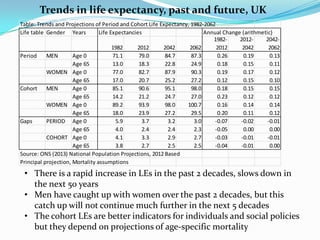
Table: Trends and Projections of Period and Cohort Life Expectancy, 1982-2062
Life table Gender Years Life Expectancies Annual Change (arithmetic)
1982 2012 2042 2062
1982-
2012
2012-
2042
2042-
2062
Period MEN Age 0 71.1 79.0 84.7 87.3 0.26 0.19 0.13
Age 65 13.0 18.3 22.8 24.9 0.18 0.15 0.11
WOMEN Age 0 77.0 82.7 87.9 90.3 0.19 0.17 0.12
Age 65 17.0 20.7 25.2 27.2 0.12 0.15 0.10
Cohort MEN Age 0 85.1 90.6 95.1 98.0 0.18 0.15 0.15
Age 65 14.2 21.2 24.7 27.0 0.23 0.12 0.12
WOMEN Age 0 89.2 93.9 98.0 100.7 0.16 0.14 0.14
Age 65 18.0 23.9 27.2 29.5 0.20 0.11 0.12
Gaps PERIOD Age 0 5.9 3.7 3.2 3.0 -0.07 -0.02 -0.01
Age 65 4.0 2.4 2.4 2.3 -0.05 0.00 0.00
COHORT Age 0 4.1 3.3 2.9 2.7 -0.03 -0.01 -0.01
Age 65 3.8 2.7 2.5 2.5 -0.04 -0.01 0.00
Source: ONS (2013) National Population Projections, 2012 Based
Principal projection, Mortality assumptions
Trends in life expectancy, past and future, UK
• There is a rapid increase in LEs in the past 2 decades, slows down in
the next 50 years
• Men have caught up with women over the past 2 decades, but this
catch up will not continue much further in the next 5 decades
• The cohort LEs are better indicators for individuals and social policies
but they depend on projections of age-specific mortality
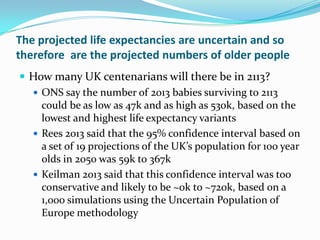
The projected life expectancies are uncertain and so
therefore are the projected numbers of older people
 How many UK centenarians will there be in 2113?
 ONS say the number of 2013 babies surviving to 2113
could be as low as 47k and as high as 530k, based on the
lowest and highest life expectancy variants
 Rees 2013 said that the 95% confidence interval based on
a set of 19 projections of the UK’s population for 100 year
olds in 2050 was 59k to 367k
 Keilman 2013 said that this confidence interval was too
conservative and likely to be ~0k to ~720k, based on a
1,000 simulations using the Uncertain Population of
Europe methodology
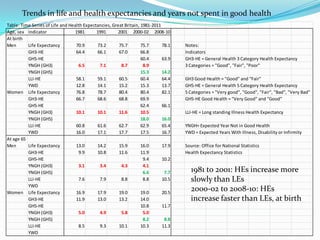
Table: Time Series of Life and Health Expectancies, Great Britain, 1981-2011
Age, sex Indicator 1981 1991 2001 2000-02 2008-10
At birth
Men Life Expectancy 70.9 73.2 75.7 75.7 78.1 Notes:
GH3-HE 64.4 66.1 67.0 66.8 Indicators
GH5-HE 60.4 63.9 GH3-HE = General Health 3 Category Health Expectancy
YNGH (GH3) 6.5 7.1 8.7 8.9 3 Categories = "Good", "Fair", "Poor"
YNGH (GH5) 15.3 14.2
LLI-HE 58.1 59.1 60.5 60.4 64.4 GH3 Good Health = "Good" and "Fair"
YWD 12.8 14.1 15.2 15.3 13.7 GH5-HE = General Health 5 Category Health Expectancy
Women Life Expectancy 76.8 78.7 80.4 80.4 82.1 5 Categories = "Very good", "Good", "Fair", "Bad", "Very Bad"
GH3-HE 66.7 68.6 68.8 69.9 GH5-HE Good Health = "Very Good" and "Good"
GH5-HE 62.4 66.1
YNGH (GH3) 10.1 10.1 11.6 10.5 LLI-HE = Long standing Illness Health Expectancy
YNGH (GH5) 18.0 16.0
LLI-HE 60.8 61.6 62.7 62.9 65.4 YNGH= Expected Year Not in Good Health
YWD 16.0 17.1 17.7 17.5 16.7 YWD = Expected Years With Illness, Disability or Infirmity
At age 65
Men Life Expectancy 13.0 14.2 15.9 16.0 17.9 Source: Office for National Statistics
GH3-HE 9.9 10.8 11.6 11.9 Health Expectancy Statistics
GH5-HE 9.4 10.2
YNGH (GH3) 3.1 3.4 4.3 4.1
YNGH (GH5) 6.6 7.7
LLI-HE 7.6 7.9 8.8 8.8 10.5
YWD
Women Life Expectancy 16.9 17.9 19.0 19.0 20.5
GH3-HE 11.9 13.0 13.2 14.0
GH5-HE 10.8 11.7
YNGH (GH3) 5.0 4.9 5.8 5.0
YNGH (GH5) 8.2 8.8
LLI-HE 8.5 9.3 10.1 10.3 11.3
YWD
1981 to 2001: HEs increase more
slowly than LEs
2000-02 to 2008-10: HEs
increase faster than LEs, at birth
Trends in life and health expectancies and years not spent in good health
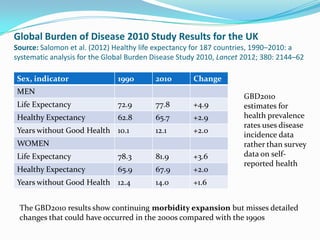
Global Burden of Disease 2010 Study Results for the UK
Source: Salomon et al. (2012) Healthy life expectancy for 187 countries, 1990–2010: a
systematic analysis for the Global Burden Disease Study 2010, Lancet 2012; 380: 2144–62
Sex, indicator 1990 2010 Change
MEN
Life Expectancy 72.9 77.8 +4.9
Healthy Expectancy 62.8 65.7 +2.9
Years without Good Health 10.1 12.1 +2.0
WOMEN
Life Expectancy 78.3 81.9 +3.6
Healthy Expectancy 65.9 67.9 +2.0
Years without Good Health 12.4 14.0 +1.6
GBD2010
estimates for
health prevalence
rates uses disease
incidence data
rather than survey
data on self-
reported health
The GBD2010 results show continuing morbidity expansion but misses detailed
changes that could have occurred in the 2000s compared with the 1990s
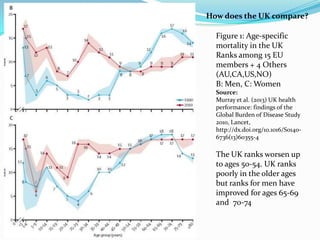
Figure 1: Age-specific
mortality in the UK
Ranks among 15 EU
members + 4 Others
(AU,CA,US,NO)
B: Men, C: Women
Source:
Murray et al. (2013) UK health
performance: findings of the
Global Burden of Disease Study
2010, Lancet,
http://dx.doi.org/10.1016/S0140-
6736(13)60355-4
The UK ranks worsen up
to ages 50-54. UK ranks
poorly in the older ages
but ranks for men have
improved for ages 65-69
and 70-74
How does the UK compare?
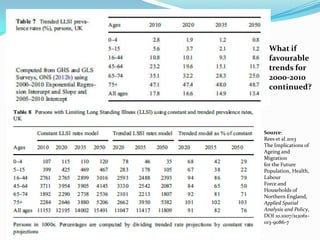
Source:
Rees et al 2013
The Implications of
Ageing and
Migration
for the Future
Population, Health,
Labour
Force and
Households of
Northern England,
Applied Spatial
Analysis and Policy,
DOI 10.1007/s12061-
013-9086-7
What if
favourable
trends for
2000-2010
continued?
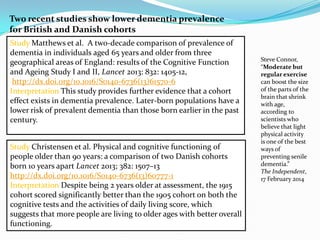
Study Matthews et al. A two-decade comparison of prevalence of
dementia in individuals aged 65 years and older from three
geographical areas of England: results of the Cognitive Function
and Ageing Study I and II, Lancet 2013: 832: 1405-12,
http://dx.doi.org/10.1016/S0140-6736(13)61570-6
Interpretation This study provides further evidence that a cohort
effect exists in dementia prevalence. Later-born populations have a
lower risk of prevalent dementia than those born earlier in the past
century.
Study Christensen et al. Physical and cognitive functioning of
people older than 90 years: a comparison of two Danish cohorts
born 10 years apart Lancet 2013; 382: 1507–13
http://dx.doi.org/10.1016/S0140-6736(13)60777-1
Interpretation Despite being 2 years older at assessment, the 1915
cohort scored significantly better than the 1905 cohort on both the
cognitive tests and the activities of daily living score, which
suggests that more people are living to older ages with better overall
functioning.
Two recent studies show lower dementia prevalence
for British and Danish cohorts
Steve Connor,
“Moderate but
regular exercise
can boost the size
of the parts of the
brain that shrink
with age,
according to
scientists who
believe that light
physical activity
is one of the best
ways of
preventing senile
dementia.”
The Independent,
17 February 2014
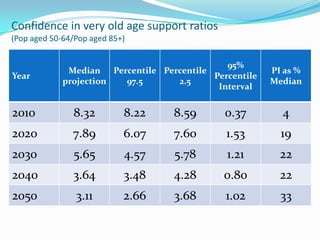
Confidence in very old age support ratios
(Pop aged 50-64/Pop aged 85+)
Year
Median
projection
Percentile
97.5
Percentile
2.5
95%
Percentile
Interval
PI as %
Median
2010 8.32 8.22 8.59 0.37 4
2020 7.89 6.07 7.60 1.53 19
2030 5.65 4.57 5.78 1.21 22
2040 3.64 3.48 4.28 0.80 22
2050 3.11 2.66 3.68 1.02 33
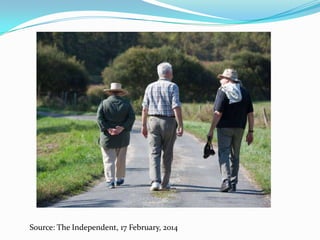
Source: The Independent, 17 February, 2014
Andrew Kaye
Head of Policy and Campaigns
Independent Age
This event is kindly supported by members of the Ready for Ageing Alliance
#future2030
Rt Hon Paul Burstow MP
Member for Sutton and Cheam
This event is kindly supported by members of the Ready for Ageing Alliance
#future2030
One year on:
Are we ready to make the UK the
best country to grow old in?
Thursday 13th March 2014
This event is kindly supported by members of the Ready for Ageing Alliance
#future2030

13Mar14 - One Year On

  • 1.
    One year on: Arewe ready to make the UK the best country to grow old in? Thursday 13th March 2014 This event is kindly supported by members of the Ready for Ageing Alliance #future2030
  • 2.
    Lord Filkin CBE Chair Centrefor Ageing Better Chairman Public Service and Demographic Change Committee This event is kindly supported by members of the Ready for Ageing Alliance #future2030
  • 3.
    Julia Unwin CBE ChiefExecutive Joseph Rowntree Foundation This event is kindly supported by members of the Ready for Ageing Alliance #future2030
  • 4.
    Professor Phillip ReesCBE Professor Emeritus, School of Geography University of Leeds This event is kindly supported by members of the Ready for Ageing Alliance #future2030
  • 5.
    A Review ofTrends in Life and Health Expectancies for the UK, with an International Comparison Philip Rees School of Geography, University of Leeds, Leeds LS2 9JT, UK E: p.h.rees@leeds.ac.uk Presentation at the International Longevity Centre/Independent Age Meeting at the House of Lords, Thursday 13th March 2014
  • 6.
    Table: Trends andProjections of Period and Cohort Life Expectancy, 1982-2062 Life table Gender Years Life Expectancies Annual Change (arithmetic) 1982 2012 2042 2062 1982- 2012 2012- 2042 2042- 2062 Period MEN Age 0 71.1 79.0 84.7 87.3 0.26 0.19 0.13 Age 65 13.0 18.3 22.8 24.9 0.18 0.15 0.11 WOMEN Age 0 77.0 82.7 87.9 90.3 0.19 0.17 0.12 Age 65 17.0 20.7 25.2 27.2 0.12 0.15 0.10 Cohort MEN Age 0 85.1 90.6 95.1 98.0 0.18 0.15 0.15 Age 65 14.2 21.2 24.7 27.0 0.23 0.12 0.12 WOMEN Age 0 89.2 93.9 98.0 100.7 0.16 0.14 0.14 Age 65 18.0 23.9 27.2 29.5 0.20 0.11 0.12 Gaps PERIOD Age 0 5.9 3.7 3.2 3.0 -0.07 -0.02 -0.01 Age 65 4.0 2.4 2.4 2.3 -0.05 0.00 0.00 COHORT Age 0 4.1 3.3 2.9 2.7 -0.03 -0.01 -0.01 Age 65 3.8 2.7 2.5 2.5 -0.04 -0.01 0.00 Source: ONS (2013) National Population Projections, 2012 Based Principal projection, Mortality assumptions Trends in life expectancy, past and future, UK • There is a rapid increase in LEs in the past 2 decades, slows down in the next 50 years • Men have caught up with women over the past 2 decades, but this catch up will not continue much further in the next 5 decades • The cohort LEs are better indicators for individuals and social policies but they depend on projections of age-specific mortality
  • 7.
    The projected lifeexpectancies are uncertain and so therefore are the projected numbers of older people  How many UK centenarians will there be in 2113?  ONS say the number of 2013 babies surviving to 2113 could be as low as 47k and as high as 530k, based on the lowest and highest life expectancy variants  Rees 2013 said that the 95% confidence interval based on a set of 19 projections of the UK’s population for 100 year olds in 2050 was 59k to 367k  Keilman 2013 said that this confidence interval was too conservative and likely to be ~0k to ~720k, based on a 1,000 simulations using the Uncertain Population of Europe methodology
  • 8.
    Table: Time Seriesof Life and Health Expectancies, Great Britain, 1981-2011 Age, sex Indicator 1981 1991 2001 2000-02 2008-10 At birth Men Life Expectancy 70.9 73.2 75.7 75.7 78.1 Notes: GH3-HE 64.4 66.1 67.0 66.8 Indicators GH5-HE 60.4 63.9 GH3-HE = General Health 3 Category Health Expectancy YNGH (GH3) 6.5 7.1 8.7 8.9 3 Categories = "Good", "Fair", "Poor" YNGH (GH5) 15.3 14.2 LLI-HE 58.1 59.1 60.5 60.4 64.4 GH3 Good Health = "Good" and "Fair" YWD 12.8 14.1 15.2 15.3 13.7 GH5-HE = General Health 5 Category Health Expectancy Women Life Expectancy 76.8 78.7 80.4 80.4 82.1 5 Categories = "Very good", "Good", "Fair", "Bad", "Very Bad" GH3-HE 66.7 68.6 68.8 69.9 GH5-HE Good Health = "Very Good" and "Good" GH5-HE 62.4 66.1 YNGH (GH3) 10.1 10.1 11.6 10.5 LLI-HE = Long standing Illness Health Expectancy YNGH (GH5) 18.0 16.0 LLI-HE 60.8 61.6 62.7 62.9 65.4 YNGH= Expected Year Not in Good Health YWD 16.0 17.1 17.7 17.5 16.7 YWD = Expected Years With Illness, Disability or Infirmity At age 65 Men Life Expectancy 13.0 14.2 15.9 16.0 17.9 Source: Office for National Statistics GH3-HE 9.9 10.8 11.6 11.9 Health Expectancy Statistics GH5-HE 9.4 10.2 YNGH (GH3) 3.1 3.4 4.3 4.1 YNGH (GH5) 6.6 7.7 LLI-HE 7.6 7.9 8.8 8.8 10.5 YWD Women Life Expectancy 16.9 17.9 19.0 19.0 20.5 GH3-HE 11.9 13.0 13.2 14.0 GH5-HE 10.8 11.7 YNGH (GH3) 5.0 4.9 5.8 5.0 YNGH (GH5) 8.2 8.8 LLI-HE 8.5 9.3 10.1 10.3 11.3 YWD 1981 to 2001: HEs increase more slowly than LEs 2000-02 to 2008-10: HEs increase faster than LEs, at birth Trends in life and health expectancies and years not spent in good health
  • 9.
    Global Burden ofDisease 2010 Study Results for the UK Source: Salomon et al. (2012) Healthy life expectancy for 187 countries, 1990–2010: a systematic analysis for the Global Burden Disease Study 2010, Lancet 2012; 380: 2144–62 Sex, indicator 1990 2010 Change MEN Life Expectancy 72.9 77.8 +4.9 Healthy Expectancy 62.8 65.7 +2.9 Years without Good Health 10.1 12.1 +2.0 WOMEN Life Expectancy 78.3 81.9 +3.6 Healthy Expectancy 65.9 67.9 +2.0 Years without Good Health 12.4 14.0 +1.6 GBD2010 estimates for health prevalence rates uses disease incidence data rather than survey data on self- reported health The GBD2010 results show continuing morbidity expansion but misses detailed changes that could have occurred in the 2000s compared with the 1990s
  • 10.
    Figure 1: Age-specific mortalityin the UK Ranks among 15 EU members + 4 Others (AU,CA,US,NO) B: Men, C: Women Source: Murray et al. (2013) UK health performance: findings of the Global Burden of Disease Study 2010, Lancet, http://dx.doi.org/10.1016/S0140- 6736(13)60355-4 The UK ranks worsen up to ages 50-54. UK ranks poorly in the older ages but ranks for men have improved for ages 65-69 and 70-74 How does the UK compare?
  • 11.
    Source: Rees et al2013 The Implications of Ageing and Migration for the Future Population, Health, Labour Force and Households of Northern England, Applied Spatial Analysis and Policy, DOI 10.1007/s12061- 013-9086-7 What if favourable trends for 2000-2010 continued?
  • 12.
    Study Matthews etal. A two-decade comparison of prevalence of dementia in individuals aged 65 years and older from three geographical areas of England: results of the Cognitive Function and Ageing Study I and II, Lancet 2013: 832: 1405-12, http://dx.doi.org/10.1016/S0140-6736(13)61570-6 Interpretation This study provides further evidence that a cohort effect exists in dementia prevalence. Later-born populations have a lower risk of prevalent dementia than those born earlier in the past century. Study Christensen et al. Physical and cognitive functioning of people older than 90 years: a comparison of two Danish cohorts born 10 years apart Lancet 2013; 382: 1507–13 http://dx.doi.org/10.1016/S0140-6736(13)60777-1 Interpretation Despite being 2 years older at assessment, the 1915 cohort scored significantly better than the 1905 cohort on both the cognitive tests and the activities of daily living score, which suggests that more people are living to older ages with better overall functioning. Two recent studies show lower dementia prevalence for British and Danish cohorts Steve Connor, “Moderate but regular exercise can boost the size of the parts of the brain that shrink with age, according to scientists who believe that light physical activity is one of the best ways of preventing senile dementia.” The Independent, 17 February 2014
  • 13.
    Confidence in veryold age support ratios (Pop aged 50-64/Pop aged 85+) Year Median projection Percentile 97.5 Percentile 2.5 95% Percentile Interval PI as % Median 2010 8.32 8.22 8.59 0.37 4 2020 7.89 6.07 7.60 1.53 19 2030 5.65 4.57 5.78 1.21 22 2040 3.64 3.48 4.28 0.80 22 2050 3.11 2.66 3.68 1.02 33
  • 14.
    Source: The Independent,17 February, 2014
  • 15.
    Andrew Kaye Head ofPolicy and Campaigns Independent Age This event is kindly supported by members of the Ready for Ageing Alliance #future2030
  • 16.
    Rt Hon PaulBurstow MP Member for Sutton and Cheam This event is kindly supported by members of the Ready for Ageing Alliance #future2030
  • 17.
    One year on: Arewe ready to make the UK the best country to grow old in? Thursday 13th March 2014 This event is kindly supported by members of the Ready for Ageing Alliance #future2030

Editor's Notes

  • #14 If the UK population experiences an increase in its highly dependent, frail elderly (e.g. persons with dementia), then we will need to take of them. Such care falls largely on family members but often the frail must be cared for in nursing homes. Are there going to be enough family members and professional carers for this vital role.After the October 2012 Hearings, Lord Filkin asked me to provide confidence intervals around the national projections and I supplied a memorandum which was included in the Evidence volume. From the projected numbers of people by age I computed what is known as the very old age support ratio, which relates the numbers aged 85 and over (at highest risk of high dependency) to the population aged 50-64 (where most of their children are located). You can see from the table that this declines precipitously from 2010 to 2050 by 63%. The 95% confidence interval estimated here is quite narrow, though subsequent work suggests it is more like the 80% confidence interval.What can we do about the coming tsunami of demand for carers?Limit the demand: maintain the health of the potential highly dependent for as long as possible. E.g. better health checks by GP practices, raise the take up of flu and pneumonia immunisation, Tai Chi for elders every dayImprove carer productivity: e.g. develop the use telecare much more in people’s own home and in care homesMaintain the supply of carer labour: don’t turn off the immigration flow of people into caring, people from other countries are a vital resourceOff-shore the care of the frail elderly to cheaper countries (e.g. India)The Very Old Age Support Ratio is important for assessing the potential numbers of carers available in future in relation to the numbers potentially needing care. Here the support ratio declines severely and the uncertainty becomes considerable though there are changes both upwards and downwards. Fortunately, the Queen’s speech earlier in May 2013 indicated that some of the Dilnot Commission’s proposals on the funding of care of the infirm elderly are to be implemented. However, the Ready for Ageing report suggests that the need to go further in implementing the Dilnot proposals.