Wiener Filtering &
Basis Functions
Nov 4th 2004
Jukka Parviainen
parvi@hut.fi
T-61.181 Biomedical Signal Processing
Sections 4.4 - 4.5.2
Nov 4th 2004 T-61.181 - Biomedical Signal
Processing - Jukka Parviainen
2
Outline
• a posteriori Wiener filter (Sec 4.4)
– removing noise by linear filtering in
optimal (mean-square error) way
– improving ensemble averaging
• single-trial analysis using basis
functions (Sec 4.5)
– only one or few evoked potentials
– e.g. Fourier analysis
Nov 4th 2004 T-61.181 - Biomedical Signal
Processing - Jukka Parviainen
3
Wiener - example in 2D
• model x = f(s)+v, where f(.) is a
linear blurring effect (in the
example)
• target: find an estimate s’ = g(x)
• an inverse filter to blurring
• value of SNR can be controlled
• Matlab example: ipexdeconvwnr
Nov 4th 2004 T-61.181 - Biomedical Signal
Processing - Jukka Parviainen
4
Part I - Wiener in EEG
• improving ensemble averages by
incorporating correlation
information, similar to weights
earlier in Sec. 4.3
• model: x_i(n) = s(n) + v_i(n)
• ensemble average of M records
• target: good s’(n) from x_i(n)
Nov 4th 2004 T-61.181 - Biomedical Signal
Processing - Jukka Parviainen
5
Wiener filter in EEG
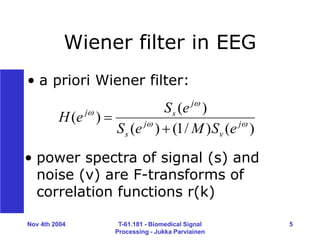
• a priori Wiener filter:
)
(
)
/
1
(
)
(
)
(
)
( 



j
v
j
s
j
s
j
e
S
M
e
S
e
S
e
H


• power spectra of signal (s) and
noise (v) are F-transforms of
correlation functions r(k)
Nov 4th 2004 T-61.181 - Biomedical Signal
Processing - Jukka Parviainen
6
Interpretation of Wiener
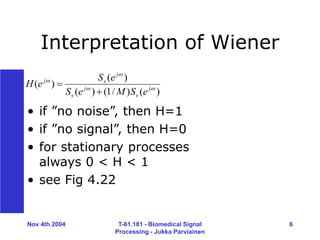
• if ”no noise”, then H=1
• if ”no signal”, then H=0
• for stationary processes
always 0 < H < 1
• see Fig 4.22
)
(
)
/
1
(
)
(
)
(
)
( 



j
v
j
s
j
s
j
e
S
M
e
S
e
S
e
H


Nov 4th 2004 T-61.181 - Biomedical Signal
Processing - Jukka Parviainen
7
Wiener in theory
• design H(z), so that mean-square
error E[(s(n)-s’(n))^2] minimized
• Wiener-Hopf equations of
noncausal IIR filter lead to H(ej )
• filter gain 0 < H < 1 implies
underestimation (bias)
• bias/variance dilemma
Nov 4th 2004 T-61.181 - Biomedical Signal
Processing - Jukka Parviainen
8
A posteriori Wiener filters
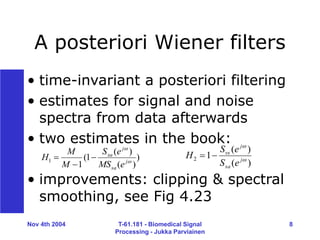
• time-invariant a posteriori filtering
• estimates for signal and noise
spectra from data afterwards
• two estimates in the book:
• improvements: clipping & spectral
smoothing, see Fig 4.23
)
)
(
)
(
1
(
1
1 

j
sa
j
xa
e
MS
e
S
M
M
H 


)
(
)
(
1
2 

j
sa
j
vs
e
S
e
S
H 

Nov 4th 2004 T-61.181 - Biomedical Signal
Processing - Jukka Parviainen
9
Limitations of APWFs
• contradictionary results due to
modalities: BAEP+VEP ok, SEP not
• bad results with low SNRs, see Fig
4.24
• APWF supposes stationary signals
• if/when not, time-varying Wiener
filters developed
Nov 4th 2004 T-61.181 - Biomedical Signal
Processing - Jukka Parviainen
10
APWF - What was learnt?
• authors: ”serious limitations”,
”important to be aware of possible
pitfalls”, especially when ”the
assumpition of stationarity is
incorporated into a signal model”
Nov 4th 2004 T-61.181 - Biomedical Signal
Processing - Jukka Parviainen
11
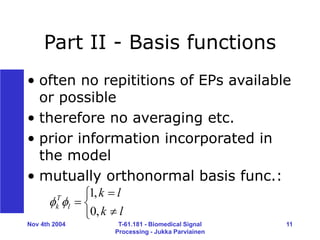
Part II - Basis functions
• often no repititions of EPs available
or possible
• therefore no averaging etc.
• prior information incorporated in
the model
• mutually orthonormal basis func.:






l
k
l
k
l
T
k
,
0
,
1


Nov 4th 2004 T-61.181 - Biomedical Signal
Processing - Jukka Parviainen
12
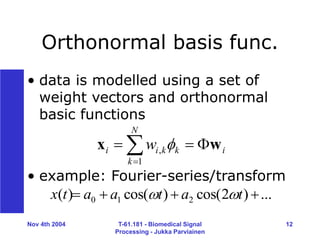
Orthonormal basis func.
• data is modelled using a set of
weight vectors and orthonormal
basic functions
• example: Fourier-series/transform
...
)
2
cos(
)
cos(
)
( 2
1
0 


 t
a
t
a
a
t
x 

i
N
k
k
k
i
i w w
x 

 
1
, 
Nov 4th 2004 T-61.181 - Biomedical Signal
Processing - Jukka Parviainen
13
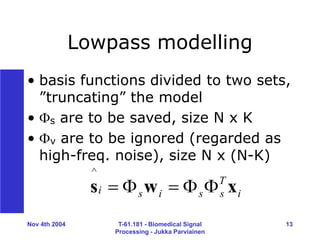
Lowpass modelling
• basis functions divided to two sets,
”truncating” the model
• s are to be saved, size N x K
• v are to be ignored (regarded as
high-freq. noise), size N x (N-K)
i
T
s
s
i
s
i x
w
s 




^
Nov 4th 2004 T-61.181 - Biomedical Signal
Processing - Jukka Parviainen
14
Demo: Fourier-series
http://www.jhu.edu/~signals/
• rapid changes - high frequency
• value K?
• transients cannot be modelled
nicely using cosines/sines
Nov 4th 2004 T-61.181 - Biomedical Signal
Processing - Jukka Parviainen
15
Summary I: Wiener
• originally by Wiener in 40’s
• with evoked potentials in 60’s and
70’s by Walker and Doyle
• lots of research in 70’s and 80’s
(time-varying filtering by de
Weerd)
• probably a baseline technique?
Nov 4th 2004 T-61.181 - Biomedical Signal
Processing - Jukka Parviainen
16
Summary II: Basis f.
• signal can be modelled using as a
sum of products of weight vectors
and basis functions
• high-frequency components
considered as noise
• to be continued in the following
presentation

WEINER FILTERING AND BASIS FUNCTIONS.ppt

  • 1.
    Wiener Filtering & BasisFunctions Nov 4th 2004 Jukka Parviainen parvi@hut.fi T-61.181 Biomedical Signal Processing Sections 4.4 - 4.5.2
  • 2.
    Nov 4th 2004T-61.181 - Biomedical Signal Processing - Jukka Parviainen 2 Outline • a posteriori Wiener filter (Sec 4.4) – removing noise by linear filtering in optimal (mean-square error) way – improving ensemble averaging • single-trial analysis using basis functions (Sec 4.5) – only one or few evoked potentials – e.g. Fourier analysis
  • 3.
    Nov 4th 2004T-61.181 - Biomedical Signal Processing - Jukka Parviainen 3 Wiener - example in 2D • model x = f(s)+v, where f(.) is a linear blurring effect (in the example) • target: find an estimate s’ = g(x) • an inverse filter to blurring • value of SNR can be controlled • Matlab example: ipexdeconvwnr
  • 4.
    Nov 4th 2004T-61.181 - Biomedical Signal Processing - Jukka Parviainen 4 Part I - Wiener in EEG • improving ensemble averages by incorporating correlation information, similar to weights earlier in Sec. 4.3 • model: x_i(n) = s(n) + v_i(n) • ensemble average of M records • target: good s’(n) from x_i(n)
  • 5.
    Nov 4th 2004T-61.181 - Biomedical Signal Processing - Jukka Parviainen 5 Wiener filter in EEG • a priori Wiener filter: ) ( ) / 1 ( ) ( ) ( ) (     j v j s j s j e S M e S e S e H   • power spectra of signal (s) and noise (v) are F-transforms of correlation functions r(k)
  • 6.
    Nov 4th 2004T-61.181 - Biomedical Signal Processing - Jukka Parviainen 6 Interpretation of Wiener • if ”no noise”, then H=1 • if ”no signal”, then H=0 • for stationary processes always 0 < H < 1 • see Fig 4.22 ) ( ) / 1 ( ) ( ) ( ) (     j v j s j s j e S M e S e S e H  
  • 7.
    Nov 4th 2004T-61.181 - Biomedical Signal Processing - Jukka Parviainen 7 Wiener in theory • design H(z), so that mean-square error E[(s(n)-s’(n))^2] minimized • Wiener-Hopf equations of noncausal IIR filter lead to H(ej ) • filter gain 0 < H < 1 implies underestimation (bias) • bias/variance dilemma
  • 8.
    Nov 4th 2004T-61.181 - Biomedical Signal Processing - Jukka Parviainen 8 A posteriori Wiener filters • time-invariant a posteriori filtering • estimates for signal and noise spectra from data afterwards • two estimates in the book: • improvements: clipping & spectral smoothing, see Fig 4.23 ) ) ( ) ( 1 ( 1 1   j sa j xa e MS e S M M H    ) ( ) ( 1 2   j sa j vs e S e S H  
  • 9.
    Nov 4th 2004T-61.181 - Biomedical Signal Processing - Jukka Parviainen 9 Limitations of APWFs • contradictionary results due to modalities: BAEP+VEP ok, SEP not • bad results with low SNRs, see Fig 4.24 • APWF supposes stationary signals • if/when not, time-varying Wiener filters developed
  • 10.
    Nov 4th 2004T-61.181 - Biomedical Signal Processing - Jukka Parviainen 10 APWF - What was learnt? • authors: ”serious limitations”, ”important to be aware of possible pitfalls”, especially when ”the assumpition of stationarity is incorporated into a signal model”
  • 11.
    Nov 4th 2004T-61.181 - Biomedical Signal Processing - Jukka Parviainen 11 Part II - Basis functions • often no repititions of EPs available or possible • therefore no averaging etc. • prior information incorporated in the model • mutually orthonormal basis func.:       l k l k l T k , 0 , 1  
  • 12.
    Nov 4th 2004T-61.181 - Biomedical Signal Processing - Jukka Parviainen 12 Orthonormal basis func. • data is modelled using a set of weight vectors and orthonormal basic functions • example: Fourier-series/transform ... ) 2 cos( ) cos( ) ( 2 1 0     t a t a a t x   i N k k k i i w w x     1 , 
  • 13.
    Nov 4th 2004T-61.181 - Biomedical Signal Processing - Jukka Parviainen 13 Lowpass modelling • basis functions divided to two sets, ”truncating” the model • s are to be saved, size N x K • v are to be ignored (regarded as high-freq. noise), size N x (N-K) i T s s i s i x w s      ^
  • 14.
    Nov 4th 2004T-61.181 - Biomedical Signal Processing - Jukka Parviainen 14 Demo: Fourier-series http://www.jhu.edu/~signals/ • rapid changes - high frequency • value K? • transients cannot be modelled nicely using cosines/sines
  • 15.
    Nov 4th 2004T-61.181 - Biomedical Signal Processing - Jukka Parviainen 15 Summary I: Wiener • originally by Wiener in 40’s • with evoked potentials in 60’s and 70’s by Walker and Doyle • lots of research in 70’s and 80’s (time-varying filtering by de Weerd) • probably a baseline technique?
  • 16.
    Nov 4th 2004T-61.181 - Biomedical Signal Processing - Jukka Parviainen 16 Summary II: Basis f. • signal can be modelled using as a sum of products of weight vectors and basis functions • high-frequency components considered as noise • to be continued in the following presentation