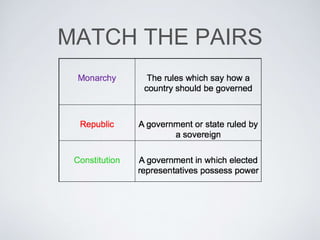


MATCH THE PAIRS
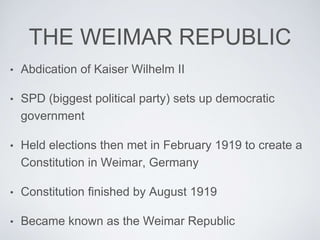
THE WEIMAR REPUBLIC
• Abdication of Kaiser Wilhelm II
• SPD (biggest political party) sets up democratic
government
• Held elections then met in February 1919 to create a
Constitution in Weimar, Germany
• Constitution finished by August 1919
• Became known as the Weimar Republic
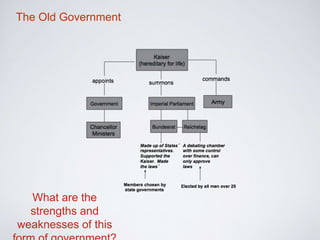
What are the
strengths and
weaknesses of this
The Old Government
THE CONSTITUTION
• Some elements of democracy in Germany pre-war - some democratic state
governments, free political parties
• Weimar Constitution made it one of the world’s most democratic states
• German people enjoyed -
• equality before the law
• freedom of speech
• freedom of assembly
• freedom of religion
• the right to form trade unions
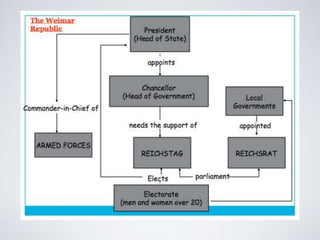
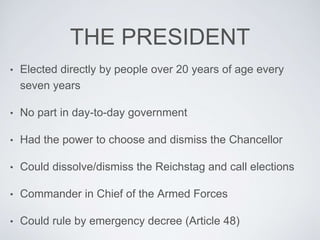
THE PRESIDENT
• Elected directly by people over 20 years of age every
seven years
• No part in day-to-day government
• Had the power to choose and dismiss the Chancellor
• Could dissolve/dismiss the Reichstag and call elections
• Commander in Chief of the Armed Forces
• Could rule by emergency decree (Article 48)
ARTICLE 48
Article 48: If any state does not fulfill the duties imposed upon it
by the constitution or the laws of the Reich, the Reich President
may enforce such duties with the aid of the armed forces. In the
event that public order and security are seriously disturbed or
threatened, the Reich President may take the measures
necessary for their restoration, intervening, if necessary, with the
aid of the armed forces. For this purpose he may temporarily
suspend, wholly or in part, the basic rights laid down in Articles
114, 115, 117, 118, 123, 124, and 153. The Reich President
must without delay inform the Reichstag of all such measures…
THE CHANCELLOR
• Appointed by the President
• Usually leader of the party with the most seats in the
Reichstag - party achieved the most votes in the
general election
• Chose ministers
• Could pass laws with the support of the majority in
the Reichstag
HOUSES OF PARLIAMENT
The Reichstag
Lower but dominant house in the German
parliament
• Controlled taxation
• Had 160 members
• All members elected every 4 years by
universal suffrage
• Used proportional representation -
parties received seats according to the
percentage of votes they received (10%
of votes meant 10% of seats)
The Reichsrat
Upper but less dominant house in
German Parliament
• Members appointed by local
governments
• Number of members sent depended on
size of region
• Could delay new laws, unless overruled
by a 2/3 majority in the Reichstag
PROPORTIONAL
REPRESENTATION
Article 22: The delegates are elected by
universal, equal, direct, and secret suffrage by
men and women over twenty years of age,
according to the principle of proportional
representation. Election day must be a Sunday
or a public holiday
PROBLEMS WITH PR
• In an attempt to assure true freedom for its citizens, the
Weimar government took it too far
• Explain this - what happens when a population with huge
left and right contingents have the power to elect any
officials they like?
• The left - Communists
• The right - loyalists, industrialists, civil service, judiciary,
landowners, later Nazis
Weimar republic setup and constitution

Weimar republic setup and constitution

  • 2.
  • 3.
    THE WEIMAR REPUBLIC •Abdication of Kaiser Wilhelm II • SPD (biggest political party) sets up democratic government • Held elections then met in February 1919 to create a Constitution in Weimar, Germany • Constitution finished by August 1919 • Became known as the Weimar Republic
  • 4.
    What are the strengthsand weaknesses of this The Old Government
  • 6.
    THE CONSTITUTION • Someelements of democracy in Germany pre-war - some democratic state governments, free political parties • Weimar Constitution made it one of the world’s most democratic states • German people enjoyed - • equality before the law • freedom of speech • freedom of assembly • freedom of religion • the right to form trade unions
  • 8.
    THE PRESIDENT • Electeddirectly by people over 20 years of age every seven years • No part in day-to-day government • Had the power to choose and dismiss the Chancellor • Could dissolve/dismiss the Reichstag and call elections • Commander in Chief of the Armed Forces • Could rule by emergency decree (Article 48)
  • 9.
    ARTICLE 48 Article 48:If any state does not fulfill the duties imposed upon it by the constitution or the laws of the Reich, the Reich President may enforce such duties with the aid of the armed forces. In the event that public order and security are seriously disturbed or threatened, the Reich President may take the measures necessary for their restoration, intervening, if necessary, with the aid of the armed forces. For this purpose he may temporarily suspend, wholly or in part, the basic rights laid down in Articles 114, 115, 117, 118, 123, 124, and 153. The Reich President must without delay inform the Reichstag of all such measures…
  • 10.
    THE CHANCELLOR • Appointedby the President • Usually leader of the party with the most seats in the Reichstag - party achieved the most votes in the general election • Chose ministers • Could pass laws with the support of the majority in the Reichstag
  • 11.
    HOUSES OF PARLIAMENT TheReichstag Lower but dominant house in the German parliament • Controlled taxation • Had 160 members • All members elected every 4 years by universal suffrage • Used proportional representation - parties received seats according to the percentage of votes they received (10% of votes meant 10% of seats) The Reichsrat Upper but less dominant house in German Parliament • Members appointed by local governments • Number of members sent depended on size of region • Could delay new laws, unless overruled by a 2/3 majority in the Reichstag
  • 12.
    PROPORTIONAL REPRESENTATION Article 22: Thedelegates are elected by universal, equal, direct, and secret suffrage by men and women over twenty years of age, according to the principle of proportional representation. Election day must be a Sunday or a public holiday
  • 13.
    PROBLEMS WITH PR •In an attempt to assure true freedom for its citizens, the Weimar government took it too far • Explain this - what happens when a population with huge left and right contingents have the power to elect any officials they like? • The left - Communists • The right - loyalists, industrialists, civil service, judiciary, landowners, later Nazis