SIULA GRANDE
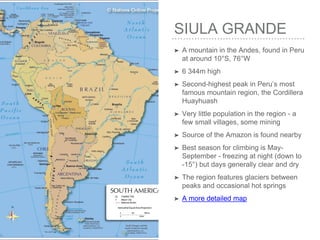
➤ A mountain in the Andes, found in Peru
at around 10°S, 76°W
➤ 6 344m high
➤ Second-highest peak in Peru’s most
famous mountain region, the Cordillera
Huayhuash
➤ Very little population in the region - a
few small villages, some mining
➤ Source of the Amazon is found nearby
➤ Best season for climbing is May-
September - freezing at night (down to
-15°) but days generally clear and dry
➤ The region features glaciers between
peaks and occasional hot springs
➤ A more detailed map
CLIMATE
➤ Before setting out on any expedition in a mountain region, it is
essential to understand the local climate and weather
conditions - why?
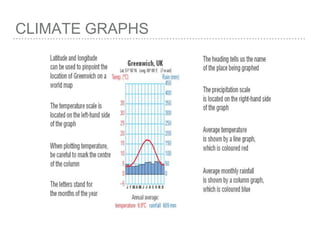
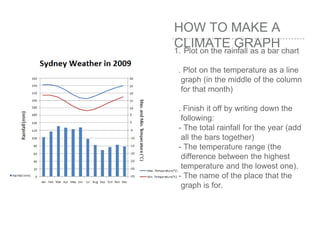
➤ Climate graphs show the average temperature and rainfall
experienced at a particular place throughout the year.
➤ They consist of a line graph showing average monthly
temperature and a simple column graph showing average
monthly rainfall figures.
➤ Climate graphs are constructed using data collected by
meteorologists.
CLIMATE GRAPHS
HOW TO MAKE A
CLIMATE GRAPH1. Plot on the rainfall as a bar chart
2. Plot on the temperature as a line
graph (in the middle of the column
for that month)
3. Finish it off by writing down the
following:
- The total rainfall for the year (add
all the bars together)
- The temperature range (the
difference between the highest
temperature and the lowest one).
- The name of the place that the
graph is for.
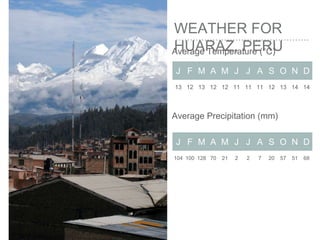
WEATHER FOR
HUARAZ, PERUAverage Temperature (°C)
Average Precipitation (mm)
J F M A M J J A S O N D
104 100 128 70 21 2 2 7 20 57 51 68
J F M A M J J A S O N D
13 12 13 12 12 11 11 11 12 13 14 14
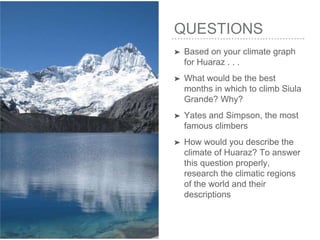
QUESTIONS
➤ Based on your climate graph
for Huaraz . . .
➤ What would be the best
months in which to climb Siula
Grande? Why?
➤ Yates and Simpson, the most
famous climbers
➤ How would you describe the
climate of Huaraz? To answer
this question properly,
research the climatic regions
of the world and their
descriptions
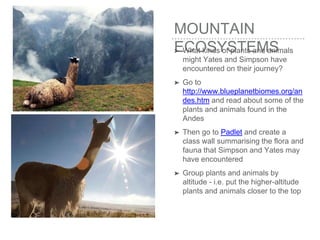
MOUNTAIN
ECOSYSTEMS➤ What kinds of plants and animals
might Yates and Simpson have
encountered on their journey?
➤ Go to
http://www.blueplanetbiomes.org/an
des.htm and read about some of the
plants and animals found in the
Andes
➤ Then go to Padlet and create a
class wall summarising the flora and
fauna that Simpson and Yates may
have encountered
➤ Group plants and animals by
altitude - i.e. put the higher-altitude
plants and animals closer to the top
JOE SIMPSON AND
SIMON YATES
➤ Two young British
mountaineers that set out to
climb Siula Grande in 1995
➤ They were relatively
inexperienced and set out to
climb an entirely new route, up
the western face of the
mountain
➤ Watch the beginning of their
climb and answer the first two
questions
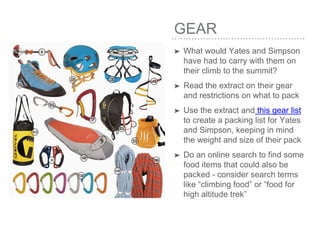
GEAR
➤ What would Yates and Simpson
have had to carry with them on
their climb to the summit?
➤ Read the extract on their gear
and restrictions on what to pack
➤ Use the extract and this gear list
to create a packing list for Yates
and Simpson, keeping in mind
the weight and size of their pack
➤ Do an online search to find some
food items that could also be
packed - consider search terms
like “climbing food” or “food for
high altitude trek”
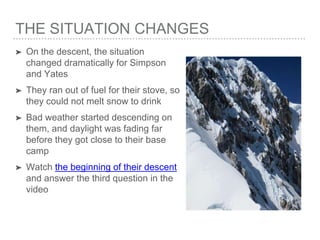
THE SITUATION CHANGES
➤ On the descent, the situation
changed dramatically for Simpson
and Yates
➤ They ran out of fuel for their stove, so
they could not melt snow to drink
➤ Bad weather started descending on
them, and daylight was fading far
before they got close to their base
camp
➤ Watch the beginning of their descent
and answer the third question in the
video
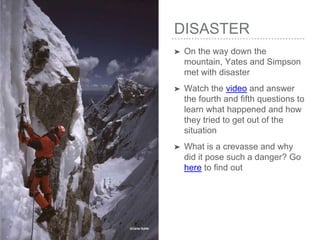
DISASTER
➤ On the way down the
mountain, Yates and Simpson
met with disaster
➤ Watch the video and answer
the fourth and fifth questions to
learn what happened and how
they tried to get out of the
situation
➤ What is a crevasse and why
did it pose such a danger? Go
here to find out
“ Now read your second extract to find
out what happened next
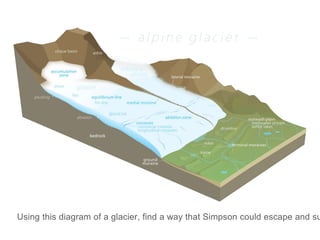
Using this diagram of a glacier, find a way that Simpson could escape and su
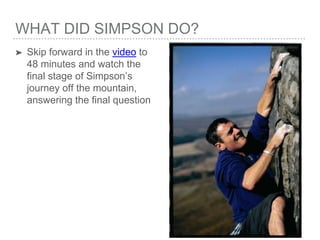
WHAT DID SIMPSON DO?
➤ Skip forward in the video to
48 minutes and watch the
final stage of Simpson’s
journey off the mountain,
answering the final question
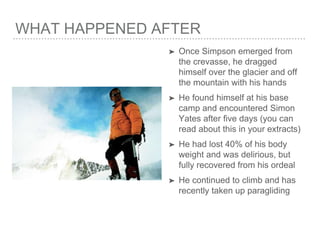
WHAT HAPPENED AFTER
➤ Once Simpson emerged from
the crevasse, he dragged
himself over the glacier and off
the mountain with his hands
➤ He found himself at his base
camp and encountered Simon
Yates after five days (you can
read about this in your extracts)
➤ He had lost 40% of his body
weight and was delirious, but
fully recovered from his ordeal
➤ He continued to climb and has
recently taken up paragliding
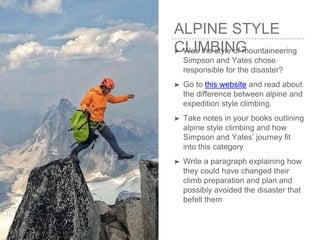
ALPINE STYLE
CLIMBING➤ Was the style of mountaineering
Simpson and Yates chose
responsible for the disaster?
➤ Go to this website and read about
the difference between alpine and
expedition style climbing.
➤ Take notes in your books outlining
alpine style climbing and how
Simpson and Yates’ journey fit
into this category
➤ Write a paragraph explaining how
they could have changed their
climb preparation and plan and
possibly avoided the disaster that
befell them

Mountaineers presentation

  • 2.
    SIULA GRANDE ➤ Amountain in the Andes, found in Peru at around 10°S, 76°W ➤ 6 344m high ➤ Second-highest peak in Peru’s most famous mountain region, the Cordillera Huayhuash ➤ Very little population in the region - a few small villages, some mining ➤ Source of the Amazon is found nearby ➤ Best season for climbing is May- September - freezing at night (down to -15°) but days generally clear and dry ➤ The region features glaciers between peaks and occasional hot springs ➤ A more detailed map
  • 3.
    CLIMATE ➤ Before settingout on any expedition in a mountain region, it is essential to understand the local climate and weather conditions - why? ➤ Climate graphs show the average temperature and rainfall experienced at a particular place throughout the year. ➤ They consist of a line graph showing average monthly temperature and a simple column graph showing average monthly rainfall figures. ➤ Climate graphs are constructed using data collected by meteorologists.
  • 4.
  • 5.
    HOW TO MAKEA CLIMATE GRAPH1. Plot on the rainfall as a bar chart 2. Plot on the temperature as a line graph (in the middle of the column for that month) 3. Finish it off by writing down the following: - The total rainfall for the year (add all the bars together) - The temperature range (the difference between the highest temperature and the lowest one). - The name of the place that the graph is for.
  • 6.
    WEATHER FOR HUARAZ, PERUAverageTemperature (°C) Average Precipitation (mm) J F M A M J J A S O N D 104 100 128 70 21 2 2 7 20 57 51 68 J F M A M J J A S O N D 13 12 13 12 12 11 11 11 12 13 14 14
  • 8.
    QUESTIONS ➤ Based onyour climate graph for Huaraz . . . ➤ What would be the best months in which to climb Siula Grande? Why? ➤ Yates and Simpson, the most famous climbers ➤ How would you describe the climate of Huaraz? To answer this question properly, research the climatic regions of the world and their descriptions
  • 9.
    MOUNTAIN ECOSYSTEMS➤ What kindsof plants and animals might Yates and Simpson have encountered on their journey? ➤ Go to http://www.blueplanetbiomes.org/an des.htm and read about some of the plants and animals found in the Andes ➤ Then go to Padlet and create a class wall summarising the flora and fauna that Simpson and Yates may have encountered ➤ Group plants and animals by altitude - i.e. put the higher-altitude plants and animals closer to the top
  • 10.
    JOE SIMPSON AND SIMONYATES ➤ Two young British mountaineers that set out to climb Siula Grande in 1995 ➤ They were relatively inexperienced and set out to climb an entirely new route, up the western face of the mountain ➤ Watch the beginning of their climb and answer the first two questions
  • 11.
    GEAR ➤ What wouldYates and Simpson have had to carry with them on their climb to the summit? ➤ Read the extract on their gear and restrictions on what to pack ➤ Use the extract and this gear list to create a packing list for Yates and Simpson, keeping in mind the weight and size of their pack ➤ Do an online search to find some food items that could also be packed - consider search terms like “climbing food” or “food for high altitude trek”
  • 12.
    THE SITUATION CHANGES ➤On the descent, the situation changed dramatically for Simpson and Yates ➤ They ran out of fuel for their stove, so they could not melt snow to drink ➤ Bad weather started descending on them, and daylight was fading far before they got close to their base camp ➤ Watch the beginning of their descent and answer the third question in the video
  • 14.
    DISASTER ➤ On theway down the mountain, Yates and Simpson met with disaster ➤ Watch the video and answer the fourth and fifth questions to learn what happened and how they tried to get out of the situation ➤ What is a crevasse and why did it pose such a danger? Go here to find out
  • 15.
    “ Now readyour second extract to find out what happened next
  • 16.
    Using this diagramof a glacier, find a way that Simpson could escape and su
  • 18.
    WHAT DID SIMPSONDO? ➤ Skip forward in the video to 48 minutes and watch the final stage of Simpson’s journey off the mountain, answering the final question
  • 19.
    WHAT HAPPENED AFTER ➤Once Simpson emerged from the crevasse, he dragged himself over the glacier and off the mountain with his hands ➤ He found himself at his base camp and encountered Simon Yates after five days (you can read about this in your extracts) ➤ He had lost 40% of his body weight and was delirious, but fully recovered from his ordeal ➤ He continued to climb and has recently taken up paragliding
  • 20.
    ALPINE STYLE CLIMBING➤ Wasthe style of mountaineering Simpson and Yates chose responsible for the disaster? ➤ Go to this website and read about the difference between alpine and expedition style climbing. ➤ Take notes in your books outlining alpine style climbing and how Simpson and Yates’ journey fit into this category ➤ Write a paragraph explaining how they could have changed their climb preparation and plan and possibly avoided the disaster that befell them