National 5 History: Hitler & Nazi
Germany
The Weimar Republic
Today’s lesson – The Weimar Republic
We are developing our knowledge and understanding of
the Weimar Government that was introduced in 1919.
By the end of today’s lesson I should be able to:
1) Describe key features of the Weimar constitution.
2) Describe the rights some citizens had in Weimar Germany
Today’s lesson involves:
Note taking
National 5 level question
The Weimar Republic
After the end of World War One, a different
type of German government was needed.
This became known as the Weimar Republic.
After the Kaiser’s abdication, Germany
needed a new system of Government.
A group of politicians including Ebert met in
the German town of Weimar where they
designed a new constitution for the country.
The task for a new constitution fell on lawyer
Hugo Preuss who researched different
political systems around the world (including
the UK) and adopting their strengths into a
German system
A constitution is an list of principles and laws
that constitute the legal basis of an Country
and commonly determine how that Country
is to be governed.
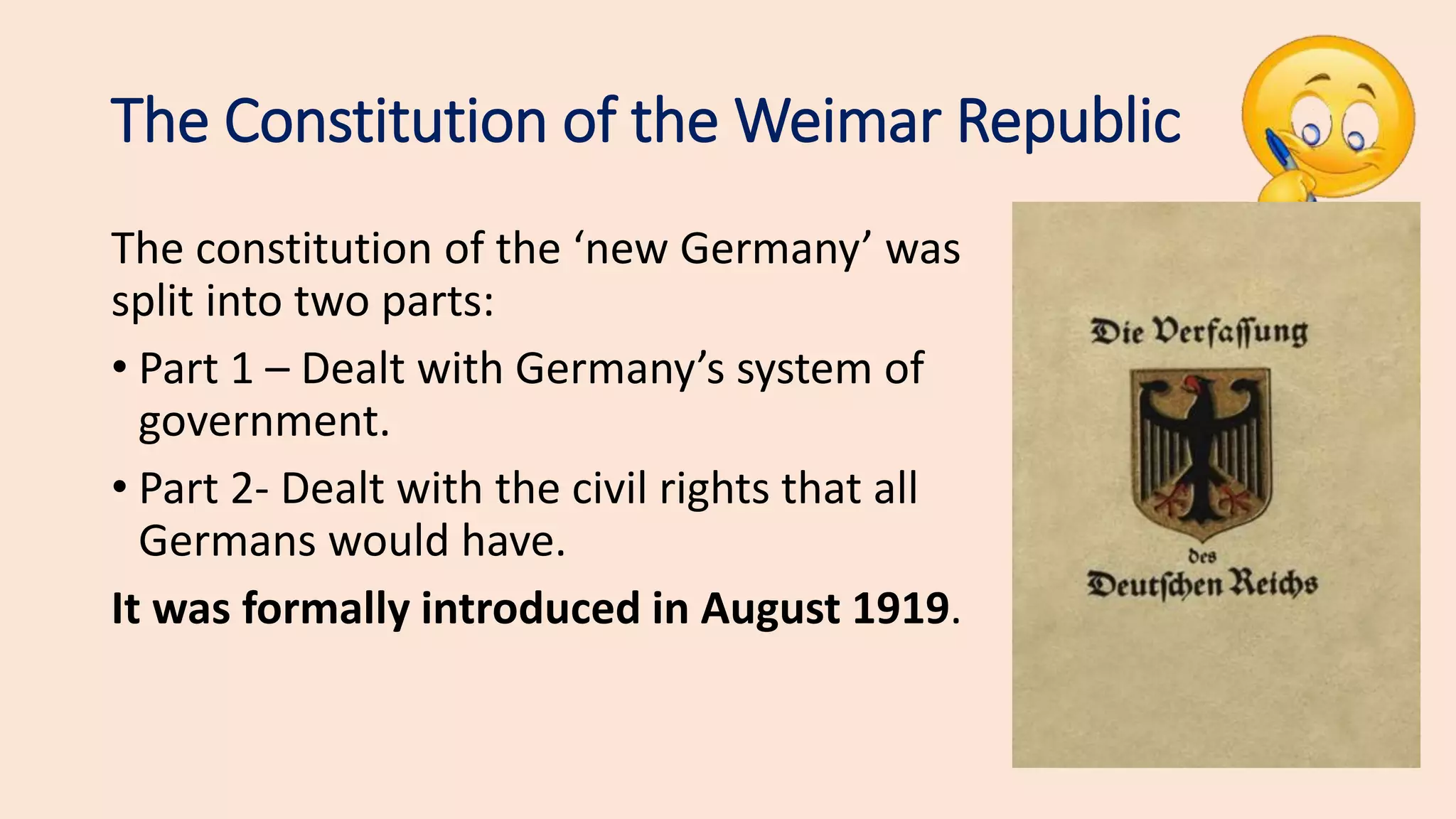
The Constitution of the Weimar Republic
The constitution of the ‘new Germany’ was
split into two parts:
• Part 1 – Dealt with Germany’s system of
government.
• Part 2- Dealt with the civil rights that all
Germans would have.
It was formally introduced in August 1919.
Task 1
Take a new mind-map in a single page in your jotter with the following
in the middle.
Germany’s system of
Government
The Republic
The first part of the Constitution described how
Germany’s government was to be run.
The country would now be a Republic (without a
monarchy or Kaiser), meaning the people could vote for
every part of their government.
Voting rights & Elections
All Germans (men and women) who were age 20+ had the right to vote
to choose members of the Reichstag (National parliament). The
Reichstag elects the head of Government – the Chancellor.
People aged 35+ were also able to vote for the country’s President
(every seven years). The President only had ceremonial powers.
Germany used a system known as proportional representation (PR) ths
meant that parties got the Reichstag members based on the number of
votes they got. (For example if you got 50% of the vote you got 50% of
seats).
PR helped smaller parties get elected... Including the Nazis.
The Reichstag
The Reichstag had the power to pass laws and decide
how taxes would be spent.
It could remove members of the government (such as
the Chancellor) from their jobs.
Due to the voting system (PR) it was very difficult for
any political party to win a majority in elections.
(Similar to the Scottish system).
This meant that Weimar governments were coalitions,
involving more than one political party (sometimes up
to 6 groups) this allowed parties such as the
Communists & Nazis to get into power.
The President
The Weimar Government gave some power to the President.
• Had the power to appoint members of the government (such as the
Chancellor).
• Could dissolve the Reichstag and call new elections.
• Had the use of Article 48 – which they could pass laws in an
emergency without the authorization of parliament.
Discuss: What are civil rights?
Task 1
Take a new mind-map in a single page in your jotter with the following
in the middle.
Civil Rights in
the Weimar
Government
Civil Rights in Weimar Germany
Freedom of Religion – People could practice any religion they want
without any government action.
Freedom of Speech – Many Germans had the right to protests and
criticise their government. They could also choose to join or set up any
group (As long as the group does not break the law). This included
groups like the Nazis.
Privacy – The Government was not allowed to read people’s private
letters or telephone conversations. People could not be arrested
without just cause and had a chance to defend themselves.
Civil Rights in Weimar Germany
Education – Germans were required to attend primary school
although free education was available up until the age of 19.
Equality – All Germans were to be treated equally, regardless
of their gender. This included in jobs such as the civil service.
Question: ‘Does Weimar
Germany sound like a good place
to live? Give two reasons to
support your answer.
Exam question
Describe the rights that people had in Weimar
Germany – 4 marks.

Constitution of the Weimar Republic

  • 1.
    National 5 History:Hitler & Nazi Germany The Weimar Republic
  • 2.
    Today’s lesson –The Weimar Republic We are developing our knowledge and understanding of the Weimar Government that was introduced in 1919. By the end of today’s lesson I should be able to: 1) Describe key features of the Weimar constitution. 2) Describe the rights some citizens had in Weimar Germany Today’s lesson involves: Note taking National 5 level question
  • 3.
    The Weimar Republic Afterthe end of World War One, a different type of German government was needed. This became known as the Weimar Republic. After the Kaiser’s abdication, Germany needed a new system of Government. A group of politicians including Ebert met in the German town of Weimar where they designed a new constitution for the country. The task for a new constitution fell on lawyer Hugo Preuss who researched different political systems around the world (including the UK) and adopting their strengths into a German system
  • 4.
    A constitution isan list of principles and laws that constitute the legal basis of an Country and commonly determine how that Country is to be governed.
  • 5.
    The Constitution ofthe Weimar Republic The constitution of the ‘new Germany’ was split into two parts: • Part 1 – Dealt with Germany’s system of government. • Part 2- Dealt with the civil rights that all Germans would have. It was formally introduced in August 1919.
  • 6.
    Task 1 Take anew mind-map in a single page in your jotter with the following in the middle. Germany’s system of Government
  • 7.
    The Republic The firstpart of the Constitution described how Germany’s government was to be run. The country would now be a Republic (without a monarchy or Kaiser), meaning the people could vote for every part of their government.
  • 8.
    Voting rights &Elections All Germans (men and women) who were age 20+ had the right to vote to choose members of the Reichstag (National parliament). The Reichstag elects the head of Government – the Chancellor. People aged 35+ were also able to vote for the country’s President (every seven years). The President only had ceremonial powers. Germany used a system known as proportional representation (PR) ths meant that parties got the Reichstag members based on the number of votes they got. (For example if you got 50% of the vote you got 50% of seats). PR helped smaller parties get elected... Including the Nazis.
  • 9.
    The Reichstag The Reichstaghad the power to pass laws and decide how taxes would be spent. It could remove members of the government (such as the Chancellor) from their jobs. Due to the voting system (PR) it was very difficult for any political party to win a majority in elections. (Similar to the Scottish system). This meant that Weimar governments were coalitions, involving more than one political party (sometimes up to 6 groups) this allowed parties such as the Communists & Nazis to get into power.
  • 10.
    The President The WeimarGovernment gave some power to the President. • Had the power to appoint members of the government (such as the Chancellor). • Could dissolve the Reichstag and call new elections. • Had the use of Article 48 – which they could pass laws in an emergency without the authorization of parliament.
  • 11.
    Discuss: What arecivil rights?
  • 12.
    Task 1 Take anew mind-map in a single page in your jotter with the following in the middle. Civil Rights in the Weimar Government
  • 13.
    Civil Rights inWeimar Germany Freedom of Religion – People could practice any religion they want without any government action. Freedom of Speech – Many Germans had the right to protests and criticise their government. They could also choose to join or set up any group (As long as the group does not break the law). This included groups like the Nazis. Privacy – The Government was not allowed to read people’s private letters or telephone conversations. People could not be arrested without just cause and had a chance to defend themselves.
  • 14.
    Civil Rights inWeimar Germany Education – Germans were required to attend primary school although free education was available up until the age of 19. Equality – All Germans were to be treated equally, regardless of their gender. This included in jobs such as the civil service.
  • 15.
    Question: ‘Does Weimar Germanysound like a good place to live? Give two reasons to support your answer.
  • 16.
    Exam question Describe therights that people had in Weimar Germany – 4 marks.