The Weimar Republic From Democracy to Nazism
End of WWI (1918-19) March - Germany offensive July - Allies stop German offensive November - Imperial fleet mutinies, Kaiser abdicates, Republic formed November - Armistice signed by civilian leaders (recommended by military)
Treaty of Versailles Brutal terms for Germans $33 billion in reparations over 30 years Article 231 (“war guilt” clause)  Disarm, territory, reparations Germany loses land to France, Poland, all of colonies Prohibited to have offensive military League of Nations “ Stab in the Back” – Military – Jews, Socialists, Bolsheviks
 
Weimar Constitution Germany emerged from revolution with new government in 1919 National assembly wrote constitution President elected popularly Chancellor appointed by President Legislators elected through proportional representation to Reichstag Article 48 - Temporary dictatorship to solve crises
Weimar Culture Berlin became center of European culture Conservatives opposed changes Political conflict was immediate and widespread
Early 1920’s Far-left and right groups fight for control 1922 - Munich (Beer Hall) Putsch 1923 - French occupy Ruhr (industrial heartland) Hyperinflation Bad economic policies Printed more money Blamed allies, reparations
Hyperinflation - 1923
Hyperinflation Most workers were paid daily and given time to shop before the value of their wages fell further. Depositors received letters from their banks informing them their life savings were worth less then the administrative costs of maintaining their accounts. Young women who had been setting aside money for their dowries saw their savings evaporate, thus making a traditional German marriage impossible. A concert pianist would be paid with a suitcase of bills for his performance and exchange half of the bills for several sausages.
Hyperinflation
Hyperinflation
Hyperinflation
Hyperinflation
Late 1920’s Hyperinflation recovery based upon American loans 1929 Stock Market crash, Depression Taxes raised, wages and social programs cut 6 million unemployed workers
Political Crisis Coalitions collapse Parties unwilling to compromise President Hindenburg and Article 48 Extremists gain power Paramilitary groups roam, dominate cities
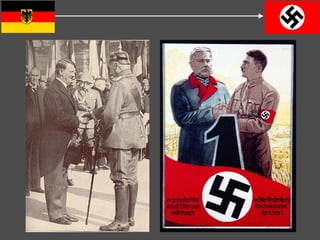
1932 Four parties vying for power Nazis receive 37% of vote - 2nd Hitler demands to be appointed Chancellor President Hindenburg believes it would keep him in check
 
1933-34 Feb. 1933, Reichstag burned Consolidates power Nazis gain control  Hindenburg dies Hitler declares himself Fuhrer
"Comrades, we stand firmly together for Germany, and we must stand firmly together for Germany. I am handing you the new insignia, knowing I place it in the most loyal hands in Germany. In the past you have proven your loyalty to me a thousand times. In the future it cannot and will not be any different!"

Weimar republic

  • 1.
    The Weimar RepublicFrom Democracy to Nazism
  • 2.
    End of WWI(1918-19) March - Germany offensive July - Allies stop German offensive November - Imperial fleet mutinies, Kaiser abdicates, Republic formed November - Armistice signed by civilian leaders (recommended by military)
  • 3.
    Treaty of VersaillesBrutal terms for Germans $33 billion in reparations over 30 years Article 231 (“war guilt” clause) Disarm, territory, reparations Germany loses land to France, Poland, all of colonies Prohibited to have offensive military League of Nations “ Stab in the Back” – Military – Jews, Socialists, Bolsheviks
  • 4.
  • 5.
    Weimar Constitution Germanyemerged from revolution with new government in 1919 National assembly wrote constitution President elected popularly Chancellor appointed by President Legislators elected through proportional representation to Reichstag Article 48 - Temporary dictatorship to solve crises
  • 6.
    Weimar Culture Berlinbecame center of European culture Conservatives opposed changes Political conflict was immediate and widespread
  • 7.
    Early 1920’s Far-leftand right groups fight for control 1922 - Munich (Beer Hall) Putsch 1923 - French occupy Ruhr (industrial heartland) Hyperinflation Bad economic policies Printed more money Blamed allies, reparations
  • 8.
  • 9.
    Hyperinflation Most workerswere paid daily and given time to shop before the value of their wages fell further. Depositors received letters from their banks informing them their life savings were worth less then the administrative costs of maintaining their accounts. Young women who had been setting aside money for their dowries saw their savings evaporate, thus making a traditional German marriage impossible. A concert pianist would be paid with a suitcase of bills for his performance and exchange half of the bills for several sausages.
  • 10.
  • 11.
  • 12.
  • 13.
  • 14.
    Late 1920’s Hyperinflationrecovery based upon American loans 1929 Stock Market crash, Depression Taxes raised, wages and social programs cut 6 million unemployed workers
  • 15.
    Political Crisis Coalitionscollapse Parties unwilling to compromise President Hindenburg and Article 48 Extremists gain power Paramilitary groups roam, dominate cities
  • 16.
    1932 Four partiesvying for power Nazis receive 37% of vote - 2nd Hitler demands to be appointed Chancellor President Hindenburg believes it would keep him in check
  • 17.
  • 18.
    1933-34 Feb. 1933,Reichstag burned Consolidates power Nazis gain control Hindenburg dies Hitler declares himself Fuhrer
  • 19.
    "Comrades, we standfirmly together for Germany, and we must stand firmly together for Germany. I am handing you the new insignia, knowing I place it in the most loyal hands in Germany. In the past you have proven your loyalty to me a thousand times. In the future it cannot and will not be any different!"

Editor's Notes

  • #8 Print more money to support Ruhr Hitler seized the first opportunity for action. On November 8 a rally was to be held in one of Munich's large beer cellars, the Buergerbraeukeller, to honor Kahr. Kahr was the featured speaker, along with General Lossow and Colonel Seisser, head of the police. Hitler surrounded the building with SA troops, broke in, took over the meeting, and melodramatically proclaimed: "The national revolution has broken out." Taking Kahr, Lossow, and Seisser into an adjoining room, Hitler pressured them to join him in overthrowing the national government. They refused until General Erich Ludendorff, who in Hitler's scheme for the new government was to be head of the army, came in to apply new pressure. Ultimately the three agreed and returned to the beer cellar with Hitler and Ludendorff to the acclaim of the audience. Hitler accepted their promises of support and allowed them to go free, much to his undoing. Circumstances changed dramatically for Hitler overnight. Although Ernst Roehm had seized the local army headquarters, the leadership of the army refused to support Hitler. Lossow, upon his release, telephoned Bavarian army headquarters for new troops to be sent to Munich to crush Hitler's revolt. Kahr also reneged on his promise. Hitler, faced with the complete collapse of his plans, tried a last desperate gamble by marching with Ludendorff and 2000 supporters through Munich to gain popular support for the coup.Their march was stopped by police barricades and after a brief gun battle the Hitler group, with the noticeable exception of General Ludendorff, ignominiously fled. The Beer Hall Putsch had collapsed. The leaders, including Hitler, were arrested. Some observers considered it the end of the upstart Austrian.The treason trial against Hitler, Ludendorff, and other leaders of the Kampfbund took place in February and March 1924. Considerable public attention became focused on the trial and gave Hitler the opportunity to establish his name outside of Bavaria. He used the publicity brilliantly to transform defeat into propaganda victory. At the trial, Hitler did not deny that he had planned to overthrow the national government. But he refused to admit that this had been an act of high treason. The real criminals, Hitler proclaimed, were the betrayers of Germany who had signed the Versailles treaty and perpetuated the Weimar Republic. Hitler also attacked the credibility of the state's chief witnesses, Kahr, Lossow, and Seisser, saying they all wanted the same thing he did. Hitler portrayed himself as the real patriot opposing the Weimar Republic, since he had had the courage to act: "I consider myself not a traitor but a German, who desired what was best for his people." But he was more than just a patriot, for he pictured himself as Germany's man of destiny:"I aimed from the beginning at something more than being a Minister. I wanted to become the destroyer of Marxism. I am going to achieve this task, and if I do, the title of Minister will be an absurdity for me."The right-wing judges were sympathetic to Hitler's words. Ludendorff was acquitted and Hitler was given the most lenient sentence possible for treason - five years in prison with an understanding of early probation.The putsch had failed, but Hitler had not. He would have time in prison to mull over the lessons of the past months and would emerge convinced that the real struggle for the soul of Germany was just beginning.