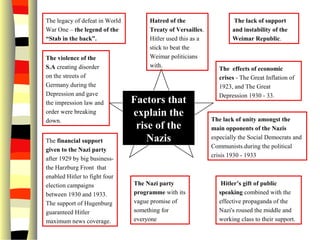
The lack of support
and instability of the
Weimar Republic.
The effects of economic
crises - The Great Inflation of
1923, and The Great
Depression 1930 - 33.
Hatred of the
Treaty of Versailles.
Hitler used this as a
stick to beat the
Weimar politicians
with.
The legacy of defeat in World
War One – the legend of the
“Stab in the back”.
The lack of unity amongst the
main opponents of the Nazis
especially the Social Democrats and
Communists.during the political
crisis 1930 - 1933
Hitler’s gift of public
speaking combined with the
effective propaganda of the
Nazi's roused the middle and
working class to their support.
The Nazi party
programme with its
vague promise of
something for
everyone
The financial support
given to the Nazi party
after 1929 by big business-
the Harzburg Front that
enabled Hitler to fight four
election campaigns
between 1930 and 1933.
The support of Hugenburg
guaranteed Hitler
maximum news coverage.
The violence of the
S.A creating disorder
on the streets of
Germany during the
Depression and gave
the impression law and
order were breaking
down.
Factors that
explain the
rise of the
Nazis
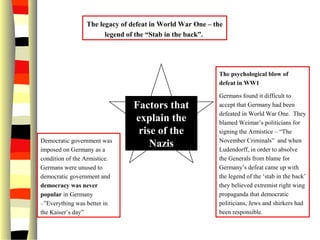
Factors that
explain the
rise of the
Nazis
The legacy of defeat in World War One – the
legend of the “Stab in the back”.
The psychological blow of
defeat in WW1
Germans found it difficult to
accept that Germany had been
defeated in World War One. They
blamed Weimar’s politicians for
signing the Armistice – “The
November Criminals” and when
Ludendorff, in order to absolve
the Generals from blame for
Germany’s defeat came up with
the legend of the ‘stab in the back’
they believed extremist right wing
propaganda that democratic
politicians, Jews and shirkers had
been responsible.
Democratic government was
imposed on Germany as a
condition of the Armistice.
Germans were unused to
democratic government and
democracy was never
popular in Germany
–”Everything was better in
the Kaiser’s day”
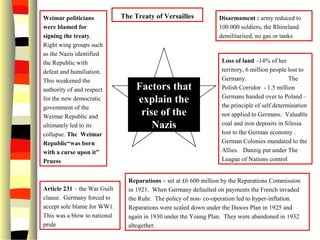
Disarmament : army reduced to
100 000 soldiers, the Rhineland
demilitarised, no gas or tanks
The Treaty of Versailles
Factors that
explain the
rise of the
Nazis
Loss of land –14% of her
territory, 6 million people lost to
Germany. The
Polish Corridor - 1.5 million
Germans handed over to Poland –
the principle of self determination
not applied to Germans. Valuable
coal and iron deposits in Silesia
lost to the German economy .
German Colonies mandated to the
Allies. Danzig put under The
League of Nations control
Reparations – set at £6 600 million by the Reparations Commission
in 1921. When Germany defaulted on payments the French invaded
the Ruhr. The policy of non- co-operation led to hyper-inflation.
Reparations were scaled down under the Dawes Plan in 1925 and
again in 1930 under the Young Plan. They were abandoned in 1932
altogether.
Article 231 – the War Guilt
clause. Germany forced to
accept sole blame for WW1.
This was a blow to national
pride
Weimar politicians
were blamed for
signing the treaty.
Right wing groups such
as the Nazis identified
the Republic with
defeat and humiliation.
This weakened the
authority of and respect
for the new democratic
government of the
Weimar Republic and
ultimately led to its
collapse. The Weimar
Republic“was born
with a curse upon it”
Pruess
Factors that
explain the
rise of the
Nazis
The lack of support and instability of the Weimar Republic.
Weimar had enemies on both the left
and right of German politics – too
many implacable enemies and too few
committed supporters who cared
enough to about it to defend the
Weimar Constitution
The early years of the Republic
were violent ones – revolts and
political assassinations. The
Spartacist Revolt was brutally
suppressed by the Freikorps sent in
by Ebert and the long term
implication of this was the
alienation of the extreme
left(Communists) from the
moderate left (Social Democrats) .
Ebert’s reliance on the Freikorps
discredited the Republic.
The early twenties saw a wave of assassinations of prominent Weimar supporters including W.Rathenau the
Foreign Minister. This shows the unpopularity of the Republic and the problem of political extremism in
Germany from the early years of its formation
The Establishment in Germany had not been changed by the
revolution in 1918. Civil servants, judges and teachers were loyal
to the old regime . Teachers taught children to despise the Republic
while judges encouraged right wing violence.
The Constitution caused
problems. The voting
system PR led to coalition
governments that found it
difficult to put into action
strong decisive policies.
The system also allowed
small extremist parties
like the Nazis to be
represented in the
Reichstag where they
worked to destroy
democracy.
Factors that
explain the
rise of the
Nazis
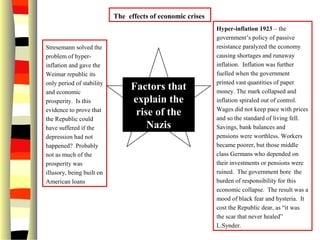
Hyper-inflation 1923 – the
government’s policy of passive
resistance paralyzed the economy
causing shortages and runaway
inflation. Inflation was further
fuelled when the government
printed vast quantities of paper
money. The mark collapsed and
inflation spiraled out of control.
Wages did not keep pace with prices
and so the standard of living fell.
Savings, bank balances and
pensions were worthless. Workers
became poorer, but those middle
class Germans who depended on
their investments or pensions were
ruined. The government bore the
burden of responsibility for this
economic collapse. The result was a
mood of black fear and hysteria. It
cost the Republic dear, as “it was
the scar that never healed”
L.Synder.
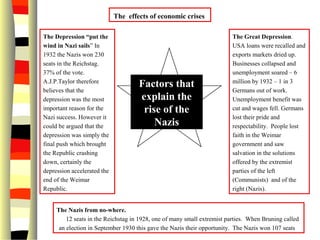
The effects of economic crises
Stresemann solved the
problem of hyper-
inflation and gave the
Weimar republic its
only period of stability
and economic
prosperity. Is this
evidence to prove that
the Republic could
have suffered if the
depression had not
happened? Probably
not as much of the
prosperity was
illusory, being built on
American loans
The Great Depression.
USA loans were recalled and
exports markets dried up.
Businesses collapsed and
unemployment soared – 6
million by 1932 – 1 in 3
Germans out of work.
Unemployment benefit was
cut and wages fell. Germans
lost their pride and
respectability. People lost
faith in the Weimar
government and saw
salvation in the solutions
offered by the extremist
parties of the left
(Communists) and of the
right (Nazis).
Factors that
explain the
rise of the
Nazis
The effects of economic crises
The Nazis from no-where.
12 seats in the Reichstag in 1928, one of many small extremist parties. When Bruning called
an election in September 1930 this gave the Nazis their opportunity. The Nazis won 107 seats
The Depression “put the
wind in Nazi sails” In
1932 the Nazis won 230
seats in the Reichstag.
37% of the vote.
A.J.P.Taylor therefore
believes that the
depression was the most
important reason for the
Nazi success. However it
could be argued that the
depression was simply the
final push which brought
the Republic crashing
down, certainly the
depression accelerated the
end of the Weimar
Republic.
Factors that
explain the
rise of the
Nazis
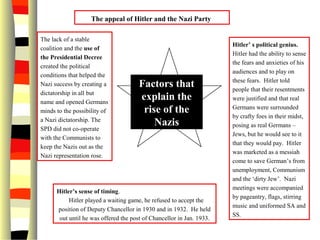
Hitler’ s political genius.
Hitler had the ability to sense
the fears and anxieties of his
audiences and to play on
these fears. Hitler told
people that their resentments
were justified and that real
Germans were surrounded
by crafty foes in their midst,
posing as real Germans –
Jews, but he would see to it
that they would pay. Hitler
was marketed as a messiah
come to save German’s from
unemployment, Communism
and the ‘dirty Jew’. Nazi
meetings were accompanied
by pageantry, flags, stirring
music and uniformed SA and
SS.
The appeal of Hitler and the Nazi Party
Hitler’s sense of timing.
Hitler played a waiting game, he refused to accept the
position of Deputy Chancellor in 1930 and in 1932. He held
out until he was offered the post of Chancellor in Jan. 1933.
The lack of a stable
coalition and the use of
the Presidential Decree
created the political
conditions that helped the
Nazi success by creating a
dictatorship in all but
name and opened Germans
minds to the possibility of
a Nazi dictatorship. The
SPD did not co-operate
with the Communists to
keep the Nazis out as the
Nazi representation rose.
Historiography
Historians differ in their opinions as to which factor was the most important in explaining the rise of
the Nazis.
A.J.P.Taylor believes that the depression was the most important reason “The depression put the
wind in the Nazi sails”
A. Bullock however points to the political crisis as being the most important reason “Hitler came to
office in 1933 . . . . As part of a shoddy political deal with the ‘old gang’ . . . . Hitler did not seize
power he was jobbed into office by backstairs intrigue”
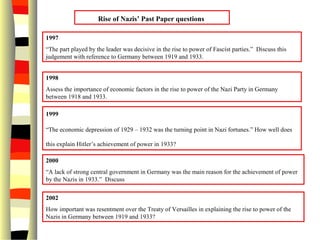
Rise of Nazis’ Past Paper questions
1997
“The part played by the leader was decisive in the rise to power of Fascist parties.” Discuss this
judgement with reference to Germany between 1919 and 1933.
2002
How important was resentment over the Treaty of Versailles in explaining the rise to power of the
Nazis in Germany between 1919 and 1933?
2000
“A lack of strong central government in Germany was the main reason for the achievement of power
by the Nazis in 1933.” Discuss
1998
Assess the importance of economic factors in the rise to power of the Nazi Party in Germany
between 1918 and 1933.
1999
“The economic depression of 1929 – 1932 was the turning point in Nazi fortunes.” How well does
this explain Hitler’s achievement of power in 1933?
Rise of Nazis’ Past Paper questions
1997
“The part played by the leader was decisive in the rise to power of Fascist parties.” Discuss this
judgement with reference to Germany between 1919 and 1933.
2002
How important was resentment over the Treaty of Versailles in explaining the rise to power of the
Nazis in Germany between 1919 and 1933?
2000
“A lack of strong central government in Germany was the main reason for the achievement of power
by the Nazis in 1933.” Discuss
1998
Assess the importance of economic factors in the rise to power of the Nazi Party in Germany
between 1918 and 1933.
1999
“The economic depression of 1929 – 1932 was the turning point in Nazi fortunes.” How well does
this explain Hitler’s achievement of power in 1933?

Nazis

  • 1.
    The lack ofsupport and instability of the Weimar Republic. The effects of economic crises - The Great Inflation of 1923, and The Great Depression 1930 - 33. Hatred of the Treaty of Versailles. Hitler used this as a stick to beat the Weimar politicians with. The legacy of defeat in World War One – the legend of the “Stab in the back”. The lack of unity amongst the main opponents of the Nazis especially the Social Democrats and Communists.during the political crisis 1930 - 1933 Hitler’s gift of public speaking combined with the effective propaganda of the Nazi's roused the middle and working class to their support. The Nazi party programme with its vague promise of something for everyone The financial support given to the Nazi party after 1929 by big business- the Harzburg Front that enabled Hitler to fight four election campaigns between 1930 and 1933. The support of Hugenburg guaranteed Hitler maximum news coverage. The violence of the S.A creating disorder on the streets of Germany during the Depression and gave the impression law and order were breaking down. Factors that explain the rise of the Nazis
  • 2.
    Factors that explain the riseof the Nazis The legacy of defeat in World War One – the legend of the “Stab in the back”. The psychological blow of defeat in WW1 Germans found it difficult to accept that Germany had been defeated in World War One. They blamed Weimar’s politicians for signing the Armistice – “The November Criminals” and when Ludendorff, in order to absolve the Generals from blame for Germany’s defeat came up with the legend of the ‘stab in the back’ they believed extremist right wing propaganda that democratic politicians, Jews and shirkers had been responsible. Democratic government was imposed on Germany as a condition of the Armistice. Germans were unused to democratic government and democracy was never popular in Germany –”Everything was better in the Kaiser’s day”
  • 3.
    Disarmament : armyreduced to 100 000 soldiers, the Rhineland demilitarised, no gas or tanks The Treaty of Versailles Factors that explain the rise of the Nazis Loss of land –14% of her territory, 6 million people lost to Germany. The Polish Corridor - 1.5 million Germans handed over to Poland – the principle of self determination not applied to Germans. Valuable coal and iron deposits in Silesia lost to the German economy . German Colonies mandated to the Allies. Danzig put under The League of Nations control Reparations – set at £6 600 million by the Reparations Commission in 1921. When Germany defaulted on payments the French invaded the Ruhr. The policy of non- co-operation led to hyper-inflation. Reparations were scaled down under the Dawes Plan in 1925 and again in 1930 under the Young Plan. They were abandoned in 1932 altogether. Article 231 – the War Guilt clause. Germany forced to accept sole blame for WW1. This was a blow to national pride Weimar politicians were blamed for signing the treaty. Right wing groups such as the Nazis identified the Republic with defeat and humiliation. This weakened the authority of and respect for the new democratic government of the Weimar Republic and ultimately led to its collapse. The Weimar Republic“was born with a curse upon it” Pruess
  • 4.
    Factors that explain the riseof the Nazis The lack of support and instability of the Weimar Republic. Weimar had enemies on both the left and right of German politics – too many implacable enemies and too few committed supporters who cared enough to about it to defend the Weimar Constitution The early years of the Republic were violent ones – revolts and political assassinations. The Spartacist Revolt was brutally suppressed by the Freikorps sent in by Ebert and the long term implication of this was the alienation of the extreme left(Communists) from the moderate left (Social Democrats) . Ebert’s reliance on the Freikorps discredited the Republic. The early twenties saw a wave of assassinations of prominent Weimar supporters including W.Rathenau the Foreign Minister. This shows the unpopularity of the Republic and the problem of political extremism in Germany from the early years of its formation The Establishment in Germany had not been changed by the revolution in 1918. Civil servants, judges and teachers were loyal to the old regime . Teachers taught children to despise the Republic while judges encouraged right wing violence. The Constitution caused problems. The voting system PR led to coalition governments that found it difficult to put into action strong decisive policies. The system also allowed small extremist parties like the Nazis to be represented in the Reichstag where they worked to destroy democracy.
  • 5.
    Factors that explain the riseof the Nazis Hyper-inflation 1923 – the government’s policy of passive resistance paralyzed the economy causing shortages and runaway inflation. Inflation was further fuelled when the government printed vast quantities of paper money. The mark collapsed and inflation spiraled out of control. Wages did not keep pace with prices and so the standard of living fell. Savings, bank balances and pensions were worthless. Workers became poorer, but those middle class Germans who depended on their investments or pensions were ruined. The government bore the burden of responsibility for this economic collapse. The result was a mood of black fear and hysteria. It cost the Republic dear, as “it was the scar that never healed” L.Synder. The effects of economic crises Stresemann solved the problem of hyper- inflation and gave the Weimar republic its only period of stability and economic prosperity. Is this evidence to prove that the Republic could have suffered if the depression had not happened? Probably not as much of the prosperity was illusory, being built on American loans
  • 6.
    The Great Depression. USAloans were recalled and exports markets dried up. Businesses collapsed and unemployment soared – 6 million by 1932 – 1 in 3 Germans out of work. Unemployment benefit was cut and wages fell. Germans lost their pride and respectability. People lost faith in the Weimar government and saw salvation in the solutions offered by the extremist parties of the left (Communists) and of the right (Nazis). Factors that explain the rise of the Nazis The effects of economic crises The Nazis from no-where. 12 seats in the Reichstag in 1928, one of many small extremist parties. When Bruning called an election in September 1930 this gave the Nazis their opportunity. The Nazis won 107 seats The Depression “put the wind in Nazi sails” In 1932 the Nazis won 230 seats in the Reichstag. 37% of the vote. A.J.P.Taylor therefore believes that the depression was the most important reason for the Nazi success. However it could be argued that the depression was simply the final push which brought the Republic crashing down, certainly the depression accelerated the end of the Weimar Republic.
  • 7.
    Factors that explain the riseof the Nazis Hitler’ s political genius. Hitler had the ability to sense the fears and anxieties of his audiences and to play on these fears. Hitler told people that their resentments were justified and that real Germans were surrounded by crafty foes in their midst, posing as real Germans – Jews, but he would see to it that they would pay. Hitler was marketed as a messiah come to save German’s from unemployment, Communism and the ‘dirty Jew’. Nazi meetings were accompanied by pageantry, flags, stirring music and uniformed SA and SS. The appeal of Hitler and the Nazi Party Hitler’s sense of timing. Hitler played a waiting game, he refused to accept the position of Deputy Chancellor in 1930 and in 1932. He held out until he was offered the post of Chancellor in Jan. 1933. The lack of a stable coalition and the use of the Presidential Decree created the political conditions that helped the Nazi success by creating a dictatorship in all but name and opened Germans minds to the possibility of a Nazi dictatorship. The SPD did not co-operate with the Communists to keep the Nazis out as the Nazi representation rose.
  • 8.
    Historiography Historians differ intheir opinions as to which factor was the most important in explaining the rise of the Nazis. A.J.P.Taylor believes that the depression was the most important reason “The depression put the wind in the Nazi sails” A. Bullock however points to the political crisis as being the most important reason “Hitler came to office in 1933 . . . . As part of a shoddy political deal with the ‘old gang’ . . . . Hitler did not seize power he was jobbed into office by backstairs intrigue”
  • 9.
    Rise of Nazis’Past Paper questions 1997 “The part played by the leader was decisive in the rise to power of Fascist parties.” Discuss this judgement with reference to Germany between 1919 and 1933. 2002 How important was resentment over the Treaty of Versailles in explaining the rise to power of the Nazis in Germany between 1919 and 1933? 2000 “A lack of strong central government in Germany was the main reason for the achievement of power by the Nazis in 1933.” Discuss 1998 Assess the importance of economic factors in the rise to power of the Nazi Party in Germany between 1918 and 1933. 1999 “The economic depression of 1929 – 1932 was the turning point in Nazi fortunes.” How well does this explain Hitler’s achievement of power in 1933?
  • 10.
    Rise of Nazis’Past Paper questions 1997 “The part played by the leader was decisive in the rise to power of Fascist parties.” Discuss this judgement with reference to Germany between 1919 and 1933. 2002 How important was resentment over the Treaty of Versailles in explaining the rise to power of the Nazis in Germany between 1919 and 1933? 2000 “A lack of strong central government in Germany was the main reason for the achievement of power by the Nazis in 1933.” Discuss 1998 Assess the importance of economic factors in the rise to power of the Nazi Party in Germany between 1918 and 1933. 1999 “The economic depression of 1929 – 1932 was the turning point in Nazi fortunes.” How well does this explain Hitler’s achievement of power in 1933?