CHAPTER 7
ENTROPY
Lecture slides by
Mehmet Kanoglu
Copyright © The McGraw-Hill Education. Permission required for reproduction or display.
Thermodynamics: An Engineering Approach
8th Edition
Yunus A. Çengel, Michael A. Boles
McGraw-Hill, 2015
2
Objectives
• Apply the second law of thermodynamics to processes.
• Define a new property called entropy to quantify the second-
law effects.
• Establish the increase of entropy principle.
• Calculate the entropy changes that take place during
processes for pure substances, incompressible substances,
and ideal gases.
• Examine a special class of idealized processes, called
isentropic processes, and develop the property relations for
these processes.
• Derive the reversible steady-flow work relations.
• Develop the isentropic efficiencies for various steady-flow
devices.
• Introduce and apply the entropy balance to various systems.
3
ENTROPY
Clasius
inequality
The equality in the Clausius inequality holds
for totally or just internally reversible cycles
and the inequality for the irreversible ones.
Formal
definition
of entropy
4
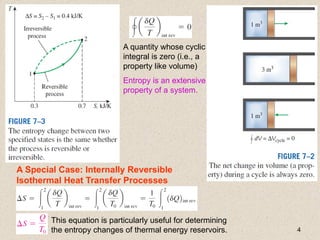
Entropy is an extensive
property of a system.
A quantity whose cyclic
integral is zero (i.e., a
property like volume)
A Special Case: Internally Reversible
Isothermal Heat Transfer Processes
This equation is particularly useful for determining
the entropy changes of thermal energy reservoirs.
5
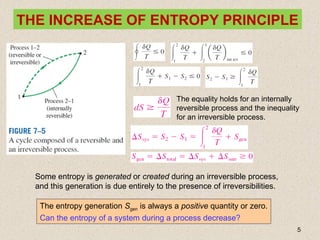
THE INCREASE OF ENTROPY PRINCIPLE
The equality holds for an internally
reversible process and the inequality
for an irreversible process.
Some entropy is generated or created during an irreversible process,
and this generation is due entirely to the presence of irreversibilities.
The entropy generation Sgen is always a positive quantity or zero.
Can the entropy of a system during a process decrease?
6
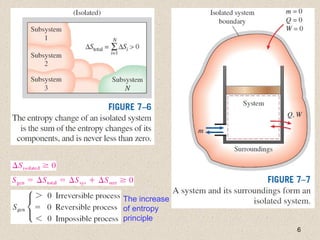
The increase
of entropy
principle
7
Some Remarks
about Entropy
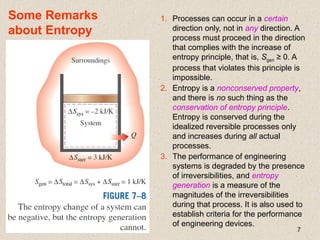
1. Processes can occur in a certain
direction only, not in any direction. A
process must proceed in the direction
that complies with the increase of
entropy principle, that is, Sgen ≥ 0. A
process that violates this principle is
impossible.
2. Entropy is a nonconserved property,
and there is no such thing as the
conservation of entropy principle.
Entropy is conserved during the
idealized reversible processes only
and increases during all actual
processes.
3. The performance of engineering
systems is degraded by the presence
of irreversibilities, and entropy
generation is a measure of the
magnitudes of the irreversibilities
during that process. It is also used to
establish criteria for the performance
of engineering devices.
8
ENTROPY CHANGE OF PURE SUBSTANCES
Entropy is a property, and thus
the value of entropy of a
system is fixed once the state
of the system is fixed.
Entropy change
9
ISENTROPIC PROCESSES
A process during which the entropy remains constant is called
an isentropic process.
10
PROPERTY DIAGRAMS INVOLVING ENTROPY
On a T-S
diagram, the
area under the
process curve
represents the
heat transfer for
internally
reversible
processes.
Mollier diagram: The h-s diagram
11
12
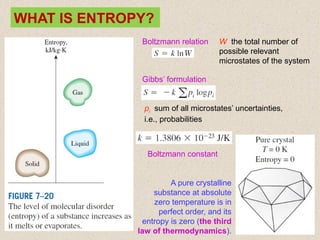
WHAT IS ENTROPY?
A pure crystalline
substance at absolute
zero temperature is in
perfect order, and its
entropy is zero (the third
law of thermodynamics).
Boltzmann relation
Gibbs’ formulation
W the total number of
possible relevant
microstates of the system
pi sum of all microstates’ uncertainties,
i.e., probabilities
Boltzmann constant
13
14
15
16
THE T ds RELATIONS
the first T ds, or Gibbs equation
the second T ds equation
Differential changes
in entropy in terms
of other properties
17
ENTROPY CHANGE OF LIQUIDS AND SOLIDS
Since for liquids and solids
Liquids and solids can be
approximated as
incompressible substances
since their specific volumes
remain nearly constant
during a process.
For and isentropic process of an incompressible substance
18
THE ENTROPY CHANGE OF IDEAL GASES
From the first T ds relation From the second T ds relation
19
Constant Specific Heats (Approximate Analysis)
Entropy change of an ideal gas on a
unit–mole basis
20
Variable Specific Heats (Exact Analysis)
We choose absolute zero as the reference
temperature and define a function s° as
On a unit–mole basis
On a unit–mass basis
21
22
Isentropic Processes of Ideal Gases
Constant Specific Heats (Approximate Analysis)
Setting this eq. equal to
zero, we get
23
Isentropic Processes of Ideal Gases
Variable Specific Heats (Exact Analysis)
Relative Pressure and Relative Specific Volume
T/Pr is the relative
specific volume vr.
exp(s°/R) is
the relative
pressure Pr.
The use of Pr data
for calculating the
final temperature
during an isentropic
process.
The use of vr data for
calculating the final
temperature during an
isentropic process
24
REVERSIBLE STEADY-FLOW WORK
The larger the
specific
volume, the
greater the
work produced
(or consumed)
by a steady-
flow device.
When kinetic and
potential energies
are negligible
For the steady flow of a liquid through a
device that involves no work interactions
(such as a pipe section), the work term is
zero (Bernoulli equation):
25
EXAMPLE: Compressing a
Substance in the Liquid versus Gas
Phases
26
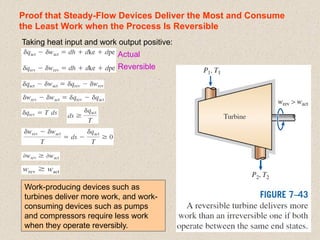
Proof that Steady-Flow Devices Deliver the Most and Consume
the Least Work when the Process Is Reversible
Actual
Reversible
Work-producing devices such as
turbines deliver more work, and work-
consuming devices such as pumps
and compressors require less work
when they operate reversibly.
Taking heat input and work output positive:
27
MINIMIZING THE COMPRESSOR WORK
Isentropic (Pvk
= constant):
Polytropic (Pvn
= constant):
Isothermal (Pv = constant):
When kinetic and
potential energies
are negligible
The adiabatic compression (Pvk
= constant)
requires the maximum work and the
isothermal compression (T = constant)
requires the minimum. Why?
28
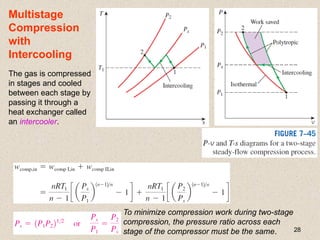
Multistage
Compression
with
Intercooling
The gas is compressed
in stages and cooled
between each stage by
passing it through a
heat exchanger called
an intercooler.
To minimize compression work during two-stage
compression, the pressure ratio across each
stage of the compressor must be the same.
29
ISENTROPIC EFFICIENCIES
OF STEADY-FLOW DEVICES
Isentropic Efficiency
of Turbines
30
31
Compressors
are sometimes
intentionally
cooled to
minimize the
work input.
Isothermal
efficiency
For a
pump
When kinetic and
potential energies
are negligible
Can you use isentropic efficiency for a
non-adiabatic compressor?
Can you use isothermal efficiency for
an adiabatic compressor?
Isentropic Efficiencies of Compressors and Pumps
32
33
Isentropic Efficiency
of Nozzles
If the inlet velocity of the
fluid is small relative to
the exit velocity, the
energy balance is
Then,
34
35
ENTROPY BALANCE
Energy and entropy
balances for a system.
Entropy Change of a
System, ∆Ssystem
When the properties of the
system are not uniform
36
1 Heat Transfer
Entropy transfer by heat transfer:
Entropy transfer by work:
No entropy accompanies work as it crosses the
system boundary. But entropy may be
generated within the system as work is
dissipated into a less useful form of energy.
Mechanisms of Entropy Transfer, Sin and Sout
37
2 Mass Flow
Entropy transfer by mass:
When the properties of the mass
change during the process
38
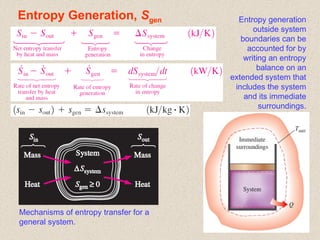
Entropy Generation, Sgen
Mechanisms of entropy transfer for a
general system.
Entropy generation
outside system
boundaries can be
accounted for by
writing an entropy
balance on an
extended system that
includes the system
and its immediate
surroundings.
39
Closed Systems
The entropy change of a closed system during a process is equal to the
sum of the net entropy transferred through the system boundary by heat
transfer and the entropy generated within the system boundaries.
40
Control Volumes
The entropy of a
substance always
increases (or
remains constant in
the case of a
reversible process)
as it flows through a
single-stream,
adiabatic, steady-
flow device.
41
Entropy balance for heat
transfer through a wall
Entropy balance for
a throttling process
EXAMPLES
42
Entropy Generated when a Hot
Block Is Dropped in a Lake
or
Entropy Generation in a Heat Exchanger
43
Entropy Generation Associated
with Heat Transfer
44
Entropy generation associated with a
heat transfer process
45
Summary
• Entropy
• The Increase of entropy principle
• Entropy change of pure substances
• Isentropic processes
• Property diagrams involving entropy
• What is entropy?
• The T ds relations
• Entropy change of liquids and solids
• The entropy change of ideal gases
• Reversible steady-flow work
• Minimizing the compressor work
• Isentropic efficiencies of steady-flow devices
• Entropy balance

thermodynamic chapter two temperature and heat

  • 1.
    CHAPTER 7 ENTROPY Lecture slidesby Mehmet Kanoglu Copyright © The McGraw-Hill Education. Permission required for reproduction or display. Thermodynamics: An Engineering Approach 8th Edition Yunus A. Çengel, Michael A. Boles McGraw-Hill, 2015
  • 2.
    2 Objectives • Apply thesecond law of thermodynamics to processes. • Define a new property called entropy to quantify the second- law effects. • Establish the increase of entropy principle. • Calculate the entropy changes that take place during processes for pure substances, incompressible substances, and ideal gases. • Examine a special class of idealized processes, called isentropic processes, and develop the property relations for these processes. • Derive the reversible steady-flow work relations. • Develop the isentropic efficiencies for various steady-flow devices. • Introduce and apply the entropy balance to various systems.
  • 3.
    3 ENTROPY Clasius inequality The equality inthe Clausius inequality holds for totally or just internally reversible cycles and the inequality for the irreversible ones. Formal definition of entropy
  • 4.
    4 Entropy is anextensive property of a system. A quantity whose cyclic integral is zero (i.e., a property like volume) A Special Case: Internally Reversible Isothermal Heat Transfer Processes This equation is particularly useful for determining the entropy changes of thermal energy reservoirs.
  • 5.
    5 THE INCREASE OFENTROPY PRINCIPLE The equality holds for an internally reversible process and the inequality for an irreversible process. Some entropy is generated or created during an irreversible process, and this generation is due entirely to the presence of irreversibilities. The entropy generation Sgen is always a positive quantity or zero. Can the entropy of a system during a process decrease?
  • 6.
  • 7.
    7 Some Remarks about Entropy 1.Processes can occur in a certain direction only, not in any direction. A process must proceed in the direction that complies with the increase of entropy principle, that is, Sgen ≥ 0. A process that violates this principle is impossible. 2. Entropy is a nonconserved property, and there is no such thing as the conservation of entropy principle. Entropy is conserved during the idealized reversible processes only and increases during all actual processes. 3. The performance of engineering systems is degraded by the presence of irreversibilities, and entropy generation is a measure of the magnitudes of the irreversibilities during that process. It is also used to establish criteria for the performance of engineering devices.
  • 8.
    8 ENTROPY CHANGE OFPURE SUBSTANCES Entropy is a property, and thus the value of entropy of a system is fixed once the state of the system is fixed. Entropy change
  • 9.
    9 ISENTROPIC PROCESSES A processduring which the entropy remains constant is called an isentropic process.
  • 10.
    10 PROPERTY DIAGRAMS INVOLVINGENTROPY On a T-S diagram, the area under the process curve represents the heat transfer for internally reversible processes. Mollier diagram: The h-s diagram
  • 11.
  • 12.
    12 WHAT IS ENTROPY? Apure crystalline substance at absolute zero temperature is in perfect order, and its entropy is zero (the third law of thermodynamics). Boltzmann relation Gibbs’ formulation W the total number of possible relevant microstates of the system pi sum of all microstates’ uncertainties, i.e., probabilities Boltzmann constant
  • 13.
  • 14.
  • 15.
  • 16.
    16 THE T dsRELATIONS the first T ds, or Gibbs equation the second T ds equation Differential changes in entropy in terms of other properties
  • 17.
    17 ENTROPY CHANGE OFLIQUIDS AND SOLIDS Since for liquids and solids Liquids and solids can be approximated as incompressible substances since their specific volumes remain nearly constant during a process. For and isentropic process of an incompressible substance
  • 18.
    18 THE ENTROPY CHANGEOF IDEAL GASES From the first T ds relation From the second T ds relation
  • 19.
    19 Constant Specific Heats(Approximate Analysis) Entropy change of an ideal gas on a unit–mole basis
  • 20.
    20 Variable Specific Heats(Exact Analysis) We choose absolute zero as the reference temperature and define a function s° as On a unit–mole basis On a unit–mass basis
  • 21.
  • 22.
    22 Isentropic Processes ofIdeal Gases Constant Specific Heats (Approximate Analysis) Setting this eq. equal to zero, we get
  • 23.
    23 Isentropic Processes ofIdeal Gases Variable Specific Heats (Exact Analysis) Relative Pressure and Relative Specific Volume T/Pr is the relative specific volume vr. exp(s°/R) is the relative pressure Pr. The use of Pr data for calculating the final temperature during an isentropic process. The use of vr data for calculating the final temperature during an isentropic process
  • 24.
    24 REVERSIBLE STEADY-FLOW WORK Thelarger the specific volume, the greater the work produced (or consumed) by a steady- flow device. When kinetic and potential energies are negligible For the steady flow of a liquid through a device that involves no work interactions (such as a pipe section), the work term is zero (Bernoulli equation):
  • 25.
    25 EXAMPLE: Compressing a Substancein the Liquid versus Gas Phases
  • 26.
    26 Proof that Steady-FlowDevices Deliver the Most and Consume the Least Work when the Process Is Reversible Actual Reversible Work-producing devices such as turbines deliver more work, and work- consuming devices such as pumps and compressors require less work when they operate reversibly. Taking heat input and work output positive:
  • 27.
    27 MINIMIZING THE COMPRESSORWORK Isentropic (Pvk = constant): Polytropic (Pvn = constant): Isothermal (Pv = constant): When kinetic and potential energies are negligible The adiabatic compression (Pvk = constant) requires the maximum work and the isothermal compression (T = constant) requires the minimum. Why?
  • 28.
    28 Multistage Compression with Intercooling The gas iscompressed in stages and cooled between each stage by passing it through a heat exchanger called an intercooler. To minimize compression work during two-stage compression, the pressure ratio across each stage of the compressor must be the same.
  • 29.
    29 ISENTROPIC EFFICIENCIES OF STEADY-FLOWDEVICES Isentropic Efficiency of Turbines
  • 30.
  • 31.
    31 Compressors are sometimes intentionally cooled to minimizethe work input. Isothermal efficiency For a pump When kinetic and potential energies are negligible Can you use isentropic efficiency for a non-adiabatic compressor? Can you use isothermal efficiency for an adiabatic compressor? Isentropic Efficiencies of Compressors and Pumps
  • 32.
  • 33.
    33 Isentropic Efficiency of Nozzles Ifthe inlet velocity of the fluid is small relative to the exit velocity, the energy balance is Then,
  • 34.
  • 35.
    35 ENTROPY BALANCE Energy andentropy balances for a system. Entropy Change of a System, ∆Ssystem When the properties of the system are not uniform
  • 36.
    36 1 Heat Transfer Entropytransfer by heat transfer: Entropy transfer by work: No entropy accompanies work as it crosses the system boundary. But entropy may be generated within the system as work is dissipated into a less useful form of energy. Mechanisms of Entropy Transfer, Sin and Sout
  • 37.
    37 2 Mass Flow Entropytransfer by mass: When the properties of the mass change during the process
  • 38.
    38 Entropy Generation, Sgen Mechanismsof entropy transfer for a general system. Entropy generation outside system boundaries can be accounted for by writing an entropy balance on an extended system that includes the system and its immediate surroundings.
  • 39.
    39 Closed Systems The entropychange of a closed system during a process is equal to the sum of the net entropy transferred through the system boundary by heat transfer and the entropy generated within the system boundaries.
  • 40.
    40 Control Volumes The entropyof a substance always increases (or remains constant in the case of a reversible process) as it flows through a single-stream, adiabatic, steady- flow device.
  • 41.
    41 Entropy balance forheat transfer through a wall Entropy balance for a throttling process EXAMPLES
  • 42.
    42 Entropy Generated whena Hot Block Is Dropped in a Lake or Entropy Generation in a Heat Exchanger
  • 43.
  • 44.
    44 Entropy generation associatedwith a heat transfer process
  • 45.
    45 Summary • Entropy • TheIncrease of entropy principle • Entropy change of pure substances • Isentropic processes • Property diagrams involving entropy • What is entropy? • The T ds relations • Entropy change of liquids and solids • The entropy change of ideal gases • Reversible steady-flow work • Minimizing the compressor work • Isentropic efficiencies of steady-flow devices • Entropy balance