Intermediate Algebra
Chapter 9
•Exponential
•and
•Logarithmic
Functions
Intermediate Algebra 9.1-9.2
•Review of Functions
Def: Relation
• A relation is a set of ordered pairs.
• Designated by:
• Listing
• Graphs
• Tables
• Algebraic equation
• Picture
• Sentence
Def: Function
• A function is a set of ordered pairs
in which no two different ordered
pairs have the same first
component.
• Vertical line test – used to
determine whether a graph
represents a function.
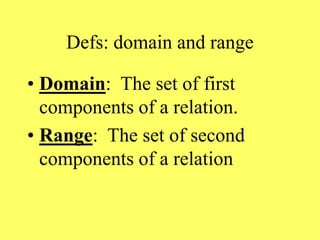
Defs: domain and range
• Domain: The set of first
components of a relation.
• Range: The set of second
components of a relation
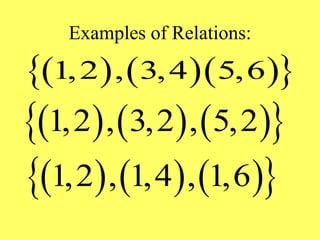
Examples of Relations:
    
 
1,2 , 3,4 5,6
     
 
1,2 , 3,2 , 5,2
     
 
1,2 , 1,4 , 1,6
Objectives
• Determine the domain, range of
relations.
• Determine if relation is a
function.
Intermediate Algebra 9.2
•Inverse Functions
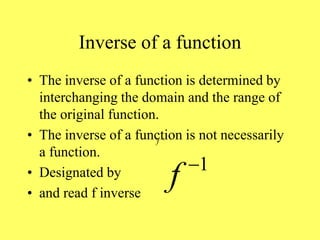
Inverse of a function
• The inverse of a function is determined by
interchanging the domain and the range of
the original function.
• The inverse of a function is not necessarily
a function.
• Designated by
• and read f inverse
1
f 
1
f 
One-to-One function
• Def: A function is a one-to-one
function if no two different
ordered pairs have the same
second coordinate.
Horizontal Line Test
• A function is a one-to-one
function if and only if no
horizontal line intersects the
graph of the function at more
than one point.
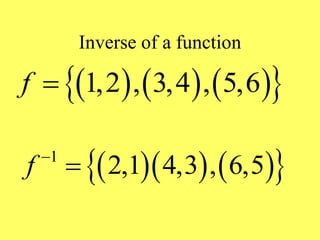
Inverse of a function
     
 
1,2 , 3,4 , 5,6
f 
    
 
1
2,1 4,3 , 6,5
f 

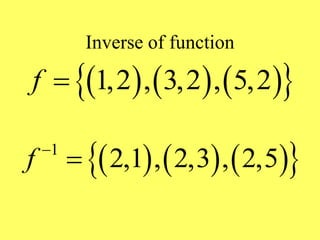
Inverse of function
     
 
1,2 , 3,2 , 5,2
f 
     
 
1
2,1 , 2,3 , 2,5
f 

Objectives:
• Determine the inverse of a function whose
ordered pairs are listed.
• Determine if a function is one to one.
Intermediate Algebra 9.3
•Exponential Functions
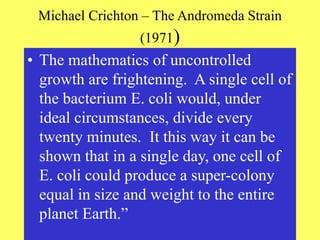
Michael Crichton – The Andromeda Strain
(1971)
• The mathematics of uncontrolled
growth are frightening. A single cell of
the bacterium E. coli would, under
ideal circumstances, divide every
twenty minutes. It this way it can be
shown that in a single day, one cell of
E. coli could produce a super-colony
equal in size and weight to the entire
planet Earth.”
Definition of Exponential
Function
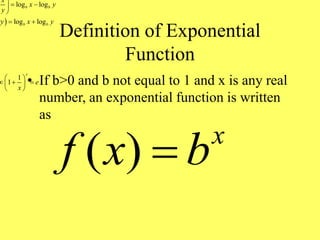
• If b>0 and b not equal to 1 and x is any real
number, an exponential function is written
as

log log
log log
1
1
b b
b b
x
x
x y
y
xy x y
e
x

 


 
 
  
 
 
( ) x
f x b

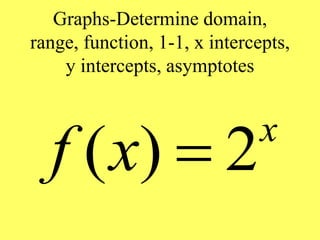
Graphs-Determine domain,
range, function, 1-1, x intercepts,
y intercepts, asymptotes
( ) 2x
f x 
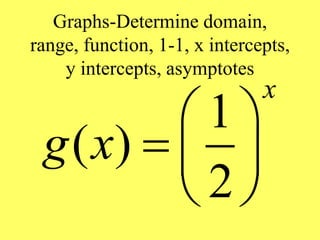
Graphs-Determine domain,
range, function, 1-1, x intercepts,
y intercepts, asymptotes
1
( )
2
x
g x
 
  
 
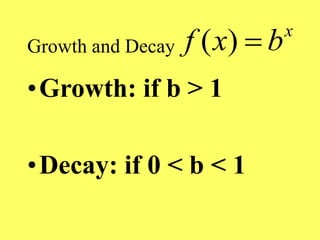
Growth and Decay
•Growth: if b > 1
•Decay: if 0 < b < 1
( ) x
f x b

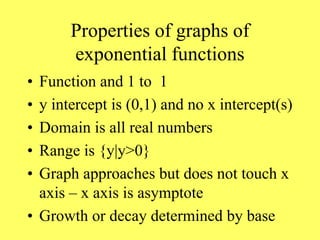
Properties of graphs of
exponential functions
• Function and 1 to 1
• y intercept is (0,1) and no x intercept(s)
• Domain is all real numbers
• Range is {y|y>0}
• Graph approaches but does not touch x
axis – x axis is asymptote
• Growth or decay determined by base
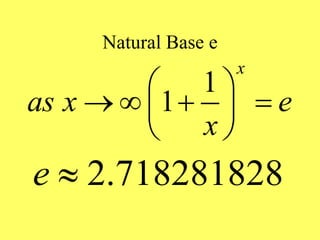
Natural Base e
1
1
x
as x e
x
 
   
 
 
2.718281828
e 
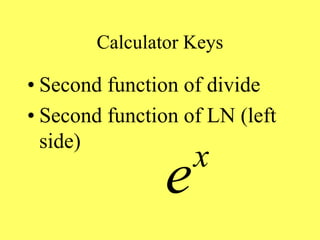
Calculator Keys
• Second function of divide
• Second function of LN (left
side)
x
e
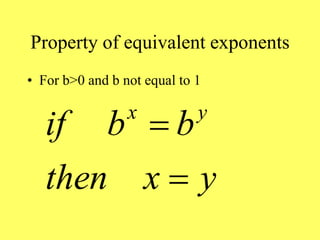
Property of equivalent exponents
• For b>0 and b not equal to 1
x y
if b b
then x y


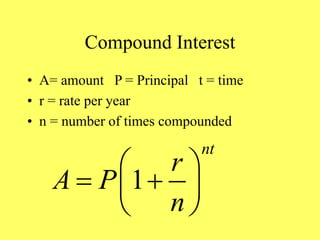
Compound Interest
• A= amount P = Principal t = time
• r = rate per year
• n = number of times compounded
1
nt
r
A P
n
 
 
 
 
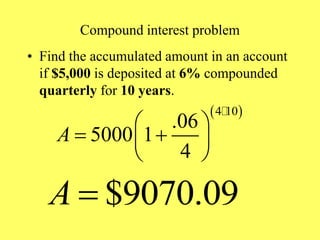
Compound interest problem
• Find the accumulated amount in an account
if $5,000 is deposited at 6% compounded
quarterly for 10 years.
 
4 10
.06
5000 1
4
A
 
 
 
 
$9070.09
A 
Objectives:
• Determine and graph
exponential functions.
• Use the natural base e
• Use the compound interest
formula.
Dwight Eisenhower – American
President
•“Pessimism never
won any battle.”
Intermediate Algebra 9.4,9.5,9.6
•Logarithmic Functions
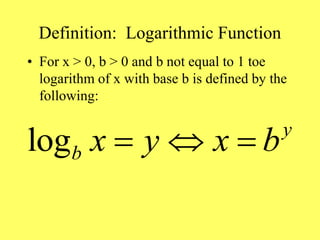
Definition: Logarithmic Function
• For x > 0, b > 0 and b not equal to 1 toe
logarithm of x with base b is defined by the
following:
log y
b x y x b
  
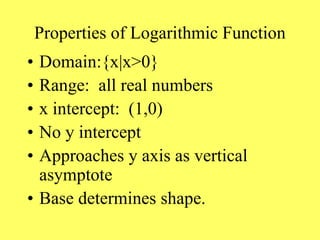
Properties of Logarithmic Function
• Domain:{x|x>0}
• Range: all real numbers
• x intercept: (1,0)
• No y intercept
• Approaches y axis as vertical
asymptote
• Base determines shape.
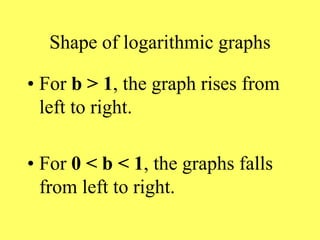
Shape of logarithmic graphs
• For b > 1, the graph rises from
left to right.
• For 0 < b < 1, the graphs falls
from left to right.
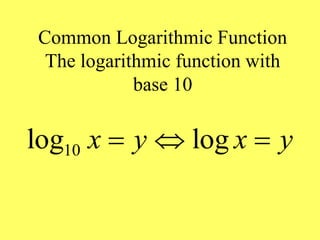
Common Logarithmic Function
The logarithmic function with
base 10
10
log log
x y x y
  
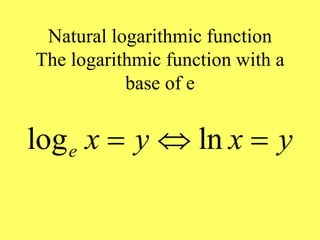
Natural logarithmic function
The logarithmic function with a
base of e
log ln
e x y x y
  
Calculator Keys
•[LOG]
•[LN]
Objective:
• Determine the common
log or natural log of any
number in the domain of
the logarithmic function.
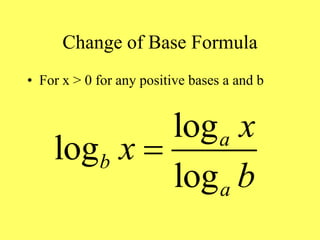
Change of Base Formula
• For x > 0 for any positive bases a and b
log
log
log
a
b
a
x
x
b

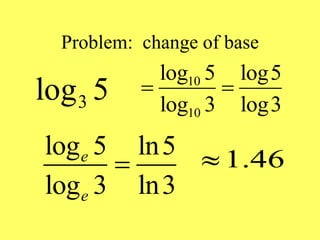
Problem: change of base
3
log 5 10
10
log 5 log5
log 3 log3
 
log 5 ln5
log 3 ln3
e
e
 1.46

Objective
• Use the change of base
formula to determine an
approximation to the
logarithm of a number when
the base is not 10 or e.
Intermediate Algebra 10.5
•Properties
•of
•Logarithms
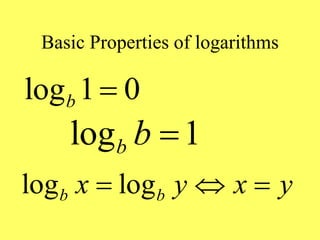
Basic Properties of logarithms
log 1 0
b 
log 1
b b 
log log
b b
x y x y
  
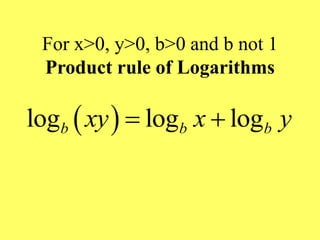
For x>0, y>0, b>0 and b not 1
Product rule of Logarithms
 
log log log
b b b
xy x y
 
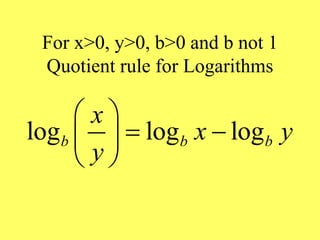
For x>0, y>0, b>0 and b not 1
Quotient rule for Logarithms
log log log
b b b
x
x y
y
 
 
 
 
For x>0, y>0, b>0 and b not 1
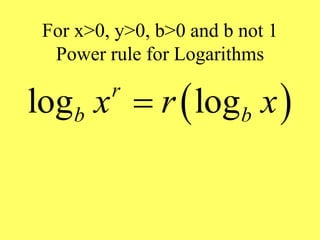
Power rule for Logarithms
 
log log
r
b b
x r x

Objectives:
• Apply the product, quotient,
and power properties of
logarithms.
• Combine and Expand
logarithmic expressions
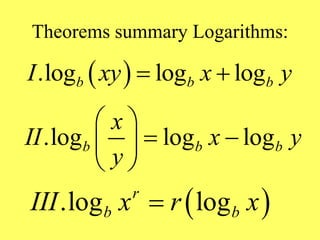
Theorems summary Logarithms:
 
.log log log
b b b
I xy x y
 
.log log log
b b b
x
II x y
y
 
 
 
 
 
.log log
r
b b
III x r x

Norman Vincent Peale
• “Believe it is possible to
solve your problem.
Tremendous things happen to
the believer. So believe the
answer will come. It will.”
Intermediate Algebra 9.7
•Exponential
•and
•Logarithmic
•Equations
Objective:
• Solve equations that have
variables as exponents.
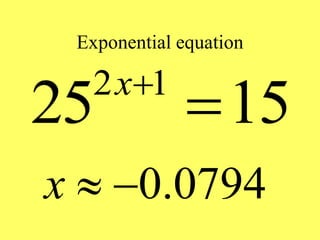
Exponential equation
2 1
25 15
x

0.0794
x  
Objective:
•Solve equations
containing logarithms.
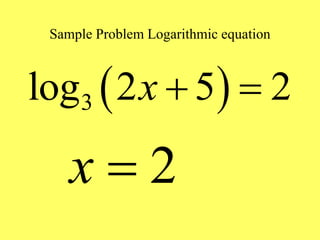
Sample Problem Logarithmic equation
 
3
log 2 5 2
x  
2
x 
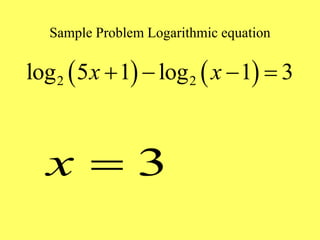
Sample Problem Logarithmic equation
   
2 2
log 5 1 log 1 3
x x
   
3
x 
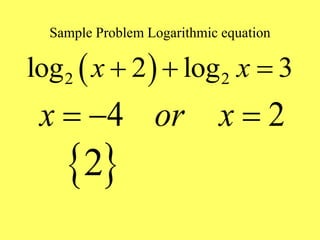
Sample Problem Logarithmic equation
 
2 2
log 2 log 3
x x
  
4 2
x or x
  
 
2
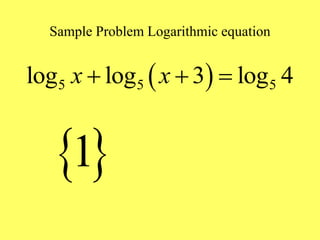
Sample Problem Logarithmic equation
 
5 5 5
log log 3 log 4
x x
  
 
1
Walt Disney
• “Disneyland will never be
completed. It will
continue to grow as long
as there is imagination
left in the world.”
Galileo Galilei (1564-1642)
•“The universe…is
written in the language
of mathematics…”

098_9.ppt