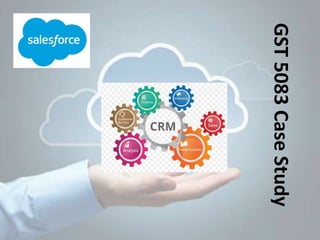
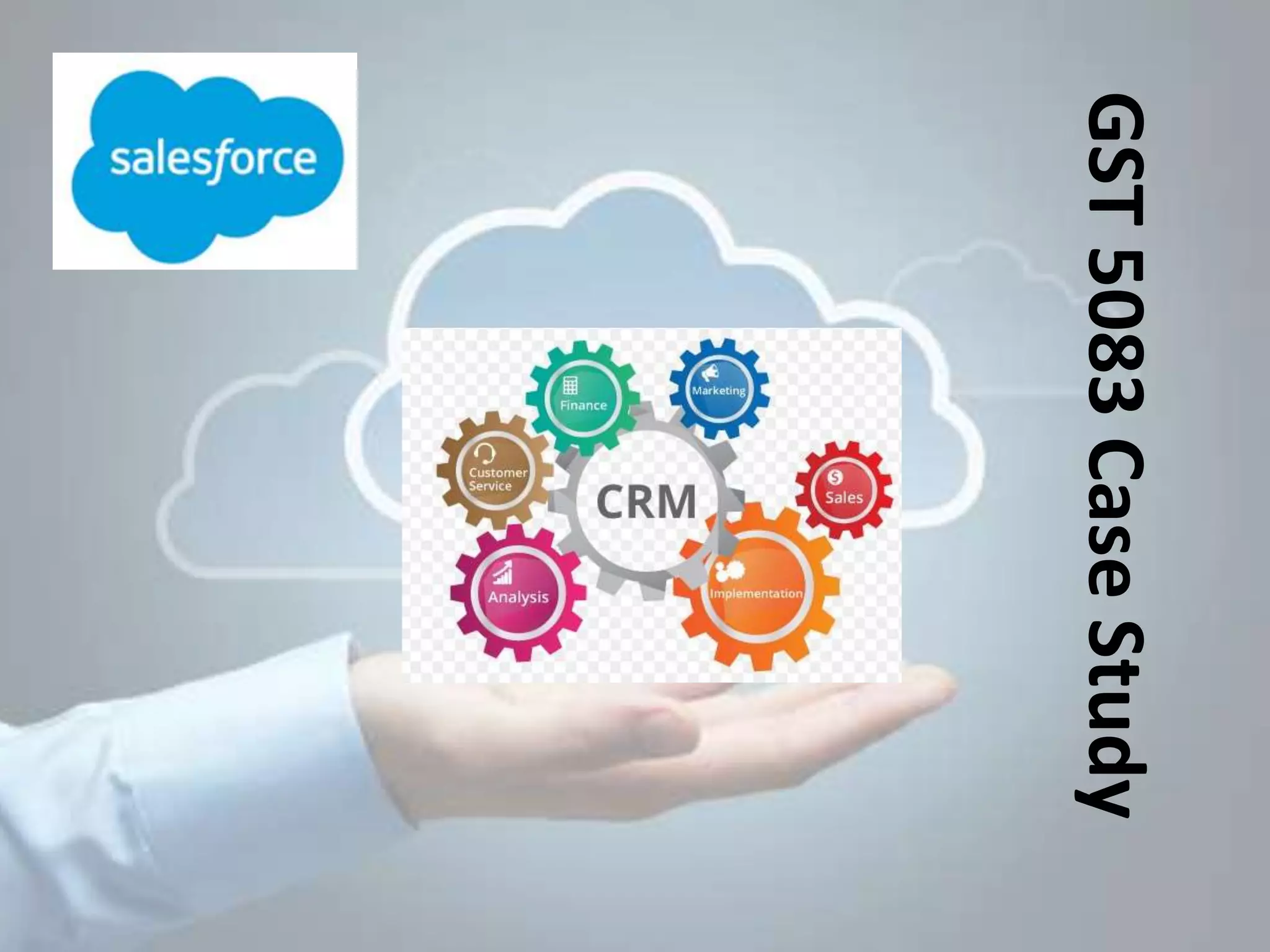
GST5083CaseStudy
Professor Dr. Rusli bin Abdullah
Chong Min Fatt P13D154P
Group Member Name:
Haji Nasseruddin Bin HJ Abdul Jabar P13D142P
Haji Zulkifflee Bin HJ Sofee P13D136P
is a global cloud computing company
headquartered in San Francisco, California. Though
best known for its customer relationship
management (CRM) product, Salesforce has also
expanded into commercial applications of social
networking through acquisition. Salesforce.com is
the most successful enterprise scale software as a
service (SaaS) and the undisputed global leader in
CRM system. Users can access Salesforce application
anywhere through an internet enabled mobile
device or connected computer.
Customer Relationship Management
(CRM)
CRM is a business strategy that blends processes,
people, and technology to help you attract sales
prospects, convert them into customers, and keep
existing customers satisfied and loyal. The goal of
CRM is to learn as much as possible about each
customer's attitudes, needs, and behavior to
provide them optimal service and retain the
relationship. Because business success is all about
customers and their needs, it's difficult for
companies to achieve and maintain leadership and
profitability without a sustained focus on CRM.
CRM reaches into many areas within the
organization, including sales, customer service,
and marketing. Salesforce.com offers a
technology solution for all those areas and
more. CRM software as a service and Force.com
cloud-computing platform, it can manage
customers while minding your budget—a key
balance to achieve in today's economic climate.
Salesforce CRM solutions also lead the way in
terms of speed of deployment and time to
value: Compared with conventional CRM
software, Salesforce CRM can be up and
running—and delivering critical business
results—within 30 days.
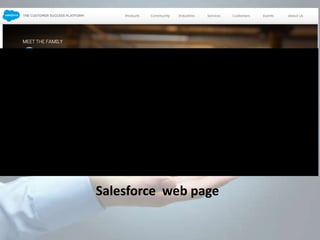
Salesforce web page
Salesforce Identity provides Identity and Access Management
(IAM) for Web and mobile applications through the simplicity,
transparency, and trust of the Salesforce Platform. Salesforce
Identity helps to improve the usability and adoption of
applications through single sign-on for end-users, simplify
administration through centralization and automation of user
identity and access rights, and provide peace of mind for the
CIO through visibility and control over their cloud investments.
Salesforce.com integration
Most salesforce.com customers need to rapidly
synchronize sales data - such as leads, accounts,
opportunities and forecasts - with a variety of
internal systems, including ERP, CRM and custom
applications. Just as the “No Software” experience
of salesforce.com has simplified sales automation,
WebSphere Cast Iron Cloud integration provides full
functionality as well as flexible deployment options
to completely map to your organization’s IT
strategy.
Multitenancy is the fundamental technology that
clouds use to share IT resources cost-efficiently and
securely.
Cloud Computing Apps for E-Business & Supply Chain Management
(SCM). Salesforce goal is to manage Global Trade & Supply Chain in a
much more efficient, collaborative and synchronized way.
B2B E-Commerce & SCM: This module empowers your trade and
collaboration with your customers and distributors and manages all
the distribution chain and logistics operations associated (CRM,
Catalog Price Lists, Promotions, Discount Rules, Pick & Ship, Route
Planning,...). Includes also Customers and Distributors Community
Portal for B2B E-Commerce.
E-Procurement & SCM: This module empowers your trade and
collaboration with your suppliers and manages all the supply chain
and logistics operations associated (SRM, Suppliers Evaluation, Supply
Projects, Reverse Auctions, Suppliers Catalogs, Order to Stock,...).
Includes also Suppliers Community Portal for E-Procurement and
integration with B2B marketplaces like Alibaba, for global sourcing.
1. What types of companies are most likely to
adopt cloud-based CRM software services?
Why? What companies might not be well-suited
for this type of software?
Small to mid-size companies that lack the know-
how or financial resources to successfully build
and maintain CRM applications in-house are
most likely to use cloud-based CRM software
services. Smaller companies are moving toward
open-source cloud computing that lets them
make their own changes to the application
source code to fit their particular situation.
When using this type of software service, small-
and mid-size companies can customize
applications by creating, modifying or deleting
business logic without extensive programming.
Large companies may not want to take
advantage of cloud-based CRM software
services if they are concerned about maintaining
control of their data and security. Most cloud-
based computing services do not make a
guarantee that data will be available 100
percent of the time. There are also service-level
agreements issues that larger companies may
want to avoid.
2. What are the advantages and disadvantages
of using cloud-based enterprise applications?
Advantages
Reduced costs; access to software that may be
too sophisticated or cumbersome for in-house
development; access to best practices industry-
wide; ability to merge legacy systems with
newer systems or merge databases together.
Disadvantages
Security risks; risk of losing control of data;
availability issues; service-level agreement
issues.
3. What management, organization, and
technology issues should be addressed in
deciding whether to use a conventional CRM
system versus a cloud-based version?
Management: Employee training; number of
employees needed for each system type; switching costs
associated with each system type.
Organization: Costs associated with each system
type; organizational changes in the way the business will
operate under each system type; changes in employee job
functions and responsibilities that may require new
organizational learning.
Technology: Degree of complexity involved in each
system type; technological changes involved with each
system type; changes in data management; ability or
inability to customize each system type.
Thank You

Week 4 power point slide -1-case study 1-customer relationship....salesforce

  • 1.
  • 2.
    Professor Dr. Ruslibin Abdullah Chong Min Fatt P13D154P Group Member Name: Haji Nasseruddin Bin HJ Abdul Jabar P13D142P Haji Zulkifflee Bin HJ Sofee P13D136P
  • 3.
    is a globalcloud computing company headquartered in San Francisco, California. Though best known for its customer relationship management (CRM) product, Salesforce has also expanded into commercial applications of social networking through acquisition. Salesforce.com is the most successful enterprise scale software as a service (SaaS) and the undisputed global leader in CRM system. Users can access Salesforce application anywhere through an internet enabled mobile device or connected computer.
  • 4.
    Customer Relationship Management (CRM) CRMis a business strategy that blends processes, people, and technology to help you attract sales prospects, convert them into customers, and keep existing customers satisfied and loyal. The goal of CRM is to learn as much as possible about each customer's attitudes, needs, and behavior to provide them optimal service and retain the relationship. Because business success is all about customers and their needs, it's difficult for companies to achieve and maintain leadership and profitability without a sustained focus on CRM.
  • 5.
    CRM reaches intomany areas within the organization, including sales, customer service, and marketing. Salesforce.com offers a technology solution for all those areas and more. CRM software as a service and Force.com cloud-computing platform, it can manage customers while minding your budget—a key balance to achieve in today's economic climate. Salesforce CRM solutions also lead the way in terms of speed of deployment and time to value: Compared with conventional CRM software, Salesforce CRM can be up and running—and delivering critical business results—within 30 days.
  • 6.
  • 8.
    Salesforce Identity providesIdentity and Access Management (IAM) for Web and mobile applications through the simplicity, transparency, and trust of the Salesforce Platform. Salesforce Identity helps to improve the usability and adoption of applications through single sign-on for end-users, simplify administration through centralization and automation of user identity and access rights, and provide peace of mind for the CIO through visibility and control over their cloud investments.
  • 9.
  • 10.
    Salesforce.com integration Most salesforce.comcustomers need to rapidly synchronize sales data - such as leads, accounts, opportunities and forecasts - with a variety of internal systems, including ERP, CRM and custom applications. Just as the “No Software” experience of salesforce.com has simplified sales automation, WebSphere Cast Iron Cloud integration provides full functionality as well as flexible deployment options to completely map to your organization’s IT strategy.
  • 11.
    Multitenancy is thefundamental technology that clouds use to share IT resources cost-efficiently and securely.
  • 13.
    Cloud Computing Appsfor E-Business & Supply Chain Management (SCM). Salesforce goal is to manage Global Trade & Supply Chain in a much more efficient, collaborative and synchronized way. B2B E-Commerce & SCM: This module empowers your trade and collaboration with your customers and distributors and manages all the distribution chain and logistics operations associated (CRM, Catalog Price Lists, Promotions, Discount Rules, Pick & Ship, Route Planning,...). Includes also Customers and Distributors Community Portal for B2B E-Commerce. E-Procurement & SCM: This module empowers your trade and collaboration with your suppliers and manages all the supply chain and logistics operations associated (SRM, Suppliers Evaluation, Supply Projects, Reverse Auctions, Suppliers Catalogs, Order to Stock,...). Includes also Suppliers Community Portal for E-Procurement and integration with B2B marketplaces like Alibaba, for global sourcing.
  • 14.
    1. What typesof companies are most likely to adopt cloud-based CRM software services? Why? What companies might not be well-suited for this type of software?
  • 15.
    Small to mid-sizecompanies that lack the know- how or financial resources to successfully build and maintain CRM applications in-house are most likely to use cloud-based CRM software services. Smaller companies are moving toward open-source cloud computing that lets them make their own changes to the application source code to fit their particular situation. When using this type of software service, small- and mid-size companies can customize applications by creating, modifying or deleting business logic without extensive programming.
  • 16.
    Large companies maynot want to take advantage of cloud-based CRM software services if they are concerned about maintaining control of their data and security. Most cloud- based computing services do not make a guarantee that data will be available 100 percent of the time. There are also service-level agreements issues that larger companies may want to avoid.
  • 17.
    2. What arethe advantages and disadvantages of using cloud-based enterprise applications?
  • 18.
    Advantages Reduced costs; accessto software that may be too sophisticated or cumbersome for in-house development; access to best practices industry- wide; ability to merge legacy systems with newer systems or merge databases together. Disadvantages Security risks; risk of losing control of data; availability issues; service-level agreement issues.
  • 19.
    3. What management,organization, and technology issues should be addressed in deciding whether to use a conventional CRM system versus a cloud-based version?
  • 20.
    Management: Employee training;number of employees needed for each system type; switching costs associated with each system type. Organization: Costs associated with each system type; organizational changes in the way the business will operate under each system type; changes in employee job functions and responsibilities that may require new organizational learning. Technology: Degree of complexity involved in each system type; technological changes involved with each system type; changes in data management; ability or inability to customize each system type.
  • 21.