COOPERATIVE STORAGE CLOUD
CUSTOMERS RELATIONS MANAGEMENT (CRM) IN
COOPERATIVE STORAGE CLOUD
CSC4301 CLOUD COMPUTING
GROUP MEMBERS
S/N NAMES REG NUMBER
1 ABUBAKAR IBRAHIM AHMAD CST/15/COM/00050
2 ADAM AMINU ADAM CST/15/COM/00043
3 HARUNA ABUBAKAR CST/15/COM/00037
4 MUHAMMAAD GARBA AHMAD CST/15/COM/00048
5 MUSTAPHA YARO AHMAD CST/15/COM/00052
6 SHAFIU UMAR ABUBAKAR CST/15/COM/00042
7 USMAN ALIYU ADAM CST/15/COM/00045
INTRODUCTION
 A customer relationship management (CRM) system is a piece of
marketing technology used to manage, analyse and quickly respond to
interactions with current or future clients or customers.
 CRM Is a relationship system that improve sales, customer service,
business development, recruiting, marketing, or any other line of
business — a better way to manage the external interactions and
relationships that drive success. An analysis of customer data
relationship lets you store customer and prospect contact information,
identify sales opportunities, record service issues, and manage
marketing and make information about every customer interaction.
PROBLEM STATEMENT
 Lack of accessibility at any time, from anywhere
 Lack affordability – especially for small businesses
 Deployment problem
 Difficulties in upgrading
 Lack of customers updated data
OBJETIVES
 To provide accessibility at any time, from anywhere
 To make it affordable – especially for small businesses
 To provide quick and painless to deploy
 T o make upgrading easy
 To enable integrating data from other sources and updating it regularly
OVERVIEW OF CUSTOMERS RELATIONS
MANAGEMENT (CRM)
 Customer relationship management (CRM) is an approach
to manage a company's interaction with current and
potential customers. It uses data analysis about customers'
history with a company to improve business relationships
with customers, specifically focusing on customer
retention and ultimately driving sales growth.
 CRM systems help you manage and maintain customer
relationships, track sales leads, marketing, and pipeline,
and deliver actionable data.
OVERVIEW OF CUSTOMERS RELATIONS
MANAGEMENT (CONT.)
 There are two main types of CRM system available to businesses:
 On-premise CRM software is a type of CRM system which is hosted on a
company’s own server. It requires the purchase of hardware, software
and software licenses to install, and regular updates must be carried out
by an on-site IT team to keep the system secure and up-to-date. It’s
highly customisable, but expensive and time-consuming to maintain.
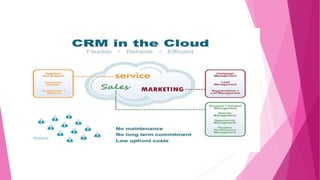
 Cloud-based CRM systems , on the other hand, store all of the data they
contain on a remote server (“in the cloud”) operated by the hosting
company. The company providing the CRM system handles software
installation and updates, as well as things like backups, hardware
maintenance and security.
OVERVIEW OF COOPERATIVE STORAGE
CLOUD
 A cooperative storage cloud is a decentralized model of
networked online storage where data is stored on multiple
computers (nodes), hosted by the participants cooperating
in the cloud. For the cooperative scheme to be viable, the
total storage contributed in aggregate must be at least
equal to the amount of storage needed by end users.
However, some nodes may contribute less storage and
some may contribute more. There may be reward models
to compensate the nodes contributing more.
OVERVIEW OF COOPERATIVE STORAGE
CLOUD (CONT.)
 Unlike a traditional storage cloud, a cooperative does not
directly employ dedicated servers for the actual storage
of the data, thereby eliminating the need for a significant
dedicated hardware investment. Each node in the
cooperative runs specialized software which
communicates with a centralized control and automatic
configuration, coordination, and management of computer
systems and software server, thereby allowing the node to
both consume and contribute storage space to the cloud.
METHODOLOGY
 ACCESSIBLE AT ANY TIME, FROM ANYWHERE
Cloud-based CRM systems can be accessed at any time, from anywhere and using any
device, thanks to the fact that the server is based in the cloud and not in a particular
office or location. This makes them much more compatible with modern ways of working,
in which so much of our work is done on-the-go or from a location other than the office.
 AFFORDABLE – ESPECIALLY FOR SMALL BUSINESSES
On-premise CRM systems come with a lot of associated costs. There’s the initial purchase
of hardware and software, plus the ongoing costs of upgrades and maintenance (known as
“hidden” costs) – all of which can be particularly difficult for a smaller business to afford.
The main cost associated with a cloud-based CRM is a subscription fee, which is usually
paid monthly.
 QUICK AND PAINLESS TO DEPLOY
Investing in a new piece of marketing technology can often be a long, drawn-out process
of weighing the various pros and cons of different solutions, painstakingly building a
business case, bringing all of the relevant parties on board, and then finally getting the
seal of approval from the higher-ups.
METHODOLOGY (CONT.)
 EASY TO UPGRADE
A cloud-based CRM, by contrast, can be updated or upgraded
simply by downloading the update in question from the
cloud. Job done.
 CAPABLE OF INTEGRATING DATA FROM OTHER SOURCES
Cloud-based CRM systems are very useful in their ability to
integrate information from other sources, whether that be
customer information on other systems, or discussions and
activity on social media.
COMPANIES THAT USING CRM IN CLOUD
HUBSPOT CRM
 HubSpot CRM is a popular tool from app developer HubSpot. The platform’s
popularity has been attributed to the fact that it comes absolutely for free.
This highly-flexible tool can be used as soon as the installation is finished,
without requiring users to make alterations in their workflows. It is highly-
suitable both for small and large businesses who want to try using a CRM.
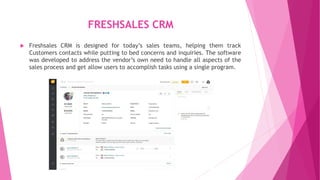
FRESHSALES CRM
 Freshsales CRM is designed for today’s sales teams, helping them track
Customers contacts while putting to bed concerns and inquiries. The software
was developed to address the vendor’s own need to handle all aspects of the
sales process and get allow users to accomplish tasks using a single program.
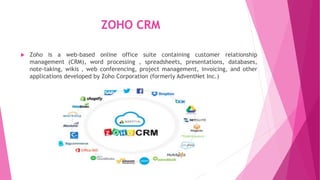
ZOHO CRM
 Zoho is a web-based online office suite containing customer relationship
management (CRM), word processing , spreadsheets, presentations, databases,
note-taking, wikis , web conferencing, project management, invoicing, and other
applications developed by Zoho Corporation (formerly AdventNet Inc.)
CONCLUSION
 A cooperative storage cloud is a distributed model of
networked online storage where data is stored on multiple
computers hosted by the participants cooperating in the
cloud.
 Customer relationship management (CRM) is a category of
integrated, data-driven software solutions that improve how
you interact and do business with your customers.
 This project anaylised some of the customer relation
problems and suggested possible solution using customer
relation software in cooperative storage cloud.

GROUP 3 CLOUD COMPUTING ASSIGNMENT

  • 1.
    COOPERATIVE STORAGE CLOUD CUSTOMERSRELATIONS MANAGEMENT (CRM) IN COOPERATIVE STORAGE CLOUD CSC4301 CLOUD COMPUTING
  • 3.
    GROUP MEMBERS S/N NAMESREG NUMBER 1 ABUBAKAR IBRAHIM AHMAD CST/15/COM/00050 2 ADAM AMINU ADAM CST/15/COM/00043 3 HARUNA ABUBAKAR CST/15/COM/00037 4 MUHAMMAAD GARBA AHMAD CST/15/COM/00048 5 MUSTAPHA YARO AHMAD CST/15/COM/00052 6 SHAFIU UMAR ABUBAKAR CST/15/COM/00042 7 USMAN ALIYU ADAM CST/15/COM/00045
  • 5.
    INTRODUCTION  A customerrelationship management (CRM) system is a piece of marketing technology used to manage, analyse and quickly respond to interactions with current or future clients or customers.  CRM Is a relationship system that improve sales, customer service, business development, recruiting, marketing, or any other line of business — a better way to manage the external interactions and relationships that drive success. An analysis of customer data relationship lets you store customer and prospect contact information, identify sales opportunities, record service issues, and manage marketing and make information about every customer interaction.
  • 6.
    PROBLEM STATEMENT  Lackof accessibility at any time, from anywhere  Lack affordability – especially for small businesses  Deployment problem  Difficulties in upgrading  Lack of customers updated data
  • 7.
    OBJETIVES  To provideaccessibility at any time, from anywhere  To make it affordable – especially for small businesses  To provide quick and painless to deploy  T o make upgrading easy  To enable integrating data from other sources and updating it regularly
  • 8.
    OVERVIEW OF CUSTOMERSRELATIONS MANAGEMENT (CRM)  Customer relationship management (CRM) is an approach to manage a company's interaction with current and potential customers. It uses data analysis about customers' history with a company to improve business relationships with customers, specifically focusing on customer retention and ultimately driving sales growth.  CRM systems help you manage and maintain customer relationships, track sales leads, marketing, and pipeline, and deliver actionable data.
  • 9.
    OVERVIEW OF CUSTOMERSRELATIONS MANAGEMENT (CONT.)  There are two main types of CRM system available to businesses:  On-premise CRM software is a type of CRM system which is hosted on a company’s own server. It requires the purchase of hardware, software and software licenses to install, and regular updates must be carried out by an on-site IT team to keep the system secure and up-to-date. It’s highly customisable, but expensive and time-consuming to maintain.  Cloud-based CRM systems , on the other hand, store all of the data they contain on a remote server (“in the cloud”) operated by the hosting company. The company providing the CRM system handles software installation and updates, as well as things like backups, hardware maintenance and security.
  • 11.
    OVERVIEW OF COOPERATIVESTORAGE CLOUD  A cooperative storage cloud is a decentralized model of networked online storage where data is stored on multiple computers (nodes), hosted by the participants cooperating in the cloud. For the cooperative scheme to be viable, the total storage contributed in aggregate must be at least equal to the amount of storage needed by end users. However, some nodes may contribute less storage and some may contribute more. There may be reward models to compensate the nodes contributing more.
  • 12.
    OVERVIEW OF COOPERATIVESTORAGE CLOUD (CONT.)  Unlike a traditional storage cloud, a cooperative does not directly employ dedicated servers for the actual storage of the data, thereby eliminating the need for a significant dedicated hardware investment. Each node in the cooperative runs specialized software which communicates with a centralized control and automatic configuration, coordination, and management of computer systems and software server, thereby allowing the node to both consume and contribute storage space to the cloud.
  • 13.
    METHODOLOGY  ACCESSIBLE ATANY TIME, FROM ANYWHERE Cloud-based CRM systems can be accessed at any time, from anywhere and using any device, thanks to the fact that the server is based in the cloud and not in a particular office or location. This makes them much more compatible with modern ways of working, in which so much of our work is done on-the-go or from a location other than the office.  AFFORDABLE – ESPECIALLY FOR SMALL BUSINESSES On-premise CRM systems come with a lot of associated costs. There’s the initial purchase of hardware and software, plus the ongoing costs of upgrades and maintenance (known as “hidden” costs) – all of which can be particularly difficult for a smaller business to afford. The main cost associated with a cloud-based CRM is a subscription fee, which is usually paid monthly.  QUICK AND PAINLESS TO DEPLOY Investing in a new piece of marketing technology can often be a long, drawn-out process of weighing the various pros and cons of different solutions, painstakingly building a business case, bringing all of the relevant parties on board, and then finally getting the seal of approval from the higher-ups.
  • 14.
    METHODOLOGY (CONT.)  EASYTO UPGRADE A cloud-based CRM, by contrast, can be updated or upgraded simply by downloading the update in question from the cloud. Job done.  CAPABLE OF INTEGRATING DATA FROM OTHER SOURCES Cloud-based CRM systems are very useful in their ability to integrate information from other sources, whether that be customer information on other systems, or discussions and activity on social media.
  • 15.
    COMPANIES THAT USINGCRM IN CLOUD HUBSPOT CRM  HubSpot CRM is a popular tool from app developer HubSpot. The platform’s popularity has been attributed to the fact that it comes absolutely for free. This highly-flexible tool can be used as soon as the installation is finished, without requiring users to make alterations in their workflows. It is highly- suitable both for small and large businesses who want to try using a CRM.
  • 16.
    FRESHSALES CRM  FreshsalesCRM is designed for today’s sales teams, helping them track Customers contacts while putting to bed concerns and inquiries. The software was developed to address the vendor’s own need to handle all aspects of the sales process and get allow users to accomplish tasks using a single program.
  • 17.
    ZOHO CRM  Zohois a web-based online office suite containing customer relationship management (CRM), word processing , spreadsheets, presentations, databases, note-taking, wikis , web conferencing, project management, invoicing, and other applications developed by Zoho Corporation (formerly AdventNet Inc.)
  • 18.
    CONCLUSION  A cooperativestorage cloud is a distributed model of networked online storage where data is stored on multiple computers hosted by the participants cooperating in the cloud.  Customer relationship management (CRM) is a category of integrated, data-driven software solutions that improve how you interact and do business with your customers.  This project anaylised some of the customer relation problems and suggested possible solution using customer relation software in cooperative storage cloud.