Developer Session 
Speaker : Arun Chandran C 
Associate Software Developer 
Suyati Technologies Pvt Ltd
Agenda 
 Cloud Computing Overview 
 Winter 13 and previous version comparison 
 Recruitment App Demo 
 More emphasis on Security, Dashboards
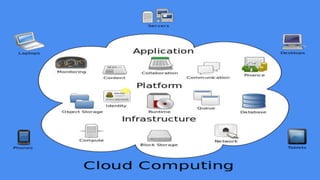
Define cloud computing by NIST 
“Cloud computing is a model for enabling convenient, on-demand 
network access to a shared pool of configurable computing resources 
(e.g., networks, servers, storage, applications, and services) that can be 
rapidly provisioned and released with minimal management effort or 
service provider interaction.” 
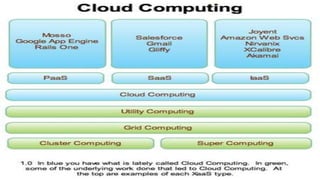
o Type of services offered 
Iaas Paas Saas
Internet And Clod Computing 
 Internet is a network of networks, which provides software/hardware 
infrastructure to establish and maintain connectivity of the computers 
around the word. 
 while Cloud computing is a new technology that delivers many types of 
resources over the Internet. Therefore Cloud computing could be 
identified as a technology that uses the Internet as the communication 
medium to deliver its services. 
 Cloud services can be offered within enterprises through LANs but in 
reality, Cloud computing cannot operate globally without the Internet.
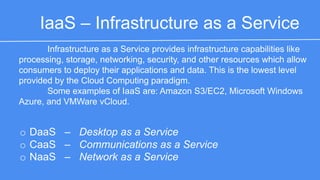
IaaS – Infrastructure as a Service 
Infrastructure as a Service provides infrastructure capabilities like 
processing, storage, networking, security, and other resources which allow 
consumers to deploy their applications and data. This is the lowest level 
provided by the Cloud Computing paradigm. 
Some examples of IaaS are: Amazon S3/EC2, Microsoft Windows 
Azure, and VMWare vCloud. 
o DaaS – Desktop as a Service 
o CaaS – Communications as a Service 
o NaaS – Network as a Service
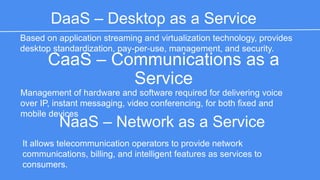
DaaS – Desktop as a Service 
Based on application streaming and virtualization technology, provides 
desktop standardization, pay-per-use, management, and security. 
CaaS – Communications as a Service 
Management of hardware and software required for delivering voice over IP, 
instant messaging, video conferencing, for both fixed and mobile devices 
NaaS – Network as a Service 
It allows telecommunication operators to provide network communications, 
billing, and intelligent features as services to consumers.
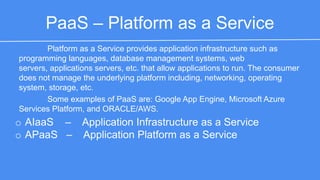
PaaS – Platform as a Service 
Platform as a Service provides application infrastructure such as 
programming languages, database management systems, web servers, applications 
servers, etc. that allow applications to run. The consumer does not manage the 
underlying platform including, networking, operating system, storage, etc. 
Some examples of PaaS are: Google App Engine, Microsoft Azure Services 
Platform, and ORACLE/AWS. 
o AIaaS – Application Infrastructure as a Service 
o APaaS – Application Platform as a Service
AIaaS – 
Application Infrastructure as a Service 
Some analysts consider this model to provide application middleware, 
including applications servers, ESB, and BPM (Business Process Management). 
APaaS – Application Platform as a Service 
Provides application servers with added multitenant elasticity as a service. The 
model PaaS (Platform as a Service) mentioned before includes AIaaS and APaaS.
SaaS – Software as a Service 
Software as a Service is the most sophisticated model hiding all the 
underlying details of networking, storage, operating system, database 
management systems, application servers, etc. from the consumer. It provides 
the consumers end-user software applications most commonly through a web 
browser (but could also be though a rich client). 
Some examples of SaaS are: Salesforce CRM, Oracle CRM On 
Demand, Microsoft Online Services, and Google Apps. 
o BPaaS – Business Process as a Service
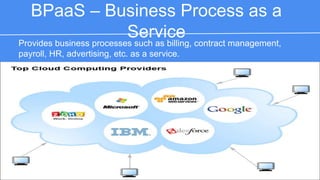
BPaaS – Business Process as a Service 
Provides business processes such as billing, contract management, payroll, 
HR, advertising, etc. as a service.
Location of the cloud 
Private cloud: The computing infrastructure is dedicated to a particular organization 
and not shared with other organizations. 
Private clouds are more expensive and more secure when compared to public 
clouds. 
Public cloud: In Public cloud the computing infrastructure is hosted by the cloud 
vendor at the vendor ’s premises. 
The customer has no visibility and control over where the computing infrastructure 
is hosted. 
The computing infrastructure is shared between any organizations.
Community cloud : involves sharing of computing infrastructure in between 
organizations of the same community. 
For example all Government organizations within the state of Kerala may 
share computing infrastructure on the cloud to manage data related to 
citizens residing in California. 
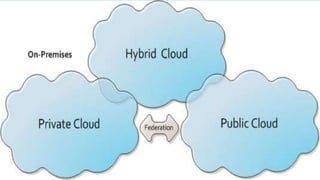
Hybrid cloud : Organizations may host critical applications on private clouds 
and applications with relatively less security concerns on the public cloud. The 
usage of both private and public clouds together is called hybrid cloud.
Salesforce 
Salesforce.com is SaaS company that distributes business software on a 
subscription basis. 
Customer Relationship Management (CRM) products. 
Ranked 27 in Fortune's 100 Best Companies to Work For in 2012. 
Founded 1999 
Founder(s) Marc Benioff (Chairman & CEO), Parker Harris 
Headquarters The Landmark, San Francisco, California, USA 
Services Cloud computing, Social enterprise solutions
Customer Relationship Management 
CRM, is a company-wide business strategy designed to reduce costs and 
increase profitability by solidifying customer satisfaction, loyalty, and 
advocacy. 
True CRM brings together information from all data sources to give one, 
holistic view of each customer in real time. 
High reliability 
High performance 
High security
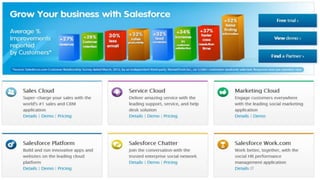
CRM Cloud Platform 
• CRM cloud apps need to be easy to use for sales, marketing, and service 
professionals in any industry. That’s why smart companies rely on a CRM 
platform that gives them complete freedom to customize CRM for their 
business. It’s the best way to boost adoption and make sure your CRM 
apps are working the way you do. 
Sales 
Cloud 
Service 
Cloud
Sales Cloud 
For sales and marketing : For sales managers, CRM cloud apps provide real-time 
visibility into their team’s activities so they can forecast sales with confidence. For 
sales reps, CRM cloud apps make it easy to manage customer information so reps 
spend less time handling data and more time with customers. 
Service Cloud 
For customer service : To deliver stellar customer service, you need to connect 
all the conversations that happen on social networks with the internal 
knowledge your agents use every day. That way, your customers get answers 
fast and are happy. And it costs you less.
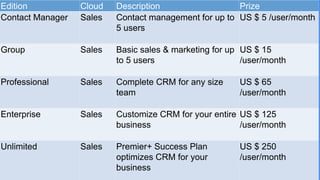
Edition Cloud Description Prize 
Professional Service Basic service and support 
for any size team 
US $ 65 /user/month 
Enterprise Service Extend service to the Web with 
customization and integration 
US $ 135 user/month 
Unlimited Service Premier+ Success Plan optimizes 
your Service Cloud app for your 
business 
US $ 260 
/user/month 
Contact Manager Sales Contact management for up to 5 
users 
US $ 5 /user/month 
Group Sales Basic sales & marketing for up to 
5 users 
US $ 15 /user/month 
Professional Sales Complete CRM for any size team US $ 65 /user/month 
Enterprise Sales Customize CRM for your entire 
business 
US $ 125 
/user/month 
Unlimited Sales Premier+ Success Plan optimizes 
CRM for your business 
US $ 250 
/user/month
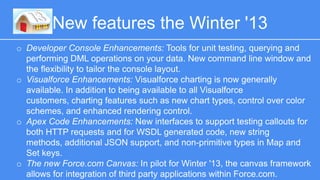
New features the Winter '13 
o Developer Console Enhancements: Tools for unit testing, querying and 
performing DML operations on your data. New command line window and the 
flexibility to tailor the console layout. 
o Visualforce Enhancements: Visualforce charting is now generally available. In 
addition to being available to all Visualforce customers, charting features such 
as new chart types, control over color schemes, and enhanced rendering 
control. 
o Apex Code Enhancements: New interfaces to support testing callouts for both 
HTTP requests and for WSDL generated code, new string methods, additional 
JSON support, and non-primitive types in Map and Set keys. 
o The new Force.com Canvas: In pilot for Winter '13, the canvas framework allows 
for integration of third party applications within Force.com.
Thank you

Intro to Cloud Computing and Sales force

  • 1.
    Developer Session Speaker: Arun Chandran C Associate Software Developer Suyati Technologies Pvt Ltd
  • 2.
    Agenda  CloudComputing Overview  Winter 13 and previous version comparison  Recruitment App Demo  More emphasis on Security, Dashboards
  • 3.
    Define cloud computingby NIST “Cloud computing is a model for enabling convenient, on-demand network access to a shared pool of configurable computing resources (e.g., networks, servers, storage, applications, and services) that can be rapidly provisioned and released with minimal management effort or service provider interaction.” o Type of services offered Iaas Paas Saas
  • 5.
    Internet And ClodComputing  Internet is a network of networks, which provides software/hardware infrastructure to establish and maintain connectivity of the computers around the word.  while Cloud computing is a new technology that delivers many types of resources over the Internet. Therefore Cloud computing could be identified as a technology that uses the Internet as the communication medium to deliver its services.  Cloud services can be offered within enterprises through LANs but in reality, Cloud computing cannot operate globally without the Internet.
  • 7.
    IaaS – Infrastructureas a Service Infrastructure as a Service provides infrastructure capabilities like processing, storage, networking, security, and other resources which allow consumers to deploy their applications and data. This is the lowest level provided by the Cloud Computing paradigm. Some examples of IaaS are: Amazon S3/EC2, Microsoft Windows Azure, and VMWare vCloud. o DaaS – Desktop as a Service o CaaS – Communications as a Service o NaaS – Network as a Service
  • 8.
    DaaS – Desktopas a Service Based on application streaming and virtualization technology, provides desktop standardization, pay-per-use, management, and security. CaaS – Communications as a Service Management of hardware and software required for delivering voice over IP, instant messaging, video conferencing, for both fixed and mobile devices NaaS – Network as a Service It allows telecommunication operators to provide network communications, billing, and intelligent features as services to consumers.
  • 9.
    PaaS – Platformas a Service Platform as a Service provides application infrastructure such as programming languages, database management systems, web servers, applications servers, etc. that allow applications to run. The consumer does not manage the underlying platform including, networking, operating system, storage, etc. Some examples of PaaS are: Google App Engine, Microsoft Azure Services Platform, and ORACLE/AWS. o AIaaS – Application Infrastructure as a Service o APaaS – Application Platform as a Service
  • 10.
    AIaaS – ApplicationInfrastructure as a Service Some analysts consider this model to provide application middleware, including applications servers, ESB, and BPM (Business Process Management). APaaS – Application Platform as a Service Provides application servers with added multitenant elasticity as a service. The model PaaS (Platform as a Service) mentioned before includes AIaaS and APaaS.
  • 11.
    SaaS – Softwareas a Service Software as a Service is the most sophisticated model hiding all the underlying details of networking, storage, operating system, database management systems, application servers, etc. from the consumer. It provides the consumers end-user software applications most commonly through a web browser (but could also be though a rich client). Some examples of SaaS are: Salesforce CRM, Oracle CRM On Demand, Microsoft Online Services, and Google Apps. o BPaaS – Business Process as a Service
  • 12.
    BPaaS – BusinessProcess as a Service Provides business processes such as billing, contract management, payroll, HR, advertising, etc. as a service.
  • 13.
    Location of thecloud Private cloud: The computing infrastructure is dedicated to a particular organization and not shared with other organizations. Private clouds are more expensive and more secure when compared to public clouds. Public cloud: In Public cloud the computing infrastructure is hosted by the cloud vendor at the vendor ’s premises. The customer has no visibility and control over where the computing infrastructure is hosted. The computing infrastructure is shared between any organizations.
  • 14.
    Community cloud :involves sharing of computing infrastructure in between organizations of the same community. For example all Government organizations within the state of Kerala may share computing infrastructure on the cloud to manage data related to citizens residing in California. Hybrid cloud : Organizations may host critical applications on private clouds and applications with relatively less security concerns on the public cloud. The usage of both private and public clouds together is called hybrid cloud.
  • 16.
    Salesforce Salesforce.com isSaaS company that distributes business software on a subscription basis. Customer Relationship Management (CRM) products. Ranked 27 in Fortune's 100 Best Companies to Work For in 2012. Founded 1999 Founder(s) Marc Benioff (Chairman & CEO), Parker Harris Headquarters The Landmark, San Francisco, California, USA Services Cloud computing, Social enterprise solutions
  • 17.
    Customer Relationship Management CRM, is a company-wide business strategy designed to reduce costs and increase profitability by solidifying customer satisfaction, loyalty, and advocacy. True CRM brings together information from all data sources to give one, holistic view of each customer in real time. High reliability High performance High security
  • 18.
    CRM Cloud Platform • CRM cloud apps need to be easy to use for sales, marketing, and service professionals in any industry. That’s why smart companies rely on a CRM platform that gives them complete freedom to customize CRM for their business. It’s the best way to boost adoption and make sure your CRM apps are working the way you do. Sales Cloud Service Cloud
  • 19.
    Sales Cloud Forsales and marketing : For sales managers, CRM cloud apps provide real-time visibility into their team’s activities so they can forecast sales with confidence. For sales reps, CRM cloud apps make it easy to manage customer information so reps spend less time handling data and more time with customers. Service Cloud For customer service : To deliver stellar customer service, you need to connect all the conversations that happen on social networks with the internal knowledge your agents use every day. That way, your customers get answers fast and are happy. And it costs you less.
  • 20.
    Edition Cloud DescriptionPrize Professional Service Basic service and support for any size team US $ 65 /user/month Enterprise Service Extend service to the Web with customization and integration US $ 135 user/month Unlimited Service Premier+ Success Plan optimizes your Service Cloud app for your business US $ 260 /user/month Contact Manager Sales Contact management for up to 5 users US $ 5 /user/month Group Sales Basic sales & marketing for up to 5 users US $ 15 /user/month Professional Sales Complete CRM for any size team US $ 65 /user/month Enterprise Sales Customize CRM for your entire business US $ 125 /user/month Unlimited Sales Premier+ Success Plan optimizes CRM for your business US $ 250 /user/month
  • 21.
    New features theWinter '13 o Developer Console Enhancements: Tools for unit testing, querying and performing DML operations on your data. New command line window and the flexibility to tailor the console layout. o Visualforce Enhancements: Visualforce charting is now generally available. In addition to being available to all Visualforce customers, charting features such as new chart types, control over color schemes, and enhanced rendering control. o Apex Code Enhancements: New interfaces to support testing callouts for both HTTP requests and for WSDL generated code, new string methods, additional JSON support, and non-primitive types in Map and Set keys. o The new Force.com Canvas: In pilot for Winter '13, the canvas framework allows for integration of third party applications within Force.com.
  • 22.

Editor's Notes

  • #18 True CRM brings together information from all data sources within an organization (and where appropriate, from outside the organization) to give one, holistic view of each customer in real time. This allows customer facing employees in such areas as sales, customer support, and marketing to make quick yet informed decisions on everything from cross-selling and upselling opportunities to target marketing strategies to competitive positioning tactics High reliability – uptime that exceeds 99.9% High performance – data access in less than 300 ms High security – industry certifications such as ISO27001 and SAS 70 Type II
  • #20 For marketers, nothing is more important than tracking the sales that result from leads generated through marketing campaigns on your Web site, in email, or with Google AdWords. CRM cloud apps let marketers track leads and sources, route leads to the right salespeople in real time, and provide the analytics to see what’s working and what can be improved Your customers have questions about your products. Today, they might go to Google or Twitter to look for answers and only contact your call center if they can’t find what they need.