
Rule Based Expert System with uncertainty
management in Smart Homes
Team Members
o Abhay R Dixit - 1DS13CS003
o Abhishek Kori - 1DS13CS007
o Diksha Kushwaha - 1DS13CS034
o Varshini B. K. – 1DS13CS112
Under the guidance of
● Prof. Rashmi S R
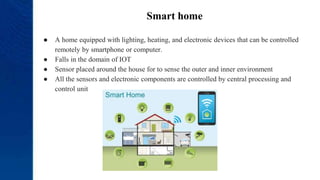
Smart home
● A home equipped with lighting, heating, and electronic devices that can be controlled
remotely by smartphone or computer.
● Falls in the domain of IOT
● Sensor placed around the house for to sense the outer and inner environment
● All the sensors and electronic components are controlled by central processing and
control unit
Need for smart homes
● All the electronic devices are getting smarter and connected to the internet
● Advancement and digitalization of real estate sector
● Security and comfortable living
● Saves energy and cost of running house activities
● Personalised home living
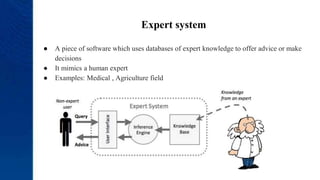
Expert system
● A piece of software which uses databases of expert knowledge to offer advice or make
decisions
● It mimics a human expert
● Examples: Medical , Agriculture field
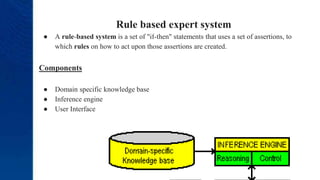
Rule based expert system
● A rule-based system is a set of "if-then" statements that uses a set of assertions, to
which rules on how to act upon those assertions are created.
Components
● Domain specific knowledge base
● Inference engine
● User Interface
Uncertainty
● The sensors and electronic appliances are exposed to nature and human interaction. They
are more likely to get damaged due and give wrong input
● The situations like sensor getting damaged , devices not able to connect to the internet
etc
● These situations collectively contribute to uncertainty situations
Need to solve uncertain situations
● The likelihood the uncertain situations is high
● Customers lose trust over the system
● Wrong decisions or no decisions may cause discomfort and in some cases it might be life
threatening
Problem statement
To build an smart system in a regular home which will react and take appropriate decisions to
changing environment and also counter uncertainty situations.
It should be
● Safe
● Dynamic
● Smart
● Adaptable
● Real time
Literature Review
“ Explicit Knowledge-based Reasoning for Visual Question Answering “ [1]
Pros:Recognising the question and answering it with reason.
Cons:The problem is that the amount of prior information that can be encoded within a LSTM system is very
limited
“Integration of Rule based and Case based Reasoning System to Support Decision Making “ [2]
Pros: Case Based Reasoning system. An approach has been made to develop a decision support system which will
take decision under complex environment.
Cons: The integration of raw facts and knowledge into a linking case base knowledge to enhance the potential of
the candidate system and to improve the probability of finding the correct measure.
“Detecting Inconsistencies in Rule-Based Reasoning for Ambient Intelligence” [3]
Pros: The purpose of this approach is to facilitate the creation of an information system for AmI using ontological
model and rule-based reasoning, in order to reduce the errors and encourage a more flexible prototyping process
Cons: little refactoring exists in models and rules, and expert-users often find themselves with redundancy between
the various rules’ content
“A Case-Based Reasoning System to Control Traffic at Signalized Intersections” [4]
Pros: Monitors , record and measure the traffic flow and regulates the signal
Cons: Initial knowledge is not available and and do not specify the correct source of knowledge
“A Rule-Based Tracking System for Video Surveillance Applications” [5]
Pros: Rule based object identification to help in monitoring video captured by security cameras
Cons: It’s very domain specific and can only focus on certain kind of situations
“Rule-Based Solution for Context-Aware Reasoning on Mobile Devices” [6]
Pros: Mobile computing devices which has even the knowledge of the context which it's currently present in
Cons: Modeling , representing and classifying context is a big challenge
“Considerations on uncertain spatio-temporal reasoning in smart home systems” [7]
Pros: Helps in assisting the elderly inside and promote over all healthy lifestyle
Cons: Inference and measurement of the environment by the hardware is still in its early stage
Implementation
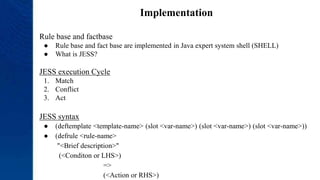
Rule base and factbase
● Rule base and fact base are implemented in Java expert system shell (SHELL)
● What is JESS?
JESS execution Cycle
1. Match
2. Conflict
3. Act
JESS syntax
● (deftemplate <template-name> (slot <var-name>) (slot <var-name>) (slot <var-name>))
● (defrule <rule-name>
"<Brief description>"
(<Conditon or LHS>)
=>
(<Action or RHS>)
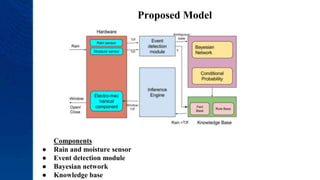
Proposed Model
Components
● Rain and moisture sensor
● Event detection module
● Bayesian network
● Knowledge base
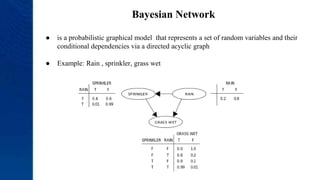
Bayesian Network
● is a probabilistic graphical model that represents a set of random variables and their
conditional dependencies via a directed acyclic graph
● Example: Rain , sprinkler, grass wet
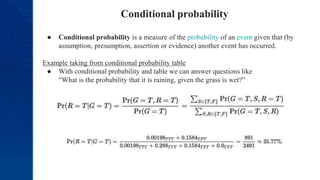
Conditional probability
● Conditional probability is a measure of the probability of an event given that (by
assumption, presumption, assertion or evidence) another event has occurred.
Example taking from conditional probability table
● With conditional probability and table we can answer questions like
“What is the probability that it is raining, given the grass is wet?”
Overall process flow
1. Send sensor input to event detection module
2. Sense for any event (rain or no rain)
3. If detected assert the fact in fact base
4. Inference engine checks the rules for matching rule with fact in the fact base
5. If a rule is matched then RHS part of that rule gets executed
6. If there is uncertain condition go to Bayesian network , conditional probability module
to calculate the probability of rain
7. If the probability is more than the pre set threshold then assert its rain true else set false
in the fact base
8. Inference engine again scans through the rules for matching rules and executes the
respective RHS
9. Depending on the RHS part the action is sent to electromechanical unit
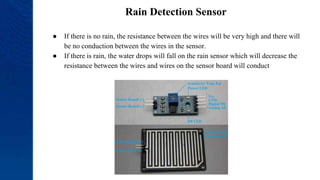
Rain Detection Sensor
● If there is no rain, the resistance between the wires will be very high and there will
be no conduction between the wires in the sensor.
● If there is rain, the water drops will fall on the rain sensor which will decrease the
resistance between the wires and wires on the sensor board will conduct
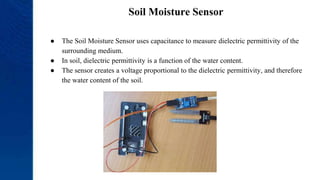
Soil Moisture Sensor
● The Soil Moisture Sensor uses capacitance to measure dielectric permittivity of the
surrounding medium.
● In soil, dielectric permittivity is a function of the water content.
● The sensor creates a voltage proportional to the dielectric permittivity, and therefore
the water content of the soil.
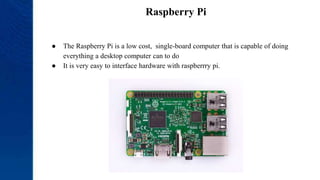
Raspberry Pi
● The Raspberry Pi is a low cost, single-board computer that is capable of doing
everything a desktop computer can to do
● It is very easy to interface hardware with raspberrry pi.
Servo Motors
● Servos are controlled by sending an electrical pulse of variable width, or pulse
width modulation (PWM), through the control wire.
● The PWM sent to the motor determines position of the shaft, and based on the
duration of the pulse sent via the control wire; the rotor will turn to the desired
position.
● For example, a 1.5ms pulse will make the motor turn to the 90° position. Shorter
than 1.5ms moves it in the counter clockwise direction toward the 0° position, and
any longer than 1.5ms will turn the servo in a clockwise direction toward the 180°
position.
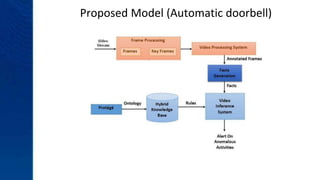
Proposed Model (Automatic doorbell)
Video stream : Video stream is a combination of various frames moving at a certain
speed.
Frame Processing , Key frames : All the frame are separated and and processed
separately, the important frames (key frames) are generated for the video.
Video Processing System: Object identification and annotation in the key frames are
done and their actions are noted down.
Facts Generation : Facts are generated depending on the object annotation.
Video Inference System : Inference is derived by checking the facts against the rules and
an action is decided upon.
Hybrid Knowledge Base : A theoretical framework capturing all the knowledge of the
system.
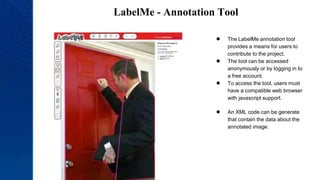
LabelMe - Annotation Tool
● The LabelMe annotation tool
provides a means for users to
contribute to the project.
● The tool can be accessed
anonymously or by logging in to
a free account.
● To access the tool, users must
have a compatible web browser
with javascript support.
● An XML code can be generate
that contain the data about the
annotated image.
Thank You

Rule based expert system

  • 1.
    Rule Based ExpertSystem with uncertainty management in Smart Homes Team Members o Abhay R Dixit - 1DS13CS003 o Abhishek Kori - 1DS13CS007 o Diksha Kushwaha - 1DS13CS034 o Varshini B. K. – 1DS13CS112 Under the guidance of ● Prof. Rashmi S R
  • 2.
    Smart home ● Ahome equipped with lighting, heating, and electronic devices that can be controlled remotely by smartphone or computer. ● Falls in the domain of IOT ● Sensor placed around the house for to sense the outer and inner environment ● All the sensors and electronic components are controlled by central processing and control unit
  • 3.
    Need for smarthomes ● All the electronic devices are getting smarter and connected to the internet ● Advancement and digitalization of real estate sector ● Security and comfortable living ● Saves energy and cost of running house activities ● Personalised home living
  • 4.
    Expert system ● Apiece of software which uses databases of expert knowledge to offer advice or make decisions ● It mimics a human expert ● Examples: Medical , Agriculture field
  • 5.
    Rule based expertsystem ● A rule-based system is a set of "if-then" statements that uses a set of assertions, to which rules on how to act upon those assertions are created. Components ● Domain specific knowledge base ● Inference engine ● User Interface
  • 6.
    Uncertainty ● The sensorsand electronic appliances are exposed to nature and human interaction. They are more likely to get damaged due and give wrong input ● The situations like sensor getting damaged , devices not able to connect to the internet etc ● These situations collectively contribute to uncertainty situations Need to solve uncertain situations ● The likelihood the uncertain situations is high ● Customers lose trust over the system ● Wrong decisions or no decisions may cause discomfort and in some cases it might be life threatening
  • 7.
    Problem statement To buildan smart system in a regular home which will react and take appropriate decisions to changing environment and also counter uncertainty situations. It should be ● Safe ● Dynamic ● Smart ● Adaptable ● Real time
  • 8.
    Literature Review “ ExplicitKnowledge-based Reasoning for Visual Question Answering “ [1] Pros:Recognising the question and answering it with reason. Cons:The problem is that the amount of prior information that can be encoded within a LSTM system is very limited “Integration of Rule based and Case based Reasoning System to Support Decision Making “ [2] Pros: Case Based Reasoning system. An approach has been made to develop a decision support system which will take decision under complex environment. Cons: The integration of raw facts and knowledge into a linking case base knowledge to enhance the potential of the candidate system and to improve the probability of finding the correct measure. “Detecting Inconsistencies in Rule-Based Reasoning for Ambient Intelligence” [3] Pros: The purpose of this approach is to facilitate the creation of an information system for AmI using ontological model and rule-based reasoning, in order to reduce the errors and encourage a more flexible prototyping process Cons: little refactoring exists in models and rules, and expert-users often find themselves with redundancy between the various rules’ content
  • 9.
    “A Case-Based ReasoningSystem to Control Traffic at Signalized Intersections” [4] Pros: Monitors , record and measure the traffic flow and regulates the signal Cons: Initial knowledge is not available and and do not specify the correct source of knowledge “A Rule-Based Tracking System for Video Surveillance Applications” [5] Pros: Rule based object identification to help in monitoring video captured by security cameras Cons: It’s very domain specific and can only focus on certain kind of situations “Rule-Based Solution for Context-Aware Reasoning on Mobile Devices” [6] Pros: Mobile computing devices which has even the knowledge of the context which it's currently present in Cons: Modeling , representing and classifying context is a big challenge “Considerations on uncertain spatio-temporal reasoning in smart home systems” [7] Pros: Helps in assisting the elderly inside and promote over all healthy lifestyle Cons: Inference and measurement of the environment by the hardware is still in its early stage
  • 10.
    Implementation Rule base andfactbase ● Rule base and fact base are implemented in Java expert system shell (SHELL) ● What is JESS? JESS execution Cycle 1. Match 2. Conflict 3. Act JESS syntax ● (deftemplate <template-name> (slot <var-name>) (slot <var-name>) (slot <var-name>)) ● (defrule <rule-name> "<Brief description>" (<Conditon or LHS>) => (<Action or RHS>)
  • 11.
    Proposed Model Components ● Rainand moisture sensor ● Event detection module ● Bayesian network ● Knowledge base
  • 12.
    Bayesian Network ● isa probabilistic graphical model that represents a set of random variables and their conditional dependencies via a directed acyclic graph ● Example: Rain , sprinkler, grass wet
  • 13.
    Conditional probability ● Conditionalprobability is a measure of the probability of an event given that (by assumption, presumption, assertion or evidence) another event has occurred. Example taking from conditional probability table ● With conditional probability and table we can answer questions like “What is the probability that it is raining, given the grass is wet?”
  • 14.
    Overall process flow 1.Send sensor input to event detection module 2. Sense for any event (rain or no rain) 3. If detected assert the fact in fact base 4. Inference engine checks the rules for matching rule with fact in the fact base 5. If a rule is matched then RHS part of that rule gets executed 6. If there is uncertain condition go to Bayesian network , conditional probability module to calculate the probability of rain 7. If the probability is more than the pre set threshold then assert its rain true else set false in the fact base 8. Inference engine again scans through the rules for matching rules and executes the respective RHS 9. Depending on the RHS part the action is sent to electromechanical unit
  • 15.
    Rain Detection Sensor ●If there is no rain, the resistance between the wires will be very high and there will be no conduction between the wires in the sensor. ● If there is rain, the water drops will fall on the rain sensor which will decrease the resistance between the wires and wires on the sensor board will conduct
  • 16.
    Soil Moisture Sensor ●The Soil Moisture Sensor uses capacitance to measure dielectric permittivity of the surrounding medium. ● In soil, dielectric permittivity is a function of the water content. ● The sensor creates a voltage proportional to the dielectric permittivity, and therefore the water content of the soil.
  • 17.
    Raspberry Pi ● TheRaspberry Pi is a low cost, single-board computer that is capable of doing everything a desktop computer can to do ● It is very easy to interface hardware with raspberrry pi.
  • 18.
    Servo Motors ● Servosare controlled by sending an electrical pulse of variable width, or pulse width modulation (PWM), through the control wire. ● The PWM sent to the motor determines position of the shaft, and based on the duration of the pulse sent via the control wire; the rotor will turn to the desired position. ● For example, a 1.5ms pulse will make the motor turn to the 90° position. Shorter than 1.5ms moves it in the counter clockwise direction toward the 0° position, and any longer than 1.5ms will turn the servo in a clockwise direction toward the 180° position.
  • 19.
  • 20.
    Video stream :Video stream is a combination of various frames moving at a certain speed. Frame Processing , Key frames : All the frame are separated and and processed separately, the important frames (key frames) are generated for the video. Video Processing System: Object identification and annotation in the key frames are done and their actions are noted down. Facts Generation : Facts are generated depending on the object annotation. Video Inference System : Inference is derived by checking the facts against the rules and an action is decided upon. Hybrid Knowledge Base : A theoretical framework capturing all the knowledge of the system.
  • 21.
    LabelMe - AnnotationTool ● The LabelMe annotation tool provides a means for users to contribute to the project. ● The tool can be accessed anonymously or by logging in to a free account. ● To access the tool, users must have a compatible web browser with javascript support. ● An XML code can be generate that contain the data about the annotated image.
  • 22.