1
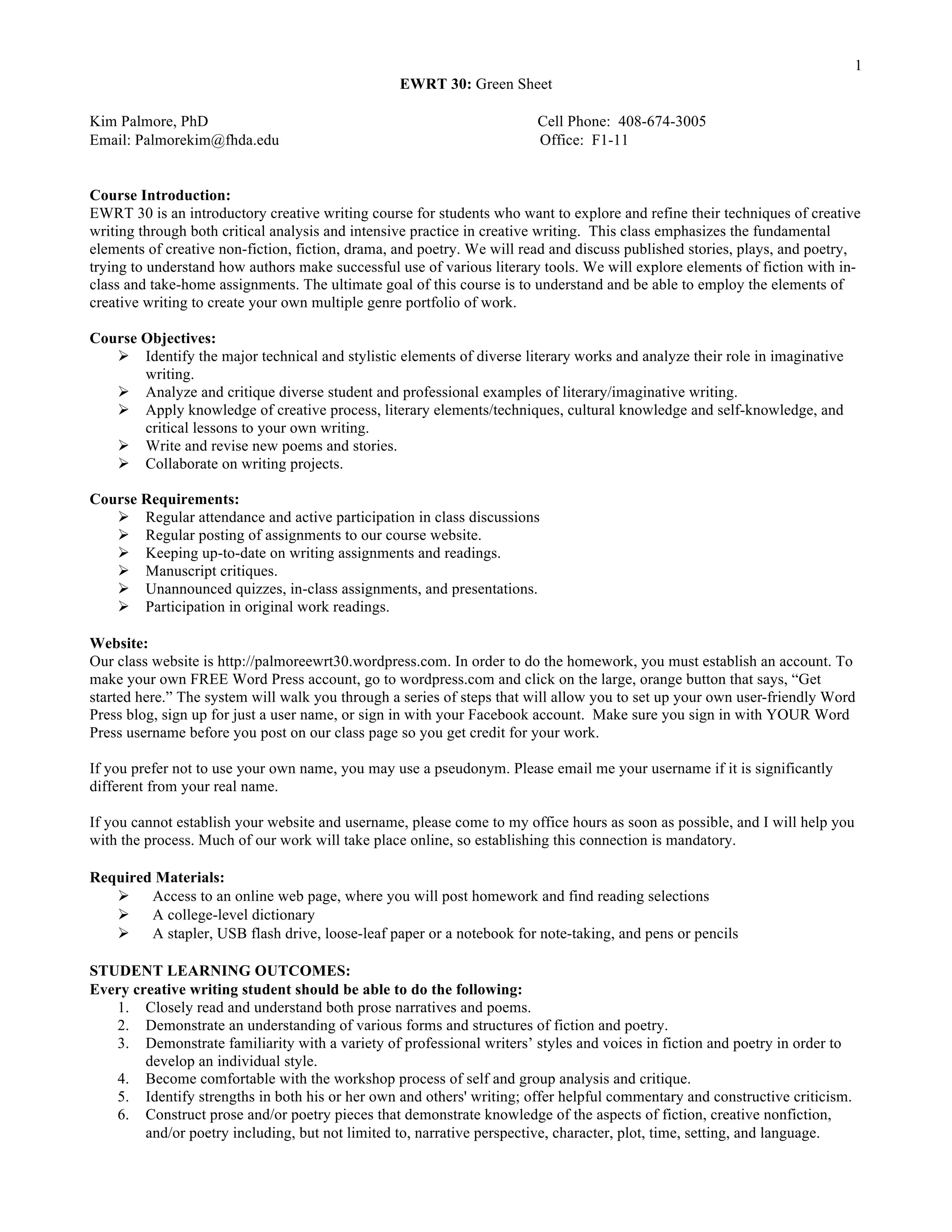
EWRT 30: Green Sheet
Kim Palmore, PhD
Email: Palmorekim@fhda.edu

Cell Phone: 408-674-3005
Office: F1-11

Course Introduction:
EWRT 30 is an introductory creative writing course for students who want to explore and refine their techniques of creative
writing through both critical analysis and intensive practice in creative writing. This class emphasizes the fundamental
elements of creative non-fiction, fiction, drama, and poetry. We will read and discuss published stories, plays, and poetry,
trying to understand how authors make successful use of various literary tools. We will explore elements of fiction with inclass and take-home assignments. The ultimate goal of this course is to understand and be able to employ the elements of
creative writing to create your own multiple genre portfolio of work.
Course Objectives:
Ø Identify the major technical and stylistic elements of diverse literary works and analyze their role in imaginative
writing.
Ø Analyze and critique diverse student and professional examples of literary/imaginative writing.
Ø Apply knowledge of creative process, literary elements/techniques, cultural knowledge and self-knowledge, and
critical lessons to your own writing.
Ø Write and revise new poems and stories.
Ø Collaborate on writing projects.
Course Requirements:
Ø Regular attendance and active participation in class discussions
Ø Regular posting of assignments to our course website.
Ø Keeping up-to-date on writing assignments and readings.
Ø Manuscript critiques.
Ø Unannounced quizzes, in-class assignments, and presentations.
Ø Participation in original work readings.
Website:
Our class website is http://palmoreewrt30.wordpress.com. In order to do the homework, you must establish an account. To
make your own FREE Word Press account, go to wordpress.com and click on the large, orange button that says, “Get
started here.” The system will walk you through a series of steps that will allow you to set up your own user-friendly Word
Press blog, sign up for just a user name, or sign in with your Facebook account. Make sure you sign in with YOUR Word
Press username before you post on our class page so you get credit for your work.
If you prefer not to use your own name, you may use a pseudonym. Please email me your username if it is significantly
different from your real name.
If you cannot establish your website and username, please come to my office hours as soon as possible, and I will help you
with the process. Much of our work will take place online, so establishing this connection is mandatory.
Required Materials:
Ø Access to an online web page, where you will post homework and find reading selections
Ø A college-level dictionary
Ø A stapler, USB flash drive, loose-leaf paper or a notebook for note-taking, and pens or pencils
STUDENT LEARNING OUTCOMES:
Every creative writing student should be able to do the following:
1. Closely read and understand both prose narratives and poems.
2. Demonstrate an understanding of various forms and structures of fiction and poetry.
3. Demonstrate familiarity with a variety of professional writers’ styles and voices in fiction and poetry in order to
develop an individual style.
4. Become comfortable with the workshop process of self and group analysis and critique.
5. Identify strengths in both his or her own and others' writing; offer helpful commentary and constructive criticism.
6. Construct prose and/or poetry pieces that demonstrate knowledge of the aspects of fiction, creative nonfiction,
and/or poetry including, but not limited to, narrative perspective, character, plot, time, setting, and language.
2
7.

Apply relevant constructive criticism made by peers and teacher to the revision of creative pieces, thus
demonstrating receptivity to readers' responses.
8. Demonstrate precision in the use of language with attention to word choice, internal and external rhyme, line
breaks (in poetry), and by effectively managing metaphor, descriptive image, dialogue, and narrative voice.
9. Demonstrate knowledge of editing and revision techniques.
10. Produce an extended work of fiction and poetry.
11. Demonstrate some familiarity with media and blogging
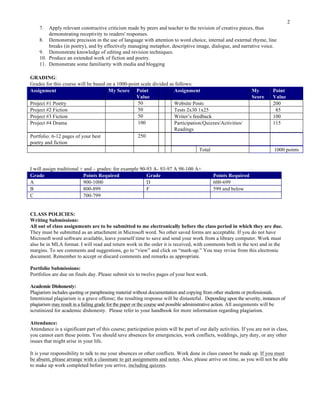
GRADING:
Grades for this course will be based on a 1000-point scale divided as follows:
Assignment
My Score Point
Assignment
Value
50
Project #1 Poetry
Website Posts
50
Project #2 Fiction
Tests 2x30 1x25
50
Project #3 Fiction
Writer’s feedback
100
Project #4 Drama
Participation/Quizzes/Activities/
Readings
250
Portfolio: 6-12 pages of your best
poetry and fiction
Total

I will assign traditional + and – grades: for example 90-93 A- 93-97 A 98-100 A+
Grade
Points Required
Grade
A
900-1000
D
B
800-899
F
C
700-799

My
Score

Point
Value
200
85
100
115

1000 points

Points Required
600-699
599 and below

CLASS POLICIES:
Writing Submissions:
All out of class assignments are to be submitted to me electronically before the class period in which they are due.
They must be submitted as an attachment in Microsoft word. No other saved forms are acceptable. If you do not have
Microsoft word software available, leave yourself time to save and send your work from a library computer. Work must
also be in MLA format. I will read and return work in the order it is received, with comments both in the text and in the
margins. To see comments and suggestions, go to “view” and click on “mark-up.” You may revise from this electronic
document. Remember to accept or discard comments and remarks as appropriate.
Portfolio Submissions:
Portfolios are due on finals day. Please submit six to twelve pages of your best work.
Academic Dishonesty:
Plagiarism includes quoting or paraphrasing material without documentation and copying from other students or professionals.
Intentional plagiarism is a grave offense; the resulting response will be distasteful. Depending upon the severity, instances of
plagiarism may result in a failing grade for the paper or the course and possible administrative action. All assignments will be
scrutinized for academic dishonesty. Please refer to your handbook for more information regarding plagiarism.
Attendance:
Attendance is a significant part of this course; participation points will be part of our daily activities. If you are not in class,
you cannot earn these points. You should save absences for emergencies, work conflicts, weddings, jury duty, or any other
issues that might arise in your life.
It is your responsibility to talk to me your absences or other conflicts. Work done in class cannot be made up. If you must
be absent, please arrange with a classmate to get assignments and notes. Also, please arrive on time, as you will not be able
to make up work completed before you arrive, including quizzes.
3
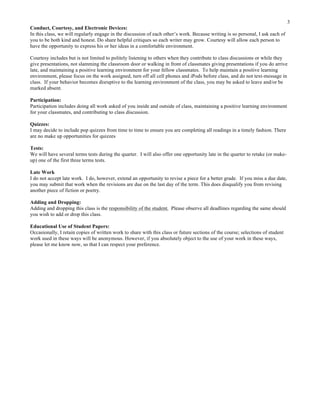
Conduct, Courtesy, and Electronic Devices:
In this class, we will regularly engage in the discussion of each other’s work. Because writing is so personal, I ask each of
you to be both kind and honest. Do share helpful critiques so each writer may grow. Courtesy will allow each person to
have the opportunity to express his or her ideas in a comfortable environment.
Courtesy includes but is not limited to politely listening to others when they contribute to class discussions or while they
give presentations, not slamming the classroom door or walking in front of classmates giving presentations if you do arrive
late, and maintaining a positive learning environment for your fellow classmates. To help maintain a positive learning
environment, please focus on the work assigned, turn off all cell phones and iPods before class, and do not text-message in
class. If your behavior becomes disruptive to the learning environment of the class, you may be asked to leave and/or be
marked absent.
Participation:
Participation includes doing all work asked of you inside and outside of class, maintaining a positive learning environment
for your classmates, and contributing to class discussion.
Quizzes:
I may decide to include pop quizzes from time to time to ensure you are completing all readings in a timely fashion. There
are no make up opportunities for quizzes
Tests:
We will have several terms tests during the quarter. I will also offer one opportunity late in the quarter to retake (or makeup) one of the first three terms tests.
Late Work
I do not accept late work. I do, however, extend an opportunity to revise a piece for a better grade. If you miss a due date,
you may submit that work when the revisions are due on the last day of the term. This does disqualify you from revising
another piece of fiction or poetry.
Adding and Dropping:
Adding and dropping this class is the responsibility of the student. Please observe all deadlines regarding the same should
you wish to add or drop this class.
Educational Use of Student Papers:
Occasionally, I retain copies of written work to share with this class or future sections of the course; selections of student
work used in these ways will be anonymous. However, if you absolutely object to the use of your work in these ways,
please let me know now, so that I can respect your preference.


Ewrt 30 green sheet winter 2014

  • 1.
    1 EWRT 30: GreenSheet Kim Palmore, PhD Email: Palmorekim@fhda.edu Cell Phone: 408-674-3005 Office: F1-11 Course Introduction: EWRT 30 is an introductory creative writing course for students who want to explore and refine their techniques of creative writing through both critical analysis and intensive practice in creative writing. This class emphasizes the fundamental elements of creative non-fiction, fiction, drama, and poetry. We will read and discuss published stories, plays, and poetry, trying to understand how authors make successful use of various literary tools. We will explore elements of fiction with inclass and take-home assignments. The ultimate goal of this course is to understand and be able to employ the elements of creative writing to create your own multiple genre portfolio of work. Course Objectives: Ø Identify the major technical and stylistic elements of diverse literary works and analyze their role in imaginative writing. Ø Analyze and critique diverse student and professional examples of literary/imaginative writing. Ø Apply knowledge of creative process, literary elements/techniques, cultural knowledge and self-knowledge, and critical lessons to your own writing. Ø Write and revise new poems and stories. Ø Collaborate on writing projects. Course Requirements: Ø Regular attendance and active participation in class discussions Ø Regular posting of assignments to our course website. Ø Keeping up-to-date on writing assignments and readings. Ø Manuscript critiques. Ø Unannounced quizzes, in-class assignments, and presentations. Ø Participation in original work readings. Website: Our class website is http://palmoreewrt30.wordpress.com. In order to do the homework, you must establish an account. To make your own FREE Word Press account, go to wordpress.com and click on the large, orange button that says, “Get started here.” The system will walk you through a series of steps that will allow you to set up your own user-friendly Word Press blog, sign up for just a user name, or sign in with your Facebook account. Make sure you sign in with YOUR Word Press username before you post on our class page so you get credit for your work. If you prefer not to use your own name, you may use a pseudonym. Please email me your username if it is significantly different from your real name. If you cannot establish your website and username, please come to my office hours as soon as possible, and I will help you with the process. Much of our work will take place online, so establishing this connection is mandatory. Required Materials: Ø Access to an online web page, where you will post homework and find reading selections Ø A college-level dictionary Ø A stapler, USB flash drive, loose-leaf paper or a notebook for note-taking, and pens or pencils STUDENT LEARNING OUTCOMES: Every creative writing student should be able to do the following: 1. Closely read and understand both prose narratives and poems. 2. Demonstrate an understanding of various forms and structures of fiction and poetry. 3. Demonstrate familiarity with a variety of professional writers’ styles and voices in fiction and poetry in order to develop an individual style. 4. Become comfortable with the workshop process of self and group analysis and critique. 5. Identify strengths in both his or her own and others' writing; offer helpful commentary and constructive criticism. 6. Construct prose and/or poetry pieces that demonstrate knowledge of the aspects of fiction, creative nonfiction, and/or poetry including, but not limited to, narrative perspective, character, plot, time, setting, and language.
  • 2.
    2 7. Apply relevant constructivecriticism made by peers and teacher to the revision of creative pieces, thus demonstrating receptivity to readers' responses. 8. Demonstrate precision in the use of language with attention to word choice, internal and external rhyme, line breaks (in poetry), and by effectively managing metaphor, descriptive image, dialogue, and narrative voice. 9. Demonstrate knowledge of editing and revision techniques. 10. Produce an extended work of fiction and poetry. 11. Demonstrate some familiarity with media and blogging GRADING: Grades for this course will be based on a 1000-point scale divided as follows: Assignment My Score Point Assignment Value 50 Project #1 Poetry Website Posts 50 Project #2 Fiction Tests 2x30 1x25 50 Project #3 Fiction Writer’s feedback 100 Project #4 Drama Participation/Quizzes/Activities/ Readings 250 Portfolio: 6-12 pages of your best poetry and fiction Total I will assign traditional + and – grades: for example 90-93 A- 93-97 A 98-100 A+ Grade Points Required Grade A 900-1000 D B 800-899 F C 700-799 My Score Point Value 200 85 100 115 1000 points Points Required 600-699 599 and below CLASS POLICIES: Writing Submissions: All out of class assignments are to be submitted to me electronically before the class period in which they are due. They must be submitted as an attachment in Microsoft word. No other saved forms are acceptable. If you do not have Microsoft word software available, leave yourself time to save and send your work from a library computer. Work must also be in MLA format. I will read and return work in the order it is received, with comments both in the text and in the margins. To see comments and suggestions, go to “view” and click on “mark-up.” You may revise from this electronic document. Remember to accept or discard comments and remarks as appropriate. Portfolio Submissions: Portfolios are due on finals day. Please submit six to twelve pages of your best work. Academic Dishonesty: Plagiarism includes quoting or paraphrasing material without documentation and copying from other students or professionals. Intentional plagiarism is a grave offense; the resulting response will be distasteful. Depending upon the severity, instances of plagiarism may result in a failing grade for the paper or the course and possible administrative action. All assignments will be scrutinized for academic dishonesty. Please refer to your handbook for more information regarding plagiarism. Attendance: Attendance is a significant part of this course; participation points will be part of our daily activities. If you are not in class, you cannot earn these points. You should save absences for emergencies, work conflicts, weddings, jury duty, or any other issues that might arise in your life. It is your responsibility to talk to me your absences or other conflicts. Work done in class cannot be made up. If you must be absent, please arrange with a classmate to get assignments and notes. Also, please arrive on time, as you will not be able to make up work completed before you arrive, including quizzes.
  • 3.
    3 Conduct, Courtesy, andElectronic Devices: In this class, we will regularly engage in the discussion of each other’s work. Because writing is so personal, I ask each of you to be both kind and honest. Do share helpful critiques so each writer may grow. Courtesy will allow each person to have the opportunity to express his or her ideas in a comfortable environment. Courtesy includes but is not limited to politely listening to others when they contribute to class discussions or while they give presentations, not slamming the classroom door or walking in front of classmates giving presentations if you do arrive late, and maintaining a positive learning environment for your fellow classmates. To help maintain a positive learning environment, please focus on the work assigned, turn off all cell phones and iPods before class, and do not text-message in class. If your behavior becomes disruptive to the learning environment of the class, you may be asked to leave and/or be marked absent. Participation: Participation includes doing all work asked of you inside and outside of class, maintaining a positive learning environment for your classmates, and contributing to class discussion. Quizzes: I may decide to include pop quizzes from time to time to ensure you are completing all readings in a timely fashion. There are no make up opportunities for quizzes Tests: We will have several terms tests during the quarter. I will also offer one opportunity late in the quarter to retake (or makeup) one of the first three terms tests. Late Work I do not accept late work. I do, however, extend an opportunity to revise a piece for a better grade. If you miss a due date, you may submit that work when the revisions are due on the last day of the term. This does disqualify you from revising another piece of fiction or poetry. Adding and Dropping: Adding and dropping this class is the responsibility of the student. Please observe all deadlines regarding the same should you wish to add or drop this class. Educational Use of Student Papers: Occasionally, I retain copies of written work to share with this class or future sections of the course; selections of student work used in these ways will be anonymous. However, if you absolutely object to the use of your work in these ways, please let me know now, so that I can respect your preference.