Principal Solar Institute 
As Coal Dims, Will Solar Shine? 
Perspective on a Changing Electricity 
Industry 
Ron Seidel 
Director, Principal Solar 
Ron Seidel is principal of RBS Energy Consulting, working with private 
equity, investment banks, and government on electric energy issues 
primarily in the ERCOT market. Previously, he was president of Texas 
Independent Energy, senior vice president of Energy Supply at City Public 
Service of San Antonio, and an executive at TXU where he was senior 
vice president of Fossil Generation and Mining, president of TXU Energy 
Trading, and operations manager at the Comanche Peak Nuclear Plant.
Agenda 
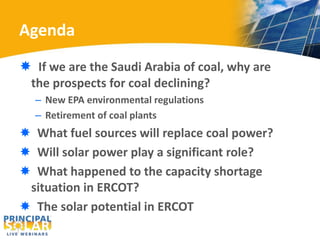
 If we are the Saudi Arabia of coal, why are 
the prospects for coal declining? 
– New EPA environmental regulations 
– Retirement of coal plants 
 What fuel sources will replace coal power? 
 Will solar power play a significant role? 
 What happened to the capacity shortage 
situation in ERCOT? 
 The solar potential in ERCOT
EPA Emissions Regulations 
Clean Air Interstate Rule (CAIR) 
Cross State Air Pollution Rule (CSAPR) 
Mercury and Air Toxics Rule (MATS) 
Carbon Pollution Standard for New Power Plants 
Carbon Pollution Standard for Existing Power 
Plants
Clean Air Interstate Rule 
(CAIR) 
Effective in 2005, under the Clean Air Act of 1970 
Addresses power plant pollution drift between 
states 
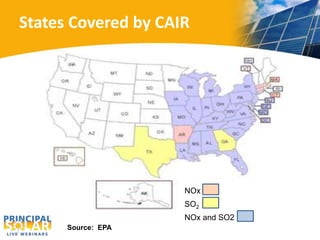
Includes 27 Eastern States and District of Columbia 
Target pollutants 
– Sulfur Dioxide (SO2) 
• Phase I – 50% reduction 2010 to 2014 
• Phase II – 65% reduction 2015 and beyond 
– Nitrogen Oxides (NOx) 
Phased in caps between 2009 and 2015 
Interstate Cap and Trade System for allowances
States Covered by CAIR 
NOx 
SO2 
NOx and SO2 
Source: EPA
Cross State Air Pollution Rule 
(CSAPR) 
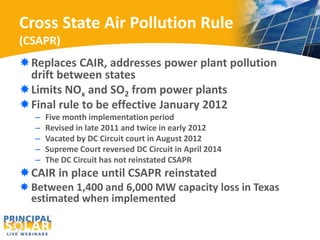
Replaces CAIR, addresses power plant pollution 
drift between states 
Limits NOx and SO2 from power plants 
Final rule to be effective January 2012 
– Five month implementation period 
– Revised in late 2011 and twice in early 2012 
– Vacated by DC Circuit court in August 2012 
– Supreme Court reversed DC Circuit in April 2014 
– The DC Circuit has not reinstated CSAPR 
CAIR in place until CSAPR reinstated 
 Between 1,400 and 6,000 MW capacity loss in Texas 
estimated when implemented
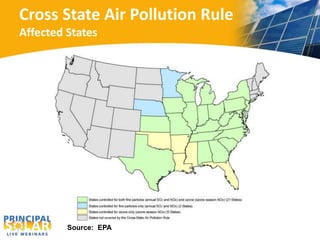
Cross State Air Pollution Rule 
Affected States 
Source: EPA
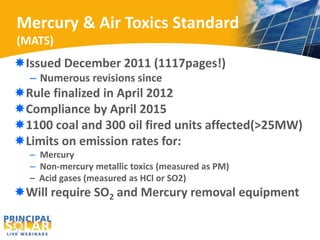
Mercury & Air Toxics Standard 
(MATS) 
Issued December 2011 (1117pages!) 
– Numerous revisions since 
Rule finalized in April 2012 
Compliance by April 2015 
1100 coal and 300 oil fired units affected(>25MW) 
Limits on emission rates for: 
– Mercury 
– Non-mercury metallic toxics (measured as PM) 
– Acid gases (measured as HCl or SO2) 
Will require SO2 and Mercury removal equipment
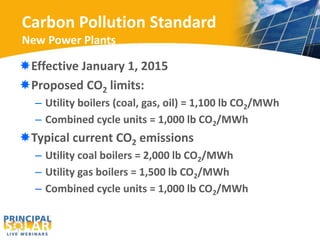
Carbon Pollution Standard 
New Power Plants 
Effective January 1, 2015 
Proposed CO2 limits: 
– Utility boilers (coal, gas, oil) = 1,100 lb CO2/MWh 
– Combined cycle units = 1,000 lb CO2/MWh 
Typical current CO2 emissions 
– Utility coal boilers = 2,000 lb CO2/MWh 
– Utility gas boilers = 1,500 lb CO2/MWh 
– Combined cycle units = 1,000 lb CO2/MWh
Carbon Pollution Standard 
Existing Power Plants 
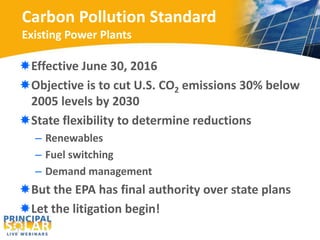
Effective June 30, 2016 
Objective is to cut U.S. CO2 emissions 30% below 
2005 levels by 2030 
State flexibility to determine reductions 
– Renewables 
– Fuel switching 
– Demand management 
But the EPA has final authority over state plans 
Let the litigation begin!
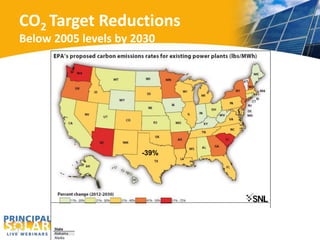
CO2 Target Reductions 
Below 2005 levels by 2030 
-39%
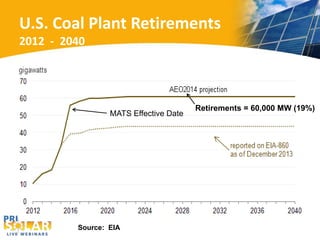
U.S. Coal Plant Retirements 
2012 - 2040 
MATS Effective Date 
Source: EIA 
Retirements = 60,000 MW (19%)
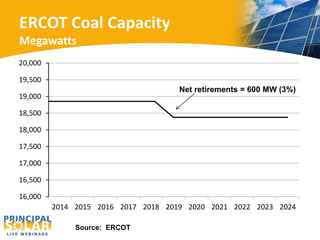
ERCOT Coal Capacity 
Megawatts 
20,000 
19,500 
19,000 
18,500 
18,000 
17,500 
17,000 
16,500 
16,000 
Net retirements = 600 MW (3%) 
2014 2015 2016 2017 2018 2019 2020 2021 2022 2023 2024 
Source: ERCOT
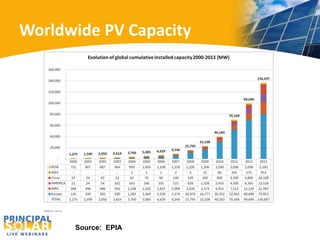
Worldwide PV Capacity 
Source: EPIA
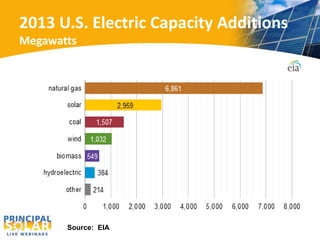
2013 U.S. Electric Capacity Additions 
Megawatts 
Source: EIA
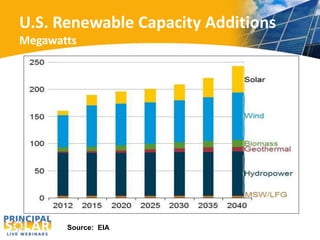
U.S. Renewable Capacity Additions 
Megawatts 
Source: EIA
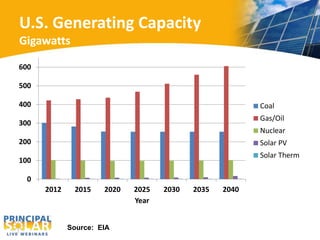
U.S. Generating Capacity 
Gigawatts 
600 
500 
400 
300 
200 
100 
0 
2012 2015 2020 2025 2030 2035 2040 
Year 
Coal 
Gas/Oil 
Nuclear 
Solar PV 
Solar Therm 
Source: EIA
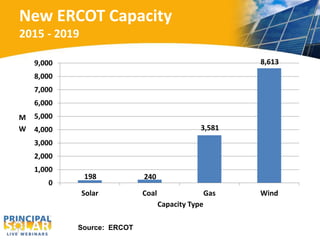
New ERCOT Capacity 
2015 - 2019 
198 240 
3,581 
8,613 
9,000 
8,000 
7,000 
6,000 
5,000 
4,000 
3,000 
2,000 
1,000 
0 
Solar Coal Gas Wind 
M 
W 
Capacity Type 
Source: ERCOT
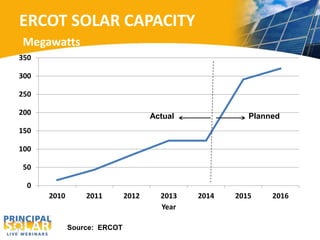
ERCOT SOLAR CAPACITY 
Megawatts 
350 
300 
250 
200 
150 
100 
50 
0 
Actual Planned 
2010 2011 2012 2013 2014 2015 2016 
Year 
Source: ERCOT
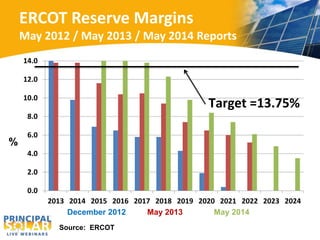
ERCOT Reserve Margins 
May 2012 / May 2013 / May 2014 Reports 
14.0 
12.0 
10.0 
8.0 
6.0 
4.0 
2.0 
0.0 
Target =13.75% 
2013 2014 2015 2016 2017 2018 2019 2020 2021 2022 2023 2024 
% 
December 2012 May 2013 May 2014 
Source: ERCOT
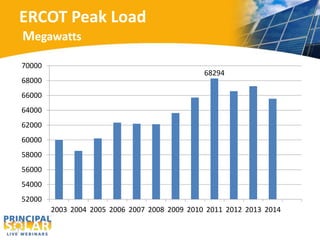
ERCOT Peak Load 
Megawatts 
68294 
70000 
68000 
66000 
64000 
62000 
60000 
58000 
56000 
54000 
52000 
2003 2004 2005 2006 2007 2008 2009 2010 2011 2012 2013 2014
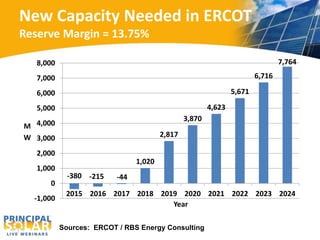
New Capacity Needed in ERCOT 
Reserve Margin = 13.75% 
-380 -215 -44 
1,020 
2,817 
3,870 
4,623 
5,671 
6,716 
7,764 
8,000 
7,000 
6,000 
5,000 
4,000 
3,000 
2,000 
1,000 
0 
-1,000 
2015 2016 2017 2018 2019 2020 2021 2022 2023 2024 
M 
W 
Year 
Sources: ERCOT / RBS Energy Consulting
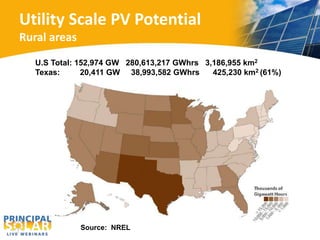
Utility Scale PV Potential 
Rural areas 
U.S Total: 152,974 GW 280,613,217 GWhrs 3,186,955 km2 
Texas: 20,411 GW 38,993,582 GWhrs 425,230 km2 (61%) 
Source: NREL
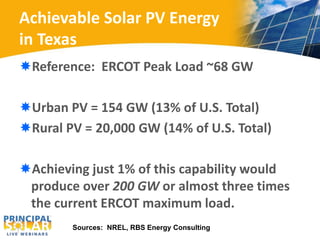
Achievable Solar PV Energy 
in Texas 
Reference: ERCOT Peak Load ~68 GW 
Urban PV = 154 GW (13% of U.S. Total) 
Rural PV = 20,000 GW (14% of U.S. Total) 
Achieving just 1% of this capability would 
produce over 200 GW or almost three times 
the current ERCOT maximum load. 
Sources: NREL, RBS Energy Consulting
Questions and Discussion 
Please enter your questions into the Chat window 
Ron Seidel 
Director, Principal Solar

As Coal Dims, Will Solar Shine? Perspective on a Changing Electricity Industry

  • 1.
    Principal Solar Institute As Coal Dims, Will Solar Shine? Perspective on a Changing Electricity Industry Ron Seidel Director, Principal Solar Ron Seidel is principal of RBS Energy Consulting, working with private equity, investment banks, and government on electric energy issues primarily in the ERCOT market. Previously, he was president of Texas Independent Energy, senior vice president of Energy Supply at City Public Service of San Antonio, and an executive at TXU where he was senior vice president of Fossil Generation and Mining, president of TXU Energy Trading, and operations manager at the Comanche Peak Nuclear Plant.
  • 2.
    Agenda  Ifwe are the Saudi Arabia of coal, why are the prospects for coal declining? – New EPA environmental regulations – Retirement of coal plants  What fuel sources will replace coal power?  Will solar power play a significant role?  What happened to the capacity shortage situation in ERCOT?  The solar potential in ERCOT
  • 3.
    EPA Emissions Regulations Clean Air Interstate Rule (CAIR) Cross State Air Pollution Rule (CSAPR) Mercury and Air Toxics Rule (MATS) Carbon Pollution Standard for New Power Plants Carbon Pollution Standard for Existing Power Plants
  • 4.
    Clean Air InterstateRule (CAIR) Effective in 2005, under the Clean Air Act of 1970 Addresses power plant pollution drift between states Includes 27 Eastern States and District of Columbia Target pollutants – Sulfur Dioxide (SO2) • Phase I – 50% reduction 2010 to 2014 • Phase II – 65% reduction 2015 and beyond – Nitrogen Oxides (NOx) Phased in caps between 2009 and 2015 Interstate Cap and Trade System for allowances
  • 5.
    States Covered byCAIR NOx SO2 NOx and SO2 Source: EPA
  • 6.
    Cross State AirPollution Rule (CSAPR) Replaces CAIR, addresses power plant pollution drift between states Limits NOx and SO2 from power plants Final rule to be effective January 2012 – Five month implementation period – Revised in late 2011 and twice in early 2012 – Vacated by DC Circuit court in August 2012 – Supreme Court reversed DC Circuit in April 2014 – The DC Circuit has not reinstated CSAPR CAIR in place until CSAPR reinstated  Between 1,400 and 6,000 MW capacity loss in Texas estimated when implemented
  • 7.
    Cross State AirPollution Rule Affected States Source: EPA
  • 8.
    Mercury & AirToxics Standard (MATS) Issued December 2011 (1117pages!) – Numerous revisions since Rule finalized in April 2012 Compliance by April 2015 1100 coal and 300 oil fired units affected(>25MW) Limits on emission rates for: – Mercury – Non-mercury metallic toxics (measured as PM) – Acid gases (measured as HCl or SO2) Will require SO2 and Mercury removal equipment
  • 9.
    Carbon Pollution Standard New Power Plants Effective January 1, 2015 Proposed CO2 limits: – Utility boilers (coal, gas, oil) = 1,100 lb CO2/MWh – Combined cycle units = 1,000 lb CO2/MWh Typical current CO2 emissions – Utility coal boilers = 2,000 lb CO2/MWh – Utility gas boilers = 1,500 lb CO2/MWh – Combined cycle units = 1,000 lb CO2/MWh
  • 10.
    Carbon Pollution Standard Existing Power Plants Effective June 30, 2016 Objective is to cut U.S. CO2 emissions 30% below 2005 levels by 2030 State flexibility to determine reductions – Renewables – Fuel switching – Demand management But the EPA has final authority over state plans Let the litigation begin!
  • 11.
    CO2 Target Reductions Below 2005 levels by 2030 -39%
  • 12.
    U.S. Coal PlantRetirements 2012 - 2040 MATS Effective Date Source: EIA Retirements = 60,000 MW (19%)
  • 13.
    ERCOT Coal Capacity Megawatts 20,000 19,500 19,000 18,500 18,000 17,500 17,000 16,500 16,000 Net retirements = 600 MW (3%) 2014 2015 2016 2017 2018 2019 2020 2021 2022 2023 2024 Source: ERCOT
  • 14.
    Worldwide PV Capacity Source: EPIA
  • 15.
    2013 U.S. ElectricCapacity Additions Megawatts Source: EIA
  • 16.
    U.S. Renewable CapacityAdditions Megawatts Source: EIA
  • 17.
    U.S. Generating Capacity Gigawatts 600 500 400 300 200 100 0 2012 2015 2020 2025 2030 2035 2040 Year Coal Gas/Oil Nuclear Solar PV Solar Therm Source: EIA
  • 18.
    New ERCOT Capacity 2015 - 2019 198 240 3,581 8,613 9,000 8,000 7,000 6,000 5,000 4,000 3,000 2,000 1,000 0 Solar Coal Gas Wind M W Capacity Type Source: ERCOT
  • 19.
    ERCOT SOLAR CAPACITY Megawatts 350 300 250 200 150 100 50 0 Actual Planned 2010 2011 2012 2013 2014 2015 2016 Year Source: ERCOT
  • 20.
    ERCOT Reserve Margins May 2012 / May 2013 / May 2014 Reports 14.0 12.0 10.0 8.0 6.0 4.0 2.0 0.0 Target =13.75% 2013 2014 2015 2016 2017 2018 2019 2020 2021 2022 2023 2024 % December 2012 May 2013 May 2014 Source: ERCOT
  • 21.
    ERCOT Peak Load Megawatts 68294 70000 68000 66000 64000 62000 60000 58000 56000 54000 52000 2003 2004 2005 2006 2007 2008 2009 2010 2011 2012 2013 2014
  • 22.
    New Capacity Neededin ERCOT Reserve Margin = 13.75% -380 -215 -44 1,020 2,817 3,870 4,623 5,671 6,716 7,764 8,000 7,000 6,000 5,000 4,000 3,000 2,000 1,000 0 -1,000 2015 2016 2017 2018 2019 2020 2021 2022 2023 2024 M W Year Sources: ERCOT / RBS Energy Consulting
  • 23.
    Utility Scale PVPotential Rural areas U.S Total: 152,974 GW 280,613,217 GWhrs 3,186,955 km2 Texas: 20,411 GW 38,993,582 GWhrs 425,230 km2 (61%) Source: NREL
  • 24.
    Achievable Solar PVEnergy in Texas Reference: ERCOT Peak Load ~68 GW Urban PV = 154 GW (13% of U.S. Total) Rural PV = 20,000 GW (14% of U.S. Total) Achieving just 1% of this capability would produce over 200 GW or almost three times the current ERCOT maximum load. Sources: NREL, RBS Energy Consulting
  • 25.
    Questions and Discussion Please enter your questions into the Chat window Ron Seidel Director, Principal Solar

Editor's Notes