#WebClinic
Accordion-Style Checkouts Tested:
How one company uncovered 26% more conversions by
putting its checkout process to the test
#WebClinic
We’re sharing on Twitter!
#WebClinic
#WebClinic
Today’s Team
@jonpowell31
Jon Powell
Senior Manager
Research and Strategy
MECLABS
Market research practitioner with 6+ years of hands-on discovery gained through
managing hundreds of A/B and multivariate tests for ecommerce, healthcare, financial,
and education Research Partners.
#WebClinic
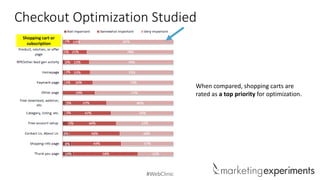
Checkout Optimization Studied
Shopping cart or
subscription
When compared, shopping carts are
rated as a top priority for optimization.
#WebClinic
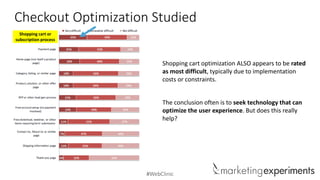
Checkout Optimization Studied
Shopping cart or
subscription process
Shopping cart optimization ALSO appears to be rated
as most difficult, typically due to implementation
costs or constraints.
The conclusion often is to seek technology that can
optimize the user experience. But does this really
help?
#WebClinic
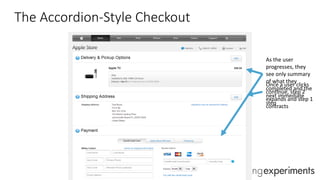
The Accordion-Style Checkout
Once a user clicks
continue, step 2
expands and step 1
contracts
As the user
progresses, they
see only summary
of what they
completed and the
next immediate
step
#WebClinic
Today’s Focus
To understand how accordion-style checkouts perform
as an optimization tactic through a series of three
major experiments.
#WebClinic
Experiment #1
#WebClinic
Experiment #1: Background
Background: National news publication selling subscriptions
Goal: To increase home delivery subscription rate
Research Question: Which treatment will generate the highest home delivery
subscription rate?
Test Design: A/B variable cluster test
Experiment ID: TP1666
Record Location: MECLABS Research Library
Research Partner: [Protected]
#WebClinic
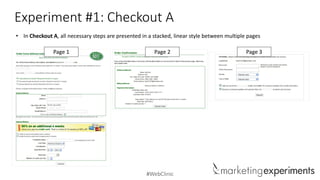
Experiment #1: Checkout A
• In Checkout A, all necessary steps are presented in a stacked, linear style between multiple pages
Page 1 Page 2 Page 3
#WebClinic
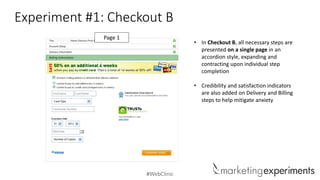
Experiment #1: Checkout B
Page 1
• In Checkout B, all necessary steps are
presented on a single page in an
accordion style, expanding and
contracting upon individual step
completion
• Credibility and satisfaction indicators
are also added on Delivery and Billing
steps to help mitigate anxiety
#WebClinic
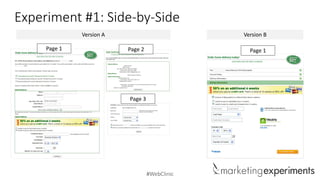
Experiment #1: Side-by-Side
Page 1 Page 2
Page 3
Page 1
Version A Version B
#WebClinic
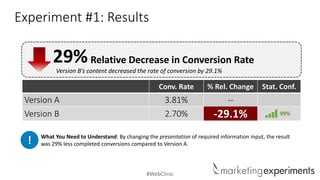
Experiment #1: Results
Conv. Rate % Rel. Change Stat. Conf.
Version A 3.81% --
Version B 2.70% -29.1%
Relative Decrease in Conversion Rate
Version B’s content decreased the rate of conversion by 29.1%
29%
! What You Need to Understand: By changing the presentation of required information input, the result
was 29% less completed conversions compared to Version A.
99%
#WebClinic
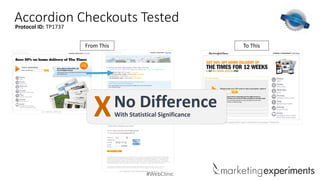
Accordion Checkouts Tested
To This
Protocol ID: TP1737
From This
No Difference
With Statistical SignificanceX
#WebClinic
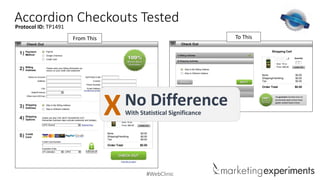
Accordion Checkouts Tested
To This
Protocol ID: TP1491
From This
No Difference
With Statistical SignificanceX
#WebClinic
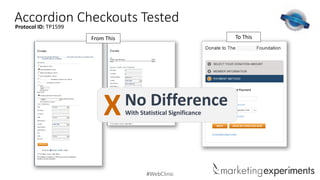
Accordion Checkouts Tested
To This
Protocol ID: TP1599
From This
No Difference
With Statistical SignificanceX
#WebClinic
Accordion Carts Tested
Why did the accordion-style checkout
implementation fail to pay for itself?
#WebClinic
Experiment #2
#WebClinic
Experiment #2: Background
Background: National news publication selling subscriptions
Goal: To increase home delivery subscription rate
Research Question: Which treatment will generate the highest home delivery
subscription rate?
Test Design: A/B variable cluster test
Experiment ID: TP1740
Record Location: MECLABS Research Library
Research Partner: [Protected]
#WebClinic
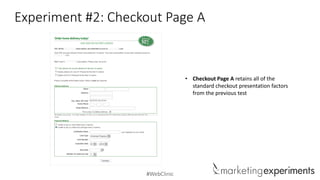
Experiment #2: Checkout Page A
• Checkout Page A retains all of the
standard checkout presentation factors
from the previous test
#WebClinic
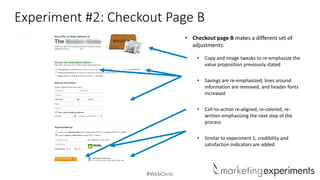
Experiment #2: Checkout Page B
• Checkout page B makes a different set of
adjustments:
• Copy and image tweaks to re-emphasize the
value proposition previously stated
• Savings are re-emphasized, lines around
information are removed, and header fonts
increased
• Call-to-action re-aligned, re-colored, re-
written emphasizing the next step of the
process
• Similar to experiment 1, credibility and
satisfaction indicators are added
#WebClinic
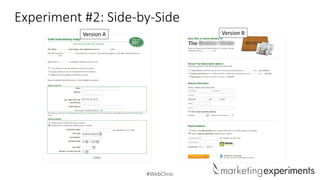
Experiment #2: Side-by-Side
Version A Version B
#WebClinic
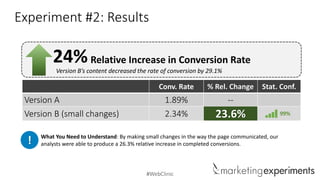
Experiment #2: Results
Conv. Rate % Rel. Change Stat. Conf.
Version A 1.89% --
Version B (small changes) 2.34% 23.6%
Relative Increase in Conversion Rate
Version B’s content decreased the rate of conversion by 29.1%
24%
! What You Need to Understand: By making small changes in the way the page communicated, our
analysts were able to produce a 26.3% relative increase in completed conversions.
99%
#WebClinic
Experiment #2: Results
Why did small changes in the way the page
communicated produce a significant yield?
#WebClinic
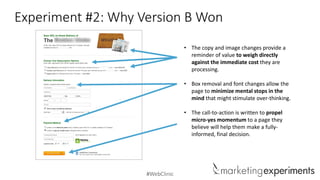
Experiment #2: Why Version B Won
• The copy and image changes provide a
reminder of value to weigh directly
against the immediate cost they are
processing.
• Box removal and font changes allow the
page to minimize mental stops in the
mind that might stimulate over-thinking.
• The call-to-action is written to propel
micro-yes momentum to a page they
believe will help them make a fully-
informed, final decision.
#WebClinic
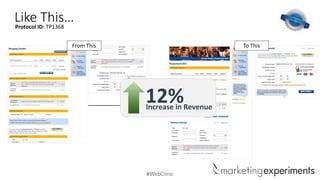
Like This…
To This
Protocol ID: TP1368
From This
12%Increase in Revenue
#WebClinic
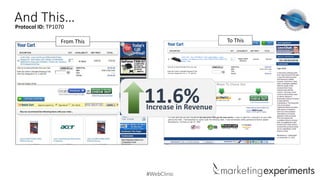
And This…
To This
Protocol ID: TP1070
From This
11.6%Increase in Revenue
#WebClinic
Experiment #3
#WebClinic
Experiment #3: Background
Background: National news publication selling subscriptions
Goal: To increase home delivery subscription rate
Research Question: Which treatment will generate the highest home delivery
subscription rate?
Test Design: A/B variable cluster test
Experiment ID: TP1789
Record Location: MECLABS Research Library
Research Partner: [Protected]
#WebClinic
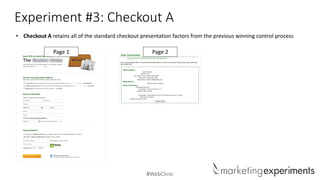
Experiment #3: Checkout A
• Checkout A retains all of the standard checkout presentation factors from the previous winning control process
Page 1 Page 2
#WebClinic
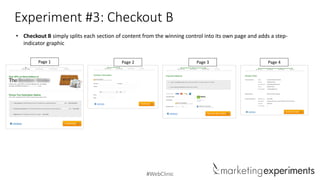
Experiment #3: Checkout B
• Checkout B simply splits each section of content from the winning control into its own page and adds a step-
indicator graphic
Page 2Page 1 Page 3 Page 4
#WebClinic
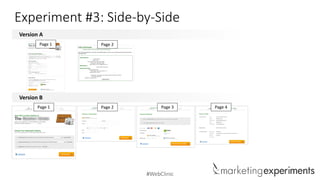
Experiment #3: Side-by-Side
Version B
Page 2Page 1 Page 3 Page 4
Version A
Page 2Page 1
#WebClinic
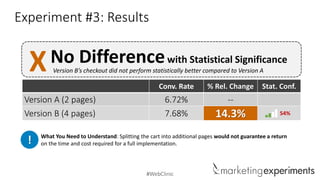
Experiment #3: Results
Conv. Rate % Rel. Change Stat. Conf.
Version A (2 pages) 6.72% --
Version B (4 pages) 7.68% 14.3%
with Statistical Significance
Version B’s checkout did not perform statistically better compared to Version A
No Difference
! What You Need to Understand: Splitting the cart into additional pages would not guarantee a return
on the time and cost required for a full implementation.
54%
X
#WebClinic
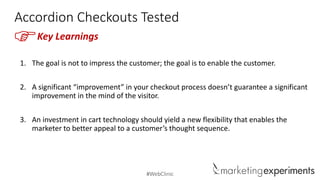
Accordion Checkouts Tested
1. The goal is not to impress the customer; the goal is to enable the customer.
2. A significant “improvement” in your checkout process doesn’t guarantee a significant
improvement in the mind of the visitor.
3. An investment in cart technology should yield a new flexibility that enables the
marketer to better appeal to a customer’s thought sequence.
FKey Learnings
#WebClinic
Live Optimization
Shopping Carts
#WebClinic
#WebClinic
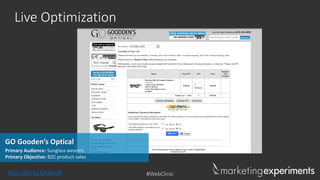
Live Optimization
Primary Audience: Sunglass wearers
Primary Objective: B2C product sales
GO Gooden’s Optical
http://bit.ly/15OwzqX
#WebClinic
Live Optimization
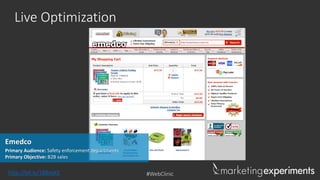
Primary Audience: Safety enforcement departments
Primary Objective: B2B sales
Emedco
http://bit.ly/188vqKE
#WebClinic
Live Optimization
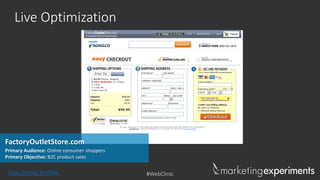
Primary Audience: Online consumer shoppers
Primary Objective: B2C product sales
FactoryOutletStore.com
http://bit.ly/1ezPZke
#WebClinic
Live Optimization
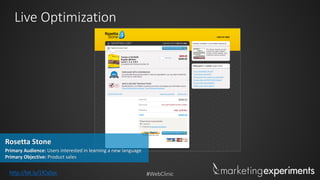
Primary Audience: Users interested in learning a new language
Primary Objective: Product sales
Rosetta Stone
http://bit.ly/1fCs0yx
#WebClinic
Live Optimization
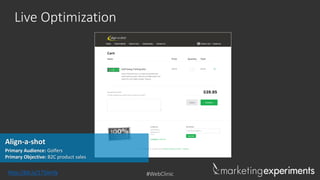
Primary Audience: Golfers
Primary Objective: B2C product sales
Align-a-shot
http://bit.ly/17SAnYa

Do Accordion Style Checkouts Work? How one company uncovered 26% more conversions by putting its checkout process to the test