AGENDA
• WEB TECHNOLOGIES
Overview
Concept
History
• GENERATION OF WORLD WIDE WEB
Web 1.0
Overview
Elements
Technology
The Shift
Web 2.0
Overview
Characteristics
Technology (Open source, AJAX)
(CMS: Joomla, Web Browser:
Mozilla Firefox, SDK: Adobe Flex)
Latest Design Trends
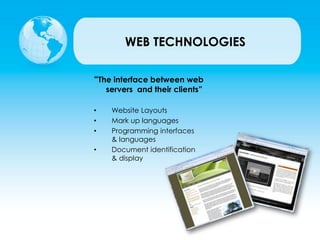
WEB TECHNOLOGIES
“The interface between web
servers and their clients”
• Website Layouts
• Mark up languages
• Programming interfaces
& languages
• Document identification
& display
THE WWW CONCEPT
• Common information space
• Universality
• Social networking
• Analysis in general
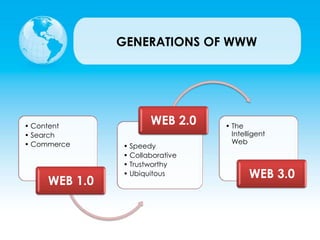
GENERATIONS OF WWW
• Content
• Search
• Commerce
WEB 1.0
• Speedy
• Collaborative
• Trustworthy
• Ubiquitous
WEB 2.0 • The
Intelligent
Web
WEB 3.0
WEB 1.0
• First generation of the web (1991 - 2003)
- Development of www
- commercialization
- The “Dot com” boom
Overview
WEB 1.0
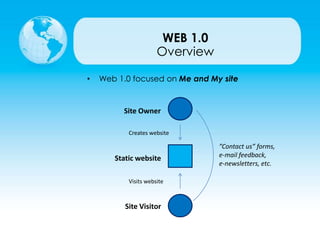
• Web 1.0 focused on Me and My site
Overview
Site Owner
Site Visitor
Static website
Creates website
Visits website
”Contact us” forms,
e-mail feedback,
e-newsletters, etc.
• Static pages instead of dynamic user-generated
content
• The use of Framesets
• The use of tables to position and align elements on a
page. These were often used in combination with
"spacer“ GIFs
• Online guestbook
• GIF buttons, typically 88x31 pixels in size promoting
web browsers and other products
• HTML forms sent via email
Elements
WEB 1.0
• Web 1.0 was dial-up, 50K average bandwidth
• Protocols such as HTTP
• Open standard markup languages such as HTML
and XML
• Internet access through ISPs
• Development of web browsers
Technology
WEB 1.0
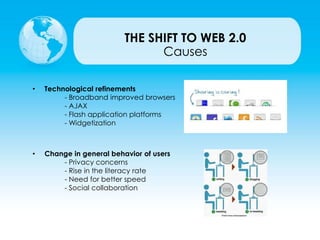
THE SHIFT TO WEB 2.0
• Technological refinements
- Broadband improved browsers
- AJAX
- Flash application platforms
- Widgetization
• Change in general behavior of users
- Privacy concerns
- Rise in the literacy rate
- Need for better speed
- Social collaboration
Causes
WEB 1.0
• “the mostly read only web”
• 45 million global users (1996)
• focused on companies
• home pages
• owning content
• Britannica Online
• HTML, portals
• web forms
• directories (taxonomy)
• Netscape
• pages views
• Advertising
WEB 2.0
• “the wildly read-write web”
• 1 billion+ global users (2006)
• focused on communities
• blogs
• sharing content
• Wikipedia
• XML, RSS
• web applications
• tagging ("folksonomy")
• Google
• cost per click
• word of mouth
Differentiation
THE SHIFT TO WEB 2.0
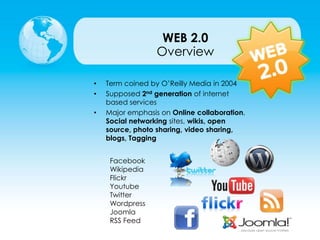
• Term coined by O’Reilly Media in 2004
• Supposed 2nd generation of internet
based services
• Major emphasis on Online collaboration,
Social networking sites, wikis, open
source, photo sharing, video sharing,
blogs, Tagging
Overview
WEB 2.0
Facebook
Wikipedia
Flickr
Youtube
Twitter
Wordpress
Joomla
RSS Feed
• Draws together the capabilities of client and server
side software
• Information storage, creation and dissemination
capabilities
• “Network as platform” computing
• Rich user experience
• User participation
• Dynamic content
• Metadata
• Easy scalability
• SLATES
(Search – Links – Authoring – Tags – Extensions -
Signals)
Characteristics
WEB 2.0
• Search
• Links
• Authoring
• Tags (Folksonomies)
• Extensions
• Signals
Characteristics: SLATES
WEB 2.0
CLIENT SIDE TECHNOLOGIES
• Open source
• AJAX
SERVER SIDE TECHNOLOGIES
• PHP
• RUBYonRAILS
• COLDFUSION
• CGI Perl
• ASP
Technologies
WEB 2.0
Technologies
OPEN SOURCE
A software whose source code is published and made
available to the public, enabling anyone to copy, modify
and redistribute the source code without paying royalties
or fees
Examples:
• CMS (Content Management Systems)
Drupal
Joomla
WordPress
• Web Browser
Mozilla Firefox
• Wiki Server Software
MediaWiki
• SDK (Software Development Kit)
Adobe Flex
WEB 2.0
Technologies: OPEN SOURCE
CMS (Content Management System)
A content management system is software that keeps
track of every piece of content on your Web site
Examples:
Drupal
Joomla
WordPress
WEB 2.0
Technologies: OPEN SOURCE
• An open source solution that is freely available to
everyone
• Enables user to build Web sites and powerful online
applications
• Most popular Web site software available.
FEATURES:
• Easy installation
Joomla is relatively easy to install in a PHP/MySQL-
based hosting environment.
• Intuitive management
It is very easy to manage your website with
Joomla. The installation pack gives you a basic
idea how you can build your website
WEB 2.0
Technologies: OPEN SOURCE
FEATURES:
• Simple template customization
There are lots of templates available for Joomla on the web. You
can choose different themes for your sites depending on its
structure and orientation
• Extra resources for add-ons
If the CMS functionalities are not enough for you, Joomla allows
you to add extra tools on your site. With Joomla you can have
ecommerce, forum, gallery add-ons and more.
WEB 2.0
Technologies: OPEN SOURCE
WEB BROWSER
A software application used to locate and display web
pages
Examples:
Mozilla Firefox
WEB 2.0
Technologies: OPEN SOURCE
With security, stability, speed and much more, Firefox is
made for the way a user uses the Web.
FEATURES:
• Awesome Bars
Find the sites you love in seconds (and without having
to remember clunky URLs)
• One-Click Bookmarking
Bookmark, search and organize Web sites quickly and
easily
• Super Speed
View Web pages way faster, using less of your
computer’s memory
WEB 2.0
Technologies: OPEN SOURCE
• Easy Customization
Thousands of add-ons give you the freedom to make your
browser your own
• Private Browsing
Surf the Web without leaving a single trace
• Tabs
Do more at once with tabs you can organize with the drag of
a mouse
• Session Restore
Unexpected shutdown? Go back to exactly where you left of
• Personas
Instantly change the look of your Firefox with thousands of
easy-to-install themes
WEB 2.0
Technologies: OPEN SOURCE
SDK (Software Development Kit)
A programming package that enables a programmer to
develop applications for a specific platform
Examples:
Adobe Flex
WEB 2.0
Technologies: OPEN SOURCE
ADOBE FLEX
An open source framework for developing intuitive web
applications that make it much easier for people to view
and interpret data
TOOL KIT CHARACTERISTICS:
• Efficient programming model
• Developer tools
• Server integration
• Runtime consistency
• Plentiful components
• Outstanding performance
WEB 2.0
Technologies: OPEN SOURCE
ADOBE FLEX
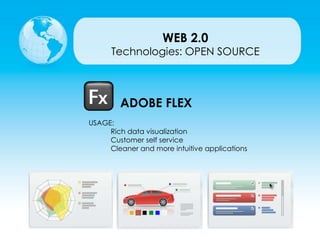
USAGE:
Rich data visualization
Customer self service
Cleaner and more intuitive applications
WEB 2.0
Technologies
AJAX (Asynchronous JavaScript & XML)
A group of interrelated web development techniques
used on the client-side to create interactive web
applications
AJAX TECHNOLOGIES:
• HTML or XHTML for presentation
• The Document Object Model for dynamic display
of and interaction with data
• XML for interchange of data
• XMLHttpRequest object for asynchronous
communication
• JavaScript to bring these technologies together
WEB 2.0
Design Trends
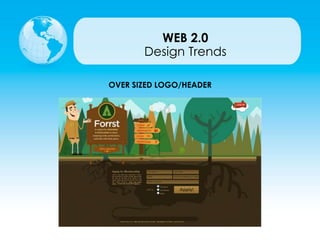
OVER SIZED LOGO/HEADER
WEB 2.0
Design Trends
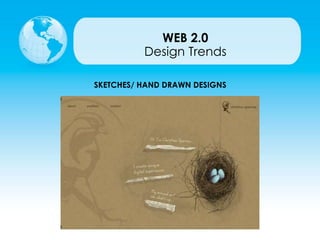
SKETCHES/ HAND DRAWN DESIGNS
WEB 2.0
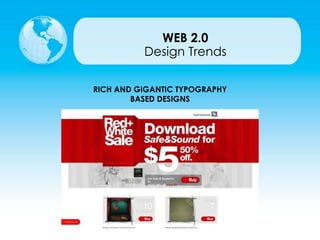
RICH AND GIGANTIC TYPOGRAPHY
BASED DESIGNS
Design Trends
WEB 2.0
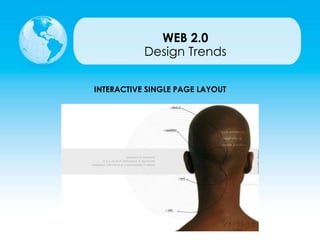
INTERACTIVE SINGLE PAGE LAYOUT
Design Trends
WEB 2.0
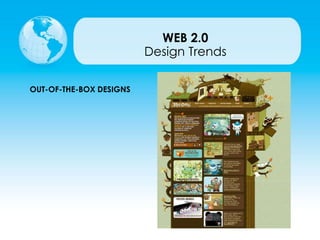
OUT-OF-THE-BOX DESIGNS
Design Trends
WEB 2.0
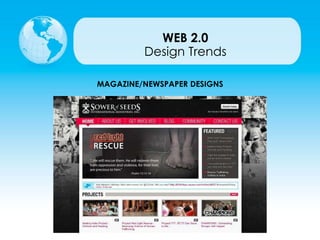
MAGAZINE/NEWSPAPER DESIGNS
Design Trends
WEB 2.0
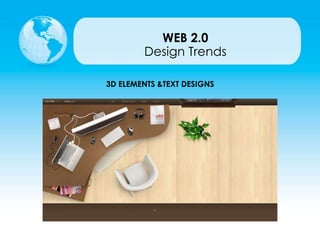
3D ELEMENTS &TEXT DESIGNS
Design Trends
WEB 2.0
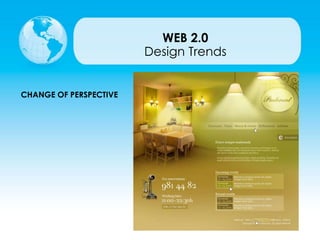
CHANGE OF PERSPECTIVE
Design Trends
WEB 2.0
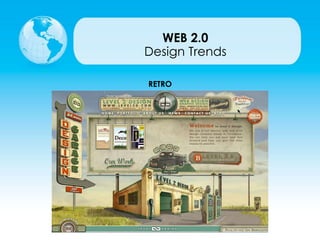
RETRO
Design Trends
WEB 2.0
The Semantic Web
WEB 3.0
THANK YOU

Web Technologies 2.0

  • 2.
    AGENDA • WEB TECHNOLOGIES Overview Concept History •GENERATION OF WORLD WIDE WEB Web 1.0 Overview Elements Technology The Shift Web 2.0 Overview Characteristics Technology (Open source, AJAX) (CMS: Joomla, Web Browser: Mozilla Firefox, SDK: Adobe Flex) Latest Design Trends
  • 3.
    WEB TECHNOLOGIES “The interfacebetween web servers and their clients” • Website Layouts • Mark up languages • Programming interfaces & languages • Document identification & display
  • 4.
    THE WWW CONCEPT •Common information space • Universality • Social networking • Analysis in general
  • 5.
    GENERATIONS OF WWW •Content • Search • Commerce WEB 1.0 • Speedy • Collaborative • Trustworthy • Ubiquitous WEB 2.0 • The Intelligent Web WEB 3.0
  • 6.
    WEB 1.0 • Firstgeneration of the web (1991 - 2003) - Development of www - commercialization - The “Dot com” boom Overview
  • 7.
    WEB 1.0 • Web1.0 focused on Me and My site Overview Site Owner Site Visitor Static website Creates website Visits website ”Contact us” forms, e-mail feedback, e-newsletters, etc.
  • 8.
    • Static pagesinstead of dynamic user-generated content • The use of Framesets • The use of tables to position and align elements on a page. These were often used in combination with "spacer“ GIFs • Online guestbook • GIF buttons, typically 88x31 pixels in size promoting web browsers and other products • HTML forms sent via email Elements WEB 1.0
  • 9.
    • Web 1.0was dial-up, 50K average bandwidth • Protocols such as HTTP • Open standard markup languages such as HTML and XML • Internet access through ISPs • Development of web browsers Technology WEB 1.0
  • 10.
    THE SHIFT TOWEB 2.0 • Technological refinements - Broadband improved browsers - AJAX - Flash application platforms - Widgetization • Change in general behavior of users - Privacy concerns - Rise in the literacy rate - Need for better speed - Social collaboration Causes
  • 11.
    WEB 1.0 • “themostly read only web” • 45 million global users (1996) • focused on companies • home pages • owning content • Britannica Online • HTML, portals • web forms • directories (taxonomy) • Netscape • pages views • Advertising WEB 2.0 • “the wildly read-write web” • 1 billion+ global users (2006) • focused on communities • blogs • sharing content • Wikipedia • XML, RSS • web applications • tagging ("folksonomy") • Google • cost per click • word of mouth Differentiation THE SHIFT TO WEB 2.0
  • 12.
    • Term coinedby O’Reilly Media in 2004 • Supposed 2nd generation of internet based services • Major emphasis on Online collaboration, Social networking sites, wikis, open source, photo sharing, video sharing, blogs, Tagging Overview WEB 2.0 Facebook Wikipedia Flickr Youtube Twitter Wordpress Joomla RSS Feed
  • 13.
    • Draws togetherthe capabilities of client and server side software • Information storage, creation and dissemination capabilities • “Network as platform” computing • Rich user experience • User participation • Dynamic content • Metadata • Easy scalability • SLATES (Search – Links – Authoring – Tags – Extensions - Signals) Characteristics WEB 2.0
  • 14.
    • Search • Links •Authoring • Tags (Folksonomies) • Extensions • Signals Characteristics: SLATES WEB 2.0
  • 15.
    CLIENT SIDE TECHNOLOGIES •Open source • AJAX SERVER SIDE TECHNOLOGIES • PHP • RUBYonRAILS • COLDFUSION • CGI Perl • ASP Technologies WEB 2.0
  • 16.
    Technologies OPEN SOURCE A softwarewhose source code is published and made available to the public, enabling anyone to copy, modify and redistribute the source code without paying royalties or fees Examples: • CMS (Content Management Systems) Drupal Joomla WordPress • Web Browser Mozilla Firefox • Wiki Server Software MediaWiki • SDK (Software Development Kit) Adobe Flex WEB 2.0
  • 17.
    Technologies: OPEN SOURCE CMS(Content Management System) A content management system is software that keeps track of every piece of content on your Web site Examples: Drupal Joomla WordPress WEB 2.0
  • 18.
    Technologies: OPEN SOURCE •An open source solution that is freely available to everyone • Enables user to build Web sites and powerful online applications • Most popular Web site software available. FEATURES: • Easy installation Joomla is relatively easy to install in a PHP/MySQL- based hosting environment. • Intuitive management It is very easy to manage your website with Joomla. The installation pack gives you a basic idea how you can build your website WEB 2.0
  • 19.
    Technologies: OPEN SOURCE FEATURES: •Simple template customization There are lots of templates available for Joomla on the web. You can choose different themes for your sites depending on its structure and orientation • Extra resources for add-ons If the CMS functionalities are not enough for you, Joomla allows you to add extra tools on your site. With Joomla you can have ecommerce, forum, gallery add-ons and more. WEB 2.0
  • 20.
    Technologies: OPEN SOURCE WEBBROWSER A software application used to locate and display web pages Examples: Mozilla Firefox WEB 2.0
  • 21.
    Technologies: OPEN SOURCE Withsecurity, stability, speed and much more, Firefox is made for the way a user uses the Web. FEATURES: • Awesome Bars Find the sites you love in seconds (and without having to remember clunky URLs) • One-Click Bookmarking Bookmark, search and organize Web sites quickly and easily • Super Speed View Web pages way faster, using less of your computer’s memory WEB 2.0
  • 22.
    Technologies: OPEN SOURCE •Easy Customization Thousands of add-ons give you the freedom to make your browser your own • Private Browsing Surf the Web without leaving a single trace • Tabs Do more at once with tabs you can organize with the drag of a mouse • Session Restore Unexpected shutdown? Go back to exactly where you left of • Personas Instantly change the look of your Firefox with thousands of easy-to-install themes WEB 2.0
  • 23.
    Technologies: OPEN SOURCE SDK(Software Development Kit) A programming package that enables a programmer to develop applications for a specific platform Examples: Adobe Flex WEB 2.0
  • 24.
    Technologies: OPEN SOURCE ADOBEFLEX An open source framework for developing intuitive web applications that make it much easier for people to view and interpret data TOOL KIT CHARACTERISTICS: • Efficient programming model • Developer tools • Server integration • Runtime consistency • Plentiful components • Outstanding performance WEB 2.0
  • 25.
    Technologies: OPEN SOURCE ADOBEFLEX USAGE: Rich data visualization Customer self service Cleaner and more intuitive applications WEB 2.0
  • 26.
    Technologies AJAX (Asynchronous JavaScript& XML) A group of interrelated web development techniques used on the client-side to create interactive web applications AJAX TECHNOLOGIES: • HTML or XHTML for presentation • The Document Object Model for dynamic display of and interaction with data • XML for interchange of data • XMLHttpRequest object for asynchronous communication • JavaScript to bring these technologies together WEB 2.0
  • 27.
    Design Trends OVER SIZEDLOGO/HEADER WEB 2.0
  • 28.
    Design Trends SKETCHES/ HANDDRAWN DESIGNS WEB 2.0
  • 29.
    RICH AND GIGANTICTYPOGRAPHY BASED DESIGNS Design Trends WEB 2.0
  • 30.
    INTERACTIVE SINGLE PAGELAYOUT Design Trends WEB 2.0
  • 31.
  • 32.
  • 33.
    3D ELEMENTS &TEXTDESIGNS Design Trends WEB 2.0
  • 34.
  • 35.
  • 36.
  • 37.