1
Naveed Siddiqui
PhD. M.B.E. PgDip Information Technology
Founder & CEO – Naveed Media Academy
www.facebook.com/NaveedAhmedSiddiqui33
www.linkedin.com/in/dr-naveed-siddiqui-191a4b2b
www.youtube.com/user/nvd30
www.youtube.com/user/NaveedAhmedSiddiqui3
nasiddiqui333@gmail.com
0092 337 0492400
Electronic Commerce
Electronic Payment Systems
3
Learning Objectives
1. Understand the crucial factors that
determine the success of e-payment
methods.
2. Discuss the players and processes
involved in using credit cards online.
3. Discuss the different categories and
potential uses of smart cards.
4
Learning Objectives (cont.)
4. Discuss various online alternatives to
credit card payments and identify
under what circumstances they are
best used.
5. Describe the processes and parties
involved in e-checking.
5
Learning Objectives (cont.)
6. Describe payment methods in B2B
EC, including payments for global
trade.
7. Discuss bill presentment and
payment.
8. Describe special payment methods.
6
LensDoc Organizes
Payments Online
LensDoc is an online retailer of contact
lenses, sun and magnifying glasses,
and dental care and personal care
products
Customers pay with a credit card
Credit cards also make it easy for a
customer to return an item and
receive credit for the return
7
LensDoc Organizes
Payments Online (cont.)
People try contact lenses and return
them if they are not satisfied
U.S. regulations prohibit the return
of contact lenses that have been
used
LensDoc had to discard the lenses
and to take a loss
8
LensDoc Organizes
Payments Online (cont.)
The Solution
LensDoc implemented special
handling procedures for authorizing
online credit card purchases
company manually processes credit
card orders
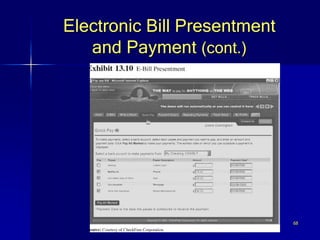
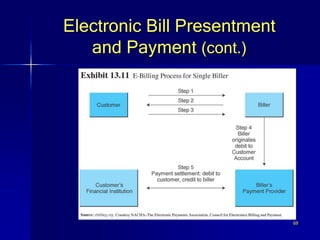
customers must fax a form that includes
the cardholder’s address as well as the
shipping address
9
LensDoc Organizes
Payments Online (cont.)
The Results
Manual processing of credit card
payments is slow and solves some
problems
However, the disadvantages of
alternative e-payment method seem to
outweigh the advantages (cash cards,
special card-swiping peripherals, credit
card processing services)
10
LensDoc Organizes
Payments Online (cont.)
What we can learn…
The potential for fraud is high when credit
cards are used online
Merchants are responsible for fraudulent
charges because online credit card
purchases are treated as “card-not-
present” transactions
By 2002, e-tailers began to view credit
card fraud as a solvable problem
11
Electronic Payments: A Critical
Element in EC Support Services
E-payments: payments made online
The overwhelming majority of Web
purchases are made with credit
cards
This may change in the future
12
Deficiencies of Credit Card
Payments
Many people who will be on the Internet
in 2004 have not even had their first Web
experience
Many of these users will come from
countries outside the United States, where
the use of credit cards is not as prevalent
Many users are also likely to be younger
and have less access to credit and debit
cards
Many purchases they make will be
micropayments
13
Deficiencies of Credit Card
Payments (cont.)
95 percent of all e-commerce are
B2B transactions
Electronic payments are more likely to
involve EFTs or electronic checks
Credit cards cannot be used for large
sums of B2B transactions
A large amount of fraud with online
credit card shopping occurs that
results in chargebacks to the
merchants
14
Electronic Payments (cont.)
Chargeback problem—a chargeback
means that the customer refuses to
pay, claiming that the purchase was
made by someone else
Happens in Internet transactions:
Four times more frequently than catalog
sales
Nine times more frequently than in
brick-and-mortar sales
15
Electronic Payments (cont.)
“Best practices” used by merchants
when conducting credit card
transactions:
implementing a firewall
using encryption and antivirus
software
incorporating intercompany security
practices
16
Electronic Payments:
Best Practices (cont.)
However, since 2002, e-tailers see
credit card fraud as a solvable problem
Risk management techniques and
fraud-prevention software are widely
available
The Merchant Fraud Squad provides
education about fraud prevention
techniques and encourages businesses
selling online to adopt best practices
and antifraud technologies
17
Electronic Payments (cont.)
nochargeback.com and
combatfraud.org offer fraud-
protection services
Members access the site’s database of
credit card numbers, e-mail addresses,
and postal addresses used for purchases
that resulted in a chargeback
Merchants check for “deadbeats” at this
site and then refuse to accept charges
from them
18
Electronic Payment Methods
Electronic payment cards (credit,
debit, charge)
Virtual credit cards
E-wallets (or e-purses)
Smart cards
Electronic cash (several variations)
19
Electronic Payment
Methods (cont.)
Wireless payments
Stored-value card payments
Loyalty cards
Person-to-person payment methods
Payments made electronically at kiosks
20
Electronic Payment
Methods (cont.)
E-payments for B2B
Electronic checks
Purchasing cards
Electronic letters of credit
Electronic funds transfer (EFT)
Electronic benefits transfer (EBT)
Other innovative methods, including
e-lines of credit
21
Electronic Payment
Methods (cont.)
Five parties involved in e-payments:
1. Customer/payer/buyer
2. Merchant/payee/seller
3. Issuer
4. Regulator
5. Automated Clearing House (ACH)
22
Electronic Payments
Methods (cont.)
Automated Clearing House (ACH):
Electronic network that connects all
U.S. financial institutions for the
purpose of making funds transfers
23
Electronic Payments
Methods (cont.)
Independence
Interoperability
and portability
Security
Anonymity
Divisibility
Ease of use
Transaction fees
Critical mass
Characteristics of successful
e-payment methods
24
Security for
Electronic Payments
Security for e-payments
Standards for e-payments—it is
necessary to have generally
accepted protocols
SSL (TLS)
SET
25
Security for
Electronic Payments (cont.)
Other security measures
Both the funds that are being
transferred and the consumer data
must be protected
intelligent agents
biometrics
26
Electronic Cards and
Smart Cards
Payment card:
Electronic card that
contains
information that
can be used for
payment purposes
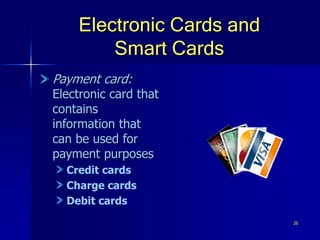
Credit cards
Charge cards
Debit cards
27
Electronic Cards and
Smart Cards (cont.)
28
Electronic Cards and
Smart Cards (cont.)
Card gateway: An online connection
that ties a merchant’s systems to the
back-end processing systems of the
credit card issuer
29
Electronic Cards and
Smart Cards (cont.)
Virtual credit card: An e-payment
system in which a credit card issuer
gives a special transaction number
that can be used online in place of
regular credit card numbers
Debit checking accounts—Western
Western Union’s MoneyZap service
30
Electronic Wallets
Electronic wallet (e-wallet): A software
component in which a user stores
credit card numbers and other
personal information; when shopping
online, the user simply clicks the e-
wallet to automatically fill in
information needed to make a
purchase
31
E-Wallets (cont.)
Digital identity (digital ID): A set of
digital information that is associated
with a particular individual and is used
to identify that individual for security
purposes
32
E-Wallets (cont.)
E-wallet as an authenticator
1. The user contacts the merchant to
place an order
2. The authentication/registry part of
the e-wallet generates a pair of
keys called session keys
33
E-Wallets (cont.)
3. The user decrypts the first session
key, using their private key
4. The merchant decrypts the ticket,
using its private key, retrieving the
user’s name and the second
session key
34
E-Wallets (cont.)
35
Electronic Cards and
Smart Cards (cont.)
Security risks with credit cards
Stolen cards
Reneging by the customer
Theft of card details stored on the
merchant’s computer
36
Electronic Cards and
Smart Cards (cont.)
Smart card: An electronic card
containing an embedded microchip
that enables predefined operations or
the addition, deletion, or manipulation
of information on the card
37
Electronic Cards and
Smart Cards (cont.)
38
Electronic Cards and
Smart Cards (cont.)
Contact card: A smart card containing
a small gold plate on the face that
when inserted in a smart-card reader
makes contact and so passes data to
and from the embedded microchip
39
Electronic Cards and
Smart Cards (cont.)
Contactless (proximity) card: A smart
card with an embedded antenna, by
means of which data and applications
are passed to and from a card reader
unit or other device without contact
between the card and the card reader
40
Electronic Cards and
Smart Cards (cont.)
Securing smart cards
Stored-value card: A card that has
monetary value loaded onto it, and
is usually rechargeable
Some smart cards show account
numbers
Most store the information in encrypted
form
Cost to the attacker so far exceeds the
benefits of hacking into these cards
41
Electronic Cards and
Smart Cards (cont.)
Applications of smart cards
Loyalty cards
Financial applications
Information technology cards
Health and social welfare
information cards
Transportation
Identification
42
Electronic Cards and
Smart Cards (cont.)
Multipurpose cards
February 2001, MasterCard
International and Korea’s Kookmin
Card Corp. issued the first
multipurpose smart card in the
world
It contains credit and debit card
features, e-cash (from Mondex), and
public transportation fares
43
E-Cash and Innovative
Payment Systems
E-cash: The digital equivalent of paper
currency and coins, which enables
secure and anonymous purchase of
low-priced items
Inconvenience of opening an
account and downloading software
and the difficulty of obtaining a
critical mass of users seems to have
outweighed the benefits
44
E-Cash and Innovative
Payment Systems (cont.)
E-cash alternatives to credit cards for
Micropayments: Small payments,
usually under $10
Vodafone’s “m-pay bill” system
Qpass
45
E-Cash and Innovative
Payment Systems (cont.)
Stored-value cards and other
innovations
Visa Cash: A stored-value card
designed to handle small purchases
or micropayments; sponsored by
Visa
Visa Bucks: prepaid card designed
for teens
46
E-Cash and Innovative
Payment Systems (cont.)
Mondex: A stored-value card
designed to handle small purchases
or micropayments; sponsored by
Mondex, a subsidiary of MasterCard
Campus cards: money value is not
stored on the card, but in an account
equivalent to the card’s ID number
47
E-Cash and Innovative
Payment Systems (cont.)
E-loyalty and rewards programs:
Electronic script: A form of
electronic money (or points), issued
by a third party as part of a loyalty
program; can be used by consumers
to make purchases at participating
stores
MyPoints-CyberGold (mypoints.com)
48
E-Cash and Innovative
Payment Systems (cont.)
Prepaid stored-value cards
The customer has a prepaid stored-value
card, they are more likely to be loyal to the
card sponsor, at least until the stored
value runs out
Telephone cards
Starbuck’s
RocketCash (rocketcash.com) combines an
online cash account with a rewards
program
49
E-Cash and Innovative
Payment Systems (cont.)
Person-to-person (P2P) payments: E-
payment schemes (such as PayPal)
that enable the transfer of funds
between two individuals
PayPal (paypal.com)
Citibank c2it (c2it.com)
AOL QuickCash (aol.com)
Bank One’s eMoneyMail
(bankone.com/presents/emoneymail/hom
e/)
Yahoo PayDirect (paydirect.yahoo.com)
WebCertificate (webcertificate.com)
50
E-Cash and Innovative
Payment Systems (cont.)
51
E-Cash and Innovative
Payment Systems (cont.)
Non-Internet EC payments
Check yourself out—consumers can use
kiosks to check out (Sears, Kmart, Home
Depot)
Buying from vending machines—use
regular credit cards at PepsiCo and Coca-
Cola vending machines
Paying with a check without writing it—
check is scanned, customer’s bank account
is debited, the merchant account is
credited (Wal-Mart, Costco)
52
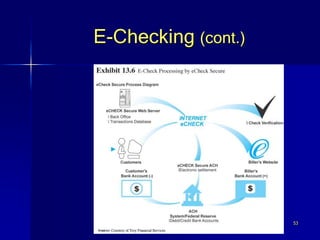
E-Checking
E-check: The electronic version or
representation of a paper check
Eliminate the need for expensive
process reengineering and taking
advantage of the banking industry
Can be used by all bank customers
who have checking accounts
53
E-Checking (cont.)
54
B2B Electronic Payments
Financial supply chains (FSC)
FSC parallels the physical supply
chain
Follows a buyer’s transaction
activities related to cash flow, which
start with a purchase order and end
in settlement with the seller
55
B2B Electronic Payments (cont.)
Typical segments of the FCS:
Segment 1: Examination of catalogs,
electronic order entry
Segment 2: Online negotiations,
culminating in a preliminary
agreement
Segment 3: Credit check, seller
validation, payment assurance,
financing
56
B2B Electronic Payments (cont.)
Segment 4: Invoice presentment,
verification of delivery, “trade
service” quote, and booking
Segment 5: Data matching,
discrepancy resolution, final payment
calculation, buyer approval, currency
exchange calculation (if needed), and
arrangements for automatic payment
Segment 6: Payment instructions,
money transfer, debit and credit
notices
57
B2B Electronic Payments (cont.)
B2B payment solutions
Purchasing cards: Special-purpose
payment cards issued to a
company’s employees to be used
solely for purchasing nonstrategic
materials and services up to a preset
dollar limit
58
B2B Electronic Payments (cont.)
Benefits accrued from the use of
purchasing cards
Productivity gains
Purchasing departments freed from
day-to-day procurement activities;
focus on relationships with suppliers
Bill consolidation
Consolidated into a single invoice that
can be paid electronically through EDI
or EFT
59
B2B Electronic Payments (cont.)
60
B2B Electronic Payments (cont.)
61
B2B Electronic Payments (cont.)
Benefits to the buyers, agency where
they work, and the merchant
Payment reconciliation
Expedited payments
Management reports
Control
62
B2B Electronic Payments (cont.)
63
B2B Electronic Payments (cont.)
Global B2B payments
Letter of credit (LC): A written
agreement by a bank to pay the
seller, on account of the buyer, a
sum of money upon presentation of
certain documents
64
B2B Electronic Payments (cont.)
Benefits of LCs to the seller
payment is highly assured if all the
terms and conditions stipulated are
met
credit risk is reduced
political/country risk is reduced
when confirmed by a bank in the
seller’s country
65
B2B Electronic Payments (cont.)
Benefits of LCs to the buyer
allows the buyer to negotiate for a
lower purchase
buyer may expand its sources of
supply and bargaining power
funds withdrawn from the buyer’s
account only after the documents
have been inspected giving the buyer
a bit more time to hold its money
66
B2B Electronic Payments (cont.)
Tradecard payments in B2B global
tracing
Members of Tradecard interact with each
other via the TradeCard system
checks purchase orders for both parties
waits for a confirmation from a logistics
company that deliveries have been made and
received
authorizes payment to complete the financial
transaction between the buyer and seller
67
Electronic Bill Presentment
and Payment
E-billing
Presentment: The presentation and
hosting on a specialized Web server
of information that is typically
printed on a bill
Two models of presentment
common-biller direct
third-party consolidators
68
Electronic Bill Presentment
and Payment (cont.)
69
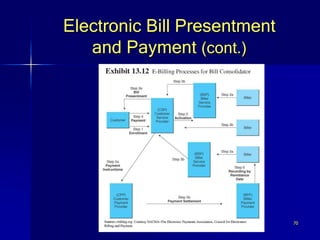
Electronic Bill Presentment
and Payment (cont.)
70
Electronic Bill Presentment
and Payment (cont.)
71
Electronic Bill Presentment
and Payment (cont.)
Paying bills at ATMs
Customer receives the bill
Go to any ATM, slide in their bank
card, enter a password, and go to
“bill payments” on the menu
Insert the account number of the
biller and the amount to be paid
Customer gets a printed receipt
showing that the payment has been
made
72
Electronic Bill Presentment
and Payment (cont.)
Advantages of e-billing
For the billing firm:
Reduction in expenses
Enables better customer service
Electronic ad inserts can be customized
73
Electronic Bill Presentment
and Payment (cont.)
Advantages of e-billing
For the customer:
Reduces customer’s expenses
Simplifies and centralizes payment
processing and provides better record
keeping
Customers review and pay bills at
virtually any time, giving them direct
control over the timing of the payment
74
Electronic Bill Presentment
and Payment (cont.)
Checkfree (checkfree.com) leading
third-party e-billing vendor
Consolidates and aggregates all of a
customer’s bills into a single presentment
Set up payments with companies that do
not offer electronic billing
Alerts users to problems with any
payments
Users can export the transaction records
to Quicken or Microsoft Money
75
Payment-Related Issues
Tax calculation services for businesses
DPC (salestax.com) licenses
software that makes it simple to
collect and report sales taxes
76
Tax-Related Issues
Sales Tax Clearinghouse (STC) has a
free online sales tax calculator for
the U.S. and Canada
(thestc.com/ratecalc.stm)
77
Tax-Related Issues (cont.)
Taxware International
(taxware.com) produces software
that operates seamlessly with
leading financial and accounting
packages on multiple hardware
platforms to accurately automate
tax compliance
78
Tax-Related Issues (cont.)
Implementing tax collection in the U.S.
Streamlined Sales Tax Project
(SSTP)— designed to create
uniformity in the way states
administer sales and use taxes
Merchants use the Internet to send
sales transaction data in real time to
any participating system
79
Tax-Related Issues (cont.)
How the systems works
A consumer initiates an online
purchase
The e-business uses the Internet to
access a trusted third-party tax
service provider
The provider calculates the tax on
the purchase based on
the locations of the buyer and the seller
applicable state and local tax laws
80
Tax-Related Issues (cont.)
The third party makes a single
monthly or quarterly tax payment to
each relevant government tax
authority
The tax authority then securely
accesses a database, managed by
the third party over the Web, to
examine the transaction data for tax
compliance
81
Special Payment-Related
Issues (cont.)
Cybersource: a comprehensive
payment provider; services include:
Electronic payments
Credit card fraud management
Verification and compliance services
82
Special Payment-Related
Issues (cont.)
Financial services for B2B
Credit reporting
Risk analysis and financial matching
Exchange insurance
83
Special Payment-Related
Issues (cont.)
84
Managerial Issues
1. What B2C payment methods should
we use?
2. What B2B payment methods should
we use?
3. Should we use an in-house payment
mechanism or oursource?
4. How secure are e-payments?
85
Summary
1. Crucial factors determining the
success of an e-payment method.
2. Online credit card players and
processes.
3. Categories and potential uses of
smart cards.
4. Online alternatives to credit card
payments.
86
Summary (cont.)
5. E-check processes and involved
parties.
6. Payment methods in B2B, including
global trade.
7. Bill presentment and payment.
8. Special payment methods.

7 electronic payment systems

  • 1.
    1 Naveed Siddiqui PhD. M.B.E.PgDip Information Technology Founder & CEO – Naveed Media Academy www.facebook.com/NaveedAhmedSiddiqui33 www.linkedin.com/in/dr-naveed-siddiqui-191a4b2b www.youtube.com/user/nvd30 www.youtube.com/user/NaveedAhmedSiddiqui3 nasiddiqui333@gmail.com 0092 337 0492400 Electronic Commerce
  • 2.
  • 3.
    3 Learning Objectives 1. Understandthe crucial factors that determine the success of e-payment methods. 2. Discuss the players and processes involved in using credit cards online. 3. Discuss the different categories and potential uses of smart cards.
  • 4.
    4 Learning Objectives (cont.) 4.Discuss various online alternatives to credit card payments and identify under what circumstances they are best used. 5. Describe the processes and parties involved in e-checking.
  • 5.
    5 Learning Objectives (cont.) 6.Describe payment methods in B2B EC, including payments for global trade. 7. Discuss bill presentment and payment. 8. Describe special payment methods.
  • 6.
    6 LensDoc Organizes Payments Online LensDocis an online retailer of contact lenses, sun and magnifying glasses, and dental care and personal care products Customers pay with a credit card Credit cards also make it easy for a customer to return an item and receive credit for the return
  • 7.
    7 LensDoc Organizes Payments Online(cont.) People try contact lenses and return them if they are not satisfied U.S. regulations prohibit the return of contact lenses that have been used LensDoc had to discard the lenses and to take a loss
  • 8.
    8 LensDoc Organizes Payments Online(cont.) The Solution LensDoc implemented special handling procedures for authorizing online credit card purchases company manually processes credit card orders customers must fax a form that includes the cardholder’s address as well as the shipping address
  • 9.
    9 LensDoc Organizes Payments Online(cont.) The Results Manual processing of credit card payments is slow and solves some problems However, the disadvantages of alternative e-payment method seem to outweigh the advantages (cash cards, special card-swiping peripherals, credit card processing services)
  • 10.
    10 LensDoc Organizes Payments Online(cont.) What we can learn… The potential for fraud is high when credit cards are used online Merchants are responsible for fraudulent charges because online credit card purchases are treated as “card-not- present” transactions By 2002, e-tailers began to view credit card fraud as a solvable problem
  • 11.
    11 Electronic Payments: ACritical Element in EC Support Services E-payments: payments made online The overwhelming majority of Web purchases are made with credit cards This may change in the future
  • 12.
    12 Deficiencies of CreditCard Payments Many people who will be on the Internet in 2004 have not even had their first Web experience Many of these users will come from countries outside the United States, where the use of credit cards is not as prevalent Many users are also likely to be younger and have less access to credit and debit cards Many purchases they make will be micropayments
  • 13.
    13 Deficiencies of CreditCard Payments (cont.) 95 percent of all e-commerce are B2B transactions Electronic payments are more likely to involve EFTs or electronic checks Credit cards cannot be used for large sums of B2B transactions A large amount of fraud with online credit card shopping occurs that results in chargebacks to the merchants
  • 14.
    14 Electronic Payments (cont.) Chargebackproblem—a chargeback means that the customer refuses to pay, claiming that the purchase was made by someone else Happens in Internet transactions: Four times more frequently than catalog sales Nine times more frequently than in brick-and-mortar sales
  • 15.
    15 Electronic Payments (cont.) “Bestpractices” used by merchants when conducting credit card transactions: implementing a firewall using encryption and antivirus software incorporating intercompany security practices
  • 16.
    16 Electronic Payments: Best Practices(cont.) However, since 2002, e-tailers see credit card fraud as a solvable problem Risk management techniques and fraud-prevention software are widely available The Merchant Fraud Squad provides education about fraud prevention techniques and encourages businesses selling online to adopt best practices and antifraud technologies
  • 17.
    17 Electronic Payments (cont.) nochargeback.comand combatfraud.org offer fraud- protection services Members access the site’s database of credit card numbers, e-mail addresses, and postal addresses used for purchases that resulted in a chargeback Merchants check for “deadbeats” at this site and then refuse to accept charges from them
  • 18.
    18 Electronic Payment Methods Electronicpayment cards (credit, debit, charge) Virtual credit cards E-wallets (or e-purses) Smart cards Electronic cash (several variations)
  • 19.
    19 Electronic Payment Methods (cont.) Wirelesspayments Stored-value card payments Loyalty cards Person-to-person payment methods Payments made electronically at kiosks
  • 20.
    20 Electronic Payment Methods (cont.) E-paymentsfor B2B Electronic checks Purchasing cards Electronic letters of credit Electronic funds transfer (EFT) Electronic benefits transfer (EBT) Other innovative methods, including e-lines of credit
  • 21.
    21 Electronic Payment Methods (cont.) Fiveparties involved in e-payments: 1. Customer/payer/buyer 2. Merchant/payee/seller 3. Issuer 4. Regulator 5. Automated Clearing House (ACH)
  • 22.
    22 Electronic Payments Methods (cont.) AutomatedClearing House (ACH): Electronic network that connects all U.S. financial institutions for the purpose of making funds transfers
  • 23.
    23 Electronic Payments Methods (cont.) Independence Interoperability andportability Security Anonymity Divisibility Ease of use Transaction fees Critical mass Characteristics of successful e-payment methods
  • 24.
    24 Security for Electronic Payments Securityfor e-payments Standards for e-payments—it is necessary to have generally accepted protocols SSL (TLS) SET
  • 25.
    25 Security for Electronic Payments(cont.) Other security measures Both the funds that are being transferred and the consumer data must be protected intelligent agents biometrics
  • 26.
    26 Electronic Cards and SmartCards Payment card: Electronic card that contains information that can be used for payment purposes Credit cards Charge cards Debit cards
  • 27.
  • 28.
    28 Electronic Cards and SmartCards (cont.) Card gateway: An online connection that ties a merchant’s systems to the back-end processing systems of the credit card issuer
  • 29.
    29 Electronic Cards and SmartCards (cont.) Virtual credit card: An e-payment system in which a credit card issuer gives a special transaction number that can be used online in place of regular credit card numbers Debit checking accounts—Western Western Union’s MoneyZap service
  • 30.
    30 Electronic Wallets Electronic wallet(e-wallet): A software component in which a user stores credit card numbers and other personal information; when shopping online, the user simply clicks the e- wallet to automatically fill in information needed to make a purchase
  • 31.
    31 E-Wallets (cont.) Digital identity(digital ID): A set of digital information that is associated with a particular individual and is used to identify that individual for security purposes
  • 32.
    32 E-Wallets (cont.) E-wallet asan authenticator 1. The user contacts the merchant to place an order 2. The authentication/registry part of the e-wallet generates a pair of keys called session keys
  • 33.
    33 E-Wallets (cont.) 3. Theuser decrypts the first session key, using their private key 4. The merchant decrypts the ticket, using its private key, retrieving the user’s name and the second session key
  • 34.
  • 35.
    35 Electronic Cards and SmartCards (cont.) Security risks with credit cards Stolen cards Reneging by the customer Theft of card details stored on the merchant’s computer
  • 36.
    36 Electronic Cards and SmartCards (cont.) Smart card: An electronic card containing an embedded microchip that enables predefined operations or the addition, deletion, or manipulation of information on the card
  • 37.
  • 38.
    38 Electronic Cards and SmartCards (cont.) Contact card: A smart card containing a small gold plate on the face that when inserted in a smart-card reader makes contact and so passes data to and from the embedded microchip
  • 39.
    39 Electronic Cards and SmartCards (cont.) Contactless (proximity) card: A smart card with an embedded antenna, by means of which data and applications are passed to and from a card reader unit or other device without contact between the card and the card reader
  • 40.
    40 Electronic Cards and SmartCards (cont.) Securing smart cards Stored-value card: A card that has monetary value loaded onto it, and is usually rechargeable Some smart cards show account numbers Most store the information in encrypted form Cost to the attacker so far exceeds the benefits of hacking into these cards
  • 41.
    41 Electronic Cards and SmartCards (cont.) Applications of smart cards Loyalty cards Financial applications Information technology cards Health and social welfare information cards Transportation Identification
  • 42.
    42 Electronic Cards and SmartCards (cont.) Multipurpose cards February 2001, MasterCard International and Korea’s Kookmin Card Corp. issued the first multipurpose smart card in the world It contains credit and debit card features, e-cash (from Mondex), and public transportation fares
  • 43.
    43 E-Cash and Innovative PaymentSystems E-cash: The digital equivalent of paper currency and coins, which enables secure and anonymous purchase of low-priced items Inconvenience of opening an account and downloading software and the difficulty of obtaining a critical mass of users seems to have outweighed the benefits
  • 44.
    44 E-Cash and Innovative PaymentSystems (cont.) E-cash alternatives to credit cards for Micropayments: Small payments, usually under $10 Vodafone’s “m-pay bill” system Qpass
  • 45.
    45 E-Cash and Innovative PaymentSystems (cont.) Stored-value cards and other innovations Visa Cash: A stored-value card designed to handle small purchases or micropayments; sponsored by Visa Visa Bucks: prepaid card designed for teens
  • 46.
    46 E-Cash and Innovative PaymentSystems (cont.) Mondex: A stored-value card designed to handle small purchases or micropayments; sponsored by Mondex, a subsidiary of MasterCard Campus cards: money value is not stored on the card, but in an account equivalent to the card’s ID number
  • 47.
    47 E-Cash and Innovative PaymentSystems (cont.) E-loyalty and rewards programs: Electronic script: A form of electronic money (or points), issued by a third party as part of a loyalty program; can be used by consumers to make purchases at participating stores MyPoints-CyberGold (mypoints.com)
  • 48.
    48 E-Cash and Innovative PaymentSystems (cont.) Prepaid stored-value cards The customer has a prepaid stored-value card, they are more likely to be loyal to the card sponsor, at least until the stored value runs out Telephone cards Starbuck’s RocketCash (rocketcash.com) combines an online cash account with a rewards program
  • 49.
    49 E-Cash and Innovative PaymentSystems (cont.) Person-to-person (P2P) payments: E- payment schemes (such as PayPal) that enable the transfer of funds between two individuals PayPal (paypal.com) Citibank c2it (c2it.com) AOL QuickCash (aol.com) Bank One’s eMoneyMail (bankone.com/presents/emoneymail/hom e/) Yahoo PayDirect (paydirect.yahoo.com) WebCertificate (webcertificate.com)
  • 50.
  • 51.
    51 E-Cash and Innovative PaymentSystems (cont.) Non-Internet EC payments Check yourself out—consumers can use kiosks to check out (Sears, Kmart, Home Depot) Buying from vending machines—use regular credit cards at PepsiCo and Coca- Cola vending machines Paying with a check without writing it— check is scanned, customer’s bank account is debited, the merchant account is credited (Wal-Mart, Costco)
  • 52.
    52 E-Checking E-check: The electronicversion or representation of a paper check Eliminate the need for expensive process reengineering and taking advantage of the banking industry Can be used by all bank customers who have checking accounts
  • 53.
  • 54.
    54 B2B Electronic Payments Financialsupply chains (FSC) FSC parallels the physical supply chain Follows a buyer’s transaction activities related to cash flow, which start with a purchase order and end in settlement with the seller
  • 55.
    55 B2B Electronic Payments(cont.) Typical segments of the FCS: Segment 1: Examination of catalogs, electronic order entry Segment 2: Online negotiations, culminating in a preliminary agreement Segment 3: Credit check, seller validation, payment assurance, financing
  • 56.
    56 B2B Electronic Payments(cont.) Segment 4: Invoice presentment, verification of delivery, “trade service” quote, and booking Segment 5: Data matching, discrepancy resolution, final payment calculation, buyer approval, currency exchange calculation (if needed), and arrangements for automatic payment Segment 6: Payment instructions, money transfer, debit and credit notices
  • 57.
    57 B2B Electronic Payments(cont.) B2B payment solutions Purchasing cards: Special-purpose payment cards issued to a company’s employees to be used solely for purchasing nonstrategic materials and services up to a preset dollar limit
  • 58.
    58 B2B Electronic Payments(cont.) Benefits accrued from the use of purchasing cards Productivity gains Purchasing departments freed from day-to-day procurement activities; focus on relationships with suppliers Bill consolidation Consolidated into a single invoice that can be paid electronically through EDI or EFT
  • 59.
  • 60.
  • 61.
    61 B2B Electronic Payments(cont.) Benefits to the buyers, agency where they work, and the merchant Payment reconciliation Expedited payments Management reports Control
  • 62.
  • 63.
    63 B2B Electronic Payments(cont.) Global B2B payments Letter of credit (LC): A written agreement by a bank to pay the seller, on account of the buyer, a sum of money upon presentation of certain documents
  • 64.
    64 B2B Electronic Payments(cont.) Benefits of LCs to the seller payment is highly assured if all the terms and conditions stipulated are met credit risk is reduced political/country risk is reduced when confirmed by a bank in the seller’s country
  • 65.
    65 B2B Electronic Payments(cont.) Benefits of LCs to the buyer allows the buyer to negotiate for a lower purchase buyer may expand its sources of supply and bargaining power funds withdrawn from the buyer’s account only after the documents have been inspected giving the buyer a bit more time to hold its money
  • 66.
    66 B2B Electronic Payments(cont.) Tradecard payments in B2B global tracing Members of Tradecard interact with each other via the TradeCard system checks purchase orders for both parties waits for a confirmation from a logistics company that deliveries have been made and received authorizes payment to complete the financial transaction between the buyer and seller
  • 67.
    67 Electronic Bill Presentment andPayment E-billing Presentment: The presentation and hosting on a specialized Web server of information that is typically printed on a bill Two models of presentment common-biller direct third-party consolidators
  • 68.
  • 69.
  • 70.
  • 71.
    71 Electronic Bill Presentment andPayment (cont.) Paying bills at ATMs Customer receives the bill Go to any ATM, slide in their bank card, enter a password, and go to “bill payments” on the menu Insert the account number of the biller and the amount to be paid Customer gets a printed receipt showing that the payment has been made
  • 72.
    72 Electronic Bill Presentment andPayment (cont.) Advantages of e-billing For the billing firm: Reduction in expenses Enables better customer service Electronic ad inserts can be customized
  • 73.
    73 Electronic Bill Presentment andPayment (cont.) Advantages of e-billing For the customer: Reduces customer’s expenses Simplifies and centralizes payment processing and provides better record keeping Customers review and pay bills at virtually any time, giving them direct control over the timing of the payment
  • 74.
    74 Electronic Bill Presentment andPayment (cont.) Checkfree (checkfree.com) leading third-party e-billing vendor Consolidates and aggregates all of a customer’s bills into a single presentment Set up payments with companies that do not offer electronic billing Alerts users to problems with any payments Users can export the transaction records to Quicken or Microsoft Money
  • 75.
    75 Payment-Related Issues Tax calculationservices for businesses DPC (salestax.com) licenses software that makes it simple to collect and report sales taxes
  • 76.
    76 Tax-Related Issues Sales TaxClearinghouse (STC) has a free online sales tax calculator for the U.S. and Canada (thestc.com/ratecalc.stm)
  • 77.
    77 Tax-Related Issues (cont.) TaxwareInternational (taxware.com) produces software that operates seamlessly with leading financial and accounting packages on multiple hardware platforms to accurately automate tax compliance
  • 78.
    78 Tax-Related Issues (cont.) Implementingtax collection in the U.S. Streamlined Sales Tax Project (SSTP)— designed to create uniformity in the way states administer sales and use taxes Merchants use the Internet to send sales transaction data in real time to any participating system
  • 79.
    79 Tax-Related Issues (cont.) Howthe systems works A consumer initiates an online purchase The e-business uses the Internet to access a trusted third-party tax service provider The provider calculates the tax on the purchase based on the locations of the buyer and the seller applicable state and local tax laws
  • 80.
    80 Tax-Related Issues (cont.) Thethird party makes a single monthly or quarterly tax payment to each relevant government tax authority The tax authority then securely accesses a database, managed by the third party over the Web, to examine the transaction data for tax compliance
  • 81.
    81 Special Payment-Related Issues (cont.) Cybersource:a comprehensive payment provider; services include: Electronic payments Credit card fraud management Verification and compliance services
  • 82.
    82 Special Payment-Related Issues (cont.) Financialservices for B2B Credit reporting Risk analysis and financial matching Exchange insurance
  • 83.
  • 84.
    84 Managerial Issues 1. WhatB2C payment methods should we use? 2. What B2B payment methods should we use? 3. Should we use an in-house payment mechanism or oursource? 4. How secure are e-payments?
  • 85.
    85 Summary 1. Crucial factorsdetermining the success of an e-payment method. 2. Online credit card players and processes. 3. Categories and potential uses of smart cards. 4. Online alternatives to credit card payments.
  • 86.
    86 Summary (cont.) 5. E-checkprocesses and involved parties. 6. Payment methods in B2B, including global trade. 7. Bill presentment and payment. 8. Special payment methods.