Introduction of e-commerce
1
hello!
I AM
Vaishnavi
I am here because I love to
give presentations.
You can find me at:
@vaishnavi.in
2
Disclaimer
Let’s start with the first set of
slides
3
Presentations are intended for educational purposes only and do not replace independent
professional judgment. Statements of fact and opinions expressed are those of Vaishnavi
individually and, unless expressly stated to the contrary, are not the opinion or position of the
Society of Actuaries, its cosponsors, or its committees. The Society of Actuaries does not
endorse or approve, and assumes no responsibility for, the content, accuracy or completeness
of the information presented. Attendees should note that sessions are audio-recorded and may
be published in various media, including print, audio and video formats without further notice.
Submitted To-Dr.Rajeshwari Trivedi
(Asst. Professor)
Submitted By-Vaishnavi
B.Sc.(IT) 2nd Year
“Electronic payment will continue to
play an ever-growing and significant
role in the development of e-
commerce as well as the stimulation
of consumer demand.
Lucy Pen
“
4
CONTENT
• Introduction to E-payment
• Modes of E-payment
• Payment cards-
• Intro to credit card, debit card &
charge card
• Acceptance and processing
• Advantages and Disadvantages
• Electronic cash
• Introduction and concern of cash
• Advantages Disadvantages
• Check Free
• Check Share
• Electronic Wallet
• Smart Card
5
Introduction of E-Payment
• An e-payment is paying For goods or
services on the internet. It includes all
financial operations using electronic
devices, such as computers, smartphones or tablets.
• E-payments come with various methods, like credit or debit card
payments or bank transfers.
• E-payment or Electronic payment is any digital financial payment
transaction involving currency transfer between two or more
parties Implementation of electronic payment systems is in its
infancy and still evolving.
• Electronic payments are far cheaper than the traditional method
of mailing out paper invoices and then processing payments
received
6
Electronic Payment system
• EPSs enable a customer to pay for the goods and services online by
using integrated hardware and software systems.
• An electronic payment is defined as a payment services that utilize
ICT, including cryptography and telecommunications networks
• EPS increase efficiency, improve security, enhance customer
convenience and ease of use.
• Electronic transfer: small but growing.
• Electronic payments totaled 84.5 billion in 2009 for a value of $40.6
trillion in the United States.
• The number of electronic payments increased at average annual
rate of 9.3 percent between 2006 and 2009 in the United States.
7
8
Mode of Payment!
• Payment Cards
• Electronic Cash
• Check free
• Micropayment System
• Wallet
• Smart Card
9
Payment Card
• Plastic card containing an embedded microchip.
• Electronic card payments continue to have a meaningful impact on
the world.
• Most of consumers use credit cards to pay for online purchases
• Card transaction volume grew at an annual growth rate of 10.8% in
2010, compared to 8.4% growth in 2009.
• More than 85% of worldwide consumer Internet purchases are paid
for with credit cards, debit cards , web cards charge cards
• Credit cards such as a Visa or a MasterCard, has a preset
spending limit based on the user’s credit limit.
• Debit cards removes the amount of the charge from the
cardholder’s account and transfers it to the seller’s bank.
• Charge cards such as one from American Express, carries no
preset spending limit.
10
Technologies in Payment card
• Magnetic stripe – 140 bytes, cost $0.20-0.75
• Memory cards – 1-4 KB memory, no processor, cost $1.00-2.50
• Optical memory cards – 4 megabytes read-only (CD-like), cost
$7.00-12.00
• Microprocessor cards – Embedded microprocessor o (OLD) 8-
bit processor, 16 KB ROM, 512 bytes RAM o Equivalent power to
IBM XT PC, cost $7.00-15.00 o 32-bit processors now available
11
BIG CONCEPT
Bring the attention of your
audience over a key concept using
icons or illustrations
12
Advantages and Disadvantages
.
Advantages:
• Payment cards provide fraud protection.
• They have worldwide acceptance.
• They are good for online transactions.
• Atomic, debt-free transactions 2
• Feasible for very small transactions (information commerce)
• (Potentially) anonymous
• Security of physical storage
• (Potentially) currency-neutral
Disadvantages:
• Payment card service companies charge merchants per-transaction
fees and monthly processing fees.
• Low maximum transaction limit (not suitable for B2B or most B2C).
• High Infrastructure costs (not suitable for C2C) . 13
Electronic fund transfer
• EFT is used for transferring money from one bank account directly to
another without any paper money changing hands .
• It can be Direct debit payments or Electronic bill payment in online
banking
• EFT transactions are known by a number of names across countries
and different payment systems.
• For example, in the United States, they may be referred to as
"electronic checks" or "e-checks". In the United Kingdom, the term
"bank transfer" and "bank payment" are
used, while in several other European
countries "giro transfer“ is the common term.
14
Electronic Cash System
• Electronic cash is a general term that describes the attempts of
several companies to create a value storage and exchange system
that operates online in much the same way that government-
issued currency operates in the physical world.
• Concerns about electronic payment methods include:
• Privacy • Security • Independence • Portability • Convenience
• System usually is developed based on an electronic payment
protocol which supports payment transactions.
• Basic attributes are Acceptability, Guaranteed payment, No
transaction chargers and Anonymity
• PayPal is still growing rapidly with 78 million active accounts (200
million total) worldwide.
PayPal
MyCheckFree
Bit coin
15
Advantages and Disadvantages
• ADVANTAGES:
• Electronic cash transactions are more efficient and less costly than
other methods.
• The distance that an electronic transaction must travel does not affect
cost.
• The fixed cost of hardware to handle electronic cash is nearly zero.
• Electronic cash does not require that one party have any special
authorization.
• DISADVANTAGES:
• Electronic cash provides no audit trail.
• Because true electronic cash is not traceable, money laundering is a
problem.
• Electronic cash is susceptible to forgery.
• So far, electronic cash is a commercial flop.
16
Check Free
• An check Free is an electronic version of paper check. Fast check
processing and very low transaction cost. Digital signatures can be
seen.
• This was the first form of internet-based payment used by the U.S.
Treasury for making large online payments.
• Check Free provides online payment processing services to both
large corporations and individual Internet users.
• Check Free provides part of the technology that the Web portal
Yahoo! uses to provide its Yahoo! Bill Pay service.
17
Micropayment system
• Transaction can become costly when customers
purchase inexpensive items. Used for small
payments on the web
• Click share
• Click share is an electronic cash system aimed at magazine
and newspaper publishers.
• Users with an ISP that supports Click share are
automatically registered with Click share.
• Click share tracks users with the standard HTTP Web
protocol.
IBM micro payment system
18
Electronic Wallet
• An electronic wallet serves a function similar to a physical wallet:
• holds credit cards, electronic cash, owner identification, and owner contact information
• provides owner contact information at an electronic commerce site’s checkout
counter
• Some electronic wallets contain an address book.
• Electronic wallets make shopping more efficient.
• Electronic wallets fall into two categories based on where they are
stored:
• Server-side electronic wallet
• Client-side electronic wallet
• Electronic wallets store shipping and billing information, including a
consumer’s first and last names, street address, city, state, country, and
zip or postal code.
• E.g. Microsoft .NET passport ,yahoo! Wallet
19
Versions of E-Wallet
• Works in many different stores to speed checkout
• Amazon.com one of the first online merchants to eliminate repeat
form-filling for purchases
• AGILE WALLET – Developed by CyberCash – Allows customers to
enter credit card and identifying information once, stored on a central
server – Information pops up in supported merchants’ payment pages,
allowing one-click payment – Does not support smart cards or Cyber
Cash, but company expects to soon
• E-Wallet – Developed by Launchpad Technologies – Free wallet
software that stores credit card and personal information on users’
computer, not on a central server; info is dragged into payment form
from E-Wallet – Information is encrypted and password protected –
Works with Netscape and Internet Explorer
• MICROSOFT WALLET – Comes pre-installed in Internet Explorer 4.0,
but not in Netscape – All information is encrypted and password
protected – Microsoft Wallet Merchant directory shows merchants
setup to accept Microsoft Wallet
20
21
Smart Card
• A smart card is a plastic card with an embedded microchip
containing information about you.
• A smart card can store about 100 times the amount of information
that a magnetic strip plastic card can store.
• A smart card contains private user information, such as financial
facts, private encryption keys, account information, credit card
numbers, health insurance information, etc.
E.g. Mondex smart card , Octopus smart card
22
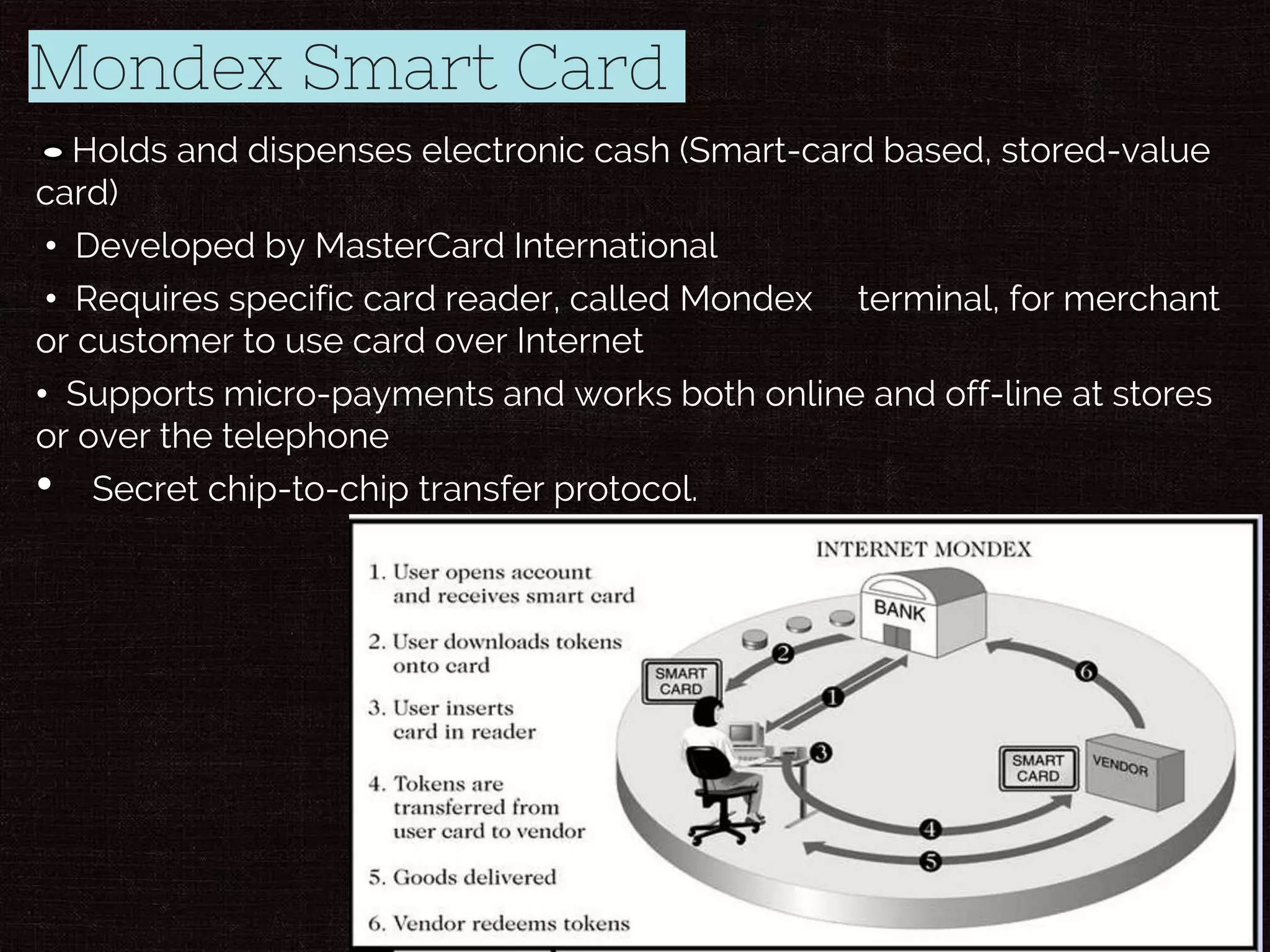
Mondex Smart Card
Holds and dispenses electronic cash (Smart-card based, stored-value
card)
• Developed by MasterCard International
• Requires specific card reader, called Mondex terminal, for merchant
or customer to use card over Internet
• Supports micro-payments and works both online and off-line at stores
or over the telephone
• Secret chip-to-chip transfer protocol.
23
Secure Electronic Transaction Protocol
• Jointly designed by MasterCard and Visa with backing of Microsoft,
Netscape, IBM, GTE, SAIC, and others
• Designed to provide security for card payments as they travel on the
Internet
• Contrasted with Secure Socket Layers (SSL) protocol, SET validates consumers
and merchants in addition to providing secure transmission
• SET specification Uses public key cryptography and digital certificates for
validating both consumers and merchants
• Provides privacy, data integrity, user and merchant authentication, and consumer
nonrepudiation
24
Latest Trend
• Growing Smartphone sales, and increasing adoption of online card
payments.
• Hybrid payments combining online and mobile methods are
expected to emerge. MasterCard already introduced such a solution
earlier this year, while Visa entered a partnership with Samsung to
encourage development of mobile
• Multi-Channel Gateways Become Retail Payment Hubs.
25
The future is MOBILE…..
• It is estimated that there are over 326 million cell phones, the vast
majority are smart phones, and over 60 million tablets were sold in the
last two years alone.
• Another important aspect to m-commerce are quick response (QR)
codes, which encourage consumers to scan barcodes with their
camera so they can be directed to an advert, voucher or
• NFC (Near Field Communication) is the latest payment method
introduced to the world.
• It is not based on cash in the wallet but storing card information on the
phone to be used in a mobile wallet or to use NFC.
26
Some secure EPS infrastructure
• Authentication
• Many tools available to confirm the authenticity of a user. Passwords and ID
numbers are used mostly
• Public Key Cryptography
• Use one public and one private to encrypt and decrypt data
• Sender can then encrypt the message with the public key and receiver can use the
private key to decrypt the message.
• Digital Signature
• An electronic one use to authenticate the identity of the sender of a message
• Secure Sockets Layer (SSL)
• commonly used protocol for managing the security of a message transmission
Uses the public-and-private key encryption system
• program layer located between HTTP and TCP
• Certificate
• The issuer verified the identity of the individual Symantec Certificates GeoTrust
27
How to select Best one
◎Is it Security ?
◎Is it Reliable?
◎ Is it Easy to Use?
28
Conclusion
• Expand Market beyond
Traditional geographic
market
• Override traditional
marketing system into
digital marketing
system.
• Made human life
convenient as a person
can pay his payments
online while he is taking
rest. 29
References
• Raja, J., Velmurgan, M.S., “E-payments: Problems and
Prospects”, Journal of Internet Banking and Commerce, April
2008, vol. 13, no. 1,
(http://www.arraydev.com/commerce/jibc/)
• Ecommerce, Strategy, Technology and Implementation
Gary P Schneider
• The 2010 Federal Reserve Payments Study by Noncash
Payment Trends in the United States: 2006 – 2009
• The Impact of Electronic Payments on Economic Growth
February 2013.
• Electronic Cash Payment Protocols and Systems
Jerry Gao
30

Vaishnavi e commerce

  • 1.
  • 2.
    hello! I AM Vaishnavi I amhere because I love to give presentations. You can find me at: @vaishnavi.in 2
  • 3.
    Disclaimer Let’s start withthe first set of slides 3 Presentations are intended for educational purposes only and do not replace independent professional judgment. Statements of fact and opinions expressed are those of Vaishnavi individually and, unless expressly stated to the contrary, are not the opinion or position of the Society of Actuaries, its cosponsors, or its committees. The Society of Actuaries does not endorse or approve, and assumes no responsibility for, the content, accuracy or completeness of the information presented. Attendees should note that sessions are audio-recorded and may be published in various media, including print, audio and video formats without further notice. Submitted To-Dr.Rajeshwari Trivedi (Asst. Professor) Submitted By-Vaishnavi B.Sc.(IT) 2nd Year
  • 4.
    “Electronic payment willcontinue to play an ever-growing and significant role in the development of e- commerce as well as the stimulation of consumer demand. Lucy Pen “ 4
  • 5.
    CONTENT • Introduction toE-payment • Modes of E-payment • Payment cards- • Intro to credit card, debit card & charge card • Acceptance and processing • Advantages and Disadvantages • Electronic cash • Introduction and concern of cash • Advantages Disadvantages • Check Free • Check Share • Electronic Wallet • Smart Card 5
  • 6.
    Introduction of E-Payment •An e-payment is paying For goods or services on the internet. It includes all financial operations using electronic devices, such as computers, smartphones or tablets. • E-payments come with various methods, like credit or debit card payments or bank transfers. • E-payment or Electronic payment is any digital financial payment transaction involving currency transfer between two or more parties Implementation of electronic payment systems is in its infancy and still evolving. • Electronic payments are far cheaper than the traditional method of mailing out paper invoices and then processing payments received 6
  • 7.
    Electronic Payment system •EPSs enable a customer to pay for the goods and services online by using integrated hardware and software systems. • An electronic payment is defined as a payment services that utilize ICT, including cryptography and telecommunications networks • EPS increase efficiency, improve security, enhance customer convenience and ease of use. • Electronic transfer: small but growing. • Electronic payments totaled 84.5 billion in 2009 for a value of $40.6 trillion in the United States. • The number of electronic payments increased at average annual rate of 9.3 percent between 2006 and 2009 in the United States. 7
  • 8.
  • 9.
    Mode of Payment! •Payment Cards • Electronic Cash • Check free • Micropayment System • Wallet • Smart Card 9
  • 10.
    Payment Card • Plasticcard containing an embedded microchip. • Electronic card payments continue to have a meaningful impact on the world. • Most of consumers use credit cards to pay for online purchases • Card transaction volume grew at an annual growth rate of 10.8% in 2010, compared to 8.4% growth in 2009. • More than 85% of worldwide consumer Internet purchases are paid for with credit cards, debit cards , web cards charge cards • Credit cards such as a Visa or a MasterCard, has a preset spending limit based on the user’s credit limit. • Debit cards removes the amount of the charge from the cardholder’s account and transfers it to the seller’s bank. • Charge cards such as one from American Express, carries no preset spending limit. 10
  • 11.
    Technologies in Paymentcard • Magnetic stripe – 140 bytes, cost $0.20-0.75 • Memory cards – 1-4 KB memory, no processor, cost $1.00-2.50 • Optical memory cards – 4 megabytes read-only (CD-like), cost $7.00-12.00 • Microprocessor cards – Embedded microprocessor o (OLD) 8- bit processor, 16 KB ROM, 512 bytes RAM o Equivalent power to IBM XT PC, cost $7.00-15.00 o 32-bit processors now available 11
  • 12.
    BIG CONCEPT Bring theattention of your audience over a key concept using icons or illustrations 12
  • 13.
    Advantages and Disadvantages . Advantages: •Payment cards provide fraud protection. • They have worldwide acceptance. • They are good for online transactions. • Atomic, debt-free transactions 2 • Feasible for very small transactions (information commerce) • (Potentially) anonymous • Security of physical storage • (Potentially) currency-neutral Disadvantages: • Payment card service companies charge merchants per-transaction fees and monthly processing fees. • Low maximum transaction limit (not suitable for B2B or most B2C). • High Infrastructure costs (not suitable for C2C) . 13
  • 14.
    Electronic fund transfer •EFT is used for transferring money from one bank account directly to another without any paper money changing hands . • It can be Direct debit payments or Electronic bill payment in online banking • EFT transactions are known by a number of names across countries and different payment systems. • For example, in the United States, they may be referred to as "electronic checks" or "e-checks". In the United Kingdom, the term "bank transfer" and "bank payment" are used, while in several other European countries "giro transfer“ is the common term. 14
  • 15.
    Electronic Cash System •Electronic cash is a general term that describes the attempts of several companies to create a value storage and exchange system that operates online in much the same way that government- issued currency operates in the physical world. • Concerns about electronic payment methods include: • Privacy • Security • Independence • Portability • Convenience • System usually is developed based on an electronic payment protocol which supports payment transactions. • Basic attributes are Acceptability, Guaranteed payment, No transaction chargers and Anonymity • PayPal is still growing rapidly with 78 million active accounts (200 million total) worldwide. PayPal MyCheckFree Bit coin 15
  • 16.
    Advantages and Disadvantages •ADVANTAGES: • Electronic cash transactions are more efficient and less costly than other methods. • The distance that an electronic transaction must travel does not affect cost. • The fixed cost of hardware to handle electronic cash is nearly zero. • Electronic cash does not require that one party have any special authorization. • DISADVANTAGES: • Electronic cash provides no audit trail. • Because true electronic cash is not traceable, money laundering is a problem. • Electronic cash is susceptible to forgery. • So far, electronic cash is a commercial flop. 16
  • 17.
    Check Free • Ancheck Free is an electronic version of paper check. Fast check processing and very low transaction cost. Digital signatures can be seen. • This was the first form of internet-based payment used by the U.S. Treasury for making large online payments. • Check Free provides online payment processing services to both large corporations and individual Internet users. • Check Free provides part of the technology that the Web portal Yahoo! uses to provide its Yahoo! Bill Pay service. 17
  • 18.
    Micropayment system • Transactioncan become costly when customers purchase inexpensive items. Used for small payments on the web • Click share • Click share is an electronic cash system aimed at magazine and newspaper publishers. • Users with an ISP that supports Click share are automatically registered with Click share. • Click share tracks users with the standard HTTP Web protocol. IBM micro payment system 18
  • 19.
    Electronic Wallet • Anelectronic wallet serves a function similar to a physical wallet: • holds credit cards, electronic cash, owner identification, and owner contact information • provides owner contact information at an electronic commerce site’s checkout counter • Some electronic wallets contain an address book. • Electronic wallets make shopping more efficient. • Electronic wallets fall into two categories based on where they are stored: • Server-side electronic wallet • Client-side electronic wallet • Electronic wallets store shipping and billing information, including a consumer’s first and last names, street address, city, state, country, and zip or postal code. • E.g. Microsoft .NET passport ,yahoo! Wallet 19
  • 20.
    Versions of E-Wallet •Works in many different stores to speed checkout • Amazon.com one of the first online merchants to eliminate repeat form-filling for purchases • AGILE WALLET – Developed by CyberCash – Allows customers to enter credit card and identifying information once, stored on a central server – Information pops up in supported merchants’ payment pages, allowing one-click payment – Does not support smart cards or Cyber Cash, but company expects to soon • E-Wallet – Developed by Launchpad Technologies – Free wallet software that stores credit card and personal information on users’ computer, not on a central server; info is dragged into payment form from E-Wallet – Information is encrypted and password protected – Works with Netscape and Internet Explorer • MICROSOFT WALLET – Comes pre-installed in Internet Explorer 4.0, but not in Netscape – All information is encrypted and password protected – Microsoft Wallet Merchant directory shows merchants setup to accept Microsoft Wallet 20
  • 21.
  • 22.
    Smart Card • Asmart card is a plastic card with an embedded microchip containing information about you. • A smart card can store about 100 times the amount of information that a magnetic strip plastic card can store. • A smart card contains private user information, such as financial facts, private encryption keys, account information, credit card numbers, health insurance information, etc. E.g. Mondex smart card , Octopus smart card 22
  • 23.
    Mondex Smart Card Holdsand dispenses electronic cash (Smart-card based, stored-value card) • Developed by MasterCard International • Requires specific card reader, called Mondex terminal, for merchant or customer to use card over Internet • Supports micro-payments and works both online and off-line at stores or over the telephone • Secret chip-to-chip transfer protocol. 23
  • 24.
    Secure Electronic TransactionProtocol • Jointly designed by MasterCard and Visa with backing of Microsoft, Netscape, IBM, GTE, SAIC, and others • Designed to provide security for card payments as they travel on the Internet • Contrasted with Secure Socket Layers (SSL) protocol, SET validates consumers and merchants in addition to providing secure transmission • SET specification Uses public key cryptography and digital certificates for validating both consumers and merchants • Provides privacy, data integrity, user and merchant authentication, and consumer nonrepudiation 24
  • 25.
    Latest Trend • GrowingSmartphone sales, and increasing adoption of online card payments. • Hybrid payments combining online and mobile methods are expected to emerge. MasterCard already introduced such a solution earlier this year, while Visa entered a partnership with Samsung to encourage development of mobile • Multi-Channel Gateways Become Retail Payment Hubs. 25
  • 26.
    The future isMOBILE….. • It is estimated that there are over 326 million cell phones, the vast majority are smart phones, and over 60 million tablets were sold in the last two years alone. • Another important aspect to m-commerce are quick response (QR) codes, which encourage consumers to scan barcodes with their camera so they can be directed to an advert, voucher or • NFC (Near Field Communication) is the latest payment method introduced to the world. • It is not based on cash in the wallet but storing card information on the phone to be used in a mobile wallet or to use NFC. 26
  • 27.
    Some secure EPSinfrastructure • Authentication • Many tools available to confirm the authenticity of a user. Passwords and ID numbers are used mostly • Public Key Cryptography • Use one public and one private to encrypt and decrypt data • Sender can then encrypt the message with the public key and receiver can use the private key to decrypt the message. • Digital Signature • An electronic one use to authenticate the identity of the sender of a message • Secure Sockets Layer (SSL) • commonly used protocol for managing the security of a message transmission Uses the public-and-private key encryption system • program layer located between HTTP and TCP • Certificate • The issuer verified the identity of the individual Symantec Certificates GeoTrust 27
  • 28.
    How to selectBest one ◎Is it Security ? ◎Is it Reliable? ◎ Is it Easy to Use? 28
  • 29.
    Conclusion • Expand Marketbeyond Traditional geographic market • Override traditional marketing system into digital marketing system. • Made human life convenient as a person can pay his payments online while he is taking rest. 29
  • 30.
    References • Raja, J.,Velmurgan, M.S., “E-payments: Problems and Prospects”, Journal of Internet Banking and Commerce, April 2008, vol. 13, no. 1, (http://www.arraydev.com/commerce/jibc/) • Ecommerce, Strategy, Technology and Implementation Gary P Schneider • The 2010 Federal Reserve Payments Study by Noncash Payment Trends in the United States: 2006 – 2009 • The Impact of Electronic Payments on Economic Growth February 2013. • Electronic Cash Payment Protocols and Systems Jerry Gao 30