
Web Development
Hypertext Mark-up
Language (HTML)
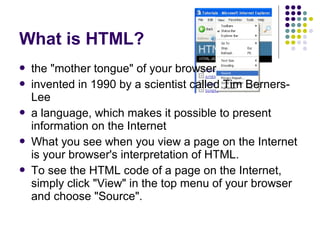
 the "mother tongue" of your browser
 invented in 1990 by a scientist called Tim Berners-
Lee
 a language, which makes it possible to present
information on the Internet
 What you see when you view a page on the Internet
is your browser's interpretation of HTML.
 To see the HTML code of a page on the Internet,
simply click "View" in the top menu of your browser
and choose "Source".
What is HTML?
What can I use HTML for?
 HTML is used to make websites. It is as simple as
that!
 HTML is an abbreviation of "HyperText Mark-up
Language" - which is already more than you need to
know at this stage. However, for the sake of good
order, let us explain in greater detail.
 Hyper is the opposite of linear.
 Text is self-explanatory.
 Mark-up is what you do with the text. You are marking up
the text the same way you do in a text editing program with
headings, bullets and bold text and so on.
 Language is what HTML is. It uses many English words.
What is needed?
 a "browser". A browser is the program that
makes it possible to browse and open
websites.
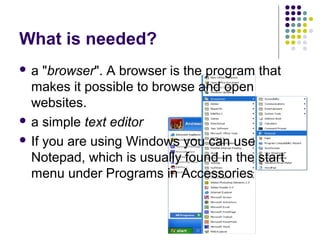
 a simple text editor
 If you are using Windows you can use
Notepad, which is usually found in the start
menu under Programs in Accessories
Elements & Tags
 Tags are labels you use to mark up the begining
and end of an element.
 All tags have the same format: they begin with a
less-than sign "<" and end with a greater-than sign
">".
 Generally, there are two kinds of tags - opening
tags: <html> and closing tags: </html>.
 The only difference between an opening tag and a
closing tag is the forward slash "/". You label content
by putting it between an opening tag and a closing
tag.
Document Tags
 Document tags define the overall structure of
an HTML document.
 There are four tags every HTML document
should have. These tags define the what type
of document it is, and the major sections.
These tags are <html>, <head>, <title> and
<body>.
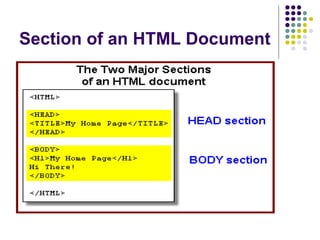
Section of an HTML Document
Attributes
 elements give structure to a HTML document
and tells the browser how you want your
website to be presented (for example, <br />
informs the browser to make a line break).
 In some elements you can add more
information. Such additional information is
called an attribute.
 Ex: <body style="background-color: red;">
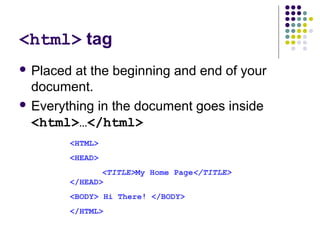
<html> tag
 Placed at the beginning and end of your
document.
 Everything in the document goes inside
<html>…</html>
<HTML>
<HEAD>
<TITLE>My Home Page</TITLE>
</HEAD>
<BODY> Hi There! </BODY>
</HTML>
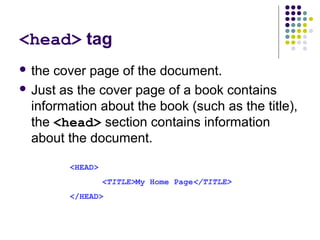
<head> tag
 the cover page of the document.
 Just as the cover page of a book contains
information about the book (such as the title),
the <head> section contains information
about the document.
<HEAD>
<TITLE>My Home Page</TITLE>
</HEAD>
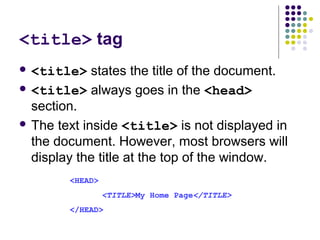
<title> tag
 <title> states the title of the document.
 <title> always goes in the <head>
section.
 The text inside <title> is not displayed in
the document. However, most browsers will
display the title at the top of the window.
<HEAD>
<TITLE>My Home Page</TITLE>
</HEAD>
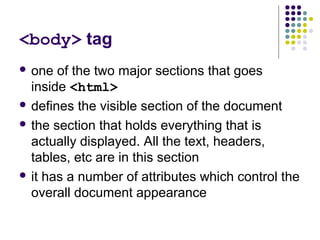
<body> tag
 one of the two major sections that goes
inside <html>
 defines the visible section of the document
 the section that holds everything that is
actually displayed. All the text, headers,
tables, etc are in this section
 it has a number of attributes which control the
overall document appearance
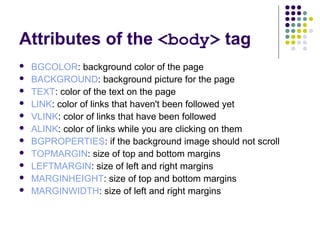
Attributes of the <body> tag
 BGCOLOR: background color of the page
 BACKGROUND: background picture for the page
 TEXT: color of the text on the page
 LINK: color of links that haven't been followed yet
 VLINK: color of links that have been followed
 ALINK: color of links while you are clicking on them
 BGPROPERTIES: if the background image should not scroll
 TOPMARGIN: size of top and bottom margins
 LEFTMARGIN: size of left and right margins
 MARGINHEIGHT: size of top and bottom margins
 MARGINWIDTH: size of left and right margins
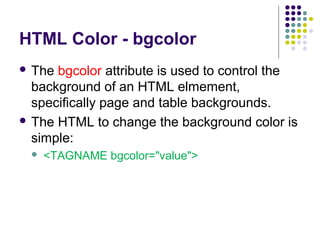
HTML Color - bgcolor
 The bgcolor attribute is used to control the
background of an HTML elmement,
specifically page and table backgrounds.
 The HTML to change the background color is
simple:
 <TAGNAME bgcolor="value">
HTML Color Coding System -
Color Names
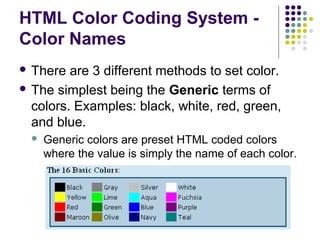
 There are 3 different methods to set color.
 The simplest being the Generic terms of
colors. Examples: black, white, red, green,
and blue.
 Generic colors are preset HTML coded colors
where the value is simply the name of each color.
HTML Coloring System - RGB
Values
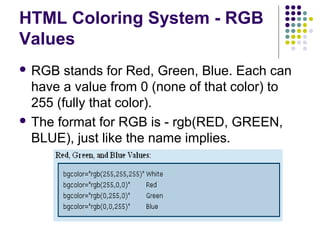
 RGB stands for Red, Green, Blue. Each can
have a value from 0 (none of that color) to
255 (fully that color).
 The format for RGB is - rgb(RED, GREEN,
BLUE), just like the name implies.
HTML Coloring System -
Hexadecimal
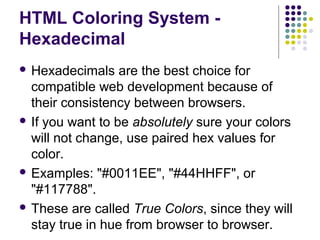
 Hexadecimals are the best choice for
compatible web development because of
their consistency between browsers.
 If you want to be absolutely sure your colors
will not change, use paired hex values for
color.
 Examples: "#0011EE", "#44HHFF", or
"#117788".
 These are called True Colors, since they will
stay true in hue from browser to browser.
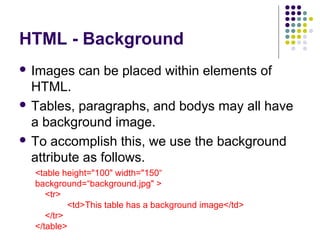
HTML - Background
 Images can be placed within elements of
HTML.
 Tables, paragraphs, and bodys may all have
a background image.
 To accomplish this, we use the background
attribute as follows.
<table height="100" width="150“
background=“background.jpg" >
<tr>
<td>This table has a background image</td>
</tr>
</table>
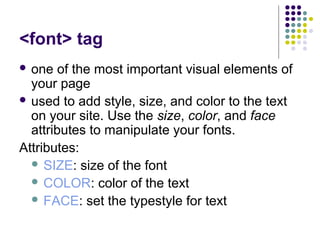
<font> tag
 one of the most important visual elements of
your page
 used to add style, size, and color to the text
on your site. Use the size, color, and face
attributes to manipulate your fonts.
Attributes:
 SIZE: size of the font
 COLOR: color of the text
 FACE: set the typestyle for text
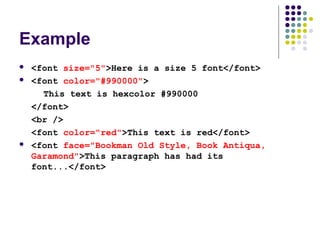
Example
 <font size="5">Here is a size 5 font</font>
 <font color="#990000">
This text is hexcolor #990000
</font>
<br />
<font color="red">This text is red</font>
 <font face="Bookman Old Style, Book Antiqua,
Garamond">This paragraph has had its
font...</font>
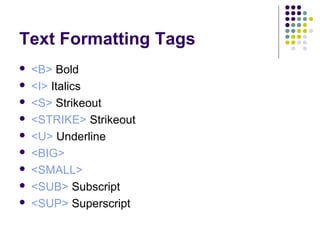
Text Formatting Tags
 <B> Bold
 <I> Italics
 <S> Strikeout
 <STRIKE> Strikeout
 <U> Underline
 <BIG>
 <SMALL>
 <SUB> Subscript
 <SUP> Superscript
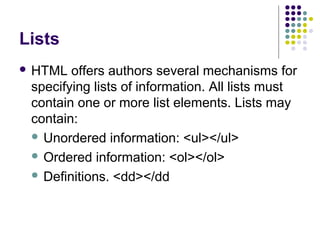
Lists
 HTML offers authors several mechanisms for
specifying lists of information. All lists must
contain one or more list elements. Lists may
contain:
 Unordered information: <ul></ul>
 Ordered information: <ol></ol>
 Definitions. <dd></dd
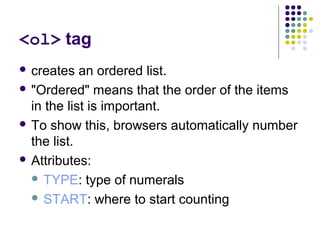
<ol> tag
 creates an ordered list.
 "Ordered" means that the order of the items
in the list is important.
 To show this, browsers automatically number
the list.
 Attributes:
 TYPE: type of numerals
 START: where to start counting
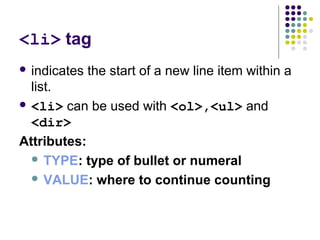
<li> tag
 indicates the start of a new line item within a
list.
 <li> can be used with <ol>,<ul> and
<dir>
Attributes:
 TYPE: type of bullet or numeral
 VALUE: where to continue counting
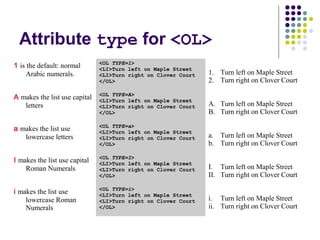
Attribute type for <OL>
1 is the default: normal
Arabic numerals.
<OL TYPE=1>
<LI>Turn left on Maple Street
<LI>Turn right on Clover Court
</OL>
1. Turn left on Maple Street
2. Turn right on Clover Court
A makes the list use capital
letters
<OL TYPE=A>
<LI>Turn left on Maple Street
<LI>Turn right on Clover Court
</OL>
A. Turn left on Maple Street
B. Turn right on Clover Court
a makes the list use
lowercase letters
<OL TYPE=a>
<LI>Turn left on Maple Street
<LI>Turn right on Clover Court
</OL>
a. Turn left on Maple Street
b. Turn right on Clover Court
I makes the list use capital
Roman Numerals
<OL TYPE=I>
<LI>Turn left on Maple Street
<LI>Turn right on Clover Court
</OL>
I. Turn left on Maple Street
II. Turn right on Clover Court
i makes the list use
lowercase Roman
Numerals
<OL TYPE=i>
<LI>Turn left on Maple Street
<LI>Turn right on Clover Court
</OL>
i. Turn left on Maple Street
ii. Turn right on Clover Court
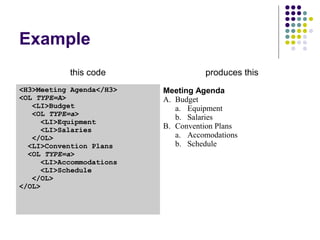
Example
this code produces this
<H3>Meeting Agenda</H3>
<OL TYPE=A>
<LI>Budget
<OL TYPE=a>
<LI>Equipment
<LI>Salaries
</OL>
<LI>Convention Plans
<OL TYPE=a>
<LI>Accommodations
<LI>Schedule
</OL>
</OL>
Meeting Agenda
A. Budget
a. Equipment
b. Salaries
B. Convention Plans
a. Accomodations
b. Schedule
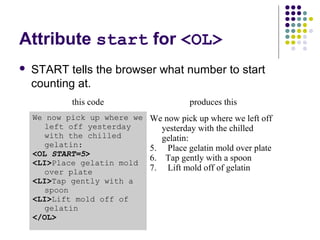
Attribute start for <OL>
 START tells the browser what number to start
counting at.
this code produces this
We now pick up where we
left off yesterday
with the chilled
gelatin:
<OL START=5>
<LI>Place gelatin mold
over plate
<LI>Tap gently with a
spoon
<LI>Lift mold off of
gelatin
</OL>
We now pick up where we left off
yesterday with the chilled
gelatin:
5. Place gelatin mold over plate
6. Tap gently with a spoon
7. Lift mold off of gelatin
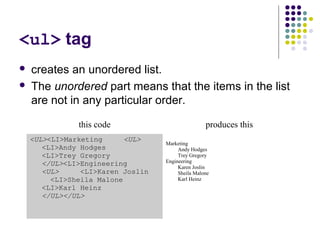
<ul> tag
 creates an unordered list.
 The unordered part means that the items in the list
are not in any particular order.
this code produces this
<UL><LI>Marketing <UL>
<LI>Andy Hodges
<LI>Trey Gregory
</UL><LI>Engineering
<UL> <LI>Karen Joslin
<LI>Sheila Malone
<LI>Karl Heinz
</UL></UL>
Marketing
Andy Hodges
Trey Gregory
Engineering
Karen Joslin
Sheila Malone
Karl Heinz
HTML Links and Anchors
 The ability to link from one document to
another is one of the most central features of
HTML .
 These connections are made using anchor
tags to create links.
 Internal - Links to anchors on the current page
 Local - Links to other pages within your domain
 Global - Links to other domains outside of your
site
<a> tag
 the <a></a> tags to define the start and
ending of an anchor.
 the cornerstone of HTML
 the tag that makes hypertext hypertext.
 the tag you use to make hyperlinks: the text
that you can click on in your web browser to
go to another web page.
Attributes of <a></a>
 HREF: URL you are linking to
 NAME: name a section of the page
 TARGET: controls where the new document will be
displayed when the user follows a link
 "_blank"
 "_parent"
 "_self"
 "_top"
 TITLE: suggested title for the document to be
opened
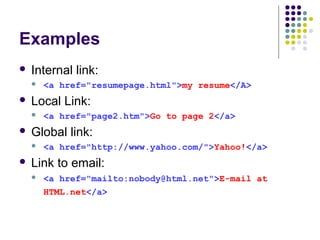
Examples
 Internal link:
 <a href="resumepage.html">my resume</A>
 Local Link:
 <a href="page2.htm">Go to page 2</a>
 Global link:
 <a href="http://www.yahoo.com/">Yahoo!</a>
 Link to email:
 <a href="mailto:nobody@html.net">E-mail at
HTML.net</a>
Images
 Images are a staple of any web designer, so
it is very important that you understand how
to use them properly.
 Images made the web cool
 The <img> tag is used to add images to
HTML documents
Attributes of the <img> tag
 SRC: where to get the picture
 ALT: text to show if you don't show the picture
 WIDTH: how wide is the picture
 HEIGHT: how tall is the picture
 ALIGN: how text should flow around the picture
 BORDER: border around the picture
 HSPACE: horizontal distance between the picture
and the text
 VSPACE: vertical distance between the picture and
the text
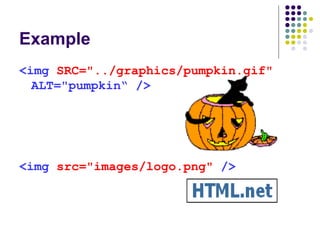
Example
<img SRC="../graphics/pumpkin.gif"
ALT="pumpkin“ />
<img src="images/logo.png" />
HTML Tables
 Tables are a handy way to create a site's
layout
 The <table> tag is used to begin a table.
 Within a table element are the <tr> (table
rows) and <td> (table columns) tags.
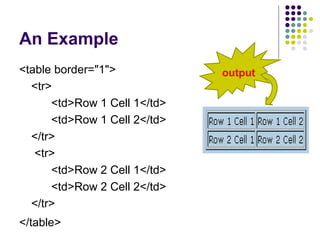
An Example
<table border="1">
<tr>
<td>Row 1 Cell 1</td>
<td>Row 1 Cell 2</td>
</tr>
<tr>
<td>Row 2 Cell 1</td>
<td>Row 2 Cell 2</td>
</tr>
</table>
output
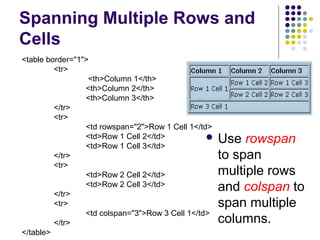
Spanning Multiple Rows and
Cells
 Use rowspan
to span
multiple rows
and colspan to
span multiple
columns.
<table border="1">
<tr>
<th>Column 1</th>
<th>Column 2</th>
<th>Column 3</th>
</tr>
<tr>
<td rowspan="2">Row 1 Cell 1</td>
<td>Row 1 Cell 2</td>
<td>Row 1 Cell 3</td>
</tr>
<tr>
<td>Row 2 Cell 2</td>
<td>Row 2 Cell 3</td>
</tr>
<tr>
<td colspan="3">Row 3 Cell 1</td>
</tr>
</table>
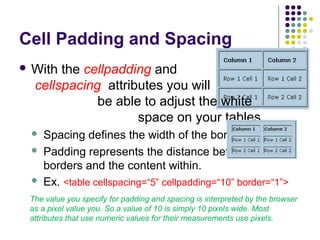
Cell Padding and Spacing
 With the cellpadding and
cellspacing attributes you will
be able to adjust the white
space on your tables.
 Spacing defines the width of the border
 Padding represents the distance between cell
borders and the content within.
 Ex. <table cellspacing=“5” cellpadding=“10” border=“1”>
The value you specify for padding and spacing is interpreted by the browser
as a pixel value you. So a value of 10 is simply 10 pixels wide. Most
attributes that use numeric values for their measurements use pixels.
Line Breaks
 Line breaks are different then most of the
tags we have seen so far.
 A line break ends the line you are currently
on and resumes on the next line.
 Placing <br /> within the code is the same as
pressing the return key in a word processor.
<p>
Will Mateson<br />
Box 61<br />
Cleveland, Ohio<br />
</p>
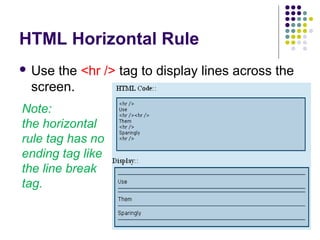
HTML Horizontal Rule
 Use the <hr /> tag to display lines across the
screen.
Note:
the horizontal
rule tag has no
ending tag like
the line break
tag.
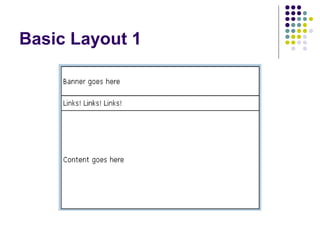
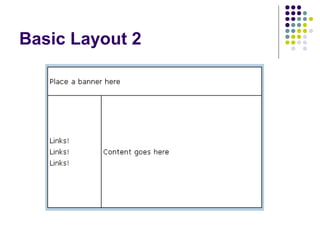
HTML Layout
 HTML layout is very basic.
 Not many options exist with the body tag
alone.
 Tables on the other hand are the bread and
butter of HTML layouts.
 Any element may be placed inside of a table
including tables themselves.
Basic Layout 1
Basic Layout 2
END OF LECTURE
Web Design and Development Workshop-Seminar

Web Development

  • 1.
  • 2.
     the "mothertongue" of your browser  invented in 1990 by a scientist called Tim Berners- Lee  a language, which makes it possible to present information on the Internet  What you see when you view a page on the Internet is your browser's interpretation of HTML.  To see the HTML code of a page on the Internet, simply click "View" in the top menu of your browser and choose "Source". What is HTML?
  • 3.
    What can Iuse HTML for?  HTML is used to make websites. It is as simple as that!  HTML is an abbreviation of "HyperText Mark-up Language" - which is already more than you need to know at this stage. However, for the sake of good order, let us explain in greater detail.  Hyper is the opposite of linear.  Text is self-explanatory.  Mark-up is what you do with the text. You are marking up the text the same way you do in a text editing program with headings, bullets and bold text and so on.  Language is what HTML is. It uses many English words.
  • 4.
    What is needed? a "browser". A browser is the program that makes it possible to browse and open websites.  a simple text editor  If you are using Windows you can use Notepad, which is usually found in the start menu under Programs in Accessories
  • 5.
    Elements & Tags Tags are labels you use to mark up the begining and end of an element.  All tags have the same format: they begin with a less-than sign "<" and end with a greater-than sign ">".  Generally, there are two kinds of tags - opening tags: <html> and closing tags: </html>.  The only difference between an opening tag and a closing tag is the forward slash "/". You label content by putting it between an opening tag and a closing tag.
  • 6.
    Document Tags  Documenttags define the overall structure of an HTML document.  There are four tags every HTML document should have. These tags define the what type of document it is, and the major sections. These tags are <html>, <head>, <title> and <body>.
  • 7.
    Section of anHTML Document
  • 8.
    Attributes  elements givestructure to a HTML document and tells the browser how you want your website to be presented (for example, <br /> informs the browser to make a line break).  In some elements you can add more information. Such additional information is called an attribute.  Ex: <body style="background-color: red;">
  • 9.
    <html> tag  Placedat the beginning and end of your document.  Everything in the document goes inside <html>…</html> <HTML> <HEAD> <TITLE>My Home Page</TITLE> </HEAD> <BODY> Hi There! </BODY> </HTML>
  • 10.
    <head> tag  thecover page of the document.  Just as the cover page of a book contains information about the book (such as the title), the <head> section contains information about the document. <HEAD> <TITLE>My Home Page</TITLE> </HEAD>
  • 11.
    <title> tag  <title>states the title of the document.  <title> always goes in the <head> section.  The text inside <title> is not displayed in the document. However, most browsers will display the title at the top of the window. <HEAD> <TITLE>My Home Page</TITLE> </HEAD>
  • 12.
    <body> tag  oneof the two major sections that goes inside <html>  defines the visible section of the document  the section that holds everything that is actually displayed. All the text, headers, tables, etc are in this section  it has a number of attributes which control the overall document appearance
  • 13.
    Attributes of the<body> tag  BGCOLOR: background color of the page  BACKGROUND: background picture for the page  TEXT: color of the text on the page  LINK: color of links that haven't been followed yet  VLINK: color of links that have been followed  ALINK: color of links while you are clicking on them  BGPROPERTIES: if the background image should not scroll  TOPMARGIN: size of top and bottom margins  LEFTMARGIN: size of left and right margins  MARGINHEIGHT: size of top and bottom margins  MARGINWIDTH: size of left and right margins
  • 14.
    HTML Color -bgcolor  The bgcolor attribute is used to control the background of an HTML elmement, specifically page and table backgrounds.  The HTML to change the background color is simple:  <TAGNAME bgcolor="value">
  • 15.
    HTML Color CodingSystem - Color Names  There are 3 different methods to set color.  The simplest being the Generic terms of colors. Examples: black, white, red, green, and blue.  Generic colors are preset HTML coded colors where the value is simply the name of each color.
  • 16.
    HTML Coloring System- RGB Values  RGB stands for Red, Green, Blue. Each can have a value from 0 (none of that color) to 255 (fully that color).  The format for RGB is - rgb(RED, GREEN, BLUE), just like the name implies.
  • 17.
    HTML Coloring System- Hexadecimal  Hexadecimals are the best choice for compatible web development because of their consistency between browsers.  If you want to be absolutely sure your colors will not change, use paired hex values for color.  Examples: "#0011EE", "#44HHFF", or "#117788".  These are called True Colors, since they will stay true in hue from browser to browser.
  • 18.
    HTML - Background Images can be placed within elements of HTML.  Tables, paragraphs, and bodys may all have a background image.  To accomplish this, we use the background attribute as follows. <table height="100" width="150“ background=“background.jpg" > <tr> <td>This table has a background image</td> </tr> </table>
  • 19.
    <font> tag  oneof the most important visual elements of your page  used to add style, size, and color to the text on your site. Use the size, color, and face attributes to manipulate your fonts. Attributes:  SIZE: size of the font  COLOR: color of the text  FACE: set the typestyle for text
  • 20.
    Example  <font size="5">Hereis a size 5 font</font>  <font color="#990000"> This text is hexcolor #990000 </font> <br /> <font color="red">This text is red</font>  <font face="Bookman Old Style, Book Antiqua, Garamond">This paragraph has had its font...</font>
  • 21.
    Text Formatting Tags <B> Bold  <I> Italics  <S> Strikeout  <STRIKE> Strikeout  <U> Underline  <BIG>  <SMALL>  <SUB> Subscript  <SUP> Superscript
  • 22.
    Lists  HTML offersauthors several mechanisms for specifying lists of information. All lists must contain one or more list elements. Lists may contain:  Unordered information: <ul></ul>  Ordered information: <ol></ol>  Definitions. <dd></dd
  • 23.
    <ol> tag  createsan ordered list.  "Ordered" means that the order of the items in the list is important.  To show this, browsers automatically number the list.  Attributes:  TYPE: type of numerals  START: where to start counting
  • 24.
    <li> tag  indicatesthe start of a new line item within a list.  <li> can be used with <ol>,<ul> and <dir> Attributes:  TYPE: type of bullet or numeral  VALUE: where to continue counting
  • 25.
    Attribute type for<OL> 1 is the default: normal Arabic numerals. <OL TYPE=1> <LI>Turn left on Maple Street <LI>Turn right on Clover Court </OL> 1. Turn left on Maple Street 2. Turn right on Clover Court A makes the list use capital letters <OL TYPE=A> <LI>Turn left on Maple Street <LI>Turn right on Clover Court </OL> A. Turn left on Maple Street B. Turn right on Clover Court a makes the list use lowercase letters <OL TYPE=a> <LI>Turn left on Maple Street <LI>Turn right on Clover Court </OL> a. Turn left on Maple Street b. Turn right on Clover Court I makes the list use capital Roman Numerals <OL TYPE=I> <LI>Turn left on Maple Street <LI>Turn right on Clover Court </OL> I. Turn left on Maple Street II. Turn right on Clover Court i makes the list use lowercase Roman Numerals <OL TYPE=i> <LI>Turn left on Maple Street <LI>Turn right on Clover Court </OL> i. Turn left on Maple Street ii. Turn right on Clover Court
  • 26.
    Example this code producesthis <H3>Meeting Agenda</H3> <OL TYPE=A> <LI>Budget <OL TYPE=a> <LI>Equipment <LI>Salaries </OL> <LI>Convention Plans <OL TYPE=a> <LI>Accommodations <LI>Schedule </OL> </OL> Meeting Agenda A. Budget a. Equipment b. Salaries B. Convention Plans a. Accomodations b. Schedule
  • 27.
    Attribute start for<OL>  START tells the browser what number to start counting at. this code produces this We now pick up where we left off yesterday with the chilled gelatin: <OL START=5> <LI>Place gelatin mold over plate <LI>Tap gently with a spoon <LI>Lift mold off of gelatin </OL> We now pick up where we left off yesterday with the chilled gelatin: 5. Place gelatin mold over plate 6. Tap gently with a spoon 7. Lift mold off of gelatin
  • 28.
    <ul> tag  createsan unordered list.  The unordered part means that the items in the list are not in any particular order. this code produces this <UL><LI>Marketing <UL> <LI>Andy Hodges <LI>Trey Gregory </UL><LI>Engineering <UL> <LI>Karen Joslin <LI>Sheila Malone <LI>Karl Heinz </UL></UL> Marketing Andy Hodges Trey Gregory Engineering Karen Joslin Sheila Malone Karl Heinz
  • 29.
    HTML Links andAnchors  The ability to link from one document to another is one of the most central features of HTML .  These connections are made using anchor tags to create links.  Internal - Links to anchors on the current page  Local - Links to other pages within your domain  Global - Links to other domains outside of your site
  • 30.
    <a> tag  the<a></a> tags to define the start and ending of an anchor.  the cornerstone of HTML  the tag that makes hypertext hypertext.  the tag you use to make hyperlinks: the text that you can click on in your web browser to go to another web page.
  • 31.
    Attributes of <a></a> HREF: URL you are linking to  NAME: name a section of the page  TARGET: controls where the new document will be displayed when the user follows a link  "_blank"  "_parent"  "_self"  "_top"  TITLE: suggested title for the document to be opened
  • 32.
    Examples  Internal link: <a href="resumepage.html">my resume</A>  Local Link:  <a href="page2.htm">Go to page 2</a>  Global link:  <a href="http://www.yahoo.com/">Yahoo!</a>  Link to email:  <a href="mailto:nobody@html.net">E-mail at HTML.net</a>
  • 33.
    Images  Images area staple of any web designer, so it is very important that you understand how to use them properly.  Images made the web cool  The <img> tag is used to add images to HTML documents
  • 34.
    Attributes of the<img> tag  SRC: where to get the picture  ALT: text to show if you don't show the picture  WIDTH: how wide is the picture  HEIGHT: how tall is the picture  ALIGN: how text should flow around the picture  BORDER: border around the picture  HSPACE: horizontal distance between the picture and the text  VSPACE: vertical distance between the picture and the text
  • 35.
  • 36.
    HTML Tables  Tablesare a handy way to create a site's layout  The <table> tag is used to begin a table.  Within a table element are the <tr> (table rows) and <td> (table columns) tags.
  • 37.
    An Example <table border="1"> <tr> <td>Row1 Cell 1</td> <td>Row 1 Cell 2</td> </tr> <tr> <td>Row 2 Cell 1</td> <td>Row 2 Cell 2</td> </tr> </table> output
  • 38.
    Spanning Multiple Rowsand Cells  Use rowspan to span multiple rows and colspan to span multiple columns. <table border="1"> <tr> <th>Column 1</th> <th>Column 2</th> <th>Column 3</th> </tr> <tr> <td rowspan="2">Row 1 Cell 1</td> <td>Row 1 Cell 2</td> <td>Row 1 Cell 3</td> </tr> <tr> <td>Row 2 Cell 2</td> <td>Row 2 Cell 3</td> </tr> <tr> <td colspan="3">Row 3 Cell 1</td> </tr> </table>
  • 39.
    Cell Padding andSpacing  With the cellpadding and cellspacing attributes you will be able to adjust the white space on your tables.  Spacing defines the width of the border  Padding represents the distance between cell borders and the content within.  Ex. <table cellspacing=“5” cellpadding=“10” border=“1”> The value you specify for padding and spacing is interpreted by the browser as a pixel value you. So a value of 10 is simply 10 pixels wide. Most attributes that use numeric values for their measurements use pixels.
  • 40.
    Line Breaks  Linebreaks are different then most of the tags we have seen so far.  A line break ends the line you are currently on and resumes on the next line.  Placing <br /> within the code is the same as pressing the return key in a word processor. <p> Will Mateson<br /> Box 61<br /> Cleveland, Ohio<br /> </p>
  • 41.
    HTML Horizontal Rule Use the <hr /> tag to display lines across the screen. Note: the horizontal rule tag has no ending tag like the line break tag.
  • 42.
    HTML Layout  HTMLlayout is very basic.  Not many options exist with the body tag alone.  Tables on the other hand are the bread and butter of HTML layouts.  Any element may be placed inside of a table including tables themselves.
  • 43.
  • 44.
  • 45.
    END OF LECTURE WebDesign and Development Workshop-Seminar