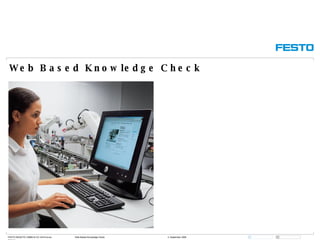

Web  Based  Knowledge Check
Contents Festo Training and Consulting 1
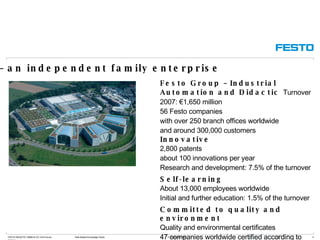
Festo –  an independent family enterprise Festo Group – Industrial Automation and Didactic  T urnover 2007: €1,650 million  56 Festo companies with over 250 branch offices worldwide and around 300,000 customers  Innovative 2,800 patents  about 100 innovations per year Research and development: 7.5% of the turnover Self-learning About 13,000 employees worldwide Initial and further education: 1.5% of the turnover Committed to quality and environment Quality and environmental certificates  47 companies worldwide certified according to  ISO 9001, 3 companies according to ISO 14001
Festo Group – Supplier of solutions for automation and learning Industrial Automation Machines and  systems People and  organisation Increase of productivity for and Components Systems and services Didactic Training  and Consulting Learning  systems
Festo Didactic – member of the Festo Group Festo Didactic in Denkendorf  Turnover 2007  About 80 million Euro  in 70 countries Staff Around 400 employees in worldwide  56 independent Festo companies  Business  division : Training and Consulting Outstanding brand, prized quality Industry experience for over 80 years Global action, local thinking  More than one million attendees Standardised trainings in more than 50 countries, culturally adgooded “ Train-the-Trainer” approach Sustained strengthening of the customer’s organisation, even after a project ends
Argentina Australia Austria Belgium Brazil Bulgaria Canada Chile China Colombia Croatia Czech Republic Denmark Egypt International training facilities and experience Sao Paolo, Brazil Estonia Finland France Germany Great Britain Greece Hong Kong Hungary India Indonesia Iran Ireland Israel Italy Japan Korean Republic Latvia Lithuania Malaysia Mexico Netherlands New Zealand Norway Peru Philippines Poland Portugal Romania Russia Singapore Slovakia Slovenia South Africa Spain Sweden Switzerland Taiwan Thailand Turkey Ukraine USA Venezuela Yokohama, Japan Johannesburg, South Africa
Contents
„ Knowledge is only of value  if it is purposefully applied!“ Information  Success in the market  Competitiveness  Trust of shareholders    ¥ ,€, $, £ Skills Knowledge is the basis  for skills Skills turn  into competence by application  Knowledge Information turns  into knowledge  by  linking it to a context Competence Competence based training: Information turns into competence
Competence based training:  Levels of competence  Source: Levels of Competence as defined by G.E. Miller in :The assessment of clinical skills / competence / performance In the first level,  Knows , the learner gathers facts. At the level of  Knows How , facts are interpreted and applied to given situations.  Demonstrating that this is accomplished occurs at the competence level of  Shows How . At the highest tier,  Does , the learner integrates his or her knowledge and skills into actual professional practice.
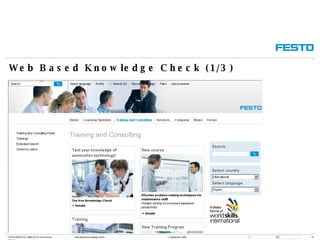
Web  Based  Knowledge Check (1/3)
Web  Based  Knowledge Check (2/3)
Web  Based  Knowledge Check (3/3)
Web Based Knowledge Check updated: structure Each test will consist of 12 questions Three learning levels will be addressed by 4 questions each Remembering Understanding Problem solving  Each question consists of three clearly defined parts Initial situation (problem taken out of the daily work) Description of task (as short and precise as possible) Problem solving part (covered by the question itself)
Web Based Knowledge Check updated: quality criteria for questions (1/3) We have decided to use only objective type questions of the following characteristics: Simple multiple choice item  Besides the correct answer at least three or four wrong answers  (distractors) have to be offered, otherwise the guess probability would be too high. Good for factual knowledge, understanding and methodical knowledge  (partial aspects of professional competence) Demanding development, easy to implement, medium guess probability 
Web Based Knowledge Check updated: quality criteria for questions (2/3) Multiple response The number of correct answers is indicated, in order not to confuse the test person. Number of distractors has to be sufficient (between 5 and 8 choices) Good for factual knowledge, understanding and methodical knowledge (partial aspects of professional competence) Less demanding development, easy to implement, medium guess probability Evaluation difficult in cases of partially correct answers  
Web Based Knowledge Check updated: quality criteria for questions (2/2) Matching type item Consists of two lists of premises and responses that have to be matched e.g. images, terms, statements. In order to avoid that the two last pairs arise automatically, one list should include distractors.  Good for factual knowledge, understanding and methodical knowledge  (partial aspects of professional competence) Less demanding development, easy to implement, medium guess probability Evaluation difficult in cases of partially correct answers
Contents
Job profiles in factory automation Job profiles Operator Maintenance Crew Designers Trainers Main task Ensures a fault-free production process and fast set up time  Ensuring maximum system availability  Design equipment with better ergonomics, productivity, user-friendliness and safety  Prepare apprentices for employment in the company  Competences Makes basic adjustments on the machine concerning quantity and quality Applies basic maintenance routines Communicates with maintenance crew Resolves basic faults Make any kind of adjustment  and maintenance on machines and components Troubleshoot, communicate and resolve failures in the shortest possible time Take measures to prevent  re- occurrence of problems Take measures to improve OEE Work in teams or build teams  against failures Follow developments in technology and transfer to  work environment Calculate and dimension systems and parts Select equipment Draw circuit diagrams Modify systems Test newly-built or modified systems Determine training needs Determine required com-petences Determine knowledge gap Prepare training schedules and examinations Train trainees in all aspects  of the required production  technologies
Job profiles in factory automation Operator Ensures a fault-free production process and fast set up time  Makes basic adjustments on the machine concerning quantity and quality Applies basic maintenance routines Communicates with maintenance crew Resolves basic faults
Operators’ competences in pneumatics Can adjust speed and cushioning of various cylinders Can adjust air pressure Can adjust sensor positions Can read measuring devices Can discharge the water in service unit Can clean or change the filter Can measure the oil level and fill with oil Can replace worn out tubes or fittings Can check and identify air leaks Can read basic pneumatic diagrams Can apply troubleshooting methods Can resolve basic faults on pneumatic circuits Can identify deviation from normal operation Can check and identify AM tasks Can read and identify basic pneumatic symbols Can identify pneumatic faults Can identify electro pneumatic faults Can communicate the faults clearly to others Perform all tasks observing relevant safety precautions
Operators’ competences in pneumatics: Machine adjustment Can adjust speed and cushioning of various cylinders Can adjust air pressure Can adjust sensor positions Can read measuring devices
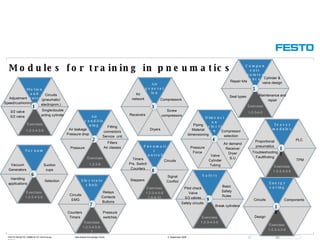
Modules for training in pneumatics Exercises 1-2-3-6 Motion and control Exercises 1-2-3-4-5-6 Single/double acting cylinder 3/2 valve 5/2 valve Circuits (pneumatic/ electropnm.) Adjustment Speed/cushioning 1 Air generation Screw compressors Receivers Air network Compressors Dryers 3 Components maintenance Exercises 1-2-3-4-5 Cylinder & valve design Seal types Repair kits Maintenance and repair 5 Vacuum Handling applications Suction cups Vacuum Generators Selection Exercises 1-2-3-4-5-6 6 Electrotechnic Counters Timers Relays Contacts Buttons Circuits EMG Pressure switches Exercises 1-2-3-4-5-6-7 7 Dimension Selection Valve Cylinder Tubing Compressor selection Piping Material dimensioning Air demand Receiver Dryer S.U 4 Pressure Force Air conditioning Filters Air classes Air leakage Pressure drop Fitting connectors Service  unit 2 Pressure Pneumatic controls Circuits Timers Prs. Switch Counters Signal Conflict Exercises 1-2-3-4-5-6 7-8-9-10 Steppers 8 Safety Basic Safety Rules Pilot check Valve 5/3 valves Break cylinders Exercises 1-2-3-4-5-6 Safety circuits 9 Teaser modules PLC Proportional pneumatics TPM Exercises 1-2-3-4-5-6 Troubleshooting Faultfinding 11 Energy saving Components Circuits Exercises 1-2-3-4-5-6 Design 10
Company Knowledge Check Each test will consist of 40 to 45 questions Each question will address a target group with competency based job profiles Operator Maintenance technician etc. All tests have to work as paper-pencil version questions have to be clearly related to competences Competences again have to be clearly related to training modules
Thank you for your attention!
Expertise model for competencies “Beginner – Professional – Expert“ Source:  K. North, K. Reinhardt: Kompetenzmanagement in der Praxis 2005 Beginner (know what) Low theoretical knowledge First practical experience No complex problem  solving strategies Expert (know why) Comprehensive experience Highly self-directed work Strong problem solving competence Professional  (know how) Knowledge of the special field Autonomous acting Intuitive problem-solving strategies
Index system for competence management Time Perspective Short- Middle- Long-term Employee Organisation Customer Appraisal  Interview Delivery reliability Analysis of customer  satisfaction Fluctuation Employee attitude survey Productivity Non-conformity costs Gross profit
Integration in a BSC or a Management-Cockpit Competence management Non-conformity  costs Productivity Finance Interface Supplier/  Customer Processes Employees Raw profit EBIT EVA Market  share Incoming  order Delivery reliability (Deadline, quantity, quality) Customer satisfaction Reclamations First pass yield Process quality CIP Qualification Employee satisfaction Added value  per employee Flexibility Turnover Leading indicators Lagging indicators

Web Based Knowledge Check

  • 1.
    Web Based Knowledge Check
  • 2.
    Contents Festo Trainingand Consulting 1
  • 3.
    Festo – an independent family enterprise Festo Group – Industrial Automation and Didactic T urnover 2007: €1,650 million 56 Festo companies with over 250 branch offices worldwide and around 300,000 customers Innovative 2,800 patents about 100 innovations per year Research and development: 7.5% of the turnover Self-learning About 13,000 employees worldwide Initial and further education: 1.5% of the turnover Committed to quality and environment Quality and environmental certificates 47 companies worldwide certified according to ISO 9001, 3 companies according to ISO 14001
  • 4.
    Festo Group –Supplier of solutions for automation and learning Industrial Automation Machines and systems People and organisation Increase of productivity for and Components Systems and services Didactic Training and Consulting Learning systems
  • 5.
    Festo Didactic –member of the Festo Group Festo Didactic in Denkendorf Turnover 2007 About 80 million Euro in 70 countries Staff Around 400 employees in worldwide 56 independent Festo companies Business division : Training and Consulting Outstanding brand, prized quality Industry experience for over 80 years Global action, local thinking More than one million attendees Standardised trainings in more than 50 countries, culturally adgooded “ Train-the-Trainer” approach Sustained strengthening of the customer’s organisation, even after a project ends
  • 6.
    Argentina Australia AustriaBelgium Brazil Bulgaria Canada Chile China Colombia Croatia Czech Republic Denmark Egypt International training facilities and experience Sao Paolo, Brazil Estonia Finland France Germany Great Britain Greece Hong Kong Hungary India Indonesia Iran Ireland Israel Italy Japan Korean Republic Latvia Lithuania Malaysia Mexico Netherlands New Zealand Norway Peru Philippines Poland Portugal Romania Russia Singapore Slovakia Slovenia South Africa Spain Sweden Switzerland Taiwan Thailand Turkey Ukraine USA Venezuela Yokohama, Japan Johannesburg, South Africa
  • 7.
  • 8.
    „ Knowledge isonly of value if it is purposefully applied!“ Information  Success in the market  Competitiveness  Trust of shareholders  ¥ ,€, $, £ Skills Knowledge is the basis for skills Skills turn into competence by application Knowledge Information turns into knowledge by linking it to a context Competence Competence based training: Information turns into competence
  • 9.
    Competence based training: Levels of competence Source: Levels of Competence as defined by G.E. Miller in :The assessment of clinical skills / competence / performance In the first level, Knows , the learner gathers facts. At the level of Knows How , facts are interpreted and applied to given situations. Demonstrating that this is accomplished occurs at the competence level of Shows How . At the highest tier, Does , the learner integrates his or her knowledge and skills into actual professional practice.
  • 10.
    Web Based Knowledge Check (1/3)
  • 11.
    Web Based Knowledge Check (2/3)
  • 12.
    Web Based Knowledge Check (3/3)
  • 13.
    Web Based KnowledgeCheck updated: structure Each test will consist of 12 questions Three learning levels will be addressed by 4 questions each Remembering Understanding Problem solving Each question consists of three clearly defined parts Initial situation (problem taken out of the daily work) Description of task (as short and precise as possible) Problem solving part (covered by the question itself)
  • 14.
    Web Based KnowledgeCheck updated: quality criteria for questions (1/3) We have decided to use only objective type questions of the following characteristics: Simple multiple choice item Besides the correct answer at least three or four wrong answers (distractors) have to be offered, otherwise the guess probability would be too high. Good for factual knowledge, understanding and methodical knowledge (partial aspects of professional competence) Demanding development, easy to implement, medium guess probability 
  • 15.
    Web Based KnowledgeCheck updated: quality criteria for questions (2/3) Multiple response The number of correct answers is indicated, in order not to confuse the test person. Number of distractors has to be sufficient (between 5 and 8 choices) Good for factual knowledge, understanding and methodical knowledge (partial aspects of professional competence) Less demanding development, easy to implement, medium guess probability Evaluation difficult in cases of partially correct answers  
  • 16.
    Web Based KnowledgeCheck updated: quality criteria for questions (2/2) Matching type item Consists of two lists of premises and responses that have to be matched e.g. images, terms, statements. In order to avoid that the two last pairs arise automatically, one list should include distractors. Good for factual knowledge, understanding and methodical knowledge (partial aspects of professional competence) Less demanding development, easy to implement, medium guess probability Evaluation difficult in cases of partially correct answers
  • 17.
  • 18.
    Job profiles infactory automation Job profiles Operator Maintenance Crew Designers Trainers Main task Ensures a fault-free production process and fast set up time Ensuring maximum system availability Design equipment with better ergonomics, productivity, user-friendliness and safety Prepare apprentices for employment in the company Competences Makes basic adjustments on the machine concerning quantity and quality Applies basic maintenance routines Communicates with maintenance crew Resolves basic faults Make any kind of adjustment and maintenance on machines and components Troubleshoot, communicate and resolve failures in the shortest possible time Take measures to prevent re- occurrence of problems Take measures to improve OEE Work in teams or build teams against failures Follow developments in technology and transfer to work environment Calculate and dimension systems and parts Select equipment Draw circuit diagrams Modify systems Test newly-built or modified systems Determine training needs Determine required com-petences Determine knowledge gap Prepare training schedules and examinations Train trainees in all aspects of the required production technologies
  • 19.
    Job profiles infactory automation Operator Ensures a fault-free production process and fast set up time Makes basic adjustments on the machine concerning quantity and quality Applies basic maintenance routines Communicates with maintenance crew Resolves basic faults
  • 20.
    Operators’ competences inpneumatics Can adjust speed and cushioning of various cylinders Can adjust air pressure Can adjust sensor positions Can read measuring devices Can discharge the water in service unit Can clean or change the filter Can measure the oil level and fill with oil Can replace worn out tubes or fittings Can check and identify air leaks Can read basic pneumatic diagrams Can apply troubleshooting methods Can resolve basic faults on pneumatic circuits Can identify deviation from normal operation Can check and identify AM tasks Can read and identify basic pneumatic symbols Can identify pneumatic faults Can identify electro pneumatic faults Can communicate the faults clearly to others Perform all tasks observing relevant safety precautions
  • 21.
    Operators’ competences inpneumatics: Machine adjustment Can adjust speed and cushioning of various cylinders Can adjust air pressure Can adjust sensor positions Can read measuring devices
  • 22.
    Modules for trainingin pneumatics Exercises 1-2-3-6 Motion and control Exercises 1-2-3-4-5-6 Single/double acting cylinder 3/2 valve 5/2 valve Circuits (pneumatic/ electropnm.) Adjustment Speed/cushioning 1 Air generation Screw compressors Receivers Air network Compressors Dryers 3 Components maintenance Exercises 1-2-3-4-5 Cylinder & valve design Seal types Repair kits Maintenance and repair 5 Vacuum Handling applications Suction cups Vacuum Generators Selection Exercises 1-2-3-4-5-6 6 Electrotechnic Counters Timers Relays Contacts Buttons Circuits EMG Pressure switches Exercises 1-2-3-4-5-6-7 7 Dimension Selection Valve Cylinder Tubing Compressor selection Piping Material dimensioning Air demand Receiver Dryer S.U 4 Pressure Force Air conditioning Filters Air classes Air leakage Pressure drop Fitting connectors Service unit 2 Pressure Pneumatic controls Circuits Timers Prs. Switch Counters Signal Conflict Exercises 1-2-3-4-5-6 7-8-9-10 Steppers 8 Safety Basic Safety Rules Pilot check Valve 5/3 valves Break cylinders Exercises 1-2-3-4-5-6 Safety circuits 9 Teaser modules PLC Proportional pneumatics TPM Exercises 1-2-3-4-5-6 Troubleshooting Faultfinding 11 Energy saving Components Circuits Exercises 1-2-3-4-5-6 Design 10
  • 23.
    Company Knowledge CheckEach test will consist of 40 to 45 questions Each question will address a target group with competency based job profiles Operator Maintenance technician etc. All tests have to work as paper-pencil version questions have to be clearly related to competences Competences again have to be clearly related to training modules
  • 24.
    Thank you foryour attention!
  • 25.
    Expertise model forcompetencies “Beginner – Professional – Expert“ Source: K. North, K. Reinhardt: Kompetenzmanagement in der Praxis 2005 Beginner (know what) Low theoretical knowledge First practical experience No complex problem solving strategies Expert (know why) Comprehensive experience Highly self-directed work Strong problem solving competence Professional (know how) Knowledge of the special field Autonomous acting Intuitive problem-solving strategies
  • 26.
    Index system forcompetence management Time Perspective Short- Middle- Long-term Employee Organisation Customer Appraisal Interview Delivery reliability Analysis of customer satisfaction Fluctuation Employee attitude survey Productivity Non-conformity costs Gross profit
  • 27.
    Integration in aBSC or a Management-Cockpit Competence management Non-conformity costs Productivity Finance Interface Supplier/ Customer Processes Employees Raw profit EBIT EVA Market share Incoming order Delivery reliability (Deadline, quantity, quality) Customer satisfaction Reclamations First pass yield Process quality CIP Qualification Employee satisfaction Added value per employee Flexibility Turnover Leading indicators Lagging indicators