“Observing Weather: Making the
       Invisible Visible”
What Is Weather?
 “Weather” refers to the conditions of the
atmosphere at a certain place and time.

 Weather differs from “Climate,” which
deals with long-term conditions in the
atmosphere—patterns, averages, and
extremes (most/maximum and least/
minimum).
We Can’t See Air, So What Can
            We Measure?
•   Temperature
•   Pressure
•   Wind direction and speed
•   Moisture—Humidity and Dew Point
•   Clouds—coverage and type
•   Precipitation—type and amount
•   Special Conditions and Changes
just-say-no
true
f
-
tg/stores/d
communit
rate-item
cust-rec
cavorite-lis
nm/justsay
GET


                  Temperature
      • Temperature is a
        measure of how much
        heat energy the air
        molecules possess
      • Thermometers can
        measure heat by
        expanding and
        contracting metal
        coils (left) or liquids
        (right)
                       [Source: www.weatheraffects.com]
Pressure
                             • Air molecules push down
                               on objects—including you
                               —with a force that we call
                               the “barometric pressure.”
                             • Metal coils in barometers,
                               as in thermometers,
                               respond to differences by
                               expanding or contracting,
                               causing a dial to move or
                               change the LED display

[Source: www.accumall.com]
Wind Direction and Speed
• When air moves
  —”wind”—we feel both
  its direction and speed
  (force.)
• Direction is measured
  with a “vane”—an arrow
  or other shape that
  points into the wind.
• Speed is measured with
  an “anemometer.” The
  faster the cups spin, the
  faster the wind.        [Source: www.fascinatingelecronics.com]
Atmospheric Moisture--Humidity
• Water vapor molecules evaporate and
  enter air, mixing among the N2, O2, and
  other gases.
• The amount of water in air compared with
  the amount that it could hold at that
  temperature is called “relative humidity.”
• If air holds all the water vapor it can, it is at
  100% RH and is said to be “saturated.”
Measuring RH
• “Sling psychrometers”
  have “dry bulbs” and
  “wet bulbs.”
• Using the difference
  between the two (“wet
  bulb depression”) and
  charts allow calculation
  of the relative humidity.
• “Hygrometers” also
  measure RH

                   [Sources:www.novalynx.com and www.accumall.com]
“Dew Point”
• As air cools, its relative humidity rises until
  reaching 100% and saturation.
• You are familiar with this because when
  you have an iced drink in the summer,
  droplets form on the outside of the glass
  as the air right next to the glass is cooled.
• The temperature at which saturation
  occurs is called the DEW POINT.
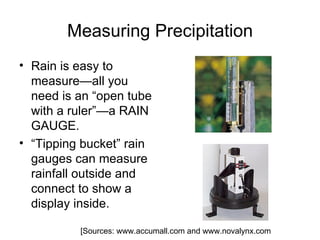
Measuring Precipitation
• Rain is easy to
  measure—all you
  need is an “open tube
  with a ruler”—a RAIN
  GAUGE.
• “Tipping bucket” rain
  gauges can measure
  rainfall outside and
  connect to show a
  display inside.

          [Sources: www.accumall.com and www.novalynx.com
Measuring Snowfall
• Measuring how much snow falls is trickier
  than measuring rain, because wind can
  carry it away or pile it up in drifts.
• Meter sticks or rulers in carefully selected
  locations are used to record how deep the
  snow lies.
• Meteorologists may also melt snow to find
  its “water equivalent”—what it would have
  been had it fallen as rain.
Clouds
    Meteorologists monitor clouds in several
    ways:
•   How much of the sky do they cover?
•   What kinds of clouds are they?
•   What kinds exist at different levels (low,
    middle, and high altitudes)?
•   In which direction are they moving?
Types of Clouds
In the early 1800s, Luke Howard (a science
  teacher in England) published a system to
  describe different types of clouds.

He used the term
CUMULUS for
“fluffy” clouds.

    [http://inspire.ospi.wednet.edu:8001/curric/weather/pricloud/]
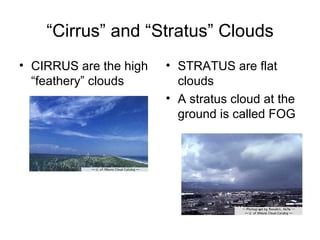
“Cirrus” and “Stratus” Clouds
• CIRRUS are the high   • STRATUS are flat
  “feathery” clouds       clouds
                        • A stratus cloud at the
                          ground is called FOG
Representing Weather with a
         “Station Model”
  National Weather Service (NWS)
meteorologists use a simple system to
represent the weather at a location. A
circle on a map identifies the location.
Numbers and symbols added to the circle
indicate the kind of weather instruments at
that station have measured.
  The next set of slides will explain how
this is done.
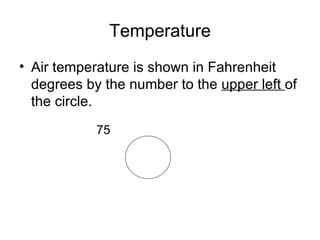
Temperature
• Air temperature is shown in Fahrenheit
  degrees by the number to the upper left of
  the circle.
            75
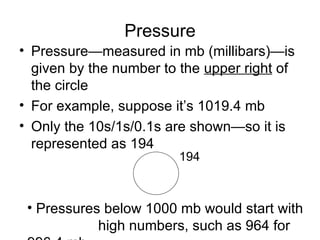
Pressure
• Pressure—measured in mb (millibars)—is
  given by the number to the upper right of
  the circle
• For example, suppose it’s 1019.4 mb
• Only the 10s/1s/0.1s are shown—so it is
  represented as 194
                        194


 • Pressures below 1000 mb would start with
            high numbers, such as 964 for
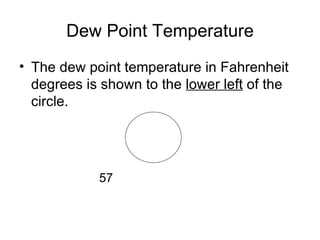
Dew Point Temperature
• The dew point temperature in Fahrenheit
  degrees is shown to the lower left of the
  circle.


            57
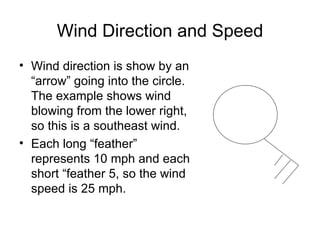
Wind Direction and Speed
• Wind direction is show by an
  “arrow” going into the circle.
  The example shows wind
  blowing from the lower right,
  so this is a southeast wind.
• Each long “feather”
  represents 10 mph and each
  short “feather 5, so the wind
  speed is 25 mph.
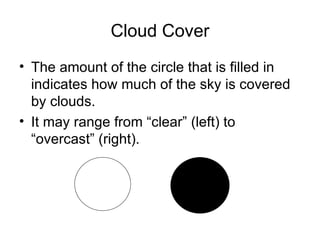
Cloud Cover
• The amount of the circle that is filled in
  indicates how much of the sky is covered
  by clouds.
• It may range from “clear” (left) to
  “overcast” (right).
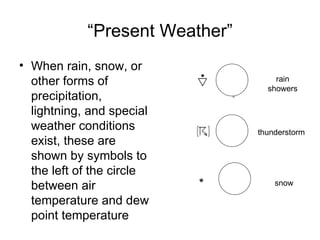
“Present Weather”
• When rain, snow, or
  other forms of                    rain
                                  showers
  precipitation,
  lightning, and special
  weather conditions            thunderstorm
  exist, these are
  shown by symbols to
  the left of the circle
  between air              *        snow

  temperature and dew
  point temperature
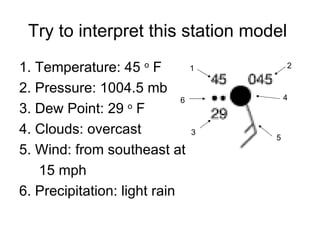
Try to interpret this station model
1. Temperature: 45 o F         1       2


2. Pressure: 1004.5 mb
                             6         4
3. Dew Point: 29 o F
4. Clouds: overcast            3
                                   5
5. Wind: from southeast at
   15 mph
6. Precipitation: light rain
• You can learn more about weather station
  models through the “DataStreme
  Atmosphere” web site created by the
  American Meteorological Society
 http://64.55.87.13/dstreme/extras/wxsym2.html

• “DStreme” also provides access to current
  weather maps which use station models to
  represent conditions at many NWS
  weather stations:
  http://64.55.87.13/dstreme/images/sfc_map.gif
Weather Conditions above the Surface

• What we have discussed so far deals only
  with weather variables at the surface, but
  weather is 3-dimensional
• To measure weather above the surface,
  NWS releases weather balloons with an
  attached instrument package called a
  “radiosonde.”
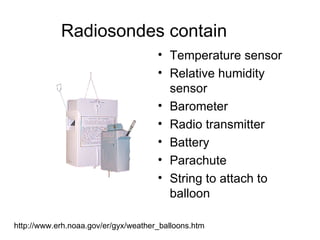
Radiosondes contain
                                      • Temperature sensor
                                      • Relative humidity
                                        sensor
                                      • Barometer
                                      • Radio transmitter
                                      • Battery
                                      • Parachute
                                      • String to attach to
                                        balloon

http://www.erh.noaa.gov/er/gyx/weather_balloons.htm
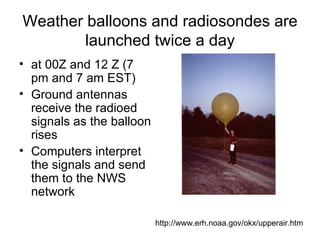
Weather balloons and radiosondes are
        launched twice a day
• at 00Z and 12 Z (7
  pm and 7 am EST)
• Ground antennas
  receive the radioed
  signals as the balloon
  rises
• Computers interpret
  the signals and send
  them to the NWS
  network

                           http://www.erh.noaa.gov/okx/upperair.htm
Upper air information is crucial for
• Aircraft flying across the country and
  round the world
• Forecasters who need information about
  the 3-dimensional characteristics of the
  atmosphere
• Upper air data, like surface data, can be
  represented in charts for different pressure
  levels
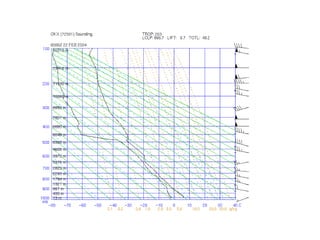
The “Stuve” Chart on the next slide
• represents conditions measured by a
  radiosonde launched from the NWS station
  on Long Island
• Horizontal lines indicate the height for each
  50 mb decrease in pressure
• The right-hand curve is air temperature and
  the left-hand curve is the dew point
• Winds at each level are show by the right
  axis. These are coming from the west at 5
  mph near the ground to about 60 (triangle
  an one feather) at about 12000 m.
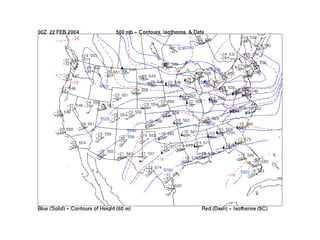
The next slide shows a typical upper air chart
• This chart indicates conditions where the air
  pressure was 500 mb, about half that at sea
  level.
• Blue lines represent height contours, which
  range from about 5760 m (17500 ft) in the
  south to about 5280 m (16000 ft) in the north.
  Actual height at a station is given to the upper
  right of the circle. Ex. “554” = “5540 m”
• The strong winds are the “jet streams.”
• Notice how cold are the air and dew point
  temperatures at these altitudes.
Modern weather observation also
     includes radar and satellite
• Advanced radar observation technologies
  were installed at NWS and other stations
  to create a network that monitors clouds,
  precipitation, and even wind motions in a
  320-km (200-mile) radius circle around the
  station
• Weather satellites provide even larger
  views of weather systems
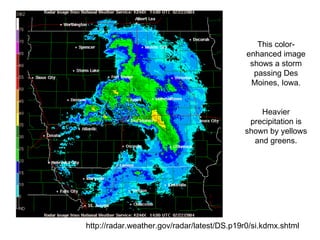
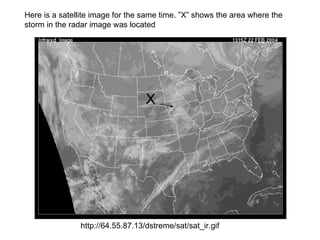
This color-
                                             enhanced image
                                              shows a storm
                                               passing Des
                                              Moines, Iowa.


                                                Heavier
                                             precipitation is
                                            shown by yellows
                                              and greens.


http://radar.weather.gov/radar/latest/DS.p19r0/si.kdmx.shtml
Here is a satellite image for the same time. ”X” shows the area where the
storm in the radar image was located


                                  X


               http://64.55.87.13/dstreme/sat/sat_ir.gif
Conclusions
• Weather occurs at local, regional and global
  scales
• So modern weather observation and
  forecasting uses simple instruments and
  the most advanced technologies
• Even so, “Some People Are Weatherwise,
  But Most Are Otherwise” (as Ben Franklin
  wrote in “Poor Richard’s Almanac”)
• Which will you be?

Weather and Climate

  • 1.
    “Observing Weather: Makingthe Invisible Visible”
  • 2.
    What Is Weather? “Weather” refers to the conditions of the atmosphere at a certain place and time. Weather differs from “Climate,” which deals with long-term conditions in the atmosphere—patterns, averages, and extremes (most/maximum and least/ minimum).
  • 3.
    We Can’t SeeAir, So What Can We Measure? • Temperature • Pressure • Wind direction and speed • Moisture—Humidity and Dew Point • Clouds—coverage and type • Precipitation—type and amount • Special Conditions and Changes
  • 4.
    just-say-no true f - tg/stores/d communit rate-item cust-rec cavorite-lis nm/justsay GET Temperature • Temperature is a measure of how much heat energy the air molecules possess • Thermometers can measure heat by expanding and contracting metal coils (left) or liquids (right) [Source: www.weatheraffects.com]
  • 5.
    Pressure • Air molecules push down on objects—including you —with a force that we call the “barometric pressure.” • Metal coils in barometers, as in thermometers, respond to differences by expanding or contracting, causing a dial to move or change the LED display [Source: www.accumall.com]
  • 6.
    Wind Direction andSpeed • When air moves —”wind”—we feel both its direction and speed (force.) • Direction is measured with a “vane”—an arrow or other shape that points into the wind. • Speed is measured with an “anemometer.” The faster the cups spin, the faster the wind. [Source: www.fascinatingelecronics.com]
  • 7.
    Atmospheric Moisture--Humidity • Watervapor molecules evaporate and enter air, mixing among the N2, O2, and other gases. • The amount of water in air compared with the amount that it could hold at that temperature is called “relative humidity.” • If air holds all the water vapor it can, it is at 100% RH and is said to be “saturated.”
  • 8.
    Measuring RH • “Slingpsychrometers” have “dry bulbs” and “wet bulbs.” • Using the difference between the two (“wet bulb depression”) and charts allow calculation of the relative humidity. • “Hygrometers” also measure RH [Sources:www.novalynx.com and www.accumall.com]
  • 9.
    “Dew Point” • Asair cools, its relative humidity rises until reaching 100% and saturation. • You are familiar with this because when you have an iced drink in the summer, droplets form on the outside of the glass as the air right next to the glass is cooled. • The temperature at which saturation occurs is called the DEW POINT.
  • 10.
    Measuring Precipitation • Rainis easy to measure—all you need is an “open tube with a ruler”—a RAIN GAUGE. • “Tipping bucket” rain gauges can measure rainfall outside and connect to show a display inside. [Sources: www.accumall.com and www.novalynx.com
  • 11.
    Measuring Snowfall • Measuringhow much snow falls is trickier than measuring rain, because wind can carry it away or pile it up in drifts. • Meter sticks or rulers in carefully selected locations are used to record how deep the snow lies. • Meteorologists may also melt snow to find its “water equivalent”—what it would have been had it fallen as rain.
  • 12.
    Clouds Meteorologists monitor clouds in several ways: • How much of the sky do they cover? • What kinds of clouds are they? • What kinds exist at different levels (low, middle, and high altitudes)? • In which direction are they moving?
  • 13.
    Types of Clouds Inthe early 1800s, Luke Howard (a science teacher in England) published a system to describe different types of clouds. He used the term CUMULUS for “fluffy” clouds. [http://inspire.ospi.wednet.edu:8001/curric/weather/pricloud/]
  • 14.
    “Cirrus” and “Stratus”Clouds • CIRRUS are the high • STRATUS are flat “feathery” clouds clouds • A stratus cloud at the ground is called FOG
  • 15.
    Representing Weather witha “Station Model” National Weather Service (NWS) meteorologists use a simple system to represent the weather at a location. A circle on a map identifies the location. Numbers and symbols added to the circle indicate the kind of weather instruments at that station have measured. The next set of slides will explain how this is done.
  • 16.
    Temperature • Air temperatureis shown in Fahrenheit degrees by the number to the upper left of the circle. 75
  • 17.
    Pressure • Pressure—measured inmb (millibars)—is given by the number to the upper right of the circle • For example, suppose it’s 1019.4 mb • Only the 10s/1s/0.1s are shown—so it is represented as 194 194 • Pressures below 1000 mb would start with high numbers, such as 964 for
  • 18.
    Dew Point Temperature •The dew point temperature in Fahrenheit degrees is shown to the lower left of the circle. 57
  • 19.
    Wind Direction andSpeed • Wind direction is show by an “arrow” going into the circle. The example shows wind blowing from the lower right, so this is a southeast wind. • Each long “feather” represents 10 mph and each short “feather 5, so the wind speed is 25 mph.
  • 20.
    Cloud Cover • Theamount of the circle that is filled in indicates how much of the sky is covered by clouds. • It may range from “clear” (left) to “overcast” (right).
  • 21.
    “Present Weather” • Whenrain, snow, or other forms of rain showers precipitation, lightning, and special weather conditions thunderstorm exist, these are shown by symbols to the left of the circle between air * snow temperature and dew point temperature
  • 22.
    Try to interpretthis station model 1. Temperature: 45 o F 1 2 2. Pressure: 1004.5 mb 6 4 3. Dew Point: 29 o F 4. Clouds: overcast 3 5 5. Wind: from southeast at 15 mph 6. Precipitation: light rain
  • 23.
    • You canlearn more about weather station models through the “DataStreme Atmosphere” web site created by the American Meteorological Society http://64.55.87.13/dstreme/extras/wxsym2.html • “DStreme” also provides access to current weather maps which use station models to represent conditions at many NWS weather stations: http://64.55.87.13/dstreme/images/sfc_map.gif
  • 24.
    Weather Conditions abovethe Surface • What we have discussed so far deals only with weather variables at the surface, but weather is 3-dimensional • To measure weather above the surface, NWS releases weather balloons with an attached instrument package called a “radiosonde.”
  • 25.
    Radiosondes contain • Temperature sensor • Relative humidity sensor • Barometer • Radio transmitter • Battery • Parachute • String to attach to balloon http://www.erh.noaa.gov/er/gyx/weather_balloons.htm
  • 26.
    Weather balloons andradiosondes are launched twice a day • at 00Z and 12 Z (7 pm and 7 am EST) • Ground antennas receive the radioed signals as the balloon rises • Computers interpret the signals and send them to the NWS network http://www.erh.noaa.gov/okx/upperair.htm
  • 27.
    Upper air informationis crucial for • Aircraft flying across the country and round the world • Forecasters who need information about the 3-dimensional characteristics of the atmosphere • Upper air data, like surface data, can be represented in charts for different pressure levels
  • 28.
    The “Stuve” Charton the next slide • represents conditions measured by a radiosonde launched from the NWS station on Long Island • Horizontal lines indicate the height for each 50 mb decrease in pressure • The right-hand curve is air temperature and the left-hand curve is the dew point • Winds at each level are show by the right axis. These are coming from the west at 5 mph near the ground to about 60 (triangle an one feather) at about 12000 m.
  • 30.
    The next slideshows a typical upper air chart • This chart indicates conditions where the air pressure was 500 mb, about half that at sea level. • Blue lines represent height contours, which range from about 5760 m (17500 ft) in the south to about 5280 m (16000 ft) in the north. Actual height at a station is given to the upper right of the circle. Ex. “554” = “5540 m” • The strong winds are the “jet streams.” • Notice how cold are the air and dew point temperatures at these altitudes.
  • 32.
    Modern weather observationalso includes radar and satellite • Advanced radar observation technologies were installed at NWS and other stations to create a network that monitors clouds, precipitation, and even wind motions in a 320-km (200-mile) radius circle around the station • Weather satellites provide even larger views of weather systems
  • 33.
    This color- enhanced image shows a storm passing Des Moines, Iowa. Heavier precipitation is shown by yellows and greens. http://radar.weather.gov/radar/latest/DS.p19r0/si.kdmx.shtml
  • 34.
    Here is asatellite image for the same time. ”X” shows the area where the storm in the radar image was located X http://64.55.87.13/dstreme/sat/sat_ir.gif
  • 35.
    Conclusions • Weather occursat local, regional and global scales • So modern weather observation and forecasting uses simple instruments and the most advanced technologies • Even so, “Some People Are Weatherwise, But Most Are Otherwise” (as Ben Franklin wrote in “Poor Richard’s Almanac”) • Which will you be?