THE SIXTH SENSE
CREATED BY ER.HIMANSHU GARG
INTRODUCTION
We’ve evolved over millions of years to sense the world around us. When
we encounter something, someone or some place, we use our five
natural senses which includes eye, ear, nose, tongue mind and body to
perceive information about it; that information helps us make decisions
and chose the right actions to take. But arguably the most useful
information that can help us make the right decision is not naturally
perceivable with our five senses, namely the data, information and
knowledge that mankind has accumulated about everything and which is
increasingly all available online.
Although the miniaturization of computing devices allows us to carry
computers in our pockets, keeping us continually connected to the digital
world, there is no link between our digital devices and our interactions
with the physical world. Information is confined traditionally on paper or
digitally on a screen. Sixth Sense bridges this gap, bringing intangible,
digital information out into the tangible world, and allowing us to interact
with this information via natural hand gestures.
• . ‘Sixth Sense’ frees information from its confines by seamlessly it
with reality, and thus making the entire world your computer. “Sixth
Sense Technology”, it is the newest jargon that has proclaimed its
presence in the technical arena. This technology has emerged, which
has its relation to the power of these six senses. Our ordinary
computers will soon be able to sense the different feelings
accumulated in the surroundings and it is all a gift of the ”Sixth
Sense Technology” newly introduced. Sixth Sense is a wearable
“gesture based” device that augments the physical world with digital
information and lets people use natural hand gestures to interact
with that information. It was developed by Pranav Mistry, a PhD
student in the Fluid Interfaces Group at the MIT Media Lab. A grad
student with the Fluid Interfaces Group at MIT, he caused a storm
with his creation of Sixth Sense. He says that the movies “Robocop”
and “Minority Report” gave him the inspiration to create his view of
a world not dominated by computers, digital information and human
robots, but one where computers and other digital devices enhance
people’s enjoyment of the physical world.
•
• Right now, we use our “devices” (computers, mobile phones,
tablets, etc.) to go into the internet and get information that
we want. With Sixth Sense we will use a device no bigger than
current cell phones and probably eventually as small as a
button on our shirts to bring the internet to us in order to
interact with our world!
•
• Sixth Sense will allow us to interact with our world like never
before. We can get information on anything we want from
anywhere within a few moments! We will not only be able to
interact with things on a whole new level but also with
people! One great part of the device is its ability to scan
objects or even people and project out information regarding
what you are looking at.
SIXTH SENSE TECHNOLOGY
WHAT IS SIXTH SENSE ?
Sixth Sense in scientific (or non-scientific) terms is defined as Extra Sensory
Perception or in short ESP. It involves the reception of information not gained
through any of the five senses. Nor is it taken from any experiences from the past
or known. Sixth Sense aims to more seamlessly integrate online information and
tech into everyday life. By making available information needed for decision-
making beyond what we have access to with our five senses, it effectively gives
users a sixth sense.
EARLIER SIXTH SENSE
PROTOTYPE
Maes’ MIT group, which includes seven graduate students, were thinking about
how a person could be more integrated into the world around them and access
information without having to do something like take out a phone. They initially
produced a wristband that would read an Radio Frequency Identification tag to
know, for example, which book a user is holding in a store.
They also had a ring that used infrared to communicate by beacon to supermarket
smart shelves to give you information about products. As we grab a package of
macaroni, the ring would glow red or green to tell us if the product was organic or
free of peanut traces whatever criteria we program into the system. They wanted
to make information more useful to people in real time with minimal effort in a way
that doesn’t require any behaviour changes. The wristband was getting close, but
we still had to take out our cell phone to look at the information.
• That’s when they struck on the idea of accessing information
from the internet and projecting it. So someone wearing the
wristband could pick up a paperback in the bookstore and
immediately call up reviews about the book, projecting them
onto a surface in the store or doing a keyword search through
the book by accessing digitized pages on Amazon or Google
books.
•
• They started with a larger projector that was mounted on a
helmet. But that proved cumbersome if someone was
projecting data onto a wall then turned to speak to friend —
the data would project on the friend’s face.
RECENT PROTOTYPE
• Now they have switched to a smaller projector and created the
pendant prototype to be worn around the neck.
•
• The SixthSense prototype is composed of a pocket projector, a
mirror and a camera. The hardware components are coupled in a
pendant-like mobile wearable device. Both the projector and the
camera are connected to the mobile computing device in the user’s
pocket. We can very well consider the Sixth Sense Technology as a
blend of the computer and the cell phone. It works as the device
associated to it is hanged around the neck of a person and thus the
projection starts by means of the micro projector attached to the
device. Therefore, in course, you turn out to be a moving computer
in yourself and the fingers act like a mouse and a keyboard.
•
•
•
• The prototype was built from an ordinary webcam and a
battery-powered 3M projector, with an attached mirror — all
connected to an internet-enabled mobile phone. The setup,
which costs less than $350, allows the user to project
information from the phone onto any surface — walls, the
body of another person or even your hand.
•
• Mistry wore the device on a lanyard around his neck, and
colored Magic Marker caps on four fingers (red, blue, green
and yellow) helped the camera distinguish the four fingers and
recognize his hand gestures with software that Mistry created.
•
WORKING
COMPONENTS:-
The hardware components are coupled in a pendant like
mobile wearable device.
Camera
Projector
Mirror
Mobile Component
Colour Markers
CAMERA
• A webcam captures and recognises an object in view and
tracks the user’s hand gestures using computer-vision based
techniques.
•
• It sends the data to the smart phone. The camera, in a sense,
acts as a digital eye, seeing what the user sees. It also tracks
the movements of the thumbs and index fingers of both of the
user's hands. The camera recognizes objects around you
instantly, with the micro projector overlaying the information
on any surface, including the object itself or your hand.
•
PROJECTOR
• Also, a projector opens up interaction and sharing. The project
itself contains a battery inside, with 3 hours of battery life. The
projector projects visual information enabling surfaces, walls
and physical objects around us to be used as interfaces. We
want this thing to merge with the physical world in a real
physical sense. You are touching that object and projecting
info onto that object. The information will look like it is part of
the object. A tiny LED projector displays data sent from the
smart phone on any surface in view–object, wall, or person.
MIRROR
• The usage of the mirror is significant as the projector dangles
pointing downwards from the neck.
MOBILE COMPONENT
• The mobile devices like Smartphone in our pockets transmit
and receive voice and data anywhere and to anyone via the
mobile internet. An accompanying Smartphone runs the Sixth
Sense software, and handles the connection to the internet. A
Web-enabled smart phone in the user’s pocket processes the
video data. Other software searches the Web and interprets
the hand gestures.
•
COLOUR MARKERS
• It is at the tip of the user’s fingers. Marking the user’s fingers
with red, yellow, green, and blue tape helps the webcam
recognize gestures. The movements and arrangements of
these makers are interpreted into gestures that act as
interaction instructions for the projected application
interfaces.
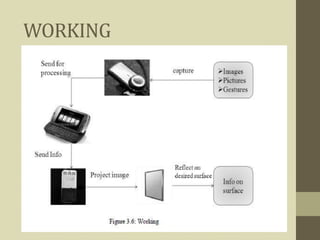
WORKING
• The hardware that makes Sixth Sense work is a pendant like
mobile wearable interface
• It has a camera, a mirror and a projector and is connected
wirelessly to a Bluetooth or 3G or wifi smart phone that can
slip comfortably into one’s pocket.
• The camera recognizes individuals, images, pictures, gestures
one makes with their hand.
• Information is sent to the Smartphone for processing.
•
• The downward-facing projector projects the output image on
to the mirror.
• Mirror reflects image on to the desired surface.
• Thus, digital information is freed from its confines and placed
in the physical world
• The entire hardware apparatus is encompassed in a pendant-
shaped mobile wearable device. Basically the camera
recognises individuals, images, pictures, gestures one makes
with their hands and the projector assists in projecting any
information on whatever type of surface is present in front of
the person. The usage of the mirror is significant as the
projector dangles pointing downwards from the neck. To bring
out variations on a much higher plane, in the demo video
which was broadcasted to showcase the prototype to the
world, Mistry uses coloured caps on his fingers so that it
becomes simpler for the software to differentiate between
the fingers, demanding various applications. The software
program analyses the video data caught by the camera and
also tracks down the locations of the coloured markers by
utilising single computer vision techniques. One can have any
number of hand gestures and movements as long as they are
all reasonably identified and differentiated for the system to
interpret it, preferably through unique and varied fiducials.
This is possible only because the ‘Sixth Sense’ device supports
multi-touch and multi-user interaction.
• MIT basically plans to augment reality with a pendant pico projector:
hold up an object at
• the store and the device blasts relevant information onto it (like
environmental stats, for instance), which can be browsed and
manipulated with hand gestures. The "sixth sense" in question is the
internet, which naturally supplies the data, and that can be just
about anything
• -- MIT has shown off the device projecting information about a
person you meet at a party on that actual person (pictured),
projecting flight status on a boarding pass, along with an entire non-
contextual interface for reading email or making calls. It's pretty
interesting technology that, like many MIT Media Lab projects,
makes the wearer look like a complete dork -- if the projector
doesn't give it away, the coloured finger bands the device uses to
detect finger motion certainly might.
• The idea is that Sixth Sense tries to determine not only what
someone is interacting with, but also how he or she is interacting
with it. The software searches the internet for information that is
potentially relevant to that situation, and then the projector takes
over.
•
• All the work is in the software," says Dr Maes. "The system is
constantly trying to figure out what's around you, and what
you're trying to do. It has to recognize the images you see,
track your gestures, and then relate it all to relevant
information at the same time."
•
• The software recognizes 3 kinds of gestures:
• Multitouch gestures, like the ones you see in Microsoft
Surface or the iPhone -- where you touch the screen and make
the map move by pinching and dragging.
• Freehand gestures, like when you take a picture [as in the
photo above]. Or, you might have noticed in the demo,
because of my culture, I do a namaste gesture to start the
projection on the wall.
• Iconic gestures, drawing an icon in the air. Like, whenever I
draw a star, show me the weather. When I draw a magnifying
glass, show me the map. You might want to use other gestures
that you use in everyday life. This system is very customizable.
•
• The technology is mainly based on hand gesture recognition,
image capturing, processing, and manipulation, etc. The map
application lets the user navigate a map displayed on a nearby
surface using hand gestures, similar to gestures supported by
multi-touch based systems, letting the user zoom in, zoom out
or pan using intuitive hand movements. The drawing
application lets the user draw on any surface by tracking the
fingertip movements of the user’s index finger.
RELATED TECHNOLOGY
Sixth Sense’ technology takes a different approach to computing
and tries to make the digital aspect of our lives more intuitive,
interactive and, above all, more natural. We shouldn’t have to
think about it separately. It’s a lot of complex technology
squeezed into a simple portable device. When we bring in
connectivity, we can get instant, relevant visual information
projected on any object we pick up or interact with The
technology is mainly based on hand augmented reality, gesture
recognition, computer vision based algorithm etc.
ARGUMENTED REALITY
• Augmented reality (AR) is a term for a live direct or indirect view of
a physical real world environment whose elements are augmented
by virtual computer-generated imagery. It is related to a more
general concept called mediated reality in which a view of reality is
modified (possibly even diminished rather than augmented) by a
computer. The augmentation is conventionally in real-time and in
semantic context with environmental elements.
•
• Sixth sense technology which uses Augmented Reality concept to
super imposes digital information on the physical world. With the
help of advanced AR technology (e.g. adding computer vision and
object recognition) the information about the surrounding real
world of the user becomes interactive and digitally usable. Artificial
information about the environment and the objects in it can be
stored and retrieved as an information layer on top of the real world
view.
• The main hardware components for augmented reality are:
display, tracking, input devices, and computer. Combination of
powerful CPU, camera, accelerometers, GPS and solid state
compass are often present in modern Smartphone, which
make them prospective platforms. There are three major
display techniques for Augmented Reality:
•
• Head Mounted Displays
• Handheld Displays
• Spatial Displays
Head Mounted Displays
A Head Mounted Display (HMD) places images of both the
physical world and registered virtual graphical objects over the
user's view of the world. The HMD's are either optical see
through or video see-through in nature.
Handheld Displays
Handheld Augment Reality employs a small computing device
with a display that fits in a user's hand. All handheld AR
solutions to date have employed video see-through techniques
to overlay the graphical information to the physical world.
Initially handheld AR employed sensors such as digital
compasses and GPS units for its six degree of freedom tracking
sensors.
• Spatial Displays
• Instead of the user wearing or carrying the display such as
with head mounted displays or handheld devices; Spatial
Augmented Reality (SAR) makes use of digital projectors to
display graphical information onto physical objects.
•
• Modern mobile augmented reality systems use one or more of
the following tracking technologies: digital cameras and/or
other optical sensors, RFID, wireless sensors etc. Each of these
technologies have different levels of accuracy and precision.
Most important is the tracking of the pose and position of the
user's head for the augmentation of the user's view. For users
with disabilities of varying kinds, AR has real potential to help
people with a variety of disabilities. Only some of the current
and future AR applications make use of a Smartphone as a
mobile computing platform.
•
• Gesture Recognition
• Gesture recognition is a topic in computer science and language
technology with the goal of interpreting human gestures via
mathematical algorithms. Gestures can originate from any bodily
motion or state but commonly originate from the face or hand. Current
focuses in the field include emotion recognition from the face and hand
gesture recognition. Many approaches have been made using cameras
and computer vision algorithms to interpret sign language.
•
• Gestures can exist in isolation or involve external objects. Free of any
object, we wave, beckon, fend off, and to a greater or lesser degree
(depending on training) make use of more formal sign languages. With
respect to objects, we have a broad range of gestures that are almost
universal, including pointing at objects, touching or moving objects,
changing object shape, activating objects such as controls, or handing
objects to others. Gesture recognition can be seen as a way for
computers to begin to understand human body language, thus building
a richer bridge between machines and humans than primitive text user
interfaces or even GUIs (graphical user interfaces), which still limit the
majority of input to keyboard and mouse. Gesture recognition enables
humans to interface with the machine (HMI) and interact naturally
without any mechanical devices.
•
Gestures can be used to communicate with a computer so we
will be mostly concerned with empty handed semiotic gestures.
These can further be categorized according to their functionality.
• Symbolic gestures
These are gestures that, within each culture, have come to a
single meaning. An Emblem such as the “OK” gesture is one
such example, however American Sign Language gestures also
fall into this category.
• Deictic gestures
These are the types of gestures most generally seen in HCI and
are the gestures of pointing, or otherwise directing the listeners
attention to specific event or objects in the environment.
• Iconic gestures
• As the name suggests, these gestures are used to convey
information about the size, shape or orientation of the object of
discourse. They are the gestures made when someone says “The
plane flew like this”, while moving their hand through the air like the
flight path of the aircraft.
Pantomimic gestures:
• These are the gestures typically used in showing the use of
movement of some invisible tool or object in the speaker’s hand.
When a speaker says “I turned the steering wheel hard to the left”,
while mimicking the action of turning a wheel with both hands, they
are making a pantomimic gesture.
• Using the concept of gesture recognition, it is possible to point a
finger at the computer screen so that the cursor will move
accordingly. This could potentially make conventional input devices
such as mouse, keyboards and even touch-screens redundant.
Gesture recognition can be conducted with techniques from
computer vision and image processing. The literature includes on
going work in the computer vision field on capturing gestures or
more general human pose and movements by cameras connected to
a computer.
•
COMPUETR VISION BASED
ALGORITHM
• Computer vision is the science and technology of machines
that see. As a scientific discipline, computer vision is
concerned with the theory behind artificial systems that
extract information from images. The image data can take
many forms, such as video sequences, views from multiple
cameras, or multi-dimensional data from a medical scanner.
Computer vision, on the other hand, studies and describes the
processes implemented in software and hardware behind
artificial vision systems. The software tracks the user’s
gestures using computer-vision based algorithms. Computer
vision is, in some ways, the inverse of computer graphics.
While computer graphics produces image data from 3D
models, computer vision often produces 3D models from
image data. There is also a trend towards a combination of the
two disciplines, e.g., as explored in augmented reality.
• The fields most closely related to computer vision are image
processing, image analysis and machine vision. Image
processing and image analysis tend to focus on 2D images,
how to transform one image to another. his characterization
implies that image processing/analysis neither require
assumptions nor produce interpretations about the image
content. Computer vision tends to focus on the 3D scene
projected onto one or several images, e.g., how to reconstruct
structure or other information about the 3D scene from one
or several images. Machine vision tends to focus on
applications, mainly in manufacturing, e.g., vision based
autonomous robots and systems for vision based inspection or
measurement.
•
The Recognition Algorithms
• The computer vision system for tracking and recognizing the
hand postures that control the menus is based on a
combination of multi-scale colour feature detection, view
based hierarchical hand models and particle filtering. The
hand postures or states are represented in terms of
hierarchies of multi-scale colour image features at different
scales, with qualitative inter-relations in terms of scale,
position and orientation. In each image, detection of
multiscale colour features is performed. The hand postures
are then simultaneously detected and tracked using particle
filtering, with an extension of layered sampling referred to as
hierarchical layered sampling. To improve the performance of
the system, a prior on skin colour is included in the particle
filtering.
Technologies that uses Sixth
Sense as Platform
• Sixth Sense technology takes a different approach to
computing and tries to make the digital aspect of our lives
more intuitive, interactive and, above all, more natural. When
you bring in connectivity, you can get instant, relevant visual
information projected on any object you pick up or interact
with. So, pick up a box of cereal and your device will project
whether it suits your preferences. Some of the technologies
that uses this are Radio Frequency Identification, gesture
gaming, washing machine.
Radio Frequency
Identification
• Sixth Sense is a platform for Radio Frequency Identification based
enterprise intelligence that combines Radio Frequency Identification
events with information from other enterprise systems and sensors to
automatically make inferences about people, objects, workspaces, and
their interactions.
•
• Radio Frequency Identification is basically an electronic tagging
technology that allows the detection and tracking of tags and
consequently the objects that they are affixed to. This ability to do
remote detection and tracking coupled with the low cost of passive tags
has led to the widespread adoption of RFID in supply chains worldwide.
Pranav Mistry, a researcher at the media lab of the Massachusetts
Institute Technology, has developed a 'sixth sense' device – a gadget
worn on the wrist that can function as a 'touch screen' device for many
modern applications. The gadget is capable of selecting a product either
by image recognition or radio frequency identification (RFID) tags and
project information, like an Amazon rating.
•
• The idea of Sixth Sense is to use Radio Frequency Identification
technology in conjunction with a bunch of other enterprise systems
such as the calendar system or online presence that can track user
activity. Here, we consider an enterprise setting of the future where
people (or rather their employee badges) and their personal objects
such as books, laptops, and mobile phones are tagged with cheap,
passive RFID tags, and there is good coverage of RFID readers in the
workplace. Sixth Sense incorporates algorithms that start with a
mass of undifferentiated tags and automatically infer a range of
information based on an accumulation of observations. The
technology is able to automatically differentiate between people
tags and object tags, learn the identities of people, infer the
ownership of objects by people, learn the nature of different zones
in a workspace (e.g., private office versus conference room), and
perform other such inferences.
•
• By combining information from these diverse sources, Sixth Sense
records all tag-level events in a raw database. The inference
algorithms consume these raw events to infer events at the level of
people, objects, and workspace zones, which are then recorded in a
separate processed database.
•
• Applications can either poll these databases by running SQL
queries or set up triggers to be notified of specific events of
interest. Sixth Sense infers when a user has interacted with an
object, for example, when you pick up your mobile phone. It is
a platform in that its programming model makes the
inferences made automatically available to applications via a
rich set of APIs. To demonstrate the capabilities of the
platform, the researchers have prototyped a few applications
using these APIs, including a misplaced object alert service, an
enhanced calendar service, and rich annotation of video with
physical events.
•
•
Sixth Sense Washing
Machine
• Whirlpool AWOE 8758 White Washing Machine is a remarkable front
loader that incorporates the unparalleled Sixth Sense technology.
Whirlpool’s 2009 range of washing machines comes integrated with
enhanced 6th sense technology that gives more optimisation of
resources and also increased saving in terms of energy, water and time.
Ideal washing machine for thorough washing that requires sixth sense to
detect stubborn stains and adjust wash impact. It is a feature packed
washing ally with Sixth Sense Technology and several customized
programs to enhance the washing performance and dexterously assist
you in heavy washing loads.
•
• The New Generation 6th Sense appliances from Whirlpool are helping
to protect the environment and to reduce your energy bills. Whirlpool
6th Sense appliances are designed to be intelligent and energy efficient
appliances that adapt their performance to better suit your needs. All
Whirlpool appliances with intelligent 6th Sense technology work on
three key principles; Sense, Adaption and Control, to ensure that they
achieve optimal performance each and every time that they are used.
Whirlpool 6th Sense washing machines can save you up to 50%
less water, energy and time during the cycle. These intelligent
machines sense the size of the load and adjust and control the
cycle dependent on the load inside in order to optimise the use
of water, energy and time. Some models also contain a
detergent overdosing monitor to make sure that you do not use
too much washing detergent. Tumble dryers use 6th Sense
technology to minimise energy and time wastage by monitoring
the humidity inside your laundry and adjusting the drying time
accordingly.
APPLICATIONS
The Sixth Sense prototype implements several applications that
demonstrate the usefulness, viability and flexibility of the system.
The Sixth Sense device has a huge number of applications. The
following are few of the applications of Sixth Sense Technology.
• Make a call
• Call up a map
• Check the time
• Create multimedia reading experience
• Drawing application
• Zooming features
• Get product information
• Get book information
• Get flight updates
• Feed information on people
• Take pictures
• Check the email
Advantages
• Sixth Sense is an user friendly interface which integrates digital
information into the physical world and its objects, making the entire
world your computer.
• Sixth Sense does not change human habits but causes computer and
other machines to adapt to human needs.
• It uses hand gestures to interact with digital information.
• Supports multi-touch and multi-user interaction
• Data access directly from machine in real time
• It is an open source and cost effective and we can mind map the idea
anywhere
• It is gesture-controlled wearable computing device that feeds our
relevant information and turns any surface into an interactive display.
• It is portable and easy to carry as we can wear it in our neck.
• The device could be used by anyone without even a basic knowledge of
a keyboard or mouse.
• There is no need to carry a camera anymore. If we are going for a
holiday, then from now on wards it will be easy to capture photos by
using mere fingers
•
Future Enhancements
• To get rid of color markers
• To incorporate camera and projector inside mobile computing
device.
• Whenever we place pendant- style wearable device on table,
it should allow us to use the table as multi touch user
interface.
• Applying this technology in various interest like gaming,
education systems etc.
• To have 3D gesture tracking.
• To make sixth sense work as fifth sense for disabled person.
•
CONCLUSION
• The key here is that Sixth Sense recognizes the objects around
you, displaying information automatically and letting you
access it in any way you want, in the simplest way possible.
• Clearly, this has the potential of becoming the ultimate
"transparent" user interface for accessing information about
everything around us. If they can get rid of the colored finger
caps and it ever goes beyond the initial development phase,
that is. But as it is now, it may change the way we interact with
the real world and truly give everyone complete awareness of
the environment around us.
• THANK YOU
• CREATED BY ER.HIMANSHU GARG
• www.t3tutor.ga

The sixth sense

  • 1.
    THE SIXTH SENSE CREATEDBY ER.HIMANSHU GARG
  • 2.
    INTRODUCTION We’ve evolved overmillions of years to sense the world around us. When we encounter something, someone or some place, we use our five natural senses which includes eye, ear, nose, tongue mind and body to perceive information about it; that information helps us make decisions and chose the right actions to take. But arguably the most useful information that can help us make the right decision is not naturally perceivable with our five senses, namely the data, information and knowledge that mankind has accumulated about everything and which is increasingly all available online. Although the miniaturization of computing devices allows us to carry computers in our pockets, keeping us continually connected to the digital world, there is no link between our digital devices and our interactions with the physical world. Information is confined traditionally on paper or digitally on a screen. Sixth Sense bridges this gap, bringing intangible, digital information out into the tangible world, and allowing us to interact with this information via natural hand gestures.
  • 3.
    • . ‘SixthSense’ frees information from its confines by seamlessly it with reality, and thus making the entire world your computer. “Sixth Sense Technology”, it is the newest jargon that has proclaimed its presence in the technical arena. This technology has emerged, which has its relation to the power of these six senses. Our ordinary computers will soon be able to sense the different feelings accumulated in the surroundings and it is all a gift of the ”Sixth Sense Technology” newly introduced. Sixth Sense is a wearable “gesture based” device that augments the physical world with digital information and lets people use natural hand gestures to interact with that information. It was developed by Pranav Mistry, a PhD student in the Fluid Interfaces Group at the MIT Media Lab. A grad student with the Fluid Interfaces Group at MIT, he caused a storm with his creation of Sixth Sense. He says that the movies “Robocop” and “Minority Report” gave him the inspiration to create his view of a world not dominated by computers, digital information and human robots, but one where computers and other digital devices enhance people’s enjoyment of the physical world. •
  • 4.
    • Right now,we use our “devices” (computers, mobile phones, tablets, etc.) to go into the internet and get information that we want. With Sixth Sense we will use a device no bigger than current cell phones and probably eventually as small as a button on our shirts to bring the internet to us in order to interact with our world! • • Sixth Sense will allow us to interact with our world like never before. We can get information on anything we want from anywhere within a few moments! We will not only be able to interact with things on a whole new level but also with people! One great part of the device is its ability to scan objects or even people and project out information regarding what you are looking at.
  • 5.
    SIXTH SENSE TECHNOLOGY WHATIS SIXTH SENSE ? Sixth Sense in scientific (or non-scientific) terms is defined as Extra Sensory Perception or in short ESP. It involves the reception of information not gained through any of the five senses. Nor is it taken from any experiences from the past or known. Sixth Sense aims to more seamlessly integrate online information and tech into everyday life. By making available information needed for decision- making beyond what we have access to with our five senses, it effectively gives users a sixth sense.
  • 6.
    EARLIER SIXTH SENSE PROTOTYPE Maes’MIT group, which includes seven graduate students, were thinking about how a person could be more integrated into the world around them and access information without having to do something like take out a phone. They initially produced a wristband that would read an Radio Frequency Identification tag to know, for example, which book a user is holding in a store. They also had a ring that used infrared to communicate by beacon to supermarket smart shelves to give you information about products. As we grab a package of macaroni, the ring would glow red or green to tell us if the product was organic or free of peanut traces whatever criteria we program into the system. They wanted to make information more useful to people in real time with minimal effort in a way that doesn’t require any behaviour changes. The wristband was getting close, but we still had to take out our cell phone to look at the information.
  • 7.
    • That’s whenthey struck on the idea of accessing information from the internet and projecting it. So someone wearing the wristband could pick up a paperback in the bookstore and immediately call up reviews about the book, projecting them onto a surface in the store or doing a keyword search through the book by accessing digitized pages on Amazon or Google books. • • They started with a larger projector that was mounted on a helmet. But that proved cumbersome if someone was projecting data onto a wall then turned to speak to friend — the data would project on the friend’s face.
  • 8.
    RECENT PROTOTYPE • Nowthey have switched to a smaller projector and created the pendant prototype to be worn around the neck. • • The SixthSense prototype is composed of a pocket projector, a mirror and a camera. The hardware components are coupled in a pendant-like mobile wearable device. Both the projector and the camera are connected to the mobile computing device in the user’s pocket. We can very well consider the Sixth Sense Technology as a blend of the computer and the cell phone. It works as the device associated to it is hanged around the neck of a person and thus the projection starts by means of the micro projector attached to the device. Therefore, in course, you turn out to be a moving computer in yourself and the fingers act like a mouse and a keyboard. • • •
  • 9.
    • The prototypewas built from an ordinary webcam and a battery-powered 3M projector, with an attached mirror — all connected to an internet-enabled mobile phone. The setup, which costs less than $350, allows the user to project information from the phone onto any surface — walls, the body of another person or even your hand. • • Mistry wore the device on a lanyard around his neck, and colored Magic Marker caps on four fingers (red, blue, green and yellow) helped the camera distinguish the four fingers and recognize his hand gestures with software that Mistry created. •
  • 10.
    WORKING COMPONENTS:- The hardware componentsare coupled in a pendant like mobile wearable device. Camera Projector Mirror Mobile Component Colour Markers
  • 11.
    CAMERA • A webcamcaptures and recognises an object in view and tracks the user’s hand gestures using computer-vision based techniques. • • It sends the data to the smart phone. The camera, in a sense, acts as a digital eye, seeing what the user sees. It also tracks the movements of the thumbs and index fingers of both of the user's hands. The camera recognizes objects around you instantly, with the micro projector overlaying the information on any surface, including the object itself or your hand. •
  • 12.
    PROJECTOR • Also, aprojector opens up interaction and sharing. The project itself contains a battery inside, with 3 hours of battery life. The projector projects visual information enabling surfaces, walls and physical objects around us to be used as interfaces. We want this thing to merge with the physical world in a real physical sense. You are touching that object and projecting info onto that object. The information will look like it is part of the object. A tiny LED projector displays data sent from the smart phone on any surface in view–object, wall, or person.
  • 13.
    MIRROR • The usageof the mirror is significant as the projector dangles pointing downwards from the neck.
  • 14.
    MOBILE COMPONENT • Themobile devices like Smartphone in our pockets transmit and receive voice and data anywhere and to anyone via the mobile internet. An accompanying Smartphone runs the Sixth Sense software, and handles the connection to the internet. A Web-enabled smart phone in the user’s pocket processes the video data. Other software searches the Web and interprets the hand gestures. •
  • 15.
    COLOUR MARKERS • Itis at the tip of the user’s fingers. Marking the user’s fingers with red, yellow, green, and blue tape helps the webcam recognize gestures. The movements and arrangements of these makers are interpreted into gestures that act as interaction instructions for the projected application interfaces.
  • 16.
  • 17.
    • The hardwarethat makes Sixth Sense work is a pendant like mobile wearable interface • It has a camera, a mirror and a projector and is connected wirelessly to a Bluetooth or 3G or wifi smart phone that can slip comfortably into one’s pocket. • The camera recognizes individuals, images, pictures, gestures one makes with their hand. • Information is sent to the Smartphone for processing. • • The downward-facing projector projects the output image on to the mirror. • Mirror reflects image on to the desired surface. • Thus, digital information is freed from its confines and placed in the physical world
  • 18.
    • The entirehardware apparatus is encompassed in a pendant- shaped mobile wearable device. Basically the camera recognises individuals, images, pictures, gestures one makes with their hands and the projector assists in projecting any information on whatever type of surface is present in front of the person. The usage of the mirror is significant as the projector dangles pointing downwards from the neck. To bring out variations on a much higher plane, in the demo video which was broadcasted to showcase the prototype to the world, Mistry uses coloured caps on his fingers so that it becomes simpler for the software to differentiate between the fingers, demanding various applications. The software program analyses the video data caught by the camera and also tracks down the locations of the coloured markers by utilising single computer vision techniques. One can have any number of hand gestures and movements as long as they are all reasonably identified and differentiated for the system to interpret it, preferably through unique and varied fiducials. This is possible only because the ‘Sixth Sense’ device supports multi-touch and multi-user interaction.
  • 19.
    • MIT basicallyplans to augment reality with a pendant pico projector: hold up an object at • the store and the device blasts relevant information onto it (like environmental stats, for instance), which can be browsed and manipulated with hand gestures. The "sixth sense" in question is the internet, which naturally supplies the data, and that can be just about anything • -- MIT has shown off the device projecting information about a person you meet at a party on that actual person (pictured), projecting flight status on a boarding pass, along with an entire non- contextual interface for reading email or making calls. It's pretty interesting technology that, like many MIT Media Lab projects, makes the wearer look like a complete dork -- if the projector doesn't give it away, the coloured finger bands the device uses to detect finger motion certainly might. • The idea is that Sixth Sense tries to determine not only what someone is interacting with, but also how he or she is interacting with it. The software searches the internet for information that is potentially relevant to that situation, and then the projector takes over. •
  • 20.
    • All thework is in the software," says Dr Maes. "The system is constantly trying to figure out what's around you, and what you're trying to do. It has to recognize the images you see, track your gestures, and then relate it all to relevant information at the same time." • • The software recognizes 3 kinds of gestures: • Multitouch gestures, like the ones you see in Microsoft Surface or the iPhone -- where you touch the screen and make the map move by pinching and dragging. • Freehand gestures, like when you take a picture [as in the photo above]. Or, you might have noticed in the demo, because of my culture, I do a namaste gesture to start the projection on the wall. • Iconic gestures, drawing an icon in the air. Like, whenever I draw a star, show me the weather. When I draw a magnifying glass, show me the map. You might want to use other gestures that you use in everyday life. This system is very customizable. •
  • 21.
    • The technologyis mainly based on hand gesture recognition, image capturing, processing, and manipulation, etc. The map application lets the user navigate a map displayed on a nearby surface using hand gestures, similar to gestures supported by multi-touch based systems, letting the user zoom in, zoom out or pan using intuitive hand movements. The drawing application lets the user draw on any surface by tracking the fingertip movements of the user’s index finger.
  • 22.
    RELATED TECHNOLOGY Sixth Sense’technology takes a different approach to computing and tries to make the digital aspect of our lives more intuitive, interactive and, above all, more natural. We shouldn’t have to think about it separately. It’s a lot of complex technology squeezed into a simple portable device. When we bring in connectivity, we can get instant, relevant visual information projected on any object we pick up or interact with The technology is mainly based on hand augmented reality, gesture recognition, computer vision based algorithm etc.
  • 23.
    ARGUMENTED REALITY • Augmentedreality (AR) is a term for a live direct or indirect view of a physical real world environment whose elements are augmented by virtual computer-generated imagery. It is related to a more general concept called mediated reality in which a view of reality is modified (possibly even diminished rather than augmented) by a computer. The augmentation is conventionally in real-time and in semantic context with environmental elements. • • Sixth sense technology which uses Augmented Reality concept to super imposes digital information on the physical world. With the help of advanced AR technology (e.g. adding computer vision and object recognition) the information about the surrounding real world of the user becomes interactive and digitally usable. Artificial information about the environment and the objects in it can be stored and retrieved as an information layer on top of the real world view.
  • 24.
    • The mainhardware components for augmented reality are: display, tracking, input devices, and computer. Combination of powerful CPU, camera, accelerometers, GPS and solid state compass are often present in modern Smartphone, which make them prospective platforms. There are three major display techniques for Augmented Reality: • • Head Mounted Displays • Handheld Displays • Spatial Displays
  • 25.
    Head Mounted Displays AHead Mounted Display (HMD) places images of both the physical world and registered virtual graphical objects over the user's view of the world. The HMD's are either optical see through or video see-through in nature. Handheld Displays Handheld Augment Reality employs a small computing device with a display that fits in a user's hand. All handheld AR solutions to date have employed video see-through techniques to overlay the graphical information to the physical world. Initially handheld AR employed sensors such as digital compasses and GPS units for its six degree of freedom tracking sensors.
  • 26.
    • Spatial Displays •Instead of the user wearing or carrying the display such as with head mounted displays or handheld devices; Spatial Augmented Reality (SAR) makes use of digital projectors to display graphical information onto physical objects. • • Modern mobile augmented reality systems use one or more of the following tracking technologies: digital cameras and/or other optical sensors, RFID, wireless sensors etc. Each of these technologies have different levels of accuracy and precision. Most important is the tracking of the pose and position of the user's head for the augmentation of the user's view. For users with disabilities of varying kinds, AR has real potential to help people with a variety of disabilities. Only some of the current and future AR applications make use of a Smartphone as a mobile computing platform. •
  • 27.
    • Gesture Recognition •Gesture recognition is a topic in computer science and language technology with the goal of interpreting human gestures via mathematical algorithms. Gestures can originate from any bodily motion or state but commonly originate from the face or hand. Current focuses in the field include emotion recognition from the face and hand gesture recognition. Many approaches have been made using cameras and computer vision algorithms to interpret sign language. • • Gestures can exist in isolation or involve external objects. Free of any object, we wave, beckon, fend off, and to a greater or lesser degree (depending on training) make use of more formal sign languages. With respect to objects, we have a broad range of gestures that are almost universal, including pointing at objects, touching or moving objects, changing object shape, activating objects such as controls, or handing objects to others. Gesture recognition can be seen as a way for computers to begin to understand human body language, thus building a richer bridge between machines and humans than primitive text user interfaces or even GUIs (graphical user interfaces), which still limit the majority of input to keyboard and mouse. Gesture recognition enables humans to interface with the machine (HMI) and interact naturally without any mechanical devices. •
  • 28.
    Gestures can beused to communicate with a computer so we will be mostly concerned with empty handed semiotic gestures. These can further be categorized according to their functionality. • Symbolic gestures These are gestures that, within each culture, have come to a single meaning. An Emblem such as the “OK” gesture is one such example, however American Sign Language gestures also fall into this category. • Deictic gestures These are the types of gestures most generally seen in HCI and are the gestures of pointing, or otherwise directing the listeners attention to specific event or objects in the environment.
  • 29.
    • Iconic gestures •As the name suggests, these gestures are used to convey information about the size, shape or orientation of the object of discourse. They are the gestures made when someone says “The plane flew like this”, while moving their hand through the air like the flight path of the aircraft. Pantomimic gestures: • These are the gestures typically used in showing the use of movement of some invisible tool or object in the speaker’s hand. When a speaker says “I turned the steering wheel hard to the left”, while mimicking the action of turning a wheel with both hands, they are making a pantomimic gesture. • Using the concept of gesture recognition, it is possible to point a finger at the computer screen so that the cursor will move accordingly. This could potentially make conventional input devices such as mouse, keyboards and even touch-screens redundant. Gesture recognition can be conducted with techniques from computer vision and image processing. The literature includes on going work in the computer vision field on capturing gestures or more general human pose and movements by cameras connected to a computer. •
  • 30.
    COMPUETR VISION BASED ALGORITHM •Computer vision is the science and technology of machines that see. As a scientific discipline, computer vision is concerned with the theory behind artificial systems that extract information from images. The image data can take many forms, such as video sequences, views from multiple cameras, or multi-dimensional data from a medical scanner. Computer vision, on the other hand, studies and describes the processes implemented in software and hardware behind artificial vision systems. The software tracks the user’s gestures using computer-vision based algorithms. Computer vision is, in some ways, the inverse of computer graphics. While computer graphics produces image data from 3D models, computer vision often produces 3D models from image data. There is also a trend towards a combination of the two disciplines, e.g., as explored in augmented reality.
  • 31.
    • The fieldsmost closely related to computer vision are image processing, image analysis and machine vision. Image processing and image analysis tend to focus on 2D images, how to transform one image to another. his characterization implies that image processing/analysis neither require assumptions nor produce interpretations about the image content. Computer vision tends to focus on the 3D scene projected onto one or several images, e.g., how to reconstruct structure or other information about the 3D scene from one or several images. Machine vision tends to focus on applications, mainly in manufacturing, e.g., vision based autonomous robots and systems for vision based inspection or measurement. •
  • 32.
    The Recognition Algorithms •The computer vision system for tracking and recognizing the hand postures that control the menus is based on a combination of multi-scale colour feature detection, view based hierarchical hand models and particle filtering. The hand postures or states are represented in terms of hierarchies of multi-scale colour image features at different scales, with qualitative inter-relations in terms of scale, position and orientation. In each image, detection of multiscale colour features is performed. The hand postures are then simultaneously detected and tracked using particle filtering, with an extension of layered sampling referred to as hierarchical layered sampling. To improve the performance of the system, a prior on skin colour is included in the particle filtering.
  • 33.
    Technologies that usesSixth Sense as Platform • Sixth Sense technology takes a different approach to computing and tries to make the digital aspect of our lives more intuitive, interactive and, above all, more natural. When you bring in connectivity, you can get instant, relevant visual information projected on any object you pick up or interact with. So, pick up a box of cereal and your device will project whether it suits your preferences. Some of the technologies that uses this are Radio Frequency Identification, gesture gaming, washing machine.
  • 34.
    Radio Frequency Identification • SixthSense is a platform for Radio Frequency Identification based enterprise intelligence that combines Radio Frequency Identification events with information from other enterprise systems and sensors to automatically make inferences about people, objects, workspaces, and their interactions. • • Radio Frequency Identification is basically an electronic tagging technology that allows the detection and tracking of tags and consequently the objects that they are affixed to. This ability to do remote detection and tracking coupled with the low cost of passive tags has led to the widespread adoption of RFID in supply chains worldwide. Pranav Mistry, a researcher at the media lab of the Massachusetts Institute Technology, has developed a 'sixth sense' device – a gadget worn on the wrist that can function as a 'touch screen' device for many modern applications. The gadget is capable of selecting a product either by image recognition or radio frequency identification (RFID) tags and project information, like an Amazon rating. •
  • 35.
    • The ideaof Sixth Sense is to use Radio Frequency Identification technology in conjunction with a bunch of other enterprise systems such as the calendar system or online presence that can track user activity. Here, we consider an enterprise setting of the future where people (or rather their employee badges) and their personal objects such as books, laptops, and mobile phones are tagged with cheap, passive RFID tags, and there is good coverage of RFID readers in the workplace. Sixth Sense incorporates algorithms that start with a mass of undifferentiated tags and automatically infer a range of information based on an accumulation of observations. The technology is able to automatically differentiate between people tags and object tags, learn the identities of people, infer the ownership of objects by people, learn the nature of different zones in a workspace (e.g., private office versus conference room), and perform other such inferences. • • By combining information from these diverse sources, Sixth Sense records all tag-level events in a raw database. The inference algorithms consume these raw events to infer events at the level of people, objects, and workspace zones, which are then recorded in a separate processed database.
  • 36.
    • • Applications caneither poll these databases by running SQL queries or set up triggers to be notified of specific events of interest. Sixth Sense infers when a user has interacted with an object, for example, when you pick up your mobile phone. It is a platform in that its programming model makes the inferences made automatically available to applications via a rich set of APIs. To demonstrate the capabilities of the platform, the researchers have prototyped a few applications using these APIs, including a misplaced object alert service, an enhanced calendar service, and rich annotation of video with physical events. • •
  • 37.
    Sixth Sense Washing Machine •Whirlpool AWOE 8758 White Washing Machine is a remarkable front loader that incorporates the unparalleled Sixth Sense technology. Whirlpool’s 2009 range of washing machines comes integrated with enhanced 6th sense technology that gives more optimisation of resources and also increased saving in terms of energy, water and time. Ideal washing machine for thorough washing that requires sixth sense to detect stubborn stains and adjust wash impact. It is a feature packed washing ally with Sixth Sense Technology and several customized programs to enhance the washing performance and dexterously assist you in heavy washing loads. • • The New Generation 6th Sense appliances from Whirlpool are helping to protect the environment and to reduce your energy bills. Whirlpool 6th Sense appliances are designed to be intelligent and energy efficient appliances that adapt their performance to better suit your needs. All Whirlpool appliances with intelligent 6th Sense technology work on three key principles; Sense, Adaption and Control, to ensure that they achieve optimal performance each and every time that they are used.
  • 38.
    Whirlpool 6th Sensewashing machines can save you up to 50% less water, energy and time during the cycle. These intelligent machines sense the size of the load and adjust and control the cycle dependent on the load inside in order to optimise the use of water, energy and time. Some models also contain a detergent overdosing monitor to make sure that you do not use too much washing detergent. Tumble dryers use 6th Sense technology to minimise energy and time wastage by monitoring the humidity inside your laundry and adjusting the drying time accordingly.
  • 39.
    APPLICATIONS The Sixth Senseprototype implements several applications that demonstrate the usefulness, viability and flexibility of the system. The Sixth Sense device has a huge number of applications. The following are few of the applications of Sixth Sense Technology. • Make a call • Call up a map • Check the time • Create multimedia reading experience • Drawing application • Zooming features • Get product information • Get book information • Get flight updates • Feed information on people • Take pictures • Check the email
  • 40.
    Advantages • Sixth Senseis an user friendly interface which integrates digital information into the physical world and its objects, making the entire world your computer. • Sixth Sense does not change human habits but causes computer and other machines to adapt to human needs. • It uses hand gestures to interact with digital information. • Supports multi-touch and multi-user interaction • Data access directly from machine in real time • It is an open source and cost effective and we can mind map the idea anywhere • It is gesture-controlled wearable computing device that feeds our relevant information and turns any surface into an interactive display. • It is portable and easy to carry as we can wear it in our neck. • The device could be used by anyone without even a basic knowledge of a keyboard or mouse. • There is no need to carry a camera anymore. If we are going for a holiday, then from now on wards it will be easy to capture photos by using mere fingers •
  • 41.
    Future Enhancements • Toget rid of color markers • To incorporate camera and projector inside mobile computing device. • Whenever we place pendant- style wearable device on table, it should allow us to use the table as multi touch user interface. • Applying this technology in various interest like gaming, education systems etc. • To have 3D gesture tracking. • To make sixth sense work as fifth sense for disabled person. •
  • 42.
    CONCLUSION • The keyhere is that Sixth Sense recognizes the objects around you, displaying information automatically and letting you access it in any way you want, in the simplest way possible. • Clearly, this has the potential of becoming the ultimate "transparent" user interface for accessing information about everything around us. If they can get rid of the colored finger caps and it ever goes beyond the initial development phase, that is. But as it is now, it may change the way we interact with the real world and truly give everyone complete awareness of the environment around us.
  • 43.
    • THANK YOU •CREATED BY ER.HIMANSHU GARG • www.t3tutor.ga