WHITE PAPER
Fiberstore (FS.COM) | WBMMF – Next Generation Duplex Multimode Fiber in the Data Center
Enterprise data center and cloud operators use multimode fiber for most of their deployments
because it offers the lowest cost means of transporting high data rates for distances aligned with
the needs of these environments. The connections typically run at 10G over a duplex multimode
fiber pair—one transmit (Tx) fiber and one receive (Rx) fiber. Upgrading to 40G and 100G using
MMF has traditionally required the use of parallel ribbons of fiber. While parallel transmission is
simple and effective, continuation of this trend drives higher cost into the cabling system. However,
a new generation of multimode fiber called WBMMF (wideband multimode fiber) is on the way,
which can enable transmission of 40G or 100G over a single pair of fibers rather than the four or ten
pairs used today. Now, let’s get close to WBMMF.
What Is Wideband Multimode Fiber?
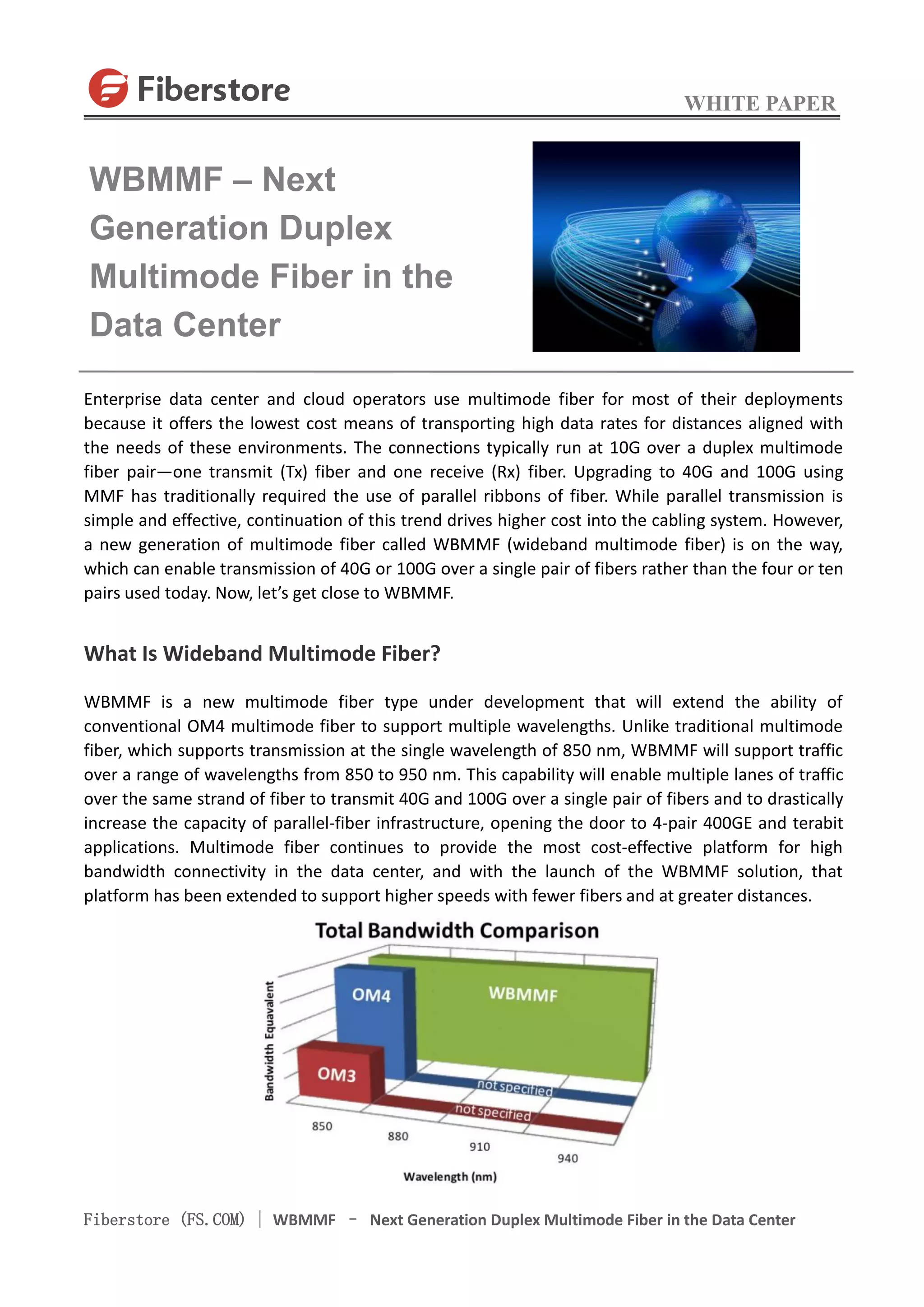
WBMMF is a new multimode fiber type under development that will extend the ability of
conventional OM4 multimode fiber to support multiple wavelengths. Unlike traditional multimode
fiber, which supports transmission at the single wavelength of 850 nm, WBMMF will support traffic
over a range of wavelengths from 850 to 950 nm. This capability will enable multiple lanes of traffic
over the same strand of fiber to transmit 40G and 100G over a single pair of fibers and to drastically
increase the capacity of parallel-fiber infrastructure, opening the door to 4-pair 400GE and terabit
applications. Multimode fiber continues to provide the most cost-effective platform for high
bandwidth connectivity in the data center, and with the launch of the WBMMF solution, that
platform has been extended to support higher speeds with fewer fibers and at greater distances.
WBMMF – Next
Generation Duplex
Multimode Fiber in the
Data Center
WHITE PAPER
Fiberstore (FS.COM) | WBMMF – Next Generation Duplex Multimode Fiber in the Data Center
What Is the Technology Behind WBMMF?
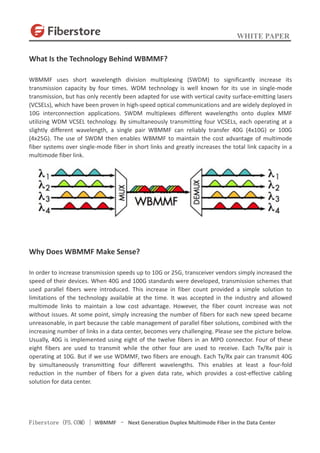
WBMMF uses short wavelength division multiplexing (SWDM) to significantly increase its
transmission capacity by four times. WDM technology is well known for its use in single-mode
transmission, but has only recently been adapted for use with vertical cavity surface-emitting lasers
(VCSELs), which have been proven in high-speed optical communications and are widely deployed in
10G interconnection applications. SWDM multiplexes different wavelengths onto duplex MMF
utilizing WDM VCSEL technology. By simultaneously transmitting four VCSELs, each operating at a
slightly different wavelength, a single pair WBMMF can reliably transfer 40G (4x10G) or 100G
(4x25G). The use of SWDM then enables WBMMF to maintain the cost advantage of multimode
fiber systems over single-mode fiber in short links and greatly increases the total link capacity in a
multimode fiber link.
Why Does WBMMF Make Sense?
In order to increase transmission speeds up to 10G or 25G, transceiver vendors simply increased the
speed of their devices. When 40G and 100G standards were developed, transmission schemes that
used parallel fibers were introduced. This increase in fiber count provided a simple solution to
limitations of the technology available at the time. It was accepted in the industry and allowed
multimode links to maintain a low cost advantage. However, the fiber count increase was not
without issues. At some point, simply increasing the number of fibers for each new speed became
unreasonable, in part because the cable management of parallel fiber solutions, combined with the
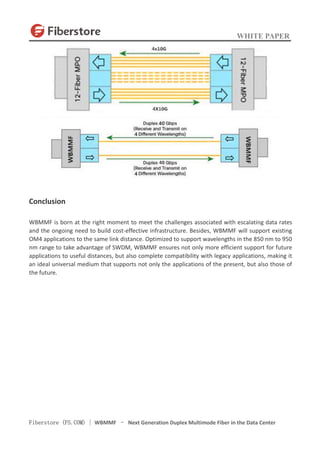
increasing number of links in a data center, becomes very challenging. Please see the picture below.
Usually, 40G is implemented using eight of the twelve fibers in an MPO connector. Four of these
eight fibers are used to transmit while the other four are used to receive. Each Tx/Rx pair is
operating at 10G. But if we use WDMMF, two fibers are enough. Each Tx/Rx pair can transmit 40G
by simultaneously transmitting four different wavelengths. This enables at least a four-fold
reduction in the number of fibers for a given data rate, which provides a cost-effective cabling
solution for data center.
WHITE PAPER
Fiberstore (FS.COM) | WBMMF – Next Generation Duplex Multimode Fiber in the Data Center
Conclusion
WBMMF is born at the right moment to meet the challenges associated with escalating data rates
and the ongoing need to build cost-effective infrastructure. Besides, WBMMF will support existing
OM4 applications to the same link distance. Optimized to support wavelengths in the 850 nm to 950
nm range to take advantage of SWDM, WBMMF ensures not only more efficient support for future
applications to useful distances, but also complete compatibility with legacy applications, making it
an ideal universal medium that supports not only the applications of the present, but also those of
the future.
WHITE PAPER
Fiberstore (FS.COM) | WBMMF – Next Generation Duplex Multimode Fiber in the Data Center
Contact Us
Manufacturing R & D (China)
Eastern Side, Second Floor, Science &
Technology Park, No.6, Keyuan Road,
Nanshan District, Shenzhen 518057,
China
Tel: +86 (755) 8300 3611
Fax: +86 (755) 8326 9395
Email: sales@fs.com
APAC Office (Hong Kong)
1220 Tung Chun Commercial Centre,
438-444 Shanghai Street, Kowloon,
Hong Kong
Tel: +852 81763606
Fax: +852 81763606
Email: sales@fs.com
North America (United States)
331 Andover Park East Ste330, Tukwila,
WA 98188,United States
Tel: +1-425-226-2035
Fax: +1-253-246-7881
Email: sales@fs.com
London Office (United Kingdom)
Third Floor 207 Regent Street, London,
W1B 3HH, United Kingdom
Tel: +44 2081441980
Notice: This document is for informational purposes only and does not set forth any warranty, expressed or
implied, concerning any equipment, equipment features, or service offered or to be offered by Fiberstore.
Fiberstore reserves the right to make changes to this document at any time, without notice, and assumes no
responsibility for its use. This information document describes features that may not be currently available.
Contact a Fiberstore sales team for information on feature and product availability.
Follow us
LinkedIn
Twitter
Facebook
G+
Pinterest
Youtube
Blog

Wbmmf – next generation duplex multimode fiber in the data center

  • 1.
    WHITE PAPER Fiberstore (FS.COM)| WBMMF – Next Generation Duplex Multimode Fiber in the Data Center Enterprise data center and cloud operators use multimode fiber for most of their deployments because it offers the lowest cost means of transporting high data rates for distances aligned with the needs of these environments. The connections typically run at 10G over a duplex multimode fiber pair—one transmit (Tx) fiber and one receive (Rx) fiber. Upgrading to 40G and 100G using MMF has traditionally required the use of parallel ribbons of fiber. While parallel transmission is simple and effective, continuation of this trend drives higher cost into the cabling system. However, a new generation of multimode fiber called WBMMF (wideband multimode fiber) is on the way, which can enable transmission of 40G or 100G over a single pair of fibers rather than the four or ten pairs used today. Now, let’s get close to WBMMF. What Is Wideband Multimode Fiber? WBMMF is a new multimode fiber type under development that will extend the ability of conventional OM4 multimode fiber to support multiple wavelengths. Unlike traditional multimode fiber, which supports transmission at the single wavelength of 850 nm, WBMMF will support traffic over a range of wavelengths from 850 to 950 nm. This capability will enable multiple lanes of traffic over the same strand of fiber to transmit 40G and 100G over a single pair of fibers and to drastically increase the capacity of parallel-fiber infrastructure, opening the door to 4-pair 400GE and terabit applications. Multimode fiber continues to provide the most cost-effective platform for high bandwidth connectivity in the data center, and with the launch of the WBMMF solution, that platform has been extended to support higher speeds with fewer fibers and at greater distances. WBMMF – Next Generation Duplex Multimode Fiber in the Data Center
  • 2.
    WHITE PAPER Fiberstore (FS.COM)| WBMMF – Next Generation Duplex Multimode Fiber in the Data Center What Is the Technology Behind WBMMF? WBMMF uses short wavelength division multiplexing (SWDM) to significantly increase its transmission capacity by four times. WDM technology is well known for its use in single-mode transmission, but has only recently been adapted for use with vertical cavity surface-emitting lasers (VCSELs), which have been proven in high-speed optical communications and are widely deployed in 10G interconnection applications. SWDM multiplexes different wavelengths onto duplex MMF utilizing WDM VCSEL technology. By simultaneously transmitting four VCSELs, each operating at a slightly different wavelength, a single pair WBMMF can reliably transfer 40G (4x10G) or 100G (4x25G). The use of SWDM then enables WBMMF to maintain the cost advantage of multimode fiber systems over single-mode fiber in short links and greatly increases the total link capacity in a multimode fiber link. Why Does WBMMF Make Sense? In order to increase transmission speeds up to 10G or 25G, transceiver vendors simply increased the speed of their devices. When 40G and 100G standards were developed, transmission schemes that used parallel fibers were introduced. This increase in fiber count provided a simple solution to limitations of the technology available at the time. It was accepted in the industry and allowed multimode links to maintain a low cost advantage. However, the fiber count increase was not without issues. At some point, simply increasing the number of fibers for each new speed became unreasonable, in part because the cable management of parallel fiber solutions, combined with the increasing number of links in a data center, becomes very challenging. Please see the picture below. Usually, 40G is implemented using eight of the twelve fibers in an MPO connector. Four of these eight fibers are used to transmit while the other four are used to receive. Each Tx/Rx pair is operating at 10G. But if we use WDMMF, two fibers are enough. Each Tx/Rx pair can transmit 40G by simultaneously transmitting four different wavelengths. This enables at least a four-fold reduction in the number of fibers for a given data rate, which provides a cost-effective cabling solution for data center.
  • 3.
    WHITE PAPER Fiberstore (FS.COM)| WBMMF – Next Generation Duplex Multimode Fiber in the Data Center Conclusion WBMMF is born at the right moment to meet the challenges associated with escalating data rates and the ongoing need to build cost-effective infrastructure. Besides, WBMMF will support existing OM4 applications to the same link distance. Optimized to support wavelengths in the 850 nm to 950 nm range to take advantage of SWDM, WBMMF ensures not only more efficient support for future applications to useful distances, but also complete compatibility with legacy applications, making it an ideal universal medium that supports not only the applications of the present, but also those of the future.
  • 4.
    WHITE PAPER Fiberstore (FS.COM)| WBMMF – Next Generation Duplex Multimode Fiber in the Data Center Contact Us Manufacturing R & D (China) Eastern Side, Second Floor, Science & Technology Park, No.6, Keyuan Road, Nanshan District, Shenzhen 518057, China Tel: +86 (755) 8300 3611 Fax: +86 (755) 8326 9395 Email: sales@fs.com APAC Office (Hong Kong) 1220 Tung Chun Commercial Centre, 438-444 Shanghai Street, Kowloon, Hong Kong Tel: +852 81763606 Fax: +852 81763606 Email: sales@fs.com North America (United States) 331 Andover Park East Ste330, Tukwila, WA 98188,United States Tel: +1-425-226-2035 Fax: +1-253-246-7881 Email: sales@fs.com London Office (United Kingdom) Third Floor 207 Regent Street, London, W1B 3HH, United Kingdom Tel: +44 2081441980 Notice: This document is for informational purposes only and does not set forth any warranty, expressed or implied, concerning any equipment, equipment features, or service offered or to be offered by Fiberstore. Fiberstore reserves the right to make changes to this document at any time, without notice, and assumes no responsibility for its use. This information document describes features that may not be currently available. Contact a Fiberstore sales team for information on feature and product availability. Follow us LinkedIn Twitter Facebook G+ Pinterest Youtube Blog