The 4th Whole Brain
Architecture
Hackathon Orientation
2018-08-19
The Whole Brain Architecture Initiative
Agenda
• Background and Purposes
• Tasks
• Evaluation Criteria
• Samples explained
• What the participants should do
Background and Purposes
WBA Hackathons so far
2015 2016 2017
Key Concept
Hackathon
theme
The Whole Brain
Architecture
Core Hypothesis
Open platform strategy
Start learning from
the Brain
Combined ML
Cognitive Architecture
with LIS
Tactile mini-Hackathon
Hippocampus Hackathon
Brain Organ Framework
(Standard external spec.)
Recent activity at WBAI
Organizing connectivity, I/F, capability, tasks of brain organs as the specs of brain-inspired AGI
Agent
St.
ML
St.
St.
Environment
Tasks
(test)
Brain organ I/F
(Information
processing
semantics)
WBCA
(Connectome)
Capabilities of
brain organs
:Stub
:ML [WBA Development]
:Brain organs’ I/F
St.
ML
R&D Scenario from now on
追加
Developme
nt
プロト
Developme
nt
プロト
Developme
nt
マージ
Developme
nt
プロト
Developme
nt
ML
St.
St.
St.
Environment
St.
ML
St.
St.
Environment
St.
St.
ML
St.
Environment
ML
ML
St.
St.
Environment
St.
St.
ML
ML
Environment
追加
Developme
nt
改良
Developme
nt
ML
ML
St.
St.
Environment
St.
ML
ML
ML
Environment
マージ
Developme
nt
ML
ML
ML
ML
Environment
Replacing with ML:Expanding inductive reasoning
Generality of Brain-
inspired Architecture① Brain organ
Framework design (I/F,
capability)
② Brain-
constrained
refactoring
Expansion
ML
ML
ML
ML
Environment
③ Meta-level
mechanism for
operating
representations
(Theory)
Complete
WBA
:Stub
:ML[WBA Development]
:Brain organs I/F
St.
ML
Entire
Architecture
Add
Prototype
Prototype
Merge
Prototype
ML
St.
St.
St.
Environment
St.
ML
St.
St.
Environment
St.
St.
ML
St.
Environment
ML
ML
St.
St.
Environment
St.
St.
ML
ML
Environment
Add
Improvement
ML
ML
St.
St.
Environment
St.
ML
ML
ML
Environment
Merge
ML
ML
ML
ML
Environment
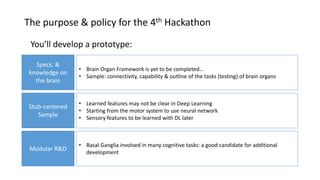
The purpose & policy for the 4th Hackathon
You’ll develop a prototype:
Stub-centered
Sample
Modular R&D
Specs. &
knowledge on
the brain
• Brain Organ Framework is yet to be completed…
• Sample: connectivity, capability & outline of the tasks (testing) of brain organs
• Learned features may not be clear in Deep Learning
• Starting from the motor system to use neural network
• Sensory features to be learned with DL later
• Basal Ganglia involved in many cognitive tasks: a good candidate for additional
development
Tasks
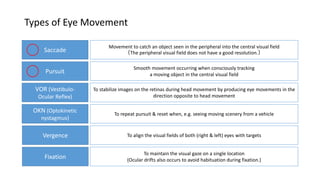
Types of Eye Movement
Saccade
VOR (Vestibulo-
Ocular Reflex)
Fixation
OKN (Optokinetic
nystagmus)
Vergence
Pursuit
Movement to catch an object seen in the peripheral into the central visual field
(The peripheral visual field does not have a good resolution.)
Smooth movement occurring when consciously tracking
a moving object in the central visual field
To stabilize images on the retinas during head movement by producing eye movements in the
direction opposite to head movement
To repeat pursuit & reset when, e.g. seeing moving scenery from a vehicle
To align the visual fields of both (right & left) eyes with targets
To maintain the visual gaze on a single location
(Ocular drifts also occurs to avoid habituation during fixation.)
0
0.2
0.4
0.6
0.8
1
-80 -60 -40 -20 0 20 40 60 80
Central & Peripheral Vision
Difference in resolution causes eye movement?
Fovea centralis
↓
Location on retina, degrees
Visualacuity
(1/minutesofarc)
Saccade
Pursuit
Detecting a salient object in the
peripheral
Perceiving an object with central vision
Moving it to the center
The object going out of the center
Tracking so that it comes to the center
Saliency
Roughly speaking, attracted attention to those stick out
cf. Pop out in visual search Saliency Map
Sticking out by
color
Sticking out by
direction
Requiring total
search
Color Bright.
Orien
-
tation
Mo-
tion
Input
movie
Parallel processing
③ Saliency Map
Adding up feature maps
② Feature Map
Lateral inhibition
① Feature Analysis
Point To Target
• Displaying red cross cursor
• Center of display = Center of visual fieldStep.1
• Go to next when the agent looks at the
cross cursorStep.2
• Displaying big and small EsStep.3
• Agent gets 1 reward point when it looks at
the big E.
• It gets 2 points when it looks at the small E.
Step.4
Random Dot
• Displaying red cross cursor
• Center of display = Center of visual field
Step.1
• Go to next when the agent looks at the
cross cursorStep.2
• Displaying randomly flashing points,
moving points & eight direction arrowsStep.3
• Agent to find which is the direction of the
moving pointStep.4
• Agent gazes in the direction.
• It gets 1 point if correct.
Step.5
Odd One Out
• Displaying red cross cursor
• Center of display = Center of visual field
Step.1
• Go to next when the agent looks at the
cross cursorStep.2
• Displaying objects including an ‘odd one’Step.3
• Agent to find the ‘odd one’Step.4
• Keep displaying until the agent looks at
the ‘odd one’Step.5
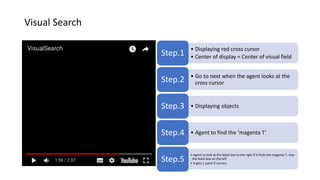
Visual Search
• Displaying red cross cursor
• Center of display = Center of visual field
Step.1
• Go to next when the agent looks at the
cross cursorStep.2
• Displaying objectsStep.3
• Agent to find the ‘magenta T’Step.4
• Agent to look at the black box to the right if it finds the magenta T, else
the black box on the left
• It gets 1 point if correct.
Step.5
Change Detection
•Displaying red cross cursor
•Center of display = Center of visual fieldStep.1
•Go to next when the agent looks at the cross cursorStep.2
•Displaying objectsStep.3
• Eliminating objects from the displayStep.4
• RedisplayStep.5
• Agent to judge if the object is the same as beforeStep.6
• It gets 1 point if correctStep.7
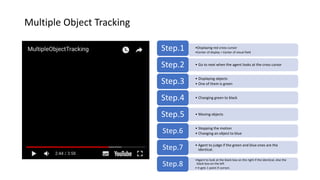
Multiple Object Tracking
•Displaying red cross cursor
•Center of display = Center of visual field
Step.1
• Go to next when the agent looks at the cross cursorStep.2
• Displaying objects
• One of them is greenStep.3
• Changing green to blackStep.4
• Moving objectsStep.5
• Stopping the motion
• Changing an object to blueStep.6
• Agent to judge if the green and blue ones are the
identical.Step.7
•Agent to look at the black box on the right if the identical, else the
black box on the left
• It gets 1 point if correct.
Step.8
Tasks Summary
Multiple Object Tracking
Change Detection
Visual Search
Odd One Out
Random Dot
Point to Target
Types of Eye
Movement
Use of Saliency
Use of Working
Memory
Comments
Saccade
Saccade
Saccade
Saccade
Saccade
Pursuit
◯
-
◯
-
-
◯
-
-
-
-
◯
◯
Often lured by large
objects
-
-
-
-
1 or 2 objects will be
tracked.
Evaluation Criteria
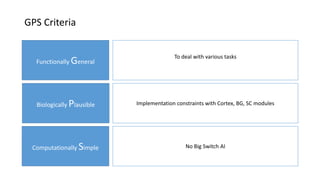
GPS Criteria
Functionally General
Biologically Plausible
Computationally Simple
To deal with various tasks
Implementation constraints with Cortex, BG, SC modules
No Big Switch AI
Evaluation Measures
Weighting is TBD
Dealing with many tasks
Reward rate
Execution speed & Accuracy
Learning rate
Success in more tasks (Generality)
Reward rate=Task success rate/Average time for decision making
Ex. Correct rate 0.8 & decision time 10 sec.
R=0.8/10sec
Time till the reward rate & loss function saturate
Expected: a module takes ~10ms & the system ~100ms.
E.g., no good if it takes 1 min. for calculating 1 frame
Biological Plausibility
Implementation constraints with Cortex, BG, SC modules※
Basal Ganglia
Cortex: likelihood calculation
(accumulator model)
Controlling threshold:
Cortex – Basal Ganglia (BG)
– Superior Colliculus (SC) Modifying the connection from Cortex to
Striatum (within BG) by learning with
dopaminergic neurons
SC: bursts when likelihood
goes beyond the threshold
(motor output)
※OK to add or divide modules
Computational Simplicity
• Your code on GitHub will be reviewed by the hackathon committee.
• Code to be evaluated should be submitted by 24:00, Oct-7th.
• Late submission could incur lower evaluation.
Other evaluation points
• Judged from your presentation, code, etc.
• Originality
• Usability
Samples explained
Sample code with Docker & BriCA
Docker BriCA
Installation as entry barrier for MLIssue
Intention
Libraries
• DL libraries such as Tensorflow, Keras,
Chainer, …
• OpenCV
• BriCA ⇒
Participants to use more time for
studying the model and examining
the prototype
The WBA Core Hypothesis:
The brain exhibits intelligence by
connecting learned ML.
Issue
Intention
Participants to connect ML modules
in an asynchronous & parallel way
Mimicking asynchronous & parallel
processing in the brain
Specs.
Brain organs and related modules in the sample
Module Full name Process summary
Retina
Visual Cortex
LIP
FEF
PFC
Cerebellum
-
-
lateral intraparietal
cortex
Frontal Eye Field
Prefrontal cortex
-
• Good vision at the center while blurred in the peripheral
• What (object) & Where (motion) paths
• The sample module passes through the image (no operation).
• On the Where path
• To create the saliency map
• Incurs eye movement when stimulated (motion command?)
• Planning, Task switching
• Working memory
• To generate allocentric information (in primates)
• Smoothing movement
• Rough command for motion targets
BG Basal Ganglia • Actor-Critic RL
SC Superior Colliculus • Controlling motion command output from input from BG & FEF
Connection in Saccade
Environment
Retina
Visual
Cortex
LIP
FEF PFC
SC BG
Hippocampal
Formation
Retinal Accumulator
E
Location dependent accumulation
Non-Retinal
Accumulator
Allocentric location on the panel
Image
Blurring
the peripheral
Thru in Sample
Making Saliency Map
Location independent
accumulation
[[likelihood, ex, ey],
[likelihood, ex, ey],
…
[likelihood, ex, ey]]
Switching
allocentric location,
phases, etc.
Allocentric location
on the panel,
etc.?
Image
Saliency
Map
?
? ?
[likelihood_threshold,
likelihood_threshold,
…
likelihood_threshold]
?
?
Controlling thresholds for
accumulator likelihood
Action=[ex, ey] or None
?: to be created by the participants
Retinal
Image
Reward
Connection in Pursuit
Environment
Retina
Visual
Cortex
LIP
FEF PFC
SC BG
Hippocampal
Formation
Retinal Accumulator
E
Location dependent accumulation
Non-Retinal
Accumulator
Allocentric location on the panel
Image
Blurring
the peripheral
Thru in Sample
Making Saliency Map
Location independent
accumulation
[[likelihood, ex, ey],
[likelihood, ex, ey],
…
[likelihood, ex, ey]]
Switching
allocentric location,
phases, etc.
Allocentric location
on the panel,
etc.?
Image
Saliency
Map
?
? ?
[likelihood_threshold,
likelihood_threshold,
…
likelihood_threshold]
?
?
Controlling thresholds for
accumulator likelihood
Action=[ex, ey] or None
?: to be created by the participants
Retinal
Image
Reward
Cerebellum
Action=[ex, ey]
?
Test tools
Tool to display Accumulator & visual features
Issues
• Difficult to grasp the features on RL
experiments
• Difficult to grasp accumulator likelihood on
the accumulator model
Visualization of the features in real time
What the participants should do
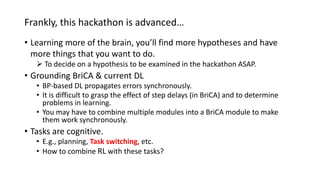
Frankly, this hackathon is advanced…
• Learning more of the brain, you’ll find more hypotheses and have
more things that you want to do.
 To decide on a hypothesis to be examined in the hackathon ASAP.
• Grounding BriCA & current DL
• BP-based DL propagates errors synchronously.
• It is difficult to grasp the effect of step delays (in BriCA) and to determine
problems in learning.
• You may have to combine multiple modules into a BriCA module to make
them work synchronously.
• Tasks are cognitive.
• E.g., planning, Task switching, etc.
• How to combine RL with these tasks?

WBA hackathon 2018 Orientation

  • 1.
    The 4th WholeBrain Architecture Hackathon Orientation 2018-08-19 The Whole Brain Architecture Initiative
  • 2.
    Agenda • Background andPurposes • Tasks • Evaluation Criteria • Samples explained • What the participants should do
  • 3.
  • 4.
    WBA Hackathons sofar 2015 2016 2017 Key Concept Hackathon theme The Whole Brain Architecture Core Hypothesis Open platform strategy Start learning from the Brain Combined ML Cognitive Architecture with LIS Tactile mini-Hackathon Hippocampus Hackathon
  • 5.
    Brain Organ Framework (Standardexternal spec.) Recent activity at WBAI Organizing connectivity, I/F, capability, tasks of brain organs as the specs of brain-inspired AGI Agent St. ML St. St. Environment Tasks (test) Brain organ I/F (Information processing semantics) WBCA (Connectome) Capabilities of brain organs :Stub :ML [WBA Development] :Brain organs’ I/F St. ML
  • 6.
    R&D Scenario fromnow on 追加 Developme nt プロト Developme nt プロト Developme nt マージ Developme nt プロト Developme nt ML St. St. St. Environment St. ML St. St. Environment St. St. ML St. Environment ML ML St. St. Environment St. St. ML ML Environment 追加 Developme nt 改良 Developme nt ML ML St. St. Environment St. ML ML ML Environment マージ Developme nt ML ML ML ML Environment Replacing with ML:Expanding inductive reasoning Generality of Brain- inspired Architecture① Brain organ Framework design (I/F, capability) ② Brain- constrained refactoring Expansion ML ML ML ML Environment ③ Meta-level mechanism for operating representations (Theory) Complete WBA :Stub :ML[WBA Development] :Brain organs I/F St. ML Entire Architecture Add Prototype Prototype Merge Prototype ML St. St. St. Environment St. ML St. St. Environment St. St. ML St. Environment ML ML St. St. Environment St. St. ML ML Environment Add Improvement ML ML St. St. Environment St. ML ML ML Environment Merge ML ML ML ML Environment
  • 7.
    The purpose &policy for the 4th Hackathon You’ll develop a prototype: Stub-centered Sample Modular R&D Specs. & knowledge on the brain • Brain Organ Framework is yet to be completed… • Sample: connectivity, capability & outline of the tasks (testing) of brain organs • Learned features may not be clear in Deep Learning • Starting from the motor system to use neural network • Sensory features to be learned with DL later • Basal Ganglia involved in many cognitive tasks: a good candidate for additional development
  • 8.
  • 9.
    Types of EyeMovement Saccade VOR (Vestibulo- Ocular Reflex) Fixation OKN (Optokinetic nystagmus) Vergence Pursuit Movement to catch an object seen in the peripheral into the central visual field (The peripheral visual field does not have a good resolution.) Smooth movement occurring when consciously tracking a moving object in the central visual field To stabilize images on the retinas during head movement by producing eye movements in the direction opposite to head movement To repeat pursuit & reset when, e.g. seeing moving scenery from a vehicle To align the visual fields of both (right & left) eyes with targets To maintain the visual gaze on a single location (Ocular drifts also occurs to avoid habituation during fixation.)
  • 10.
    0 0.2 0.4 0.6 0.8 1 -80 -60 -40-20 0 20 40 60 80 Central & Peripheral Vision Difference in resolution causes eye movement? Fovea centralis ↓ Location on retina, degrees Visualacuity (1/minutesofarc) Saccade Pursuit Detecting a salient object in the peripheral Perceiving an object with central vision Moving it to the center The object going out of the center Tracking so that it comes to the center
  • 11.
    Saliency Roughly speaking, attractedattention to those stick out cf. Pop out in visual search Saliency Map Sticking out by color Sticking out by direction Requiring total search Color Bright. Orien - tation Mo- tion Input movie Parallel processing ③ Saliency Map Adding up feature maps ② Feature Map Lateral inhibition ① Feature Analysis
  • 12.
    Point To Target •Displaying red cross cursor • Center of display = Center of visual fieldStep.1 • Go to next when the agent looks at the cross cursorStep.2 • Displaying big and small EsStep.3 • Agent gets 1 reward point when it looks at the big E. • It gets 2 points when it looks at the small E. Step.4
  • 13.
    Random Dot • Displayingred cross cursor • Center of display = Center of visual field Step.1 • Go to next when the agent looks at the cross cursorStep.2 • Displaying randomly flashing points, moving points & eight direction arrowsStep.3 • Agent to find which is the direction of the moving pointStep.4 • Agent gazes in the direction. • It gets 1 point if correct. Step.5
  • 14.
    Odd One Out •Displaying red cross cursor • Center of display = Center of visual field Step.1 • Go to next when the agent looks at the cross cursorStep.2 • Displaying objects including an ‘odd one’Step.3 • Agent to find the ‘odd one’Step.4 • Keep displaying until the agent looks at the ‘odd one’Step.5
  • 15.
    Visual Search • Displayingred cross cursor • Center of display = Center of visual field Step.1 • Go to next when the agent looks at the cross cursorStep.2 • Displaying objectsStep.3 • Agent to find the ‘magenta T’Step.4 • Agent to look at the black box to the right if it finds the magenta T, else the black box on the left • It gets 1 point if correct. Step.5
  • 16.
    Change Detection •Displaying redcross cursor •Center of display = Center of visual fieldStep.1 •Go to next when the agent looks at the cross cursorStep.2 •Displaying objectsStep.3 • Eliminating objects from the displayStep.4 • RedisplayStep.5 • Agent to judge if the object is the same as beforeStep.6 • It gets 1 point if correctStep.7
  • 17.
    Multiple Object Tracking •Displayingred cross cursor •Center of display = Center of visual field Step.1 • Go to next when the agent looks at the cross cursorStep.2 • Displaying objects • One of them is greenStep.3 • Changing green to blackStep.4 • Moving objectsStep.5 • Stopping the motion • Changing an object to blueStep.6 • Agent to judge if the green and blue ones are the identical.Step.7 •Agent to look at the black box on the right if the identical, else the black box on the left • It gets 1 point if correct. Step.8
  • 18.
    Tasks Summary Multiple ObjectTracking Change Detection Visual Search Odd One Out Random Dot Point to Target Types of Eye Movement Use of Saliency Use of Working Memory Comments Saccade Saccade Saccade Saccade Saccade Pursuit ◯ - ◯ - - ◯ - - - - ◯ ◯ Often lured by large objects - - - - 1 or 2 objects will be tracked.
  • 19.
  • 20.
    GPS Criteria Functionally General BiologicallyPlausible Computationally Simple To deal with various tasks Implementation constraints with Cortex, BG, SC modules No Big Switch AI
  • 21.
    Evaluation Measures Weighting isTBD Dealing with many tasks Reward rate Execution speed & Accuracy Learning rate Success in more tasks (Generality) Reward rate=Task success rate/Average time for decision making Ex. Correct rate 0.8 & decision time 10 sec. R=0.8/10sec Time till the reward rate & loss function saturate Expected: a module takes ~10ms & the system ~100ms. E.g., no good if it takes 1 min. for calculating 1 frame
  • 22.
    Biological Plausibility Implementation constraintswith Cortex, BG, SC modules※ Basal Ganglia Cortex: likelihood calculation (accumulator model) Controlling threshold: Cortex – Basal Ganglia (BG) – Superior Colliculus (SC) Modifying the connection from Cortex to Striatum (within BG) by learning with dopaminergic neurons SC: bursts when likelihood goes beyond the threshold (motor output) ※OK to add or divide modules
  • 23.
    Computational Simplicity • Yourcode on GitHub will be reviewed by the hackathon committee. • Code to be evaluated should be submitted by 24:00, Oct-7th. • Late submission could incur lower evaluation.
  • 24.
    Other evaluation points •Judged from your presentation, code, etc. • Originality • Usability
  • 25.
  • 26.
    Sample code withDocker & BriCA Docker BriCA Installation as entry barrier for MLIssue Intention Libraries • DL libraries such as Tensorflow, Keras, Chainer, … • OpenCV • BriCA ⇒ Participants to use more time for studying the model and examining the prototype The WBA Core Hypothesis: The brain exhibits intelligence by connecting learned ML. Issue Intention Participants to connect ML modules in an asynchronous & parallel way Mimicking asynchronous & parallel processing in the brain Specs.
  • 27.
    Brain organs andrelated modules in the sample Module Full name Process summary Retina Visual Cortex LIP FEF PFC Cerebellum - - lateral intraparietal cortex Frontal Eye Field Prefrontal cortex - • Good vision at the center while blurred in the peripheral • What (object) & Where (motion) paths • The sample module passes through the image (no operation). • On the Where path • To create the saliency map • Incurs eye movement when stimulated (motion command?) • Planning, Task switching • Working memory • To generate allocentric information (in primates) • Smoothing movement • Rough command for motion targets BG Basal Ganglia • Actor-Critic RL SC Superior Colliculus • Controlling motion command output from input from BG & FEF
  • 28.
    Connection in Saccade Environment Retina Visual Cortex LIP FEFPFC SC BG Hippocampal Formation Retinal Accumulator E Location dependent accumulation Non-Retinal Accumulator Allocentric location on the panel Image Blurring the peripheral Thru in Sample Making Saliency Map Location independent accumulation [[likelihood, ex, ey], [likelihood, ex, ey], … [likelihood, ex, ey]] Switching allocentric location, phases, etc. Allocentric location on the panel, etc.? Image Saliency Map ? ? ? [likelihood_threshold, likelihood_threshold, … likelihood_threshold] ? ? Controlling thresholds for accumulator likelihood Action=[ex, ey] or None ?: to be created by the participants Retinal Image Reward
  • 29.
    Connection in Pursuit Environment Retina Visual Cortex LIP FEFPFC SC BG Hippocampal Formation Retinal Accumulator E Location dependent accumulation Non-Retinal Accumulator Allocentric location on the panel Image Blurring the peripheral Thru in Sample Making Saliency Map Location independent accumulation [[likelihood, ex, ey], [likelihood, ex, ey], … [likelihood, ex, ey]] Switching allocentric location, phases, etc. Allocentric location on the panel, etc.? Image Saliency Map ? ? ? [likelihood_threshold, likelihood_threshold, … likelihood_threshold] ? ? Controlling thresholds for accumulator likelihood Action=[ex, ey] or None ?: to be created by the participants Retinal Image Reward Cerebellum Action=[ex, ey] ?
  • 30.
    Test tools Tool todisplay Accumulator & visual features Issues • Difficult to grasp the features on RL experiments • Difficult to grasp accumulator likelihood on the accumulator model Visualization of the features in real time
  • 31.
  • 32.
    Frankly, this hackathonis advanced… • Learning more of the brain, you’ll find more hypotheses and have more things that you want to do.  To decide on a hypothesis to be examined in the hackathon ASAP. • Grounding BriCA & current DL • BP-based DL propagates errors synchronously. • It is difficult to grasp the effect of step delays (in BriCA) and to determine problems in learning. • You may have to combine multiple modules into a BriCA module to make them work synchronously. • Tasks are cognitive. • E.g., planning, Task switching, etc. • How to combine RL with these tasks?

Editor's Notes