Ways of The World
   1750 - 2010
  By Misty Sims

    Ways of The World
      1750 - 2010
      By Misty Sims
Chapter 17 The American Revolution 1775 -1787


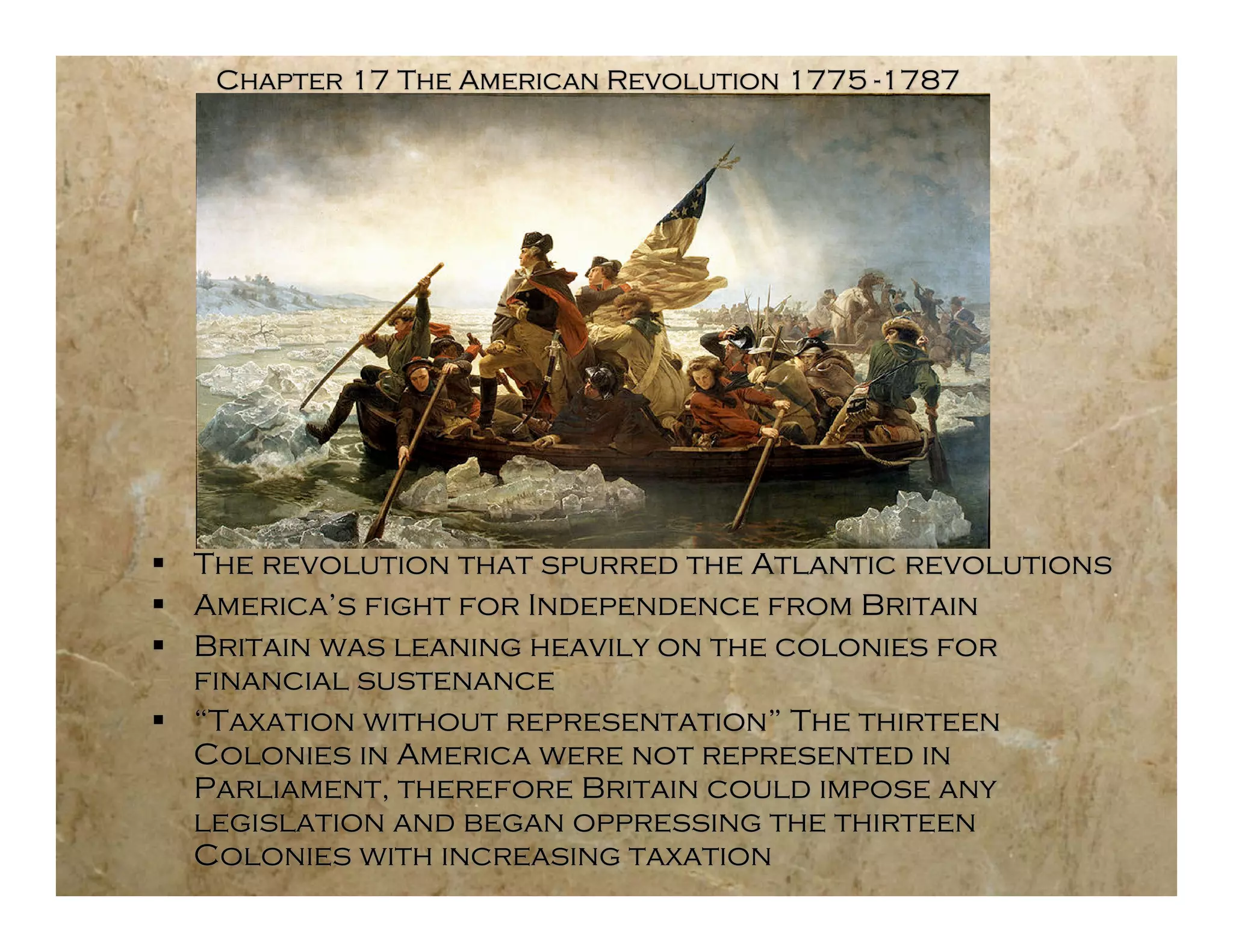
 The revolution that spurred the Atlantic revolutions
 America’s fight for Independence from Britain
 Britain was leaning heavily on the colonies for
  financial sustenance
 “Taxation without representation” The thirteen
  Colonies in America were not represented in
  Parliament, therefore Britain could impose any
  legislation and began oppressing the thirteen
  Colonies with increasing taxation
Chapter 17 The American Revolution 1775-1787


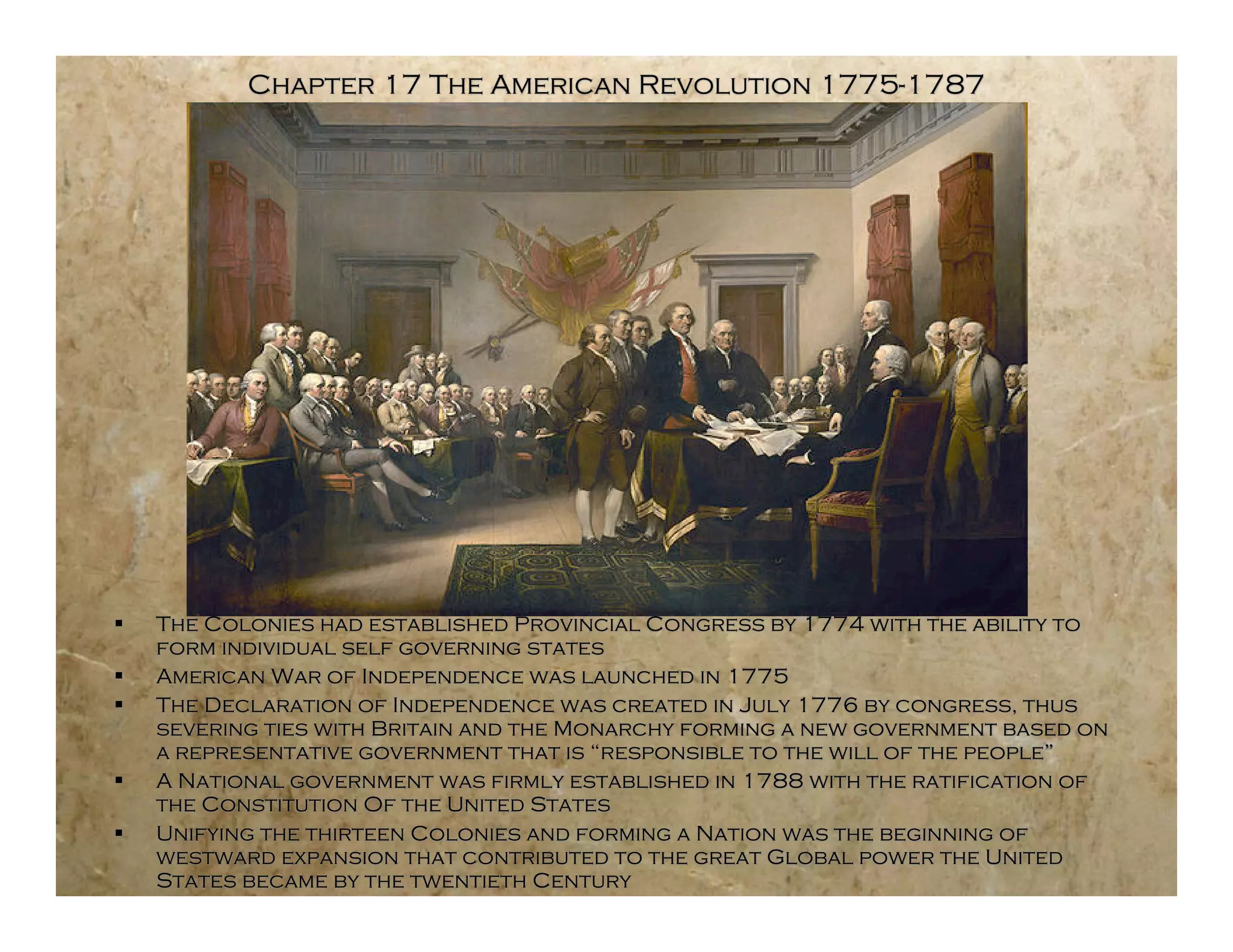
   The Colonies had established Provincial Congress by 1774 with the ability to
    form individual self governing states
   American War of Independence was launched in 1775
   The Declaration of Independence was created in July 1776 by congress, thus
    severing ties with Britain and the Monarchy forming a new government based on
    a representative government that is “responsible to the will of the people”
   A National government was firmly established in 1788 with the ratification of
    the Constitution Of the United States
   Unifying the thirteen Colonies and forming a Nation was the beginning of
    westward expansion that contributed to the great Global power the United
    States became by the twentieth Century
Chapter 17 The American Revolution 1775 - 1787
                                     The Birth of Democracy and
                                      Hope for Tomorrow
                                     The “Right to Revolution”
                                      written in the Declaration of
                                      Independence gave inspiration to
                                      the politically oppressed
                                     The American War of
                                      Independence was the template
                                      and inspiration for many
                                      countries across the Atlantic
                                      suffering from tyranny
                                     French soldiers returning home
                                      from giving aid to the American
                                      Colonists were “awakened” by
                                      the American revolution
                                     The Bill of Rights created in
                                      1789, establishes and protects
                                      the personal rights and
                                      liberties of individuals
                                     The Bill of Rights was the first
                                      document of this political
                                      nature and the enlightenment
                                      ideas that it embodied
                                      contributed to political
                                      upheavals around the world for
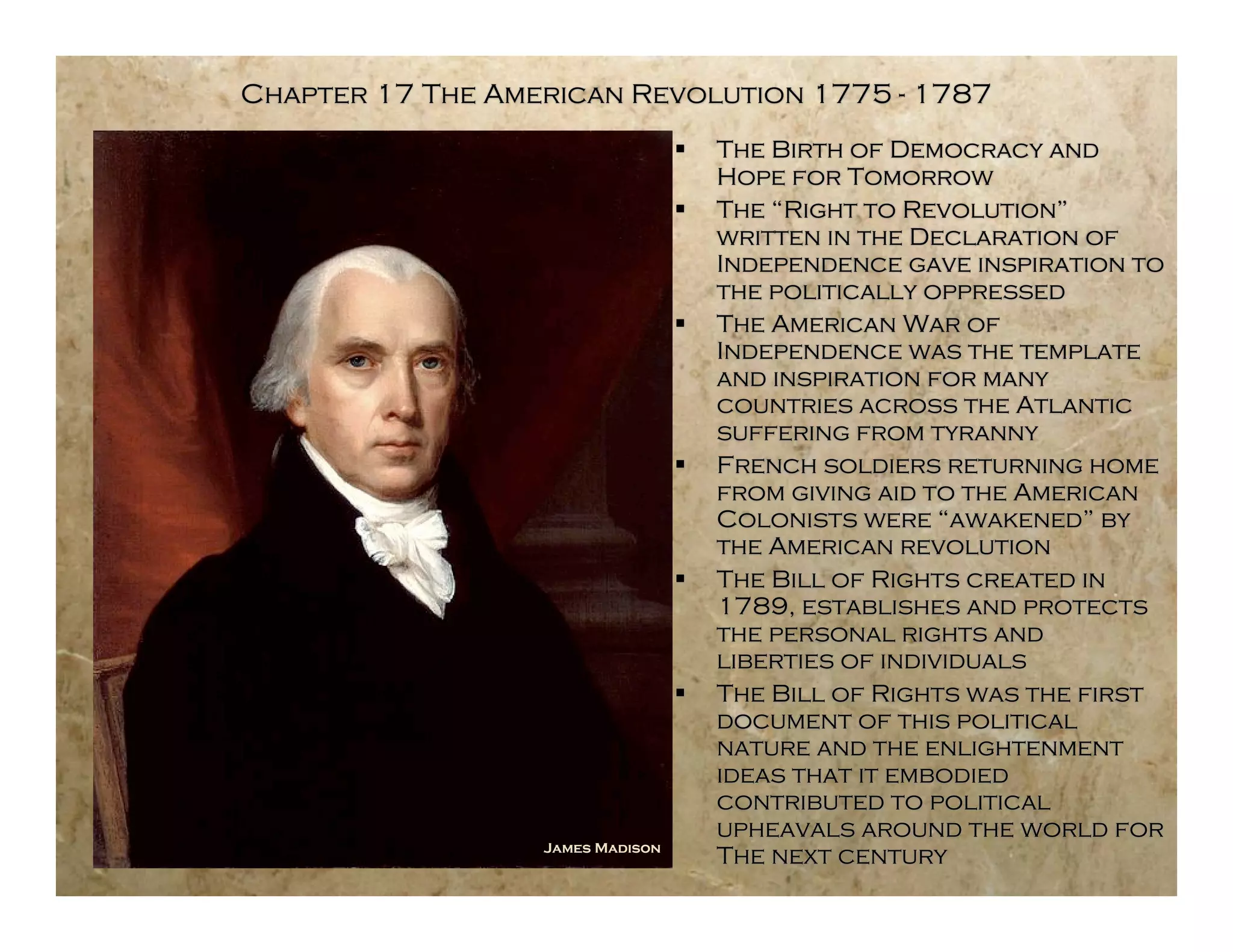
                  James Madison
                                      The next century
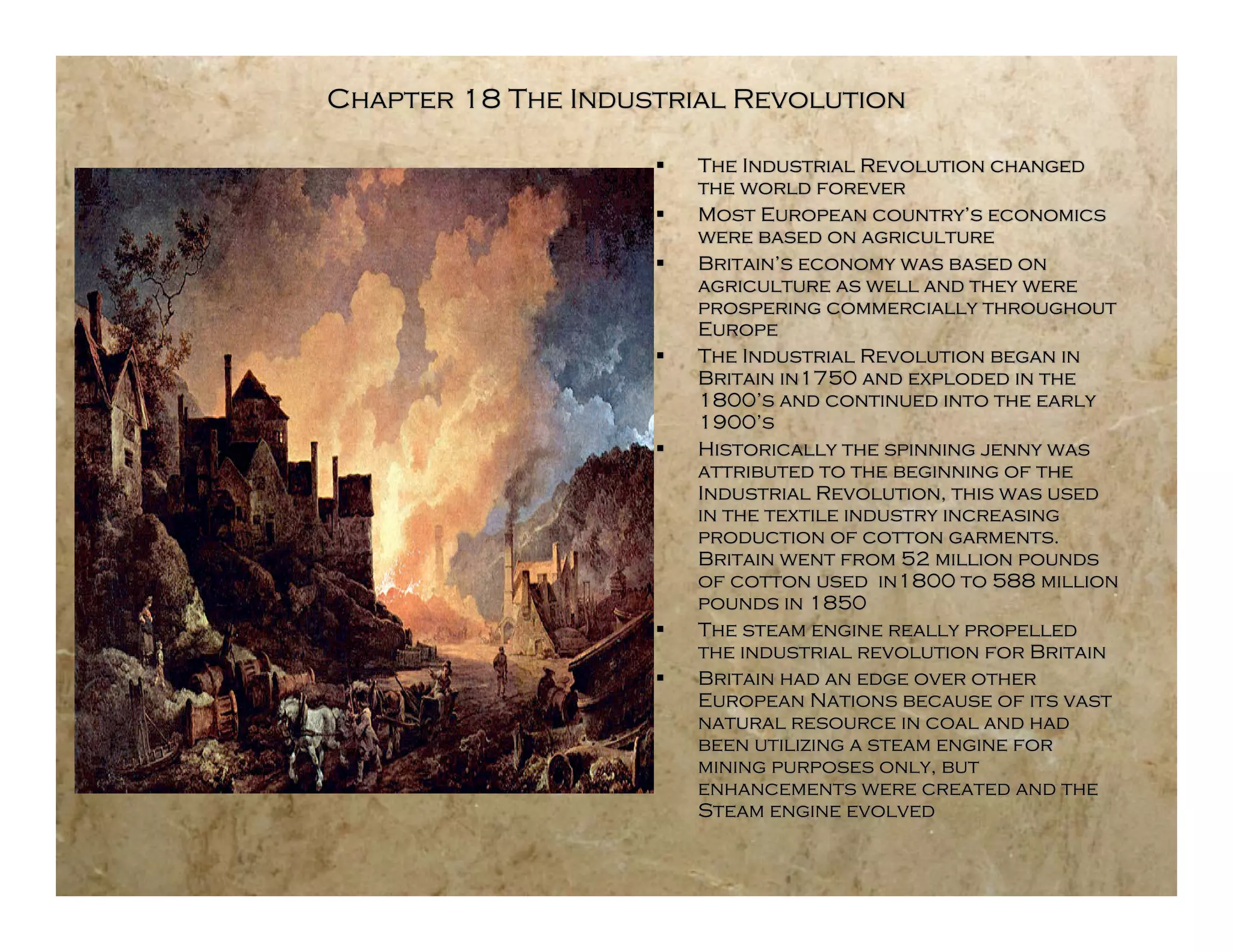
Chapter 18 The Industrial Revolution

                       The Industrial Revolution changed
                        the world forever
                       Most European country’s economics
                        were based on agriculture
                       Britain’s economy was based on
                        agriculture as well and they were
                        prospering commercially throughout
                        Europe
                       The Industrial Revolution began in
                        Britain in1750 and exploded in the
                        1800’s and continued into the early
                        1900’s
                       Historically the spinning jenny was
                        attributed to the beginning of the
                        Industrial Revolution, this was used
                        in the textile industry increasing
                        production of cotton garments.
                        Britain went from 52 million pounds
                        of cotton used in1800 to 588 million
                        pounds in 1850
                       The steam engine really propelled
                        the industrial revolution for Britain
                       Britain had an edge over other
                        European Nations because of its vast
                        natural resource in coal and had
                        been utilizing a steam engine for
                        mining purposes only, but
                        enhancements were created and the
                        Steam engine evolved
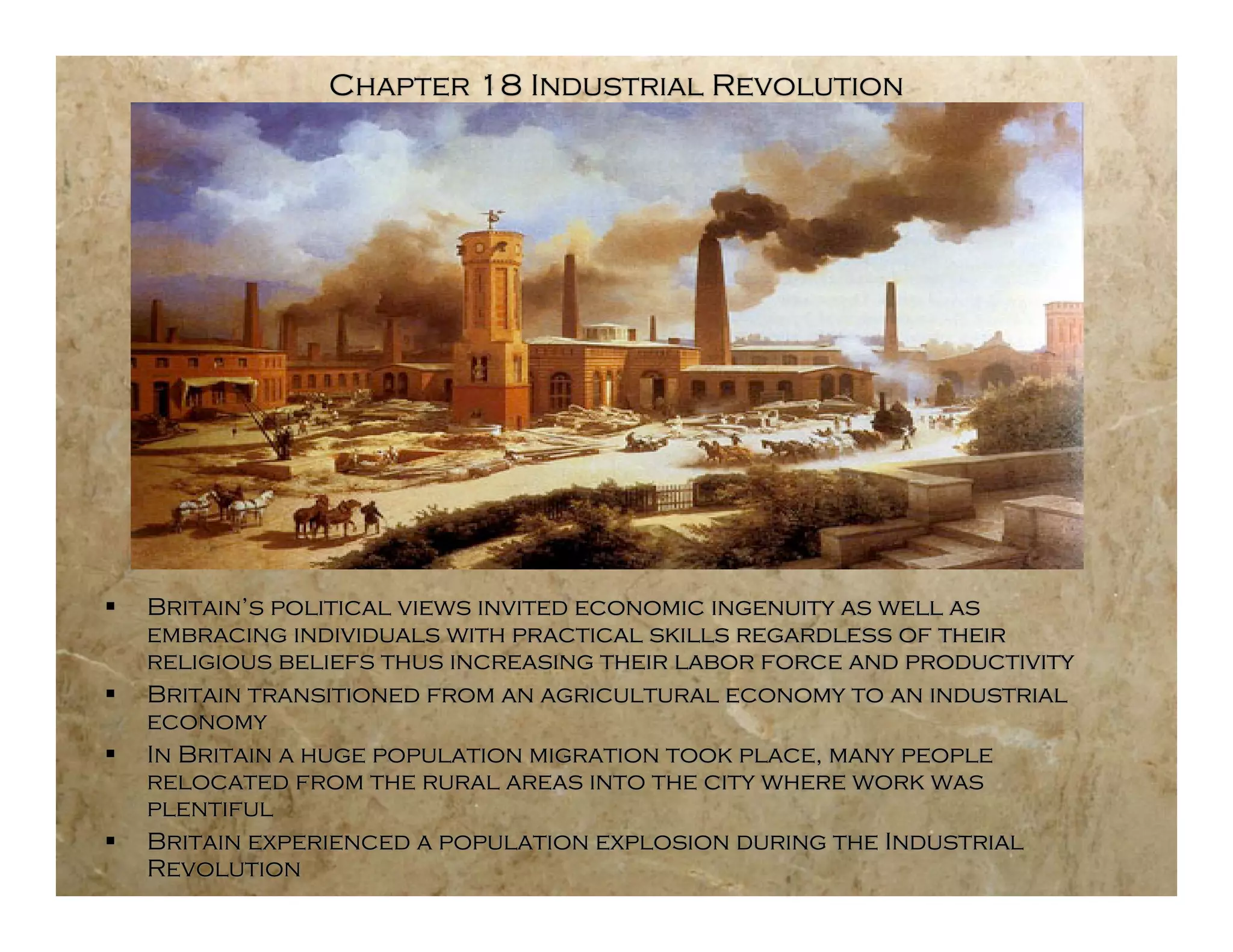
Chapter 18 Industrial Revolution


   Britain’s political views invited economic ingenuity as well as
    embracing individuals with practical skills regardless of their
    religious beliefs thus increasing their labor force and productivity
   Britain transitioned from an agricultural economy to an industrial
    economy
   In Britain a huge population migration took place, many people
    relocated from the rural areas into the city where work was
    plentiful
   Britain experienced a population explosion during the Industrial
    Revolution
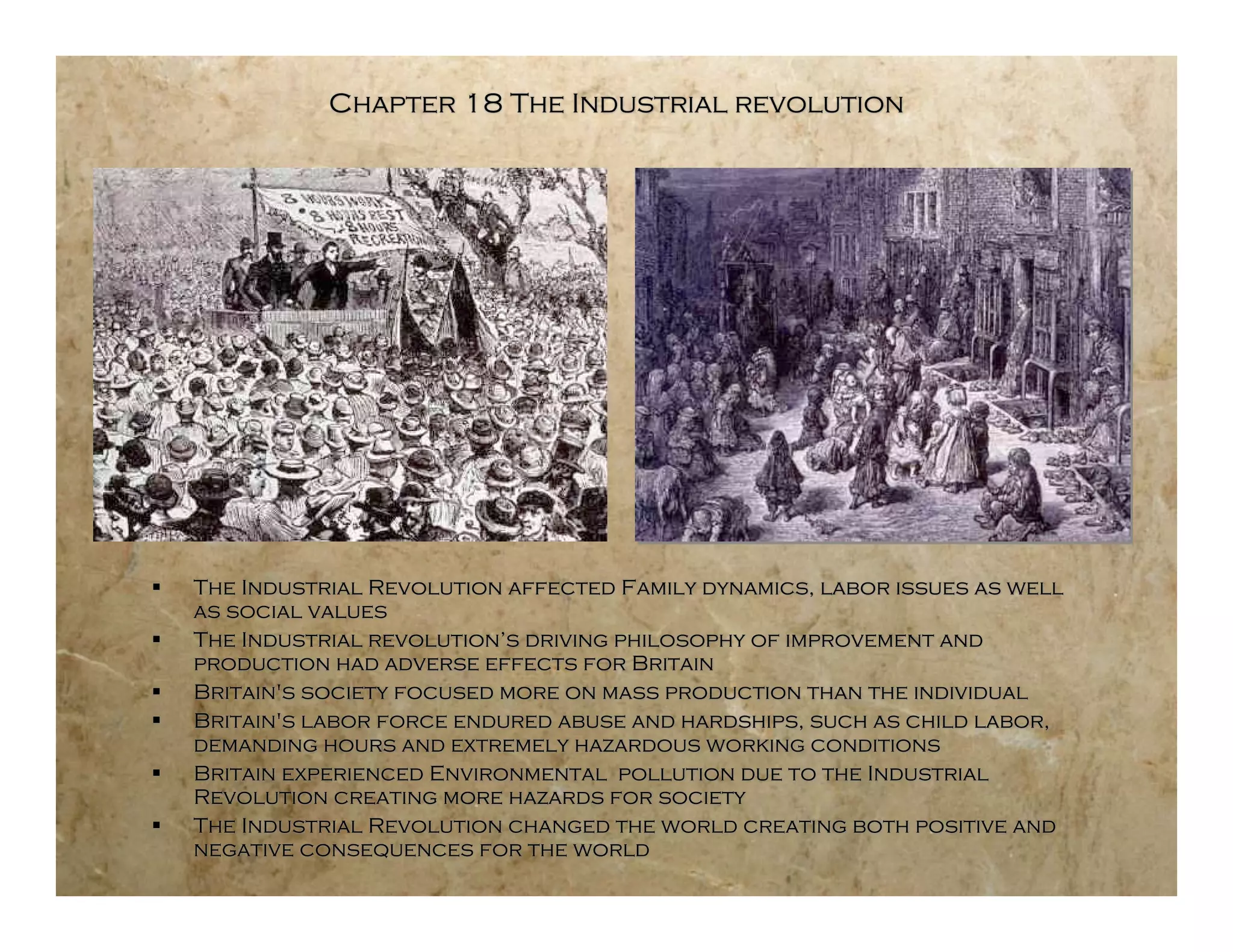
Chapter 18 The Industrial revolution


   The Industrial Revolution affected Family dynamics, labor issues as well
    as social values
   The Industrial revolution’s driving philosophy of improvement and
    production had adverse effects for Britain
   Britain's society focused more on mass production than the individual
   Britain's labor force endured abuse and hardships, such as child labor,
    demanding hours and extremely hazardous working conditions
   Britain experienced Environmental pollution due to the Industrial
    Revolution creating more hazards for society
   The Industrial Revolution changed the world creating both positive and
    negative consequences for the world
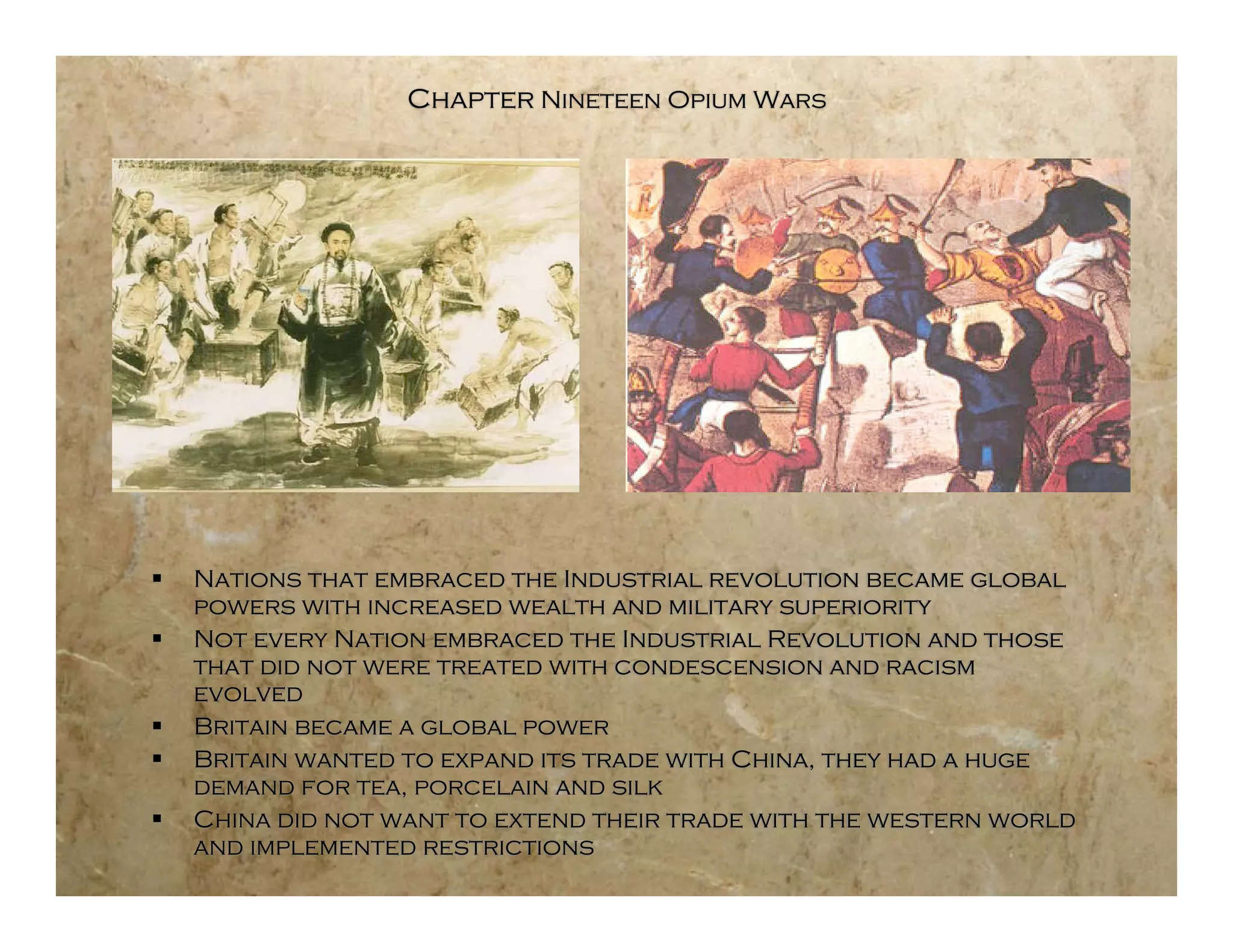
Chapter Nineteen Opium Wars


   Nations that embraced the Industrial revolution became global
    powers with increased wealth and military superiority
   Not every Nation embraced the Industrial Revolution and those
    that did not were treated with condescension and racism
    evolved
   Britain became a global power
   Britain wanted to expand its trade with China, they had a huge
    demand for tea, porcelain and silk
   China did not want to extend their trade with the western world
    and implemented restrictions
Chapter Nineteen Opium Wars


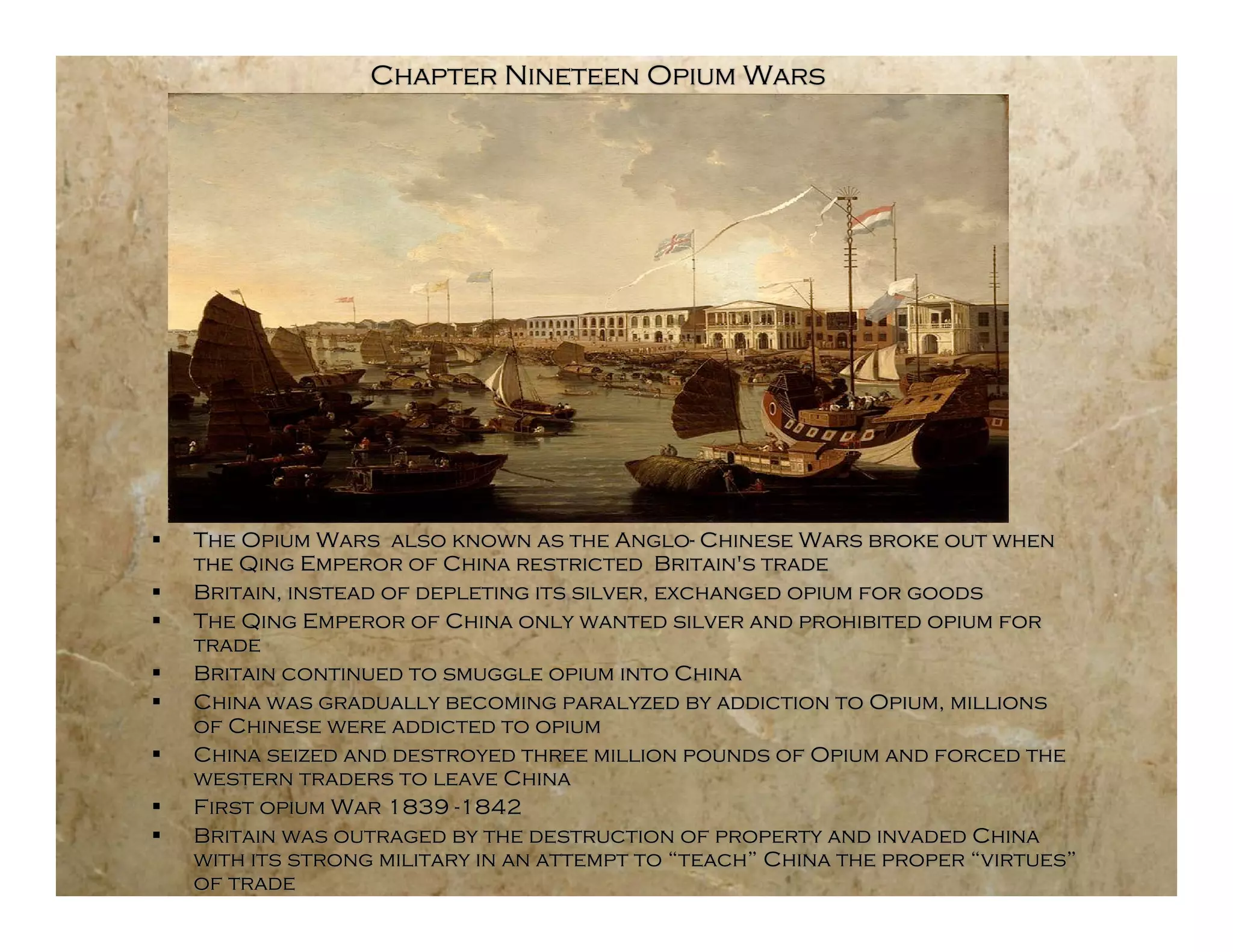
   The Opium Wars also known as the Anglo- Chinese Wars broke out when
    the Qing Emperor of China restricted Britain's trade
   Britain, instead of depleting its silver, exchanged opium for goods
   The Qing Emperor of China only wanted silver and prohibited opium for
    trade
   Britain continued to smuggle opium into China
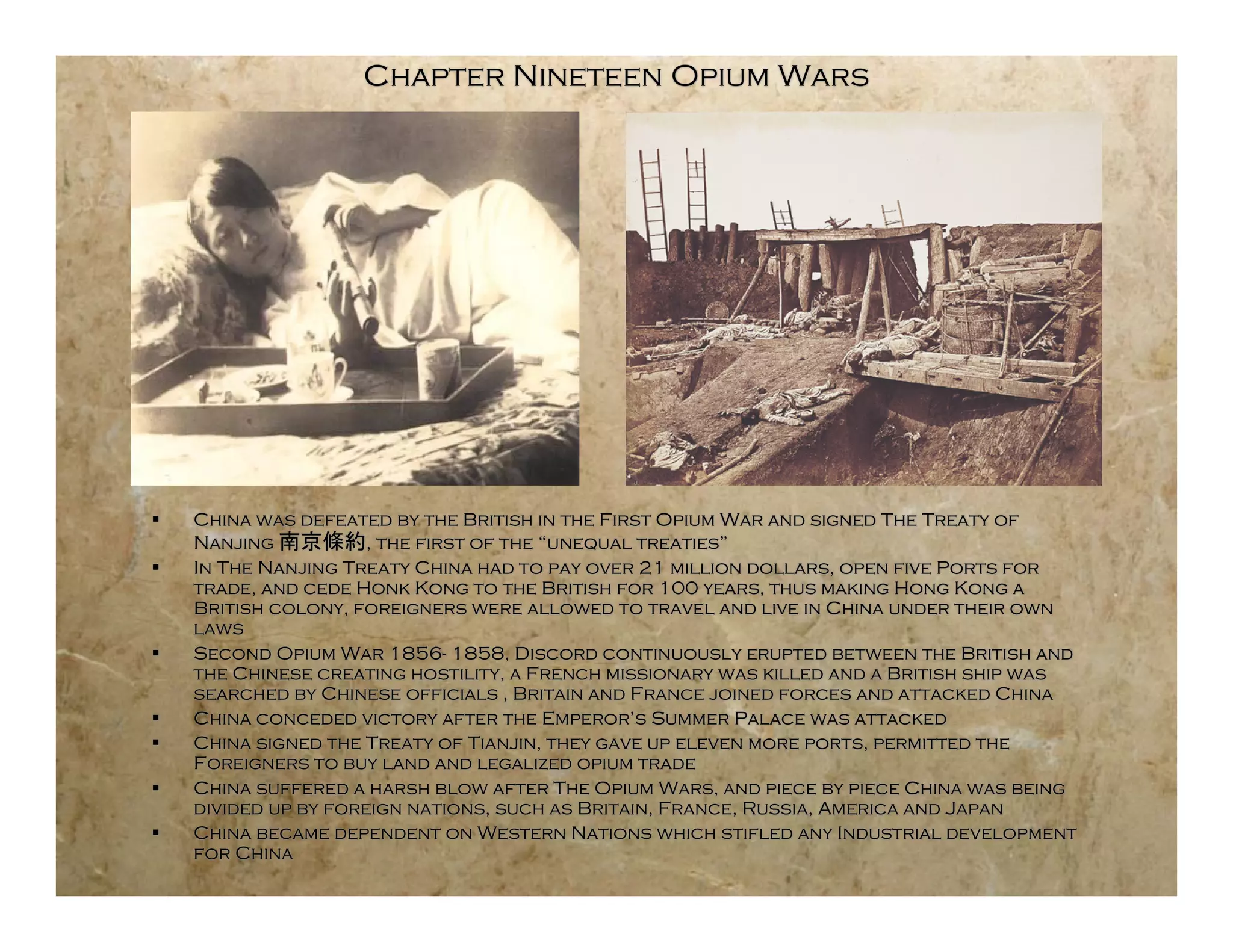
   China was gradually becoming paralyzed by addiction to Opium, millions
    of Chinese were addicted to opium
   China seized and destroyed three million pounds of Opium and forced the
    western traders to leave China
   First opium War 1839 -1842
   Britain was outraged by the destruction of property and invaded China
    with its strong military in an attempt to “teach” China the proper “virtues”
    of trade
Chapter Nineteen Opium Wars


   China was defeated by the British in the First Opium War and signed The Treaty of
    Nanjing           , the first of the “unequal treaties”
   In The Nanjing Treaty China had to pay over 21 million dollars, open five Ports for
    trade, and cede Honk Kong to the British for 100 years, thus making Hong Kong a
    British colony, foreigners were allowed to travel and live in China under their own
    laws
   Second Opium War 1856- 1858, Discord continuously erupted between the British and
    the Chinese creating hostility, a French missionary was killed and a British ship was
    searched by Chinese officials , Britain and France joined forces and attacked China
   China conceded victory after the Emperor’s Summer Palace was attacked
   China signed the Treaty of Tianjin, they gave up eleven more ports, permitted the
    Foreigners to buy land and legalized opium trade
   China suffered a harsh blow after The Opium Wars, and piece by piece China was being
    divided up by foreign nations, such as Britain, France, Russia, America and Japan
   China became dependent on Western Nations which stifled any Industrial development
    for China
Chapter 20 Christian Missionaries


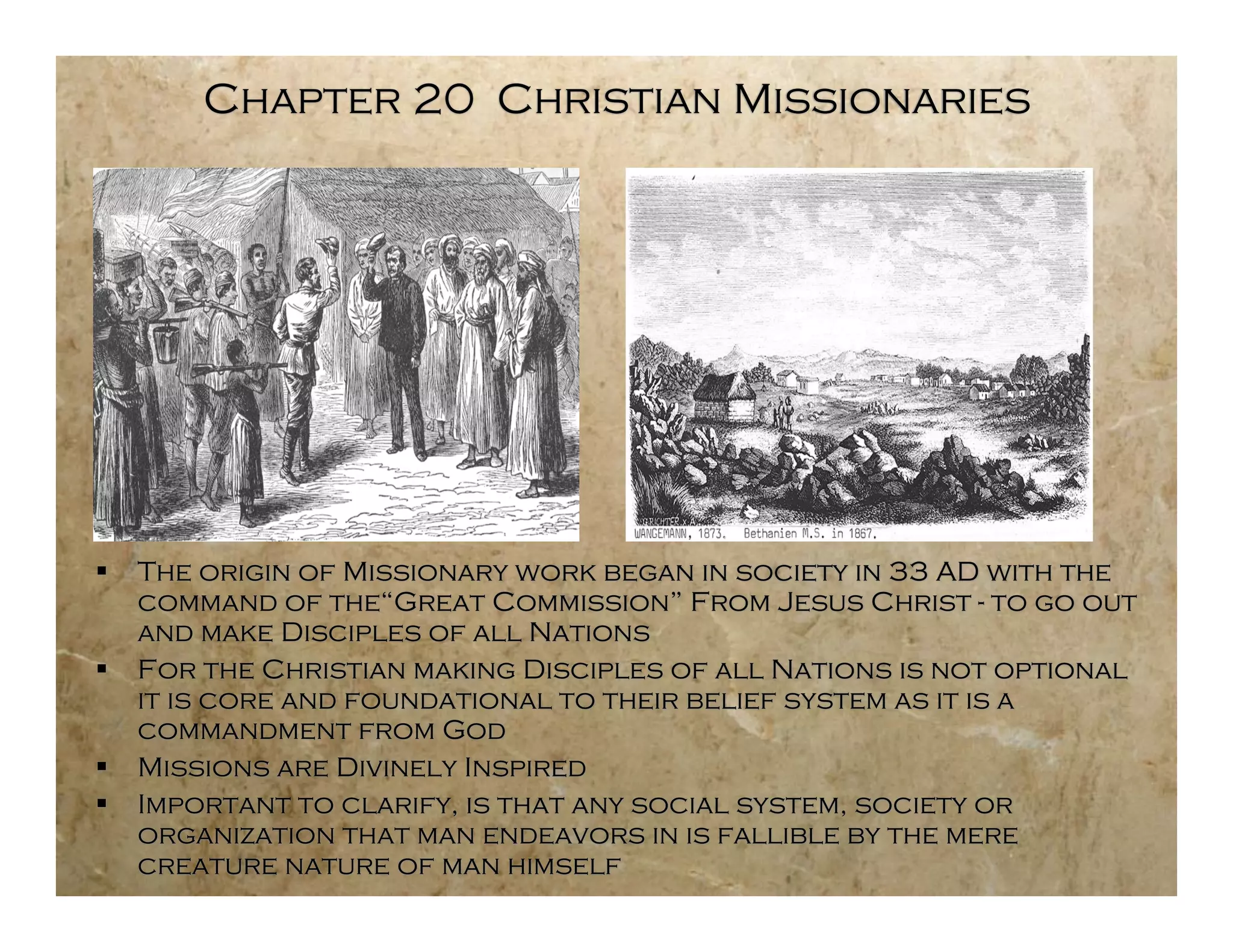
   The origin of Missionary work began in society in 33 AD with the
    command of the“Great Commission” From Jesus Christ - to go out
    and make Disciples of all Nations
   For the Christian making Disciples of all Nations is not optional
    it is core and foundational to their belief system as it is a
    commandment from God
   Missions are Divinely Inspired
   Important to clarify, is that any social system, society or
    organization that man endeavors in is fallible by the mere
    creature nature of man himself
Chapter 20 Christian Missionaries


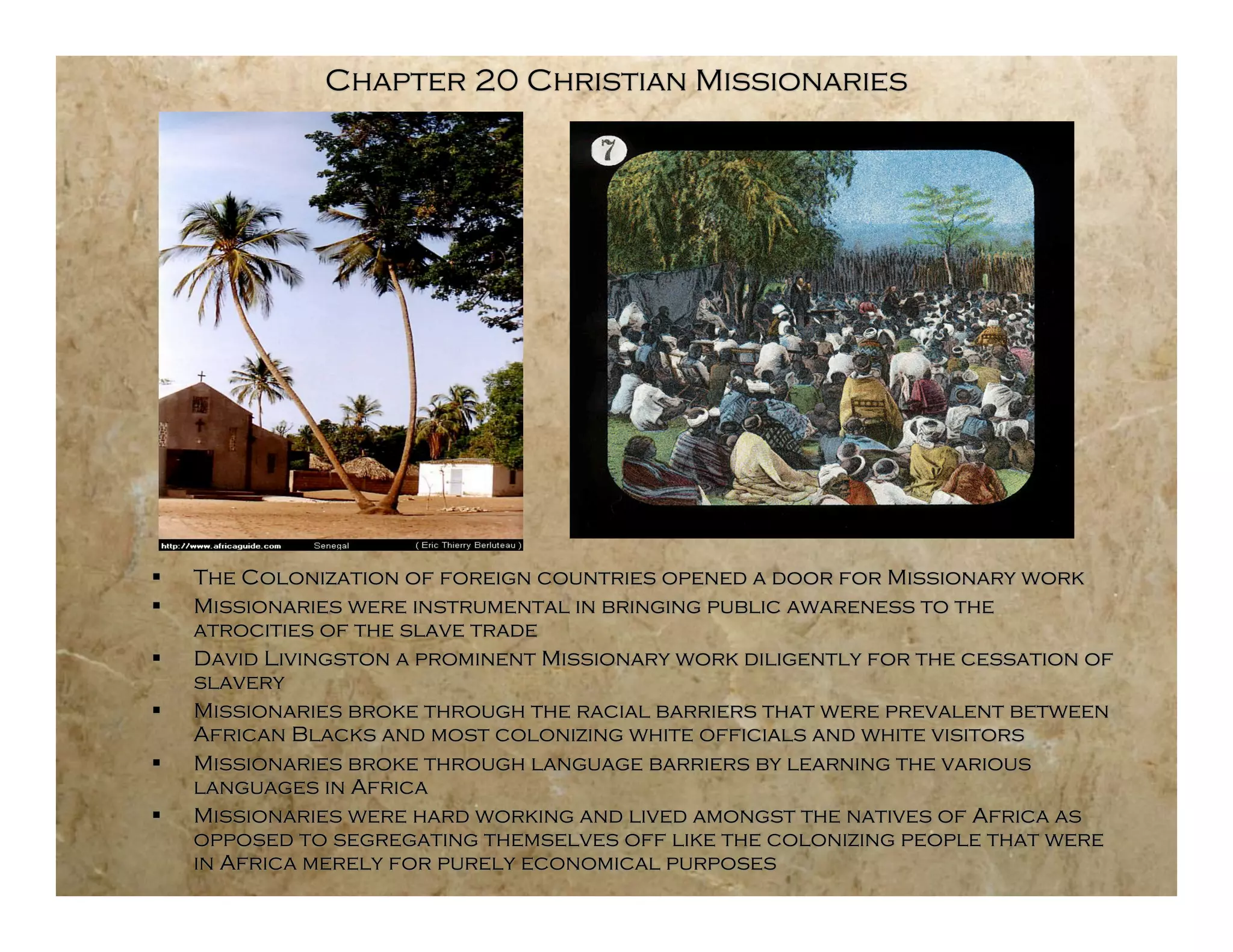
   The Colonization of foreign countries opened a door for Missionary work
   Missionaries were instrumental in bringing public awareness to the
    atrocities of the slave trade
   David Livingston a prominent Missionary work diligently for the cessation of
    slavery
   Missionaries broke through the racial barriers that were prevalent between
    African Blacks and most colonizing white officials and white visitors
   Missionaries broke through language barriers by learning the various
    languages in Africa
   Missionaries were hard working and lived amongst the natives of Africa as
    opposed to segregating themselves off like the colonizing people that were
    in Africa merely for purely economical purposes
Chapter 20 Christian Missionaries


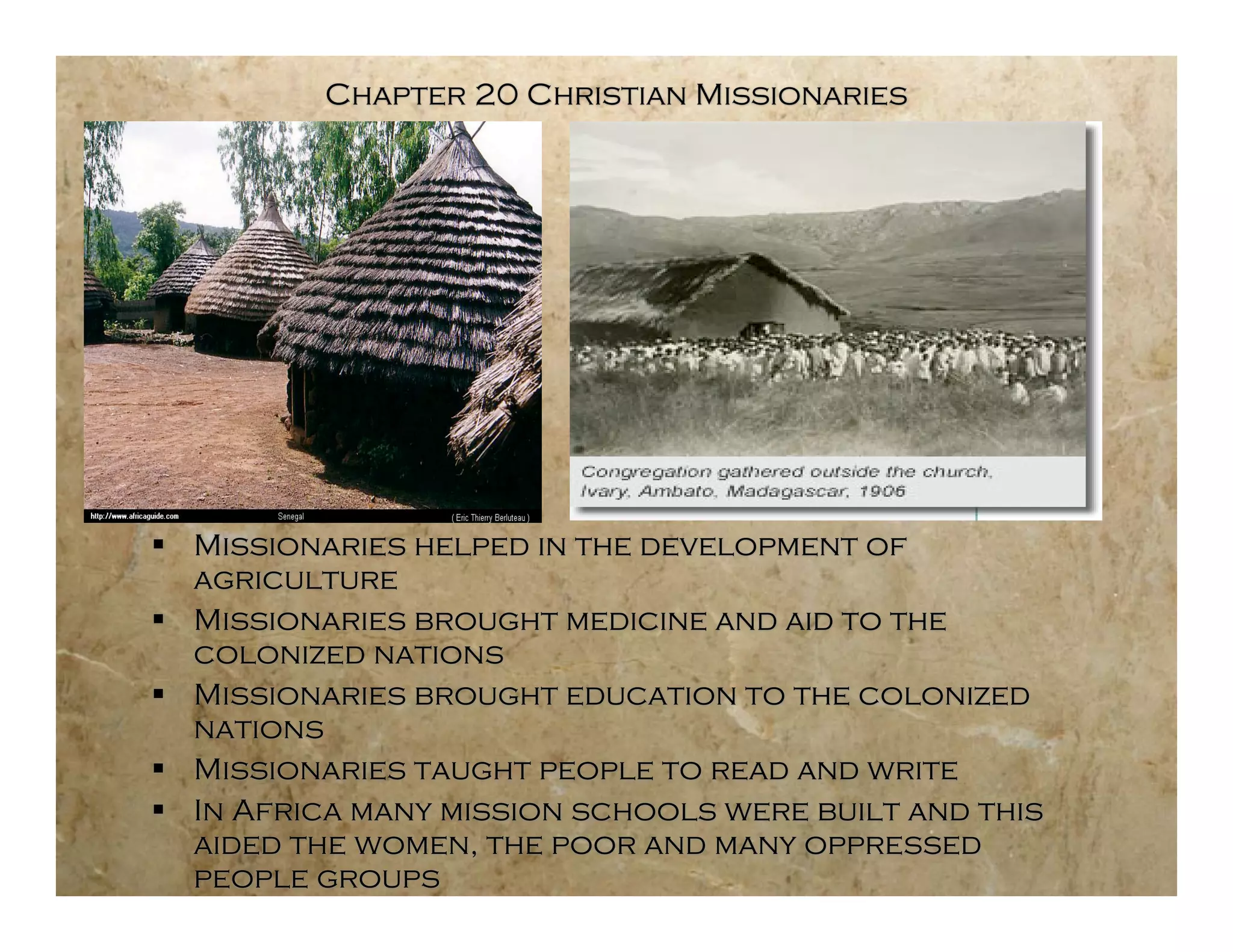
 Missionaries helped in the development of
  agriculture
 Missionaries brought medicine and aid to the
  colonized nations
 Missionaries brought education to the colonized
  nations
 Missionaries taught people to read and write
 In Africa many mission schools were built and this
  aided the women, the poor and many oppressed
  people groups
Chapter 21 The Holocaust


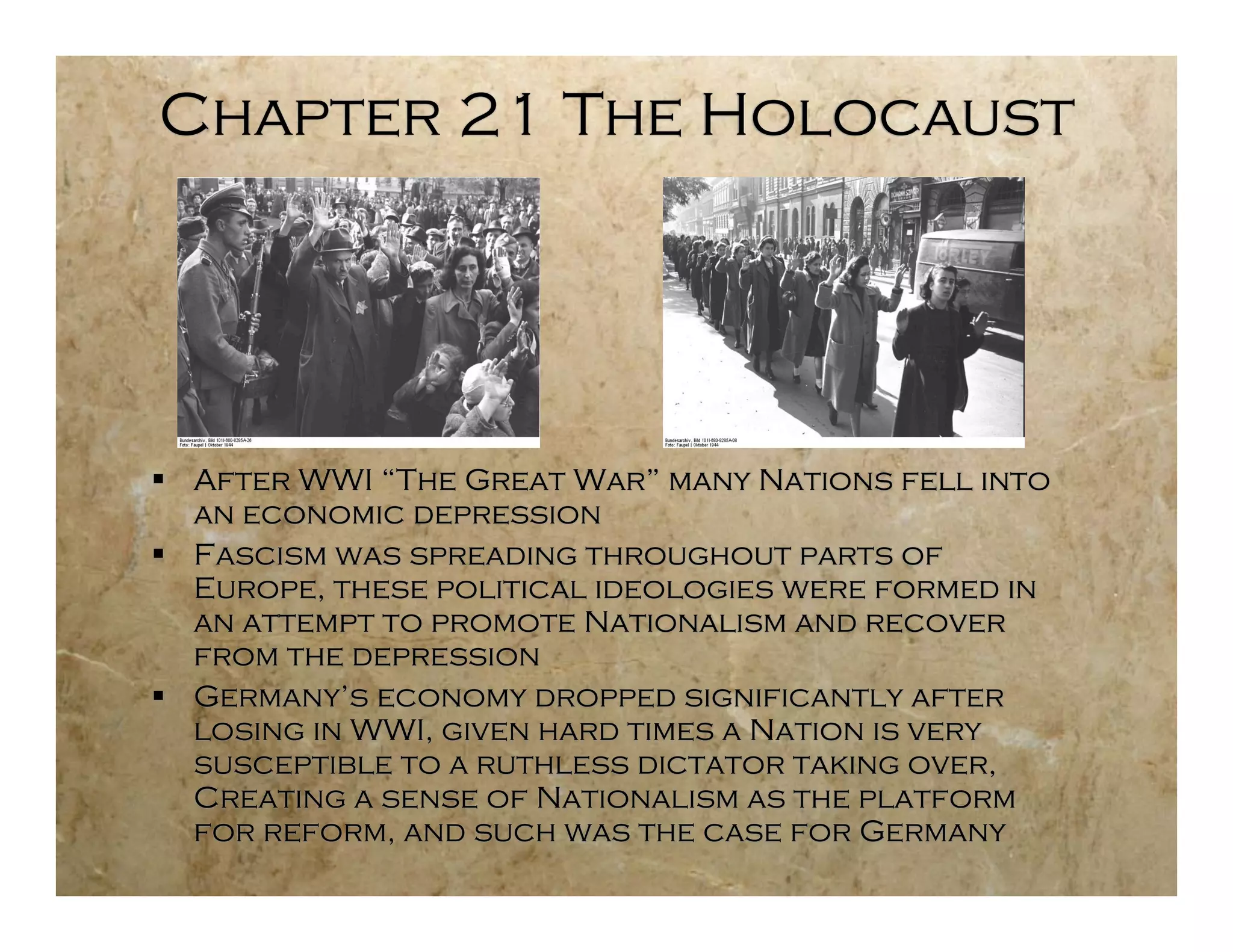
 After WWI “The Great War” many Nations fell into
  an economic depression
 Fascism was spreading throughout parts of
  Europe, these political ideologies were formed in
  an attempt to promote Nationalism and recover
  from the depression
 Germany’s economy dropped significantly after
  losing in WWI, given hard times a Nation is very
  susceptible to a ruthless dictator taking over,
  Creating a sense of Nationalism as the platform
  for reform, and such was the case for Germany
Chapter 21 The Holocaust


   Adolph Hitler came into power in Germany under the Nationalist
    umbrella, he was a ruthless dictator and in his Nationalistic
    political ideology he developed the idea of a supreme race of
    Germans, this led to the extermination of millions of Jews, whom
    Hitler believed were evil and a threat to German Nationalism As
    Hitler referred to as “the Jewish problem”
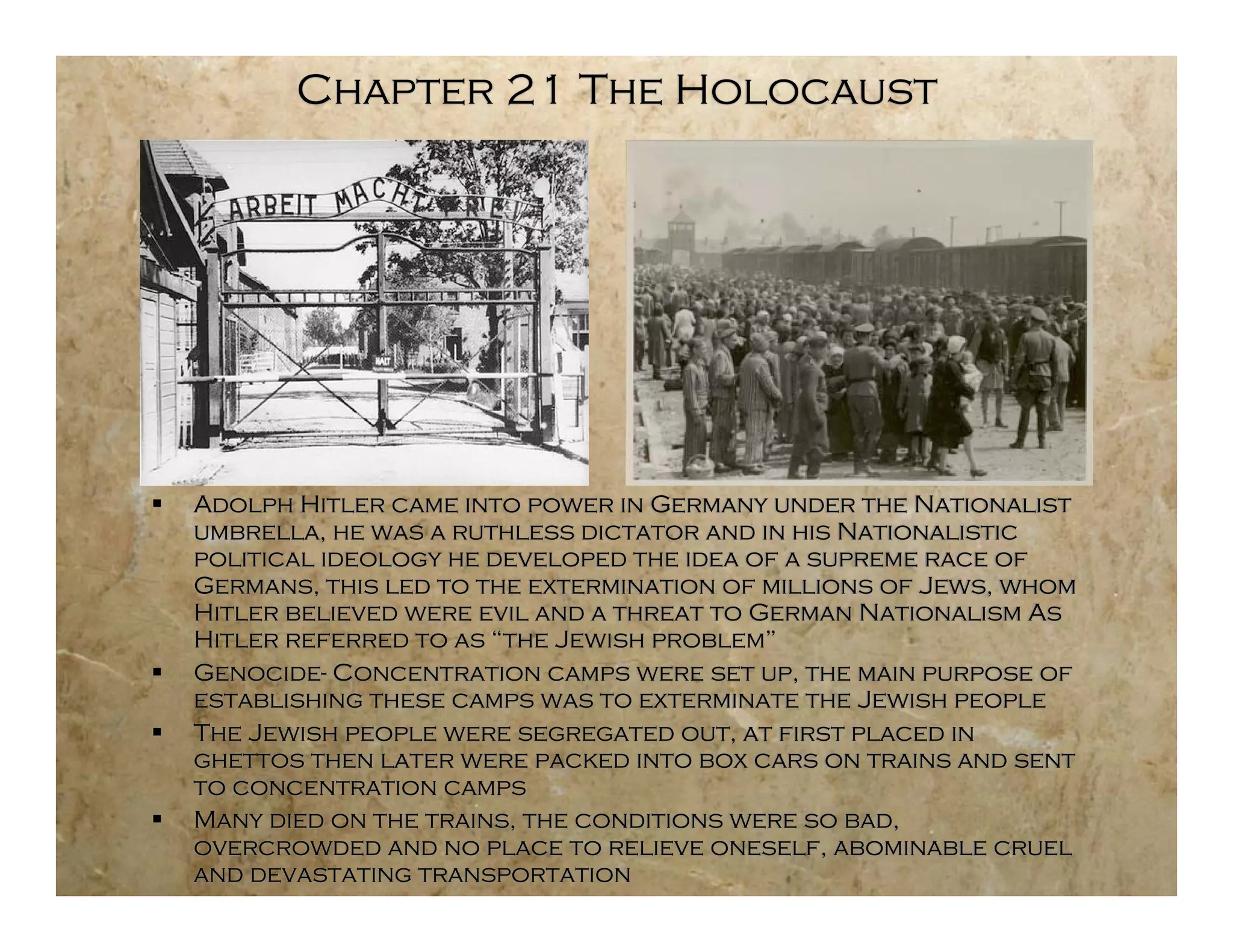
   Genocide- Concentration camps were set up, the main purpose of
    establishing these camps was to exterminate the Jewish people
   The Jewish people were segregated out, at first placed in
    ghettos then later were packed into box cars on trains and sent
    to concentration camps
   Many died on the trains, the conditions were so bad,
    overcrowded and no place to relieve oneself, abominable cruel
    and devastating transportation
Chapter 21 The Holocaust


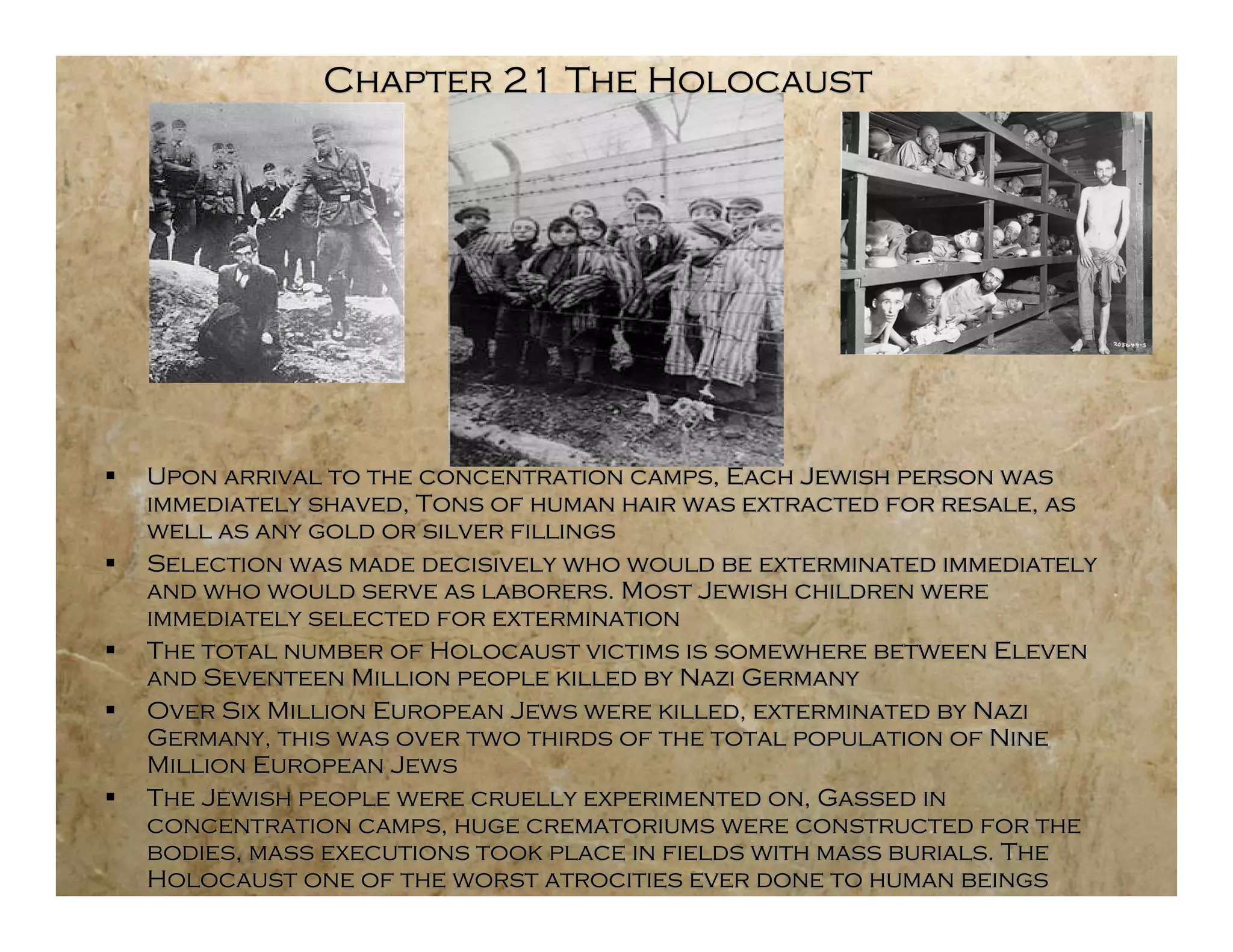
   Upon arrival to the concentration camps, Each Jewish person was
    immediately shaved, Tons of human hair was extracted for resale, as
    well as any gold or silver fillings
   Selection was made decisively who would be exterminated immediately
    and who would serve as laborers. Most Jewish children were
    immediately selected for extermination
   The total number of Holocaust victims is somewhere between Eleven
    and Seventeen Million people killed by Nazi Germany
   Over Six Million European Jews were killed, exterminated by Nazi
    Germany, this was over two thirds of the total population of Nine
    Million European Jews
   The Jewish people were cruelly experimented on, Gassed in
    concentration camps, huge crematoriums were constructed for the
    bodies, mass executions took place in fields with mass burials. The
    Holocaust one of the worst atrocities ever done to human beings
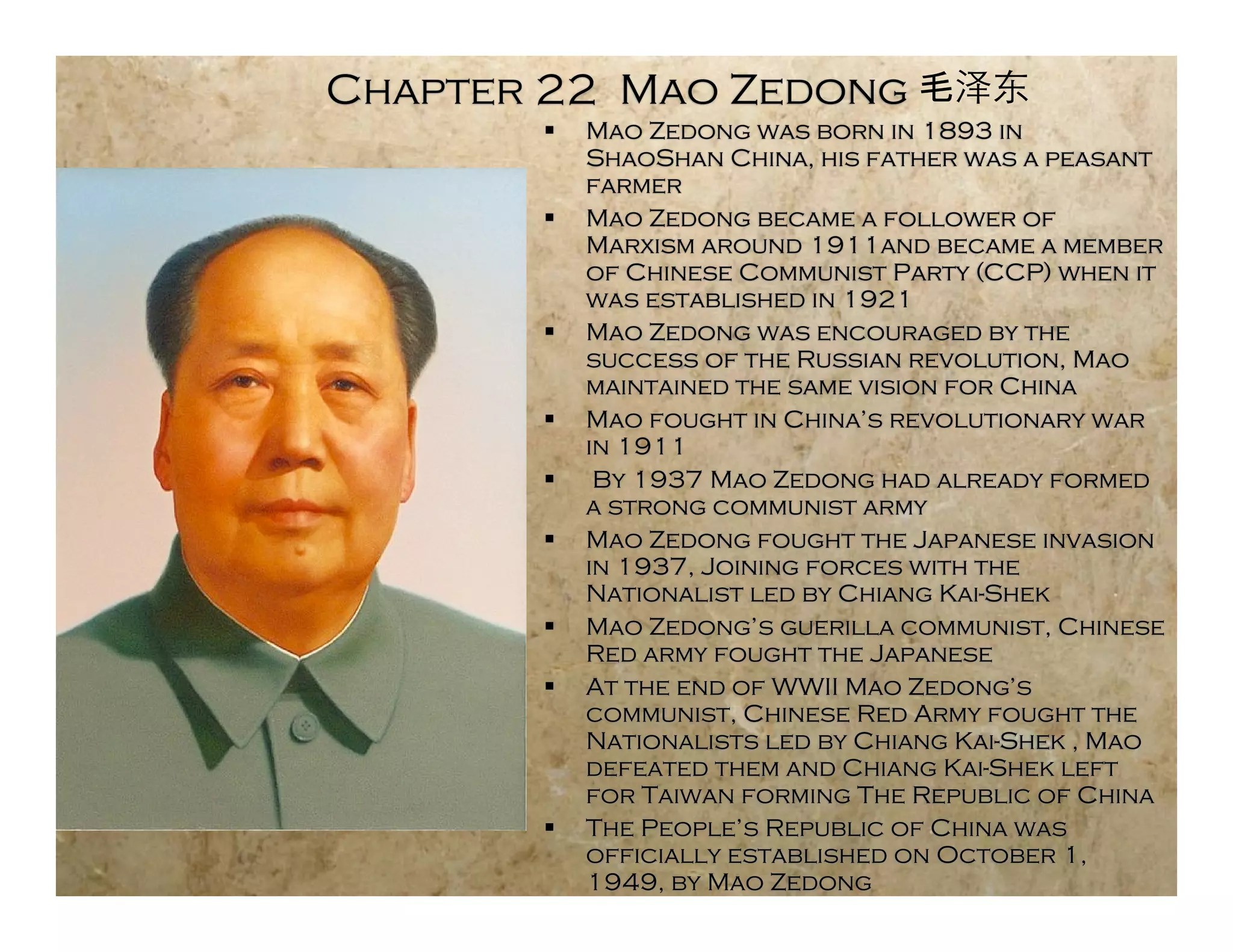
Chapter 22 Mao Zedong
          Mao Zedong was born in 1893 in
           ShaoShan China, his father was a peasant
           farmer
          Mao Zedong became a follower of
           Marxism around 1911and became a member
           of Chinese Communist Party (CCP) when it
           was established in 1921
          Mao Zedong was encouraged by the
           success of the Russian revolution, Mao
           maintained the same vision for China
          Mao fought in China’s revolutionary war
           in 1911
           By 1937 Mao Zedong had already formed
           a strong communist army
          Mao Zedong fought the Japanese invasion
           in 1937, Joining forces with the
           Nationalist led by Chiang Kai-Shek
          Mao Zedong’s guerilla communist, Chinese
           Red army fought the Japanese
          At the end of WWII Mao Zedong’s
           communist, Chinese Red Army fought the
           Nationalists led by Chiang Kai-Shek , Mao
           defeated them and Chiang Kai-Shek left
           for Taiwan forming The Republic of China
          The People’s Republic of China was
           officially established on October 1,
           1949, by Mao Zedong
Chapter 22 Mao Zedong
           Since it’s formation in1921 to 1949,
            it took the Chinese communist Party
            Twenty eight years to gain power in
            China
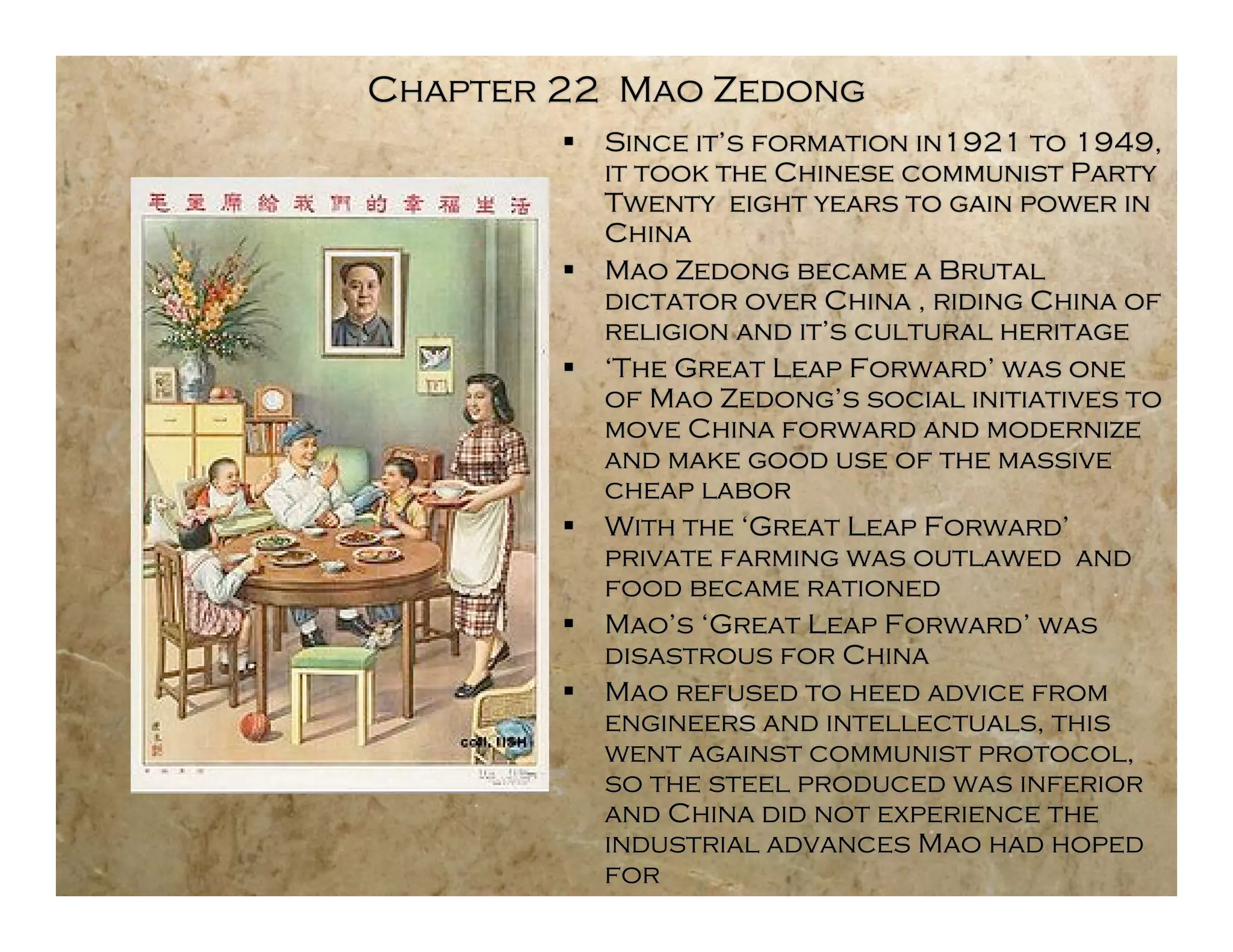
           Mao Zedong became a Brutal
            dictator over China , riding China of
            religion and it’s cultural heritage
           ‘The Great Leap Forward’ was one
            of Mao Zedong’s social initiatives to
            move China forward and modernize
            and make good use of the massive
            cheap labor
           With the ‘Great Leap Forward’
            private farming was outlawed and
            food became rationed
           Mao’s ‘Great Leap Forward’ was
            disastrous for China
           Mao refused to heed advice from
            engineers and intellectuals, this
            went against communist protocol,
            so the steel produced was inferior
            and China did not experience the
            industrial advances Mao had hoped
            for
Chapter 22 Mao Zedong
          Many restrictions were placed on the Chinese
           people, social pressures and violence broke out
          People were placed to live on communes, no
           longer possessing property rights, many people
           starved to death
          ‘The Great Leap Forward’ contributed to the
           deaths of at least Twenty Million Chinese and
           numbers could be as high as forty three million
          ‘The Cultural revolution’ was also disastrous for
           China
          Mao Zedong thought that china was being brought
           down by internal forces and that many were
           becoming a new class of elitist
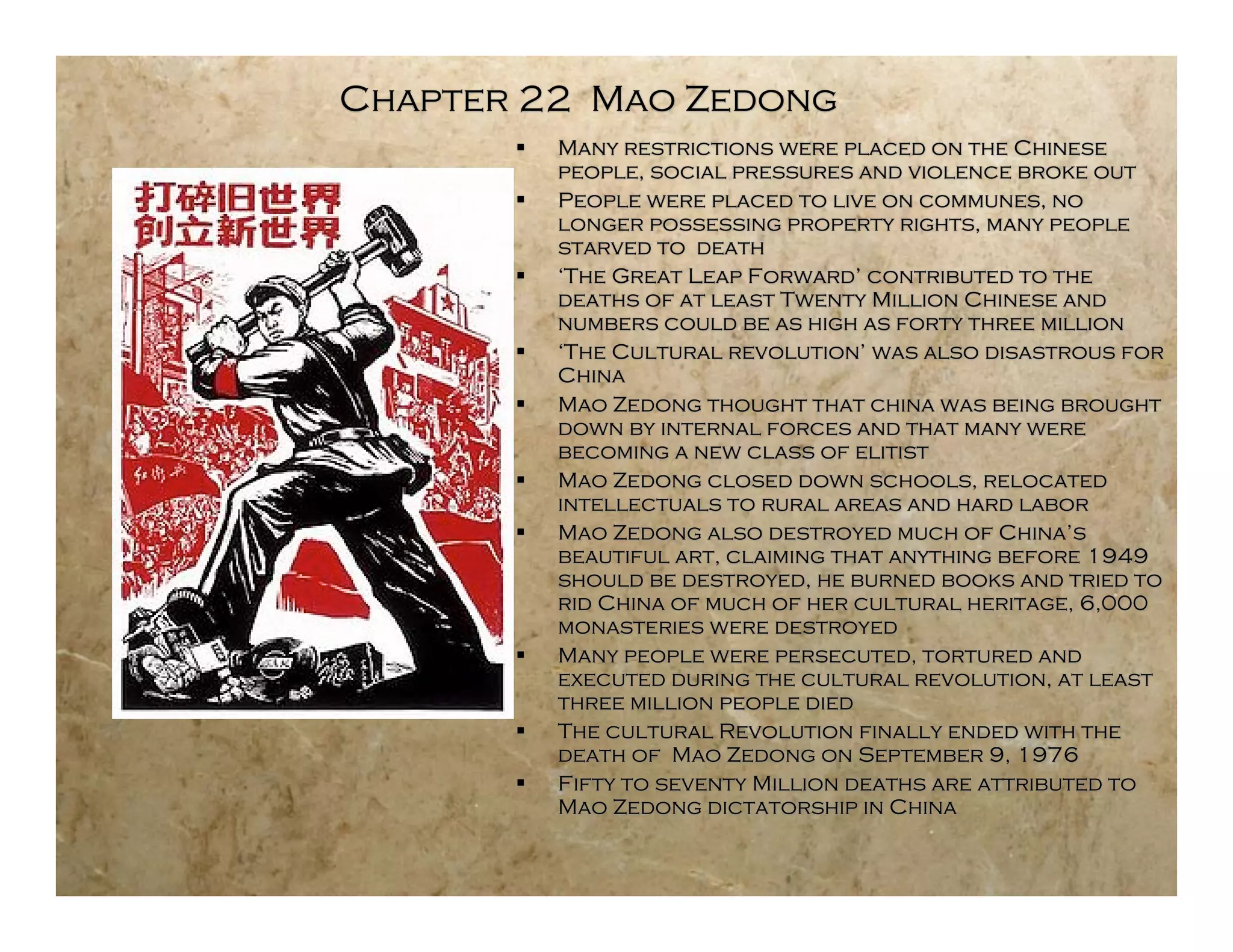
          Mao Zedong closed down schools, relocated
           intellectuals to rural areas and hard labor
          Mao Zedong also destroyed much of China’s
           beautiful art, claiming that anything before 1949
           should be destroyed, he burned books and tried to
           rid China of much of her cultural heritage, 6,000
           monasteries were destroyed
          Many people were persecuted, tortured and
           executed during the cultural revolution, at least
           three million people died
          The cultural Revolution finally ended with the
           death of Mao Zedong on September 9, 1976
          Fifty to seventy Million deaths are attributed to
           Mao Zedong dictatorship in China
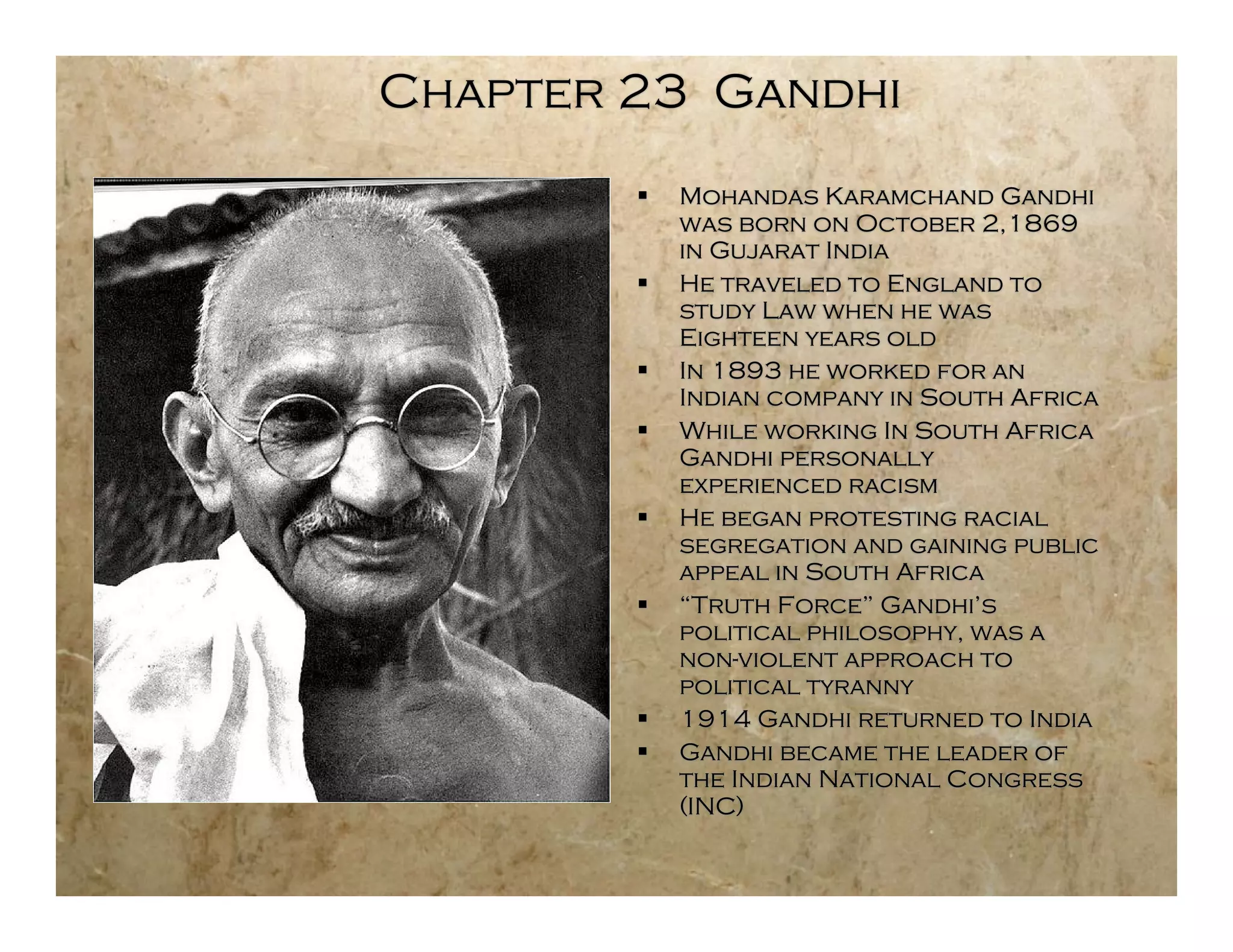
Chapter 23 Gandhi
           Mohandas Karamchand Gandhi
            was born on October 2,1869
            in Gujarat India
           He traveled to England to
            study Law when he was
            Eighteen years old
           In 1893 he worked for an
            Indian company in South Africa
           While working In South Africa
            Gandhi personally
            experienced racism
           He began protesting racial
            segregation and gaining public
            appeal in South Africa
           “Truth Force” Gandhi’s
            political philosophy, was a
            non-violent approach to
            political tyranny
           1914 Gandhi returned to India
           Gandhi became the leader of
            the Indian National Congress
            (INC)
Chapter 23 Gandhi


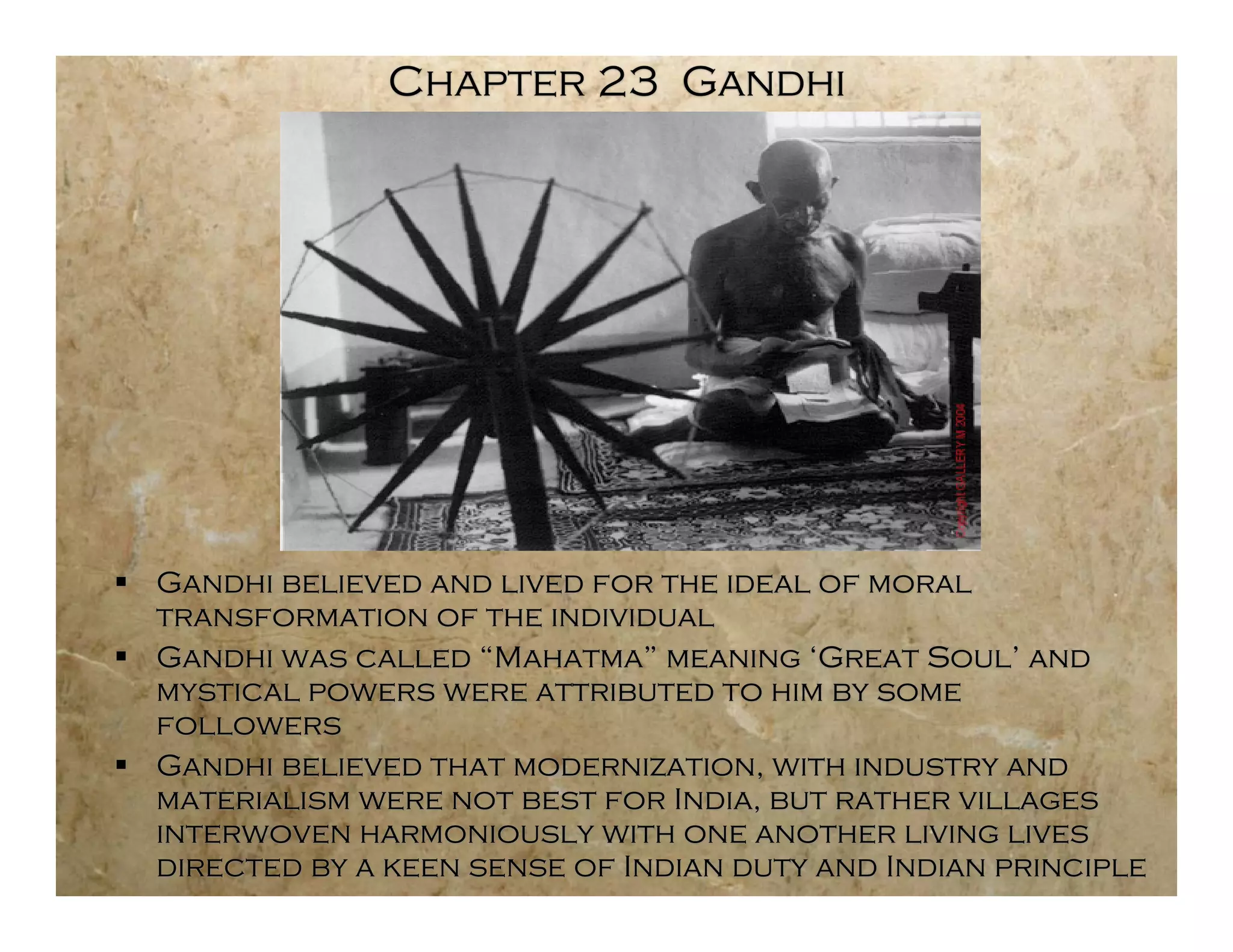
 Gandhi believed and lived for the ideal of moral
  transformation of the individual
 Gandhi was called “Mahatma” meaning ‘Great Soul’ and
  mystical powers were attributed to him by some
  followers
 Gandhi believed that modernization, with industry and
  materialism were not best for India, but rather villages
  interwoven harmoniously with one another living lives
  directed by a keen sense of Indian duty and Indian principle
Chapter 23 Gandhi
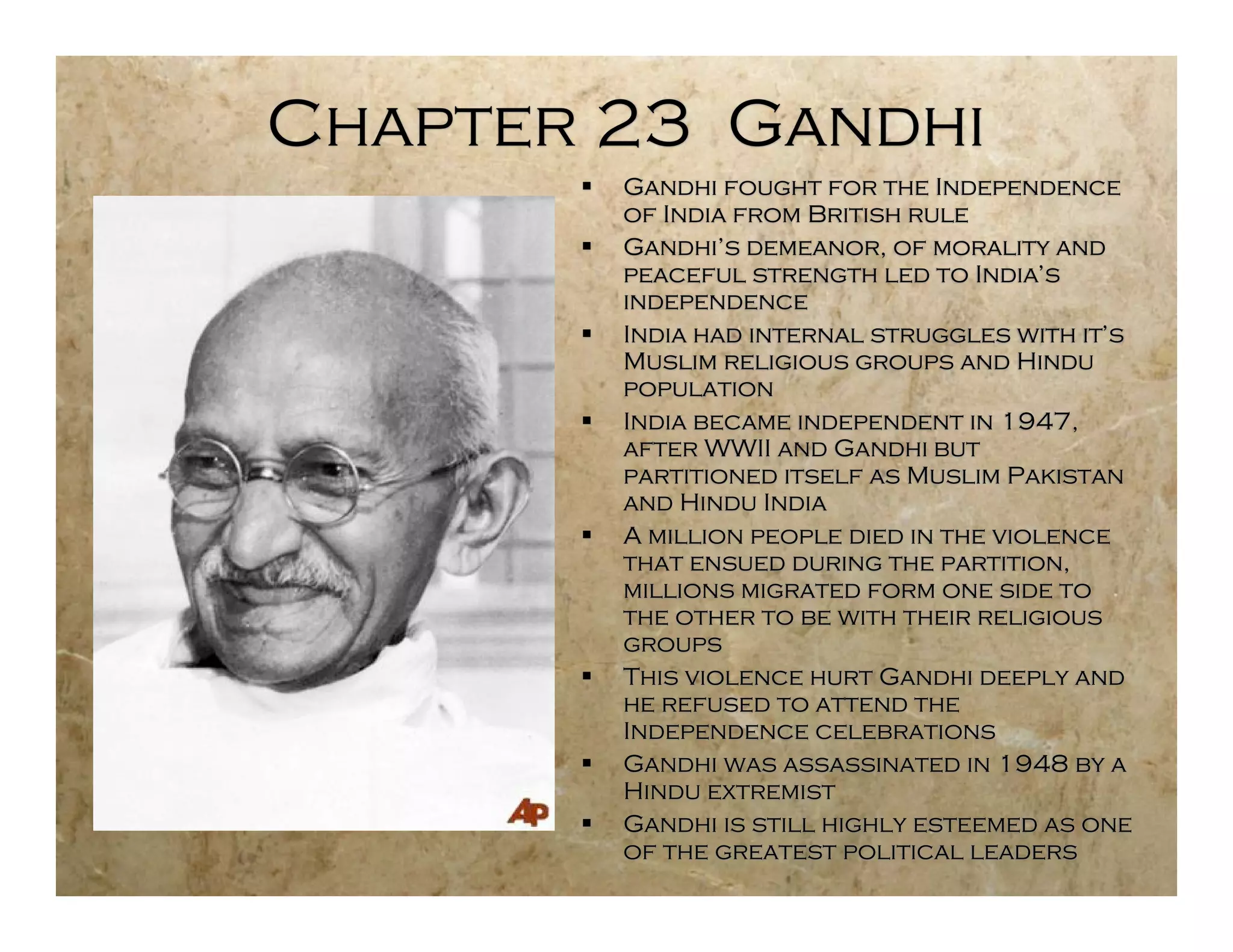
          Gandhi fought for the Independence
           of India from British rule
          Gandhi’s demeanor, of morality and
           peaceful strength led to India’s
           independence
          India had internal struggles with it’s
           Muslim religious groups and Hindu
           population
          India became independent in 1947,
           after WWII and Gandhi but
           partitioned itself as Muslim Pakistan
           and Hindu India
          A million people died in the violence
           that ensued during the partition,
           millions migrated form one side to
           the other to be with their religious
           groups
          This violence hurt Gandhi deeply and
           he refused to attend the
           Independence celebrations
          Gandhi was assassinated in 1948 by a
           Hindu extremist
          Gandhi is still highly esteemed as one
           of the greatest political leaders
Chapter 24 Chernobyl


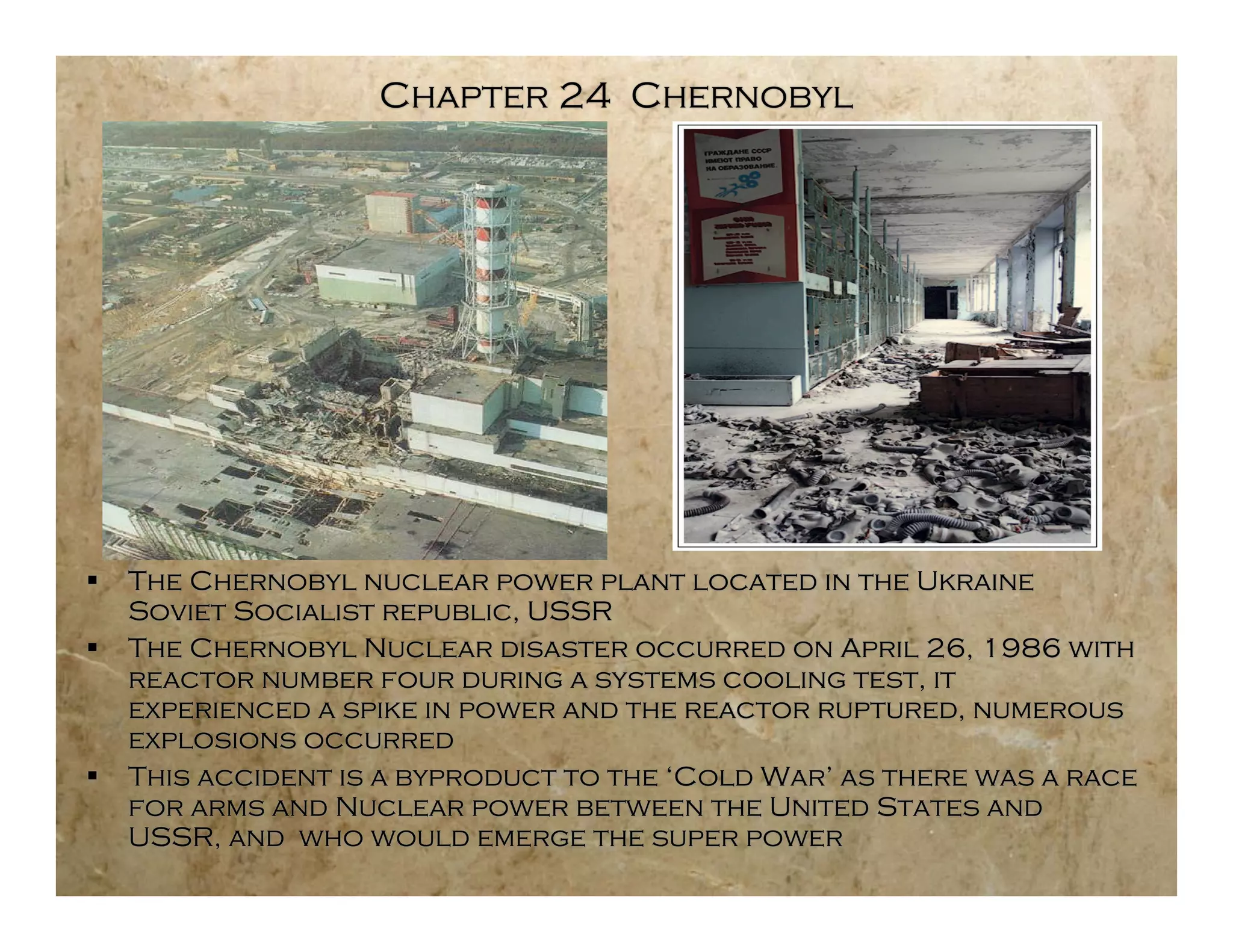
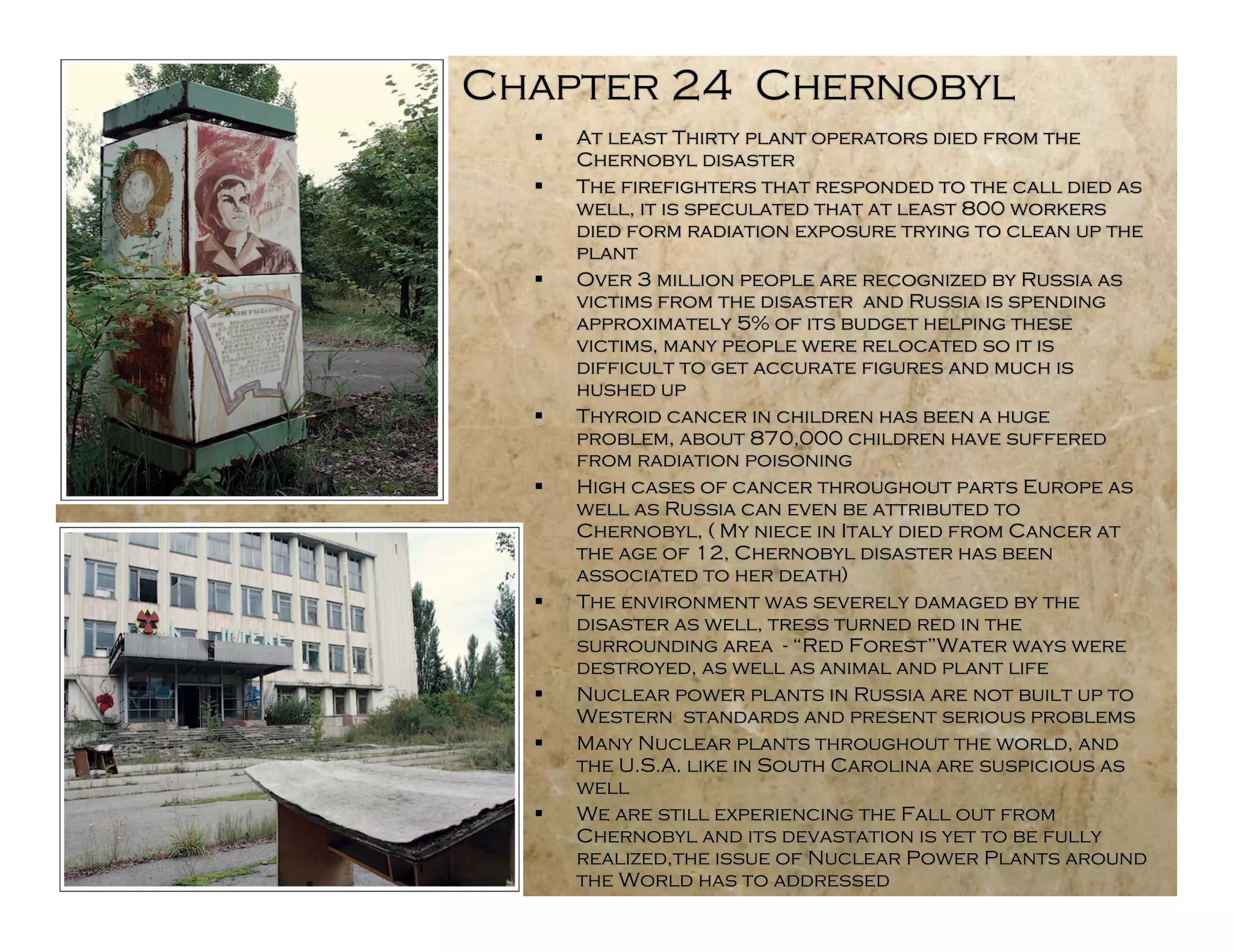
   The Chernobyl nuclear power plant located in the Ukraine
    Soviet Socialist republic, USSR
   The Chernobyl Nuclear disaster occurred on April 26, 1986 with
    reactor number four during a systems cooling test, it
    experienced a spike in power and the reactor ruptured, numerous
    explosions occurred
   This accident is a byproduct to the ‘Cold War’ as there was a race
    for arms and Nuclear power between the United States and
    USSR, and who would emerge the super power
Chapter 24 Chernobyl


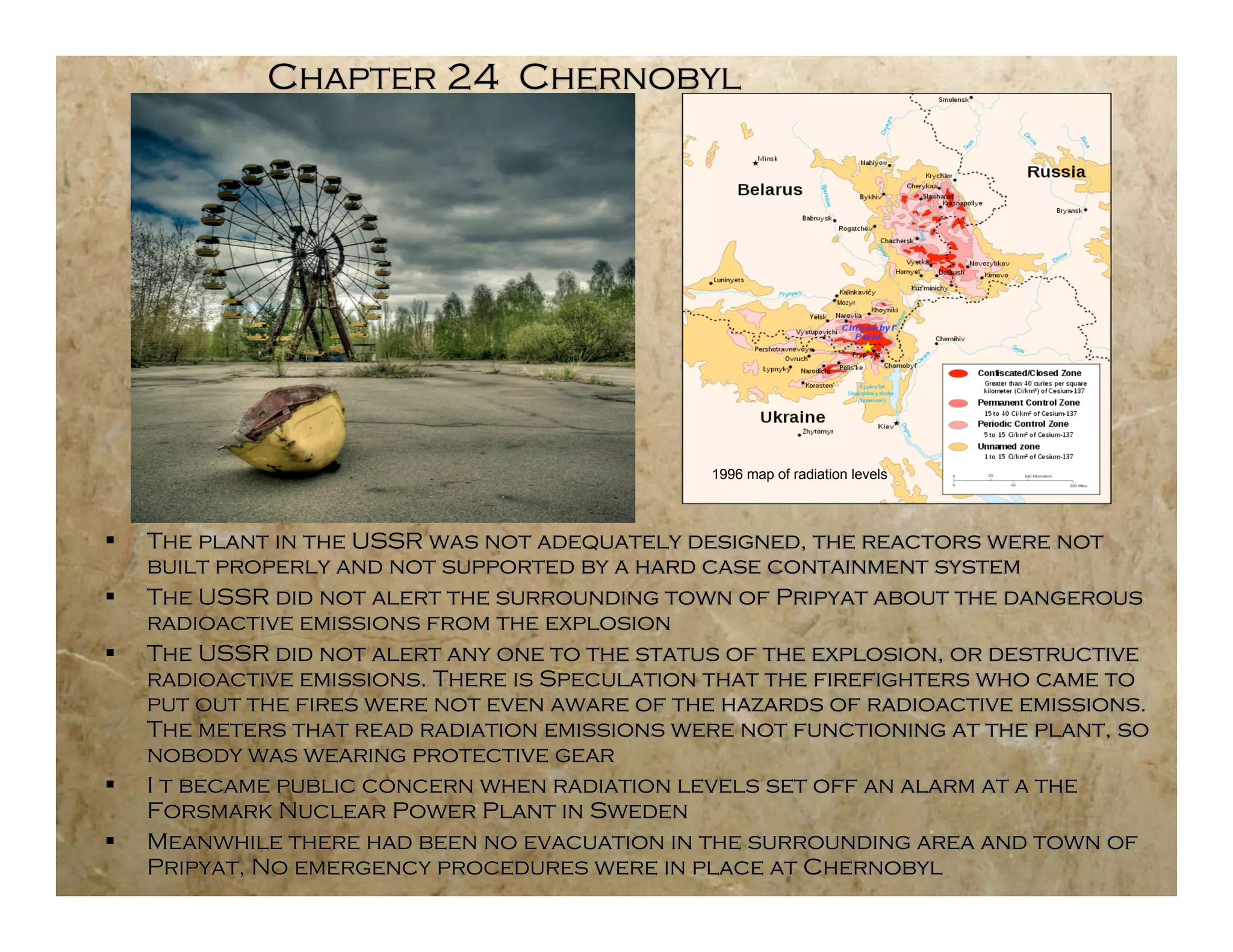
                                               1996 map of radiation levels


   The plant in the USSR was not adequately designed, the reactors were not
    built properly and not supported by a hard case containment system
   The USSR did not alert the surrounding town of Pripyat about the dangerous
    radioactive emissions from the explosion
   The USSR did not alert any one to the status of the explosion, or destructive
    radioactive emissions. There is Speculation that the firefighters who came to
    put out the fires were not even aware of the hazards of radioactive emissions.
    The meters that read radiation emissions were not functioning at the plant, so
    nobody was wearing protective gear
   I t became public concern when radiation levels set off an alarm at a the
    Forsmark Nuclear Power Plant in Sweden
   Meanwhile there had been no evacuation in the surrounding area and town of
    Pripyat, No emergency procedures were in place at Chernobyl
Chapter 24 Chernobyl
     At least Thirty plant operators died from the
      Chernobyl disaster
     The firefighters that responded to the call died as
      well, it is speculated that at least 800 workers
      died form radiation exposure trying to clean up the
      plant
     Over 3 million people are recognized by Russia as
      victims from the disaster and Russia is spending
      approximately 5% of its budget helping these
      victims, many people were relocated so it is
      difficult to get accurate figures and much is
      hushed up
     Thyroid cancer in children has been a huge
      problem, about 870,000 children have suffered
      from radiation poisoning
     High cases of cancer throughout parts Europe as
      well as Russia can even be attributed to
      Chernobyl, ( My niece in Italy died from Cancer at
      the age of 12, Chernobyl disaster has been
      associated to her death)
     The environment was severely damaged by the
      disaster as well, tress turned red in the
      surrounding area - “Red Forest”Water ways were
      destroyed, as well as animal and plant life
     Nuclear power plants in Russia are not built up to
      Western standards and present serious problems
     Many Nuclear plants throughout the world, and
      the U.S.A. like in South Carolina are suspicious as
      well
     We are still experiencing the Fall out from
      Chernobyl and its devastation is yet to be fully
      realized,the issue of Nuclear Power Plants around
      the World has to addressed
   http://en.wikipedia.org/wiki/File:Selection_Birkenau_ramp.jpg
Sources
             http://en.wikipedia.org/wiki/The_Holocaust

             http://en.wikipedia.org/wiki/Mao_Zedong

             http://www.spartacus.schoolnet.co.uk/COLDmao.htm

             http://en.wikipedia.org/wiki/Great_Leap_Forward

             http://englishrussia.com/index.php/2006/09/13/lost-city-of-
              chernobyl/

             http://www.lightmillennium.org/2006_17th/hkilic_chernobly.ht
              ml

             http://en.wikipedia.org/wiki/Industrial_Revolution

             http://www.google.com/images?q=photos+industrial+revolution
              &oe=utf-8&rls=org.mozilla:en-US:official&client=firefox-
              a&um=1&ie=UTF-
              8&source=univ&ei=9gZWTPerC8GC8gbyv6zXCw&sa=X&oi
              =image_result_group&ct=title&resnum=4&ved=0CDIQsAQw
              Aw&biw=994&bih=827


             http://www.google.com/images?q=american+revolution&oe=utf
              -8&rls=org.mozilla:en-US:official&client=firefox-
              a&um=1&ie=UTF-
              8&source=univ&ei=MQdWTJicMYL58AbBpeiSBQ&sa=X&oi
              =image_result_group&ct=title&resnum=4&ved=0CD0QsAQw
              Aw&biw=994&bih=827

             http://en.wikipedia.org/wiki/American_Revolution

             http://en.wikipedia.org/wiki/Mohandas_Karamchand_Gandhi

             http://en.wikipedia.org/wiki/Opium_Wars

             http://en.wikipedia.org/wiki/Mission_(Christian)

             http://en.wikipedia.org/wiki/David_Livingstone

Waysoftheworldpart1

  • 1.
    Ways of TheWorld 1750 - 2010 By Misty Sims Ways of The World 1750 - 2010 By Misty Sims
  • 2.
    Chapter 17 TheAmerican Revolution 1775 -1787  The revolution that spurred the Atlantic revolutions  America’s fight for Independence from Britain  Britain was leaning heavily on the colonies for financial sustenance  “Taxation without representation” The thirteen Colonies in America were not represented in Parliament, therefore Britain could impose any legislation and began oppressing the thirteen Colonies with increasing taxation
  • 3.
    Chapter 17 TheAmerican Revolution 1775-1787  The Colonies had established Provincial Congress by 1774 with the ability to form individual self governing states  American War of Independence was launched in 1775  The Declaration of Independence was created in July 1776 by congress, thus severing ties with Britain and the Monarchy forming a new government based on a representative government that is “responsible to the will of the people”  A National government was firmly established in 1788 with the ratification of the Constitution Of the United States  Unifying the thirteen Colonies and forming a Nation was the beginning of westward expansion that contributed to the great Global power the United States became by the twentieth Century
  • 4.
    Chapter 17 TheAmerican Revolution 1775 - 1787  The Birth of Democracy and Hope for Tomorrow  The “Right to Revolution” written in the Declaration of Independence gave inspiration to the politically oppressed  The American War of Independence was the template and inspiration for many countries across the Atlantic suffering from tyranny  French soldiers returning home from giving aid to the American Colonists were “awakened” by the American revolution  The Bill of Rights created in 1789, establishes and protects the personal rights and liberties of individuals  The Bill of Rights was the first document of this political nature and the enlightenment ideas that it embodied contributed to political upheavals around the world for James Madison The next century
  • 5.
    Chapter 18 TheIndustrial Revolution  The Industrial Revolution changed the world forever  Most European country’s economics were based on agriculture  Britain’s economy was based on agriculture as well and they were prospering commercially throughout Europe  The Industrial Revolution began in Britain in1750 and exploded in the 1800’s and continued into the early 1900’s  Historically the spinning jenny was attributed to the beginning of the Industrial Revolution, this was used in the textile industry increasing production of cotton garments. Britain went from 52 million pounds of cotton used in1800 to 588 million pounds in 1850  The steam engine really propelled the industrial revolution for Britain  Britain had an edge over other European Nations because of its vast natural resource in coal and had been utilizing a steam engine for mining purposes only, but enhancements were created and the Steam engine evolved
  • 6.
    Chapter 18 IndustrialRevolution  Britain’s political views invited economic ingenuity as well as embracing individuals with practical skills regardless of their religious beliefs thus increasing their labor force and productivity  Britain transitioned from an agricultural economy to an industrial economy  In Britain a huge population migration took place, many people relocated from the rural areas into the city where work was plentiful  Britain experienced a population explosion during the Industrial Revolution
  • 7.
    Chapter 18 TheIndustrial revolution  The Industrial Revolution affected Family dynamics, labor issues as well as social values  The Industrial revolution’s driving philosophy of improvement and production had adverse effects for Britain  Britain's society focused more on mass production than the individual  Britain's labor force endured abuse and hardships, such as child labor, demanding hours and extremely hazardous working conditions  Britain experienced Environmental pollution due to the Industrial Revolution creating more hazards for society  The Industrial Revolution changed the world creating both positive and negative consequences for the world
  • 8.
    Chapter Nineteen OpiumWars  Nations that embraced the Industrial revolution became global powers with increased wealth and military superiority  Not every Nation embraced the Industrial Revolution and those that did not were treated with condescension and racism evolved  Britain became a global power  Britain wanted to expand its trade with China, they had a huge demand for tea, porcelain and silk  China did not want to extend their trade with the western world and implemented restrictions
  • 9.
    Chapter Nineteen OpiumWars  The Opium Wars also known as the Anglo- Chinese Wars broke out when the Qing Emperor of China restricted Britain's trade  Britain, instead of depleting its silver, exchanged opium for goods  The Qing Emperor of China only wanted silver and prohibited opium for trade  Britain continued to smuggle opium into China  China was gradually becoming paralyzed by addiction to Opium, millions of Chinese were addicted to opium  China seized and destroyed three million pounds of Opium and forced the western traders to leave China  First opium War 1839 -1842  Britain was outraged by the destruction of property and invaded China with its strong military in an attempt to “teach” China the proper “virtues” of trade
  • 10.
    Chapter Nineteen OpiumWars  China was defeated by the British in the First Opium War and signed The Treaty of Nanjing , the first of the “unequal treaties”  In The Nanjing Treaty China had to pay over 21 million dollars, open five Ports for trade, and cede Honk Kong to the British for 100 years, thus making Hong Kong a British colony, foreigners were allowed to travel and live in China under their own laws  Second Opium War 1856- 1858, Discord continuously erupted between the British and the Chinese creating hostility, a French missionary was killed and a British ship was searched by Chinese officials , Britain and France joined forces and attacked China  China conceded victory after the Emperor’s Summer Palace was attacked  China signed the Treaty of Tianjin, they gave up eleven more ports, permitted the Foreigners to buy land and legalized opium trade  China suffered a harsh blow after The Opium Wars, and piece by piece China was being divided up by foreign nations, such as Britain, France, Russia, America and Japan  China became dependent on Western Nations which stifled any Industrial development for China
  • 11.
    Chapter 20 ChristianMissionaries  The origin of Missionary work began in society in 33 AD with the command of the“Great Commission” From Jesus Christ - to go out and make Disciples of all Nations  For the Christian making Disciples of all Nations is not optional it is core and foundational to their belief system as it is a commandment from God  Missions are Divinely Inspired  Important to clarify, is that any social system, society or organization that man endeavors in is fallible by the mere creature nature of man himself
  • 12.
    Chapter 20 ChristianMissionaries  The Colonization of foreign countries opened a door for Missionary work  Missionaries were instrumental in bringing public awareness to the atrocities of the slave trade  David Livingston a prominent Missionary work diligently for the cessation of slavery  Missionaries broke through the racial barriers that were prevalent between African Blacks and most colonizing white officials and white visitors  Missionaries broke through language barriers by learning the various languages in Africa  Missionaries were hard working and lived amongst the natives of Africa as opposed to segregating themselves off like the colonizing people that were in Africa merely for purely economical purposes
  • 13.
    Chapter 20 ChristianMissionaries  Missionaries helped in the development of agriculture  Missionaries brought medicine and aid to the colonized nations  Missionaries brought education to the colonized nations  Missionaries taught people to read and write  In Africa many mission schools were built and this aided the women, the poor and many oppressed people groups
  • 14.
    Chapter 21 TheHolocaust  After WWI “The Great War” many Nations fell into an economic depression  Fascism was spreading throughout parts of Europe, these political ideologies were formed in an attempt to promote Nationalism and recover from the depression  Germany’s economy dropped significantly after losing in WWI, given hard times a Nation is very susceptible to a ruthless dictator taking over, Creating a sense of Nationalism as the platform for reform, and such was the case for Germany
  • 15.
    Chapter 21 TheHolocaust  Adolph Hitler came into power in Germany under the Nationalist umbrella, he was a ruthless dictator and in his Nationalistic political ideology he developed the idea of a supreme race of Germans, this led to the extermination of millions of Jews, whom Hitler believed were evil and a threat to German Nationalism As Hitler referred to as “the Jewish problem”  Genocide- Concentration camps were set up, the main purpose of establishing these camps was to exterminate the Jewish people  The Jewish people were segregated out, at first placed in ghettos then later were packed into box cars on trains and sent to concentration camps  Many died on the trains, the conditions were so bad, overcrowded and no place to relieve oneself, abominable cruel and devastating transportation
  • 16.
    Chapter 21 TheHolocaust  Upon arrival to the concentration camps, Each Jewish person was immediately shaved, Tons of human hair was extracted for resale, as well as any gold or silver fillings  Selection was made decisively who would be exterminated immediately and who would serve as laborers. Most Jewish children were immediately selected for extermination  The total number of Holocaust victims is somewhere between Eleven and Seventeen Million people killed by Nazi Germany  Over Six Million European Jews were killed, exterminated by Nazi Germany, this was over two thirds of the total population of Nine Million European Jews  The Jewish people were cruelly experimented on, Gassed in concentration camps, huge crematoriums were constructed for the bodies, mass executions took place in fields with mass burials. The Holocaust one of the worst atrocities ever done to human beings
  • 17.
    Chapter 22 MaoZedong  Mao Zedong was born in 1893 in ShaoShan China, his father was a peasant farmer  Mao Zedong became a follower of Marxism around 1911and became a member of Chinese Communist Party (CCP) when it was established in 1921  Mao Zedong was encouraged by the success of the Russian revolution, Mao maintained the same vision for China  Mao fought in China’s revolutionary war in 1911  By 1937 Mao Zedong had already formed a strong communist army  Mao Zedong fought the Japanese invasion in 1937, Joining forces with the Nationalist led by Chiang Kai-Shek  Mao Zedong’s guerilla communist, Chinese Red army fought the Japanese  At the end of WWII Mao Zedong’s communist, Chinese Red Army fought the Nationalists led by Chiang Kai-Shek , Mao defeated them and Chiang Kai-Shek left for Taiwan forming The Republic of China  The People’s Republic of China was officially established on October 1, 1949, by Mao Zedong
  • 18.
    Chapter 22 MaoZedong  Since it’s formation in1921 to 1949, it took the Chinese communist Party Twenty eight years to gain power in China  Mao Zedong became a Brutal dictator over China , riding China of religion and it’s cultural heritage  ‘The Great Leap Forward’ was one of Mao Zedong’s social initiatives to move China forward and modernize and make good use of the massive cheap labor  With the ‘Great Leap Forward’ private farming was outlawed and food became rationed  Mao’s ‘Great Leap Forward’ was disastrous for China  Mao refused to heed advice from engineers and intellectuals, this went against communist protocol, so the steel produced was inferior and China did not experience the industrial advances Mao had hoped for
  • 19.
    Chapter 22 MaoZedong  Many restrictions were placed on the Chinese people, social pressures and violence broke out  People were placed to live on communes, no longer possessing property rights, many people starved to death  ‘The Great Leap Forward’ contributed to the deaths of at least Twenty Million Chinese and numbers could be as high as forty three million  ‘The Cultural revolution’ was also disastrous for China  Mao Zedong thought that china was being brought down by internal forces and that many were becoming a new class of elitist  Mao Zedong closed down schools, relocated intellectuals to rural areas and hard labor  Mao Zedong also destroyed much of China’s beautiful art, claiming that anything before 1949 should be destroyed, he burned books and tried to rid China of much of her cultural heritage, 6,000 monasteries were destroyed  Many people were persecuted, tortured and executed during the cultural revolution, at least three million people died  The cultural Revolution finally ended with the death of Mao Zedong on September 9, 1976  Fifty to seventy Million deaths are attributed to Mao Zedong dictatorship in China
  • 20.
    Chapter 23 Gandhi  Mohandas Karamchand Gandhi was born on October 2,1869 in Gujarat India  He traveled to England to study Law when he was Eighteen years old  In 1893 he worked for an Indian company in South Africa  While working In South Africa Gandhi personally experienced racism  He began protesting racial segregation and gaining public appeal in South Africa  “Truth Force” Gandhi’s political philosophy, was a non-violent approach to political tyranny  1914 Gandhi returned to India  Gandhi became the leader of the Indian National Congress (INC)
  • 21.
    Chapter 23 Gandhi Gandhi believed and lived for the ideal of moral transformation of the individual  Gandhi was called “Mahatma” meaning ‘Great Soul’ and mystical powers were attributed to him by some followers  Gandhi believed that modernization, with industry and materialism were not best for India, but rather villages interwoven harmoniously with one another living lives directed by a keen sense of Indian duty and Indian principle
  • 22.
    Chapter 23 Gandhi  Gandhi fought for the Independence of India from British rule  Gandhi’s demeanor, of morality and peaceful strength led to India’s independence  India had internal struggles with it’s Muslim religious groups and Hindu population  India became independent in 1947, after WWII and Gandhi but partitioned itself as Muslim Pakistan and Hindu India  A million people died in the violence that ensued during the partition, millions migrated form one side to the other to be with their religious groups  This violence hurt Gandhi deeply and he refused to attend the Independence celebrations  Gandhi was assassinated in 1948 by a Hindu extremist  Gandhi is still highly esteemed as one of the greatest political leaders
  • 23.
    Chapter 24 Chernobyl  The Chernobyl nuclear power plant located in the Ukraine Soviet Socialist republic, USSR  The Chernobyl Nuclear disaster occurred on April 26, 1986 with reactor number four during a systems cooling test, it experienced a spike in power and the reactor ruptured, numerous explosions occurred  This accident is a byproduct to the ‘Cold War’ as there was a race for arms and Nuclear power between the United States and USSR, and who would emerge the super power
  • 24.
    Chapter 24 Chernobyl 1996 map of radiation levels  The plant in the USSR was not adequately designed, the reactors were not built properly and not supported by a hard case containment system  The USSR did not alert the surrounding town of Pripyat about the dangerous radioactive emissions from the explosion  The USSR did not alert any one to the status of the explosion, or destructive radioactive emissions. There is Speculation that the firefighters who came to put out the fires were not even aware of the hazards of radioactive emissions. The meters that read radiation emissions were not functioning at the plant, so nobody was wearing protective gear  I t became public concern when radiation levels set off an alarm at a the Forsmark Nuclear Power Plant in Sweden  Meanwhile there had been no evacuation in the surrounding area and town of Pripyat, No emergency procedures were in place at Chernobyl
  • 25.
    Chapter 24 Chernobyl  At least Thirty plant operators died from the Chernobyl disaster  The firefighters that responded to the call died as well, it is speculated that at least 800 workers died form radiation exposure trying to clean up the plant  Over 3 million people are recognized by Russia as victims from the disaster and Russia is spending approximately 5% of its budget helping these victims, many people were relocated so it is difficult to get accurate figures and much is hushed up  Thyroid cancer in children has been a huge problem, about 870,000 children have suffered from radiation poisoning  High cases of cancer throughout parts Europe as well as Russia can even be attributed to Chernobyl, ( My niece in Italy died from Cancer at the age of 12, Chernobyl disaster has been associated to her death)  The environment was severely damaged by the disaster as well, tress turned red in the surrounding area - “Red Forest”Water ways were destroyed, as well as animal and plant life  Nuclear power plants in Russia are not built up to Western standards and present serious problems  Many Nuclear plants throughout the world, and the U.S.A. like in South Carolina are suspicious as well  We are still experiencing the Fall out from Chernobyl and its devastation is yet to be fully realized,the issue of Nuclear Power Plants around the World has to addressed
  • 26.
    http://en.wikipedia.org/wiki/File:Selection_Birkenau_ramp.jpg Sources  http://en.wikipedia.org/wiki/The_Holocaust  http://en.wikipedia.org/wiki/Mao_Zedong  http://www.spartacus.schoolnet.co.uk/COLDmao.htm  http://en.wikipedia.org/wiki/Great_Leap_Forward  http://englishrussia.com/index.php/2006/09/13/lost-city-of- chernobyl/  http://www.lightmillennium.org/2006_17th/hkilic_chernobly.ht ml  http://en.wikipedia.org/wiki/Industrial_Revolution  http://www.google.com/images?q=photos+industrial+revolution &oe=utf-8&rls=org.mozilla:en-US:official&client=firefox- a&um=1&ie=UTF- 8&source=univ&ei=9gZWTPerC8GC8gbyv6zXCw&sa=X&oi =image_result_group&ct=title&resnum=4&ved=0CDIQsAQw Aw&biw=994&bih=827  http://www.google.com/images?q=american+revolution&oe=utf -8&rls=org.mozilla:en-US:official&client=firefox- a&um=1&ie=UTF- 8&source=univ&ei=MQdWTJicMYL58AbBpeiSBQ&sa=X&oi =image_result_group&ct=title&resnum=4&ved=0CD0QsAQw Aw&biw=994&bih=827  http://en.wikipedia.org/wiki/American_Revolution  http://en.wikipedia.org/wiki/Mohandas_Karamchand_Gandhi  http://en.wikipedia.org/wiki/Opium_Wars  http://en.wikipedia.org/wiki/Mission_(Christian)  http://en.wikipedia.org/wiki/David_Livingstone