By: Aaron HahsWays of The World
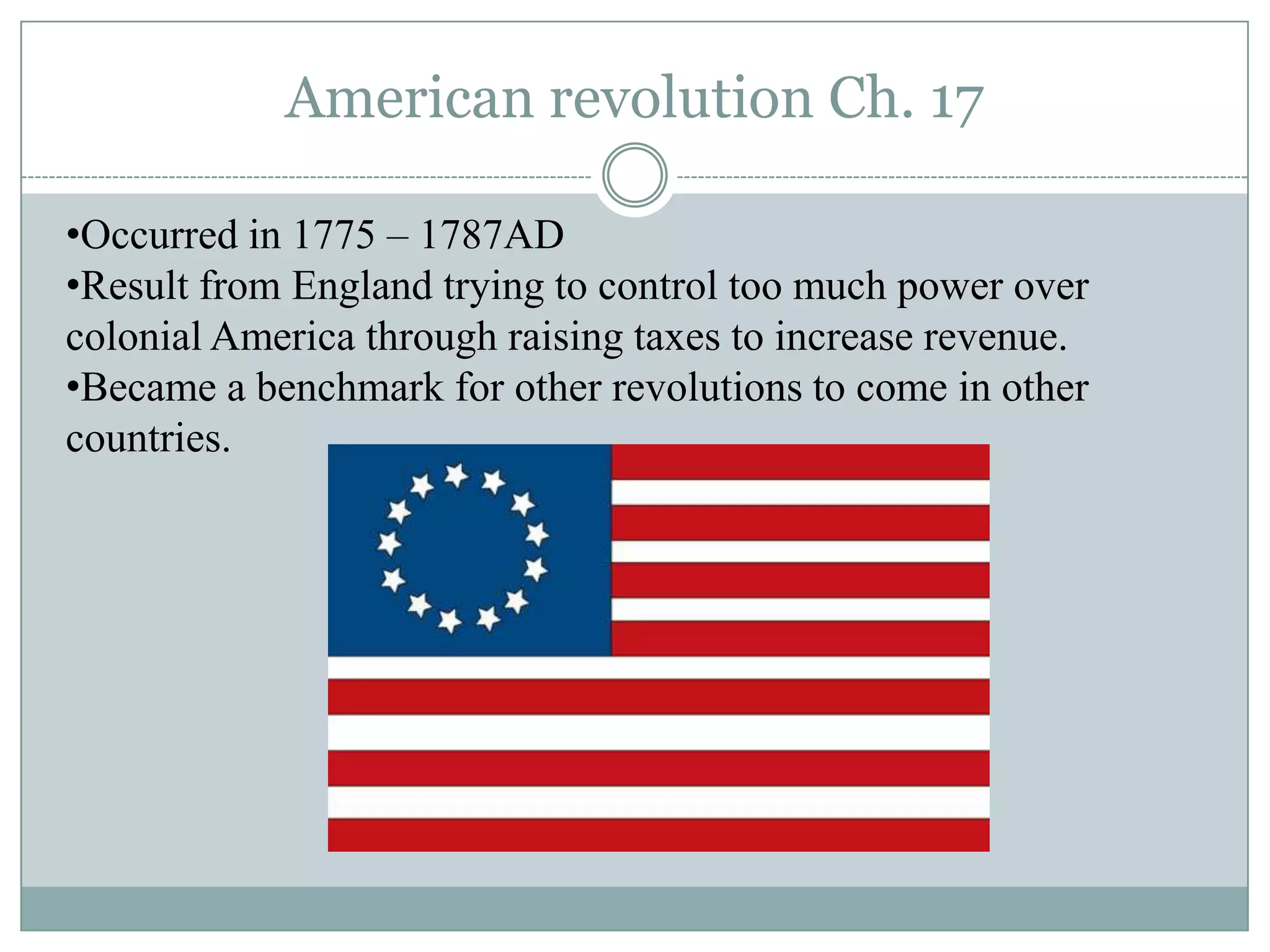
American revolution Ch. 17Occurred in 1775 – 1787AD
Result from England trying to control too much power over colonial America through raising taxes to increase revenue.
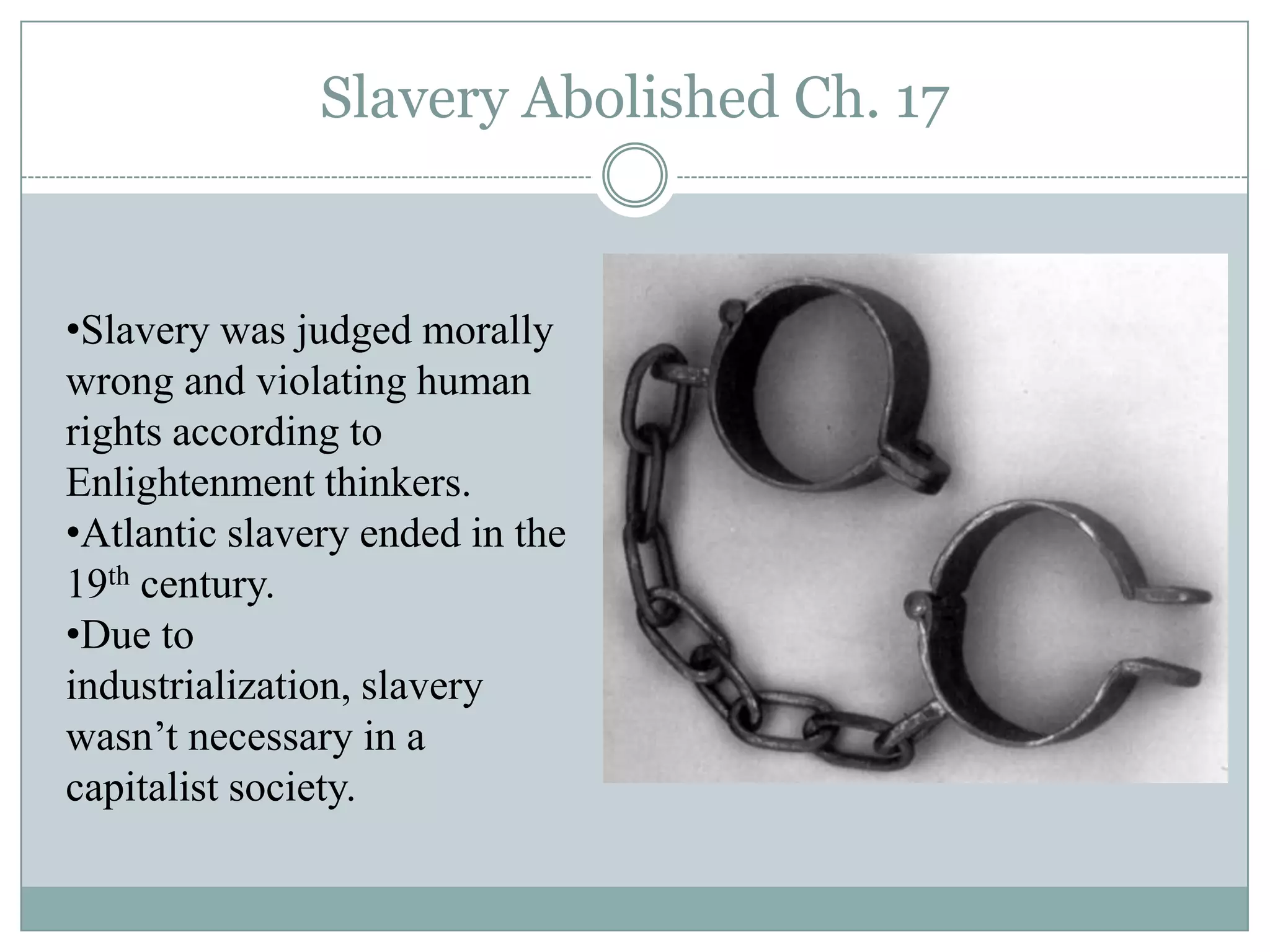
Became a benchmark for other revolutions to come in other countries.Slavery Abolished Ch. 17Slavery was judged morally wrong and violating human rights according to Enlightenment thinkers.
Atlantic slavery ended in the 19th century.
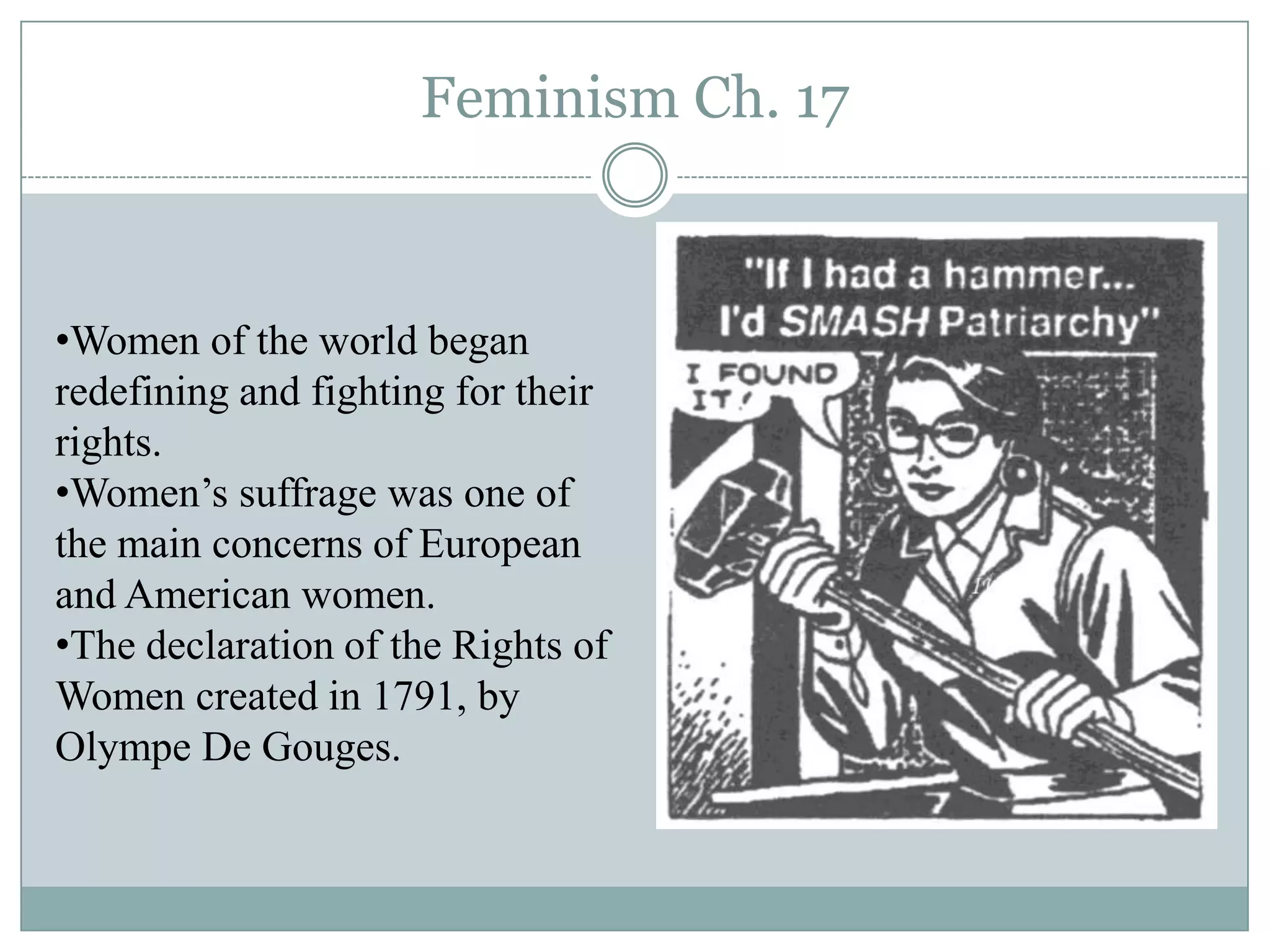
Due to industrialization, slavery wasn’t necessary in a capitalist society.Feminism Ch. 17Women of the world began redefining and fighting for their rights.
Women’s suffrage was one of the main concerns of European and American women.
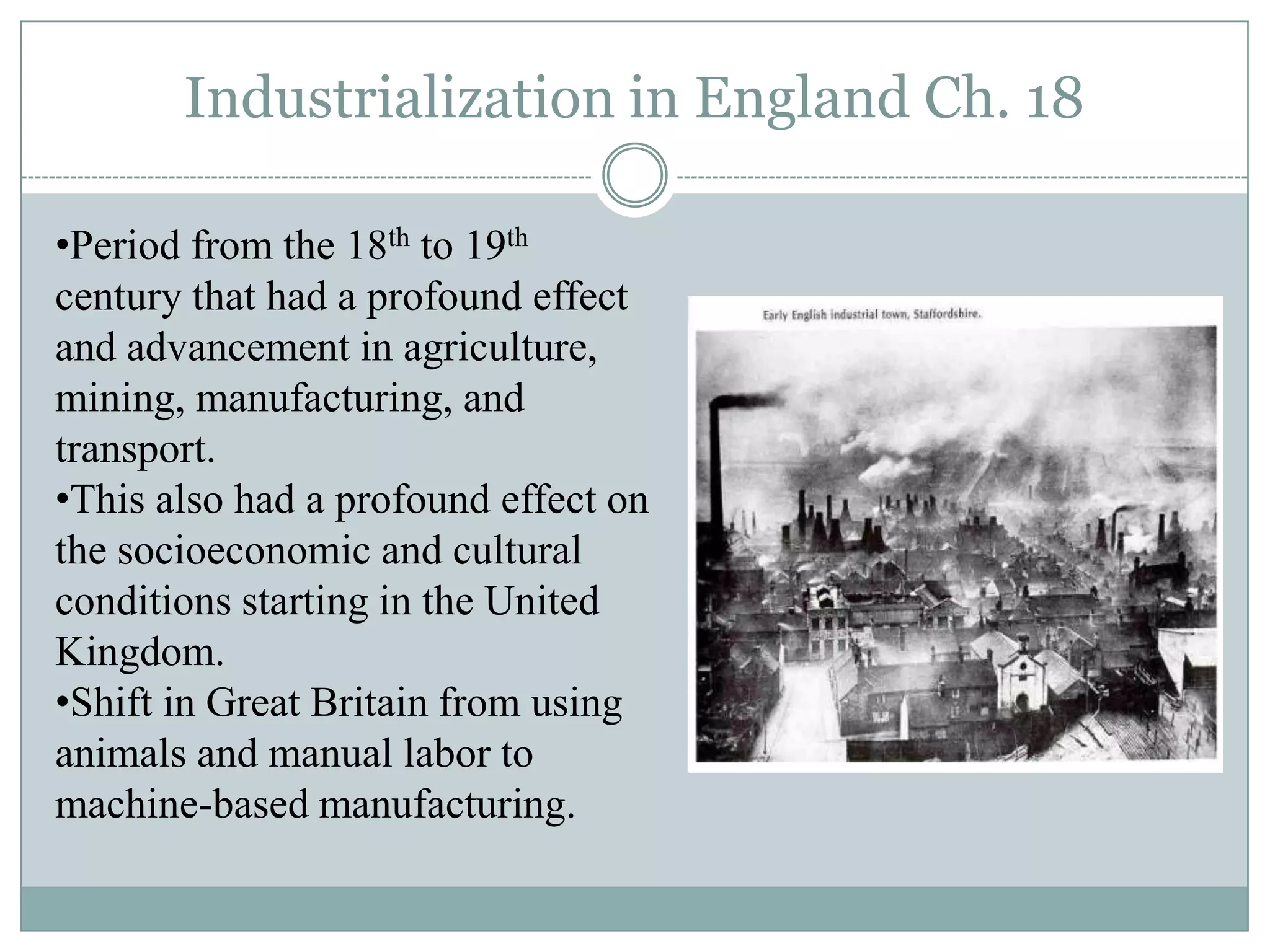
The declaration of the Rights of Women created in 1791, by Olympe De Gouges.Industrialization in England Ch. 18Period from the 18th to 19th century that had a profound effect and advancement in agriculture, mining, manufacturing, and transport.
This also had a profound effect on the socioeconomic and cultural conditions starting in the United Kingdom.
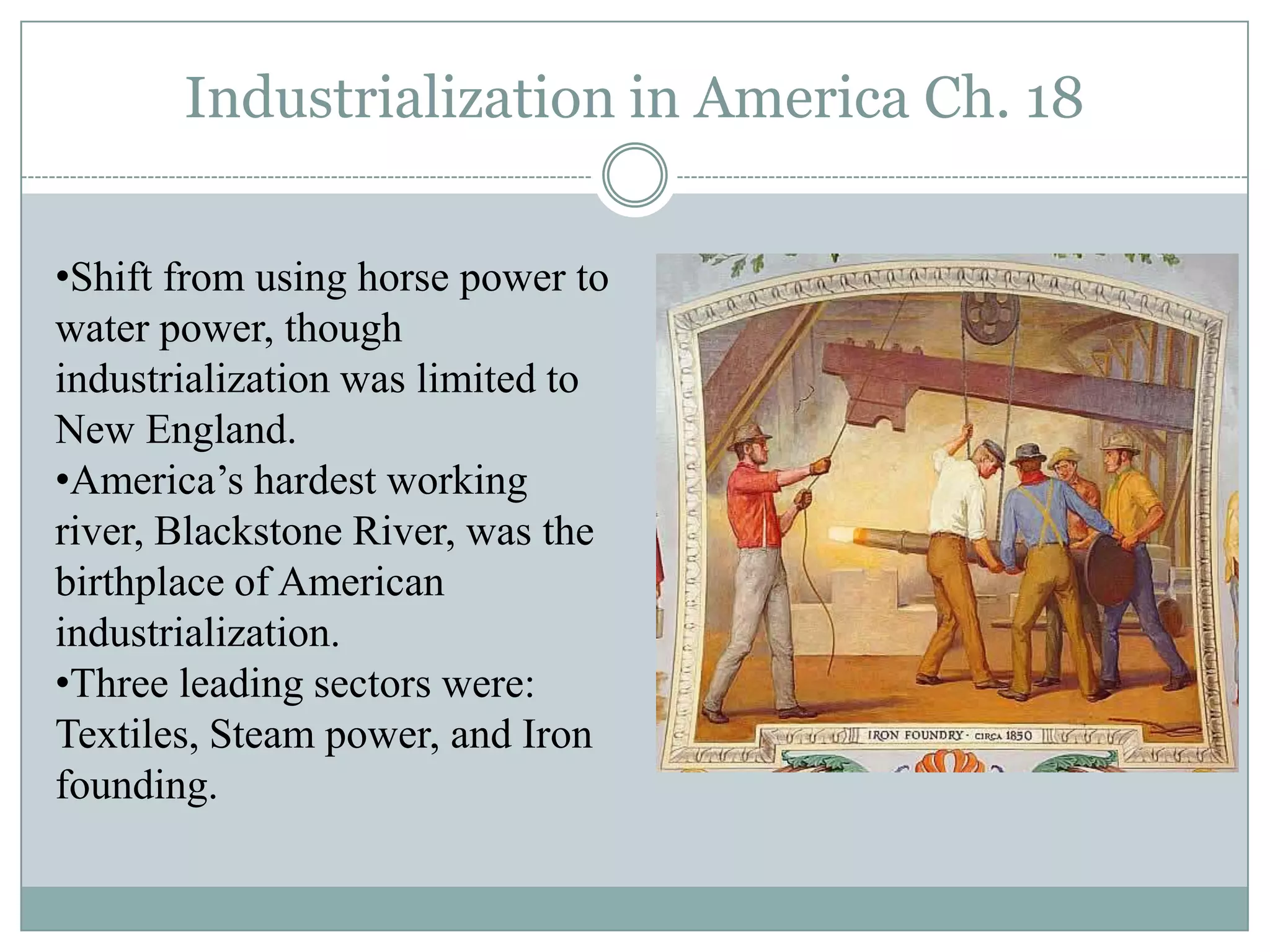
Shift in Great Britain from using animals and manual labor to machine-based manufacturing.Industrialization in America Ch. 18Shift from using horse power to water power, though industrialization was limited to New England.
America’s hardest working river, Blackstone River, was the birthplace of American industrialization.
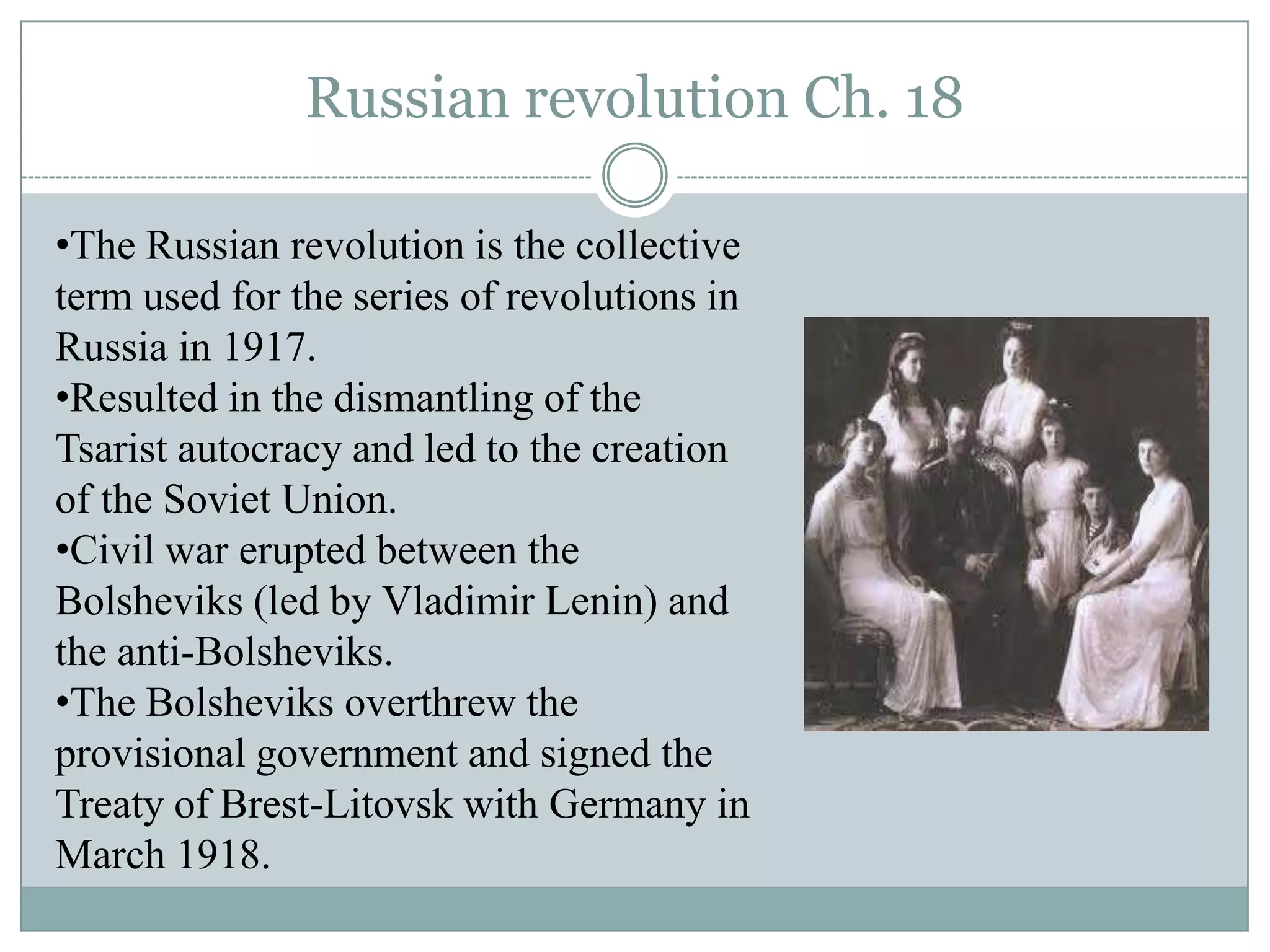
Three leading sectors were: Textiles, Steam power, and Iron founding.Russian revolution Ch. 18The Russian revolution is the collective term used for the series of revolutions in Russia in 1917.
Resulted in the dismantling of the Tsarist autocracy and led to the creation of the Soviet Union.
Civil war erupted between the Bolsheviks (led by Vladimir Lenin) and the anti-Bolsheviks.
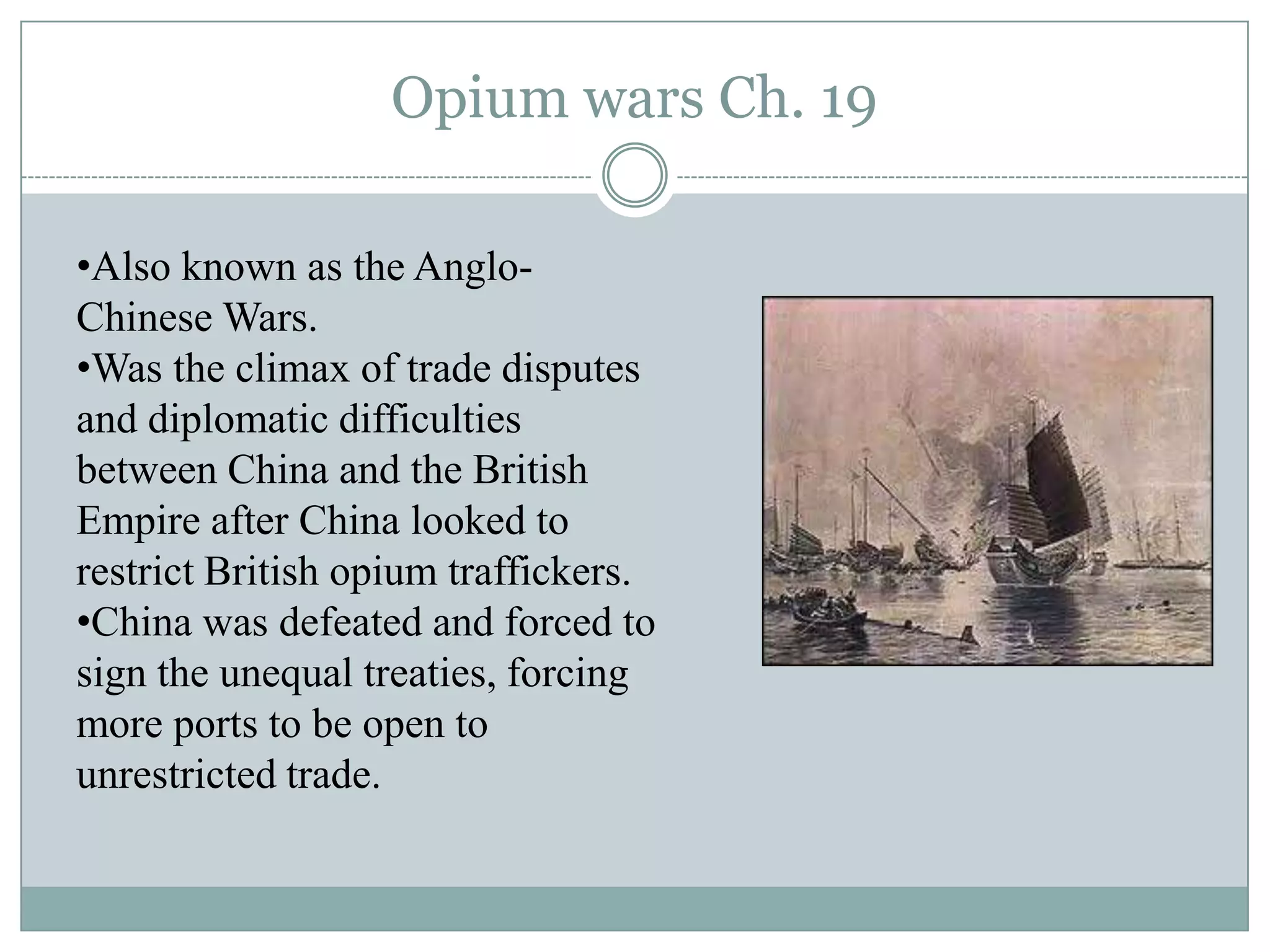
The Bolsheviks overthrew the provisional government and signed the Treaty of Brest-Litovsk with Germany in March 1918.Opium wars Ch. 19Also known as the Anglo-Chinese Wars.
Was the climax of trade disputes and diplomatic difficulties between China and the British Empire after China looked to restrict British opium traffickers.
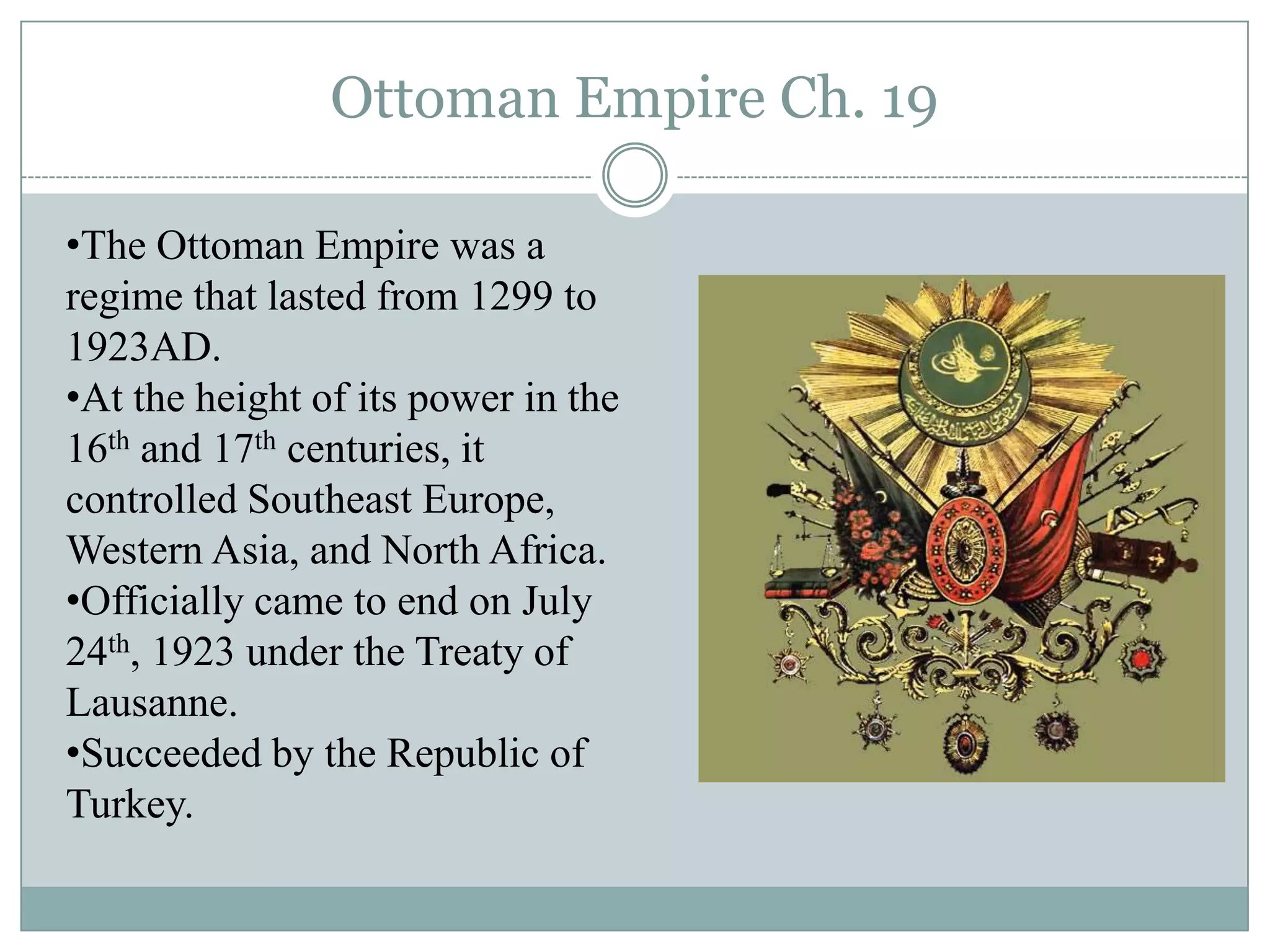
China was defeated and forced to sign the unequal treaties, forcing more ports to be open to unrestricted trade.Ottoman Empire Ch. 19The Ottoman Empire was a regime that lasted from 1299 to 1923AD.
At the height of its power in the 16th and 17th centuries, it controlled Southeast Europe, Western Asia, and North Africa.
Officially came to end on July 24th, 1923 under the Treaty of Lausanne.
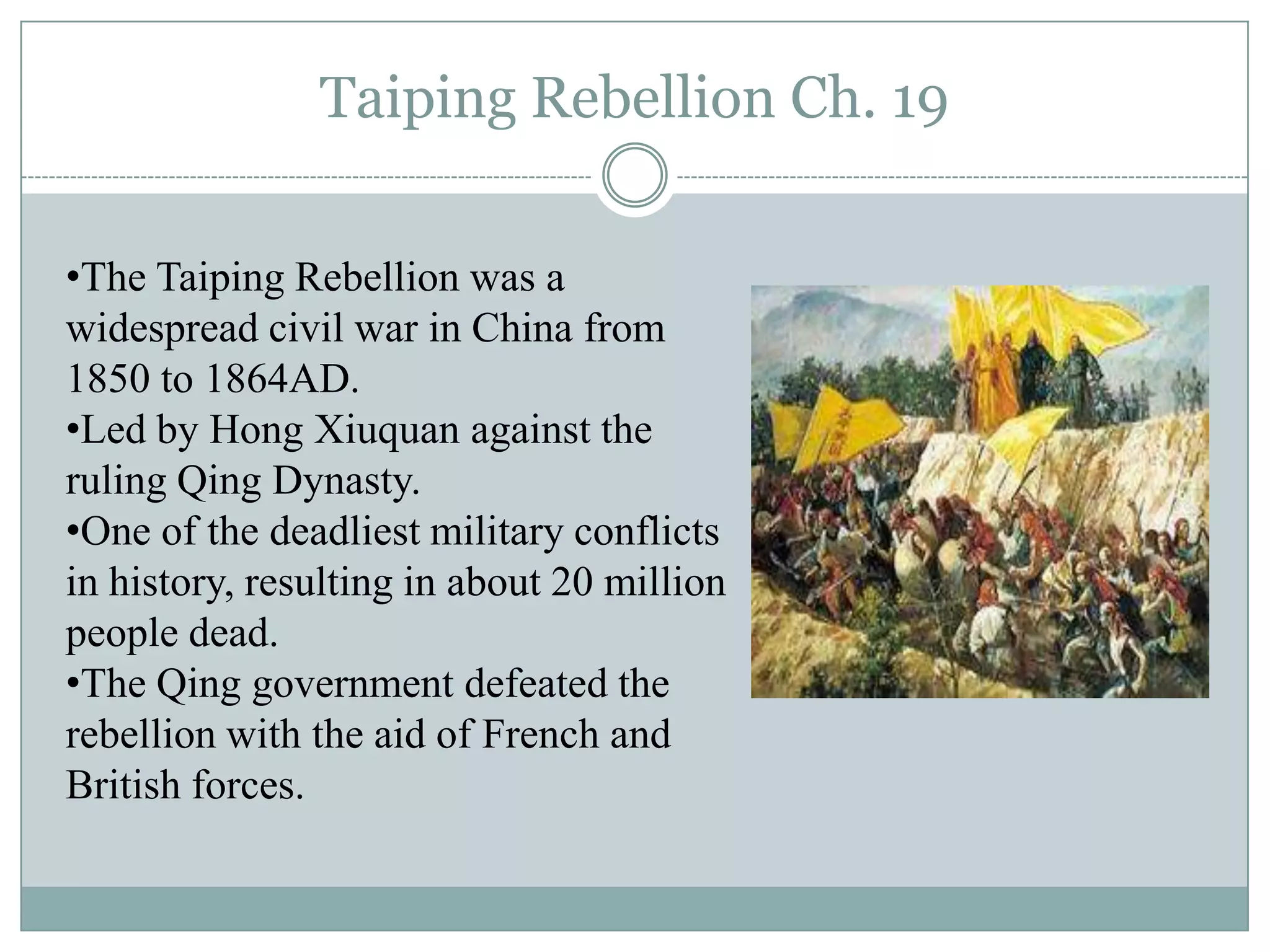
Succeeded by the Republic of Turkey.Taiping Rebellion Ch. 19The Taiping Rebellion was a widespread civil war in China from 1850 to 1864AD.
Led by Hong Xiuquan against the ruling Qing Dynasty.
One of the deadliest military conflicts in history, resulting in about 20 million people dead.
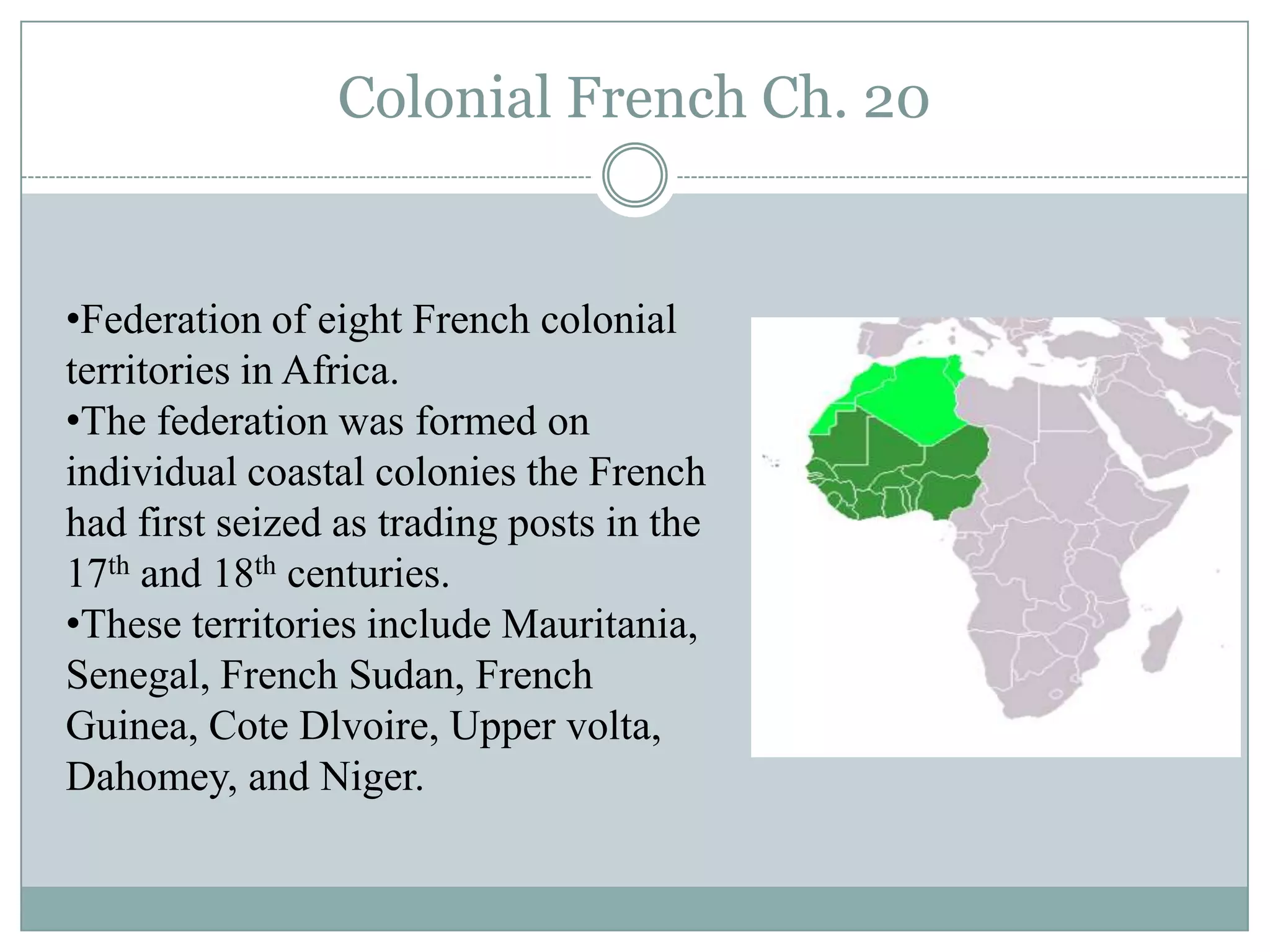
The Qing government defeated the rebellion with the aid of French and British forces.Colonial French Ch. 20Federation of eight French colonial territories in Africa.
The federation was formed on individual coastal colonies the French had first seized as trading posts in the 17th and 18th centuries.
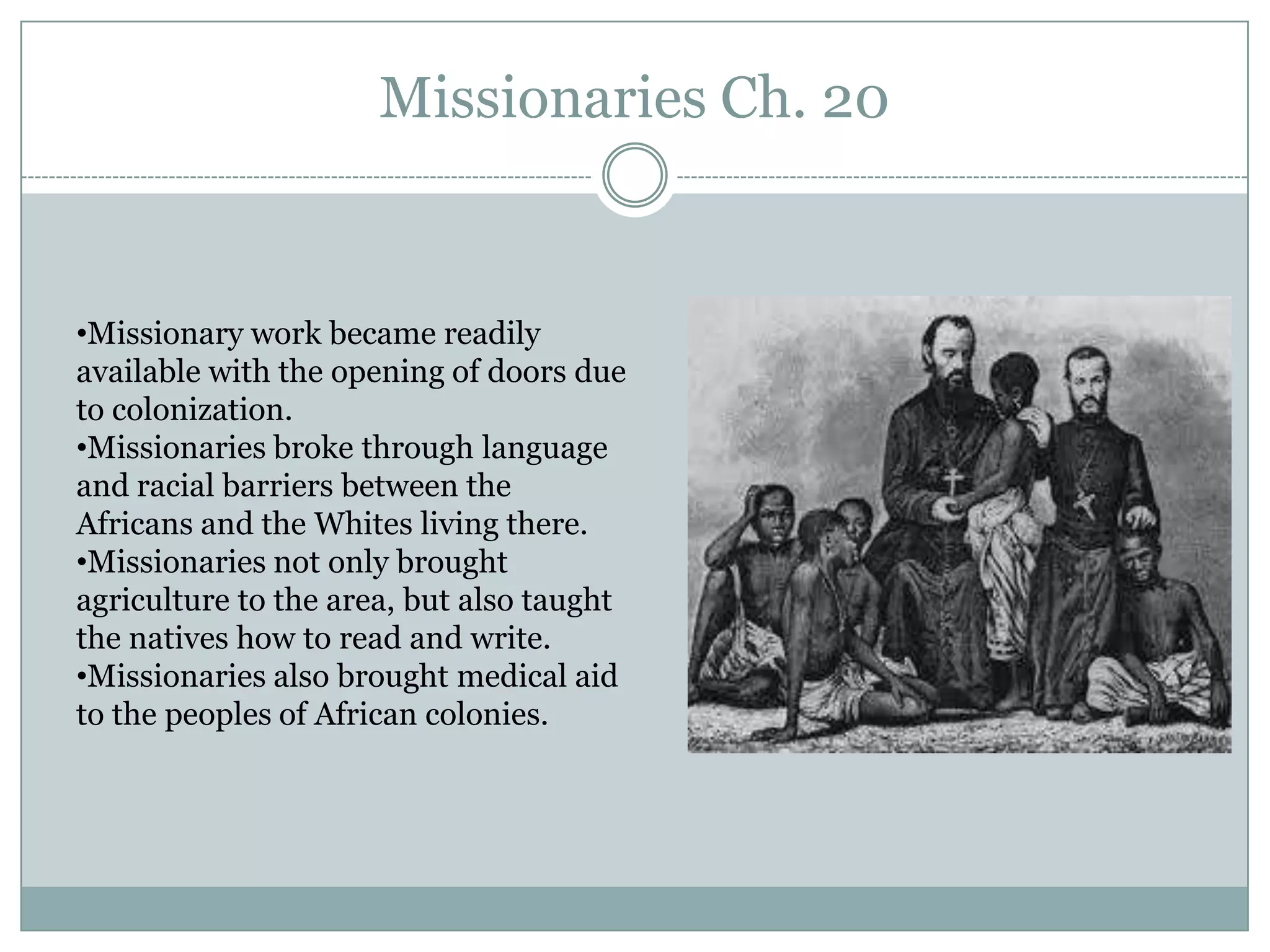
These territories include Mauritania, Senegal, French Sudan, French Guinea, Cote Dlvoire, Upper volta, Dahomey, and Niger.Missionaries Ch. 20Missionary work became readily available with the opening of doors due to colonization.

Hist5 ways of the world pp

  • 1.
    By: Aaron HahsWaysof The World
  • 2.
    American revolution Ch.17Occurred in 1775 – 1787AD
  • 3.
    Result from Englandtrying to control too much power over colonial America through raising taxes to increase revenue.
  • 4.
    Became a benchmarkfor other revolutions to come in other countries.Slavery Abolished Ch. 17Slavery was judged morally wrong and violating human rights according to Enlightenment thinkers.
  • 5.
    Atlantic slavery endedin the 19th century.
  • 6.
    Due to industrialization,slavery wasn’t necessary in a capitalist society.Feminism Ch. 17Women of the world began redefining and fighting for their rights.
  • 7.
    Women’s suffrage wasone of the main concerns of European and American women.
  • 8.
    The declaration ofthe Rights of Women created in 1791, by Olympe De Gouges.Industrialization in England Ch. 18Period from the 18th to 19th century that had a profound effect and advancement in agriculture, mining, manufacturing, and transport.
  • 9.
    This also hada profound effect on the socioeconomic and cultural conditions starting in the United Kingdom.
  • 10.
    Shift in GreatBritain from using animals and manual labor to machine-based manufacturing.Industrialization in America Ch. 18Shift from using horse power to water power, though industrialization was limited to New England.
  • 11.
    America’s hardest workingriver, Blackstone River, was the birthplace of American industrialization.
  • 12.
    Three leading sectorswere: Textiles, Steam power, and Iron founding.Russian revolution Ch. 18The Russian revolution is the collective term used for the series of revolutions in Russia in 1917.
  • 13.
    Resulted in thedismantling of the Tsarist autocracy and led to the creation of the Soviet Union.
  • 14.
    Civil war eruptedbetween the Bolsheviks (led by Vladimir Lenin) and the anti-Bolsheviks.
  • 15.
    The Bolsheviks overthrewthe provisional government and signed the Treaty of Brest-Litovsk with Germany in March 1918.Opium wars Ch. 19Also known as the Anglo-Chinese Wars.
  • 16.
    Was the climaxof trade disputes and diplomatic difficulties between China and the British Empire after China looked to restrict British opium traffickers.
  • 17.
    China was defeatedand forced to sign the unequal treaties, forcing more ports to be open to unrestricted trade.Ottoman Empire Ch. 19The Ottoman Empire was a regime that lasted from 1299 to 1923AD.
  • 18.
    At the heightof its power in the 16th and 17th centuries, it controlled Southeast Europe, Western Asia, and North Africa.
  • 19.
    Officially came toend on July 24th, 1923 under the Treaty of Lausanne.
  • 20.
    Succeeded by theRepublic of Turkey.Taiping Rebellion Ch. 19The Taiping Rebellion was a widespread civil war in China from 1850 to 1864AD.
  • 21.
    Led by HongXiuquan against the ruling Qing Dynasty.
  • 22.
    One of thedeadliest military conflicts in history, resulting in about 20 million people dead.
  • 23.
    The Qing governmentdefeated the rebellion with the aid of French and British forces.Colonial French Ch. 20Federation of eight French colonial territories in Africa.
  • 24.
    The federation wasformed on individual coastal colonies the French had first seized as trading posts in the 17th and 18th centuries.
  • 25.
    These territories includeMauritania, Senegal, French Sudan, French Guinea, Cote Dlvoire, Upper volta, Dahomey, and Niger.Missionaries Ch. 20Missionary work became readily available with the opening of doors due to colonization.
  • 26.
    Missionaries broke throughlanguage and racial barriers between the Africans and the Whites living there.
  • 27.
    Missionaries not onlybrought agriculture to the area, but also taught the natives how to read and write.
  • 28.
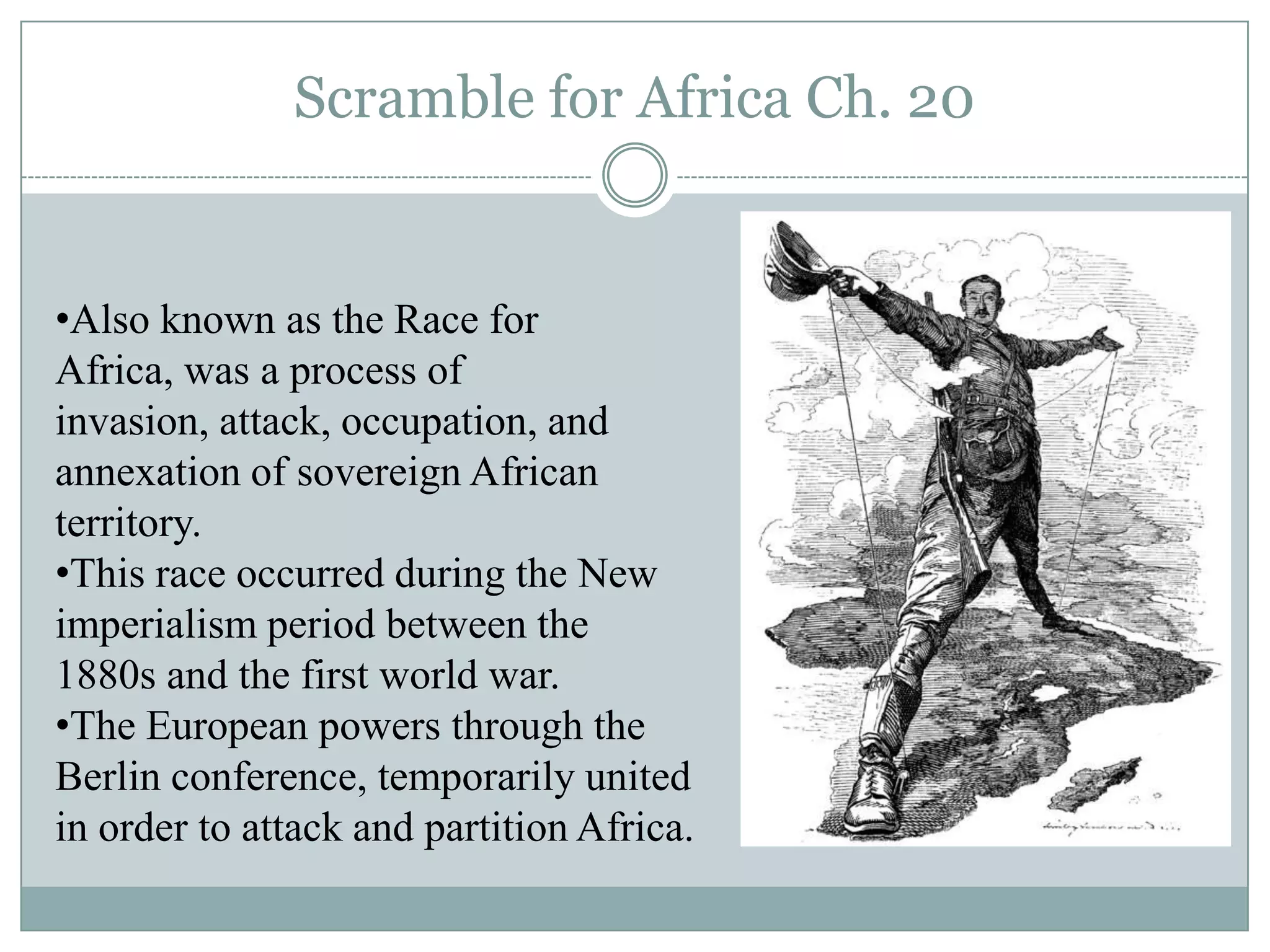
    Missionaries also broughtmedical aid to the peoples of African colonies.Scramble for Africa Ch. 20Also known as the Race for Africa, was a process of invasion, attack, occupation, and annexation of sovereign African territory.
  • 29.
    This race occurredduring the New imperialism period between the 1880s and the first world war.
  • 30.
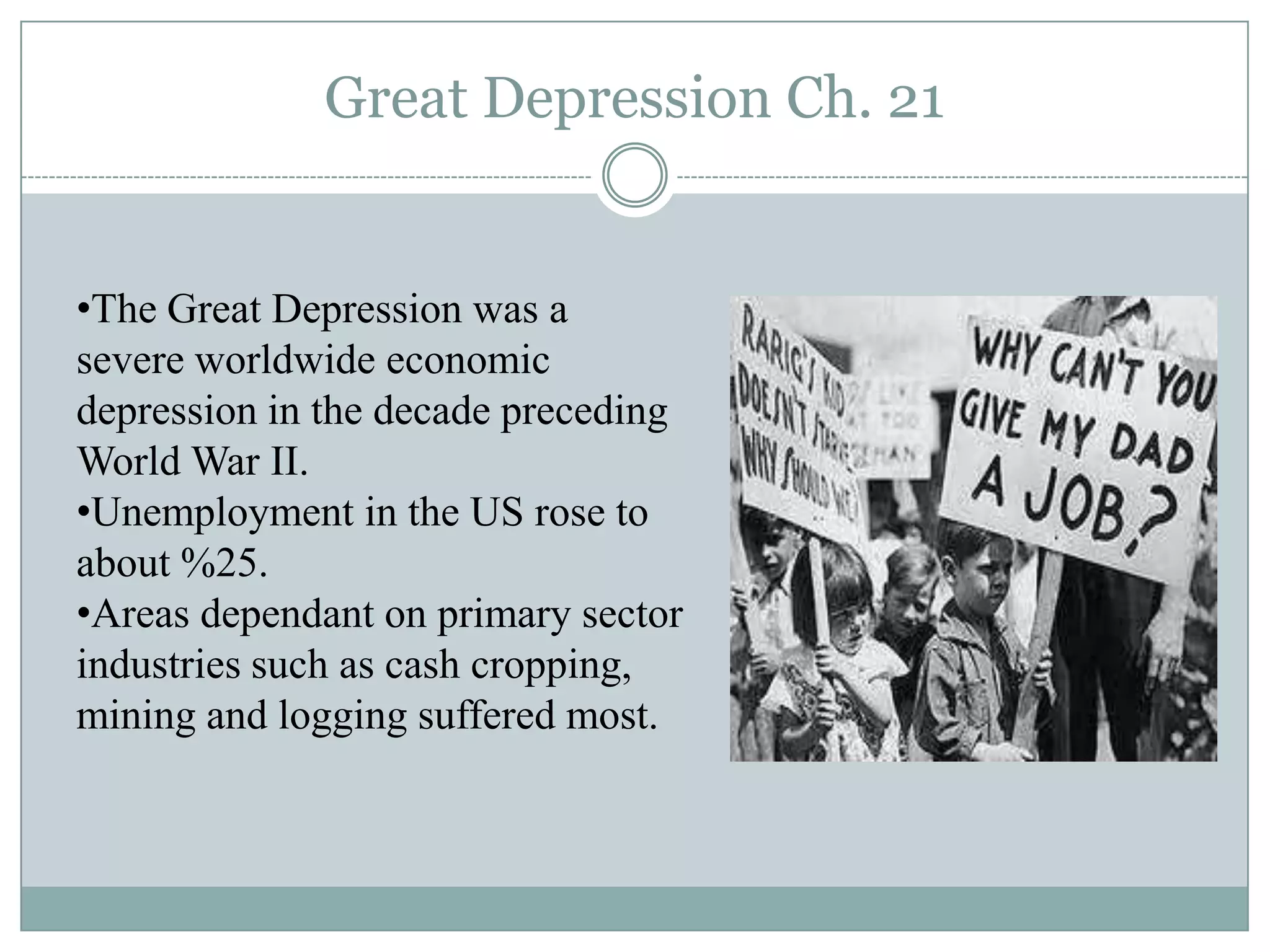
    The European powersthrough the Berlin conference, temporarily united in order to attack and partition Africa.Great Depression Ch. 21The Great Depression was a severe worldwide economic depression in the decade preceding World War II.
  • 31.
    Unemployment in theUS rose to about %25.
  • 32.
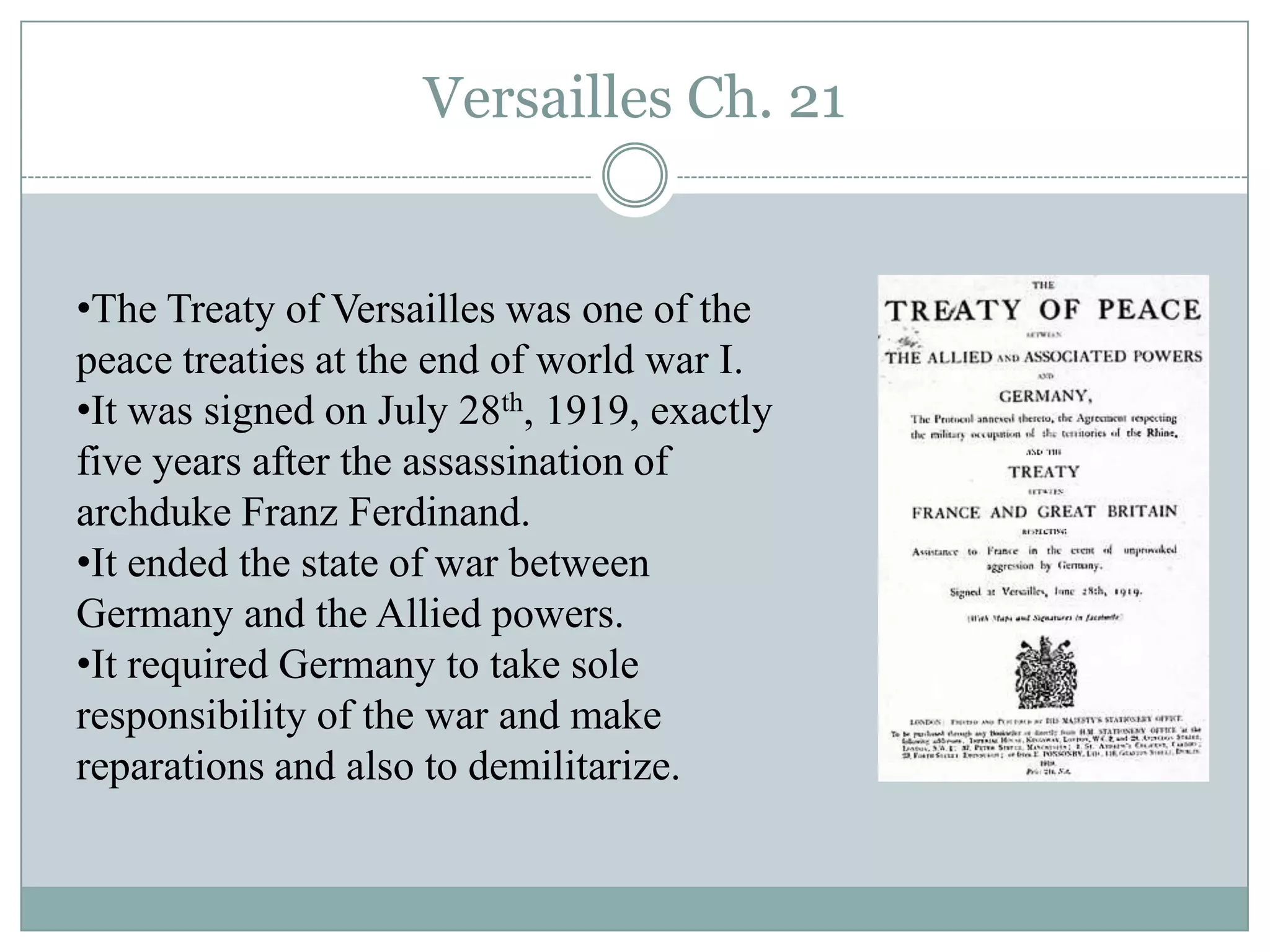
    Areas dependant onprimary sector industries such as cash cropping, mining and logging suffered most.Versailles Ch. 21The Treaty of Versailles was one of the peace treaties at the end of world war I.
  • 33.
    It was signedon July 28th, 1919, exactly five years after the assassination of archduke Franz Ferdinand.
  • 34.
    It ended thestate of war between Germany and the Allied powers.
  • 35.
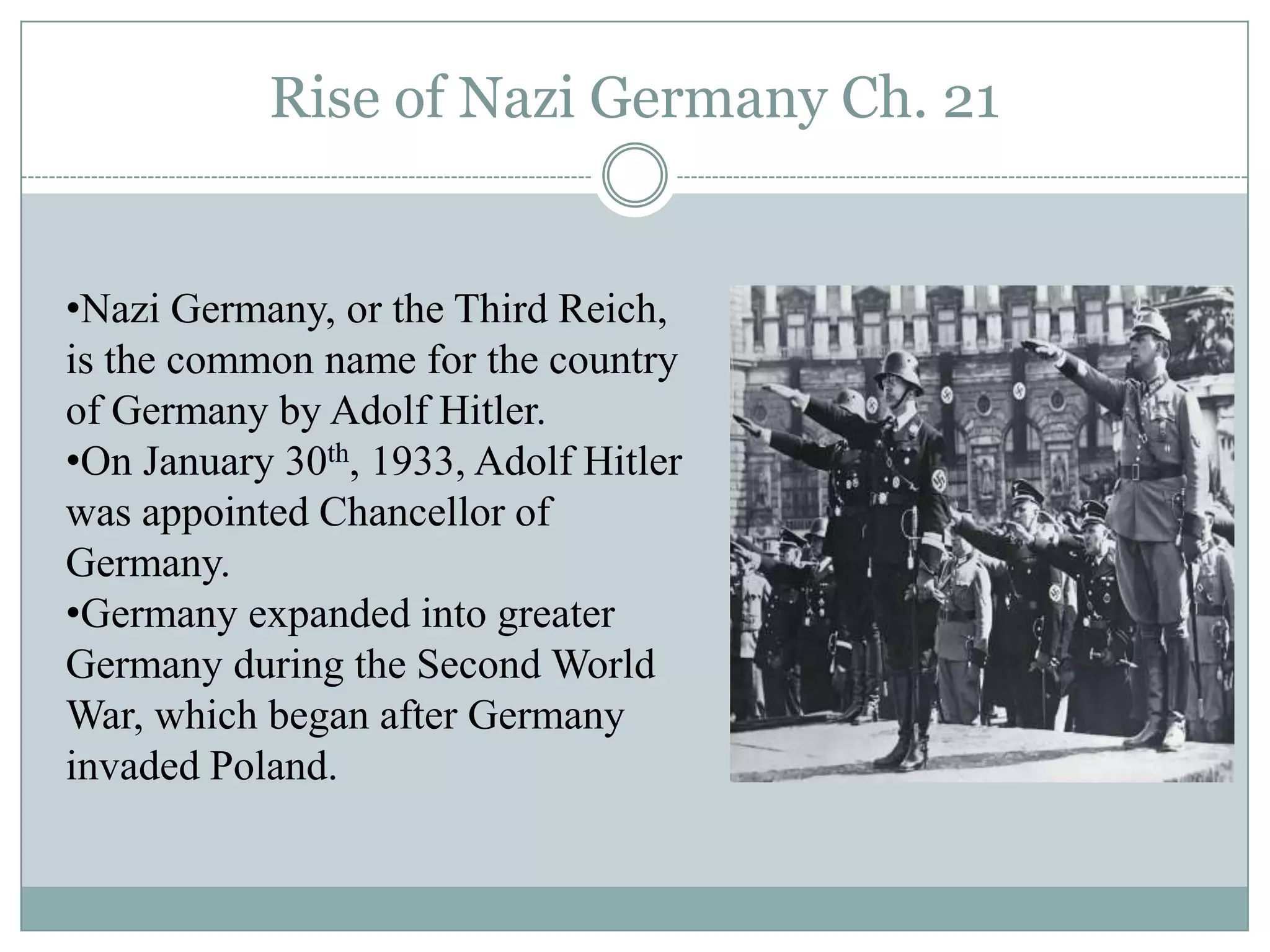
    It required Germanyto take sole responsibility of the war and make reparations and also to demilitarize.Rise of Nazi Germany Ch. 21Nazi Germany, or the Third Reich, is the common name for the country of Germany by Adolf Hitler.
  • 36.
    On January 30th,1933, Adolf Hitler was appointed Chancellor of Germany.
  • 37.
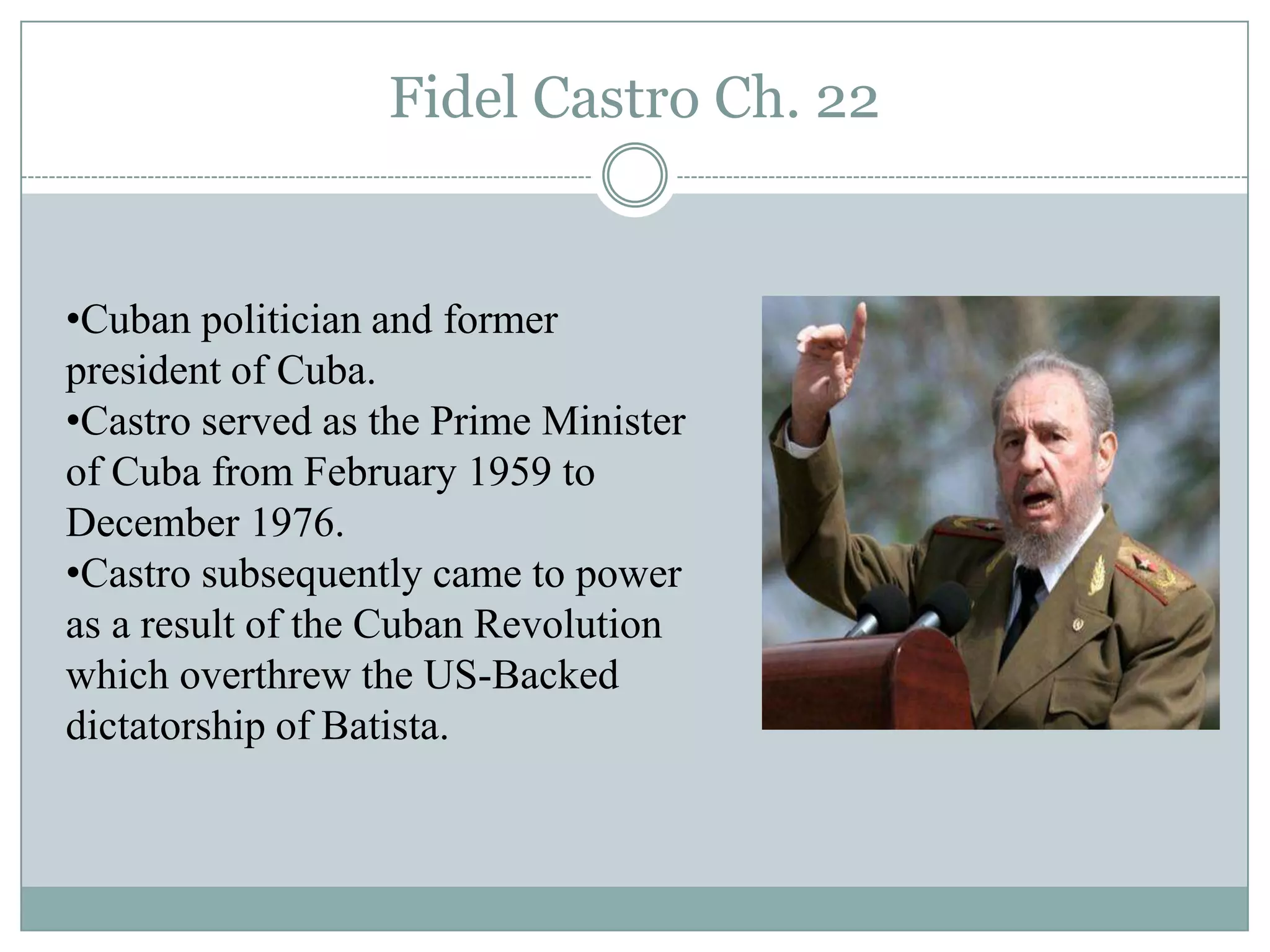
    Germany expanded intogreater Germany during the Second World War, which began after Germany invaded Poland.Fidel Castro Ch. 22Cuban politician and former president of Cuba.
  • 38.
    Castro served asthe Prime Minister of Cuba from February 1959 to December 1976.
  • 39.
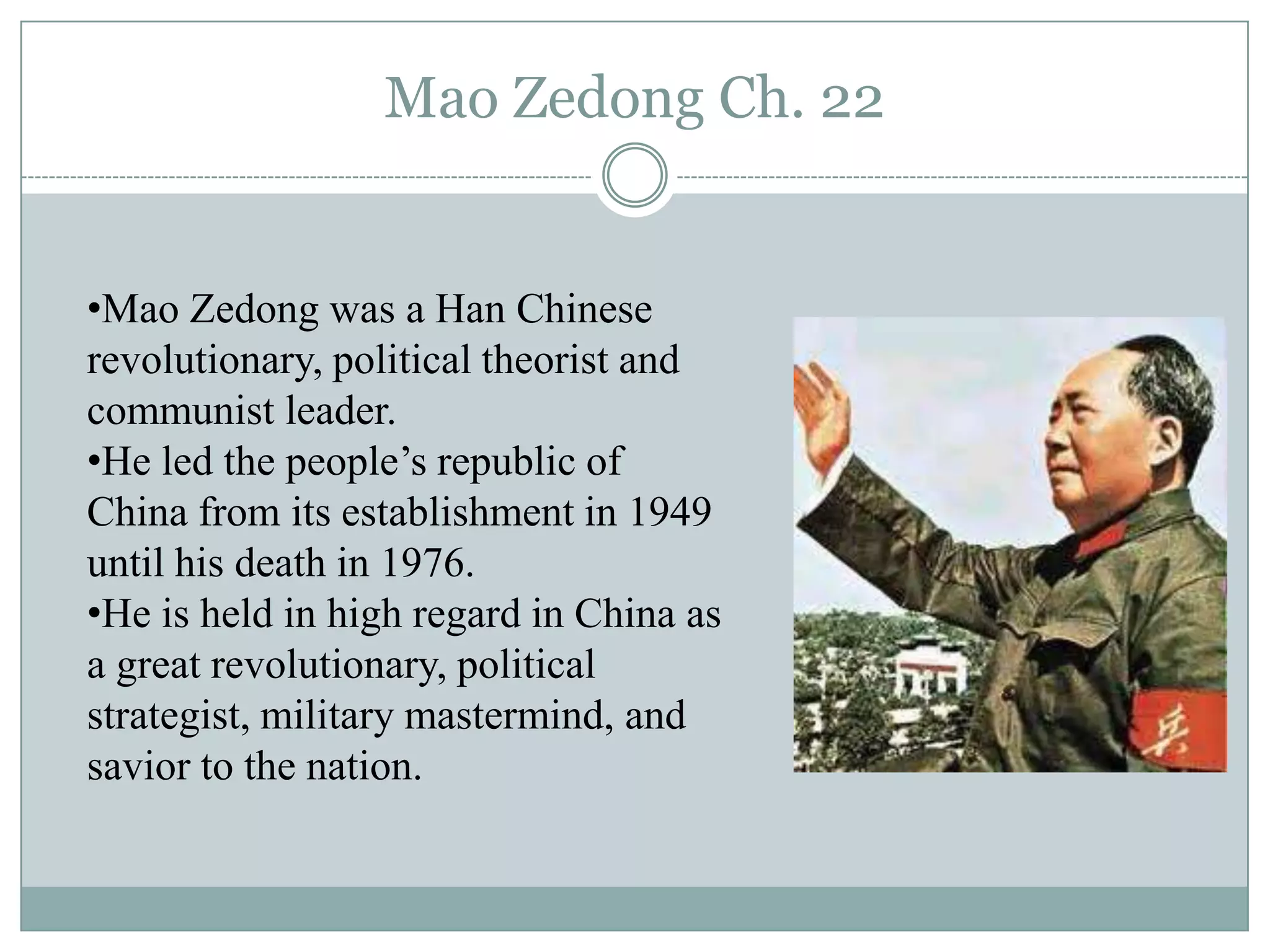
    Castro subsequently cameto power as a result of the Cuban Revolution which overthrew the US-Backed dictatorship of Batista.Mao Zedong Ch. 22Mao Zedong was a Han Chinese revolutionary, political theorist and communist leader.
  • 40.
    He led thepeople’s republic of China from its establishment in 1949 until his death in 1976.
  • 41.
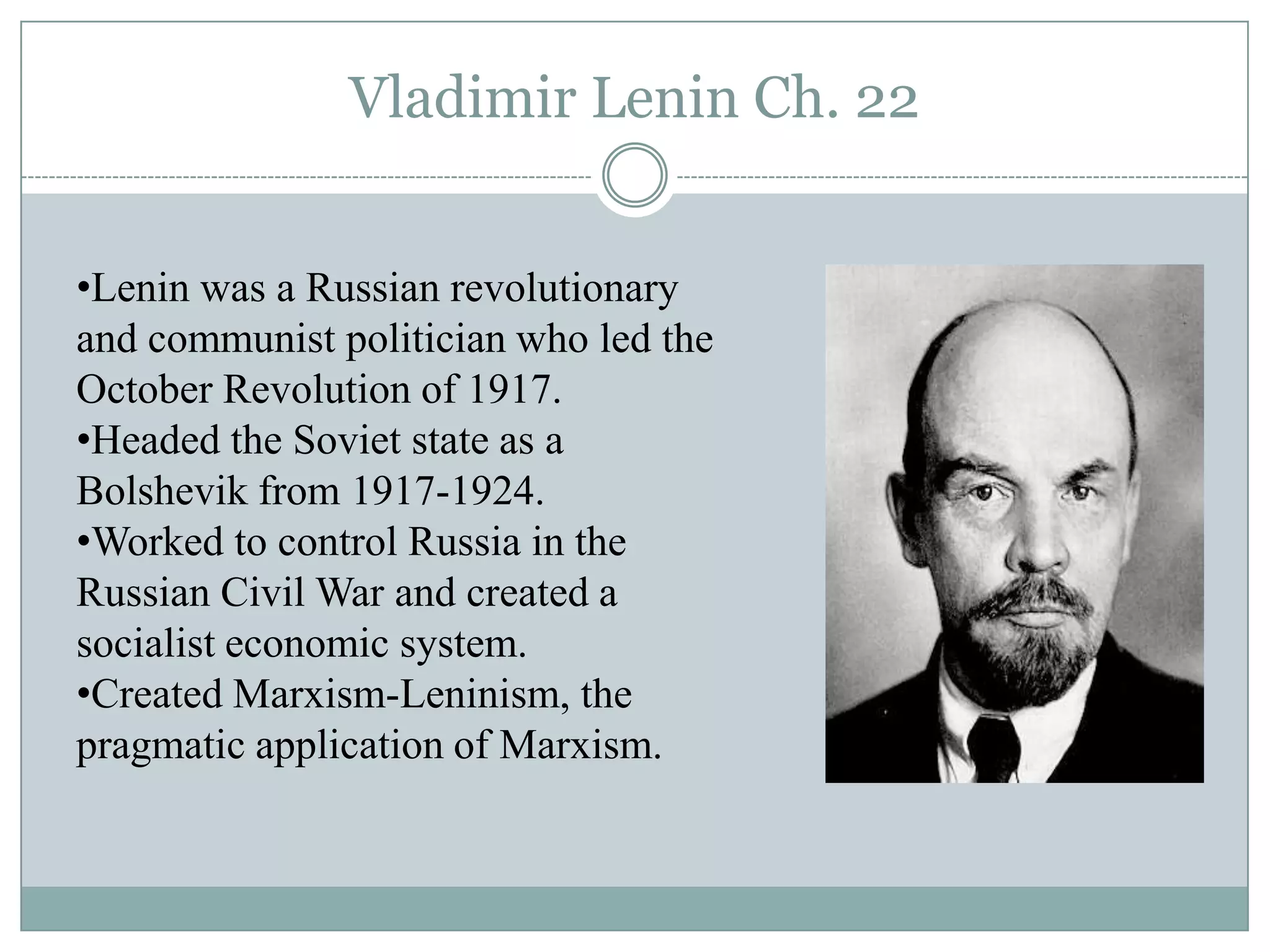
    He is heldin high regard in China as a great revolutionary, political strategist, military mastermind, and savior to the nation.Vladimir Lenin Ch. 22Lenin was a Russian revolutionary and communist politician who led the October Revolution of 1917.
  • 42.
    Headed the Sovietstate as a Bolshevik from 1917-1924.
  • 43.
    Worked to controlRussia in the Russian Civil War and created a socialist economic system.
  • 44.
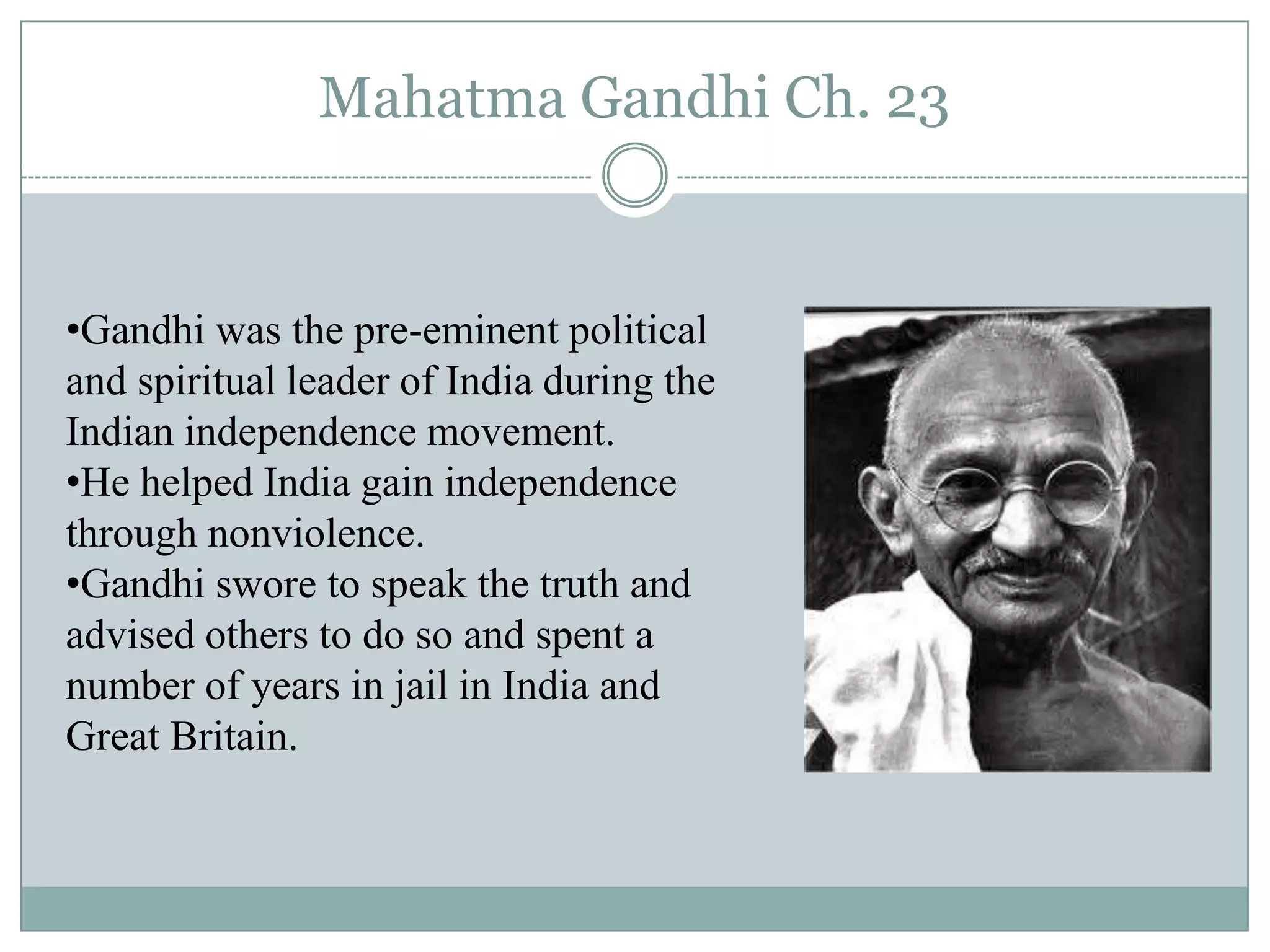
    Created Marxism-Leninism, thepragmatic application of Marxism.Mahatma Gandhi Ch. 23Gandhi was the pre-eminent political and spiritual leader of India during the Indian independence movement.
  • 45.
    He helped Indiagain independence through nonviolence.
  • 46.
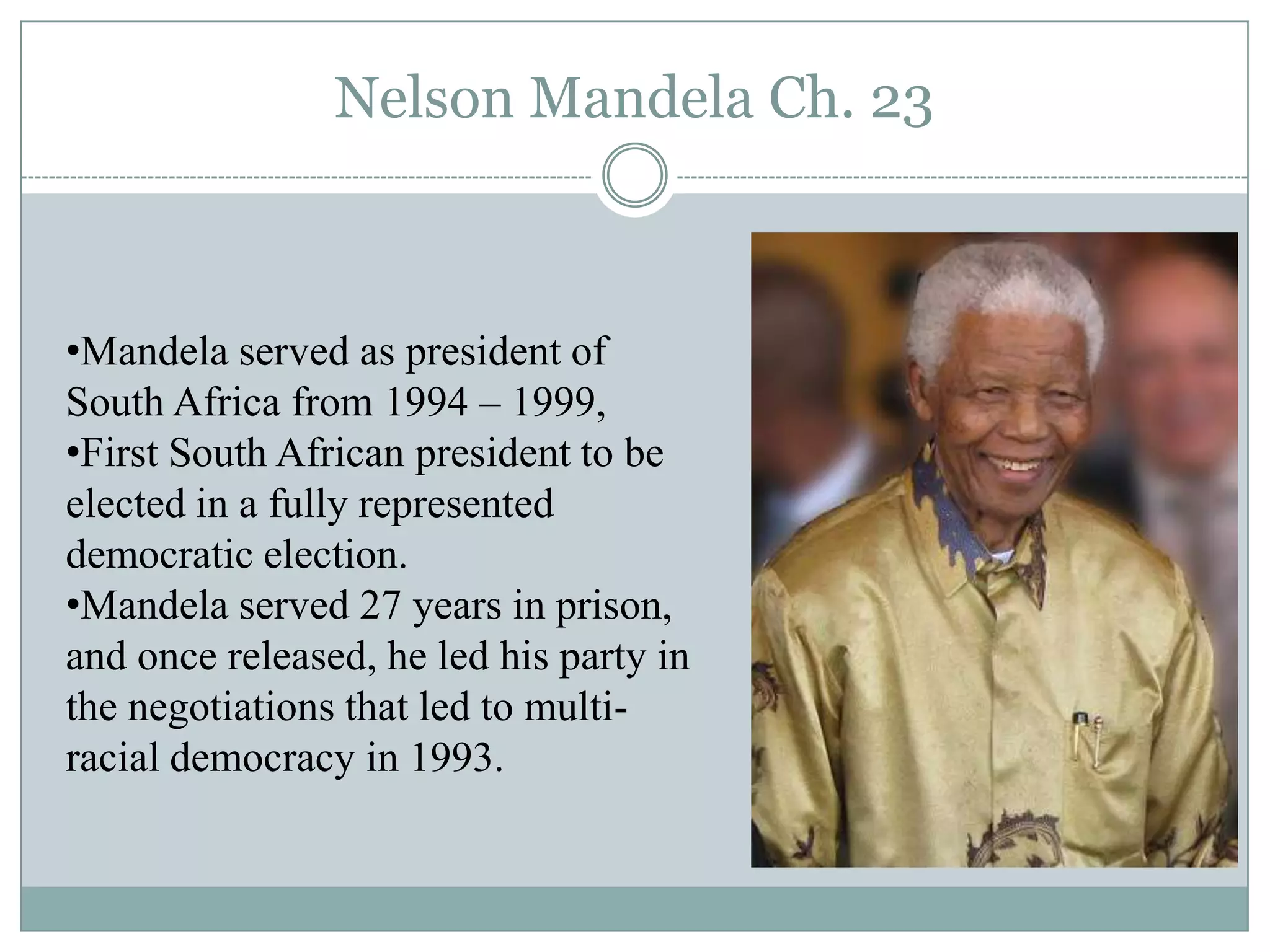
    Gandhi swore tospeak the truth and advised others to do so and spent a number of years in jail in India and Great Britain.Nelson Mandela Ch. 23Mandela served as president of South Africa from 1994 – 1999,
  • 47.
    First South Africanpresident to be elected in a fully represented democratic election.
  • 48.
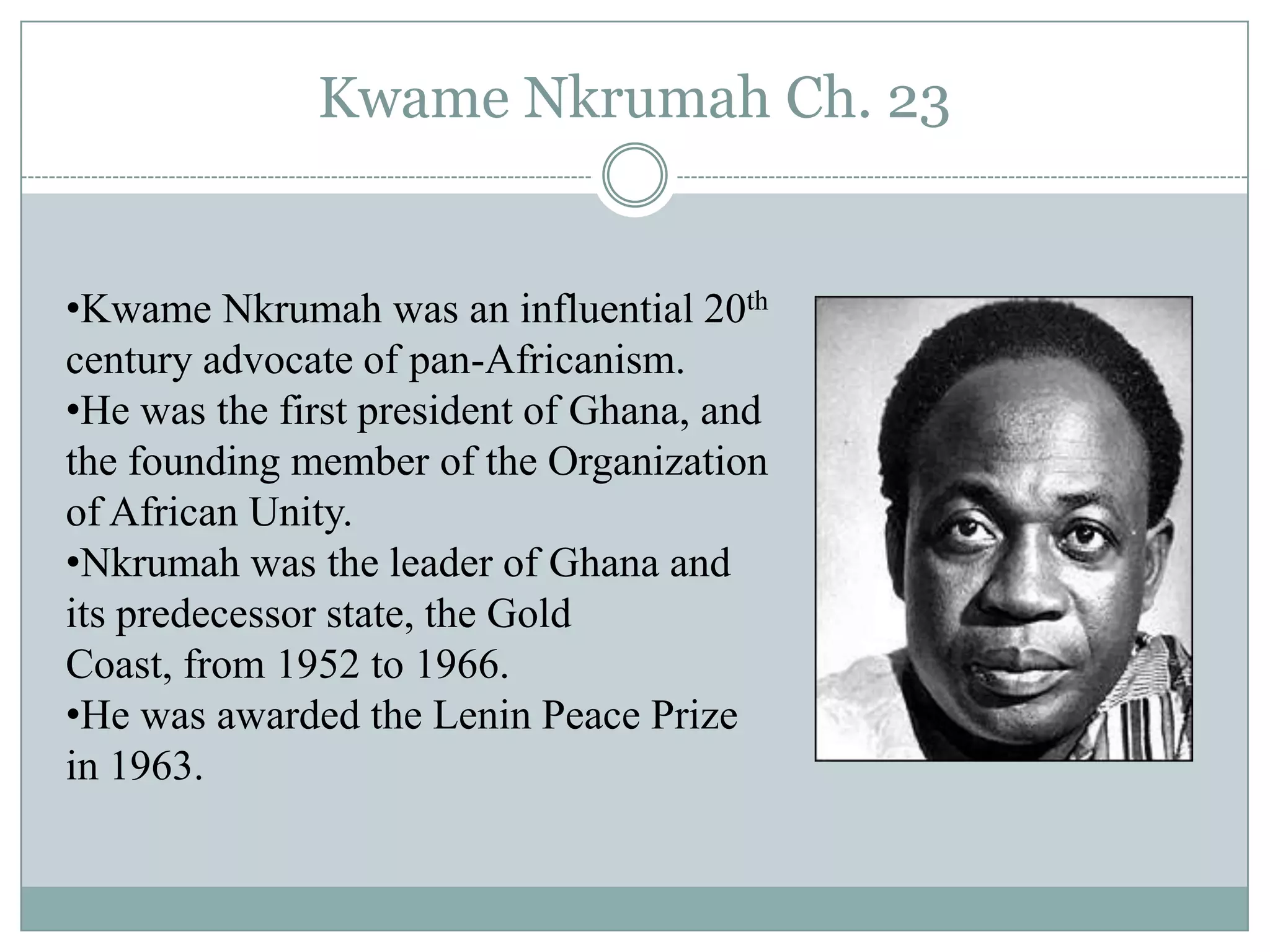
    Mandela served 27years in prison, and once released, he led his party in the negotiations that led to multi-racial democracy in 1993.Kwame Nkrumah Ch. 23Kwame Nkrumah was an influential 20th century advocate of pan-Africanism.
  • 49.
    He was thefirst president of Ghana, and the founding member of the Organization of African Unity.
  • 50.
    Nkrumah was theleader of Ghana and its predecessor state, the Gold Coast, from 1952 to 1966.
  • 51.
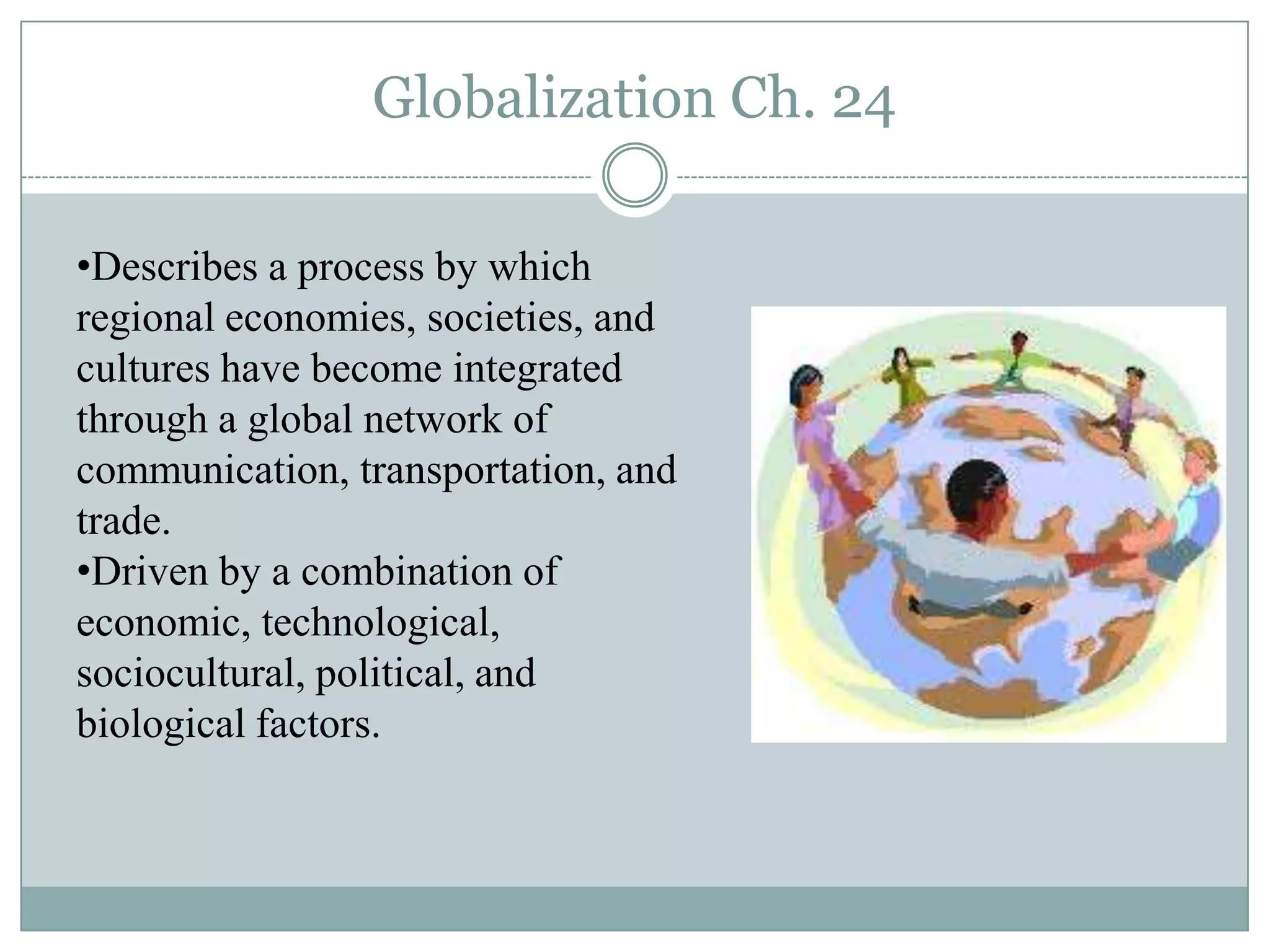
    He was awardedthe Lenin Peace Prize in 1963.Globalization Ch. 24Describes a process by which regional economies, societies, and cultures have become integrated through a global network of communication, transportation, and trade.
  • 52.
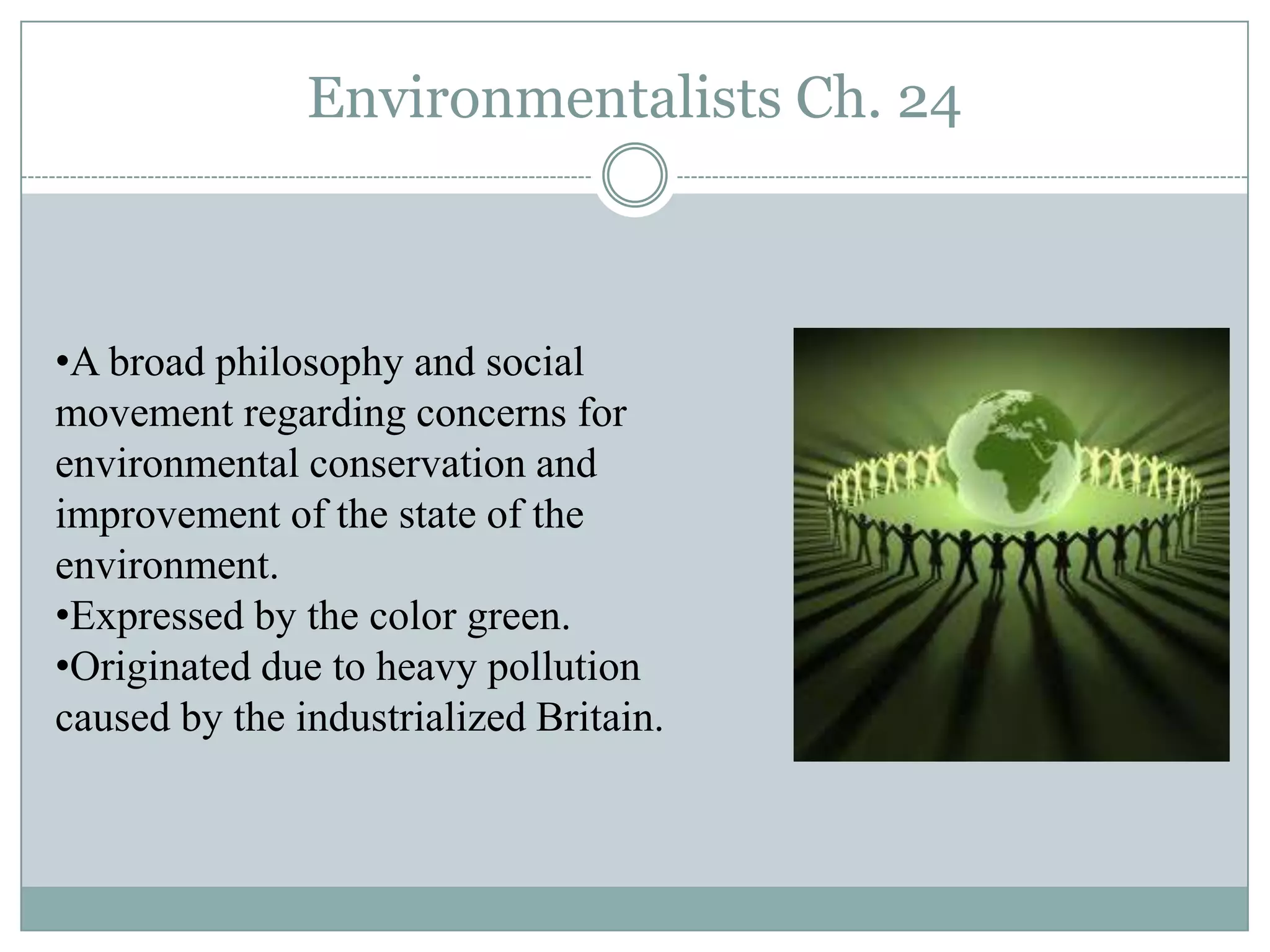
    Driven by acombination of economic, technological, sociocultural, political, and biological factors.Environmentalists Ch. 24A broad philosophy and social movement regarding concerns for environmental conservation and improvement of the state of the environment.
  • 53.
    Expressed by thecolor green.
  • 54.
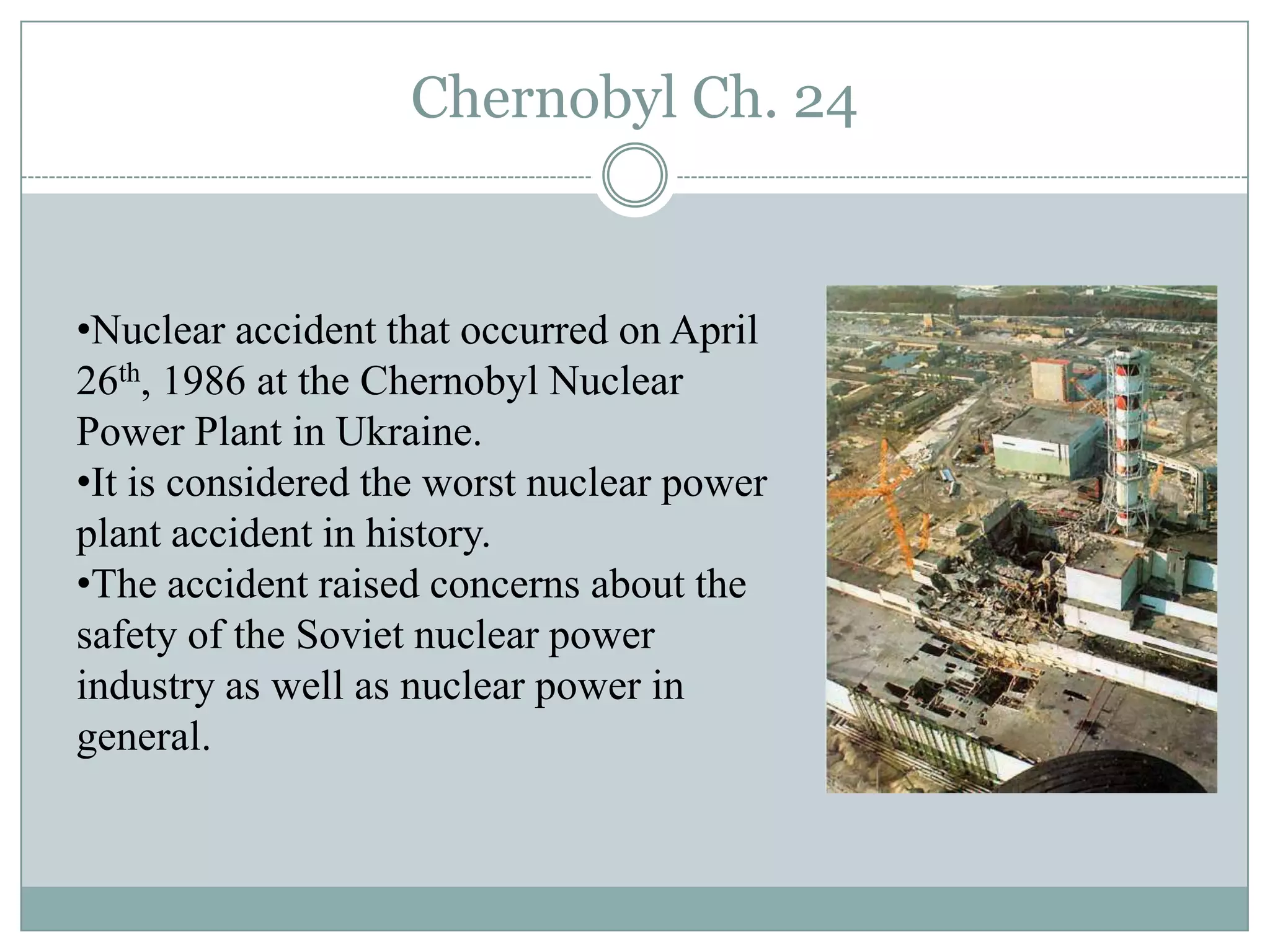
    Originated due toheavy pollution caused by the industrialized Britain.Chernobyl Ch. 24Nuclear accident that occurred on April 26th, 1986 at the Chernobyl Nuclear Power Plant in Ukraine.
  • 55.
    It is consideredthe worst nuclear power plant accident in history.
  • 56.
    The accident raisedconcerns about the safety of the Soviet nuclear power industry as well as nuclear power in general.