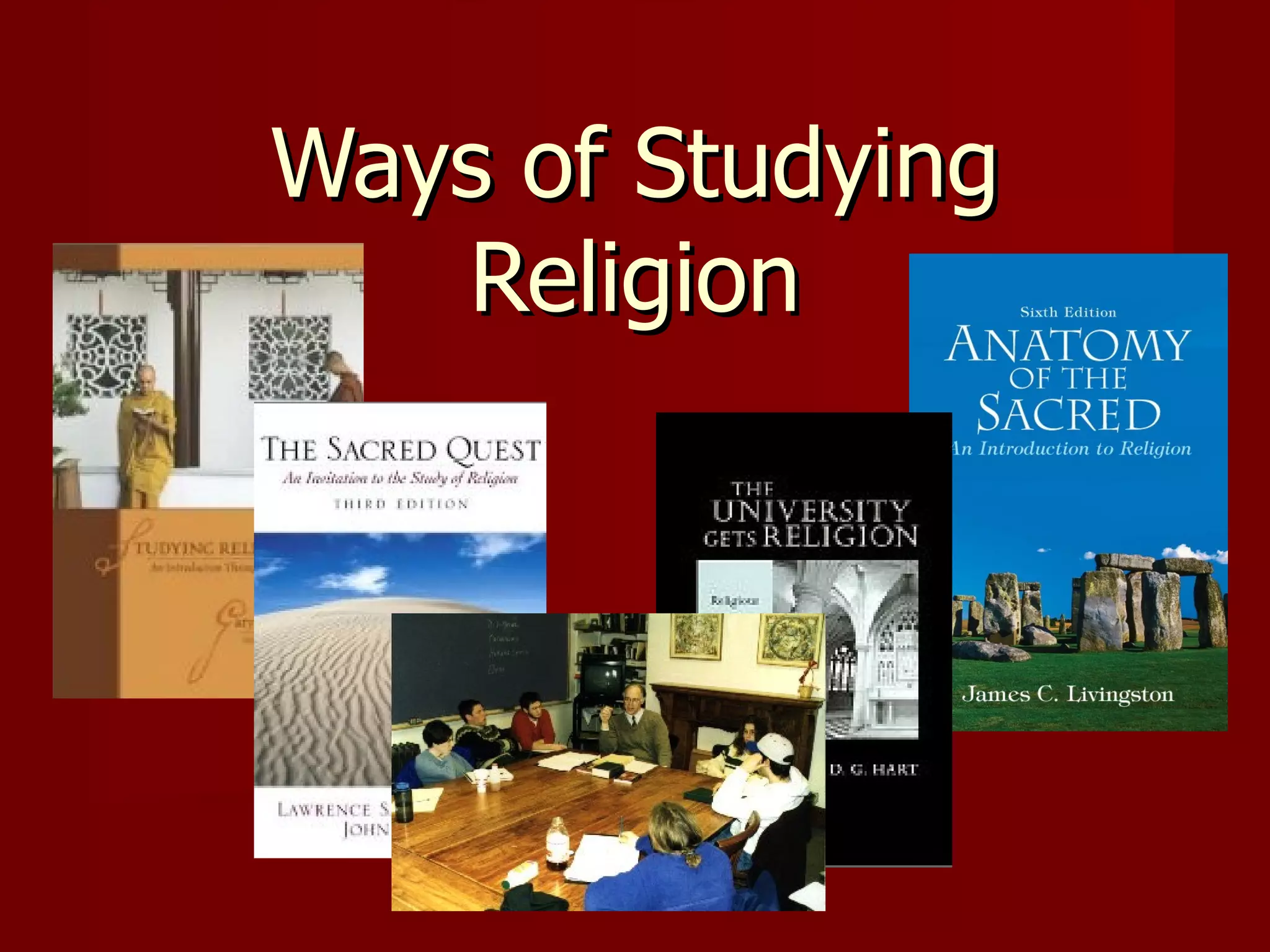
Ways of Studying
   Religion
The Academic Study of Religion
           - Assumptions -
   One religion is neither better nor worse than
    another religion; they are simply different
   There are core similarities that are shared by all
    religions
   There are differences between, within and
    among all religions
   Religion is a powerful influence on a person’s
    approach and response to life experiences
   All individuals have the right to be respected for
    their religious heritage
   Not all people are religious – they too have the
    right to be respected
The Academic study of religion
 “is a secondary activity that attempts to
  discover, describe, and explain the
  primary expressions of the religious life of
  a community…”
 “requires the use of many disciplines and
  methods…”
Theology
   “words about [study of] God”
   Generally done from within a [theistic] religious
    tradition (e.g. Christian theology)
   To describe and transmit the teachings of a
    particular religious tradition or community

Discuss: difference between studying religion in
  church vs. in the classroom

But religion is more than just thinking about God
Literary Criticism
   Asks questions regarding sacred texts
    or scriptures:
    –   Who is the author?
    –   When was this text composed?
    –   Where was it written and to what audience?
    –   What was the author’s reason for writing this?
    –   What type of literature is used?
    –   How has this text been received, edited, interpreted?

But religion is more than just what is contained in
  a sacred text
History of Religion
     click link to see 5000 years of religion play out in 90 seconds

 Historians seek to find out “what really
  happened” – the facts about a given
  religion
 Explores how social, economic, cultural or
  environmental factors may have
  influenced a religion’s:
    – Beginnings, development, spread
   Using “tools” such as:
    – Archaeology, geography, demography,
      population statistics
The Anthropological Study of
               Religion
 “words about human beings” and human
  societies…
 as both creators and creations of cultures
 Religion, as a part of human culture, is
  thus studied by anthropologists as a
  “powerful factor in any culture”

   Edward B. Tylor
    (1832 – 1917)
Sociology of Religion
 “words about social behavior”
 Generally concerned with the life of
  modern , developed, literate societies (in contrast to
  anthropology)
 Explores the social origins and function of religion in
  human society
 The sociologist studies “the way religion interacts
  with other dimensions of our social experience”
    – How human social life changes religion
    – How religion transforms human social behavior
 Max Weber (1864-1920)
But religion is more than just a fact of social life
Psychology of Religion
   “words about the psyche [mind]”
   The psychologist explores the psychological
    dimensions of religious phenomena

   William James (1842-1910)
   Sigmund Freud (1856-1939)
    – “religion is an infantile dependency, a neurosis”
   Carl Jung (1875-1961)
    – religion is a projection of “archetypes of the
      unconscious”
But religion is more than just a fact of psychic life
Philosophy of Religion
   “Love of wisdom”
   Philosophers of religion reflect on the logic,
    meaning and truth value of religious stories and
    beliefs
   Analyzing religious language

   Thomas Aquinas (1225-1274) (theologian)
   Immanuel Kant (1724-1804)

But religion is more than just ideas to be analyzed
  and often goes beyond the limits of logic
Phenomenology
 “words about phenomena” – that which
  appears
 Concerned only with description
 Goal: to portray religion in its own terms
  rather than reduce or explain it in terms of
  some other discipline

 Edmund Husserl (1859-1938)
 Mircea Eliade (historian of religion)
The Phenomenologist
 suspends judgment, does not seek to
  explain (as do the other disciplines)
 must remain detached and impartial to
  avoid explaining, interpreting or judging
  what he or she studies
 remains skeptical of explanatory theories
  that claim to completely account for the
  complex origins or nature of religion itself,
  or of any religious tradition
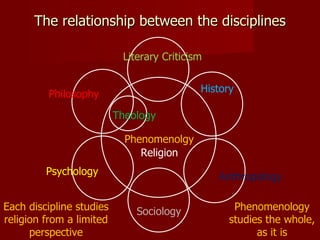
The relationship between the disciplines

                           Literary Criticism


         Philosophy                         History

                          Theology

                            Phenomenolgy
                               Religion
         Psychology                             Anthropology

Each discipline studies       Sociology            Phenomenology
religion from a limited                           studies the whole,
      perspective                                       as it is
“insiders” vs. “Outsiders”
   Hermeneutics: how we “interpret”
   The “inside” believer and the “outside” observer
    understanding of religion will differ
   Either may be a partial, distorted or even wrong
    understanding
   These different scholarly disciplines are not
    mutually exclusive; they may be complementary –
    each providing insight to both “insiders” and
    “outsiders”

What can the academic study of religion do for you?
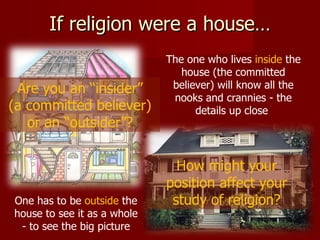
If religion were a house…
                             The one who lives inside the
                                house (the committed
 Are you an “insider”         believer) will know all the
                              nooks and crannies - the
(a committed believer)             details up close
   or an “outsider”?


                               How might your
                             position affect your
One has to be outside the     study of religion?
house to see it as a whole
 - to see the big picture
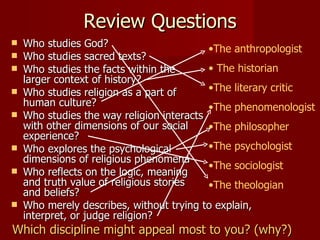
Review Questions
   Who studies God?                       •The anthropologist
   Who studies sacred texts?
   Who studies the facts within the       • The historian
    larger context of history?
   Who studies religion as a part of      •The literary critic
    human culture?                         •The phenomenologist
   Who studies the way religion interacts
    with other dimensions of our social    •The philosopher
    experience?
   Who explores the psychological         •The psychologist
    dimensions of religious phenomena
                                           •The sociologist
   Who reflects on the logic, meaning
    and truth value of religious stories   •The theologian
    and beliefs?
   Who merely describes, without trying to explain,
    interpret, or judge religion?
Which discipline might appeal most to you? (why?)

Ways2studyreligion

  • 1.
  • 2.
    The Academic Studyof Religion - Assumptions -  One religion is neither better nor worse than another religion; they are simply different  There are core similarities that are shared by all religions  There are differences between, within and among all religions  Religion is a powerful influence on a person’s approach and response to life experiences  All individuals have the right to be respected for their religious heritage  Not all people are religious – they too have the right to be respected
  • 3.
    The Academic studyof religion  “is a secondary activity that attempts to discover, describe, and explain the primary expressions of the religious life of a community…”  “requires the use of many disciplines and methods…”
  • 4.
    Theology  “words about [study of] God”  Generally done from within a [theistic] religious tradition (e.g. Christian theology)  To describe and transmit the teachings of a particular religious tradition or community Discuss: difference between studying religion in church vs. in the classroom But religion is more than just thinking about God
  • 5.
    Literary Criticism  Asks questions regarding sacred texts or scriptures: – Who is the author? – When was this text composed? – Where was it written and to what audience? – What was the author’s reason for writing this? – What type of literature is used? – How has this text been received, edited, interpreted? But religion is more than just what is contained in a sacred text
  • 6.
    History of Religion click link to see 5000 years of religion play out in 90 seconds  Historians seek to find out “what really happened” – the facts about a given religion  Explores how social, economic, cultural or environmental factors may have influenced a religion’s: – Beginnings, development, spread  Using “tools” such as: – Archaeology, geography, demography, population statistics
  • 7.
    The Anthropological Studyof Religion  “words about human beings” and human societies…  as both creators and creations of cultures  Religion, as a part of human culture, is thus studied by anthropologists as a “powerful factor in any culture”  Edward B. Tylor (1832 – 1917)
  • 8.
    Sociology of Religion “words about social behavior”  Generally concerned with the life of modern , developed, literate societies (in contrast to anthropology)  Explores the social origins and function of religion in human society  The sociologist studies “the way religion interacts with other dimensions of our social experience” – How human social life changes religion – How religion transforms human social behavior  Max Weber (1864-1920) But religion is more than just a fact of social life
  • 9.
    Psychology of Religion  “words about the psyche [mind]”  The psychologist explores the psychological dimensions of religious phenomena  William James (1842-1910)  Sigmund Freud (1856-1939) – “religion is an infantile dependency, a neurosis”  Carl Jung (1875-1961) – religion is a projection of “archetypes of the unconscious” But religion is more than just a fact of psychic life
  • 10.
    Philosophy of Religion  “Love of wisdom”  Philosophers of religion reflect on the logic, meaning and truth value of religious stories and beliefs  Analyzing religious language  Thomas Aquinas (1225-1274) (theologian)  Immanuel Kant (1724-1804) But religion is more than just ideas to be analyzed and often goes beyond the limits of logic
  • 11.
    Phenomenology  “words aboutphenomena” – that which appears  Concerned only with description  Goal: to portray religion in its own terms rather than reduce or explain it in terms of some other discipline  Edmund Husserl (1859-1938)  Mircea Eliade (historian of religion)
  • 12.
    The Phenomenologist  suspendsjudgment, does not seek to explain (as do the other disciplines)  must remain detached and impartial to avoid explaining, interpreting or judging what he or she studies  remains skeptical of explanatory theories that claim to completely account for the complex origins or nature of religion itself, or of any religious tradition
  • 13.
    The relationship betweenthe disciplines Literary Criticism Philosophy History Theology Phenomenolgy Religion Psychology Anthropology Each discipline studies Sociology Phenomenology religion from a limited studies the whole, perspective as it is
  • 14.
    “insiders” vs. “Outsiders”  Hermeneutics: how we “interpret”  The “inside” believer and the “outside” observer understanding of religion will differ  Either may be a partial, distorted or even wrong understanding  These different scholarly disciplines are not mutually exclusive; they may be complementary – each providing insight to both “insiders” and “outsiders” What can the academic study of religion do for you?
  • 15.
    If religion werea house… The one who lives inside the house (the committed Are you an “insider” believer) will know all the nooks and crannies - the (a committed believer) details up close or an “outsider”? How might your position affect your One has to be outside the study of religion? house to see it as a whole - to see the big picture
  • 16.
    Review Questions  Who studies God? •The anthropologist  Who studies sacred texts?  Who studies the facts within the • The historian larger context of history?  Who studies religion as a part of •The literary critic human culture? •The phenomenologist  Who studies the way religion interacts with other dimensions of our social •The philosopher experience?  Who explores the psychological •The psychologist dimensions of religious phenomena •The sociologist  Who reflects on the logic, meaning and truth value of religious stories •The theologian and beliefs?  Who merely describes, without trying to explain, interpret, or judge religion? Which discipline might appeal most to you? (why?)