
Definition of Standing Orders
                                   Importance
                            Useful in terms of
                        Scope and Application
           Submission of Draft Standing Orders
               Certification of Standing Orders
                                        Penalty


BY
SUVIDHA KUDTARKAR
Important Definitions
  The term ‘Standing Orders’ means rules relating to
       matters set out in the Schedule of the Act.

 Appropriate Government: State Government, Central
  Government.
 Certifying Officer: means Labour
  Commissioner/Regional Labour Commissioner and
  includes any other officer appointed by the
  appropriate Government, by notification in the
  Official Gazette to perform such duties.
 Employer: owner of the establishment
Importance
 No uniform practice governing the conditions of service of workers

 No clarity of rights and obligations of the employer

 In respect of terms of employment, friction/dispute between

  management and worker
 Demand for statutory service conditions raised by Bombay Cotton

  Textile workers in 1927-28
 The Bombay Industrial Disputes Act of 1938 for the first time provided

  for statutory standing orders.
 The Labour Investigation Committee emphasized the workers’ right

  to know the terms & conditions of employment
Its Useful in below terms
 To require employers to define the conditions of work
 Helps to bring about uniformity in terms and conditions
  of employment
 Helps to minimize industrial conflicts
 Helps to foster harmonious relations between employers
  and employees.
 Helps in providing statutory sanctity and importance to
  standing orders
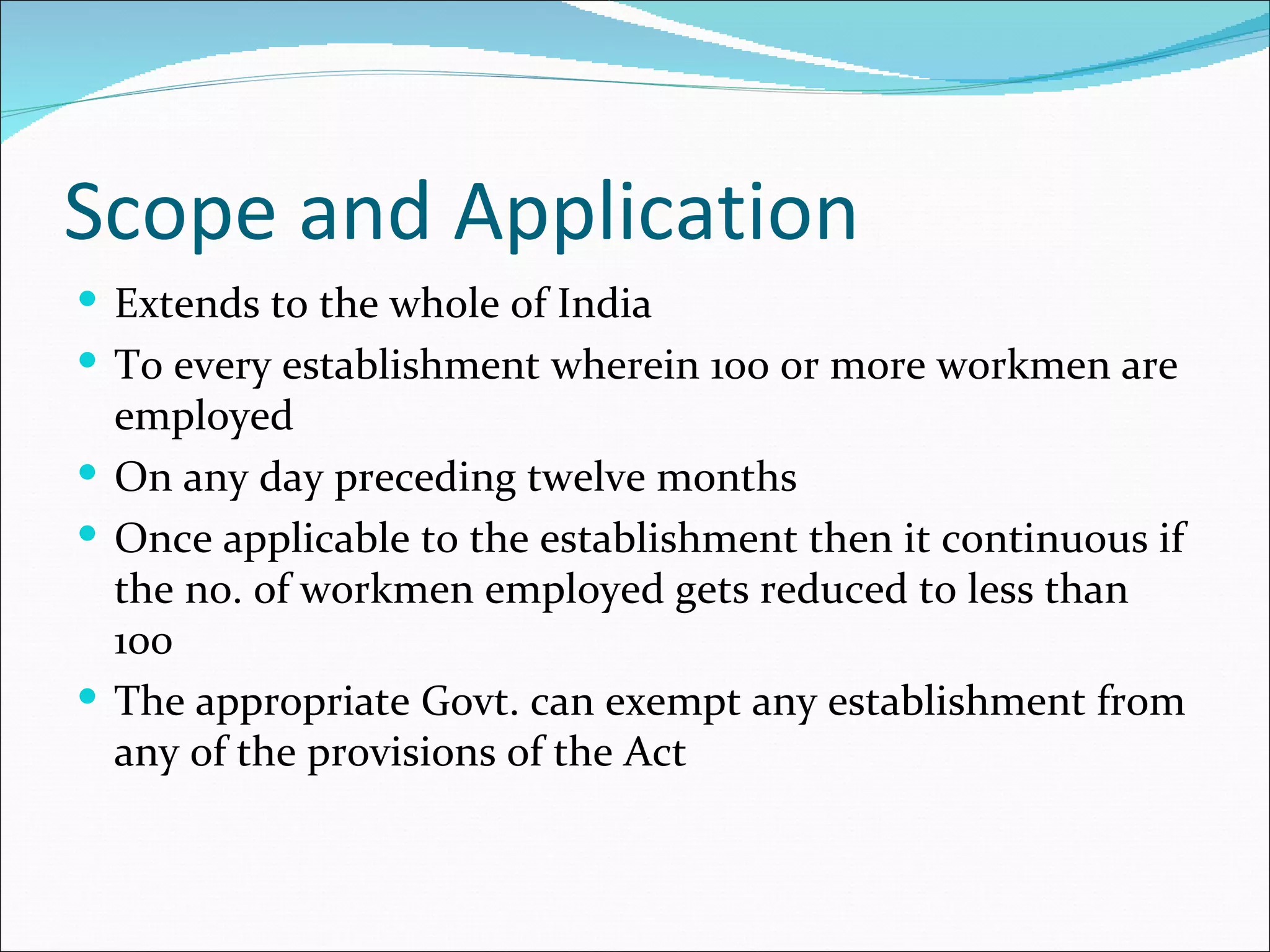
Scope and Application
 Extends to the whole of India
 To every establishment wherein 100 or more workmen are
  employed
 On any day preceding twelve months
 Once applicable to the establishment then it continuous if
  the no. of workmen employed gets reduced to less than
  100
 The appropriate Govt. can exempt any establishment from
  any of the provisions of the Act
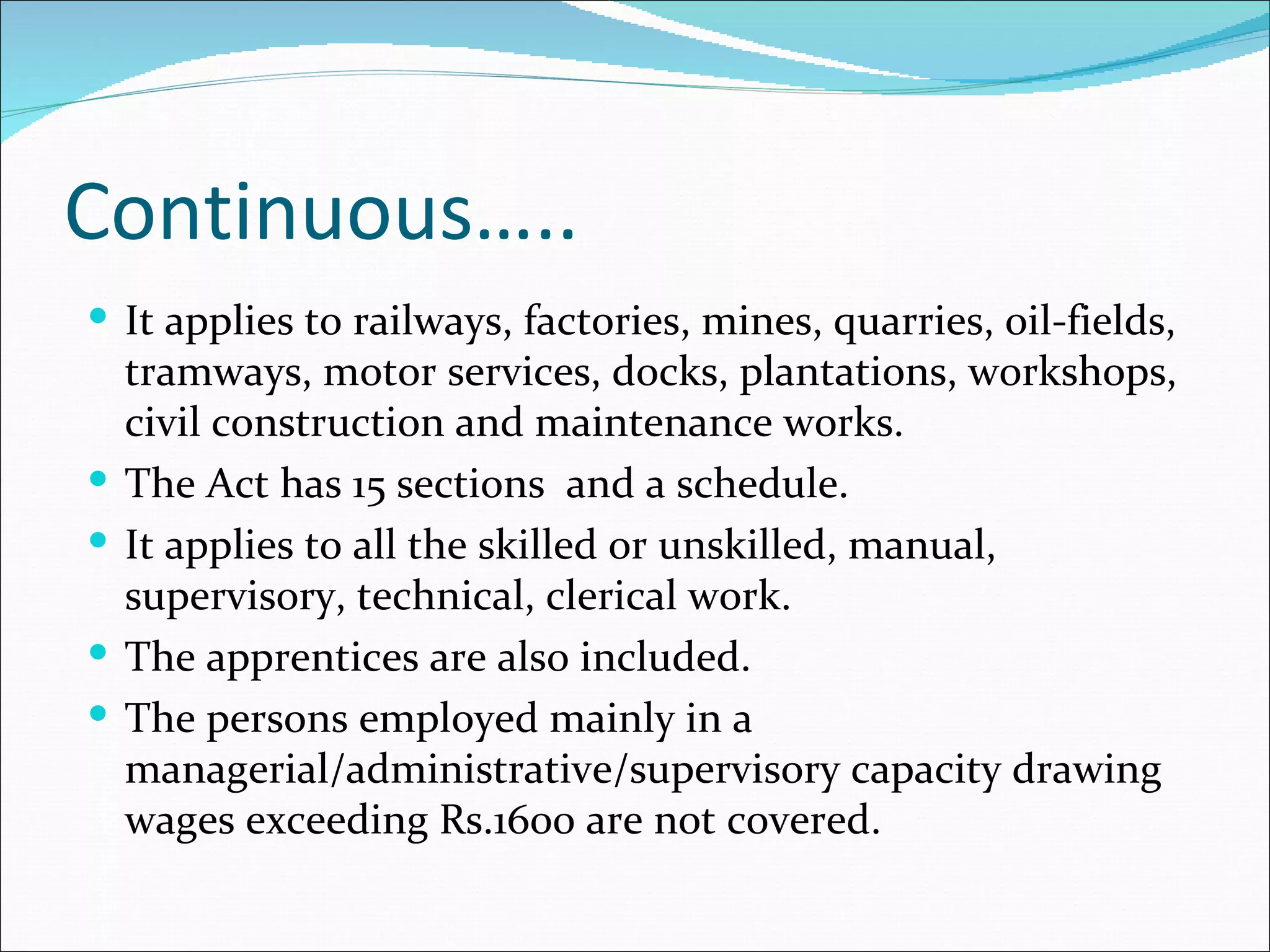
Continuous…..
 It applies to railways, factories, mines, quarries, oil-fields,
    tramways, motor services, docks, plantations, workshops,
    civil construction and maintenance works.
   The Act has 15 sections and a schedule.
   It applies to all the skilled or unskilled, manual,
    supervisory, technical, clerical work.
   The apprentices are also included.
   The persons employed mainly in a
    managerial/administrative/supervisory capacity drawing
    wages exceeding Rs.1600 are not covered.
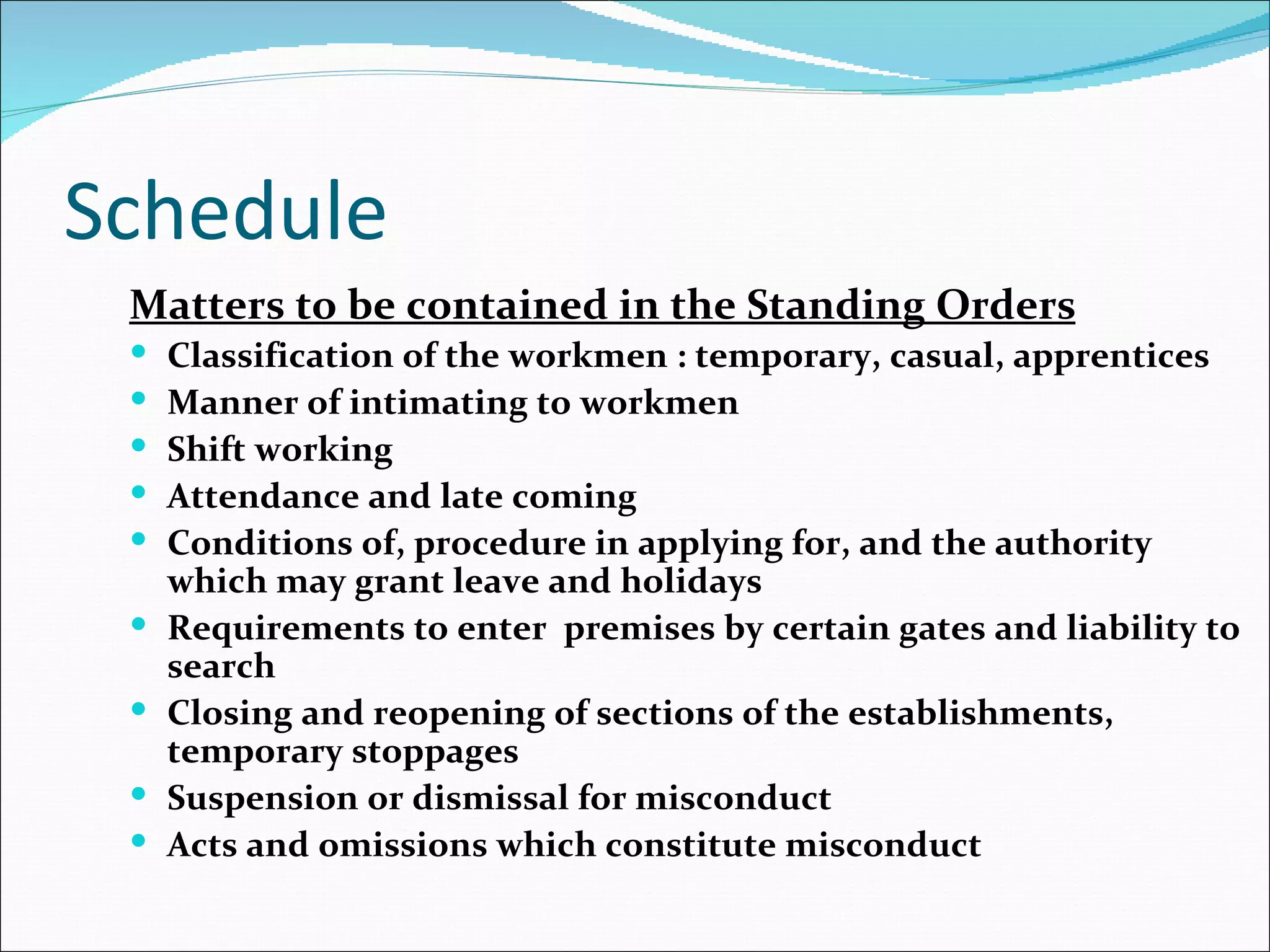
Schedule
 Matters to be contained in the Standing Orders
    Classification of the workmen : temporary, casual, apprentices
    Manner of intimating to workmen
    Shift working
    Attendance and late coming
    Conditions of, procedure in applying for, and the authority
     which may grant leave and holidays
    Requirements to enter premises by certain gates and liability to
     search
    Closing and reopening of sections of the establishments,
     temporary stoppages
    Suspension or dismissal for misconduct
    Acts and omissions which constitute misconduct
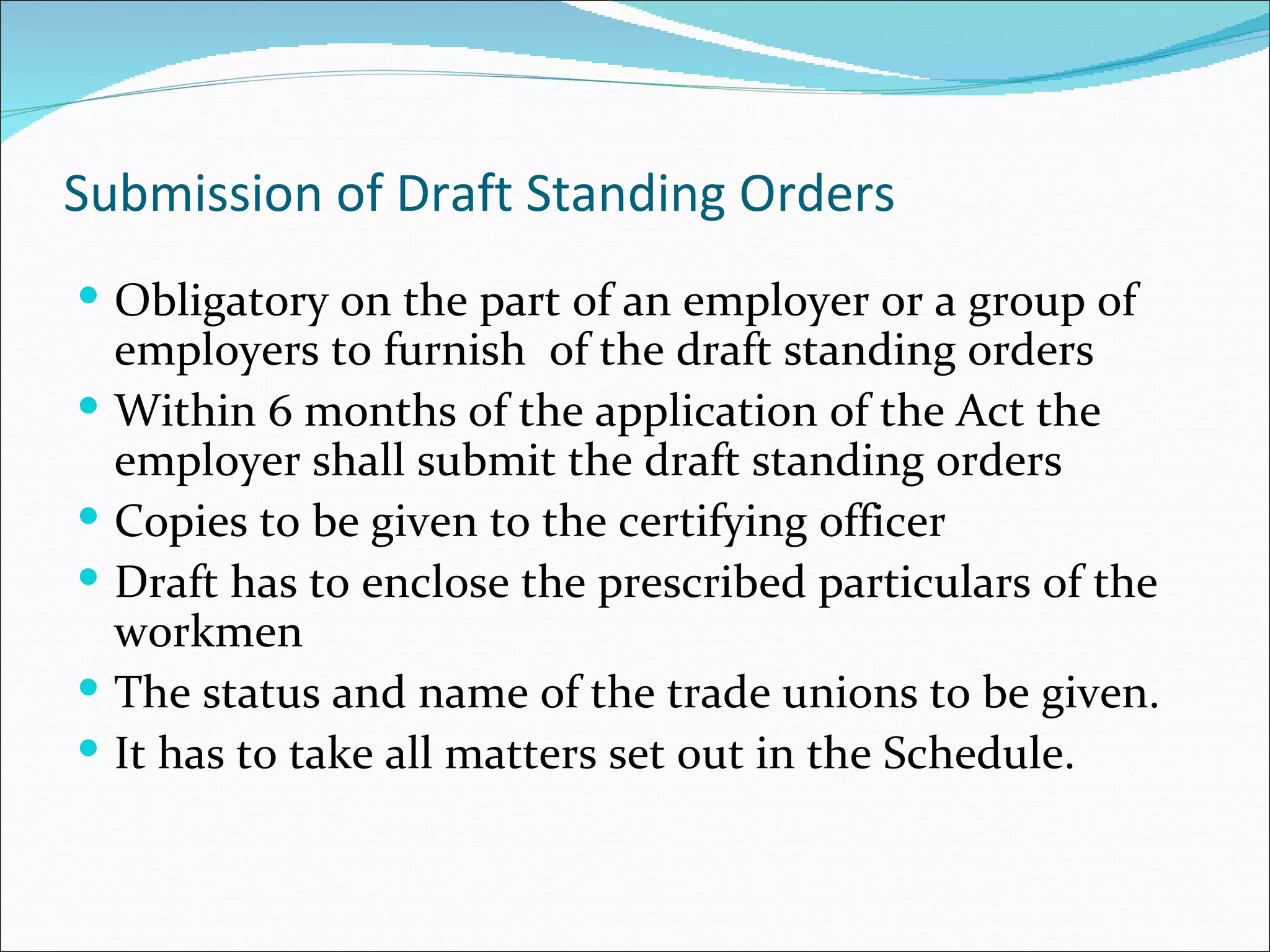
Submission of Draft Standing Orders
 Obligatory on the part of an employer or a group of
    employers to furnish of the draft standing orders
   Within 6 months of the application of the Act the
    employer shall submit the draft standing orders
   Copies to be given to the certifying officer
   Draft has to enclose the prescribed particulars of the
    workmen
   The status and name of the trade unions to be given.
   It has to take all matters set out in the Schedule.
Procedure for Certification of Standing Orders
 Copy of draft standing orders to be sent to trade
    union/workmen
   Opportunity of hearing to trade union/workmen to be
    provided
   Certification
   Certified standing orders have the force of law and the
    violation of any provision shall be taken action
   Standing orders to be applicable to all present and future
    workmen
Payment of Subsistence allowance
 Payment of subsistence allowance by an employer to a
  workman who has been suspended by the employer
  and his investigation is pending
 the allowance shall be at the rate of 50% of the wage
  for the first 90 days of suspension
 The allowance shall be 75% of the wage after 90 days
  if the investigation is delayed due to employer
Penalty
 Any employer fails to submit draft standing orders or
  modifies it, shall be punishable with fine which may
  extend to Rs. 5000.
 In case of continuance of the above offence, fine up to
  Rs.200 per every day.
 Any contravention of Standing Orders is punishable
  by Rs. 100 fine .
Standing orders

Standing orders

  • 1.
    Definition of StandingOrders Importance Useful in terms of  Scope and Application Submission of Draft Standing Orders  Certification of Standing Orders  Penalty BY SUVIDHA KUDTARKAR
  • 2.
    Important Definitions The term ‘Standing Orders’ means rules relating to matters set out in the Schedule of the Act.  Appropriate Government: State Government, Central Government.  Certifying Officer: means Labour Commissioner/Regional Labour Commissioner and includes any other officer appointed by the appropriate Government, by notification in the Official Gazette to perform such duties.  Employer: owner of the establishment
  • 3.
    Importance  No uniformpractice governing the conditions of service of workers  No clarity of rights and obligations of the employer  In respect of terms of employment, friction/dispute between management and worker  Demand for statutory service conditions raised by Bombay Cotton Textile workers in 1927-28  The Bombay Industrial Disputes Act of 1938 for the first time provided for statutory standing orders.  The Labour Investigation Committee emphasized the workers’ right to know the terms & conditions of employment
  • 4.
    Its Useful inbelow terms  To require employers to define the conditions of work  Helps to bring about uniformity in terms and conditions of employment  Helps to minimize industrial conflicts  Helps to foster harmonious relations between employers and employees.  Helps in providing statutory sanctity and importance to standing orders
  • 5.
    Scope and Application Extends to the whole of India  To every establishment wherein 100 or more workmen are employed  On any day preceding twelve months  Once applicable to the establishment then it continuous if the no. of workmen employed gets reduced to less than 100  The appropriate Govt. can exempt any establishment from any of the provisions of the Act
  • 6.
    Continuous…..  It appliesto railways, factories, mines, quarries, oil-fields, tramways, motor services, docks, plantations, workshops, civil construction and maintenance works.  The Act has 15 sections and a schedule.  It applies to all the skilled or unskilled, manual, supervisory, technical, clerical work.  The apprentices are also included.  The persons employed mainly in a managerial/administrative/supervisory capacity drawing wages exceeding Rs.1600 are not covered.
  • 7.
    Schedule Matters tobe contained in the Standing Orders  Classification of the workmen : temporary, casual, apprentices  Manner of intimating to workmen  Shift working  Attendance and late coming  Conditions of, procedure in applying for, and the authority which may grant leave and holidays  Requirements to enter premises by certain gates and liability to search  Closing and reopening of sections of the establishments, temporary stoppages  Suspension or dismissal for misconduct  Acts and omissions which constitute misconduct
  • 8.
    Submission of DraftStanding Orders  Obligatory on the part of an employer or a group of employers to furnish of the draft standing orders  Within 6 months of the application of the Act the employer shall submit the draft standing orders  Copies to be given to the certifying officer  Draft has to enclose the prescribed particulars of the workmen  The status and name of the trade unions to be given.  It has to take all matters set out in the Schedule.
  • 9.
    Procedure for Certificationof Standing Orders  Copy of draft standing orders to be sent to trade union/workmen  Opportunity of hearing to trade union/workmen to be provided  Certification  Certified standing orders have the force of law and the violation of any provision shall be taken action  Standing orders to be applicable to all present and future workmen
  • 10.
    Payment of Subsistenceallowance  Payment of subsistence allowance by an employer to a workman who has been suspended by the employer and his investigation is pending  the allowance shall be at the rate of 50% of the wage for the first 90 days of suspension  The allowance shall be 75% of the wage after 90 days if the investigation is delayed due to employer
  • 11.
    Penalty  Any employerfails to submit draft standing orders or modifies it, shall be punishable with fine which may extend to Rs. 5000.  In case of continuance of the above offence, fine up to Rs.200 per every day.  Any contravention of Standing Orders is punishable by Rs. 100 fine .