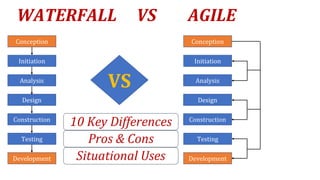
Conception
Initiation
Analysis
Design
Construction
Testing
Development
Conception
Initiation
Analysis
Design
Construction
Testing
Development
VS
WATERFALL VS AGILE
10 Key Differences
Pros & Cons
Situational Uses
What is waterfall ?
The waterfall project management method is a linear, step-by-step approach that's ideal for
projects with a clear scope and predictable timeline.
It involves rigorous planning upfront to ensure that the project stays on track,
with progress tracked closely and issues addressed promptly.
1: Initiation 2: planning 3: execution 4: monitoring/control 5: closing
The Waterfall model usually includes five project management stages (or phases):
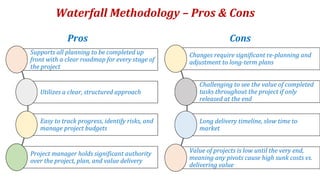
Pros
Supports all planning to be completed up
front with a clear roadmap for every stage of
the project
Utilizes a clear, structured approach
Easy to track progress, identify risks, and
manage project budgets
Project manager holds significant authority
over the project, plan, and value delivery
Cons
Changes require significant re-planning and
adjustment to long-term plans
Challenging to see the value of completed
tasks throughout the project if only
released at the end
Long delivery timeline, slow time to
market
Value of projects is low until the very end,
meaning any pivots cause high sunk costs vs.
delivering value
Waterfall Methodology – Pros & Cons
What is Agile?
Agile project management is a flexible and iterative approach that enables teams to quickly adapt to
changing project requirements and deliver high-quality results within shorter timeframes.
Agile methodologies are about:
▪ Teamwork
▪ Constant refinement
▪ Customer satisfaction
▪ Breaking big projects into bite-sized pieces
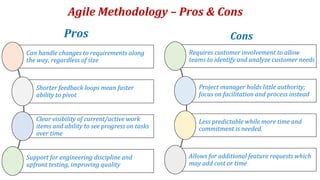
Pros
Can handle changes to requirements along
the way, regardless of size
Shorter feedback loops mean faster
ability to pivot
Clear visibility of current/active work
items and ability to see progress on tasks
over time
Support for engineering discipline and
upfront testing, improving quality
Cons
Requires customer involvement to allow
teams to identify and analyze customer needs
Project manager holds little authority;
focus on facilitation and process instead
Less predictable while more time and
commitment is needed.
Allows for additional feature requests which
may add cost or time
Agile Methodology – Pros & Cons
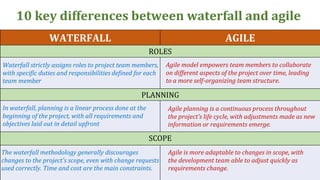
WATERFALL AGILE
ROLES
PLANNING
SCOPE
10 key differences between waterfall and agile
Waterfall strictly assigns roles to project team members,
with specific duties and responsibilities defined for each
team member
Agile model empowers team members to collaborate
on different aspects of the project over time, leading
to a more self-organizing team structure.
In waterfall, planning is a linear process done at the
beginning of the project, with all requirements and
objectives laid out in detail upfront
Agile planning is a continuous process throughout
the project's life cycle, with adjustments made as new
information or requirements emerge.
The waterfall methodology generally discourages
changes to the project's scope, even with change requests
used correctly. Time and cost are the main constraints.
Agile is more adaptable to changes in scope, with
the development team able to adjust quickly as
requirements change.
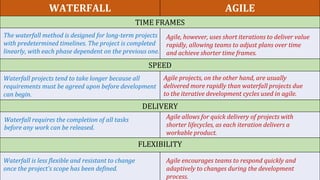
WATERFALL AGILE
TIME FRAMES
SPEED
DELIVERY
FLEXIBILITY
The waterfall method is designed for long-term projects
with predetermined timelines. The project is completed
linearly, with each phase dependent on the previous one.
Waterfall projects tend to take longer because all
requirements must be agreed upon before development
can begin.
Agile allows for quick delivery of projects with
shorter lifecycles, as each iteration delivers a
workable product.
Agile encourages teams to respond quickly and
adaptively to changes during the development
process.
Agile, however, uses short iterations to deliver value
rapidly, allowing teams to adjust plans over time
and achieve shorter time frames.
Agile projects, on the other hand, are usually
delivered more rapidly than waterfall projects due
to the iterative development cycles used in agile.
Waterfall requires the completion of all tasks
before any work can be released.
Waterfall is less flexible and resistant to change
once the project's scope has been defined.
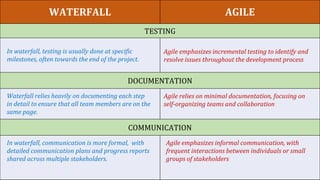
WATERFALL AGILE
TESTING
DOCUMENTATION
COMMUNICATION
Agile emphasizes incremental testing to identify and
resolve issues throughout the development process
Agile relies on minimal documentation, focusing on
self-organizing teams and collaboration
Agile emphasizes informal communication, with
frequent interactions between individuals or small
groups of stakeholders
In waterfall, communication is more formal, with
detailed communication plans and progress reports
shared across multiple stakeholders.
Waterfall relies heavily on documenting each step
in detail to ensure that all team members are on the
same page.
In waterfall, testing is usually done at specific
milestones, often towards the end of the project.
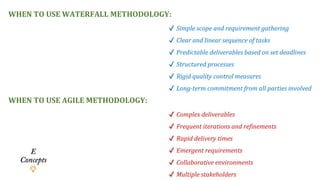
WHEN TO USE WATERFALL METHODOLOGY:
✔ Simple scope and requirement gathering
✔ Clear and linear sequence of tasks
✔ Predictable deliverables based on set deadlines
✔ Structured processes
✔ Rigid quality control measures
✔ Long-term commitment from all parties involved
WHEN TO USE AGILE METHODOLOGY:
✔ Complex deliverables
✔ Frequent iterations and refinements
✔ Rapid delivery times
✔ Emergent requirements
✔ Collaborative environments
✔ Multiple stakeholders
For full explanation of this lecture, see the YouTube
tutorial by clicking the below link:
https://www.youtube.com/watch?v=4zSSO11_oR8

Waterfall vs Agile Methodology Explained.pptx

  • 1.
  • 2.
    What is waterfall? The waterfall project management method is a linear, step-by-step approach that's ideal for projects with a clear scope and predictable timeline. It involves rigorous planning upfront to ensure that the project stays on track, with progress tracked closely and issues addressed promptly. 1: Initiation 2: planning 3: execution 4: monitoring/control 5: closing The Waterfall model usually includes five project management stages (or phases):
  • 3.
    Pros Supports all planningto be completed up front with a clear roadmap for every stage of the project Utilizes a clear, structured approach Easy to track progress, identify risks, and manage project budgets Project manager holds significant authority over the project, plan, and value delivery Cons Changes require significant re-planning and adjustment to long-term plans Challenging to see the value of completed tasks throughout the project if only released at the end Long delivery timeline, slow time to market Value of projects is low until the very end, meaning any pivots cause high sunk costs vs. delivering value Waterfall Methodology – Pros & Cons
  • 4.
    What is Agile? Agileproject management is a flexible and iterative approach that enables teams to quickly adapt to changing project requirements and deliver high-quality results within shorter timeframes. Agile methodologies are about: ▪ Teamwork ▪ Constant refinement ▪ Customer satisfaction ▪ Breaking big projects into bite-sized pieces
  • 5.
    Pros Can handle changesto requirements along the way, regardless of size Shorter feedback loops mean faster ability to pivot Clear visibility of current/active work items and ability to see progress on tasks over time Support for engineering discipline and upfront testing, improving quality Cons Requires customer involvement to allow teams to identify and analyze customer needs Project manager holds little authority; focus on facilitation and process instead Less predictable while more time and commitment is needed. Allows for additional feature requests which may add cost or time Agile Methodology – Pros & Cons
  • 6.
    WATERFALL AGILE ROLES PLANNING SCOPE 10 keydifferences between waterfall and agile Waterfall strictly assigns roles to project team members, with specific duties and responsibilities defined for each team member Agile model empowers team members to collaborate on different aspects of the project over time, leading to a more self-organizing team structure. In waterfall, planning is a linear process done at the beginning of the project, with all requirements and objectives laid out in detail upfront Agile planning is a continuous process throughout the project's life cycle, with adjustments made as new information or requirements emerge. The waterfall methodology generally discourages changes to the project's scope, even with change requests used correctly. Time and cost are the main constraints. Agile is more adaptable to changes in scope, with the development team able to adjust quickly as requirements change.
  • 7.
    WATERFALL AGILE TIME FRAMES SPEED DELIVERY FLEXIBILITY Thewaterfall method is designed for long-term projects with predetermined timelines. The project is completed linearly, with each phase dependent on the previous one. Waterfall projects tend to take longer because all requirements must be agreed upon before development can begin. Agile allows for quick delivery of projects with shorter lifecycles, as each iteration delivers a workable product. Agile encourages teams to respond quickly and adaptively to changes during the development process. Agile, however, uses short iterations to deliver value rapidly, allowing teams to adjust plans over time and achieve shorter time frames. Agile projects, on the other hand, are usually delivered more rapidly than waterfall projects due to the iterative development cycles used in agile. Waterfall requires the completion of all tasks before any work can be released. Waterfall is less flexible and resistant to change once the project's scope has been defined.
  • 8.
    WATERFALL AGILE TESTING DOCUMENTATION COMMUNICATION Agile emphasizesincremental testing to identify and resolve issues throughout the development process Agile relies on minimal documentation, focusing on self-organizing teams and collaboration Agile emphasizes informal communication, with frequent interactions between individuals or small groups of stakeholders In waterfall, communication is more formal, with detailed communication plans and progress reports shared across multiple stakeholders. Waterfall relies heavily on documenting each step in detail to ensure that all team members are on the same page. In waterfall, testing is usually done at specific milestones, often towards the end of the project.
  • 9.
    WHEN TO USEWATERFALL METHODOLOGY: ✔ Simple scope and requirement gathering ✔ Clear and linear sequence of tasks ✔ Predictable deliverables based on set deadlines ✔ Structured processes ✔ Rigid quality control measures ✔ Long-term commitment from all parties involved WHEN TO USE AGILE METHODOLOGY: ✔ Complex deliverables ✔ Frequent iterations and refinements ✔ Rapid delivery times ✔ Emergent requirements ✔ Collaborative environments ✔ Multiple stakeholders
  • 10.
    For full explanationof this lecture, see the YouTube tutorial by clicking the below link: https://www.youtube.com/watch?v=4zSSO11_oR8