Water Sub metering
Prepared By
B.Gowtham AP/Civil
•
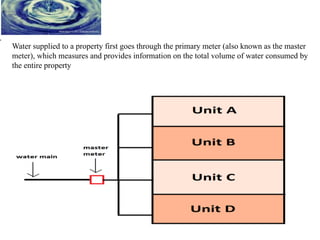
Water supplied to a property first goes through the primary meter (also known as the master
meter), which measures and provides information on the total volume of water consumed by
the entire property
The limitation of a master meter is that it does not reveal how much and where water is
consumed within the property
A sub-meter is “a water measuring device used at a subsection or end use of a water
supply system for any of the following purposes: billing, water management,
collecting and analyzing water usage data, detection of leaks, equipment failure,
water waste and irregular or abnormal use for a specific application”
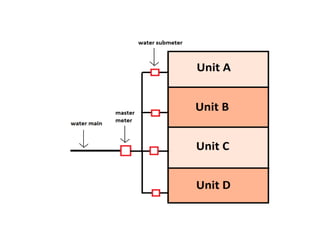
For instance, sub-meters can be installed for all units in a strata titled property, allowing
property managers to identify the water usage of individual tenants who can then be
charged based on their actual water usage.
Moreover, sub-meters can also be installed to measure the water usage of water intensive
fixtures such as boilers and irrigation systems within the property.
Consequently, sub-metering allows property owners and/or managers to collect the water
consumption data of each unit and/or fixture on their property, and hence identify water
conservation possibilities.
Benefits of water sub metering
• Sub-metering has been described as an essential
element of effective water management
• Water sub-metering has been documented to help
reduce water use
• Sub-metering provides the water usage data of
individual units, allowing landlords/ tenants to
identify and compare the water usage of these
units throughout the year.
• sub-metering data also allow landlords/ tenants to
identify water conservation possibilities
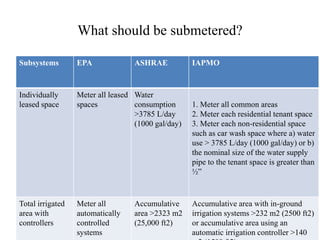
What should be submetered?
Subsystems EPA ASHRAE IAPMO
Individually
leased space
Meter all leased
spaces
Water
consumption
>3785 L/day
(1000 gal/day)
1. Meter all common areas
2. Meter each residential tenant space
3. Meter each non-residential space
such as car wash space where a) water
use > 3785 L/day (1000 gal/day) or b)
the nominal size of the water supply
pipe to the tenant space is greater than
½”
Total irrigated
area with
controllers
Meter all
automatically
controlled
systems
Accumulative
area >2323 m2
(25,000 ft2)
Accumulative area with in-ground
irrigation systems >232 m2 (2500 ft2)
or accumulative area using an
automatic irrigation controller >140
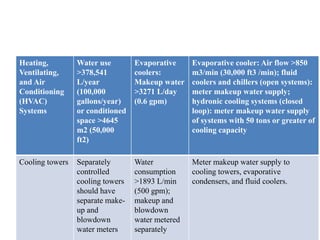
Heating,
Ventilating,
and Air
Conditioning
(HVAC)
Systems
Water use
>378,541
L/year
(100,000
gallons/year)
or conditioned
space >4645
m2 (50,000
ft2)
Evaporative
coolers:
Makeup water
>3271 L/day
(0.6 gpm)
Evaporative cooler: Air flow >850
m3/min (30,000 ft3 /min); fluid
coolers and chillers (open systems):
meter makeup water supply;
hydronic cooling systems (closed
loop): meter makeup water supply
of systems with 50 tons or greater of
cooling capacity
Cooling towers Separately
controlled
cooling towers
should have
separate make-
up and
blowdown
water meters
Water
consumption
>1893 L/min
(500 gpm);
makeup and
blowdown
water metered
separately
Meter makeup water supply to
cooling towers, evaporative
condensers, and fluid coolers.
Types of measurement
1) informational measurement and
2) compliance measurement.
Information measurement is mainly for reviewing overall
water use patterns of propert(ies) for management purposes
and/or planning. Thus informational measurement does not
require high accuracy standards.
compliance measurement - which is used for billing purposes
- requires much higher accuracy as the data are used for
billing individual users. High accuracy is required to ensure
that water users are charged equitably.
Types of sub meters
• Positive displacement (“disc” meters)
• Single jet meters
• Multi-jet meters
• Turbine meters
• Electromagnetic meters
Positive displacement (“disc”
meters)
• The chamber contains a piston or disk. The number of
rotations of the piston or disc is converted to the
volumetric register.
• Small residential and commercial building
• Precisely measure pulsing flow. Low cost. smaller
versions can operate for more than 10 years with only
minor deterioration of accuracy; Some versions can
service hot water
• Clean fluid is required. Any larger particles can be
trapped and block the flow
• Can be installed on inclined and even vertical pipe
Single jet meters
•The chamber contains an impeller. The flow of water
pushes the tips of the impeller.
•Suitable for limited space
•Physically smaller than positive displacement meters.
Some versions can service hot water up to 140 degrees
Celsius. Accurately measure low flow rate (under 7.57
L/min or 2 gpm)
•More expensive than positive displacement or multi-
jet meters
•Can be installed horizontally or vertically. No
upstream or downstream straight pipe requirement.
Multi Jet Meters
• Water is forced through a series of ducts open in the
distributor. The ducts generate a series of symmetrical
jets that push the turbine.
• Popular in utilities that have suspended matter or grit
in their water
• It can measure water flow as low as 0.47 L/min or 1/8
gpm.
• Not as accurate as positive displacement meters over
the long term
• Must be installed in a level horizontal plane
Turbine meters
• Inferential meters designed with a known cross sectional
area. A rotor is installed inside the meter chamber.
Passing the rotor blades, water impacts angular velocity
to the blades and thus to the rotors. The angular velocity
is proportional to the total volumetric rate.
• Best suited for continuous, high flow measurement
• Accurately measure high and sustained flow rates
• Suspended particles or grit in fluid can affect the rotation
of the turbine, distorting measurement. Susceptible to
start/stop error and errors caused by unsteady flow
• Requires straight run of pipe before and after the meter
Electromagnetic Meters
• Uses the Faraday principle. Flowing water produces electric
current that is proportional to the flow velocity.
• Effective in measuring the flow rate of acidic or corrosive
materials such as abrasives and slurries; can also measure
flow rate of combustible or explosive liquids
• Have no moving parts (operate on Faraday’s Principle) thus
reduces the risk of break-downs and the frequency of
repairs
• Only effective on conductive fluids
• Can be installed on horizontal, vertical, or slightly
ascending pipe
Requirements of sub meters
All meters should meet the following requirements
• Be located in an accessible and protected location to allow for
repair and reading.
• Be protected from freezing and other potential damage
• Possess an inlet-shut off valve for meter maintenance
• Provide an appropriate bypass assembly with valves to avoid water
supply stoppage during meter servicing for critical water lines
• Have installed a strainer upstream of turbine, propeller and
compound meters to prevent large debris from damaging the meter
• Provide for adequate straight length piping on upstream and
downstream sides of the meter, as required by the manufacturer
sub-meter installation must comply with the following
specifications:
1. Sub-meter must be 150mm above ground
2. Sub-meters must have a 300mm horizontal clearance all
round
3. Sub-meters must have a 120cm vertical clearance
4. The “tails” must be 80mm long on either side of the meter
5. The fittings must be made of copper/brass or stainless steel
6. The meter viewing glass/window must not be damaged or
difficult to read
Meter reading
• Traditional method -Physically read the odometer display on the meter
• Absolute encoders - A specialized computer or AMR box is connected
to the meter register. The device transmits a low voltage signal into the
register and the register returns with the actual read. Some AMR systems
can read real-time water use data.
• Pulse - A pulse represents a specific volume of water, for example
one pulse per gallon or one pulse for every ten gallon for larger meters (2”
or larger). The pulses are sent to the remote device which acts as the
totalizer.
• 4-20 mA - Mostly used in the heating ventilating and air conditioning
(HVAC) industry but less commonly used in the meter industry. But this
can be an option for electromagnetic meters.
Totalizer- A device that calculates the number of pulses received and the total
corresponding volume.
Most automated systems are capable of:
1) Electronically storing and transmitting water use
data hourly, daily, monthly or annually8.
2) 2) Online consumption reporting, which allows
property owners and/or tenants to track their water
use throughout the billing cycle and identify
abnormal use that may signify leakage and/or meter
malfunctions.
3) 3) Sending alerts to property managers and tenants
when leaks or other operational anomalies such as
lose wiring are detected.
Thank you

Water submetering

  • 1.
    Water Sub metering PreparedBy B.Gowtham AP/Civil
  • 2.
    • Water supplied toa property first goes through the primary meter (also known as the master meter), which measures and provides information on the total volume of water consumed by the entire property
  • 3.
    The limitation ofa master meter is that it does not reveal how much and where water is consumed within the property A sub-meter is “a water measuring device used at a subsection or end use of a water supply system for any of the following purposes: billing, water management, collecting and analyzing water usage data, detection of leaks, equipment failure, water waste and irregular or abnormal use for a specific application” For instance, sub-meters can be installed for all units in a strata titled property, allowing property managers to identify the water usage of individual tenants who can then be charged based on their actual water usage. Moreover, sub-meters can also be installed to measure the water usage of water intensive fixtures such as boilers and irrigation systems within the property. Consequently, sub-metering allows property owners and/or managers to collect the water consumption data of each unit and/or fixture on their property, and hence identify water conservation possibilities.
  • 6.
    Benefits of watersub metering • Sub-metering has been described as an essential element of effective water management • Water sub-metering has been documented to help reduce water use • Sub-metering provides the water usage data of individual units, allowing landlords/ tenants to identify and compare the water usage of these units throughout the year. • sub-metering data also allow landlords/ tenants to identify water conservation possibilities
  • 7.
    What should besubmetered? Subsystems EPA ASHRAE IAPMO Individually leased space Meter all leased spaces Water consumption >3785 L/day (1000 gal/day) 1. Meter all common areas 2. Meter each residential tenant space 3. Meter each non-residential space such as car wash space where a) water use > 3785 L/day (1000 gal/day) or b) the nominal size of the water supply pipe to the tenant space is greater than ½” Total irrigated area with controllers Meter all automatically controlled systems Accumulative area >2323 m2 (25,000 ft2) Accumulative area with in-ground irrigation systems >232 m2 (2500 ft2) or accumulative area using an automatic irrigation controller >140
  • 8.
    Heating, Ventilating, and Air Conditioning (HVAC) Systems Water use >378,541 L/year (100,000 gallons/year) orconditioned space >4645 m2 (50,000 ft2) Evaporative coolers: Makeup water >3271 L/day (0.6 gpm) Evaporative cooler: Air flow >850 m3/min (30,000 ft3 /min); fluid coolers and chillers (open systems): meter makeup water supply; hydronic cooling systems (closed loop): meter makeup water supply of systems with 50 tons or greater of cooling capacity Cooling towers Separately controlled cooling towers should have separate make- up and blowdown water meters Water consumption >1893 L/min (500 gpm); makeup and blowdown water metered separately Meter makeup water supply to cooling towers, evaporative condensers, and fluid coolers.
  • 9.
    Types of measurement 1)informational measurement and 2) compliance measurement. Information measurement is mainly for reviewing overall water use patterns of propert(ies) for management purposes and/or planning. Thus informational measurement does not require high accuracy standards. compliance measurement - which is used for billing purposes - requires much higher accuracy as the data are used for billing individual users. High accuracy is required to ensure that water users are charged equitably.
  • 10.
    Types of submeters • Positive displacement (“disc” meters) • Single jet meters • Multi-jet meters • Turbine meters • Electromagnetic meters
  • 11.
    Positive displacement (“disc” meters) •The chamber contains a piston or disk. The number of rotations of the piston or disc is converted to the volumetric register. • Small residential and commercial building • Precisely measure pulsing flow. Low cost. smaller versions can operate for more than 10 years with only minor deterioration of accuracy; Some versions can service hot water • Clean fluid is required. Any larger particles can be trapped and block the flow • Can be installed on inclined and even vertical pipe
  • 12.
    Single jet meters •Thechamber contains an impeller. The flow of water pushes the tips of the impeller. •Suitable for limited space •Physically smaller than positive displacement meters. Some versions can service hot water up to 140 degrees Celsius. Accurately measure low flow rate (under 7.57 L/min or 2 gpm) •More expensive than positive displacement or multi- jet meters •Can be installed horizontally or vertically. No upstream or downstream straight pipe requirement.
  • 13.
    Multi Jet Meters •Water is forced through a series of ducts open in the distributor. The ducts generate a series of symmetrical jets that push the turbine. • Popular in utilities that have suspended matter or grit in their water • It can measure water flow as low as 0.47 L/min or 1/8 gpm. • Not as accurate as positive displacement meters over the long term • Must be installed in a level horizontal plane
  • 14.
    Turbine meters • Inferentialmeters designed with a known cross sectional area. A rotor is installed inside the meter chamber. Passing the rotor blades, water impacts angular velocity to the blades and thus to the rotors. The angular velocity is proportional to the total volumetric rate. • Best suited for continuous, high flow measurement • Accurately measure high and sustained flow rates • Suspended particles or grit in fluid can affect the rotation of the turbine, distorting measurement. Susceptible to start/stop error and errors caused by unsteady flow • Requires straight run of pipe before and after the meter
  • 15.
    Electromagnetic Meters • Usesthe Faraday principle. Flowing water produces electric current that is proportional to the flow velocity. • Effective in measuring the flow rate of acidic or corrosive materials such as abrasives and slurries; can also measure flow rate of combustible or explosive liquids • Have no moving parts (operate on Faraday’s Principle) thus reduces the risk of break-downs and the frequency of repairs • Only effective on conductive fluids • Can be installed on horizontal, vertical, or slightly ascending pipe
  • 16.
    Requirements of submeters All meters should meet the following requirements • Be located in an accessible and protected location to allow for repair and reading. • Be protected from freezing and other potential damage • Possess an inlet-shut off valve for meter maintenance • Provide an appropriate bypass assembly with valves to avoid water supply stoppage during meter servicing for critical water lines • Have installed a strainer upstream of turbine, propeller and compound meters to prevent large debris from damaging the meter • Provide for adequate straight length piping on upstream and downstream sides of the meter, as required by the manufacturer
  • 17.
    sub-meter installation mustcomply with the following specifications: 1. Sub-meter must be 150mm above ground 2. Sub-meters must have a 300mm horizontal clearance all round 3. Sub-meters must have a 120cm vertical clearance 4. The “tails” must be 80mm long on either side of the meter 5. The fittings must be made of copper/brass or stainless steel 6. The meter viewing glass/window must not be damaged or difficult to read
  • 18.
    Meter reading • Traditionalmethod -Physically read the odometer display on the meter • Absolute encoders - A specialized computer or AMR box is connected to the meter register. The device transmits a low voltage signal into the register and the register returns with the actual read. Some AMR systems can read real-time water use data. • Pulse - A pulse represents a specific volume of water, for example one pulse per gallon or one pulse for every ten gallon for larger meters (2” or larger). The pulses are sent to the remote device which acts as the totalizer. • 4-20 mA - Mostly used in the heating ventilating and air conditioning (HVAC) industry but less commonly used in the meter industry. But this can be an option for electromagnetic meters. Totalizer- A device that calculates the number of pulses received and the total corresponding volume.
  • 19.
    Most automated systemsare capable of: 1) Electronically storing and transmitting water use data hourly, daily, monthly or annually8. 2) 2) Online consumption reporting, which allows property owners and/or tenants to track their water use throughout the billing cycle and identify abnormal use that may signify leakage and/or meter malfunctions. 3) 3) Sending alerts to property managers and tenants when leaks or other operational anomalies such as lose wiring are detected.
  • 20.