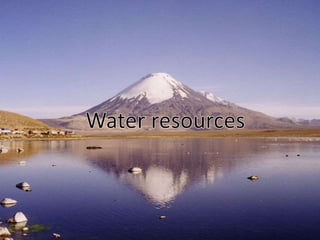
Water resources 
• Water resources are sources of water that are 
useful or potentially useful. Uses of water 
include agricultural 
,industrial, household, recreational and environmen 
tal activities. The majority of human uses 
require fresh water. 
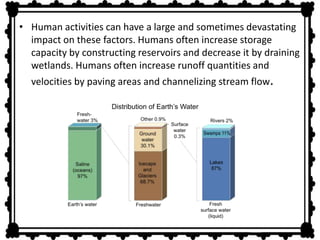
• 97 percent of the water on the Earth is salt water 
and only three percent is fresh water; slightly over 
two thirds of this is frozen in glaciers and polar ice 
caps. The remaining unfrozen freshwater is found 
mainly as groundwater, with only a small fraction 
present above ground or in the air.
• Fresh water is a renewable resource, yet the 
world's supply of groundwater is steadily 
decreasing, with depletion occurring most 
prominently in Asia and North America, 
although it is still unclear how much natural 
renewal balances this usage, and 
whether ecosystems are threatened. The 
framework for allocating water resources to 
water users (where such a framework exists) is 
known as water rights.
Sources of fresh water 
Surface water 
• Surface water is water in a river, lake or fresh 
water wetland. Surface water is naturally replenished 
by precipitation and naturally lost through discharge to the 
oceans, evaporation, evapotranspiration and sub-surface 
seepage. 
• Although the only natural input to any surface water system 
is precipitation within its watershed, the total quantity of 
water in that system at any given time is also dependent on 
many other factors. These factors include storage capacity 
in lakes, wetlands and artificial reservoirs, the permeability 
of the soil beneath these storage bodies, 
the runoff characteristics of the land in the watershed, the 
timing of the precipitation and local evaporation rates. All of 
these factors also affect the proportions of water loss.
• Human activities can have a large and sometimes devastating 
impact on these factors. Humans often increase storage 
capacity by constructing reservoirs and decrease it by draining 
wetlands. Humans often increase runoff quantities and 
velocities by paving areas and channelizing stream flow.
Under river flow 
• Throughout the course of a river, the total volume of water 
transported downstream will often be a combination of the 
visible free water flow together with a substantial 
contribution flowing through sub-surface rocks and gravels 
that underlie the river and its floodplain called 
the hyporheic zone. For many rivers in large valleys, this 
unseen component of flow may greatly exceed the visible 
flow. The hyporheic zone often forms a dynamic interface 
between surface water and true ground-water receiving 
water from the ground water when aquifers are fully 
charged and contributing water to ground-water when 
ground waters are depleted. This is especially significant 
in kart areas where pot-holes and underground rivers are 
common. 
•
Ground water 
Sub-surface water, or groundwater, is fresh 
water located in the porespace of soil 
and rocks. It is also water that is flowing 
within aquifersbelow the water table. 
Sometimes it is useful to make a distinction 
between sub-surface water that is closely 
associated with surface water and deep sub-surface 
water in an aquifer (sometimes called 
"fossil water").
Sub-surface water can be thought of in the same 
terms as surface water: inputs, outputs and 
storage. The critical difference is that due to its 
slow rate of turnover, sub-surface water storage 
is generally much larger compared to inputs than 
it is for surface water. This difference makes it 
easy for humans to use sub-surface water 
unsustainably for a long time without severe 
consequences. Nevertheless, over the long term 
the average rate of seepage above a sub-surface 
water source is the upper bound for average 
consumption of water from that source.
• The natural input to sub-surface water is seepage from 
surface water. The natural outputs from sub-surface 
water are springs and seepage to the oceans. 
• If the surface water source is also subject to substantial 
evaporation, a sub-surface water source may 
become saline. This situation can occur naturally 
under endorheic bodies of water, or artificially 
under irrigatd farmland. In coastal areas, human use of 
a sub-surface water source may cause the direction of 
seepage to ocean to reverse which can also cause soil 
salinization. Humans can also cause sub-surface water 
to be "lost" (i.e. become unusable) through pollution. 
Humans can increase the input to a sub-surface water 
source by building reservoirs or detention ponds.
Desalination 
• Desalination is an artificial process by which 
saline water (generally sea water) is converted to 
fresh water. The most common desalination 
processes are distillation and reverse osmosis. 
Desalination is currently expensive compared to 
most alternative sources of water, and only a very 
small fraction of total human use is satisfied by 
desalination. It is only economically practical for 
high-valued uses (such as household and 
industrial uses) in arid areas. The most extensive 
use is in the Persian Gulf.

water resources

  • 2.
    Water resources •Water resources are sources of water that are useful or potentially useful. Uses of water include agricultural ,industrial, household, recreational and environmen tal activities. The majority of human uses require fresh water. • 97 percent of the water on the Earth is salt water and only three percent is fresh water; slightly over two thirds of this is frozen in glaciers and polar ice caps. The remaining unfrozen freshwater is found mainly as groundwater, with only a small fraction present above ground or in the air.
  • 3.
    • Fresh wateris a renewable resource, yet the world's supply of groundwater is steadily decreasing, with depletion occurring most prominently in Asia and North America, although it is still unclear how much natural renewal balances this usage, and whether ecosystems are threatened. The framework for allocating water resources to water users (where such a framework exists) is known as water rights.
  • 4.
    Sources of freshwater Surface water • Surface water is water in a river, lake or fresh water wetland. Surface water is naturally replenished by precipitation and naturally lost through discharge to the oceans, evaporation, evapotranspiration and sub-surface seepage. • Although the only natural input to any surface water system is precipitation within its watershed, the total quantity of water in that system at any given time is also dependent on many other factors. These factors include storage capacity in lakes, wetlands and artificial reservoirs, the permeability of the soil beneath these storage bodies, the runoff characteristics of the land in the watershed, the timing of the precipitation and local evaporation rates. All of these factors also affect the proportions of water loss.
  • 5.
    • Human activitiescan have a large and sometimes devastating impact on these factors. Humans often increase storage capacity by constructing reservoirs and decrease it by draining wetlands. Humans often increase runoff quantities and velocities by paving areas and channelizing stream flow.
  • 6.
    Under river flow • Throughout the course of a river, the total volume of water transported downstream will often be a combination of the visible free water flow together with a substantial contribution flowing through sub-surface rocks and gravels that underlie the river and its floodplain called the hyporheic zone. For many rivers in large valleys, this unseen component of flow may greatly exceed the visible flow. The hyporheic zone often forms a dynamic interface between surface water and true ground-water receiving water from the ground water when aquifers are fully charged and contributing water to ground-water when ground waters are depleted. This is especially significant in kart areas where pot-holes and underground rivers are common. •
  • 7.
    Ground water Sub-surfacewater, or groundwater, is fresh water located in the porespace of soil and rocks. It is also water that is flowing within aquifersbelow the water table. Sometimes it is useful to make a distinction between sub-surface water that is closely associated with surface water and deep sub-surface water in an aquifer (sometimes called "fossil water").
  • 8.
    Sub-surface water canbe thought of in the same terms as surface water: inputs, outputs and storage. The critical difference is that due to its slow rate of turnover, sub-surface water storage is generally much larger compared to inputs than it is for surface water. This difference makes it easy for humans to use sub-surface water unsustainably for a long time without severe consequences. Nevertheless, over the long term the average rate of seepage above a sub-surface water source is the upper bound for average consumption of water from that source.
  • 9.
    • The naturalinput to sub-surface water is seepage from surface water. The natural outputs from sub-surface water are springs and seepage to the oceans. • If the surface water source is also subject to substantial evaporation, a sub-surface water source may become saline. This situation can occur naturally under endorheic bodies of water, or artificially under irrigatd farmland. In coastal areas, human use of a sub-surface water source may cause the direction of seepage to ocean to reverse which can also cause soil salinization. Humans can also cause sub-surface water to be "lost" (i.e. become unusable) through pollution. Humans can increase the input to a sub-surface water source by building reservoirs or detention ponds.
  • 10.
    Desalination • Desalinationis an artificial process by which saline water (generally sea water) is converted to fresh water. The most common desalination processes are distillation and reverse osmosis. Desalination is currently expensive compared to most alternative sources of water, and only a very small fraction of total human use is satisfied by desalination. It is only economically practical for high-valued uses (such as household and industrial uses) in arid areas. The most extensive use is in the Persian Gulf.