Water Management Practices
NITHYA SUNIL
Roll no: 06
II Semester: ENS2E06-Hydrology and Water
Management
M.SC. ENVIRONMENTAL SCIENCE
KANNUR UNIVERSITY CAMPUS
By
• Water shed Management
• Wetland Conservation
• Rainfall pits and Rain water Harvesting
• Water management is the activity of
planning, developing, distributing and
optimum use of water
resources under defined water polices
and regulations.
• Water is very essential for our survival.
• Of the water resources on Earth only 3%
of it is fresh and 2/3 of the freshwater is
locked up in ice caps and glaciers.
WATER SHED
MANAGEMENT
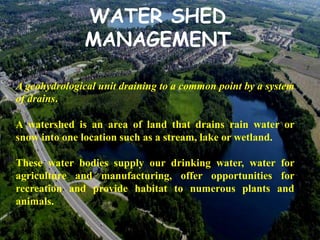
A geohydrological unit draining to a common point by a system
of drains.
A watershed is an area of land that drains rain water or
snow into one location such as a stream, lake or wetland.
These water bodies supply our drinking water, water for
agriculture and manufacturing, offer opportunities for
recreation and provide habitat to numerous plants and
animals.
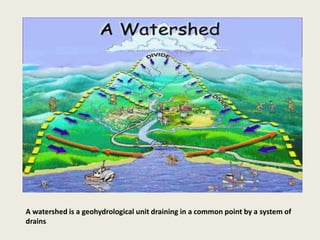
A watershed is a geohydrological unit draining in a common point by a system of
drains
Watershed management practices
In terms of Purpose
1. To increase infiltration
2. To increase water holding capacity
3. To prevent soil erosion
4. Protects vegetation
TYPES OF WATERSHED
• Macro watershed (> 50,000 Hect)
• Sub-watershed (10,000 to 50,000 Hect)
• Milli-watershed (1000 to10000 Hect)
• Micro watershed (100 to 1000 Hect)
• Mini watershed (1-100 Hect)
Objectives of watershed management
1. To control damaging runoff and degradation and thereby
conservation of soil and water.
2. To manage and utilize the runoff water for useful purpose.
3. To protect, conserve and improve the land of watershed for more
efficient and sustained production.
4. To protect and enhance the water resource originating in the
watershed.
5. To check soil erosion and to reduce the effect of sediment yield on
the watershed.
6. To rehabilitate the deteriorating lands.
7. To moderate the floods peaks at down stream areas.
8. To increase infiltration of rainwater.
9. To improve and increase the production of timbers, fodder and wild
life resource.
10. To enhance the ground water recharge, wherever applicable.
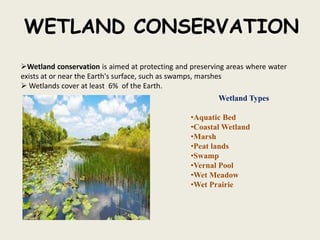
WETLAND CONSERVATION
Wetland conservation is aimed at protecting and preserving areas where water
exists at or near the Earth's surface, such as swamps, marshes
 Wetlands cover at least 6% of the Earth.
Wetland Types
•Aquatic Bed
•Coastal Wetland
•Marsh
•Peat lands
•Swamp
•Vernal Pool
•Wet Meadow
•Wet Prairie
Wetland Definition
United States Environmental Protection
Agency(EPA) or Wetlands Reserve Program,
describes wetlands as "those areas that are
inundated or saturated by surface or groundwater at
a frequency and duration sufficient to support, and
that under normal circumstances do support, a
prevalence of vegetation typically adapted for life in
saturated soil conditions”.
Aquatic Bed: Areas of shallow permanent water that are dominated by
plants that grow on or below the surface of the water.
Great Lakes Coastal Wetland: The hydrology of these wetlands is
driven by Great Lakes water level fluctuations. There are different
types of these rare wetlands due to substrate (clay, sand, muck) and
exposure to wind and wave action.
Marsh: A frequently or continually inundated wetland characterized
by grass-like and other emergent vegetation adapted to saturated
soil conditions. They are wet areas which can be periodically
covered by standing or slow-moving water and are usually
associated with ponds, rivers, streams, and the Great Lakes.
Peat lands: Occur as thick peat deposits in old lake basins or as
blankets of peat across the landscape. Their formation is due to the
combination of cool temperatures and adequate rainfall in northern
temperate regions around the earth.
• Peat-accumulating wetlands include both bogs and fens.
Bog: Bogs form in lake basins that are isolated from sources of ground
water.
Fen : A peat-accumulating wetland that receives some inputs of
groundwater or drainage from surrounding mineral soils which
typically results in alkaline waters and usually supports grass-like
vegetation.
Swamp: A wetland dominated by trees or shrubs. Swamps are usually
inundated or saturated periodically at some point during the
growing season. The soils in swamps are usually rich in nutrients
and organic matter. This is due to silt and organic matter deposited
by flood events and the accumulation of organic matter (dead trees
and other vegetation) over time.
Vernal Pool: An ephemeral wetland usually in a forested area. Vernal
pools are small isolated wetlands that only hold water for a short
time during the spring.
Wet Meadow: Grassland with saturated soil near the surface but
without standing water for most of the year. Wet meadows contain
grass-like vegetation and saturated soils, but seldom have water
standing on the ground surface.
Wet Prairie: Wet prairies are intermediate areas between a marsh and
a wet meadow
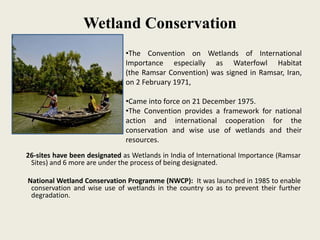
Wetland Conservation
26-sites have been designated as Wetlands in India of International Importance (Ramsar
Sites) and 6 more are under the process of being designated.
National Wetland Conservation Programme (NWCP): It was launched in 1985 to enable
conservation and wise use of wetlands in the country so as to prevent their further
degradation.
•The Convention on Wetlands of International
Importance especially as Waterfowl Habitat
(the Ramsar Convention) was signed in Ramsar, Iran,
on 2 February 1971,
•Came into force on 21 December 1975.
•The Convention provides a framework for national
action and international cooperation for the
conservation and wise use of wetlands and their
resources.
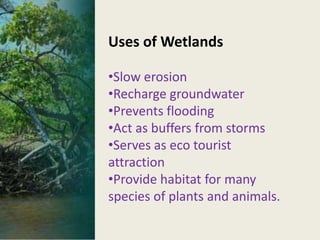
Uses of Wetlands
•Slow erosion
•Recharge groundwater
•Prevents flooding
•Act as buffers from storms
•Serves as eco tourist
attraction
•Provide habitat for many
species of plants and animals.
RAINFALL PITS &
RAINWATER HARVESTING
What is Rainwater Harvesting?
Rainwater harvesting is a technology used for
collecting and storing rain water from rooftops, the
land surface or rock catchments using simple
techniques such as jars and pots as well as more
complex techniques such as under ground check
dams.
Uses of Rain water
 Gardening
 Drinking
 Irrigation
 Livestock
 Groundwater Recharge
How Rain Water can be Harvested
Broadly there are two ways of arvesting rain water
1. Surface run off Harvesting
2. Roof top Harvesting
Surface runoff harvesting:-
In urban areas raunwater flows away as surface
runoff. This runoff could be caught and used for
recharging aquifers.
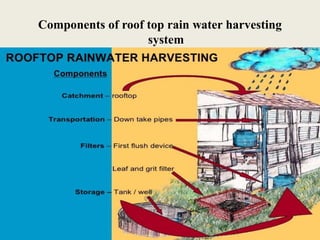
Roof top rainwater harvesting:-
• It is a system of catching rainwater where it falls.
• In rooftop harvesting, the roof becomes the
catchments, and the rainwater is collected from the
roof of the house / building
• Less expensive and very effective
Components of roof top rain water harvesting
system
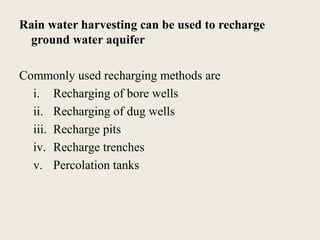
Rain water harvesting can be used to recharge
ground water aquifer
Commonly used recharging methods are
i. Recharging of bore wells
ii. Recharging of dug wells
iii. Recharge pits
iv. Recharge trenches
v. Percolation tanks
Recharging of bore wells
Recharging Pits
Recharging of Dug wells
Advantages of Rain Water Harvesting
 Easy to install and operate
 Construction materials are readily available
 No need of skilled labour for operation
 Cost effective
 Water collected from roof tops can be used for
domestic purposes.
• Water Management is important since it helps
determine future Irrigation expectations.
• Water management is the management of water
resources under set policies and regulations.
• Water, once an abundant natural resource, is
becoming a more valuable commodity due to
droughts and overuse
Water management practices

Water management practices

  • 1.
    Water Management Practices NITHYASUNIL Roll no: 06 II Semester: ENS2E06-Hydrology and Water Management M.SC. ENVIRONMENTAL SCIENCE KANNUR UNIVERSITY CAMPUS By • Water shed Management • Wetland Conservation • Rainfall pits and Rain water Harvesting
  • 2.
    • Water managementis the activity of planning, developing, distributing and optimum use of water resources under defined water polices and regulations. • Water is very essential for our survival. • Of the water resources on Earth only 3% of it is fresh and 2/3 of the freshwater is locked up in ice caps and glaciers.
  • 3.
    WATER SHED MANAGEMENT A geohydrologicalunit draining to a common point by a system of drains. A watershed is an area of land that drains rain water or snow into one location such as a stream, lake or wetland. These water bodies supply our drinking water, water for agriculture and manufacturing, offer opportunities for recreation and provide habitat to numerous plants and animals.
  • 4.
    A watershed isa geohydrological unit draining in a common point by a system of drains
  • 5.
    Watershed management practices Interms of Purpose 1. To increase infiltration 2. To increase water holding capacity 3. To prevent soil erosion 4. Protects vegetation TYPES OF WATERSHED • Macro watershed (> 50,000 Hect) • Sub-watershed (10,000 to 50,000 Hect) • Milli-watershed (1000 to10000 Hect) • Micro watershed (100 to 1000 Hect) • Mini watershed (1-100 Hect)
  • 6.
    Objectives of watershedmanagement 1. To control damaging runoff and degradation and thereby conservation of soil and water. 2. To manage and utilize the runoff water for useful purpose. 3. To protect, conserve and improve the land of watershed for more efficient and sustained production. 4. To protect and enhance the water resource originating in the watershed. 5. To check soil erosion and to reduce the effect of sediment yield on the watershed. 6. To rehabilitate the deteriorating lands. 7. To moderate the floods peaks at down stream areas. 8. To increase infiltration of rainwater. 9. To improve and increase the production of timbers, fodder and wild life resource. 10. To enhance the ground water recharge, wherever applicable.
  • 7.
    WETLAND CONSERVATION Wetland conservationis aimed at protecting and preserving areas where water exists at or near the Earth's surface, such as swamps, marshes  Wetlands cover at least 6% of the Earth. Wetland Types •Aquatic Bed •Coastal Wetland •Marsh •Peat lands •Swamp •Vernal Pool •Wet Meadow •Wet Prairie
  • 8.
    Wetland Definition United StatesEnvironmental Protection Agency(EPA) or Wetlands Reserve Program, describes wetlands as "those areas that are inundated or saturated by surface or groundwater at a frequency and duration sufficient to support, and that under normal circumstances do support, a prevalence of vegetation typically adapted for life in saturated soil conditions”.
  • 9.
    Aquatic Bed: Areasof shallow permanent water that are dominated by plants that grow on or below the surface of the water. Great Lakes Coastal Wetland: The hydrology of these wetlands is driven by Great Lakes water level fluctuations. There are different types of these rare wetlands due to substrate (clay, sand, muck) and exposure to wind and wave action. Marsh: A frequently or continually inundated wetland characterized by grass-like and other emergent vegetation adapted to saturated soil conditions. They are wet areas which can be periodically covered by standing or slow-moving water and are usually associated with ponds, rivers, streams, and the Great Lakes. Peat lands: Occur as thick peat deposits in old lake basins or as blankets of peat across the landscape. Their formation is due to the combination of cool temperatures and adequate rainfall in northern temperate regions around the earth. • Peat-accumulating wetlands include both bogs and fens. Bog: Bogs form in lake basins that are isolated from sources of ground water.
  • 10.
    Fen : Apeat-accumulating wetland that receives some inputs of groundwater or drainage from surrounding mineral soils which typically results in alkaline waters and usually supports grass-like vegetation. Swamp: A wetland dominated by trees or shrubs. Swamps are usually inundated or saturated periodically at some point during the growing season. The soils in swamps are usually rich in nutrients and organic matter. This is due to silt and organic matter deposited by flood events and the accumulation of organic matter (dead trees and other vegetation) over time. Vernal Pool: An ephemeral wetland usually in a forested area. Vernal pools are small isolated wetlands that only hold water for a short time during the spring. Wet Meadow: Grassland with saturated soil near the surface but without standing water for most of the year. Wet meadows contain grass-like vegetation and saturated soils, but seldom have water standing on the ground surface. Wet Prairie: Wet prairies are intermediate areas between a marsh and a wet meadow
  • 11.
    Wetland Conservation 26-sites havebeen designated as Wetlands in India of International Importance (Ramsar Sites) and 6 more are under the process of being designated. National Wetland Conservation Programme (NWCP): It was launched in 1985 to enable conservation and wise use of wetlands in the country so as to prevent their further degradation. •The Convention on Wetlands of International Importance especially as Waterfowl Habitat (the Ramsar Convention) was signed in Ramsar, Iran, on 2 February 1971, •Came into force on 21 December 1975. •The Convention provides a framework for national action and international cooperation for the conservation and wise use of wetlands and their resources.
  • 12.
    Uses of Wetlands •Slowerosion •Recharge groundwater •Prevents flooding •Act as buffers from storms •Serves as eco tourist attraction •Provide habitat for many species of plants and animals.
  • 13.
    RAINFALL PITS & RAINWATERHARVESTING What is Rainwater Harvesting? Rainwater harvesting is a technology used for collecting and storing rain water from rooftops, the land surface or rock catchments using simple techniques such as jars and pots as well as more complex techniques such as under ground check dams.
  • 14.
    Uses of Rainwater  Gardening  Drinking  Irrigation  Livestock  Groundwater Recharge
  • 15.
    How Rain Watercan be Harvested Broadly there are two ways of arvesting rain water 1. Surface run off Harvesting 2. Roof top Harvesting Surface runoff harvesting:- In urban areas raunwater flows away as surface runoff. This runoff could be caught and used for recharging aquifers.
  • 16.
    Roof top rainwaterharvesting:- • It is a system of catching rainwater where it falls. • In rooftop harvesting, the roof becomes the catchments, and the rainwater is collected from the roof of the house / building • Less expensive and very effective
  • 17.
    Components of rooftop rain water harvesting system
  • 18.
    Rain water harvestingcan be used to recharge ground water aquifer Commonly used recharging methods are i. Recharging of bore wells ii. Recharging of dug wells iii. Recharge pits iv. Recharge trenches v. Percolation tanks
  • 19.
  • 20.
  • 21.
  • 22.
    Advantages of RainWater Harvesting  Easy to install and operate  Construction materials are readily available  No need of skilled labour for operation  Cost effective  Water collected from roof tops can be used for domestic purposes.
  • 23.
    • Water Managementis important since it helps determine future Irrigation expectations. • Water management is the management of water resources under set policies and regulations. • Water, once an abundant natural resource, is becoming a more valuable commodity due to droughts and overuse