INVASION OF KERALA’S
WATER BODIES BY WATER
HYACINTH
INTRODUCTION
 Aquatic weeds-global issue
 Major characteristics of weeds
-unwanted occurrence
-undesirable features
-ability to adapt to disturbed
environment
Water hyacinth(Eichhornia
crassipes)
 One of the most aggressive weeds
 Occupies major proportion of water
bodies in Kerala
 Affects:
1. fishing
2. tourism
3. water transportation
4. native species
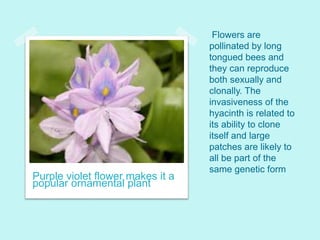
Flowers are
pollinated by long
tongued bees and
they can reproduce
both sexually and
clonally. The
invasiveness of the
hyacinth is related to
its ability to clone
itself and large
patches are likely to
all be part of the
same genetic form
Purple violet flower makes it a
popular ornamental plant
DESCRIPTION
 Free floating perennial plant
 Broad thick ovate glossy leaves
 Can grow up to 1 metre in height
 Spongy bulbous stalk
 Feathery free hanging roots
 Reproduction: vegetative propagations
and stolons
 Also capable of cloning itself
 Flower throughout the year, releases
more than 3000 seeds per year, could
live up to 20 years.
HABITAT AND ECOLOGY
 Tropical desert-subtropical or warm
temperate desert –rain forest zone
Min growth temp 120C
Max growth temp 250-300 C
Optimum growth temp 330-350C
pH tolerance 5-7
CONTROL
Manual and mechanical
 Drainage of water body
 Pulling through net
 Weed harvesters, crusher boats and
destruction boats
 Demerits
 Expensive
 Shredded bunches are carried by
waves to unaffected areas
Chemical control
 2,4-D glycophosate and diquat
 2,4-D:- death through inhibition of growth
and cell apoptosis
 Glycophosate:-steady wilting and
discolouration, plant decay
 Merits
 Cost effective, less laborious
 Demerits
 Penetrate into ground waters, affects
aquatic organism and animals
Biological control
 2 species of Weevil beetles and two
moth species
 Weevils decreases plant size, affects
vegetative reproductions, flower and
seed production
 Facilitate transfer of deleterious
organisms into plant tissue
USES
Phytoremediation and waste water
treatment
 Ability to absorb large quantities of
heavy metals(arsenic, cadmium)
 Thrive well in polluted waters(organic
contaminants and plant nutrients)
 Efficiently removes 60-80% of nitrogen
and 69% of potassium
Bio-energy
 Excellent biomass source
 1 hectare of standing crop produces
more than 70,000m3 biogas
 dry water hyacinth –fuel in Bengal
 High water content- difficulty in
harvesting and processing+ ethanol
production
Semi industrial use and household
articles
 In Philippines, Indonesia, and India
 Used for making ropes, mats shoes,
sandals, and bags
Animal feedstock and agricultural
use
 Sundried water hyacinth
 Rich in proteins, vitamins, minerals
 Feedstock for non ruminant animals
and plants
 Green manure or compost for
increasing soil quality
 Accumulation of toxic substance-use
restricted to flowering plants only.
CONCLUSION
 Depleted Kerala's water bodies of
their oxygen content
 Commercial use should not encourage
its propagation rather help control
growth
Water hyacinth

Water hyacinth

  • 1.
    INVASION OF KERALA’S WATERBODIES BY WATER HYACINTH
  • 2.
    INTRODUCTION  Aquatic weeds-globalissue  Major characteristics of weeds -unwanted occurrence -undesirable features -ability to adapt to disturbed environment
  • 3.
    Water hyacinth(Eichhornia crassipes)  Oneof the most aggressive weeds  Occupies major proportion of water bodies in Kerala  Affects: 1. fishing 2. tourism 3. water transportation 4. native species
  • 4.
    Flowers are pollinated bylong tongued bees and they can reproduce both sexually and clonally. The invasiveness of the hyacinth is related to its ability to clone itself and large patches are likely to all be part of the same genetic form Purple violet flower makes it a popular ornamental plant
  • 5.
    DESCRIPTION  Free floatingperennial plant  Broad thick ovate glossy leaves  Can grow up to 1 metre in height  Spongy bulbous stalk  Feathery free hanging roots  Reproduction: vegetative propagations and stolons  Also capable of cloning itself  Flower throughout the year, releases more than 3000 seeds per year, could live up to 20 years.
  • 7.
    HABITAT AND ECOLOGY Tropical desert-subtropical or warm temperate desert –rain forest zone Min growth temp 120C Max growth temp 250-300 C Optimum growth temp 330-350C pH tolerance 5-7
  • 8.
    CONTROL Manual and mechanical Drainage of water body  Pulling through net  Weed harvesters, crusher boats and destruction boats  Demerits  Expensive  Shredded bunches are carried by waves to unaffected areas
  • 9.
    Chemical control  2,4-Dglycophosate and diquat  2,4-D:- death through inhibition of growth and cell apoptosis  Glycophosate:-steady wilting and discolouration, plant decay  Merits  Cost effective, less laborious  Demerits  Penetrate into ground waters, affects aquatic organism and animals
  • 10.
    Biological control  2species of Weevil beetles and two moth species  Weevils decreases plant size, affects vegetative reproductions, flower and seed production  Facilitate transfer of deleterious organisms into plant tissue
  • 11.
    USES Phytoremediation and wastewater treatment  Ability to absorb large quantities of heavy metals(arsenic, cadmium)  Thrive well in polluted waters(organic contaminants and plant nutrients)  Efficiently removes 60-80% of nitrogen and 69% of potassium
  • 12.
    Bio-energy  Excellent biomasssource  1 hectare of standing crop produces more than 70,000m3 biogas  dry water hyacinth –fuel in Bengal  High water content- difficulty in harvesting and processing+ ethanol production
  • 13.
    Semi industrial useand household articles  In Philippines, Indonesia, and India  Used for making ropes, mats shoes, sandals, and bags
  • 14.
    Animal feedstock andagricultural use  Sundried water hyacinth  Rich in proteins, vitamins, minerals  Feedstock for non ruminant animals and plants  Green manure or compost for increasing soil quality  Accumulation of toxic substance-use restricted to flowering plants only.
  • 15.
    CONCLUSION  Depleted Kerala'swater bodies of their oxygen content  Commercial use should not encourage its propagation rather help control growth