WATER HARVESTING
WATER HARVESTING
•The term ‘water harvesting’ is usually taken to mean the
immediate collection of rainwaterrunning off surfaces
upon which it has fallendirectly.
•This definition excludes run-off from land watersheds into
streams,rivers,lakes,etc.
•Hence it is the catching of rain water when it falls and
storing to use during the nonrainyseason.
PRINCIPLES OF WATER HARVESTING
 Studying of Rainfall and suitable Locations
 Construct small structures which can be constructed by
locally available materials
 Start constructing from high point and gradually come
down
 Stream should be made of water rather than runoff and
erode lot of soils.
 Create a storage so that the harvested water be allowed for
percolation to take place
 Always plan for an overflow route and manage that
overflow as a resource
 Using this harvested water multiple purposes can be
served
 Continually reassess the system such that any shortage
can be met with in the next face in 2nd principle
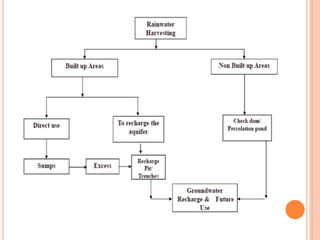
RAIN WATER HARVESTING – Methods
- Rooftopharvesting
- Run offharvesting
These methods can be selected considering the purpose,
source of collecting water, the type and quantity of storage,
catchmentstate.
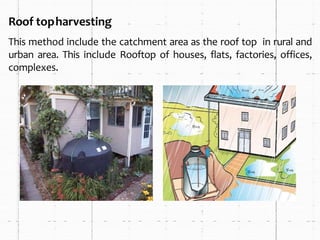
Roof topharvesting
This method include the catchment area as the roof top in rural and
urban area. This include Rooftop of houses, flats, factories, offices,
complexes.
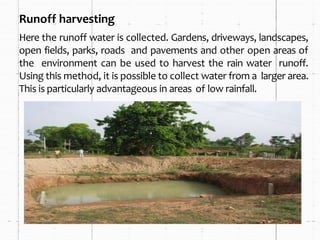
Runoff harvesting
Here the runoff water is collected. Gardens, driveways, landscapes,
open fields, parks, roads and pavements and other open areas of
the environment can be used to harvest the rain water runoff.
Using this method, it is possible to collect water from a larger area.
This is particularly advantageous in areas of low rainfall.
COMPONENTS OF RAIN WATER HARVESTING
 Catchment area
 Rain water can be collected from most forms ofroofs
 Tiled roofs, or roofssheeted with corrugated mild steel
 Preferable,easiesttouseand givethe cleanestwater.
 Thatched orpalm leafed surfacesarealsofeasible, although
they are difficult to clean and can often taint therun-off.
 Asbestos sheeting or lead-painted surfacesshould be avoided.
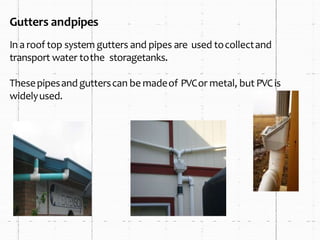
Gutters andpipes
Ina roof top system gutters and pipes are used tocollectand
transport water tothe storagetanks.
Thesepipesandgutterscan be madeof PVCor metal, but PVCis
widelyused.
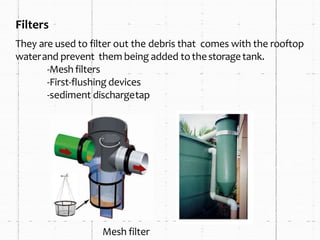
Filters
They are used to filter out the debris that comes with the rooftop
waterand prevent them being added tothestoragetank.
-Mesh filters
-First-flushing devices
-sediment dischargetap
Mesh filter
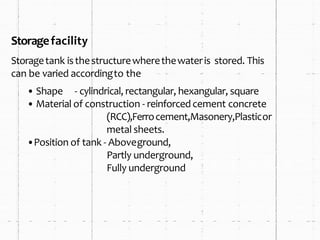
Storagefacility
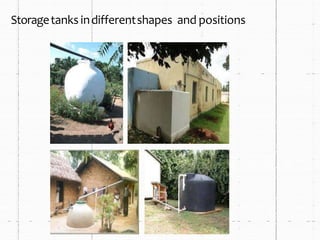
Storagetank isthestructurewherethewateris stored. This
can be varied accordingto the
• Shape - cylindrical, rectangular, hexangular, square
• Material of construction - reinforcedcement concrete
(RCC),Ferrocement,Masonery,Plasticor
metal sheets.
•Position of tank - Aboveground,
Partly underground,
Fully underground
Storagetanks indifferentshapes and positions
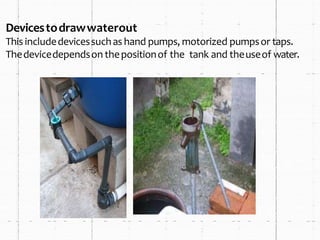
Devicestodrawwaterout
This includedevicessuchas hand pumps, motorized pumpsor taps.
Thedevicedependson thepositionof the tank and theuseof water.
ADVANTAGES OF RAIN WATERHARVESTING
•Relatively cheap materials can be used for construction of
containers and collecting surfaces
•Construction methods are relatively straight forward
•Low maintenance costs andrequirements
•Environment friendly
•Increase the ground water levelandquality.
•Mitigates the effects ofdrought.
•Reduces therunoff
•Reduces the soilerosion
•Helps in reducing water andelectricitybills
•Provides a supply of safe water close to homes, schools or
clinics, encourages increased consumption, reduces the time
women and children spend collecting water, reduces back
strain or injuries from carrying heavy water
DISADVANTAGES OF RAIN WATER HARVESTING
•Supplies can be contaminated by bird/animal droppingson
catchment surfaces and guttering structures unless they
arecleaned/flushed beforeuse
•Poorly constructed water jars/containers can sufferfrom
algal growth and invasion by insects, lizards and rodents.
They can act asa breedingground fordiseasevectorsif they
are not properlymaintained
•Regular maintenance should beneeded

11 Water Harvesting.pptx

  • 1.
  • 2.
    WATER HARVESTING •The term‘water harvesting’ is usually taken to mean the immediate collection of rainwaterrunning off surfaces upon which it has fallendirectly. •This definition excludes run-off from land watersheds into streams,rivers,lakes,etc. •Hence it is the catching of rain water when it falls and storing to use during the nonrainyseason.
  • 3.
    PRINCIPLES OF WATERHARVESTING  Studying of Rainfall and suitable Locations  Construct small structures which can be constructed by locally available materials  Start constructing from high point and gradually come down  Stream should be made of water rather than runoff and erode lot of soils.
  • 4.
     Create astorage so that the harvested water be allowed for percolation to take place  Always plan for an overflow route and manage that overflow as a resource  Using this harvested water multiple purposes can be served  Continually reassess the system such that any shortage can be met with in the next face in 2nd principle
  • 5.
    RAIN WATER HARVESTING– Methods - Rooftopharvesting - Run offharvesting These methods can be selected considering the purpose, source of collecting water, the type and quantity of storage, catchmentstate.
  • 7.
    Roof topharvesting This methodinclude the catchment area as the roof top in rural and urban area. This include Rooftop of houses, flats, factories, offices, complexes.
  • 8.
    Runoff harvesting Here therunoff water is collected. Gardens, driveways, landscapes, open fields, parks, roads and pavements and other open areas of the environment can be used to harvest the rain water runoff. Using this method, it is possible to collect water from a larger area. This is particularly advantageous in areas of low rainfall.
  • 9.
    COMPONENTS OF RAINWATER HARVESTING  Catchment area  Rain water can be collected from most forms ofroofs  Tiled roofs, or roofssheeted with corrugated mild steel  Preferable,easiesttouseand givethe cleanestwater.  Thatched orpalm leafed surfacesarealsofeasible, although they are difficult to clean and can often taint therun-off.  Asbestos sheeting or lead-painted surfacesshould be avoided.
  • 10.
    Gutters andpipes Ina rooftop system gutters and pipes are used tocollectand transport water tothe storagetanks. Thesepipesandgutterscan be madeof PVCor metal, but PVCis widelyused.
  • 11.
    Filters They are usedto filter out the debris that comes with the rooftop waterand prevent them being added tothestoragetank. -Mesh filters -First-flushing devices -sediment dischargetap Mesh filter
  • 12.
    Storagefacility Storagetank isthestructurewherethewateris stored.This can be varied accordingto the • Shape - cylindrical, rectangular, hexangular, square • Material of construction - reinforcedcement concrete (RCC),Ferrocement,Masonery,Plasticor metal sheets. •Position of tank - Aboveground, Partly underground, Fully underground
  • 13.
  • 14.
    Devicestodrawwaterout This includedevicessuchas handpumps, motorized pumpsor taps. Thedevicedependson thepositionof the tank and theuseof water.
  • 15.
    ADVANTAGES OF RAINWATERHARVESTING •Relatively cheap materials can be used for construction of containers and collecting surfaces •Construction methods are relatively straight forward •Low maintenance costs andrequirements •Environment friendly •Increase the ground water levelandquality. •Mitigates the effects ofdrought. •Reduces therunoff •Reduces the soilerosion •Helps in reducing water andelectricitybills •Provides a supply of safe water close to homes, schools or clinics, encourages increased consumption, reduces the time women and children spend collecting water, reduces back strain or injuries from carrying heavy water
  • 16.
    DISADVANTAGES OF RAINWATER HARVESTING •Supplies can be contaminated by bird/animal droppingson catchment surfaces and guttering structures unless they arecleaned/flushed beforeuse •Poorly constructed water jars/containers can sufferfrom algal growth and invasion by insects, lizards and rodents. They can act asa breedingground fordiseasevectorsif they are not properlymaintained •Regular maintenance should beneeded