1
5/13/2020
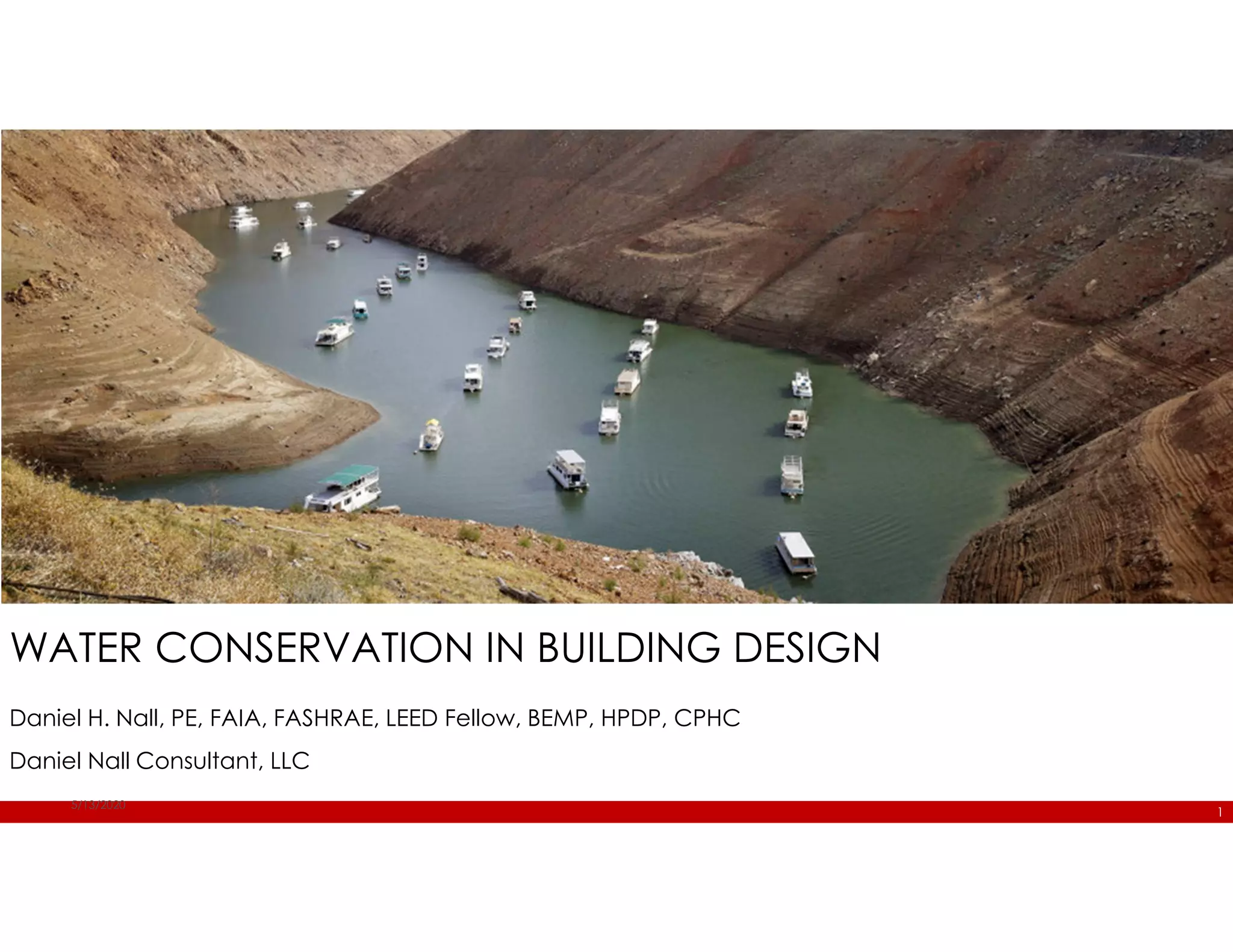
WATER CONSERVATION IN BUILDING DESIGN
Daniel H. Nall, PE, FAIA, FASHRAE, LEED Fellow, BEMP, HPDP, CPHC
Daniel Nall Consultant, LLC
2
ASHRAE is a Registered Provider with The American Institute of
Architects Continuing Education Systems. Credit earned on
completion of this program will be reported to CES Records for
AIA members. Certificates of Completion for non-AIA members
are available on request.
This program is registered with the AIA/CES for continuing
professional education. As such, it does not include content that
may be deemed or construed to be an approval or
endorsement by the AIA of any material of construction or any
method or manner of handling, using, distributing, or dealing in
any material or product. Questions related to specific materials,
methods, and services will be addressed at the conclusion of
this presentation.
6
GBCI cannot guarantee that course sessions
will be delivered to you as submitted to GBCI.
However, any course found to be in violation of
the standards of the program, or otherwise
contrary to the mission of GBCI, shall be
removed. Your course evaluations will help us
uphold these standards.
Course ID: 0920005383
WATER CONSERVATION IN
BUILDING DESIGN
By ASHRAE
Approved for:
1General CE hours
0LEED-specific hours
4
This presentation will discuss options for water
conservation and wastewater harvesting techniques.
Technology for water conservation will be discussed.
Utilization of on-site non-potable water resources will be
discussed, and methods of capturing and treating these
resources will be presented. The requirements of water
consumption end-uses that can benefit from non-
potable resources will be presented, along with
technical issues that limit the exploitation of these
resources. A case study showing a 2/3 reduction in
potable water consumption through the utilization of
both conservation measures and non-potable water
harvesting will be presented
Course Description
5
Learning Objectives
1. Recognize how HVAC systems use water and how they generate non-potable water
resources.
2. Integrate different strategies of water conservation for dramatic reductions in
consumption.
3. Allocate different types of reclaimed water to different types of non-potable uses.
4. Overcome contamination issues to optimize re-use of harvested waste water.
At the end of this course, participants will be able to:
ASHRAE WILL GIVE
YOU THE WORLD
ASHRAE WILL GIVE
YOU THE WORLD
This ASHRAE Distinguished Lecturer is brought to you by the
Society Chapter Technology Transfer Committee
Complete the Distinguished Lecturer
Event Summary Critique
CTTC needs your feedback to continue to
improve the DL Program
Distribute the DL Evaluation Form to all attendees
Collect at the end of the meeting
Compile the attendee rating on the Event Summary
Critique
Send the completed Event Summary Critique to your
CTTC RVC and ASHRAE Headquarters
CTTC needs your feedback to continue to
improve the DL Program
Distribute the DL Evaluation Form to all attendees
Collect at the end of the meeting
Compile the attendee rating on the Event Summary
Critique
Send the completed Event Summary Critique to your
CTTC RVC and ASHRAE Headquarters
Forms are available at:
www.ashrae.org/distinguishedlecturers
BECOME A FUTURE LEADER IN ASHRAE – WRITE THE NEXT
CHAPTER IN YOUR CAREER
BECOME A FUTURE LEADER IN ASHRAE – WRITE THE NEXT
CHAPTER IN YOUR CAREER
YOU ARE NEEDED FOR:
 Membership Promotion
 Research Promotion
 Student Activities
 Chapter Technology
Transfer Technical
Committees
YOU ARE NEEDED FOR:
 Membership Promotion
 Research Promotion
 Student Activities
 Chapter Technology
Transfer Technical
Committees
Find your Place in ASHRAE! Visit www.ashrae.orgFind your Place in ASHRAE! Visit www.ashrae.org
ASHRAE Members who attend their monthly chapter meetings become
leaders and bring information and technology back to their job.
9
• The upcoming water crisis and the natural water cycle
• Water conservation opportunities in buildings
• Non-potable water resources in buildings and end-uses that don’t require potable
water
• Non-potable water treatment options for buildings
• The total dissolved solids issue for treated wastewater and methods of dealing with
that issue.
• A successful case study for dramatic water use reduction.
5/13/2020 9
Presentation Outline
10
10
World Water Shortage 2040
11
Per Capita Water Consumption
5/13/2020 11
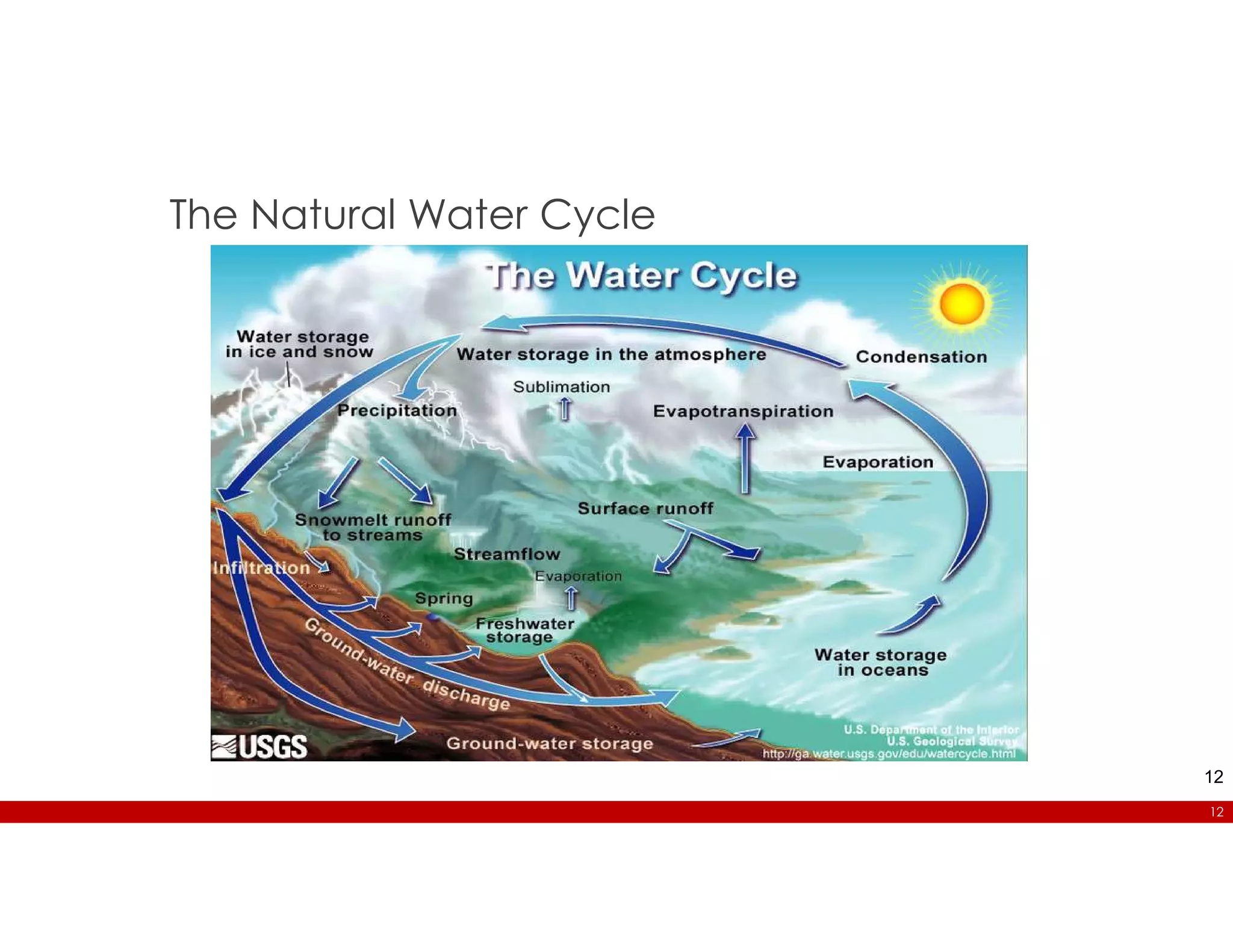
12
The Natural Water Cycle
12
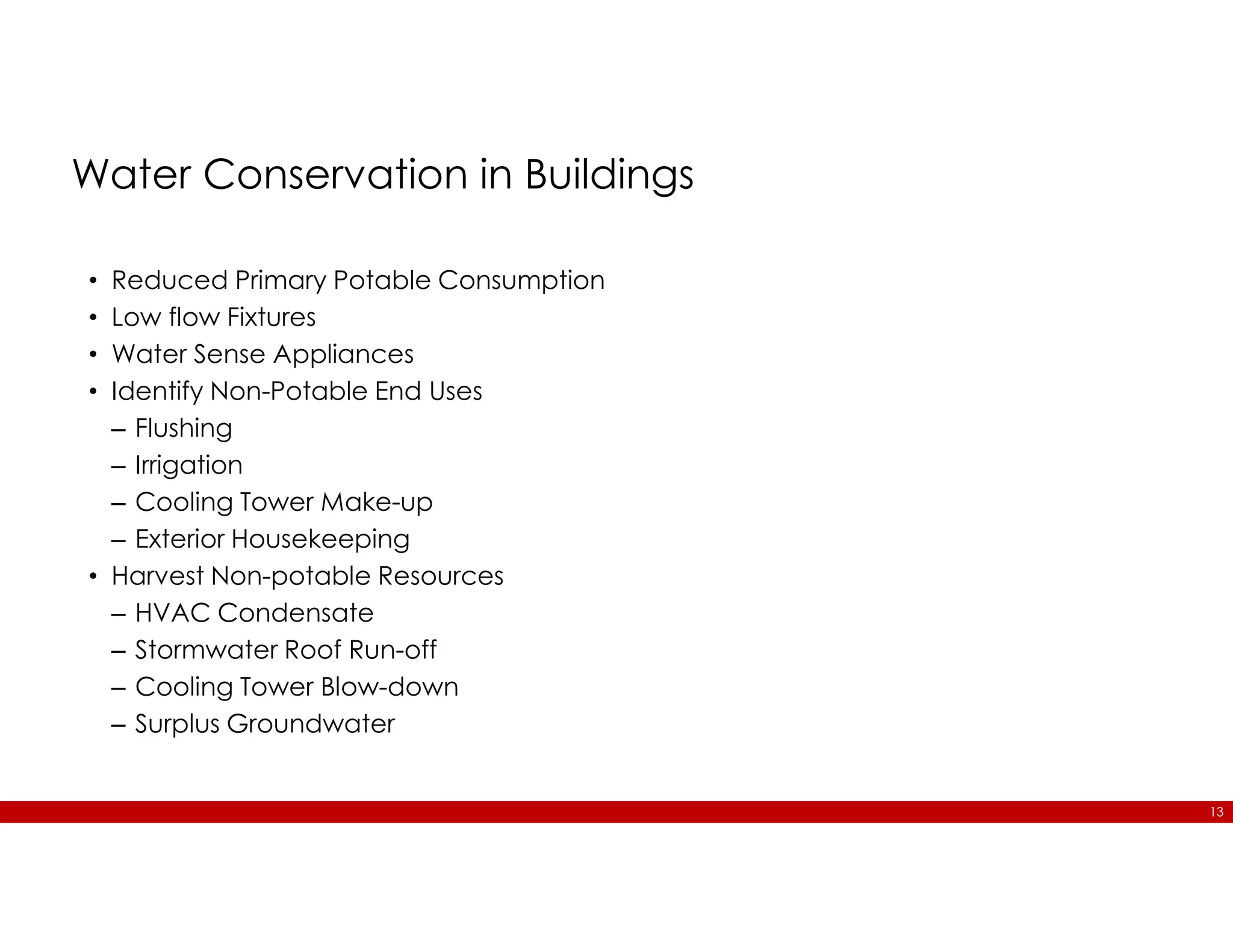
13
Water Conservation in Buildings
• Reduced Primary Potable Consumption
• Low flow Fixtures
• Water Sense Appliances
• Identify Non-Potable End Uses
– Flushing
– Irrigation
– Cooling Tower Make-up
– Exterior Housekeeping
• Harvest Non-potable Resources
– HVAC Condensate
– Stormwater Roof Run-off
– Cooling Tower Blow-down
– Surplus Groundwater
14
Residential Low Flow Plumbing Fixtures
14
Up to
33% Savings
6.0 L/flush (typical)
vs.
3 L/flush
Private Toilets
(dual flush water closets)
9.5 L/flush (typical)
vs.
7.6 L/min
Up to
20% Savings
Up to
28% Savings
9.5 L/min (typical)
vs.
6.8 L/min
Kitchen Faucet
Up to 80% Savings
8.33 L/min (typical)
vs.
1.9 L/min
Lavatory Faucet
Residential Shower Head
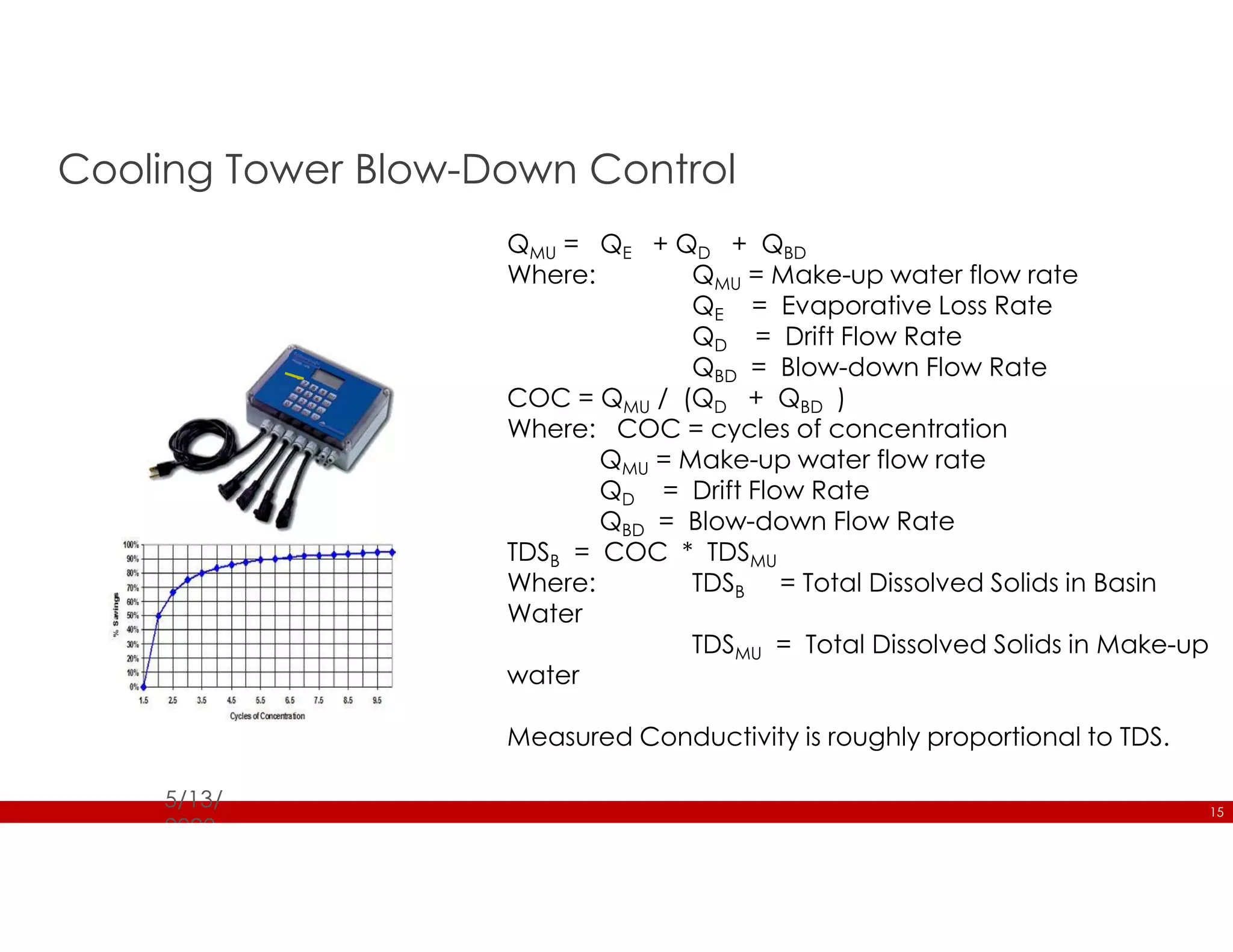
15
Cooling Tower Blow-Down Control
5/13/
2020
QMU = QE + QD + QBD
Where: QMU = Make-up water flow rate
QE = Evaporative Loss Rate
QD = Drift Flow Rate
QBD = Blow-down Flow Rate
COC = QMU / (QD + QBD )
Where: COC = cycles of concentration
QMU = Make-up water flow rate
QD = Drift Flow Rate
QBD = Blow-down Flow Rate
TDSB = COC * TDSMU
Where: TDSB = Total Dissolved Solids in Basin
Water
TDSMU = Total Dissolved Solids in Make-up
water
Measured Conductivity is roughly proportional to TDS.
16
Irrigation Delivery and Control
5/13/
2020
17
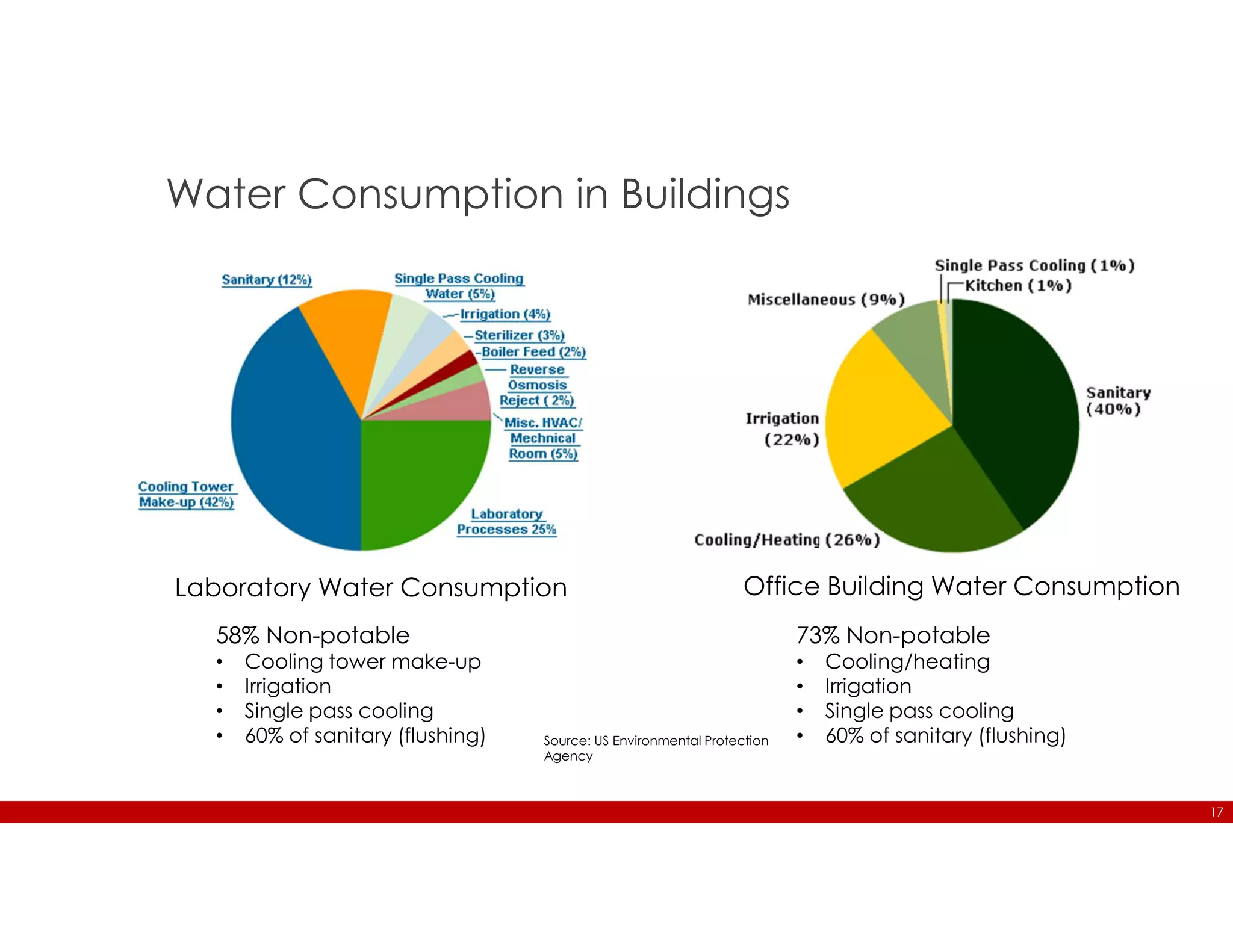
Water Consumption in Buildings
Source: US Environmental Protection
Agency
Laboratory Water Consumption Office Building Water Consumption
58% Non-potable
• Cooling tower make-up
• Irrigation
• Single pass cooling
• 60% of sanitary (flushing)
73% Non-potable
• Cooling/heating
• Irrigation
• Single pass cooling
• 60% of sanitary (flushing)
18
Alternative Sources of Non-Potable Water
Water Source Debris Suspended
Solids
Dissolved
Inorganics
Dissolved
Organics
Microbia
City Water None Very Low Low Very Low Very Low
HVAC Condensate None Very Low Very Low Very Low Very Low
Stormwater
(Roof)
Low Medium Low Low Low
Stormwater
(Grade)
Medium Medium Varies Varies Medium
Washwater Low Low Low Medium Low
CT Blowdown Low Medium Medium Low Low
STP Effluent None Very Low Low Very Low Very Low
Blackwater High High Medium High High
Alternative Sources of Non-Potable Water
19
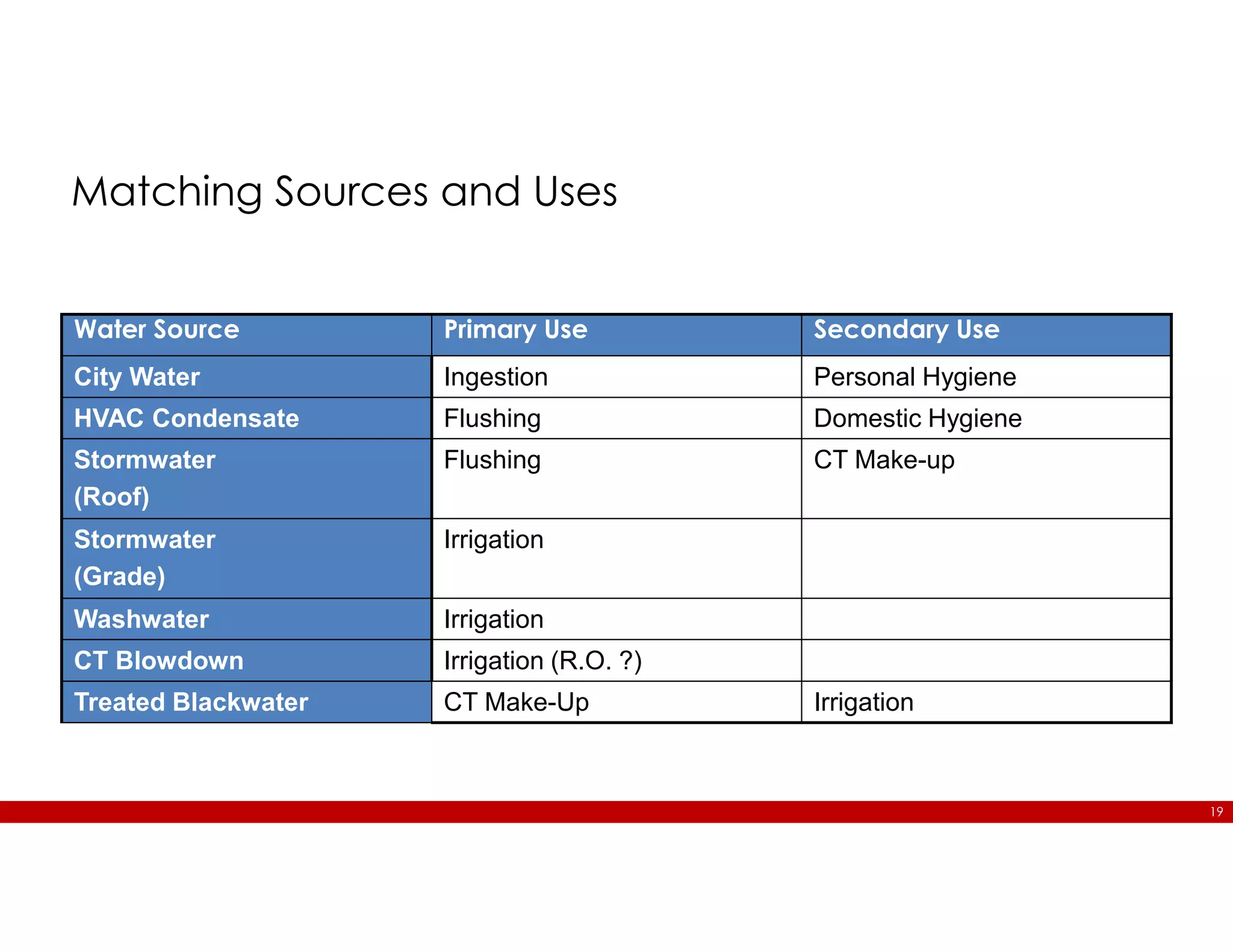
Water Source Primary Use Secondary Use
City Water Ingestion Personal Hygiene
HVAC Condensate Flushing Domestic Hygiene
Stormwater
(Roof)
Flushing CT Make-up
Stormwater
(Grade)
Irrigation
Washwater Irrigation
CT Blowdown Irrigation (R.O. ?)
Treated Blackwater CT Make-Up Irrigation
Matching Sources and Uses
20
Criteria for Using Non-Potable Water
21
5/13/2020 21
Greywater (Wash Water) Characteristics
22
5/13/2020 22
Greywater Harvesting for Trickle Irrigation
23
5/13/2020 23
Using Greywater
24
5/13/2020 24
Criteria for Interior Usage of Recycled Water
Summary of ANSI/NSF Standard 350 Effluent Criteria for Graywater Treatment
Systems
Parameter Class C (Commercial or Multi-Family Interior Use)
Test Average Single Sample Maximum
CBOD5 (mg/L) 10 25
TSS (mg/L) 10 30
Turbidity (NTU) 2 5
E. coli 2
(MPN/100 mL)
2.2 200
pH (SU) 6.0 – 9.0 NA
Storage vessel
disinfection
(mg/L)3
≥ 0.5 – ≤ 2.5 NA
Color MR NA
Odor Nonoffensive NA
Oily film and foam Nondetectable Nondetectable
1 NA: not applicable
2 Calculated as geometric mean
3 As total chlorine; other disinfectants can be used
25
5/13/2020 25
Rainwater Harvesting for Interior Use
DIN 1989 Tank Sizing Standard
VT = lesser of
.06 * AR * RAA * Ya * KRO * eF
Or .06 * D
Where: VT = volume of storage tank
AR = area of catchment roof
RAA = annual average rainfall
KRO = roof yield (0.4 to 0.75)
eF = efficiency of the filter
D = annual water consumption
for targeted end use
26
5/13/2020 26
HVAC Condensate Recovery for Interior Use
• Tank typically sized for 1 design day
condensate production
• Tank may much smaller for
continuous usage such at CT make-up
• Make-up float valve only keeps lift
pump inlet submerged
27
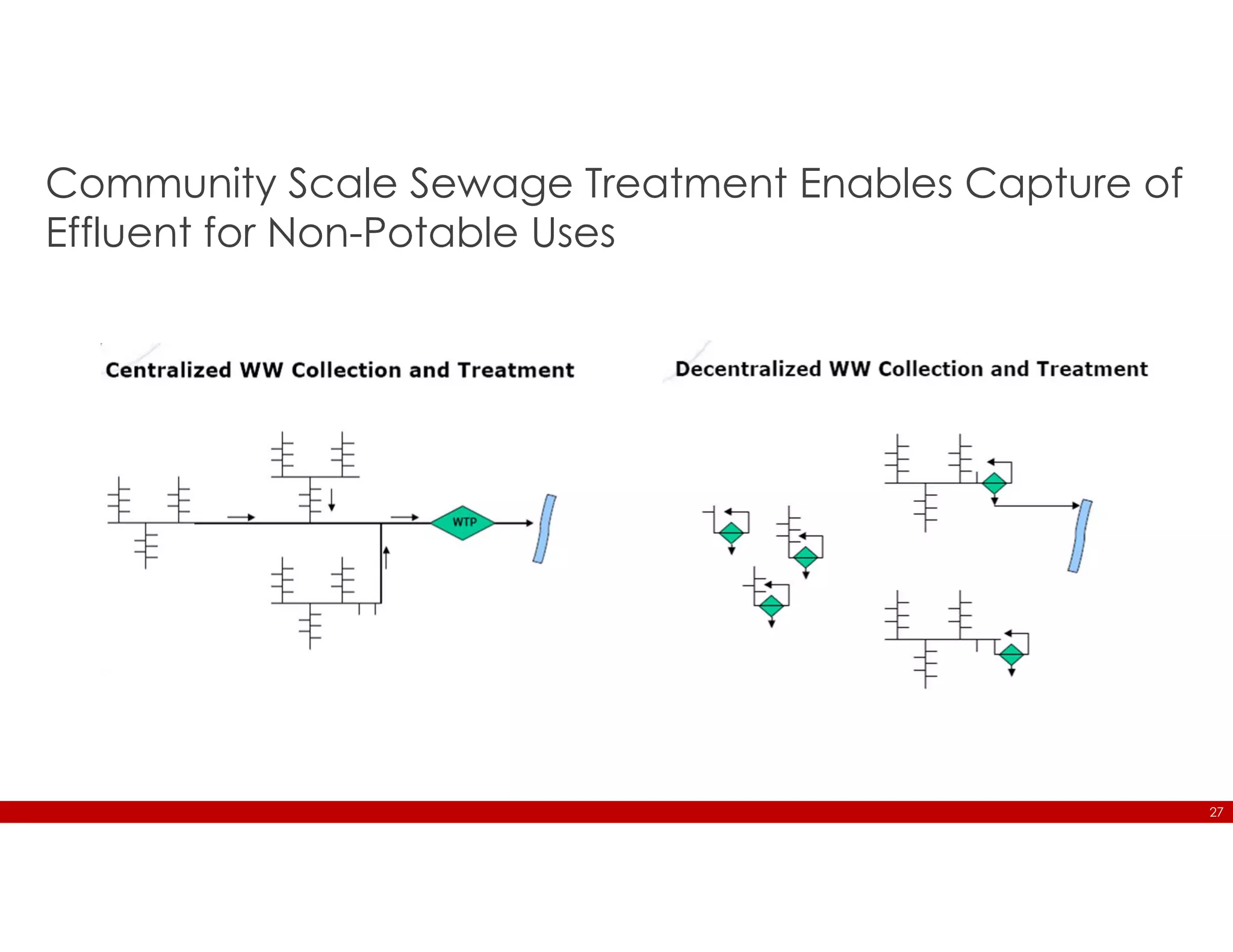
Community Scale Sewage Treatment Enables Capture of
Effluent for Non-Potable Uses
28
DEWATS – Decentralized Waste Water Treatment
System
29
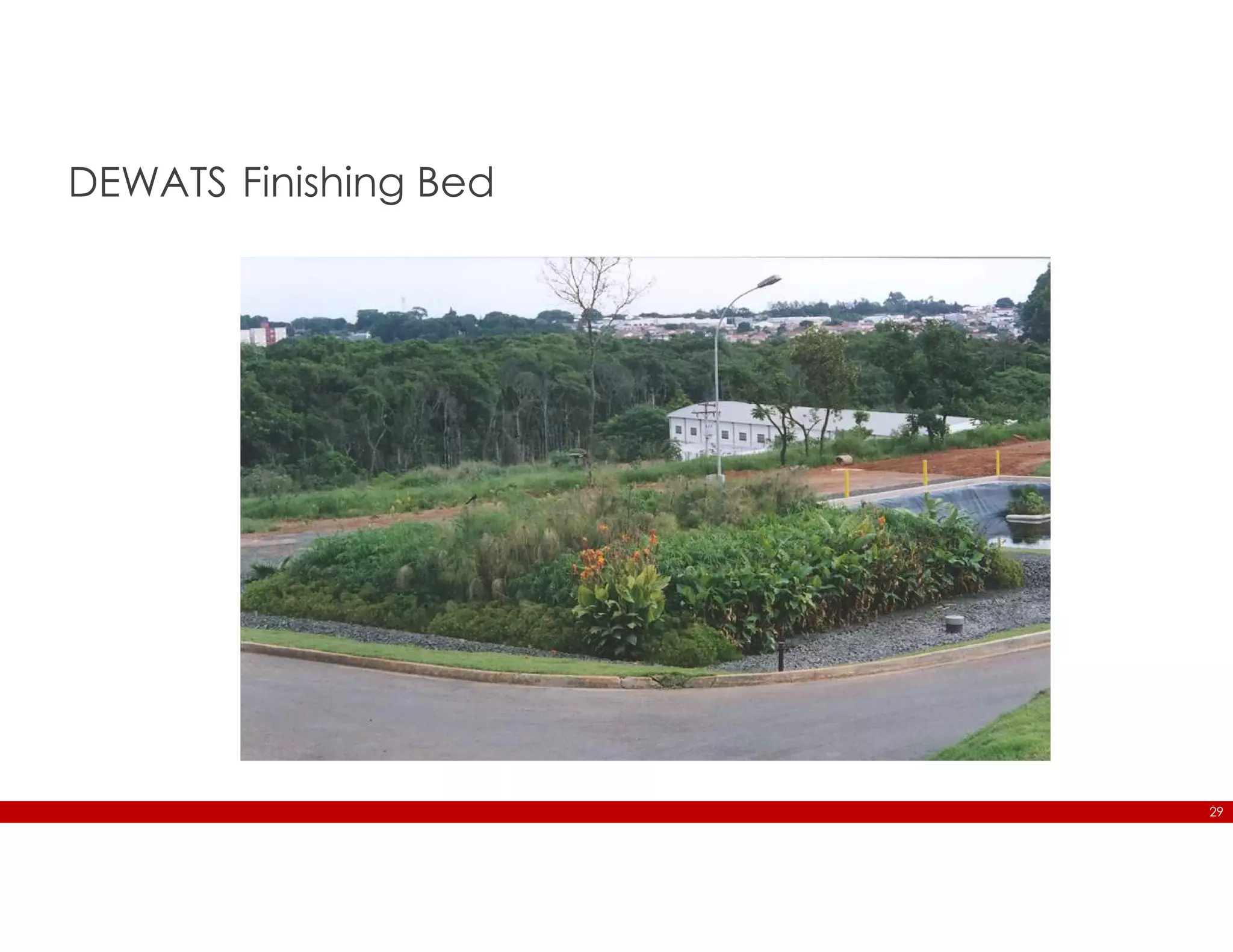
DEWATS Finishing Bed
30
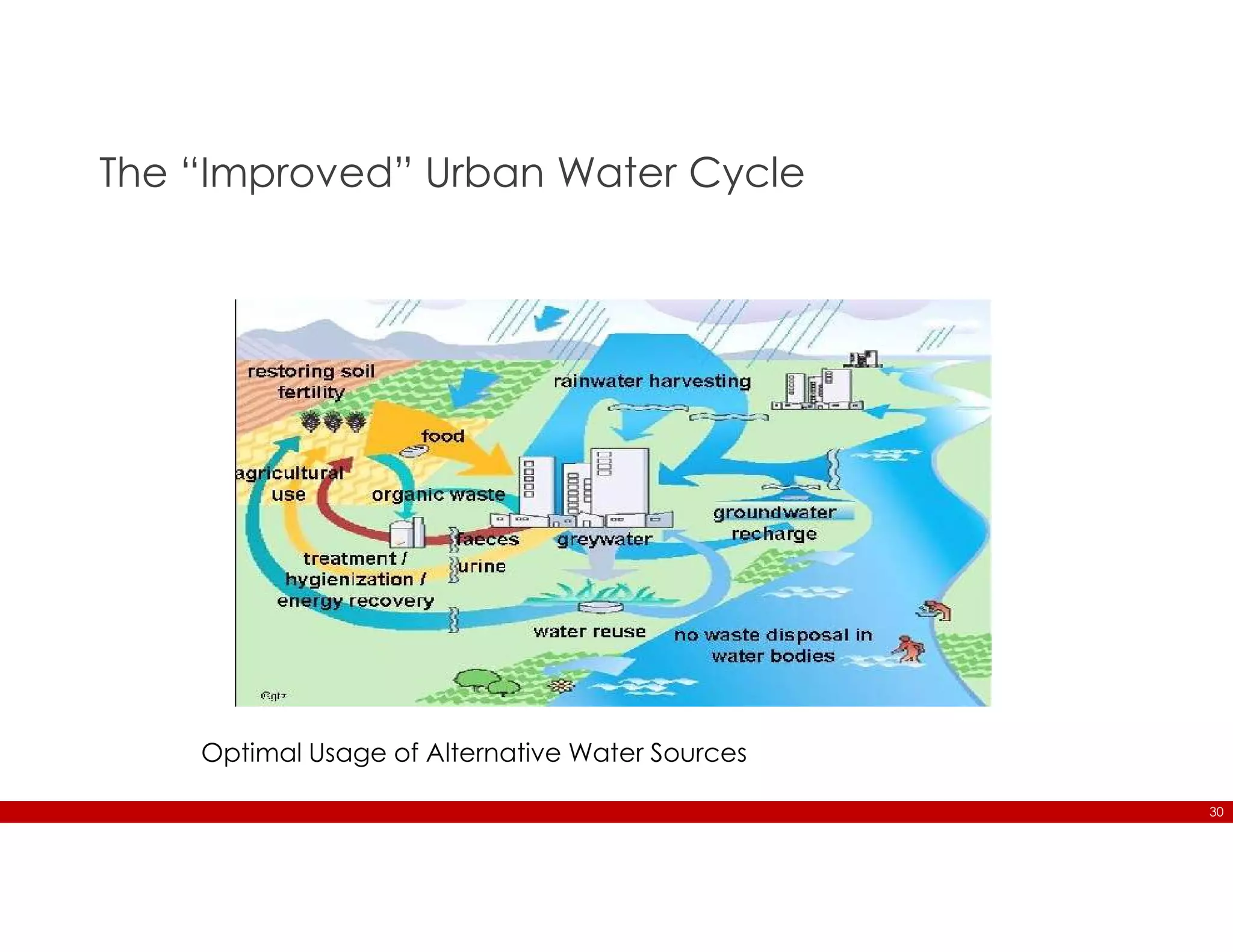
The “Improved” Urban Water Cycle
Optimal Usage of Alternative Water Sources
31
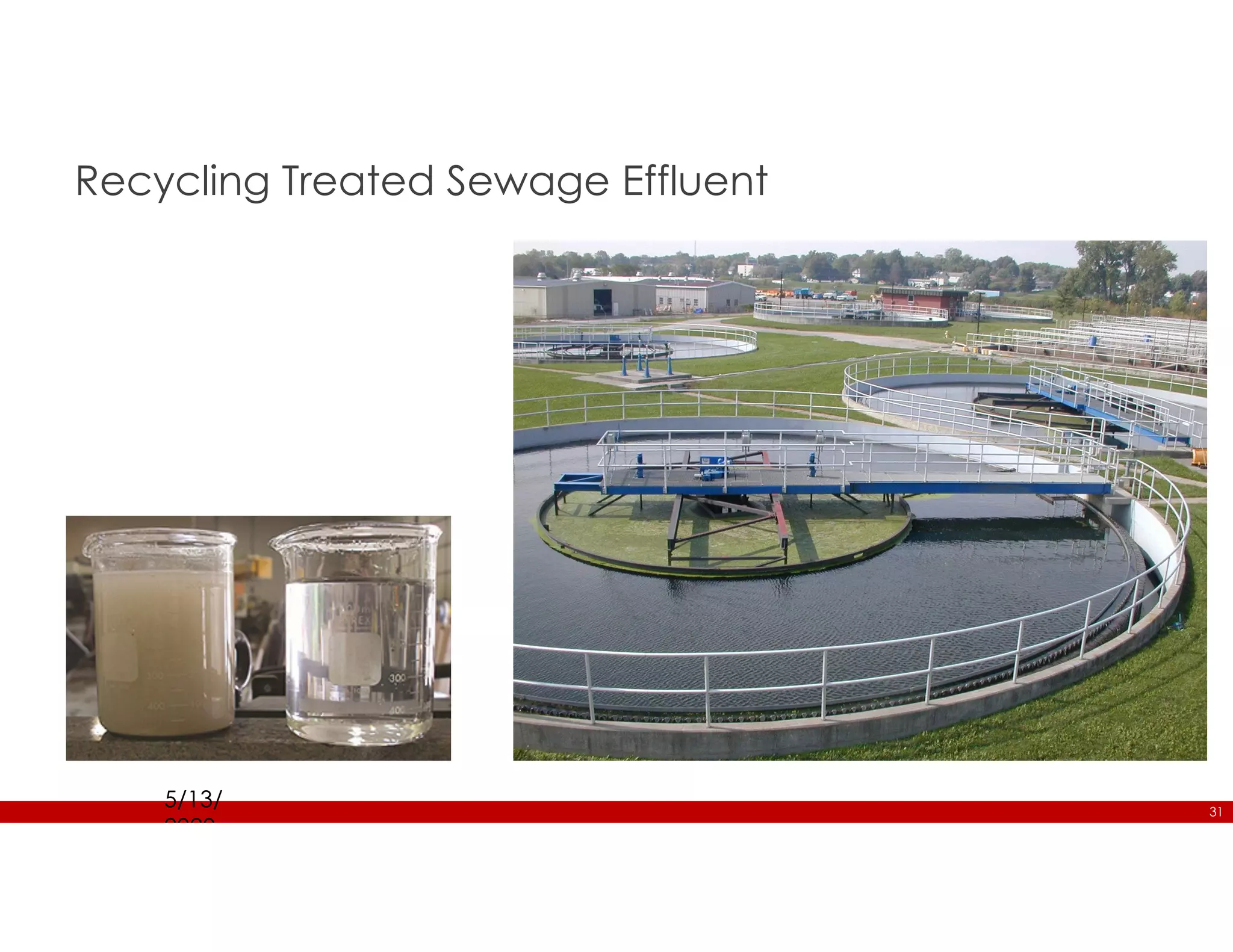
Recycling Treated Sewage Effluent
5/13/
2020
32
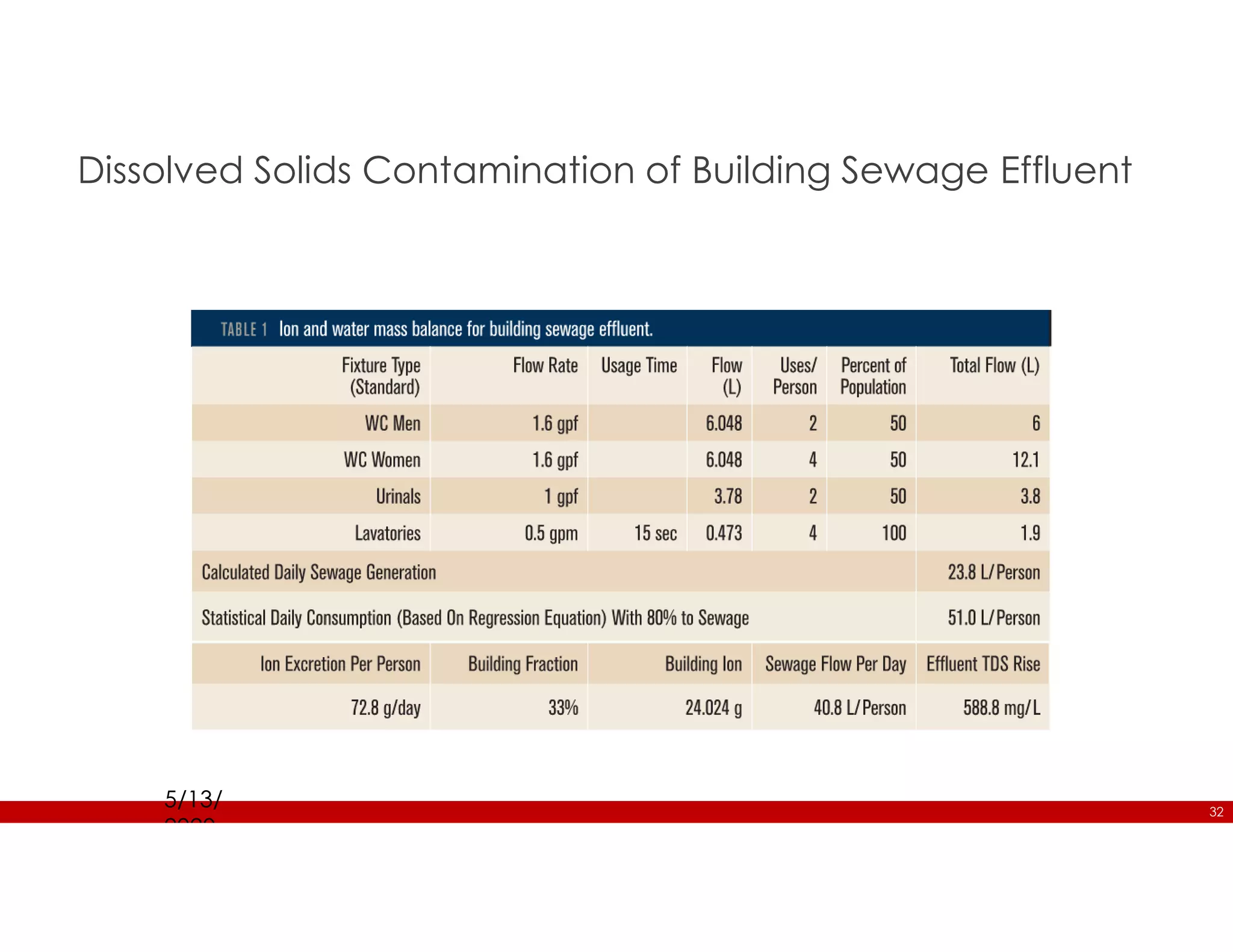
Dissolved Solids Contamination of Building Sewage Effluent
5/13/
2020
33
High TDS to Flushing; Rainwater/Condensate to CT
5/13/
2020
34
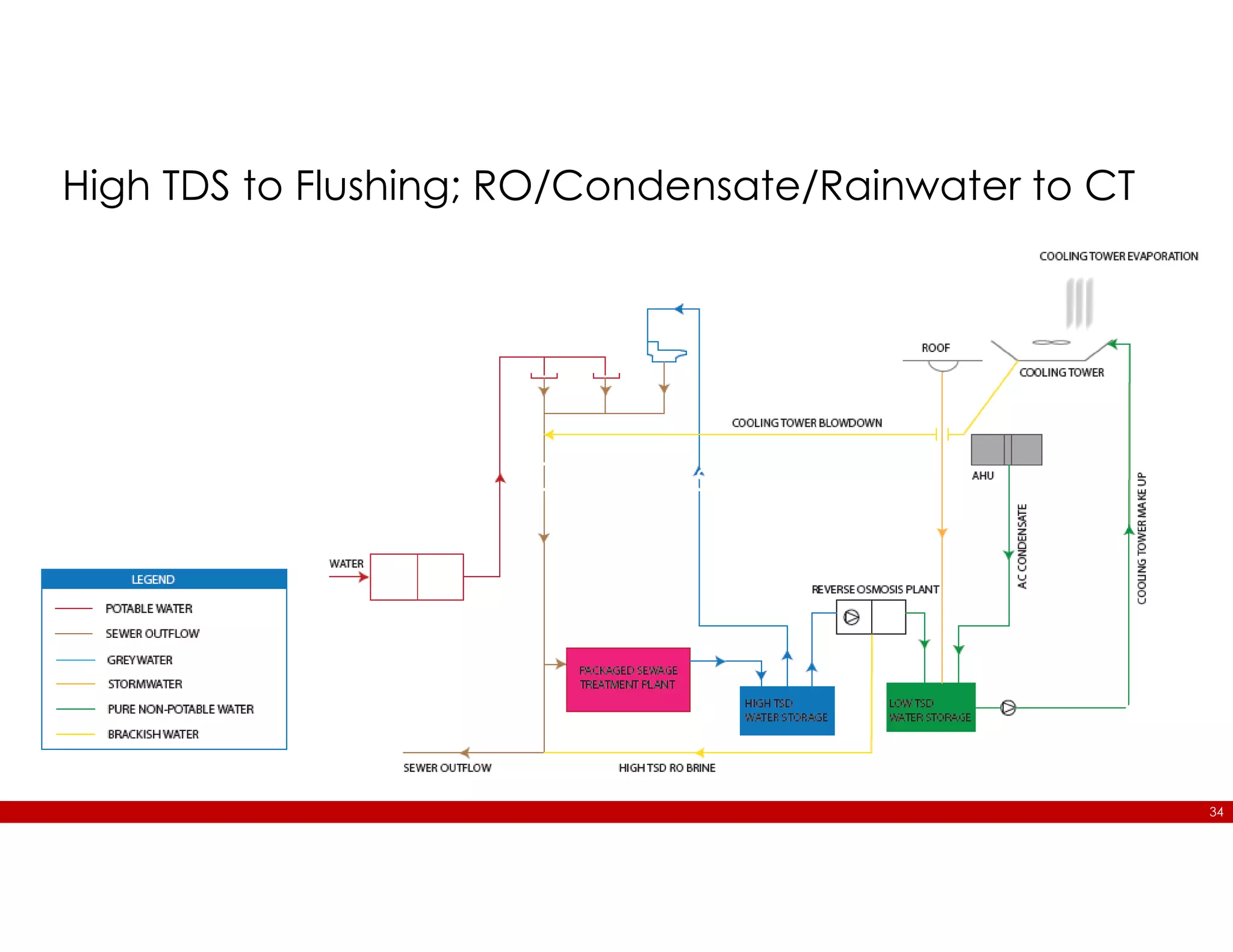
High TDS to Flushing;
High TDS to Flushing; RO/Condensate/Rainwater to CT
35
Net Zero Liquid Discharge CT Water Treatment
5/13/
2020
36
-
5,000,000
10,000,000
15,000,000
20,000,000
25,000,000
30,000,000
35,000,000
1 2 3 4
L/Year
Water Re-Use Strategy
Potable Water Consumption by End-Use
Misc. Potable Uses CT Make-up Flushing Water
Sewage Effluent Flushing
Only
Comparison of 3 Water Recycling Strategies
5/13/
2020
CT with Zero Liquid DischargeSewage Effluent
Flushing; Blowdown
RO
Base Case; No
Recovery
37
Case Study – Godrej Headquarters
LEED Platinum – India Green Building Council LEED NC
38
Godrej Water Efficiency Measures
 Potable Water Use limited to Ingestion, Personal Hygiene and
Food Service
 All Other Uses Non-Potable
 Non-potable Resource Reclamation
− HVAC Condensate Centrally collected
− One Million Gallon Stormwater Storage Tank
− Brackish Foundation Drain Effluent Collected
− Cooling Tower Blowdown Collected
 Reclaimed Water Treatment
− Stormwater Filtered and Chlorinated
− Tertiary Blackwater Treatment with MBR System
− CT Blowdown and Groundwater Treated with Reverse Osmosis to
Remove Dissolved Solids.*
* Removed from final design
39
Membrane Bioreactor Blackwater
Treatment
Effluent has Very Low BOD,
Little Impact on TDS
For Removal of Suspended or
Dissolved Organic Material
By M brannock at English Wikipedia,
40
40
Packaged Reverse Osmosis Systems
14,000 gpd input at 1500 ppm TDS
11,000 gpd output at 80 ppm TDS
3,000 gpd waste at 6,700 ppm TDS
< 1.0 kWh/ per m3 water output
For Removal of Dissolved Solids
(Inorganic Salts)
41
Godrej Headquarters Water Diagram
42
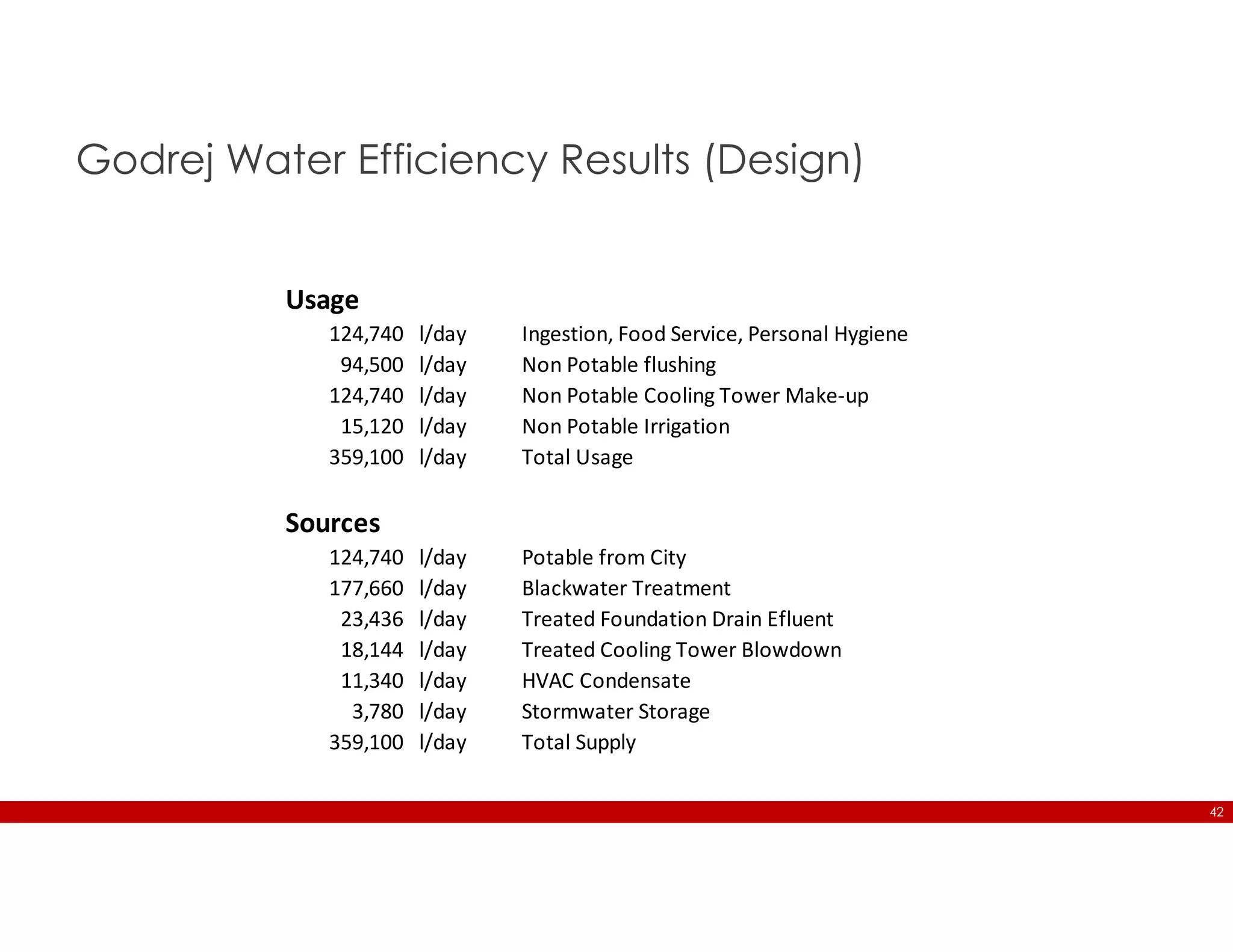
Godrej Water Efficiency Results (Design)
Usage
124,740 l/day Ingestion, Food Service, Personal Hygiene
94,500 l/day Non Potable flushing
124,740 l/day Non Potable Cooling Tower Make-up
15,120 l/day Non Potable Irrigation
359,100 l/day Total Usage
Sources
124,740 l/day Potable from City
177,660 l/day Blackwater Treatment
23,436 l/day Treated Foundation Drain Efluent
18,144 l/day Treated Cooling Tower Blowdown
11,340 l/day HVAC Condensate
3,780 l/day Stormwater Storage
359,100 l/day Total Supply
43
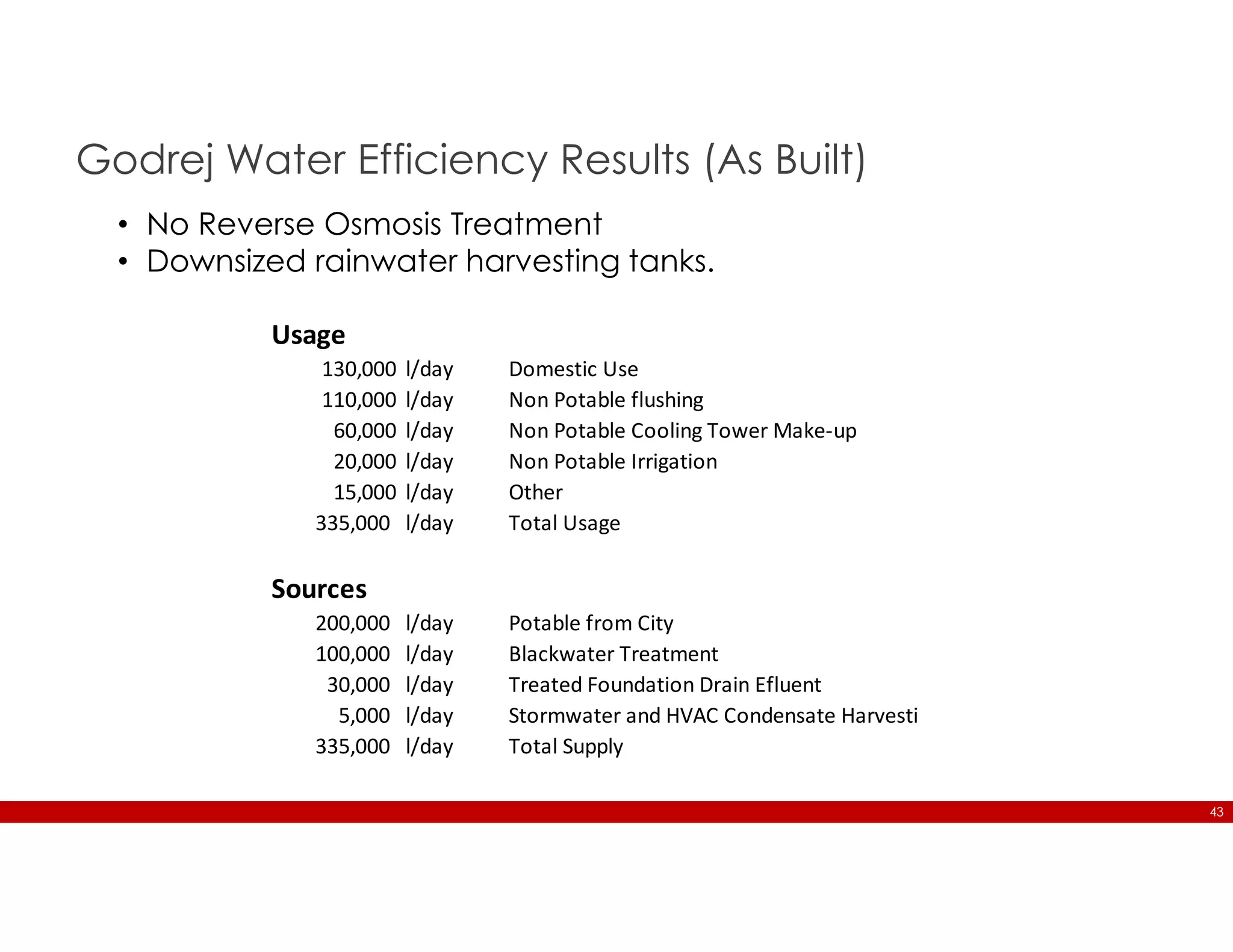
Godrej Water Efficiency Results (As Built)
Usage
130,000 l/day Domestic Use
110,000 l/day Non Potable flushing
60,000 l/day Non Potable Cooling Tower Make-up
20,000 l/day Non Potable Irrigation
15,000 l/day Other
335,000 l/day Total Usage
Sources
200,000 l/day Potable from City
100,000 l/day Blackwater Treatment
30,000 l/day Treated Foundation Drain Efluent
5,000 l/day Stormwater and HVAC Condensate Harvesting
335,000 l/day Total Supply
• No Reverse Osmosis Treatment
• Downsized rainwater harvesting tanks.
44
Godrej Headquarters, Mumbai, India
Architect – Pelli, Clarke, Pelli, New York, NY, USA
MEP Engineering – WSP Flack + Kurtz, New York, NY, USA
The engineering work described here was performed or supervised
by Daniel H. Nall, PE, FAIA while he was a Senior Vice President at
WSP Flack + Kurtz, in New York City, NY
5/13/2020 44
ACKNOWLEDGEMENTS:
Questions?
THANK YOU!
Dan Nall, P.E., FAIA, FASHRAE, LEED Fellow, BEMP, HBDP,CPHC
dannall@mindspring.com

Water conservation in building systems design

  • 1.
    1 5/13/2020 WATER CONSERVATION INBUILDING DESIGN Daniel H. Nall, PE, FAIA, FASHRAE, LEED Fellow, BEMP, HPDP, CPHC Daniel Nall Consultant, LLC
  • 2.
    2 ASHRAE is aRegistered Provider with The American Institute of Architects Continuing Education Systems. Credit earned on completion of this program will be reported to CES Records for AIA members. Certificates of Completion for non-AIA members are available on request. This program is registered with the AIA/CES for continuing professional education. As such, it does not include content that may be deemed or construed to be an approval or endorsement by the AIA of any material of construction or any method or manner of handling, using, distributing, or dealing in any material or product. Questions related to specific materials, methods, and services will be addressed at the conclusion of this presentation.
  • 3.
    6 GBCI cannot guaranteethat course sessions will be delivered to you as submitted to GBCI. However, any course found to be in violation of the standards of the program, or otherwise contrary to the mission of GBCI, shall be removed. Your course evaluations will help us uphold these standards. Course ID: 0920005383 WATER CONSERVATION IN BUILDING DESIGN By ASHRAE Approved for: 1General CE hours 0LEED-specific hours
  • 4.
    4 This presentation willdiscuss options for water conservation and wastewater harvesting techniques. Technology for water conservation will be discussed. Utilization of on-site non-potable water resources will be discussed, and methods of capturing and treating these resources will be presented. The requirements of water consumption end-uses that can benefit from non- potable resources will be presented, along with technical issues that limit the exploitation of these resources. A case study showing a 2/3 reduction in potable water consumption through the utilization of both conservation measures and non-potable water harvesting will be presented Course Description
  • 5.
    5 Learning Objectives 1. Recognizehow HVAC systems use water and how they generate non-potable water resources. 2. Integrate different strategies of water conservation for dramatic reductions in consumption. 3. Allocate different types of reclaimed water to different types of non-potable uses. 4. Overcome contamination issues to optimize re-use of harvested waste water. At the end of this course, participants will be able to:
  • 6.
    ASHRAE WILL GIVE YOUTHE WORLD ASHRAE WILL GIVE YOU THE WORLD This ASHRAE Distinguished Lecturer is brought to you by the Society Chapter Technology Transfer Committee
  • 7.
    Complete the DistinguishedLecturer Event Summary Critique CTTC needs your feedback to continue to improve the DL Program Distribute the DL Evaluation Form to all attendees Collect at the end of the meeting Compile the attendee rating on the Event Summary Critique Send the completed Event Summary Critique to your CTTC RVC and ASHRAE Headquarters CTTC needs your feedback to continue to improve the DL Program Distribute the DL Evaluation Form to all attendees Collect at the end of the meeting Compile the attendee rating on the Event Summary Critique Send the completed Event Summary Critique to your CTTC RVC and ASHRAE Headquarters Forms are available at: www.ashrae.org/distinguishedlecturers
  • 8.
    BECOME A FUTURELEADER IN ASHRAE – WRITE THE NEXT CHAPTER IN YOUR CAREER BECOME A FUTURE LEADER IN ASHRAE – WRITE THE NEXT CHAPTER IN YOUR CAREER YOU ARE NEEDED FOR:  Membership Promotion  Research Promotion  Student Activities  Chapter Technology Transfer Technical Committees YOU ARE NEEDED FOR:  Membership Promotion  Research Promotion  Student Activities  Chapter Technology Transfer Technical Committees Find your Place in ASHRAE! Visit www.ashrae.orgFind your Place in ASHRAE! Visit www.ashrae.org ASHRAE Members who attend their monthly chapter meetings become leaders and bring information and technology back to their job.
  • 9.
    9 • The upcomingwater crisis and the natural water cycle • Water conservation opportunities in buildings • Non-potable water resources in buildings and end-uses that don’t require potable water • Non-potable water treatment options for buildings • The total dissolved solids issue for treated wastewater and methods of dealing with that issue. • A successful case study for dramatic water use reduction. 5/13/2020 9 Presentation Outline
  • 10.
  • 11.
    11 Per Capita WaterConsumption 5/13/2020 11
  • 12.
  • 13.
    13 Water Conservation inBuildings • Reduced Primary Potable Consumption • Low flow Fixtures • Water Sense Appliances • Identify Non-Potable End Uses – Flushing – Irrigation – Cooling Tower Make-up – Exterior Housekeeping • Harvest Non-potable Resources – HVAC Condensate – Stormwater Roof Run-off – Cooling Tower Blow-down – Surplus Groundwater
  • 14.
    14 Residential Low FlowPlumbing Fixtures 14 Up to 33% Savings 6.0 L/flush (typical) vs. 3 L/flush Private Toilets (dual flush water closets) 9.5 L/flush (typical) vs. 7.6 L/min Up to 20% Savings Up to 28% Savings 9.5 L/min (typical) vs. 6.8 L/min Kitchen Faucet Up to 80% Savings 8.33 L/min (typical) vs. 1.9 L/min Lavatory Faucet Residential Shower Head
  • 15.
    15 Cooling Tower Blow-DownControl 5/13/ 2020 QMU = QE + QD + QBD Where: QMU = Make-up water flow rate QE = Evaporative Loss Rate QD = Drift Flow Rate QBD = Blow-down Flow Rate COC = QMU / (QD + QBD ) Where: COC = cycles of concentration QMU = Make-up water flow rate QD = Drift Flow Rate QBD = Blow-down Flow Rate TDSB = COC * TDSMU Where: TDSB = Total Dissolved Solids in Basin Water TDSMU = Total Dissolved Solids in Make-up water Measured Conductivity is roughly proportional to TDS.
  • 16.
    16 Irrigation Delivery andControl 5/13/ 2020
  • 17.
    17 Water Consumption inBuildings Source: US Environmental Protection Agency Laboratory Water Consumption Office Building Water Consumption 58% Non-potable • Cooling tower make-up • Irrigation • Single pass cooling • 60% of sanitary (flushing) 73% Non-potable • Cooling/heating • Irrigation • Single pass cooling • 60% of sanitary (flushing)
  • 18.
    18 Alternative Sources ofNon-Potable Water Water Source Debris Suspended Solids Dissolved Inorganics Dissolved Organics Microbia City Water None Very Low Low Very Low Very Low HVAC Condensate None Very Low Very Low Very Low Very Low Stormwater (Roof) Low Medium Low Low Low Stormwater (Grade) Medium Medium Varies Varies Medium Washwater Low Low Low Medium Low CT Blowdown Low Medium Medium Low Low STP Effluent None Very Low Low Very Low Very Low Blackwater High High Medium High High Alternative Sources of Non-Potable Water
  • 19.
    19 Water Source PrimaryUse Secondary Use City Water Ingestion Personal Hygiene HVAC Condensate Flushing Domestic Hygiene Stormwater (Roof) Flushing CT Make-up Stormwater (Grade) Irrigation Washwater Irrigation CT Blowdown Irrigation (R.O. ?) Treated Blackwater CT Make-Up Irrigation Matching Sources and Uses Matching Sources and Uses
  • 20.
    20 Criteria for UsingNon-Potable Water
  • 21.
    21 5/13/2020 21 Greywater (WashWater) Characteristics
  • 22.
  • 23.
  • 24.
    24 5/13/2020 24 Criteria forInterior Usage of Recycled Water Summary of ANSI/NSF Standard 350 Effluent Criteria for Graywater Treatment Systems Parameter Class C (Commercial or Multi-Family Interior Use) Test Average Single Sample Maximum CBOD5 (mg/L) 10 25 TSS (mg/L) 10 30 Turbidity (NTU) 2 5 E. coli 2 (MPN/100 mL) 2.2 200 pH (SU) 6.0 – 9.0 NA Storage vessel disinfection (mg/L)3 ≥ 0.5 – ≤ 2.5 NA Color MR NA Odor Nonoffensive NA Oily film and foam Nondetectable Nondetectable 1 NA: not applicable 2 Calculated as geometric mean 3 As total chlorine; other disinfectants can be used
  • 25.
    25 5/13/2020 25 Rainwater Harvestingfor Interior Use DIN 1989 Tank Sizing Standard VT = lesser of .06 * AR * RAA * Ya * KRO * eF Or .06 * D Where: VT = volume of storage tank AR = area of catchment roof RAA = annual average rainfall KRO = roof yield (0.4 to 0.75) eF = efficiency of the filter D = annual water consumption for targeted end use
  • 26.
    26 5/13/2020 26 HVAC CondensateRecovery for Interior Use • Tank typically sized for 1 design day condensate production • Tank may much smaller for continuous usage such at CT make-up • Make-up float valve only keeps lift pump inlet submerged
  • 27.
    27 Community Scale SewageTreatment Enables Capture of Effluent for Non-Potable Uses
  • 28.
    28 DEWATS – DecentralizedWaste Water Treatment System
  • 29.
  • 30.
    30 The “Improved” UrbanWater Cycle Optimal Usage of Alternative Water Sources
  • 31.
    31 Recycling Treated SewageEffluent 5/13/ 2020
  • 32.
    32 Dissolved Solids Contaminationof Building Sewage Effluent 5/13/ 2020
  • 33.
    33 High TDS toFlushing; Rainwater/Condensate to CT 5/13/ 2020
  • 34.
    34 High TDS toFlushing; High TDS to Flushing; RO/Condensate/Rainwater to CT
  • 35.
    35 Net Zero LiquidDischarge CT Water Treatment 5/13/ 2020
  • 36.
    36 - 5,000,000 10,000,000 15,000,000 20,000,000 25,000,000 30,000,000 35,000,000 1 2 34 L/Year Water Re-Use Strategy Potable Water Consumption by End-Use Misc. Potable Uses CT Make-up Flushing Water Sewage Effluent Flushing Only Comparison of 3 Water Recycling Strategies 5/13/ 2020 CT with Zero Liquid DischargeSewage Effluent Flushing; Blowdown RO Base Case; No Recovery
  • 37.
    37 Case Study –Godrej Headquarters LEED Platinum – India Green Building Council LEED NC
  • 38.
    38 Godrej Water EfficiencyMeasures  Potable Water Use limited to Ingestion, Personal Hygiene and Food Service  All Other Uses Non-Potable  Non-potable Resource Reclamation − HVAC Condensate Centrally collected − One Million Gallon Stormwater Storage Tank − Brackish Foundation Drain Effluent Collected − Cooling Tower Blowdown Collected  Reclaimed Water Treatment − Stormwater Filtered and Chlorinated − Tertiary Blackwater Treatment with MBR System − CT Blowdown and Groundwater Treated with Reverse Osmosis to Remove Dissolved Solids.* * Removed from final design
  • 39.
    39 Membrane Bioreactor Blackwater Treatment Effluenthas Very Low BOD, Little Impact on TDS For Removal of Suspended or Dissolved Organic Material By M brannock at English Wikipedia,
  • 40.
    40 40 Packaged Reverse OsmosisSystems 14,000 gpd input at 1500 ppm TDS 11,000 gpd output at 80 ppm TDS 3,000 gpd waste at 6,700 ppm TDS < 1.0 kWh/ per m3 water output For Removal of Dissolved Solids (Inorganic Salts)
  • 41.
  • 42.
    42 Godrej Water EfficiencyResults (Design) Usage 124,740 l/day Ingestion, Food Service, Personal Hygiene 94,500 l/day Non Potable flushing 124,740 l/day Non Potable Cooling Tower Make-up 15,120 l/day Non Potable Irrigation 359,100 l/day Total Usage Sources 124,740 l/day Potable from City 177,660 l/day Blackwater Treatment 23,436 l/day Treated Foundation Drain Efluent 18,144 l/day Treated Cooling Tower Blowdown 11,340 l/day HVAC Condensate 3,780 l/day Stormwater Storage 359,100 l/day Total Supply
  • 43.
    43 Godrej Water EfficiencyResults (As Built) Usage 130,000 l/day Domestic Use 110,000 l/day Non Potable flushing 60,000 l/day Non Potable Cooling Tower Make-up 20,000 l/day Non Potable Irrigation 15,000 l/day Other 335,000 l/day Total Usage Sources 200,000 l/day Potable from City 100,000 l/day Blackwater Treatment 30,000 l/day Treated Foundation Drain Efluent 5,000 l/day Stormwater and HVAC Condensate Harvesting 335,000 l/day Total Supply • No Reverse Osmosis Treatment • Downsized rainwater harvesting tanks.
  • 44.
    44 Godrej Headquarters, Mumbai,India Architect – Pelli, Clarke, Pelli, New York, NY, USA MEP Engineering – WSP Flack + Kurtz, New York, NY, USA The engineering work described here was performed or supervised by Daniel H. Nall, PE, FAIA while he was a Senior Vice President at WSP Flack + Kurtz, in New York City, NY 5/13/2020 44 ACKNOWLEDGEMENTS:
  • 45.
    Questions? THANK YOU! Dan Nall,P.E., FAIA, FASHRAE, LEED Fellow, BEMP, HBDP,CPHC dannall@mindspring.com