WASTE CYCLE
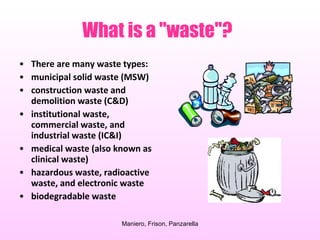
What is a "waste"?   There are many waste types: municipal solid waste (MSW) construction waste and demolition waste (C&D) institutional waste, commercial waste, and industrial waste (IC&I) medical waste (also known as clinical waste) hazardous waste, radioactive waste, and electronic waste biodegradable waste
How much waste we produce?   Some data provided by WWF shows a production of solid waste per year, in Italy alone, about 26 million tons, more than 70,000 metric tons per day, more than one kilogram per capita per day and the forecasts announce the achievement of a quota of 32 million tons in 2005. for industrial waste but the same source estimates an annual production of 40 million tons.
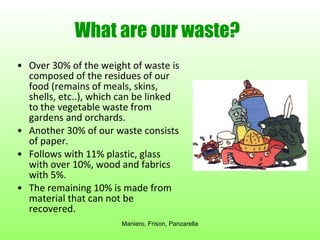
What are our waste?   Over 30% of the weight of waste is composed of the residues of our food (remains of meals, skins, shells, etc..), which can be linked to the vegetable waste from gardens and orchards.  Another 30% of our waste consists of paper.  Follows with 11% plastic, glass with over 10%, wood and fabrics with 5%.  The remaining 10% is made from material that can not be recovered.
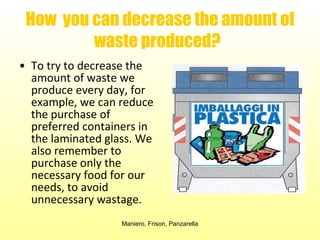
How  you can decrease the amount of waste produced?   To try to decrease the amount of waste we produce every day, for example, we can reduce the purchase of preferred containers in the laminated glass. We also remember to purchase only the necessary food for our needs, to avoid unnecessary wastage.
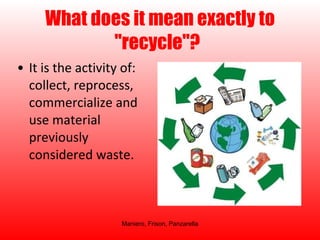
What does it mean exactly to "recycle"?   It is the activity of: collect, reprocess, commercialize and use material previously considered waste.
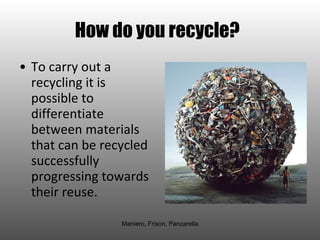
How do you recycle?   To carry out a recycling it is possible to differentiate between materials that can be recycled successfully progressing towards their reuse.
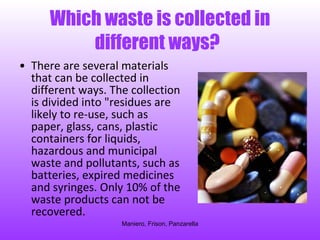
Which waste is collected in different ways?   There are several materials that can be collected in different ways. The collection is divided into "residues are likely to re-use, such as paper, glass, cans, plastic containers for liquids, hazardous and municipal waste and pollutants, such as batteries, expired medicines and syringes. Only 10% of the waste products can not be recovered.
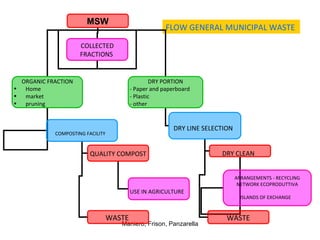
FLOW GENERAL MUNICIPAL WASTE   MSW COLLECTED FRACTIONS  ORGANIC FRACTION Home  market  pruning   DRY PORTION - Paper and paperboard - Plastic  - other  COMPOSTING FACILITY   DRY LINE SELECTION   QUALITY COMPOST WASTE  DRY CLEAN   WASTE USE IN AGRICULTURE   ARRANGEMENTS - RECYCLING NETWORK ECOPRODUTTIVA ISLANDS OF EXCHANGE

Waste cycle

  • 1.
  • 2.
    What is a"waste"? There are many waste types: municipal solid waste (MSW) construction waste and demolition waste (C&D) institutional waste, commercial waste, and industrial waste (IC&I) medical waste (also known as clinical waste) hazardous waste, radioactive waste, and electronic waste biodegradable waste
  • 3.
    How much wastewe produce? Some data provided by WWF shows a production of solid waste per year, in Italy alone, about 26 million tons, more than 70,000 metric tons per day, more than one kilogram per capita per day and the forecasts announce the achievement of a quota of 32 million tons in 2005. for industrial waste but the same source estimates an annual production of 40 million tons.
  • 4.
    What are ourwaste? Over 30% of the weight of waste is composed of the residues of our food (remains of meals, skins, shells, etc..), which can be linked to the vegetable waste from gardens and orchards. Another 30% of our waste consists of paper. Follows with 11% plastic, glass with over 10%, wood and fabrics with 5%. The remaining 10% is made from material that can not be recovered.
  • 5.
    How youcan decrease the amount of waste produced? To try to decrease the amount of waste we produce every day, for example, we can reduce the purchase of preferred containers in the laminated glass. We also remember to purchase only the necessary food for our needs, to avoid unnecessary wastage.
  • 6.
    What does itmean exactly to "recycle"? It is the activity of: collect, reprocess, commercialize and use material previously considered waste.
  • 7.
    How do yourecycle? To carry out a recycling it is possible to differentiate between materials that can be recycled successfully progressing towards their reuse.
  • 8.
    Which waste iscollected in different ways? There are several materials that can be collected in different ways. The collection is divided into "residues are likely to re-use, such as paper, glass, cans, plastic containers for liquids, hazardous and municipal waste and pollutants, such as batteries, expired medicines and syringes. Only 10% of the waste products can not be recovered.
  • 9.
    FLOW GENERAL MUNICIPALWASTE MSW COLLECTED FRACTIONS ORGANIC FRACTION Home market pruning DRY PORTION - Paper and paperboard - Plastic - other COMPOSTING FACILITY DRY LINE SELECTION QUALITY COMPOST WASTE DRY CLEAN WASTE USE IN AGRICULTURE ARRANGEMENTS - RECYCLING NETWORK ECOPRODUTTIVA ISLANDS OF EXCHANGE