SUZAN MEHMET GÖNÇ VOCATIONAL AND TRADE
ANATOLIAN HIGH SCHOOL
GERMANY, 23-25 FEBRUARY 2015
Waste
Also known as rubbish, trash, refuse, garbage,
junk… is unwanted or useless materials.
Wastes
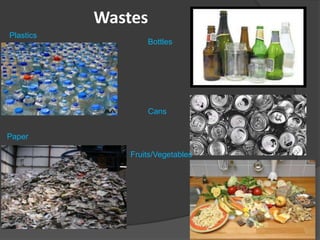
Fruits/Vegetables
Plastics
Paper
Bottles
Cans
Kinds of Wastes
Solid wastes: wastes in solid forms, domestic,
commercial and industrial wastes
Examples: plastics, bottles,cans, papers…
Liquid Wastes: wastes in liquid form
Examples: domestic washings, chemicals, oils…
Classification of Wastes According to
Their Biodegradability
Bio-degradable
can be degraded in nature
(paper, wood, fruits)
Non-biodegradable
cannot be degraded in nature
(plastics, bottles, old machines, cans)
Classification of Wastes According to
Their Effects on Human Health and the Environment
Hazardous wastes
Substances unsafe to use commercially, industrially,
agriculturally, or economically.
They have any of the following properties- ignitability,
corrosivity, reactivity & toxicity.
Non-hazardous
Substances safe to use commercially, industrially,
agriculturally, or economically.
They don’t have any of those properties mentioned
above.
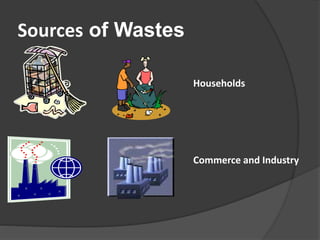
Sources of Wastes
Households
Commerce and Industry
How Much Waste Do We Create?
 Each person generates ~ 2.7 kg of waste each
day all over th world.
 The total amount of waste collected in Turkey
is 24.4 million tons per year in 2012.
 12.7 (~ %52) million tons of waste was directly
disposed of in landfills.
 0.3 million tons were treated in composting
facilities.
IMPACTS OF WASTE IF NOT MANAGED
1- Affects our health
2- Affects our socio-economic conditions
3- Affects our coastal and marine environment
4- Affects our climate
Impacts of waste on health
- Chemical poisoning through chemical inhalation
- Uncollected waste can lead to flood
- Cancer
- Congenital malformations
- Neurological disease
Effects of Waste on Animals and
Aquatics Life
- Increase in mercury level in fish due to
disposal of mercury in the rivers.
- Plastic found in oceans ingested by birds.
- Resulted in high algal population in rivers
and sea.
- Degrades water and soil quality.
Impacts of Waste on Environment
- Waste breaks down in landfills to form
methane, a potent greenhouse gas (GHGs)
- GHGs lead to change in climate
- Leads to leaching: is a process by which solid
waste enter soil and ground water and
contaminating them.
 U.S. Environment Protection Agency (2009)
It is estimated that;
«The food wasted by the US and Europe could
feed the world three times over.»
Every tons of food waste prevented has the
potential to save 4.2 tons of CO2 equivalent.
The Problem
More People
+ More Waste
= Less Available Landfill Space
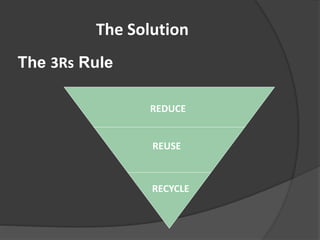
The 3Rs Rule
REDUCE
REUSE
RECYCLE
The Solution
WHAT SHOULD BE DONE
1- Reduce Waste
- Reduce office paper waste by using both sides.
- Redesign packaging to eliminate excess materials.
- Work with customers to design and implement a
packaging return program.
...
WHAT SHOULD BE DONE
2- Reuse
- Reuse office furniture and supplies, such as
envelopes, file folders, and paper.
- Use durable towels, tablecloths, dishes, cups, and
glasses.
- Encourage employees to reuse office materials rather
than new ones.
- Donate old books, old clothes, old computers …
3- Recycling
Wastes = Resources
RECYCLING PLANTS IN TURKEY
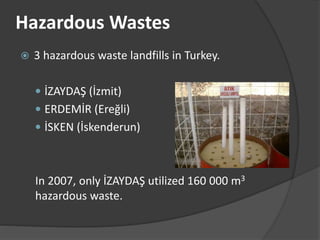
Hazardous Wastes
 3 hazardous waste landfills in Turkey.
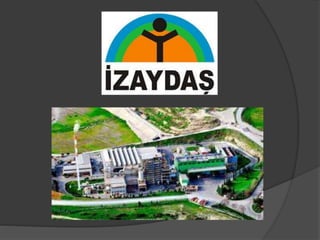
 İZAYDAŞ (İzmit)
 ERDEMİR (Ereğli)
 İSKEN (İskenderun)
In 2007, only İZAYDAŞ utilized 160 000 m3
hazardous waste.
Waste Oil
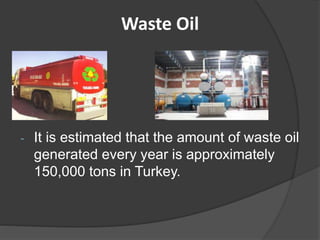
- It is estimated that the amount of waste oil
generated every year is approximately
150,000 tons in Turkey.
Used Batteries and Accumulators
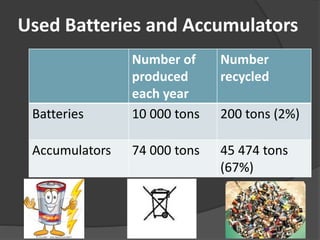
Number of
produced
each year
Number
recycled
Batteries 10 000 tons 200 tons (2%)
Accumulators 74 000 tons 45 474 tons
(67%)
Medical Waste
 According to data of year 2006 (Ministry of
Health),
91,323 tons of medical waste was
generated each year.
 In 2008, 12 681 tons of medical waste
(14% of the total) had been sterilized.
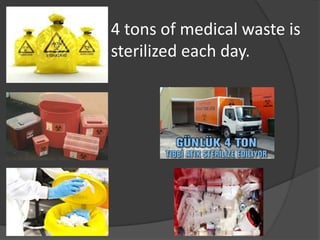
4 tons of medical waste is
sterilized each day.
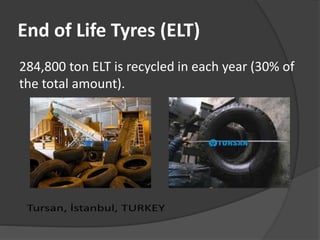
End of Life Tyres (ELT)
284,800 ton ELT is recycled in each year (30% of
the total amount).
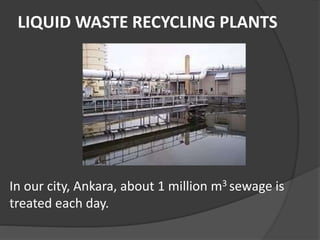
LIQUID WASTE RECYCLING PLANTS
In our city, Ankara, about 1 million m3 sewage is
treated each day.
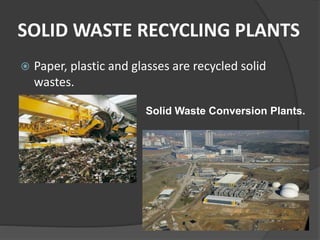
SOLID WASTE RECYCLING PLANTS
 Paper, plastic and glasses are recycled solid
wastes.
Solid Waste Conversion Plants.
 This area was a dump area about 10 years
ago.
 The genereted methane gas is converted to
electrical energy and some heat is produced as
a by-product.
 This heat is used to heat the water.
 This water is used to heat the greenhouses.
 As this area was a dump area the soil
quality is very low.
 So they cultivate plants without land.
 They put the seeds in bags with inorganic
substrats like perlit.
 Or they use water cultures.
MAMAK SOLID WASTE RECYCLING PLANT
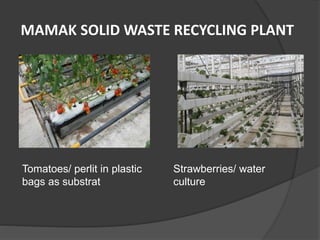
Tomatoes/ perlit in plastic
bags as substrat
Strawberries/ water
culture
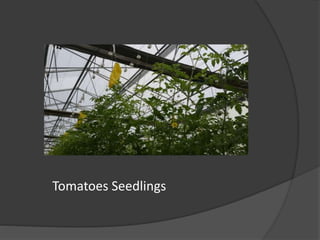
Tomatoes Seedlings
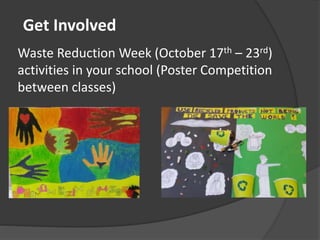
Waste Reduction Week (October 17th – 23rd)
activities in your school (Poster Competition
between classes)
Get Involved
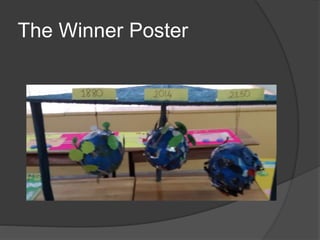
The Winner Poster
THANK YOU
BEGÜMCAN BÖLÜKBAŞI
KARDELEN HANOĞLU
İREM BAHAR BUĞDAYCI
BUSE BAŞPINAR
YEŞİM ÖZBEK
HANİFE SILA KULECİ

Presentation turkey waste management

  • 1.
    SUZAN MEHMET GÖNÇVOCATIONAL AND TRADE ANATOLIAN HIGH SCHOOL GERMANY, 23-25 FEBRUARY 2015
  • 2.
    Waste Also known asrubbish, trash, refuse, garbage, junk… is unwanted or useless materials.
  • 3.
  • 4.
    Kinds of Wastes Solidwastes: wastes in solid forms, domestic, commercial and industrial wastes Examples: plastics, bottles,cans, papers… Liquid Wastes: wastes in liquid form Examples: domestic washings, chemicals, oils…
  • 5.
    Classification of WastesAccording to Their Biodegradability Bio-degradable can be degraded in nature (paper, wood, fruits) Non-biodegradable cannot be degraded in nature (plastics, bottles, old machines, cans)
  • 6.
    Classification of WastesAccording to Their Effects on Human Health and the Environment Hazardous wastes Substances unsafe to use commercially, industrially, agriculturally, or economically. They have any of the following properties- ignitability, corrosivity, reactivity & toxicity. Non-hazardous Substances safe to use commercially, industrially, agriculturally, or economically. They don’t have any of those properties mentioned above.
  • 7.
  • 8.
    How Much WasteDo We Create?  Each person generates ~ 2.7 kg of waste each day all over th world.  The total amount of waste collected in Turkey is 24.4 million tons per year in 2012.  12.7 (~ %52) million tons of waste was directly disposed of in landfills.  0.3 million tons were treated in composting facilities.
  • 9.
    IMPACTS OF WASTEIF NOT MANAGED 1- Affects our health 2- Affects our socio-economic conditions 3- Affects our coastal and marine environment 4- Affects our climate
  • 10.
    Impacts of wasteon health - Chemical poisoning through chemical inhalation - Uncollected waste can lead to flood - Cancer - Congenital malformations - Neurological disease
  • 11.
    Effects of Wasteon Animals and Aquatics Life - Increase in mercury level in fish due to disposal of mercury in the rivers. - Plastic found in oceans ingested by birds. - Resulted in high algal population in rivers and sea. - Degrades water and soil quality.
  • 12.
    Impacts of Wasteon Environment - Waste breaks down in landfills to form methane, a potent greenhouse gas (GHGs) - GHGs lead to change in climate - Leads to leaching: is a process by which solid waste enter soil and ground water and contaminating them.  U.S. Environment Protection Agency (2009)
  • 13.
    It is estimatedthat; «The food wasted by the US and Europe could feed the world three times over.» Every tons of food waste prevented has the potential to save 4.2 tons of CO2 equivalent.
  • 14.
    The Problem More People +More Waste = Less Available Landfill Space
  • 15.
  • 16.
    WHAT SHOULD BEDONE 1- Reduce Waste - Reduce office paper waste by using both sides. - Redesign packaging to eliminate excess materials. - Work with customers to design and implement a packaging return program. ...
  • 17.
    WHAT SHOULD BEDONE 2- Reuse - Reuse office furniture and supplies, such as envelopes, file folders, and paper. - Use durable towels, tablecloths, dishes, cups, and glasses. - Encourage employees to reuse office materials rather than new ones. - Donate old books, old clothes, old computers …
  • 18.
  • 19.
  • 20.
    Hazardous Wastes  3hazardous waste landfills in Turkey.  İZAYDAŞ (İzmit)  ERDEMİR (Ereğli)  İSKEN (İskenderun) In 2007, only İZAYDAŞ utilized 160 000 m3 hazardous waste.
  • 22.
    Waste Oil - Itis estimated that the amount of waste oil generated every year is approximately 150,000 tons in Turkey.
  • 23.
    Used Batteries andAccumulators Number of produced each year Number recycled Batteries 10 000 tons 200 tons (2%) Accumulators 74 000 tons 45 474 tons (67%)
  • 24.
    Medical Waste  Accordingto data of year 2006 (Ministry of Health), 91,323 tons of medical waste was generated each year.  In 2008, 12 681 tons of medical waste (14% of the total) had been sterilized.
  • 25.
    4 tons ofmedical waste is sterilized each day.
  • 26.
    End of LifeTyres (ELT) 284,800 ton ELT is recycled in each year (30% of the total amount).
  • 27.
    LIQUID WASTE RECYCLINGPLANTS In our city, Ankara, about 1 million m3 sewage is treated each day.
  • 28.
    SOLID WASTE RECYCLINGPLANTS  Paper, plastic and glasses are recycled solid wastes. Solid Waste Conversion Plants.
  • 29.
     This areawas a dump area about 10 years ago.  The genereted methane gas is converted to electrical energy and some heat is produced as a by-product.  This heat is used to heat the water.  This water is used to heat the greenhouses.
  • 30.
     As thisarea was a dump area the soil quality is very low.  So they cultivate plants without land.  They put the seeds in bags with inorganic substrats like perlit.  Or they use water cultures. MAMAK SOLID WASTE RECYCLING PLANT
  • 31.
    MAMAK SOLID WASTERECYCLING PLANT Tomatoes/ perlit in plastic bags as substrat Strawberries/ water culture
  • 32.
  • 33.
    Waste Reduction Week(October 17th – 23rd) activities in your school (Poster Competition between classes) Get Involved
  • 34.
  • 35.
    THANK YOU BEGÜMCAN BÖLÜKBAŞI KARDELENHANOĞLU İREM BAHAR BUĞDAYCI BUSE BAŞPINAR YEŞİM ÖZBEK HANİFE SILA KULECİ