ORGANIC AGRICULTURE BY Dr.P.Bhattacharyya Director, NCOF, Ghaziabad Additional Commissioner (INM) DAC, Krishi Bhawan New Delhi
ORGANIC AGRICULTURE Holistic production system, harmony with nature, Avoids chemical fertiliser, pesticides etc. PURPOSE Good soil, good food, good health, good environment, good business Movement from Farmers, NGOs etc.
ORGANIC STATUS Global :  24 mha (1.6% Ag. Area)  : Nearly 130 countries produce organic    product, Australia (10 mha) – lead    country Indian :  37000-41000 ha (SOEL survey),      (0.3% of Ag. Area)  :  2.50 million ha (APEDA)   (Including 2.43 mha of forest area with    wild herb & medicinal plants
Main ISSUES Standard Inspection, Certification, Accreditation  Input Market (Export/Domestic)
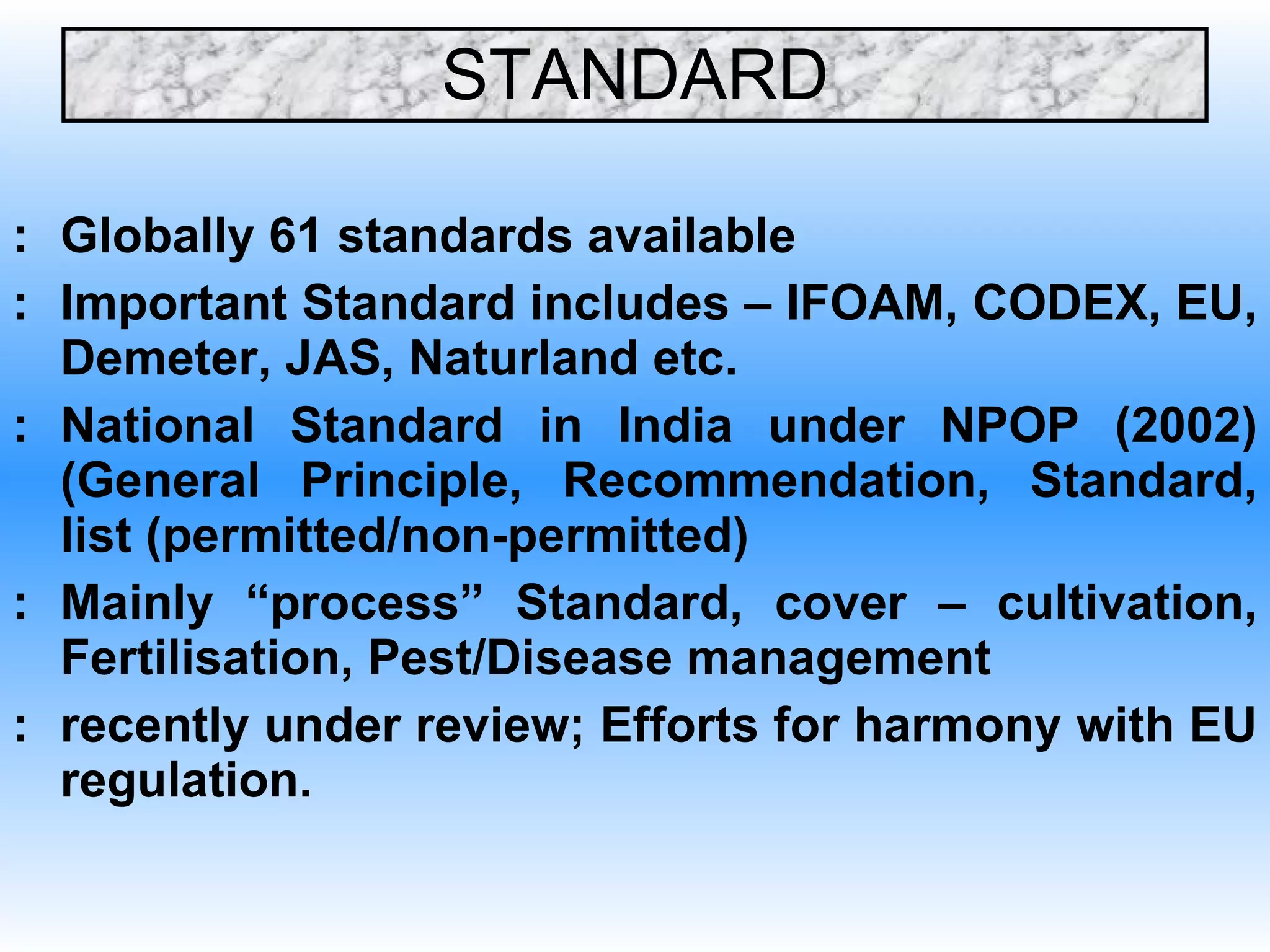
STANDARD : Globally 61 standards available : Important Standard includes – IFOAM, CODEX, EU, Demeter, JAS, Naturland etc. : National Standard in India under NPOP (2002) (General Principle, Recommendation, Standard, list (permitted/non-permitted) : Mainly “process” Standard, cover – cultivation, Fertilisation, Pest/Disease management : recently under review; Efforts for harmony with EU regulation.
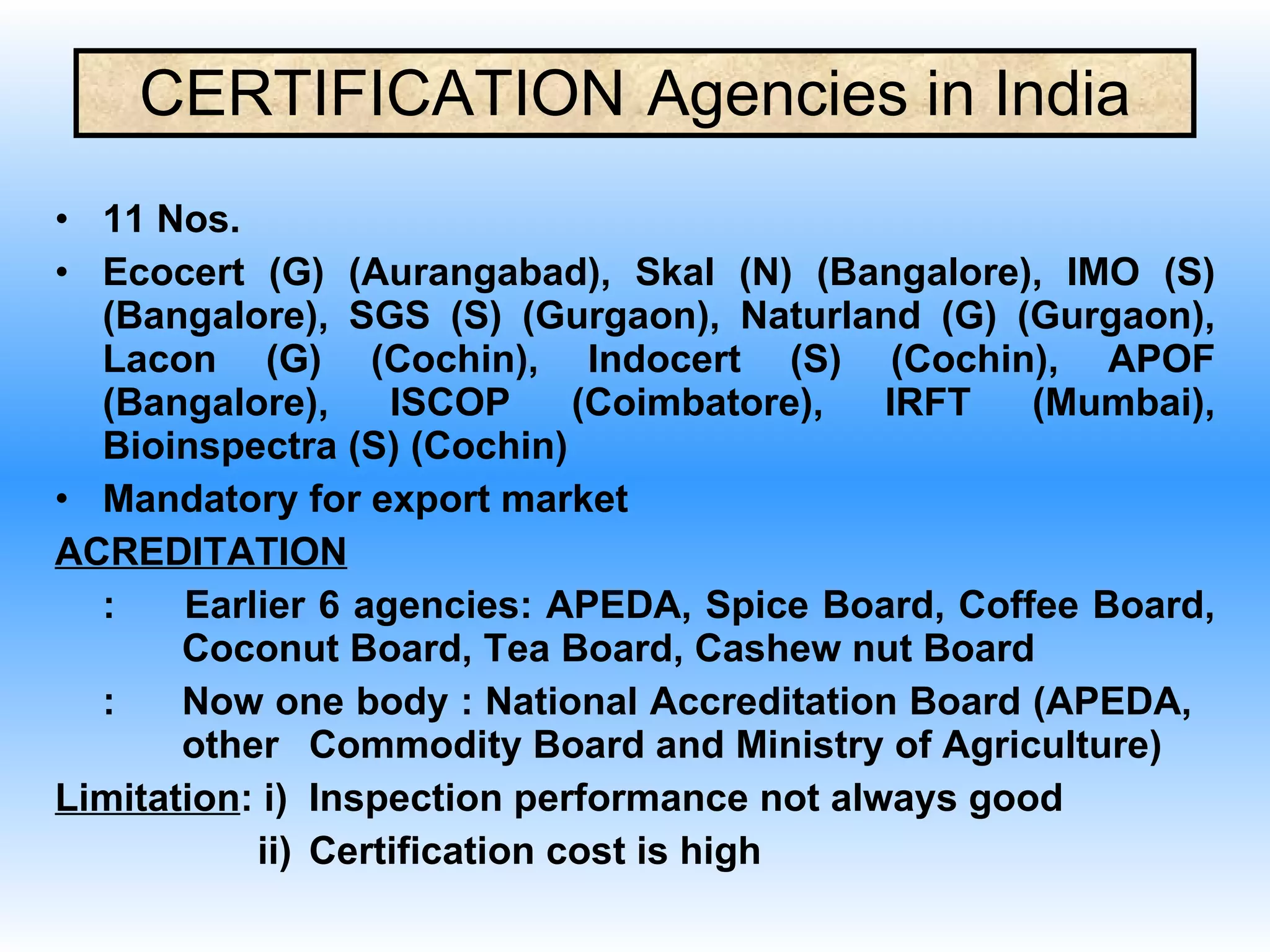
CERTIFICATION  Agencies in India 11 Nos. Ecocert (G) (Aurangabad), Skal (N) (Bangalore), IMO (S) (Bangalore), SGS (S) (Gurgaon), Naturland (G) (Gurgaon), Lacon (G) (Cochin), Indocert (S) (Cochin), APOF (Bangalore), ISCOP (Coimbatore), IRFT (Mumbai), Bioinspectra (S) (Cochin) Mandatory for export market ACREDITATION :  Earlier 6 agencies: APEDA, Spice Board, Coffee Board,  Coconut Board, Tea Board, Cashew nut Board : Now one body : National Accreditation Board (APEDA,  other  Commodity Board and Ministry of Agriculture) Limitation : i) Inspection performance not always good   ii) Certification cost is high
Organic Input Availability Live stock = 2.47 million ton Crop residues = 2.00 million ton Biogas slurry = 0.12 million ton Biofertiliser = 0.20 million ton Green manure = 0.10 million ton City refuse = 0.68 million ton Others = 1.00 million ton (Rural compost, Vermicompost, = 6.57 million ton    Ag. Waste) Total = 7.0  million ton  Biopesticide = 1000 ton Constraint: (a) No regulatory mechanism (b) Response always not satisfactory.
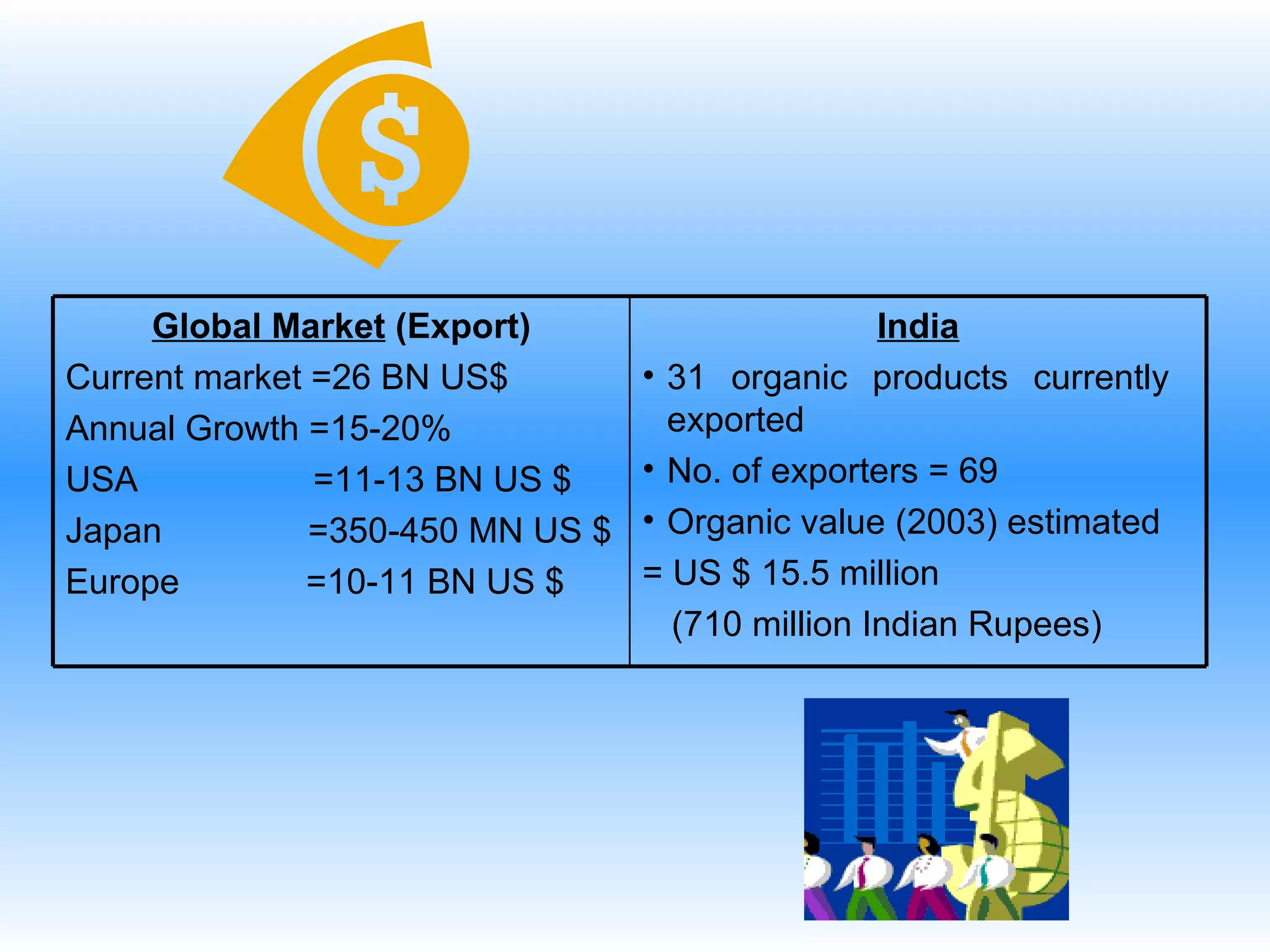
India 31 organic products currently  exported No. of exporters = 69 Organic value (2003) estimated  = US $ 15.5 million (710 million Indian Rupees) Global Market  (Export) Current market =26 BN US$ Annual Growth =15-20% USA  =11-13 BN US $ Japan  =350-450 MN US $ Europe  =10-11 BN US $
Market Organic (Export) 2004 Export Product Basmati rice, cotton, Mangopulp, Cashew nut, Sesame, Piniapple pulp, Honey, Walnut, spices, coffee, Tea, Peanut canned.  APEDA,  Metric ton 6472 = India    Total Metric ton 375 = Maharashtra Metric ton 521 = Himachal Pradesh Metric ton 541 = Punjab Metric ton 471 = Tamil Nadu Metric ton 476 = Karnataka Metric ton 937 = West Bengal Metric ton 1232 = Kerala
Future Export Demand Exported to : Europe :  Netherland, UK, Germany, Belgium, Sweeden, Switzerland, France, Italy, Spain America :  USA, Canada Middle East :  Saudi Arabia, UAE Asia :  Japan, Singapore (Source Org. Marg = 2002) [In 2002, from a total food production over 200 million ton, India produced only 14000 ton of organic food produces] 21523 ton 2006-07 19080 ton 2005-06 16930 ton 2004-05 15050 ton 2003-04
THANK YOU EAT ORGANIC LIVE ORGANIC DREAM ORGANIC

silent features of organic f

  • 1.
    ORGANIC AGRICULTURE BYDr.P.Bhattacharyya Director, NCOF, Ghaziabad Additional Commissioner (INM) DAC, Krishi Bhawan New Delhi
  • 2.
    ORGANIC AGRICULTURE Holisticproduction system, harmony with nature, Avoids chemical fertiliser, pesticides etc. PURPOSE Good soil, good food, good health, good environment, good business Movement from Farmers, NGOs etc.
  • 3.
    ORGANIC STATUS Global: 24 mha (1.6% Ag. Area) : Nearly 130 countries produce organic product, Australia (10 mha) – lead country Indian : 37000-41000 ha (SOEL survey), (0.3% of Ag. Area) : 2.50 million ha (APEDA) (Including 2.43 mha of forest area with wild herb & medicinal plants
  • 4.
    Main ISSUES StandardInspection, Certification, Accreditation Input Market (Export/Domestic)
  • 5.
    STANDARD : Globally61 standards available : Important Standard includes – IFOAM, CODEX, EU, Demeter, JAS, Naturland etc. : National Standard in India under NPOP (2002) (General Principle, Recommendation, Standard, list (permitted/non-permitted) : Mainly “process” Standard, cover – cultivation, Fertilisation, Pest/Disease management : recently under review; Efforts for harmony with EU regulation.
  • 6.
    CERTIFICATION Agenciesin India 11 Nos. Ecocert (G) (Aurangabad), Skal (N) (Bangalore), IMO (S) (Bangalore), SGS (S) (Gurgaon), Naturland (G) (Gurgaon), Lacon (G) (Cochin), Indocert (S) (Cochin), APOF (Bangalore), ISCOP (Coimbatore), IRFT (Mumbai), Bioinspectra (S) (Cochin) Mandatory for export market ACREDITATION : Earlier 6 agencies: APEDA, Spice Board, Coffee Board, Coconut Board, Tea Board, Cashew nut Board : Now one body : National Accreditation Board (APEDA, other Commodity Board and Ministry of Agriculture) Limitation : i) Inspection performance not always good ii) Certification cost is high
  • 7.
    Organic Input AvailabilityLive stock = 2.47 million ton Crop residues = 2.00 million ton Biogas slurry = 0.12 million ton Biofertiliser = 0.20 million ton Green manure = 0.10 million ton City refuse = 0.68 million ton Others = 1.00 million ton (Rural compost, Vermicompost, = 6.57 million ton Ag. Waste) Total = 7.0 million ton Biopesticide = 1000 ton Constraint: (a) No regulatory mechanism (b) Response always not satisfactory.
  • 8.
    India 31 organicproducts currently exported No. of exporters = 69 Organic value (2003) estimated = US $ 15.5 million (710 million Indian Rupees) Global Market (Export) Current market =26 BN US$ Annual Growth =15-20% USA =11-13 BN US $ Japan =350-450 MN US $ Europe =10-11 BN US $
  • 9.
    Market Organic (Export)2004 Export Product Basmati rice, cotton, Mangopulp, Cashew nut, Sesame, Piniapple pulp, Honey, Walnut, spices, coffee, Tea, Peanut canned. APEDA, Metric ton 6472 = India Total Metric ton 375 = Maharashtra Metric ton 521 = Himachal Pradesh Metric ton 541 = Punjab Metric ton 471 = Tamil Nadu Metric ton 476 = Karnataka Metric ton 937 = West Bengal Metric ton 1232 = Kerala
  • 10.
    Future Export DemandExported to : Europe : Netherland, UK, Germany, Belgium, Sweeden, Switzerland, France, Italy, Spain America : USA, Canada Middle East : Saudi Arabia, UAE Asia : Japan, Singapore (Source Org. Marg = 2002) [In 2002, from a total food production over 200 million ton, India produced only 14000 ton of organic food produces] 21523 ton 2006-07 19080 ton 2005-06 16930 ton 2004-05 15050 ton 2003-04
  • 11.
    THANK YOU EATORGANIC LIVE ORGANIC DREAM ORGANIC