MATERIALS MANAGEMENT
Week 10 : Physical Inventory Control
and Warehouse Management
OUTLINE
➢ Warehousing Management
➢ Physical Control and Security
➢ Inventory Record Accuracy
➢ TechnologyApplications
Ch. 10: Physical Inventory and Warehouse Management
3
Warehousing Management
Objectivesof EfficientWarehouse Operations
⚫ Provide timely customerservice
⚫ Keep track of items so they can be found
readilyand correctly
⚫ Minimize the total physical effort and thus
the cost of moving goods into and out of
storage
⚫ Providecommunication links with customers
Ch. 10: Physical Inventory and Warehouse Management
4
Warehousing Management
⚫ Benefits of Warehouse Management
⚫ Providea place to storeand protect inventory
⚫ Reduce transportationcosts
⚫ Improvecustomerservice levels
⚫ The complexity of a warehouse operation will depend
on the numberof SKUs (stock-keeping units) handled
and the numberof orders received and filled.
⚫ Mostactivity in awarehouse is material handling.
Ch. 10: Physical Inventory and Warehouse Management
5
Warehousing Management
⚫ Costsof Operating a Warehouse
⚫ Capital costs
⚫ costsof spaceand materials handling equipment
⚫ Operating costs
⚫ costof labor
⚫ the measureof laborproductivity is the numberof units that
an operatorcan move in a day
Ch. 10: Physical Inventory and Warehouse Management
6
Warehousing Management
⚫ Costsof Operating a Warehouse
⚫ The costs of operating a warehouse will depend on:
material handling equipmentused, stock location system
used and thewarehouse layout.
Ch. 10: Physical Inventory and Warehouse Management
Warehouse Activities
7
⚫ Receivegoods
⚫ Identifythegoods
⚫ Dispatch goods tostorage
 Hold goods
⚫ Pick goods
⚫ Marshal shipment
⚫ Dispatchshipment
⚫ Operatean informationsystem
Ch. 10: Physical Inventory and Warehouse Management
8
Warehouse Activities
⚫ Receive goods
⚫ accepts goods from outside transportation or
attached factory and accepts responsibility forthem
⚫ check thegoodsagainst an orderand the bill of lading
⚫ check thequantities
⚫ check fordamageand fill out damage reports if
necessary
⚫ inspectgoods if required
Ch. 10: Physical Inventory and Warehouse Management
9
Warehouse Activities
⚫ Identify the goods
items are identified with theappropriate stock-keeping unit
(SKU) number (part number) and the quantity received
recorded
⚫ Dispatch goods to storage
goodsaresorted and putaway
⚫ Hold goods
goodsare kept in storageand underproperprotection until
needed
Ch. 10: Physical Inventory and Warehouse Management
10
Warehouse Activities
⚫ Pick goods
items required from stock must beselected from storageand
brought toa marshalling area
⚫ Marshal the shipment
goods making upa singleorderare brought togetherand
checked foromissionsorerrors; orderrecords are updated
⚫ Dispatch the shipment
ordersare packaged, shipping documentsare prepared, and
goods loaded on thevehicle
Ch. 10: Physical Inventory and Warehouse Management
11
Warehouse Activities
⚫ Operate an information system
a record must be maintained foreach item in stock
showing thequantityon hand, quantityreceived,
quantity issued, and location in thewarehouse
Ch. 10: Physical Inventory and Warehouse Management
12
Warehouse Activities
To maximize productivityand minimize cost, warehouse
management mustwork with the following:
⚫ Maximizeuseof space
space is the largestcapital cost
⚫ Effectiveuseof laborand equipment
labor is the largestoperating cost
material handling equipment is thesecond largestcapital
cost
Ch. 10: Physical Inventory and Warehouse Management
13
Warehouse Activities
Factors influencing effectiveuseof warehouses
⚫ cube utilizationand accessibility
⚫ stock location
⚫ order picking and assembly
Ch. 10: Physical Inventory and Warehouse Management
14
Warehouse Activities
⚫ Cube utilization and accessibility
⚫ Goods are stored not just on the floor, but in the
cubic spaceof thewarehouse; warehouse capacity
dependson how highgoods can be stored
⚫ Accessibility means being able togetat thegoods
wanted with a minimumamount of work
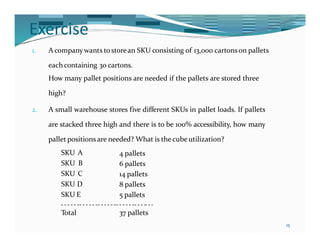
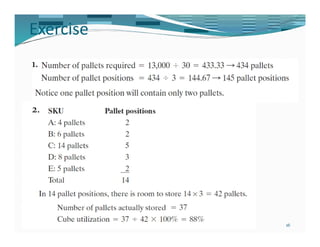
Exercise
1. A company wants to storean SKU consisting of 13,000 cartonson pallets
each containing 30 cartons.
How many pallet positions are needed if the pallets are stored three
high?
2. A small warehouse stores five different SKUs in pallet loads. If pallets
are stacked three high and there is to be 100% accessibility, how many
pallet positions are needed? What is thecube utilization?
SKU A
SKU B
SKU C
SKU D
SKU E
4 pallets
6 pallets
14 pallets
8 pallets
5 pallets
Total
15
37 pallets
1.
16
2.
Exercise
Ch. 10: Physical Inventory and Warehouse Management
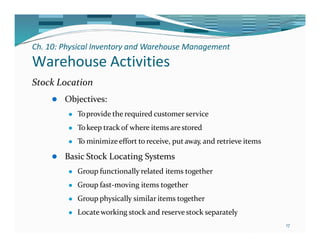
17
Warehouse Activities
Stock Location
⚫ Objectives:
⚫ Toprovide the required customer service
⚫ Tokeep track of where items arestored
⚫ To minimize effort to receive, put away, and retrieve items
⚫ Basic Stock Locating Systems
⚫ Group functionally related items together
⚫ Group fast-moving items together
⚫ Group physically similar items together
⚫ Locateworking stock and reserve stock separately
Ch. 10: Physical Inventory and Warehouse Management
18
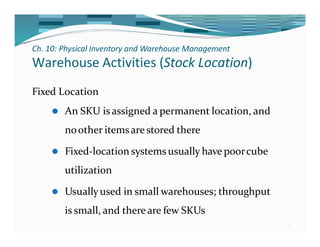
Warehouse Activities (Stock Location)
Fixed Location
⚫ An SKU isassigned a permanent location, and
noother itemsare stored there
⚫ Fixed-location systems usually have poorcube
utilization
⚫ Usuallyused in small warehouses; throughput
is small, and thereare few SKUs
Ch. 10: Physical Inventory and Warehouse Management
19
Warehouse Activities (Stock Location)
Floating (Random) Location
⚫ Goods are stored wherever there isappropriatespace
⚫ Advantageof this system is improved cube utilization
⚫ It requiresaccurate and up-to-date information
⚫ Warehouses using floating-location systems are
usuallycomputer-based
Ch. 10: Physical Inventory and Warehouse Management
20
Warehouse Activities (Stock Location)
Twoothersystems sometimes used are:
⚫ Point-of-use storage
⚫ Inventory is stored close to where itwill be needed
⚫ Mainly used in repetitive manufacturing and JIT systems
⚫ Central storage
⚫ Containsall inventory in onecentral location
Ch. 10: Physical Inventory and Warehouse Management
21
Warehouse Activities (Stock Location)
Advantages of Point-of-use Storage
⚫ Materialsare readilyaccessible to users
⚫ Material handling is reduced oreliminated
⚫ Central storagecosts are reduced
⚫ Material isaccessible all the time
Ch. 10: Physical Inventory and Warehouse Management
22
Warehouse Activities (Stock Location)
Advantages of Central Storage
⚫ Easeof control
⚫ Inventory record accuracy is easier to maintain
⚫ Specialized storage can be used
⚫ Reduced safetystock, since users do not need to carry
theirown safetystock
Ch. 10: Physical Inventory and Warehouse Management
23
Warehouse Activities
Order Picking and Assembly
⚫ When an order is received, items must beobtained
from the warehouse, grouped, and prepared for
shipment, systems used:
⚫ Area system
⚫ Zonesystem
⚫ Multiordersystem
Ch. 10: Physical Inventory and Warehouse Management
24
Warehouse Activities
Order Picking and Assembly
⚫ Area system
The order picker circulates throughout the warehouse
selecting the items on an order. Theorder is completeand
ready to shipwhen theorderpicker is finished
⚫ Zone system
Thewarehouse isdivided into zones, and each pickerworks
only in an assigned zone. Theorder is divided by zone, and
the items from each zonearesent to the marshaling area.
Ch. 10: Physical Inventory and Warehouse Management
25
Warehouse Activities
Order Picking and Assembly (continued)
⚫ Multiorder system
This system is thesame as thezonesystem, exceptthateach
pickercollects items fora numberof ordersat thesame
time.
Ch. 10: Physical Inventory and Warehouse Management
26
Warehousing: Physical Control and Security
Physical Control and Security - Elements
⚫ Good part numbering system
⚫ Simple, well-documented transaction system
⚫ Identify the item
⚫ Verify thequantity
⚫ Record thetransaction
⚫ Physically executethe transaction
Ch. 10: Physical Inventory and Warehouse Management
27
Warehousing: Physical Control and Security
Physical Control and Security - Elements
⚫ Limited access
Inventory must be kept in a safe, secure (locked) place
with limited general access.
⚫ Well-trained workforce
Ch. 10: Physical Inventory and Warehouse Management
28
Warehousing: Inventory Record Accuracy
Accurate inventoryrecords enable firms to:
⚫ Operatean effective materials management system
⚫ Maintainsatisfactorycustomerservice
⚫ Operateeffectivelyand efficiently
⚫ Analyze inventory
Ch. 10: Physical Inventory and Warehouse Management
29
Warehousing: Inventory Record Accuracy
Three pieces of information must be accurate:
⚫ Partdescription (part number)
⚫ Quantity
⚫ Location
Ch. 10: Physical Inventory and Warehouse Management
30
Warehousing: Inventory Record Accuracy
⚫ Inventory is a tangibleasset that is easy to
lose track of unless properlycontrolled
⚫ Inaccurate inventory records will result in:
- Lost sales
- Shortages and disrupted schedules
- Excess inventory (of thewrong things)
- Ineffective MRP / MRPII / ERP
Ch. 10: Physical Inventory and Warehouse Management
31
Warehousing: Inventory Record Accuracy
Inaccurate inventory records will result in:
⚫ Low productivity
⚫ Poor delivery performance
⚫ Excessive expediting, since people will always be
reacting to a bad situation rather than planning
for the future
Ch. 10: Physical Inventory and Warehouse Management
32
Warehousing: Inventory Record Accuracy
Causesof Inventory Record Errors
⚫ Unauthorized withdrawal of material
⚫ Unsecured stockroom
⚫ Poorly trained personnel
⚫ Inaccurate transaction recording
⚫ Poor transaction recording systems
⚫ Lack of auditcapability
Ch. 10: Physical Inventory and Warehouse Management
33
Warehousing: Inventory Record Accuracy
Measuring Inventory Record Accuracy
⚫ It is not practical toexpect 100% accuracy.
⚫ Tolerance
⚫ Tojudge inventoryaccuracy, a tolerance level foreach part
must be specified
⚫ Tolerance is theamount of permissiblevariation between an
inventoryrecord and a physical count.
⚫ Tolerancesareset on individual items based on value, critical
nature, availability, lead time, ability to stop prod., safety
problems, or the difficultyof measurement.
Ch. 10: Physical Inventory and Warehouse Management
34
Warehousing: Auditing Inventory Records
⚫ Two basic methodsof auditing inventory:
- Periodic (usuallyannual) counts of all items
- Cyclic (usuallydaily) counts of specified items
⚫ Most important is to audit the system to
find causes of record inaccuracy and
eliminate them. Cyclecounting does this;
periodicaudits tend not to.
Ch. 10: Physical Inventory and Warehouse Management
35
Warehousing: Auditing Inventory Records
⚫ Factors in good preparation fora physical
inventoryare:
- Housekeeping
- Identification
- Training
Ch. 10: Physical Inventory and Warehouse Management
36
Warehousing: Auditing Inventory Records
A physical inventoryconsistsof foursteps:
⚫ Count itemsand record thecount on a ticket left
on them
⚫ Verify thiscount by recounting or by sampling
⚫ When theverification is finished, collect the
tickets and list the items in each department
⚫ Reconcile the inventory records fordifferences
between the physical countand inventorydollars
Ch. 10: Physical Inventory and Warehouse Management
37
Warehousing: Auditing Inventory Records
Several problemswith annual physical inventory:
⚫ Usually the factory/facility has to be shut down,
thus losing production or business
⚫ Laborand paperwork areexpensive
⚫ The job isoften done hurriedlyand poorly since
there is much pressure toget itdone
⚫ Many times, moreerrors are introduced into the
records than areeliminated
Ch. 10: Physical Inventory and Warehouse Management
38
Warehousing: Auditing Inventory Records
Cycle Counting
⚫ A system of counting inventory continually throughout
the year
⚫ Advantages of cycle counting:
⚫ Timely detection and correction of problems
⚫ Complete or partial reduction of lost production
⚫ Use of personnel trained and dedicated to cycle counting
⚫ Count frequency
⚫ The number of times an item is counted in a year
Ch. 10: Physical Inventory and Warehouse Management
39
Warehousing: Auditing Inventory Records
Count Frequency
⚫ Thecount frequencyshould increase as thevalueof
the item and numberof transactions (chance of
error) increase. Forexample, you can base the
frequencyof count on annual dollarvalue usage
⚫ Methods used:
⚫ ABC Method
⚫ Zone Method
⚫ Location Audit System
Ch. 10: Physical Inventory and Warehouse Management
40
Warehousing: Auditing Inventory Records
⚫ Cyclecountscan be scheduled at regular
intervalsorspecial times
⚫ When to Count
- When an order is placed
- When an order is received
- When the inventory record reaches zero
- When an erroroccurs
41

PHYSICAL INVENTORY CONTROL AND WAREHOUSE MANAGEMENT

  • 1.
    MATERIALS MANAGEMENT Week 10: Physical Inventory Control and Warehouse Management
  • 2.
    OUTLINE ➢ Warehousing Management ➢Physical Control and Security ➢ Inventory Record Accuracy ➢ TechnologyApplications
  • 3.
    Ch. 10: PhysicalInventory and Warehouse Management 3 Warehousing Management Objectivesof EfficientWarehouse Operations ⚫ Provide timely customerservice ⚫ Keep track of items so they can be found readilyand correctly ⚫ Minimize the total physical effort and thus the cost of moving goods into and out of storage ⚫ Providecommunication links with customers
  • 4.
    Ch. 10: PhysicalInventory and Warehouse Management 4 Warehousing Management ⚫ Benefits of Warehouse Management ⚫ Providea place to storeand protect inventory ⚫ Reduce transportationcosts ⚫ Improvecustomerservice levels ⚫ The complexity of a warehouse operation will depend on the numberof SKUs (stock-keeping units) handled and the numberof orders received and filled. ⚫ Mostactivity in awarehouse is material handling.
  • 5.
    Ch. 10: PhysicalInventory and Warehouse Management 5 Warehousing Management ⚫ Costsof Operating a Warehouse ⚫ Capital costs ⚫ costsof spaceand materials handling equipment ⚫ Operating costs ⚫ costof labor ⚫ the measureof laborproductivity is the numberof units that an operatorcan move in a day
  • 6.
    Ch. 10: PhysicalInventory and Warehouse Management 6 Warehousing Management ⚫ Costsof Operating a Warehouse ⚫ The costs of operating a warehouse will depend on: material handling equipmentused, stock location system used and thewarehouse layout.
  • 7.
    Ch. 10: PhysicalInventory and Warehouse Management Warehouse Activities 7 ⚫ Receivegoods ⚫ Identifythegoods ⚫ Dispatch goods tostorage  Hold goods ⚫ Pick goods ⚫ Marshal shipment ⚫ Dispatchshipment ⚫ Operatean informationsystem
  • 8.
    Ch. 10: PhysicalInventory and Warehouse Management 8 Warehouse Activities ⚫ Receive goods ⚫ accepts goods from outside transportation or attached factory and accepts responsibility forthem ⚫ check thegoodsagainst an orderand the bill of lading ⚫ check thequantities ⚫ check fordamageand fill out damage reports if necessary ⚫ inspectgoods if required
  • 9.
    Ch. 10: PhysicalInventory and Warehouse Management 9 Warehouse Activities ⚫ Identify the goods items are identified with theappropriate stock-keeping unit (SKU) number (part number) and the quantity received recorded ⚫ Dispatch goods to storage goodsaresorted and putaway ⚫ Hold goods goodsare kept in storageand underproperprotection until needed
  • 10.
    Ch. 10: PhysicalInventory and Warehouse Management 10 Warehouse Activities ⚫ Pick goods items required from stock must beselected from storageand brought toa marshalling area ⚫ Marshal the shipment goods making upa singleorderare brought togetherand checked foromissionsorerrors; orderrecords are updated ⚫ Dispatch the shipment ordersare packaged, shipping documentsare prepared, and goods loaded on thevehicle
  • 11.
    Ch. 10: PhysicalInventory and Warehouse Management 11 Warehouse Activities ⚫ Operate an information system a record must be maintained foreach item in stock showing thequantityon hand, quantityreceived, quantity issued, and location in thewarehouse
  • 12.
    Ch. 10: PhysicalInventory and Warehouse Management 12 Warehouse Activities To maximize productivityand minimize cost, warehouse management mustwork with the following: ⚫ Maximizeuseof space space is the largestcapital cost ⚫ Effectiveuseof laborand equipment labor is the largestoperating cost material handling equipment is thesecond largestcapital cost
  • 13.
    Ch. 10: PhysicalInventory and Warehouse Management 13 Warehouse Activities Factors influencing effectiveuseof warehouses ⚫ cube utilizationand accessibility ⚫ stock location ⚫ order picking and assembly
  • 14.
    Ch. 10: PhysicalInventory and Warehouse Management 14 Warehouse Activities ⚫ Cube utilization and accessibility ⚫ Goods are stored not just on the floor, but in the cubic spaceof thewarehouse; warehouse capacity dependson how highgoods can be stored ⚫ Accessibility means being able togetat thegoods wanted with a minimumamount of work
  • 15.
    Exercise 1. A companywants to storean SKU consisting of 13,000 cartonson pallets each containing 30 cartons. How many pallet positions are needed if the pallets are stored three high? 2. A small warehouse stores five different SKUs in pallet loads. If pallets are stacked three high and there is to be 100% accessibility, how many pallet positions are needed? What is thecube utilization? SKU A SKU B SKU C SKU D SKU E 4 pallets 6 pallets 14 pallets 8 pallets 5 pallets Total 15 37 pallets
  • 16.
  • 17.
    Ch. 10: PhysicalInventory and Warehouse Management 17 Warehouse Activities Stock Location ⚫ Objectives: ⚫ Toprovide the required customer service ⚫ Tokeep track of where items arestored ⚫ To minimize effort to receive, put away, and retrieve items ⚫ Basic Stock Locating Systems ⚫ Group functionally related items together ⚫ Group fast-moving items together ⚫ Group physically similar items together ⚫ Locateworking stock and reserve stock separately
  • 18.
    Ch. 10: PhysicalInventory and Warehouse Management 18 Warehouse Activities (Stock Location) Fixed Location ⚫ An SKU isassigned a permanent location, and noother itemsare stored there ⚫ Fixed-location systems usually have poorcube utilization ⚫ Usuallyused in small warehouses; throughput is small, and thereare few SKUs
  • 19.
    Ch. 10: PhysicalInventory and Warehouse Management 19 Warehouse Activities (Stock Location) Floating (Random) Location ⚫ Goods are stored wherever there isappropriatespace ⚫ Advantageof this system is improved cube utilization ⚫ It requiresaccurate and up-to-date information ⚫ Warehouses using floating-location systems are usuallycomputer-based
  • 20.
    Ch. 10: PhysicalInventory and Warehouse Management 20 Warehouse Activities (Stock Location) Twoothersystems sometimes used are: ⚫ Point-of-use storage ⚫ Inventory is stored close to where itwill be needed ⚫ Mainly used in repetitive manufacturing and JIT systems ⚫ Central storage ⚫ Containsall inventory in onecentral location
  • 21.
    Ch. 10: PhysicalInventory and Warehouse Management 21 Warehouse Activities (Stock Location) Advantages of Point-of-use Storage ⚫ Materialsare readilyaccessible to users ⚫ Material handling is reduced oreliminated ⚫ Central storagecosts are reduced ⚫ Material isaccessible all the time
  • 22.
    Ch. 10: PhysicalInventory and Warehouse Management 22 Warehouse Activities (Stock Location) Advantages of Central Storage ⚫ Easeof control ⚫ Inventory record accuracy is easier to maintain ⚫ Specialized storage can be used ⚫ Reduced safetystock, since users do not need to carry theirown safetystock
  • 23.
    Ch. 10: PhysicalInventory and Warehouse Management 23 Warehouse Activities Order Picking and Assembly ⚫ When an order is received, items must beobtained from the warehouse, grouped, and prepared for shipment, systems used: ⚫ Area system ⚫ Zonesystem ⚫ Multiordersystem
  • 24.
    Ch. 10: PhysicalInventory and Warehouse Management 24 Warehouse Activities Order Picking and Assembly ⚫ Area system The order picker circulates throughout the warehouse selecting the items on an order. Theorder is completeand ready to shipwhen theorderpicker is finished ⚫ Zone system Thewarehouse isdivided into zones, and each pickerworks only in an assigned zone. Theorder is divided by zone, and the items from each zonearesent to the marshaling area.
  • 25.
    Ch. 10: PhysicalInventory and Warehouse Management 25 Warehouse Activities Order Picking and Assembly (continued) ⚫ Multiorder system This system is thesame as thezonesystem, exceptthateach pickercollects items fora numberof ordersat thesame time.
  • 26.
    Ch. 10: PhysicalInventory and Warehouse Management 26 Warehousing: Physical Control and Security Physical Control and Security - Elements ⚫ Good part numbering system ⚫ Simple, well-documented transaction system ⚫ Identify the item ⚫ Verify thequantity ⚫ Record thetransaction ⚫ Physically executethe transaction
  • 27.
    Ch. 10: PhysicalInventory and Warehouse Management 27 Warehousing: Physical Control and Security Physical Control and Security - Elements ⚫ Limited access Inventory must be kept in a safe, secure (locked) place with limited general access. ⚫ Well-trained workforce
  • 28.
    Ch. 10: PhysicalInventory and Warehouse Management 28 Warehousing: Inventory Record Accuracy Accurate inventoryrecords enable firms to: ⚫ Operatean effective materials management system ⚫ Maintainsatisfactorycustomerservice ⚫ Operateeffectivelyand efficiently ⚫ Analyze inventory
  • 29.
    Ch. 10: PhysicalInventory and Warehouse Management 29 Warehousing: Inventory Record Accuracy Three pieces of information must be accurate: ⚫ Partdescription (part number) ⚫ Quantity ⚫ Location
  • 30.
    Ch. 10: PhysicalInventory and Warehouse Management 30 Warehousing: Inventory Record Accuracy ⚫ Inventory is a tangibleasset that is easy to lose track of unless properlycontrolled ⚫ Inaccurate inventory records will result in: - Lost sales - Shortages and disrupted schedules - Excess inventory (of thewrong things) - Ineffective MRP / MRPII / ERP
  • 31.
    Ch. 10: PhysicalInventory and Warehouse Management 31 Warehousing: Inventory Record Accuracy Inaccurate inventory records will result in: ⚫ Low productivity ⚫ Poor delivery performance ⚫ Excessive expediting, since people will always be reacting to a bad situation rather than planning for the future
  • 32.
    Ch. 10: PhysicalInventory and Warehouse Management 32 Warehousing: Inventory Record Accuracy Causesof Inventory Record Errors ⚫ Unauthorized withdrawal of material ⚫ Unsecured stockroom ⚫ Poorly trained personnel ⚫ Inaccurate transaction recording ⚫ Poor transaction recording systems ⚫ Lack of auditcapability
  • 33.
    Ch. 10: PhysicalInventory and Warehouse Management 33 Warehousing: Inventory Record Accuracy Measuring Inventory Record Accuracy ⚫ It is not practical toexpect 100% accuracy. ⚫ Tolerance ⚫ Tojudge inventoryaccuracy, a tolerance level foreach part must be specified ⚫ Tolerance is theamount of permissiblevariation between an inventoryrecord and a physical count. ⚫ Tolerancesareset on individual items based on value, critical nature, availability, lead time, ability to stop prod., safety problems, or the difficultyof measurement.
  • 34.
    Ch. 10: PhysicalInventory and Warehouse Management 34 Warehousing: Auditing Inventory Records ⚫ Two basic methodsof auditing inventory: - Periodic (usuallyannual) counts of all items - Cyclic (usuallydaily) counts of specified items ⚫ Most important is to audit the system to find causes of record inaccuracy and eliminate them. Cyclecounting does this; periodicaudits tend not to.
  • 35.
    Ch. 10: PhysicalInventory and Warehouse Management 35 Warehousing: Auditing Inventory Records ⚫ Factors in good preparation fora physical inventoryare: - Housekeeping - Identification - Training
  • 36.
    Ch. 10: PhysicalInventory and Warehouse Management 36 Warehousing: Auditing Inventory Records A physical inventoryconsistsof foursteps: ⚫ Count itemsand record thecount on a ticket left on them ⚫ Verify thiscount by recounting or by sampling ⚫ When theverification is finished, collect the tickets and list the items in each department ⚫ Reconcile the inventory records fordifferences between the physical countand inventorydollars
  • 37.
    Ch. 10: PhysicalInventory and Warehouse Management 37 Warehousing: Auditing Inventory Records Several problemswith annual physical inventory: ⚫ Usually the factory/facility has to be shut down, thus losing production or business ⚫ Laborand paperwork areexpensive ⚫ The job isoften done hurriedlyand poorly since there is much pressure toget itdone ⚫ Many times, moreerrors are introduced into the records than areeliminated
  • 38.
    Ch. 10: PhysicalInventory and Warehouse Management 38 Warehousing: Auditing Inventory Records Cycle Counting ⚫ A system of counting inventory continually throughout the year ⚫ Advantages of cycle counting: ⚫ Timely detection and correction of problems ⚫ Complete or partial reduction of lost production ⚫ Use of personnel trained and dedicated to cycle counting ⚫ Count frequency ⚫ The number of times an item is counted in a year
  • 39.
    Ch. 10: PhysicalInventory and Warehouse Management 39 Warehousing: Auditing Inventory Records Count Frequency ⚫ Thecount frequencyshould increase as thevalueof the item and numberof transactions (chance of error) increase. Forexample, you can base the frequencyof count on annual dollarvalue usage ⚫ Methods used: ⚫ ABC Method ⚫ Zone Method ⚫ Location Audit System
  • 40.
    Ch. 10: PhysicalInventory and Warehouse Management 40 Warehousing: Auditing Inventory Records ⚫ Cyclecountscan be scheduled at regular intervalsorspecial times ⚫ When to Count - When an order is placed - When an order is received - When the inventory record reaches zero - When an erroroccurs
  • 41.