FUTURE OF WATER AND AGRICULTURE IN SRI LANKA IN THE
             FACE OF CLIMATE CHANGE


         Nishadi Eriyagama & Vladimir Smakhtin (IWMI)


        GWP Workshop on Climate Change Food and Water Security
                   Colombo, Sri Lanka, February 2011


                  Water for a food-secure world
OUTLINE

• Climate change signals in Sri Lanka – observed changes

• What will the future hold? – projected changes

• Impacts

    – On water resources
                                           Food Security
    – On agriculture

• Climate change vulnerability hotspots?

• Responding to climatic changes

• Knowledge gaps


               Water for a food-secure world
INFORMATION SOURCES


          Interviews and e-mail correspondence with
                    -Government officials
                                             16
                    -International experts

          Over 75 national and global climate change studies
Sources
          IWMI climate change vulnerability mapping


          Preliminary review of recent floods


              Water for a food-secure world
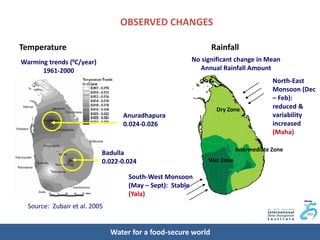
OBSERVED CHANGES

Temperature                                                    Rainfall
Warming trends (0C/year)                               No significant change in Mean
      1961-2000                                          Annual Rainfall Amount
                                                                                    North-East
                                                                                    Monsoon (Dec
                                                                                    – Feb):
                                                                Dry Zone            reduced &
                                  Anuradhapura                                      variability
                                  0.024-0.026                                       increased
                                                                                    (Maha)

                                                                       Intermediate Zone
                           Badulla
                           0.022-0.024                      Wet Zone

                                    South-West Monsoon
                                    (May – Sept): Stable
                                    (Yala)
  Source: Zubair et al. 2005


                               Water for a food-secure world
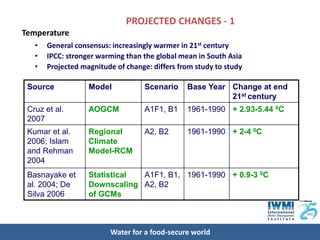
PROJECTED CHANGES - 1
Temperature
   •   General consensus: increasingly warmer in 21st century
   •   IPCC: stronger warming than the global mean in South Asia
   •   Projected magnitude of change: differs from study to study

 Source            Model            Scenario    Base Year Change at end
                                                          21st century
 Cruz et al.       AOGCM            A1F1, B1    1961-1990 + 2.93-5.44 0C
 2007
 Kumar et al.      Regional         A2, B2      1961-1990 + 2-4 0C
 2006; Islam       Climate
 and Rehman        Model-RCM
 2004
 Basnayake et      Statistical A1F1, B1, 1961-1990 + 0.9-3 0C
 al. 2004; De      Downscaling A2, B2
 Silva 2006        of GCMs


                         Water for a food-secure world
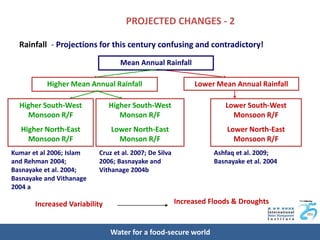
PROJECTED CHANGES - 2

  Rainfall - Projections for this century confusing and contradictory!

                                  Mean Annual Rainfall

          Higher Mean Annual Rainfall                       Lower Mean Annual Rainfall

  Higher South-West            Higher South-West                     Lower South-West
    Monsoon R/F                   Monson R/F                           Monsoon R/F
  Higher North-East            Lower North-East                       Lower North-East
    Monsoon R/F                  Monson R/F                             Monsoon R/F
Kumar et al 2006; Islam   Cruz et al. 2007; De Silva              Ashfaq et al. 2009;
and Rehman 2004;          2006; Basnayake and                     Basnayake et al. 2004
Basnayake et al. 2004;    Vithanage 2004b
Basnayake and Vithanage
2004 a

       Increased Variability                           Increased Floods & Droughts


                               Water for a food-secure world
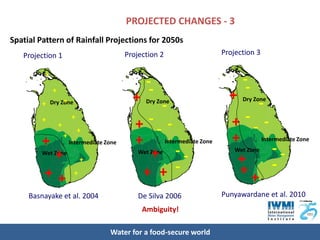
PROJECTED CHANGES - 3
Spatial Pattern of Rainfall Projections for 2050s
   Projection 1                              Projection 2                       Projection 3

         +                                             De Silva, 2006
                                                 --                                 - De Silva, 2006
             +
                                                                                  + --
         +        +
             Dry Zone                          + - Dry Zone                           Dry Zone


         +
                 +
                         +
                             +
                                               + -- -                             + -- -
         +           +
                         Intermediate Zone     +            Intermediate Zone     +            Intermediate Zone

              +
         Wet Zone                                  + --
                                                 Wet Zone                           Wet Zone--
                              +                                                    +
         ++               +                      + + -                              ++ -
     Basnayake et al. 2004                       De Silva 2006                  Punyawardane et al. 2010
                                                  Ambiguity!

                                       Water for a food-secure world
IMPACTS ON WATER RESOURCES

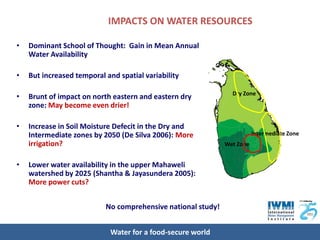
•   Dominant School of Thought: Gain in Mean Annual
    Water Availability

•   But increased temporal and spatial variability

                                                                Dry Zone
•   Brunt of impact on north eastern and eastern dry
    zone: May become even drier!

•   Increase in Soil Moisture Defecit in the Dry and
    Intermediate zones by 2050 (De Silva 2006): More                     Intermediate Zone
    irrigation?                                               Wet Zone


•   Lower water availability in the upper Mahaweli
    watershed by 2025 (Shantha & Jayasundera 2005):
    More power cuts?


                           No comprehensive national study!


                             Water for a food-secure world
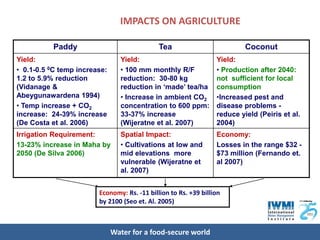
IMPACTS ON AGRICULTURE

          Paddy                              Tea                          Coconut
Yield:                          Yield:                           Yield:
• 0.1-0.5 0C temp increase:     • 100 mm monthly R/F             • Production after 2040:
1.2 to 5.9% reduction           reduction: 30-80 kg              not sufficient for local
(Vidanage &                     reduction in ‘made’ tea/ha       consumption
Abeygunawardena 1994)           • Increase in ambient CO2        •Increased pest and
• Temp increase + CO2           concentration to 600 ppm:        disease problems -
increase: 24-39% increase       33-37% increase                  reduce yield (Peiris et al.
(De Costa et al. 2006)          (Wijeratne et al. 2007)          2004)
Irrigation Requirement:         Spatial Impact:                  Economy:
13-23% increase in Maha by      • Cultivations at low and        Losses in the range $32 -
2050 (De Silva 2006)            mid elevations more              $73 million (Fernando et.
                                vulnerable (Wijeratne et         al 2007)
                                al. 2007)


                        Economy: Rs. -11 billion to Rs. +39 billion
                        by 2100 (Seo et. Al. 2005)


                              Water for a food-secure world
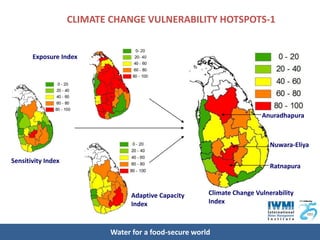
CLIMATE CHANGE VULNERABILITY HOTSPOTS-1


       Exposure Index


                                                                         Anuradhapura


                                                                            Nuwara-Eliya

Sensitivity Index
                                                                            Ratnapura


                                  Adaptive Capacity     Climate Change Vulnerability
                                  Index                 Index


                            Water for a food-secure world
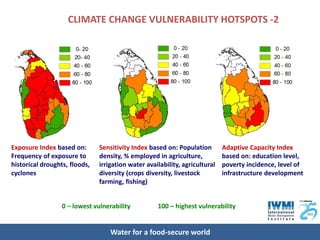
CLIMATE CHANGE VULNERABILITY HOTSPOTS -2


Exposure Index based on:       Sensitivity Index based on: Population        Adaptive Capacity Index
Frequency of exposure to       density, % employed in agriculture,           based on: education level,
historical droughts, floods,   irrigation water availability, agricultural   poverty incidence, level of
cyclones                       diversity (crops diversity, livestock         infrastructure development
                               farming, fishing)


                  0 – lowest vulnerability          100 – highest vulnerability


                                   Water for a food-secure world
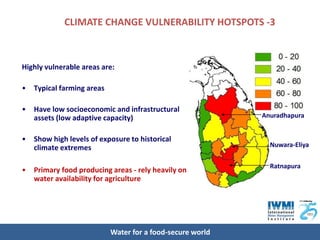
CLIMATE CHANGE VULNERABILITY HOTSPOTS -3


Highly vulnerable areas are:

•   Typical farming areas

•   Have low socioeconomic and infrastructural
    assets (low adaptive capacity)                          Anuradhapura


•   Show high levels of exposure to historical
    climate extremes                                          Nuwara-Eliya


                                                              Ratnapura
•   Primary food producing areas - rely heavily on
    water availability for agriculture


                            Water for a food-secure world
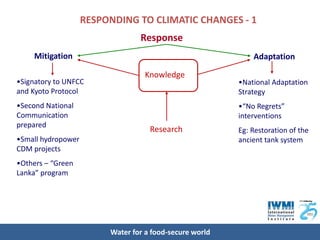
RESPONDING TO CLIMATIC CHANGES - 1
                                 Response
    Mitigation                                               Adaptation

                                   Knowledge
•Signatory to UNFCC                                      •National Adaptation
and Kyoto Protocol                                       Strategy
•Second National                                         •“No Regrets”
Communication                                            interventions
prepared
                                    Research             Eg: Restoration of the
•Small hydropower                                        ancient tank system
CDM projects
•Others – “Green
Lanka” program


                         Water for a food-secure world
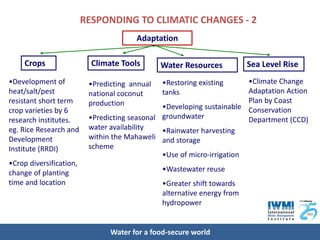
RESPONDING TO CLIMATIC CHANGES - 2
                                       Adaptation

     Crops                 Climate Tools       Water Resources           Sea Level Rise
•Development of           •Predicting annual   •Restoring existing      •Climate Change
heat/salt/pest            national coconut     tanks                    Adaptation Action
resistant short term      production                                    Plan by Coast
crop varieties by 6                            •Developing sustainable Conservation
research institutes.      •Predicting seasonal groundwater              Department (CCD)
eg. Rice Research and     water availability   •Rainwater harvesting
Development               within the Mahaweli and storage
Institute (RRDI)          scheme
                                               •Use of micro-irrigation
•Crop diversification,
change of planting                             •Wastewater reuse
time and location                              •Greater shift towards
                                               alternative energy from
                                               hydropower


                                Water for a food-secure world
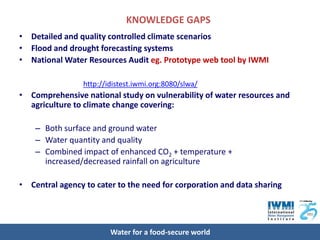
KNOWLEDGE GAPS
• Detailed and quality controlled climate scenarios
• Flood and drought forecasting systems
• National Water Resources Audit eg. Prototype web tool by IWMI

                 http://idistest.iwmi.org:8080/slwa/
• Comprehensive national study on vulnerability of water resources and
  agriculture to climate change covering:

    – Both surface and ground water
    – Water quantity and quality
    – Combined impact of enhanced CO2 + temperature +
      increased/decreased rainfall on agriculture

• Central agency to cater to the need for corporation and data sharing


                         Water for a food-secure world
THANK YOU !

ACKNOWLEDGEMENTS:
• Mr. Lalith Chandrapala, National Disaster Mitigation Council (NDMC)
• Dr. B. V. R. Punyawardane, Department of Agriculture
• Ms. Dharshanie De Silva, World Bank
• Ms. Chandanie Panditharatne, Ministry of Environment and Natural Resources
• Mr. Sarath Premalal, Department of Meteorology
• Mr. Bandula Wickramarachchi, Coast Conservation Department (CCD)
• Mr. N. Wickramaratne, Mahaweli Authority
• Mr. H. M. Jayatillake, Irrigation Department
• Mr. K. A. U. S., Imbulana, Ministry of Irrigation
• Mr. L. Manawadu, University of Colombo
• Dr. W. M. W. Weerakoon, Rice Research and Development Institute (RRDI)
• Ms. Karin Fernando, Centre for Poverty Analysis (CEPA)
• Dr. G. G. A. Godaliyadda, Irrigation Department
• Dr. A. W. Jayawardena, Public Works Research Institute, Japan
• Mr. Gerard Fernando, National Water Supply and Drainage Board
• Mr. Harsha Sooriyarachchi, Water Resources Board
• Staff of Sri Lanka Association for the advancement of Science (SLASS)
• Dr. Herath Manthrithilake (IWMI)


                            Water for a food-secure world
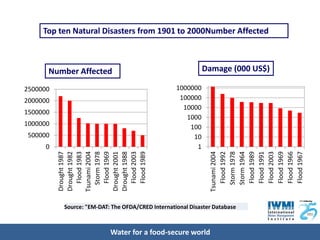
Top ten Natural Disasters from 1901 to 2000Number Affected


      Number Affected                                       Damage (000 US$)

2500000                                           1000000
2000000                                            100000
                                                    10000
1500000
                                                     1000
1000000                                               100
 500000                                                10
      0                                                 1
          Tsunami 2004


                                                              Tsunami 2004
             Flood 1983


             Flood 1969


             Flood 2003
             Flood 1989


                                                                 Flood 1992


                                                                 Flood 1991
                                                                 Flood 2003
                                                                 Flood 1969
                                                                 Flood 1966
                                                                 Flood 1967
            Storm 1978


                                                                Storm 1978
                                                                Storm 1964
                                                                 Flood 1989
          Drought 1982
          Drought 1987


          Drought 2001
          Drought 1988


          Source: "EM-DAT: The OFDA/CRED International Disaster Database


                          Water for a food-secure world

Future of water and agriculture in Sri Lanka in the face of climate change, Nishadi & Vladimir Smakhtin

  • 1.
    FUTURE OF WATERAND AGRICULTURE IN SRI LANKA IN THE FACE OF CLIMATE CHANGE Nishadi Eriyagama & Vladimir Smakhtin (IWMI) GWP Workshop on Climate Change Food and Water Security Colombo, Sri Lanka, February 2011 Water for a food-secure world
  • 2.
    OUTLINE • Climate changesignals in Sri Lanka – observed changes • What will the future hold? – projected changes • Impacts – On water resources Food Security – On agriculture • Climate change vulnerability hotspots? • Responding to climatic changes • Knowledge gaps Water for a food-secure world
  • 3.
    INFORMATION SOURCES Interviews and e-mail correspondence with -Government officials 16 -International experts Over 75 national and global climate change studies Sources IWMI climate change vulnerability mapping Preliminary review of recent floods Water for a food-secure world
  • 4.
    OBSERVED CHANGES Temperature Rainfall Warming trends (0C/year) No significant change in Mean 1961-2000 Annual Rainfall Amount North-East Monsoon (Dec – Feb): Dry Zone reduced & Anuradhapura variability 0.024-0.026 increased (Maha) Intermediate Zone Badulla 0.022-0.024 Wet Zone South-West Monsoon (May – Sept): Stable (Yala) Source: Zubair et al. 2005 Water for a food-secure world
  • 5.
    PROJECTED CHANGES -1 Temperature • General consensus: increasingly warmer in 21st century • IPCC: stronger warming than the global mean in South Asia • Projected magnitude of change: differs from study to study Source Model Scenario Base Year Change at end 21st century Cruz et al. AOGCM A1F1, B1 1961-1990 + 2.93-5.44 0C 2007 Kumar et al. Regional A2, B2 1961-1990 + 2-4 0C 2006; Islam Climate and Rehman Model-RCM 2004 Basnayake et Statistical A1F1, B1, 1961-1990 + 0.9-3 0C al. 2004; De Downscaling A2, B2 Silva 2006 of GCMs Water for a food-secure world
  • 6.
    PROJECTED CHANGES -2 Rainfall - Projections for this century confusing and contradictory! Mean Annual Rainfall Higher Mean Annual Rainfall Lower Mean Annual Rainfall Higher South-West Higher South-West Lower South-West Monsoon R/F Monson R/F Monsoon R/F Higher North-East Lower North-East Lower North-East Monsoon R/F Monson R/F Monsoon R/F Kumar et al 2006; Islam Cruz et al. 2007; De Silva Ashfaq et al. 2009; and Rehman 2004; 2006; Basnayake and Basnayake et al. 2004 Basnayake et al. 2004; Vithanage 2004b Basnayake and Vithanage 2004 a Increased Variability Increased Floods & Droughts Water for a food-secure world
  • 7.
    PROJECTED CHANGES -3 Spatial Pattern of Rainfall Projections for 2050s Projection 1 Projection 2 Projection 3 + De Silva, 2006 -- - De Silva, 2006 + + -- + + Dry Zone + - Dry Zone Dry Zone + + + + + -- - + -- - + + Intermediate Zone + Intermediate Zone + Intermediate Zone + Wet Zone + -- Wet Zone Wet Zone-- + + ++ + + + - ++ - Basnayake et al. 2004 De Silva 2006 Punyawardane et al. 2010 Ambiguity! Water for a food-secure world
  • 8.
    IMPACTS ON WATERRESOURCES • Dominant School of Thought: Gain in Mean Annual Water Availability • But increased temporal and spatial variability Dry Zone • Brunt of impact on north eastern and eastern dry zone: May become even drier! • Increase in Soil Moisture Defecit in the Dry and Intermediate zones by 2050 (De Silva 2006): More Intermediate Zone irrigation? Wet Zone • Lower water availability in the upper Mahaweli watershed by 2025 (Shantha & Jayasundera 2005): More power cuts? No comprehensive national study! Water for a food-secure world
  • 9.
    IMPACTS ON AGRICULTURE Paddy Tea Coconut Yield: Yield: Yield: • 0.1-0.5 0C temp increase: • 100 mm monthly R/F • Production after 2040: 1.2 to 5.9% reduction reduction: 30-80 kg not sufficient for local (Vidanage & reduction in ‘made’ tea/ha consumption Abeygunawardena 1994) • Increase in ambient CO2 •Increased pest and • Temp increase + CO2 concentration to 600 ppm: disease problems - increase: 24-39% increase 33-37% increase reduce yield (Peiris et al. (De Costa et al. 2006) (Wijeratne et al. 2007) 2004) Irrigation Requirement: Spatial Impact: Economy: 13-23% increase in Maha by • Cultivations at low and Losses in the range $32 - 2050 (De Silva 2006) mid elevations more $73 million (Fernando et. vulnerable (Wijeratne et al 2007) al. 2007) Economy: Rs. -11 billion to Rs. +39 billion by 2100 (Seo et. Al. 2005) Water for a food-secure world
  • 10.
    CLIMATE CHANGE VULNERABILITYHOTSPOTS-1 Exposure Index Anuradhapura Nuwara-Eliya Sensitivity Index Ratnapura Adaptive Capacity Climate Change Vulnerability Index Index Water for a food-secure world
  • 11.
    CLIMATE CHANGE VULNERABILITYHOTSPOTS -2 Exposure Index based on: Sensitivity Index based on: Population Adaptive Capacity Index Frequency of exposure to density, % employed in agriculture, based on: education level, historical droughts, floods, irrigation water availability, agricultural poverty incidence, level of cyclones diversity (crops diversity, livestock infrastructure development farming, fishing) 0 – lowest vulnerability 100 – highest vulnerability Water for a food-secure world
  • 12.
    CLIMATE CHANGE VULNERABILITYHOTSPOTS -3 Highly vulnerable areas are: • Typical farming areas • Have low socioeconomic and infrastructural assets (low adaptive capacity) Anuradhapura • Show high levels of exposure to historical climate extremes Nuwara-Eliya Ratnapura • Primary food producing areas - rely heavily on water availability for agriculture Water for a food-secure world
  • 13.
    RESPONDING TO CLIMATICCHANGES - 1 Response Mitigation Adaptation Knowledge •Signatory to UNFCC •National Adaptation and Kyoto Protocol Strategy •Second National •“No Regrets” Communication interventions prepared Research Eg: Restoration of the •Small hydropower ancient tank system CDM projects •Others – “Green Lanka” program Water for a food-secure world
  • 14.
    RESPONDING TO CLIMATICCHANGES - 2 Adaptation Crops Climate Tools Water Resources Sea Level Rise •Development of •Predicting annual •Restoring existing •Climate Change heat/salt/pest national coconut tanks Adaptation Action resistant short term production Plan by Coast crop varieties by 6 •Developing sustainable Conservation research institutes. •Predicting seasonal groundwater Department (CCD) eg. Rice Research and water availability •Rainwater harvesting Development within the Mahaweli and storage Institute (RRDI) scheme •Use of micro-irrigation •Crop diversification, change of planting •Wastewater reuse time and location •Greater shift towards alternative energy from hydropower Water for a food-secure world
  • 15.
    KNOWLEDGE GAPS • Detailedand quality controlled climate scenarios • Flood and drought forecasting systems • National Water Resources Audit eg. Prototype web tool by IWMI http://idistest.iwmi.org:8080/slwa/ • Comprehensive national study on vulnerability of water resources and agriculture to climate change covering: – Both surface and ground water – Water quantity and quality – Combined impact of enhanced CO2 + temperature + increased/decreased rainfall on agriculture • Central agency to cater to the need for corporation and data sharing Water for a food-secure world
  • 16.
    THANK YOU ! ACKNOWLEDGEMENTS: •Mr. Lalith Chandrapala, National Disaster Mitigation Council (NDMC) • Dr. B. V. R. Punyawardane, Department of Agriculture • Ms. Dharshanie De Silva, World Bank • Ms. Chandanie Panditharatne, Ministry of Environment and Natural Resources • Mr. Sarath Premalal, Department of Meteorology • Mr. Bandula Wickramarachchi, Coast Conservation Department (CCD) • Mr. N. Wickramaratne, Mahaweli Authority • Mr. H. M. Jayatillake, Irrigation Department • Mr. K. A. U. S., Imbulana, Ministry of Irrigation • Mr. L. Manawadu, University of Colombo • Dr. W. M. W. Weerakoon, Rice Research and Development Institute (RRDI) • Ms. Karin Fernando, Centre for Poverty Analysis (CEPA) • Dr. G. G. A. Godaliyadda, Irrigation Department • Dr. A. W. Jayawardena, Public Works Research Institute, Japan • Mr. Gerard Fernando, National Water Supply and Drainage Board • Mr. Harsha Sooriyarachchi, Water Resources Board • Staff of Sri Lanka Association for the advancement of Science (SLASS) • Dr. Herath Manthrithilake (IWMI) Water for a food-secure world
  • 17.
    Top ten NaturalDisasters from 1901 to 2000Number Affected Number Affected Damage (000 US$) 2500000 1000000 2000000 100000 10000 1500000 1000 1000000 100 500000 10 0 1 Tsunami 2004 Tsunami 2004 Flood 1983 Flood 1969 Flood 2003 Flood 1989 Flood 1992 Flood 1991 Flood 2003 Flood 1969 Flood 1966 Flood 1967 Storm 1978 Storm 1978 Storm 1964 Flood 1989 Drought 1982 Drought 1987 Drought 2001 Drought 1988 Source: "EM-DAT: The OFDA/CRED International Disaster Database Water for a food-secure world