Code of Best Practices in Fair Use for Media Literacy Education By: Jamia Waddell
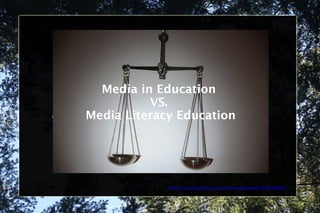
Media in Education vs. Media Literacy Education Media in Education  VS.  Media Literacy Education Image: http://www.flickr.com/photos/sepehrehsani/5766453552/
Media in Education Uses text, audiovisual and digital material to convey facts and information. Uses the content of materials for the same purposes for which it was originally intended – for instruction or entertainment. Images: www.office.com
Media Literacy Education The ability to access, analyze, evaluate and communicate messages in a wide variety of forms. Includes both receptive and productive dimensions. Encompasses critical analysis and communication skills (in relation to mass media, popular culture and digital media. Can be taught learned and applied in many contexts. http://online.education.ufl.edu/file.php/4197/05DigitalCitizen/CodeofBestPracticesinFairUse.pdf
Copyright and Fair Use Video Click Here Image: http://www.flickr.com/photos/shockinglytasty/5007461858/sizes/l/in/photostream/
Copyright Definition: “The legal right granted to an author, a composer, a playwright, a publisher, or a distributor to exclusive publication, production, sale, or distribution of a literary, musical, dramatic, or artistic work.”   http://www.edu-cyberpg.com/Teachers/copyrightlaw.html Doesn't specify how to apply fair use. Lawyers and judges decide whether use of copyrighted material is “fair” according to a “rule of reason.”  http://online.education.ufl.edu/file.php/4197/05DigitalCitizen/CodeofBestPracticesinFairUse.pdf
Fair Use Definition: Fair Use allows reproduction of copyrighted works for noncommercial purposes like “criticism, comment, news reporting, teaching, scholarship or research. Four Factors considered by judges The nature of the use The nature of the work used The extent of the use Its economic effect http://online.education.ufl.edu/file.php/4197/05DigitalCitizen/CodeofBestPracticesinFairUse.pdf
Fair Use  con't Two additional key questions that arise for judges: Did the unlicensed use “transform the material taken from the copyrighted work by using it for a different purpose than that of the original, or did it just repeat the work for the same intent and value as the original? Was the material taken appropriate in kind and amount, considering the nature of the copyrighted work and of the use? Yes to both questions usually results in a court finding a use fair. http://online.education.ufl.edu/file.php/4197/05DigitalCitizen/CodeofBestPracticesinFairUse.pdf
Five Current Principles in the Use of Copyrighted Materials Employing copyrighted material in media literacy lessons Employing copyrighted material in preparing curriculum materials Sharing media literacy curriculum materials Student use of copyrighted materials in their own academic and creative work Developing audiences for student work http://online.education.ufl.edu/file.php/4197/05DigitalCitizen/CodeofBestPracticesinFairUse.pdf
Principle One Employing Copyrighted Material in Media Literacy Lessons Description : Educators use various examples of media to build critical-thinking and communication skills Examples : Compare/contrast analysis, illustration of key points using media. Limitations : Educators should use materials relevant to educational goals or purposes, provide proper attribution and model citation practices http://online.education.ufl.edu/file.php/4197/05DigitalCitizen/CodeofBestPracticesinFairUse.pdf
Principle Two Employing Copyrighted Material in Preparing Curriculum Materials Description : Teacher use copyrighted materials to create lessons, materials, curricula to apply principles of media literacy education and use digital technologies in an educational setting. Examples : Educators integrate books, podcasts, videos, websites, etc. into curriculum materials designed for learning. Limitations : Educators should provide attribution for copyrighted materials and use only necessary materials that meet professional standards for curriculum development. http://online.education.ufl.edu/file.php/4197/05DigitalCitizen/CodeofBestPracticesinFairUse.pdf
Principle Three Sharing Media Literacy Curriculum Materials Description : Educators informally share media literacy curriculum materials from mass media and popular culture through professional development, at educational conferences and by electronic means. Examples : Educators sharing lessons and resource materials with one another. Limitations:  Educators should only use materials relevant to educational goals or purposes. They should provide proper attribution and for promotion of materials using third-party images, developers should complete the permissions process. http://online.education.ufl.edu/file.php/4197/05DigitalCitizen/CodeofBestPracticesinFairUse.pdf
Principle Four Student Use of Copyrighted Materials in Their Own Academic and Creative Work Description : Students learn to include copyrighted materials in their own creative works. Examples:  Students should be allowed to incorporate, modify, and re-present existing media in their own work. Media production, critiques, illustration of ideas/concepts. Limitations:  Use of copyrighted material shouldn't be a substitute for creative effort. Students should understand and demonstrate how their use of copyrighted work transforms the original work and should be reminded that attribution, in itself, doesn't convert infringing use into fair  use. http://online.education.ufl.edu/file.php/4197/05DigitalCitizen/CodeofBestPracticesinFairUse.pdf
Principle Five Developing Audiences for Student Work Description : Students have the opportunity to distribute and share their work with other individuals. Examples : Students' assignments are shared through the Internet by blogging or use of websites. Limitations:  Students should use materials relevant to educational goals or purposes and provide proper attribution. Educators should model the real-world permissions process and explore the differences between materials that should be licensed, material that's public domain and copyrighted material subject to fair use. http://online.education.ufl.edu/file.php/4197/05DigitalCitizen/CodeofBestPracticesinFairUse.pdf
General Points About Principles The principles: Apply to ALL forms of media. Apply in institutional settings  and  to non-school based programs. Concern the unlicensed fair use of copyrighted materials for education, not the way those materials were acquired. Are all subject to a “rule of proportionality.” http://online.education.ufl.edu/file.php/4197/05DigitalCitizen/CodeofBestPracticesinFairUse.pdf
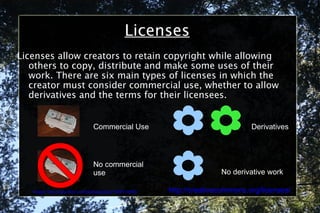
Licenses Licenses allow creators to retain copyright while allowing others to copy, distribute and make some uses of their work. There are six main types of licenses in which the creator must consider commercial use, whether to allow derivatives and the terms for their licensees. Commercial Use No commercial use Derivatives No derivative work Image: http://www.flickr.com/photos/jollyuk/1989719848/ http://creativecommons.org/licenses/
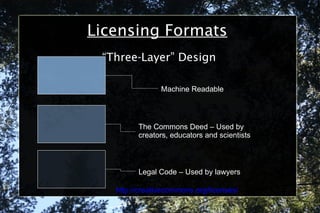
Licensing Formats “ Three-Layer” Design Legal Code – Used by lawyers The Commons Deed – Used by creators, educators and scientists Machine Readable http://creativecommons.org/licenses/
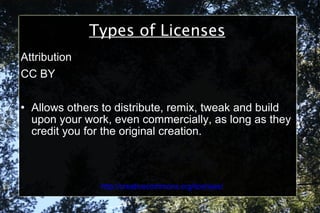
Types of Licenses Attribution CC BY Allows others to distribute, remix, tweak and build upon your work, even commercially, as long as they credit you for the original creation. http://creativecommons.org/licenses/
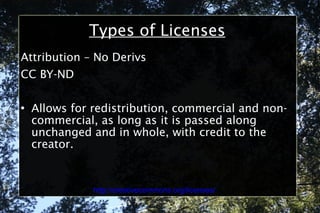
Types of Licenses Attribution – No Derivs CC BY-ND Allows for redistribution, commercial and non-commercial, as long as it is passed along unchanged and in whole, with credit to the creator. http://creativecommons.org/licenses/
Types of Licenses Attribution- NonCommercial- ShareAlike CC BY-NC-SA Allows others to remix, tweak, and build upon your work non-commercially, as long as they credit you and license their new creations under the identical terms. http://creativecommons.org/licenses/
Types of Licenses Attribution- ShareAlike CC BY-SA Allows others to remix, tweak and build upon your work even for commercial purposes, as long as they credit you and license their new creations under the identical terms. http://creativecommons.org/licenses/
Types of Licenses Attribution – NonCommercial CC BY-NC Allows other to remix, tweak and build upon your work non-commercially, and although their new works must also acknowledge you and be non-commercial, they don't have to license their derivative works on the same terms. http://creativecommons.org/licenses/
Types of Licenses Attribution- NonCommercial- No Derivs CC BY-NC-ND Allows other to download your works and share them with others as long as they credit you, but they can't change them in any way or use them commercially. http://creativecommons.org/licenses/

Waddell Educational Copyright and Fair Use

  • 1.
    Code of BestPractices in Fair Use for Media Literacy Education By: Jamia Waddell
  • 2.
    Media in Educationvs. Media Literacy Education Media in Education VS. Media Literacy Education Image: http://www.flickr.com/photos/sepehrehsani/5766453552/
  • 3.
    Media in EducationUses text, audiovisual and digital material to convey facts and information. Uses the content of materials for the same purposes for which it was originally intended – for instruction or entertainment. Images: www.office.com
  • 4.
    Media Literacy EducationThe ability to access, analyze, evaluate and communicate messages in a wide variety of forms. Includes both receptive and productive dimensions. Encompasses critical analysis and communication skills (in relation to mass media, popular culture and digital media. Can be taught learned and applied in many contexts. http://online.education.ufl.edu/file.php/4197/05DigitalCitizen/CodeofBestPracticesinFairUse.pdf
  • 5.
    Copyright and FairUse Video Click Here Image: http://www.flickr.com/photos/shockinglytasty/5007461858/sizes/l/in/photostream/
  • 6.
    Copyright Definition: “Thelegal right granted to an author, a composer, a playwright, a publisher, or a distributor to exclusive publication, production, sale, or distribution of a literary, musical, dramatic, or artistic work.” http://www.edu-cyberpg.com/Teachers/copyrightlaw.html Doesn't specify how to apply fair use. Lawyers and judges decide whether use of copyrighted material is “fair” according to a “rule of reason.” http://online.education.ufl.edu/file.php/4197/05DigitalCitizen/CodeofBestPracticesinFairUse.pdf
  • 7.
    Fair Use Definition:Fair Use allows reproduction of copyrighted works for noncommercial purposes like “criticism, comment, news reporting, teaching, scholarship or research. Four Factors considered by judges The nature of the use The nature of the work used The extent of the use Its economic effect http://online.education.ufl.edu/file.php/4197/05DigitalCitizen/CodeofBestPracticesinFairUse.pdf
  • 8.
    Fair Use con't Two additional key questions that arise for judges: Did the unlicensed use “transform the material taken from the copyrighted work by using it for a different purpose than that of the original, or did it just repeat the work for the same intent and value as the original? Was the material taken appropriate in kind and amount, considering the nature of the copyrighted work and of the use? Yes to both questions usually results in a court finding a use fair. http://online.education.ufl.edu/file.php/4197/05DigitalCitizen/CodeofBestPracticesinFairUse.pdf
  • 9.
    Five Current Principlesin the Use of Copyrighted Materials Employing copyrighted material in media literacy lessons Employing copyrighted material in preparing curriculum materials Sharing media literacy curriculum materials Student use of copyrighted materials in their own academic and creative work Developing audiences for student work http://online.education.ufl.edu/file.php/4197/05DigitalCitizen/CodeofBestPracticesinFairUse.pdf
  • 10.
    Principle One EmployingCopyrighted Material in Media Literacy Lessons Description : Educators use various examples of media to build critical-thinking and communication skills Examples : Compare/contrast analysis, illustration of key points using media. Limitations : Educators should use materials relevant to educational goals or purposes, provide proper attribution and model citation practices http://online.education.ufl.edu/file.php/4197/05DigitalCitizen/CodeofBestPracticesinFairUse.pdf
  • 11.
    Principle Two EmployingCopyrighted Material in Preparing Curriculum Materials Description : Teacher use copyrighted materials to create lessons, materials, curricula to apply principles of media literacy education and use digital technologies in an educational setting. Examples : Educators integrate books, podcasts, videos, websites, etc. into curriculum materials designed for learning. Limitations : Educators should provide attribution for copyrighted materials and use only necessary materials that meet professional standards for curriculum development. http://online.education.ufl.edu/file.php/4197/05DigitalCitizen/CodeofBestPracticesinFairUse.pdf
  • 12.
    Principle Three SharingMedia Literacy Curriculum Materials Description : Educators informally share media literacy curriculum materials from mass media and popular culture through professional development, at educational conferences and by electronic means. Examples : Educators sharing lessons and resource materials with one another. Limitations: Educators should only use materials relevant to educational goals or purposes. They should provide proper attribution and for promotion of materials using third-party images, developers should complete the permissions process. http://online.education.ufl.edu/file.php/4197/05DigitalCitizen/CodeofBestPracticesinFairUse.pdf
  • 13.
    Principle Four StudentUse of Copyrighted Materials in Their Own Academic and Creative Work Description : Students learn to include copyrighted materials in their own creative works. Examples: Students should be allowed to incorporate, modify, and re-present existing media in their own work. Media production, critiques, illustration of ideas/concepts. Limitations: Use of copyrighted material shouldn't be a substitute for creative effort. Students should understand and demonstrate how their use of copyrighted work transforms the original work and should be reminded that attribution, in itself, doesn't convert infringing use into fair use. http://online.education.ufl.edu/file.php/4197/05DigitalCitizen/CodeofBestPracticesinFairUse.pdf
  • 14.
    Principle Five DevelopingAudiences for Student Work Description : Students have the opportunity to distribute and share their work with other individuals. Examples : Students' assignments are shared through the Internet by blogging or use of websites. Limitations: Students should use materials relevant to educational goals or purposes and provide proper attribution. Educators should model the real-world permissions process and explore the differences between materials that should be licensed, material that's public domain and copyrighted material subject to fair use. http://online.education.ufl.edu/file.php/4197/05DigitalCitizen/CodeofBestPracticesinFairUse.pdf
  • 15.
    General Points AboutPrinciples The principles: Apply to ALL forms of media. Apply in institutional settings and to non-school based programs. Concern the unlicensed fair use of copyrighted materials for education, not the way those materials were acquired. Are all subject to a “rule of proportionality.” http://online.education.ufl.edu/file.php/4197/05DigitalCitizen/CodeofBestPracticesinFairUse.pdf
  • 16.
    Licenses Licenses allowcreators to retain copyright while allowing others to copy, distribute and make some uses of their work. There are six main types of licenses in which the creator must consider commercial use, whether to allow derivatives and the terms for their licensees. Commercial Use No commercial use Derivatives No derivative work Image: http://www.flickr.com/photos/jollyuk/1989719848/ http://creativecommons.org/licenses/
  • 17.
    Licensing Formats “Three-Layer” Design Legal Code – Used by lawyers The Commons Deed – Used by creators, educators and scientists Machine Readable http://creativecommons.org/licenses/
  • 18.
    Types of LicensesAttribution CC BY Allows others to distribute, remix, tweak and build upon your work, even commercially, as long as they credit you for the original creation. http://creativecommons.org/licenses/
  • 19.
    Types of LicensesAttribution – No Derivs CC BY-ND Allows for redistribution, commercial and non-commercial, as long as it is passed along unchanged and in whole, with credit to the creator. http://creativecommons.org/licenses/
  • 20.
    Types of LicensesAttribution- NonCommercial- ShareAlike CC BY-NC-SA Allows others to remix, tweak, and build upon your work non-commercially, as long as they credit you and license their new creations under the identical terms. http://creativecommons.org/licenses/
  • 21.
    Types of LicensesAttribution- ShareAlike CC BY-SA Allows others to remix, tweak and build upon your work even for commercial purposes, as long as they credit you and license their new creations under the identical terms. http://creativecommons.org/licenses/
  • 22.
    Types of LicensesAttribution – NonCommercial CC BY-NC Allows other to remix, tweak and build upon your work non-commercially, and although their new works must also acknowledge you and be non-commercial, they don't have to license their derivative works on the same terms. http://creativecommons.org/licenses/
  • 23.
    Types of LicensesAttribution- NonCommercial- No Derivs CC BY-NC-ND Allows other to download your works and share them with others as long as they credit you, but they can't change them in any way or use them commercially. http://creativecommons.org/licenses/